




Abstract
To capture the complexity of the social world, researchers sometimes must color outside the lines, or break the mold of orthodox methods to bring under-examined phenomena into view. Queer nightlife is a case in point. It often takes forms that are fleeting, in flux, and which thus can seem empirically elusive. We argue that this complexity need not prompt methodological nihilism; it instead can serve as a catalyst for devising new approaches for research. In this spirit, we revisit two core questions. First: What counts as evidence? We propose that ethnography attuned to ephemerality enriches inferences about nightlife without reducing it to numerical trends. Second: How do we study change? We introduce a palimpsestic approach that equips researchers to examine the historical dynamism of nightlife. In our discussion of each question, we suggest that what appears as a chaotic, messy, and evasive object of study can in fact be rigorously characterized if we creatively recalibrate our methods. Across both sections, we offer methodological invitations from the study of queer nightlife which may prove broadly useful to researchers interested in ephemeral or changing social worlds.
Introduction
Queer theorists have made an impressive set of interventions into gender and sexuality studies over the past decades, reshaping the concepts we use and the questions we ask. In parallel, proponents of queer methods (Ghaziani and Brim 2019a; Love et al. 2012) have made significant strides in overcoming a “suspicion of method” in the humanities while defying “physics envy” in the social sciences (Brim and Ghaziani 2016:16). Still, conjoining “queer theory” and “method” is a risky proposition, with close readings (Coviello 2013), deconstruction (Freeman 2010; Sedgwick 1990), and performativity (Butler 1990) characterizing the former while methods can emphasize fixity, quantification, and mutually exclusive categories. In short, the notion of a theory feels more flexible and fluid, expansive ideas untethered by disciplinary boundaries, while methods evoke narrower, discipline-specific practices.
The conundrum is particularly acute for sociologists, who insist that science has a method (Compton, Meadow, and Schilt 2018). The textbook version begins with a theory from which researchers deduce falsifiable hypotheses based on systematically collected and analyzed evidence. This approach avoids “everything messy and chaotic about scientific inquiry” (Clarke and Primo 2012). Yet those “untidy” (Love 2019:28) and “unfixed” (Ahmed 2016:490) spaces of sexual desires, fantasies, identities, behaviors, and bodies are precisely where queer inquiry thrives. While the traditional scientific method champions order, queer methods recognize disorder as generative. In this article, we detail two ways of coloring outside the lines of conventional methodological approaches by reimagining what counts as evidence and re-envisioning how to study social change. These two themes, which emerge from our work on nightlife, illuminate how queer methods can leverage the analytic possibilities that gender and sexuality offer as sites of knowledge production.
What Counts as Evidence?
Gay bars, described as “the single most important public manifestation” (Kennedy and Davis 1993:80) of LGBTQ lives, are also the most visible form of queer nightlife (Armstrong 2002; Brody 2024; Mattson 2023). While estimating their numbers can be challenging, recent research suggests global declines. During the first two decades of the 2000s, the number of gay bars in London, an international hub of finance and culture, fell from 125 to 53, a 58% decrease (Campkin and Marshall 2017). Over the same time period, there was a 41% decrease overall in the United States (Mattson 2019), with more pronounced downward trends for bars that cater to lesbians and people of color (Figure 1).
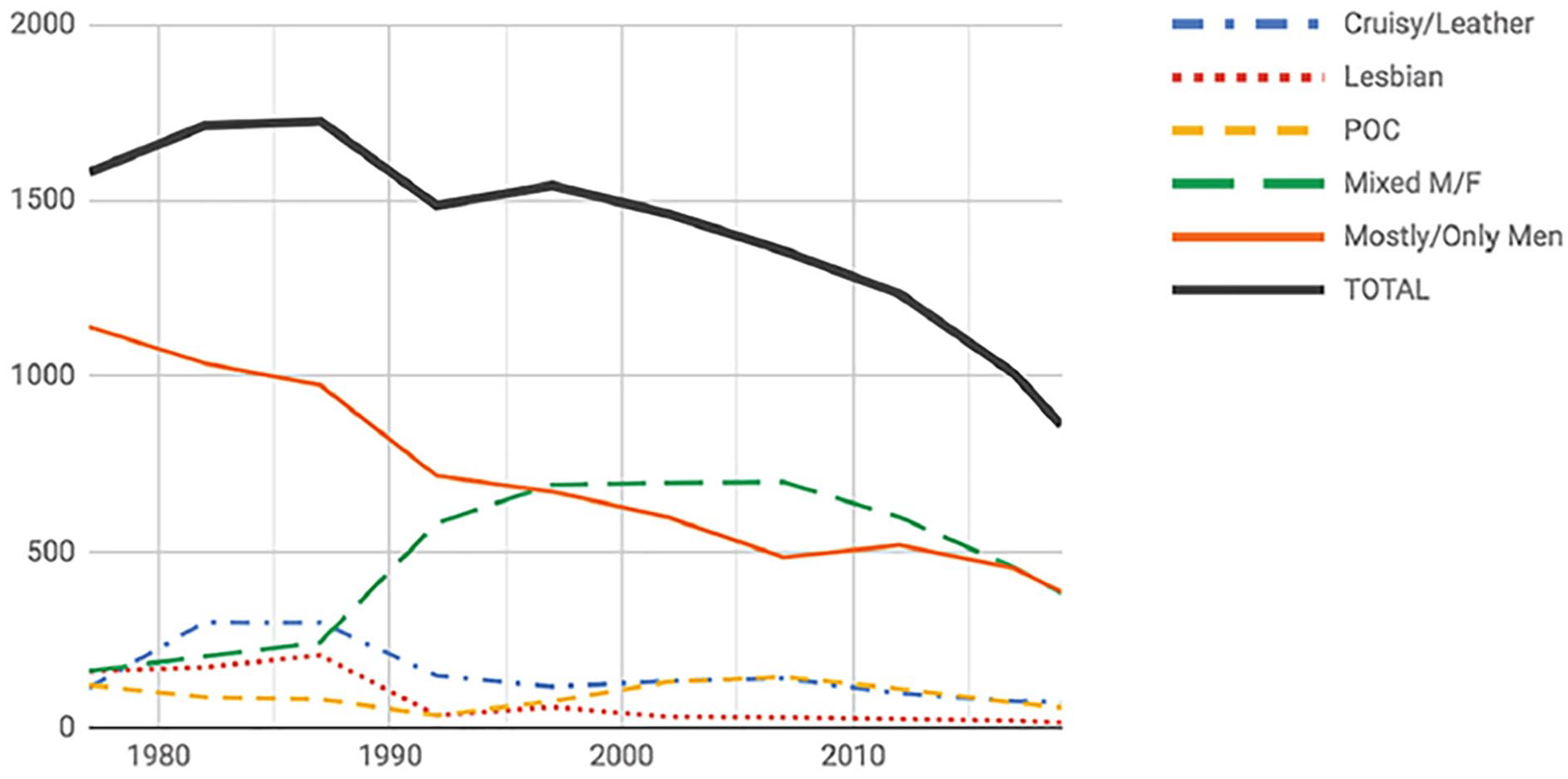
U.S. Gay Bars Over Time.
Yet much is missed by these quantitative estimates. While gay bars predominate as privileged cases (Krause 2024) and have been carefully enumerated, other less visible and harder-to-quantify organizational forms are often occluded, amounting to “neglected cases” (p. 251) in the study of queer nightlife. As we will discuss, a more complex and vibrant image of queer nightlife comes into view when we expand our frameworks beyond just counting to think more capaciously about what counts as evidence.
Instead of being available as stable and quantifiable data, queerness operates as “fleeting moments” (Muñoz 1996:6) of interaction, often in places removed from the mainstream gaze. For Muñoz (1996), ephemera is a form of evidence that exists as the “residue” (p. 10) of quickly-passing events and intimacies. Inspired by his line of thinking, we invite researchers to recalibrate measurement to study not ephemera, which is what concerns Muñoz, but ephemeral nightlife forms.
Embrace Reflexivity
Counting is parsimonious, but parsimony does not always dovetail with validity. The common approach of tallying listings of gay bars in newspapers, business directories, and travel guides like Damron and Time Out (Knopp and Brown 2021; Mattson 2019) can result in selection effects: Counting bars will offer conclusions about only those venues while leaving unexamined other nightlife forms that are harder to track, like queer parties (Adeyemi 2022). Quantification enriches our evidence base, but it can also mislead us if prioritized exclusively over other ways of knowing. When done unreflexively or in isolation from other forms of inquiry, counting practices can distort knowledge about nightlife by overlooking its less visible segments. We thus heed the cautionary notes of queer methodologists who have described “fetishizing of the observable” (Brim and Ghaziani 2016:16) and “forcing queer subjects into tick boxes” (Doan 2016:89) as research practices that can obscure more than they clarify. The methodological question then shifts from “how do we count?” to “ought we count?” (Brim and Ghaziani 2021:153).
The answer to that question may be yes, but especially for those who study ephemeral social worlds, other research strategies are also needed. Notable examples of studies that resist an orthodoxy of counting include Rodríguez’s (2014) reimagining of the archive as ephemeral, consisting of gestures and longings; Allen’s (2011) reading of Black Cuban self-making in erotic terms; and Simpson’s (2014) ethnography of the Mohawks of Kahnawake and their struggle for sovereignty. Drawing on Black feminism, queer of color critique, and epistemologies of Indigenous peoples, these and other works center embodied knowledge (Jones 2025), self-determination (Smith 2021), and relational practices (Morgensen 2015) as they embrace reflexivity to devise new research practices and possibilities.
Reimagine Evidence
Following the ethnographic tradition in sociology, we can immerse ourselves in and examine, rather than control away, the messy realities of social life. In so doing, we may uncover unexpected evidence. Consider the following scene from Ghaziani’s fieldnotes, where he describes a club night, the name for underground parties in London:
Today, an insider with deep familiarity about local nightlife scenes took me to an unadvertised event that, I was told, would feature Bollywood imagery and fuse Bollywood music with hip-hop as a reflection of the South Asian diasporic experience. I felt this vibe as soon as I walked into the space, a cavernous room located an hour’s train ride from the city center in an ungentrified area of warehouses, where one building looked to my uninitiated eyes as indistinguishable from the next. The room was about the size of a high school gym. Projected on a bare white wall in front of the DJ booth were clips of iconic Bollywood videos: Devdas, Kuch Kuch Hota Hai, and Khabhi Kushi Kabhie Gham pulsated on a dancefloor packed with hundreds of people. The place felt less gay and more queer to me, a compositional and tonal shift fitting for a party called Hungama, an Urdu word which loosely translates to a celebratory chaos or commotion. Bindis and saris were decoupled from binary gender norms, creating a kaleidoscopic rendering of nightlife as a fluid space freed from fixed categories. Ryan Lanji is the founder of Hungama, and he was also a DJ that night. Two hours into his set, he took a break and joined me on the dancefloor. As we danced, I took note of how seamlessly Ryan switched between singing Bollywood songs and debating theories of diaspora. The South Asian diaspora is like “mercury,” Ryan said. “We’re shape shifters, and so at moments we can become quite Black-oriented, or we can become quite queer, or we can become quite straight, or we can become quite white.” After he said this, I looked around to see if I can observe this “mercurial” culture. As my eyes returned to his, Ryan told me that the audience at Hungama looks like a “color wheel.” Hungama is part of an “explosive underground scene,” as Vogue India describes it, a “nightlife movement that queer, trans, Black, Indigenous, and people of color, or QTBIPOC individuals, can claim as their own.” These parties are called club nights. Unlike gay bars, which are fixed in particular parts of the city, like an entertainment district or a gayborhood, club nights are themselves mercurial—events that occur only occasionally throughout the year, often moving from one place to the next.
The contrast between declining bar districts and the bustling scene at Hungama is stark. We cannot study these different nightlife forms using the same techniques since knowledge is a function of methodology: What we know depends on how we know. Club nights do not have countable listings. Because queer parties like these thrive on secrecy, access requires “specialized” (moore 2016:61) insights that come from ethnographic immersion. Participatory approaches that are local, embodied, and relational can provide access to knowledge “transmitted covertly” (Muñoz 1996:6) among participants, enabling the study of social worlds that are spatially fluid though still specific (Bathelt, Malmberg, and Maskell 2004), like what Ghaziani witnessed in the warehouse.
An inventive spirit is flourishing in event-based nightlife scenes around the world, including in Bangalore (Khubchandani 2020), Chicago (Adeyemi 2022), and Shanghai (Farrer and Field 2015), where queer artists, audiophiles, and creatives are ensuring that nightlife remains vital and vibrant in ephemeral forms. Stillwagon and Ghaziani (2019) call them “popups,” arguing that these gatherings are often designed for groups who feel excluded from gay bars. Examples are numerous, from drag parties at speakeasies during American prohibition in the 1920s and 1930s (Bullock 2017) to rent parties that Black lesbians organized in the 1940s and 1950s (Thorpe 1996), from Detroit’s ballroom scene (Bailey 2013) to queer techno parties in Berlin (Andersson 2022). The success of these scenes offers a cautionary tale against making overgeneralized claims about nightlife based only on evidence about gay bars.
Club nights evade counting. While the challenges associated with studying them numerically might constrain our ability to track their development, it also presents an opportunity to conceptualize disorder as generative. A methodological embrace of empirical messiness pushes us to devise research protocols and procedures that serve “to grow, rather than codify, possibilities for how to be in the world” (Schilt, Meadow, and Compton 2018:5).
Seek Synergies
The ethnographic study of ephemeral forms is one way, but not the only way, to capture overlooked phenomena. Queer and feminist researchers also count, including in ways that creatively recalibrate orthodox approaches (e.g., Budnick, Pao, and Velasco 2025; Grzanka 2025). We thus advise against seeing different forms of evidence as incompatible since researchers from diverse traditions are often involved in similar pursuits. How can we work together to study nightlife and other social forms that are episodic and ephemeral? The feminist scholar Haraway (1988:590) offers useful guidance: “The only way to find a larger vision is to be somewhere in particular.” For Haraway, that larger vision comes from “the joining of partial views.” There are many ways of doing this, such as triangulating count data with qualitative evidence generated by participant observation. This approach allows ethnographic accounts and quantitative figures—the messy and the orderly—to co-occur, co-exist, and complement one another.
Another strategy is to identify synergies across fields. For instance, attention to embodied knowledge in queer and feminist theory aligns with sociological approaches like Bourdieu’s (1977, 1986) examination of habitus and capital as embodied or Erving Goffman’s (1956) attention to the performative presentation of the self, each of which theorizes ways of feeling, perceiving, and moving. Several researchers are reconceptualizing both creativity and creative labor as “deeply enmeshed in webs of relational interdependencies” (Wigen 2024:3). Such broadly relational approaches (Zelizer 2012) examine the practices people use to experience community and belonging. Alacovska et al. (2024) find that people manage precarity, like the current-day closures of gay bars, by cultivating new forms of relational rights. The concept draws on Afro-communitarian ethics and decolonial critiques to emphasize alternative forms of evidence, like the specialized knowledge required to access club nights.
Our idiom of coloring outside the lines captures a crucial message about evidence: To validly account for the complexity of the social world, researchers sometimes need to break the mold of orthodox methods to bring empirical dynamics that are less accounted for, such as ephemeral nightlife forms, into view. As outlined in this section, we propose that researchers will be better equipped to do this if they are reflexive about what counts as evidence; if they embrace local, embodied, and relational knowledges; and if they seek synergies across traditions of inquiry.
How Do We Study Change?
Queer nightlife is changing. Whether a decline in the number of gay bars (Mattson 2019), the increasing popularity of roving parties (Ghaziani 2024), or the mainstreaming of bar districts (Orne 2017), sociologists have described significant shifts. Some changes presage decline, while others imply evolution—or something else entirely. Missing is a synthetic approach that integrates multiple types and trajectories of change while accounting for their interconnections. We introduce the palimpsest as a sensitizing concept (Blumer 1954) that can do just that (see also Ochoa 2025).
A palimpsest is a parchment that is used again and again, accumulating layers of writing over time. Partial effacement of older layers makes room for the new, yet older layers remain visible. We can extend this concept to study changes in queer nightlife. Rather than undergoing an unmitigated process of creative destruction (Schumpeter 1962)—out with the old, in with the new—changing scenes are palimpsestic because they provide space to create anew while retaining imprints of the past. This conceptualization invites researchers to ask three complimentary questions: Which older layers remain retrievable? What new layers are being actively composed? And how are the layers of the palimpsest interacting?
Cultural Retention: Which Layers Remain Retrievable?
Although queer nightlife is perennially changing, a palimpsestic approach predicts that older aspects of group life will persist over time, thus inviting researchers to examine processes of cultural retention. Collective memory scholar Huyssen (2003) has written in a similar vein about urban palimpsests, showing how older layers of history remain visible in the built environment of contemporary cities. We extend the logic by observing that many gay bars resemble “museums of ephemera” (Mattson 2023:300) with posters from bygone bars or other tributes on the walls. Long-standing bars are often perceived by patrons as commemorative places where people can step into and immediately connect with community history. Just as annual pride parades carry forward in time the memory of the 1969 Stonewall riots (Armstrong and Crage 2006), so too does queer nightlife provide a place where people maintain knowledge of the past.
Queer nightlife is a realm where accumulated cultural know-how is kept alive. It provides places where “lessons of the night” (Orne 2017:10) are passed on to newcomers, including via cross-generational relationships and mentorship (Van Doorn 2016). A palimpsestic approach encourages researchers to study such processes of cultural retention. What aspects of the past remain retrievable (e.g., Schudson 1989)? Why do those persist over others that are obscured, effaced, or forgotten (e.g., Castiglia and Reed 2011; Delany 1999; Schulman 2013)? We can study how actors sustain temporal ties between the past, present, and future of nightlife scenes or, stated differently, how those actors forge queer temporalities (Freeman 2010; Halberstam 2005). This requires researchers to examine how the past persists into the present, and also, as we discuss next, to adopt a “forward-dawning” (Muñoz 2009) epistemology attuned to how people actively compose “new worlds” (p. 1).
Cultural Elaboration: Which Layers Are Being Actively Composed?
A palimpsest carries traces of the past and also facilitates fresh expression. Analogously, queer nightlife holds layers of history and also has a yet-to-be-written future. Attuned to this open-endedness, our approach encourages researchers to trace continued cultural elaboration: How are people reimagining and recrafting what nightlife can be?
Nightlife has long been a place of queer worldmaking (Adeyemi, Khubchandani, and Rivera-Servera 2021; Buckland 2002). More than fifty years ago, ethnographers observed that gay bars were “permissive and protective” settings (Achilles 1967:175; Hooker 1961) where sexual and gender expressions generally seen as nonnormative were instead customary. Within this enabling milieu, a plurality of bar cultures (Hilderbrand 2023) and “specialized erotic worlds” (Green 2008:29) blossomed—from lesbian bars to leather bars—each with its own sensibilities, styles, hierarchies, and carefully crafted spaces. Queer nightlife thus represents a multidecade and multigenerational field of cultural production and participation (Bourdieu 1993; Ghaziani 2025). Like any field, it is subject to reformulation, as its rules are continually renegotiated, contested, and elaborated.
Attuned to such reformulation, a palimpsestic approach encourages researchers to study how people lay claim to nightlife, use it as a medium for expression, and transform it in the process, including by adapting it to new historical circumstances. Queer people of color claim and recraft nightlife in precisely this way to enact alternatives to the white mainstream via the cultural work of placemaking (Greene 2022; Hunter et al. 2016; Lane 2015; Rosenberg 2021; Thorpe 1996) and through performance art (moore 2016, 2018), including drag (Khubchandani 2023; McCormack and Wignall 2022) and ballroom (Bailey 2013). Moreover, queer scenes are also adapting to the digital age (Wignall 2022). Some even migrated online during the COVID-19 pandemic to continue gathering when in-person venues were closed (Ochoa 2025). The palimpsest metaphor sensitizes researchers to trace these and other reformulations, some of which replicate earlier scenes while others renew the field of nightlife without simply recreating earlier forms (Ghaziani and Abrutyn 2024).
Cultural Superimposition: How Do the Layers Interact?
A palimpsest has a temporal thickness in which newer layers superimpose upon, yet do not fully eclipse, older ones. The concept thus prompts us to consider how newer and older cultural layers interlink and interact, including how creative emergence builds upon or is in tension with antecedent realities. What synergies and tensions exist across earlier and emergent forms of queer nightlife?
Regarding synergies, we propose that older layers serve as a resource for the creation of newer elements, which is to say that cultural retention enables cultural elaboration. An example comes from “place reactivation” (Greene 2024:7), incidents of historically significant meeting grounds springing to life after periods of abeyance (Taylor 1989) when communities need to congregate, such as when LGBTQ people flocked to the Stonewall Inn in New York or DuPont Circle in Washington, D.C. to mourn in the wake of the Pulse nightclub shooting. In a similar vein, Ochoa (2025) demonstrates how Touché, a gay leather bar in Chicago, became a site of community health mobilization against the 2022 mpox outbreak 1 in ways that drew upon a long history of bar-based community responses to the HIV/AIDS crisis. In other cases, contemporary usage of the queer past takes the form of “critical nostalgia” (Brown-Saracino 2021), such as when commemorators of “lost dyke bars” (Brown-Saracino 2021) intentionally remember bygone spaces yet disidentify (Muñoz 1999) with lesbian identity politics (Pfeffer 2014), forging new forms of collectivity in the process.
Regarding tensions, newer layers of the palimpsest are not always in harmony with older ones. Temporal frictions occur alongside synergies, as layers impinge or compete for the same space. For instance, scholars have described queer generational divides, including how styles, outlooks, and political sensibilities of younger cohorts can clash with older groups (Plummer 2010; see also Parham 2017 who applies the palimpsest analytic to examine tensions between older and newer racial systems). People battle over which aspects of the queer past are to be embraced and carried forward, and which others should be renounced. Consider the following ethnographic vignette based on Ochoa’s fieldwork studying Chicago’s leather and kink scene:
Touché’s 45th anniversary in November 2022 was supposed to be a celebratory occasion, a commemoration of its long history as Chicago’s oldest operating leather bar. Business was returning to some semblance of normal after the worst of the COVID-19 pandemic. The bar was well-regarded in Chicago, having hosted several widely attended vaccination campaigns to help curb the mpox outbreak a few months earlier. Touché was a symbol of community resiliency, but it was about to transform into a battleground of community division. Touché had brought back one of its “old acts” in the spirit of the anniversary event: a ventriloquist named Jerry Holiday. “Everyone in the crowd thinks this is weird for 2022,” an audience member at the event can be heard confronting the puppeteer, in a video recording which later circulated widely on Twitter/X. The puppet on stage was a racialized and sexualized caricature of a Black woman ventriloquized by the white puppeteer who, all the while, spoke in a “blaccent” and evoked various racist tropes unabashedly. In addition to the audience member who confronted the puppeteer, a bartender quit mid-shift in protest, and some attendees departed mid-show; yet others clapped, laughed along, and participated in the spectacle which continued to completion. “We thought it would be fun to bring an entertainer from the past,” said the owner of Touché in apologetic statements to the press, “but apparently his material has not changed with the ages. . .Hopefully people will look at the 45-year history of the establishment over a 45-minute tasteless performance.” News outlets and Chicago’s broader leather and kink community swiftly condemned the puppet show as racist over the following days, and the particular act was ultimately “retired” by the puppeteer. Yet the impacts of the performance were lasting. In its aftermath, various leather and kink groups disaffiliated from Touché, moving their monthly “bar nights” elsewhere, including groups like ONYX (a leather club for men of color) and the Women, Transgender, and Nonbinary Leather Social, both of whom had called Touché their “home bar” for years. Six months later, as I began fieldwork in Chicago’s kink scene, the puppet show still loomed large. There were whisperings of a boycott against Touché and interviewees informed me of rumors that the bar might be sold, perhaps even permanently closed. “Do we stop going to Touché for all time?” an interviewee wondered aloud, worried that not patronizing the bar could hasten its rumored demise. In an interview nearly a year after the anniversary event, Touché’s longtime manager recalled the sense of community unity that he felt during the bar and the leather community’s response to HIV/AIDS over the years, and more recently to mpox. He then contrasted it with the “chasm” caused by the puppet show: “This other issue? I don’t know. I don’t know if we can come together or not.”
A palimpsestic approach examines how chasms, or synergies, form across past, present, and future layers of queer nightlife. The metaphor sensitizes researchers to see how the past can serve as a resource or as a burden, including how unresolved histories, like racism, can haunt and disrupt existing scenes. Above all, a palimpsestic view brings the historical dynamism of nightlife into clearer view, including the persistence of older layers, the emergence of newer ones, and their complex interrelations.
Conclusions
Queer social forms are at once ephemeral and enduring. The methodological invitations we offered in this article equip researchers to study these twin timescales: the passing moment and the longer durée. By examining a more diverse array of evidence about nightlife forms, especially event-based scenes that are not always easily quantifiable, and by integrating a palimpsestic approach into our work, we can empirically elucidate the spatial and temporal organization of collective identities and cultures.
Our invitations echo the broad goals of queer methods to outline worldmaking efforts in ways that “clarify, but do not overdetermine, the conditions that make life livable” (Ghaziani and Brim 2019b:19). This pursuit often requires researchers to color outside the lines of methodological orthodoxy in order to produce more variable and valid characterizations. More generally, we hope to convey that researchers can queer the heuristics of sociological knowledge production (Riley, Ahmed, and Emigh 2021) whenever established approaches obscure more than they clarify. Such instances of incongruity offer generative opportunities to design ever-queerer methods which elucidate, rather than elide, the social complexity of queer worlds.
