




Abstract
This paper draws on the first comprehensive study of Two Spirit, trans, nonbinary, and gender-nonconforming (2STNBGN) people in Saskatchewan. Despite challenges, including rising conservatism and targeted political attacks, we temper assumptions that trans and queer people want to leave Saskatchewan for other locations where the 2STNBGN community is assumed to be bigger. Many of our participants described choosing to stay in the province as an intentional way to build community, advocate for support, and cultivate belonging. We further explore a distinctly prairie politic that includes Two Spirit and Indigiqueer projects of belonging to land and community, cross-provincial trans community organizing, and a complicated geography that supersedes binaries between urban and rural. Our research tells us that gender-diverse people on the prairies are enacted through a “grounded relationality,” a context-dependent, binary-resistant expression through place, whether that place is land, city, country, or small-town paint store. Ultimately, our research shows that despite an increasingly chilly political climate toward 2STNBGN people, Saskatchewan still bears witness to trans joy, innovative activism, and an activated trans community that is invested in a future that they are a part of.
Plain Language Summary
This research is unique in its discussion of Two Spirit, trans, nonbinary, and gender-nonconforming (2STNBGN) people in the Canadian province of Saskatchewan. We talk about the ways that people on the prairies, especially Two Spirit and Indigiqueer folks, feel connected to the land and their community and further that gender-diverse people express and understand themselves in ways that aren’t tied to strict divisions between urban and rural or gender and sexuality. Even though the political climate in Saskatchewan isn’t always welcoming to gender-diverse people, our research found that there’s still a lot of happiness and activism in the trans community here. They’re working toward a future where they feel included and valued. Many of the people we talked to actually choose to stay in Saskatchewan on purpose to build community and push for social change.
Keywords
We should be spreading happiness, we should be spreading joy, we should be spreading queer, trans joy. You know, even if you’re in a small conservative town, you can still leave a rock that’s painted like a rainbow on a church doorstep. (Interview #6)
Saskatchewan, with a population just over a million, faces limited healthcare access for gender-affirming surgeries, sparse provincial funding for any Two Spirit, lesbian, gay, bisexual, trans, and queer (2SLGBTQ+) 1 initiatives, and a longstanding conservative government with a history of anti-queer Members of Legislative Assembly and policies. In fact, the premier has recently implemented a “Parent’s Bill of Rights” requiring parental consent for any changes to names, pronouns, or gender identity in schools for students under the age of 16 years (Postey 2023; Warick 2023). The policy follows a similar attempt in New Brunswick and has been heavily criticized by progressives in the province (Mundie 2023). Because the policy breaches protections of gender identity and expression and the rights of children and youth outlined in the Canadian Charter of Rights and Freedoms, a judge granted an injunction that allowed more time for the implications of the “Parental Bill of Rights” policy to be understood. However, Premier Scott Moe invoked Section 33 of the Charter, allowing provinces to contravene charter and human rights through a “notwithstanding” clause (UR Pride Centre for Sexuality and Gender Diversity v Saskatchewan [Education] 2024). On October 20, 2023, this clause took effect, cementing the “Parent’s Bill of Rights” into Law in Saskatchewan (also coined the “anti-trans” bill) and further polarizing the province around 2SLGBTQ+ communities more broadly.
As a Two Spirit, trans, nonbinary, and queer research group situated on the prairies, we are deeply concerned with the developing chilly climate in Saskatchewan. Having grown up predominantly in small prairie cities and towns, we ourselves have experienced a range of exclusion, discrimination, isolation, and legal barriers in Saskatchewan. However, we have also experienced great joy, rich community, belonging, and agency, and ultimately our lived experiences defy stereotypes, demonstrating a lack of apathy and a commitment to advocacy for gender-diverse communities. More important, however, through a comprehensive survey of Two Spirit, trans, nonbinary, and gender-nonconforming (2STNBGN) people from Saskatchewan, we share that these themes of accountability, political engagement, and “grounded relationality” surface throughout the community (Byrd 2020). Jodi Byrd’s “grounded relationality” is a form of Indigenous queer relationality that recognizes that queer theory often belies its own roots in settler colonialism while Indigenous worldviews can sometimes reify heteronormative futures. Drawing attention to a relationality deeply tied to context and place, Byrd’s intersectional reading provides us with a productive method through which to bring not only Two Spirit and trans communities into conversation with one another, but to bridge binaries between urban and rural and between gender and sexuality, and in so doing to offer greater nuance and complexity to perceptions of the Canadian prairies and the types of experiences they engender.
We are not the first to trouble the stereotype surrounding the prairie queer subject, but we are among the first to explore this topic as it specifically impacts trans, nonbinary, and Two Spirit people, whether in Saskatchewan or elsewhere. In a comprehensive mapping of trans, nonbinary, and gender-diverse research within the social sciences, Marshall and colleagues (2019) note that discussions of space and place have received little attention, despite representing a key factor in matters of employment, healthcare, community connections, and resources. Conversely, within a humanities landscape, Jack Halberstam has written at length on the relationship between space and trans experiences, noting that mainstream interests in the stories of rural trans people, such as the devastating story of Brandon Teena from rural Nebraska, often hinge on their ability to locate transphobia and homophobia “in spaces removed from urban life” (Halberstam 2005, 2011).
Consequently, we write at the interstices of these counternarratives, emphasizing the significance of geographical location for trans experiences and highlighting the lack of intersectional analysis, particularly regarding social, health, and economic outcomes. At the same time, we make a case for blurring the lines between categorical dichotomies (such as rural and urban, gender and sexuality, even trans and queer) in service to a prairie geographical context and as foregrounded through Two Spirit and Indigenous methods and praxis. Consequently, we blend our empirical research on 2STNBGN people in Saskatchewan with theoretical perspectives from queer theory and Indigenous philosophy, shaping a foundation for our queered geographies that draws upon the concepts of metronormativity (Halberstam 2005, 2011), grounded relationality (Byrd 2020), and “caretaking relations” (TallBear 2019). We liken this blending to a queering and not one that subsumes the rich complexity of gender diversity into sexuality. However, taking lessons from our research participants, we honor the entanglements as expressed and already in motion.
Following this theoretical exploration, we share findings from Saskatchewan’s first comprehensive survey of 2STNBGN people in the province. Through these data, we demonstrate that despite additional challenges in healthcare access, many gender-diverse people choose to live in smaller municipalities such as Prince Albert, Saskatoon, and Regina. They emphasize their sense of community and belonging, a sentiment shared particularly by Indigenous participants who preferred living in areas with higher Indigenous populations. Participants also expressed a sense of responsibility for future generations, sharing their efforts to increase the visibility of 2STNBGN people and to serve as role models.
Our findings also challenge the historical notion of rural exodus for trans and queer subjects, and our unique focus on trans, Two Spirit, and gender-diverse people in Saskatchewan provides insight into a prairie politic that includes Two Spirit and Indigiqueer projects of belonging to land and community, cross-provincial community organizing, and a context-dependent, binary-resistant, and place-based geography. Ultimately, we bear witness to the diverse stories and experiences of 2STNGBN people in Saskatchewan, demonstrating that despite conservative trends and targeted attacks on trans and gender-diverse communities, this sparsely populated province still bears witness to trans joy, innovative activism, and an engaged trans community working toward a shared future.
Toward A Prairie Queer Geography
When looking at bodies and cities through a queer lens, the norm often centers around an urban queer experience, whether in terms of cultural production, media representation, or academic uptake (Marple 2005). Halberstam introduced the term metronormativity to describe this urban-centric focus, conflating visible and urban in relation to queer subjects, rendering those outside of the metropolis invisible. Metronormativity positions the city as the desired haven of tolerance, contrasting with small cities and towns where queer subjects face “suspicion, persecution, and secrecy” (Halberstam 2005, 37). This narrative relies on the stereotype of the disenfranchised, patronized rural queer, who is given wings through deliverance into the urban landscape, and it is notably thin in its inclusion of trans and gender-diverse people within the supposed metro utopia. From our prairie city standpoint, this stereotype tracks, as small cities and towns such as Swift Current (population 16,604), Watrous (population 1,865), or La Ronge (population 2,688) get cast as the places where no queer or trans kid wants to grow up. In fact, during Pride festivities in June 2019, a rainbow flag in Stoughton, Saskatchewan (population 694), was set on fire after a flag-raising ceremony at the local high school. Commentators were amazed that the flag was flown in the first place, as such a ceremony is something deemed to be “fairly uncommon in small towns (sic) Saskatchewan” (Nielsen 2019).
Deliverance from all homophobic and transphobic evils will never occur with a simple move to the “big city,” and Stoughton’s residents clearly didn’t see their geographic location as a barrier to their ability to celebrate 2SLGBTQ+ diversity; but we see this sentiment expressed in stories whereby the city represents a “gaytopia,” or the “symbolic homeland” for trans and queer people who grew up in small towns (Baker 2016, 36). These imaginary boundaries also have economic impacts, requiring more funding for 2SLGBTQ+ initiatives in smaller areas due to limited resources, mobility, anonymity, and historical presence (Marple 2005). Funders often opt to support organizations in larger cities which parachute into smaller centers, applying urban lenses to rural contexts and sometimes leaving communities in worse shape than when they start (Marple 2005, 73). One of the news articles covering the flag burning in Stoughton echoed these narratives as it lamented that It’s not just this small Saskatchewan community that is having issues with Pride this year. Medicine Hat in Alberta recently had to start a GoFundMe page in order to ensure pride festivities could occur. According to the fundraiser page, there was a lack of funding that was preventing pride events from taking place . . . But not all hope is lost. Vancouver pride has received $1 million worth of funding to ensure that festivals are more epic and inclusive than ever before. This large amount of federal funding was also given to pride organizations in Toronto and Montréal. (Hilash 2019)
With this background in play, we amplify a plethora of studies and research in recent years that have already troubled the negative narrative surrounding the “rural queer” (Crawford 2017; Duckett 2021; Kazyak 2011, 2012; Marple 2005). Not only is this narrative dismissive and stereotyping, but it fails to account for the strengths that working within smaller communities can bring, such as heightened inclusion, increased understandings and practices of intersectional programming, and a greater sense of group agency—as our neighbors, colleagues, and friends are often part of the movement. More important, however, we use this literature as a departure point for a more complex look at space and place in relation to 2STNBGN people living in Saskatchewan, including how Saskatchewan operates according to a unique prairie politic influenced by the province’s demographic, political, and cultural makeup.
On this latter point, we note that the scale of this rural/urban question extends to the entire province of Saskatchewan, often considered “backward” and “behind” by larger cities like Montreal, Toronto, or Vancouver (MTV, as some have called them), which are always keen to deliver us into a new and progressive future. Saskatchewan is located at the center of the Canadian prairies, sandwiched between Alberta and Manitoba, with two major cities, Saskatoon and Regina, with populations of only 266,000 and 226,000, respectively (Statistics Canada 2021). The next largest is Prince Albert, with 43,000 residents, demonstrating that we barely hold a candle to MTV, or even to Edmonton or Calgary, both of which host more than a million residents. 2 The historical stereotype of the “backward” prairies is reinforced by public opinion surveys, documenting that prairie residents were the least likely to know someone who is “LGBTQ,” a factor that might be “a symptom of migration, a case of non-heterosexuals having left for cities with larger gay populations such as Toronto, Vancouver, or Montreal” (Carlson 2012). When paired with statistics indicating that prairie residents were the least likely to support marriage equality, a professor from the University of Toronto responded simply “that is proof, of the so-called contact hypothesis, that says with less interaction comes less acceptance of the gay community” (Adam Green, as quoted in Carlson 2012). With no clear “gay village” in either Saskatoon or Regina, persistent barriers in accessing gender-affirming healthcare services, a government that provides minimal support to 2SLGBTQ+ organizations, and more recently has rolled back affirming policies for gender-diverse children and youth, it isn’t hard to understand why people assume that 2SLGBTQ+ people would want to seek out larger centers. And in fact, some do, opting to move to larger cities that can offer access to services that Saskatoon or Regina can’t match.
However, as we discuss in more detail below, this “myth of exodus” is both short-sighted and one-dimensional, failing to acknowledge more interrelated engagements with land and place that characterize Two Spirit and Indigiqueer people on the prairies, and that intersect with trans and nonbinary residents. Expanding Leanne Betasamosake Simpson’s “grounded normativity”—a method for creating tangible, practical modes of Indigenous self-determination and solidarity—Byrd (2020) proposes “grounded relationality” as method by which to queer grounded normativity. The concept draws on values of kinship, reciprocity, and community, while also rendering visible the ways in which any lived experience of race, gender, or sexuality is produced in relation to the colonial occupation of Indigenous lands. Byrd (2020, 108) notes that a relationship between queer subjectivity and Indigeneity is found in the “(im)materiality of the Indigenous body as the ground through which belonging and being are rendered, critiqued, and transformed.” We recognize this pull on the prairies and in our research, as Two Spirit and Indigiqueer scholars, leaders, elders, and community members negotiate the complex terrains of decolonization and Indigenization. Prairie Two Spirit scholar Alex Wilson’s concept of “coming in” is one such example of Indigenizing queer landscapes as she reframes the practice of coming out of the closet to one of coming in to the circle, coming in to the grounded, (im)material community (Wilson 2015).
Consequently, a grounded relationality easily circumvents the limitations of metronormativity. It orients us away from the normative queer that is free, “out,” and autonomous, primarily located in urban contexts, located in close ideological and spatial proximity to gay bars and pride parades. It also blurs the lines between gender and sexuality as Two Spirit communities and scholars have demonstrated. Grounded relationality situates people in relation to isolated northern communities, complicated families, and caretaking kinship networks. This framework also extends our understanding of time, acknowledging not only the pull of the past on present conservativism, but the impact of Kim TallBear’s (2019, 25) “caretaking relations”: a “relational web as spatial metaphor” that underscores the need to focus on our immediate relations and responsibilities in the present. Ultimately, we reinforce the necessity of a rooted and grounded 2STNBGN existence if we are to have a queered future at all.
With these complex geographies and temporalities in hand, we explore the surveyed and shared experiences of 2STNBGN people in Saskatchewan. We ask why people stay. What makes community for 2STNBGN people on the prairies? What makes it difficult to stay? But more important, we ask: How do they stay? For what and for whom do they stay? It is through these questions that we see that community building for 2STNBGN people in Saskatchewan operates through an intersectional relationality that includes singular, individual interventions, land-based intergenerational community building, and an eye to a future where 2STNBGN people belong.
Data and Methods
We are an interdisciplinary team that have lived experience and/or research, advocacy, and work experience in the 2STNBGN community. Two team members are affiliated with Trans Sask a provincial nonprofit organization that advocates for Two Spirit, trans, nonbinary, intersex, and gender-nonconforming people. University-affiliated team members are part of the Women’s and Gender Studies program at the University of Saskatchewan and the Faculty of Education at the University of Winnipeg, and one member is a PhD student in the Faculty of Nursing at the University of British Columbia. Our final author, “All my Relations,” is a tribute to our project participants. This exploration is one part of a larger community research study on 2STNBGN experiences in Saskatchewan, released as a comprehensive community report titled “So They Know We’re Here,” and forthcoming articles that explore the social determinants of health and well-being as they impact 2STNBGN people in Saskatchewan. The study design, led by Tiberius Fayant-McLeod, a Cree and Métis Two Spirit person, emphasized community engagement and Indigenous principles, including a Quilt Methodology (forthcoming), which favors long-term sustainable relationships, community time frames, and participants as co-creators of knowledge, as opposed to subjects of research, alongside queer, trans, and anti-racist theories of research and community-led practice. We received ethics approval from the University of Saskatchewan and employed a sequential mixed-methods approach, combining quantitative and qualitative methods, such as a provincial survey, interviews, and sharing circles. This adaptive approach enhanced the validity of our quantitative analysis by incorporating insights from previous methods, resulting in a more robust analysis of underexplored topics (McKim 2017). It also facilitated nested participant recruitment, with the provincial survey data informing the recruitment of participants for interviews and sharing circles (Polit and Beck 2017).
The provincial survey was developed using multiple perspectives, with initial priorities identified by community members. The survey contained two compulsory demographic questions, two compulsory consent questions, and 250 optional questions. Survey questions mirrored previously administered Canadian surveys of trans and gender-diverse people in Canada (see Trans PULSE Canada 2019) in order to enable comparisons across provincial contexts. Our analysis of place and rurality stems partially from this comparison, as TransPulse had 95 people from Saskatchewan and 709 from all of Alberta, Saskatchewan, and Manitoba (Trans PULSE Canada 2020). We were proud of our reach to 305 survey participants, recognizing the impact of local relationships and recruitment, and the role of this research in providing a more robust picture of 2STNBGN people on the prairies. Survey participants were offered a US$25 honorarium for their time.
Interviews and sharing circles aimed for in-depth experiences, with 11 one-on-one interviews and four sharing circles involving eight participants. Fayant-McLeod worked to create oral agreements with participants that were contingent on trust and mutual respect, while all participants were invited to review transcripts and to renew their affirmation for any quotations used in subsequent publications. These consent practices ensured self-determination on the part of participants, working to support a model of “asymmetrical reciprocity” (Loewen Walker and McLean 2024), which recognizes the inherent power imbalances that exist even in well-intentioned community-engaged research and therefore incorporates key strategies to increase agency and decision-making on the part of research participants. Interviews and sharing circles were conducted online via Zoom, to facilitate participation from different areas of the province and to follow COVID-19 safety protocols, and participants were offered a US$75 honorarium for their time and contributions.
As a team, we approached data analysis iteratively and relationally (Kovach 2021), guided by several principles. These principles included striving for consensus in our analysis; embracing a strengths-based approach to disrupt deficit notions (Hitomi 2018; Lange, Duran, and Jackson 2019); foregrounding typically excluded or unconventional data (Guyan 2022); communicating diversity in participants’ responses; and upholding ethical considerations (Scheim et al. 2021). We familiarized ourselves with provincial survey data, with one team member identifying important data for each survey section. Larger sections were analyzed collectively to establish a consensus, and quantitative data were scrutinized for patterns and outliers. For instance, when examining gender descriptions, we reduced 211 distinct expressions to 87 unique terms, organizing them into gender constellations, and therefore prioritizing diverse gender expressions over correlations with other demographic categories (see Table 1).
Demographic Data
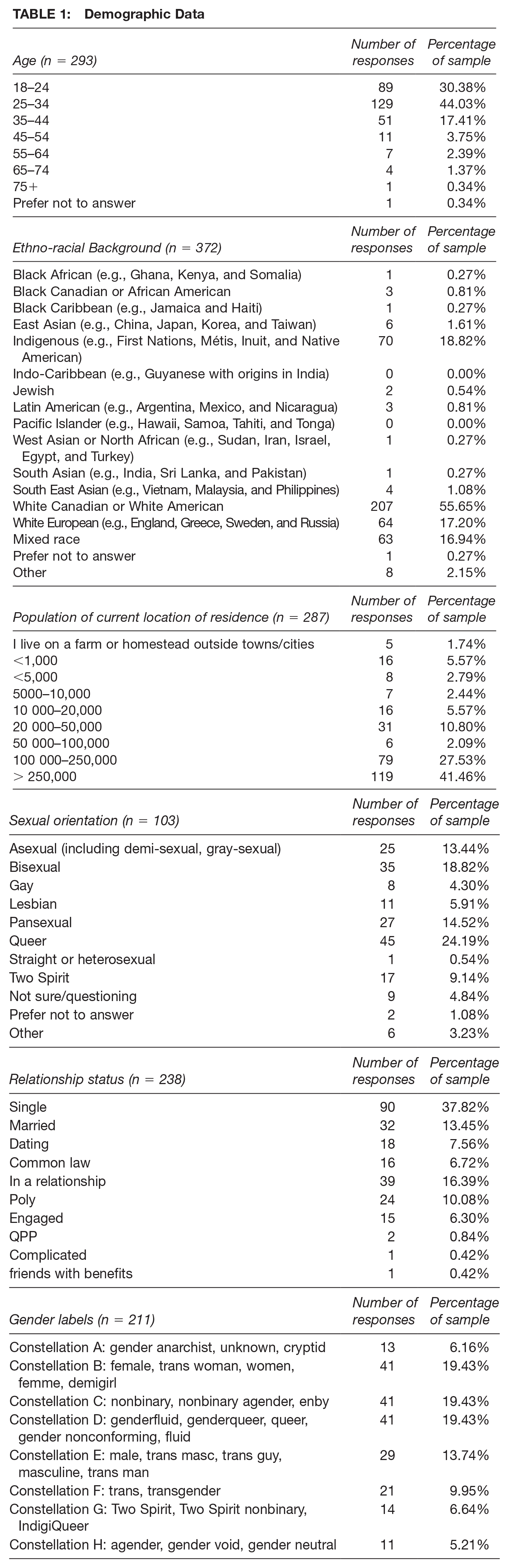
Additionally, interview and sharing circle transcripts were coded independently by three team members (TFM, JB, RLW), leading to the identification of five prevalent themes: (1) employment, (2) mental health, (3) geography, (4) community, and (5) gender; additionally coded were six themes of importance: (1) trans joy, (2) sexuality, (3) medical experiences, (4) community, (5) visibility, and (6) neurodiversity. Initial findings were shared with stakeholders, garnering feedback and recommendations for knowledge mobilization. Finally, key findings were determined through discussions with the full research group, considering the data’s relevance to gaps in community knowledge, systemic impacts, and the amplification of historically excluded voices and experiences.
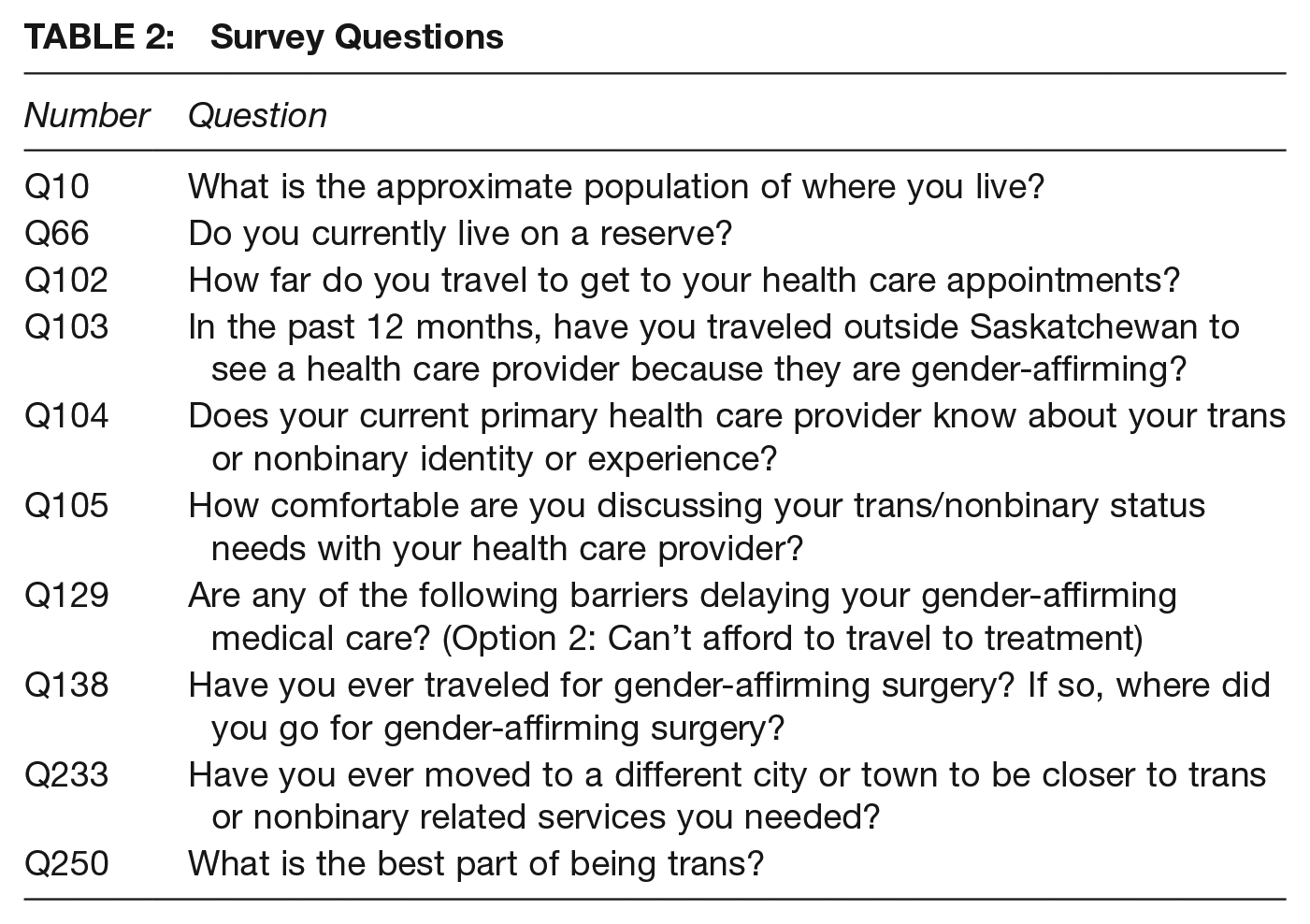
In this paper we narrow in on the prevalence category of “geography” as it arose from coding the participant interviews and sharing circles of the larger research project. We also draw on a small subset of questions from the larger survey related to where people live, the sizes of their communities, as well as questions that ask about whether people have had to travel for gender-affirming services and/or have moved to different locations to be closer to gender-affirming services (see Table 2 for a list of reviewed survey questions relevant to this topic). Due to this “narrowing in,” although the larger project employed a mixed-methods approach, we relied primarily on descriptive statistical and qualitative data in service to a theoretical intervention. These conversations showed that 2STNBGN people in Saskatchewan have rich and varied relationships to the prairies, whether they are from larger cities, from small towns, or from more rural settings, and that these experiences offer a novel contribution to trans and queer “geographies” as they have otherwise been documented. We provide participant demographics beyond those discussed here for potential future use of the data.
Survey Questions
Results and Discussion
As we read through and coded the data, we identified key themes related to the geographical positioning of Saskatchewan, specifically how place impacts the lives and experiences of trans people. These themes include the myth of exodus, grounded relationality (particularly as demonstrated by Indigenous participants), barriers to healthcare access for 2STNBGN people, and a sense of responsibility for future generations.
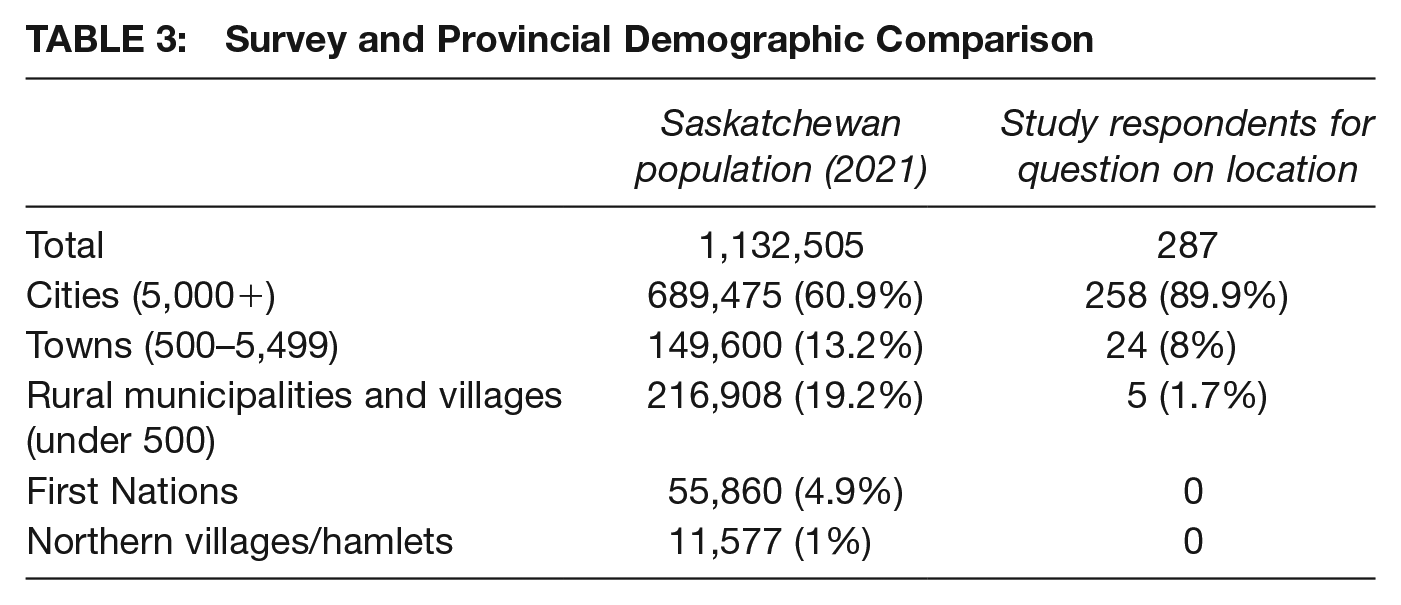
Due to Saskatchewan’s small overall population and concerns about compromising anonymity in smaller and rural locations, we did not ask respondents to specify towns, cities, or locations. Instead, we included a question about the population size of individual communities or locations. Most respondents (69 percent, n = 198) lived in communities with a population of more than 100,000, which includes Saskatoon and Regina, whereas 19 percent (n = 3) lived in one of the province’s smaller cities (between 10,000 and 100,000 population). Eleven percent (n = 31) of respondents lived in towns, villages, and hamlets, and five respondents lived on farms or homesteads. Although more respondents lived in cities compared with the general population breakdown (see Table 3), we reiterate the fact that Saskatchewan’s two main cities each have populations below 300,000, representing small urban centers in contrast to the assumed “urban metropolis.”
Survey and Provincial Demographic Comparison
From our prairie perspective, Canada’s queer geography focuses primarily on larger centers such as Montreal, Toronto, and Vancouver. The prairies, Atlantic Canada, and the Northern territories, with smaller and isolated communities (especially in the case of the territories), are often overlooked in Canada’s queer and trans rights movements. Valerie Korinek’s (2018) work Prairie Fairies is the first to document some of the unique positionalities on the prairies: It tracks the historical experiences of queer lives on the prairies, sharing hundreds of stories from interviews with queer people from Alberta, Manitoba, and Saskatchewan. Korinek documents the political, social, artistic, and organizational ventures from these distinct and overlapping regions, while pulling together a common thread regarding the migration patterns to and from the prairies between 1930 and 1985.
More recently, Canada’s 2SLGBTQ+ community center movement is developing quickly thanks to significant investments on the part of the federal government, the formation of a national network (The Enchanté Network; https://enchantenetwork.ca/en/), and increasing cross-Canada communication among organizations, leaders, and grassroots movements. However, despite beginning on the prairies, this initiative has quickly become an Ontario effort, and even contemporary research rarely includes Saskatchewan and other less-populated provinces in research or outputs. For example, Queerly Canadian (Rayter and Zisman 2022), a new textbook that professes to provide a new queer perspective from across Canada, not one of its 43 individual chapters focuses on Saskatchewan or on any topics related to Saskatchewan. In fact, there are only four mentions of the province at all, compared with 49 mentions of Vancouver, 47 mentions of Toronto, and 26 mentions of Montreal (Rayter and Zisman 2022). 3 We highlight this prairie politic not to assign blame, but to emphasize the need for richer research landscapes and stories about the unique experiences that surface in locales where it is not even about rural versus urban, but about an entire province rendered absent from important conversations.
The Myth of Exodus
In the expanding body of scholarship focused on rural 2SLGBTQ+ experiences, biases, and temporalities, few explore rural/urban migration in relation to trans and nonbinary people (Crawford 2017; Halberstam 2005). While there are overlaps between gender diversity and sexual diversity, we work to differentiate them here.
A key finding from our larger study was that 2STNBGN people regularly transgress not just gender binaries, but binaries related to neurodiversity, relationships, and sexuality (see Table 1 for additional demographic data). Unsurprisingly, they also challenge the binary of rural versus urban, as many participants have retained connections to their small towns and/or Indigenous communities, traveling to and from “the city” to visit or to stay for periods of time. City dwellers also escape to the countryside or take regular camping trips as some participants described practices of visiting small town bars and being the visibility they sought in their youth. One participant noted that although Regina doesn’t have an arts scene that compares with that of Toronto or Montreal, it still has a vibrant arts community with a lot to contribute (Interview #10), and later shared that despite planning to move to Vancouver when they were younger, they stayed in Saskatchewan. Other participants shared having left Saskatchewan for a time, but finding their way back, more determined than ever to stay and contribute to a changing social climate.
Discussions of urban and rural in Saskatchewan might equate to comparing different types of apples, rather than apples and lettuce, as would be the case between comparisons of Toronto and Northern Ontario, for example; and these stories underscore that there is no distinctly “urban” or “rural” experience, because people are always moving between spaces, and likewise, finding inspiration, community, and possibility in a variety of locations. The assumption that trans and queer people are desperate to leave smaller places for cities that boast gay villages and designated areas of the city where trans and queer people live, work, and play is built upon the myth that the only place trans and queer people can exist fully are in socially liberal major urban centers. It also perpetuates the myth that cities inherently provide queer-positive spaces. For instance, Saskatoon’s two “gay bars” have been reclaimed as heterosexual spaces, reflecting a liberal performativity of safe space that has become common in Canadian cities
One of Korinek’s interview participants from Edmonton, Liz Massiah, spoke to this myth, stating that “I have had lots of people who I’ve known who have gone to Vancouver and said the community is not nearly as welcoming . . . They come back here and like our community better” (Korinek 2018, 397). In interviews with queer people from rural Nova Scotia, Kelly Baker (2016, 36) found that participants experienced urban queer communities as “insular and exclusionary,” by which the larger concentration of 2SLGBTQ+ people meant that identities were subdivided and that groups didn’t “mix” or collaborate in the way that they did in smaller locations. Tellingly, these comments align with new information from Statistics Canada, which shows that 2STNBGN people are moving away from the big urban centers. In the 2021 census, Halifax (0.65 percent) and Victoria (0.74 percent), which are smaller cities in the Canadian context, had the highest concentrations of trans and nonbinary people per capita. This means that of more than 100,000 trans and nonbinary people in Canada, approximately 650 are in Halifax and 750 are in Victoria. Encouragingly, Saskatoon’s trans and nonbinary population per capita (0.41 percent) is following closely behind Vancouver’s (0.43 percent), and both Saskatoon and Regina (0.35 percent) have proportionally larger trans and nonbinary residents per capita than Toronto (0.32 percent) and Montreal (0.28 percent) (Government of Canada 2022b).
We are inspired by these human geographies because they indicate the richness of small urban and prairie environments, alongside shifting political tides. One of our participants speaks to this temporal change, noting that “There are so many folks like you said, you know, you leave and then you come back and all of a sudden everybody is like . . . it’s become okay. People can become themselves now” (Interview #11). Another participant shared a similar experience in relation to one of Saskatchewan’s cities: I’m finding to my delight that in the time that I’ve, you know, purchased a home here, and made a life here, that the city is growing big enough that it is actually getting quite close to what I was hoping for. So it’s a really nice place to be and I’m grateful that it has the culture that I need in my life. Because when I grew up, it felt too small town, and now it feels like it’s big enough that I can actually, you know, exist and be myself and explore different things and different cultures without having to leave my city, which is nice. (Interview #9)
Korinek’s work challenges stereotypes surrounding queer life in small prairie cities while remaining attuned to the powerful (national and regional) political and social movements that have come from the prairies. On the topic of prairie migration, Korinek’s (2018, 398) thoughtful history also disproves the stereotype that queer people always move away from the prairies, noting instead that while “people chose to move, regionally or outside the region, . . . they often chose to stay.”
We take up the matter of community in greater detail in the next section, as these stories support our argument that queer people on the prairies were and are not all moving away in droves. They were building queer alcoves in Regina, Saskatoon, and Edmonton; they were “fashion[ing] queer lives . . . [within] a network of regional queer possibility” (Korinek 2018, 398). Likewise, we found that gender-diverse people in Saskatchewan are also “becoming themselves” and “fashioning their lives” and their communities according to their needs, interests, and dreams for the future, findings that call for richer storytelling about these prairie possibilities.
Belonging and Community
Research has consistently shown that a sense of belonging and community significantly influences positive health outcomes for 2SLGBTQ+ people (Dykhuizen et al. 2022; Ferlatte et al. 2020). Some argue that smaller and rural environments are particularly good at fostering community building (Kazyak 2011, 2012; Marple 2005). Instead of reiterating these findings, our focus centers on the compelling insights we’ve gained, particularly among Indigenous participants and their documented connections to community.
Ontario boasts the largest population of Indigenous people in Canada, yet they only account for 2.9 percent of the overall provincial population (Government of Canada 2022a). In contrast, Indigenous people in Manitoba and Saskatchewan constitute 18 and 17 percent of the provincial populations, respectively (Government of Canada 2022a). Nearly one-quarter (24.39 percent, n = 70) of our survey participants and several interview and sharing circle participants were Indigenous (First Nations, Métis, or Inuit) (see Table 1). We acknowledge that the high representation of Indigenous people within our study correlates directly to Fayant-McLeod, who conducted all focus groups and interviews, and is a Cree and Métis Two Spirit person who drew on existing relationships and worked always to increase experiences of cultural safety. We also acknowledge our community-driven research methods, which included making space for high levels of participant agency and decision-making throughout the research process.
Two Spirit and Indigiqueer research participants noted strong ties to Indigenous communities, prompting an examination of the decision-making processes behind where they lived. For example, one interview participant noted their choice to stay in Prince Albert due to its small size and significant Indigenous population, expressing, “I guess I really like Prince Albert’s small [size]. And it’s more than 50 percent Aboriginal. And I think those are the two things that like I really like about my community . . . And everybody knows everybody” (Interview #4). Another participant stressed the importance of having a robust support network in their chosen location, explaining “my whole family lives in PA [Prince Albert]. And I’m pretty close to them. So it’s a pretty big support group. Yeah. And most of my friends are here too” (Interview #7). Notably, none of the 70 Indigenous survey participants lived on reserve, aligning with the growing trend of Indigenous people gravitating toward urban settings, with as many as 40 percent of First Nations people, 55 percent of Métis people, and 15 percent of Inuit people now living in urban centers (Government of Canada 2022a).
Many Two Spirit and Indigiqueer scholars hail from the Canadian prairies, and have already provided fertile ground for a discussion of the influence of relationships and community on Indigenous people (see TallBear 2019; Whitehead 2022; Wilson 2008). Our research builds on this work by emphasizing the heightened sense of belonging within rural and smaller urban settings. While recognizing that these communities may struggle to provide extensive community programming and events as found in larger cities, the grounded, caretaking relationality shaping such initiatives has had a profound impact. For example, Saskatchewan has been host to many years of OUT on the Land, an intergenerational, cross-provincial Two Spirit culture camp (Longman 2022). The land-based camp provides access to ceremony and traditional teachings alongside Two Spirit elders and knowledge keepers. Saskatchewan has also hosted national and international Two Spirit gatherings and is home to the newly formed 2 Spirit Alliance of Saskatchewan (2SAS), bringing together community leaders dedicated to building space for Two Spirit and Indigiqueer people on Treaties 2, 4, 5, 6, 8, and 10.
We also acknowledge non-urban support groups and pride festivals including the Saskatchewan Pride Network, the Humboldt & Area Pride Network’s weekly Youth Rainbow Coffee group (Wrubleski 2021), Prince Albert Pride, and Swift Current Pride. These entities fill gaps throughout the province: One of our participants from Prince Albert noted the need for safe spaces outside of the bigger cities, saying that they wished the city had “like more open queer spaces. And like, easily accessible places too –” (Interview #7).
While rural communities present unique challenges such as a lack of privacy, limited peer support, and small or nonexistent dating pools, they also demonstrate the wider ripple effects of transphobia due to the interconnected and tight-knit nature of rural life (Movement Advancement Project 2019). Responding to these challenges, visibility within rural communities may take unconventional and creative forms, such as coded language and symbolism. One participant explained, I always have some form of gender expression on me, be it like my hat, I have pins, I have masks . . . I just love that, you know, it can be like playing “I Spy.” And then you know, when you see those people, you can make the eye contact, and you can do the nod. (Interview #6)
Another participant shared a positive interaction in a small-town paint store, where someone recognized their queer-coded hat. When questioned about the comment by their grandma, who accompanied them to the store, the participant brushed it off, leaning into the underground languages of color and clothing that 2SLGBTQ+ communities have long relied on in order to find one another in historically hostile territory.
Healthcare Access
Accessing healthcare is consistently challenging for those living in rural locations, but for trans people, these challenges intensify. Many trans people already struggle with a lack of access to affirming and knowledgeable medical practitioners, a situation that worsens outside of outside of urban centers, and studies focusing on sexual diversity often overlook the intricate healthcare issues faced by trans people, particularly their need for gender-affirming medical and social services (Macapagal, Bhatia, and Greene 2016; Poteat, German, and Kerrigan 2013). When asked whether their current healthcare provider knew about their trans or nonbinary identities, 40 percent (n = 103) of respondents said “no.” Additionally, when asked about their comfort discussing their trans/nonbinary needs with their healthcare provider, 28 percent (n = 71) selected “not at all comfortable,” and 27 percent (n = 70) chose “somewhat comfortable.”
The scarcity of knowledgeable and affirming healthcare providers is compounded by limited availability and access in smaller centers. 2STNBGN people who live outside of Saskatoon or Regina may have no option but to travel considerable distances for doctor’s appointments and services, such as counseling, coaching, and peer support. Although 81 percent (n = 210) of respondents indicated that their healthcare appointments were in the town or city in which they lived, 16 percent (n = 42) noted having to travel to another city or town for healthcare, and 2 percent (n = 4) reported traveling to another province for appointments. When asked if they had moved to a different city or town to be closer to gender-affirming services, 18 percent (n = 42) responded “yes.” An interview participant noted “I’d like to stay here. When it comes to surgeries, for some of them, I have no choice, I have to go out of province” (Interview #5).
Even when healthcare providers are available, their knowledge about the treatments sought by 2STNBGN people varies individually. Although any doctor in Saskatchewan can prescribe gender-affirming hormones, discrimination and ignorance among medical professionals result in few doctors doing so. At the time of this writing (February 2024), several surgeons in Saskatchewan provide gender-affirming breast augmentation, but only one offers gender-affirming mastectomies. Surgeries such as vaginoplasty and phalloplasty have to be accessed out of province, with financial coverage contingent on the procedure and location. Notably, 21 percent of respondents (n = 41) report having to travel for gender-affirming surgery, citing locations such as Saskatoon, Regina, Montreal, Vancouver, Edmonton, Fort Lauderdale, and Thailand. When asked if the surgery they sought was available in Saskatchewan, all respondents except one said “no” (20 percent, n = 39), likely referencing surgeries not currently available. For others, accessing any degree of gender-affirming medical care is blocked by financial barriers, as 18 percent (n = 36) of respondents note that they cannot afford to travel in order to access medical care. The healthcare and access landscape highlights the need for tailored advocacy for gender-diverse people.
Responsibility for the Next Generation
A number of respondents shared that they chose to stay in Saskatchewan in service to a future generation of 2STNBGN people. Interviewee #2 captures the complicated nuance of this hopeful sacrifice: [It was] a nice city to grow up in, particularly, it was a little bit lonely though being like one of the few Asian kids at my school. But I do think the size of the city was nice. I don’t think I would have liked to grow up in a big city. I do know that there are a lot of, like, systemic problems that I kind of have issues with when it comes to the prairies in particular. And some of the ways that our government doesn’t manage things that I think would be better managed other ways. But I do feel like I have a sense of obligation to kind of help make this place a better space for people.
For another participant this translated to leaving imagery and messages for others to see: I feel like we should be spreading happiness, we should be spreading joy, we should be spreading queer, trans joy. You know, even if you’re in a small conservative town, you can still leave a rock that’s painted like a rainbow on a church doorstep and they’re not going to burn you. (Interview #6)
Within the larger research project, we set out to share affirming and positive experiences of 2STNBGN people, because these are typically left out of mainstream narratives (Fayant-McLeod et al. 2022). While metrocentric beliefs about gender and sexually diverse communities promote the stereotype that radical queerness and identity-affirming experiences happen only in large cities, our project participants confirmed that this is untrue, sharing moments of trans joy in the intentionality of growing-in-place and community building in smaller areas. In an effort to transform narratives about 2STNBGN people on the prairies, we asked “What is the best part of being trans?” to which one participant responded: Possibility. As someone who is nonbinary, there is a lot of room for me to try to figure out who I truly am. If genders are planets in a galaxy, I am still looking for mine. In the context of my culture (Cree & Métis), I am excited about what this self-discovery could mean for my responsibilities to future generations, and the space I can make for them to be more supported in their gender identities.
Two other participants envisioned their future self as an effect of their present-day actions. One shared, “I will become an unstoppable mother someday and the smartest Kokum someday. Hopefully, I will have been kind to have gotten there”; another shared that the best part of being trans includes “The loving relationships I form with myself and others” and further that it includes a degree of responsibility to mentorship and “being the person I needed when I was younger.”
Together, these narratives amplify the positive and visionary movements of Two Spirit, trans, and queer communities on a much larger scale. Political fights for rights have always been paired with celebration and artistic performances; likewise, stories of struggle have long been accompanied by stories of trans joy and coming into community, as Wilson’s (2008) “coming in” stories illustrate. Our respondents reminded us at every step that 2STNBGN people are supporting and mentoring one another, creating their own places of belonging, ensuring that name change and medical processes are easier for those that follow them, and archiving symbols and messages of hope. This sense of caretaking for future generations likely exists at all levels of population and all ranges of geography, but we amplify it here on the Canadian prairies, reminding ourselves that we are not alone.
Conclusion
I like that it’s close to family. That’s mainly why I came back here. I was living in Edmonton for about five years following high school. And then I came back here to be closer to family and resources and such for mental health help. . . . So that’s what brought me back here, really. And then it’s nice sometimes that it’s small. Sometimes it’s not very nice that it’s small, [it] has its plus and minuses to be in a small city. (Interview #8)
We found a great deal of hope in the fact that 2STNBGN people are choosing to live and stay in Saskatchewan, whether in small urban centers such as Saskatoon or Regina, smaller cities such as North Battleford or Prince Albert, or in rural locations such as farms and small towns. Our participants described this choice as an intentional way to build community, advocate for support, and cultivate belonging. Participants also described Saskatchewan as their ideal location to be close to family or their roots, have more affordable lives, and live in cities that aren’t too big. Some participants shared having left Saskatchewan for a time, but finding their way back, more determined than ever to contribute to a changing social climate. Though Saskatoon or Regina cannot honorably claim a “rural” character, we hope that we have complicated the urban/rural binary and instead created new political geographics of 2STNBGN people in Saskatchewan. These geographies encompass shared small-town origins, reduced anonymity, and a grounded relationality tethered by unique threads of kinship and belonging. They also highlight the recognition that place matters and that 2STNBGN people should be able to live and thrive, in place. Thus, we see future potential in exploring the ways that smaller geographic settings provide increased opportunities for political impact and enhanced feelings of inclusion, given the structural inability to further fragment already small 2SLGBTQ+ communities—a factor that was amplified by a number of our participants who relied not just on the concept of “queering,” but on the actual word “queer” as a flexible and widely applicable term, applying to spaces, communities, visual signifiers, and expressions, regardless of their gender identity.
We also do not underestimate the substantial healthcare barriers faced by trans people in Saskatchewan, barriers that look different for people who are gender diverse versus sexually diverse. Combining participants’ desires to thrive in Saskatchewan with the existing obstacles highlights the need for significant changes to improve the quality of life for 2STNBGN people. Although the larger urban centers have garnered heaps of cultural capital through resources, grants, programs, and the ability to have trans and queer-specific health centers, “rural life is characterized by increased community interrelatedness, where there is a greater dependence on those around you for survival” (Marple 2005, 72). This reliance on neighbors for survival fosters an invested accountability as expressed through shared actions in service of a better tomorrow for future generations. We also recognize that decision-making processes in smaller jurisdictions are complicated, requiring a deeper commitment to relationality, lest we fracture an already under-resourced terrain.
To close, there is something about queering rurality, or queering the prairies, perhaps, that grounds us, that forces us to connect, to work with one another. Leveraging the active momentum of “to queer,” the concept of queering rurality tends toward transforming, shifting, or twisting both the heteronormative and cisnormative rural landscapes. For example, Saskatchewan artist Devin West (2019) uses multimedia installation art to tell the stories of trans and queer people who choose to live in rural, prairie communities. During an artist residency with Camp fYrefly in August of 2019, a 2SLGBTQ+ youth camp that takes place in Alberta, Saskatchewan, and Ontario, West worked with youth from across Saskatchewan during the Saskatoon Camp to create self-portraits of resilience. West tells the story of one young person in particular who was described as a “loud mouth” in their small rural community for always calling out instances of misogyny and homophobia. While describing this experience alongside her produced artwork, this young person expressed a great deal of pride in this role, and a future-forward commitment to continued engagement and disruption in her small community. Like the young participants in West’s artist workshop, our research has documented the stories of queering rurality and queering the prairies, reminding us to trouble narratives that diversity and acceptance are possible only within the metropolis, or that rural settings can only ever be difficult and conservative spaces. Our conversations with 2STNBGN people province-wide demonstrate that the prairies were and are a vibrant and interconnected landscape of “mavericks” and community builders (Korinek 2018, 26), intent upon working together and through our differences, in the hopes of more transformative politics, more representative histories, and increased spaces of belonging.
Our prairie cities and towns have their own kinship narratives that enfold around community, belonging, and relationships. And in fact, as ourselves Two Spirit, trans, and queer residents of the prairies, having mostly grown up in small towns and on farms, we feel lucky to tread upon prairie soil in our work surrounding 2STNBGN people and communities. We have all witnessed exceptional strength, agility, and bravery in our communities, attributes which are developed not “in spite of” our rurality, but precisely because of it.
Footnotes
Authors’ note:
Thank you to the Government of Canada’s Department of Women and Gender Equality and the Social Sciences and Humanities Research Council for funds in support of this research. Thank you to Claire Yacishyn, Executive Director of Trans Sask Support Services, for input and guidance. And thank you to three anonymous reviewers who provided some of the most thoughtful, engaged, and valuable feedback we have ever received.

Notes
Rachel Loewen Walker (she/her) MA, PhD, is an assistant professor in Political Studies and the Program Chair of Women’s and Gender Studies in at the University of Saskatchewan. She is also the Project Director of the University of Saskatchewan’s Social Innovation Lab on Gender and Sexuality. Her research focuses on queer theory and gender studies, feminist philosophy, temporality, human rights, and community-led research.
Jake Bergen (they/them) is a queer, agender-nonbinary, education researcher at the University of Winnipeg. They facilitate mixed-methods research at the intersections of anti-racism, 2SLGBTQIA+ inclusion, social justice, and mental health in postsecondary teaching and learning, with a focus on teacher education.
Tiberius Fayant Mcleod (they/them) is a Cree and Métis Two-Spirit and nonbinary holistic researcher from Treaty 4. They consult and support various community initiatives and research projects in Saskatchewan.
Kerry Marshall (she/her) is a PhD candidate in the School of Nursing at the University of British Columbia, Canada. Her research interests include reproductive justice, gender equity, and 2SLGBTQIA+ health.