




Abstract
How can we understand queer kinship as it is experienced in the present, without inadvertently fixing its meaning, ignoring the (in)flexibility of memory, or failing to capture its continued evolution? We argue that through recognition of the stickiness of family and kinship characterized variously by pain, joy, tradition, contrariness, and connection, we can find routes to collectively imagine queer futures. Based on an ongoing collaboration between a sociologist and an artist, this paper considers what a queer approach to collating and exploring experiences of kinship may produce. We recount our experiments in implementing methods that allow us to narrate our (queer) relationship to kinship with acknowledgement of the fragments of diverse pasts, embodied presents, and wished for futures. We offer examples of how we might celebrate randomness and interruption, and curate ongoing disruption to linear inheritances and transmission of meaning. We show how these methods can offer opportunities to recursively deconstruct and reconstruct our personal and shared histories, creating unfinished, chaotic, glitchy, and always-becoming stories of queer kinship.
Beginning
Queer kinship has been variously conceptualised through decades of excellent scholarship. However, challenges remain in finding ways to capture experience of, and imagine, queer kinship without referring to ’breaking from the past’ tropes where a path ‘out’ of normative kinship patterns position queer identity as ‘a rupture in kinship and generation’ (Reed and O’Riordan, 2023: 4) setting up a false binary between queer kinship and normative, or heterosexual kinship. In this article, we propose a method for researching past kinship experiences and traditions and for staging moments of queer kinship in the present, which allow for exploration of queer kinship beyond such a binary. Through a collaborative and evolving creative process, we aimed to identify ways we might narrate our multiple, ambivalent relationships to kinship pasts without inadvertently fixing our experiences in the present or restricting possibilities of kin for the future.
Using the example of a 1-day creative, participatory workshop, and an artistic output produced in communication with the content of this workshop, we show how queer kinship can be explored with methods which embrace ambivalence, multiplicity, messiness, and non-linear progress. We recognise the challenge of disrupting linearity, especially when such interruptions also seek to transform familiar structures of narratives for inheritance, belonging and tradition. Our intention in this work is therefore not to attempt to index a single way of achieving this. Instead, we offer highly personalised insights into the possibilities of collaborative production when striving for new approaches to understanding our past, present and future kinships.
We begin by unfolding the core frame of queer kinship which provides the methodological and conceptual challenge we seek to address; how to replicate processes by which we imagine kinship, retain complexity and multiplicity, and produce comprehensible records of these experiments which invite further interpretation and reworking – as patterns of kinship do. From here we identify our subjectivity and the significance of this to our research design, interpretation, use of voice, and artistic practice. We aimed to research queer kinship by developing activities which stage queer relationalities to allow emotionally intense and extra-ordinary moments of sharing and collaboration to be recorded (Lescure, 2023: 41). The work is therefore resolutely political as it acknowledges the anxiety and urgency with which we, as queer people, grapple as we navigate meanings of genealogical lineage, intimacy, reproductive expectation, and wishes for a different kinship future. Finally, we outline three distinct activities; two activities taken from our in-person workshop and the third a reflection on the experiences of interacting with Milou’s multimedia installation made following the workshop and continuing the process of reflection, reinterpretation, and non-linearity storying.
Ultimately, we present the possibilities of what a queer approach to collating experiences of kinship may deliver. Our experiments in curating methods offer opportunities to narrate our (queer) relationship to kinship with acknowledgement of the fragments of diverse pasts, embodied presents, and wished for futures. We offer examples of methods that can be borrowed, reworked, and deployed in order to celebrate randomness and interruption, and curate ongoing disruption to linear inheritances and transmission of meaning. We show how these methods can offer opportunities to recursively deconstruct and reconstruct our personal and shared histories, creating unfinished, chaotic, glitchy, and always-becoming stories of queer kinship.
Thinking
We argue that queer kinship is not a straightforward reversal of what has come before but is characterised by a reworking of ties to generation, and critical evaluation of inheritances through creativity and reflection. We move beyond a binary framework as a way to reject homophobic discourses which have long constructed queers as the failed end point of heteronormative succession (Roulston, 2021: 118). Rather than regarding queerness as a position of rupture which requires new ‘makings’ of connection, generation, and inheritance, we note the detritus, the fragments of kinship, family, inheritance, tradition, and genealogy which lay at our feet, which retain value and which we weave into new patterns. How can we narrate our multiple, ambivalent relationships to kinship pasts without inadvertently fixing our experiences in the present or restricting possibilities of kin for the future?
We therefore propose an approach which allows space for acknowledging how inheritances can constrain and enable without demanding binary rejections, reinventions or fixing. We aim to hold a space to collectively – with kin and by kin - imagine queer futures out of aspects of various pasts (Amin, 2019: 287; Muñoz, 2009). To achieve this, we assert that it is only through embracing backward-looking that we might make sense of how we build presents and futures. As Freeman argues: we can’t know in advance—we can know only retrospectively, if even then—what is queer and what is not, we gather and combine eclectically and idiosyncratically, dragging a bunch of cultural debris around with us and stacking it in eclectic piles not necessarily like any pre-existing whole. (Freeman, 2007: 499)
Queer time is recursive, built of both progression and doubling back (Thomas, 2007: 616). By finding ways to grasp experience and knowledge outside of linear narratives, we can approach the topic of queer kinship productively. We therefore propose methods which mirror the process of gathering and combining debris of the past to build our kin-networks. Through play, participation, imagination, and collaboration, we create opportunities to reflect on norms and traditions and craft relationalities that support us in the present. By holding past, present, and future together, we can explore queer kinship as a dynamic and evolving process.
Planning
The principles of queer research orientate us to accept and invite messiness and non-linear stories, situate knowledge with awareness of multiple intersections and subjectivities, and work reflexively (Mizielińska et al., 2018: 978). Objectives of disrupting linearity and retaining messiness are easily articulated but can be harder to put into practice given the numerous social structures and story-telling conventions which emphasise coherence. We propose a method which creates the possibility for such variation and subjectivity: we developed participatory workshops which focused on play and experimentation. In writing about these workshops, we deliberately hustle between registers, drawing on histories of performative writing, poetry, and academic formal conventions, mirroring, as we do, the blending and reworking pasts and presents we dramatize through our methods. We write in circles at times, inviting our readers to attend to complexity and reflect on the participation of those written about (and with). Our written style reflects our commitment to refusing an orderly, singular, and authoritative academic voice, through which we seek to enliven our approach by drawing attention to the always unfinished, collaborative work of conceptualising kinship.
Participants in our workshop volunteered to join us after we offered a day of collaborative exploration of the question ‘what does it mean to queer the family?’. We designed a series of short activities for this workshop which aimed to create space to reapproach norms of narrative structure, coherence, and provide frameworks to play with and speak about kin traditions, histories and values. These activities included improv games in which two participants co-constructed a story following the prompt of a scenario such as ‘you are going on holiday’; a free-association word game where each participant in turn said the first word that game to mind in response to the previous participant’s contribution; roundtable discussion on open questions aimed at exploring key concepts implicated in family, kin and queering such as ‘what does inheritance mean to you?’; a mapping of oddkin; and creation of new proverbs. It is these last two activities which we explore in more detail below. The workshop took place over 4 h with participants opting in and out of activities as they wished.
After the workshop, Milou reflected on the processes and products of the activities and began to build and reshape these into the final installation, Incubator for Anothertime (Stella, 2023). The free-association and improv games provided inspiration for the inclusion of words which contain multiple meanings across contexts, in the audio track of the piece; the collective reading of the re-assembled proverbs had been musical and playful, this was reflected in the blending of words and music in the piece. The visual elements of the installation reflect the overarching project in the workshop activities of troubling the familiar which Milou chose to express through a disturbing of images associated with human and non-human biological reproduction. In summer 2023, Lizzie and all workshop participants were invited to the public exhibition of the installation; by engaging with the reflected and refracted components of workshops present in the installation, there was an opportunity to continue exploration of these themes – both alone and in new collective spaces. The installation space invited audiences to sit down and experience the audio-visual track together, offering another place where queer relationality might be staged.
Following review by the University of Southampton Faculty of Social Sciences Ethics Committee, all participants were briefed, with the help of an information sheet, on the likely scope of discussion and activity and invited to ask questions about the purposes and use of materials we solicited in workshops. Participants were asked to sign consent forms and select a pseudonym we could use to refer to them in any project outputs. We do not individually identify any participants in this paper. We did not collect information on participant age, race, ethnicity, class, gender, or sexuality. This was informed by a commitment to non-extractive methodologies which do not overburden marginalised groups with requirements to index their subjectivities into datafied categories (Niang, 2024). We also wished to retain the spontaneity and co-present interpretation of one another which characterises meeting in everyday life. Our impression was that participants were racially and ethnically diverse, that we were all under 40, and that we were all most commonly read as women (despite not all identifying in this way). These impressions are partial and incomplete against the biographical narrative any one of us might give.
In total six of us took part; Lizzie and Milou participated in all activities, mixing our reflections, hopes and experiences with those of our four volunteers. As a desire-based project, our participation in the workshops acknowledges our orientation to joy and connection to the process of constructing meaning (Niang, 2024: 62). This subjectivity is a strength, allowing a situated insight into kinship, belonging and collaborative worldmaking. Our explicit participation is central to the production of knowledge and transferability of our practice because, as Keaney compellingly argues, ‘race and queerness are not at end simply qualities of bodies, or identity categories’ but ‘sparking intercorporeal fields through which embodiment, attachment and subjectivity are plotted. To do justice to these formations as critics requires skin in the game’ (Keaney, 2023: 26).
Resultingly, we consider autoethnographic elements to be a central component in any exploration of queer kinship, and do not separate our contributions from those of our participants, nor can we separate the contributions of the participants from the approaches we subsequently developed and self-reflection we engaged in. It is in the example of Milou’s installation (below) that we offer a vision of how such an intertwined approach can be communicated without fixing particular ‘findings’ as it offers a conversation with material from workshops in new form which itself, invites ongoing reworking of meanings, histories and presents. Our participation in the activities is therefore part autoethnographic, part acknowledgement of the value of subjectivity, reflexivity and insider-knowledge in research, and part staging of ‘(queer) selves-in-relation’ (Pidduck, 2009: 462) which both define and create kinship networks and contribute to the always ongoing reworkings and evolving meanings for kinship.
Doing
Proverbs: Glitching inter-generational wisdom
Taking proverbs as a mode of transmission for inter-generational ‘wisdom’ or experience, we invited workshop participants to reconsider and rework their meanings. We presented participants with British (curated by Lizzie) and Italian (curated by Milou) proverbs written in English, along with scissors and glue. We invited everyone to cut them up and recombine them as they wished to create new proverbs. We didn’t offer any other steer on this. While Lizzie and Milou reviewed the different national ‘wisdom’ we each had both curated, our participants read all of them; sometimes encountering these aphorisms for the first time.
After some time, reading, sorting, hesitation, and cutting and sticking, we jointly produced a sheet of 24 ‘new’ proverbs. Or rather, we didn’t. The new proverbs feel somehow discordant as familiar turns of phrase rub up against unfamiliar ones from other linguistic backgrounds or traditions. We find them oddly disorientating. The physical process of cutting and sticking together leaves fractures – there are uneven gaps between these words; you can see that they didn’t start their life together (see Figure 1). New/old proverbs.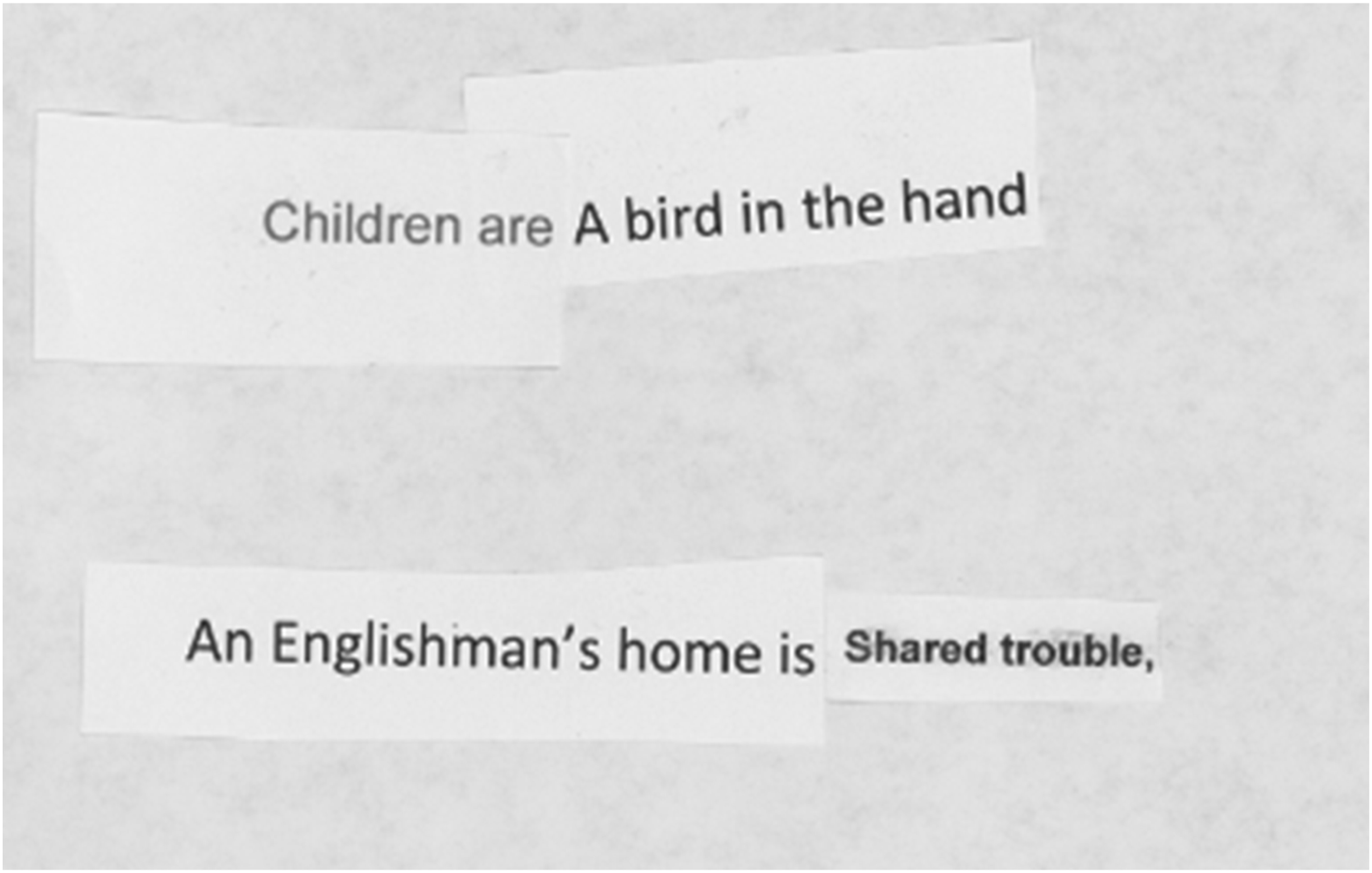
After affixing all the ‘new’ proverbs to a large piece of paper, we read each aloud. Taking turns to read we laughed at some and echoed others which resonated as valuable new wisdom. ‘It takes two to cook an army’; ‘we don’t teach the child of valour lies’; ‘familiarity breeds a friend’ and, employed in the title of this article; ‘to raise a village, fall far from the tree’. In the reception of these new constructions, we felt the playfulness of this process. Play can offer opportunities for encountering feeling anew and seeing experiences of the world differently, generating space for transformation or renegotiation (Medina et al., 2022: 9). The new ways of seeing in this activity describe making these (largely) familiar proverbs strange, allowing the discovery of how creative, collaborative action can, at least for the duration of the workshop, frame a different engagement with our otherwise static histories.
All of the proverbs we list above – and a majority of those which were made – refer to some sort of relationality or interaction. Understandings and patterns of kinship are structured by norms which reiterate who is entangled in family or community or intimacy and the bounds of this. These norms also vary across cultural and national borders. The two ‘new’ proverbs in Figure 1 both combine British and Italian proverbs. The different fonts and visible transitions between pieces of paper remind us of their different points of origin. In doing so, they offer a visualisation of the mixing of resources of culture, knowledge, and tradition. These resources were tangible in the raw material of the printed proverbs but also incorporated intangible knowledges built from diverse personal, ethnic, and racial histories. By cutting up these proverbs, recombining them, mulling the implicit patriarchal, racialized, and cis-heteronormative wisdom they relate, we engaged in a kind of queer hacking: a ‘momentary rewriting of history…by creating a glitch in informational processes and exchanges’ (Wang, 2023: 306). For example, an anti-racist feminist reading of ‘an Englishman’s home is shared trouble’ might take trouble as a prompt to consider the conquest, colonisation, and domestic violence which is closely associated with the history of ‘an Englishman’s home’. As a piece of new wisdom, it rejects nostalgic, jingoistic readings of ‘Englishman’ and offers a warning. Our hacks are both literal (the cutting up of these phrases and words) and imaginative, as we confront and reimagine static knowledge which is repeated in diverse multiple cultural contexts.
This activity offered a way of conceptualising the challenge of ‘imagining’ new futures when the tools we have to do that are steeped in tradition, experience, and recognition through norms. These new proverbs’ sometimes-incoherence is a failure of form; but this failure offers an escape from the rigid norms which the original proverbs both enforce and conform to (c.f. Halberstam, 2011: 3). The sticky-connections they retain to their original form is not an indication of a product which is insufficiently radical; such an evaluation would force us to return to binary notions of conformity/reinvention of kinship which inhibits celebration of the vast space of challenging and reordering pasts which exists between such simplistic poles. Rather than categorising the proverbs we created by their failure or success as idioms for future use, we suggest they offer a simple way to engage people in questioning of inherited norms and wisdom. They provide a form which allows us to value what we produce through disruption for exactly what it is; unfinished, glitchy, playful, and built from the fragments of what comes before. Indeed, in their incoherence we suggest there is a path for continued experimentation which, in retaining glitches, offers space for further disruption, alternative models of engagement and new claims for legitimacy.
Incubator for Anothertime: Generative recursions
The terminology of ‘families of choice’ has long been used to describe queer family making beyond the rigid kinship systems of genetic inheritance or marriage (Weston, 1997) but this emphasis on choice has come to obscure the enduring ways in which ‘queerness is reproduced through personal and collective genealogies of race’ (Keaney, 2023: 15). Kinship is always entangled with reproductive histories, possibilities, and refusals, entrenched in dominant narratives of genealogical linkages, ancestry, and entanglements of power. These entanglements remind us that kin relations are never fully autonomous but haunted by power and violence, though still ‘capable of exceeding and confounding the very definitions within which they are said to work’ (Butler, 2022: 40). In Incubator for Anothertime (2023), Milou creates opportunities to confound and exceed expectations of biogenetic coherence, defamiliarizing technological discourses which reassure us of the recognisability of biological, species and racial ‘realities’. The piece provides voice to embodied experience and diverse biological knowledges through a creative, artistic frame, building on the theoretical material and questions we identify above, weaving in the collaborative imaginative moments we curated in workshops, alongside Milou’s personal experiences of infertility and assisted reproductive technologies.
In a 22-min-long HD video projection and soundscape, presented in a room laid with a white faux fur floor and soft cushions, Incubator for Anothertime invites us to immerse ourselves in a temporary expansive kinship system. This is a warm, slightly dreamy space in which to experience reproductive technologies and meanings differently. Incubator for Anothertime presents images of a tardigrade egg under a microscope which in this context invites a [mis]reading of it as a human ovum, and a sea anemone (Actinoscyphia aurelia) which we readily misrecognise as a venus flytrap (Dionaea muscipula). Presented without narrative of their origin they blur our understanding of the distinctiveness of human/animal and animal/plant biology and confound the supposed coherence of genetic identities. The piece therefore offers imaginative space in which to ‘reconfigure bodies and worlds as fluid and relational processes, enabling new becomings’ (Lykke, 2008: 14). The piece does not suggest an escape from materiality; there is no choice to ignore the cellular facts which construct one type of organism or another, regardless of our misapprehension of its classification. Instead, Incubator for Anothertime’s playful challenge to our ability to identify human cells or distinguish between animal and plant serves to remind us of the impossibility of escape from concrete conditions for making of life and meanings attached to such production. We cannot conceive a human child from the tardigrade or the chicken eggs placed on the beach (see Figure 2), but we can build kinship and belonging through a collective mediation on what reproduction means. Still from Incubator for Anothertime: Eggs on the beach.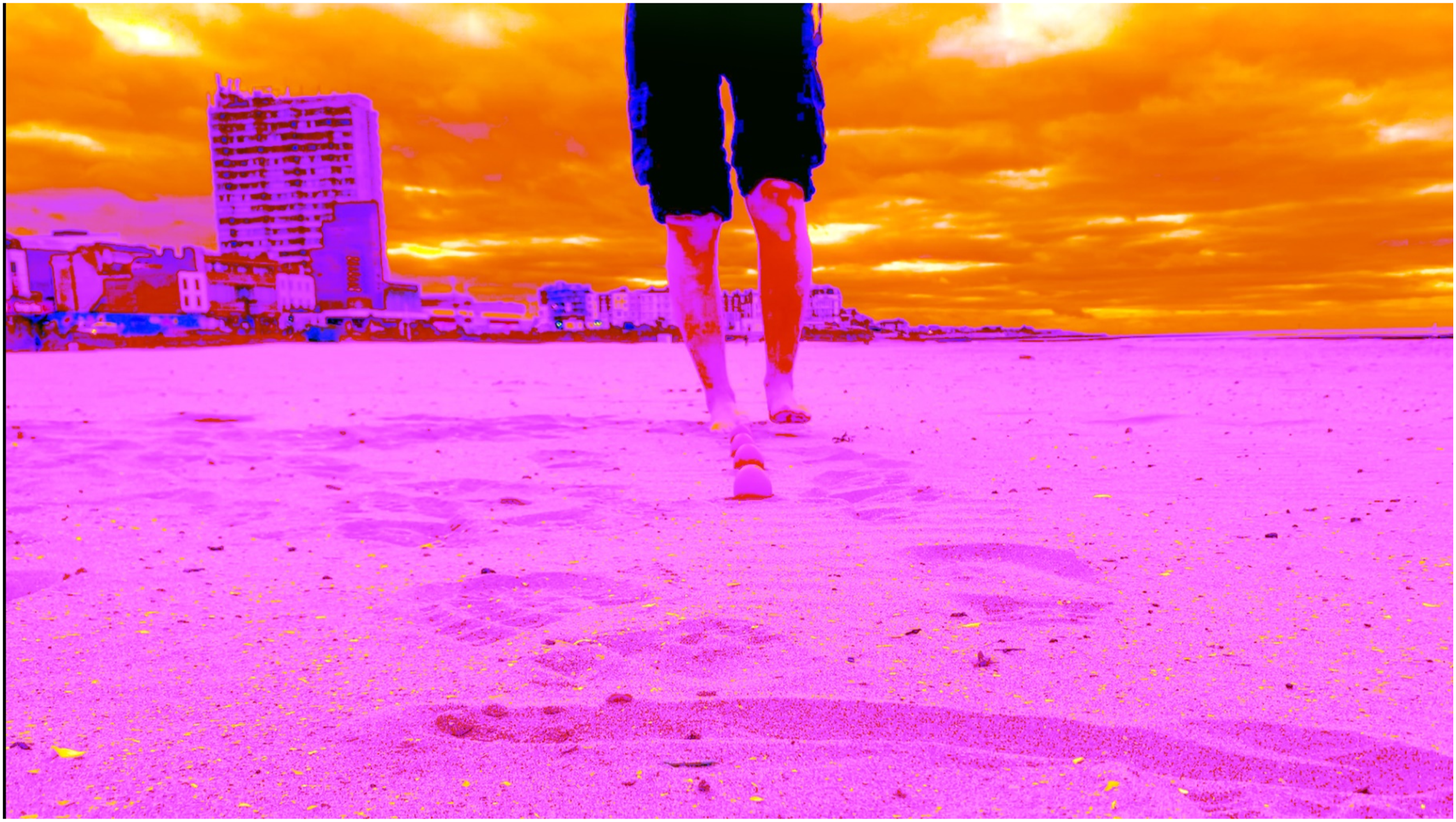
The piece focuses on rhythm and movement rather than linear narratives or plot, like a hybrid multimodal poem that allows for both scientific, personal, and visual language to co-exist alongside a chorus of voices. In this space we are invited to follow an exploration of reproduction as a chaotic, multiple, recursive process. Sound and images repeat and slowly vary in colour and rhythm. These recursions are generative both in the evolution of the light, sound, and movement produced through the repetitions and changes in the projection and soundscape (see Figure 3) and in the response we may have to the invitation to imagine reproduction differently. Haraway argues that it is ‘generative recursions that make up living and dying’ (2016: 33) and this is visualised as images of flowers deconstruct and reconstruct; the blooms almost imperceptibly opening and then dying as the image cycles. The prompt to mediate on these images by sitting in the immersive space of the installation allows us to explore the generative recursions from familiarity to unfamiliarity to familiarity, from recognition to misrecognition to recognition. The piece facilitates a new awareness of the capacity we have for transformation through embodied relations, critical reflections on biological categories, and imaginative queer kinships. Series of 9 stills from Incubator for Anothertime: Recursive blooms.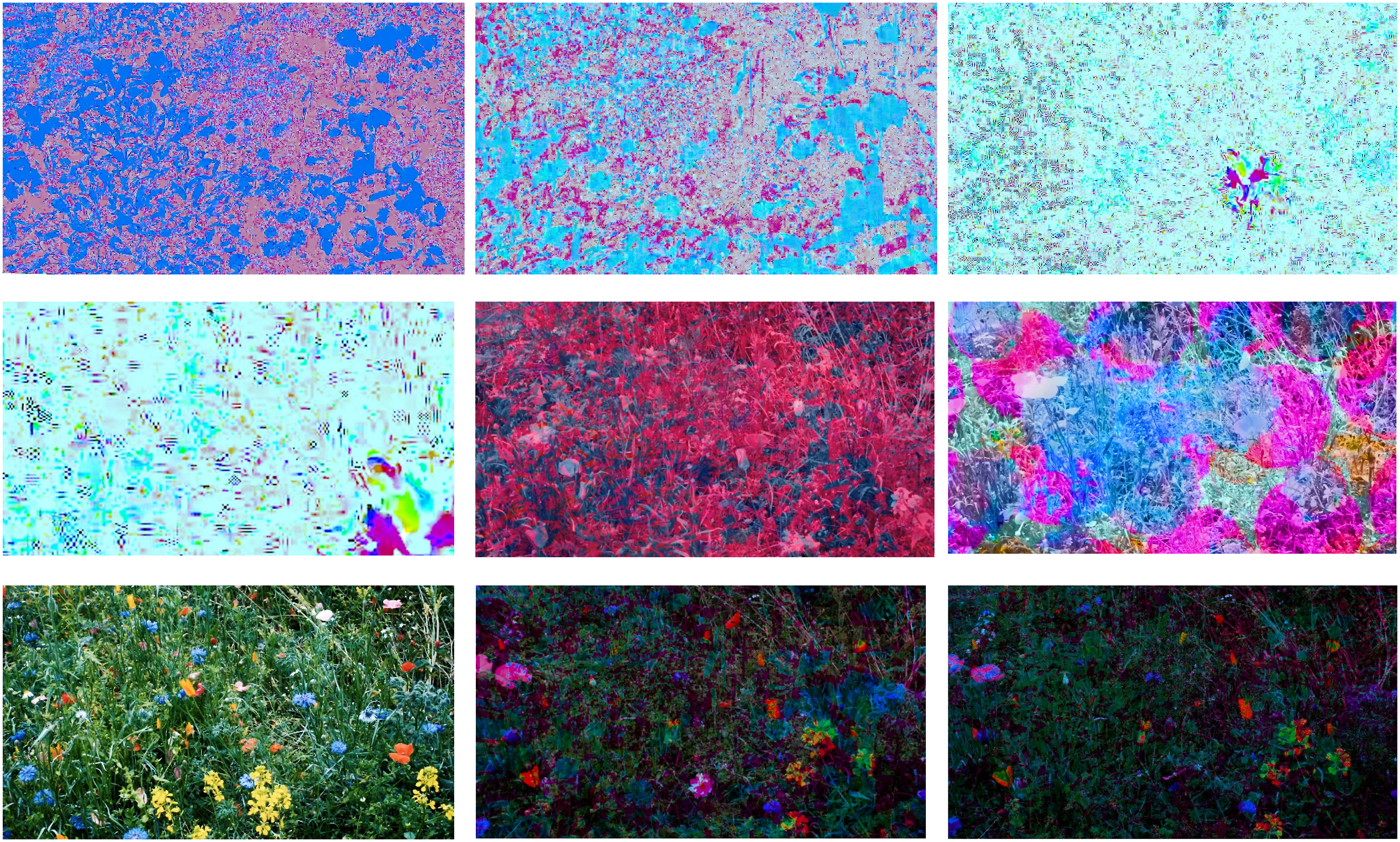
As a strategy to tell new stories of kinship and reproduction we are often invited to undo the past, its traditions, bonds and forms (Edelman, 2004; Warner, 1999; Weiner and Young, 2011); to untangle and begin again with the raw components as though this can be a linear endeavour. But we suggest, and Milou presents in this piece, an undoing and redoing which happen simultaneously through messy connections, entanglements that become the ways in which we tell our stories and/or find kin in transformative ways. These entangled experiences are always in the past, present, and future simultaneously and which only change and grow through recursion.
Oddkin webs: Becoming tentacular
Who are our relatives who are not connected to us through blood, nor tradition? How, as Haraway asks, can we make kin with ‘something other/more than entities tied by ancestry or genealogy’ (2016: 103)? We asked our workshop participants to join us in mapping ‘relatives without ties by birth, lateral relatives’ in search of another way to ‘stretch the imagination and…change the story’ (ibid).
We sat together in a circle to name our ‘oddkin’ (Haraway, 2016), collecting a web or cloud of names connected by invisible threads. We rejected a reworking of a (linear) family tree in this activity because, to playfully misquote Deleuze and Guattari (in technicality but we think, not in spirit), such a format ‘is not a method for…people’ (1987: 8). Our cloud of oddkin is instead rhizomatic, tentacular, sprawling. We stretch and reassemble the meaning of connection and of kin as, together, we assemble our relations to offer this future story of who we are (and who we were from and with) in the moment we came together in the workshop.
In the cloud of names facing in all directions, noted down in multiple hands and colours (see Figure 4), we collated a kin network which includes human and non-human animals and where certain recursions of one name or another were marked, by communal agreement, with asterisks. The additional clarifications (‘cat’ or a crude drawing of a cat’s head) or emphasis (‘*’) were not instructions we gave for the activity but quickly these differentiations felt necessary, and notations were agreed upon. These names indicate affective orientations to happy connections compiled in a relational context. That names repeated by more than one person seemed to merit differentiation from the others reflects the discursive, communal, construction of value in these orientations, inadvertently patterning normative emphasis on kinship being determined by social proximity over individual value. Put another way: the affective orientation to these people made them close, allowed them to be our oddkin, but the sociality which backgrounded this activity rendered some oddkin closer, ‘accumulating positive affective value’ (Ahmed 2010: 21) as we passed around their names.
In this ‘shared horizon of experience’ (Ahmed, 2010: 21) we generate a momentary kinship system, laden with unarticulated evaluations that have rendered some worthy of inclusion and others not. Our cloud stretches and recomposes kin, enabled by ‘the fact that we are all earthlings in the deepest sense’ (Haraway, 2016: 103). Non-human animals mix with the living and dead and offer a ‘potentially generative, unexpected, queer’ vision of kinship (Pidduck, 2009: 459) which assembles as we move together in the workshop, shifts as we share our affective orientations, and disperses as we drift apart from one another afterwards.
We become tentacular in this process, making ‘attachments and detachments…cuts and knots…[we] weave paths and consequences but not determinisms’ (Haraway, 2016: 31). The paths we weave are not linear and not a binding into sameness or coherence, they visualise our differences as well as our affinities. The process of contributing names to a piece of paper and reflecting on the cloud we produced provides form to speak about the complexity and difference in our (odd)kin networks.
We record the multiracialness of workshop participants in this cloud; in the mediation on names and discussion between contributors, the addition of asterisks, or in meeting these names for the first time, we can express ‘chosen affinity, without disavowing the embodied differences between us’ (Keaney, 2023: 175). Such nuanced affinity describes an acknowledgement of the limits of similarity, recognition of the fact that while we may individually select the names we record, we do not do so apart from our embodied, genealogical, and cultural histories, and present interaction. The cloud itself visualises the interwoven inheritances of kin: I (Lizzie) did not choose JPEGMafia, but in this moment he is part of my kinship network. The force of connection I feel to him is different than the others with whom I built this web. Their sense of his meaning, proximity, and value to them are not available to me: but his significance is something I am prompted to reflect on and affirm through our collaborative crafting of the cloud. Biogenetic kinship also orientates us to invest meaning in connections indexed through blood which we have been given rather than chosen; in mapping the making of kin from non-biogenetic relations in this activity we can reflect on the processes of consent by which meaning is sustained in biogenetic kinship ties and reminded that choosing kin outside such links is not an intrinsically democratic and equal experience. We are (always) bound by our connections to one another but experience these differently according to the force of our movement and strength of orientation.
The oddkin cloud prompts us to acknowledge the inseparability of relations (e.g. I Lizzie am white, my kin are white, Black, and Asian; we experience connection beyond biogenetic-racial-lineage) and uneven connections within such webs (e.g. my relationship to JPEGMafia is materially different than that of my kin as a result of our different embodied experiences and histories in a racist, sexist society). We suggest this is a recognition of a point of friction between bodies and affects which unleashes a queer force towards renewal and transformation of kinship. The cloud does not vision a post-racial sameness in which we claim equal connection, it is full of splittings, cuts and knots, of gaps, fractures, and ambivalence. Our cloud of oddkin is a frame by which we might recognise the differences in the kinship ties which have shaped us, but also how we might be ‘undone’ by difference ‘as it collides in the intimate encounter of kinship (Keaney, 2023: 180).
Who is the ‘our’ of our kin? The voice of this article is already multiple, sometimes ‘I’ or ‘we’, but never either of us fully. We multiply as we speak for, with and inside the collection of people we describe abstractly as the ‘participants’ who co-created this cloud. Our belonging is hybrid and multiple. Our kin is ‘an assembling’ (Haraway, 2016: 103) and imaged here, also an assemblage. Assemblages produce orientations: past kinship and traditions point us to find lines, to look for our relations, to identify our origin. We readily orientate to those beings outside our formally recognised genealogical threads, but we turn back to offering emphasis and are inextricably orientated by the relational webs which made us and the racialised bodies through which we are situated. We circle on certain ‘relatives’ as more than others, as points of hard connection and creative juncture. In this moment of sticky structuring, we see that even creative routes to explore new kinship imaginaries ‘have a way of reflecting back the sustaining dimensions of kinship [such as biogenetic definitions of racial lineage] that have been instrumentalised in the service of violent forms of regulation’ (Butler, 2022: 37). But this shadow of regulating structure – with its violent pasts using such biogenetic ties as the basis for segregation and other racist regulation - does not undermine the value of striving to think beyond and out of these bounds. We disrupt the meaning of ‘relative’ with distant and dead public figures, producing a soft untimebound web standing apart from the rigid linearity of heteronormative kinship. The hard, bodily realities of life in a racist and queerphobic society create solidarities and difference and these are articulated through our complexly chosen interwoven cloud of kin. Also constructed in softness and closeness, our materiality reorientates us to companion animals with whom we can hold and belong and who share (and disrupt) notions of biorelatedness as a condition for kinship. Our Kin: fragment of the cloud.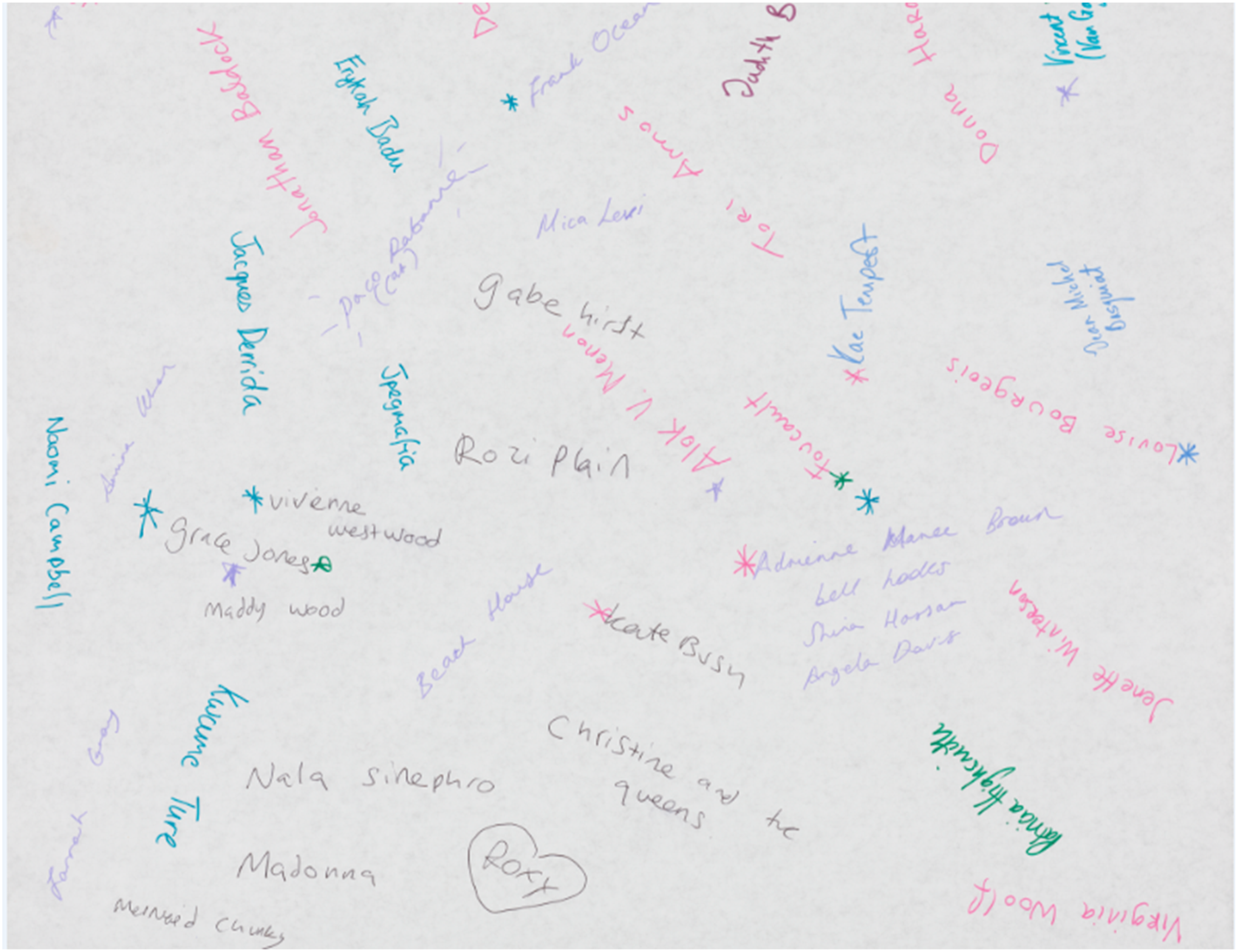
Reflecting
We created spaces to explore difference, value pasts, and build exploratory narratives of hopeful futures in a participatory creative workshop and through the production of artistic outputs. The workshop and installation were spaces of recuperation of our imagination (Haraway, 2016: 24) in which we engaged in a relational exploration of how we (re)tell our histories. These activities and outputs did not aim for consensus, coherence, or static definitions, nor did we regard them as serious or intrinsically constructive. They describe routes by which we might collectively [re]produce stories of kinship through rupture, retelling and [re]layering of existing stories. By refusing clear starting points and the suggestion that any conceptualising queer kinship has an end point, we demonstrate the value of remaining in the moment of deconstruction and reconstruction. Not as a place of static impossibility, but as a dynamic space which supports us in making sense of our orientations from the past to the future, and who (and what) we might collaborate with in the present.
To trouble a simple binary of queer kinship present and future against a heteronormative kinship past requires embracing the ambivalence, multiplicity and messiness which exists between and across these two idealised positions. It is in this complexity that kinship is done and relationality is built. We are at times buffeted back and forth between heteronormative structures of kin and queered possibilities – as we saw in the oddkin mapping activity. At others, we find ourselves immersed in a reinvention which blends traditions and pasts with new imaginations – as with the proverb activity. It is in spaces – like Incubator for Anothertime – that we might explore all of these positions and seek understanding of our journeys between them.
Through creative, playful and relational autoethnographic activities 1 we offer opportunities for witnessing and mutual legitimation. Our subjectivity in this research was a core part of what it was possible to do in this workshop and installation. We do not demand others discard their pasts, subscribe to our futures, or disclose their pain in order to join the creative exploration of queer kinship values and staged relationalities. We insist on an ethically accountable co-engagement with queer others in which we collaboratively explore queer relationality without expectation of what we will jointly produce.
In sum, our methods demonstrate ways to engage with the debris of personal and public pasts (e.g. the relationship of an individual to a celebrity or cat, and the ways we use proverbs) in collective processes of rebuilding and unbuilding kinship. These methods are participatory experiments through which we can continue to change and challenge the fixity of meaning and invite critique, creative reinvention, and future-orientated imagining. Collectively, our activities embrace randomness, interruption, change. We represent this randomness, interruption and change in the constricted set of activities we chose to write about here, and in the refusal to offer a coherent story of queer kinship resulting from these them. We do not suggest kinship is endlessly malleable, or expands to include all possible formulations, but we also do not position ourselves as arbiters of where those limits might be. Our workshop and Incubator for Anothertime dramatize and record personal and shared histories, and collectively offer unfinished, chaotic, glitchy, and always-becoming stories of queer kinship.
Looking backwards: Towards futures
As I (Lizzie) sit and write this piece, I reflect on the non-linear structure of writing. Today it is a sunny spring day, I am looking at bright green leaves swaying gently in the breeze – a green that will soon disappear as spring crystallises into summer and the leaves grow thicker, waxier, darker as they mature. I know there is another ‘today’ in which a future me will re-read these words and edit them into a new shape. The sky will be a different colour. The breeze will have died down and picked up again, flowers will have bloomed, trees will have stretched their branches out; imperceptible daily changes cumulatively bringing new forms. These words will be new and old, broken and put together again retaining only the present moment; they are like kin networks which are often felt to be enduring but exist only temporarily, continually being made and remade with various comings and goings, pieces of the past, rupture and ambivalence. It is from this static but changing place that I write for Milou, my co-author and collaborator; I write for unknown reviewers; I write for a future audience. I am in the future and the present, I am reading myself in the past. I craft something which will (hopefully) appear coherent and whole but is an amalgam of years of reading and thinking and months of writing and redrafting. Our workshops and creative processes are active, changing, fluid, but the outputs – the proverbs, transcripts, family webs, Incubator for Anothertime, and this article – can appear static. At least in the moment of meeting them.
Queer kinship exists in a similar eddy. Between the anchoring or reinvention of past, present, and future, observed in a snapshot or glimpse of apparent coherence. Between tradition and normativity and radical transformation. In attempting to imagine methods which facilitate acknowledgment of this fluidity we are always caught in the bind of doing and telling. Our methods are not a model for the future, they are already complete and in the process of changing. As we tell the story of method, of kinship, of belonging, of inheritance, you read it, and we forget it, we re-remember it, and reshape it. Method, kinship, stories are always something new and old, continually becoming.
By looking backwards – at the knowledge, debris and experience we all carry – we allow for the contrariness of the ways we might imagine queer futures and live together in queer kinship now. Our story for the [queer] future is chaotic but playful. A cycle of doing and undoing towards expansive imaginaries, from and with the past. We are looking forward (and backwards) to what more we can produce as we continue to explore through these creative and (in)coherent methods.
Footnotes
Acknowledgements
The authors are grateful to the organisers of Queer Frontiers conference in Bristol for providing the opportunity to share an early version of this paper, and to Cathryn MacLeod and Avi Boukli for providing feedback on early drafts.
Declaration of conflicting interests
The author declared no potential conflicts of interest with respect to the research, authorship, and/or publication of this article.
Funding
The author(s) disclosed receipt of the following financial support for the research, authorship, and/or publication of this article: This workshop was supported from the School of Economic Social and Political Sciences Strategic Research Development Fund.
