



Abstract
Effective public sector contracting requires government personnel trained with the right skills for performing contract management. We propose a conceptual framework of three clusters of public sector contracting competencies: technical, interpersonal, and strategic, and apply them to formal and relational contracting, the two most prominent contract management approaches. We then examine how higher education programs across the world are training government contract managers. We analyze the course content of 26 public sector contract management programs in higher education institutions across nine countries and three continents. The findings suggest that contract management programs primarily emphasize formal contracting competencies, focusing mainly on technical skills and secondarily on strategic skills, whereas interpersonal skills are covered less and typically only at more shallow levels. A more balanced contract management education with more interpersonal skills can enhance public sector competencies along the spectrum of formal and relational contracting.
Introduction
The performance of public organizations depends on their employees possessing the right skills and knowledge for the challenges of their job (Wright, 2001). Governments perform better when the public workforce is trained to carry out the required tasks (Kruyen and Van Genugten 2020; Dimand et al. 2023). Public affairs programs around the world—the higher education institutions offering degrees in public administration, public management, and public policy—are responsible for preparing government administrators to meet the challenges of the modern state (Woodring and Feeney 2023). Preparing the public workforce with the right knowledge, skills, and abilities for contracting is an important task given that, among the OECD countries, government purchasing accounts for 5% to 20% of national GDP and 20% to 45% of government expenditures (OECD 2019, 172–173). As governments acquire a broad range of products and services from the market, contracting has become a core strategic competency for public organizations, on par with managing information technology, finances, and budgeting (Kelman 1990; Harris and Brunjes 2022).
While public management scholars have broadly identified the human resources for general public management (Schnell and 2023 Gerard 2022), and within certain areas like inter-organizational collaboration (Getha-Taylor 2008), there has been less focus on the skills and knowledge for government contracting (though see Dimand et al., 2023). We therefore propose a framework for identifying public sector contracting skills and knowledge, drawing on the literatures on contract management, human resources, and transaction costs economics. Our framework identifies three types of contracting skills and knowledge—what we call competence clusters: technical, interpersonal, and strategic. We then apply our framework to examine how higher education institutions deliver contracting education, using a purposeful sample of 26 public sector contracting courses and programs spanning three continents and nine countries. Our analysis identifies 20 skills across competence clusters, which as a group are applicable for many contracting challenges and tasks discussed in the contract management literature, including topics such as supply chain management, contract design, and monitoring vendor performance.
To illustrate the value of our framework and analyses, we investigate how higher education institutions prepare public managers for two prominent contract management paradigms: formal and relational contract management (Lamothe and Lamothe 2012b). In the formal approach, managers look to write a contract with as much detail as possible and strictly enforce the seller's adherence to the terms. In the relational approach, managers use a less detailed contract and look to build a cooperative and trusting relationship with the vendor that achieves mutual gains (Carson et al. 2006; Frydlinger et al. 2019). Proponents of formal and relational contracting do not explicitly address human resources and education needs for these approaches, even though governments are more likely to experience better contract outcomes when their workforce is more skilled for the tasks (Jeffries and Reed 2000). Our framework suggests the contract skills and knowledge that contract management scholars should be studying and teaching in the classroom. Our analysis shows that higher education programs offering public sector contracting curricula focus on topics more relevant for formal contracting, including technical and strategic contracting skills, legal knowledge, contract design, and product specification. Relational contracting subjects, including interpersonal skills, communication, networking, and team building are covered less frequently (Holmer and Adams 1995; Christie 2012).
Our article offers several contributions for contract management research and practice. Despite longstanding calls for greater attention to contract management in public affairs programs (Thai 2001), an analysis of US higher education institutions a decade ago revealed that only 25 of 165 NASPAA-accredited master's degree programs offered courses that covered procurement and/or contract management topics (Snider and Rendon 2012). We build on this research by analyzing the content of contract management courses to identify the skills taught in a purposeful sample of public affairs programs across nine countries and three continents. By relating the human resource components of contract management to transaction costs economics and the literature on formal and relational contracting, we identify areas where current education programs fall short in preparing the public workforce for the tasks and challenges of contract management. Our analyses also suggest strategies for higher education programs to design and deliver education to prepare future public contract managers to engage the full spectrum of formal and relational contracting. More broadly, these analyses show how our contracting skills and knowledge framework can apply to other contract management challenges, such as sustainable/green procurement (Rodriguez-Plesa et al. 2022), innovation (Selviaridis et al. 2023), and digital technologies (Darnall et al. 2023).
This article is organized in five sections beyond this introduction. We start by developing a competency framework for formal and relational contracting approaches. The framework identifies three core clusters of human skills for public sector contract management: technical, interpersonal, and strategic. Next, we present our method for collecting and analyzing education programs for contract management in the public sector. Then, using our competency framework for public sector contracting, we analyze the type of competencies and skills covered in the education programs relative to the formal and relational contracting approaches. The final section concludes the article by summarizing our results, discussing limitations, and identifying avenues for future research.
Theoretical Framework: Human Resources for Public Sector Contract Management
The contribution of contracting to public value (Jørgensen and Bozeman 2002) is largely contingent on the people—procurement managers and contract management staff—charged with overseeing and implementing purchasing activities. When spending government money for purchasing, public contract managers aim to achieve the contracting “holy trinity” of cost, quality, and timeliness, while also balancing the need for additional politically mandated values, such as equity, transparency, and sustainability (Erridge 2007; Brunjes and Kellough 2018; Rodriguez-Plesa et al. 2022). For example, when purchasing common office products, some governments require that managers pursue social equity through set-aside contracts targeting specific groups, such as underrepresented minorities (Smith and Fernandez 2010; Hawkins et al. 2018). Sometimes efforts to promote different broader social values conflict with each other, particularly in politically contentious arenas. Consequently, public contract managers must either frame the tradeoffs for key decision makers to consider, or, as is often the case, use their discretion to manage these trade-offs themselves (Resh and Marvel 2012).
From a broad perspective, the activities of public contract management may appear simple. The contract manager identifies a problem or need and then selects a product, perhaps negotiating with the seller for the price and other terms of the exchange. The government receives the product, makes its payment, and evaluates how well the product addresses the problem (Anguelov 2020). However, purchasing in the public sector often requires a broad range of additional tasks, such as engaging with diverse stakeholders (e.g., service clients, voters, and politicians), understanding advanced technologies and complex social conditions, negotiating with multiple suppliers, and building and managing the markets themselves (Girth et al. 2012; McKevitt et al. 2012). The type of activities required to execute a purchase may also depend on a variety of external factors, such as whether the products are easier to describe, produce, and purchase (Brown et al. 2016), the market conditions of the purchase (Hart and Moore 1999; Girth et al. 2012), and the public laws and regulations that constitute the institutional “rules of the game” (North 1991).
In response to this complexity, the academic literature offers two broad approaches to purchasing and contract management, representing a continuum from formal to relational (Jeffries and Reed 2000; Lamothe and Lamothe 2012a, 2012b; Terman and Feiock 2016; Chuang et al. 2020; Frydlinger et al. 2021). The formal approach looks to fully define the government's and seller's rights and obligations in the exchange. This typically involves specifying the production process, product quality, pricing, and delivery terms, and which party bears unanticipated costs, risks, and benefits. When this approach works well, the precision in the contract channels participants’ incentives towards value for each. However, the formal approach's pursuit of more complete contracts also has some potential downsides. Detailed contracts cost more to design and implement. Search and screening costs are higher because detailed contract terms require more information about the product's features and quality, their costs and benefits, and potential delivery terms. Bargaining costs are higher because these quality, price, and delivery terms must be precisely specified and agreed upon. More complete contract rules can also stifle the seller's ability to use her expertise and creativity to find extra sources of value for the buyer. Governments need to weigh the benefits of specifying the contract details against the additional costs of writing, negotiating, and monitoring.
The relational approach replaces a detailed contract with a cooperative relationship between the buyer and seller (Poppo and Zenger 2002; Brown et al. 2013, 7–8), where cooperation is based on the expectation that sacrificing short-term opportunities will generate greater longer-term gains. Such gains may stem from expectations that the partner will respond to consummate behavior with their own consummate behavior. Or participants may expect that their consummate behavior will yield greater returns outside the current contracts, perhaps through future contracts and favorable terms that stem from a reputation for being a good contract partner. In the relational approach, the contract's residual risk is shared between the buyer and seller. If unforeseen events significantly change the value distribution from the exchange, the buyer and seller negotiate a solution that preserves the spirit of shared value. Relational contracting comes with downsides, of course. One downside is the potential for perfunctory behavior in which the buyer or seller exploits contract ambiguities for their own small gain while imposing greater losses on the other side. This is a significant risk when products are complex and multiple factors outside the control of the buyer and the seller can influence the contract's outcome (e.g., supply chains sensitive to weather disruptions). Likewise, relational contracting requires relationship-specific investments (Frydlinger et al. 2021), which risks lock-in, hold up problems, and limited competition in future exchanges. Because the relational approach often includes less specificity about the product and the exchange, perfunctory buyers or sellers may leverage the uncertainty to secure their own gain under the pretense of partnership.
While there are some discussions about when and how much formal and relational contracting should occur (Carson et al. 2006; Lamothe and Lamothe 2012b; Frydlinger et al. 2021; Frydlinger and Hart 2024), the extent to which governments engage in formal and relational contract management is difficult to discern. 1 Formal and relational contracting are not binary categories; any exchange has room for formal and relational elements, and the fingerprints of relational contracting may not be easy to detect. An exchange laden with formal contract terms and strict enforcement may still leave opportunity for longer-term cooperation; a seller, for example, may discover ways to improve the product in ways neither anticipated or the buyer may discover that flexible delivery dates benefit the seller without hurting the buyer's value. Likewise, a relational contract may still benefit from specifying the important elements of the exchange. Bridging the formal and relational approaches, “formal-relational contracting”—a recent innovation in contracting theory and practice—aims to specify the process of cooperation in legally enforceable contract terms (Frydlinger et al. 2019; Frydlinger and Hart 2024).
Government procurement regulations push governments towards more formal contracting practices (Tadelis 2012; Potoski et al. 2023), such as by mandating more detailed contract terms to promote transparency, fair labor practices, or environmentally beneficial production methods. Meanwhile, the contract may have room for important relational practices, such as cooperative behavior that can be difficult for outsiders to observe. Even with the specified terms of a formal contract, cooperation may yield more effective ways to improve product quality as well as values like transparency, fair labor, and environmental performance. Contract managements may also find ways to work around government regulations that prohibit using sellers’ past performance or reputation in making awards, perhaps by using proxies that signal sellers’ cooperative potential. Understanding government workforce's skills and training can thus shed light on where additional education can add value and potentially shape future contracting practice.
To conceptualize the competencies for the formal and relational contract management approaches, we start from the human resources literature, where human capital has long been acknowledged as vital to organizational performance (Wright et al. 2001; Le Deist and Winterton 2005). We differentiate between knowledge, skills, and competencies (e.g., McClelland 1973). We use the term “skill” to refer to a person's potential to perform a task well; typing is a skill in the sense that some can learn to do it quickly and accurately. We use the term “knowledge” to refer to acquired information—either through direct observation or the provision of information—about a subject area, task, or activity (e.g., understanding how various law and regulations apply to a public contracting context). We use the term “competency” to refer to the ability to properly implement a cluster of skills and knowledge in a workplace environment or as part of a workplace task or function (Gubbins and Dooley 2021). In accordance with our focus on public procurement and contract management curricula, we understand contract management knowledge and skills as competencies that can be acquired through formal education and training (McKevitt et al. 2012), as opposed to broader definitions of competencies that includes personal traits and motives (Le Deist and Winterton 2005).
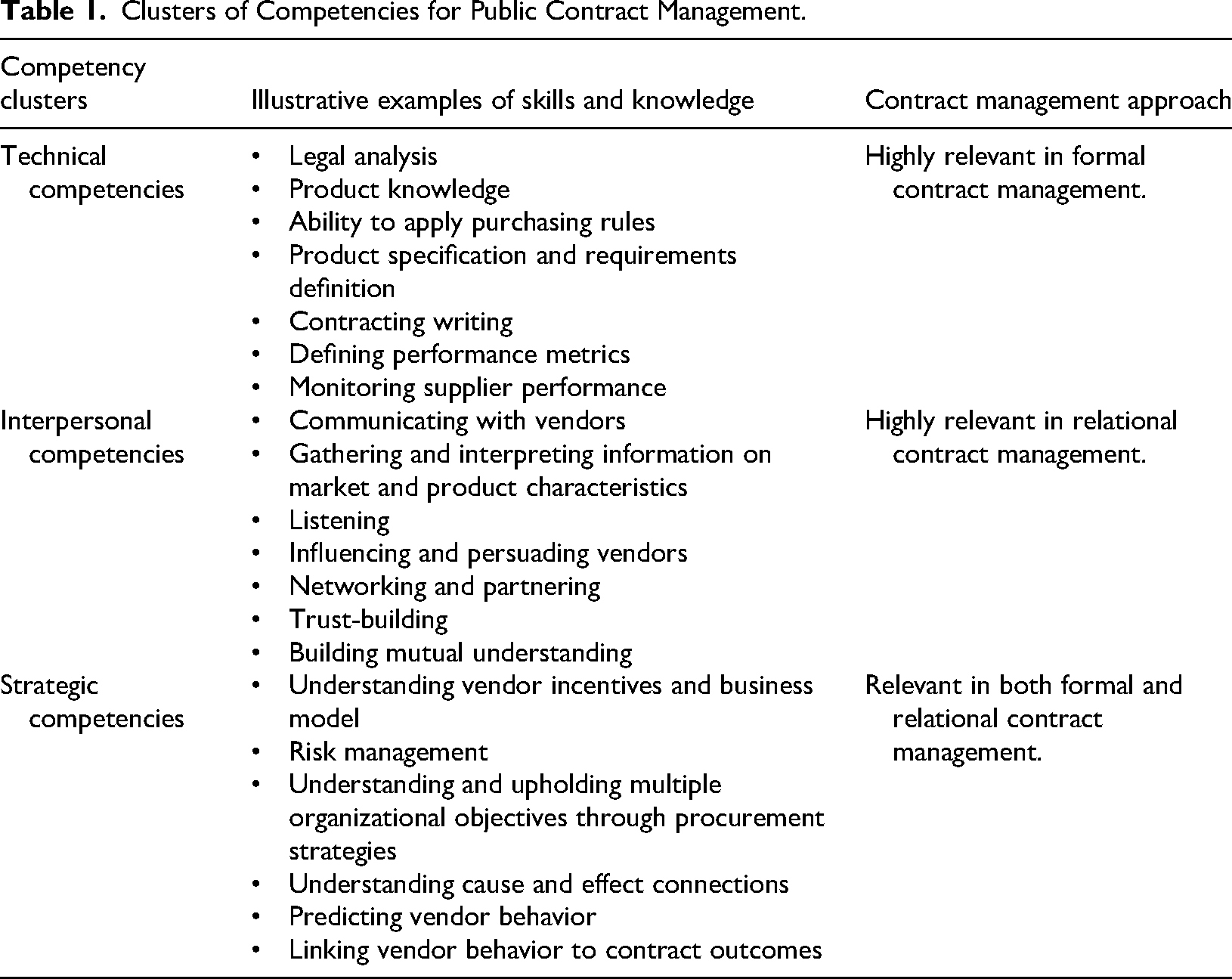
We conceptualize three core competency clusters that reflect the knowledge and skills associated with formal and relational contract management: technical, interpersonal, and strategic competencies. Our classification uses broad competency categories to ensure coverage of the various skills required by public contract managers, thus resembling categories found in studies of job-relevant competencies in other fields (see, e.g., Leiponen 2005; Burger et al. 2019). In presenting these competencies below, we discuss their relative importance in formal and relational contract management approaches.
Technical Contracting Competencies
Technical competencies are the hard skills and knowledge required to perform the job-specific tasks and administrative functions that fall within an organization or unit's core work processes (Tassabehji and Moorhouse 2008). Technical skills are particularly relevant for tasks that are formalized, specialized, and in some cases, unique to the organization or unit's production process (e.g., operating a specific machine). While technical skills are often associated with manufacturing processes that are technology-dependent (Williams 2001), many organizations have work processes that necessitate some degree of specialized knowledge to perform their core tasks.
Many aspects of contracting are formalized and specialized, including determining the appropriate contracting vehicle and procedures, writing requests for proposals (RFPs), and crafting contract terms. This is particularly the case in public sector contracting where detailed regulations govern what steps and actions are allowable, and which are not (Warren 2014). Effectively managing contracts in such contexts requires technical skills to understand a dense taxonomy of contracting constructs (e.g., scope of work, terms, and deliverables), and to navigate and deploy different formal processes and procedures (McCue et al. 2018). A good portion of this knowledge and understanding is legal in nature as contracting rules are derivative of legal acts and codified in regulations that have the force of law.
Among the wide array of technical skills required for contract management, designing and assembling a contract to govern the exchange is especially important. This can involve specifying details of the product (e.g., its attributes and capabilities), the terms of exchange (e.g., how much it will cost and when and under what conditions payment will be provided), and who gets to make contractual decisions as the production process unfolds (Brown et al. 2016). Contracting also requires frequent use of administrative skills in fulfilling more basic tasks such as correctly entering required information into electronic procurement systems, declaring and upholding deadlines for receiving bids and finalizing contracts, or collecting performance data through, e.g., user feedback (Bals et al. 2019).
Formal contracting thus relies more heavily on the technical competencies of the government workforce managing the contract. The abilities to write effective contracts, monitor and enforce produce quality, and ensure compliance with contracting laws and regulations, are all of higher importance when the contract is more firmly grounded on detailed and fully specified exchanges. While these activities are still relevant in relational contracting, they are less central to the exchange as the government relies more on the cooperative relationship to ensure value from the exchange.
Interpersonal Contracting Competencies
Interpersonal competencies involve soft skills and knowledge for interacting, building relationships, and communicating effectively with others (Laker and Powell 2011; Heckman and Kautz 2012). Communication skills are important for conveying information about the desired product and gathering information about alternative products and producers. Interpersonal skills include abilities to transmit and receive information and meaning through verbal (e.g., reading, writing, speaking, and listening) and nonverbal (e.g., body language and behavior) processes (Bedwell et al. 2014; Riggio and Lee 2007). Much of interpersonal skills, and emotional intelligence more broadly, requires understanding others’ language, culture, organizational framework, and values for interpreting the world (Tassabehji and Moorhouse 2008). Interpersonal or behavioral interactions most typically occur between individuals. However, these individuals may be operating within or on behalf of socially constructed institutions, such as teams, units, and organizations, making the ability to work through institutions an important skill (Stek and Schiele 2021).
Interpersonal competencies are relevant for formal contracting. Contract managers buy products to meet the needs of the government workers and their clients. They interact with sellers to negotiate contract terms. They evaluate products based on how users experience them. Soft skills are important because contract managers interact with diverse stakeholders (e.g., vendors, service recipients, other government employees, political overseers, and technical and scientific experts) to elicit their input on user needs and feedback on performance (Amirkhanyan et al. 2019). Communication, for example, helps facilitate the flow of information inside the formal contract by acquiring information to help specify the product, exchange terms, and vendor reporting expectations. Communication is important for negotiations and conflict-resolution between the purchasing government and vendors, alongside the ability to persuade and influence the other party about the appropriate contractual terms (Tassabehji and Moorhouse 2008; Dubey et al. 2022). Moreover, when information is incomplete and sellers have incentive to opportunistically exploit loopholes in the contract, public contract managers must acquire information from a variety of sources, including service recipients, end users, and the sellers themselves, and contract managers must anticipate how sellers will respond under different contract incentive structures.
However, interpersonal skills are more relevant for relational contracting than formal contracting. In relational contracting, the contract is more incomplete and the exchange is more firmly ground in social norms and interaction between the buyer and seller (Lamothe and Lamothe 2012b). The increased discretion that follows from flexible contracts necessitates trusting relations and close communication to align expectations (Jeffries and Reed 2000). Interpersonal skills help managers identify sellers’ propensity to cooperate in the shared value spirit of a relational exchange, which is essential for building trust (Bedwell et al. 2014). Interpersonal competencies also help outside the contract by discussing problems and products with stakeholders and soliciting insights from external experts. Personal attributes such as open-mindedness can likewise be important to the contracting process to help facilitate and adjust the relationship so that each side can peruse shared value with confidence that the other side of the exchange is doing so as well (Bals et al. 2019).
Strategic Contracting Competencies
Strategic competencies constitute the skills and knowledge needed to make integrated sets of choices in pursuit of organizational goals (Truss et al. 1997), where outcomes are conditional on external circumstances and the reactions of others. Strategic skills thus aid in interpreting information, understanding cause and effect, and anticipating the intentions and behavior of others, how that affects desired outcomes, and planning an appropriate response. Strategic skills are more complicated in social interactions, such as contract exchanges, because people, and the organizations they serve, are independent decisions makers and can react in difficult to predict and complex ways.
As public sector contracting increasingly revolves around fulfilling multiple objectives and values beyond “just” acquiring timely and cost-efficient products and services, strategic skills have become essential (Stek and Schiele 2021). Managing contracts to increase the probability of achieving desired objectives requires understanding and responding to the behavior of vendors, service recipients, product users, and other stakeholders (Levin and Tadelis 2010). Understanding vendors’ incentives allows public contract managers to predict how their own actions will stimulate a potential exchange partner's action, and how these behaviors will impact contract outcomes (Petersen et al. 2022). For example, strategic skills can help contract managers navigate institutional rules to craft contracts that align the purchasing government's goals with the business model of the seller.
Strategic skills can be especially valuable when markets function less well, such as when there are few vendors for a product or vendors have opportunities to behave opportunistically (Johnston and Girth 2012). Once an exchange is underway, strategic skills help predict and react to vendor behaviors through contract actions such as conducting monitoring and oversight, setting up meetings with the vendor to address contract ambiguities, and deploying additional incentives. In this way, strategic skills can be more valuable when contract terms are less complete compared to when they are more detailed (Jeffries and Reed 2000; Brown et al. 2016).
Strategic skills are relevant for both the relational and formal contracting approaches. Both approaches rely on contract managers’ ability to understanding vendors’ incentives and how they can change under different circumstances, contract management approaches, and across different contexts. Strategic skills, for example, can help managers identify which vendors are more likely to exploit less detailed contracts for their own gain and which are more likely to pursue a cooperative partnership. They can also help managers design formal contract terms with clear, enforceable, and targeted incentives tailored to specific vendor's propensities to behave cooperatively or perfunctorily.
Table 1 provides examples of skills within each of the three competency clusters in our framework, highlighting the different types of skills and knowledge public contract managers need to perform their job. Contract management requires competencies in each of these three clusters, particularly in risky contexts (e.g., conflicting value expectations, complex products, thin markets). Some mastery of each of the three skills is therefore required for successful outcomes; the ideal combination of skills depends on the particular mixture of values, institutions, and market conditions present in each purchase.
Clusters of Competencies for Public Contract Management.
Methods and Data
To examine contract management content at higher education institutions worldwide, we collected information on 26 public procurement and contract management education programs and courses across nine countries and three continents: North America, Europe, Australia. We used two purposive sampling strategies to identify and select the programs. First, we completed a systematic search in Web of Science for academic research on public procurement and contracting, using a search string consisting of the terms “purchasing,” “procurement,” “contracting,” “privatization,” and “outsourcing.” We used these terms to identify the 25 universities in the world that publish most frequently on public procurement and contracting. Our assumption is that publications indicate active research environments, which are more likely to offer educational programs on this topic. We then manually searched the websites of all these universities for educational programs and courses in public procurement and contract management. Second, we triangulated our search in the Web of Science with an expert strategy to account for higher education institutions that offer contract management courses or programs without an active research environment. We contacted researchers in our own network of higher education institutions in the three continents described above. We requested information on all training programs in public procurement and contract management and then used the snowball method to identify additional programs by asking the researchers we initially contacted to refer to other public procurement and contract management programs and relevant colleagues teaching such programs.
These two strategies resulted in the identification of 26 programs and courses from nine countries across three continents. The 26 public procurement and contract management programs are offered by 22 higher education institutions as shown in Table 2. The majority of the programs included in the final sample originate from the use of experts and the snowball method. Some are entire programs in procurement and contract management or procurement law, while others are courses that are part of, e.g., a master's in public administration or policy. For some institutions, we identified several programs, where the content overlaps to various degrees. In these cases, we performed a qualitative assessment, and if we found significant overlap, we analyzed the most relevant program.
Overview of the Selective Sample of Education Courses and Programs.
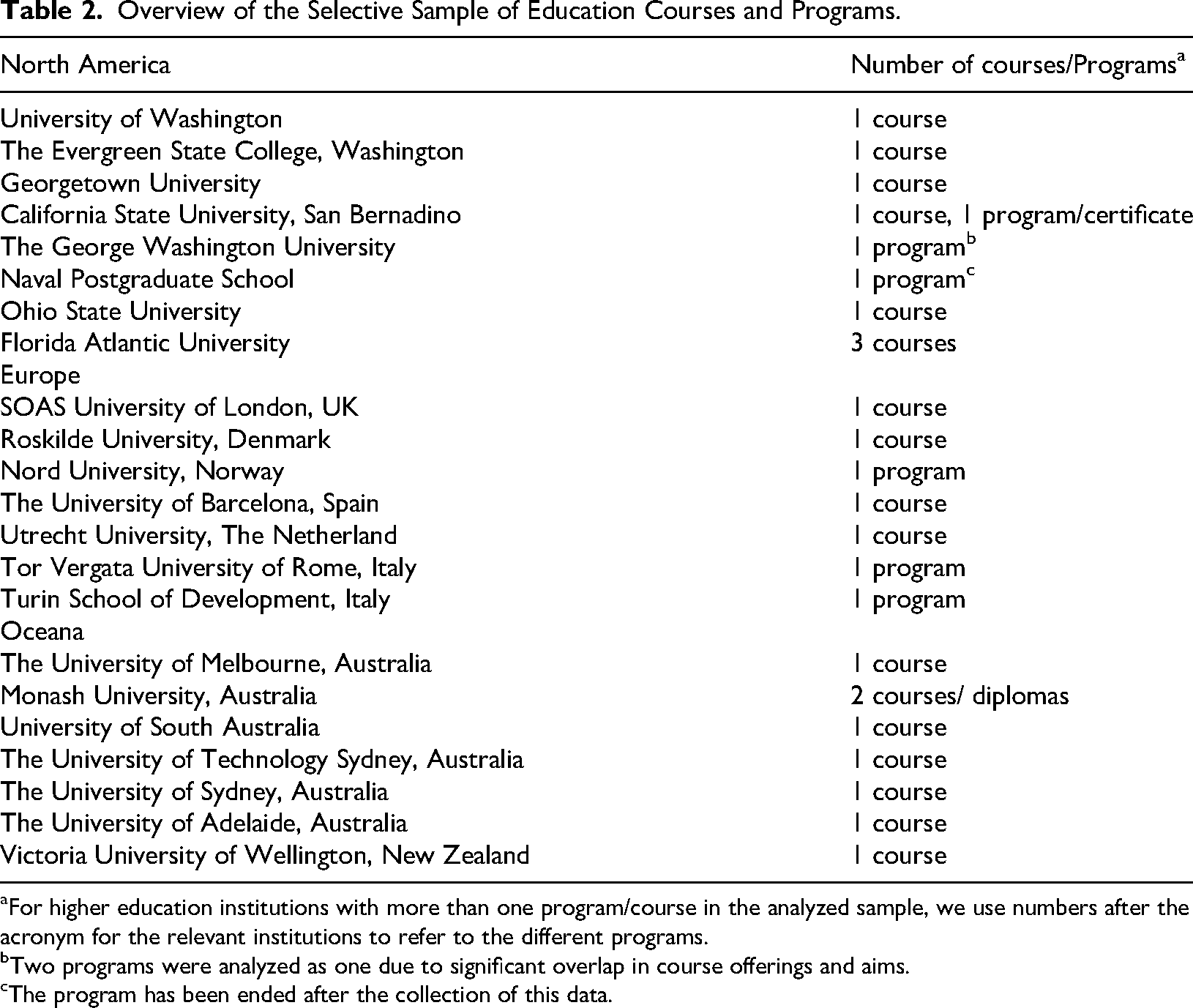
aFor higher education institutions with more than one program/course in the analyzed sample, we use numbers after the acronym for the relevant institutions to refer to the different programs.
bTwo programs were analyzed as one due to significant overlap in course offerings and aims.
cThe program has been ended after the collection of this data.
To facilitate systematic coding and analysis of the identified programs and courses, we collected course descriptions, course plans, curricula, and intended learning outcomes for each program and course, and stored the material in a database for subsequent analysis. The amount of information and material for each program and course varied. The programs and courses tended to have more detailed description of the overall purpose and learning goals, but less (accessible) information about each module in the program. Individual courses typically have more detail about each class, exercises, and readings. The minimum documentation requirement for including a course/program in our sample of courses was access to a course description and a course plan. In cases where only superficial information about the courses was available on the university websites or sent to us by experts, we contacted the course/program coordinators and requested additional information.
Table A2 in the online Appendix shows what type of information we were able to access or acquire for each program. As we only include programs and courses in English and languages the authors of this article understand, it has not been possible to include programs and courses from, e.g., Asia or Latin America. This limitation implies that there is a Western and Anglo-Saxon focus in our study. We return to the consequences of this limitation in the discussion and conclusion section.
We analyzed the programs and courses in two phases, starting with an initial content coding of each program to identify all contract management skills, followed by an analysis of the skills within each competency cluster across programs. Our approach is inspired by the coding steps and use of displays to analyze and present data as prescribed by Miles et al. (2019). In the first phase, we applied the analytical framework to identify and code skills from all programs as technical, interpersonal, and strategic competencies. We focused on extracting the contract management skills taught in each program by carefully reviewing the collected documents for each course or program. For most of the courses and programs, the skills were evident from the intended learning outcomes, and we could verify them using the course descriptions, readings, and course plans. For instance, some programs clearly stated that a learning objective was to develop competencies in, e.g., writing RFPs, which we coded as a technical skill. Other programs and courses had more abstract or limited descriptions, which required identifying implied skills from the curriculum (e.g., reading the course textbook to identify the key skills taught in the program). To ensure rigorous and reliable coding of the programs, the coding process was completed in four steps:
All four authors of this article calibrated how to apply and understand the three clusters of contract management competencies by coding a sub-set of the sample of education programs. This entailed clarifying how to decide when some skills belong in more than one category. For instance, dispute resolution can entail technical skills, e.g., following legal procedures, and can also have an interpersonal dimension, such as when dispute resolution requires understanding emotional dynamics. If both aspects (legal procedures and emotions) were specified in a program description or in the curriculum, then dispute resolution was categorized as both a technical and an interpersonal skill. Based on the calibration, two researchers continued coding the remaining programs and courses, each taking primary responsibility for half of them. To increase intercoder reliability, the two researchers exchanged programs to cross-check and validate each other's coding. Fourth, in cases of coding disagreement, where skills were categorized differently, the researchers discussed said skills until reaching consensus.
In the second phase, we conducted an analysis of the coding across programs and courses. The goal was to provide a more condensed and intuitive presentation of the findings by aggregating the different types of skills identified in the first phase and visualizing the concentration of programs for different types of technical, interpersonal, and strategic competencies. For instance, in most programs we identified legal skills and knowledge of contracting regulation, policies, and procedures. While programs described these with slightly different terms, the underlying skill set was the same. Thus, we aggregated the different ways of describing legal skills into one type of skill referred to as “Contract law and procurement regulations, policies, and procedures” and linked this group or type of skill to all the relevant programs and the competency cluster. In this process, we strived to balance specific and general levels of skills. Thus, we sought to avoid overly broad categories, such as “contract management.” We note that contracting-relevant skills may be taught elsewhere in a program, perhaps as part of the general management curriculum. Our analyses may therefore undercount the relevant course material. The outcome of this process is displayed in Tables 3 and 4 in the results section, while Table A1 with the full coding of each program from the first analytical phase is found in the online Appendix.
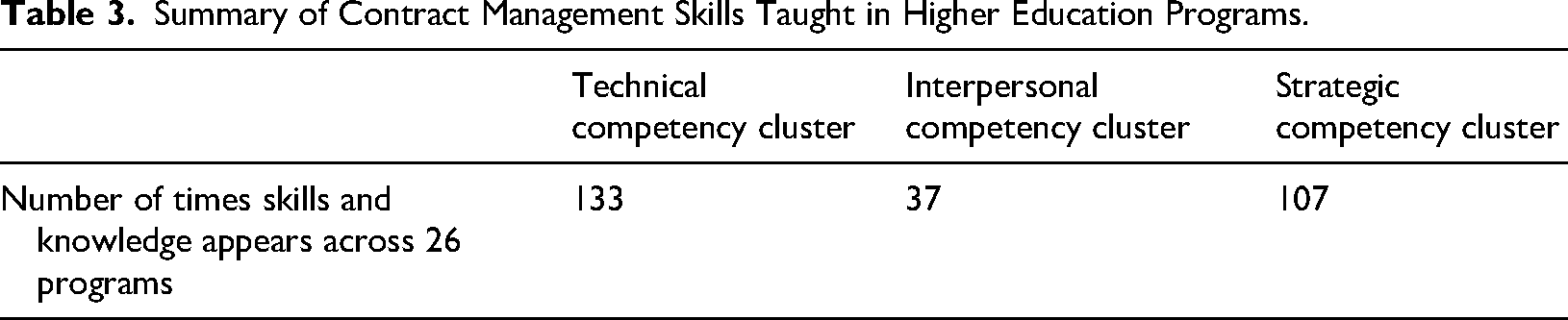
Summary of Contract Management Skills Taught in Higher Education Programs.
Number of Higher Education Programs and Courses Covering Contract Management Skills.
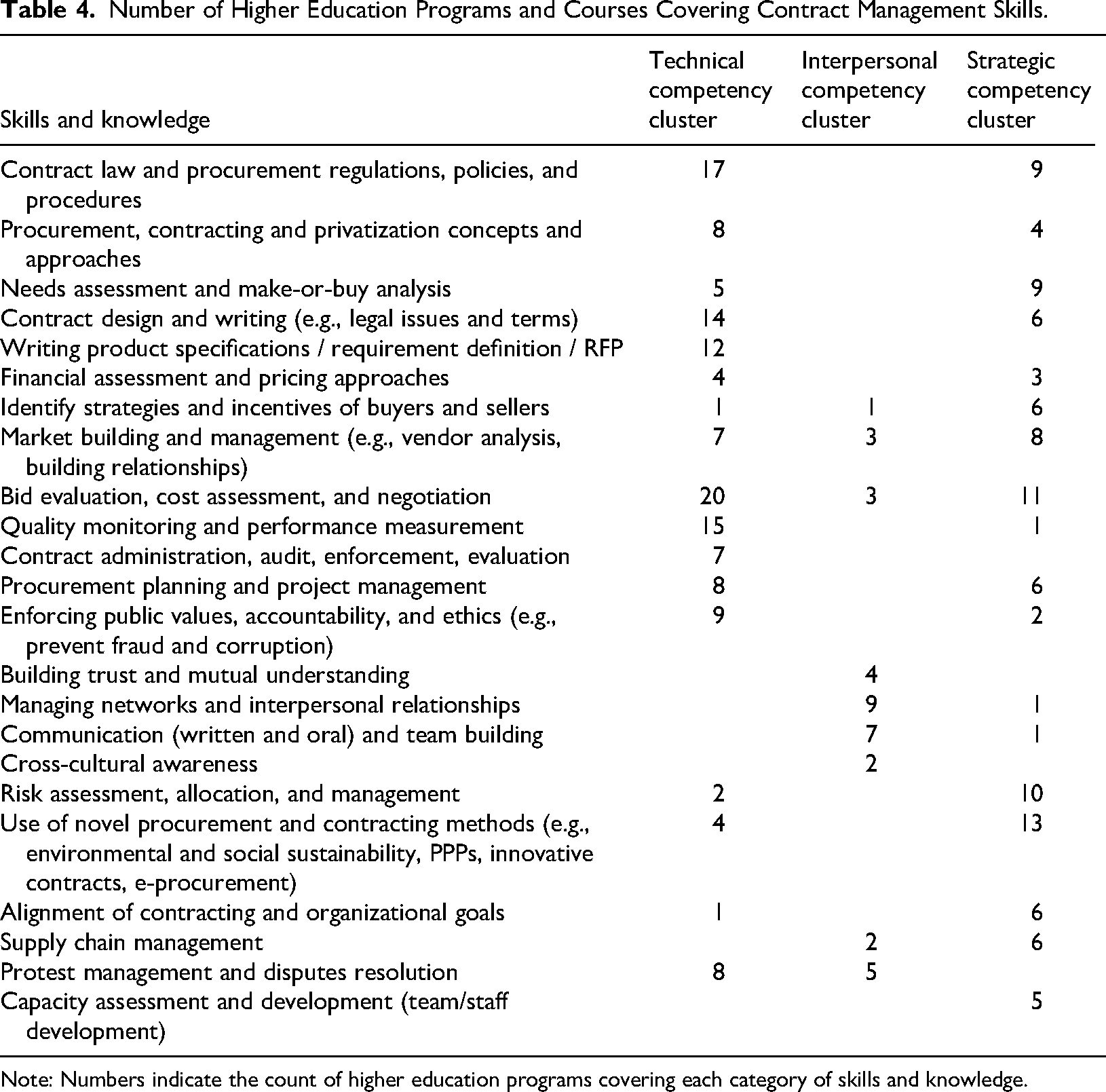
Note: Numbers indicate the count of higher education programs covering each category of skills and knowledge.
Although we applied a deductive approach in our analysis, we remained open to findings and insights beyond our framework of competency clusters. Our initial reading and raw coding of the sample suggests that our competency categories cover main themes and trends across programs. The courses and programs focus on the phases, activities, and context (e.g., procurement regulation) of government contracting corresponding to the skills outlined in our framework. We did observe, however, that theoretical perspectives from economy such as agency theory, public choice, and transaction cost economics, dominate the curricula in our sample. We return to the potential implications of this observation in the discussion.
Results
Tables 3 and 4 report the findings from our analysis of higher education programs and courses on public procurement and contract management. Table 3 provides an initial overview of how often different types of skills and knowledge within the three competency clusters appear across all analyzed programs and courses. Technical skills appear 133 times across the 26 programs, interpersonal skills appear 37 times, and strategic skills appear 107 times. Overall, these findings suggest that public sector contract management education and training prioritize technical skills, and to some degree strategic skills, relative to interpersonal skills. These results suggest that the skills more relevant for formal public sector contracting appear more often than the skills more relevant for relational contracting.
Table 4 provides the details for each competency cluster. Specifically, the table shows the 23 different types of technical, interpersonal, and strategic skills and knowledge deduced from coding the programs’ content and how many educational programs and courses cover these different competencies. Among programs that focus on technical competencies, we find that most of the identified skills and knowledge focus on “hands-on” activities, functions, and tasks. Table 4 displays this with a high concentration of programs within the technical competency cluster for the following skills: contract design, writing product specifications/RFPs, bid evaluation, quality monitoring and performance measurement, and contract administration. In turn, to perform these tasks properly, contract mangers require legal, procedural, and product knowledge. For example, the University of Technology Sydney's “Procurement and Contract Management” course focuses on technical skills such as constructing a contract and evaluating bids.
The results in Table 4 reinforce the insights from Table 3 that formal contracting skills appear more frequently in public procurement and contract management curricula. The most important technical skills relate to contract design, regulatory compliance, monitoring product quality, and enforcing contract terms. Skills and knowledge within the interpersonal competency cluster are covered in 18 out of 26 programs. However, as Table 4 shows, most of these programs only cover a limited number of different types of skills within interpersonal competencies compared to technical and strategic competencies. The relational skills that appear most frequently in the curricula, such as interpersonal relationships, team building, communication, building trust, and dispute resolution, are certainly relevant to relational contracting. On the whole, these relational skills are taught less frequently than the technical skills more relevant to formal contracting. An exception is Adelaide University's course “Project procurement and resourcing,” where we find a marked focus on different types of interpersonal skills compared to most programs. The syllabus and examination form teach students about communication with stakeholders, trust-building, negotiation with a focus on influencing others, and how to manage collaboration in cross-cultural teams.
Table 4 also shows that 17 out of 26 programs and courses, broadly distributed across all the analyzed continents and countries, teach contract law and procurement regulations, policies, and procedures. Course content often focuses on knowledge of and the ability to comply with relevant public procurement and contracting regulations. For law degrees and procurement certificates, legal skills comprise one of or the main learning objective, which is for example the case for the George Washington University's “Government Procurement Law Program.”
Strategic skills and knowledge covered in the programs vary from understanding the underlying incentives and strategies of stakeholders to contract negotiation and risk assessment. Table 4 demonstrates that between eight and 13 of the 26 programs teach one or more of the following strategic skills: contract law and procurement regulation, market building and management, bid evaluation and negotiation, risk assessment and management, and novel contracting methods. Thus, some of the skills and knowledge identified in the technical competency cluster also have a strategic focus in several programs. For instance, the “Procurement Certificate” at California State University, San Bernadino, teaches procurement regulation with a focus on the strategic choice between single and cooperative/joint procurement, which suggests a strategic analysis of tradeoffs between these approaches.
A few programs mainly teach public procurement and contract management from a strategic perspective. One example is Monash University's “Advanced Diploma of Procurement and Contracting,” which is oriented towards different types of strategic skills. Lectures and exercises focus on such skills as developing businesses cases to understand business incentives and strategies, organizing, and supporting work groups to foster leadership and innovation, and managing risks. Technical skills and knowledge are covered less extensively in this program and are limited to planning and conducting practical aspects of a purchase and analysis of suppliers/markets.
Table 4 also suggests that several skills and knowledge are relevant to more than one cluster. For instance, designing and writing contracts requires technical skills in drafting contract terms and product knowledge to specify product requirements. These types of technical skills and knowledge are taught in several courses in our sample, as shown in Table 4. Moreover, Table 4 shows that some programs also teach designing and writing contracts as involving strategic skills, because designing contracts involves considering and weighing the advantages and disadvantages of different contract types (e.g., more complete versus more incomplete contracts). Moreover, risk assessment plays an important role in determining scenarios for deviations in cost, quality, or schedule of delivery and contains both skills in the technical competence cluster (how to carry out a risk analysis) and in the strategic competence cluster (how to allocate risk based on the risk analysis and how to manage the contract accordingly). Finally, bid evaluation, cost assessment, and negotiation are taught as both technical, interpersonal, and strategic skills. These examples suggest that many higher education offerings around the world offer students a combination of skills from the technical, interpersonal, and strategic competence cluster to effectively manage contracts.
Discussion
Our analyses of contracting curricula in public procurement and contract management programs across nine countries and three continents suggest that most programs do so in an elective format and the course content focuses more on technical and strategic skills, whereas interpersonal skills are less frequently covered and typically only at more shallow levels. Moreover, some of the curricula are practice-oriented, focusing on procedural and processual technical skills for preparing, implementing, and managing the different phases of contract management from identifying needs to monitoring and evaluating contracts. Strategic contracting competencies are covered in most courses, though with fewer topics relative to technical competencies. Finally, the courses cover fewer interpersonal competencies.
Our analysis suggests directions for improving higher education programs in public sector contract management. A first direction is suggested by the dearth of interpersonal skills topics in education programs. Our analyses show examples of training in interpersonal areas, such as listening, understanding, and positive communication, although such topics are rare. One potential reason for this is that the programs often approach contracting from an economic theoretical perspective using agency theory, public choice, and transaction cost economics. These perspectives focus more on incentives, constraints, and formal contract terms, thus favoring technical and strategic skills and overlooking the importance of soft competencies. Integrating more theories and insights from public management and behavioral economics on network governance, human resource management, and social norms may help remedy this imbalance. Teaching interpersonal skills may also require different pedagogical approaches than teaching strategic skills. Techniques for teaching interpersonal skills may include role-playing, classroom simulations, and collaboration exercises that develop skills in areas like verbal and non-verbal communication, body language, and positive and negative communication (Bedwell et al. 2014). A second direction is towards improvements in strategic skills. Strategic skills are essential for connecting contracts and actions to some framework for interpreting the intentions and behaviors of the exchange partner. In this way, strategic skills are essential for receiving, processing, and translating information that contract managers acquire through technical skills (e.g., facilitating a formal contract negotiation with prospective suppliers) and interpersonal skills (e.g., a strategy for collecting and sharing communication with sellers to improve contract outcomes). Such strategic skills can also be acquired through formal training, such as through training in game theory (e.g., tit-for-tat and prisoners dilemma games), designing financial and non-financial incentives, and negotiations business competitive strategy (e.g., competitive advantage, reputation, strategic resources, and short versus long-term time horizons).
Finally, to perform the contract management job effectively, contract managers need the proper balance of contracting skills. Governments need access to the full range of contracting skills and knowledge to design contracts and execute contract management activities to fit the product being purchased and the circumstances of the exchange. All approaches to contract management, including formal and relational contracting, rely on a blend of skills—every formal contract has opportunities for relational cooperation, and every formal contract has some formal elements backed legal enforcement. Just as importantly, contract managers need the full range of management approaches and activities to identify and implement innovative practices. For example, formal-relational contracting is a recent innovation in business-to-business contracting in which the buyer and seller look to build a cooperative relationship by using the tools of formal contracting (Frydlinger et al. 2019; Frydlinger and Hart 2024). Implementing formal-relational contracting is likely to require a blend of interpersonal, technical, and strategic skills so that the contract's legally enforceable relationship provisions promote mutually beneficial cooperation and reciprocity between the buyer and seller.
Conclusion
Higher education programs around the world play an important role in preparing the public sector workforce (Woodring and Feeney 2023). This article has presented a conceptual framework of public sector contracting skills and competencies and assessed how well higher education institutions across nine countries and three continents are preparing the public workforce. The results reveal 23 different types of public sector contract management skills and knowledge related to three overall competency clusters: technical, strategic, and interpersonal. Many education programs in our sample cover technical competencies quite extensively, and strategic competencies to a somewhat lesser extent. Meanwhile, the interpersonal competencies that are deemed important in human resource development (Riggio and Lee 2007) and learning theory (Christie 2012) are more seldom covered in higher education programs in public contract management. Consequently, our findings suggest that higher education programs emphasize development of formal contracting approaches over relational contracting approaches. The implication is that current education programs and courses are not fully meeting the demands of the public sector; competencies associated with a relational contract management approach are highly relevant for purchasing more complex products in risky settings, where flexible contracts based on cooperative relationship may be more likely to create value (Lamothe and Lamothe 2012b; Frydlinger et al. 2021).
Our results should be interpreted with an understanding of this study's limitations. First, the 26 higher education programs in the analysis are to some extent a convenience sample, with coverage limited by geography and language. The focus on programs taught in English and other languages that are familiar to the authors implies that we were not able to cover programs in, e.g., China, Japan, South Korea, and South America, where governance, market institutions, and culture may be very different from the Western context examined in this study. Market exchanges in cultures other than those examined here may require a different set of knowledge, skills, and competencies for effective public sector contract management. Coverage of these countries and regions is important in their own right and helps facilitate comparative analysis in further research (Hatcher and McDonald 2022). Second, our analytic approach may also undercount how much skills relevant to contract management appear across an entire public affairs curriculum. Relational contracting benefits from collaboration skills, which can be learned in courses such as collaborative governance. Policy analysis skills are relevant for formal contracting's reliance on monitoring vendor performance. Identifying how these skills appear in other courses is not achievable with our analytic approach, and of course, learning these skills in a public affairs contract management course helps target them to the challenges and circumstances of government purchasing.
An important direction for further research is a more complete assessment of how public sector contract management education and training can improve the outcomes of contracting, inspired by recent public management studies on the effects of leadership training (Jacobsen et al. 2022). Effective training addresses contract managers’ needs and the challenges and circumstances they will be facing in their careers. The value of training is likely to depend on several factors, including the extant skills in the contract management workforce, the career stage of the public contract manager, the relational or formal contracting approaches, and perhaps most importantly, the extent to which the needed skills can be enhanced through education and training. A more explicit focus on human resources for public sector contract management has the potential to improve contract outcomes and harness public value in government-business exchanges.
Supplemental Material
sj-pdf-1-jsc-10.1177_29768829251369390 - Supplemental material for Human Resources for Public Sector Contracting: An Education and Training Perspective for Formal and Relational Management
Supplemental material, sj-pdf-1-jsc-10.1177_29768829251369390 for Human Resources for Public Sector Contracting: An Education and Training Perspective for Formal and Relational Management by Lena Brogaard, Trevor Brown, Ole Helby Petersen and Matthew Potoski in International Journal of Commerce and Contracting
Footnotes

Funding
The authors disclosed receipt of the following financial support for the research, authorship, and/or publication of this article: This work was supported by the Independent Research Fund Denmark (grant number 9061-00020B).
Declaration of Conflicting Interests
The authors declared no potential conflicts of interest with respect to the research, authorship, and/or publication of this article.
Supplemental Material
Supplemental material for this article is available online.
Notes
Author Biographies
References
Supplementary Material
Please find the following supplemental material available below.
For Open Access articles published under a Creative Commons License, all supplemental material carries the same license as the article it is associated with.
For non-Open Access articles published, all supplemental material carries a non-exclusive license, and permission requests for re-use of supplemental material or any part of supplemental material shall be sent directly to the copyright owner as specified in the copyright notice associated with the article.
