



Abstract
While there is general consensus that a lack of internal skills and abilities threatens contracting performance, there is relatively little research on the processes and practices by which government develops knowledge in contract design and implementation. Drawing from primary data collected from two state government agencies in the USA, this research identifies the ways public managers use lessons from their own organization and from the wider organizational environment to improve their approach to contracting for public–private partnerships (PPPs). A four-part framework of organizational learning is presented to guide public sector capacity development for PPPs. The results suggest that public and private interests conflict not only in contract design and implementation, but also in the battle for ideas that inform government decision-making. The results also suggest that a number of internal management reforms are needed to foster a climate amenable to organizational learning on PPPs.
Keywords
Many of the criticisms of government contracting have focused on the public sector’s lack of skills, expertise and overall capacity for negotiating and overseeing contracts with the private sector (Brown et al., 2006; Kettl, 2002; Milward and Provan, 2000; Provan and Milward, 1995; Van Slyke, 2003). However, the public sector is often unprepared in entering into contracts, and instead outsources government functions for ideological or political purposes (Bloomfield, 2006; Coghill and Woodward, 2005; Hodge and Greve, 2010), 1 to accelerate projects in the face of government budget constraints (Delmon, 2011; Hellowell et al., 2015; Hodge and Greve, 2007), or to pursue market-based innovations and efficiencies in government service delivery (Grimsey and Lewis, 2007; Savas, 2000). While prior studies address many of the ways that contracting capacity evolves over time (Resh and Marvel, 2012; Yang et al., 2009), there is relatively little research on the processes by which public organizations develop knowledge and expertise for contract management. The central research question guiding this study is: How do state departments of transportation develop knowledge and expertise to design and implement contracts for PPPs?
The issue is particularly important given the increasing development of more integrated, long-term, high-cost, and – ultimately – knowledge intensive contracts with the private sector. The most prominent example is the increase of public–private partnerships for transportation infrastructure (PPP) – a contracting model gaining interest in the USA and around the world (Aldrete et al., 2012; Garvin, 2010). 2 In PPPs, the public sector enters a mutually dependent relationship with the private sector to construct, renovate and operate a major infrastructure system. 3 Unlike traditional construction contracts in transportation with more ‘complete’ and exact specifications, the terms of PPPs are ambiguous and allow the private sector leeway in determining how services will be delivered (Garvin, 2010). PPP contracts mirror conditions in other ‘incomplete’ contracts where power is shared across public and private sectors (Gietzmann, 1996; Tirole, 1999; Van Mieghem, 1999), requiring a more collaborative approach for guiding and incentivizing private sector behavior (Bertelli and Smith, 2009). The integration of contracted services in PPPs is also asset-specific and increases public sector reliance on a single vendor, reflecting the challenges of other ‘complex’ contracts (Brown et al., 2009; Brown et al., 2011). Much of the success of PPPs depends on the ways in which government makes use of knowledge in constructing the public–private contract (Robinson et al., 2010), since errors in contract design may leave the public sector with too much risk, and may lead them to prioritize private earnings over public values or develop projects that conflict with public expectations (Chen et al., 2013; Hodge and Coghill, 2007). Forrer et al. (2014) outline a number of ways that collaborative, partnership-based contracts, challenge contract management (Table 1).
Traditional contracting versus collaborative contracting in partnerships.
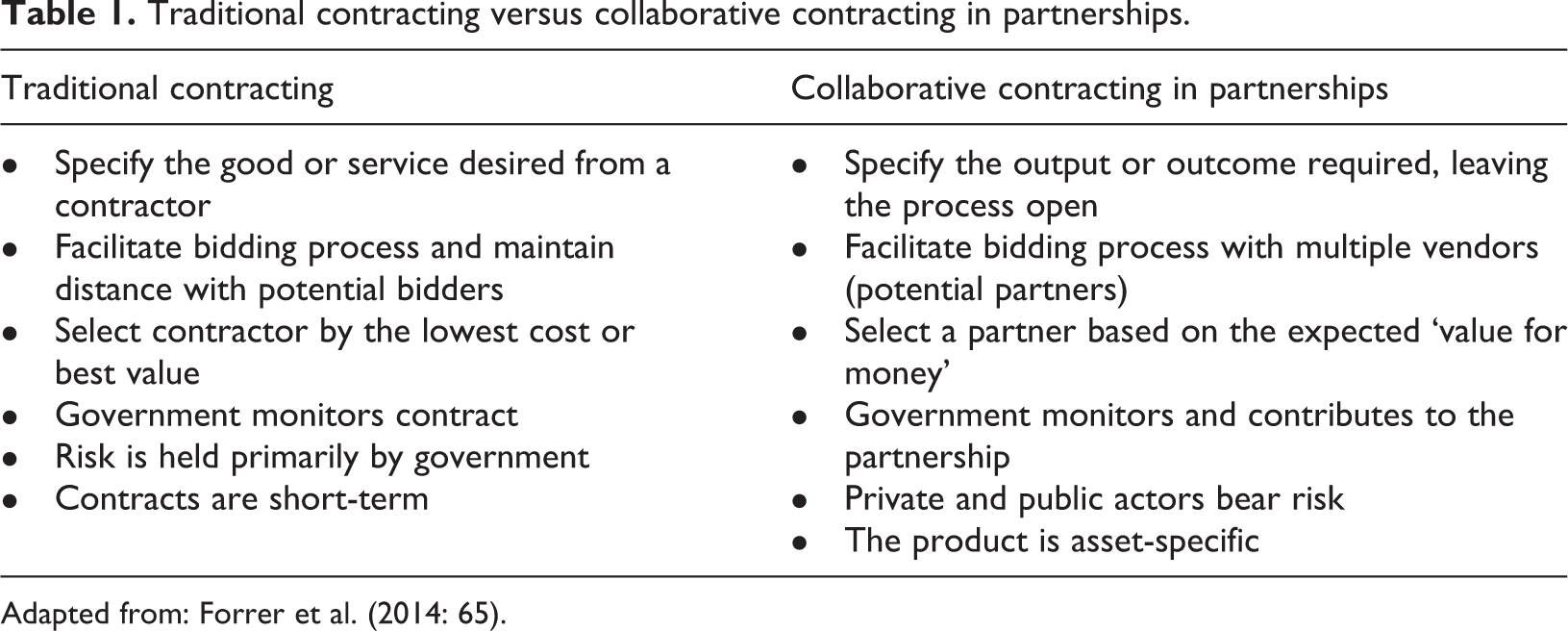
Adapted from: Forrer et al. (2014: 65).
One explanation for the lack of government contracting capacity for PPPs is that state and local agencies implement them on a case-by-case basis. Typical transportation contracts are arm’s-length transactions (termed Design–Bid–Build), where the government develops a design and identifies a contractor to construct it (DOT, 2004, 2007, 2008). PPPs, on the other hand, delegate multiple roles to the private sector, including the design, financing, construction and operation of transportation facilities (Grimsey and Lewis, 2007). As of April 2015, 33 states have enacted statutes that allow state and local authorities to develop infrastructure projects as PPPs (FHWA, 2015), and of those states only 23 have completed a contract for some type of innovative contracting for transportation (PWFinancing, 2014). A survey in 2009of all 50 state departments of transportation found that more than 75% of survey respondents indicated a need for expertise on the basic elements of PPP contracts (Buxbaum and Ortiz, 2009).
A second dimension of the problem is that the private sector brings far more expertise to PPPs than its government partners (Garvin, 2010; Robinson et al., 2010). With the United Kingdom as pioneer, several European governments developed physical infrastructure through PPPs (Delmon, 2011). Multi-lateral aid organizations like the World Bank and the United Nations promote PPPs in emerging economies, in an effort to accelerate infrastructure development through private investment (PPIAF, 2013; UNECE, 2013). State and local agencies may have experience with one or a few projects of this kind, while international private partners bring experience from projects around the world. One study explained the public–private knowledge imbalance in the following way: Public agencies that seek PPPs for transport projects commonly lack productive, financial, or managerial expertise and capacity and, very likely, have no previous experience in managing a PPP. In contrast, private entities that bid for, and win, public contracts generally have long engaged in the business and have accumulated expertise in assessing risks, negotiating benefits, and crafting contracts. (Ni, 2012: 259)
This study investigates the processes by which public transportation agencies develop knowledge, skills and abilities for designing and implementing contracts for PPPs. By definition, PPPs are collaborative partnerships that are long-term in nature (often extending beyond 30–40 years), involve both public and private financing, require private sector involvement in the provision of government services, transfer risks from public to private organizations, and outline roles and responsibilities of involved organizations through complex contracts (Hodge and Greve, 2007).
There are three intended contributions of this article. The first is investigation of organizational learning and contract capacity development for public managers working on PPPs. In this way, this study aims to complement prior research on the importance of government learning in contract design and oversight (Brown and Potoski, 2003a; Brown et al., 2006; Cooper, 2003), by identifying the ways that this learning actually takes place. This research also responds to a call for contracting research that goes ‘beyond transaction cost theory’ (Yang et al., 2009), by adopting an organizational learning framework to highlight relatively understudied dimensions of contracting capacity development.
Our second contribution is to practice, by identifying the actual steps and techniques that state transportation officials can take to manage knowledge on PPPs. We develop an organizational learning framework that could be adopted by public managers developing expertise for contract management of PPPs.
Third, we contribute to an understanding of cultural change in public agencies working on PPPs. Knowledge utilization is ultimately a social and cognitive process – persons do not act upon new information simply because they are exposed to it, but because they understand the meaning and value of that new information and change their own actions in turn (Brown and Duguid, 2001; Delios and Henisz, 2003; Inkpen and Tsang, 2005). We build on related research of the structural and social dimensions of public sector learning (Moynihan and Landuyt, 2009), by identifying the practices that improve the identification of critical knowledge for PPPs and the conditions by which public managers incorporate that knowledge into their work.
Using analysis of project documents and semi-structured interview data from two state departments of transportation, we examine the ways that public managers draw from externally and internally generated lessons to build a knowledge base for PPPs. Our findings indicate that the search and utilization of knowledge is fundamental to the development of contracting capacity for PPPs. Lessons are needed from an organization’s own experience, and from the experiences of other agencies. Several social conditions, including the selection of contracting staff, triangulating industry-provided guidance with public sector experience, transparency in error reporting, and the involvement of contract managers in contract design, are also found to be important drivers of the utilization of new knowledge.
Contracting capacity and public–private partnerships
The capacity for government to oversee projects with the private sector can be considered in terms of design (preparations prior to signing a contract) and implementation (ongoing oversight once a contract has been awarded) (Brown and Potoski, 2003b; Brown et al., 2009). Contract management constitutes some of the most significant costs of transactions in establishing and governing public–private collaborations (Vining and Boardman, 2008), and is one of the most important factors in ensuring that the public interest is protected when goods and services are delivered by nongovernmental actors (Brown and Potoski, 2003a; Van Slyke, 2003).
Dimensions of contracting capacity have been addressed by a number of studies. Yang et al. (2009) outline four components of contracting capacity: (1) agenda setting capacity; (2) formulation capacity; (3) implementation capacity; and (4) evaluation capacity. Brown and Potoski (2003a) describe the pre-award components of contracting with regard to bidding on a contract, selecting a provider, negotiating a contract, and creating management systems for contracting; and the post-award components in terms of procedures for collecting performance information and assigning employees to carry out evaluation. Forrer et al. (2014) describe six components of contracting capacity: setting clear expectations, assessment, establishing criteria, transparency in selection, monitoring, and evaluation. Considered with regard to these definitions, the management challenges of PPPs are outlined in Table 2.
Contract capacity in PPPs.
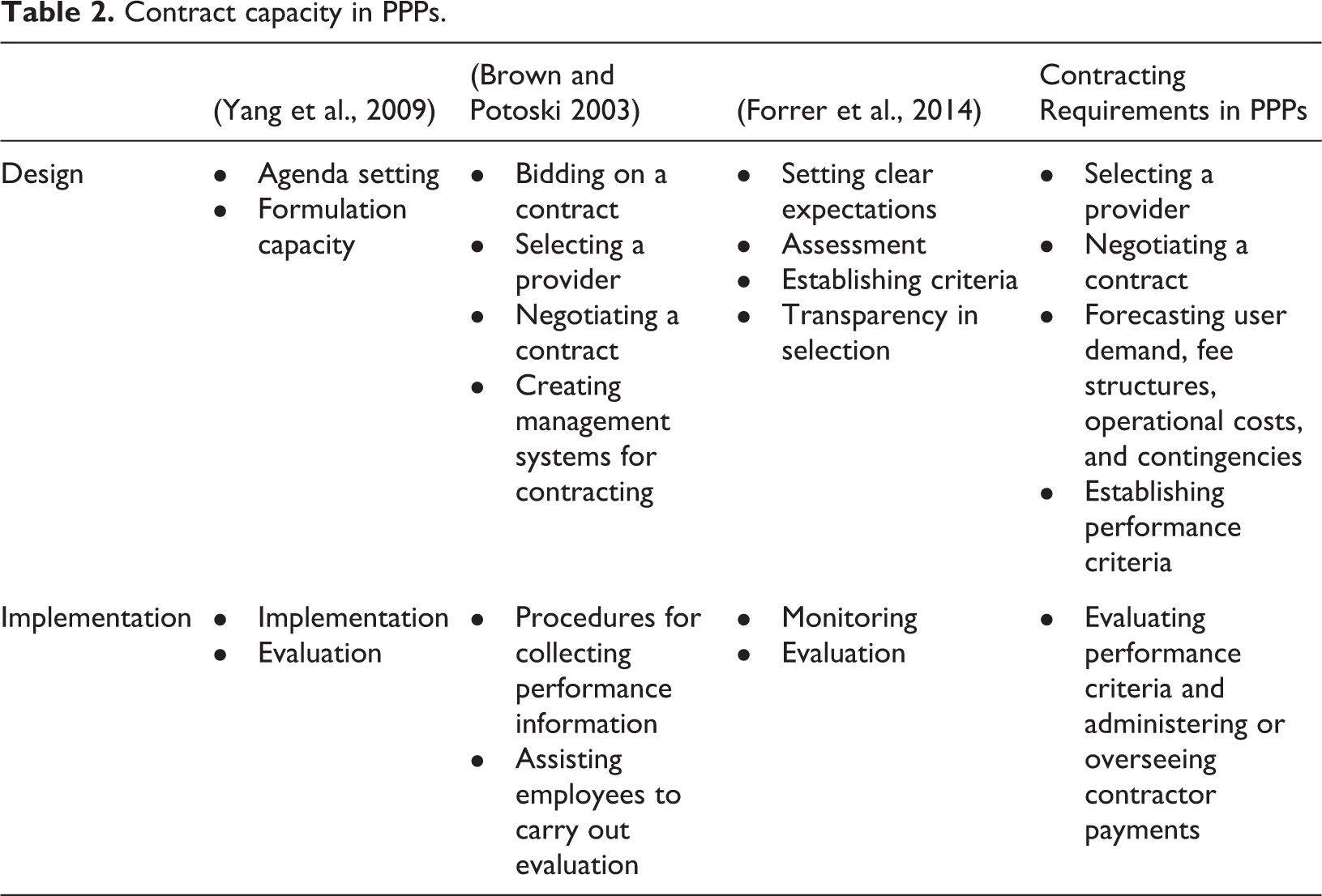
The challenge of contract management in PPPs is two-fold. First, the initial terms of PPP contracts set the terms of public–private relations long into the future, and the private sector has experience setting those terms in its favor. Contract design requires estimations of how the private contractor is to be paid, which are based on forecasts of consumer demand (such as the willingness to pay tolls), long-term operational costs, and/or potential disruptions of services related to natural disasters. Errors in estimation can lead to over-optimistic demand forecasts that compromise the financial stability of projects (Flyvbjerg et al., 2005), or establish terms that ‘lock’ the government into conditions that constrain future transportation planning (Hodge and Coghill, 2007). The second challenge is that of contract governance (Garvin, 2010). PPPs involve performance-based payments to a private operator, either in the form of government regulation of user fees paid directly to a private entity (such as toll roads), or through direct government payments to a private operator, based on the ‘availability’ of key performance indicators (Lawther and Martin, 2014; Siemiatycki and Friedman, 2012). Errors in implementation can overestimate the value of private sector involvement in PPPs.
Organizational learning and contracting capacity
Organizational learning refers to deliberate attempts to identify, store and disseminate lessons about how and why to change practices in order to improve organizational performance. Organizational learning is fundamental to contract capacity development because it addresses the means by which managers collect and apply knowledge to address public–private information asymmetries and, by extension, the government’s position in public–private contracts.
In the absence of opportunities for developing project experience on PPPs, and with little pre-existing expertise in this area, public managers have two options for develop knowledge in designing and implementing PPPs: either (1) identify and leverage knowledge from sources outside of their organization, or (2) engage in PPPs and capture lessons from direct experience. The literature on organizational learning explains these processes in terms of vicarious learning (learning from other organizations) (Baum et al., 2000; Gino et al., 2010; Srinivasan et al., 2007) and experiential learning (learning through direct experience) (Baum and Dahlin, 2007). Research on organizational learning in public organizations also distinguishes between structural and social dimensions of organizational learning (Moynihan and Landuyt, 2009). The structural dimensions are the formal activities developed to improve knowledge sharing, and social dimensions address the cultural changes needed to apply new knowledge to ongoing behavior.
Vicarious learning
Vicarious learning is a process of identifying and making use of lessons from other organizations when members of an ‘observing’ organization do not possess the desired knowledge themselves. For example, companies in the pharmaceutical field draw lessons from one another in an effort to capitalize on innovations in research and development (Lane and Lubatkin, 1998) and railroad companies learn how to improve safety by studying accidents encountered by their competitors (Baum and Dahlin, 2007). Airlines also identify lessons from significant plane crashes to improve their own safety, and professionals in disaster management evaluate the causes behind significant catastrophes to improve their own capacity for disaster mitigation and prevention (March et al., 1991). Learning from others, in this way, allows learning ‘from failure without incurring the cost of failure’ (Moynihan, 2008: 358). Lessons from other organizations can be adopted outright (Haunschild and Miner, 1997), or augmented and adapted to meet the needs of the ‘observing’ organization (Feldman and Pentland, 2003).
The social dimensions of vicarious learning involve discriminating among external knowledge sources and relating outside information to internal capabilities. The first issue involves ‘knowledge validation’, and the extent to which organizational leaders can verify the utility of outside information (Cochrane et al., 2009; Cross and Sproull, 2004; Thomas et al., 2001; Wyer and Radvansky, 1999). Validation, in this sense, requires determining the accuracy of outside knowledge. In the realm of transportation delivery, knowledge validation processes involve adherence to both technical engineering principles and overlapping regulations related to federal, state and local standards of environmental planning. An unanswered question is whether or not the external knowledge provided to public agencies is in fact deemed valid for application so that they actually learn vicariously from that knowledge.
A second issue – and related social dimension of learning – involves the extent to which the public sector has the technical know-how to make use of outside information on PPPs. In some industries, organizational leaders only learn from organizations with similar operational conditions in order to ease the adaptation of practices from one organization to another (Beckman and Haunschild, 2002; Srinivasan et al., 2007). The ability to learn from other organizations is also determined by ‘absorptive capacity’, or an observing organization’s preexisting knowledge base and the relation of that knowledge base with regard to outside information (Cohen and Levinthal, 1990). There is an important interaction between existing knowledge and assimilated knowledge which determines the extent to which outside ideas can shape internal behavior. While there is broad consensus that the practice of PPPs is largely different from standard practices in transportation planning, there is less understanding about how public managers are able to incorporate outside lessons based on their own existing knowledge base.
Experiential learning
Experiential learning addresses the process of ‘learning by doing’ (Nelson and Winter, 1982), which may include trial-and-error experimentation or improvisation (Argote, 2007). Experiential learning is deliberate (Hamel, 1991) and involves a systematic process for documenting lessons-learned that can be shared and disseminated across the organization (Argote and Ingram, 2000; Tan et al., 2006). Examples of experiential learning include the facilitation of round-tables and lessons-learned debriefings, instructor-based trainings, mentoring relationships, communities of practice, technology-based knowledge-sharing platforms, the developing of operating procedures and manuals, the interviewing of subject-matter experts, job shadowing, job-rotations, and related techniques.
The extent to which experiential learning takes place in the workplace depends in large part on cultural norms that are favorable or unfavorable towards learning (Senge, 2006). Through face-to-face interactions, individuals collectively create and reinforce their shared understandings about what is and is not appropriate behavior (Berger and Luckman, 1967; Burrell and Morgan, 1979). If leadership in an organization does not accept information or knowledge arising from practice (perhaps that which challenges the status quo or challenges hierarchical authority), experiential learning will not place. For example, a number of studies indicate that the National Aeronautics Space Administration (NASA) fell into this trap, when cultural norms prevented leadership from considering technical problems identified by lower-level, front-line engineers (Donahue and O’Leary, 2012; Mahler and Casamayou, 2009). In addition, if front-line workers do not recognize the value of new knowledge, they will not incorporate the new knowledge into practice. Two key drivers of experience-based learning are thus (1) ensuring that newly captured knowledge is disclosed and recognized (generating lessons), and (2) ensuring that persons of all levels of hierarchy recognize the value of new lessons from experience (accepting lessons).
Methodology
The data for this study were collected from two cases: the Texas Department of Transportation (TxDOT) and the Virginia Department of Transportation (VDOT). Van Evra (1997) suggests, ‘investigators should select cases that best serve the purpose of their inquiry’ (Van Evra, 1997: 78). The two cases offer particular insights into the development of knowledge due to their respective efforts to consolidate staff, resources and systems at the state-level to guide PPP activity. Twenty-three state transportation agencies have experimented with PPPs for some type of roadway project (PWFinancing, 2014), and TxDOT and VDOT have completed more PPPs than any of their counterparts. Experience was with PPP design and implementation, central to the case study selection in order to examine contexts where administrators would have ample opportunities for vicarious and experiential learning. Since 1995, five PPPs have been implemented by VDOT, with more in process, and nearly US$6 billion devoted to such projects (PWFinancing, 2014). Individual project values in the state range from US$200 million to US$2,000 million, with some lasting up to 99 years in length. Since 1999, TxDOT has implemented five PPPs (PWFinancing, 2014). More than US$8 billion has been devoted to such projects in Texas, with individual project values ranging from US$85 million to US$2,800 million (Table 3 and Table 4).
Scope and scale of transportation PPP projects in Virginia.
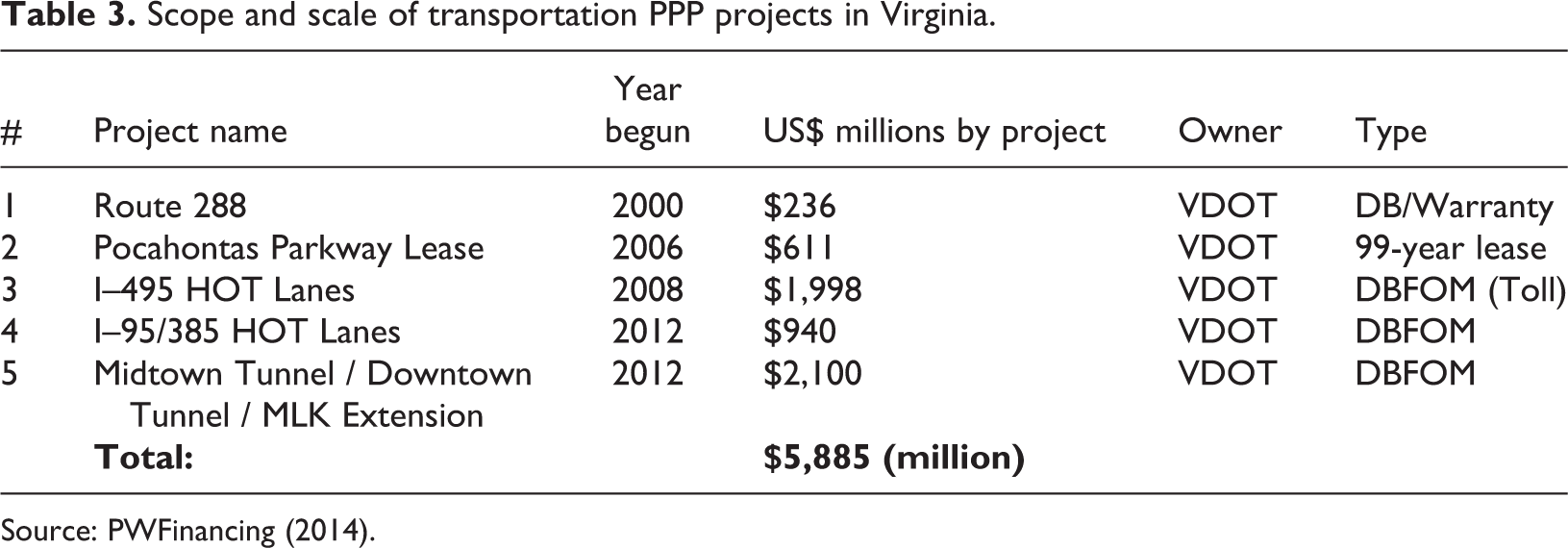
Source: PWFinancing (2014).
Scope and scale of transportation PPP projects in Texas.
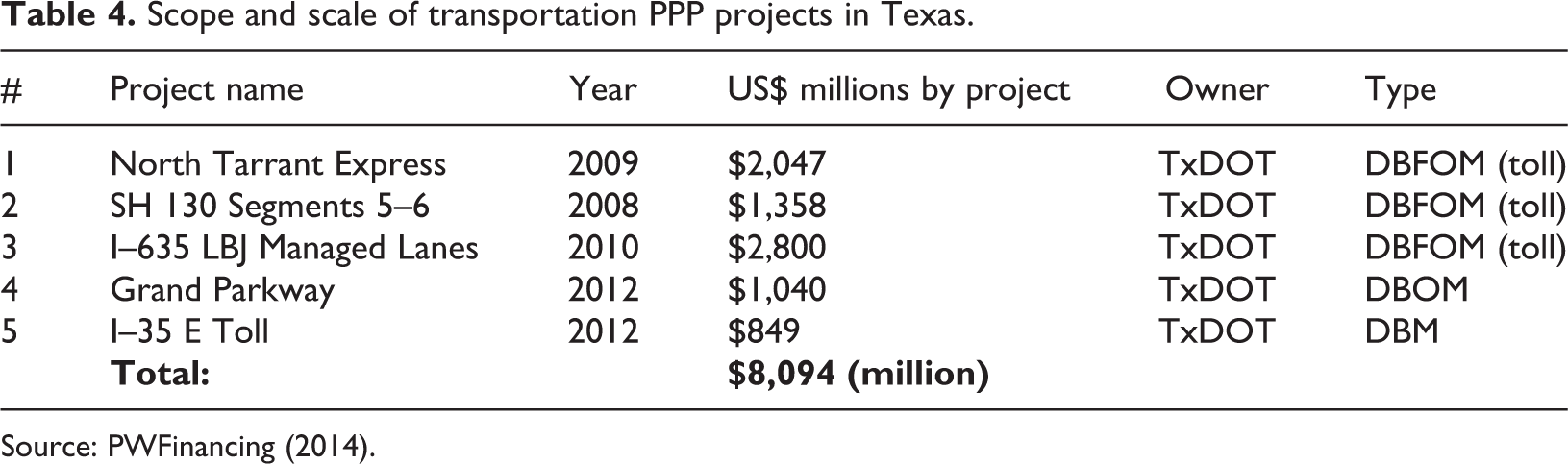
Source: PWFinancing (2014).
Data collection involved reviewing more than 180 project documents, 5 and conducting 24 semi-structured interviews with professionals from the two states (12 interviews per agency). Interviewees were chosen purposefully, and through a snow-balling strategy, in order to select persons with direct experience working on PPPs. Document reviews included PPP contracts, PPP authorizing legislation, press releases, reports on specific projects, manuals to guide PPP implementation, and other supporting government and industry records. The interviews were conducted with close-ended and open-ended questions, to allow for the discovery of practices that were not anticipated in advance (Axinn and Pearce, 2006). Examples of open-ended questions included the following: ‘Are there any other activities that you think are important for building government capacity to design and implement PPPs? Can you explain?’ and ‘How do you think transportation administrations should build capacity for designing and implementing PPPs?’
The semi-structured interviews were conducted with professionals with direct experience of working on PPPs in each state, including public managers involved in PPP transactions, executive-level public sector professionals, and private sector professionals from advisory firms who worked side-by-side with the respective agencies. Interviewees from the private sector were selected on the basis of recommendations from their public sector counterparts.
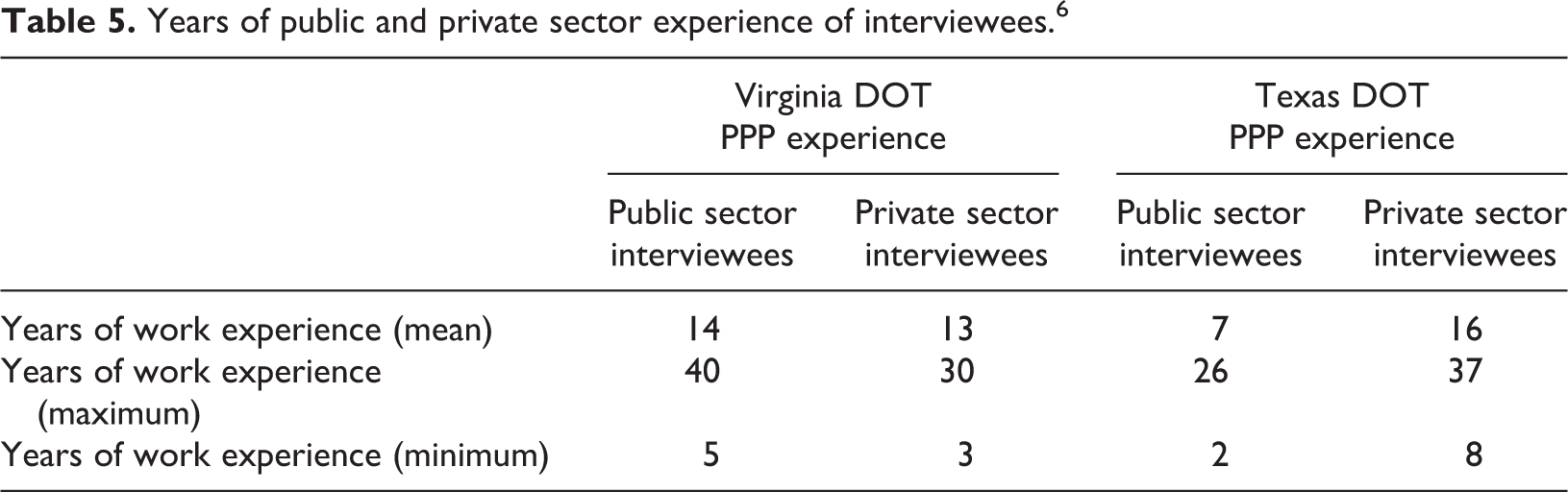
The interviewees were assured anonymity in their responses, and a list of their years of experience in government and industry is provided in Table 5. All participants were chosen deliberately. There are only a certain number of people with direct experience working on PPPs in the US transportation sector, and participants were selected from that already narrow group. This selection process is in line with established sampling procedures in qualitative research (Miles and Huberman, 1994).
Years of public and private sector experience of interviewees. 6
An audio recorder was used to document each interview, and the audio files were transcribed and coded using a qualitative software program, Atlas.ti. Content analysis of interview responses was performed in order to quantify the number of comments relating to theoretical concepts (Bazeley, 2003; Krippendorff, 2004; Wu et al., 2010). The theoretical framework was adjusted with regard to concepts that emerged from the analysis in order to incorporate data-driven insights with theory-driven codes (Axinn and Pearce, 2006).
Findings
Vicarious learning
The interviewees indicated a number of lessons learned from sources outside of their respective agencies, indicating the prevalence of vicarious learning for PPPs. Specifically, they explained how working with consultants (through consultant training sessions) provided them with guidance on developing requests for proposals for PPPs, and how working with other public sector officials led to the implementation of better contract provisions and improved methodologies for determining which projects are appropriate for PPPs and which are not. Interviewees also explained how working with consultants provided them with strategies for engaging local communities and political leaders to build support for PPPs, because consultants often provided approaches to public involvement that had been successful in other states.
The actual process of vicarious learning was explained in terms of two components: (1) forming a team to work exclusively on PPPs, and (2) identifying and leveraging lessons from external knowledge sources. External knowledge sources were identified as critical for compensating the public sector’s lack of direct experience on PPPs; however, assigned personnel were also necessary to relate lessons to ongoing operations.
Forming the PPP team
Interviewees indicated the importance of developing a threshold of understanding of PPPs in order to leverage lessons from other organizations. The skill areas of greatest need were those related to PPP finance, law and engineering. A number of interviewees also explained the importance of ‘dedicating staff’ to a contracting team, since too often managers work on PPPs on an ad hoc basis, assembling for a particular project but re-integrating into the agency after the project’s completion. Peripheral roles on PPPs can stretch staff thin and limit their potentials for becoming ‘experts’ in the agency. One person explained, You need to make sure that you have committed your human resources to the PPP program, so they are not distracted with other responsibilities. Make that their job. Make it their job to be fully-committed to the ongoing operations and maintenance activities…[the team] will see a proliferation of this activity across the state.
Identifying external knowledge sources
Interviewees addressed a wide range of knowledge sources for supporting government learning on PPPs. Advisory consultants, including the ‘big-four’ accounting firms (KPMG, Deloitte & Touche, Ernst & Young, and PricewaterhouseCoopers) were among the most cited. Consultants often fill key knowledge gaps that the public sector cannot ‘hire-in’ for. One person explained, I doubt a state DOT [Department of Transportation] could afford the kinds of expertise that are needed in PPPs. Even the secretary of transportation for a DOT makes less than $200,000 per year. The kinds of financial or other expertise needed for PPPs necessitates skills [that] cost much more than that. Since the DOT cannot afford to pay employees such high salaries, they depend on consultants to make up the difference.
Other state transportation agencies were also identified as critical sources of knowledge. One way that administrators learned lessons ‘across states’ was through scan tours, or structured visits to one another’s agencies. One interviewee explained, …the best way of learning from somebody is to go to see the actual project…GDOT [the Georgia Department of Transportation] came to see us and they did a walkthrough of the capital beltway project. It was not a flawless project. It was very good for them to review the pluses and minuses of what happened.
PPP conferences and workshops provide a third knowledge source for public administrators. The transportation ‘industry’ organizes a range of conferences and workshops for transportation officials from the government and private sectors. Some of the events are sponsored by industry groups like InfraAmericas, the National Council on Public–private Partnerships (NCPPP), or the American Road and Transportation Builders Association (ARTBA). Public sector associations like AASHTO and TRB, or the Federal Highway Administration (FHWA), organize similar events. Conferences and workshops also offer opportunities for networking within the wider PPP community. One interviewee explained, ‘conferences introduce you to the right people, that’s key’.
In terms of the social conditions of learning from external sources, respondents explained the challenge of ‘validating’ external knowledge – in particular, that which was provided by private sector consultants and industry-sponsored conferences. When choosing between a PPP or an alternate project delivery model, consultants may promote the PPP variation whether or not it is the best deal for the public. Another problem is that consultants may slow down a project delivery process, because they charge the government ‘by the hour’ and not by the ability to meet project deadlines. One interviewee explained, Even when you have consultants involved, the consultants are often incentivized to put barriers up to the process, to gain more fees. Engineers and investors want to accelerate the process, but consultants may slow it down. Many conferences are boondoggles, some are ways for the industry to schmooze with people they are trying to influence. They are not the same kind of knowledge centers or panels that are seeking to dig deep [into issues].
Experiential learning
The interviewees identified a number of lessons learned from their direct experience of working on PPPs, indicating the prevalence of experiential learning for PPPs. Specifically, public managers improved their understanding of how to include federal money and credit assistance in the development of PPPs, their abilities for building and sustaining public support on projects, their skills in achieving cooperation across state and local governments for multi-jurisdictional projects, and the identification and forecasting of risks for transportation projects. 7 Interestingly, respondents indicated lessons learned in respect to public involvement – a key area of learning also identified in vicarious learning.
The actual process of experiential learning was explained in respect to two components: (1) organizing project reviews, and (2) monitoring and evaluating PPP performance. Capturing lessons from direct experience was identified as important; however, a number of practices were also recommended for improving social acceptance and incorporation of lessons from experience.
Organizing project reviews
One interviewee explained, ‘they have to set up the appropriate reviews to reflect on the process as they are going through it—that is what helps the process’. The most effective reviews were those that involved not only the administrators working directly on the PPPs, but also senior-level administrators and private sector advisers involved in the project. A discussion guide for the review can also guide the conversation and address components of the project that are most critical with regard to government implementation. Officials use very structured templates for walking through questions and issues that arise on the projects. Some project debriefings are organized as quarterly meetings, while others occur more frequently. The key recommendation was to conduct project debriefings on an ongoing basis, to capture lessons before they are forgotten.
In terms of the social dimensions of learning, respondents noted challenges in cultivating an environment of candor in discussing personal and project errors and identified strategies for overcoming cultural resistance to problem reporting. One interviewee explained, ‘there are no individual or collective failures, no one wants to talk about them’. The hierarchical nature of transportation agencies often inhibits the tendency to challenge superiors to disclose personal error. Despite these inherent challenges, a number of public managers explained how they took the initiative to improve the identification of project errors on PPPs. A senior official of one of the contracting teams explained his message to his staff: ‘I say to my team, if we’re not screwing up, we’re not doing something right’. Leadership modeling of error disclosure helped to capture areas of improvement, such as more accurate assessments of project risk estimations.
Monitoring and evaluating PPP performance
Monitoring toll rates, roadway quality, or standards such as safety and citizen satisfaction, are critical for ensuring quality control on PPPs. Evaluation also generates knowledge that can inform the agency’s ongoing approaches to PPP contract design and implementation. One interviewee explained, One time the private sector said that there would be no design exceptions, and they ended up with 200 design exceptions…Another time, the private sector committed funding for a project, with only 13% of public funds involved – then the economy tanked and the state had to borrow more. [The private sector] is not always going to be able to do what they said they would do.
Discussion
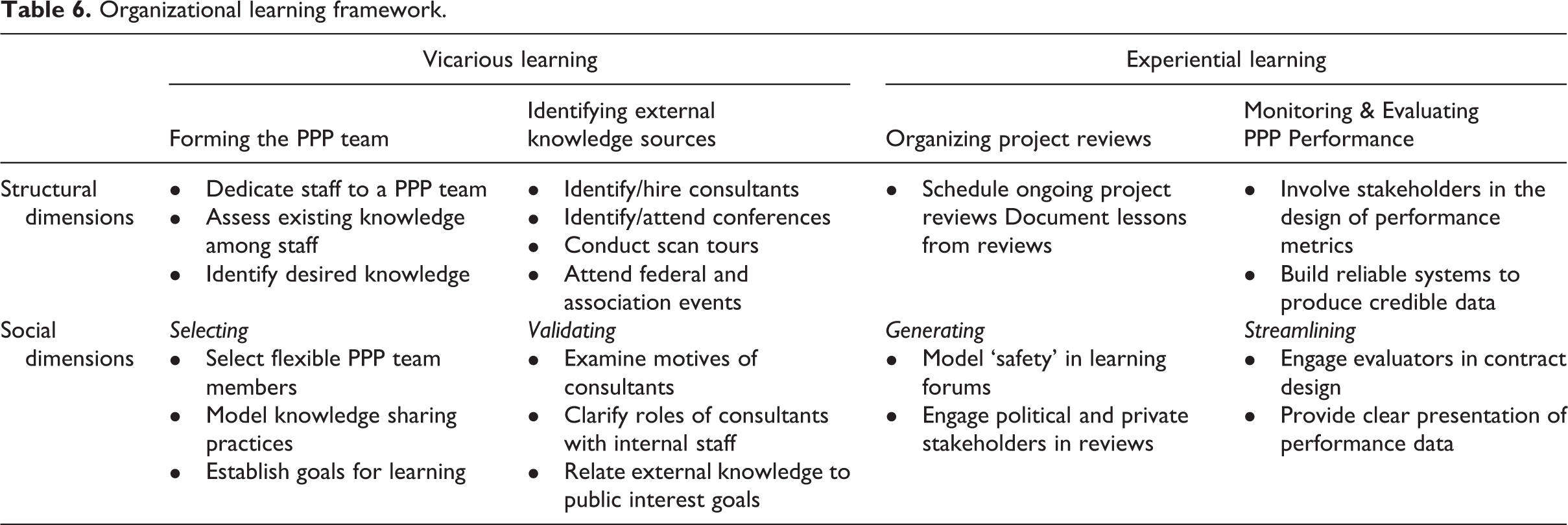
The findings indicate that public managers deliberately seek out lessons from other organizations, and from their own experience, in order to develop capacity for contracting for PPPs – engaging in both vicarious and experiential learning. Interestingly, their learning on PPPs involved not only accumulating lessons about the technical dimensions of PPPs (how to design and monitor PPP contracts), but also that they ‘learned how to learn’ on PPPs. Their experience demonstrated the importance of (1) ‘dedicating’ teams to PPPs and selecting appropriate staff, (2) identifying and validating knowledge from external sources, (3) conducting project reviews and ensuring error disclosure, and (4) streamlining measurement design and evaluation.
The primary challenge to vicarious learning for PPPs is the prevalence of industry-sponsored advice that can compromise the public sector’s position. Public managers compensate for this challenge by dedicating staff to a contracting team from beginning to end of a PPP, and by validating industry guidance by comparing it to public sector advice. Their practices reveal the structural and social dimensions of learning vicariously on PPPs. Structurally, specific personnel need to be assigned exclusively to PPP projects in the agencies and a number of external knowledge sources (consultants, workshops/conferences, other DOT officials) need to be identified and leveraged to capture lessons beyond an agencies own direct experience.
Social dimensions of vicarious learning include the acceptance of new knowledge and the validation of externally generated knowledge. The dedication of public managers to PPP teams was found to serve two functions: first, the creation of a knowledge base of professionals who could understand and make use of unique knowledge related to PPPs; and, second, the selection of personnel who would be more inclined to consider alternate ways of doing things and, by extension, would be more amenable to working on PPPs. While industry-sponsored knowledge is essential to government learning on PPPs (particularly with regard to advisory consultants), public managers also need processes for validating the content of this guidance. Validation processes are supported by relating industry guidance to guidance from other DOT officials, insights from public sector associations, and public objectives within agencies themselves.
The primary challenge to experiential learning on PPPs involves creating the social conditions by which knowledge is captured and utilized from these activities. Ongoing project reviews are fundamental to transportation planning and are essential for capturing lessons from direct experience on PPPs. However, the inherent hierarchical orientation of public agencies can limit the exchange of knowledge, and the politically volatile nature of PPPs may lead to the avoidance or concealment of project errors. Public managers overcome these challenges by modeling conditions of ‘psychological safety’ (Edmondson, 1999), and encouraging, or even rewarding, the disclosure of project errors. This cultural shift is fundamental to identification of lessons for improving the public sector’s approach to PPPs. Ongoing project evaluation is also fundamental to experiential knowledge capture. The findings here indicate that managers develop more appreciation for the lessons generated from these systems and their applications when they have a say in the actual measures that structure project evaluation. Transportation engineers are more accustomed to evaluating the details of construction contracts and their abilities to ‘manage to objectives’ instead is improved by their involvement in the design of the standards.
Taken together, the findings from this study provide an empirical perspective on the tools and techniques of utilized by government to improve learning on PPPs, as outlined in Table 6.
Organizational learning framework.
Conclusions
Overall, this study highlights the importance of leveraging external and internal knowledge to improve the public sector’s position in PPP contracts. For some time it has been apparent that the public sector often lacks appropriate capacity for contracting with the private sector (Cooper, 2003; Romzek and Johnston, 2002), and there is a need for more research on the types of training and development that can be provided to public managers working on contracts (Hsieh, 2013). This study provides an empirical perspective on the processes and practices of knowledge identification and knowledge utilization adopted by agencies working directly on PPPs. In addition, this research identifies the ways that the public and private interests conflict and seek strategic advantage not only in the terms of PPP contracts (Forrer et al., 2014; Hodge and Coghill, 2007), but also within the content of knowledge that is provided to inform public sector decisions. Avoiding private sector ‘capture’ in PPPs requires not only skills in contract design and implementation, but also skills and systems for managing knowledge that informs public sector approaches to PPPs.
Identifying the social dimensions of organizational learning also revealed how public managers improve cultural acceptance of PPP practices within their own organizations, and how they overcame private sector ‘capture’ of the industry-sponsored PPP knowledge itself. Specifically, public managers address the acceptance of PPP-related knowledge, adopt practices to validate private sector advice, generate lessons through psychological safety, and improve monitoring by streamlining evaluation design and implementation. The primary value of identifying these processes lies in the development of a more robust and evidence-based explanation of the ways the public sector identifies and best exploits knowledge for PPPs.
This study contributes to an understanding of the knowledge needs associated with developing contracting capacity for highly technical, complex public–private collaborations like PPPs. While the literature has reported on the long-term recognition of the knowledge needs associated with overcoming information asymmetries inherent in working with a more experienced private partner (Brown et al., 2009; Forrer et al., 2014), this study also demonstrates the knowledge needs associated with deciphering knowledge provided through professional services and private industry. In other words, the challenge of managing knowledge for PPPs is not just addressing information imbalances between public and private sectors, but also developing in-house capabilities for scrutinizing and making sense of the very information aimed at reducing those imbalances. From a practical standpoint this research indicates that public managers can address these two related challenges by adopting a strategy for organizational learning. The practices of forming a PPP team, identifying and leveraging external knowledge sources, organizing project reviews, and monitoring and evaluating performance, provide a foundation for identifying, capturing and utilizing PPP-related knowledge. PPP practitioners can adapt the practices and associated cultural change agents from this framework to evaluate and develop their own approaches for managing knowledge on PPPs.
One limitation of these findings is that even agencies with extensive experience with PPPs face knowledge gaps and information asymmetries and require external assistance. Working with consultants accelerates government learning in key areas related to public involvement and RFP design, but not all of the advice they share is transferred to government and they continue to play central ‘knowledge roles’ for agencies over subsequent projects. While the knowledge framework presented here provides evidence-based explanations of how knowledge is being captured, additional research is needed on tools and techniques for specifically reducing knowledge dependence on external consultants.
Even though the technical and financial demands in transportation projects require more sophisticated approaches to public–private relations than other types of PPPs (for instance, social services such as health care or workforce development), the framework from this study provides valuable insights for government approaches to a range of public–private relations. While this study was conducted on PPPs in the USA, the core elements of the four learning processes can inform practice for public sector entities in other parts of the world.
The US fiscal climate and mounting needs in infrastructure expansion and maintenance suggest PPPs will remain a fundamental and increasing delivery alternative for public managers in transportation planning. Understanding how the government can effectively negotiate relationships with private sector firms is essential to gaining public value through PPPs. Addressing this issue will require bolstering the public sector’s capabilities for identifying and managing knowledge for PPPs.
Footnotes
Acknowledgements
We would like to thank all of the people who completed the interviews for this study and the anonymous reviewers for their constructive feedback. All errors are our own.
Funding
This research received no specific grant from any funding agency in the public, commercial or not-for-profit sectors.
Notes
References
Supplementary Material
Please find the following supplemental material available below.
For Open Access articles published under a Creative Commons License, all supplemental material carries the same license as the article it is associated with.
For non-Open Access articles published, all supplemental material carries a non-exclusive license, and permission requests for re-use of supplemental material or any part of supplemental material shall be sent directly to the copyright owner as specified in the copyright notice associated with the article.
