



Abstract
Solving the climate-ocean crisis requires both cutting emissions and pursuing carbon dioxide removal (CDR). Past ocean iron fertilization (OIF) experiments in some parts of the ocean have shown that small additions of iron can enhance phytoplankton growth and CO2 drawdown. However, prior experiments did not assess the efficacy, durability, or feasibility of OIF for CDR, and broader ecological and biogeochemical responses were not evaluated given the short duration and limited spatial scales. The next generation of OIF field trials must be larger (ca. 1000 km2) and longer (>3–6 months) to observe the full response and return to baseline conditions. Potential risks will be assessed, while using community engagement and co-design to create go/no-go decision points. Planning and extrapolating impacts on regional and global scales will require modeling, with the overall goal to provide unbiased assessments and open-source protocols that can guide responsible and rigorous decision-making for any further OIF.
Keywords
Introduction
The continued warming of Earth is pushing many ecosystems and components of the climate system beyond their tipping points, resulting in irreversible damage to our planet as we know it. Alarmingly, we have experienced a 1.5°C increase in global temperatures since the pre-industrial era (Bevacqua et al., 2025), and the oceans are already suffering from a buildup of heat, increased acidity, and a large decrease in sea-ice cover now affecting both poles. To stem the tide, we need to shift away from our fossil fuel-based economies. But this is not enough. International consensus now accepts that we must also develop methods to remove tens of billions of tonnes (Gt) per year of carbon dioxide (CO2) from the atmosphere in the coming decades (Smith et al., 2024).
Today, there is no single CO2 removal (CDR) technology available that is capable of sustainably reaching the needed capacity, making it essential to pursue a portfolio approach (NASEM, 2022). Adding iron (Fe) to the ocean may be an effective way to make a contribution to the much-needed reduction of atmospheric CO2 concentrations. This is not a new technology as prior experiments have confirmed that the availability of Fe restricts production by phytoplankton at the base of the ocean food web across vast swaths of the ocean. What remains uncertain is the extent to which carbon could be sequestered via the addition of this rate-limiting micronutrient. However, our existing knowledge gleaned from both natural and deliberate ocean iron fertilization (OIF) field experiments, as well as numerical models, suggests that large-scale OIF could potentially remove Gt's of atmospheric CO2 per year (GESAMP, 2019; NASEM, 2022) thus serving as an effective component of the total global carbon mitigation strategy. This potential needs to be tested in real-world trials designed explicitly to measure changes in carbon flux and sequestration in response to Fe additions.
With this motivation and experience, why can’t we simply move to deployment of OIF on a large scale given that past experiments have confirmed Fe limitation? Quite simply, past field experiments were aimed at assessing whether Fe enrichment can enhance primary production in high nutrient low chlorophyll (HNLC) waters, which are regions of the ocean with sufficient macronutrients (e.g., nitrate and phosphate) but insufficient Fe to support phytoplankton growth at high rates. These experiments were not designed to, nor could they, adequately quantify how effective, durable, or feasible Fe addition may be as a CDR approach. Moreover, the broader biogeochemical responses could not be assessed from these short-term experiments, nor did they fully explore the possibility of undesirable ecological consequences.
Key to using OIF for marine CDR (mCDR) is the fate of organic carbon in the surface that is produced by phytoplankton and then transported to depth via the biological carbon pump (BCP) where it can remain sequestered for centuries to millennia if the carbon reaches depths below about 500–1000 m (Siegel et al., 2021b). Current paradigms and ocean models lack key processes needed for parameterization of the current strength and future efficacy of this BCP (Henson et al., 2022). Ten of 12 key BCP processes, such as particle fragmentation and stickiness, daily vertical migrations by zooplankton and fish, were missing from the 19 coupled climate models they compared. In addition, while diatoms are a key player in OIF responses, models are typically unable to reproduce diatom mass sinking events (e.g., Losch et al., 2014), nor do they include essential features such as life-cycle and resting spore formation (e.g., Crawford et al., 1997; Salter et al., 2012). Hence, understanding and improving representation of BCP processes in models remains a prerequisite for long-term simulations of both natural and artificial OIF.
This article advances the case for the next generation of OIF field research, with a specific focus on how to assess its efficacy for durable and additional CO2 removal, and importantly, its impact on ocean ecosystems. This rationale for a revival of OIF field studies is not new (Smetacek and Naqvi, 2008; Watson et al., 2008); however, the urgency is now greater, driven by damaging climate impacts along with the rapid commercialization of land and ocean-based CDR, which has attracted public research and private investments exceeding billions of dollars (Kitch et al., 2025). However, for mCDR in general, the research and development (R&D) investments are lagging land-based options. For OIF, costs per tonne CO2 removed could be among the lowest for mCDR approaches (<$100/tonne CO2 removed; NASEM, 2022). This is due to the small amount of the inexpensive and abundant mineral Fe that is needed to stimulate large increases in phytoplankton growth (>1:1000 Feadded:Cexport; see What we can learn from nature) and the use of sunlight for energy. Given these low costs, the barrier to its deployment, with or without good science, is low.
Previous OIF experiments were logistically restricted to temporal and spatial scales too small to provide the needed insights, but advances in remote sensing and autonomous platforms provide new capabilities that enable larger and longer duration experiments (Boyd et al., 2023). These new observational tools can also support the increasingly sophisticated ocean biogeochemical and Earth Systems models, enabling scientists to address major gaps in our ability to reliably extrapolate the effectiveness and consequences of deployments at climate-relevant scales. In addition to strong scientific planning, societal support will be essential to understand the need for mCDR studies. Community involvement will be an important component of field planning, both to communicate the science and to ensure that field planning can address the hopes and concerns of those who defend and depend on ocean resources.
Brief history of OIF field experiments
There have been several comprehensive reviews of the 13 major OIF field experiments conducted from 1993 to 2009 (Figure 1; de Baar et al., 2005; Boyd et al., 2007; Yoon et al., 2018) and hundreds of peer-reviewed research papers, reporting and interpreting the findings (https://oceaniron.org/our-plan/bibliography/). These field studies consistently concluded that in HNLC settings, Fe enrichment enhances primary production and thus the drawdown of dissolved inorganic carbon (DIC) in the surface ocean that naturally accompanies the growth of marine phytoplankton.
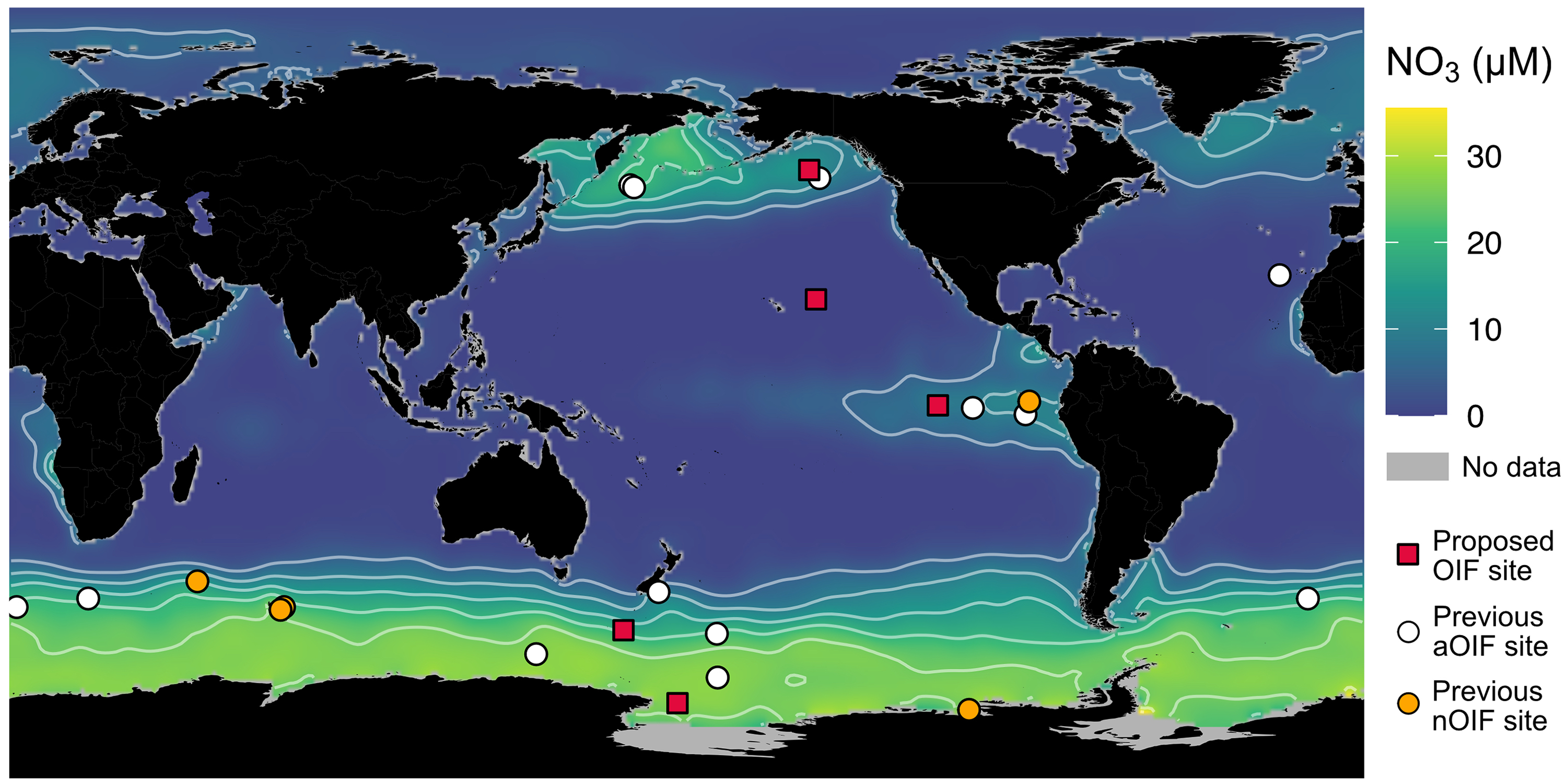
Average annual surface (0–50 m) nitrate concentrations and locations of previous artificial OIF field experiments (aOIF; n = 13) and natural iron fertilization studies (nOIF; n = 5). Proposed sites for the next generation of OIF field studies are located in the North Pacific, Equatorial Pacific, and Southern Ocean HNLCs. Nitrate concentrations were derived from the NOAA World Ocean Atlas 2023 dataset (Reagan et al., 2024), and gray indicates where no nitrate data was available.
These field studies all employed similar experimental protocols. Commercially available iron sulfate (FeSO4) dissolved in acidified seawater was added to surface waters in low Fe regions (<0.2 nM) via the propeller wash of a moving ship, creating “patch” sizes ranging from <25–300 km2 (Yoon et al., 2018). A total of equivalent of 350–4000 kg of elemental Fe was added at least once and as many as four times to enhance productivity, over experimental observation periods of 10–40 days (Yoon et al., 2018). The scale of these experiments was limited mostly by the endurance of standard oceanographic research vessels, and ultimately the funding available for conducting the research.
Unlike bottle experiments, OIF field experiments offer a holistic approach by studying the entire planktonic community. While stocks of many phytoplankton groups initially increased, it was the diatom species that most often dominated the growth response to Fe, while grazing pressure from microzooplankton limited the buildup of smaller taxa. Cellular-level physiological responses were rapid, occurring within days alongside the drawdown of macronutrients, DIC, and Fe. Multiple nutrient co-limitations were also thought to control ecosystem responses, in particular the uptake of dissolved silicic acid and vitamins, which are required by most diatoms.
Fundamentally, the physical conditions set the overall responses, with colder waters leading to slower growth rates, shallower mixed layers leading to higher concentrations of chlorophyll, and greater pCO2 drawdown (Figure 2). The total biomass produced (standing stocks per square meter) showed, however, similar increases despite large differences in physical settings. One problem with extrapolating to larger scales from prior studies is that the underlying physics of smaller-scale patches increases the effects of lateral mixing that dilutes phytoplankton stocks and limits particle aggregation, while supplying macronutrients without sufficient Fe into fertilized patch waters (Abraham et al., 2000).
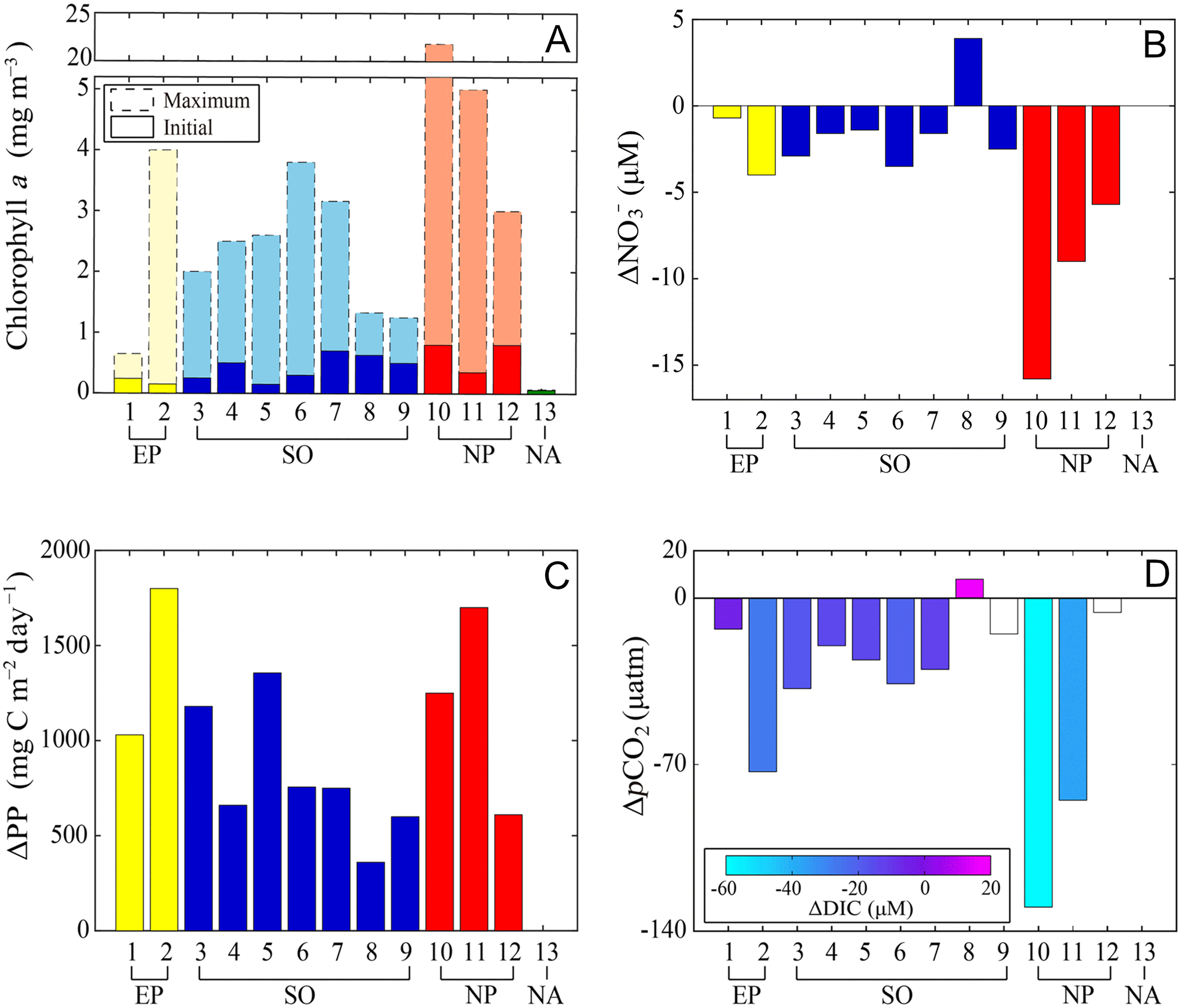
Figure adapted from Yoon et al. (2018) summarizing (A) initial and maximum chlorophyll a and changes pre- and post-fertilization in (B) nitrate, (C) primary production, (D) pCO2 and DIC from 13 artificial OIF trials in the Equatorial Pacific (EP), Southern Ocean (SO), North Pacific (NP), and North Atlantic (NA).
The tendency to keep adding Fe to the patch to maximize phytoplankton growth greatly limited the ability to quantify export of sinking organic carbon, as there is a lag between accumulation of phytoplankton carbon and subsequent export. Export from the upper ocean was seen in at least 5 experiments using sediment traps, thorium-234-based methods, or a drifting float-camera system (Yoon et al., 2018). Only one experiment used adequate methods to observe particles at greater depth, deploying optical instruments down to 3000 m, which gave some indication of rapid particle sinking rates and carbon sequestration to greater depths (Smetacek et al., 2012). The estimates of shallow carbon export below the mixed layer range from 1000–8000 tonnes of carbon in these earlier studies. Even then, the spatial sampling and limited duration means that a quantitative estimate of the shallow carbon export flux response is still lacking, as well as estimates of flux attenuation with depth.
In addition to carbon tracking, several previous experiments also measured the production of non-CO2 greenhouse gases (GHG) related to OIF. These could in theory offset a substantial portion of the potential cooling impacts of CO2 removal. These included assessment of the production of nitrous oxide (N2O) and methane (CH4), commonly associated with the breakdown of organic matter produced by OIF that takes place below the patch. These studies did see increases in non-CO2 GHGs, but at levels that would only reduce the impacts of CO2 removal by roughly 10% or less (e.g., Law, 2008). In addition, measurements were made of dimethyl sulfide (DMS), a potentially cloud-inducing GHG that would have a positive impact on cooling, and effects were small (Wingenter et al., 2004). Importantly from these studies it is clear that a next generation of experiments could readily assess the net impacts of other GHGs beyond CO2.
In terms of potential ecological risks, one of the concerns is that harmful algal blooms (HABs) of the diatom genus Pseudo-nitzschia, some species of which produce the neurotoxin domoic acid, could be stimulated by OIF. The two known efforts to measure domoic acid from OIF field experiments resulted in concentrations below the limit of detection (Assmy et al., 2007; Marchetti et al., 2008). While OIF field incubation studies in the northeast (NE) Pacific Ocean did show domoic acid production with the addition of Fe, the levels produced were orders of magnitude below those known to have ecological consequences (Trick et al., 2010). So while the risk of HABs should be monitored during larger field trials, to date no impacts of domoic acid on higher trophic levels in open ocean OIF studies have been reported (NASEM, 2022).
Next generation of OIF field studies
We contend that a new generation of OIF field studies is needed to evaluate if OIF is a viable approach to reducing atmospheric CO2. Previous studies did not fully address the complex scientific, technical, economic, governance, social, and moral concerns surrounding the implementation of OIF at-scale for mCDR.
Chief among the scientific uncertainties are issues of efficacy—how much additional carbon can be sequestered by adding Fe (additionality) and for how long (durability)—and the efficiency of air-sea CO2 exchange to balance the decrease in surface ocean pCO2, along with any intended and unintended biogeochemical and ecological consequences. Well-designed field studies are needed to generate the data required to constrain these uncertainties. This foundational knowledge is necessary to assess whether or not OIF is verifiable, scientifically sound, and socially acceptable as a strategy for mCDR. Thus, the central question to be addressed here is not—should it be done?—but rather—how effective would it be and at what environmental and societal cost? The end goal would be to provide decision-makers sound assessments along with an open-source description of the protocols that would be needed if the choice was to move forward to implement OIF at climate-relevant scales.
To address the limitations of previous studies, experiments would need to be larger (>1000 km2) and longer (>3–6 months) to observe the transition from a pre-experimental baseline to the full development of the bloom, and importantly and new to these studies, its decay and the fate of the newly produced carbon and the associated ecosystem impacts. The necessity to document a return to natural conditions is a go/no-go criterion that takes place once Fe additions end, and includes a reset of ambient macronutrients and planktonic ecosystems during winter mixing. Modeling will be critical for planning experiments, synthesizing field trials, and extrapolating and predicting the impact on climate to regional and global scales (see Role of models). As noted by Watson et al. (2008), a central role for observational studies will be to make such models as accurate as possible in their simulations and predictions.
Ultimately the decision of where and when to conduct OIF trials will need to consider both baseline conditions at the time of implementation, as well as the unique feasibility requirements for each site. Among the greater challenges are how strategies for OIF can be “tuned” to alter the biogeochemical and ecological outcomes. The experience gained in any one experiment will reduce risks and guide future field studies. Experience will lead to better estimates of deployment and life cycle costs for OIF relative to other mCDR and land-based CDR approaches (Emerson et al., 2024; Ward et al., 2025).
Prior observations and models led Williamson et al. (2012) to conclude that “there is consensus within the scientific community that none of the Fe fertilization field experiments conducted to date could have caused long-term alteration of ocean ecosystems.” Whether or not this holds at climate-relevant scales is one of the motivations for these field studies.
Priorities for a field sampling plan
The next generation of OIF field studies needs to be designed to evaluate whether OIF is an efficient and responsible approach to reducing atmospheric CO2. As such, it is fundamentally an oceanographic research study, but also an engineering exercise, aimed to constrain key variables, reduce uncertainties, optimize desirable responses, and minimize undesirable effects at acceptable costs. Not all variables that impact upper ocean carbon cycling need to be measured, as we are not trying to look at the details of ocean processes per se. Rather, we set out to determine the efficiencies of CO2 uptake, and its additional and durable removal.
Here, additionality refers to carbon transported to the deep ocean largely via the gravitational sinking of particles as part of the BCP, over and above what would happen without any intervention (i.e., a control site with no iron addition). Other pathways of the BCP, such as particle injection pumps and the daily vertical migrations of animals, can be important in shallower waters, but less so at transporting carbon to depth (Boyd et al., 2019). Hence, the focus here is on sinking particles since we are most interested in the transport of carbon to depths of 500–1000 m, the depth that is required to reach isolation times from the atmosphere of 100 years or more (Siegel et al., 2021b). This 100-year metric is a somewhat arbitrary time scale chosen to match durability criteria commonly used in carbon markets, or for countries considering mCDR to meet their carbon obligations under international treaties. We call this metric for additional and durable carbon storage a centennial tonne (Figure 3 in Buesseler et al., 2024). The counterfactual against which this additional flux is measured in field studies is the local baseline in carbon flux in waters surrounding the iron fertilized area, that is, in-patch versus out-patch conditions.
It should be noted that much of the sinking carbon flux is attenuated before it reaches these depths by consumption and recycling of organic matter by mid-water heterotrophs, including bacteria and zooplankton, as well as by physical disaggregation processes. Much of the carbon carried by the BCP is thereby transformed into non-sinking and dissolved forms at shallower depths that would exchange with the atmosphere on shorter, though still relevant time scales. Estimates of the efficiency of carbon reaching depths of 500–1000 m are highly variable, ranging from only 10% on average in open ocean conditions (Martin et al., 1987), to five times greater or more, for example after diatom blooms (Buesseler et al., 2020b). Hence, current uncertainties in costs per tonne CO2 removed and the capacity of OIF at global scales are highly sensitive to the parameterization of this BCP export efficiency (Emerson et al., 2024; Ward et al., 2025), making it a high priority in new field studies.
In addition to the export efficiency of the BCP, we also need to consider the air-sea equilibration efficiency for surface waters that are carrying a CO2 deficit after enhanced phytoplankton growth. Quite simply, the time required for the drawdown of surface pCO2 in response to enhanced phytoplankton growth is much shorter (days) than the net removal of atmospheric CO2 via gaseous exchange (months to years). So, if surface waters subduct prior to complete CO2 equilibration, the degree that the “bucket” is refilled (Bach et al., 2023a) after OIF and other forms of mCDR, is variable and never 100%. These air-sea efficiencies depend largely upon rates of physical mixing processes and subduction, modulated by local wind speeds. However, over longer time scales (years to a decade) the extent that the bucket is not refilled is modest, a 10%–20% reduction on the net impact of the original drawdown, at least in the areas proposed for OIF studies (Long, 2024).
Thus, to succeed in assessing OIF for mCDR, we need to know both the efficiencies for exporting carbon to depth, and for air-sea equilibration. These carbon flux efficiencies need to be quantified, requiring both observations and models as part of monitoring, reporting, and verification (MRV), a term used to describe the measurements, models, and protocols one would need to make these carbon determinations in any mCDR approach. We prefer to distinguish separately MRV for carbon impacts, from the need for determining the environmental and ecological shifts that are both intended and desirable, as well as those that are unintended and have undesirable consequences, which we term eMRV.
With this in mind, we have set out the following priorities to optimize the study design and assess OIF carbon efficiencies. These include:
Create and track a coherent and large (ca. 1000 km2) phytoplankton bloom- here defined as a significant enhancement of phytoplankton biomass relative to background variability. Track export and fate over several months of the additional particulate carbon flux to depths where sequestration time scales exceed at least 100 years (≈500 m depth at our recommended study site in the NE Pacific). Assess surface DIC and the carbon dioxide (pCO2) drawdown with observations, and estimate air-sea exchange using models. Quantify ecological and biogeochemical changes and their relaxation time scales relative to non-enriched waters outside of Fe-enriched waters. Establish MRV protocols via assessment of MRV and eMRV technologies from OIF field experiments for the development and validation of MRV models. Use observational field data and models to assess scalability and costs, and with models, assess regional and climate impacts as well as inform Life Cycle Assessments (LCAs). Utilize the findings to design future studies that maximize mCDR potential, reduce unintended environmental and ecological impacts, evaluate variability, and reduce costs at different sites.
These priorities differ in important ways from prior studies, emphasizing not just stimulating phytoplankton growth, but quantifying key carbon pathway efficiencies that require longer and larger studies that augment traditional ocean sampling from ships with new autonomous vehicle (AV) technologies. The details of each measurement and model are beyond the scope of this paper, however, we briefly discuss below how we would implement such a study and where it would best be conducted.
Where should the next set of field experiments take place?
There are several large ocean regions with HNLC conditions that have already been shown to be effective for the growth of phytoplankton in response to small additions of Fe. These include the waters of the Southern Ocean, upwelling sites in the Equatorial Pacific Ocean, and the subarctic waters of the North Pacific Ocean (Figure 1). Studies of low nutrient, low chlorophyll (LNLC) sites should also be considered, as an increase in nitrogen-fixing plankton is another way to relieve macronutrient stress and encourage plankton growth with concomitant CO2 uptake. Such LNLC dynamics have been seen in nature (Forrer et al., 2023) but attempted only once with limited success as a deliberate open ocean OIF field study (FeeP; Dixon, 2008).
OIF field studies will eventually need to explore multiple settings, particularly the Southern Ocean with its characteristic (often endemic) plankton communities and food-web structure, given that this region holds the greatest potential for carbon removal. Siegert et al. (2025) are particularly critical of OIF field studies in the Southern Ocean. On the scientific side, they cite data are lacking about the effectiveness for carbon removal but note prior OIF studies were monitored only 2–5 weeks so “it is not known whether longer-term observations would yield more positive results.” The next generation of OIF experiments would need to be longer to address this issue. Concerns about negative consequences were also noted and are the same processes that have been, and would continue to be, monitored as part of go/no-go decisions moving ahead (discussed in more detail below). They review the governance challenges specific to the Southern Ocean under the Antarctic Treaty and the associated international consultation needed for even non-commercial activities in this region. We agree, and this is one reason it would be premature to initiate the next generation of OIF field studies in the Southern Ocean, for both these regulatory challenges, and as they also point out, the added logistical costs of working in remote and harsh conditions.
Another possible HNLC region where the first OIF studies were conducted is in the upwelling waters of the Equatorial Pacific (Coale et al., 1996, 1998). While warmer waters result in faster response times for plankton growth, low silicic acid concentrations and the fast currents in the Equatorial Pacific region would require studies over much larger areas, and that poses additional costs and constraints to observations.
The most promising location for the next generation of field study is in the NE Pacific Ocean (Figure 3; Buesseler et al., 2024). This site was chosen over others as success can be anticipated given low Fe conditions, past OIF field studies (SERIES; Boyd et al., 2004), and evidence of natural Fe-induced blooms (e.g., Kashatoshi eruption; Hamme et al., 2010). This region of the NE Pacific Ocean is also known to have some of the lowest rates of eddy kinetic energy (Xu et al., 2014). This is a measure of physical mixing, and thus how likely a patch would maintain its original position and shape. For sequestration of one tonne of sinking carbon for >100 years, our centennial tonne (see Priorities for a field sampling plan), the depth which needs to be reached by sinking POC is among the shallowest in the ocean at roughly 500 m (Siegel et al., 2021b). For air-sea exchange, timescales for equilibration can be assessed using in situ DIC observations and meteorological data from Ocean Station Papa (50°N 145°W) moorings (Freeland, 2007; NASA, 2024; Peña and Bograd, 2007), and included in any LCA of carbon efficiencies and additional durable storage.
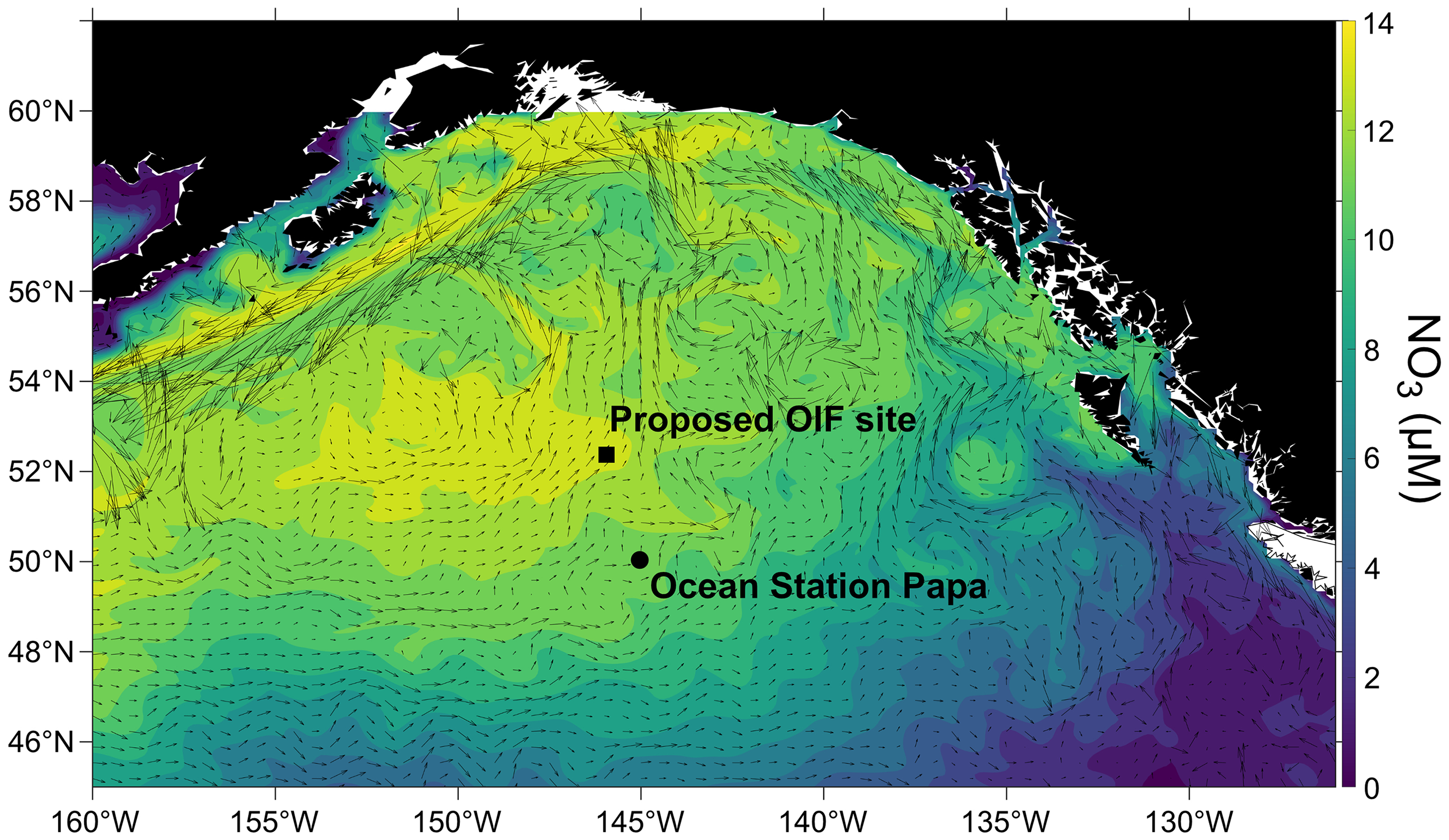
Average annual surface (0–50 m) nitrate concentrations (color) and surface currents (0–50 m; vectors) in May from a climatological run of the ROMS-CoSiNE model. Locations of Ocean Station Papa and the proposed site for Fe fertilization in the Northeast Pacific. Nitrate concentrations were derived from the NOAA World Ocean Atlas 2023 dataset (Reagan et al., 2024), and white indicates where no nitrate data was available. Unpublished results (F. Chai, P. Xiu).
Our observations will help constrain models and predicted effects downstream, which are minimized here given the location at the end of the global conveyor belt. Compared to other sites, logistics would be easier despite being about 1600 km from the nearest major ports, being proximal to the decades-long time series at Ocean Station Papa, which requires regular visits by Canadian and US researchers, among others. Thus, the regional baseline for this area is well known, although the proposed Fe deployment would be approximately 260 km to the northwest and “downstream” so as not to impact Ocean Station Papa baselines (Figure 3). The site has attracted many prior studies, including more recently a study of carbon cycling and export as part of NASA's EXPORTS program (Siegel et al., 2021a), which was used as a template for some of the cruise planning and cost analyses we are considering here. US ports along the Pacific Northwest and in Alaska as well as Canadian ports can be used for access, and international interest across the Pacific Ocean by Japan and China is encouraging for collaborations, including potential incorporation of their research vessels and AVs into studies at this site.
Delivery of iron and tracking the patch
Implementing our priorities will require a carefully and openly planned international collaborative effort. The essential first step of such a field plan is creating and tracking a large and coherent bloom (Priority 1). This requires site-specific models and estimates of minimum patch size that can be tracked and laid out using existing platforms. In this case, the first experiment would follow the lead of prior studies, using well-known properties of FeSO4 deployed in acidified liquid form in the propeller wash of a ship as the Fe source. This can certainly be improved upon, given rapid loss of this form of Fe (Bowie et al., 2001), potentially using barges, AVs, or airplanes to deploy (de Andrade et al., 2025; Emerson et al., 2024). We encourage progress in parallel on these advances. However, using established methods that have been shown to be low-risk and effective is important in this initial study, as it facilitates direct comparison to past results, and offers a precedent for obtaining the first high seas permits under the London Convention and London Protocol (LC/LP; see Permitting, communication, and community engagement).
Ocean models of the recommended study site (see Role of models) suggest a patch size of 30–50 km per side (i.e., 900–2500 km2) and adding on the order 10–50 tonnes of Fe create an enhanced growth response and POC export flux to 500 m over the course of 3–5 months (Figures 4 and 5). Adding the inert tracer SF5CF3, the preferred modern replacement for SF6 (Ho et al., 2008), will allow for near-real-time patch tracking from ships at least during the first several weeks. As SF5CF3 disperses and is lost to the atmosphere (Vardner and Loose, 2016), a large number of surface drifters, along with AVs, remote sensing, and ship-based measurements of the rapidly responding chlorophyll, Fv/Fm, pCO2 and other biogeochemical fields, will be used to track the patch evolution over several months.
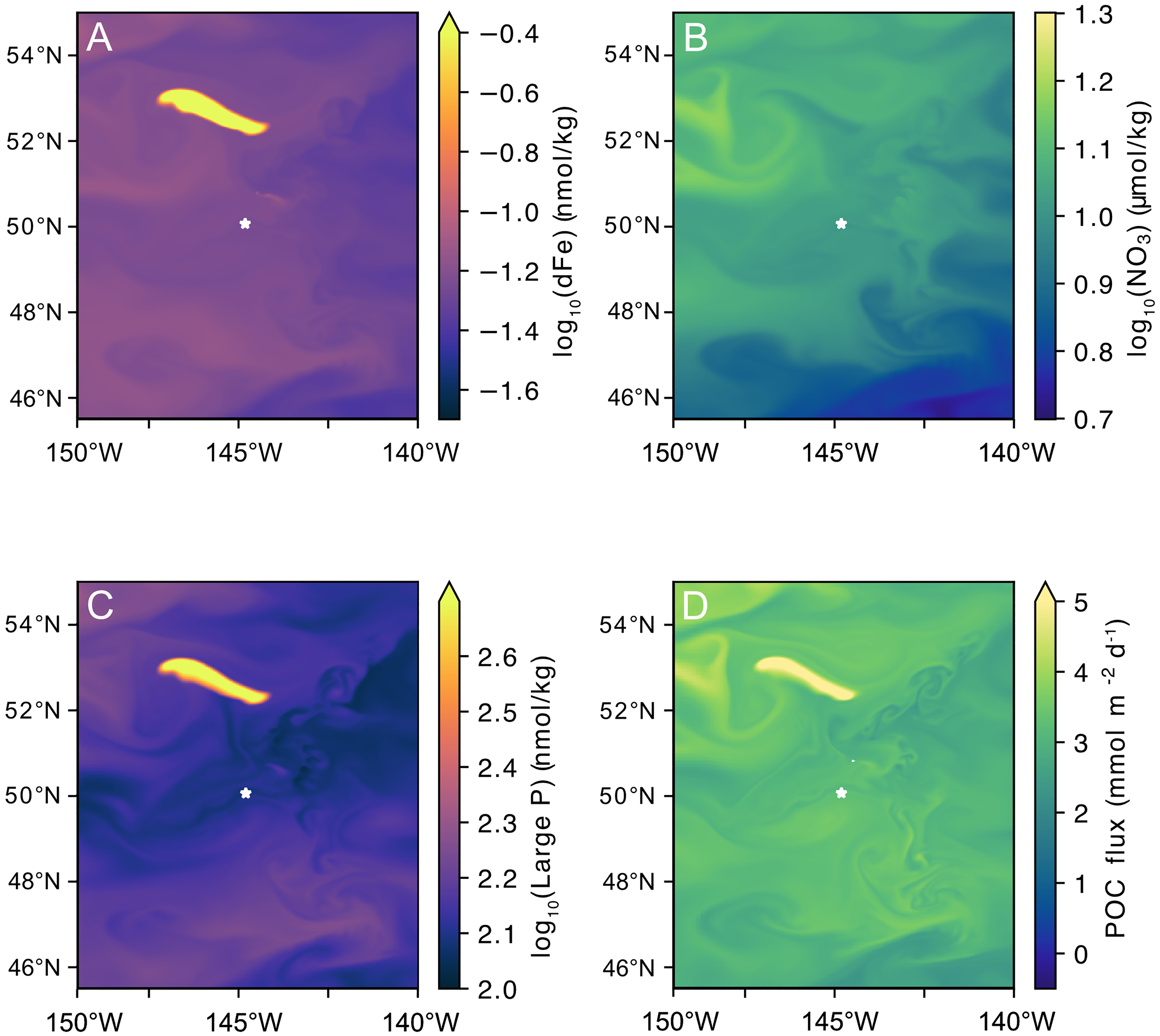
Snapshots from a 1/32 degree resolution nested coupled physical-biogeochemical model (MOM6-COBALT) 7 days after a patch of iron was released approximately 200 km northwest of Ocean Station Papa (star) in June. (A) Surface dissolved iron, (B) surface nitrate, (C) surface large phytoplankton abundance, (D) particulate organic carbon flux at 500 m. Unpublished results (Z. Liu, D. McGillicuddy).
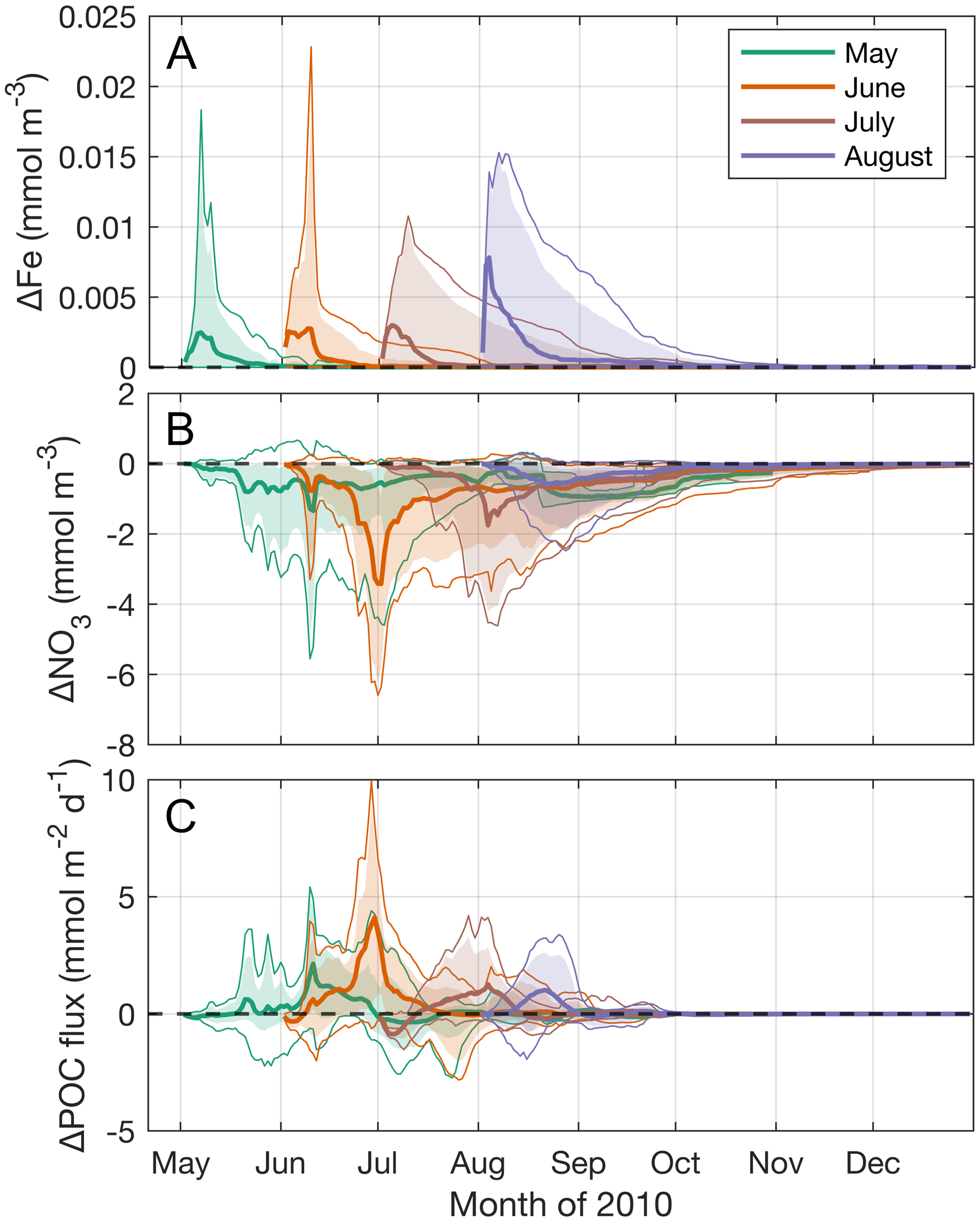
Biogeochemical response to OIF in the NE Pacific, approximately 200 km northwest of Ocean Station Papa, simulated using ROMS-BEC at 4 km resolution. Time series of changes in (A) surface dissolved Fe, (B) surface nitrate, and (C) particulate organic carbon flux at 500 m depth between the Fe-fertilized patch and baseline conditions. Thick lines represent the median values within the fertilized patch for May–August release times, while shading indicates 5th–95th percentile and thin lines mark the full range. Unpublished results (D. Bianchi, D. Li).
MRV and eMRV
The second and third priorities relate to key variables of MRV for carbon. For durable and additional carbon sequestration, we would need to capture the sinking flux of particulate carbon directly or assess it via verified proxies. Combinations of sediment traps, radionuclide budgets, and optical/camera-based approaches have evolved to be capable of 4D time-series estimates of POC flux below the evolving patch as it sinks both vertically and spreads horizontally (Buesseler et al., 2020a; Estapa et al., 2021; Siegel et al., 2008, 2025). The emphasis will be on the upper 500 m where flux attenuation is greatest, and below which the time scale for isolation of carbon largely exceeds 100 years. These methods allow us to quantify not only export efficiencies, i.e., production/export, but also durability in terms of the centennial tonne metric. This needs to be done at multiple locations within, and importantly, outside of the Fe-amended areas for the local baseline. A region initially on order 100 × 100 km would need to be studied to encompass areas outside of the fertilized patch, enabling quantification of the counterfactual conditions (no Fe addition). This study region will be followed in a Lagrangian fashion as it moves with the changing 3D physics.
The depth of remineralization is key to the return of nutrients and carbon to the surface and both near and far field effects. This nutrient reallocation, or nutrient “robbing,” is a consequence of enhancing productivity in one area, and the extent of this impact will vary for the different elements and environmental conditions. For example, the remineralization length scales of nitrogen and phosphorus on sinking particles are shorter than carbon (e.g., Lamborg et al., 2008a, 2008b), and thus models that are required to predict downstream and regional impacts on decadal times scales will need better observational results to parameterize these different length scales in response to OIF. As such, in these next-generation OIF experiments, considerable attention is needed not just on carbon export, but on vertically resolved observations of other elements beyond carbon, such as nitrogen, phosphorus, biogenic silica, particulate inorganic carbon and Fe. Multiple methods would be required to reduce uncertainties and efficiently track the export flux, its remineralization, and particle characteristics under the evolving OIF patch.
MRV for carbon includes not only carbon export to depth, but also carbon drawdown and exchange at the surface (Priority 3), as this atmospheric CO2 “influx” efficiency will not be 100% (Bach et al., 2023b). A complete program measuring DIC parameters using ship and AV-based sampling and sensors will be needed to assess the evolving decrease in the pCO2 field due to stimulation of phytoplankton growth, which prior studies show can happen relatively quickly (days). However, the re-equilibration with atmospheric CO2 takes months to years and occurs over larger areas, and this requires model assessments to consider the degree to which this is completed, prior to water subduction and mixing. This need is paralleled in other biotic and abiotic mCDR approaches, and is an opportunity for collaboration across studies of different mCDR strategies.
For eMRV (Priority 4), we will track changes to plankton communities, relying largely on molecular DNA metabarcoding (Hook et al., 2024) and automated optical approaches such as Imaging FlowCytobots, towed shadowgraph cameras, and/or underwater vision profilers (Cowen and Guigand, 2008; Dugenne et al., 2024; San Soucie et al., 2024), with integration of these complementary techniques (Kramer et al., 2024). The intended effect of OIF is to increase phytoplankton growth of the existing species. In the past, diatoms have responded quickly, though this can shift as dissolved silicate and/or other trace elements and vitamins become limiting, and as grazing pressure on small and large phytoplankton changes over time. At one level, the increase in biomass can be seen as a desirable effect that enhances production at the base of the food chain, but we also need to consider potential undesirable impacts.
For example, the rapid growth of the diatom genus Pseudo-nitzschia has raised concern regarding their role in coastal HABs through production of the associated toxin domoic acid, which concentrates up the food chain (Bates et al., 2018). As noted above, past experiments have not seen evidence of higher domoic acid per cell in these Fe-induced blooms in the high seas, and experimental incubations indicate that it will not be a factor (NASEM, 2022), but nevertheless, measures of plankton toxicity will be a clear go/no-go criterion (see Go/no-go criteria). Fortunately, this can be monitored in near real time using ship-based sampling. Molecular techniques and advanced toxin analytics allow for these potential HAB responses to be monitored rapidly (Brunson et al., 2024; Litaker et al., 2008; Moore et al., 2021), and will be used to re-evaluate field plans if undesirable consequences are observed. Thresholds for adverse effects, including toxin concentrations and others, will be essential to define ahead of field trials through co-design with vested communities and organizations.
There are suggestions by some that Fe-enhanced plankton blooms and associated trophic cascade may benefit fisheries (Olgun et al., 2013). However, even with 6 months of observations, the studies are too short to monitor complete fisheries impacts and effects on higher trophic levels (NASEM, 2022). We can however use existing water quality parameters to assess in near-real time if we are causing harmful growth conditions and changes in planktonic food web structures that may lead to either enhancement or undesirable changes at higher trophic levels (e.g., low oxygen, low pH values, and changes to food supply). All of these can be used as go/no-go decision points in any particular field experiment.
Other geochemical variables beyond carbon will be monitored closely, including major nutrients and oxygen. Subsurface remineralization of sinking carbon has been of concern, which decreases oxygen, but predictions even at large scale are small (3% global reduction in oxygen after 100 years of OIF; Oschlies et al., 2025). Changes are even smaller for the areal extent of suboxic regions, where OIF leads to less than a 1% shift in areas defined by oxygen < 5 µM (Figure 3 in Oschlies et al., 2025). As noted, the subsurface oxygen decline is essentially restricted to the location of the OIF applications, whereas waters outside the OIF region show an average oxygen increase over baseline. This is due to reduced primary production at depth downstream from the fertilized region. For specific field work, the subsurface oxygen changes are small and will be relatively easy to measure (Figure 6) with sensors mounted on autonomous gliders, floats, and CTDs (Briciu-Burghina et al., 2023).
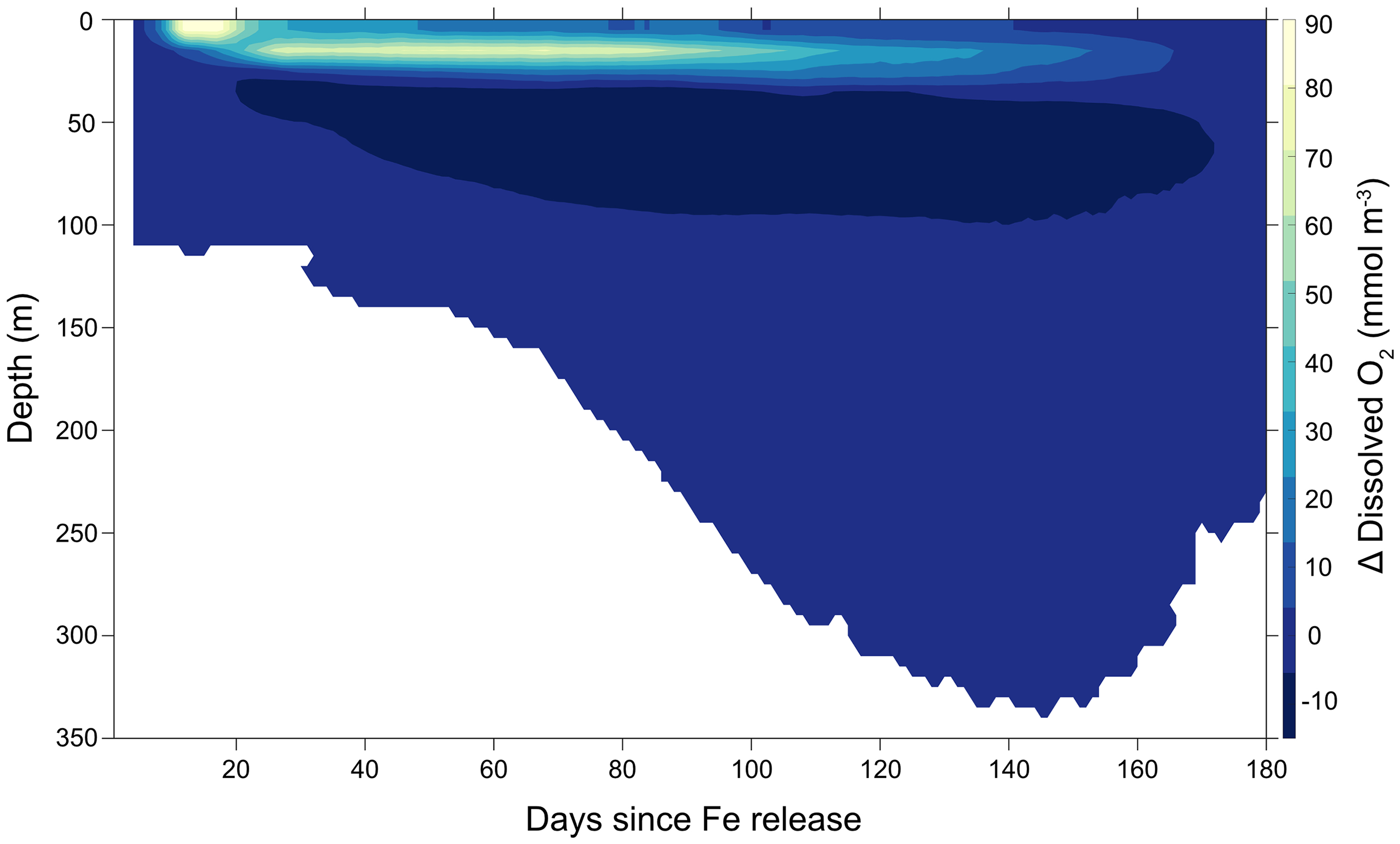
Difference in dissolved oxygen concentration (OIF – control) averaged inside the OIF patch over time following Fe release in May approximately 200 km northwest of Ocean Station Papa using the ROMS-CoSiNE model. Typical water column oxygen concentrations at this site range from ≈60 mmol m–3 at 350 m to ≈320 mmol m–3 at the surface. Oxygen concentrations were derived from the NOAA World Ocean Atlas 2023 dataset (Reagan et al., 2024). Unpublished results (F. Chai, P. Xiu).
Remineralization of sinking organic matter can also lead to the production of other more potent GHGs, such as CH4 and N2O, which will be measured shipboard as part of the eMRV to make a full accounting of climatic impacts (see Law, 2008 for methods). Similarly to HAB toxins, thresholds for oxygen depletion and non-CO2 GHG production will be pre-defined. The change in sinking carbon flux, estimated from models to peak around 4–6 mmol m−2 d−1 at 500 m (Figure 5) would be even smaller at the seafloor, and is within the range of natural POC flux variability in this region (Timothy et al., 2013).
With new results in hand and improved models (Priority 5), much more realistic assessments of carbon budgets can be made that will allow for vastly improved LCA's (Priority 6). If results are promising, optimization will become increasingly important, as we look for ways to improve carbon efficiencies and reduce unintended environmental and ecological impacts (Priority 7). To give one example, repeated field experiments will be able to test whether a single pulsed input of Fe, or a longer period of repeated Fe addition during the growth season, produces a greater carbon export response. Parallel studies of the most bioavailable and effective forms of Fe will very likely lead to ways to improve carbon responses and optimize delivery costs. Ultimately, the goal would be to improve carbon efficiencies, limit undesirable ecological impacts, and reduce the number of variables that need to be measured to constrain carbon benefits and minimize negative consequences. This optimization allows for more realistic scaling and assessment of downstream and global climate impacts for comparison to other mCDR approaches that also suffer from this lack of knowledge. A proposed list of observational variables to meet these priorities has already been published (see Table S1 published in Buesseler et al., 2024).
Role of models
Detailed simulations of the proposed field trials have begun in earnest (Buesseler et al., 2024; McGillicuddy et al., 2026), with several different models being run at high resolution in the vicinity of the recommended release site (Figure 4). At present, three different coupled physical-biogeochemical models have been implemented, and a set of common protocols for the numerical experiments has been shared with the community to encourage other groups to join. This ensemble approach is particularly powerful in light of the differences in model hydrodynamics, biogeochemistry, and Fe chemistry in particular. Analogous to hurricane forecasting, the variance between models is used to estimate uncertainty in outcomes—often expressed as the “cone of uncertainty.” The envelope of model predictions is being used to bound expectation of nutrient drawdown, air-sea CO2 flux, and carbon export, as well as the spatial and temporal footprint of each. This latter aspect informs site selection, providing a means to determine that the proposed location is far enough from Ocean Station Papa that the time-series is unaffected, and thus can serve as one of the “controls” for the OIF experiments (Figure 4). The model outputs are also being used for Observing System Simulation Experiments (OSSEs) to design experimental sampling plans. The goal is to ensure the spatial and temporal resolution of the various measurement systems will be sufficient to provide quantitative estimates of the ocean response to OIF and the associated uncertainties.
Modeling in the lead-up to the field trials helps to build the numerical infrastructure that will be needed for execution of the OIF experiments and analysis of the results. Data assimilative models will provide real-time predictions of the hydrodynamic environment to help guide actual deployment of the Fe addition, as minor adjustments of the patch location relative to fronts and eddies could help minimize transport and dispersion. Such models will also inform adaptive sampling of the patch as it evolves in space and time. The models will provide a framework for synthesis of the results in hindcast mode, providing space/time continuous field estimates of carbon fluxes from which additionality and durability will be quantified (see Figure 3 in Buesseler et al., 2024).
After the field experiment, the models will be tested with the observations, and model-data comparisons will guide model improvement. This is particularly important as they relate to observations of the relative remineralization length scales of carbon, macronutrients, and Fe, and the models are required to extrapolate to regional, and decadal to centennial impacts (Aumont and Bopp, 2006; Oschlies et al., 2010). Predicting the extent of nutrient robbing requires both appropriate modeling of physical transport of surface and intermediate waters but also requires knowing the depth of sinking particle remineralization, the latter of which is far less well known from observations and differs for carbon compared to other macronutrients and Fe. In one recent model (Tagliabue et al. 2023), nutrient robbing leads to an additional decrease of 5% biomass off South America by 2100 with continuous large-scale OIF when compared to the expected 15% decrease in biomass due to climate change without OIF. For context, the OIF scenario would lead to significant removal of atmospheric CO2 on the order of more than 100 Gt. This balance of decadal far-field nutrient redistribution impacts and the positive benefit of CO2 removal are hard to predict without better knowledge of particle remineralization length scales and consideration of other processes missing in models of the BCP (Henson et al., 2022).
Go/no-go criteria
The priorities above establish several sentinels that would be used to halt Fe release or further experimentation, that is, go/no-go decisions or so called “off ramps.” If we can’t create and track the patch, then there is no reason to continue beyond Priority 1. Likewise, if we can’t measure CO2 drawdown or subsurface particulate organic carbon export with a high degree of confidence compared to prior studies, then there is no point in proceeding (Priorities 2 and 3). If biogeochemical impacts are detrimental—e.g., deoxygenation is trending close to where undesirable changes in deepwater or benthic communities are expected, or where N2O production begins to offset CO2 reductions, or a buildup of domoic acid concentrations known to be problematic—then further study would not be warranted (Priority 4). These are the key variables we intend to monitor with a high level of intensity in these next experiments. As part of the observational design, we also need to confirm that the experimental perturbations are small enough that the system “resets” back to ambient conditions across seasons, as observed with natural blooms. The experience gained from 13 prior experiments gives us confidence that these go/no-go conditions will remain within acceptable limits for the scale of the field trials we are proposing. While the proposed experiments are larger, they are still small compared to seasonal trends in regional primary productivity, which are reset at the end of the season by winter mixing. However, out of an abundance of caution, these risk factors will be closely tracked to provide confidence both during the initial experiments and, if patch deployment size is incrementally increased, in future deployments.
What we can learn from nature
It should be recognized that in terms of impacts at scale, we do have examples in nature for comparisons. These examples involve both short-term inputs and long-term sources of Fe to HNLC waters. Large pulses of Fe to the ocean are delivered from volcanic eruptions and forest fires. Focusing on the proposed NE Pacific site, the Kasatochi volcanic eruption in 2008 on the Aleutian Islands is perhaps the most relevant example. This led to a doubling of surface chlorophyll over an area of 1.5–2 × 10⁶ km2, as seen by remote sensing, resulting in what was estimated to be some 10 million tonnes of additional carbon export during that single growth cycle (Hamme et al., 2010). Instruments already in place measured a decrease of 30 µatm in surface water pCO2 and an increase in pH from 8.08 to 8.13 at an Ocean Station Papa mooring, confirming the remote sensing results that tracked the depositional plume. Some postulated that the bloom had a net positive effect on fisheries (Parsons and Whitney, 2012) encouraging the growth of juvenile salmon species, a claim that was later disputed due to the many confounding processes that impact salmon fisheries (McKinnell, 2013).
The Australian wildfires in 2019–20 led to an even larger ocean growth response, with a temporary increase in phytoplankton production seen by satellites potentially offsetting the additional CO2 released by the fires (Wang et al., 2022). This elevated production was sustained by Fe recycling for nearly 9 months after pyrogenic inputs ended (Weis et al., 2022). Export models suggested an increase in carbon flux of 150–300 million tonnes (see Table S2 published in Tang et al., 2021). No undesirable impacts to marine ecosystems from these volcanic or forest fire events, such as HABs or deoxygenation, were reported, but a comprehensive biogeochemical study of these events was not conducted.
More deliberate studies by many scientists over several cruises were conducted in high Fe settings in areas surrounded by HNLC waters in the vicinity of the Crozet and Kerguelen Island archipelagos found at high latitudes (46°S and 50°S, respectively), as part of the CROZEX (Pollard et al., 2009) and KEOPS programs (Blain et al., 2007). Relevant to potential mCDR export efficiencies, the molar ratio of Feadded:Cexport was on the order of 1:1000 to 8000 in the OIF field studies but reached much higher efficiencies up to 1:174,000 in these natural island settings, due perhaps in large part to the rapid scavenging of Fe leading to >75% removal of Fe in the deliberate OIF additions (Buesseler and Boyd, 2003; de Baar et al., 2008).
Associated with these naturally Fe-enriched areas were not just higher abundances of phytoplankton and carbon export (Morris et al., 2007; Savoye et al., 2008) but a stable ecosystem higher up the pelagic food chain (Carlotti et al., 2015; Fielding et al., 2007) and including the benthos (Hughes et al., 2007). Studies of larval krill development in the Georgia Basin and Scotia Sea (two areas naturally fertilized) indicate a positive response of larval (and by extrapolation most likely adult krill) to an increase in plankton biomass (Meyer et al., 2017). Similar to natural settings, OIF field studies in the Southern Ocean, EIFEX, and LOHAFEX showed positive responses for zooplankton with increase in copepod egg production and migration of larger zooplankton in the fertilized area (Jansen et al., 2006; Mazzocchi et al., 2009).
Permitting, communication, and community engagement
The next generation of OIF field studies would comply with permitting regulations for research projects currently established by the US EPA under the Marine Protection, Research, and Sanctuaries Act (MPRSA) and Clean Water Act (CWA) (EPA, 2025). This process involves justification of field research activities, detailed characterization of the material to be added to the ocean, background conditions at the study site, anticipated impacts to the environment and other uses of the ocean, monitoring protocols, and contingency plans for unexpected outcomes. The field trials must additionally conform to the criteria for conducting “legitimate scientific research” under the LC/LP (Silverman-Roati and Webb, 2025). In the USA, the MPRSA regulatory framework has yet to be used for deposition of materials in the high seas. If field trials are funded by national agencies, philanthropies, or private donations, and not by groups seeking to monetize carbon credits, the criteria for legitimate scientific research can be met. By following the high bar set by the LC/LP, the next generation experimental results will demonstrate if, where, how, and under what conditions OIF might be considered as a way to meet international standards for GHG removal. The findings could also inform effective and safe practices for commercial operators who wish to engage in mCDR. It should be highlighted that governance research at national and international levels is an integral need as part of mCDR research (Morrison et al., 2025). However, discussion of governance issues beyond the immediate needs for seeking an EPA permit and conforming to the LC/LP stipulations for legitimate scientific research is outside the scope of this manuscript.
We are following a set of guiding principles that specifies that all planning and results will be shared in an open and transparent manner, and includes communication with the public and engagement with local communities, including Indigenous groups (Buesseler et al., 2022, 2024). As part of this process, it is important to consider independent advice from social scientists to lay out guiding recommendations (Bastian et al., 2025). These recommendations include the need to initiate a mapping study in the Pacific Northwest region to characterize the landscape of communities and other parties with interests in, or potentially impacted by, field trials. The recommendations also include a commitment to govern and share data aligned with the CARE (Collective Benefit, Authority to Control, Responsibility, and Ethics), and FAIR (Findable, Accessible, Interoperable, and Reusable) principles, which reflects the importance of data for Indigenous peoples, and ensures data is made easily available for sharing and future reuse.
It is also essential to communicate the need for research into mCDR, specifically OIF, both within the scientific community and to diverse audiences. We are actively working to establish a collaborative network in the Pacific Northwest with others who are acting in this space to assist in constructive dialogue via their own trusted networks. The foundation of these conversations needs to be rooted in mutual trust, which requires time and effort to establish, so is being initiated in advance of permitting and field trials. While it is critical to convey an understanding of the value of mCDR research, an engagement plan is needed to support two-way conversation and create opportunities for local individuals with experiential knowledge to participate in project co-design.
Summary and future vision
We argue that there is a need for a new generation of OIF field work in key areas of the world's oceans. This is demanded by the urgency of the climate crisis. It is also needed to build social trust, which can be lost if carbon markets and credits are advanced prior to having non-biased and acceptable methodologies in place. We need to consistently state that decarbonization should be the main priority to address increasing atmospheric CO2, but that will not be enough to escape the worst of the climate outcomes. CDR is now essential, and the oceans have the largest capacity to store the carbon necessary to achieve Gt per year removal rates (Friedlingstein et al., 2025). We must also consider how much worse off the ocean will be if we choose not to adequately remove CO2, given the accelerating and undesirable changes in contemporary ocean systems. While some contend we know enough already to rule out OIF for mCDR and hence no further research is needed (e.g., Strong et al., 2009). We argue that the unknowns for large-scale OIF deployments are large and that there is considerable merit in learning by doing—indeed it is a necessary path forward. We can build upon past experiments that shed light on how to conduct large unenclosed open ocean manipulations, which successfully showed a large response to phytoplankton growth and surface pCO2 drawdown in some parts of the ocean to relatively small amounts of Fe.
We know that larger and longer experiments combining existing observation tools, models, ships, and remote sensing, along with new monitoring technologies, in particular AVs, can make such studies even more insightful. If we meet our seven priorities for the NE Pacific field trial, we expect to stimulate a significant diatom bloom at the surface in response to only small addition of Fe (Feadded : Cexport ratios of >1,000–10,000), followed by carbon export efficiencies (export/production) exceeding 10–25% at the depth of the centennial tonne. Demonstrating we can successfully quantify these metrics in a responsible field study will further serve to reduce the risk of future experiments by setting guard-rails on procedures to prevent undesirable outcomes. If we fail to move the science quickly and rigorously, commercially motivated carbon credit markets that are not accompanied by the best science will erode public trust, as has happened with unsupported claims of the efficacy and low cost of OIF in the past (Tollefson, 2017). While public-private partnerships for R&D funding should be considered, it needs to be independent of carbon credits, which might be sold or traded as a result of any given study.
We also learned from these prior experiences (Schiermeier, 2009) that we need to engage with public audiences and local communities (e.g., fisherman, Indigenous peoples, and coastal populations), appropriate policymakers, NGOs, and our scientific peers in the planning stages and throughout. This includes listening to their concerns, explaining the research motivation, adapting and improving methodologies where necessary, and sharing our guiding principles in planning and executing such experiments. Results must be made publicly available, and the interpretation of our results needs to be published in the peer-reviewed literature to ensure these findings are up to the highest academic standards.
As seen in prior studies and models, the impacts of adding Fe at field trial scales will be neither long lasting with the seasonal reset of ocean nutrients, nor extend to the far field. Rather it is precisely because of new observations that we will be able to improve models to better incorporate key processes, which are needed to make regional, and ultimately global, extrapolations at larger deployment scales. Key to these observations are changes to the BCP that impacts transport of not just carbon to depth, but major nutrients and trace metals such as Fe, into subsurface intermediate and deeper waters. We intend to generate scientific understanding that will inform decisions on where, when, and to what degree the benefits from mCDR, and in this case OIF, exceed the risks and impacts of scaled-up deployments.
In the end, mCDR approaches that carry the “nature-based” label can influence their acceptance by the public and potential investors in mCDR (Ho and Bopp, 2024). No matter how it is labeled, it is more important to determine if deliberate OIF can reproduce the effects seen in nature, which are thought to lead to productive ecosystems and additional and durable atmospheric CO2 removal with minimal Fe additions. The challenge is designing studies with enough understanding of the consequences and costs to be able to choose wisely among CDR approaches.
The endorsement of new OIF field studies amongst the academic community is not new. Prior synthesis by the oceanographic community encouraged additional OIF field experiments (Boyd et al., 2007; Williamson et al., 2012; Yoon et al., 2018). To do this, a new generation of ocean scientists will need to be entrained, and many are eager to move ahead with such studies (Kitch et al., 2025; Li et al., 2025). No matter what path is taken to complete these studies, we need to consistently emphasize substantial and rapid emissions reductions so we can apply some type of CDR to reduce the negative impacts of our current and future high atmospheric CO2 levels. This will reduce global temperatures overall, mitigate declining ocean pH, and thus improve the health of the ocean, and certainly life for humans and environmental systems on land. It is precisely for these potential benefits that we are proposing the next generation of OIF field studies in the ocean.
Footnotes
Acknowledgments
We acknowledge Yui Takeshita, Jessica Drysdale, and Chris Pierce for their feedback on this manuscript and/or contributions to the planning workshop.
ORCID iDs

Ethical considerations
Ethical approval was not required.
Author contributions
Conceptualization: KOB, FC, JTC, ME, MH, SJ, DJM, PJM, JN, MMO, DAS, SRS, BST, MW, AW. Writing–original draft: KOB, PJM. Writing–review and editing: all authors. Formal analysis: DB, FC, DL, ZL, DJM. Visualization: DB, FC, DL, ZL, DJM, KMR, JY.
Funding
The authors disclosed receipt of the following financial support for the research, authorship, and/or publication of this article: KOB, DJM, PJM, KR, and KMR were supported by Ocean Visions, Astera, The Navigation Fund, the Ocean Resilience Climate Alliance (ORCA), the McConnell Family Foundation and the Woods Hole Oceanographic Institution. KOB and DJM were additionally funded by NSF and NOAA (NOPP grant). Funding for CK was provided by the Alfred Wegener Institute, Helmholtz-Centre for Polar and Marine Research.
Declaration of conflicting interests
The authors declared no potential conflicts of interest with respect to the research, authorship, and/or publication of this article.