




Abstract
With the development of digital technology and changes in people’s lifestyles, the number of takeaway orders has grown rapidly. University students are one of the main takeaway consumers, producing a large amount of plastic packaging waste. ShuangTi, a college smart canteen catering system provider, developed the reusable food container system for Chinese universities which is successfully adopted in the Southern Medical University, Shunde Campus. Taking it as a case study of the practical application of reusable takeaway container, this study used the life cycle assessment to quantify the carbon footprint of the reusable food container systems and explore the carbon emissions reduction potential of reusable food container systems. Results show that ordering a takeaway with reusable container produces 0.1492 kgCO2eq of carbon emissions, and carbon emissions per order are reduced by 24.2%, compared with using disposable containers. Reusable food containers offset the carbon footprint of single-use containers after being reused 27 times. The operation stage contributes 59.9% of the carbon footprint in the reusable system. The cleaning technical process update would reduce carbon emissions by 25.4% throughout the entire life cycle. The adoption of reusable food container across Chinese universities could reduce carbon footprint by 76.1 kt CO2eq annually. The adoption of reusable food container system promotes the green campus construction and shift in consumer behavior toward sustainability, thus accelerating China’s transition to a circular economy.
Keywords
Introduction
With the popularity of the Internet and the rise of the lazy economy, people’s lifestyles have changed. The takeaway industry has grown rapidly, especially in China. The market size of the Chinese takeaway industry has been rising dramatically from RMB 21.7 billion in 2011 to RMB 1635.7 billion in 2024 (iiMedia Research, 2024). The exponential growth of takeaway packaging consumption has led to a surge in the amount of takeaway packaging waste. The takeaway packaging waste is mainly disposable products such as plastic food containers and spoons, wood chopsticks, plastic packaging bags, and cutlery wrappers, which has aroused wide attention (Zhou et al., 2020; Lu et al., 2025). It puts a huge strain on the environment and can also harm our health (Bank et al., 2021; Gallo et al., 2018; Yates et al., 2021). Young people aged 18–25 are the largest takeaway consumers in China accounting for 36.1%, followed by people aged 26–30 (22.5%), and they order takeaways more frequently than other age groups (Meituan Research Institute, 2020). There are about 30 million university students in China, accounting for 2.3% of the national population. University students have become the second-largest consumer group of food delivery services after white-collar workers, contributing 12% of the annual takeaway orders in China (Ali New Service Research Center, 2021). As high-density settings for takeaway consumption, reducing packaging waste on university campuses is essential for both mitigating environmental impact and facilitating the long-term transformation of society toward a circular economy model. By reshaping student consumption concepts through actions to reduce packaging waste, given their future influence as core consumers, universities can drive broader adoption of circular economy consumption principles.
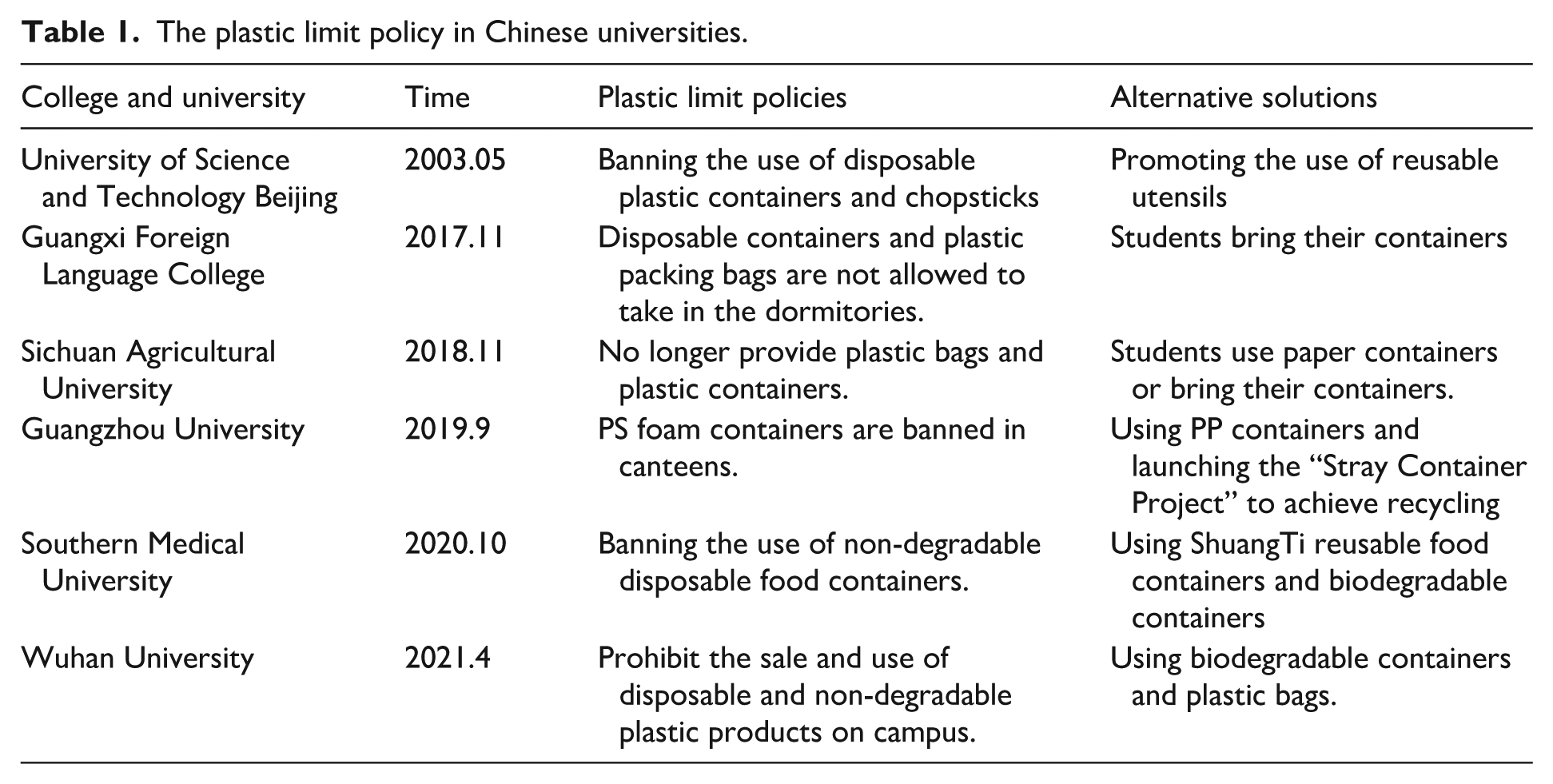
To address plastic packaging waste, several Chinese universities proposed plastic reduction strategies. As shown in Table 1, plastic recycling, material substitution, reusable tableware are alternatives to reduce disposable plastic waste. For example, in September 2019, Guangzhou University, Guangzhou Urban Management and Comprehensive Law Enforcement Bureau, and Guangzhou Urban Mineral Association, together with Meituan, the largest online food delivery platform in China, launched the “Stray Container Project” to recycle polypropylene plastic food container in the Guangzhou University, University Town Campus. Thirty-five collection points were set up in the dormitory and convenience store on campus, and 12 tons of disposable takeaway food containers were collected and transported to the resource treatment station for recycling by the end of 2019. Although recycling can reduce plastic waste generation and increase the resource utilization rate, it is costly and resource-intensive to wash the container and achieve plastic recycling with low economic and environmental benefits. Replacing disposable containers with reusable ones is a potential solution to reduce plastic packaging waste from the source (Sun et al., 2021; Zhou et al., 2020). As a college smart canteen catering system provider, ShuangTi developed an online ordering & offline delivery solution by the college reusable food containers system and applied it to more than 60 Chinese universities. In ShuangTi’s campus practices, students order takeaway on campus and return reusable food containers without washing after use to the collection point under the dormitory. Students’ takeaway needs are met without sacrificing convenience, and the plastic packaging waste generation is reduced from the source. ShuangTi offers new practices for promoting reusable food containers in universities and reducing plastic packaging waste, which was selected as one of SDG good practices of the United Nations (2021b).
The plastic limit policy in Chinese universities.
Reusable food containers have obvious environmental benefits (Coelho et al., 2020; Deeney et al., 2023). Previous studies have focused on the environmental impacts of reusable food containers in terms of materials (Bher and Auras, 2024; De Feo et al., 2022; Gallego-Schmid et al., 2019), reuse patterns(Calabrese et al., 2021; Espinoza-Orias and Lundquist, 2025), and required infrastructure(Ellsworth-Krebs et al., 2022). Sun et al. (2021) quantified carbon emissions of disposable plastic tableware (DPT) and three materials of reusable tableware, including: Plastic (RPT), ceramic, and straw materials, finding that replacing DPT with RPT would reduce carbon emissions by 92%. Gallego-Schmid et al. (2018) evaluated 12 environmental impacts throughout the entire life cycle of reusable plastic and glass food containers and found that the impact of glass containers with longer service life was 12%–64% higher than plastic containers, and the usage stage was the main contributor of 40% of all environmental impacts. Due to reasons such as population concentration, semi-closed state and complete infrastructure, colleges and universities are good application scenarios for promoting reusable tableware, and researchers demonstrated the environmental advantages of reusable tableware on campus and explored the key processes in carbon emission reduction. Duan et al. (2024) quantified the environmental impact of reusing food packaging in universities, and modeling results show that reusable food packaging has significant emission reduction benefits under the current practice of 63 cycles per year. Barros et al. (2020) assessed the environmental impacts of reusable cups in a Brazilian university and showed that raw material production and consumer USA (cup cleaning) stages contributed 64% and 32% of the carbon emissions throughout the entire life cycle. Most of the researches mainly focused on the environmental advantages of reusable tableware, the carbon emission reduction potential of reusable tableware systems in the university has not to be quantified, especially the operation stage of the reusable system and the reduction of disposable plastic needs to be further explored.
This study proposes the carbon footprint accounting framework of the reusable food container system in the university. As ShuangTi is the first university smart canteen takeaway platform in China, a reusable food container system has been proposed and successfully adopted in the Southern Medical University, Shunde Campus. We used it as a case study to quantify the carbon footprint of the reusable tableware system in five stages: raw material production, tableware and packaging manufacturing, transportation, operation, and end of life. This research explored the carbon footprint reduction potential of updating cleaning process of reusable food container and mitigating disposable plastic packaging waste on campus.
Beyond providing an empirical foundation for sustainable universities and green campuses, this framework enables the reuse model to be applied in settings like offices and hospitals, offering a concrete, actionable strategy to support China’s transition to a circular economy.
Method
Goal and scope of the study
The goal of the study is to quantify the carbon footprint of the reusable food container system on campus and explore the potential greenhouse gas emissions savings under two scenarios for improvements, such as update of cleaning technical process and reduction in disposable plastic food containers. Taking an actual example of ShuangTi’s reusable container system in university, and the system boundary is shown in Figure 1. The scope of the study is from “cradle to grave” and five stages. The system boundary and functional unit is raw material production, tableware and packaging manufacturing, transportation, operation, and end of life of annual food containers and packaging generated in university.
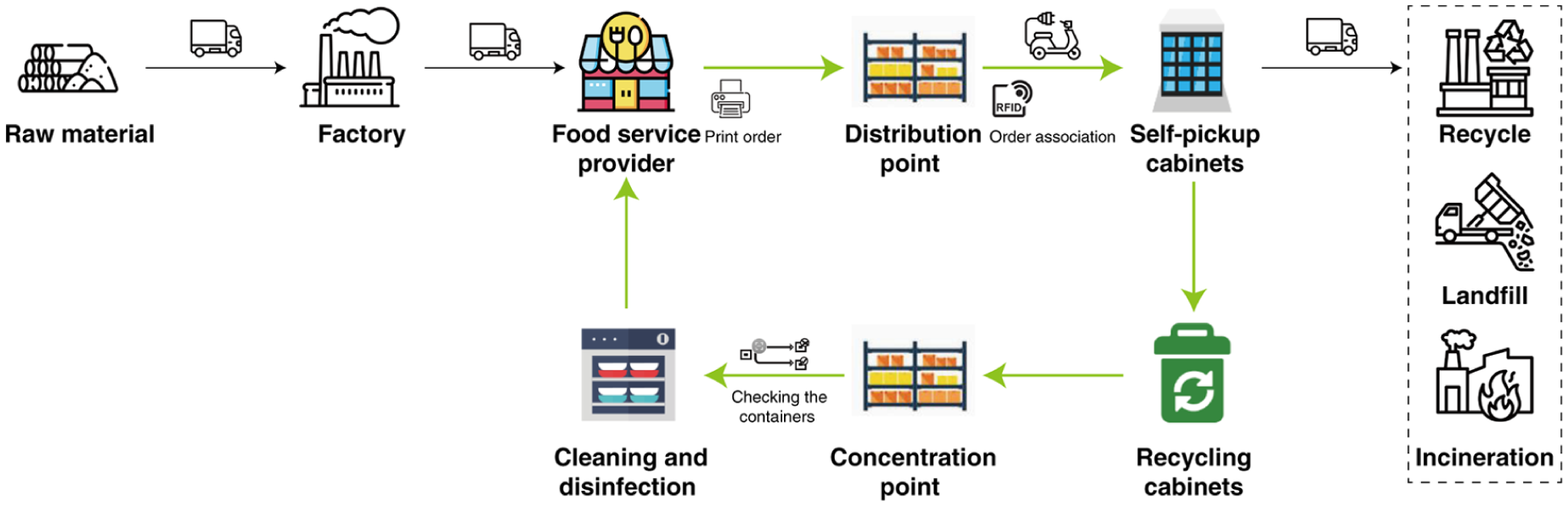
System boundary of the study.
Based on the field sampling on campus, a set of food container and packaging used for each takeaway order was one food container, one plastic spoon, a pair of disposable chopsticks, one napkin, one cutlery wrapper, and one plastic packaging bag (Supplemental Table for material and specification). The reusable food container is designed by ShuangTi, and its lifetime is more than 3-year. Ten-month per year uses (300 days) for reusable food containers are calculated in the scenario. Electric bicycles are used for the delivery and collection of food containers throughout the campus. The reuse mechanism of food containers in university was shown in Figure 1, which is the type of decentralized collection with machine washing of sharing tableware mechanism. Six steps including printing the order, order correlation, takeaway storage, returning the containers after using, checking the containers, and cleaning and disinfection form the operation system of reusable food container:
Step 1 Students order takeaway in the online takeaway order platform of ShuangTi, and a reusable food container or disposable food container could be chosen. The merchant of the food store on the campus prints the order and makes the meal.
Step 2 The takeaway is packaged and taken to the distribution point. With the radio frequency identification (RFID) technology, the reusable food container embedded with a chip is associated with the takeaway orders information.
Step 3 The takeaway is delivered to self-service takeaway storage cabinets under the dormitory. Students will be alerted by text message and scan the QR code to open the door of the self-service counter to get their takeaway at their leisure.
Step 4 After use, students return the container by putting it on the collection point on the first floor of each dormitory.
Step 5 The food container is collected back by the rider to the distribution point, and the number of food containers is confirmed to the inventory facility with RFID technology.
Step 6 The containers are washed and disinfected in the kitchen of campus, stored in the warehouse, and distributed to the merchant.
The production of equipment and infrastructure (i.e. takeaway order printers, radio frequency identification equipment, self-service food container cabinets, collection points, dishwashers, disinfection cabinets) and food preparation are excluded from the system boundary.
Carbon footprint evaluation
The global warming potential (GWP) with a time horizon of 100 years was applied to calculate the carbon footprint in carbon dioxide equivalent (CO2-eq). Followed the life cycle assessment (LCA) method guidelines, the carbon emissions are calculated by summing the greenhouse gas emissions from the cradle to grave life cycle of the reusable food container system. Equation (1) presented the formula that calculates the total carbon emissions of the reusable container system on the Chinese campus,

where
Raw material production
The food containers and the spoons are made of polypropylene (PP) granules. Producing reusable and disposable food containers with 750 mL of capacity require 301 g and 24.6 g of PP granule, respectively. The plastic bag and tableware packaging are made of polyethylene (PE) granules. The production of polypropylene and polyethylene granules was sourced from the average Chinese data of CLCD. The chips embedded in the food container are made from printed circuit boards (PCB). The carbon emissions by the life cycle processes of PCBs came from (Ozkan et al., 2018). The disposable chopsticks are made from birch with a density of 0.45
Tableware and packaging manufacturing
The production process of reusable food containers includes melting, shaping, and cooling, consuming 0.15 kg of water and 0.2 kWh of electricity taken from the local manufacturer. The data of water production can be applied from tap water production in the dataset of the rest of the world (RoW) in Ecoinvent. Disposable food containers were processed with polymer foaming, and production data was from the dataset of the RoW in Ecoinvent. Spoons are processed by injection molding similar to containers. For production processing of plastic bags and tableware packaging, stretch blow molding and extrusion are required. The data of spoon and packaging production were taken from the RoW dataset, Ecoinvent, and the losses and auxiliaries in the production process were included. The disposal chopsticks needed to be milled, bleached, and polished, and chopsticks, electricity, sulfur dioxide, and paraffin wax were consumed during the manufacturing process. The data of electricity was taken from the CN dataset in Ecoinvent and the data of water sulfur and paraffin were sourced from the RoW in Ecoinvent. The manufacturing of napkins would consume electricity, and the consumption of electricity was collected from local manufacturers and the emission factor of electricity came from the CN dataset in Ecoinvent.
Transportation
The transportation includes the transportation of raw materials to the manufacturing factory, delivery of containers, tableware, and packaging to the university, takeaway delivery inside the campus, takeback of reusable food containers, and the transportation of discarded tableware and packaging to the disposal point. Assume that the transportation of raw materials to the factory for manufacturing, the transportation of containers, tableware, and packaging to the university, and the transportation of waste to the disposal point are used by a heavy-duty diesel truck (Siracusa et al., 2014). The carbon emission factor of the heavy diesel truck with a load capacity of 18 t was taken from the CLCD. It is assumed that the transportation of raw materials to the factory for manufacturing, the transportation of manufactured tableware and packaging to the university is 150 km and the transportation of single-use tableware and packaging to the disposal point is 50 km (Gallego-Schmid et al., 2019). Learn from Shuangti, the transportation of containers to the factory for manufacturing is 50 km. And the transportation of containers to the university and transportation of containers back to the factory for recycling is 100 km. Electric bicycles are manufactured by Haorui Electronics Ltd (system 60V20-23AH) and deliver more than 330 takeaway orders per day with a charging power of 221 w and 5 hours of charging. The electricity consumption of each takeaway order is divided the daily electricity consumption of electric bicycles by the number of takeaway orders per day. The average delivery distance of takeaway on campus is 0.72 km, and 0.006 kWh of electricity is consumed for each takeaway delivery.
Operation
At this stage, the use and reuse of food containers are included. Merchants received the takeaway order and print out order information by a printer. We take the printer produced by Flying Goose (FP-58W) as an example, the power of the print is 0.03 kW with working 16 hours a day. After packaging the takeaway, the merchant takes the takeaway to the distribution point on the first floor of the canteen for order information by identifier. The takeaway identifier has a power of 0.005 kW and runs for about 12 hours a day. On the first floor of each dormitory, there is a self-service counter and a returning counter. The self-service counter runs all day to serve 1000 takeaways with a power of 0.028 kW. According to ShuangTi, 300 orders per day use reusable containers. The reusable food containers are collected after use and delivered to an inventory facility with 0.01 kW of power, which only runs for approximately 0.01 hour at a time. Disposable food containers are discarded after use and enter the end of life stage. The containers are cleaned by the automatic cleaning line in the school canteen through the process of conveying, soaking, washing, and disinfecting. The conveyor belt runs 12 hours a day and has a power of 0.75 kW. In the sink, 1.66 m3 of water and about 10 kg of detergent would be consumed. Taking a commercial dishwasher (Ebrank EB322) as an example, the washing of food containers consists of three main washes, two rinses, and high-temperature disinfection and drying. It runs for 5 minutes and consumes 750 L of water with a high power of 48.81 kW. Containers are disinfected for 1 hour in a disinfection cabinet with a power of 1.2 kW. The carbon emission factor of electricity came from the CN dataset in Ecoinvent and the data of water collected from the RoW in Ecoinvent. And the data of detergent was applied from non-ionic surfactant production (ethylene oxide derivate) of the RoW in Ecoinvent.
End of life
The broken food container is transported back to the factory for recycling. Disposable tableware and packaging are disposed of by incineration or landfill. From the 2019 China Urban Construction Statistical Yearbook, 74.39% of waste is disposed of in landfills in Foshan city, Guangdong Province, and 25.61% is disposed of by incineration (MOHURD, 2020). The data for recycling is sourced from the treatment of waste polyethylene for recycling of the RoW in Ecoinvent. The rest of the tableware and packaging are incinerated and disposed of in the landfill. The data for municipal incineration and sanitary landfill could also be found in the RoW in Ecoinvent.
Results and discussion
Carbon footprint of the reusable food container system
In the reusable container system on campus, each takeaway order produces 0.1492 kgCO2eq of carbon emissions. The operation stage (reuse of food container) produces the largest carbon emissions, accounting for 59.9% of the total carbon emissions. The raw material production stage ranked second and contributed 19.4% (0.0289 kgCO2eq) of the total carbon footprint. The manufacturing phase produces the third largest amount of carbon emissions, accounting for 14.9% (0.0222 kgCO
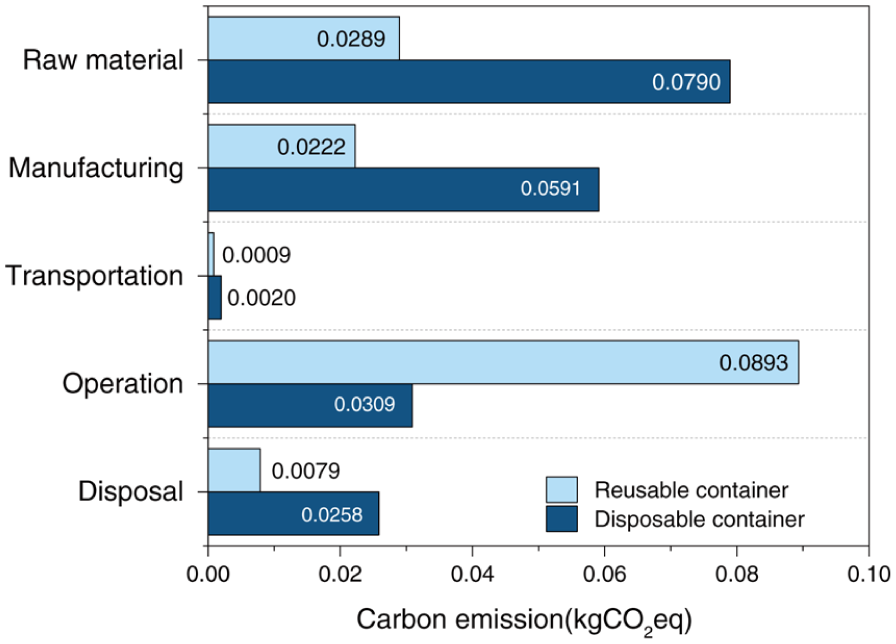
Carbon emissions of the reusable food container system.
Carbon reduction potential of the reusable food container
Since the operation stage contributes the most carbon emissions to the reusable container system, the carbon footprint of the operation stage and carbon reduction potential are further analyzed. Figure 3a shows that the washing of reusable containers generates the largest carbon emissions during the operation stage, contributing 51.7% of the carbon footprint. Printing takeaway order information ranked second and contributed 22.0% (0.0196 kgCO2eq for one use) of the operational stage. The disinfection ranking third and accounted for 13.7% (0.0123 kgCO2eq for one use) of the operational stage. The washing stage is one of the key steps for carbon emission reduction of the reusable system.
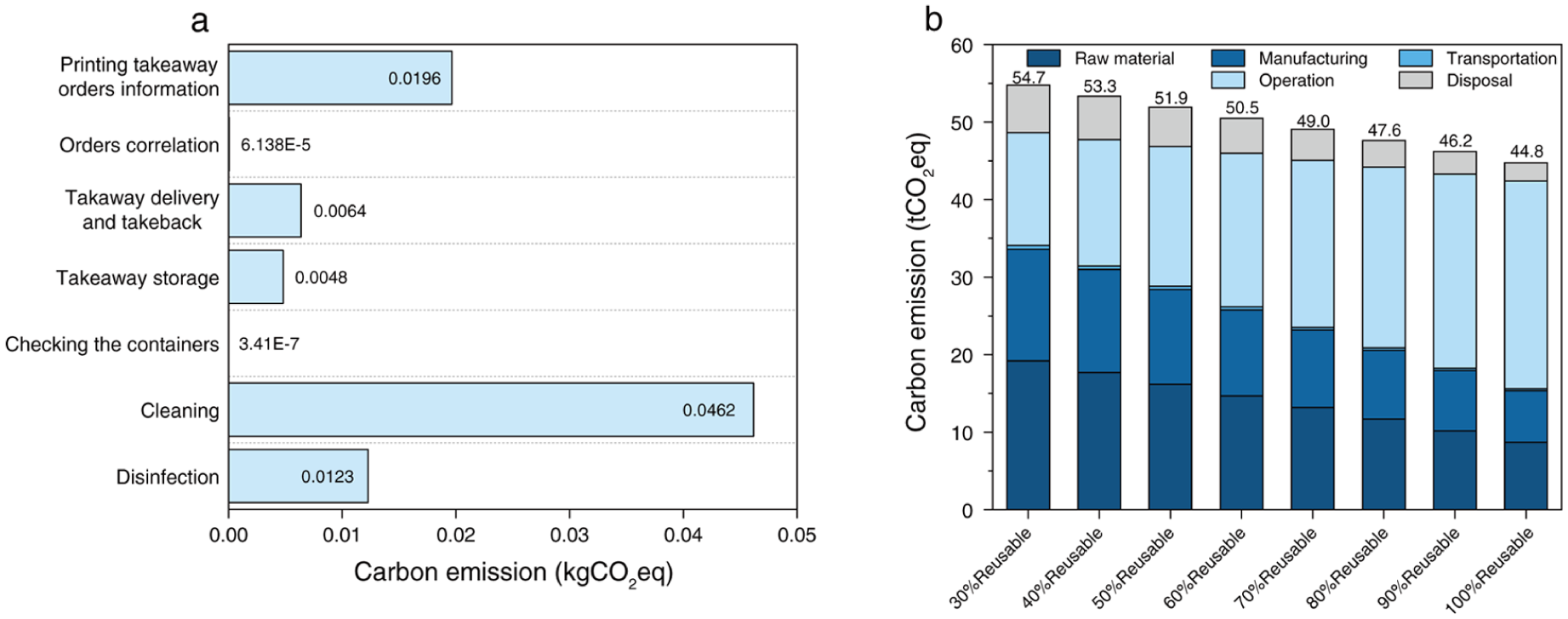
Carbon footprint of reusable food container system. (a) Carbon emission of operation stage. (b) Carbon emission of replacing reusable food containers in different proportions.
Previous studies, such as Zhou et al. (2020), Gallego-Schmid et al. (2018), and Sun et al. (2021), have discussed the difference between the environmental impact of manual and machine washing and indicated that replacing handwashing with machine washing can significantly reduce the carbon footprint of the washing stage. The environmental impacts of different types of dishwashers (i.e. ordinary dishwashers and commercial dishwashers) have large differences. In Shunde Campus of Southern Medical University, the machine washing including three main wash cycles, two rinsing wash cycles, and one high-temperature disinfection and drying cycle are conducted. The containers are put in the disinfection cabinet for a second disinfected, and 0.65 L of water and 0.044 kWh of electricity are consumed for washing one food container. This implies that by multiple washing and disinfecting, food containers are over-washed. In previous researches, the ordinary dishwasher consumes 0.16 L of water and 0.012 kWh of electricity per dish for the ordinary dishwasher (All-China Environment Federation, 2014). If the dishwasher is replaced by a water-saving dishwasher, 0.49 L of water and 0.032 kWh of electricity could be saved for washing each food container for one use. Carbon emissions of the reusable food container for the full life cycle are reduced by 25.4% compared to the reusable system with the current cleaning technique. Taking a four-room Chinese university dormitory as an example, a student consumes 0.3 kWh of electricity per day (Zhou et al., 2021). In Shunde Campus of Southern Medical University, 90,000 food containers are reused per year, and improving the cleaning process of reusable food containers could save 2880 kWh of electricity consumption (equal to 9.6 thousand students need for 1 day) and 2938 kgCO2eq of carbon emissions for 1 year. Although the dishwasher equipment at the Shunde Campus of Southern Medical University came into use in 2017 and show relatively new technology, it is necessary to upgrade the clean technical process of the dishwasher for resource saving (i.e. electricity, water) and carbon emission reduction.
Compared with the disposable container system, the reusable food container system could reduce 24.2% of carbon (reducing 0.0476 kgCO2eq) emissions per takeaway order. According to the ShuangTi collected from Shunde Campus of Southern Medical University, students order 1000 takeaways per day through the campus food delivery platform, 300,000 takeaways per year, 30% of orders are served by reusable food containers. Figure 3b shows the gradual replacement of disposable containers with reusable food containers, and the gradual decrease in carbon emissions of the campus food delivery system. Compared with the disposable system, the reusable food container system can significantly reduce carbon emissions at the stage of raw material production, manufacturing, and disposal. If disposable food containers are all replaced by reusable ones, carbon emissions can be reduced by 9989.5 kgCO2eq for 1 year. In 2020, there are 2738 universities and 41.83 million students in China (Ministry of Education PRC, 2021). According to (Trustdata, 2020), in 2019, there are 1.6 billion takeaway orders from universities in China. If the reusable food container is applied in all the Chinese universities, namely the takeaway are served by reusable food container instead of a disposable one, 76.1 kt CO2eq of carbon emissions could be reduced for 1 year.
Environmental advantages of reusable food container
The carbon footprint of a reusable PP food container is compared with that of a single-use PP food container to further discuss its environmental advantages. As shown in Figure 4, the carbon footprint of a reusable food container for one use (1.4305 kgCO2eq) is 7.3 times higher than a single-use container (0.1968 kgCO2eq). After being reused 27 times, the reusable food container could balance out the carbon footprints of the single-use one. If the food container is reused for 1 year (300 days), its carbon emission is 0.1521 kgCO2eq, less than one-tenth of the carbon footprint of one use. In our previous studies without calculating the carbon emission of the practical operation of a reusable system (Zhou et al., 2020), the shared tableware is reused 14 times, the CO2 emission could be balanced. The operation stage, especially washing, disinfection, order information printing increases the carbon footprint of the reusable food container, which should not be overlooked in the practical application. The reusable system avoids plastic waste generation, reduces carbon emissions, and promotes sustainable development.
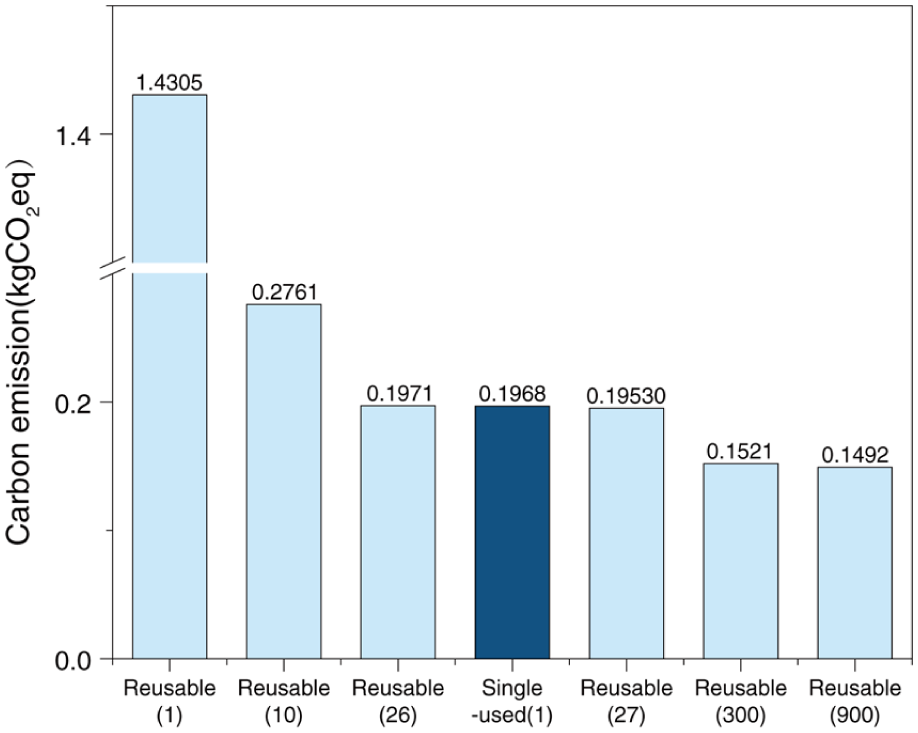
Environmental advantage of the reusable food container.
The reusable food container system on campus proposed by ShuangTi is a good practice and has been applied in 60 Chinese universities. The social-economic superiority of the reusable system could be summarized as follows. Firstly, in the takeaway food industry, food safety is a key concern (Song et al., 2020), particularly in the post-COVID-19 pandemic era (McCabe and Erdem, 2021). The no-contact takeaway delivery minimizes the COVID-19 spread risks on campus (United Nations, 2021a). The reusable food containers are washed and disinfected in the university canteens, which meets the university’s food safety standards. Secondly, the ease of use and return, and the need to pay additional fees are important factors in whether customers choose the reusable food container (Dembek, 2020). With the help of QR code and RFID technologies, efficient payment mode and return process provide a convenient experience for customers. Thirdly, the takeaway in ShuangTi’s reusable system on campus is delivered and taken back by riders. The operation of the reusable system is managed by a student CEO, the takeaway order information, stocktaking of reusable food containers is conducted by students, which provides work-study and internship opportunities.
Discussion
Students are one of the largest takeaway consumers, with high consumption frequency and concentrated scale. Implementing reusable tableware and packaging systems within Chinese universities could reshape behavioral patterns at the consumption end, thereby reducing waste generation at its source. This approach would alleviate pressure on terminal waste treatment (Sun et al., 2021; Zhou et al., 2020), and advance the development of green and zero-waste campuses. Reusable packaging systems provide valuable insights for formulating carbon neutrality action plans in China’s higher education institutions. Green nudging serves as a viable and effective tool (He et al., 2023), through well-designed reuse models, universities can cultivate habitual reuse practices among students (Novoradovskaya et al., 2021), fostering sustainable consumption mindsets (Li et al., 2022). As future primary consumers, individuals abandoning single-use habits will exert reverse pressure on markets to supply more circular products, accelerating China’s transition from a linear economy to a circular economy.
The promotion of reusable food container systems in universities requires the coordinated efforts from multiple stakeholders, including government policy-driven, enterprise technological innovation and practical implementation in universities. The government level needs to play a leading role, enhance the public’s awareness of the carbon emission reduction value of reusable containers through public publicity and education, and provide special support funds and tax incentives to reduce the operating costs of enterprises. Mandatory technical standards such as the “Technical Specifications for Reusable Tableware Cleaning and Disinfection” should be formulated to promote the upgrading of cleaning processes, and a unified national standard for tableware materials and recycling labels should be established to remove obstacles to cross-campus circulation. At the enterprise level, enterprises should take the initiative to assume environmental responsibilities and design scalable reusable models, such as the composite model of “digital deposit system and carbon credit incentives.” And optimize the entire process management through technological empowerment, including using RFID chips to achieve “one box, one code” traceability and tracking, AI algorithms to predict recycling demands and reduce user costs, as well as promoting environmentally friendly disinfection and sterilization technologies to ensure cleaning efficiency, etc. By partnering with universities, users who order meals using reusable containers can receive discounts or earn “green credits” linked to their campus ID cards, which can be redeemed for benefits such as printing quotas or cafeteria vouchers. Enterprise can further nudge behavioral change by setting reusable containers as the default option in their ordering interfaces. At the institutional level, universities should prioritize upgrading smart recycling infrastructure (such as installing intelligent return cabinets in dormitories and dedicated cleaning lines in dining halls) to streamline the return process. They should also design behavioral incentive mechanisms, for instance, incorporating sustainable practices like using reusable containers into the university’s “Second Classroom” credit system or comprehensive student evaluation framework. Additionally, campuses can implement policies to restrict or phase out single-use food containers in on-campus food outlets, thereby accelerating the transition toward sustainable consumption. The logistics department needs to cooperate with the enterprise to prevent resource waste through dynamic monitoring of cleaning energy consumption.
Some studies explored the barriers to the spread of the reusable food packaging system and the mechanisms that encourage it (Novoradovskaya et al., 2021; Sandhu et al., 2021). Costs, behaviors, attitudes, and motivations influence the use of reusable food packaging (Novoradovskaya et al., 2020; Poortinga and Whitaker, 2018). Consumer acceptance of reusable food packaging remains low, primarily due to persistent concerns regarding hygiene of food packaging, coupled with entrenched reliance on the convenience of single-use packaging. The complex design of reuse systems involves multiple stakeholders, resulting in coordination challenges. Currently, there is a lack of targeted policy support for reusable packaging system, with insufficient funding and inadequate incentive mechanisms (Ada et al., 2023). The infrastructure required for reusable systems remains underdeveloped, characterized by a scarcity of public collection points and cleaning facilities (Ellsworth-Krebs et al., 2022). Moreover, the substantial upfront investment in infrastructure delays the realization of economies of scale (de Mello Soares et al., 2022). The cleaning stage is a high-emission component of reusable food container systems. Drawing on the sharing economy model, an internet-based sharing platform could integrate existing cleaning infrastructure (such as dishwashing lines in large restaurants, canteens, and professional cleaning centers) and allocate idle cleaning capacity through the platform. This approach not only reduces upfront investment in cleaning facilities but also enables reusable food containers to be matched with the nearest available cleaning resources, facilitating scaled and efficient cleaning operations and thereby lowering carbon emissions from this stage.
The reusable food container systems in Chinese universities are still in their early stages. Reusable containers are primarily deployed in settings with concentrated users and controllable logistics flows (such as food delivery services, corporate campuses, and large-scale events) to support efficient closed-loop collection and reuse. The environmental awareness of users would be raised by reusable consumption. It is necessary to explore the driving factors for consumers to use reusable container systems, such as cultural differences and price sensitivity. Evaluate the effect of policy intervention on consumer usage rates, such as extending the plastic ban to takeaway packaging and the design of deposit systems. The environmental awareness of consumers and influencing factor of selecting reusable packaging would be explored to improve the design and operation of the reusable food container. In terms of reusable container design, explore the compatibility of bio-based or degradable materials in reusable scenarios, and develop lightweight and durable packaging materials (Greenwood et al., 2021). The ecological design of reusable food containers plays a significant role in the promotion of the reusable system.
Conclusion
Reusable food containers could address the dilemma of takeaway packaging waste in China, reducing the plastic production, use, and disposal from the source. This study, based on real-case research data, explored the climate benefits of the reusable food container systems in the Chinese university food delivery services. Research has found that reusable food container systems can reduce carbon emissions by 24.2% per unit compared with single-use containers. The operation stage, including washing and disinfection of food containers, and printing takeaway orders, contributes 59.9% of the carbon footprint of the reusable food container system, which is the main hotspot for carbon emission reduction. The update of the cleaning technical process has significant carbon reduction benefits. If the overwashing is avoid by updating the cleaning technical process, the daily electricity consumption of 9.6 thousand students and 2938 kgCO2eq of carbon emission could be saved for 1 year. After being reused 27 times, the reusable food container could balance out the carbon footprint of the disposable one. If the reusable food container is applied in national universities in China, 76.1 kt CO2eq could be reduced for 1 year. There are obvious environmental advantages of the reusable food container system, such as safe, no-contact takeaway delivery, convenient experience, waste generation reduction. The research results could be beneficial for reducing plastic waste generation and constructing sustainable university and green campus, the accounting framework could also provide the basis for no waste city construction and reusable consumption lifestyle. The reusable food container system needs to be applied in more Chinese universities and university towns for exploring various carbon emission reduction pathways. The application of the reuse system has played a promoting role in the transformation of people’s consumption patterns and behaviors. As the reuse system is promoted outside the campus, the sustainable consumption model is accepted by people, accelerating the transformation of China’s circular economy development.
Supplemental Material
sj-docx-1-tss-10.1177_29768632251407462 – Supplemental material for Identifying the climate benefits of reusable takeout container systems in campus online food delivery services
Supplemental material, sj-docx-1-tss-10.1177_29768632251407462 for Identifying the climate benefits of reusable takeout container systems in campus online food delivery services by Xuanhao Huang, Aiqun Guan, Zhikun Li, Yang Zhou and Ya Zhou in Transactions in Energy and Sustainability
Footnotes
Acknowledgements
We especially acknowledge Yuejiang Duan, Yichao Wang from Shenzhen Kuaipin Information Technology Co., Ltd (ShuangTi), and Yuchen Zhong from Shunde Campus of Southern Medical University for invaluable collaboration in the field surveys.

Ethical considerations
This article does not contain any studies with human or animal participants.
Author contributions
Xuanhao Huang: Writing – original draft, Visualization, Validation, Methodology, Formal analysis. Aiqun Guan: Data curation, Visualization, Validation, Methodology, Writing – original draft. Zhikun Li: Methodology, Investigation. Yang Zhou: Writing – review & editing. Ya Zhou: Writing – review & editing, Validation, Supervision, Methodology, Investigation, Funding acquisition, Project administration, Formal analysis, Resources, Conceptualization.
Funding
The authors disclosed receipt of the following financial support for the research, authorship, and/or publication of this article: This work was supported by the National Natural Science Foundation of China (52222007, 52170179, 52270186).
Declaration of conflicting interests
The authors declared no potential conflicts of interest with respect to the research, authorship, and/or publication of this article.
Data availability statement
The weight and specification of reusable and disposable food packaging are respectively provided in Supplementary material. The life cycle list were sourced from manufacturers’ data, the Ecoinvent and literature sources. All data used in the study are available from the corresponding author upon reasonable request.
Supplemental material
Supplemental material for this article is available online.
Author biographies
References
Supplementary Material
Please find the following supplemental material available below.
For Open Access articles published under a Creative Commons License, all supplemental material carries the same license as the article it is associated with.
For non-Open Access articles published, all supplemental material carries a non-exclusive license, and permission requests for re-use of supplemental material or any part of supplemental material shall be sent directly to the copyright owner as specified in the copyright notice associated with the article.
