



Abstract
The ocean has absorbed 25% of anthropogenic CO2 emissions and over 90% of excess heat, mitigating climate change but causing ocean acidification and marine ecosystem disruption. In addition to this natural role, various marine carbon dioxide removal (mCDR) techniques have been proposed, including biotic approaches such as blue carbon conservation and abiotic techniques such as ocean alkalinity enhancement. While biotic techniques are often preferred for their perceived ecological benefits, abiotic approaches offer higher sequestration potential and longer-term carbon storage. However, significant knowledge gaps and challenges remain, particularly in monitoring, reporting, and verification. As decarbonization progresses, mCDR could be essential for removing residual and legacy CO2 emissions. Further research is needed to assess the effectiveness, impacts, and social acceptance of various mCDR techniques, ensuring the ocean's continued role in climate mitigation.
Introduction
When asked whether we should think about the ocean as a climate solution, our immediate reaction is that the ocean is already one. In recent years, many schemes have been proposed to use the ocean to remove CO2 from the atmosphere, but it is important to remember that the ocean has absorbed a quarter of CO2 emissions from human activities and more than 90% of the excess heat resulting from the increase in atmospheric greenhouse gasses, thereby slowing the rate at which Earth's surface is warming. In the long term, after we reach net-zero emissions, the ocean will continue to absorb the majority of the additional CO2 stored in the atmosphere, although this will occur over timescales of thousands of years (Archer et al., 2009). Unfortunately, this absorption of CO2 and heat has significant consequences for marine ecosystems. The uptake of CO2 leads to ocean acidification, with potential harmful effects on marine organisms (Doney et al., 2009). Climate change also causes substantial alterations in ocean circulation (Fox-Kemper et al., 2021) and major ocean biogeochemical cycles (e.g. nutrient redistribution and ocean deoxygenation; Keeling et al., 2010), which, in turn, have far-reaching impacts on marine ecosystems and the vital services they provide (Cooley et al., 2022).
In addition to these built-in processes of CO2 and heat uptake, several other ocean-related but human-driven climate solutions have been proposed and discussed over the last few decades (Gattuso et al., 2018). Many of these aim to reduce or accommodate the impacts of climate change on the ocean by implementing adaptation measures. By reducing other stressors, Marine Protected Areas, for instance, have been shown to increase the resilience of marine ecosystems to climate change impacts (Jacquemont et al., 2022). In addition, ocean-based solutions for climate change mitigation are also being considered. These include extracting renewable energy from the ocean or reducing greenhouse gas emissions from maritime activities (Gattuso et al., 2018).
Due to its vast surface area (covering two-thirds of the planet), its unique physical and chemical characteristics, and reduced competition with other human activities, the ocean also presents opportunities for additional carbon dioxide removal (CDR) (Doney et al., 2025). In recent years, there has been a dramatic increase in the number of projects and startups working to develop marine CDR (mCDR) techniques, accompanied by a substantial increase in scientific publications and expert reports (e.g. GESAMP, 2019; NASEM, 2021). However, despite the potential promise of these techniques and the race to develop them, significant knowledge gaps remain. These gaps concern not only the potential effectiveness of each technique but also the positive or negative impacts these techniques may have on the functioning of the ocean ecosystem and the people who depend on it.
It is clear that CDR techniques, including those that rely on the ocean, should not be deployed before decarbonization is mostly complete, since they will be ineffective (Ho, 2023). To have functional and trustworthy mCDR, robust monitoring, reporting, and verification (MRV) must be developed. Finally, certain mCDR techniques, namely those that rely on geochemistry, have a higher likelihood of successful scale-up, as we will explain below.
mCDR techniques
In preindustrial times, the ocean released a small amount of CO2 into the atmosphere, mainly originating as carbon input from the land. However, today the ocean acts as a significant sink for anthropogenic CO2, absorbing 25% of our emissions (Friedlingstein et al., 2023). The absorption of anthropogenic CO2 by the ocean is primarily an abiotic process, driven by physics rather than biology (Broecker, 1991; DeVries, 2022).
Most mCDR techniques involve decreasing the partial pressure of CO2 in the surface ocean, and waiting for the new ocean state to equilibrate with the atmosphere through additional uptake of atmospheric CO2. These proposed techniques include ocean iron fertilization (OIF), artificial upwelling, macroalgae cultivation, ocean alkalinity enhancement (OAE) with either minerals or electrochemistry and direct ocean removal. mCDR also includes techniques that rely on the ability of specific ecosystems to remove and/or store carbon, such as conservation and restoration of blue carbon ecosystems (i.e. mangrove, seagrass, and salt marsh) (NASEM, 2021).
These mCDR approaches have been categorized in different ways (e.g. Cooley et al., 2023): (a) biotic or abiotic; (b) photosynthetic, geochemical, or technological; (c) novel or conventional; (d) as either a nature-based solution or not. We attempt to reconcile these different frameworks in Figure 1.
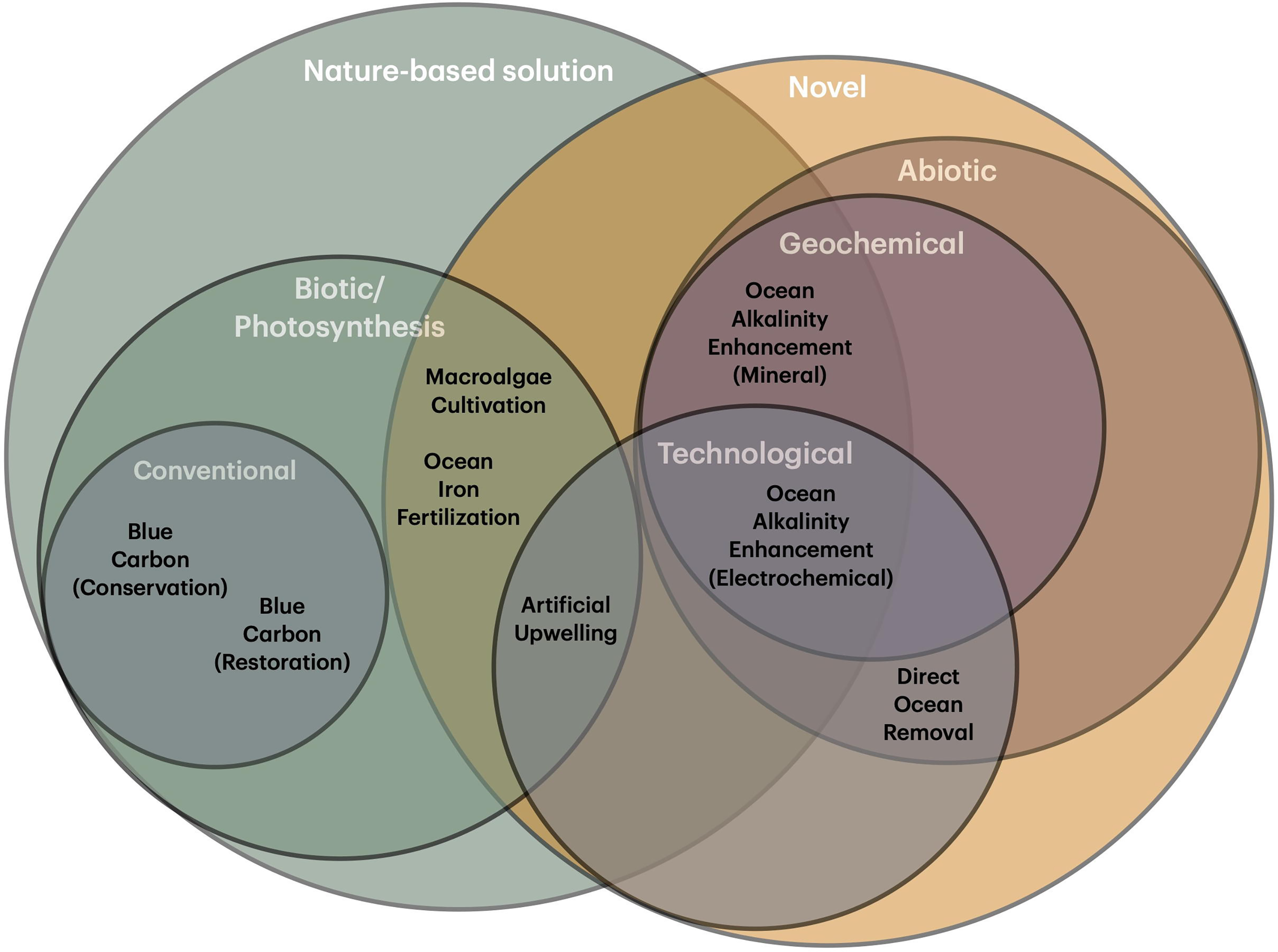
Venn diagram showing how the different categorizations of marine carbon dioxide removal (mCDR) are related and where each proposed mCDR technique fits.
The method by which CO2 is first removed or reduced, whether through biotic or abiotic processes, is a key distinction between CDR techniques (see the eight examples in Figure 1). Independently, the techniques can also vary based on the level of technological advancement required. For example, OAE aims to increase the ocean's carbon sink by artificially raising surface ocean alkalinity and reducing the concentration of dissolved CO2, making it an abiotic technique. However, the way this alkalinity increase is achieved can rely on electrochemical processes (technological) or simply on the dissolution of minerals added to the ocean (geochemical).
Historically, these various techniques have also been grouped into two broad categories: conventional CDR and novel CDR (e.g. Smith et al., 2024). Conventional techniques are well-established, already in use, and in some cases, their deployments are already reported by countries. This is the case with the conservation and restoration of blue carbon ecosystems. On the other hand, novel mCDR techniques are less mature and have a lower level of readiness, but represent the vast majority of proposed mCDR approaches.
Lastly, nature-based solutions are defined by the International Union for Conservation of Nature (IUCN) as actions that also provide “human well-being and biodiversity benefits” (Cohen-Shacham et al., 2016). Some mCDR techniques clearly fall into this category (e.g. blue carbon conservation and restoration). Others, such as OAE, work with nature and address societal challenges, but doubts remain about their impact on biodiversity. However, we argue for their inclusion in the category of nature-based solutions here since they are accelerating a natural process that aims to benefit ecosystems and humans.
We do not consider dumping terrestrial biomass in the ocean or injecting CO2 on or beneath the seafloor to be mCDR, even though they are potentially ocean-based climate solutions, because they do not rely on either an ocean or coastal ecosystem or air–sea gas exchange to remove atmospheric CO2.
Effectiveness and MRV
The conventional techniques are typically already being deployed but offer limited capacity for additional carbon removal (Williamson and Gattuso, 2022). The novel biotic techniques (e.g. OIF and macroalgae cultivation) aim to increase primary production and export organic carbon to the deep sea for storage, whereas the abiotic techniques aim to store carbon as dissolved inorganic carbon. The efficacy of biotic techniques is uncertain because we do not understand the fate of organic matter in the ocean. The abiotic techniques are considered promising CDR strategies due to the ocean's buffering capacity and the long lifetime of dissolved inorganic carbon in the ocean (NASEM, 2021).
Significant knowledge gaps remain regarding these techniques, along with substantial challenges, such as the development of robust MRV systems. At the core of robust MRV is the assessment of two critical factors: (a) additionality (i.e. assessing how much extra CO2 was removed from the atmosphere relative to a counterfactual in which the intervention never happened) and (b) durability (i.e. assessing how long the removed CO2 is kept out of the atmosphere). MRV for mCDR is difficult because we cannot measure the additional CO2 uptake. mCDR interventions occur on local scales, but the CO2 uptake happens at the scale of ocean basins due to the long timescale (i.e. months to years) for air–sea CO2 equilibrium with the new ocean state (Jones et al., 2014). Monitoring these basin-scale signals in situ is further challenged by the fact that the ocean is already taking up a large amount of anthropogenic CO2 and this uptake is highly variable in space and time. Robust MRV will likely involve observations in the nearfield and numerical modeling on the local and basin scales, and is an area of active research (e.g. Ho et al., 2023).
Side effects, preferences, and perceptions
Another key dimension of mCDR relates to the potential societal and environmental impacts of applying such solutions in the ocean. These impacts are far from fully understood or explored today, but they can vary significantly in nature and scale (both spatial and temporal). Typically, approaches focused on the conservation and restoration of blue carbon ecosystems are viewed favorably because they combine potential CDR with numerous co-benefits. Coastal vegetated ecosystems provide substantial services—such as high biodiversity per unit area, abundant habitat and nurseries for many species, as well as coastal protection. These mCDR techniques have been referred to as “no-regret solutions” (Gattuso et al., 2018) because even if it is difficult to accurately estimate the carbon removal and storage they provide, they offer these other beneficial services.
For some of the novel biotic mCDR techniques, numerous studies have demonstrated potential detrimental side effects on marine ecosystems. For example, OIF can cause large disruptions to marine ecosystems and decreases in fish biomass far from the fertilization areas (Tagliabue et al., 2023), and macroalgae cultivation can lead to deoxygenation and increased acidification in the deep sea where seaweed biomass is ultimately remineralized (Ross et al., 2022).
An ongoing debate is whether broader ecosystem impact assessment is part of MRV (i.e. carbon MRV vs. ecosystem MRV). One might view negative impacts on marine ecosystems as “gating criteria”—that would stop an mCDR deployment from moving forward—to retain MRV's focus on quantifying additional carbon removal.
Studies on public perception of abiotic mCDR have shown that people prefer conventional mCDR techniques (Figure 1) or even direct air capture (DAC) to OAE. This preference is partly based on the perception that OAE pollutes the ocean and would have negative environmental impacts (Cox et al., 2024). There is also concern about the dispersed storage of dissolved inorganic carbon versus the controlled storage of CO2 in a geological reservoir (Cooley et al., 2023). Furthermore, there is public reluctance if the CDR technique involves mining (e.g. for minerals) or high energy use (e.g. for electrochemistry) (e.g. Cox et al., 2020). Finally, there is the perception that there is less control in an open system such as the ocean compared to a closed system such as DAC with carbon storage. Much work remains to be done on public engagement before these mCDR techniques can be deployed with public support.
There is also concern that the expectation of CDR deployment will prolong the use of fossil fuels and cause further damage to the environment (e.g. Ampah et al., 2024). One way to address this concern is to establish separate targets for emissions reduction and CDR (e.g. McLaren et al., 2019).
Conclusion
In general, techniques that rely on biotic processes, often referred to as nature-based solutions, benefit from greater political and social acceptability. We contend that in the marine realm, this preconceived preference should be reconsidered, as it stems from several misconceptions. In fact, some abiotic techniques may offer greater promise than biotic ones. First, it is crucial to recognize that the current ocean carbon sink is primarily driven by geochemical processes rather than biotic ones (DeVries, 2022). Second, geochemical techniques, such as OAE, leverage existing natural processes and involve physico-chemical mechanisms that are generally better understood and more predictable than most biotic approaches. Lastly, the sequestration potential and the duration of storage are usually higher for abiotic techniques. The estimated potential CDR of OIF, macroalgae cultivation, and blue carbon is estimated at 0.1 to 1, 0.1 to 0.6, and 0.1 to 0.5 Gt CO2/year, respectively, while that of OAE is at least an order of magnitude higher at 1 to 15 Gt CO2/year (Cross et al., 2023). In terms of the duration of carbon storage, OIF and macroalgae cultivation are estimated at 10 to 100 years, blue carbon at 1000 years, and OAE at 20,000 years (Cross et al., 2023).
We emphasize that no form of CDR is a climate solution while human activities are still emitting >40 Gt CO2/year. However, if CO2 emissions were reduced to 10% to 20% of their current values in the next 20 to 30 years, we would still need CDR to reach net zero because of residual emissions from activities that are difficult to decarbonize, such as shipping and aviation, as well as the production of cement, steel, and fertilizer. We will also need CDR to remove legacy emissions to address intergenerational justice.
As such, it is essential to research the maximum potential of mCDR, considering various constraints such as geophysical, environmental, technological, economic, social/cultural, and regulatory factors. Research is also necessary to develop MRV for mCDR, and to assess the effectiveness, side effects, and social acceptance of various mCDR techniques.
Even though it does not make sense to rely on mCDR deployments in the next few decades, there are ways the ocean can act as a climate solution today, including strategies for mitigation, such as the expansion of offshore wind energy and for adaptation, such as the conservation of coastal vegetation and coral reef ecosystems for coastal protection.
Footnotes
Declaration of conflicting interests
The authors declared no potential conflicts of interest with respect to the research, authorship, and/or publication of this article.
Funding
The authors received no financial support for the research, authorship, and/or publication of this article.