



Abstract
This article examines the phenomenon of the AI testbed and practices of testing-in-the-wild. It combines historical and sociological approaches to understand how the settler-colony of Australia has come to be treated as an ideal test site, using commercial drone delivery company Wing Aviation as a case study. It connects the figuration of Australia as contemporary testbed with histories of the nation as a colonial experiment. I argue that this historical frame has been consistently deployed to justify the treatment of lands and peoples as experimental subjects across a range of domains—from medical science, penal management, and military operations. In doing so, I show how Australia has been treated as a test site and Australians as test subjects based on changing imaginaries of the nation and its people—from proxies for whiteness and Empire in the colonial period, to multiculturalism and ethnic diversity in the contemporary era.
Keywords
Introduction
A farmer stands in a field and makes a call for an order of dog food. We’re in the outback town of Warwick, Queensland and the farmer, Neal, is playing the role of a test subject. He is flanked on either side by a team of engineers who are watching in anticipation at the trial that is about to unfold. We see a small drone shakily take off from the ground and navigate across a vast landscape of gum trees, paddocks, and kangaroos. We see testing teams observing, taking notes, and making adjustments. When the drone reaches its destination, it hovers briefly before clumsily releasing a small package that lands a few metres away from Neal, who unwraps and feeds a treat to his patiently waiting canine friend. These scenes of high-tech trials framed by an Australian landscape are what Google X (now X Development) used to unveil their newest, AI-powered venture: autonomous drone delivery (see Figure 1).
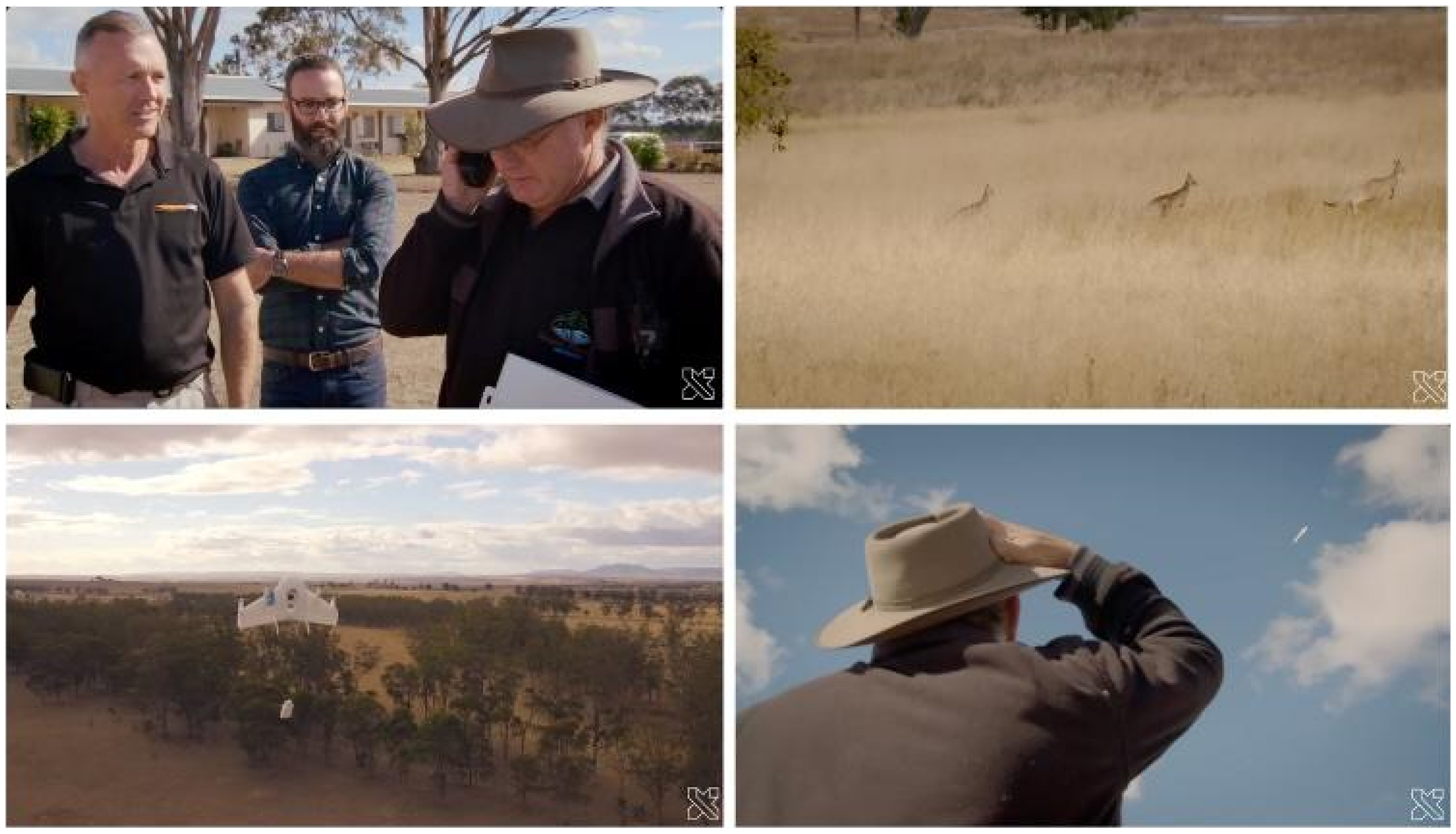
Scenes from “introducing wing”, August 29, 2014. X, the moonshot factory. Accessed 1 March, 2024 [Online] https://www.youtube.com/watch?v=cRTNvWcx9Oo. Screenshots by the author.
These striking scenes of innovation being tested “in-the-wild” employ a distinct colonial gaze that, consciously or not, recuperates earlier imaginaries of the nation as an ideal testbed for imperial experiments. The depiction of large swathes of vast and uninterrupted land invokes the visual language of terra nullius, in which the “empty” space of the bush marks it as a justifiable location for high-risk procedures. The choice of farmers and homesteads as test subjects and test sites also centres the settler-colonial figure as at the frontier of this technologically advanced modernising project.
However, Australia makes up more than just the backdrop for these promotional images. In the decade since this 2014 announcement, Wing Aviation (as the project is now known) has made significant investments in turning the country into one of the world's largest commercial drone delivery testbeds. In 2017, Wing launched its first drone delivery trial in select suburbs across Canberra in the nation's capital. In 2019, Wing doubled its delivery capacity, expanding to Queensland to include new trial sites in the city of Logan, a peri-urban township approximately 30 min south of Brisbane. By 2021, Wing had made over 100,000 deliveries across the country, declaring Logan “the drone delivery capital of the world” (Wing team, 2021). And by 2023, the company had established partnerships with some of the nation's major commercial retailers, including the supermarket chain Coles, and property development groups Mirvac and Vicinity—the owners of the largest shopping malls across the country (see LaFrenz, 2022; Lenaghan 2023). These trials involved the live testing of experimental systems and technologies in existing communities, using local people, infrastructure and environments to test and refine social, technical, and commercial models for future operations.
But Google and its subsidiaries are not the only Big Tech firm to turn to Australia as a useful site for new technology testing. Many major platforms have named the southern continent as their preferred location for trialling features and products. The streaming service Spotify used Australia as a test site for its then experimental Discover Weekly playlist and for Spotify Kids (Ried, 2016). The dating app Tinder piloted Tinder Social and Super Like in the Australian market before releasing them globally (Fry, 2015). And Facebook/Meta tested its upvote downvote feature first on users based in Australia and New Zealand before then introducing it elsewhere (Withers, 2018). In the context of digital platforms and technologies, Australia has been described as a “sandbox for innovation” (Buttigieg, 2018), an “ideal testing ground” (Withers, 2018) for experimentation, the perfect “petri dish” (Bogle, 2017) for global business to trial new features before opening them to primary markets.
In this article, I examine how it is that Australia has come to be treated as a global technology testbed, asking: what is it about the people and place that make them ideal test sites and test subjects? To answer this question, I look both historically and sociologically, arguing that Wing's depiction of the Australian outback as a test site is coextensive with longer histories of science and technology testing in the settler-colony. Examining the nineteenth and early twentieth century framing of the nation as a British experiment in colonial management, I contend that this framing has been consistently deployed to justify the treatment of lands and peoples as experimental subjects across a range of domains—from medical science, to penal reform, and military operations. I then seek to connect this history to the present moment, using the example of Wing and drone delivery to analyse how the legacy of colonial experimentation continues to shape the dynamics of technology testing today. I draw on fieldwork conducted between 2022–2023 in which I spent time in Australian cities where drone delivery systems were being tested in-the-wild, in communities. I spoke with policymakers, company representatives, and everyday people who had suddenly found themselves as participants within these new technology trials.
Alongside this, I analyse the rise of testbeds, street trials, and other practices of in-the-wild experimentation as objects of study within fields concerned with the social and cultural impacts of digital technology, such as STS, media studies, and critical studies of AI. In contrast to existing studies that characterise in-the-wild testing of AI and digital technologies as a new phenomenon that has emerged in response to post-War urban practice (see Günel, 2019; Halpern et al., 2013; Halpern and Mitchell, 2022; Marres, 2025), I argue that in sites like Australia, this practice is not only not new but is a key factor that has historically justified the existence of the colony and which in practice helped to drive colonial expansion. In doing so, I hope to make a critical intervention into the burgeoning field of research emerging around the concept of the AI testbed. Drawing on insights from settler-colonial studies and postcolonial theory, I argue that prior to its integration into smart urbanism, testbeds and testing-in-the-wild were colonial practices used in the service of Empire. While there have been changes in what technologies are being tested — techniques of penal management in the nineteenth century, military weapons in the early twentieth century, AI-driven systems like drone delivery in the twenty-first century — what persists are asymmetries of power between those who test and those who are tested upon. Additionally, I explore how in recent decades becoming a testbed has been a feature of the national project, one of the ways the country articulates its value to the global community. This strategy can be characterised as a form of “innovation nationalism”—the instrumentalisation of so-called innovative technologies in service of nation-building and nationalist agendas. Inextricable from the concept of nation are imaginaries of race and, as this article will argue, the imaginary of Australia—first as a white colony, and now as a multicultural community—has been central to the articulation of the country and people as ideal sites and subjects for new technology testing across its settler-colonial history.
Experiments in nation building
To describe Australia as a testbed or test site is like naming an open secret. In The Cultivation of Whiteness (2005), historian Warwick Anderson provides a compelling account of how Australia, as a modern nation, was founded on the back of experiments in colonial medical science. Australia was not just treated as a convenient site for experiments to take place—a frontier laboratory where medical scientists and physical anthropologists could have free reign—but where new, experimental theories concerning the limits of white civilisation could themselves be put to the test. These experiments followed questions such as survivability (was the white, European body physiologically capable of surviving the hostile climates of the tropical north and the central deserts?), acclimatisation (could European plants, animals and people learn to adapt their behaviour in order to suit their new environments?), as well as assimilation (which racial and ethnic groups could or could not be successfully absorbed into the national body for it to still maintain an essentially white character?)
As Anderson's account makes clear, Australia's status as an early scientific testbed was directly tied to the racial imaginary of the nation. Indeed, these experiments were part of Australian settler-colonial society's contribution to the burgeoning fields of race science and racial theory coalescing during the late nineteenth and early twentieth centuries, with the colony serving as a living study in the dynamics of human transplantation and white settlement. 1 As he argues, the ideological project of British Empire and white racial supremacy were bolstered by the language of empirical science with labels such as the medical trial and the scientific experiment helping to legitimise colonial expansion. Scientific curiosity helped to drive exploration into the continent's tropical north, and technocratic figures such as the medical scientist, public health official, and physical anthropologist framed themselves as “experts in bodily reform and hygiene [and] therefore they also could represent themselves as experts in white citizenship and national identity” (ibid, p. 254). Driven by the promise to allay racial anxiety, the entire colony became a national laboratory where white citizens were encouraged to see themselves as experimental subjects in new nation-building. What they were testing was not only their own physiological limits but the very idea of a White Australia and a futurity for whiteness in the region.
Indeed, the language of experimentation has been used to describe colonial practices in the continent as far back as early settlement. Jeremy Bentham, famed designer of the Panopticon, condemned the practice of forced convict deportation to colonies like Australia on the grounds that it was “a measure of experiment…a peculiarly commodious one… a sort of excrementitious mass, that could be projected, and as it should seem purposively—as far out of sight as possible” (cited in Brown, 1989, p.141). But for many prison reformers, the very value of the colony was in its status as a relatively safe site to test new theories of penal management. Places like Port Phillip Bay were used as sites for experimental exile programs, in which conditionally pardoned prisoners could live and work as free men. In addition to solving the problem of labour shortages, these programs were designed to transition away from incarceration as a punitive program of retribution and punishment to “more enlightened, humanitarian ideas of reform and retraining proposed by Quaker humanitarians” (Wood, 2014, p.56). These were experiments in moral innovation and economic management, a sign that the colony could successfully serve as both a civilising and modernising project. 2
The call to modernity, and the central role of the experiment, would also manifest in the early to mid-twentieth century in the form of military weapons trials. During the 1940s, the Department of Defence established the Australian Chemical Warfare Research and Experimental Section (ACWR & ES), a branch of the Australian army whose role it was to conduct field tests on the effects of chemical weapons on the bodies of soldiers. To do this, they used real life soldiers as experimental subjects, asking them to “exercise vigorously” while being exposed to mustard gas and march through sections of freshly bombed jungle to replicate contamination under battle conditions (Young, 2024). Their gas-soaked uniforms left the soldiers severely burned and covered in lesions, and because these injuries were sustained during domestic tests, and not in battle on foreign soil, many soldiers were denied military pensions on the grounds that they “did not incur danger from hostile forces of the enemy whilst serving inside Australia” (ibid).
Perhaps the most egregious example of the treatment of Australia as a colonial testbed was the British testing of nuclear weapons during the 1950s through to the 1960s. Designed to be “the Los Alamos of the British Commonwealth” (Beale in Tynan, 2016, p. 91), these tests took place across sites in the Monte Bello Islands, off the coast of Western Australia, and Maralinga and Emu Field in South Australia. There were 12 major nuclear weapons tests in total and over 700 minor trials involving radioactive and toxic materials. The effects of the full-scale nuclear detonations were devastating, spreading clouds of atomic material across the continent with radionuclides from the blasts travelling as far as Madagascar. 3 Historian Elizabeth Tynan (2016) has argued that Australia was chosen as the site for British nuclear tests precisely because of its colonial connection and the profound power imbalances between the two nations. This relationship has been described as a form of “nuclear colonialism,” in which the nuclear development of one country is dependent on the extraction and exploitation of resources, land and people of another (Burrows et al., 2023; Richardson, 2024; Tynan, 2016; Vincent, 2020). Britain, on the one hand, was eager to demonstrate its nuclear capabilities in the context of an escalating Cold War climate. Australia, meanwhile, had ambitions to prove itself as a young nation that was “coming of age” and accepted the invitation to take part in trials in the hopes that it would “[signal] a new, mature and very modern collaboration between the mother country and her former colony” (Vincent, 2020, p. 107).
The tests themselves weren’t only founded on a pre-existing colonial relationship but were justified via colonial narratives and used to continue the dispossessive functions of the colonial state. The desert, for instance, was described as “a blank space” that was “empty and inhabited”—a characterisation that extends violent terra nullius imaginaries that undermine Indigenous sovereignty and erases Indigenous knowledge of country (Vincent, 2020, p. 106). 4 Though characterised as empty, the land (paradoxically) still needed to be cleared. Aboriginal groups, including the Anangu, the Southern Pitjantjatjara, and the Yunkungytjatjara among others, were forcibly removed by military officials and relocated to missions such as Yalata, 200 km south of the South Australian test sites. These missions themselves were also explicitly described as experimental. Most were established by colonial administrators and, usually in collaboration with missionary organisations, hosted schools focused on “civilising” Aboriginal children. The testing of nuclear weapons thus contributed to practices of cultural genocide as they did not just dispossess people of land, but also of language, culture, and connection to country (see Scrimgeour, 2007). While the territories at Maralinga were formally handed back to the Maralinga Tjarutja traditional owners in 2014 — a gesture which rang hollow given it was unjustly taken in the first place — the ground remains contaminated, covered in pits and trenches of cleared plutonium and uranium buried during cleanup operations. Uninhabitable, the land is now, in the words of artist and writer David Burns, an “inearthed ‘material archive’” of nuclear colonialism's ongoing legacy (Burns, 2023, p. 27).
The Australian nation gained little from this arrangement. In the subsequent Royal Commission into British Nuclear Tests in Australia that took place decades after the conclusion of the trials, the commissioner James McClelland (1985) was scathing of then Prime Minister Robert Menzies’ willingness to offer the country and its people as experimental subjects. He lamented that Menzies’ eagerness to serve the mother-country had turned Australia into “the oval on which Britain's nuclear game was to be played” (ibid, pp. 11–15). While the hope was that this inter-Commonwealth partnership would be mutually beneficial, boosting Australia's technical skills and home-grown knowledge base, in reality there was very little in terms of scientific or political returns on this strategic alignment. This position is argued most forcefully by Elizabeth Tynan who argued that: While the country sacrificed much to assist Britain's nuclear aspirations to become a nuclear nation, we did not benefit from it. The evidence suggests the opposite. The UK became the world's third atomic superpower, after the US and the Union of Soviet Socialist Republics (USSR), while Australia was left with a radioactive contamination problem that costs tens of millions of dollars to mitigate Tynan, 2016, p. 4
Indeed, the climate of suspicion and secrecy that came to define the Cold War meant that no nuclear knowledge was shared with Australia. Although it had vast stores of uranium resources, and for a brief moment considered developing nuclear weaponry alongside civilian nuclear power, these ambitions never came to pass.
As these examples illustrate, Australia has, in a sense always already been conceived as a testbed nation. First by colonial administrators and, as this article will explore, by its own governing bodies. One of the primary reasons for this treatment was its geographic location. Above all things, the value and justification of using the colony as a site for experimentation was because of its perception as staggeringly distant. In its most extreme and deplorable form this distance enabled moral detachments, that in turn enabled regimes of dehumanisation, that in turn enabled acts of brutal colonial violence and genocide. In the case of penal management, the southern continent was chosen as the site for penal punishment based on the British metropolitan view that “unwanted people should be sent to ‘the ends of the earth’” (Lennon, 2008, p. 165). And like many islands, Australia was seen as a naturally contained site, walled in on all sides by the Pacific and Indian Oceans providing the ideal conditions for controlled experimentation. 5 Even the specific style of colonisation has been characterised as fundamentally experimental. Unlike other colonies that were driven by more coherent ideologies, such as French revolutionary imperial discourse or concepts like Manifest Destiny, the settlement discourse within Australia was instead justified through British empiricist legacies that sought to expand domains of scientific knowledge by entering new territories in order to map and master the unknown (Anderson, 2005; Le Guellec, 2010).
Testbeds and the crisis of digital societies
In the contemporary moment, the emergence of testbeds, trials, and other in-the-wild experiments in digital society have also been explained through the rise of new, data-driven empiricist agendas. What are ostensibly on trial are new systems and technologies, new policies and regulatory arrangements, and new ways of living and being in worlds that are increasingly defined by pressing and intractable crisis. The crisis (or crises) in question are almost too vast to name. They span the political, economic, environmental, social and more. As anthropologist and economic theorist Janet Roitman (2013) has argued, “crisis is an omnipresent sign in almost all forms of narrative today…The geography of crisis has come to be world geography CNN-style: crisis in Afghanistan, crisis in Darfur, crisis in Iran, crisis in Iraq, crisis in the Congo, crisis in Cairo, crisis in the Middle East, crisis on Main Street. But beyond global geopolitics, crisis qualifies the very nature of events: humanitarian crisis, environmental crisis, energy crisis, debt crisis, financial crisis, and so forth” (p. 3). Alongside the rise of these historicising crisis narratives is the expansion of tools and techniques that promise to ameliorate crisis through the logics of optimisation and resilience, namely large-scale digital information gathering tools, computational modelling techniques, distributed networks of so-called “smart infrastructure”, and other automated systems that fall under the rubric of AI systems and technologies. Orit Halpern and Robert Mitchell (2022) have coined this dynamic “the smartness mandate” and have elegantly analysed the rise of AI-driven, infrastructural “smartness” as a dominant mode of governmentality that has emerged in the current moment as if in response to the problem of catastrophe. This vision of smartness, they argue, “has an agonistic relationship to crisis: whether the threat is terrorism, subprime mortgage failures, energy shortages, or hurricanes, smart infrastructure will save us” (Halpern and Mitchell, 2022, p.73)
Of interest here is Halpern and Mitchell's identification of the testbed as a key technique for dissimulating crisis. Testbeds operate as the physical territories in which “an infinite range of experimental existences, all based on real-time adaptive exchanges among users, environments, and machines” can be explored (Halpern and Mitchell, 2022, p. 4). This iterative form of testing tackles the anxiety associated with crisis through risk-management methods that rely on constant feedback to inform and improve statistical modelling. The idea is that the testbed acts as an experimental zone in which disorderly events can be manipulated and managed (Halpern et al., 2013, p. 295). This arrangement proceeds on the tenet that calculation reduces the chaos and uncertainty of events, and uncertainty is at the heart of crisis.
As in the colony, the empirical language of trialling, testing, and experimentation emerges as a byproduct of fetishised technocratic management, but instead of the medical scientist or public health official, it is the software engineer, computer scientist, consultant, and urban policy maker who implements testing as part of a new science of “smart” governmentality. This is not, however, the experiment of Enlightenment science that is concerned with simulating the controlled conditions of the laboratory. Rather, this sense of experiment is inherited from the tradition of cybernetics and its history, among other things, of Cold War collaborations between mathematicians, computer scientists and the military state. Geographer Louise Amoore (2023) describes how these alliances “embodied a specific understanding of testing as a practice, and of errors as problems of fallible human perception that could be corrected with machine systems” (p.13). In this context, testing emerges through procedural practices like alpha and beta scenario testing, and through military applications like anti-aircraft targeting. This cybernetic model, which finds its genesis in twentieth century military technoscience, is now deployed to help solve the crises of digital society in the twenty-first century.
Both the colony and the contemporary testbed thus operate as sacrificial zones, absorbing failure so that progress can continue unabated. In contrast to the colony, however, which became a site to house the failed subjects of Empire, the contemporary testbed retains no such hangups. This is because failure does not exist in the contemporary testbed. Or rather, failure is never apprehended as failure. Instead, failure is tempered through the language of cybernetics to no longer be failure per se but to exist instead as an “instructive experience” or an instance for feedback. In Amoore's words, “failure as learning” (2023, p. 12). Here, failure helps to justify a logic of “endless versioning” in which the testbed becomes a model that can be reproduced elsewhere (Halpern and Günel, 2017, p. 8).
For these reasons, Halpern and Mitchell have argued that the testbed embodies the ideal of a “new normal” while also effacing the idea of the norm. On the one hand, the normalisation of crisis is what necessitates the call for things like smart infrastructure that can be used to experiment with and to develop new strategies of optimisation and resilience. That is, if crisis is normal then we need to find new ways of living within this norm. On the other, computational optimisation, as it is understood in fields like engineering and data science, displaces the idea of the norm as a stable state or ideal turning instead to a more emergent, contingent, and situational meaning: “Optimisation was not a normative or absolute measure of performance but an internally referential and relative one: for this system, given these goals and these constraints, the optimal solution is X” (Halpern and Mitchell, 2022, p. 16). In both instances, the insistence on “new norm” and “no norm” operate concurrently to reify constant innovation and experimentation as necessary practices for future survival.
This relationship to the norm is perhaps the most distinguishing feature between the colony and the contemporary testbed. The colony was treated as a site for experimentation because the perception of immense distance allowed it to be cleaved away from the norms and laws that governed so-called regular civic space, operating as a geographically bound “zone” (Easterling, 2012) or “territory of exception” (Laurent et al., 2021). In the words of Brice Laurent and colleagues, it was “a place like no other… a site where it is possible to do things that would not be conceivable, or even legally feasible, elsewhere” (Laurent et al., 2021, p. 369). In this way, the colony is a heterotopic space contiguous with other documented technology testing sites such as the prison (Kaun and Stiernstedt, 2023) and, as investigative journalist Antony Loewenstein (2023) has compellingly argued, occupied territories such as Palestine. 6 Indeed, the colony, prison, and occupied territory are all sites subject to extreme exercises in state control and practices of open experimentation that would otherwise be contested under any other conditions (ibid).
What sets this current moment apart, however, is the shift in discourse towards an empirical language that casts aside the frame of the exceptional in favour of the exemplary. Terms like “living labs” and “testing-in-the-wild” are now commonly used to describe a shift in experimental practice from testing under controlled conditions to testing in naturally occurring environments. Where the former are characterised as bounded sites of knowledge production, the latter are seen as unbounded, letting go of notions like control (i.e., the controlled experiment) to operate “beyond the laboratory” (Van de Poel et al., 2017) in everyday streets. Within this framework, testbeds are no longer the exception to the norm but rather exemplary of the norm: a place for testing in real-world conditions that resemble the complexities and dynamics of places elsewhere.
While the arrival of testbeds and ways of seeing the city as experimental zones have so far been traced through histories of urban environments and ubiquitous computing (see Halpern and Mitchell, 2022), reading these phenomena again through the lens of the southern continent helps to foreground the slippages between the historic and the contemporary framing of testbeds. In particular, it shows how places like Australia have paradoxically managed to fit the mould of an ideal testbed, regardless of how that ideal is conceived.
Spotify, for instance, cites Australia's size as part of their rationale. With a population of roughly 26 million, Australia is said to be a “large enough test bed and small enough market”, such that any lost revenue as a result of product failures is relatively negligible (Butcher, 2018). Australia is also a relatively affluent and predominately English-speaking nation that imagines itself as part of the white Western cultural project. For this reason, consultancies such as BCG have spruiked the country as an ideal social testing ground on the basis that it operates as a “good proxy for white, Christian America” (cited in Fry, 2015). Most significantly though, Australia—at least in the imaginary of global technology companies—is still perceived as a remote outpost. Sean Rad, chief executive of Tinder, has stated that Australia's primary virtue as a testing site is that tests can be conducted in relative isolation: “There's not a lot of science behind it. Australia is very far away from everywhere else, there's not a lot of cross-pollination” (cited in Jackson, 2016).
While for years the discourse on digital societies was invested in the image of a McLuhanite “global village” in which networked communications would effectively collapse distance, in practice digital platforms still exploit this distance in ways that reconstitute colonial asymmetries of power. The colony still occupies a peripheral position in geographies of risk and consequence, such that major failures can be easily written off as par for the course. Indeed, as Fortune magazine aptly asked, “if a product flops in the outback and no one hears about it, did it really happen?” (Fry, 2015).
Drone delivery “in-the-wild”
If we return to the example of drone delivery, we can observe how the slippage between historic and contemporary framing of the ideal testbed plays out within trial and testing practices today.
The company Wing launched their drone delivery trials in select suburbs first across Canberra in the nation's capital in 2017 before then expanding to Logan, Queensland in 2019. These trials involved the enrolment of eligible residents as live-users for Wing's app-based delivery platform. The app works much like other delivery services such as UberEats or DoorDash. After signing up for the service, customers use the app to place and pay for their delivery orders. Once the order is received, items are packaged at local base stations (called “nests”), then attached to a drone and delivered to customer households using the drone's autonomous navigation system. On arrival, the package is lowered by a winch, automatically detaching from the drone before it returns to the nest. Delivery time in the trial zones was incredibly fast, taking an average of 10 min, with the fastest ever delivery— from order placement to arrival at doorstep — as 2 min and 47 s (Goldenfein et al., 2021; Phan, 2024). The speed, efficiency, low outlay costs, and low carbon emissions (relative to other forms of motor vehicle delivery) are part of why drone delivery has been touted by industry and government alike as the future of last mile delivery.
In my interviews with Wing representatives, we spoke about the company's process for choosing an appropriate test location. What were their criteria? And how did they arrive in Australia? They spoke candidly about how finding a friendly government, one who shared in their “vision” for innovation was at the top of this list: So why do we go where we go? So we need a few things. We needed all the permissions obtained. The first piece is signing governments that have a vision for this. The regulation success is not us asking for, you know, them to look the other way or things like that, this is aviation. There aren’t really shortcuts in aviation. We have to make a safety case, similar to that of commercial airlines. But first we’re looking for regulators that have a vision for this and have a pathway for it. Andy, representative from Wing
7
Unlike other digital platforms, Wing trials technologies that operate in highly regulated physical space, and as such, requires significant national, state, and local approvals. Prior to their launch in Australia, Wing had conducted test flights on campuses at Virginia Tech University in the United States but further negotiations regarding safety standards with federal aviation authorities failed to progress stalling avenues to pursue further testing. Wing was, then, forced to look further afield, to find a government with regulatory bodies with enough “vision” to allow for in-the-wild community trials. Enter Australia.
Where other countries were stubbornly reticent to take on the risk of these trials, Australian regulators proved much more accommodating. Wing worked closely with the national aviation regulator, the Civil Aviation Safety Authority (CASA), to find pathways through which the company could sufficiently demonstrate that they could meet the regulator's stringent standards. This involved a significant regulatory modernisation process that, among other things, included the development and adoption of risk assessment tools that were aligned to international standards bodies. Once these standards were met, however, the door was open: CASA was the start of that conversation. And it was an interesting one because they have a global reputation for safety. So they essentially said, yes, we could talk about this, but you have to be safe… if you can prove that [safety], you know, we could be forward thinking and forward leaning and say, okay there is a pathway for this to happen. Andy
Worth highlighting is the emphasis on Australia's reputation for aviation safety. “There is respect for CASA and the work they do and their record for the aviation sector”, Andy told me. He explained that the pathway for regulatory approval was managed by a global network of aviation regulators called the Joint Authority for Rulemaking on Unmanned Systems (JARUS). JARUS currently operates across 69 countries and designed the protocols for scenario risk-management to enable drone delivery operations: JARUS just said this is how you assess [drone delivery], and then individual member countries could follow that process…We were, if I’m not mistaken, the first to go through that process in Australia and probably the first if not one of the first in the world. After that though, when you start talking to other government agencies, there is a respect for CASA and the work they do and their record for the aviation sector. And they said, okay, well actually CASA is providing the fastest or highest hurdles working with you on this, maybe we can work with you on this too. Andy
In contrast to the colonial era, in which the country was treated as a frontier testing ground on the basis that it was a territory of exception—a place where normal rules did not apply—in the case of drone delivery, Australia was chosen for the opposite reason. Namely, that Australia had exceptionally high regulatory standards, such that any proven successes could then be leveraged as evidence of safety and used to gain access into other, more risk-adverse regions.
From noise to feedback
Having received a green light at the national level, Wing then sought to identify locations where their trial could run. They settled first on locations based around Canberra in the ACT. As Australia's capital city, I was told that Canberra was initially chosen because it was the home to relevant national regulatory bodies, such as CASA and the Department of Infrastructure. However, while the local government had been welcoming to the Wing trials, the local residents were less enthusiastic. Within three months of launching in the suburb of Bonython, the “Bonython Against Drones (BAD)” community action group was formed, protesting the trial of commercial delivery drones in their neighbourhood. Within a year, the community group were successful in triggering a formal inquiry into drone delivery systems, reviewing the decision to base trials in the Capital, the economic impact of drone delivery, the extent of environmental impacts, as well as other concerns related to privacy and regulation (see Zenz and Powles, 2024). As a result of this hostile reception, the company decided to seek out an alternative trial site, initially moving to the more migrant heavy outer suburbs of Gungahlin before eventually finding itself up north in the city of Logan, a township of similar size to Canberra in the state of Queensland.
When I asked about the move from Canberra to Logan, company representatives were blunt about the pitfalls of the nation's capital: “Canberra has too many retired public servants” they said. Meaning that as the seat of national Government, Canberrans (who according to the national census over 20% of which are employed as government administrators), were well versed in the language of complaint and bureaucracy. This was enough to waylay the progression of Wing trials in the capital territory for the short term.
8
But true to the cybernetic character of the contemporary testbed, these local complaints were not parsed by the company as evidence of failure but rather reconfigured as an opportunity for feedback. Speaking with Andy on the high volume of noise complaints the company had received he was quick to spin these as sites for extraction of data on community views on drone noise: What we did was anyone who submitted noise feedback from the government to our company, we just asked to interview them to better understand what it was. Because we’re an engineering company. If I’d gone to our engineers and said, hey we just need you to make the drone quieter they probably would have attacked decibels which is a measurement of sound power. And that wouldn’t have been what I asked for, right? Make it quieter, they would have said okay we have to reduce the decibel number…But if you’d actually asked people to describe what was bothering them, it was actually the pitch of the frequency.
In an almost absurd demonstration of computational optimism in action, Andy went on to explain how these moments of complaint (transposed as feedback) assisted the company in developing the next iteration of their product: People would say ‘I can’t stand when my neighbour uses the drone, the moment I hear like the high frequency pitch.’ And that was great. So what we had to do was say yes, retune the hardware in our drone…We brought the frequency down by at least half and that was a game changer. That was the drone we brought into our next market.
While in the short term community complaints had forced the company to search for other options for local testing locations, in the long term these complaints had actually strengthened their overall position providing them with the feedback necessary to develop the next iteration of their product. This practice of “endless versioning” (Halpern and Günel, 2017, p. 8) not only benefitted Wing, but also over time became a narrative adopted by local Government actors who began to pursue becoming a testbed as a unique economic strategy.
Innovation nationalism
Today the city of Canberra now proudly promotes itself as a “hub for trialling new ideas” (see Figure 2). In addition to drone delivery, the ACT Government now supports street-level autonomous vehicle trials, public hydrogen refuelling stations, and is home to one of the world's largest domestic virtual power plants. As their website states: “Innovation is in Canberra's DNA, which is why companies around the world are choosing Canberra as the place to trial new ideas” (ACT Government, 2024a, 2024b). Canberra's embrace of the testbed ethos, I argue, is an expression of innovation nationalism, in which innovation itself becomes the primary instrument for nation-building and nationalist agendas. As Australia's capital city, Canberra embodies this ideology. Canberra was famously built as a planned city, an urban environment that in the words of its designer Walter Burley Griffin would represent the “ideal of the city of the future” an experiment in nation building through urban planning (cited in Daley, 2016).
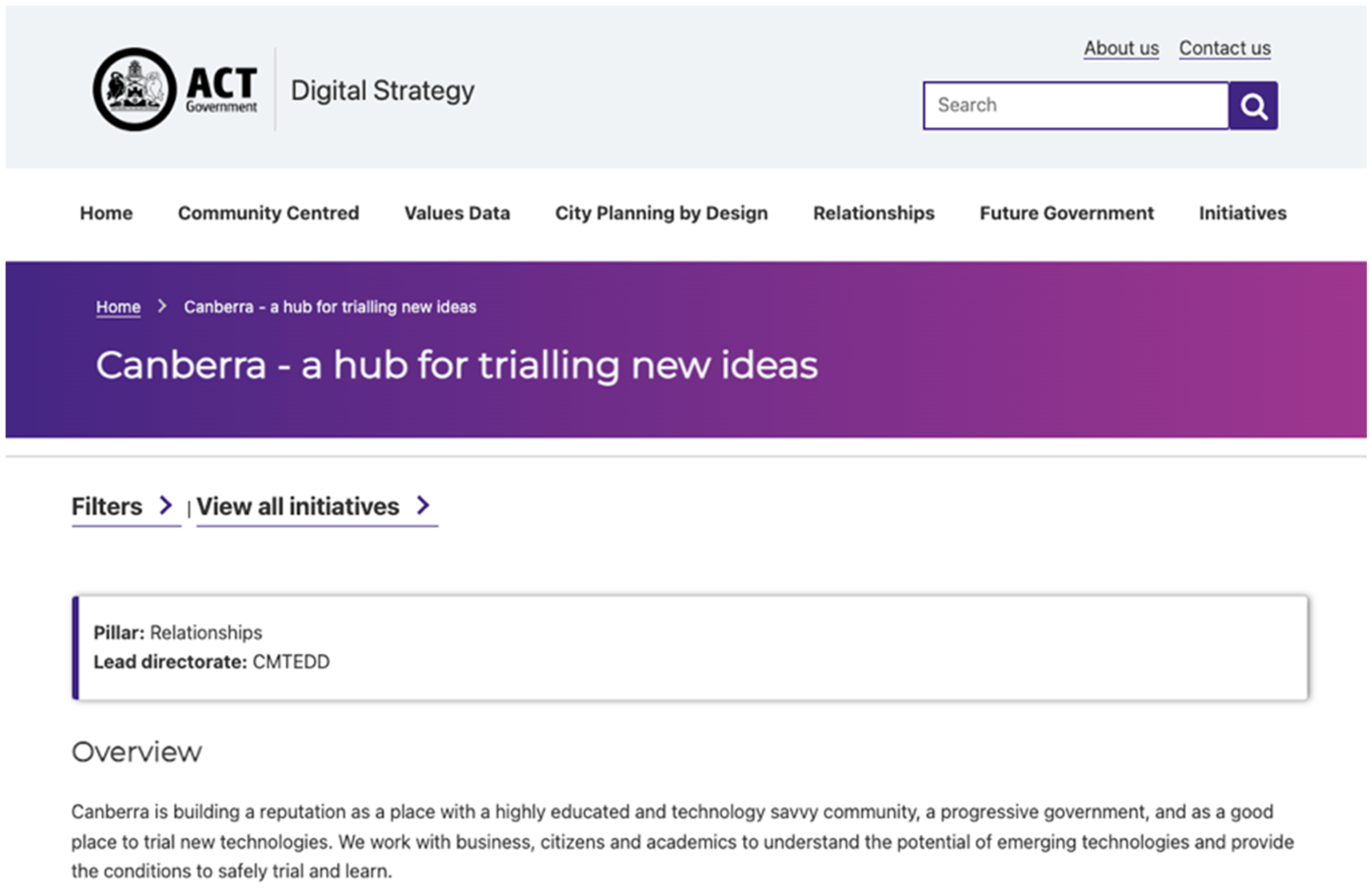
Chief minister, treasury and economic development directorate, ACT government digital strategy website, “Canberra – a hub for trialling new ideas.” Accessed 10 April, 2024 [Online] https://www.cmtedd.act.gov.au/digital-strategy/current-initiatives/industry/canberra-a-hub-for-trialling-new-ideas. Screenshot by the author.
Indeed, as a medium-sized city Canberra serves as a good metonym for Australia as a middle-power country. Limited population, infrastructure and resources have meant that places like this are unable to compete as major centres for innovation. 9 What it can offer instead is the capacity to loosen restrictions to enable what all innovation initiatives need—a low risk place to trial new ideas. It is in this capacity that places like Canberra, and by proxy Australia, are able to articulate value as middle-powers and to compete in the global innovation race.
Like Canberra, the city of Logan has also recognised the economic potential in hosting trials and becoming an innovation testbed. Only a few years after the arrival of Wing, the city announced its intentions to become a “Silicon Valley-esqe” innovation district, investing in initiatives like the coLab Growth Hub, a government funded “scale up” program designed to attract new technology start-ups to the area (Stone, 2023)(see Figure 3). “We’ve got an innovation lab, we’re attracting scaling ventures, creating jobs, lifting capability, building the ecosystem” Tim, a senior manager said to me, “the coLab approach is to be a platform for business.”
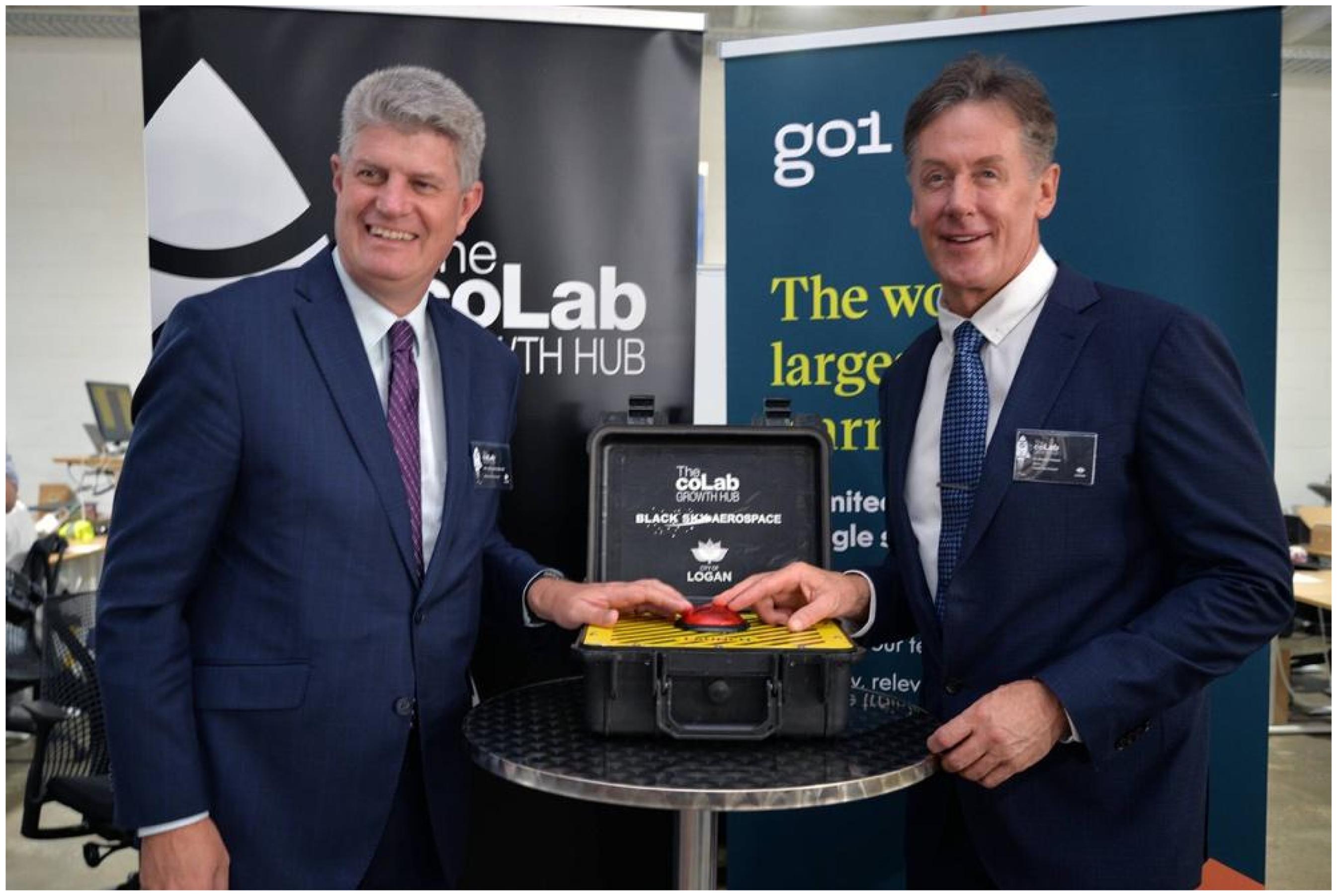
Stirling hinchclife (left), Queensland minister for tourism, innovation and sport and darren power (right), Mayor of logan, launching the coLab growth hub on march 30, 2021. Image: The Jimbooba Times https://www.jimboombatimes.com.au/story/7189445/logan-businesses-to-reach-for-the-sky-with-new-growth-hub/.
The hub offers a range of incentives: residency programs, mentorship, and access to office space to entice startups to relocate to Logan. In Tim's words: “we give them some desks and coffee and wi-fi and puppies on Tuesday and a space to do their business from.” The aim of the innovation district was not just to promote the city of Logan as a place to host experimental ventures, but to become a scalable experiment itself: It's a pilot. It's a scalable repeatable pilot, something that hasn’t been done to the best of our knowledge by any other local government in Australia…But we built this business to be scalable and repeatable. So just like what we’re doing here in Logan tomorrow I could do in other regions around Australia, and we’ve already got interest. Tim, senior manager of the coLabGrowth Hub
Logan here imagines itself as trialling a model for innovation that can then be replicated across the country. It reproduces the idea of the testbed as not just a space or territory where new commodities can be safely trialled and tested, but as anthropologist Gökçe Günel contends, an exportable commodity in and of itself (2019, p. 50). However, more than this, Logan invests in the concept of the testbed as a national strategy that can bring new avenues for growth and productivity for regions searching for change
Early adopters and diversity assets
For a city such as Logan, the promise of change that accompanies calls for innovation is invaluable. Logan is a city that has for decades struggled under the stigma and social realities of disadvantage. Logan is not just classified as a low-socioeconomic area, according to the Australian Bureau of Statistics, suburbs in Logan are in the top 10 percent of disadvantaged suburbs in the country, a measure calculated based on a range of indicators, from household income, to unemployment levels, people in low skilled occupations, without qualifications, access to infrastructure like wifi, and so on (Australian Bureau of Statistics, 2023). The city is also mired by scandals and corruption. In 2019 — the same year that Wing launched in Queensland — the entire Logan City Council (including the mayor) was suspended and 8 out of 12 counsellors were charged with fraud related criminal offences by the Crime and Corruption Commission (ABC news, 2019).
The opportunity to turn over a new leaf, to rebuild its reputation, and to bring in new avenues for local investment in a resource poor region made for an especially enthusiastic reception for Wing. When I spoke to the city counsellors (the ones who had not been charged with corruption) about the success of Wing in Logan, they did not shy from discussing the challenges and stigma facing their communities. But like all good politicians, they were quick to spin these as positive assets that, significantly, made them perfect hosts for global companies like Wing to come and trial their new technology systems. In my conversation with Eric, one of the counsellors involved in early negotiations to bring drone delivery trials to Logan, he told me that: Logan has been suffering for a long time [from] specific stigmas around low social economics [sic], but like many places around the world, that has transformed into a kind of a positive gentrification where a lot of young families, young people have been able to afford housing in Logan. And for companies like Alphabet, and other innovative companies that's early adopters. That's how they translate it. Eric, local Member of Logan City Council
This stigma, and Logan's status as a disadvantaged city, is largely the result of poor planning policy, recent humanitarian resettlement programs, and longer legacies of colonial exploitation. Like many parts of Australia, early nineteenth century colonisers established the area as a British penal settlement via processes of violent displacement of Aboriginal peoples. During the mid to late 1800s, after the closure of the settlement, it then hosted a number of plantation industries, namely sugar and cotton. As is the case with British run plantations elsewhere, these industries were reliant on the labour of indentured workers, mostly Kanaka South Pacific Islanders who were coerced and kidnapped under what became known as the practice of blackbirding. From the nineteenth to the first part of the twentieth century, the area was primarily dairy region and following the war saw large amounts of urban development. In the late 1960s, the Queensland Housing Commission converted large swathes of land into public housing, a planning decision that has since been criticised as ghettoising the poor. And in the 2000s, the city was part of the country's two major resettlement zones for humanitarian refugees from countries such as Syria, Sudan, Iraq, Burma, and more. These factors have led to chain migration with the area now home to a large number of migrant communities. The result is a fast-growing city that is both working class and extremely racially diverse (see Robertson, 2016).
These specific factors, which in other contexts had marked the community as disadvantaged, were now explicitly named as reasons why Logan made for a perfect technology testbed. “We’re a young city, we’re a multi-cultural city, so usually our constituents are, and residents are open to new things” Eric told me. This combination of youth and racial diversity were also factors for Mike, another council member. “Logan is the youngest city in Queensland. It's the most diverse city in the world” he said, “234 cultures. New York is the only city that gets close to us and just depends on which stat you want to use to cut it.” In narrating the city's success story as a testbed for drone delivery, Mike would identify diversity as Logan's primary asset, the reason why it was a perfect testbed population: There's a bit of research that shows essentially the more diverse a city is, the better it is for testing in. So, New York is the best test case in the US because it is the most diverse city. And essentially if something works in New York, it'll work anywhere because you've got a cross section of communities that exist in other parts of the country. And the same thing is true in Logan. If it works in Logan, it'll work in Melbourne, it'll work in Sydney, it'll even work in Western Australia. So and that was information that Wing came to us with. They were like, we know that diversity are better, to trial things in, because if it works here, it'll work elsewhere. Mike, local Member of Logan City Council, emphasis added
This story of diversity as a national asset diverges from earlier accounts of Australia's practical advantage as a testing ground. As discussed earlier, the colonial project of White settlement has in most cases seen the colony being treated as an outpost of Empire. This in turn has led to a heuristic structured by proxy relations, where Australia operates as a stand-in for other White nations and is valued because of an imagined alignment to this Whiteness elsewhere. In this example, however, it is not Whiteness but a perceived diversity beyond Whiteness that creates the ideal conditions for testing and produces value for the nation as a testing ground. In short, Australia is not just a proxy for White countries, but a proxy for the world.
This shift from whiteness-as-asset to diversity-as-asset follows contemporary strands in nationalist discourse in which multiculturalism has been framed as “an economically exploitable resource” (Hage, 2000, p. 133). For anthropologist Ghassan Hage, this ideological view of Australian multiculturalism emerged during the 1980s in the aftermath of what was known as the White Australia policy—a set of restrictive immigration practices used to prevent non-European people from settling in Australia. He argues that during periods of rapid Asian migration, discourses of economic rationalism were used to justify social policy interventions. Multiculturalism was framed as an object of national value, the effect of which was the production of the non-White migrant as tolerable insofar as their presence was assessed as somehow beneficial to the White system of management. In his words, “one can see it as a cultural exploitation of ethnicity to make it yield a kind of ethnic surplus value” (ibid, p. 129). This ethnic surplus value now manifests in the discourse of local city councillors who see the bodies of racialised people who have been corralled together because of histories of urban planning failure, global conflict, and colonial exploitation as economic resources that provide the city with a strategic, market advantage.
Conclusion
In his iconic paper on the new sociology of testing, STS scholar Trevor Pinch argues that tests (all tests) are dependent on a series of relations based on patterns of similarity and projection. He writes: Testing always proceeds by a process of projection. If a scale model of a Boeing 747 airfoil performs satisfactorily in a wind tunnel, we can project that the wing of a Boeing 747 will perform satisfactorily in actual flight. If a microphone works now, we can project that it will work later when being held by Mick Jagger…The act of projection—whether from the present to the future, from the present to the past, from the particular to the general, from the small to the larger from the large to the small (as in miniaturisation) — depends crucially upon the establishment of a similarity relationship. Pinch, 1993, p. 29, original emphasis)
In this article, I have shown how Australia too has been treated as a testbed based on such acts of similarity and projection. The founding of the colony was part of British efforts to project imperial power outwards across distant frontiers and the positioning of Australia as a testbed was in fact central to the justification of British settler colonialism. The southern continent would serve as a proxy of the motherland, a place where new ambitions, new ideals, and new modes of social organisation could be trialled and tested. The now-overturned principle of terra nullius was used as an act of state via which Britain established its sovereign power over the Australian continent, but it also provided the image of an empty space, a clean slate upon which such experimentation could take place. The whiteness of the settler body also marked them as appropriate stand-ins for a range of social, medical, and scientific experiments that in many cases would have been considered too controversial or too dangerous to conduct on the same bodies that populated the metropole.
Australia continues to be positioned as an ideal test site and Australians as ideal test subjects today, with places like Logan and Canberra promoted as proxies for anywhere. These cities are imagined as experimental zones that allow us to contend with the challenges of urban life in an age of endless and intractable crisis. Indeed, the company Wing promotes delivery drones as not just solutions to last mile delivery, but as pre-emptive forms of emergency infrastructure that can deliver crucial goods during increasingly common periods of flood, fire, and as the COVID-19 pandemic vividly illustrated, communicable disease. The ways of living that are produced through these processes of “endless versioning” (Halpern and Günel, 2017, p. 8) can, in theory, be exported across the world as solutions for crisis neatly packaged in commodity form. As sites of new migration, their racially diverse populations are also touted as a representative mix of global consumers. An early adopter here, is said to be an accurate stand for an early adopter anywhere.
Yet as my analysis has also shown, Australia has only become a testbed through very specific conditions and because of very specific relations. Colonial dynamics of distance and asymmetries of power still persist in the examples of contemporary experimentation described in this article, justified by the principle of innovation that is so enthusiastically embraced by local governments. It is my contention that Australia is thus only able to be posited as generic (insofar as findings from these experiments are universally applicable) only because it is profoundly specific (insofar as it has been posited as a site of exception where experimentation can take place). 10
By analysing the example of the Australian testbed, I have also sought to demonstrate how practices and narratives of AI innovation are connected to histories and imaginaries of race and nation. The embrace of the testbed as an economic strategy has shaped how people and place are figured as assets and resources that can be called upon in service of agendas tied to innovation nationalism. These agendas do not just serve Australia's own national interest but crucially have been developed in relation to its position to imperial power.
One of the many legacies of colonisation is that Australia has one of the least diverse economies within the OECD (Fernandes, 2022). In a dynamic that is typical to imperial-colonial relationships, Australia's economy is centred around mineral resources and agricultural goods, a feature that in the colonial era was designed to feed directly back into the wealth of the metropole. This economic dependency helps to explain Australia's trajectory as a testbed nation. In the colonial era, Australia became Britain's colonial laboratory because its wealth and security were so dependent on the British empire. In the post-Cold War era, Australia has shifted its dependence, now operating as “an active, eager participant in the US-led order” (Fernandes, 2022, p. 3). It is no coincidence then that Australia is now the preferred location for contemporary testbeds for primarily US-based technology firms.
These relations of dependency, that are deeply tied to histories of expropriation and extraction, are masked by buzzwords like innovation. One of my aims has been to add to the growing chorus of critics who seek to expose the forms of exploitation taking place under the banner of innovation, and to ground these within longer histories and structures. This work is important to do because phrases such as “innovation” are stubbornly employed again and again in ways that obscure these histories. Innovation, in its search for constant newness, claims certain practices as new even if they’re not. Innovation thinking fetishises narratives of sudden breaks and disruption, seeing everything as a frontier that needs to be transgressed. But in doing so, the language of innovation encourages a pathological historical amnesia, obscuring one's ability to trace continuities between the then and the now. It also renders the frontier as a purely abstract and metaphoric phenomena, glossing over its functions as a distancing technique that enabled, among other things, frontier violence. If history can impart one key lesson it may just be to ask: who really benefits from all these trials? If we look back to the colonial era, it's clear that the value generated, whether wealth or knowledge, very rarely trickles back down the imperial chain. It is local communities who are tasked with bearing the cost of change and who are often left to clean up the mess. By returning to the colony as a site of historical and contemporary testbed practice, my hope is to highlight how testing “in-the-wild” is not only not new, but that despite changes in who and what technologies are being tested, there is still something about the colonial dynamic that continues to shape testbed imaginaries.
Footnotes
Acknowledgements
The article benefitted immensely from the generous feedback of many careful readers. In particular, I would like to acknowledge Sarah Pink, Noortje Marres, Alex Taylor, Thomas Sutherland, Christopher O'Neill, Warwick Anderson, and the entire Emerging Technologies Research Lab at Monash University. I would also like to acknowledge the anonymous peer-reviewers (or not so anonymous in the case of Jack Stilgoe!) whose thoughtful comments were invaluable in shaping the final piece.
Declaration of conflicting interests
The author declared no potential conflicts of interest with respect to the research, authorship, and/or publication of this article.
Funding
The authors disclosed receipt of the following financial support for the research, authorship, and/or publication of this article: This research was funded by the Australian Research Council’s Centre of Excellence for Automated Decision-Making & Society (CE200100005).
