




Abstract
This research endeavours to examine the discursive construction of blackness and whiteness by protestors spanning from Minneapolis to the entirety of America following the murder of Floyd. The data, which were analysed using the framework of van Dijk’s critical discourse analysis approach, consisted of 140 slogans collected from photos found on CNN, BBC, AP News, CBS News and Shutterstock websites. The analysis uncovered several recurring discursive strategies utilised to construct the notions of vulnerable blackness and privileged whiteness, including polarisation, concretisation, norm and value violation, victimisation, negative lexicalisation, generalisation, compassion move, self-identity descriptions, negative comparison, resource description and hyperbole. The findings revolve around ‘Othering’, which emphasises positive self-perceptions and negative perceptions of others while shedding insight into the power dynamics between White and Black people. This study offers unique perspectives on whiteness and blackness within the wider social context of the United States by addressing systemic racial inequality and societal change.
Introduction
Existing scholarly investigations of protestors’ discourse after the murder of Floyd have predominantly focused on the visual rhetoric employed by protestors to convey emotions and express opposition towards unfairness and institutional racism (Cappelli, 2020; Luigi, 2023; Mansouri & Parina, 2023). Meng (2021) argues that the slogans used during George Floyd’s protests question structural racial injustice. The rights of American ethnic minority groups are in danger of systemic racial inequality. The investigation conducted by Boya and Min (2021) examined the qualities of the linguistic landscape that manifests in slogans. The findings revealed that the prominent features of these phrases are potency, brevity and liveliness. Several studies have examined individuals’ verbal and non-verbal responses to systemic racism following Floyd’s murder (e.g. Affandi & Murwadji, 2020; Ferguson et al., 2022; Iheme, 2020; Raees Kazemi & Akefi Ghaziani, 2021; Toosi et al., 2021). Following the tragic murder, protestors embraced the narratives and rhetoric of the Black Lives Matter (BLM) movement, which has been subject to comprehensive scholarly investigation (Anderson et al., 2020; Cross et al., 2022; Goodman et al., 2023; Leyh, 2020; Luigi, 2023). Moreover, a substantial body of scholarly work exists on the portrayal of slogans used by protesters on both official and social media platforms (Ahaotu & Oshamo, 2023; Cowart et al., 2022; Dixon & Lauren, 2020; Marta & Fabio, 2023; Williams, 2020; Zulli, 2020). Our study examined the discursive strategies employed in the linguistic expressions of slogans used by protestors in Minneapolis and across the United States following Floyd’s murder. This is to shape the concepts of whiteness and blackness. This study seeks to answer the following research questions:
RQ1. What discursive strategies are employed in the linguistic expressions of slogans used by protestors following Floyd’s murder?
RQ2. What role do the discursive strategies play in constructing whiteness and blackness?
RQ3. How do the discursive strategies impact White–Black power relations?
Race has been a preoccupation of American society since the establishment of the United States, as stated by Terkel (1992). DuBois (1903/1995) asserted that the central challenge of the 20th century was the issue of the colour line. According to Winant (1997), racial conflict is the root cause of discontent in America, which shapes other conflicts. Smedley (1999) argued that the concept of race arose to represent perceived distinctions between individuals after the broad enslavement of Africans. Individuals were not labelled ‘White’ or ‘Black’ before enslavement. Instead of skin colour, their identities are determined by their social standing, location and culture. Within the American context, the concepts of whiteness and blackness have developed as cultural concepts in connection with the categories of ‘White’ and ‘Black’. According to Helms (2017), whiteness encompasses all the ways in which the White racial group is privileged over all others, including overt and subtle forms of socialisation, power dynamics, laws, privileges and life experiences. Saad (2020) agrees with Helms (2017) in that whiteness is a complex concept that includes cultural worldviews, self-beliefs, emotions, attitudes and racial activities. These worldviews are embraced and institutionalised to create a hierarchical social structure that prioritises white skin, cultural values, intellectual tendencies and behavioural patterns over those of Black people.
On the contrary, Yancy (2012) argues that whiteness stems from a deep disavowal of ‘I am not that!’ (p. 20). The exclamation ‘I am not that!’ represents a lifestyle, behavioural code and cultural beliefs that are inextricably related to the exclusion of Black people. Frankenberg (2001) contends that, at times, whiteness seems to provide a definitive assertion of ‘I am not that Other!’ (p. 75). In this regard, ‘I’, as a White being, is primarily characterised by negation in its social ontological composition. A context of relationality or otherness forms the White ‘I’ (Frankenberg, 2001). This exclamation offers profound insights into whiteness and blackness, emphasising the dominance of whiteness and the vulnerability of blackness. It is closely connected to our research that aims to analyse the conceptualisation of whiteness and blackness in the discourse reflected in the slogans of demonstrators following Floyd’s murder. According to Yancy (2012), whiteness is defined by recognising what it is not. Whiteness is a spurious construct devised by White people to maintain the illusory sense of ontological superiority. Whiteness represents a lifestyle, self-presentation and self-preservation, code of behaviour, projected cultural values and worldview that is undoubtedly linked to Black oppression and marginalisation (Yancy, 2012). According to Yancy (2021), whiteness is a location for investment, immunity and privilege, whereas blackness is a site of damnation and nullification. Similarly, Fanon (1986) argued that blackness is characterised by a negative association with dark skin, resulting in the development of an inferiority complex within the identities of Black individuals. This issue is significant because of the inherent connection between whiteness and a system characterised by oppression and dominance, which has persisted throughout the history of American society (Al-Ramahi et al., 2021; Bhabha, 1998; Johnson, 2001; Warren, 2010; Delgado & Stefancic, 2012; Sirleaf, 2023). These two fundamental concepts profoundly influence the social identity and privilege of White and Black Americans, as in Owen (2007), Jungkunz (2011) and Mapedzahama and Kwansah-Aidoo (2017).
Our study offers a unique perspective on the discursive strategies employed in protest slogans following George Floyd’s murder and provides a nuanced analysis of how language shapes the notions of whiteness and blackness. This study goes beyond the typical analyses of visual rhetoric and linguistic landscapes by addressing the three research questions mentioned previously. This study aims to explore the underlying communicative strategies employed by protests. The findings have the potential to inform both academic discussions and practical efforts to address systemic racial inequality, making a substantial contribution to the body of knowledge and societal change.
Literature review
Whiteness
How White people in the United States view themselves and the world around them is an integral part of the concept of whiteness, which has a significant impact on their daily lives (Dwyer & Jones, 2000). As discussed by Malat et al. (2017) and Joyce and Cawthon (2017), the idea of whiteness has the potential to influence the creation of social policies by changing the beliefs and narratives of those who identify as White. Scholars have made considerable efforts to examine how whiteness affects people’s social, health, economic, educational and political experiences in the United States (e.g. Lipsitz, 1995; Olson, 2008; Picower, 2009; Schooley et al., 2019; Williams et al., 2010). Numerous empirical studies support the idea that people of various racial identities, especially those who identify as White or Black, live in a society shaped by racial dynamics that are most closely associated with the concept of whiteness (see Delgado & Stefancic, 2012; Jones, 2003; Parrillo, 2001; Picower, 2009).
White privilege, which refers to the various benefits and resources accorded to individuals who are socially identified as White people, is closely associated with whiteness (Harris, 1993; Jungkunz, 2011; McIntosh, 1988; Rasul & Asim, 2023). In academic discourse, whiteness is frequently understood as a socially produced phenomenon that intrinsically bestows individuals with specific societal privileges (Frankenberg, 1993). As stated by McIntosh (1988), individuals self-identify as White people through a process of socialisation that instils in them a certain framework, resulting in their perception of their existence as morally neutral, normative and deserving of praise. Referring to Ansley’s work (1989), the perpetuation of institutionalised whiteness is upheld by interconnected elements that create a network of institutional whiteness, hence reinforcing and standardising its presence. Potapchuk (2013) identifies several institutional advantages often experienced by Whites. These advantages include a reduced likelihood of being arrested and residing in communities offering superior access to high-quality employment opportunities, educational institutions and community services. McIntosh’s (1989) seminal work presents an extensive compilation of the personal benefits enjoyed by those with white skins. These privileges encompass all aspects of life, such as the freedom to engage in solitary shopping excursions, unrestricted public speaking, the capacity to openly critique political figures, the assurance of adequate safety for children and the presence of neutral neighbours. Hence, this study examines the construction of whiteness by exploring the privileges of being White, specifically within the framework of protesters’ written expressions.
It is generally agreed that the Western world’s repressive power dynamics towards non-Western cultures are largely attributable to the association between whiteness and racism. Allen (2001) and Leonardo (2009) argue that people of White racial origin contribute to the maintenance of racism and other forms of bigotry through whiteness. Ogbonnaya (1994) maintained that ideas associated with whiteness significantly shape how people think about race, blackness and otherness. Race is a term that no biologist can pin down. An explanation that establishes the genetic basis of one ‘race’ and thus excludes ‘all others’ (Ignatiev, 1994). According to Hartigan (2013), the concept of race has been extended globally to mixing behaviour and physical characteristics. As a dynamic, race has consequences for fundamental social institutions. Foucault (2003a) compares biopower with sovereign power in his analysis of racism. In the context of modern biopower, racist institutions perceive racism as a tool for maintaining their own power. Foucault (2003a) argues that racism operates among many forms of power, rather than outright prejudice or discrimination. According to Foucault (2003a), the concept of ‘internal racism’ refers to a complex system of connections that may be adjusted to suit specific contexts to uphold societal norms and enforce various forms of exclusion. Racism is an enduring and persistent presence that permeates and is constantly reproduced within social structures (Foucault, 2003b). Foucault’s (2003a) notion of racism helps us better understand the discursive formation of race and racism in this study. Bhabha (1998) analysed how the concept of whiteness contributes to racism. Given that our study focuses on how whiteness and blackness are constructed through language, racism plays a significant role. By examining the language used in slogans, we obtained significant insights from Whitehead’s (2017) discursive approach to race and racism. This approach focuses on language as a social action and helps uncover racial ideologies associated with racism and whiteness.
Within this context, the idea of White supremacy is widely acknowledged as an accurate reflection of the pervasive manifestation of racism in everyday life (Bonnett, 2000; Cole, 2009) because of its close connection to the production of whiteness. According to Mills (1997), White supremacy is a system of power in which White people have more power and privilege than racially marginalised groups. As this concept is inextricably linked to racism and power, it helps reveal how privileged whiteness is produced in protest slogans following Floyd’s murder. Given the system’s inherent connection to the idea of whiteness, we considered it necessary to examine the systemic racial policies that have significantly contributed to the formation and preservation of whiteness.
Blackness
The notion of blackness has historically been associated with prejudiced preconceptions and unfavourable sentiments towards people of colour. Consequently, many members of the Black community feel devalued (Greason, 2009; Mapedzahama & Kwansah-Aidoo, 2017). According to Johnson (2003), blackness is characterised by intrinsic instability, which can be traced back to White supremacist ideas. Owing to the pervasiveness of the White supremacist ideology, Black people continue to live on the margins of society. According to Mapedzahama and Kwansah-Aidoo (2017), ‘blackness’ refers to more than just skin colour; it is also a social construct that is inextricably bound up with ideas of White superiority. Most definitions of ‘blackness’ rely on references to slavery, colonialism, racism or contrast with ‘whiteness’ (Hlulani, 2022; Johnson, 2003; Yancy, 2008). Numerous studies have analysed how whiteness affects blackness (e.g. Anderson, 2015; Fishkin, 1995; Mapedzahama and Kwansah-Aidoo, 2017; Tyler et al., 2022).
Those of African origin often struggle with the psychological effects of the concept of whiteness, which can lead to the reflection and questioning of one’s own racial identity. Given the difficulties of navigating a predominantly White society, many Black people feel that they have no choice but to adopt the norms of that society. Several studies have examined the psychological difficulties and identity ambiguity faced by people of African descent in a society dominated by White-centric ideologies (e.g. DeCuir-Gunby, 2009; Harvey, 2023; Hollingsworth, Polanco-Roman, 2022; Logan, 2014; Mays, 1986; Mushunje & Graves, 2023; Sikanku, 2023; ya Azibo et al., 2013). To contribute to this body of literature by examining how being Black is perceived and constructed through the lens of protesters’ textual statements, specifically the psychological, racial, economic and political challenges of being Black.
BLM movement and the American Black–White conflict
Racism is ingrained in American society. Terrible events, such as mass incarceration, police brutality and voter disenfranchisement, have affected every social and legal institution in the past and present (Kendi, 2016). Through the civil rights movement, which served as the catalyst for the protest cycle of the 1960s, Black people have historically battled against racial prejudice. Launched in 2013 in reaction to the murder of Trayvon Martin, BLM is an extension of the Black community’s fight for racial equality in the United States (Taylor, 2016). BLM is
an ideological and political intervention in a world where Black lives are systematically and intentionally targeted for demise. It is an affirmation of Black folks’ contributions to this society, our humanity, and our resilience in the face of deadly oppression. (Garza, 2014, p. 23)
Eliminating White supremacy, confronting and countering acts of violence against the Black community, supporting people affected by state-sanctioned violence and anti-Black racism and creating an atmosphere that supports Black creativity and ingenuity are goals of the BLM movement. The movement has crystallised the self and others as well as the Black–White conflict by drawing attention to the hardship Black people endure under the racial system that favours White people over Black people.
The BLM movement has recently played an essential role in bringing attention to the ongoing systemic racism and oppression of Black people in the United States. Since 2013, the BLM movement has openly pushed the Black community to actively combat institutional racism, White supremacy and oppression to better socioeconomic conditions (Cox, 2017). The BLM movement’s ideology inspired protests in Minneapolis and across the United States in the aftermath of Floyd’s murder. These protests emphasised Black people’s continual struggle against a racial system that denies them basic rights. The protesters’ slogans reflected the ideas of the BLM movement (Leyh, 2020; Meng, 2021; Remus, 2021). Protesters’ slogans following George Floyd’s murder show ideas related to whiteness and blackness, as well as the self and others. According to Assri (2021), these slogans illustrate the core fight of the BLM movement, which advocates the rights of Black people. They also emphasise social reality based on whiteness beliefs, which are ideologies and practices that favour White people’s political, economic and cultural dominance over non-White people (Belew & Gutiérrez, 2021).
Theoretical framework
In this study, van Dijk’s critical discourse analysis (CDA) serves as a guiding theoretical framework. Analysing how social power, dominance and inequality are enacted, reproduced and resisted in textual and linguistic political contexts is the main goal of CDA (van Dijk, 2001). CDA is an interdisciplinary approach to studying language, with the overarching purpose of clarifying the interplay between various forms of social authority and power (van Dijk, 1995a). CDA was developed to better understand the discursive processes that establish, sustain and reproduce symmetrical power relations (van Dijk, 1997). Among the many components of van Dijk’s (1995a) framework for ideological studies is the analysis of social interactions, individual thought processes and group communications. As pointed out by van Dijk (1995b), any aspect of discourse that expresses, establishes, confirms or emphasises a self-interested group opinion, perspective or position is a candidate for special attention in such an ideological analysis. According to van Dijk (2009), discourse, cognition and society are interconnected in sociocognitive frameworks, with cognition mediating the relationship between discourse and social structure. Insights into the ideological analysis of protestors’ slogans can be engendered by applying van Dijk’s approach to this study.
This study interprets the ideologies of protestors’ slogans by applying insights into discursive strategies from van Dijk’s (2004) sociocognitive framework. Polarisation, concretisation, compassion move, negative comparison, hyperbole, norm and value violation, victimisation, resource description, generalisation, self-identity descriptions, negative lexicalisation and warnings are the components of van Dijk’s framework relevant to the generated data. These discursive strategies focus on the positive and negative descriptors of the self and other, respectively. Insights into conflicts arising from struggles for resources, efforts to establish a positive identity, emphasis on equality and violation of norms and values by others were provided using these strategies in this study’s analysis. By illuminating how whiteness beliefs lead to competing goals for Black and White individuals, the discursive strategies at play in this study contribute to the development of negative others.
According to Efird and Lightfoot (2020), whiteness beliefs perpetuate White American social supremacy and the oppression of people of colour. Van Dijk’s approach helped us address the three research inquiries by providing insights into the discursive constructions of privileged whiteness and vulnerable blackness, as well as the positive self and negative other. It also helped provide thoughts on the development of power dynamics in the discourse of slogans.
Method
The sample of the study
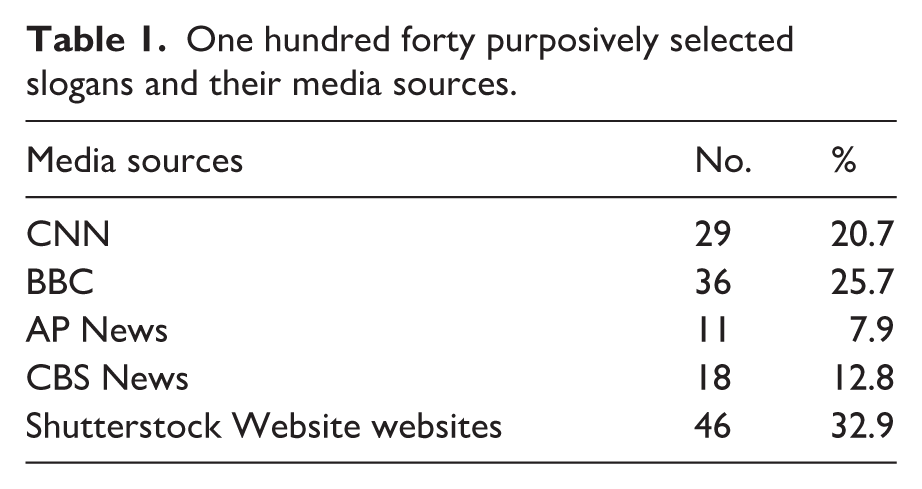
The sample included 140 written slogans purposively selected from various media sources. It was critical to examine more than one source while gathering data to ensure that as many diverse slogans as possible were collected. We gathered slogans from CNN, BBC, AP News, CBS News and Shutterstock websites. Table 1 shows the media sources and the number and percentage of slogans selected from each.
One hundred forty purposively selected slogans and their media sources.
We gathered data using purposive sampling. This sampling method enhances our ability to address research questions by allowing us to select instances containing substantial information (Palinkas et al., 2015; Patton, 2002). In addition, the purposive sample enabled us to select slogans that demonstrated discursive strategies closely associated with van Dijk’s (2009) sociocognitive framework. This facilitated the development of themes related to whiteness, blackness and power dynamics. After gathering 256 slogans from several media sources, we rigorously evaluated each and discarded those that did not provide adequate information to answer our research questions. For example, the slogan ‘DARK SKIN IS NOT A CRIME’ sufficiently informative to answer our research questions. Concurrently, we eliminated 116 slogans from the dataset because of their irrelevance to the research questions. Our research, concentrating on the notions of whiteness and blackness, excluded slogans such as ‘GAY RIGHTS ARE HUMAN RIGHTS’ from our analysis. Our choice of slogans was informed by the variety of discursive strategies that perpetually generated discourse on whiteness and blackness.
Data collection and analysis
The raw materials were identified, categorised and analysed. Braun and Clarke’s (2006) thematic analysis was employed to identify codes, categories and themes. We began by enhancing our understanding of accessible information. A comprehensive analysis of the data was followed by note-taking to aid the next coding process. Preliminary codes derived from the data were generated, as listed in Table 2.
Instances of data and the initial codes assigned to said data as numbered in the selected data of this study.
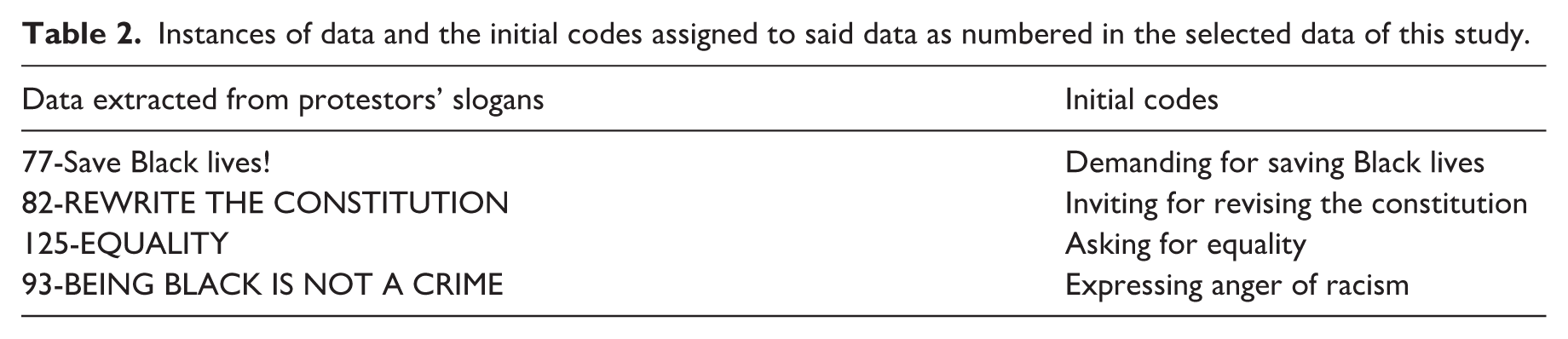
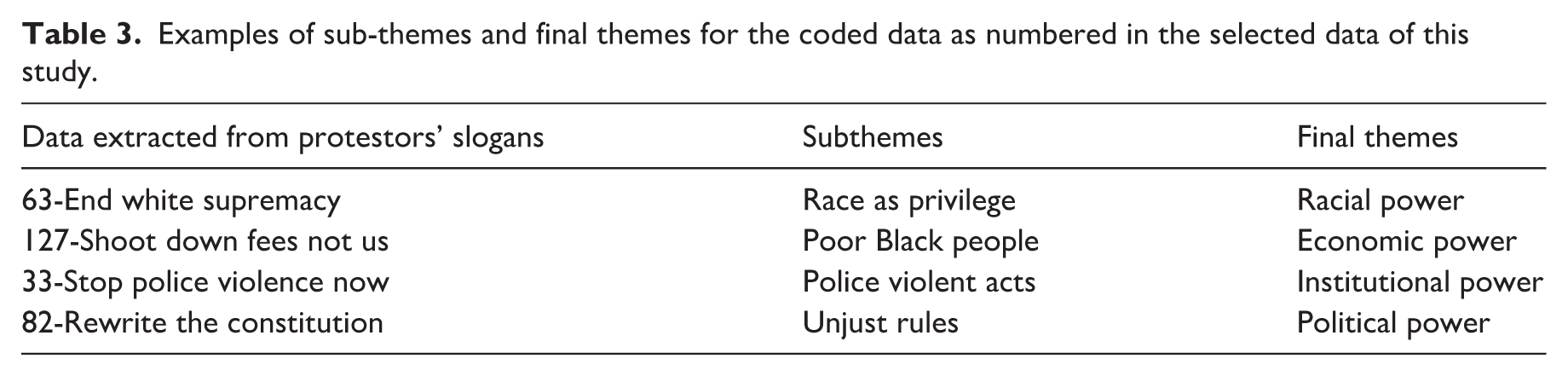
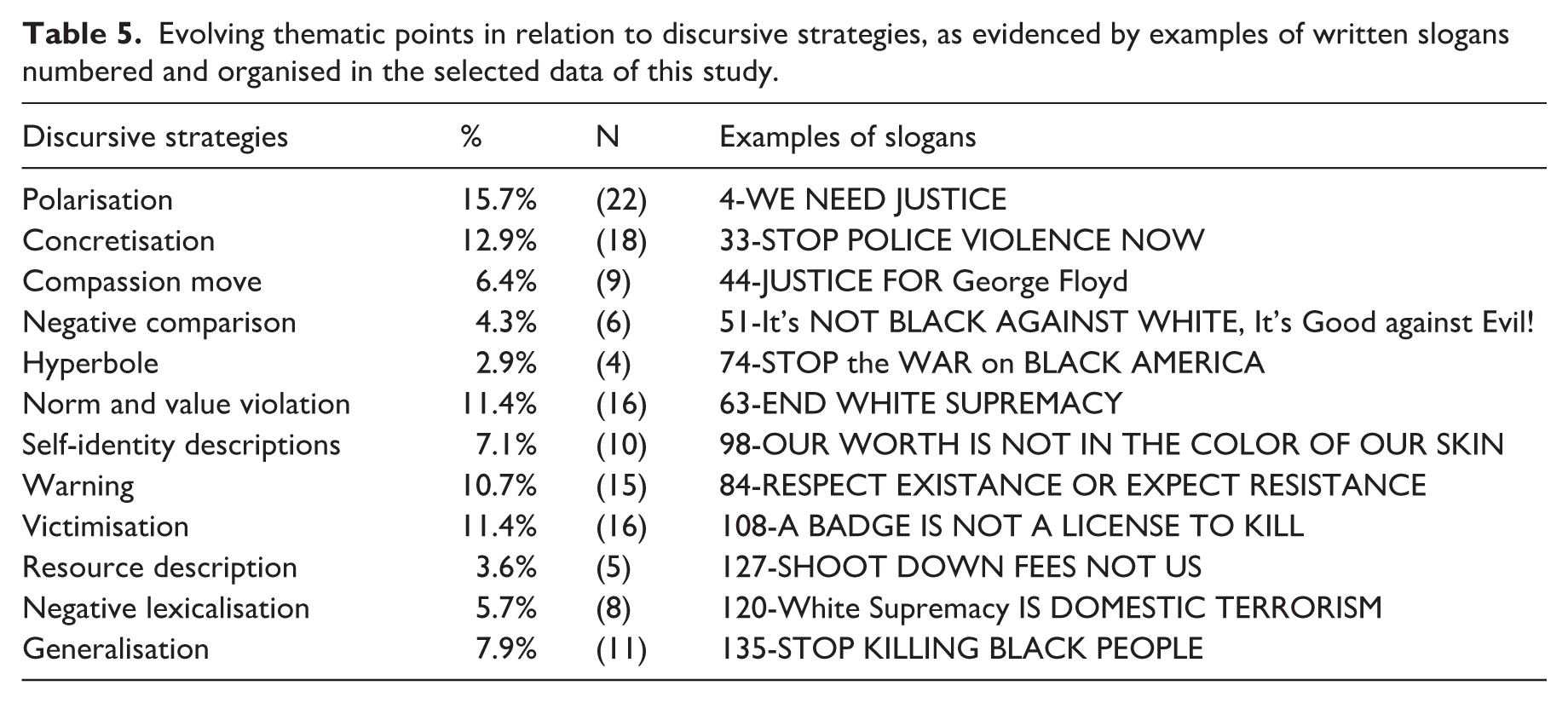
The initial codes were generated through a comprehensive investigation of the substantial data sets (Table 2). A systematic arrangement of diverse codes was conducted to generate thematic categories. To address the RQ1, the coded data were analysed to identify potential thematic patterns (see Table 5). Following the generation of themes related to discursive strategies, a comprehensive evaluation was conducted. Table 5 illustrates numerous thematic elements pertaining to discursive strategies. To address the RQ3 concerning White–Black power dynamics, the coded data were analysed to identify potential thematic patterns (Table 3). Table 3 presents examples of the final themes pertaining to White–Black power dynamics.
Examples of sub-themes and final themes for the coded data as numbered in the selected data of this study.
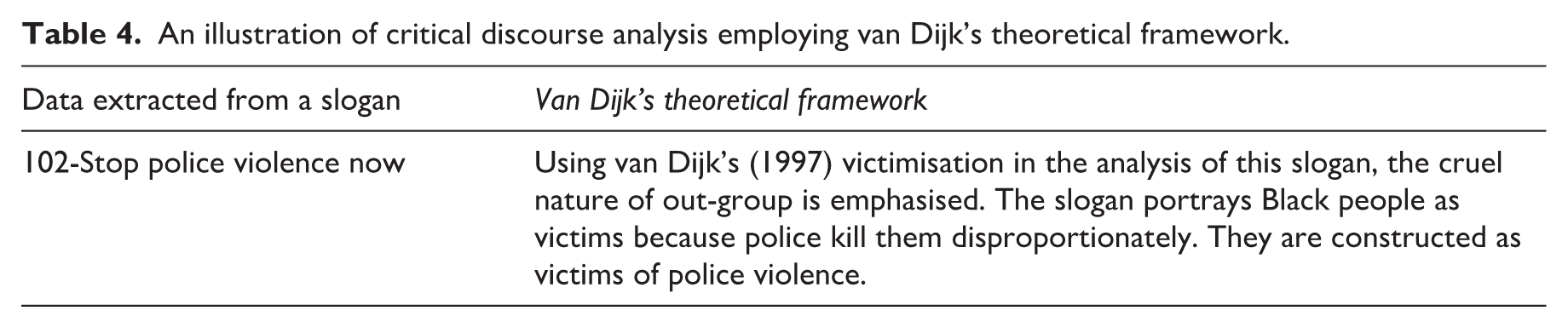
This study examined the discursive strategies employed in protest slogans using van Dijk’s (1993) discourse to affirm thematic elements. Consequently, the utilisation of cognitive concepts facilitates the examination of words, propositions and rhetoric, thereby enabling critical analysis. Consideration was also directed towards the social structures present within the coded data. We gained insights into the discursive strategies employed to construct the themes (i.e. victimisation; see Table 4) by examining the conceptual frameworks inherent in the coded data. We addressed the RQ2 by examining the role of discursive strategies in the formation of whiteness and blackness within the protest slogan language. Table 4 presents an example of van Dijk’s critical analysis.
An illustration of critical discourse analysis employing van Dijk’s theoretical framework.
Findings and discussion
The findings indicated that protestors employed several discursive strategies to construct notions of whiteness and blackness in the language of their written slogans. The analysis additionally demonstrates that these discursive strategies emphasise fostering good self-judgements and unfavourable perceptions of others, while also highlighting the power dynamics between individuals of White and Black racial backgrounds within the context of the United States. Van Dijk’s (1995c) CDA posits that the discourse employed in slogans contributes to the construction of whiteness and blackness through the utilisation of discursive strategies, such as polarisation, concretisation, compassion move, negative comparison, hyperbole, norm and value violation, victimisation, resource description, generalisation, self-identity descriptions, warning and negative lexicalisation. Table 5 displays the emergent themes of discursive strategies together with their respective frequencies.
Evolving thematic points in relation to discursive strategies, as evidenced by examples of written slogans numbered and organised in the selected data of this study.
The discursive strategies utilised inside the discourse of protesters’ slogans
In the purposively selected sample of protestors’ slogans following Floyd’s murder, polarisation and concretisation were the dominant discursive strategies (see Table 5). Polarisation is the tendency of a group to reach conclusions through a unanimous vote (Stroud, 2010). This discursive strategy, which arises when pre-group decisions about group work are gradually replaced by group decisions (Kim & Park, 2010), is a recurring theme in slogan discourse. Data analysis revealed recurring polarised structures, which comprised approximately 15.7% of the dataset. This finding suggests a limited number of distinct groups, each exhibiting a high degree of similarity in political beliefs within the group but significant dissimilarity between different groups (Tang et al., 2022). According to Schooley et al. (2019), this discursive strategy reinforces the perception of blackness as a state of vulnerability by emphasising Black people’s inferiority while emphasising the superiority of White individuals with full rights and privileges. Concretisation is a prevalent discursive strategy in slogans, as noted by van Dijk (2006a). This strategy is highly effective because it highlights the racist actions of White Americans (van Dijk, 2009). By showing how White people behave against Black people, this tactic adds to the perception that White people are an outgroup (van Dijk, 2001). The study of the data indicates the presence of repeated instances of concretisation, which comprise approximately 12.9% of the dataset (refer to Table 5). The frequent utilisation of this strategy within the realm of slogans accentuates the unfavourable attributes and behaviours attributed to White Americans, thus constructing a depiction of the ‘other’ as being prone to violence, racism, abuse, criminality and injustice.
The analysis also illustrated that the discursive strategies of norm and value violation, victimisation and warning exhibited similar levels of importance (Table 5). According to van Dijk (1995c), the strategy of norm and value violation is employed to portray the out-group as negative by highlighting its divergence from individuals’ beliefs and values. This discursive strategy accounted for 11.4% of the data (see Table 5), indicating its significance in the discourse of protestors who expressed opposition to the perceived transgressions of White individuals about fundamental human principles. Like norm and value violation, victimisation emerged as a frequently employed discursive strategy in the slogans of protestors, constituting approximately 11.4% of the total instances (Table 5). Victimisation plays a role in fostering polarisation by highlighting the negative actions of White people and presenting themselves as victims. According to Igwebuike (2018), this strategy links the adverse conduct of the ‘out group’ with perceived threats, while portraying the ‘in group’ as the recipients of these threats. With a representation of 10.7% of the entire collection of slogans (as indicated in Table 5), it can be observed that warning is a discursive strategy that has been employed with a reasonably high frequency. This strategy holds significant value for protestors, as it allows them to employ negative language to instil fear and concern within their own group regarding the perceived threat posed by the opposing group (van Dijk, 1995c). Consequently, this strategy was intentionally incorporated into the rhetoric of slogans.
The slogans have demonstrated restricted repetition of generalisation, self-identity descriptions, compassion move and the incorporation of negative lexicalisation. Van Dijk (1995c) argued that authors strategically employ generalisation to move from specific cases involving individuals and events to more encompassing and persuasive claims concerning diverse groups and categories of individuals. We propose that generalisation, which accounts for 7.9% of all slogans (see Table 5), helps project White people in general as racists by producing fear about their sentiments towards Black people. When people make assumptions about the bad qualities of others, they might give rise to prejudice and fear, as argued by van Dijk (2006b). Throughout history, Black people have been labelled as violent and seen as negative. Moreover, despite having a small number of recurrences (7.1%; see Table 5), the strategy of self-identity descriptions helps create good attributes for Black people, whereas the other is shown to hold all negative features (van Dijk, 2001). According to van Dijk (2004), this strategy facilitates the development of constructive self-identity among communities facing threats or marginalisation. The discursive strategy, known as the compassion move, accounted for 6.4% of overall recurrences, as indicated in Table 5. This strategy entails demonstrating empathy for individuals who are viewed as harmed by the acts of others. Its purpose is to amplify the perceived cruelty of the Other, as van Dijk and Kintsch (1983) describe. This strategy perpetuates the enduring vulnerability associated with Black people and the inherent brutality associated with whiteness, thereby reinforcing the privileged status of whiteness. Negative lexicalisation refers to the use of negative language to describe the actions and conduct of individuals belonging to different groups or categories. This phenomenon, as indicated in Table 5, constitutes approximately 5.7% of all the slogans. Moreover, negative lexicalisation plays a significant role in shaping the detrimental perception of the Other, as outlined by van Dijk (1995c).
Based on the information examined, it can be observed from Table 5 that the discursive strategies of negative comparison, resource descriptions and hyperbole exhibit the least frequent instances. The infrequency of employing negative comparisons in slogans to highlight the bad attributes of a particular outgroup by comparing them to a generally unfavourable outgroup (van Dijk, 1995c) has been noted to be 4.3%. The strategy of resource descriptions could have been more frequent, accounting for only 3.6% of the entire dataset. This strategy is closely intertwined with the utilisation of racial and economic elements, thereby illuminating the way blackness is employed to construct a perception of inferiority among Black people within a social structure primarily influenced by notions centred on whiteness. The use of this strategy within the realm of slogans accentuates the inherent advantages associated with whiteness and the perceived vulnerability associated with blackness (Johnson, 2003; Jungkunz, 2011). It is worth noting that the existence of a conflict of interest has led to the portrayal of Black people as inferior and White people as superior, with the latter exerting control over accessible resources. As shown in Table 5, hyperbole was the least frequently used discursive strategy, with only 2.9% of occurrences. This strategy uses vividly exaggerated language to depict an event or action. The use of this rhetoric has been observed in four slogans, wherein the behaviours of White people are portrayed exaggeratedly regarding their interactions with Black people.
The construction of vulnerable blackness and privileged whiteness in the discourse of slogans
The incorporation of 12 distinct discursive strategies in the slogans deployed by protestors contributed to the construction of the concepts of privileged whiteness and vulnerable blackness. This is achieved by redirecting focus towards issues concerning civil rights, marginalisation, socioeconomic inequalities, White supremacy and anti-Black racism, all of which concurrently constitute the core concerns of the BLM movement. In addition, it involves highlighting the negative behaviours displayed by White people and portraying them as harbouring racist tendencies through the cultivation of apprehension regarding their attitudes towards Black people. Furthermore, it entails demonstrating empathy towards Black people who are perceived as victims of the actions of White people, facilitating the cultivation of positive self-perception among Black people and illuminating the mechanisms through which blackness is employed to perpetuate feelings of inferiority within a social framework predominantly governed by White people. The subsequent subsections provide explanations on how the slogans express the 12 discursive strategies.
Polarisation
As noted by van Dijk (2004), the polarised structures in the linguistic composition of slogans signify the significance of in-group decision-making, as highlighted by Kim and Park (2010). The prevalence of the inclusive pronoun ‘We’ in the language of slogans indicates that negative experiences are often experienced within the Black community. This technique highlights the issues of civil rights, marginalisation and socioeconomic inequities experienced by those of African descent. The polarised structure in ‘WE NEED JUSTICE’ (see Example 4, Table 5) illustrates the manifestation of a collective voice among Black individuals in response to the presence of whiteness. Blackness as a condition of vulnerability is effectively maintained by this slogan’s polarisation strategy, which emphasises how White people view Black people as inferior and shows how Black people voice their need for justice. In a society where White supremacist ideologies are prevalent, the inclusive ‘We’, the verb ‘NEED’ and the word ‘JUSTICE’ all allude to the importance of belonging to one’s group and experiencing injustice. As stated in the slogan, Black people’s negative experiences with injustice in America shape their vulnerability. The slogan ‘WE NEVER LEFT JIM CROW’ (Example 13, from the dataset) is materialised using the polarisation strategy. In this slogan, Black people form the polarised ‘WE’ to express their dissatisfaction with racial policies that favour White people over Black people. This is demonstrated by a reference to history, when ‘JIM CROW’’s laws denied the Black people’s basic rights.
Concretisation
The process of concretisation has played a significant role in the construction of privileged whiteness and vulnerable blackness. This was achieved by emphasising the negative behaviours exhibited by White people and utilising them as illustrative instances. The use of this strategy has been commonly observed in slogans, leading to the attribution of negative representations to White people. Consequently, this strategy portrays White people as privileged in a negative manner, in contrast to Black people. The example ‘STOP POLICE VIOLENCE NOW’ (see Example 33, Table 5) highlights regular and systematic adverse police conduct in the United States, which is perpetuated by ideas centred around whiteness (Nakayama & Krizek, 1995). These specific instances, highlighting the detrimental behaviours of White people against Black people, further perpetuate the notion of Black inferiority. Our argument posits that highlighting the negative actions of White people and using these actions as examples may reinforce their perception of a negative outgroup. By putting White people’s evil deeds into a concrete form, this slogan contributes to the definition of White people as a negative outgroup. Although Example 33 appears to stress the vulnerability of blackness, it seems to show Black people’s resistance to police violence.
Victimisation
The use of slogans that evoke distressing experiences among Black people can foster a sense of shared victimhood within this group (Ismail, Al-Subaihi, 2020). As evidenced by ‘A BADGE IS NOT A LICENSE TO KILL’ (see Example 108, Table 5), a badge does not grant the authority to take a life. This slogan shows how the discursive strategy of victimisation helps to construct Black people as victims of police violence. The slogan appears to stress the White Police’s ability to wield authority over Black people. The references to ‘A BADGE’ and ‘A LICENCE TO KILL’ could mean that a White police officer can kill Black individuals with no consequences. Thus, Black people seem to be victims of the police officers’ racist sentiments. The slogan appears to emphasise White police officers’ determination to kill Black individuals and obtain police protection. Conversely, it represents Black people’s resistance to acts of violence committed by law enforcement. There is a serious risk to the lives of Black people because of violent situations involving law enforcement. The portrayal of Black people as victims contributes to the reinforcement of White supremacist views, which in turn influences White people’s actions towards Black people (Cole, 2009). Protest slogans depicting the grave circumstances of Black people in a White-dominated society may inadvertently reinforce White supremacy by highlighting the superiority of White people over other races. The articulation of Black people’s demands for equal rights through protest slogans fosters a sense of Black inferiority among White individuals. White people may leverage the vulnerability of individuals of African descent constructed in the discourse of slogans to influence public perception and action. We argue that police brutality against Black people is an inherent feature of White people’s privileges. Whiteness beliefs grant unwarranted privileges to White people, resulting in instances such as the unjust treatment of George Floyd and other individuals of African descent. Black people are the victims of racism and racial policies.
The slogans ‘DARK SKIN IS NOT A CRIME’ (Example 109, from the dataset) and ‘MY SKIN IS NOT A SIN’ (Example 105, from the dataset) demonstrate that Black people in America are subjected to victimisation based on ethnicity and skin colour. These two slogans highlight the prevalence of racism in America, where race and skin colour are often regarded as both a crime and sin. The slogan ‘IN TEXAS, YOUR RACE DETERMINES YOUR RIGHTS’ (Example 100, from the dataset) highlights the significance of race in determining Americans’ rights. Consequently, individuals of Black ethnicity may experience right deprivation based on their race. With this strategy, victimised Black people are positively represented, while those responsible for their victimisation are depicted in a negative manner.
Norm and value violation
The motto ‘END WHITE SUPREMACY’ (refer to Example 63, Table 5) highlights a violation of societal norms and values, including the principle of equality among all Americans, as it implies the superiority of White people. White people deviate from societal norms because of the influence and endorsement of ideologies centred on whiteness (Jensen, 2005), which not only encourages but also institutionalises such deviations for their benefit. Conversely, the recurrent transgression of values and norms fortifies the construct of whiteness by expanding its constituent elements (Mapedzahama & Kwansah-Aidoo, 2017). We argue that while this slogan appears to highlight the vulnerability of Black individuals as victims of White supremacy, it also conveys a spirit of resistance among Black people. The verb ‘END’ appears to be a summons to halt the transgressions of norms and values by White individuals.
Warning
The use of this discursive strategy within protestors’ slogans is important because it effectively facilitates the dissemination of information to the public regarding the inherent dangers arising from racial policies, discriminatory practices and oppressive measures against Black people. This approach aids in the construction of whiteness by invoking the apprehension elicited by detrimental behaviours perpetrated by individuals with White racial backgrounds (Jensen, 2005). In addition, it incorporates the concept of blackness by depicting Black people as being at risk because of the ideals associated with whiteness. Example 84, as illustrated in Table 5, ‘RESPECT EXISTANCE OR EXPECT RESISTANCE’, focuses on the concept of warning. This example illustrates the exclusion of Black people, highlighting the need for ‘RESPECT EXISTANCE’ and urging White-dominated society to be aware of potential opposition. This strategy highlights the fear of excluding Black people, which arises directly from ideas centred on whiteness. Furthermore, the act of excluding Black people contributes to the construction of a privileged White identity by reinforcing the power dynamics that allow White people to exclude non-White groups. This exclusionary practice may also perpetuate the perception of Black people and blackness as being inherently inferior and lacking strength (Parker & Villalpando, 2007). Example 84 not only highlights the vulnerability of blackness but also portrays the resilience of Black people through the inclusion of the warning ‘EXPECT RESISTANCE’.
Generalisation
This strategy fosters the perception of White people as universally racist, instilling apprehension regarding their attitudes towards Black people and cultivating a negative perception of whiteness within public consciousness. This phenomenon has resulted in the conceptualisation of whiteness as a culture that has been rejected or denied. Upon analysing the dataset related to the slogan ‘STOP KILLING BLACK PEOPLE’ (refer to Example 135, Table 5), it becomes evident that there is a propensity to generalise all individuals of White ethnicity as being responsible for acts of violence. Moreover, a prevalent stereotype exists that depicts Black people as universally victimised, implying a perpetual vulnerability to the perceived threat posed by White people. The motto also emphasises how White cops kill Black people due to their race ‘BLACK’ and being the negative other. Black people, on the contrary, perceive White cops as negative because of their aggressive behaviour. Consequently, the concepts of privileged whiteness and vulnerable blackness are frequently linked to the anxiety and violent behaviour exhibited by individuals of White racial heritage.
Self-identity descriptions
A recurring trend was observed, wherein positive traits were consistently ascribed to Black people, whereas White people were frequently observed under a negative light. As seen in the illustrative case of ‘OUR WORTH IS NOT IN THE COLOR OF OUR SKIN’ (see Example 98, Table 5), the attribution of worth to Americans is influenced by the perception of skin colour through the lens of whiteness beliefs. This slogan appears to express the unwavering refusal of Black people to be treated any less valuable because of the colour of their skin. Thus, because blackness is associated with skin colour, it may be devalued. This slogan epitomises the perspective of White people perceiving Black people as unfavourable. According to Sithole (2016) and Whitehead (2017), racial discourse portrays Black individuals as criminalised, disadvantaged and degraded because of their skin colour.
Compassion move
The act of expressing compassion for Black people leads to the construction of their identity as victims of the bad deeds perpetrated by White people. Hence, blackness is characterised by vulnerability, whereas whiteness is perceived as dominant (Nakayama & Krizek, 1995). Leonardo (2009) establishes a connection between privilege, racism, cruelty and whiteness. The protestors have shown their empathy towards George Floyd as a victim of racial discrimination inside law enforcement, as evidenced by the rallying cry ‘JUSTICE FOR George Floyd’ (refer to Example 44, Table 5). The strategy of compassion is exemplified in this instance through the demonstration of empathy towards ‘George Floyed’, whose murder was precipitated by the absence of ‘JUSTICE’. A further illustration of the compassion of protestors is the slogan, ‘Taylor, Arbery, & Floyd matter!’ ‘If they are DOGS, America would be outraged!!!’ (Example 47 in the dataset). Naming the Black victims and demonstrating that American society considers them to be inferior to canines ‘If they are DOGS’ illustrates the devaluation of blackness in the United States. This instance exemplifies the compassion move strategy by subtly encouraging Americans to feel resentment and to stop injustices committed against Black people. The slogan also stresses how Black people are perceived as negative others, who are devalued by America.
Negative lexicalisation
The use of negative language in slogans contributes to the creation of an unfavourable perception of individuals with White racial characteristics, primarily because of their whiteness. This strategy elucidates the concept of White privilege by focusing on its analysis of the portrayal of forceful, inequitable, and discriminatory behaviours exhibited by White people. The use of this strategy has been observed in the linguistic formulation of the slogan ‘White Supremacy IS DOMESTIC TERRORISM’ (refer to Example 120, Table 5). As is apparent from the slogan, White supremacy, a component of ideologies centred on whiteness, often exhibits a strong association with the highly pejorative label of ‘terrorism’ (Harris, 1993). ‘END WHITE NONSENSE’ (Example 118), a slogan that utilises the derogatory term ‘NONSENSE’, demonstrates the negative connotation associated with White people. According to our argument, several slogans employ negative language to demonstrate White people’s preeminence. Thus, the strategy of negative lexicalisation may lead to the perception of White people as the negative other.
Negative comparison
By comparing White people with an unfavourable outgroup, the negative perception of White people is accentuated. The use of this discursive strategy in protestors’ slogans has contributed to the construction of the derogatory perception of White people and the concept of whiteness. Whiteness is viewed as a privilege that exerts detrimental influence on blackness. The slogan ‘It’s NOT BLACK AGAINST WHITE, It’s Good against Evil!’ (see Example 51 in Table 5) attempts to eradicate racial divisions between Black and White people. It deals with accusations of ‘reverse racism’ (James et al., 2016) brought forward by White individuals who feel defensive towards the BLM movement and racial equity. The slogan indicates that those of Caucasian descent are also permitted to participate or become members of the ‘good site’. The slogan contrasts the concepts of ‘Good’ and ‘Evil’ in a comparative way. The virtuous among the White population are those who advocate for racial equity, even if it means giving up their own privileges as Whites. Conversely, the term ‘evil’ may refer to White people who do not connect with their race and believe their way of life is superior to that of Black people. According to James et al. (2016), White people with malicious intentions perceive an increase in racial equality as a decrease in their social position. Thus, the discursive strategy of negative comparison seeks to perpetuate the negative image of White people who regard whiteness as their typical way of life. Likewise, the slogan ‘WHITE SUPREMACY IS A PANDEMIC’ (Example 53, from the dataset) uses the discursive strategy of negative comparison. This example uses the unfavourable comparison of White supremacy to a pandemic to highlight how deeply ingrained racism is in American culture. White supremacy may represent a ubiquitous expression of racism in daily life (Al-Ramahi & Rashid, 2019; Cole, 2009; Whitehead, 2017) because of its association with whiteness. This comparison demonstrates that the White people’s supremacist beliefs have a negative image.
Resource descriptions
This strategy plays a role in the construction of racial identities, specifically blackness and whiteness, by consistently highlighting the challenges Black people face in achieving a satisfactory quality of life, which can be attributed to economic hardships stemming from the prevailing ideas associated with whiteness. Black people in capitalist countries such as the United States are marginalised because of their restricted access to economic resources, resulting in their social construction being inferior. This aligns with van Dijk’s (2004) discursive ideology of resource descriptions, which emphasises that conflicts develop because of limited access to resources. In ‘SHOOT DOWN FEES NOT US’ (see Example 127, Table 5), this strategy is utilised to emphasise the economic struggles faced by the Black community. This case exemplifies the effect of whiteness ideologies, which promote a society in which White people are viewed as superior, while Black people are viewed as inferior and unable to keep up with rising costs of life.
Hyperbole
Employing hyperbole in the language of slogans contributes to drawing attention to the great effect of whiteness ideologies on Black people’s lives in the United States. According to Murfin and Ray (2003), hyperbole is a rhetorical device that employs intentional exaggeration to elicit the desired impact. The use of hyperbole in ‘STOP the WAR on BLACK AMERICA’ (see Example 74, Table 5) occurs due to the ‘impossible portrayal’ (Christodoulidou, 2011) of Black people’s relationships with White people. The slogan effectively employs this strategy to underscore the fundamentally adversarial nature of the relationship between individuals of White and Black descent. Given that this slogan is founded upon hyperbole, it appears to be an extremely grave depiction of the vulnerability of Black people, who are deprived of stability in the face of a ‘WAR’ declared by White supremacism against ‘BLACK AMERICA’.
White–Black power dynamics as constructed through discourse
Van Dijk’s CDA lens contributes to our understanding of how White supremacy and Black oppression interact with one another. The presence of recurring themes in slogans illuminates the underlying power dynamics shaping the construction of whiteness and blackness. Given this, it is critical to acknowledge that the social reality shaped by slogan language reflects the conflict of interest between White and Black people, assisting Black people in developing positive self-perceptions and fostering negative stereotypes among White people. Conflicts of interest have arisen between people of White and Black racial backgrounds because of unequal power distribution and limited resources. This aligns with the emerging strategy of resource descriptions through various slogans. The battle arose because of systematic inequalities that confer privilege and abundant resources to White people, whereas Black people lack such advantages. The polarisation of the two groups’ competing interests, as conveyed in the slogans, highlights the privilege of White and Black people over one another. Black people are especially vulnerable to victimisation because of their economic disadvantages. Furthermore, whiteness-centred beliefs institutionalise White people’s deviation from social norms. Table 6 presents the findings of the data analysis, indicating that the dominant themes that emerged were predominantly centred on the concept of power.
Power dynamics, as depicted by recurring themes in protest slogans.
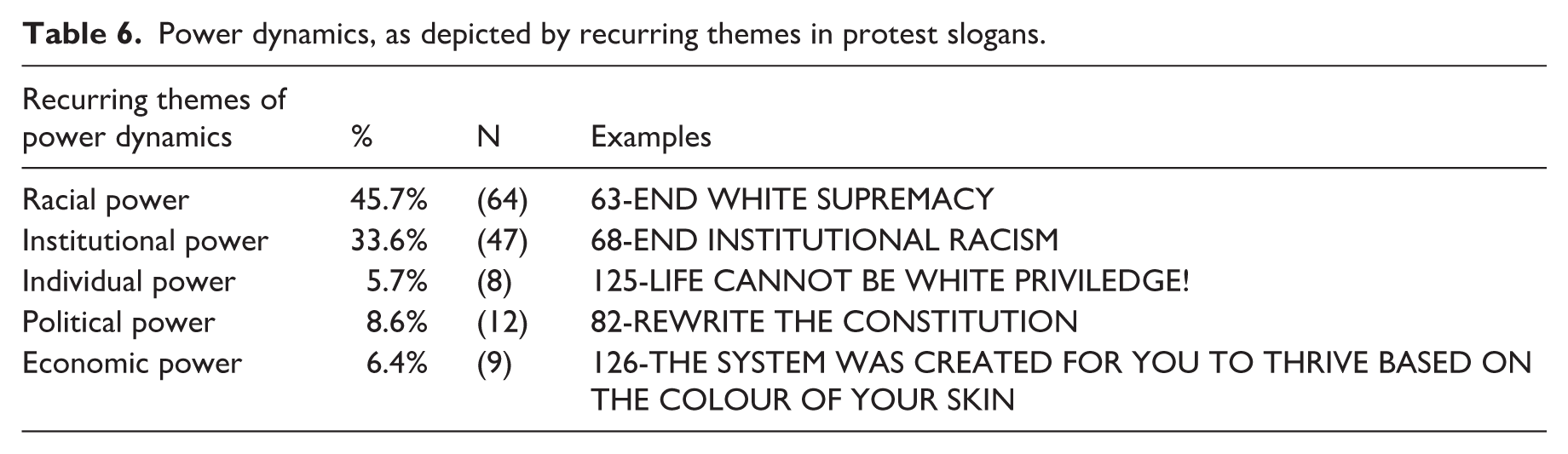
Analysis of the data showed a significant manifestation of racial influence, accounting for 45.7% of the total number of slogans evaluated in the sample (Table 6). This observation highlights the significant influence of a White-centred worldview on the lived experiences of individuals within the Black community. This finding is consistent with the viewpoint put forth by Molina et al. (2019), wherein they contend that a distinct racial hierarchy is present within the United States. Different social groupings are conceptualised, situated and positioned in reference to the prevailing racial category of whiteness, as well as in relation to each other. According to the slogan ‘END WHITE SUPREMACY’ (see Example 63, Table 6), there is a persistent demand to eradicate White supremacy, which encompasses both an ideology and a series of practices that support the political, economic and cultural hegemony of White people over those categorised as non-White (Belew & Gutiérrez, 2021). This demand is particularly significant as it serves as a primary catalyst for awakening awareness among Black people.
Institutional power emerged as a prominent recurring theme in the data analysis, accounting for 33.6% of the total. The influence of institutional power on the lives of Black people has been significant, rendering it comparable in magnitude to racial power. Institutions significantly affect the social, economic and educational outcomes. Despite being perceived as race-neutral, it is important to acknowledge that racialised concepts and instances of racism are deeply ingrained throughout these institutions (Ray, 2019). The assertions made by Ray (2019) align with the perspectives of Potapchuk (2013), who argues that individuals of White racial backgrounds enjoy institutional privileges, such as a decreased likelihood of being subjected to arrest and increased access to a wide range of life chances. The slogan ‘END INSTITUTIONAL RACISM’ (see Example 68, Table 6) exemplifies the influence of institutions in perpetuating racial advantages for White people at the expense of Black people (Hartigan, 2013; Whitehead, 2017). The use of a commanding imperative language in this instance demonstrates the significant influence of racist establishments on the standard of living experienced by Black people in the United States.
The examination of the selected data provides more evidence that the theme of political power has emerged, albeit infrequently, constituting only 8.6% of the overall instances of slogans. Despite the significant advancements in civil rights achieved by the Black community, there remains a prevailing sentiment among them that their political rights are constrained, leading to a continued perception of inequality compared with their White counterparts. According to Bobo (1988), the responses of those identifying as White-to-Black political activities are characterised by racial bias and engagement in political conflict. The examination of the slogan ‘REWRITE THE CONSTITUTION’ (see Example 82, Table 6) demonstrates the adverse circumstances experienced by Black people because of inequity in the United States. We contend that White people’s confidence in their ability to increase their dominance by excluding other groups from the political process is justified. The current study reveals that the use of demanding language, as shown in Examples 63 ‘END WHITE SUPREMACY’ and 68 ‘END INSTITUTIONAL RACISM’ can reflect a negative depiction of the outgroup ‘the other’ while simultaneously offering a positive portrayal of the ingroup – Black people (see Table 6). These two slogans stress the need to abolish White supremacy and institutional racism. This represents Black people’s vulnerability as well as White domination. In this sense, White people are discursively constructed as negative, but vulnerable Black people are presented positively.
The data analysis revealed that the topics pertaining to power dynamics that exhibited the lowest occurrence were economic power, accounting for 6.4% of the total, and individual power, accounting for 5.7% (see Table 6). The relatively low rate of recurrence observed for these themes may be attributed to the fact that the primary determinant of White people’s economic and personal privileges lies in their racial power and the institutions that perpetuate racial hierarchies. The themes of institutional power and racial dominance were common in the sample. The analysis of the slogan presented in Table 6, which states ‘THE SYSTEM WAS CREATED FOR YOU TO THRIVE BASED ON THE COLOR OF YOUR SKIN’ (see Example 126 in Table 6), highlights the inherent conflicts of interest between individuals of White and Black racial backgrounds. As elucidated in the slogan, individuals in the United States, who are categorised as White based on their skin tone, experience systematic privileges. This finding is consistent with van Dijk’s (2004) discursive ideology of resource descriptions, which highlights that conflicts arise because of restricted resource availability. The detrimental impact of White privilege on Black people is also highlighted by the slogan ‘LIFE CANNOT BE WHITE PRIVILEDGE!’ (Example 125 in Table 6). Using this slogan, we argue that White people’s high standards of living represent yet another facet of the negative outgroup that results from the inequitable distribution of resources, which disproportionately benefits White people.
Conclusion
There is a growing scholarly interest in examining the concepts of whiteness and blackness. Prior scholarly investigations have indicated a dearth of research pertaining to the examination of these two concepts in the discourse on protestors in Minneapolis and in the wider United States after the murder of Floyd. This study conducted a comprehensive examination of the discourse present in demonstrators’ slogans. The analysis identified a range of discursive strategies used in the linguistic expressions of these slogans. The strategies include polarisation, concretisation, norm and value violation, victimisation, negative lexicalisation, generalisation, compassion move, self-identity descriptions, negative comparison, resource description and hyperbole. This further elucidates the importance of these strategies in shaping the conceptualisation of privileged whiteness and vulnerable blackness. The strategies contribute to highlighting issues pertaining to civil rights, marginalisation, economic inequalities, White supremacy and anti-Black racism. The use of these strategies also aids Black people in developing a positive self-image while revealing how a predominantly White society exploits blackness to sustain feelings of inferiority. In addition, this study provides illustrations of how these strategies impact the power dynamics between individuals of White and Black racial backgrounds. The sociocognitive approach developed by van Dijk was adopted to examine the cognitive concepts utilised in the language of demonstrators’ slogans, thus aiding in the revelation of discursive strategies. This study provides innovative insights into the current corpus of research on linguistic attributes of protest slogans.
Nevertheless, it is important to acknowledge that this study had certain limitations. This study utilised a limited sample size of five websites and a relatively small number of selected slogans, specifically 140. Given the qualitative nature of this study, our primary emphasis was on the careful selection of information-rich instances for thorough examination, rather than prioritising the quantity of data. Another limitation is the deductive use of van Dijk’s cognitive notions in data analysis. Twelve cognitive concepts were examined, perhaps leading to the restriction of discursive strategies that play a role in shaping the notions of vulnerable blackness and privileged whiteness.
Future research can explore the solid political beliefs embedded in protester slogans, thereby contributing to the existing body of research on this topic. The application of van Dijk’s sociocognitive approach in the current study also holds potential for future research endeavours that aim to explore ideological analysis in a similar manner.
Footnotes

Funding
The authors received no financial support for the research, authorship and/or publication of this article.
Declaration of conflicting interests
The authors declared no potential conflicts of interest with respect to the research, authorship and/or publication of this article.