




Abstract
Webcam sex platforms, operating at the margins of the digital economy, face instability on both sides of their multisided markets due to the flexibility of platform labor, infrastructural exclusion, and cultural stigma. This paper examines a non-monopolistic webcam sex industry, in which platforms seek stability and “quality control” by building strategic third-party partnerships with traffic providers on the demand side and labor intermediaries (studios) on the supply side. Drawing on fieldwork at European and US-based industry events spanning 4 years and 43 interviews with platform and studio operators, marketers, and other expert informants, the analysis traces how these partnerships affect platform competition in a saturated, global, multi-platform ecosystem. First, it details industry structure and how adult livestreaming platforms acquire traffic despite tight restrictions, through niche ad networks and affiliate marketing. Second, it turns to the supply side and analyzes platform–studio relationships that outsource performer recruitment and retention, offering the platform workforce stability largely financed from the cut of performer earnings. The paper contributes to platform ecosystem research as well as online sex work scholarship, provides a case study of a unique platform industry and its partnerships, and demonstrates how the competitive platform strategies shape the conditions of an intersectionally precarious labor force.
Keywords
Introduction
On today's platformized web, the once-humorous phrase “the Internet is for porn” has not only retained but gained renewed relevance. Scholars emphasize the abundance of traffic to adult sites (Ahmed et al., 2016; Xavier, 2024), and OnlyFans alone hosted more than 50 million new content pieces in a single month (OnlyFans, 2025). Yet, while mainstream narratives rarely question supply and demand in the adult industry, attracting a steady, monetizable flow of content creators and end-users to specific platforms is far from straightforward. This paper examines one segment of the online adult industry 1 where these challenges are prominent: webcam sex work. Platforms like Chaturbate, Stripchat, and LiveJasmin host live sexual performances monetized through tips (freemium) or per-minute payments (premium) and presented on an algorithmically ranked homepage. Because participation is synchronous, camming platforms depend on a continuous flow of what industry actors call “quality” traffic and content—in essence, paying end-users and monetizable performers. Attracting both sides of this multisided market (Evans and Schmalensee, 2016; Rochet and Tirole, 2006) is a complex task, embedded in the broader platform ecosystem.
Adult content platforms operate under strict regulatory frameworks, including the US federal FOSTA-SESTA package and the UK Online Safety Act, and remain excluded from the mainstream Internet due to the persistent stigmatization and marginalization of sex (Paasonen and Sundén, 2024; Tiidenberg and van der Nagel, 2020) and, especially, sex work (Are and Paasonen, 2021). As a result, their marketing is confined to 18+ online spaces (Zhyliaev, 2023), cutting them off from major online advertising platforms operated by Google and Meta (Google, 2021; Meta, n.d.b), which place ads on Instagram, Facebook, Google, and YouTube. While performers often promote their shows on social media (Bleakley, 2014), traffic provision by the platform remains essential in webcamming. This distinguishes camming platforms from other adult industry segments, such as fansites 2 like OnlyFans, which do not afford discoverability and rely on creators to generate their own traffic (Hamilton et al., 2023). The limited access to advertising makes traffic acquisition—the strategies of attracting users to the site—both difficult and vital.
Similarly, webcam sex work is characterized by high performer turnover (Jokubauskaitė et al., 2023). Unlike many digital platform markets dominated by near-monopolies (Poell et al., 2021; Srnicek, 2016; van Dijck et al., 2018), webcamming is a competitive, global, multi-platform industry. Its low barriers of entry and promises of easy and lucrative earnings, sometimes marketed to be as high as 1000 US dollars a day (Business Insider US, 2020), draw a vast, heterogeneous workforce of hundreds of thousands of streamers (Bellu, 2023; Jokubauskaitė et al., 2023). However, with low switching costs, many performers soon quit or change platforms when they find such promises unfulfilled (Nayar, 2021). Others stream sporadically or as a side gig, especially in high-income countries (Stegeman and Hardy, 2025), all making the platform workforce unstable and unpredictable.
Since adult livestreaming platforms primarily profit by taking a cut from performers’ token earnings, maintaining a steady, monetizable flow of creators and end-users is essential. This paper argues that in this competitive, highly restricted, non-monopolistic market, third-party partners are key to attracting both sides. Following van Dijck et al.'s call to “reframe platform power” by regarding “single platform companies as part of an integrated platform ecosystem, acknowledging its interrelational, dynamic structure” (2019: 4), I expand the analytical focus beyond “dry” traffic metrics and performer counts to these partnerships. To attract and retain “quality” supply and demand, webcam platforms partner with two key groups: traffic providers—adult-friendly advertising networks and affiliates that help draw (paying) users despite advertising restrictions—and labor intermediaries, particularly physical studios, which help ensure a more consistent stream of (monetizable) content. This study examines the role of both these groups in sustaining platform operations.
While scholarship on webcamming has grown in recent years, few studies address platform partnerships across both traffic and labor fronts. Research on studio work (e.g. Jones, 2020; Mathews, 2017; Vlase and Preoteasa, 2022) and webcamming generally (e.g. Jones, 2016; Rand and Stegeman, 2023) often focus on performer experiences, labor conditions, and precarity. When webcam platforms are the primary study object, the focus tends to be their affordances (e.g. Hernández, 2019; Stegeman et al., 2023) or algorithmic ranking systems (Caminhas, 2022; Jokubauskaitė et al., 2023; Jones, 2015; van Doorn and Velthuis, 2018). Jones (2020) offers a broader overview, identifying studios, regulators, and banks as industry players, but does not examine their interrelationships in detail. The existing webcamming research and the limited scholarly attention to platform partnerships more broadly warrant further investigation into traffic providers and studios to better understand the structural labor conditions shaping adult streaming.
Other platformized industries face similar challenges in attracting a stable flow of users and workers, but their dynamics do not map neatly onto webcamming. Ride-hailing and delivery platforms, for instance, manage worker supply and service “quality” via control mechanisms (Veen et al., 2020), including partnerships with labor intermediaries (Li, 2022). However, their one-on-one, digitally mediated, geographically organized offline interactions are different from online sex work, especially its freemium one-to-many model. Similarly to webcam performers struggling to get their viewers to tip, free-to-play video games also encounter low conversion rates, with very few users making in-game purchases (Fernández del Río et al., 2021; Nieborg, 2015). Yet, both ride-hailing and gaming lack the stigma and restrictions of sex work. Online gambling does face similar advertising limits (Hörnle et al., 2019), but neither gambling nor video games rely on precarious platform labor in the same way. Among platformized cultural industries, adult livestreaming stands out as a stigmatized, competitive, non-monopolized sector where multiple large players vie for both performers and users.
Drawing on fieldwork at industry events in Europe and the USA spanning 4 years and 43 interviews with expert informants, this paper examines how globally operating webcam platforms navigate inter-platform competition via partnerships with labor intermediaries and traffic providers. It explores how platforms secure traffic despite exclusion from major ad networks and how they outsource the recruitment and management of a significant share of performers to studios. The paper proceeds as follows. First, I develop the conceptual framework in dialogue with relevant literature and then outline the methods of data collection and analysis, followed by three findings sections. The analysis begins by providing the context of the webcam sex platform ecosystem. I then zoom in on the relationships with traffic partners and studios, highlighting their roles in competition. I conclude with broader reflections, including how these partnership models affect performer populations.
Attracting the market “sides” in the webcam platform ecosystem
Long excluded from the scope of platform studies, recently online sex work has become increasingly incorporated into the discourse on platform labor and creator economy (e.g. Rand, 2019; Ruberg and Brewer, 2022; Vlase and Preoteasa, 2022). Following this line of thought, this paper turns to the platform ecosystem—“the dominant technological, organisational, and governance model or configuration for today's online digital platforms” (van der Vlist, 2022: 23)—to analyze webcam platform partnerships in efforts to stabilize supply and demand.
Adult platforms, including camsites, function as lean platforms (Srnicek, 2016), intermediating between the different “sides” of the multisided market (Rochet and Tirole, 2006) and generating revenue from the brokered relationships. While many digital platforms balance the needs of users and numerous complementors: “cultural producers, cultural intermediaries, and advertisers” (Poell et al., 2021: 11), webcamming platforms typically forgo advertising rent (Srnicek, 2021). That is, unlike platforms that “use content to attract viewers and then sell advertisers access to those viewers” (Evans, 2008: 363), camming platforms instead primarily operate as “transaction” platforms that do not allow development or distribution of third-party add-ons, like apps (Poell et al., 2021: 35). Their infrastructure rent (Srnicek, 2021) thus derives from enabling live interaction between content creators and viewers, suggesting a largely two-sided market structure based on getting livestreamers and viewers “on board” (Rochet and Tirole, 2006).
On these platforms, users pay to engage with performers one-on-one or tip to influence what happens in a public show. Premium platforms, like LiveJasmin or Streamate, restrict the free-chat zone, requiring the clients to “pay for private shows to see sexually explicit content” (Jones, 2020: 69). Freemium platforms such as Chaturbate, Stripchat, or BongaCams instead monetize through tipping. That is, viewers contribute toward “goals” listed in the performer's tipping menu, like undressing or activating a teledildonic device 3 (Weiss, 2018), echoing monetization strategies used on Twitch (Johnson and Woodcock, 2019; Partin, 2020). Performers pay a commission in exchange for access to the platform's traffic as well as, somewhat controversially, its “matchmaking” affordances. That is, to be visible via (niche) tags (Jokubauskaitė and Peeters, 2025), (hyper)categories (Stegeman et al., 2023), and algorithmic homepage ranking (Jokubauskaitė et al., 2023; van Doorn and Velthuis, 2018), despite their “heteronormative, white-centric, patriarchal structures” (Stegeman et al., 2023: 12) and racial, body-composition, and age bias (Caminhas, 2022; Jones, 2015).
Since “the more end-users join a market, the more plentiful and valuable the transactions become for other sides in the market” (Helmond et al., 2019: 128), many platform industries tend toward “winner-take-all” outcomes through network effects. However, unlike video game streaming, where Twitch has “locked out” its competitors, no single platform monopolizes the adult livestreaming market. Estimates vary, with researchers identifying five (Jokubauskaitė et al., 2023) to thirteen (Jones, 2020) major webcamming platforms. Barriers to entry and switching costs for both users and performers remain low, even after the introduction of stricter age-verification protocols for streamers worldwide in 2021 (Franco, 2024) and the passage of legislation in many US states requiring platforms to verify user age beginning in 2022 (Age Verification Bills, n.d.). In fact, many performers stream on multiple sites (Jones, 2020), often simultaneously—a practice known as splitcamming (Tristan, 2021).
Although some webcam platforms enjoy stronger brand recognition, most rely heavily on online advertising to drive traffic. However, because of the restrictions on sexual content online, adult platforms are largely excluded from Google and Meta's advertising networks, which “dominate the consumer (‘end-user’) side as well as the publisher (business) side” in the audience economy (van der Vlist and Helmond, 2021: 2–3). Since few ad publishers accept adult products or services, these industries are often pushed to rely on smaller, specialized ad networks to buy traffic. However, despite their relevance in marginalized industries, smaller traffic providers are rarely the focus, with most research studies centering on “advertiser-dependent social media platforms” (Joseph and Bishop, 2024: 1270) and the largest traffic brokers (e.g. Rieder and Sire, 2014; van der Vlist and Helmond, 2021).
Simultaneously, many webcam platforms provide application programming interfaces (APIs) to affiliate marketers. These programmable platform boundary resources (Ghazawneh and Henfridsson, 2013; van der Vlist and Helmond, 2021) allow affiliates to redirect audiences and earn from sales through specially coded links to merchants’ sites (Edelman and Brandi, 2015). When a user follows such a link and spends money, the affiliate earns a commission. Described in 2005 by The Economist as “the holy grail of online advertising” (Edelman and Brandi, 2015: 1), this online marketing practice is still considered among the dominant ones (Mangiò and Di Domenico, 2022). Their role is especially pronounced in “high-risk” industries like adult content and gambling (Houghton et al., 2020; McMullan and Kervin, 2012). Despite their differing relationships with platforms, both affiliates and ad network providers are instrumental in attracting end-users.
At the same time, the adult webcam business model is rooted in platform labor, based on the premise of “freedom, flexibility, and entrepreneurship” (Rosenblat and Stark, 2016: 3761) of the on-demand “independent contractors.” This framing, built on the strategic misclassification of workers, has allowed platforms to offload labor costs associated with formal employment relationships (Srnicek, 2016). However, “[m]anaging a massive amount of flexible labor presents a continual dilemma” of navigating between labor cost savings and the risk of inconsistent productivity (Li, 2022: 2015). Platform companies have developed various forms of control over their workers (Rosenblat and Stark, 2016; van Doorn, 2017). Recently, such efforts have been exemplified by Deliveroo Australia's core workforce of “shift-riders,” who were assigned a number of “guaranteed” clients during their shifts, akin to an hourly rate of pay (Veen et al., 2020). Didi Chuxing, similarly, partnered with fleet management companies (FMCs) to address “labor shortages, high labor turnover, high search costs, fluctuating labor supply, and […] a loss of control over labor performance” (Li, 2022: 2019). Similar labor instabilities have been observed on webcamming platforms (Jokubauskaitė et al., 2023).
Although some webcam performers operate independently, many platforms collaborate with performer studios. These organizations function as “cultural intermediaries” that “facilitate cultural creation” (Poell et al., 2021: 10) by offering performers the necessary infrastructure to stream: physical space, equipment, fast Internet, training, and language support in exchange for a percentage of their earnings (Jones, 2020; Vlase and Preoteasa, 2022). This is especially prevalent in locations where “the initial investment […] to start camming can be harder to make” (Stegeman and Hardy, 2025: 8). While both studios and platforms have been labeled as “sex entrepreneurs” that exploit performers by taking a substantial cut of their pay (Jones, 2020: 61), little is known about their partnerships. Next to platforms’ relationships with traffic providers on the demand side, this paper examines how studios function as labor intermediaries on the supply side, expanding platforms’ managerial control (van Doorn, 2017), for example, by influencing performers’ schedules and show content (Stegeman and Hardy, 2025) in line with platform preferences. Unlike traffic providers, who connect via programmable boundary resources, studios usually engage with platforms through corporate partner programs (Helmond et al., 2019), making their relationships harder to analyze without internal company data.
As this section shows, in an adult platform model built around “at-a-distance, indirect ‘live’ experiences” (Swords et al., 2023: 278), recruiting users and performers to participate at a certain time is a continuous competitive task. This paper examines platform efforts to stabilize the supply and demand in an ecosystem that is highly marginalized, tightly regulated, and inherently unstable. Doing so, it offers three main contributions. First, it addresses the continued academic marginalization of online sex work by situating it within the broader platform labor field. Second, it expands the understanding of the infrastructural labor conditions that webcam performers are subjected to. Third, it examines how limited traffic sources and workforce volatility shape inter-platform competition in a multi-platform ecosystem. The next section outlines the methodological approach.
Methodological approach
Researching an adult platform ecosystem poses methodological challenges due to the private ownership and secrecy of webcam platforms, which, unlike some other digital industries (e.g. van der Vlist and Helmond, 2021), do not openly publish partner directories. Its lack of transparency lends the industry to a fieldwork-based approach. Differently from crucial previous ethnographic work focused on performers’ experiences (e.g. Jones, 2020; van Doorn and Velthuis, 2018; Vlase and Preoteasa, 2022), this study draws on the perspectives of those involved in organizing platform partnerships to offer insight into industry structures and business-to-business dynamics. It uses fieldwork at industry events in the USA and Europe and expert interviews, supplemented by online sources such as blogs, platform pages, and news media.
Webcamming is a secretive field, in no small part due to stigmatization. To address the access barriers, I borrow the methodology of encircling (Bosma et al., 2019) developed in security studies. As an approach, “[e]ncircling entails a lateral, multipronged, creative, iterative approaching of secret sites, confidential materials and classified practices” (Bosma et al., 2019: 14). It offers ways to analyze what is not directly observable, whether due to restricted access or a lack of necessary expertise, by going beyond the rigid binaries of visibility and invisibility, making sense of ambiguous boundaries (Bosma et al., 2019: 14). In this study, the platform ecosystem relationships were approached gradually through multiple iterations, involving numerous informants as well as other data sources and triangulating the findings. Gossip—“conversation about things that in epistemological terms exists in the space between ‘known knowns’ and ‘known unknowns’” (Fan et al., 2021: 1653)—collected in “smoking areas” or anonymously during conversations and interviews, reflects one of the creative strategies used by this study to approach and encircle confidential data.
Encircling also attends to the line between what is shared and what remains a secret—an essential feature of the field itself. Here, a reflexive awareness of both my position as a researcher and that of my informants was crucial. Interviewees were often constrained in what they could disclose to an outsider and what they knew. When encircling, this awareness is embedded in the research narrative, treating the informants as experts but acknowledging their positionality and the incremental uncovering of the object. Gaining trust in the field as an outsider also required continued efforts, often only partially successful. Some interviews, particularly with representatives of large and established platform companies, remained unattainable despite repeated outreach and introductions made by other industry insiders. This reflects broader struggles in studying platform economy environments discussed by other authors (e.g. Bonini and Gandini, 2020; Nieborg et al., 2020).
The long-term iterative approach to data collection spanned over 4 years, allowing for more targeted interviews and richer observations over time. Fieldwork was conducted at industry conferences in Bucharest (Bucharest Summit), Prague (TES Affiliate Conference, YNOT Awards), Limassol (Webmaster Access Affiliate Conference), Las Vegas (Adult Entertainment Expo, interNEXT), Los Angeles (XBIZ), Amsterdam (XBIZ), and online (YNOT Summit) 4 . They served as opportunities to make connections, observations, and conduct some of the interviews, while the remainder were completed outside of the events, online or offline.
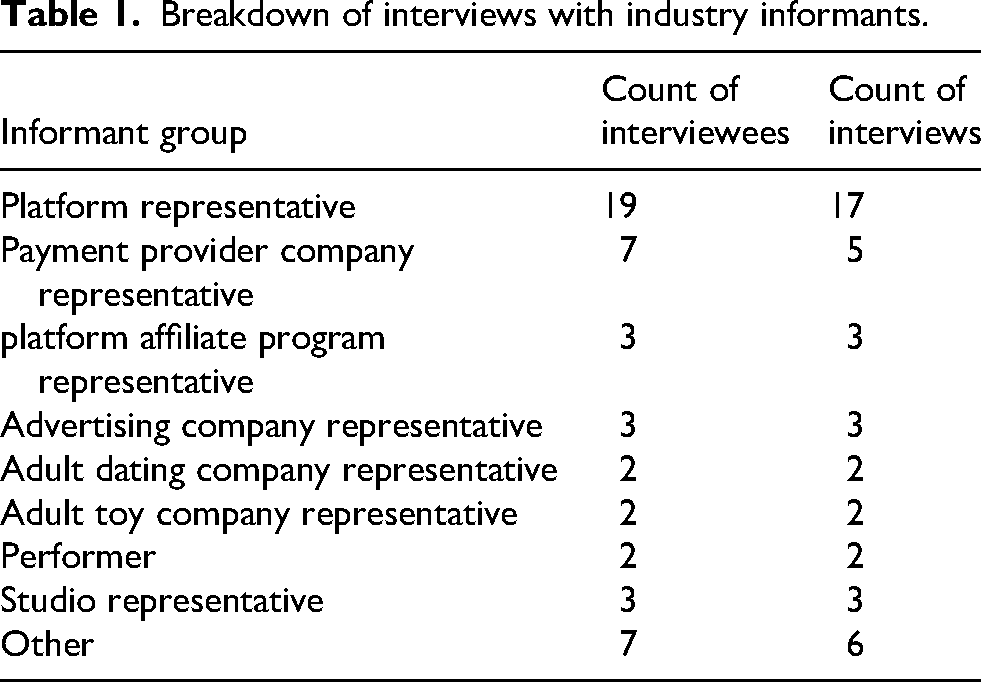
In total, I conducted 43 on-record interviews 5 with 48 key industry informants (see Table 1 for details). Some participants also provided schematic drawings of the industry. Other data included observations at events, such as sponsor and attendant lists or panel topics, as well as informal conversations. Online sources helped identify or confirm relationships between platforms, partners, and competitors, providing insight into the industry's structure.
Breakdown of interviews with industry informants.
All interviewees gave verbal or written consent and chose how they wished to be identified, ranging from complete anonymity to insisting on being named in full. This diversity is adhered to in the text, while their details, recordings, and transcripts are stored on an end-to-end encrypted laptop and external hard drive. Amberscript, a GDPR-compliant transcription software, was used with an additional request not to process or store data. The interviews were coded abductively (Timmermans and Tavory, 2012), using Atlas.ti. Public information from panels, talks, or online was not treated as confidential, but potential risks for vulnerable participants were evaluated on a case-by-case basis. The paper is a component of a larger research project 6 , in part focused on destigmatizing online sex work by positioning it within the broader platform economy.
Industry structure and the role of partners
So the fight is happening on the traffic—on the affiliates, marketing, and traffic companies that are bringing customers, and, of course, on the performers—on recruiting performers and studios to bring on the platform. So, technically, the fight is how to bring more customers and how to bring more performers.
Alex, the CEO of the platform SkyPrivate, explains that competition between webcam platforms centers on attracting both end-users and performers to the multisided market, with traffic providers and studios playing crucial roles. Others have argued that in webcamming's non-monopolistic industry structure, intra-platform competition between performers is nested within inter-platform competition (Velthuis and van Doorn, 2020: 180). For example, algorithmic homepage rankings organize competition between streamers but also influence inter-platform competition, as a better-ranking system may attract and retain more end-users and streamers (Jokubauskaitė et al., 2023). Following van der Vlist and Helmond's argument that “platform power concerns more than market or monopoly power alone” (2021: 13), the analysis will show that, beyond algorithmic ranking and other matchmaking affordances, the highlighted webcam platform partnerships play a crucial role in inter-platform competition.
During fieldwork, numerous interviewees provided schematic maps of the industry's key players, broadly echoing a list that includes “the platforms, the content providers […]—the studios and the models; the payment, […] because we can do nothing without money. And the holy grail of the industry, the traffic” (Interview 6). While some actors align with those previously identified by Jones (2020) as sex entrepreneurs (platforms, studios), moral entrepreneurs (banks, regulators), and cam models, others and their interrelations have yet to be analyzed. Figure 1 offers a schematic representation of this ecosystem, including the key players and primary financial flows.

Money flows and relationships between a webcam platform and its main partners.
The webcam platform is positioned in the middle of the figure. In total, 23 different platforms were mentioned 7 by interviewees, indicating the industry's intense competitive dynamics. Some platforms target a worldwide audience, while others specialize and dominate smaller geographic–linguistic markets (e.g. German, French, Dutch, or Spanish platforms). With the mainstream payment intermediaries “reluctant to allow sex-oriented platforms to use their services” (Swords et al., 2023: 291), the majority of financial transactions rely on two types of “high-risk” financial third parties, which exert high fees and significant control over permitted content (Franco, 2024). Payment processors (e.g. CCBill, Segpay, Epoch) largely handle transactions from end-users to platforms, while payout providers (e.g. Paxum) distribute earnings to performers and partners such as traffic companies and studios, although their services sometimes overlap. At the top of the figure are end-users, typically brought in by traffic partners; at the bottom are performers, with a focus of this paper on those managed through studios. The two following sections zoom in on the structural partnerships that facilitate bringing in traffic and monetizable content—both critical to platform operation and revenue generation.
Getting traffic
[…] in a lot of industries, when you are going to do marketing, you begin from the point of view of where can I advertise? And then boom, you just go and advertise there. Um, in our industry, you cannot begin from that point of view because you are restricted in so many ways of advertising. So you just begin with, okay, where am I not restricted? And then those are the platforms that you take.
Advertising for adult platforms is heavily restricted, as George from Cherry.TV explains. Excluded from much of the mainstream web, the adult industry is siloed off, forced to compete for the limited traffic available within the 18+ segment of the Internet. Notably, most webcam platforms are not ad “publishers,” that is, they do not sell their traffic by advertising other sites or services. As Mike de Jong from Islive explains, “[W]e don’t want to send our people away.” Lacking the strong brand recognition of giant tube sites like Pornhub, multiple webcam sex platforms still rank among the highest-traffic sites online (Top Websites Ranking, 2025), underscoring their significant visitor base. What are the sources of their traffic, given the restricted advertising landscape?
Some answers emerged during industry events focused adult advertising and traffic, such as The European Summit (TES) Affiliate. These gatherings connect diverse players in the adult platform ecosystem: advertising networks, affiliates, “adult dating” 8 platforms, webcam platforms, and others. Echoing many industry insiders’ claims, Moritz from TrafficPartner outlined that, besides organic brand traffic, the traffic to the webcams they operate comes primarily from affiliates (40%) and media buying (30%). The remainder of this section explores these two partnership-based channels. The most common examples are provided in Figure 2.

Common traffic partners of webcam platforms.

A screenshot of a video ad for LiveJasmin on one of the large tube sites (XNXX.com).
Importantly, interviewees stressed that traffic volume is not enough—what matters even more is “quality” traffic. Visitors must register, purchase tokens, and spend them, with success measured by conversion rate. Some platforms, for example, rely on a small but high-spending loyal clientele, referred to as “whales.” Chris Youngs, founder of Paxum, illustrated this: “Streamate may only get one client and that's going to spend $10,000, but the next sites only get 100 clients that each spend 100.”
Niche ad networks
“It works exactly the same as, like it would be on Google or on Facebook or on Snapchat” (Interview 31): one adult industry representative explained adult ad networks. Otherwise known as “media buying,” this involves purchasing space on “publisher” sites—like “tube” or “adult dating” platforms—to place banners, footers, or notifications, and other media (example in Figure 3). Ad networks act as a “technological connection” (Interview 31) between advertisers (webcam platform) buying traffic and publishers selling ad space (Figure 2). Via a key boundary resource—the “ads manager”— advertisers set their target audience, format (small or large banners, links, etc.), country (“tier 1” being more expensive), budget, and daily cap: “the number of times that I want to hit a user with my ad” (Interview 31). However, excluded from mainstream advertising platforms, the industry turns to niche, adult-friendly networks.
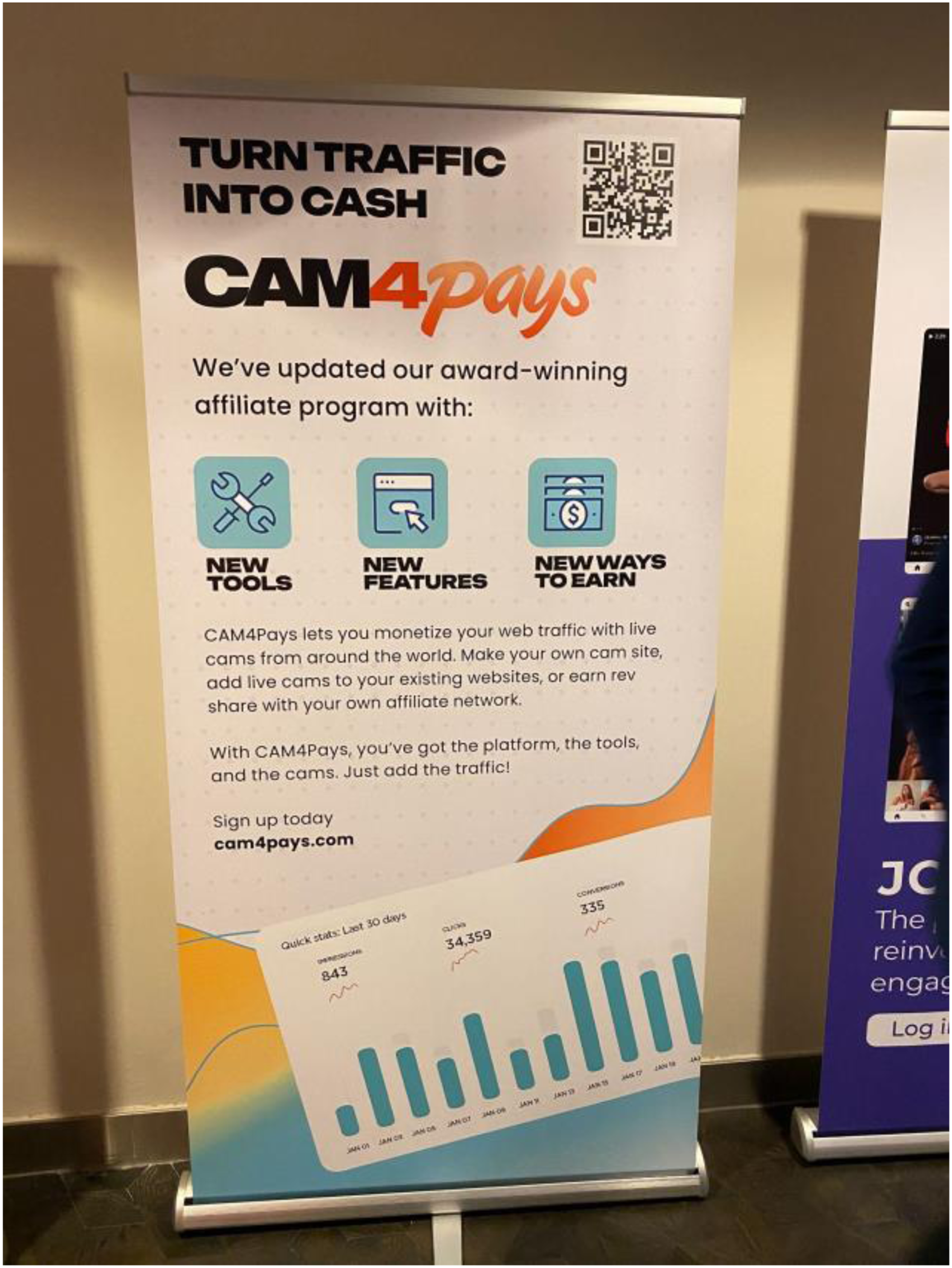
An example of an affiliate program banner presented at an industry event.
These niche networks vary in scope and specialization. Some are company-specific—TrafficJunky, for example, sells ad space exclusively on Aylo's (formerly MindGeek) platforms like Pornhub and Redtube. Others specialize in subsectors like “adult dating” and offer tailored strategies. Finally, a few span both adult and mainstream publishers and brands, although most specialize in high-risk industries, including camming, “adult dating,” and gambling.
While ad placement via adult-friendly networks resembles that on the mainstream Internet, the networks and traffic sources involved are distinct. Webcamming thus highlights how marginalized online advertising operates in a competitive environment under strict constraints without access to Google and Meta's traffic. The difference is most notable in their scale. In contrast to the millions of advertisers reportedly using Google Ads (Google, 2023) and Meta Ads (Meta, n.d.a), smaller adult-friendly ad networks like JuicyAds with “more than 80,000 advertisers” and “tens of thousands” (Interview 30) of publishers appear minuscule. Even the largest adult-friendly networks like ExoClick, Adsterra, and Clickadu remain small in comparison. Cut off from the traffic sources of the mainstream web, the adult industry depends on limited sources in a tightly competitive environment.
Adult affiliates
‘Are you an affiliate?’ I am asked repeatedly during fieldwork in Prague, at the dedicated ‘high-risk’ industries traffic event. My interviews are frequently interrupted by spontaneous offers and audience statistics being discussed in business-native abbreviations.
Rachel Stuart describes affiliates as “a door that opens into a model's chatroom” (2022: 174). Most webcam platforms run in-house affiliate programs (see example in Figure 4) and actively seek such partners. Affiliates promote webcam sites across various online spaces, redirecting their (niche) audiences via affiliate links. While models vary, the most common is revenue share: affiliates earn a percentage of what referred users spend. This incentivizes the affiliates to attract “quality” traffic that is “[…] converting, and people are actually people, not bots” (Interview 27). Many programs offer a lifetime share of revenue, typically 20–25%, meaning that affiliates continue earning as long as their referrals remain active spenders.
Alongside common affiliate sites like blogs or “Top 10 Best Webcam Sites” review pages, a key affiliate group is the platform performers themselves. They increase their earnings by redirecting their highly targeted fan traffic. As Streamate performer Ms. Caitlyn Brooks explains: So as a cam model, you get paid a percentage from a client that they send you, and I make 35%. Now, however, if I bring that client in myself, meaning they haven’t spent all this money to bring that client there, I did it on my own. So they’re saving a shit ton of money, and it's a new source of traffic. I make an additional 40%.
Webcam performers are known to diversify their earnings by sharing content across multiple platforms. For example, they are known to share reminders of their shows on social media (Bleakley, 2014), which is largely discussed as an individual strategy, attracting a likely higher-spending fan audience. However, besides better spending, most of these links also return higher payouts.
Since affiliate traffic is vital but faces wide-reaching restrictions, webcam platforms implement technical workarounds to obscure adult links. For example, Stripchat's performer landing pages can link to non-explicit preview pages (Interview 18). Nevertheless, such platform efforts do not alter the core dynamic: affiliate programs outsource the burden of navigating restrictions and competing for high-conversion-rate traffic to partners, many of whom are precarious platform workers themselves.
Another major affiliate marketing strategy in webcamming is creating whitelabels, otherwise known as clone sites (Jones, 2020). These are customized versions of a platform's main page, operated by partners of varying scale. As Mike de Jong from Islive explains, “we call the platform basically the streaming engine, which is […] the backend. And then that is used by also our partners, […] they just pull a different cover on it, which in our world we call a whitelabel.” The same performer base appears on each one of them, but often filtered or reorganized to appeal to different (niche) audiences. For instance, several interviewees suggested catering to users interested in blondes—using my then-blonde hair as an example. A partner may launch a whitelabel called blondecamgirls.com 9 , filtering to show only light-haired performers.
Whitelabel numbers per platform vary widely—from hundreds (e.g. Islive.nl, Interview 5) to tens of thousands (e.g. LiveJasmin, Interview 11). Not all platforms adopt this traffic acquisition approach due to the technical commitment it requires, but for some, it is essential. As George (Cherry.TV) explains: Streamate is the biggest one with this entire implementation. It is actually their only business model because if you go to the website streamate.com, […] nobody has ever really seen this exact website. Um, people know Streamate from Pornhub Live and um, other much, much, much bigger partners.
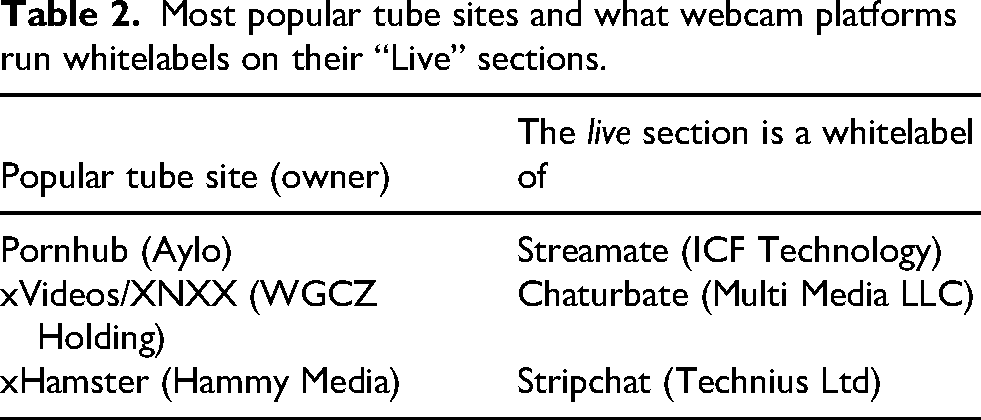
Streamate partners with Aylo 10 (Pornhub's parent company), likely gaining a massive traffic boost: anyone clicking Pornhub's “Live” tab is redirected to LiveHDCams, a Streamate whitelabel.
Stripchat exemplifies the massive rewards large-scale whitelabel partnerships can bring. It quickly rose to prominence during my fieldwork and is now the only webcam platform classified as “very large” under the EU's Digital Services Act (DSA). This rapid growth is linked to ownership ties between its parent company, Technius Ltd, and xHamster Holding, which operates the popular tube site xHamster. xHamsterLive, a Stripchat whitelabel, likely drives major traffic, described by Andra Chirnogeanu, Stripchat's Head of Business Communication, as “our own.” Although details remain opaque, multiple interviewees credited this relationship 11 as the key to Stripchat's success.
Strategic partnerships with established adult sites (Table 2) often drive substantial traffic to webcam platforms. Infrastructurally, whitelabel sites serve as a platform's “expansion into the rest of the web” (Helmond, 2015: 8), designed to attract users. The scope and direction of these expansions directly shape a platform's competitive positioning, as Stripchat's rapid rise over the past 6 years illustrates. However, this form of platform power remains largely invisible in site-level traffic metrics commonly used to assess market dominance in the absence of revenue data.
Most popular tube sites and what webcam platforms run whitelabels on their “Live” sections.
Traffic acquisition, both via advertising networks and affiliates, typically accounts for 20–35% of webcam platforms’ spending, second only to performer payouts. As Alex (SkyPrivate) noted, “the largest competition is how to attract customers,” but “all the good sources of traffic are already sold,” referencing the strategic positions that webcam platforms have assumed within the industry to attract and stabilize “quality” traffic.
In sum, this analysis shows that platforms gain a competitive edge on the demand side through several key strategies. First, they secure exclusivity deals and, for example, host whitelabel sites on large tube sites. Second, they build strong affiliate programs that attract numerous platform marketers, including performers who bring in targeted traffic. Third, they cultivate localized brand recognition, ensuring large language or region-specific audiences that allow them to compete against major platforms in particular markets. What remains are smaller, often niche, traffic sources that numerous webcam platforms vie for. To compete for traffic, the analysis has shown, platforms outsource the (emotional) labor of managing stigma and navigating restrictions to affiliates, often the same livestreamers. In a saturated market, success depends not only on financial investment (often scarce in the adult industry) but also on strategic affiliations with major adult industry actors, as the case of Stripchat illustrates.
Recruiting and managing streamers
Behind every single platform, there are like a bunch of studios … This [the platform] is just technical support, right? It's nothing. Technical support and a payment service.
Beyond efforts to attract and stabilize “quality” traffic, webcam platforms compete for monetizable live content. As Moritz (TrafficPartner) notes above, studio intermediaries play a central role in this process. Unlike many platform labor models, which normally “represent the income generating opportunities as aspatial and atemporal” (Stegeman and Hardy, 2025: 2), a significant share of webcam performers—up to 50% on some platforms—stream on regular schedules from physical studios 12 equipped with the needed amenities, providing training, and other services.
As former studio performer Ms. Caitlyn Brooks explained, “studios are inherently very important for keeping the adult industry alive in certain regions of the world.” In Romania alone, a major camming hub, around 150 officially registered studios operate, ranging from small setups with up to four rooms to facilities with as many as 20 (Interview 4). While performer dependency on studios, especially in certain areas (Kilbride, 2024; Stegeman and Hardy, 2025), is documented, this section focuses on the platform–studio partnership and its involvement in inter-platform competition.
LiveJasmin's CEO, Zsolt Theiss-Balazs, described the platform–studio relationship as mutually beneficial: […] we are having the same goal: we want to be successful from a business point of view. And we are happy if they are earning more, and they are happy if we are earning more because it's our common interest […].
Described as separate businesses, they are aligned in profit-making by taking a cut from performers’ earnings. While higher performer earnings indeed benefit both, this section shows that their partnership is far more intertwined. Figure 5 illustrates the main aspects of the platform–studio–performer relationship.

Platform–studio–performer relationships, including approximate payout rates. Note. Payout rates based on the knowledge from fieldwork and previous academic publications (e.g. Vlase and Preoteasa, 2022).
Recruitment and retention
Partnering with studios offers webcam platforms a major advantage: a steady influx of new performers. Platform representatives I talked to often expressed that they invest little effort in performer recruitment: while they do advertise on performer-only forums like WeCamgirls, studios often bear the brunt of recruitment. As Zsolt Theiss-Balazs from LiveJasmin explained: Studios are doing advertisement. They are hiring models into their studios and advertising their services. So, kind of, they’re advertising us through this.
Independent performers, in line with typical platform labor, work on their own terms. This often renders content supply unpredictable, especially notable in regions like the USA, where camming serves as a side gig rather than a primary income source. Due to platform labor flexibility, performer turnover remains high even if they regularly align their shows to peak traffic hours and communicate schedules to fans. A BongaCams representative described the instability: We are getting 500–600 new models signing up, but only about 20% of them are getting online. And also, you have to understand when a model gets online, it doesn't mean that it won't be her last session.
Studios help mitigate this platform churn (van Doorn, 2017: 904), as a CAM4 representative explained: They are better organized. […] independents, they hop along a lot. […] Studios are more dedicated to really make it work with you. They try to keep at least their performers online a few weeks to make some earnings because … Yeah, not any performer will earn a lot of money in the first day.
According to platform representatives, new performers often expect high earnings fast and quit when those expectations are not met. Studios, by contrast, “motivate” performers to persist by approaches ranging from soft encouragement to contractual enforcement.
Most studio performers—often at the platform's request—follow strict schedules, typically morning and evening shifts aligned with peak traffic. They are also required to meet a fixed number of hours per “period” (i.e. 2 weeks), often without flexibility, even for illness (Interview 10). This usually means at least eight streaming hours daily, amounting to 40 hours online a week, as expected by LiveJasmin (Interview 11). This excludes additional training and preparation time surrounding each shift. The emphasis on “hours, hours, hours” (Stegeman and Hardy, 2025: 9) ensures a reliable supply of live content by a core workforce similar to what Deliveroo has implemented (Veen et al., 2020).
Managerial control
Besides recruiting and retaining performers, studios also enforce platform-specific standards for show content. The level of control varies by platform, but LiveJasmin exemplifies one of the most demanding, with its strict requirements for the “quality” of outfits, room setup, posing, camera quality, and angle, in addition to constraints on behavior and nudity in the “free chat” area (Categories and Rules – Wiki, n.d.). Significant effort, knowledge, and financial investment are necessary to comply with these rules and avoid platform penalties. Studios typically provide such resources, but they also enforce platform standards through their “trainers,” who monitor shows and instruct performers.
Platform requirements and their strictness depend on several factors and are tied to business models. Premium platforms tend to rely more heavily on studio performers and impose tighter controls. As Jay Kopita (Co-Owner and President, YNOT Group) illustrates: Chaturbate is freemium. Uh, Jasmin is premium. Uh, Jasmin is mostly studio models. […] Chaturbate does utilize a lot of studios as well. But they also have a ton of independent models who, you know, they can go into their office or their bedroom and they can just start streaming.
Due to its tightly intertwined platform–studio business model, some even claimed that LiveJasmin “basically invented the studio system in Romania” (Interview 12, Tristan). In contrast, freemium platforms like Chaturbate and Stripchat host more independent streamers, although it depends on the geographical region 13 .
This contrast was also attributed to the different skill sets required. Andra Chirnogeanu noted that freemium shows have “everything to do with personality,” making training harder, whereas premium shows follow clearer engagement strategies and are easier to systematize (Interview 40). As Evelina Cirlan (Models4Models) adds, focusing on one type of show as a studio simplifies training performers “to perform the show correctly.”
Meeting the platform expectations of a “correct” show refers not only to the performer's skills but also other requirements, from room design to make-up and wardrobe aesthetic, making studios “platform ready” (Helmond, 2015: 1). These aesthetic requirements often vary significantly, for example, between the “glamour” looks of LiveJasmin and the “girl-next-door” aesthetic on US-centric freemium platforms. Such differences also push studios to specialize and even collaborate exclusively with one platform.
Exclusivity and dependency
That's why, as a studio, you are a partner of the platform. You provide models for them and you are being paid a commission for doing that. (Interview 4)
The platform–studio relationship is reciprocal: platforms outsource recruitment and gain indirect managerial control over the performers, while studios receive compensation through increased performer payouts, dedicated traffic, and enhanced visibility. Even webcam consultancies seem to benefit financially, as explained by Bogdan Dumitrescu, CEO of AMP Holding: “Because I give birth to new studios and I implement all the rules. That's why they don’t need to offer so much support to the final client because they have me.”
Financial compensation is especially common in exclusivity deals, where a studio's models stream on a single platform. CAM4, for instance, offered exclusive studio performers a 10% higher payout (Interview 16), which directly increased studio income given their commission-based business model. Beyond direct financial gains, (exclusive) studios receive additional perks: enhanced support via personal account managers, access to platform-specific trainings and data, individualized performer advice, as well as traffic deals, as Maria Boroghina, the COO at Best Studios, explains: That is a thing that here in Romania they are using as a marketing strategy. That we have dedicated traffic. When you start as a model, you can start from home, from studio A, studio B, studio C. The site will know something about you. As an independent model, they don’t know anything about you, but from different sites, they will know something specific and they will send different kind of traffic.
Platforms also attract new studio partnerships by increasing their performer visibility, for instance, by ranking their performers higher in search results (Interview 24, BongaCams). These backend arrangements, largely overlooked in research on algorithmic ranking (e.g. Jokubauskaitė et al., 2023; van Doorn and Velthuis, 2018), offer studio models a competitive advantage, both over independent models on the same platform and over studio performers with less favorable deals.
However, exclusive dependency on one platform can make studios vulnerable to sudden changes, often harming performers. For example, in September 2020, LiveJasmin introduced a new, tighter payout structure, which severely reduced performer earnings and, in turn, brought financial losses to Studio 20—its exclusive studio and one of the largest studio corporations. The leadership pressured their managers to “push their models even more to basically keep the same sales” (Interview 10), with detrimental effects on performers.
As the final part of the analysis has shown, platforms often build close-knit partnerships with studios, especially in regions where streamers require access to infrastructure and support to perform this platform labor. Strategically, these partnerships allow platforms to pursue stable, “quality” content without assuming employer responsibilities and reducing the resources to directly train and communicate with performers. The degree of partnership varies by platform and reflects their competitive strategies. Some platforms, especially those with stronger brand recognition—often freemium—may host large volumes of content from independent streamers. Others rely on some level of a core workforce recruited and managed by studios. Finally, certain platforms form deeply integrated, exclusive arrangements, whereby partner studios recruit and manage performers solely for them. While some monetary compensations by platforms occur, most of the financial burden is carried by performers, who pay studios a share of their earnings.
Conclusion
This article has analyzed webcam platforms’ efforts for stability and “quality” of supply and demand via third-party partnerships and how these arrangements affect their competitive positioning. In this marginalized, non-monopolistic, synchronous-content industry, platforms rely on smaller, adult-friendly ad networks rather than large mainstream ones, which exclude sex work. To navigate restrictive advertising policies, they diversify traffic sources by commissioning affiliates, many of whom operate whitelabels or are performers themselves. On the supply side, performer recruitment, retention, and management are outsourced to studios, building arrangements that resemble employment. Maintaining the volatility low and the “quality” of both market sides high are key for remaining competitive in the saturated multi-platform ecosystem—goals only achievable through these strategic partnerships.
Recognizing the webcam industry's combination of unique structure, restrictions, and content type, I show how webcam platform power is rooted not only in market share but also in broader ecosystems of infrastructural and strategic relationships, extending previous arguments made in platform studies (van der Vlist, 2022; van der Vlist and Helmond, 2021; van Dijck et al., 2019). Webcam platforms expand into the rest of the web (van der Vlist and Helmond, 2021) through adult-friendly ad networks and numerous whitelabels, some embedded in prominent adult sites that drive substantial traffic. They draw on (niche) affiliate audiences, outsourcing the challenges of navigating the tight restrictions of the mainstream Internet. Finally, to mitigate high workforce turnover, they partner with “platform-ready” (Helmond, 2015: 1) studios that deliver a steady flow of live content tailored to numerous platform requirements. Some, like LiveJasmin, run their business in parallel to expansive and integrated studio networks. In webcamming's non-monopoly universe, platforms carve out their zones of influence by combining multiple stabilization strategies.
The platform benefits of these partnerships come largely at the performers’ expense. Many are forced to wear multiple hats, as performers, affiliates, and personal brand managers, just to retain more than half of their earnings. Promoting their work across platforms, including the mainstream ones, has high labor costs (Swords et al., 2023) and is not viable for all, due to the risks associated with an increased digital footprint, which may expose them to outsized chances of being outed or doxxed (Campbell et al., 2019; Stegeman et al., 2024). Moreover, performers often have little control over where their (recorded) content appears across third-party affiliates and ad networks, yet opting out comes at a substantial loss of traffic (Stuart, 2022). Studio performers, meanwhile, forfeit the lauded flexibility of online sex work, often contractually bound to physical workplaces that own their platform accounts, making leaving difficult (Kilbride, 2024; Stegeman and Hardy, 2025). Notably, platform power gained through studio relationships is ultimately subsidized by the most precarious workers, who cannot access platform labor without studio-provided means.
The stigmatization of sex work has long obscured both webcamming's parallels to other platform labor and its distinctiveness. As Hardy and Barbagallo argue, “researchers of platform work and sex work have much to learn from greater dialogue” (2021: 534). The case of adult livestreaming expands the study of platform economies by centering a heavily restricted multi-platform sector powered by the labor of intersectionally precarious gig workers. At the same time, a critical platform labor lens offers tools to unpack the technocapitalist structures webcam performers must navigate—structures that extend beyond the platform itself into a wider ecosystem of partners. Future research could build on this analysis by further mapping the roles and practices of webcam platform partners, potentially incorporating quantitative data. This should be combined with more clearly situating performer experiences within these platform ecosystems, taking into account their geopolitical, legal, and economic contexts.
Footnotes
Acknowledgements
The author would like to thank Thomas Poell, Bernhard Rieder, Olav Velthuis, Fernando van Der Vlist, and Hanne Stegeman for their valuable comments on the manuscript.

Funding
The author disclosed receipt of the following financial support for the research, authorship, and/ or publication of this article: This work was supported by the Nederlandse Organisatie voor Wetenschappelijk Onderzoek (406.DI.19.035).
Declaration of conflicting interests
The author declared no potential conflicts of interest with respect to the research, authorship, and/or publication of this article.