



Abstract
Online platforms have profoundly changed the organization of work in many economic sectors, and the sex industry is no exception. Webcam sex platforms, in particular, host large and heterogeneous populations of workers who are not formally employed and rely heavily on algorithmic systems to manage this workforce. These systems are often said to produce or reinforce unpredictable and unequal winner-take-all effects, contributing to economic pressure and precarity. Most research trying to empirically assess these claims has focused on single platforms and on the experiences of limited samples of regular workers, excluding more sporadic performers that nonetheless compete for visibility within the same ranking systems. In this article, we seek to address these limitations through a multi-platform study based on systematic ranking data collected by scraping the complete homepages of five webcam platforms over 11 weeks. The article proceeds in four steps. We first discuss existing work on algorithmic workplace management and webcam sex platforms. We then introduce the case studies, present our empirical approach, and discuss ethical considerations. The findings section is organized around two complementary lines of inquiry: an examination of visibility distributions across our sample of websites, as well as their connection with viewer numbers, and an exploration of the relationship between visibility and labor practices, which allows us to link performer availability to ranking outcomes. We conclude by highlighting the substantial differences between these designed marketplaces and discuss repercussions for both webcam sex research and the broader field of platform studies.
Introduction
Online platforms have profoundly changed the organization of work in many economic sectors, from ridesharing to the cultural industries, prompting debates about the meaning and repercussions of these transformations. One strand of research has emphasized the precarity of platform labor, which exacerbates a broader trend toward less protected and more “flexible” work arrangements (e.g., Vallas, 2019; van Doorn, 2017). Often connected to the recognition of the uncertainty, unpredictability, and low compensation faced by workers is the role played by “algorithmic management,” which concerns both the automated matching between market participants and the control of work, for example, through rating systems (Möhlmann et al., 2021). Particularly in the domain of cultural production, where products and performances can be easily reproduced, “winner-take-all” dynamics are expected outcomes (Elberse, 2013; Poell et al., 2021), and algorithmic systems that rank and recommend based on popularity are often said to magnify this trend (Hindman, 2009; Salganik et al., 2006). The threat of “algorithmic invisibility” (Bucher, 2012) then adds to the pressures workers experience, and to increase output is commonly shared advice between online creators (Bishop, 2019). However, empirical validation of such claims is often difficult, given the reluctance of platforms to disclose information about their technical systems.
Sex work is no exception to the larger trend of platformization. Webcamming, a popular type of sex work (Sanders et al., 2018), is mediated by online platforms, some of which (e.g., Chaturbate) rank in the top 100 most visited sites on the Internet (Top Adult Websites Ranking in January 2023, n.d.). These platforms allow users to choose from ranked lists of live performers, who earn tokens from user tips (freemium model) or per-minute in private shows (premium model). This work is distinctly similar to other types of “platform-mediated labor” (Jarrett, 2022) like care work, delivery driving, content creation, or game streaming. However, it has been largely omitted from gig work discourse (Nayar, 2021; Rand, 2019; Vlase & Preoteasa, 2021), even if some of the same issues have been identified, for example, economic precarity (Vlase & Preoteasa, 2021) and algorithmic control (Caminhas, 2022; van Doorn & Velthuis, 2018). More specifically, webcam sex platforms are said to develop unpredictable and unequal winner-take-all effects, with ranking systems positioning “those who are already earning well to earn even more” (Velthuis & van Doorn, 2020, p. 168). In addition, performers have called attention to the pressure to be “available” (Caminhas, 2022) or “patient” (van Doorn & Velthuis, 2018) on the platform to sway the ranking system in their favor. These working conditions shape the lives of a significant number of people: while exact figures are unknown, MyFreeCams reports having over 200,000 performers, and the Romanian fiscal administration claims that there are over 400,000 people working in this field in their country alone (Bellu, 2023).
Similar to other areas of platform labor (e.g., Möhlmann et al., 2021; Schor et al., 2020), research on the impact of algorithmic ranking in webcamming (e.g., Caminhas, 2022; Jones, 2020; Nayar, 2017; van Doorn & Velthuis, 2018; Vlase & Preoteasa, 2021) primarily relies on feedback provided by performers. While these findings yield important and informed insights, webcam streamers face ranking systems that are complex, fluid, and opaque, resisting efforts at sense-making. The “algorithmic gossip” (Bishop, 2019) performers share is thus marked by inherent information asymmetries (Rosenblat & Stark, 2016). In addition, (digital) ethnographic research centers on the experiences of streamers who identify as professional webcam performers. However, platform labor, due to “the openness of the employment relation yields a heterogeneous workforce with high variation in conditions of work and by extension, levels of precarity” (Schor et al., 2020, p. 834). Focusing research on limited samples of webcammers often excludes performers who are new to webcamming, work part-time, quit after a short period, or do not consider webcamming work altogether. These streamers, however, compete for visibility in the same ranking systems and may even receive a newcomer boost (Nayar, 2021). Therefore, their presence on the platform needs to be taken into account. Finally, existing research on webcamming often focuses on a single platform (Hernández, 2019; Jones, 2015; van Doorn & Velthuis, 2018; Velthuis & van Doorn, 2020), a specific geographic location (Caminhas, 2022; Mathews, 2017; Vlase & Preoteasa, 2021), or the overall experience of camming (Jones, 2020; Nayar, 2017; Stuart, 2022). However, ranking systems can vary significantly, calling for studies that compare them across multiple platforms.
In this article, we add to the understanding of webcam sex work as part of the larger ecosystem of platform-mediated labor by providing such a “multi-platform study” (Schor et al., 2020). We base our investigation on systematic ranking data collected by scraping the complete homepages of five webcam platforms over 11 weeks, adhering to strict ethical guidelines. This resulted in a full sample of active performers, including “regulars” and those that only sporadically appear on these platforms. Drawing on this rich data set, we aim to empirically investigate and nuance two central observations. First, we inquire into the specific “inequality distributions” that hide behind broad winner-take-all assessments. Second, we analyze the relationship between performer availability and ranking. Our research thus differs from studies focusing on performer identities concerning gender, ethnicity, or age (Caminhas, 2022; Jones, 2015, 2021), which are difficult to collect at scale. Instead, following Caminhas’ (2022) findings about Brazilian webcam platforms, we foreground the time invested by performers to understand how specific labor practices intersect with algorithmic visibility. We compare the selected platforms with regard to the regularity and intensity of work, surface relevant differences between cases, and provide a more general picture of the large and heterogeneous populations of active performers. Comparing sites is particularly interesting in an industry without a clear monopoly (Jones, 2020), where ranking mechanisms are a means of differentiation and of attracting both users and performers (Velthuis & van Doorn, 2020). Relying on systematic quantitative data, our approach also seeks to rebalance information asymmetries between platform companies and performers.
Conceptually, we not only draw on platform studies (Gillespie, 2010; Helmond, 2015; Poell et al., 2021; van Dijck et al., 2018) but also approach webcam sex platforms as “designed markets” (van Basshuysen, 2022) where performers are matched with users through algorithmic systems. According to Roth (2018), these “new kinds of matching marketplaces” (p. 1612) do “more than price discovery” (p. 1612) as other factors influence who is connected with whom, for example, interests or preferences. Algorithmic systems are used not only to optimize user behavior for retaining attention and maximizing income but also to manage workers who compete for visibility, viewership, and, by extension, income. Following Keilty’s (2018) call to study the technical aspects of the adult industry, we investigate the design and “character” of these webcam marketplaces by analyzing the outcomes of ranking procedures and ask how (economic) opportunities are distributed by algorithmic means.
The article proceeds in four steps. We first discuss existing work on algorithmic workplace management and webcam sex platforms. We then introduce the case studies, present our empirical approach, and discuss ethical considerations. The findings section is organized around two complementary lines of inquiry: an examination of visibility distributions across our sample of websites, as well as their connection with viewer numbers, and an exploration of the relationship between visibility and labor practices, which allows us to link performer availability to ranking outcomes. We conclude by highlighting the substantial differences between these designed marketplaces and discuss repercussions for both webcam sex research and the broader field of platform studies.
Algorithmic Management in Platform Labor
One area where the impact of online platforms has been particularly notable is the organization of the so-called “gig-work,” which refers to the provision of services such as transportation (Uber), handiwork (TaskRabbit), or delivery (Deliveroo). Another area is the “creator” or “influencer” economy, which includes content creation on sites like YouTube, Instagram, TikTok, or Twitch. Workers on these platforms are not employed but provide services or content as freelancers who find clients or audiences through the digital infrastructures at their disposal. Economists (Rochet & Tirole, 2003) have described this setup as “two-sided markets” that match the offer on one side with the demand on the other, generating income from transaction fees or advertisement. Due to low barriers of entry and generally no minimum requirement for working hours, successful platforms like Uber or YouTube host large numbers of workers or creators competing for attention and income. As Schor et al. (2020) find, the time and energy these workers invest can vary significantly, and the same holds for their level of dependence on income from platform work. No matter if they are full-time gig workers, or if their primary motivation is “having fun or having something to do in their spare time” (Smith, 2016), these workers compete in the same pool. Unsurprisingly, then, “platform labor” (van Doorn, 2017) or “platform-mediated labor” (Jarrett, 2022) has often been associated with highly competitive conditions (Wood et al., 2019), precarity, and inequality (Duffy et al., 2021; Rieder et al., 2023; Sanyoura & Anderson, 2022), as prices fluctuate, and income may dry up at any time.
Webcam sex platforms—the focus of this article—can be considered part of both “gig work” and the “creator” economy, since performers produce dynamic adult content in the form of platform-mediated sex work. However, previous literature has rarely made the connection between camming and digital labor or cultural production (Rand, 2019; Ruberg & Brewer, 2022). Nayar (2021) even argues that this “oversight gives tacit consent to the continued marginalization of sex work” (p. 160). To emphasize their shared precarity, we follow Vlase and Preoteasa (2021) in grouping camming with other types of gig work—especially because camming has previously been discussed as safer and more pleasurable (Jones, 2016) than offline sex work, and more accommodating for people who have responsibilities, illnesses, or criminal records (Nayar, 2021) preventing them from maintaining more conventional jobs. But platform-based sex work, similar to other types of creative gig labor, is associated with income instability (Rand, 2018), content control under obscure rules (Stegeman, 2021), intense competition (van Doorn & Velthuis, 2018), and high amounts of aspirational labor (Rand, 2018). In fact, webcamming can be considered even more precarious than “mainstream” gig work due to the risk of performers being shadowbanned or removed from mainstream platforms (Are & Briggs, 2023; Blunt et al., 2020), banking discrimination (Free Speech Coalition, 2023; Stardust et al., 2023), and, more generally, the stigma of sex work as an “illegitimate” profession. The lauded flexibility in camming may also not always be available to individuals in countries with unstable Internet connections or to those who cannot afford to create a suitable streaming environment. In these cases, many workers sign up with studios, which not only provide workspace, equipment, and different kinds of consultation services, but also take a large portion of their earnings (Mathews, 2017; Vlase & Preoteasa, 2021).
Online platforms extensively employ technological affordances—including interfaces, algorithms, and database technology—to organize, oversee, and orient the activities they enable. In this sense, a platform is not an abstract market but a material artifact, “a marketplace, consisting of infrastructure and algorithms” (van Basshuysen, 2022, p. 1), designed with specific goals in mind. Terms like “economic engineering” (Roth, 2018) and “algorithmic management” (Möhlmann et al., 2021; Stark & Pais, 2021) are now commonly used to highlight the pivotal role of technology in enabling and steering (economic) activity, particularly in online platforms. Möhlmann et al. (2021) distinguish two main functions of algorithms in this context: algorithmic matching, “the algorithmically mediated coordination of interactions between demand and supply” (p. 2005), and algorithmic control, “the use of algorithms to monitor platform workers’ behavior and ensure its alignment with the platform organization’s goals” (p. 2006). Using Uber as an example, they argue that the algorithms connecting drivers to riders are an instance of the former and the rating system of the latter. However, these two aspects are often intertwined, as ranking and recommendation systems not only make connections but also provide feedback to creators on “what works,” nudging them toward behavioral practices that make them “algorithmically recognizable” (Gillespie, 2014) and excluding certain performers or contents from visibility.
While platforms can be considered designed marketplaces, certain commentators have argued that they should be recognized as a distinct “organizational form” (Stark & Pais, 2021) or “governance mechanism” (Vallas & Schor, 2020). Stark and Pais, in particular, argue that while “markets contract, hierarchies command, and networks collaborate” (p. 47), platforms co-opt as their fundamental mode of operation. They co-opt the labor of external “providers”—for example, content creators or performers—without having to treat them as employees; they also co-opt the behavior of users by enrolling them “in practices of algorithmic management without managerial authority” (p. 54), where every behavioral trace is turned into a signal for algorithmic ordering. Gestures like clicking, viewing, commenting, or tipping on webcam sites thus “simultaneously enact carnal desires and serve as algorithmic data for the continuous process of organizing sexual representations” (Keilty, 2017, p. 265), in our case, streams of live performances. They participate in “solving” a central problem platforms face: managing a large and heterogeneous workforce that is not hierarchically controlled due to its non-employee status. The constant evaluation of platform workers by users establishes a regime of visibility where “non-productive” labor is algorithmically moved out of sight, to the bottom of the rankings (Stark & Pais, 2021).
And indeed, very lopsided visibility dynamics have been commonly observed online. Despite early hopes of the Internet’s “democratizing” effects, where everyone was said to have a voice, empirical studies frequently reveal unequal distributions of success, for example, concerning popularity or engagement (Hindman, 2009). Especially, when products or performances can be scaled to large audiences (e.g., YouTube videos or live shows), a small number of participants often receive the lion’s share of attention (Elberse, 2013). These “winner-take-all” distributions are commonly explained by “the rich get richer” processes or Matthew effects (Merton, 1968). While Adler (1985) showed how, even without any technological intervention, the public’s limited capacity to know and exchange about artists can lead to a small number of highly successful stars dominating, the ranking and recommendation mechanisms platforms use can produce similar outcomes (Hindman, 2009). By utilizing some measure of popularity as an ordering principle, these mechanisms grant visibility to certain actors or contents, further boosting their popularity through a self-reinforcing feedback loop. Although the concept of winner-take-all has been observed in various contexts and is logically compelling, the term itself is imprecise, as it rarely refers to one actor completely dominating all the attention or income. Instead, it alludes to skewed distributions perceived as particularly unequal and, by extension, unjust. How the “pie” is divided may still vary significantly between cases, however. Our research, therefore, aims to empirically compare inequalities in visibility across several webcam platforms.
Previous literature on webcamming has already highlighted the competitive environment created by intransparent algorithmic ranking systems. In fact, Velthuis and van Doorn (2020) see them as “constitutive of competition” (p. 168) and responsible for transforming “the world of webcamming into a winner-take-all world” (p. 176). Angela Jones (2015) has argued that the “winners,” in this case, are racially and ethnically skewed, as “black and Hispanic performers have disproportionately lower camscores” 1 (p. 789). Caminhas (2022) equally argues that in the local Brazilian industry, “rankings rely on axes of difference, centrally gender, race, and age, foregrounding young white cisgender women” (p. 1). Besides research that tries to analyze ranking mechanisms on webcam platforms directly, discussions between performers on online forums point to the opacity of who gets to be on top of the page (van Doorn & Velthuis, 2018) and, therefore, receives a higher probability of attracting viewers. 2 Subjected to these “engines of anxiety” (Espeland et al., 2016), performers share strategies to become or remain visible, for example, by tagging their performances with popular or niche—and often derogatory—terms (Stegeman et al., 2023) or by increasing their availability (Caminhas, 2022). They also promote themselves on other platforms (Are & Briggs, 2023), and full-time models often expand their work to other kinds of adult content creation (Nayar, 2021), such as making photos or videos for subscription services (e.g., OnlyFans).
For the platform, keeping the ranking mechanisms secret is seen as important because “the algorithm is a strategic tool in inter-platform competition” (Velthuis & van Doorn, 2020, p. 176): a system that ranks “better” may attract and keep more viewers and streamers on the platform. Therefore, different platforms may implement different ranking logics—what “works” for one customer and performer base may not for another. Opacity is also seen as protecting against creators trying to “game” the system, for example, by using bot viewers (Hernández, 2019; van Doorn & Velthuis, 2018). On the other hand, when platforms withhold details on how to succeed in their labor environments, performers cannot make informed decisions, which may be detrimental to the platform itself. Operators, therefore, have to strike a balance between secrecy and openness, and several sites in our sample, in fact, share broad insights into their ranking procedures, which we will address in the next section.
It bears mentioning, however, that the specific reasons why a particular ranking or recommendation system produces particular outcomes are increasingly hard to establish. Rather than being simple formulas, contemporary information ordering mechanisms commonly draw on machine learning, where rules are not programmed directly, but “learned” by connecting data signals to desired outcomes, for example, higher rates of engagement or increased sales. Rahwan et al. (2019) thus argue that “[m]achine behavior . . . cannot be fully understood without the integrated study of algorithms and the social environments in which algorithms operate” (p. 477), referring to the idea that users co-produce the decision procedures encapsulated in machine learning models. These procedures are beyond the reach of transparency mechanisms like code audits and are hard to reduce to a set of intelligible parameters (Dourish, 2016). In our approach, we thus refrain from attempting to reverse-engineer (Diakopoulos, 2015) the mechanisms at hand and, instead, follow the notion of “ranking cultures” (Rieder et al., 2018), which focuses on the outcomes of ranking processes, considering them as co-produced by algorithmic procedures, user behavior, and performer practices. Our aim is to provide a macro view of how different platforms distribute visibility—and thereby economic opportunities—across a heterogeneous, non-employee workforce.
Case Studies
The webcamming industry is estimated to comprise hundreds or even thousands of platforms (Nayar, 2017, p. 479). Based on their average reach per million, as reported by Alexa Internet, 3 we chose the most prominent webcam sex platforms as the case studies for this article: LiveJasmin, Chaturbate, Bongacams, and MyFreeCams; Streamate was added because of relatively high traffic combined with a large number of clone sites, 4 one of them hosted on Pornhub, the most popular “tube” site.
Two of the observed platforms (LiveJasmin and Streamate) fall in the so-called private show category, while the remaining three are public show platforms (Chaturbate, Bongacams, and MyFreeCams), otherwise known as “premium” and “freemium.” In private shows, users interact with performers one-on-one or sometimes in a small group and pay per minute, while in public shows, viewers join the same performance and tip the streamer. Although freemium platforms may offer “privates” upon request and premium platforms allow some freedom in the open chat, most sites can be categorized into one of these two groups.
LiveJasmin, for example, is a premium show platform with strict content rules (Penalty System, n.d.), only recently allowing smartphone streaming (Live from Mobile, n.d.) and interactive toys in the open chat, although still without “sexually explicit content” (Interactive Toy, n.d.). The platform emphasizes the “human relationship” 5 between performers and members 6 and sets high “quality requirements” for models and their rooms. Many LiveJasmin performers work in studios that help meet these standards. On the other end of the spectrum, Chaturbate “made their start by encouraging exhibitionists to masturbate while chatting on webcam” (Hony, 2021), maintaining very low barriers of entry for “broadcasters,” not even requiring an email address for registration. MyFreeCams, most often categorized as a freemium platform (Hamilton, 2018), is difficult to place precisely, as it affords both types of performances (Jones, 2015) and features performer pictures instead of show screencaps on the front page, unlike Chaturbate or Bongacams. Founded in 2002, it falls within the “first wave” of webcam platforms, 7 predating the rest of the freemium platforms, which were established around 2011.
Platforms differ in their target audience and workforce, depending on their business affordances and factors like performer gender. 8 Consequently, we expect variations in how their ranking systems manage these online workplaces, influencing visibility distributions and labor practices. As already mentioned, platforms sometimes share information about the elements factored into their rankings, conveying discursive signals to performers, even if the details may not be comprehensive or accurate. In our sample, only Chaturbate provides no information on ranking, while Streamate restricts it to registered performers. However, online discussions suggest that Chaturbate’s ranking relies on tips, while Streamate considers performer ratings, average earnings, private show time percentage, monthly streaming hours, stream quality, and use of voice audio. Unsurprisingly, Bongacams and MyFreeCams also directly link rankings to earnings. 9 Like Streamate, Bongacams prioritizes video streaming quality (see Note 9). In contrast, LiveJasmin says its rankings are influenced by the use of specific features (see Note 9), such as VIP shows, streaming from the Mobile App, and uploading teasers to be used for promotion on other sites. Contest participation and user conversion effectiveness via teasers also play a role in LiveJasmin’s ranking system. Streamate and Bongacams both consider labor intensity for performer ranking, but on Streamate, labor productivity and features like voice usage are also important. However, even if these platform claims were fully accurate, they could not completely account for actual ranking outcomes, which also depend on user and performer behavior. Our empirical approach, therefore, relies on the direct observation of visibility distributions, which we detail in the next section.
Empirical Approach
In this article, we ask how (economic) opportunities are distributed on five webcam sex platforms. We focus on the homepages of these platforms, where performers are ranked, users make decisions on which thumbnail to click, and the initial matching takes place. To account for the full performer base during our observation period, we collected all listings on these pages between 3 November 2021 and 16 January 2022, capturing data every 30 min, for a total of 3,560 scraping runs. We collected scrapetime, ranking position, and performer account identifier for all five platforms and added platform-specific data when available. The data are presented in detail in Appendix B.
During the scraping period, 3,136 successful runs were conducted. Two significant data outages occurred for all platforms, for a total of 6 days. Some other data collection interruptions occurred on a platform-to-platform basis and were accounted for during the analysis. Overall, Bongacams returned data for 86.1% of scrape runs, Chaturbate for 83.99%, LiveJasmin for 75.5%, MyFreeCams for 86.2%, and Streamate for 86.1%. Livejasmin was the most inconsistent, as a significant number of scraping runs (42.1%) returned data for only 251 top thumbnails (usually, above 2,000), while in other cases (10.7%), the retrieved HTML included an unusually high number of performers (10,000 and more). We thus excluded LiveJasmin from certain analyses and approximated findings for others.
Performer identifier, scrapetime, ranking position, calculated performance length, and viewers-in-show (when available) were used for our analysis. To facilitate comparison, a normalized position score between 0 and 1 was generated. We then aggregated data around performer accounts and streaming sessions. Descriptive statistics were used to compare marketplace size, “winner” populations, visibility distributions, viewer numbers, and performer availability. We also investigated relationships between variables around two principal findings trajectories. Since this study is part of a larger research project, we included a small number of references to interviews and fieldwork for additional context.
Ethical Considerations
Studying online sex work requires recognizing the sensitivity of the research domain due to continuous stigmatization and harm caused to these communities in the past. While performers’ individual experiences of platform algorithms are important for understanding how these systems shape working conditions, researchers and workers alike struggle to make sense of opaque socio-technical structures without large-scale analysis. Collecting platform-based quantitative data can thus counter the power of large companies engaging in “sexual datafication” (Saunders, 2020, p. 58) of their workforce without requiring marginalized groups of workers to perform “intellectual, practical, or emotional labor” (Phipps, 2015) on behalf of the researchers. We thus consider the potential benefits sufficient to warrant our study and focus on minimizing (potential) harms during data collection, analysis, writing, publishing, and dissemination. The research plan was approved by the Ethics Committee of the Faculty of Social and Behavioral Sciences at the University of Amsterdam.
When collecting large-scale data from online platforms, informed consent is almost never possible. The AoIR (Association of Internet Researchers) Ethical Guidelines 3.0 (franzke et al., 2020) thus emphasize users’ expectations of privacy when data are gathered without informed consent. While it is unclear how “public” webcam sex platforms should be considered overall, it can be argued that different data on these platforms fall into different categories of publicness, for example, the homepage versus show content. Our approach limited the collection of all show data to metadata (e.g., length of the show, number of viewers, performer account) accessible on the front page of the site. We did not collect any visual information such as thumbnails or videos and analyzed aggregates rather than individual performers.
Risks of harm were re-evaluated continuously throughout the research process. The article provides no identifying information about webcam performers. Data security is ensured via encryption, password use, limited copies of data, and restricted physical access. The data were irreversibly anonymized after the completion of the research project.
Findings
In this section, we describe and interpret the outcomes of performer ranking on five webcam platforms along two broad lines: first, we analyze the distributions of visibility resulting from these processes and discuss how the specific patterns of inequality we detect relate to (economic) opportunities for workers; second, we profile the labor force active on these platforms and, in particular, connect regularity and intensity to ranking outcomes. Together, these two approaches allow us to better understand how the five websites under scrutiny draw differently on algorithmic mechanisms to manage workers and position themselves within a competitive industry.
Winner-Take-All?
As we discussed at the beginning of this article, winner-take-all dynamics are said to be prevalent in the online creative industries (Duffy et al., 2021; Rieder et al., 2023), including webcamming itself (Velthuis & van Doorn, 2020). But what does “winning” actually mean, and are winners indeed taking “all”? To answer these questions, we operationalize several ways to assess the actual inequalities ranking gives rise to and consider how this relates to the economic precarities performers face. Since users give disproportionate attention to the first results in algorithmically generated lists (Lewandowski & Kammerer, 2021), making it to the top of the homepage is one way of “winning” on webcamming platforms. We thus first identified and scoped a “high-visibility” group of performers who reached the top 50 ranking slots 10 at least once. In line with previous research (e.g., Velthuis & van Doorn, 2020), we found a limited class of winners on all platforms, but its size and proportion varied significantly (Figure 1). Chaturbate stands out the most: it had both the largest performer base—almost 200,000 active streamers—and the smallest percentage of performers making it to the top (less than 3%). On the opposite end of the scale, almost a fourth of LiveJasmin’s performers ended up on top at least once. This is only in part an effect of total market size, as the number of active performers competing for a limited number of spots at the top is not proportional: despite LiveJasmin’s much smaller overall performer base, the average number of available performers is rather high (μ = 3,830; on Chaturbate μ = 5,921), and yet more performers actually reached the top in total.

Per-platform numbers for total active performers counted during the observation period and for “high-visibility” performers (in gray). Made with RAWGraphs 2.0 (Mauri et al., 2017).
The divergence between Chaturbate and LiveJasmin can be explained by differences in business models, the former having considerably lower barriers of entry than its more premium competitor. But, compared to the other freemium platforms—Bongacams and MyFreeCams—Chaturbate still affords the lowest probability to feature at the top, even if more performers get there in absolute terms. MyFreeCams had more than 13% of performers on the front page at least once, but it is also the smallest platform in overall performer numbers and average performers online (μ = 1,040). Compared to Streamate, LiveJasmin is the more egalitarian platform.
For a more detailed overview, Figure 2 shows the distributions of average performer ranking. LiveJasmin again stands out, with nearly half of its performers ranking in the middle of the board. Together with the previous finding, this suggests significant rank fluctuations for many performers, as the high-visibility group is not able to “hog” the top spots. This tendency is not present on the other platforms: Streamate and MyFreeCams, despite differing business models, both exhibited ranking distributions with a skew to the top—a significant number of performers regularly ranked higher. In contrast, Chaturbate and Bongacams, both freemium platforms, displayed distributions skewed toward lower positions. Not only did very few performers get their chance at the top, but the majority consistently ranked low or very low. These outcomes can, in part, be attributed to how platforms treat regular and sporadic workers, a topic we come back to further down.

Histogram (bin size = 0.1) of average performer positions, normalized for easier comparison. The number of performers is provided for bins with the most streamers. LiveJasmin results are based on a smaller data set, but the findings are not expected to differ significantly. For all performer rank distribution metrics, see Appendix C.
But does achieving algorithmic visibility mean that users actually watch a show? Or, conversely, do higher viewer numbers put shows in more visible spots? While we cannot establish causality, here, the relationship is likely circular, with the two aspects mutually reinforcing each other. We also cannot account for other factors, such as viewer bots (Hernández, 2019; van Doorn & Velthuis, 2018), site promotions, and traffic coming from other places on the web. Despite these limitations, we decided to assess the relationship between visibility and viewer numbers for the three freemium sites in our sample, where these numbers were available (Table 1). While only few users actually tip (Velthuis & van Doorn, 2020), viewer numbers are the closest we can get to inferring income opportunities.
Relationship Between Ranking and Viewership.
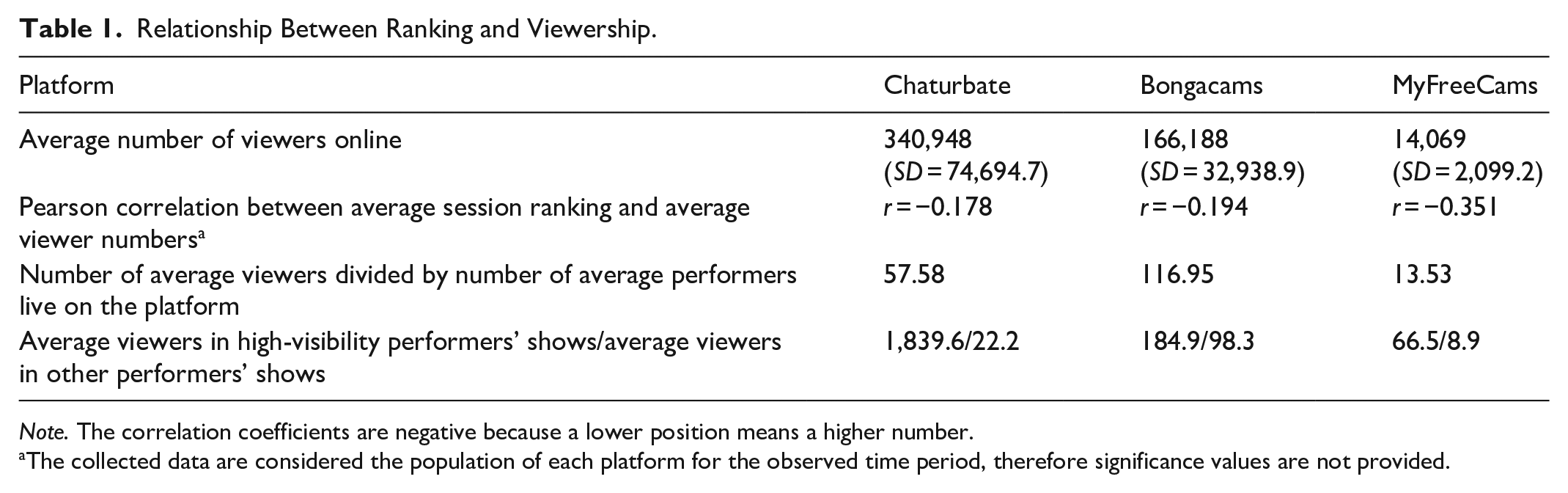
Note. The correlation coefficients are negative because a lower position means a higher number.
The collected data are considered the population of each platform for the observed time period, therefore significance values are not provided.
Across all three platforms, higher-ranked shows tended to have more viewers. MyFreeCams exhibited the strongest correlation, followed by Bongacams and Chaturbate. MyFreeCams, however, had a significantly lower number of viewers, meaning that even though the relationship between variables was strong, the performers were competing for a significantly smaller pool of attention.
To put these findings into context, we compare high-visibility performers’ viewership to that of other streamers (last row of Table 1). Bongacams showed the smallest difference, with around two times more viewers in these “elite” shows and overall very high per-show attendance. MyFreeCams had about seven times more viewers, while Chaturbate exhibited even stronger differences, with visibility-winners having almost 83 times more viewers in their shows, the closest to a winner-take-all distribution.
Despite clear visibility and viewership inequalities on all observed platforms, there are palpable differences between premium and freemium platforms. On the performer side, public shows scale to much larger audiences than private, one-on-one shows, suggesting that “whale” users, who spend generously on one performer, may be more influential in private shows, where they are the sole viewers. On the user side, freemium and premium shows entail different spending commitments—every minute costs in a private show, while viewers can “lurk” in public shows until they decide to tip. Thus, platforms like LiveJasmin, seemingly more egalitarian, offer performers a greater chance to rank high, but due to the nature of private shows, the economic outcomes remain unclear. On other platforms, the likelihood of being sorted at the top is very low, but the viewership rewards can be immense. Even though previous research shows that performers connect better ranking with greater financial gains (Caminhas, 2022; van Doorn & Velthuis, 2018), a larger audience is not always a tipping audience. In fact, Chaturbate’s creator and owner has claimed that only about 1 in 200 viewers tip (Velthuis & van Doorn, 2020), which potentially leaves the majority of performers with negligible income, especially after the platform takes its cut.
Performer Availability and Heterogeneity
In this section, we explore whether “diligent” workers are positioned higher on the page, as previous research (Caminhas, 2022) suggests. Even if intensity or regularity are not the main determinants of performers’ position on the front page, understanding which labor practices are prioritized by ranking systems provides valuable insights into how workers’ lived realities are subject to algorithmic management. To prepare this analysis, we distinguish “regulars” from more sporadic gig workers, shedding light on the composition and potential heterogeneity of the workforce (Vallas & Schor, 2020).
We measured performer availability and work intensity by counting active days, streaming sessions, and total online duration. Chaturbate ranked lowest on every metric, with performers streaming, on average, for 14 days, 20 sessions, and a total duration of 2,173 min (36.2 h) over 11 weeks. Bongacam’s results were only slightly higher in terms of days (17) and sessions (21), but performers streamed around twice the total duration (4,480 min/74.6 h). Figure 3 shows how many days performers streamed on each platform, revealing similar long tail patterns for both Chaturbate and Bongacams.

Histogram (bin width = 1, median provided) of performers in terms of days active. LiveJasmin results are based on a shorter observation period. For full measures of performer availability on all platforms, see Appendix D.
The other three platforms demonstrated significantly higher average performer availability, most clearly along days active and session count. LiveJasmin stands out the most: first, performers streamed on average over twice as many shows (73) compared to MyFreeCams (29) and Streamate (35); second, there is a substantial group of “regulars” who stream almost every day (Figure 3), possibly due to working in studios with fixed schedules (see Note 5). These findings are not simply a result of the differences between premium and freemium models, as performer availability on Streamate was much lower, and no population of “regulars” stood out. On the other hand, Streamate’s performers were live the longest (4,791 min/79.9 h), followed by Bongacams (4,480 min/74.6 h) and MyFreeCams (4,116 min/68.6 h).
How are these labor practices related to performers’ visibility? Figure 4 illustrates the relationships between each availability metric and front-page rankings. To facilitate platform comparison, positions were again normalized.

Pearson correlations between normalized ranking position (y-axis) and days active, sessions streamed, and total streaming duration (x-axis), visually expressed as a regression fit line. For LiveJasmin, a shorter time period was used, and we approximated the full data with a dashed line.
While tendencies mostly align across the three variables, Figure 4 reveals striking differences between platforms. Streamate showed little correlation, indicating no connection between performers’ work regularity and average position. LiveJasmin, on the other hand, displayed a positive correlation with both days and sessions streamed, counter-intuitively suggesting that less availability on the platform was associated with more visibility. Similar patterns were found for MyFreeCams, corroborating Jones’ (2015) observation that “models that spend the least amount of time online but generate the most money in tips have the highest camscores” (p. 781). LiveJasmin and MyFreeCams were also the two platforms with the largest proportion of high-visibility performers, suggesting that they seek to distribute attention to a larger pool of workers, including newcomers they may hope to retain.
The observed dynamics on both premium platforms, as well as MyFreeCams, suggest that ranking on the generic platform homepage might not be the most critical factor for performers’ competitive success. Instead, personalized matching based on individual customer preferences could play a more significant role. This personalization could be algorithmic or based on other platform affordances, such as the subscription model, notifications, display of regular streaming schedules, filtering, categories, and specialized whitelabel sites. 11 Streamate, for instance, operates numerous relatively high-traffic whitelabels that offer customers specific content based on their interests. Similarly, MyFreeCams’ highly adjustable homepage allows users to customize how they view the presented performers.
Negative correlations were observed on Chaturbate and Bongacams, both freemium platforms. Here, streaming regularity and intensity were related to a higher average position on the front page. For Bongacams, this aligns with the platform’s claims that streaming duration is considered in performer ranking and may explain why performers work much longer hours than on Chaturbate. Given the strong variation in performer availability on Chaturbate, the observed correlation is not straightforward. As we already observed, the majority of its performers streamed little and irregularly, generally remaining at the bottom of the rankings. Interestingly, however, among the top 20 highest-ranked performers, 16 streamed only one session. Many of these performers have large followings on social media or OnlyFans, where they announce their shows in advance, bringing an influx of viewers when they stream on Chaturbate. They may not see webcamming as central to their performer identity, but rather as a tool within a larger ecosystem of platforms they use for all-round adult content creation.
Similar observations with regard to the heterogeneity of the performer community can be found in the mixed-gender composition of Chaturbate’s streamer base. While the webcamming industry is often perceived as predominantly female, Chaturbate’s population was almost equally self-identified male (41.9%) and female (45.4%), with minorities of couples (6.4%) and trans (6.3%) cammers. On average, women ranked higher than men (the median position was 4,028.5 for men and 3,563 for women), suggesting that distinct performer subcommunities have varied platform uses and audiences. For instance, the audience for male performers is likely much smaller than for female cammers, indicating that a large majority of male performers on Chaturbate do not expect to make significant income, and, likely, stream for their own pleasure instead (“Eyes on Chaturbate—December Edition,” 2022). This is linked to Chaturbate’s historical openness to “self-pleasure” streamers, and the platform continues to be particularly welcoming to passers-by or casual performers, even if starting to broadcast is not as effortless as it used to be due to age verification requirements. These streamers, who likely would not view their use of the platform as work, are kept at lower visibility rungs by the ranking system, however. While comparison with other platforms is not possible due to the lack of gender-specific data, these observations may account for the platform’s larger performer base and distinct ranking patterns.
Our findings reveal roughly two groups among the observed platforms: freemium platforms with a lot of irregular streamers, where performer availability is associated with a higher position (Bongacams and Chaturbate), and the remaining platforms, where performers stream slightly more regularly and intensely, without that effort necessarily correlating with better ranking (Streamate, LiveJasmin, MyFreeCams). These findings can be partly attributed to performer-base heterogeneity (Schor et al., 2020). For example, Chaturbate has a particularly large population of passers-by, who rank low on the page. On premium platforms and MyFreeCams, ranking seems to have less impact on performers’ financial success, as evidenced by the substantial group of “regulars” on LiveJasmin who continue to stream despite limited visibility incentives. These performers indicate the presence of a large group of platform workers to whom webcamming is not a flexible alternative, as sometimes portrayed (Nayar, 2021), but a full-time job, most often at a studio that takes up to 70% of their earnings (Vlase & Preoteasa, 2021).
Discussion and Conclusion
In this article, we have empirically analyzed the outcomes of ranking systems—or rather distributed “ranking cultures” (Rieder et al., 2018) that include the contributions of users and performers—on five webcamming platforms. This section profiles each platform in turn to lay the ground for our broader conclusions.
In the non-monopolistic webcam sex industry, Chaturbate stands out as the largest and most heterogeneous platform. Its easy-to-sign-up model attracts both superstars that stream infrequently but to massive audiences and large numbers of passers-by who are kept mostly out of sight and struggle to attract viewers. Streaming regularly is rewarded in terms of visibility, and there is a stark contrast between a proportionally small platform “elite” and a huge pool of performers that get discouraged quickly or may simply stream for their own pleasure. The “winner-take-all” label (van Doorn & Velthuis, 2018) applies most clearly to Chaturbate’s high-risk, high-reward atmosphere, which is further substantiated by the considerable inequality in follower distribution among performers (“Chaturbate Follower Distribution,” 2020). Its “excellent traffic” (Jones, 2020, p. 69) is also known to bring high levels of freeloaders (Velthuis & van Doorn, 2020, p. 172) who “lurk” in shows without tipping, which means that the large viewer numbers we observed for our high-visibility group may be necessary to earn significant income.
At first glance, Bongacams emerges as Chaturbate’s smaller sister—it is quite clearly a freemium platform and shares patterns in performer visibility, availability distribution, and correlations. There are, however, more viewers per streamer, and, importantly, the difference in terms of viewer attention between high-visibility streamers and everybody else is much smaller than on Chaturbate. Bongacams thus more closely resembles a performers’ “main workplace” than a winner-take-all gamble: diligent streamers are rewarded with visibility, even if penetrating the upper echelons remains difficult, and there are still considerable numbers of passers-by. Our findings also echo the platform’s claims that its ranking system privileges earnings and time spent online as performers, on average, stream longer compared to other freemium platforms.
MyFreeCams represents somewhat of a paradox. It has the smallest performer pool in our sample, and, despite having a larger population of regular streamers than the two freemium sites, these regulars are given less visibility than more sporadic webcammers. This can, in part, be explained by the presence of “external superstars” who occasionally use the site, similar to Chaturbate, as a tool in a larger arsenal of fansites and social media accounts. It may also be that MyFreeCams’ highly customizable interface, long history, and reputation “for having fewer freeloaders than sites as Chaturbate” (Jones, 2020, p. 70) direct sufficient income to regulars, starting to lean toward a premium model. But it may also be that the site faces a shrinking performer base and feels the need to be attractive to newcomers.
LiveJasmin lives up to its reputation as a “boutique” platform. In stark contrast to all other platforms and in line with the company’s suggestion to “handle LiveJasmin as a full-time job” (see Note 5), we found a distinct group of regulars that worked almost every day, likely associated with studios from Eastern Europe and South America (see Note 5). While the ranking system did not substantially reward labor regularity or intensity, almost a fourth of all performers landed in the top 50 spots at least once, suggesting that they are almost “rotated through” rather than following a popularity- or income-based visibility logic. Here, much more stringent barriers of entry do the work that other platforms delegate to algorithmically mediated market dynamics.
Finally, Streamate emerges as a less egalitarian premium platform than LiveJasmin. It shares a higher proportion of regulars compared to the freemium sites, but also skews visibility more strongly toward a smaller group of “elite” performers. This may be a way to manage workers more explicitly through ranking pressure, but it may also be due to Streamate operating many whitelabel sites where performers are filtered based on a specific content niche, directing traffic through other means of generating visibility.
Overall, our large-scale data-driven approach was able to pinpoint considerable differences between the five platforms we observed. First, while we were generally able to confirm the high levels of heterogeneity in terms of work intensity mentioned by Schor et al. (2020) and others, there is a broad spectrum between low-barrier-of-entry sites like Chaturbate, which attract large numbers of passers-by, and “boutique” platforms like LiveJasmin, where regulars dominate. Second, this spectrum mostly—if not fully—mirrored the difference between freemium and premium, with the former aligning more closely with the creator economy and the capacity to scale to large audiences and the latter more directly with gig work like transportation and delivery, where a single worker cannot serve more than one client at a time. This also means that freemium and premium platforms likely attract different types of customers and require different sets of skills or even personality traits from performers (Hamilton, 2018). Third, and directly related, this means that winner-take-all dynamics were most clearly observable on freemium sites, where shows can reach an unlimited number of viewers, at least in theory. But even on Chaturbate, where viewer numbers are heavily skewed toward high-visibility performers, the term “winner-take-most” would be more appropriate. There are certainly patterns of inequality on LiveJasmin as well, but the model strays closer to Netflix than YouTube: having a much smaller number of highly vetted contents/performers means that the pie can be distributed much more evenly. Although we were not able to test this, we would expect that the higher stakes on premium platforms, where jumping between performances is discouraged, increase the relevance of personalization, as finding the “right” match becomes even more important.
While we have focused our inquiry on ranking, we have had to point many times to other “adjustment variables” available to our platforms. The business model was clearly the most important, but various technical affordances also came into play, for example, the multiplication of a site over whitelabels, the possibilities to bookmark or follow performers, and the various ways content can be made navigable and searchable on the level of the interface. Together with all kinds of rules and regulations, these elements are means for webcam companies to manage their platforms and carve out their niches in a competitive environment. Algorithmic management through ranking is most relevant to those who keep barriers of entry low and delegate filtering and “quality control” to algorithmically mediated audiences (Stark & Pais, 2021). While the fundamental openness of places like Chaturbate serves those parts of the performer base that stream for pleasure or fun, it creates a particularly harsh environment for performers looking to make a living. Similar to YouTube, where the hope of “making it” one day is always kept alive (Duffy et al., 2021; Rieder et al., 2023), these performers risk getting caught in a limbo, where they earn some income, but not necessarily enough to thrive.
The “algorithmic gossip” (Bishop, 2019), that a lot of platform labor draws on, becomes a double-edged sword in this context: while it may allow some performers to succeed, it does not shift the overall distribution curve. Even worse, it may present the ranking system as a rational and knowable object that can be used to one’s advantage once its arcane rules are uncovered rather than as a dynamic “market device” that optimizes revenue for the platform (MacDonald, 2023). It is no surprise, then, that the most “platformy” platform in our sample, Chaturbate, is the most muted about their algorithms: keeping performers in the dark forces them to constantly innovate to chase the elusive top of the page, which, by definition, has limited real estate. As Stark and Pais (2021) point out, this kind of algorithmic management is not “disciplinary” as it does not engulf performers in bureaucratic control. Instead, we could call it “experimental” as it remains agnostic to what performers should do with regard to content; what they should do, in this logic, is to find out what viewers like and what gets them to tip. The ranking system is then tuned to provide not only enough feedback to reward success but also enough variation to not get stale.
More work, both quantitative and qualitative, is needed to tie our rather broad conclusions to the lived realities of performers. The lack of robust information on actual money flows is particularly problematic when it comes to making the connection between algorithmic management and precarity. We were also not able to shed more light on inequalities in terms of performer identities (e.g., Caminhas, 2022; Jones, 2015, 2021), which would be especially interesting to explore comparatively across multiple platforms. Here, a combination of our scraping approach and qualitative analysis via random sampling could be a viable way forward. Moreover, we had little to say about the actual contents of shows (e.g., Weiss, 2018), which constitute another element in the complex interplay of many different factors that determine outcomes for performers. Finally, our article cannot comment on how performers practically engage with the ranking systems that we study. This includes tactics of resistance or subversion, such as streaming for a long time without actively engaging with the audience, which might complicate our findings.
From a platform studies perspective, our study shows how a comparative approach can reposition ranking as an object of study. While monopoly settings and problems with data collection make comparative empirical research difficult in many areas, we found that the contrast between platforms sharpens our view of their specificities and opens a window into the design space available to them. While we are not equipped to weigh which of the five platforms is the “fairest” or the most “egalitarian,” we hope to have added to our understanding of the adjustment variables and trade-offs that come into play. Pushing this understanding further can ultimately help performers make informed choices, rebalancing the information asymmetries that seem to be a defining and particularly problematic characteristic of platform labor. Showing that ranking systems can and do vary can also inform critiques in other areas of the platform economy: algorithmic systems, as well as interfaces and corporate policies for that matter, are not deterministic in the sense that they necessarily lead to the same winner-take-all outcomes, but designed artifacts that can produce various kinds of orderings, creating meaningful differences for the people they manage. While systematic data collection through scraping has clear limitations when it comes to shedding light on the lived realities of these differences, it allows us to get a sense of the size and heterogeneity of the affected populations and to identify patterns and trends that can be a starting point for critical resistance. At the same time, attention paid to algorithmic systems should not come at the expense of other efforts to improve working conditions: the creation and recognition of legal and social rights for workers remain essential to the “humanization” of platform labor, particularly in areas where societal stigmatization contributes to other forms of precarity.
Footnotes
Appendix
Distribution Measures of Performer Availability on Five Observed Platforms.

| Platform | Chaturbate | LiveJasmin | Bongacams | MyFreeCams | Streamate | Global |
|---|---|---|---|---|---|---|
| Days active | ||||||
| Mean, standard deviation | μ = 13.9 SD = 15.8 |
μ = 20.3 SD = 13.8 |
μ = 16.9 SD = 17.5 |
μ = 22.2 SD = 17.7 |
μ = 22.3 SD = 17.6 |
μ = 16.3 SD = 16.4 |
| Median | MDN = 6 | MDN = 22 | MDN = 9 | MDN = 18 | MDN = 19 | MDN = 9 |
| Lower quartile | Q1 = 2 | Q1 = 5 | Q1 = 2 | Q1 = 6 | Q1 = 6 | Q1 = 2 |
| Upper quartile | Q3 = 22 | Q3 = 35 | Q3 = 28 | Q3 = 37 | Q3 = 36 | Q3 = 28 |
| Count of sessions | ||||||
| Mean, standard deviation | μ = 20.1SD = 26.6 | μ = 72.8 SD = 60.3 |
μ = 20.6 SD = 24.3 |
μ = 29.4 SD = 27.4 |
μ = 35.2 SD = 32 |
μ = 27.7 SD = 35.8 |
| Median | MDN = 8 | MDN = 61 | MDN = 11 | MDN = 22 | MDN = 27 | MDN = 12 |
| Lower quartile | Q1 = 2 | Q1 = 10 | Q1 = 3 | Q1 = 7 | Q1 = 8 | Q1 = 3 |
| Upper quartile | Q3 = 29 | Q3 = 133 | Q3 = 32 | Q3 = 46 | Q3 = 55 | Q3 = 40 |
| Total minutes streamed | ||||||
| Mean, standard deviation | μ = 2,173.7 SD = 3,644.5 |
μ = 2,923.5 SD = 3,098.5 |
μ = 4,480.3 SD = 6,256 |
μ = 4,116.3 SD = 4,734.9 |
μ = 4,790.6 SD = 5,182.7 |
μ = 2,881.5 SD = 4,311 |
| Median | MDN = 450 | MDN = 2,130 | MDN = 1,710 | MDN = 2,280 | MDN = 2,940 | MDN = 930 |
| Lower quartile | Q1 = 60 | Q1 = 690 | Q1 = 240 | Q1 = 540 | Q1 = 690 | Q1 = 120 |
| Upper quartile | Q3 = 2,730 | Q3 = 3,510 | Q3 = 6,540 | Q3 = 6,240 | Q3 = 7,350 | Q3 = 3,900 |
Note. Mean and standard deviation values rounded to one decimal place. Data used for LiveJasmin calculations was collected over a shorter period of time (5 weeks), this data is also used for global calculations.
Acknowledgements
The authors would like to thank Hanne Stegeman, Thomas Poell, Olav Velthuis, and two anonymous reviewers for their valuable comments on the manuscript.
Declaration of Conflicting Interests
The author(s) declared no potential conflicts of interest with respect to the research, authorship, and/or publication of this article.
Funding
The author(s) disclosed receipt of the following financial support for the research, authorship, and/or publication of this article: This work was supported by the Nederlandse Organisatie voor Wetenschappelijk Onderzoek (406.DI.19.035).
