




Abstract
This online ethnographic study explores the nature of online work by Nigerian X (formerly Twitter) influencers through their adaptation of the platform's socio-technical features and affective labour. Two interconnected observations are advanced. First, influencers’ practices hinge on relevance, one that draws on the limited repertoire of platform affordances available. These practices are employed before or alongside their engagement with affective labour and identity entrepreneurship. Second, the immateriality of influencership and practices adopted when influencers lose relevance contribute to understanding their platform-based technical labour and online influence. These findings, therefore, suggest that the practices of building popularity and influence online extend beyond affective labour, which dominates the existing literature. This research relies on 15 in-depth interviews with influencers, media agencies, and representatives of corporate organisations, including an observation of their online activities. Particular attention is paid to research ethics, positionality, and data collection, management and processing. This study contributes new insights into the influencer culture on social media in Nigeria and Africa.
Keywords
Introduction
Several studies have sought to account for how social media users gain popularity. For some, it is the originality or uniqueness of their contents (Hund, 2023; Watanabe et al., 2015; Zou et al., 2021). For some others, it is the characteristics of the users, including their status, location, existing popularity and number of followers (Khan et al., 2016; MacKay et al., 2022; Zeren and Gökdağlı, 2020; Zhang et al., 2023). According to Woods’ (2023) literature review, studies consider users’ frequency and timing of posts, vividness, interactivity, information and self-orientation as factors influencing their popularity. For some scholars, it is the kind of followers a user has, and as such, they consider the concept of audience central to understanding online popularity (Catalina-García and Suárez-Álvarez, 2022).
In particular, studies have examined the role of affective labour in building followership and online popularity (Abidin, 2016b; Duffy et al., 2022). For instance, Raun (2018: 100) contends that affective labour is a core practice of social media micro-celebrities, which includes ‘signalling accessibility, availability, presence, connectedness, and authenticity, all of which presuppose and rely on some form of intimacy’. Using YouTube as a case study, they conceive the affect of intimacy as a ‘capital deeply ingrained in the strategies, dynamics, and affective labour of micro-celebrities’ (Raun, 2018: 100). Alongside affect, studies also consider the role of platform features in gaining popularity (Abidin, 2021; Cotter, 2019). For example, Arriagada and Siles (2024) examine how affordances shape the Chilean influencer industry and expand the frames of their meaning and usage. They find that X (formerly Twitter) 1 allows more ‘informal’ communication with audiences, while Facebook aggregates audiences and Instagram curates contents styles.
However, not enough attention has been paid to the practices of re-purposing platform features for visibility and growing followership beyond the dominant content-focused approach. As Woods (2023: 74) puts it, ‘most studies … assume that individuals use emotions as a form of strategic communication’ to gain popularity. While having content niches may be important to build and sustain influencership, they are sometimes not enough to explain influencers initial source of popularity.
Building on this gap, this online ethnographic study of social media influencers in Nigeria focuses on the generative practices of X influencers who have built their followership by re-purposing the platform's features before or alongside their engagement with affects and identity. 2 Methodologically and theoretically, this research brings the burgeoning scholarship of digital cultures (Abidin, 2016a; Boateng, 2022; De Veirman et al., 2017; Khamis et al., 2017) in conversation with the social theories of bricolage, affective labour, and identity entrepreneurship (Deuze, 2006; Faucher, 2018; Fauchart and Gruber, 2020; Janssen et al., 2018; Stets and Burke, 2000; Utz and Muscanell, 2015) to expand the qualitative analysis of the social media and influencer economies. Doing this allows me to demonstrate how influencers domesticate platform affordances in material and non-material forms.
As a result, two interconnected observations and arguments are advanced. First, the practices of influencers hinge on relevance, one that draws on platform affordances, including users’ followers and content engagement lists, following–follower ratio, and API (application programming interface). These practices are employed before or alongside their engagement with affective labour and identity entrepreneurship. Second, the study engages with the immateriality of influence through psychic or non-material income and practices adopted when influencers lose relevance. Thus, attention to the practices, contexts, and social protocols of influencership provides insights into the new experiential configurations generated. Additionally, these innovative practices demonstrate how African audiences can domesticate ‘global’ Western products.
The rest of this study is divided into five sections. The first reviews the related literature on social media, identity entrepreneurship and the digital informal economy. The second introduces my methodology, methods, and ethical considerations. The third centres on the technical and affective practices deployed by X influencers to build and increase their followership. The last section outlines my concluding thoughts.
Literature review
Conceptualising social media and influencership
Media transformation in Nigeria and Africa is often traced to the colonial era (Apejoye and Mutsvairo, 2024; Olaniyan and Akpojivi, 2021). However, the new digital media technologies have not necessarily differed from old media forms, such as radio, nor the oral forms (Barber, 2018; Coetzee, 2020). This is because the increasing availability of social media to everyday people has only enabled them to bypass the State and create networks of transmission locally and globally (Barber, 2018: 130). That is, the diffusion of digital technologies presents opportunities to evade the excessive State control of traditional broadcasting means.
For instance, five times more than users in the US and the UK, X users in Africa are more likely to post their political views (Lubinga and Baloyi, 2019). This includes using humour and jokes to ‘affirm their capacity for political agency and confront the exclusionary regulations of corruptive social structures’ (Yékú, 2016: 260). Sometimes, users mobilise to organise protests and express their views, as in the case of the 2020 #EndSARS protests against police brutality in Nigeria, which started on Twitter (Yeku, 2022).
Thus, while vast research on influencers has focused on X (Bakshy et al., 2011b; Ingenhoff et al., 2021; Villegas et al., 2023), Instagram (Abidin, 2014, 2016c; Campana et al., 2020; Drenten et al., 2020), YouTube (Glatt, 2024; Jayadeva, 2024) and TikTok (Barta et al., 2023; Wang, 2020), this study focuses on X because of its notoriety for the easy spread of socio-politico commentaries 3 through its affordances, such as ‘reposts’, 4 ‘quotes’, ‘likes’ 5 and replies, and given that these affordances that can embody different meanings, imaginings, and expectations (Bucher and Helmond, 2018; Murthy, 2024). For instance, reposts allow users to immediately show their followers the content they have seen, and Geboers and Van De Wiele's (2020) study shows how this contributes to understanding the practices of ‘influential actors’ through the images they post. Also, X users can generally express themselves via texts, audios, images, videos and emojis, with 280 characters 6 per post in ways that are different from other major platforms (Shamayleh and Arsel, 2021).
For instance, ‘Quote’ is a citational practice that allows users place a comment on top of a post. ‘Likes’, typically represented with a heart-shaped emoji, generally indicate what content users like. Replies enable users to respond directly to a post. Hashtags (#) are a particularly effective way to organise and view the thoughts of Twitter users on an issue. For instance, Zappavigna's (2011) study shows how the hashtag feature marked a cultural shift in online discourse. As an example, Ogola (2019) used the hashtag #Whatwouldmagufulido? to understand Twitter's inherent capacity to exclude, neuter or appropriate ‘popular’ voices in Kenya. Thus, focusing on X , I approach social media affordances through their platform-specific features. Building on Woods’ (2023) finding from their review of 68 studies that there is little scholarly attention on the socio-cultural origins of gaining social media influence, I proceed further to explore the socio-technical practice of gaining popularity and building influence.
The practice of Influencer culture has a long history, although the term influencer became popular in the mid-2010s (Abidin, 2018). A United Kingdom Digital, Culture, Media and Sport Committee (DCMSC) (2022) define an influencer as an individual who builds trusting relationships with audiences and creates both commercial and non-commercial social media content across various topics and genres. More broadly, Abidin defines them as ‘Everyday, ordinary Internet users who accumulate a relatively large following on blogs and social media through the textual and visual narration of their personal lives and lifestyles … and monetize their following by integrating “advertorials” into their blogs or social media posts and making physical paid-guest appearances at events’ Abidin, 2016a: 3).
However, as I will show in subsequent paragraphs and my discussion, X influencers may not always accumulate large followings through affective labour, nor do they always have to engage with physical spaces. Truly, they build influence primarily by growing their follower base and increasing the engagement metrics they receive on their posts. This, nonetheless, does not always explain their source of popularity, as they can also inventively adapt platforms’ socio-technical features to grow followership. As my findings below will show, these inventions include ‘massing’, ‘decking’, and the use of ‘group pods’. As such, I conceptualise influencers as users who start out with or without any intent of popularity but gain prominence through different ways beyond personalised content, after which they maintain or become fluid with their niches to sustain their engagement.
Domesticating the digital economy: Thinking through affective labour, bricolage and identity entrepreneurship
Studies have focussed on the impact of social media on scaling entrepreneurship (Francesca et al., 2017; Gustafsson and Khan, 2017; Khajeheian, 2013). They explain in various ways how social media, through influencers, has acted as an amplifier to create awareness of goods and services to address potential and targeted consumers (Khamis et al., 2017). Reports, such as those by the World Bank (2019), also advocate for digital platforms as tools for Africa's ‘leapfrogging’. However, studies, such as Meagher (2020), caution about the ‘illusion of inclusion’ that the digital economy may portray, given Africa's diverse economic structures, infrastructural inequalities, and corresponding unequal outcomes.
Thus, using social media, this study takes an epistemological approach to the digital economy in Nigeria and Africa by extending our understanding of social media and digital economies beyond commodities, branding, and economic outcomes. Influencers create inventive ways to gain popularity by constantly re-purposing and regenerating ideas on X. Therefore, understanding influencer practices is useful for providing contexts to recurring narratives on the adoption of technology. In this regard, this study critically considers the concepts of affective labour and bricolage in the study of the identity entrepreneurship engaged by influencers.
The concept of affective labour was popularised through Hardt's (1999) influential argument, which considers the immaterial labour of affect as a biopower for resistance against the global capitalist framework economy. Building on the works that combine Marx and Freud in critiquing capitalist production processes and feminist studies on unpaid labour, Hardt (1999: 89) conceives affective labour as the ‘labouring practices that produce collective subjectivities, produce sociality, and ultimately produce society’. Hardt describes affective labour as the pinnacle of labour forms in the globalist capital economy.
More broadly, within an affective turn (Clough and Halley, 2008), studies employ affect to understand the changing social relations on the internet. In particular, affective labour is engaged to understand the practices of online popularity and influence. For instance, Lehto (2022) adapts from Loveday's (2018) ‘neurotic academic’ to understand the Finnish mothers’ work of influencership through the affective practice of anxiety. They argue that anxiety underpins emotions and cultural expectations within social media work. Also, Willment (2023) investigated how audiences influence the affective labour practices of British travel bloggers. They explain how influencers use stimuli, such as discussions of place, to tailor their affective work. In addition, Mäkinen (2021) explore vulnerability, control, and emotional resilience as sites of affective labour in mom blogging. Thus, beyond its economic origins, affective labour has been adopted to explain the social dynamics of influencership, including through niche content.
However, this study proceeds further to engage the technical labour that may precede the affective one. That is, the platform-reliant labour engaged to build followership or popularity. For instance, it includes the efforts dedicated to using X's followers feature 7 to increase followership. Separately, studies such as Abidin (2016a, 11) have examined the under-visible tacit technical labour that influencers engage. For instance, they explain that the ‘instruments of makeup and dressing, lighting and posturing, and apps and artifice’ contribute to the tacit labour engaged in taking selfies. Similarly, Duguay (2019) writes on the ‘development aesthetic labour’ that Instagram and Vine influencers engage in creating content. This includes the practices of using platforms’ and third-party apps’ picture filters and editing tools to make a desired appearance and recognisable brand. However, as I will show in my analysis, I consider the labour practices of followership building that rely on re-purposing platform affordances, such as the ‘view post interactions’ or users’ list of followers features.
Two concepts are relevant to theoretically accounting for this approach. First is the concept of domestication, which partly originates from anthropological research into the meaning-making of goods and possessions and how people use them. Domestication places interest in the role of users in innovation by focusing on the work done to make technology do practical work (Haddon, 2011). Second, building on the theoretical building blocks of affordance and domestication, influencers can be described as bricoleurs. Bricolage is a concept coined by Lévi-Strauss (1966) in their work, ‘the savage mind’. It is ‘the creation of objects with materials to hand, re-using existing artefacts and incorporating bits and pieces’ (Hartley, 2002: 22). Bricolage consists of domestication that contrasts the more rational problem-solving approaches or systematic and standardised methods and resources (Lévi-Strauss, 1966). However, inspired by Derrida's (1970) reading of Lévi-Strauss, scholars in African studies have increasingly problematised Lévi-Strauss’ primitive and Eurocentric explanation of the use of technology.
For example, Lévi-Strauss’ postulations on the differences between non-Western cultures and Western systems result in a ‘Western-centric view of creativity, planning, and the overall understanding of the way things work’ (Cancel, 2022: 129). As such, in this study, rather than see technologies as second-hand materials, I adapt from Deuze (2006: 66) to refer to X as a bricolage, one that is ‘highly personalised, continuous, and more or less autonomous assembly, disassembly, and reassembly of mediated reality’. Subsequently, I conceptualise influencers as bricoleurs, who are functional agents and identity entrepreneurs actively domesticating X to build influence.
Furthermore, this study extends the analytical capability of bricolage by considering the immateriality of influencership by bringing it in conversation with the concept of affective labour and social capital. Hardt (1999) explains that affective labour emerges from the immateriality of the information economy. For example, the structural changes from an industrial economy to a service economy, the embeddedness of computer technologies in day-to-day life, and the resulting virtual human communication. These changes engage the affective labour that produces an immaterial good, such as knowledge, service or, in particular, social capital. Similarly, the concept of social capital, which stems from Bourdieu's (2011) forms of capital, emerges from the attempt to transubstantiate capital from a restricted economic sense to one presented in the immaterial form. Bourdieu (2011) explains social capital as the accumulated labour that can be appropriated by individuals or groups. Social media studies describe social capital as digital capital, one that is converted by a means of social practices and social support (Calderón Gómez, 2021). 8
For example, influencers, as bricoleurs, can develop a range of efforts to gain popularity when they lose their influence or their X account, including relying on online and offline networks. As such, exploring the immateriality of influencership is useful to understand influencers’ meaning-making of the social capital that comes with popularity, beyond the economic interpretations. For instance, psychic income, a concept that emerges from the analysis of social capital (Tuten, 2017: 52), cannot be explained in economic terms as it refers to the personal non-material benefit of being famous. As I will demonstrate in my analysis, some influencers choose to enjoy the psychic income of popularity rather than its materialistic potentials.
Above all, these theoretical considerations shape identity entrepreneurship, which has paralleled the growth of social media, and which refers to ‘individuals benefit from having a unique selling point, or a public identity that is singularly charismatic and responsive to the needs and interests of target audiences’ (Khamis et al., 2017: 191). The role of identities and affect in entrepreneurship has seen increased scholarship since the rise of dotcom in the late 90s and in the wake of the 2008 economic recession (Fauchart and Gruber, 2020; Marwick, 2013; Peters, 1997), broadly for three reasons (Khamis et al., 2017). First, social media tacitly promises fame that can lead to wealth creation for ‘ordinary’ users and thus encourages practices of micro-celebrity. Second, the socio-political culture of neoliberal individualism encourages self-branding. Third, the replicability of the commercial viability of some social media influencers inspires others to self-brand. More importantly, scholars generally agree that an individual's social and role identity provides the opportunity to grasp their influence within social groups and how their behaviours are shaped (Durkheim, 1984; Powell and Baker, 2014; Stets and Burke, 2000).
To conclude, while studies have theoretically accounted for influencership and identity entrepreneurship through their affective practices to build and sustain influence or gain immaterial income, a gap exists in understanding the domestication of platform affordances for these purposes. Thus, by adopting a theoretical approach that brings the concepts of affordance, domestication, and bricolage into conversation with affective labour and social capital, this study presents Nigerian X influencers as innovative users who engage a repertoire of skills at their disposal in accounting for influencer entrepreneurship. It is important to note that I do not discard the relevance of affective labour to the study of influencership; I am only arguing that it is sometimes not enough to understand the practices of building popularity, as some platform-reliant labour may precede the one of affect, as I have found with Nigerian X influencers. Moreover, affective labour also has a theoretical use-value in understanding the immateriality of influencership.
Methodology
This study relies on an observation of X influencers in their individual state and in their networked communities. In addition, I conducted virtual interviews with twelve (12) influencers, one (1) corporate organisation and two (2) media and Public Relations (PR) agencies representatives. The choice of online observation 9 and virtual interviews allowed me to directly elicit from the influencers specific platform-based practices and how they navigate the techniques of staying relevant. For instance, I shared my screen during the interview with all participants to show them visual images of the analytics of their profiles, which enriched our conversations.
Online ethnography requires learning about the activities of people in their online natural and ‘constructed’ settings by observing or participating in those activities (Postill and Pink, 2012). This process is not a single research method but a blend of different methods, such as formal and informal interviews, observations, interactions and content and thematic analysis (TA). As Marcus (1995: 95) puts it, ethnography involves ‘multiple sites of observation and participation’. The same applies to online research. For instance, Msosa (2017) combined archival research and interviews with social media (Facebook and WhatsApp) groups’ observation to deepen their understanding of the Malawian queer scene to uncover misinterpretations of gender and sexuality. Building on this, my research process can be classed into three stages:
Sampling process
From the literature review above, social media influencers include everyday users who gain popularity through various strategies. However, measuring online influence has ‘no formula to follow’ (Brown and Hayes, 2008: 50). For instance, Bakshy et al. (2011a) widely cited Twitter study finds that ordinary users who exert less than average influence can be cost-effective for marketing than popular influential users, and as such, a useful strategy is to consider everyone a potential influencer. For example, while Nigerian musicians are the most followed celebrities and influencers on Twitter, there are everyday users who are typically considered influencers because of the relatively large followership and popularity they have generated on the platform and without any prior popularity from elsewhere. With this in mind, I was interested in people who became influencers solely from the platform without prior offline popularity. First, I started with ‘background listening’ (Mare, 2017), during which I considered two poll results ran by a cross-continent online magazine 10 on the top social media influencers in Nigeria and the top 10 Twitter influencers for the year 2021 (Pulse Nigeria [@PulseNigeria247], 2021; PulseNG, 2021).
Following the influencers and observing their profiles, posts and conversations
With reasons already highlighted in the literature review, I focused on X influencers in the poll result list. I followed them with a new X account opened solely for this study in line with the guidelines of internet-mediated research by my university's Research Ethics Committee. This is to maintain neutrality and avoid the possibility of influencing my data with an already existing account. Following influencers allowed me to observe their posts’ engagement rate first-hand. I contacted the ones I could reach via their X Direct Message (DM) function, or the email provided in their profile bio 11 and sent them my department's approved recruitment text. Having secured their consent, I began my observation, which allows me to build ‘intimate familiarity’ (Mare, 2017) that helps kickstart my interviews in a more conversational manner. For instance, when I asked an influencer, ‘What was going through your mind when you created your account in June 2011?’, he grinned. His face was animated, and he was happy to go down memory lane.
I drew on Bouziane and Saoudi's (2021) study, in which they monitored popular social network sites (SNS) such as Hespress, Morocco World News and YouTube for months, collecting 2018 comments for their analysis. I constantly kept track of my research participants’ posts by turning on their notifications and frequently visiting their profiles. For the interviews, I sent them an online calendar, as shown in Figure 1, which allows them to freely choose what dates and times work best for them. Each interview lasted between 60 and 95 minutes. All interviews were conducted through the Teams Application with an account associated with my university email address.

An example of the online calendar sent to participants to select their preferred dates and time for an interview.
Collecting and archiving
At this stage, I collected and stored both the qualitative and quantitative data gathered over the previous steps. X's API used to be a useful open-access resource in providing structured access to data in standardised formats (Burgess and Bruns, 2012). However, with the platform data restriction since the ownership take-over by Elon Musk in October 2022 and Meta's discontinuation of CrowdTangle 12 (Meta, 2024), Open-Source Intelligence Tools (OSINT) are now increasingly needed to collect social media data.
In the early days of influencer entrepreneurship, metrics were pulled manually by visiting each social media page or through self-reportage on platforms like Blogger and WordPress, where the backend analytics are not immediately open to the public (Abidin, 2018). However, using third-party applications, such as Social Blade, allowed me to explore the impact of quantitative metrics on qualitative data. For instance, through https://socialblade.com/, 13 I could visualise the growth and interactions of X influencers’ profiles. As an example, Figure 2 shows the monthly growth of followers and followings for Commentator (a pseudonym for an Influencer I interviewed). The y-axis indicates the followers/following count, and the x-axis indicates their month and year.
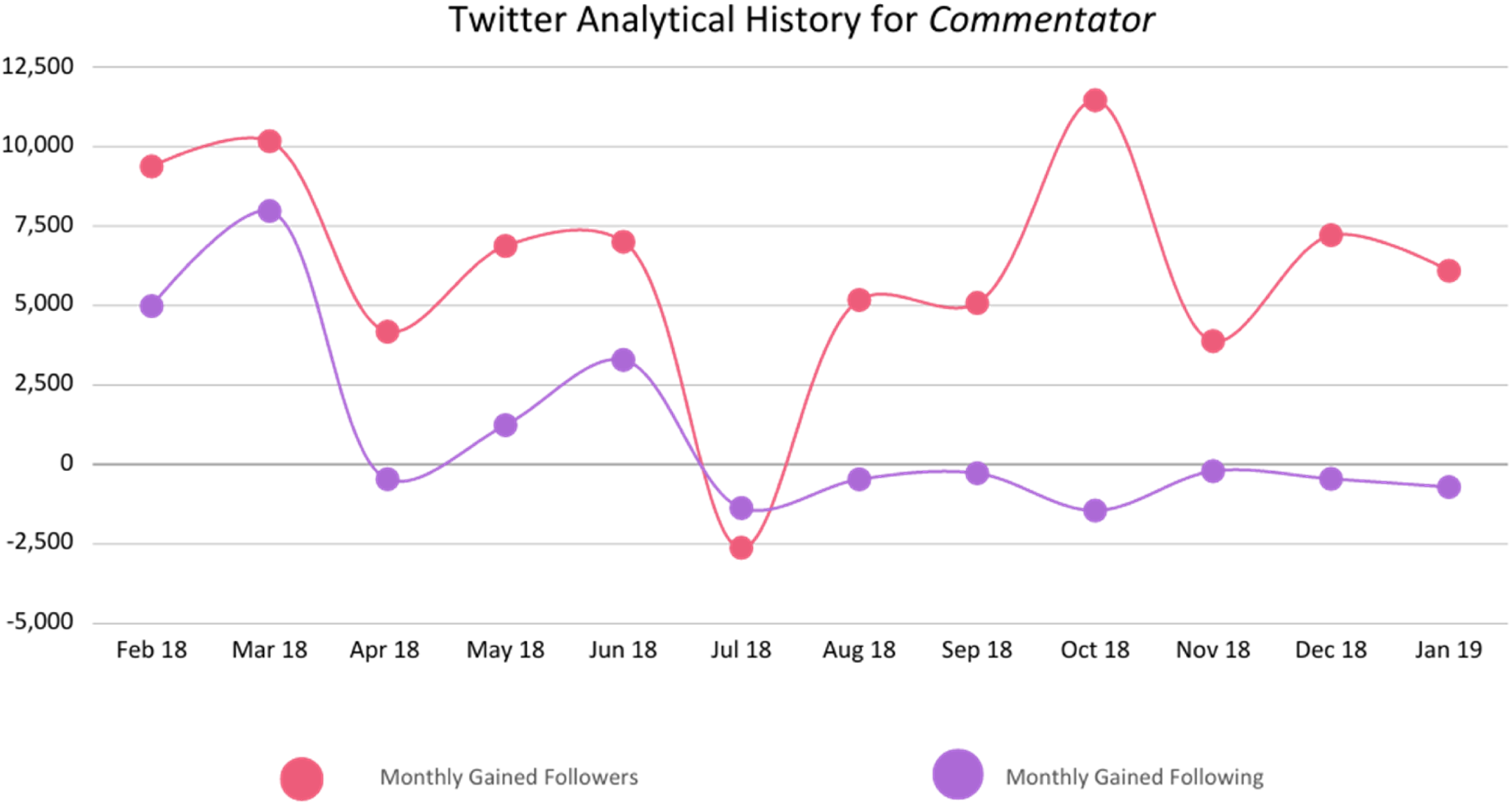
Data source: Socialblade.com. Graph created by author.
Method of analysis
I engaged with a reflexive method of TA, an ‘open and organic’ approach distinct from the other two forms of TAs, which are codebook-reliant (Braun and Clarke, 2021). Thus, while I conducted three rounds of manuscript reading, I did not use a specific coding framework. First, I uploaded the interview recordings into the Microsoft Word associated with my university to first transcribe using the Microsoft transcription feature (Bishop, 2020), and then cleaned them upon listening to the recordings again. Second, I conducted an inductive reading of all manuscripts aimed at immersing myself in the data. In line with my interview guide, which is informed by my literature review, my manuscript is broadly divided into three parts, one of which engages with the practices of building followership and influence online.
Through a reading of all responses under the section for followership building, I firstly highlighted recurring keywords and passages across all manuscripts. In addition, I read each manuscript together with the quantitative data collected, particularly as I had allowed the influencers to respond to their respective (quantitative) profile data during my interviews. Third, I read the manuscripts again and merged these codes (keywords and passages) into three themes, which informed the development of this article and the tripartite division of my findings. These three stages of manuscript readings cut across the six-step process of reflexive TA, which includes data familiarisation, coding, developing and reviewing themes, and refining and naming the themes (Braun and Clarke, 2021: 331).
Research participants
Preliminarily, from my reflexive TA, I classify my participants into two.
Niche-based X influencers
This is the enviable peak position many aspire to achieve. They comprise Nigerian X users who have gained influence on the platform through niche content and now make a lucrative living from it. I labelled influencers in this group as my key informant interview participants (KIIPs) based on three criteria. One, the number of years they have spent as an Influencer- usually between 5 and 10 years. Two, their ability to have successfully carved out a niche for themselves, and three, a minimum of 150,000 followers on either their current account or a previous one before it was suspended.
I interviewed six KIIPs across the niches of education, lifestyle, health & fitness, travel, and migration. Although these influencers have all generated influence through socio-political commentaries on X, they all have a content niche from which I have created pseudonyms. My choice of this was to maintain their anonymity and avoid discussing them in numbers or alphabets. I call the first Expertise. He is in his early thirties and a verified 14 (X account) social media expert with 200,000 followers. He also organises an annual social media conference where experts come together to discuss topical issues on social media. His influence spans beyond X to Instagram and YouTube. He posts in the niche of sports, socio-political issues, and migration. He is a computer science graduate and does influencer entrepreneurship as a side job.
The second is Ubiquitous. He has a specific health niche but posts generally on socio-political issues. For instance, he was instrumental in calling out celebrities who defied the government’s COVID-19 regulations. He, however, does not monetise his influence, as I will explain in my discussion. I call the third Dexterous because of his skills and techniques to effectively make hashtags, products or persons’ trend on X, even when there are a lot of trending issues going on. He has been doing this for a decade and is one of the highly sought-after influencers doing Twitter trends. He has built four houses and owns a vast amount of land from influencer entrepreneurship, his mainstay.
The fourth is tagged Commentator because he actively comments on social-political issues in the country, even though he was once suspended because of it. These comments draw followers who like to hear critical analyses of trending issues. Influencer entrepreneurship generates the most income for him, and he has invested money derived in other forms of business. 15 The fifth is called Farsighted because of her proactive plans as a Twitter influencer. She is a graduate of Mass Communication and in her mid-twenties. Her niche is modelling, beauty, and lifestyle. Influencer entrepreneurship is her major business, and she has about 100 micro-influencers working for her. The sixth is called Strategist. He consults for media agencies and corporate brands and has deep industry knowledge of the influencer culture.
General X influencers
These are X users without a particular niche but have a significant number of followers and make some money from the platform. In-depth interviews (IDIs) were conducted with six of them. What distinguishes my key informant interview participants from my in-depth interview participants (IDIPs) is the fact that the former have a distinct niche, whilst the latter do not necessarily have. The in-depth interview participants are fluid, have a large follower base, usually above 50,000 followers and are good for amplifying messages, services, and products for brands. Thus, the criteria for my in-depth interview participants includes having at least 50,000 followers and being an influencer marketer for brands for 3 to 5 years.
Charismatic, aptly anonymised here based on his persona, influences not only through his wisdom-filled posts but also through his widely admired cheer-giving character. He is a student. The second is dubbed Lighthearted. He cracks jokes with his posts, and even in tense situations, his facial expression makes people laugh even more. The third identifies as a Satirist. His contents mostly require deeper thoughts and are sarcastic in nature.
I call the fourth Sporty because he generally posts about all kinds of sports. Although he grew his follower base and influence through a different niche (lifestyle), he has since been engrossed with sports-related content. I named the fifth Ceder because she decided to stay from X after being suspended. She is a political science graduate and currently works in Lagos. The sixth is Chronicler. She is a graduate whose niche of influence is writing.
Beyond the influencers, it is essential to note that corporate organisations are the primary economic drivers of influencer entrepreneurship. X influencers aspire to work for them, and whilst some reach out to them, the brands mostly get to them through contracted media agencies. Corporate organisations and media agencies sponsor campaigns to promote their products, persons, services, or programmes and sometimes for damage control in case of bad viral publicity. I had an in-depth interview with a recent ex-employee (in the social media department) of a Nigerian bank that actively engages X influencers. I also interviewed two representatives from media and PR agencies who have led several campaigns and gigs with Twitter influencers.
Figure 3 above shows the location of the interviewed X influencers, brands, and media organisations. Most are based in Lagos, the country's economic hub. Some, such as Lighthearted, Satirist, and Farsighted, migrated to Lagos to maximise the benefits of their influencer entrepreneurship. Whilst this study is not exhaustive of all influencers in Nigeria, this geographic disparity evidences the digital divide in internet penetration and social media usage in the country (Afrobarometer, 2020).

Image showing the geographical distribution of my interview participants in Nigeria.
Ethical considerations, data collection, management and processing
The past three decades have seen a growing scholarly concern on the ethical implications of using internet-mediated research methodology. Whilst some studies argue that online research methods require a separate set of ethical standards from traditional research ethics, others posit that there is only a need for an extension, not a separation. However, it is generally agreed that the traditional ethics guidelines are insufficient for protecting online participants where data is easily archievable, searchable and traceable (Markham, 2012). Along this line, privacy and choice of methods are the key ethical considerations of this study in ensuring the anonymity of participants and seeking their consent.
Participants’ privacy
Privacy remains the most important ethical concern in research, as it ensures that every participant has the right to decide what and how much others should know about them (Sveningsson Elm, 2008: 69). In line with my university's guidelines for internet-mediated research, this study adhered to five key ethical principles to protect participants’ privacy. One, not misrepresenting my participants’ posts. Two, not providing participants’ information that are potentially harmful. Three, not inferring personal information from the information provided (e.g. gender from screen names). Four, keeping tabs on changes to X's privacy settings. Five, anonymising my participants. Furthermore, I recognise that privacy is inextricable from informed consent, where all participants must consent to being studied (Sveningsson Elm, 2008).
Choice of methods
The ever-evolving dynamic of the internet as a space for social interaction and information dissemination means that the methods necessary to capture and document such activities are also emergent (Fielding et al., 2017). This dynamism contributes to the ethical challenges of choosing the appropriate methods for an online ethnography. For instance, X's search API is not an exhaustive archive of public posts, as not all posts are indexed or returned (Twitter Developers Forum, 2013). As an example, using Social Blade, the followers’ count available for most influencers starts from 2018, even when their accounts may have been created since 2011.
Ethical challenges and experiences in the field
Firstly, it is challenging to define what privacy means for different influencers, as its meaning can vary among them. Influencers may be active in public spaces but maintain strong expectations of privacy (Markham, 2012). For instance, while many influencers were happy to remain anonymous in their conversation with me, some others suggested they would love to be identified as they see it as another form of publicity. Similarly, whilst some influencers permitted me to use their rate card (which can ordinarily be publicly available) as part of my research, some others declined. In addition, the anonymity of online users can be difficult to ensure. These influencers are already public figures, so little details about them can give them away even after anonymising their data because specific inferences I make may be known to the public. As such, I was faced with constant ‘ethical pluralism’ (Ess, 2013) in decision-making processes as the understanding and expectations of privacy are ambiguous, contested, and ever-changing (Mulligan et al., 2016). I resorted to making informed decisions on a case-by-case basis and developing ‘contextual integrity’, where decisions about specific situations speak to particular questions (Markham, 2012; Nissenbaum, 2010).
Analysis
In this section, I substantively discuss Nigerian Twitter influencers as bricoleurs who domesticate the platform to build followership and then build and maintain relevance by creating affective resonances with their audience. From comedy to social commentary to health care and more, I show that X influencers perform a kind of online work to build their social capital, which should not be taken for granted in both their material and immaterial forms. The section is divided into three. First, I demonstrate their domestication skills that exploit X's socio-technical features. Second, I discuss influencers’ affective resonances. Third, I explore the immateriality of influencership.
Influencers as bricoleurs and X as bricolage
Large followership is generally seen as the first step to gaining influence. For instance, the DCMSC (2022) survey amongst 511 British schoolchildren found that 62.6% believed that an influencer is best defined as someone who has a large number of followers. Only 18.5% believed they needed to have a niche. In this section, I explore influencers as bricoleurs who adopt innovative growth hacks to build followership through massing and retweet groups.
Massing
Massing, also called #followforfollow (follow4follow), is a growth hack adopted by some influencers. It simply means following people and unfollowing those who do not follow back (Cotter, 2019). This hack can be seen as domesticating X to build followership. This is because platform features that allow users to ‘view post interactions’ or to see a user's list of followers are re-purposed as a list of users to ‘mass’ from. Practically, as in Figure 4 below, Strategist's followers increased as he followed more people between July and October 2018, and his followers reduced as he followed fewer people between February and June 2018.

Data source: Socialblade.com. Graph created by author.
Strategist gained 45,450 followers in September 2018, with a subsequent high following count of 37,211 for the same month. In explaining this growth through massing, Strategist states that, ‘There is this thing influencers do then to grow their followers. It is called follow for follow. From that particular May till maybe, sometimes around September, I was gaining nothing less than maybe 400/500 followers every single day. I’ll follow 1000
16
people and unfollow those who don’t follow back’ (Strategist, 25-05-2022).
However, influencers do not just follow any account. For instance, some are likely to follow an account that has a good follower–following ratio, which indicates that that account is likely to follow back. Therefore, conversely, massing does not only work when influencers first follow a set of accounts. It also includes them following back their new followers en masse, to show potential followers that they will be followed back if they do follow. Additionally, in this regard, massing also re-purposes X follower–following ratio affordance. For instance, X does not allow users to follow more than 5000 people if they do not have more than 5000 followers (X Help Center, 2019). As such, massing does not only re-purpose platform affordance, but it is also adopted to bypass the limitation of other affordances.
It is, however, important to note that influencers usually stop massing after attaining a certain level of popularity and prominence. For instance, in Figure 5 below, Charismatic, who started massing in 2017 until July 2018, still experienced iincreased followership even without following additional people en masse. Essentially, these mechanisms of gaining followership show how influencers domesticate the affordances of X follow features, beyond their purpose, to amass followership.

Data source: Socialblade.com. Graph created by author.
Decks, retweet groups, pods and lobs
Beyond massing, retweet groups bring influencers together, allowing them to easily engage with each other's content for increased visibility. In the affective economy, as Duffy et al. (2021) put it, quantified indices of online visibility—likes, subscribers, and shares—are cast as routes to professional success and status. However, in my analysis, I proceed to pay attention to the practices that re-purpose X platform affordances, through these groups, for followership building and engagements in two ways. First is through (re)tweet decks. TweetDeck is a third-party application, although it has now been bought by X and is known as X Pro (Al-Mansoori et al., 2025), that enables X users to monitor their feed in real-time and access multiple accounts at once. Influencers domesticate X API's affordance to build followership through this application. As Charismatic details, ‘So, when I joined Twitter, one guy noticed me because I usually tag him to my tweets … and asked, “Do you want to join a deck”? That time, there were things we called TweetDecks, third-party platforms. You connect your account to the TweetDeck, so everybody (in a Telegram group) connects their account to that tweet deck. Then the (deck) admins have sessions. So, when the session is open, (and) you have a tweet you want to deck, you drop your tweet. Once the session is closed, you don't drop. Once you drop, the admin immediately decks the tweet and immediately … if you're 100 on the group, you see 100 retweets from each account, including your own account. It was just a way to (increase followership and account visibility). It was just like an automatic retweet group’ (Charismatic, 14-04-2022).
The above process describes a practice where influencers form a group and connect their X account to an application that relies on X's API to manage multiple accounts simultaneously. This affordance then allows an administrator to use all connected accounts to retweet multiple tweets at once. This is primarily aimed at increasing influencers’ visibility and building their followership.
Second is the manual practices influencers engage in to domesticate X's affordances. For instance, influencers may turn on post notifications for each other's accounts so that they can easily see each other's posts and engage them, as Sporty noted.
As Abidin (2018: 82) finds in Malaysia, influencers come together to ‘mutually amplify each other's content, either through narratively promoting others … or by systematically liking, retweeting, or commenting on posts by Influencers’ to increase their visibility. Similarly, Cotter (2019) finds the same amongst Instagram influencers who form Facebook groups to mutually amplify their content. These groups can be formed on X, Telegram, and WhatsApp, as shown in Figure 6. However, this strategy is not deployed by all influencers. For instance, Chronicler said she has never been in any Twitter lob as her page grew organically. Also, while retweet pods were initially not a violation of Twitter's rules and regulations (Abidin, 2018: 82), they are now a violation according to Twitter's updated manipulation and spam policy (Twitter Help Center, 2022). Nonetheless, with the launch of ‘Spaces’, a platform for live audio conversation, in November 2020, there are now live audio lobs re-purposed by users to follow each other, engage their content, and increase their followers. Figure 7 below is a screengrab of a live Space, where users have joined with the aim of gaining 1000 followers.

Screengrab of different retweet groups and lobs across Telegram and WhatsApp.

An example of a live audio space for gaining followers.
Identity entrepreneurship; Building relevance through affect and identity
Building followership by re-purposing platform affordances does not equal having relevance; thus, some Twitter influencers turn to identity entrepreneurship and affective labour to gain and sustain relevance online. However, I extend the discourse of affective labour to consider influencers’ platform-based practices. Affective labour describes the work in which the mobilisation, performance and enactment of subjectivities and social relationships are critical (Hardt and Negri, 2004; Lazzarato, 1996). At the centre of this labour is identity building through a content niche. Niches are a focused area of content creation. They span across health, sports and fitness, politics, education, lifestyle, science and technology, among others. For instance, Chronicler explained that her niche in storytelling established her identity and increased her followership. Similarly, Charismatic explained that he knew sharing jokes would make people follow him. As Nguyen and Dolbec (2020) have noted, influencers broadly adopt niches in two ways.
First, they broaden their expertise to multiple fields (e.g. from fashion to food, travel, and design). For instance, after gaining Twitter prominence because he raised awareness of a social issue affecting recent graduates in the country, Strategist devised affective practices by building niches in comedy, football bants, audience entertainment and jokes. He argued that ‘Retweet is a drug’ and that once he started getting them, he didn’t want it to stop. In 2015, he had gained prominence through his authority-challenging posts in a bid to draw the attention of the relevant bodies and institutions to a country-wide youth programme anomaly. In a few weeks, the issue was resolved. However, this marked his journey into influencing as he then created an identity out of this to build a niche for himself and sustain his popularity. This niche intentionality, which can be regarded as the end-product of affective labour, is to generate sensations, emotions, or embodied experiences, requiring influencers to develop ‘relationality and embodiment’ capacities that are intrinsic to their followers’ subjectivity, as Farrugia et al. (2018) put it. However, and more importantly, it indicates the role of platform affordances within affective labour. To Strategist, retweet is no longer the affordance to make his followers show others his tweet, but a feature to boost his identity and popularity. This meaning-making informed the niches he curated.
Furthermore, influencers may be fluid with their niches. That is, even when they have a specified niche, they can still make socio-political commentaries or be identified with other forms of content. For instance, Ceder usually joined trending topics and created comical memes and comments. In her words, ‘there was not really anything deep going on’ with her niche. However, this also indicates a platform-specific practice. X's ‘Trends’ provide the ability to see all trending topics and issues, but this affordance is re-purposed for fluid niche contents to gain visibility. In addition, the X affordances re-purposed through retweet groups and lobs are also used to curate niches. For instance, Satirist built his niche through the lob groups he joined. He observed the kinds of posts that resonated with people and started tailoring his content accordingly.
Secondly, influencers deepen their expertise in their focal field of interest (Nguyen and Dolbec, 2020). For instance, Strategist deepened his football niche as he realised how affectionate football fans can be. According to him, football banters 20 made his account grow exponentially as he ‘went from 1 K to 80 K (followers) in less than four months’. As such, affective labour contributes to forming influencers’ identities in the form of niches. Dexterous refers to these niche-based influencers as the ‘A influencers’ and notes that they are very few. The contractor 19 supports this description and argues that they are the ‘true influencers’, whilst all other persons are only ‘amplifiers’. Essentially, there is a ‘use-value’ to Twitter influencers’ identities. Whilst corporate brands are easily identified through their trademarks, copyrights, and similar forms of property (Faucher, 2018: 30), Twitter influencers are identified through their ‘online social face’ built with affective labour, which includes re-purposing platform affordances.
Whilst many studies in self-branding, consumer, and influencer marketing have theorised on the role of identity in building influence online, very few have discussed the specifics of these identities. Online identities are not built in a vacuum. Influencers interviewed mentioned that they are always conscious of how they are perceived online and constantly try to maintain one, given platform affordances. For instance, identities could be built with X's profile picture affordance, as Charismatic argued that his profile picture is the core of his identity, and as such, he has not changed it for the past five years. Recognising the affordance that X allows users to open a profile picture for a bigger view, Charismatic noted that this makes people easily associate his niche (jokes and funny posts) with his picture.
The extent to which profile picture affordance forms the core of his identity can be understood when he mentioned that he had recently rejected a gig job because it required him to change his profile picture. Although, this also speaks to the tension influencers face as identity entrepreneurs. They are sometimes forced to choose between engaging in affective labour and self-surveillance to ensure an appropriately branded persona, both of which can be inherently contradictory (Marwick, 2013: 167). In addition, Lighthearted explains that pictures of his unique body physique made him gain popularity. As such, he needs to constantly upload his pictures to sustain that interest in him, as it was observable that his pictures generate more engagement than his posts, thereby using affect to create a marketable identity. Lastly, observed followers generally indicate that they follow influencers for their niches.
Immateriality of influencership: Psychic income and losing influence
Beyond growing followership and creating affective content niche through platform-based practices, here, I engage with the practices of influencership immaterialities in two ways. First, as highlighted in the literature review, bringing the theories of bricolage into conversation with the social capital, I explore the non-materiality of influence through psychic income. Adapting from social capital, psychic income, also referred to as social currency, is the perceived value not expressed in monetary form. I explore this amongst Twitter influencers in two ways. Firstly, as a build-up to the social capital that is needed to gain popularity and influence. That is, Twitter influencers may first build their followers without any material benefit in sight. Secondly, it is the sole reward for some influencers. That is, there are some influencers who love the attention without any economic benefits in mind. For instance, Ubiquitous, an influencer who has a specific niche but makes socio-political commentaries on general issues in Nigeria, did not monetise his influence. In his words, he makes no advertisement or promotion for any brand because; ‘… I honestly don’t want my views coloured and tainted by money. I don’t want my objectivity compromised because I have been paid by a big entity/corporation/government parastatal. I want to be able to speak truth to power at all times. And I realise you really can’t do this if you are in the pockets of the same people who perpetrate injustice’ (Ubiquitous, 30-05-2022).
This affective ability to call out any institutions or persons, however, still increases his followers, engagements, popularity and influence. For instance, he was instrumental in the callout of the violation of the COVID-19 lockdown rules by celebrities in April 2020 and in the October 2020 #EndSARS movement to end police brutality in Nigeria. As Figure 8 below shows, his followers increased the most during these periods. He gained 21,431 and 99,240 new followers in April and October 2020, respectively, unlike other months where the followers increase counts largely remained the same. This is the form of psychic income that Ubiquitous enjoys.

Data source: Socialblade.com. Graph created by author.
Second, whilst studies have focused on what it takes to build followers and influence on social media, very few have been done to know what it is like to lose influence or popularity. X ‘influencership’ can be highly precarious, and influencers can lose influence for different reasons, with account suspension as the leading cause. Usually, when their account is suspended, they are not able to access it indefinitely and are forced to create new accounts and build their followers all over again. What then happens if they are unable to attain the influence or popularity they had built with their earlier account,given that the true mark of an influencer lies in their ability to build their influence back after being suspended (as posted in Figure 9 below by an influencer)? 17
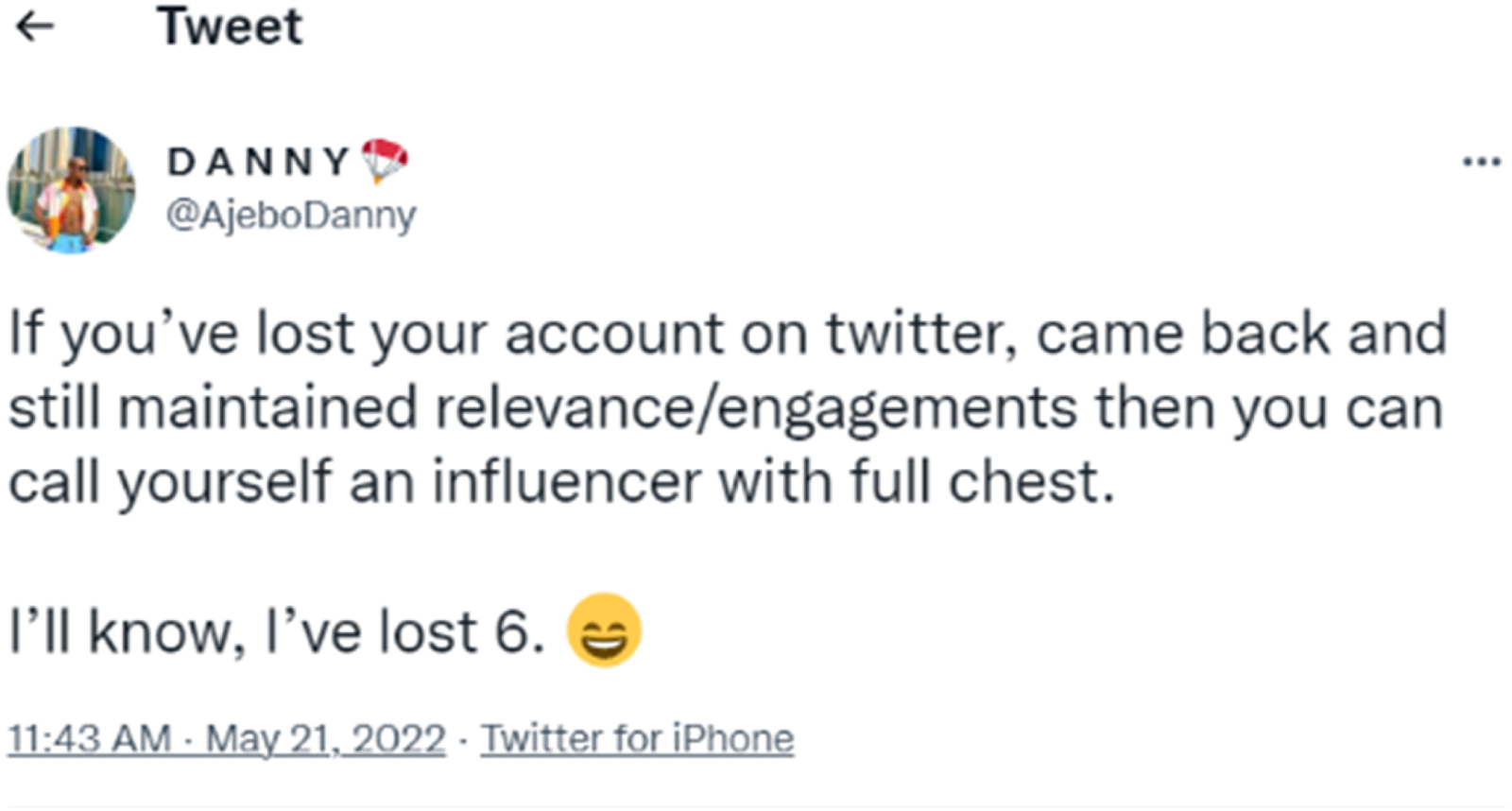
Data source: Twitter.com/ajebodanny.
After suspension, some influencers leave and do not return. For instance, Ceder left Twitter in early 2021 after the suspension of her account, as she could not bear the energy of building back. Some other influencers buy Twitter accounts that have a number of following already to avoid the stress of building a followers’ base back. For instance, Commentator said he bought an account with a large Twitter following after he lost his Twitter account. Some influencers, such as Strategist, continue with the other side accounts they had initially created and managed, given X affordance to manage up to five (5) accounts on one app. Some others create new accounts and start over again, as the influencer in Figure 9 above. These varied strategies evidence their ‘make-do’ side as bricoleurs, who engage with problems ‘rather than linger over questions of whether a workable outcome can be created’ (Baker and Nelson, 2005: 334).
Also, within these strategies, they rely on the networks they have created through their popularity or the lob (deck) groups they joined to help in increasing the visibility of their new accounts. In fact, they need these networks to sell them new accounts to buy. The unwillingness of some to come back to X indicates the potentiality of affective labour in dealing with the loss of influence, and the reliance on other technical strategies indicates how growing followership and influence comes to a full circle. Above all, these immaterialities in gaining followership and psychic income and in losing relevance indicate the practices of influencers in re-purposing platform affordances.
Essentially, this analysis section has placed bricolage, affective labour, identity entrepreneurship, and immateriality at its core to explain how influencers redefine and (re)build influence. Twitter influencership hinges on relevance through practices that showcase their innovative socio-technical exploits, affective relationships with their followers, and the immateriality of creativity and innovation in the digital economy.
Conclusion
To conclude, my central argument is that while the concept of affective labour is relevant to engaging with the study of social media influencership, it may not always be sufficient in explaining influencers’ rise to popularity. This is because influencers may engage in a set of platform-based practices before or alongside their engagement with affective resonance through their content. Using Nigerian X influencers as a case study, these practices include re-purposing the platform's affordance of users’ followers and content engagement lists, following–follower ratio, and APIs. Drawing on the theoretical concepts of bricolage and domestication, I describe influencers as bricoleurs, who are making do with the technological affordances they have available to them. In addition, I extend the analytical capability of the concept of bricolage by bringing it into conversation with the theories of social capital and affective labour to understand the immateriality of influencership. Through this triangulation, I argue that influencers’ practices of platform-based labour do not end with building followership, but they are also engaged when influencers lose their accounts or popularity.
At a time when alternative platforms are sought to X, 18 this study evidences that a focus on the practices of building followership, which is usually one of the first sets of platform-based practices for users, is important to consider in accounting for influencership. For example, the affordance of ‘starter packs’ on Bluesky (largely considered an alternative to X), which allows users to ‘mass’ follow up to 150 people at once (Chedraoui, 2024; The Bluesky Team, 2024), can serve as a tool re-purposed for popularity building. As such, what contributes to making a user popular may not always be their affective content, but rather the way they re-purpose platform affordances to amass followership. Although this does not suggest that they do not engage in affective labour to sustain their popularities, but understanding these practicalities can better inform scholarly engagement with the influencership and platform policies at large. As Murthy (2024: 184) concludes from their review of 1644 articles about Twitter, the study of Twitter provides a foundation to study users’ behaviours and conversations on similar platforms ‘regardless of where their new online home may be’.
Thus, this study presents the innovative practice of building followers and relevance by Nigerian influencers, one that redefines influence building beyond affective labour. I started with an epistemological justification for my ethnographic enquiry and the central theoretical orientation of my research. I place the theories of bricolage, affective labour, and identity entrepreneurship at the centre of influencer entrepreneurship. I then discuss my methodology, methods, and ethical considerations. In my findings, I demonstrated the platform-based practices and affectionate work used to build followership and sustain relevance online through massing, TweetDecks, retweet pods, and niche building. Lastly, within the context of an epistemological shift in the digital economy, I analysed the immateriality of online influencership through psychic income and loss of relevance.
This study is limited theoretically as it does not engage with institutional and resource constraints, as the theory of bricolage advocates. As such, further research can explore the practices of influencership within institutional constraints. Also, whilst the influencers interviewed in this study mostly had no materialistic benefits in mind when they joined X, it is important to note that the same may not be true for the new set of influencers who have seen the materialistic benefits of influencing, including children influencers who have been on the rise in recent times (DCMSC, 2022). Thus, further research can engage with the platform-based practices that emerging or children influencers adopt to examine the continuities or discontinuities with existing practice. In addition, an analysis of influencers’ profile bios as an affordance, alongside biography interviews, can further flesh out their identities and online practices.
Footnotes
Acknowledgements
The author is grateful to his MSc thesis supervisor, Dr Doris Okenwa, who patiently guided him throughout the research. He also thanks the influencers, followers, brands' representatives, and the Public Relations (PR) & media personnel interviewed for their time, listening ears and invaluable contributions to this study. Finally, he is grateful to the anonymous reviewers for significantly improving his arguments.

Ethical consideration
The study was approved by the Oxford School of Global and Area Studies (Ethical Clearance Reference Number: SSH_OSGA_AS_C1_22_030) on the 14th of March 2022. The application was considered on behalf of the Social Sciences and Humanities Interdivisional Research Ethics Committee (IDREC) in accordance with the procedures laid down by the University of Oxford for Ethical Approval of all research involving human participants.
Consent to participate
All participants in this study provided written and verbal informed consent prior to participating.
Funding
The authors disclosed receipt of the following financial support for the research, authorship and/or publication of this article: This research received the African Studies Centre Research Grants for overseas fieldwork – African Studies Centre, Oxford School of Global and Area Studies, University of Oxford.
Conflicting interests
The author declared no potential conflicts of interest with respect to the research, authorship and/or publication of this article.