




Abstract
The paper conceptualizes two distinct yet interconnected modes of judicial activism: courts as intervening in the policies and actions of other branches of government and courts as involved in their policymaking process. It proposes empirical methods to assess these modes and investigates them using a case study of Israeli Supreme Court justices’ votes from 2010 to 2018. Contrary to common perception, the findings reveal that justices demonstrate low and declining tendencies to invalidate laws (N = 544 votes in petitions challenging the constitutionality of laws) or policies established by the political branches (N = 22,415 votes in HCJ petitions). Justices’ attitudes towards the ideological underpinnings of contested legislation or policies exhibit minimal to no statistically significant influence on their votes. However, the analysis reveals a discernible and increasing pattern of covert judicial involvement, wherein justices exert pressure on the state to revise its policy before issuing a final ruling. Additionally, there is a diminishing trend of dismissing petitions in limine without accepting them for substantive review. These findings suggest that ISC justices engage in relatively low levels of intervening activism but high levels of involved activism.
Introduction
On January 4, 2023, only days after the formation of a right-wing government in Israel, the newly appointed justice minister announced the government’s intention to overhaul the Israeli legal system through a set of amendments to Basic Laws that would limit the judicial review powers of the Israeli Supreme Court (ISC), reduce the independence of the judiciary, and weaken the government’s legal advisors. The coalition contended that its proposed reform was a necessary response to the ISC’s rampant judicial activism and was crucial for restoring a proper balance of power between the political and legal branches. Israel’s prime minister, Benjamin Netanyahu, even declared the ISC to be “the most activist judicial court on the planet” (Winsor, 2023, July 27). A year later, following widespread protests against the government’s plans, the ISC invalidated the sole element of the overhaul that was actually amended, thereby establishing its authority to disqualify amendments to Basic Laws (HCJ 5658/23).
Judicial activism is a loaded term. In recent decades, the term has become a ubiquitous topic of public debate regarding the appropriate role of courts (Ginsburg & Versteeg, 2014; Roux, 2023), spreading from North America (Dickson, 2007; Murchison, 2017) to Latin America (Hauseggar & Sanchez-Urribarri, 2024), and from Europe (de Witte et al., 2013) to Asia (Sathe, 2002), Africa (Quansah et al., 2012), and Australia (Wheeler & Williams, 2007). Yet despite the salience of this debate and the undisputed real-world impact of judicial activism, the term remains ill-defined and fraught with multiple meanings (Canon, 1982; Barak, 1992; Garoupa, 2016; Staton, 2023). While many consider judicial activism a necessary safeguard in a checks-and-balances system, others use it as a pejorative term. Indeed, concerns over what is perceived as extreme activism have been a main impetus for initiatives aimed to curtail the courts’ power, not only in Israel, but in judiciaries worldwide (Grover, 2023; Hirschl, 2023).
This paper aims to better conceptualize judicial activism by distinguishing between two modes of the phenomena: courts as intervening in the policies and actions of the other branches of government, and courts as involved in the policymaking of the other branches. Judges are generally considered more activist in the intervening mode if they are willing to strike down or otherwise change laws or government policies. The focus of intervening activism is on how judges ultimately vote in judicial review cases. On the other hand, involved activism places emphasis on the justices’ reasoning and use of legal doctrines. An involved judge may reject a petition against the legislature or executive after thoroughly examining the case facts, declaring (but not exercising) the court’s broad remedial powers, and writing long obiter dicta discussing moral principles that may be unnecessary for the disposition of the case. These methods augment the judiciary’s power by enhancing its indirect influence in future policymaking processes.
This novel conceptualization is tested within the context of the ISC, which presents a useful case study. Despite its depiction as one of the most activist judiciaries globally, several empirical studies suggest that the ISC tends to defer to the political branches in most cases (Rosenthal et al., 2021; Weinshall & Epstein, 2020). Therefore, I hypothesize that ISC justices exhibit high levels of involved activism and low levels of intervening activism.
The empirical analysis utilizes voting data drawn from petitions filed between 2010 and 2018, encompassing challenges to the constitutionality of laws (544 votes stemming from 120 petitions) and petitions against parliamentary or governmental policies and actions (22,415 votes in 7418 petitions).
The findings support the hypothesis, revealing low and declining tendencies to invalidate laws and policies established by the political branches. The justices’ views on the underlying ideology of a challenged law or policy had little to no statistically significant impact on their decision to invalidate or uphold it. On the other hand, the analysis shows a distinct and intensifying pattern of covert judicial involvement in shaping state policies and actions, wherein justices exert pressure on the state to alter its policy before issuing a final ruling, thereby granting petitioners partial or full relief without publishing a reasoned judgment. Furthermore, the analysis unveils an overall declining trend in dismissal votes that dispose of cases in limine due to non-justiciability, lack of standing, mootness, ripeness, exhaustion, or on other procedural grounds. This trend effectively expands petitioners’ access to substantive review on the merits and increases the justices’ involvement in public policy.
The paper makes several contributions to the discourse on judicial activism in Israel and beyond. First, it introduces a novel conceptual distinction between the two modes of activism and provides empirical methods for testing it. The new conceptualization can accommodate the seemingly contradictory views on ISC justices’ level of activism. Additionally, to better distinguish between intervening activism and the potential ideological basis of judicial self-restraint, the paper introduces empirical measurement for both the ideological content of challenged policies and judicial ideology of the deciding ISC justice.
The article proceeds as follows: The next section explores the extensive literature on judicial activism in an endeavor to categorize the multidimension phenomena into two coherent concepts: intervening and involved activism. The thired section introduces the ISC and the ongoing debate surrounding the level of activism among its justices. In the fourth section, I present the research hypothesis and sets the stage for the empirical investigation, while the fifth section details the research design, dataset, and coding scheme. Results are reported in the sixth section and, in conclusion, the final section discusses the study’s implications, addressing its limitations and suggesting potential avenues for future research.
What is Judicial Activism? Between Intervention and Involvement
The entry on “judicial activism” in the Encyclopedia of Comparative Law commences with the assertion that “[j]udicial activism is a concept in search of a clearly defined phenomenon” (Roux, 2023). Indeed, there is no universally accepted definition for judicial activism. Since its first appearance in 1947, there have been numerous attempts to define the concept and several notable efforts to empirically measure it. Yung asserts that “perhaps the clearest conclusion one can draw from the various attempts to understand and define judicial activism is that the concept is ‘multidimensional’” (2011, p. 10).
Dimensions of Judicial Activism.
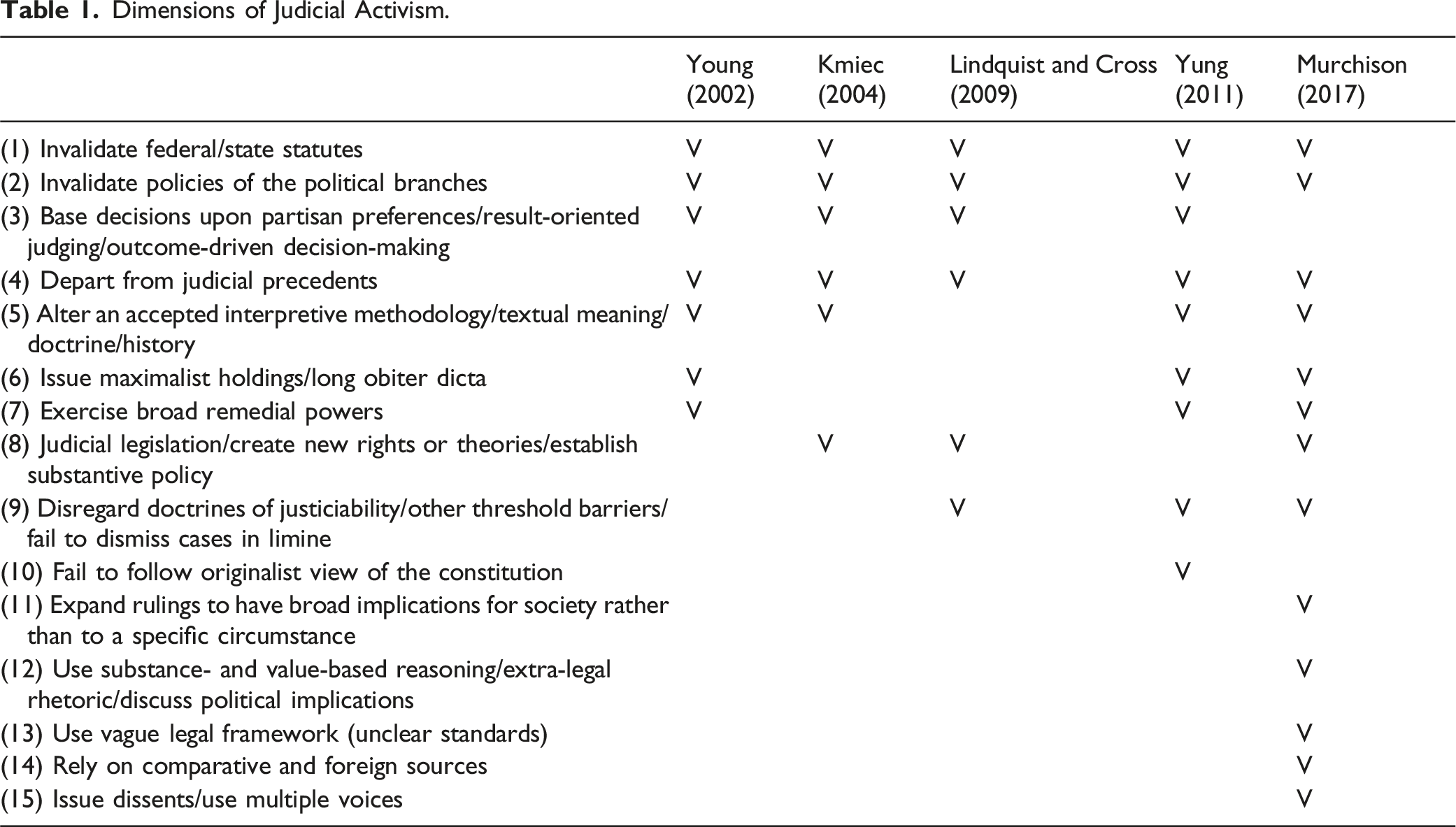
Staton (2023) contends that the multidimensional definition of judicial activism is an integral aspect of its complexity, which is further underscored by the absence of a definitive ranking of its various dimensions and the lack of a standardized rule for aggregation. The intricacy is heightened by the tension among the dimensions of judicial activism. A notable example is the potential clash between adhering to precedents and refraining from invalidating public policies (see also Young, 2002).
The fundamental premise of this paper is that judicial activism, as a multidimensional and complex phenomenon, can be better understood by categorizing its various dimensions along a spectrum between two distinct yet interconnected modes: intervening and involved activism.
The focus of courts as intervening in the policies and actions of the other branches of government is on how judges ultimately vote in judicial review cases. Intervening activism occurs when judges invalidate laws or governmental actions, thereby directly altering an established policy. Judicial restraint, on the other hand, is evident when judges uphold laws or policies made by other branches, particularly when those conflict with the judge’s policy preferences. Intervening activism aligns with the first two dimensions of judicial activism outlined in Table 1, and to a lesser extent, with the partisanship dimension.
The second mode of judicial activism centers not on the judges’ choice to intervene or defer to the other branches, but rather on the judges’ involvement in their policymaking process. Involved activism emphasizes the judges’ rhetoric, reasoning, and use of legal doctrines rather than their final votes. Thus, involved activism encompasses a broader and more obscure set of behaviors, most clearly expressed in rows 6 to 12 of Table 1.
The involved judge perceives the court’s role as broader than resolving disputes between adversaries or interpreting the law. It extends to establishing and safeguarding the prevailing values and ideals of society. Involved judges may be more inclined to disregard threshold barriers, expand justiciability, and accept cases for substantive review. They may address the legality of acts or policies that are not under review, potentially leading to what could be perceived as judicial legislation. Involved judges may interpret and apply the law in a manner that extends beyond the strict text of the law, often employing proactive decisions to shape public policy, even in the absence of clear legal precedent or legislative guidance. The techniques involved judges use include issuing broad or “maximalist” holdings rather than narrow or “minimalist” ones, creating new rights or using vague legal standards and framework. An involved judge may issue opinions inconsistent with legal tradition or opt not to use an accepted interpretative methodology. These methods augment the judiciary’s power by enhancing its indirect influence in future policymaking processes.
Scholars studying intervening activism typically focus on cases involving constitutional and administrative review, where judges’ decisions regarding the actions of other branches are more prominent. Involved activism, on the other hand, remains just as relevant when analyzing civil or criminal law. While the intervening mode tends to focus more on influencing specific and recently made policies, the involved approach is more often forward-looking, with its impact developing gradually over time.
An important distinction between the two modes of activism pertains to the significance of the judges’ policy preferences or partisanship. Neither mode of judicial activism is tied to a particular ideological orientation – both liberals and conservatives may exercise activism or self-restraint (Balkin, 2019; Easterbrook, 2002; Epstein & Landes, 2012; Epstein & Martin, 2011; Lindquist & Cross, 2009; Solberg & Lindquist, 2006; Weiden, 2011). However, while judges can often render a restrained or activist decision in the involved aspect irrespective of their stance on the reviewed policy, the same cannot be said for the intervening mode.
Determining the extent of the reviewing judge’s ideological alignment with the reviewed policy is crucial for assessing the level of intervening activism. This holds true for two different interpretations of the partisan dimension listed in the third row of Table 1. First, according to some scholars (e.g., Kmiec, 2004; Young, 2002), the use of judicial voting to achieve partisan or policy objectives is considered activist in itself. Second, a more contemporary interpretation distinguishes between policy-driven (ideological or partisan) voting and activist voting that expands the judiciary’s power, whether motivated by judges’ partisan preferences or their institutional/legal stance on the court’s role (Lindquist & Cross, 2009). In this second interpretation, policy preferences are relevant for measuring judicial self-restraint. In cases of full ideological alignment between a judge and the policy she reviews, the concept of restraint as non-intervention becomes misleading (Dotan, 2019). Epstein and Landes (2012) describe this as “opportunistic-restraintism,” wherein judges are inclined to uphold laws that align with their ideology.
A number of empirical studies have examined the ideological leanings of both the judges and the policies or laws under review in an effort to more effectively distinguish between judicial activism and the political dimensions of judicial self-restraint. Most of the studies conclude that votes to invalidate laws or policies (i.e., intervening activism) are more effectively explained by the justices’ ideologies rather than by a purely institutional stance on activism/restraint (Lindquist & Cross, 2009; Solberg & Lindquist, 2006). Epstein and Landes (2012), for example, showed this trend to be more prevalent among U.S. Supreme Court justices appointed after the 1960s, and Weiden (2011) observed that justices’ ideologies similarly play a role in their decisions to disqualify legislation in the high courts of Australia and Canada.
Note that the role of policy preferences in examining judicial activism necessitates an empirical analysis focusing on judges’ votes rather than courts as the unit of analysis (assuming judges hold diverse policy preferences). Consequently, most empirical studies assessing court’s activism analyze individual votes, with the understanding that a court cannot be considered particularly activist if none of the justices are (Epstein & Martin, 2012).
In concluding this section, I would like to emphasize that the intervening and involved modes of judicial activism are not mutually exclusive. A judicial decision invalidating a policy can be considered activist in both modes or only in the intervening aspect, depending on its reasoning. Conversely, an involved decision can choose to uphold the policy (i.e., refrain from intervention). Yet, it is possible (perhaps even likely) that intervening and involved activism are inherently interconnected. For a court to be effectively involved, it should occasionally intervene in the legislation, policies, and actions of other branches. But if the rate of intervention becomes too high, the court runs the risk of backlash from the political branches, which may ultimately jeopardize its involvement in the public arena (Hirsch, 2023). Thus, a low rate of intervention may help a court maintain its involved position. I investigate this potential relationship in the context of Israel’s Supreme Court.
Are ISC Justices Activists?
The ISC serves as an excellent case study for examining judicial activism. In line with the persistent contention surrounding the multifaceted dimensions of judicial activism, scholars disagree on the past and present levels of activism in the ISC. Before delving into this heated debate, let’s start by establishing some institutional facts.
The ISC operates as something of a hybrid between a common-law apex court, a lower court, and a civil-law constitutional court. In criminal, civic, and limited administrative spheres, the ISC acts as Israel’s highest appellate court. Most appeals, however, are a matter of right and not of discretion (unlike most other apex courts). In constitutional and most administrative petitions, when reviewing legislation or polices made by the executive and legislative branches, the ISC acts as the first (and final) instance on original jurisdiction. In this capacity, it is often referred to as the High Court of Justice (HCJ). The empirical investigation below centers on the HCJ petitions.
The different legal and institutional capacities of the ISC result in low control over its docket and extremely high caseload. These, in turn, are often viewed as key factors contributing to the relatively low dissent rate and ideological or political decision-making in the ISC (Weinshall & Epstein, 2020; Weinshall et al., 2018). Other factors include the composition of judicial panels and method of appointments. The ISC consists of 15 justices, usually sitting in three-justice panels. Panels are mandatorily extended in specific legal procedures pertaining to elections, retrials, and further court hearings, and may also be extended in any case according to the chief justice’s discretion. Enlarged panels are thus rare and generally indicate a salient case.
Justices are appointed by a Judicial Selection Committee composed of two cabinet ministers, two members of parliament, three justices and two representatives from the Israeli Bar Association. In order to grant the political coalition veto power, a 2008 amendment to the selection process stipulated that a special majority of seven of the nine committee members is required to appoint justices to the ISC. However, in later years, the amendment was utilized to provide the three justices with equal veto power. The composition and procedures of the Judicial Selection Committee was the first item on the government’s overhaul plan unveiled in January 2023, as it aimed to enhance the influence of the political coalition in the committee.
The ISC is often portrayed as one of the most activist courts in the world (e.g., Mautner, 2011; Sapir, 2018). Mautner (2011, pp. 75–98) attributes a perceivable increase in judicial activism to two socio-legal trends that emerged in the early 1980s. First, the ISC’s reasoning gradually changed from legal formalism to value-laden jurisprudence. Broad principles of law, moral judgments, and terms such as “reasonableness” became increasingly common in the court’s rulings. Second, the ISC’s self-perception shifted from that of a professional institution whose role is to settle disputes, to a view of itself as a political institution that participates in determining the country’s values and the distribution of its material resources.
Accordingly, tectonic changes in the ISC’s approach to administrative law in the 1980s led the court to open its gate by disregarding doctrines of standing and justiciability (Gavison et al., 2000). This allegedly marked a decline in the utilization of threshold barriers and other procedural grounds used to dismiss petitions in limine, thereby bypassing substantive review. Dotan (2002, 2013) claims that the willingness of the ISC to review almost any public action or state decision enabled interest groups and politicians to turn to the court on all public issues. Consequently, many administrative institutions began to adapt to the prevailing legal patterns of thought, and the influence of legal advisors rose as they were consulted to ensure that the government was acting in sync with the values the ISC upheld. Through such techniques, the ISC could gain wide impact on governmental policymaking even without direct litigation. Dotan refers to this process as “Israeli judicial hyperactivism.”
During the 1990s, the ISC expanded its activist approach from administrative to constitutional law. The court’s landmark ruling in United Mizrahi Bank v. Migdal (49(4) P.D. 221 (1995) marked a pivotal moment, affirming the court’s authority to invalidate legislation based on Basic Laws enacted in 1992. Over the ensuing decades, through a series of rulings, the court significantly expanded the parameters in what is referred to as “the constitutional revolution” (Jacobsohn & Roznai, 2020). For example, the ISC broadened the scope of rights protected by Basic Laws to include those not explicitly mentioned and even intentionally omitted in legislation (e.g., freedom of expression and equality). Furthermore, starting in the mid-2010s, the ISC began debating its authority to intervene in Basic Laws, establishing procedures for amending Basic Laws and discussing its power to invalidate them (Aronson et al., 2024; Shinar et al., 2020).
The perceived rise of judicial activism cannot be discussed without considering the political context. Notable trends of populism within Israeli political discourse, the escalation of societal divisions, and the erosion of individual rights, alongside the bolstering of nationalist elements, have catalyzed activist behavior. In turn, the court’s response to these trends heightened political resistance to its authority (Shinar et al., 2020). Reform proposals seeking to curtail the ISC’s power have been periodically proposed by the government since the early 2000s.
This culminated in the planned judicial overhaul of 2023. After facing significant opposition and protests, the coalition managed to pass only one amendment to the Basic Law: The Judiciary in July 2023. This amendment revoked the court’s authority to review government decisions based on the reasonableness doctrine. However, in January 2024, the ISC invalidated the amendment (HCJ 5658/23). The ISC, with 12 of 15 justices concurring, affirmed its authority to invalidate basic laws based on their content. The decision to invalidate the specific amendment was made by a smaller majority of eight justices. The ISC’s decision expanded the court’s powers by thwarting attempts to limit judicial review through the reasonableness doctrine and by extending judicial review to Basic Laws. 3
As an interim summation, critics of the ISC contend that through actions such as lowering the standing threshold and broadening the reasonableness criteria, the ISC has positioned itself as a policymaker with powers akin to those of the parliament. By asserting its authority to invalidate laws and even Basic Laws, the ISC is seen as assuming a position of superiority over the parliament.
However, other scholars contest this view, arguing that despite the court’s activist rhetoric since the 1980s, its actual decision-making has consistently displayed a restrained approach (e.g., Medina, 2007). Notable in this regard is the fact that since the 1995 United Mizrahi Bank decision, the court has invalidated laws in only 24 cases. Lurie and Shany (2019) argue that this indicates a restrained approach of approximately 0.8 instances of legislative invalidation per year, a significantly lower invalidation rate than that of similar apex courts (e.g., 3.6 invalidations annually in South Africa, 2.3 in the U.S., 1.6 in Canada, and 1.3 in Ireland).
Several empirical studies indicate similar trends in HCJ administrative petitions (Dotan, 2013; Weinshall & Epstein, 2020, p. 427). Rosenthal et al. (2021), for example, focused exclusively on HCJ petitions against elected politicians that were fully adjudicated on the merits. Their research, examining nearly 10,000 judgments on the merits issued between 1995 and 2017, found that approximately 10% of petitioned were partly or fully accepted. Moreover, they identified a trend of declining acceptance rates for petitions since 1995 and attributed this trend to the 2008 reform in the Judicial Selection Committee, noting that justices nominated after 2008 have exhibited a lower degree of “interventionism” compared to their colleagues who joined the ISC prior to 2008.
It is important to note that previous studies did not consider two critical factors in determining intervening activism: the ideological content of the challenged law or policy and the ideology of the deciding justice. As noted, the mere act of a justice abstaining from invalidating a policy does not automatically indicate judicial restraint; it could equally arise from ideological alignment with the contested policy. The proposed measurement in this study aims to address both these factors.
In summary, an overview of the scholarship in the field reviled a rich body of literature describing the ISC’s activist approach. On the other hand, there is also considerable research, supported by some empirical evidence, suggesting that judicial restraint is the ISC’s salient approach. That is, far from intervening in the policies of the executive and legislative branches, the ISC tends to defer to them in the vast majority of cases.
Research Hypotheses
This study suggests that by conceptualizing and distinguishing between two modes of judicial activism, we can better assess levels of activism in the ISC. My primary hypothesis is that ISC justices display high levels of involved activism and low levels of intervening activism. By expanding the right of standing, emphasizing the concept of justiciability of all government acts, and asserting its authority to invalidate legislation on a growing number of causes and even in Basic Laws, the justices have established their involvement in political questions and public debates. These techniques are indeed manifested to a great degree in the rhetoric and doctrine embraced by justices, rather than their final votes.
This hypothesis can be best explained using the example of ISC rulings on security policies. Empirical studies in recent decades have indicated that despite employing human rights (activist) rhetoric, ISC justices rarely intervene in security policies (Davidov & Reichman, 2010; Dotan, 1999; Hofnung & Weinshall-Margel 2011; Kretzmer & Ronen, 2021). While some argue that this suggests the ISC primarily acts to legitimize state practices in the occupied territories (Kretzmer & Ronen, 2021), others delve into the more subtle ISC involvement in shaping security policies.
In a previous study (Hofnung & Weinshall-Margel, 2011), I pointed towards two mechanisms of involvement employed by ISC justices in these cases. The first mechanism is expressed in a recurring pattern of reasoning in three consecutive stages. In the initial stage, justices explicitly endorse a broader interpretation of the justiciability of security issues. In the second phase, the legality of the policy at hand is discussed. Finally, in the third stage, justices meticulously examine the challenged action, often employing legal criteria such as proportionality or reasonableness. The study showed that 95.6% of security-related petitions reached the third stage, arguably enhancing the involvement and influence of the ISC by causing commanders and policymakers to consider the justices’ positions on security matters when making their initial policies. Kretzmer and Ronen (2021) claim that this mechanism casts a “shadow” of influence through which the ISC impacts security policies.
The second mechanism functions as an indirect form of covert influence, whereby the ISC justices apply pressure on the state to amend its policies prior to a final ruling. During hearings, justices subtly express discontent with the state’s actions, prompting reconsideration in order to avert an unfavorable legal outcome. Consequently, if the state indeed changes its policy, petitioners may choose to withdraw their petition or agree on a settlement, knowing that the court is likely to reject their petition if they continue with the proceedings. This dynamic is exemplified in a series of petitions contesting the route of the security barrier between Israel and the West Bank. Throughout the court hearings, justices expressed sentiments favoring the petitioners’ stance and recommended reevaluating the barrier’s location to forestall potential legal precedent against the state’s security policies. In some instances, the state adjusted the barrier’s path to meet petitioners’ satisfaction, prompting withdrawal of the case. Alternatively, the Ministry of Defense agreed to revise some, but not all, of the barrier’s route. Petitioners in such scenarios often opt for settlement agreements, though some may accept the partial victory and withdraw, or proceed with court proceedings (Hofnung & Weinshall-Margel, 2011, pp. 677–679).
Dotan (2013) provides additional insight into the covert mechanism at play, describing a subtle signaling system employed by the justices during court proceedings. He asserts that this covert mechanism has become a prevailing mode of the HCJ’s involvement in all policy matters, facilitated by government lawyers who have internalized and spread the court’s values. In a recent study examining case outcomes in all ISC cases, we found empirical support for Dotan’s claim (Weinshall & Epstein, 2020).
The covert mechanism shares a common feature with intervening activism, as the pressure exerted by the justices often results in a direct alteration of recently enacted state policy. Nevertheless, the covert mechanism is more accurately classified as involved activism due to the absence of judicial voting in the process. The decision to change a policy during litigation is ultimately made by government lawyers and the state, not by the justices. Moreover, as highlighted by Dotan (2013), the empowerment of government lawyers (as agents of the court) to negotiate settlements and affect policies further enhances the court’s indirect influence on future policymaking processes, sometimes even widening its impact in policy formation stages without direct reference to litigation. Despite its significant effect on both immediate and future state policies, the court’s covert involvement remains unpublished and does not establish legally binding precedents. This also affords the court flexibility in how to wield its power and influence in future cases, a trait that also aligns more closely with involved activism.
In summary, my assumption is that ISC justices will exhibit low levels of intervening activism: They will largely refrain from striking down laws as unconstitutional or accepting petitions against the state’s policies or actions. In addition, their votes in constitutional and administrative petitions are not expected to highly correlate with their ideological policy preferences. On the other hand, I expect to find high levels of involved activism in the ISC: Justices are likely to demonstrate a relatively high frequency of covert involvement in shaping state policies and actions and relatively low rates of dismissal votes (which dispose of cases in limine, thereby denying petitions access for substantive review on the merits). Note that I focus on these two forms for involved activist behavior because they can be discerned through judicial votes and case outcomes. Assessing other dimensions of involved activism will necessitate employing methods of computational text analysis, as the phenomenon primarily manifests through rhetoric and reasoning within court documents.
Determining the degree of intervention or involvement is subjective and often obscured. What constitutes a low or high rate? Some may argue that invalidating even one law is momentous, while others may contend that simply counting accepted or rejected petitions fails to capture the true magnitude or impact of judicial activism. To address this concern, I incorporate indicators for case salience. Still, establishing a definitive threshold for what constitutes high or low level of activism remains subjective. I thus explore time trends as a point of reference. The empirical examination in this study covers a nine-year period ending in 2018 (well before the current political debate on the issue). My hypotheses include a declining trend in votes invalidating laws and policies over these years; a growing trend of covert involvement; and a decrease in dismissal rates.
Data and Measurement
To test these hypotheses, I extracted voting data from the population of HCJ petitions filed between 2010 and 2018. The data includes 544 votes stemming from 120 petitions challenging the constitutionality of laws, and 22,415 votes on 7418 petitions submitted against the policies and actions of the executive or legislative branches. The data was initially sourced from the ISC Database (Weinshall & Epstein, 2020) 4 and subsequently customized and expanded to investigate intervening and involved activism.
Distribution of Votes/Outcomes.
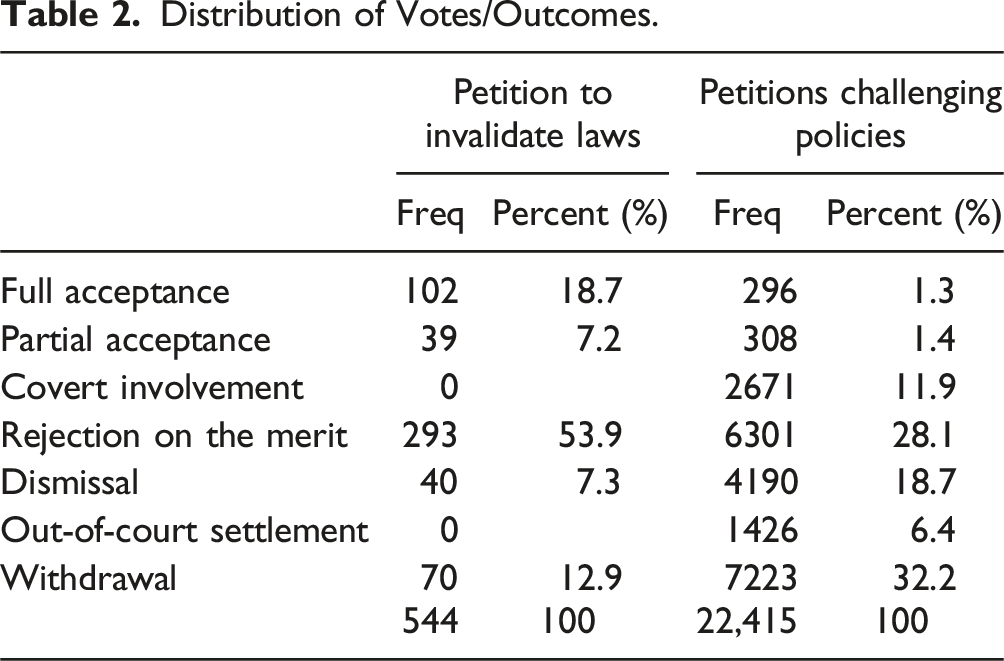
53.9% of votes regarding laws and 28.1% of votes concerning state policies reject petitions on their merits, thereby upholding the challenged law or policy. This outcome also occurs in 7.3% and 18.7% of votes, respectively, dismissing petitions in limine due to threshold barriers such as non-justiciability, lack of standing, mootness, ripeness, exhaustion, and other procedural grounds. As explained, these are also considered restraint votes in the involved mode of activism.
Approximately half of the petitions challenging state policies were not resolved through judicial decisions. However, justices covertly influenced 11.9% of their outcomes. Covert involvement was observed in cases resolved through in-court settlements or withdrawals after petitioners were granted partial or full relief (oral hearings were conducted in covert involvements). Additionally, 6.4% of case outcomes involved out-of-court settlements, typically occurring before oral hearings. Finally, about a third of the policy petitions were withdrawn without discernible relief granted to the petitioners, often in response to indications from the justices that the petition lacks substantial legal grounds.
Petitions challenging the constitutionality of laws tend to be high-profile and usually result in published decisions. Covert influences or settlements are irrelevant to these cases. However, 12.9% of outcomes involved the petitioners’ withdrawal, sometimes after justices threatened petitioners with court fees if they did not rescind frivolous petitions.
Descriptive Statistics.
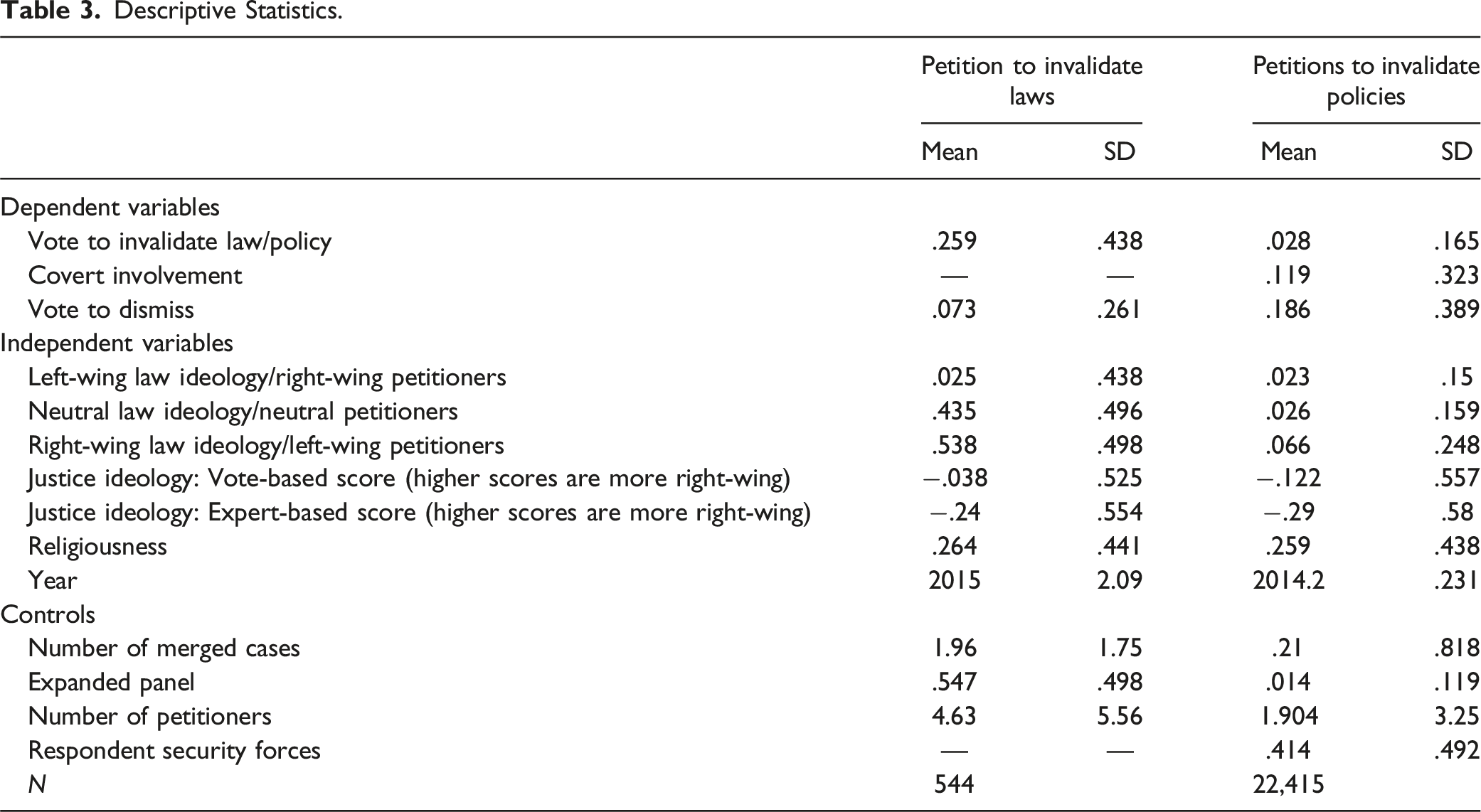
Assessing the underlying ideology of contested laws was straightforward, apparent in both their content and the list of petitioners, which frequently included parliament members or NGOs aligned with recognized positions on the political spectrum. Table 3 shows that 53.8% of votes pertained to laws associated with right-wing ideology (and left-wing petitioners). One example is the Anti-Boycott Law. Under this law (which was later invalidated in HCJ 5239/11), anyone advocating a boycott of Israeli entities or settlements in the West Bank could be required to pay exemplary compensation. The prevalent right-wing ideology of contested legislation mirrors the political context in Israel. During the nine years studied, the governing coalition was consistently led by Netanyahu and the right-wing Likud party, with varying combinations of centrist or leftist parties. Thus, few laws promoting left-wing ideology were enacted during this timeframe, accounting for a mere 2.5% of justices’ votes. The few left-leaning laws are all linked to economic ideology, property rights, or occupational freedom, skirting around the more prominent ideological divides in Israel. 43.5% of the votes pertained to ideologically neutral laws, such as an amendment altering the government’s budget approval from two years to one year. Some laws faced challenges from both the right and left, such as a land ownership amendment (within the Green Line, HCJ 729/10); these cases were also classified as neutral.
I also employed the petitioner’s identity as an indicator to gauge the ideological underpinnings of challenged government policies. 5 Aligned with the prevailing right-wing government during the study period, nearly three times as many votes pertained to petitions filed by left-leaning NGOs or members of parliament (6.62%) compared to those by the right (2.3%). 2.6% of votes involved petitions from neutral NGOs or legislators representing both sides of the political spectrum. All other petitions were submitted by individuals, businesses, NGOs, and other organizations that did not fit into the categories described above.
Measuring the justices’ ideology posed a challenge. Up until a decade ago, appointments to the ISC were not part of the political fray and in most cases the candidate’s ideological views were not public knowledge. Meetings of the Judicial Selection Committee were held behind closed doors, without any public hearing to illuminate the ideological values of the prospective justice. While in recent years this has gradually changed and today each appointment to the ISC is politically scrutinized, there is limited public information regarding justices appointed prior to 2010. Thus, a measurement based on editorials, for example, such as the Segal-Cover scores (Segal & Cover, 1989), is not yet possible. I thus offer three alternative measurements of judicial ideology, based on prominent methods discussed in the literature (Epstein et al., 2024).
The first is based on experts’ assessments of the justices’ ideology as an exogenous measure. Seven jurists served as the experts. All seven are personally familiarity with the ISC: two were former interns or legal assistants to ISC justices; two were practicing attorneys with extensive experience as litigators at the ISC; two were public law professors; and one was a member of the Judicial Selection Committee. Three of the experts embodied multiple categorizations, having transitioned from internships at the ISC to legal practice or an academic career. Notably, the composition of the experts reflects the political landscape in Israel: three of the experts self-identify as right-wingers, three as left-wingers, and one as a centrist.
The experts placed the justices’ ideological orientations on a scale ranging from −1 (left) to 1 (right) within the context of the three pivotal domains in Israeli politics: national security, state and religion, and economic policy. The experts were then asked to assign a general ideological score to each judge (from −1 to 1). The means of the general scores were used for the “Expert-based scores” variable (for a more detailed explanation of the index’s formulation and the outcomes, see Weinshall-Margel, 2016, pp. 64–78, 137–139, 159).
The second variable measuring judicial ideology – “Votes-based scores” – is based on ideal-point estimates. It is an endogenous measure derived from justices’ voting patterns in civil rights cases starting in 2000, including freedom of religion, political rights, right to dignity, and economic rights. The measurement draws inspiration from the well-established Martin-Quinn scores utilized for U.S. justices (Martin & Quinn, 2002), with adaptations tailored to the ISC. The scoring follows the convention of the liberal-conservative split in the U.S.: negative values signify a leftist ideology, while positive values indicate right-wing leanings, where higher numeric values correspond to a stronger right-wing inclination (see Weinshall et al., 2018 for a comprehensive explanation).
A third alternative measurement considers the religiousness of the justices. This personal attribute serves as a direct, albeit somewhat rudimentary, indicator of ideological inclinations in matters concerning state and religion. When it comes to issues of national security, being a religious Jew in Israel is a strong indicator for holding right-wing policy preferences (Ben-Porat, 2021). Research indicates that religious ISC justices are more inclined to rule in favor of religious interests (Weinshall, 2011), expand the rights of extremist right-wing parties to participate in elections (Weinshall-Margel, 2016), and rule against the state in constitutional matters (Rosenthal et al., 2021; Weinshall, 2021). In other socio-legal matters, scholars have not found statistically significant effects of religiousness on justices’ votes (Weinshall-Margel, 2016; Weinshall, 2021). Note that religiousness cannot serve as a clear-cut indicator of economic ideology because the religious-secular divide in Israel does not significantly correlate with economic ideology.
Another disadvantage to this measurement is that it is coded as a binary variable, allowing justices to be identified as either Jewish-religious or not. 6 Yet, in reality, a wide spectrum of religious and secular orientations exists. For instance, being a non-observant Jew does not necessarily imply a disbelief in God. Nevertheless, despite these complexities, this measurement still holds value as an objective criterion, offering a rough division that is particularly useful for categorizing religiously observant justices, albeit with less nuance for their non-religious counterparts.
The religiousness of justices is a matter of public knowledge in Israel. In our data, all justices coded as religious adhered to the basic principles of Jewish law: observing the Sabbath and dietary restrictions, and visibly covering their head in a way that distinguishes themselves as Orthodox Jews (see Weinshall, 2011 for more on religiousness as a measure of justices’ ideology in the ISC).
To assess consistency and disparities among the three measurements of judicial ideology, I investigated their correlations and found robust associations. 7 The similarity among the results of the various ideological scores is also apparent when examining the data presented in Table 3. The negative values indicate that the ideological alignment of the justices leans towards a left-wing perspective, consistent with their widely accepted characterization. Approximately 26% of the votes were rendered by religious justices. This percentage corresponds to the representation of religious justices in the ISC, which has slowly risen from around 10% in the 1990s to 26.7% in 2018 (Weinshall, 2021).
Table 3 includes several additional factors that could potentially influence the ISC’s votes on whether to invalidate laws or policies. First, I analyzed time trends using the year of the final court judgment. Second, I investigated the impact of factors that indicate case salience. These factors include the number of petitioners, the merger of multiple petitions submitted to the HCJ (all contesting the same policy), and whether the case was assigned to an expanded panel of more than three justices.
Indeed, Table 3 highlights the salience of petitions aimed at invalidating laws, with an average of 4.63 petitioners, 1.96 merged petitions, and 54.7% of votes rendered in cases that were assigned to expanded judicial panels. This can be contrasted with the average numbers of 1.9 petitioners, 0.2 merged petitions, and a 1.4% rate of expanded panels in votes referring to other petitions submitted to the HCJ.
Finally, the respondent’s identity was also considered as a determining factor in justices’ decisions. All petitions aimed at invalidating a law were addressed to the parliament as one of the respondents, and most of the petitions also included the government. In general, I did not find significant differences between the parliament and government as respondents. This may be attributed to the structure of the parliamentary regime in Israel, where the executive branch is formed by a parliamentary majority. However, the inclusion of the security forces as one of the respondents did demonstrate significant effects, consistent with previous studies concerning petitions that challenge state security policies (Dotan, 1999; Hofnung & Weinshall, 2011; Kretzmer & Ronen, 2021).
Results
Intervention in Legislation
Probability of Voting to Invalidate a Law.
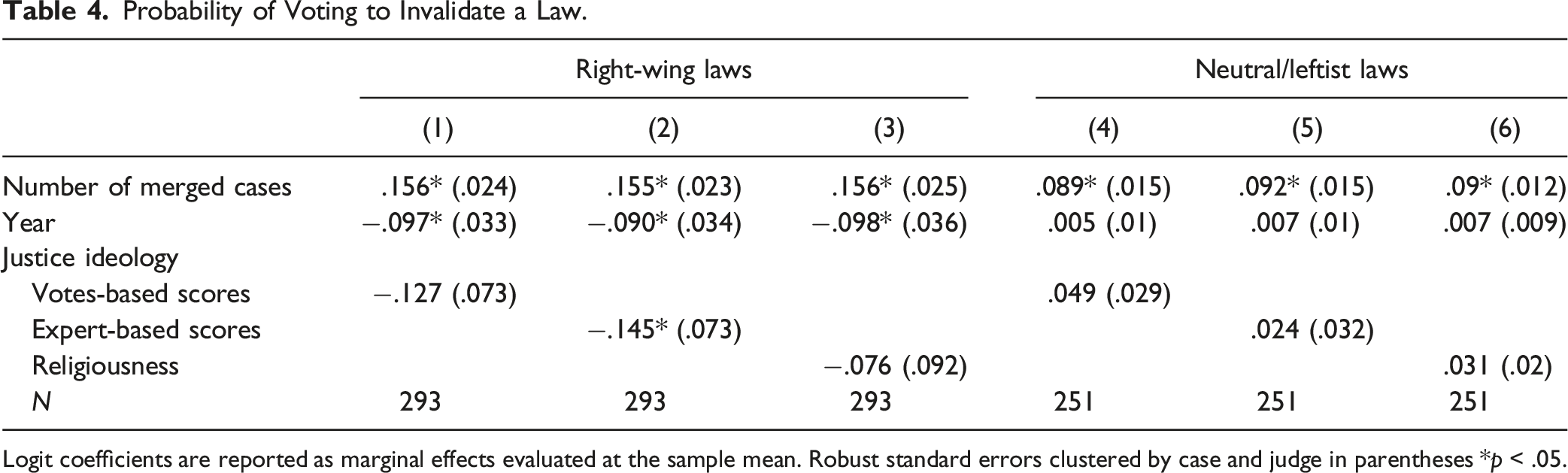
Logit coefficients are reported as marginal effects evaluated at the sample mean. Robust standard errors clustered by case and judge in parentheses *p < .05.
The coefficients of justice ideology are most relevant for our purposes. Although all six coefficients indicate that right-wing justices are more likely to strike down neutral laws and left-wing justices are more likely to reject right-wing laws, five of the effects are not statistically significant at p < .05. The only statistically significant effect is that of the expert-based score, suggesting that justices who align with right-wing ideology are less likely to invalidate right-wing laws. The number of observations in the models (293 for right-wing laws and 251 for neutral legislation) could potentially contribute to the lack of a significant effect. However, this still suggests that any potential influence of policy preference on intervention is weak.
On the other hand, the effects of some of the indicators of case salience are substantial. In fact, all petitions that invalidated a law were decided in expanded panels, which creates a collinearity issue, leading to the exclusion of this variable from the models presented in Table 4. The number of merged cases exhibits significant effects in all models, particularly when deciding on right-wing laws. The number of petitioners did not show any significant effect, and due to the number of observations, I excluded it from the analysis.
Finally, the results indicated a significant negative time trend for right-wing legislation, but not for left-wing laws. The probability of a judicial decision invalidating right-wing legislation decreased by approximately 7.5% from 2010 to 2018.
Intervention and Involvement in Policies Made by Other Branches
I employed various approaches to assess justices’ intervention in the policies and actions of other branches, all yielding consistent findings. Models a1 and a2 in the left side of Figure 1 depict the odds ratios derived from logistic regression analyses predicting the probability of judicial votes to intervene in policies by fully or partially accepting HCJ petitions. In models 1a, three distinct regressions are presented, delineated by the petitioner ideology: those submitted by left-wing NGOs and parliament members (N = 1482), right-wing (N = 504), and neutral (N = 320). Model a2 displays results encompassing all petitions (N = 22,415 votes) and includes an interaction term between justices and petitioner ideology. Regression models predicting votes for intervention/covert involvement in policies.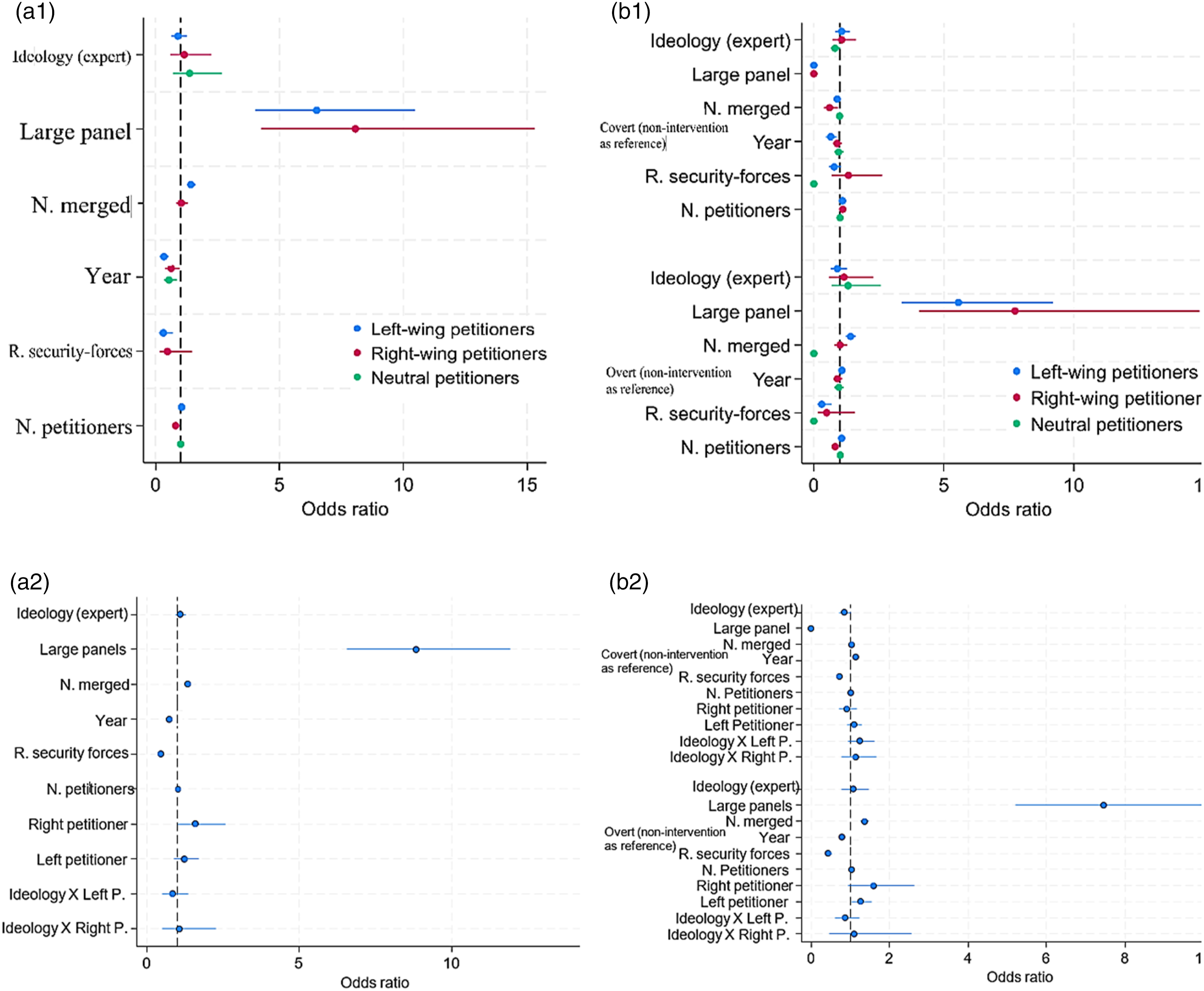
This analysis consolidates petitions dismissed or rejected in judicial decisions with covert involvement in the non-intervening category. Therefore, models b1 and b2 present results for multinomial logistic regression predicting one of three outcomes: covert involvement, (overt) interventions as defined in models a1 and a2, and non-intervention. Non-intervention serves as the reference category, and includes rejections, dismissals, and withdrawals without any known relief granted to the petitioners. Models b1 illustrate votes in petitions submitted by the three ideological groups, while model b2 analyzes all 22,415 votes.
An additional analysis, focusing solely on intervening or upholding policies in cases resolved via court rulings, is presented in the Appendix (Table A), indicating similar trends. It is important to note that justices’ ideological scores in all models presented in Figure 1 are based on experts’ assessments. Equivalent analyses for ideology scores derived from judicial votes or religiousness are provided in the Appendix, all yielding nearly identical results. Tables A, B, and C in the Appendix report logit coefficients for all models as marginal effects evaluated at the sample mean. Standard errors are clustered by case and justice in all models (in Figure 1 and in the Appendix).
I begin by examining the effects of the justices’ ideology. Estimates for all models show that the ideological inclinations of justices had no statistically significant impact on their votes to intervene in the actions of other branches. This finding remains consistent across various ideological groups of petitioners (in models a1 and a2), when testing for the interaction terms between the petitioner’s and justice’s ideology (models b1 and b2), and when employing the three different measurements of judicial ideology (see in the Appendix).
However, model 2b for predicting covert involvement reveals a very subtle yet statistically significant influence of justices’ ideology on the likelihood of covert intervention compared to non-intervention. The findings indicate that justices leaning to the left and secular justices tend to engage in covert interventions more frequently than their right-wing or religious counterparts. However, the non-significant estimates of the interaction term in all models and categories suggest that this trend is unaffected by the ideology of the challenged policy.
Models b1 and b2 show higher probability of an (overt) intervening vote in petitions submitted by both right-wing and left-wing NGOs and politicians compared to all other petitioners (statistically significant in all models). One likely reason is that, as repeat players, NGOs from both sides of the political spectrum tended to select cases with a higher likelihood of success. Model b2, however, shows that the ideological alignment of petitioners does not yield statistically significant effects on the likelihood of covert interventions.
The most noticeable effect is evident for panel size. An extended panel increased the likelihood of overt interventions while reducing covert involvement across all models. Other indicators for case salience exhibited mixed effects. Merging petitions increases the likelihood of overt intervention, especially for petitions submitted by left-leaning groups. Models b1 and b2 indicate that as the number of petitioners increases, so does the likelihood of overt interventions (as well as covert involvement, according to the model b2).
All models demonstrate a notable decrease in the likelihood of intervention when including the security forces as one of the respondents. This finding is consistent with a body of research suggesting that Israeli justices exhibit reluctance to overtly intervene in security-related policies (Dotan, 1999; Hofnung & Weinshall, 2011; Kretzmer & Ronen, 2021). Model b1 which evaluates votes in cases submitted by neutral petitioners, reveals that for this group alone, the likelihood of covert intervention also diminishes when the actions or policies of the security forces are under challenge.
Finally, corresponding to the time trend observed regarding the invalidation of legislation, the analysis indicates a general decrease in the likelihood of interventions that lead to the invalidations of the policies or actions of other branches, especially those leaning toward the right. The negative significant effects evident in model a2 for all HCJ votes and in model a1 for left-wing or neutral petitions were not statistically significant for cases submitted by right-wing petitioners.
Conversely, model b2 indicates that the likelihood of covert intervention increased from 2010 to 2018. In essence, over the studied years, covert intervention became more prevalent. This phenomenon could be attributed to the justices’ preference for promoting settlements instead of rendering judgments, or it may reflect changes in litigant behavior. Regardless of the underlying cause, models b1 demonstrate that this trend does not apply to petitions submitted by left-wing NGOs or politicians. In these petitions, I observe a significant opposing trend: the likelihood of covert intervention also decreases over the years, while the likelihood of non-intervention increases.
Figure 2 displays the results of logistic regressions predicting the probability of a vote to dismiss. Models a depict the probability within a subset of cases brought by left-wing or right-wing petitioners,
8
and model b represents all petitions. The full results of the regressions are presented in Appendix Table D, which includes estimates for regressions utilizing various scores for judicial ideology. Regression models predicting dismissals.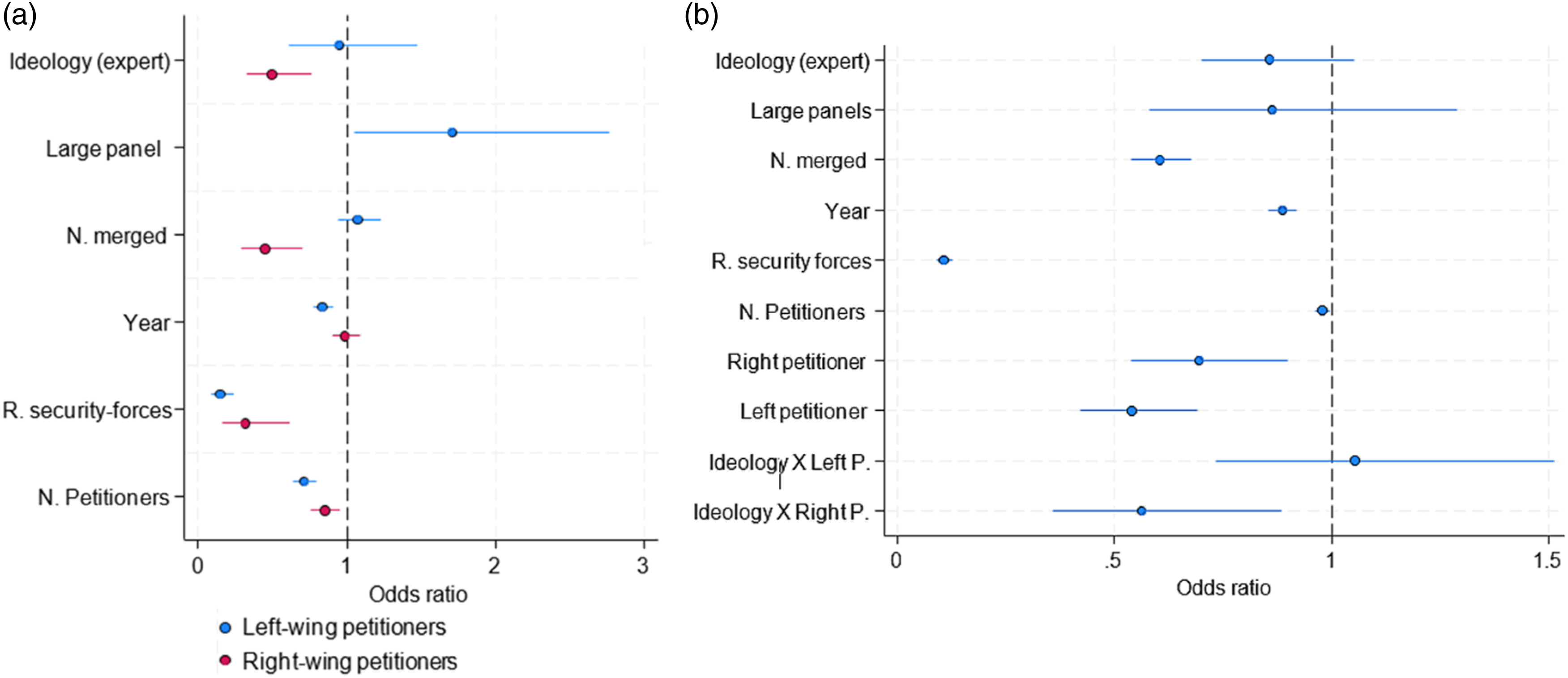
In contrast to previous analyses, judicial ideology exhibited a statistically significant effect, albeit only for petitions submitted by right-wing NGOs and politicians. Model a suggests that the more a justice leans towards the right, the less likely she is to vote for dismissal in these cases.
Consistent with previous findings and as anticipated from repeat players, model b indicates that petitions submitted by both right-wing and left-wing NGOs and politicians are less likely to be dismissed. The same pattern holds true for petitions challenging security policies. The variables testing for merged cases or enlarged panels are less relevant for this analysis, as such decisions are typically made after cases have passed the dismissal stage.
Lastly, results across all models and estimates reveal a statistically significant negative time trend, indicating that over the study years, justices have become less inclined to dismiss cases in limine, without substantial review.
Discussion
The findings are in line with the research hypotheses, indicating that ISC justices exhibit relatively low and decreasing levels of intervening activism, along with high and increasing levels of involved activism. Contrary to public perception, the ISC does not seem to exhibit activist-intervening tendencies. The rate of intervention in the policies of other branches is notably low: Only 2.8% of justices’ votes fully or partially reversed a policy made by other branches. Justices’ views on the underlying ideology of challenged policies had little to no statistically significant impact on their decisions to invalidate laws or polices. The analysis uncovers a general declining trend in judicial intervention between 2010 and 2018, especially salient when deciding on right-wing legislation and policies.
In terms of involved activism, justices displayed a stronger inclination towards covertly influencing policymaking, accounting for 11.9% of outcomes, compared to the 2.8% overt interventions. This trend too is increasingly prominent over time. Establishing a clear threshold for high or low dismissal rates proves challenging. However, considering that HCJ petitions are directly filed to the ISC as a first instance, with anyone permitted to submit a petition, no need for legal representation, and only a nominal filing fee (around $450), a dismissal rate of less than 19% does not seem high. This perception is reinforced by the high rates of rejections and withdrawals following justices’ recommendations during the initial oral hearings, suggesting that some petitions might have been dismissed outright. Additionally, the analysis indicates a consistent decline in dismissals over time, bolstering standing and justiciability, and broadening access to the ISC in a way that may expand judicial involvement in public policymaking.
The study has some obvious limitations. Firstly, numbers may not reveal the “real” story here. The relatively low intervention rate could be attributed to the large number of HCJ petitions filed and, in particular, to the fact that the justices hear these cases as a first instance rather than through case selection. Furthermore, even if justices only intervene in a small fraction of laws and policies, the intervention occurs in monumental and significant cases that shape the public sphere. However, when considering the context of the policies and laws that were invalidated, there seems to be little support for this argument. For instance, of the 24 laws invalidated by the ISC, most pertained to issues such as illegal immigration or asylum seekers, rights of detainees and prisoners, tax benefits, and social security matters. While these are important topics, they are not at the forefront of the political debate in Israel. Even when examining laws related to national security, the court’s interventions were primarily related to monetary compensation for tort injuries or due process issues. The exception was in matters related to state and religion, particularly the highly sensitive issue of exemptions from military service granted to ultra-Orthodox men. In any case, given the small number of laws invalidated and their specific contexts, characterizing the ISC as the most activist court in the world is unsubstantiated.
Other limitations pertain to measurement. As detailed in Section 4 (Research Hypothesis), quantifying justices’ ideology poses a particular challenge within the ISC context and may have resulted in imprecise scores, potentially leading to results showing no effect. However, this concern is partially alleviated by employing three distinct ideological scores, each derived from a different source (expert evaluation, justices’ votes, and personal attributes), all converging on similar scores.
Measurements of involved activism present a greater challenge. The study focused solely on two aspects of the phenomenon: covert involvement and dismissals in limine. These aspects were chosen due to their discernibility through empirical analysis of voting and case outcomes. However, the conceptualization of involved courts encompasses many unmeasured aspects, such as the distinction between maximalist and minimalist holdings or value-laden language.
Future research should focus on developing metrics for assessing involved courts and justices. Since techniques for expanding involvement are reflected more in justices’ rhetoric and reasoning, these metrics may be best suited for analysis using Natural Language Processing tools. The development of such metrics could facilitate further exploration across various courts, as well as the investigation of potential correlations between the two forms of judicial activism. Are findings from the Israeli case relevant to other courts worldwide? Do involved courts and justices intervene less in governmental policies, and vice versa? Is there a dialectical relationship between the two modes of judicial activism? These questions remain open for future research.
Supplemental Material
Supplemental Material - Reconceptualizing Judicial Activism: Intervention Versus Involvement in the Israeli Supreme Court
Supplemental Material for Reconceptualizing Judicial Activism: Intervention Versus Involvement in the Israeli Supreme Court by Keren Weinshall in Journal of Law and Empirical Analysis.
Footnotes
Acknowledgments
I thank Yoav Dotan, David Grundmanns, Ronit Levine-Schnur, Barak Medina, Urška Šadl, Jeff Staton, the editors of the Journal of Law & Empirical Analysis, and the anonymous reviewers for their valuable insights and comments.
Declaration of Conflicting Interests
The author(s) declared no potential conflicts of interest with respect to the research, authorship, and/or publication of this article.
Funding
The author(s) received no financial support for the research, authorship, and/or publication of this article.
Supplemental Material
Supplemental material for this article is available online.
Notes
References
Supplementary Material
Please find the following supplemental material available below.
For Open Access articles published under a Creative Commons License, all supplemental material carries the same license as the article it is associated with.
For non-Open Access articles published, all supplemental material carries a non-exclusive license, and permission requests for re-use of supplemental material or any part of supplemental material shall be sent directly to the copyright owner as specified in the copyright notice associated with the article.
