




Abstract
Why do judges disagree about judicial reasoning – i.e., the use of legal reasoning in adjudication – and how can such disagreement be studied empirically? We propose a general theory of variation in judicial reasoning that focuses on a core element of legal analysis – the choice of authoritative sources. In particular, we argue that source-based disagreement is likely to manifest itself on two dimensions: The degree to which extra-national versus national and extra-legislative versus legislative sources should be relied on. Where judges place themselves on these dimensions have important normative implications for the origin of and power over law, and in particular the status and power of the national legislator. We demonstrate the strength and usefulness of our theory with original data from more than 3400 judicial opinions of the Swedish Supreme Court over a 40-year period. We find that Justices’ backgrounds, in terms of when they went to law school and professional pre-appointment experience, are correlated with their placement on these two dimensions in theoretically expected ways.
1. Taking Judicial Reasoning Seriously
Legal reasoning sits at the heart of what lawyers do. In fact, it has been said that law itself is reason (Coke, 2003, Section 138). Legal reasoning refers to the method by which lawyers seek to answer legal questions, more specifically to find the ‘correct’ answer to the question ‘what is the law that governs this specific situation in this specific jurisdiction?’. This task is approached from a point of view that is internal to law, on its own terms (Hesselink, 2009, p. 21), and as legal practitioners understand it. Legal reasoning involves using methods that are accepted by the ‘interpretative community’ of lawyers (Postema, 2014, p. 87; Varuhas, 2023, pp. 71–73) and according to the ‘conventions’ of lawyers (Sunstein, 2018, p. 13). Thus, what we think that we know about what the law ‘is’ depends “in large part on an understanding of prevailing interpretative practices within the legal community.” (Sunstein, 2018, p. 33)
Legal reasoning is the quintessential tool-of-the-trade for lawyers, regardless of the context in which they work, but it is arguably especially important for courts and judges. While much of what is discussed in this article applies to legal reasoning generally, the focus is on judicial reasoning, meaning judges’ use of legal reasoning in providing written explanations for the conclusion that they reach in cases (cf Blackshield, 2001). The fact that judges are required to provide acceptable legal reasons for their judgments could be seen as limiting judicial discretion, preventing arbitrariness, and promoting consistency and foreseeability in the application of law. In this manner, judges complying with their duty to provide judicial reasoning enhances judicial accountability, legality, the rule of law, and the legitimacy of the institutions on which they serve (MacCormick, 2003, pp. 13–14; Rawls, 1993, pp. 231–240).
While it is clear that reasoning is a core function of courts, it is equally evident that judges differ in their approach to judicial reasoning. Contrary to the impression given by lawyers who might refer to ‘the legal method’, there is no single, universally agree-upon approach to legal reasoning. Accordingly, the conventions on what constitutes acceptable, appropriate, and superior judicial reasoning are neither fixed nor universal. Disagreements are especially likely to appear and cause contention on courts of precedence, where there is almost by definition significant uncertainty regarding the answers to legal questions and where important societal values may be at stake.
One fundamental element of legal reasoning that frequently causes disagreement is determining which authoritative sources should be consulted to determine the law, i.e., legal sources. While reasoning in many aspects of society involve the use of sources, appeal to authoritative sources is arguably uniquely important to the field of law and sits at the heart of legal reasoning (Raz, 1996).
For example, there are jurisdictions where judges at one point in time could invoke the Bible as a legal source, but where this is no longer acceptable (Welch, 2002, pp. 619–629).
1
Variation in judicial reasoning is however not limited to shifts in conventions among lawyers over time; at a given point in time there can be significant disagreement regarding the authoritative status of particular sources, when and how it is appropriate to use them, and their relative strength. For example, in discussing legal reasoning in public law in common law systems, Varuhas (2023, p. 71) writes: Recognized legal materials are those that are authoritative sources of state law, most obviously judgments and legislation. There may be disputes over which materials count as canonical. For example, within common law systems there are ongoing debates over the status of soft law, constitutional conventions, international law, and Indigenous law and custom.
Judges at courts of precedent often have strong views about judicial reasoning. Perhaps the clearest illustration of this are “doctrinal concurrences” or “concurrence in judgments”, where a judge agrees with the majority on the result but not with its reasoning (Kirman, 1995, pp. 2084–2085; Ray, 1990, p. 800). Writing on the use of concurring opinions on the U.S. Supreme Court, Maveety (2003, p. 2) explains that judges who agree with the majority on the results, by writing an individual concurring opinion are able to “express their views about the law, and to engage in a dialogue of law with each other, the legal community, the public, and Congress.” Whereas the practice of writing individual, dissenting and concurring, opinions has long been a feature of common law courts, it is now also an accepted practice in most European legal systems (Kelemen, 2013, p. 1345).
Concurring opinions are a puzzling aspect of judicial behavior that is “notoriously difficult to understand” (Maveety, 2003, p. 174) and one that judicial behavior theory and scholars have struggled to explain (Maveety, 2005, p. 139). The labor market theory of judicial behavior states that judges, just like everyone else, have limited time, energy, and other resources, that they prefer to do other things than work all the time, and that how they spend their resources reflect their preferences (Clark et al., 2018; Posner, 1993). The fact that judges spend time and energy writing concurring opinions suggests that these serve some important purpose. Furthermore, they do so despite the fact that a concurring opinion does not change the outcome and may even undermine the clarity, authority, and force of the decision (see e.g., Corley, 2010, p. 10; Maveety, 2003, p. 174; 2005, p. 138; Penrose, 2020, pp. 29–30). 2
The attitudinal model, the dominant theory of judicial behavior in political science (Yates et al., 2013, p. 849), assumes that judges care about policy impact and that how they vote on the disposition of cases reflect their political preferences (Segal & Spaeth, 2005, ch. 3). The model focuses heavily on judges’ preferences on legal outcomes and cares not about judicial reasoning per se. Instead, judicial reasoning is often viewed as so malleable and secondary to judges’ policy preferences that it is effectively irrelevant. For example, according to Segal and Champlin (2017, p. 25), “[p]recedent, plain meaning of the law, and intent can be interpreted so broadly as to be potentially applicable on all sides of a case.” Accordingly, the attitudinal model also fails to provide an explanation for concurring opinions (Maveety, 2003, pp. 175–176; Segal & Spaeth, 2005, pp. 394–399). This view is to a significant extent driven by a rigid view of law and judicial reasoning, what has been referred to as ‘the legal model’ (Pickerill & Brough, 2017). Other explanations for concurring opinions have been offered. For example, it has been suggested that concurring opinions can serve as signals for the future (Corley, 2010; Ray, 1990).
Without discounting the possibility that concurring opinions may serve a plurality of functions, it appears that the literature has thus far largely overlooked one obvious explanation: judges bother to formulate alternative judicial reasoning because they care about judicial reasoning per se. Is the fact that judges care and disagree about judicial reasoning sufficient that scholars studying judges and courts should make more of an effort to understand it and measure variation in judicial reasoning? Sunstein (2018, p. x) explains that legal reasoning answers questions that are “important not only for lawyers and law students, but also for ordinary citizens thinking about the nature and place of law, and courts of law, in society.”
One reason for this is that judicial reasoning may drive how the law develops and is applied in concrete cases in the short and long term. How judges answer legal questions and the judicial reasoning they employ are likely related. Doctrinal legal thinking departs from the premise that judicial decisions are “the product of reasoned deliberation and taken to be rational, in the sense of underpinned by justifying reasons.” (Varuhas, 2023, p. 4) A doctrinally minded lawyer would thus say that preferences in terms of judicial reasoning causes legal questions to be answered one way rather than another. When those answers are provided by judges on precedent-setting courts, judicial preference in reasoning affects not only the litigants in an individual dispute but pushes the law — i.e., legal rules and principles — in a direction that will favor certain groups’ interests over others’. In this regard, judicial reasoning can affect precedent and policy in the long run.
Equally important, it affects which actors can affect policy through law and legal sources. 3 A preference for certain reasoning may significantly overlap with those of political ideologies – one example being the connection between constitutional originalism and conservatism in the United States (Post & Siegel, 2006), but not necessarily so. For example, Davis (1989, p. 23) frames U.S. Chief Justice William Rehnquist’s behavior in terms of his preference for a certain type of judicial reasoning based on legal positivism, rather than his conservative ideology.
Doctrinal scholars make assumptions about the complex and unsettled causal relationship between judicial reasoning and legal answers. By comparison, scholars that insist that U.S. Supreme Court Justices are “single minded seekers of legal policy” (George & Epstein, 1992, p. 325) would likely, in opposition to doctrinal scholars, assume that judges first pick legal answers based on ideological preference and second pick judicial reasoning to justify that outcome. Regardless of one’s theoretical starting point, untangling the casual relationship requires being able to measure judicial reasoning in a transparent, theoretically-informed, and consistent manner.
Finally, when judges — and particularly judges on the highest, most influential courts — disagree on and employ different types of judicial reasoning — such as originalism versus living constitutionalism on the U.S. Supreme Court — this may indirectly have consequences far beyond the individual dispute at hand. When a judge uses a certain type of judicial reasoning over another, this can be viewed as them promoting this as the best or only appropriate type of judicial reasoning, and if judicial colleagues are convinced about the merits of a certain type of judicial reasoning over another — which in some instances may be one of the authoring judge’s objectives — this will affect how they will answer other legal questions and decide other cases.
Our aim is to take judicial reasoning seriously by developing a theory that purports to explain why differences in reasoning among judges occur and to put that theory to an empirical test. To do so, we must overcome the problem that judicial reasoning is of a vague and obscure nature and varies significantly between legal contexts (see further Section 2.1). We seek to achieve this by narrowing our focus to one central element of judicial reasoning: the determination of relevant legal sources. Legal sources, we argue, is a universal and core feature of judicial reasoning. Furthermore, we must devise a way to operationalize and measure the choice of legal sources in a reliable and theoretically meaningful way. Finally, we need to test the usefulness of the theory and method on an appropriate empirical case.
This article takes on those tasks in the following manner. In Section 2 we present a source-based theory of variation in judicial reasoning that employs two relatively simple and straightforward dimensions of judicial reasoning on which judges may disagree: the use of national versus extra-national sources (Section 2.2) and legislative versus extra-legislative sources (Section 2.3). Our ambition is to formulate a theory that is sufficiently general to be applicable to any legal system. In Section 3 we proceed to demonstrate the practical value of the theory by explaining variation in judicial reasoning on the Swedish Supreme Court. As explained further below, we believe that the Swedish Supreme Court is an excellent candidate for testing the theory due to the nature of the Swedish legal system and the important shifts that it has undergone in recent decades (Section 3.2). We argue that a likely source of variation in judicial reasoning is judges’ socialization and education in law school and in pre-appointment legal careers, and formulate hypotheses on the basis of variation with regards to these background factors (Section 3.3). As summarized in Section 4, we find that the empirical analysis supports several of these hypotheses and lends credence to the plausibility and practical value of our theory and method.
In sum, our article makes three key contributions: 1. We propose a general (i.e., non-system-specific) theoretical framework for thinking about and capturing variation in judicial reasoning. 2. We present a methodology for measuring and analyzing variation in judicial reasoning. 3. We empirically identify factors related to individual judges’ backgrounds that drive variation in judicial reasoning on the Swedish Supreme Court and which are likely to be important also on many other courts.
2. A Source-Based Theory of Judicial Reasoning
2.1. Judicial Reasoning, Legal Sources, and Legal Authority
Doctrinal legal scholarship tends to approach legal reasoning from a normative perspective with an aim of determining whether legal reasoning is ‘sound’, ‘appropriate’, ‘correct’ etc., and theorists have sought to formulate frameworks for such assessments. Still, there is much ambiguity, vagueness, and uncertainty around legal reasoning, including what are the acceptable methods of legal reasoning (Alexander & Sherwin, 2008, pp. 1–3; Blackshield, 2001). For example, as aptly expressed by one author, “[t]hose introduced to the law for the first time […] are rightly shocked that something as obviously basic to legal reasoning as interpretation should be so poorly worked out by either judges or scholars.” (Moore, 1985, p. 285). While the dominant modes of legal reasoning may vary between jurisdictions, the uncertainty surrounding legal reasoning is more or less universal. Sunstein (2018, p. x) puts it hard but fair when he states that “[i]n nearly every nation, legal reasoning seems impenetrable, mysterious, baroque.” Much of the existing literature that seeks to fill this theoretical gap – and especially literature that departs from a common law perspective – distinguishes between legal reasoning based on abstract rules (rule-based reasoning) and on reaching similar outcomes in comparable cases (case-based reasoning) (Alexander, 1989; see e.g., Eisenberg, 2022; Hafner, 2001).
Our contribution does not seek to answer these seemingly intractable questions. Nor does it aim to take a normative position on what constitutes or ought to constitute high-quality legal reasoning. Instead, we aim to provide a theory capable of empirically mapping and explaining variation in judicial reasoning. For that reason, we take a narrower perspective, focusing on the use of legal sources in judicial reasoning, even though legal sources are by no means the be-all and end-all of judicial reasoning. Importantly, there may be considerable variation among judges in how they approach or use the same legal sources. For example, judges may interpret the same statutory text differently, differ in view of what is the holding in case law, or the appropriateness of applying rules by analogy, and for these reasons reach different conclusions. Lawyers are for good reasons trained to pay careful attention to such non-source-based differences in reasoning. For example, if one seeks to advocate effectively on behalf of a client or to analyze a precedent from a doctrinal perspective, such differences in judicial reasoning are of manifest importance. However, for a general theory of variation in judicial reasoning, we argue that the use of legal sources is both an appropriate and sufficient starting point. 4
Lawyers’ views on which sources should be recognized as legal sources, how they should be consulted, and their relative weight constitute the core of legal reasoning. It marks “the realm of legal analysis” and distinguishes what is legal from the non-legal (Hesselink, 2009, p. 30). For example, as Raz (2002, p. 49) explains, “the law on a question is settled when legally binding sources provide its solution.” In positive legal orders, a norm is a legal norm (a rule or principle), rather than a social norm, because it was established by an actor and in the form authorized by a higher norm, and which also gives rise to a hierarchy among legal sources (Hart, 1994; Kelsen, 1967). It follows that which sources are recognized as legal and which sources takes precedent over other sources ultimately determines who has the power to make law.
It also follows that which legal sources judges use in deciding cases is the aspect of judicial reasoning that matters most. As Sunstein (2018, p. 13) aptly explains, those who engage in legal reasoning “are concerned above all with issues of legitimate authority; they attempt to allocate power to the right people”. Judges by recognizing the sources that some actors, but not others, produce as legal sources, engage in one of the most important such allocations of power. What sources judges use thus both reflect their views on which institutions have the authority to make law, as well as confer this power upon them. Accordingly, variation among judges in the use of legal sources is a reflection of the variation in their understanding of who creates and ought to create
5
law. For example, recognizing that there are controlling and binding precedent enhances the law-making power of judges. Similarly, finding that general principles trump statutes reduces the power of legislative bodies. Schauer (2008, pp. 1934–1935) perhaps formulated it best when he wrote: Rather than being little more than the characteristic form of legal jargon, the law’s practice of using and announcing its authorities – its citation practice – is part and parcel of law’s character. The various contemporary controversies about citation practice turn out, therefore, to be controversies about authority, and as a result they are controversies about the nature of law itself.
Approaching judicial reasoning by way of the use of legal sources has the added advantage of separating reasoning from issues of style. How a judgment is written is arguably influenced by style, understood on different levels. On the highest level of abstraction, legal culture influences the style of judgments, including issues such as how discursive or authoritative the text is perceived to be (e.g., Andenas & Fairgrieve, 2014, p. 363). On a more individual basis, judges can exhibit different style-concerning aspects, such as how technical or impersonal the language is (e.g., Posner, 1995). However, use of legal sources is such a fundamental part of judicial reasoning that it transgresses style in the latter sense. Style in the former sense does not present a problem for the study, as it is limited to a specific court in a single legal system. Furthermore, institutional features of the Swedish Supreme Court, mainly the absence of cabinets of law clerks attached to individual Justices, 6 avoid the traditional discussion of opinions being the product of the Justices’ clerks rather than the Justices themselves (Posner, 1995, pp. 1425 and 1447–1448).
We now turn to specifying the theoretically most relevant dimensions on which judges may disagree with regard to the use of legal sources. How judicial reasoning typically place on these dimensions will likely differ considerably between legal orders, as well as over time. However, as expanded on below, we believe that there are compelling reasons to expect that the two proposed dimensions capture the most significant variation in judicial reasoning. Because they build on competing theories about law and who creates law that has dominated legal thinking, 7 the two dimensions ought to be sufficiently general to be relevant in nearly all jurisdictions. 8
In defining these dimensions, we draw on the theory of legal pluralism, that is to say the idea that multiple, complementary, and sometimes competing legal regimes can and do co-exist in the same field or territory (see e.g., Berman, 2007; Michaels, 2009; Teubner, 1997). Legal pluralism is the well-established, main competitor to the long-time dominant theory of legal centrism. On a fundamental level, the pluralist legal debate is about what should count as ‘law’, including which actors can create law and whether law includes other normative orderings besides the nation-state-based ones traditional covered (Merry, 1988; Michaels, 2009, p. 250). It is a reaction against the dominant centrist conception of law according to which “law is and should be the law of the state, uniform for all persons, exclusive of all other law, and administered by a single set of state institutions.” (Griffiths, 1986, p. 3) As elaborated on below, one is highly unlikely to find a judge that is of the opinion that state legislation is not law. The interesting question is how far from that traditional center judges are willing and tend to depart in their reasoning, and here we expect greater variation.
2.2. National versus Extra-National Sources
The first dimension seeks to capture the distinction between legal orders and the geographic aspects of lawmaking and judicial reasoning. This dimension focuses on the connection between, on the one hand, the legal order to which the judge belongs to and, on the other hand, the lawmaking institutions of that legal order.
The obvious starting point for judicial reasoning is the nation state, the national legal order, and sources produced by national authorities. Nations have had an extraordinary central role in law as the main source of law, and still today very much dominate the creation of law. Under the Westphalian model, nation-states constitute the core units of international relations, as well as the only source of legitimate lawmaking powers (see e.g., Schapiro, 2008, p. 801). According to this model, all nations are sovereign, including in the sense that each state alone can lay down the laws that will apply in their respective jurisdiction (Schapiro, 2008, pp. 804–805). The understanding of law that dominated — and probably still dominates — most legal systems in the 20th century serves to protect the ‘modern’ state as the exclusive center of law (Griffith, 1986).
Accordingly, legal sources that originate in or is otherwise strongly connected to the national jurisdiction, that is to say national sources of law, constitute the natural, traditional starting point for judicial reasoning (Micklitz, 2014, p. 594). Although the basic assumption motivating our above-described theory is that judges vary in their judicial reasoning, it is effectively unimaginable that a judge would generally reject national legal sources as valid legal sources. Moreover, the main forum of adjudication is the national court which has jurisdiction over disputes connected to the geographic area of the state to which they apply the internal, national law of the jurisdiction.
The hegemony of the nation-state as the main or even exclusive origin of law under the Westphalian framework has over time, and especially during the later parts of the 20th century, come under heavy challenge, largely as a result of various forces related to globalization, and this development affects law and judicial reasoning (Björling, 2016, p. 126). First, deepened international cooperation has strengthened alternative centers of lawmaking power on the international level. While states are involved in these processes, the phenomenon and the results that it produces raises questions about the sovereignty of the nation-state. One significant example is the complex and heterarchical relationship within Europe between national law, European Union law (EU law), and the law of the European Convention of Human Rights (ECHR), which are frequently referred to as examples of legal pluralism (Barber, 2006, pp. 323–327; MacCormick, 1999; Maduro, 2007).
Second, another serious challenge to the nation-state as the source of law appeared as a result of the increased influence of non-state actors in local, regional, and global norm-setting, especially accentuated in the later parts of the 20th century. The rise of multinationals and increased private regulation on a transnational level led to the broad recognition of transnational or global law, a reawakening of medieval lex mercatoria, as an alternative to law based in the nation-state (see e.g., Jansen & Michaels, 2008; Michaels, 2007; Michaels, 2009). This has prompted the conclusion that “[t]he steady concentration of power in the hands of states that began in 1648 with the Peace of Westphalia is over, at least for a while.” (Matthews, 1997, p. 50) This development has been characterized as ‘the decline of the nation-state’ (Colombatto & Macey, 1996; Schachter, 1998) and the rise of a ‘new world order’ (Slaughter, 1997; 2005) characterized by ‘global law without a state’ (Teubner, 1997).
These developments have clearly not rendered nation-based law or the use of national legal sources in judicial reasoning irrelevant. What they have done, however, is to create a situation where national lawmakers and national legal sources are in stronger competition with their extra-national counterparts. The effects of this development can be seen in judicial reasoning, such as an increase in judges citing foreign legal sources, also referred to as comparative judicial reasoning (Canale, 2015; Harding, 2003). This has given rise to a broader phenomenon that Slaughter (2000) refers to as ‘judicial globalization’.
To judges, this development means that they both can and must decide to what extent to use extra-national sources in judicial reasoning. This decision constitutes an opportunity for methodological development and diversity, but it is not necessarily an easy choice. Since the choice of sources in judicial reasoning is, as previously established, about authority and power, giving additional weight to extra-national sources effectively means weakening the lawmaking power and sovereignty of nation-states for the benefit of global, international, and transnational influence over law. Doing so reduces (indirectly) popular local influence over law, and by extension its democratic legitimacy, but adds values and legal elements that are more widely shared. We expect that judges’ views on this complex and normatively significant matter varies considerably and that this translates into individuals varying in their use of extra-national sources in judicial reasoning.
2.3. Legislative versus Extra-Legislative Sources
As described above, one important aspect of legal pluralism is the declining status of the nation-state as the core unit of law and the natural starting point for dividing law on a territorial basis, resulting in extra-national actors having greater influence over law. However, legal pluralism also involves an increased influence of non-state-based actors and non-state-based law at the expense of state-based actors and state-based law. Although it has arguably become more frequent and important in recent times, the phenomenon of non-state actors competing with nation-states in the lawmaking sphere is not as such new (Berman, 2007; Michaels, 2009). 9
If one, as we propose, views judicial reasoning through the lens of authority to make law, one of the most important and to some extent controversial questions has historically been the authority of the legislature relative to that of other actors. On one side of this debate are legal positivists, many of whom would argue that the power of lawmaking belongs squarely to the legislature and that frequently view sources of law that are unconnected to the legislature with a certain degree of suspicion. Those who adhere to this view might, for example, characterize courts developing or modifying the law through precedent as a form of illegitimate judicial lawmaking whereby unelected judges inappropriately usurp the lawmaking power that rightfully belong to the people and that they exercise through duly-elected legislative bodies (see e.g., Dyzenhaus & Taggert, 2007).
Whether statutes and other products of the legislative process are legal sources is not a controversial question on which one will find a meaningful variation among judges. One would be hard pressed to find a judge or lawyer that would answer this question in the negative. The more controversial question is to what extent only sources that are produced in the legislative process are legal sources (c.f. Spaak & Mindus, 2021, pp. 39–40). Are for example custom a legal source? If so, what weight should be afforded to it relative to other legal sources? What about other non-legislative sources, such as unwritten general principles, industry standards, and private regulations? 10
Departing from these questions, the second theoretically interesting dimension of judicial reasoning that we propose distinguishes between legal sources created by legislative bodies (legislative sources) and those created by other, extra-legislative actors (extra-legislative sources). Whereas the national versus extra-national dimension centers around the geographical aspects of lawmaking, or the question of where law is made, this second dimension focuses on the actors and institutions involved in law making, or the question of who makes law. On one side of the dimension, we can place an imaginary principled positivist who regards the duly appointed legislative body, such as an elected parliament, as the sole legitimate lawmaker. We expect that this imaginary judge will be reluctant to refer to other sources than those created by a legislative body or that provides information about its legislative intent, such as statutes and preparatory works (legislative sources). At the other end of the scale would be a judge that is very open to acknowledging and in judicial reasoning citing legal sources that have no or weak connection to legislative bodies, such as customs, uncodified general legal principles, and case law (extra-legislative sources). Judges on this side are more likely than their colleagues to depart from legislation and legislative intent. They might also require the legislator to act more explicitly and precisely, and in the absence of explicit and precise commands be more willing to fill in ‘gaps’ in the law.
We believe that there is a real and significant variation among judges on the legislative versus extra-legislative dimension that lawyers in many jurisdictions encounter. Accordingly, we expect that one can in many courts find judges that differ strongly on this dimension with some judges having a relatively strong preference for legislative sources and others having a more open attitude under which legislative sources are in greater competition with extra-legislative legal sources (see the illustrative example in Section 2.4 below). 11
The implications of the second dimension on the authority over law are obvious: greater use of extra-legislative sources means less lawmaking power for the legislator and more for other actors. Thus, in the same way that the processes of globalization and transnationalization of law constitute major challenges to the nation-state as the origin of lawmaking, they also challenge the legislature’s position as the main or exclusive lawmaker.
2.4. Putting the Dimensions Together
By combining the two dimensions presented above, we can, as illustrated in Figure 1, create an imagined two-dimensional space in which we can place judges and judicial opinions based on their relative use of different types of legal sources. Whereas some will contain a relatively high degree of national and legislative sources, others will contain greater elements of sources that are extra-national, extra-legislative, or both. Where judges and their judicial opinions place themselves in this space does not reflect a position on whether a certain type of source ought to be used in judicial reasoning, or not. It is instead more appropriate to view it as a position on how much weight should be afforded a certain type of source relatively to others. As Schauer (2008, p. 1953) explains, “sources can also function as authorities without necessarily prevailing over all other sources, or even all other reasons for a decision.” It is in this regard unlikely that any judge would not afford national legislative sources some or even considerable weight. What we expect to be less universally agreed upon among judges, and to some can be quite controversial, is how far out on the two dimensions it is appropriate for a judge to venture when engaging in judicial reasoning. A representation of theorized variation in judicial reasoning based on the legislative versus extra-legislative and national versus extra-national dimensions.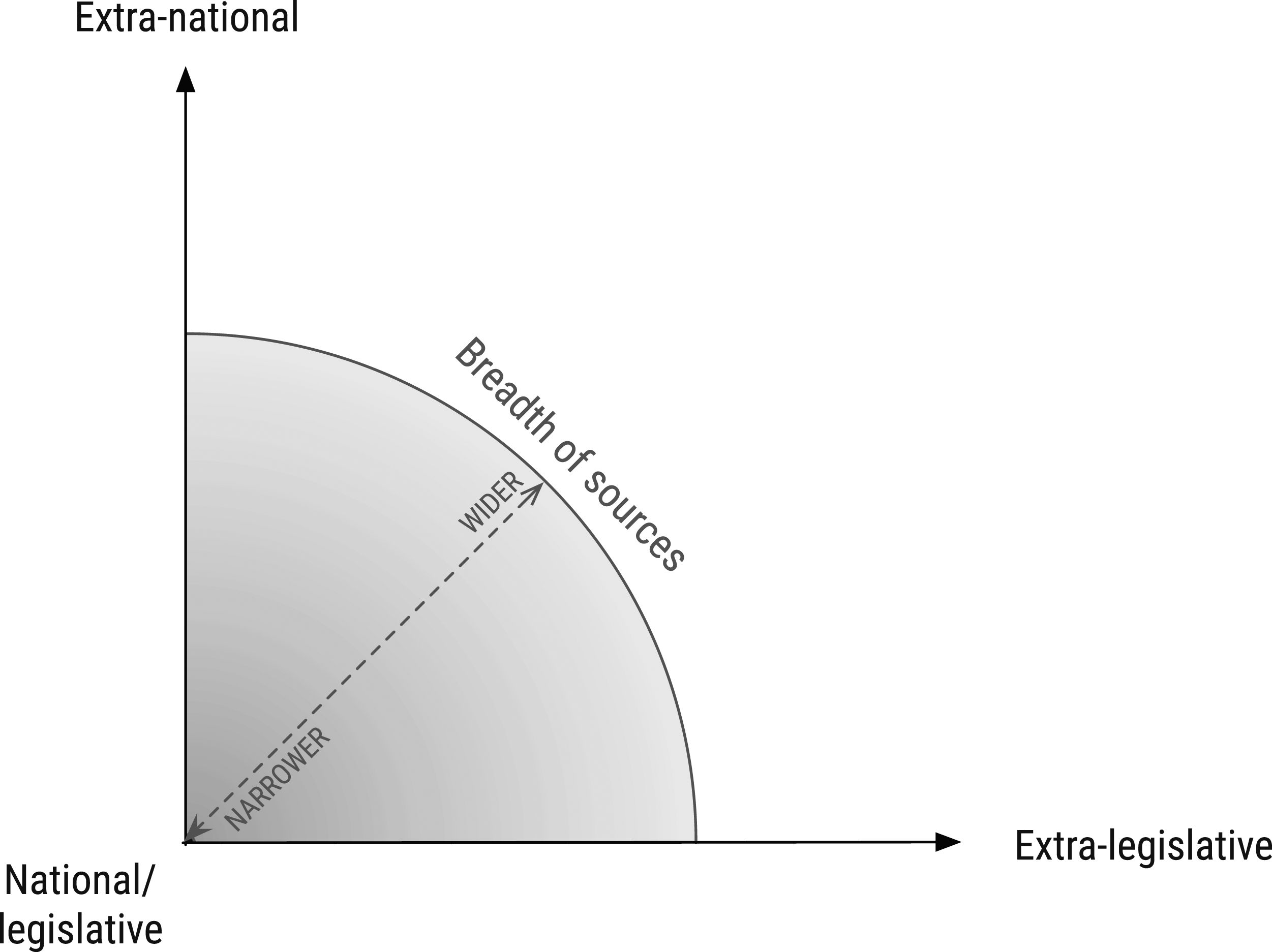
As an illustrative example, take the Swedish Supreme Court’s decision in NJA 2015 p. 899 which concerned a conflict between H.G., the owner of a small construction company, and Byggnads, the Swedish Construction Workers’ Union. Byggnads had taken labor actions to compel H.G. to sign a collective bargaining agreement according to which the union would receive 1.5% of the workers’ wages as ‘inspection fees’. These actions ultimately caused the construction company to go bankrupt. In Evaldsson and Others v. Sweden, the European Court of Human Rights (ECtHR) found that the inspection fees violated the right to property in Article 1 of Protocol No. 1 to the ECHR. 12 H.G. brought a civil action against Byggnads that reached the Supreme Court and which was asked to determine whether a person under general tort law principles could be entitled to damages for ‘pure economic loss’ as a result of violations of the European Convention. Based on the right to take labor action inscribed in the Swedish Constitution, a two-Justice minority answered the question in the negative. However, based on previous case law, interpreting the Constitution in the light of the ECHR, and applying the principle of proportionality, a three-Justice majority found that a person may under certain circumstances be entitled to such damages. 13 Using the two dimensions defined above, we would characterize the minority opinion as national and legislative, whereas the majority opinion was more extra-national and extra-legislative.
3. Variation in Judicial Reasoning Among Swedish Supreme Court Justices
3.1. Introduction
We now proceed to testing the plausibility of our theory by applying it to empirical data. If our theory is valid, i.e., if judges differ in meaningful ways in terms of which legal sources they choose to rely on in their opinions, we should be able to find systematic patterns in that variation. One way of determining whether the variation is systematic is to connect judges’ references to sources to their backgrounds. We do that by theoretically deriving hypotheses about individual background factors relating to education and professional experience that are likely to influence judges’ tendencies to cite extra-legislative and/or extra-national sources (Section 3.3). These hypotheses are subsequently tested on original data from the Swedish Supreme Court from 1981 to 2022.
We believe that the Swedish Supreme Court is a good case for testing whether the theory can be operationalized and be useful for studying judicial reasoning more generally. As explained below, the Swedish legal system and legal sources have been subject to dramatic changes during the last decades (Section 3.2). In such moments of systemic legal change, variation in judicial reasoning is likely to become stronger and more accentuated. For example, after 1 January 1995, Swedish Supreme Court Justices had to decide when and how, in their minds, EU law and the ECHR ought to be applied, including the extent to which they should take precedence over national legislation. Although these important and difficult questions have still not been definitely settled — and may never be so — it is when they are first posed that Justices will disagree the most on the answers. In this way, the case of the Swedish Supreme Court during the studied years is one where we would expect to see variation in judicial reasoning on the theorized dimensions and for which we have strong theoretical expectations in terms of the effects of judges’ backgrounds (Section 3.3). The Swedish case is, in other words, one where we expect to find an explainable variation in judicial reasoning. If the theory and methodology work for the Swedish case, it should be useful in other contexts, even if the directions and magnitude of variation, along with its societal causes, are very different.
3.2. Legal Reasoning in Sweden and the Swedish Supreme Court
For large parts of the 20th century, Swedish law students were taught and Swedish lawyers commonly practiced a form of legal reasoning that can best be described as monistic instrumentalism. This approach employs a positivist perspective on law that seeks to advance democratic lawmaking through political bodies and emphasizes the role of legislative bodies. Under this view, courts and judges were largely characterized as legal ‘technicians’ (Anton, 1980, p. 59), the primary role of which was to loyally implement legislation, not to challenge or control the legislator. This was in line with the position of the Social Democratic Party that sought to undertake fundamental societal reforms and the creation of the Swedish welfare state by way of legislation. As a result, they “were staunch defenders of democracy conceived as parliamentary or popular sovereignty, and were deeply suspicious of judicial checks on the political branches.” (Holmström, 1994, p. 156; see also Lerwall, 2014, p. 599; Zamboni, 2019, pp. 676–679)
It was also to a significant extent a product of the Scandinavian legal realist movement which had a profound impact on legal reasoning in Sweden in the 20th century. Much like other realist schools, the Scandinavian legal realists viewed law as “social facts” or “man-made and made for men” (Hart, 1959, p. 233). However, whereas American realists sought to highlight the connections between law and politics (Alexander, 2002), the Scandinavian realism movement sought to separate the two by ‘demystifying’ the law. It viewed law through a positive lens largely as an instrument for the legislator (see e.g., Bell, 2006, pp. 253–269; Holmström, 1994; Peczenik & Bergholtz, 1991). The Scandinavian legal realist movement took an “aggressively anti-metaphysical approach to the study of law” that rejected natural law principles and emphasized legislation (Spaak, 2022, p. 419; see also e.g., Bjarup, 2005; Jonsson, 2023). 14
The dominance of the Scandinavian realist school of thought on Swedish legal society had direct methodological implications on the dominant forms of legal reasoning in Sweden in the 20th century. When applied by judges, this methodology tended to give priority to national legislation, interpreted in the light of the aims of the historical legislator, often by strong reliance on the preparatory works (travaux préparatoires) (Peczenik & Bergholtz, 1991). As a result, in the early 1980s, the dominant tradition in Swedish legal reasoning was, to use the theoretical dimensions defined above, heavily national and legislative in nature. An illustrative example from this era is a Supreme Court decision, NJA 1985 p. 768, where the Court found a boxer criminally liable under a statute criminalizing professional boxing based on statements made by the legislator in the preparatory works, even though these statements ran contrary to the statutory language (Lambertz, 1986). 15
In recent decades, the position of legal sources that had previously dominated the Swedish legal system and judicial reasoning has come under challenge. First, for much of the 20th century, Swedish legislation changed at a relatively low pace and was developed through a long and careful process that typically produced succinct and general legislation that was accompanied by extensive and detailed preparatory works. With regard to legal reasoning, this meant that legislative text was for a long time relatively bare-bones and long-lasting, whereas preparatory works was a rich, well-developed, and heavily relied on legal source (see e.g., Peczenik & Bergholtz, 1991; Sandström, 2007). The pace of the legislative process has increased dramatically since the 1980s. This resulted in an increasingly complex regulatory situation with more legislation and preparatory works, but also in less extensive, detailed, and well-processed preparatory works. This meant that these sources were less useful to judges as legal sources (see e.g., Wersäll, 2000).
Second, in the same time period, Swedish law has become significantly less moored in the national context. Like most other legal orders, the increased globalization of society meant a globalization of Swedish law. As global activities require global regulation, Swedish law has over recent decades become entangled with regional, international, and transnational regulations in increasingly complex ways. This shift was particular accentuated by the ‘Europeanization’ of Swedish law in the 1980s and 1990s. Starting in the mid-1980s, Sweden experienced strong and (to lawyers and politicians) surprising challenges to national legal sovereignty (legal monism and the Westphalian legal paradigm), as well as to the best-in-class self-image. In 1982, in the case of Sporrong and Lönnroth v. Sweden (application no. 7151/75 and 7152/75), the ECtHR for the first time concluded that Sweden 16 had violated the ECHR. This decision was a rough wake-up call for the Swedish legal community with divisive and dramatic effects (see e.g., Schultz, 2011, p. 1001). Those effects were felt, among other places, in Swedish law schools where law professors were compelled to consider the ECHR, as well as other sources of international law, in their teaching and research. Swedish law took another dramatic step towards the European level in 1995 when Sweden, on the first of January, both joined the European Union (EU) and adopted the ECHR as law.
These events fundamentally changed the nature and context of Swedish law. Hirshl writes about the Nordic countries that “[n]o other region in the world, perhaps with exception of the former Eastern bloc, has undergone such a transformative constitutional change in such a short period of time” (Hirschl, 2011, p. 460) and that it “is a largely unexplored paradise for theory building in the field of comparative constitutional law and politics.” (Hirschl, 2011, p. 469) The development of a global approach with overlapping and competing legislators clashed with a tradition heavily focused on national and legislator-based legal sources. It also challenged the traditionally passive judicial role of Swedish judges, pushing them to reevaluate their role in the legal system. Under these new conditions, the judge has both a stronger responsibility as a guardian of core legal values as well as access to a plurality of new legal sources to use in judicial reasoning in order to fulfil this role. The new opportunities and responsibilities have caused a shift in how Swedish judges reason, away from a near-exclusive use of national and legislative sources and towards increased elements of extra-national and extra-legislative sources. However, so far, no systematic empirical studies of this shift have been conducted.
When a legal system shifts fundamentally and dramatically, judges need to come to terms with a new legal context. Although we lack systematic evidence regarding whether the extent of the legal shift has caused disagreement among Swedish judges, we expect it to be a major source of variation in judicial reasoning. Some judges are likely to be more open and willing to accept the change, whereas others will be more reluctant. It is also likely to trigger greater disagreement among judges about legal reasoning per se. That is to say, in times of systemic change, judges are not only more likely to disagree about the outcome because they have different approaches to legal reasoning, but they are also more likely to disagree about what is the most appropriate approach to legal reasoning.
3.3. Institutional Framework
The Swedish Supreme Court is the highest court of general jurisdiction, primarily handling civil and criminal law cases. 17 The Supreme Court was established in 1789 and has varied with regard to function, setup, and size 18 over time. Today, the Supreme Court consists of 16 Justices, with 14 adjudicating at any given time while two serve on the Council on Legislation. The Court is divided into two divisions of seven Justices, and Justices rotate between the divisions, except for the President, who chairs one division, and the Chamber Chair, who chairs the other division.
Since 2011 Justices are appointed through an open, merit-based selection process where positions are openly advertised and the Judges Proposals Board (Domarnämnden) ranks the candidates, and the government formally appoints them. So far, the government has always appointed the highest ranked candidates. This appointment system differs from the previous system under which the government itself, without any meaningful oversight, “called upon” new Justices when a seat came open.
The Supreme Court exercises strong docket control, granting leave almost exclusively for cases with precedential value. 19 Each year, the Court receives about 8000 requests but admit only circa 100 for review. Accepted cases are effectively randomly assigned to panels that in all but a very small number of cases consist of five Justices from one of the two divisions. Each case is first reviewed by a law clerk (justitiesekreterare) who prepares and presents the case to a panel of Justices along with a proposed decision. One of the Justices on the panel is appointed reporting Justice (referent) and given the task of producing a draft decision. While the panels strive to reach unanimous decisions, and unanimity is reached in most cases, in 22% of the cases we studied the panel did not reach a unanimous decision. Moreover, Justices that we have talked to have told us that dissenting opinions are not discouraged on the Court.
Finally, it is worth noting that Justices on the Supreme Court do not have a cabinet of clerks, to assist them in researching and drafting opinions. Highly qualified law clerks are employed by the Supreme Court, but they are not attached to individual justices but to the two divisions (Svensson, 2002, p. 665).
3.4. Hypotheses
From our source-based theory of judicial reasoning we are able to derive a set of expectations about systematic patterns in the variation in judicial reasoning among Swedish judges. As discussed above, judicial reasoning is to some extent both social and communal. By this we mean that there is limited independent, objective basis for characterizing judicial reasoning as for example acceptable or good. What is recognized as legal, valid, and good is a social construct emanating from the ‘interpretive community’ to which lawyers belong, or ‘the legal community’. Legal reasoning is thus social in the sense that it is “a competence learned and exercised through participating in a common practice.” (Postema, 2014, p. 87) It follows that education and practice are likely to be key mechanisms driving differences between individual judges with regard to judicial reasoning and that we should expect to find variation in judicial reasoning between judges that have different educational and professional backgrounds. 20
First, we believe that individual judges’ attitudes towards judicial reasoning are affected by their educational experiences, that is to say how they were taught to reason in law school. It is often repeated that the most important part of a legal education is learning how to think like a lawyer (see e.g., Schauer, 2009). In other words, one of the most important functions of law schools is to teach its students – which includes future judges – what constitutes acceptable, appropriate, and preferable legal reasoning. We expect that these early legal education experiences can impact how judges engage in judicial reasoning, even much later in life.
This allows us to formulate two testable hypotheses about the relationship between Swedish Supreme Court Justices’ legal education and judicial reasoning. As discussed in Section 3.2, Swedish legal thinking in the 1900s was dominated by Scandinavian legal realism (Alexander, 2002; Bjarup, 2005; Hart, 1959; MacCormack, 1970). While legal realism was (and still is) relatively strong throughout Swedish legal society, a distinct variation in thinking can be found between the faculty at Sweden’s different law schools. 21 The founding ideas of Scandinavian legal realism were established at Uppsala University in the early 20th century by professor Axel Hägerström and his pupil professor Karl Olivecrona. The theory’s connection to Uppsala University is so strong that it is in Sweden known as ‘the Uppsala School’ (Sandin, 1962). In the period in which many of the Justices that we study received their education, Professor Per-Olof Ekelöf, who was a student of Hägerström, was influential at Uppsala University. He was a strong proponent of realist ideals, which involved rejecting law’s ‘metaphysical elements’ and advocating for legislation and legislator-based sources in legal reasoning (see e.g., Ekelöf, 1958). 22 Meanwhile, at Lund University, influential professor of jurisprudence Aleksander Peczenik 23 advocated for a more permissive approach to legal reasoning that includes using a broader range of sources. This includes, inter alia, foreign law and recommendations by public and private institutions (see e.g., Peczenik, 1995, pp. 213–216). It is reasonable to expect that such differences in the legal philosophical and methodological teachings that Justices received in law school are reflected in their use of extra-legislative sources in judicial reasoning on the bench.
Justices with a law degree from Uppsala University are less likely than Justices with a law degree from Lund University to refer to extra-legislative sources.
However, it is not equally apparent that the two law schools differed in their approach to extra-national sources. While advocates of Scandinavian realism could be expected to be more inclined to reject some extra-national legal sources, such as those containing universal human rights, most extra-national legal sources do not belong to this category. On this dimension we therefore expect to see less of a difference between Justices’ judicial reasoning depending on where they studied law.
There is no difference between Justices from different law schools with regards to their tendency to refer to extra-national sources.
The Supreme Court Justices who appear in our data can be divided into two major categories depending on when they studied law. Justices who graduated from law school before Swedish law became overtly ‘Europeanized’ would have received relatively little exposure to international legal sources, especially since Sweden traditionally adheres to the monistic tradition under which international legal instruments must be implemented or incorporated into national law in order to be directly applicable and invokable. By comparison, Justices who received their law degrees after the aforementioned decision in Sporrong and Lönnroth v. Sweden in 1982 would have received a legal education that paid more attention to international and European law, and they were presumably to a greater extent than their senior colleagues taught to consider and use European, international, and other extra-national legal sources. Accordingly, we expect that Justices who attended law school after this pivotal moment of ‘Europeanization’ are more open than their colleagues to citing extra-national sources. The effect of having a more recent law school degree has likely increased and is even more true for judges that studied law in the second half of the 1990s, when Sweden had joined the European Union and there was an increased focus in law schools on transnational or global law. However, this generation of lawyers have yet to be appointed to the Supreme Court.
Justices who received a law degree after 1982 are more likely than other Justices to refer to extra-national sources.
While law school plays an important role in shaping how lawyers think, their understanding and view of the law do not stop developing just because they graduate. How they engage with the law post-graduation will also shape their thinking. We expect that what judges worked with after graduating from law school and before becoming judges can explain variation in judicial reasoning. It is also possible that the choice of career track of new law school graduates depends in part on their understanding or view of the law. Regardless of the causal direction, our theory leads us to expect a correlation between judges’ pre-appointment professional background and their subsequent judicial reasoning on the Supreme Court.
More specifically we expect that Justices that had more exposure to extra-national law in the professional career prior to being appointed to the Supreme Court will be more likely than their colleagues to employ extra-national sources in their judicial reasoning. While we do not have access to exact data on individual Justices’ exposure to extra-national law, we can use the nature of their pre-appointment legal careers as proxies. Regardless of what career track Swedish lawyers pick after graduating from law school, most of them will spend the majority of their time and effort studying, interpreting, and applying traditional Swedish sources of law, i.e., sources that originate from the Swedish political institutions, courts, and legal scholars. To Justices that have participated in the legislative process by working in the ministries, the natural form of law-making is, in the words of a former Chief Justice Lindskog, legislation, whereas private practitioners and academics tend to be more critical of legislation (Lindskog, 2013, pp. 155–156). This echoes a common view in the Nordic literature that Justices with backgrounds in academia and private practice are significantly more likely to challenge legislation and to use international and other extra-national sources to do so (see e.g., Skiple et al., 2016, pp. 78–79, 2020, pp. 270–271, and sources cited). They may also be more familiar than other Justices with extra-national sources. Those who choose to go into private practice, especially if they work for large multinational law firms, are more likely than their peers to wrestle with foreign and international law. The same is true for those who go into academia where scholars are expected to read and engage with international and comparative legal research and other extra-national sources.
Justices who have a background in private practice or academia are more likely than other Justices to refer to extra-national sources.
After graduating from law school, many new lawyers choose to work in the public sector. Common positions in this area include working in the courts, the prosecutor’s office, other government agencies, or in the halls of ministries. Much of the work done in such positions concerns the application of national law, in areas primarily governed by legislator-made law, and under the Swedish government. Similarly, experience working in the ministries, a common background for Swedish Justices, teach Justices “to be loyal to the legislator (i.e., the politicians)” (Schultz, 2011, p. 995, our translation) and tend to give them “a civil servant’s perspective” (Zamboni, 2019, p. 680). Compared to lawyers who between graduating law school and entering the high courts as Justices spend their time in academia and private practice, we expect the former group to be less open to using extra-legislative sources in their judicial reasoning. This is in line with previous research in the Nordic context, demonstrating that academics are less deferential, in the sense of being more likely to rule against the government (Skiple et al., 2016, 2020), and that a government career can make a Justice more likely to vote in favor of the government (Skiple et al., 2021).
Justices with backgrounds in academia and private practice are more likely than other Justices to refer to extra-legislative sources.
4. Empirical Design
To test our hypotheses, we collect and analyze a novel dataset on the decisions of the Swedish Supreme Court between 1980 and 2022, 24 more specifically on all 2601 Supreme Court precedential judgments in civil and criminal cases during that time period. 25 Those judgments contain 3642 judicial opinions: 2803 majority opinions, 708 dissenting opinions, and 131 concurring opinions. In order to capture our two dependent, theoretically-interesting variables — references to extra-national and extra-legislative sources — we began by identifying all references to legal sources that appeared in those 3642 opinions using a combination of automated data extraction and hand coding conducted by trained research assistants. 26 We proceeded by classifying the cited sources using in law well-established categories of legal sources, such as national statutes, EU legislation, case law, legal literature, and preparatory works (travaux preparatoire). We found 28 such types of legal sources appear in those opinions. 27
On the basis of the theoretical framework presented above, each of those 28 types of legal sources were assigned a direction on the two dimensions: National/Extra-national and Legislative/Extra-legislative. Any legal source that was produced by a national entity, 28 such as the Swedish parliament, the Swedish government, a Swedish court, or Swedish government agency, was coded as National and all other sources were coded as Extra-national, unless they were ambiguous on this dimension, in which case we assigned a null value. 29 We proceeded similarly to code any type of source that was produced during or as the result of legislative process as Legislative, and other sources as Extra-legislative or null. 30 For example, we code Swedish statutes as National and Legislative; the Supreme Court’s own case law as National and Extra-legislative; EU legislative products, such as Directives and Regulations, as Extra-national and Legislative; 31 and the principle of primacy of EU law as Extra-national and Extra-legislative. 32
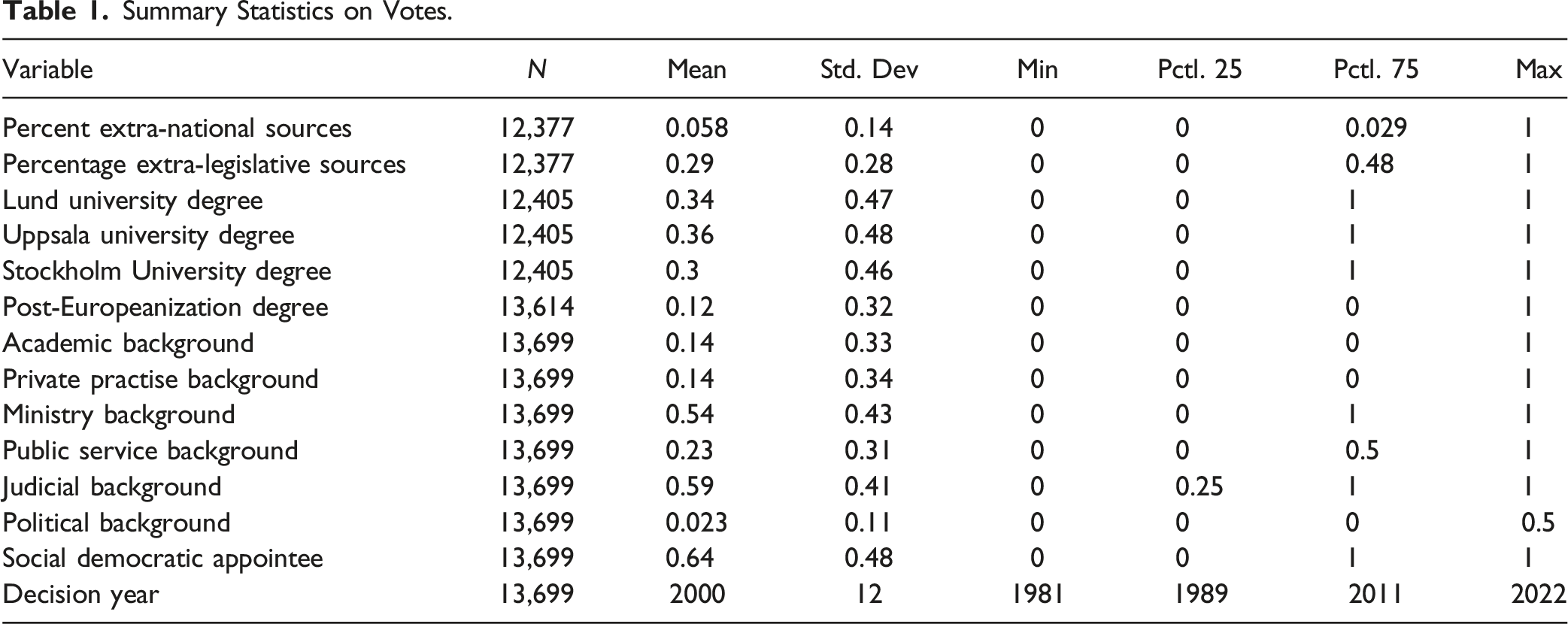
Summary Statistics on Votes.
As Figure 2 illustrates, the observations largely follow the distribution theorized above and illustrated in Figure 1. They are concentrated in the National/Legislative corner, fanning out from there, largely proportionally but a little skewed towards the Extra-legislative dimension. In Figure 2 we highlight the positions of the majority and minority opinions in NJA 2015 p. 899, the example used in Section 2.4 above, and which shows how the majority opinion scores higher than the minority opinion on both dimensions, as expected. Distribution of votes by percent extra-national and extra-legislative sources cited. The red diamond-shaped points represent the positions of the majority and minority opinions in case NJA 2015 p. 899. There is no significant correlation between the two dimensions: Pearson r = 0.058.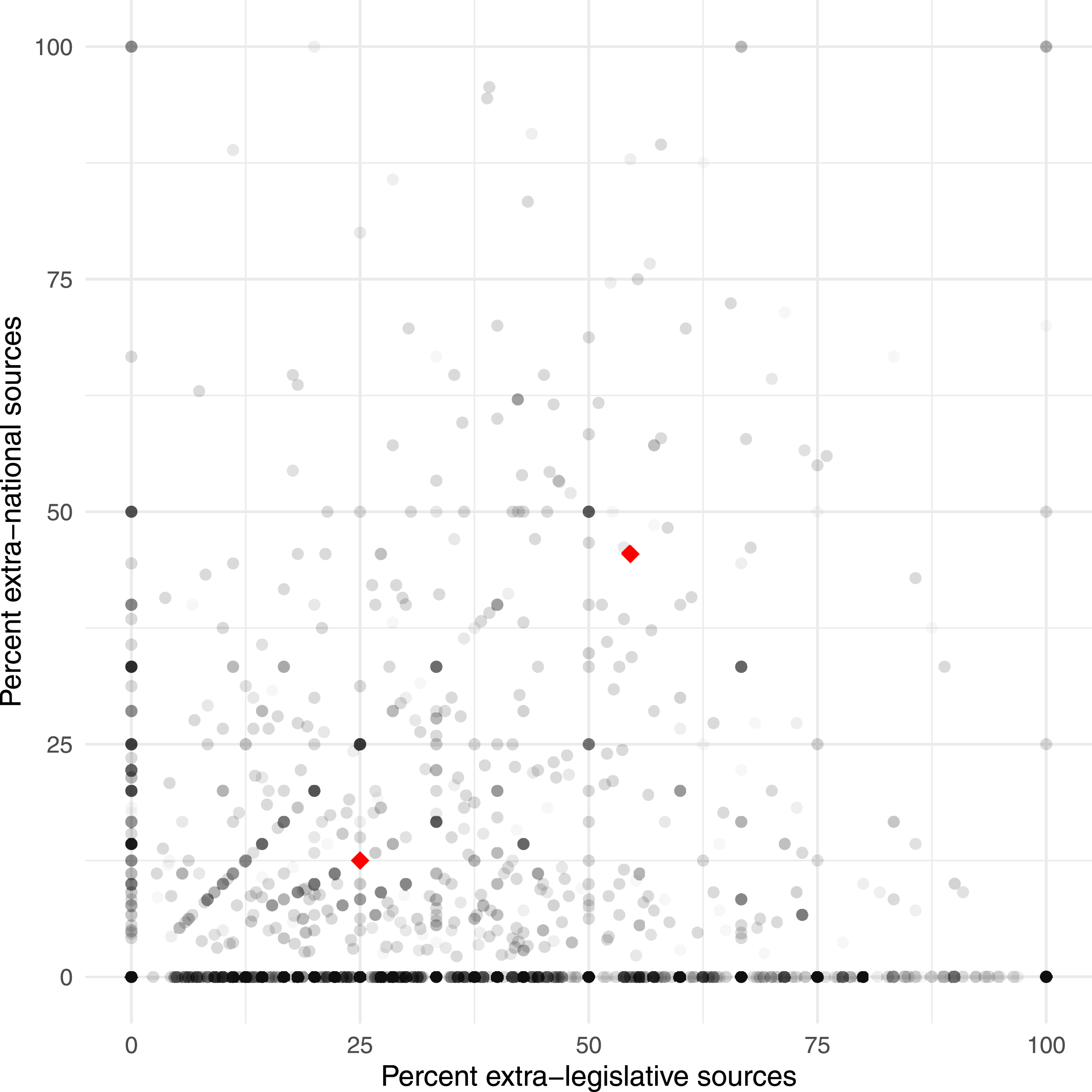
Each observation represents a vote cast by a Justice, with multiple observations corresponding to each individual Justice. This dataset allows for a comparative analysis of the types of sources that Justices cite in their opinions. For example, Figure 3 presents the relative mean positioning of Supreme Court Presidents’ opinions within this analytical framework. This plot is however mainly illustrative as it is not possible to say, from this alone, to what extent the observed placements are attributable to case-specific factors and individual preferences in terms of judicial reasoning respectively. The regression models presented in Section 5 below allow us to overcome these limitations. Mean percent extra-national and extra-legislative sources cited in opinions by Supreme Court Presidents since 1986.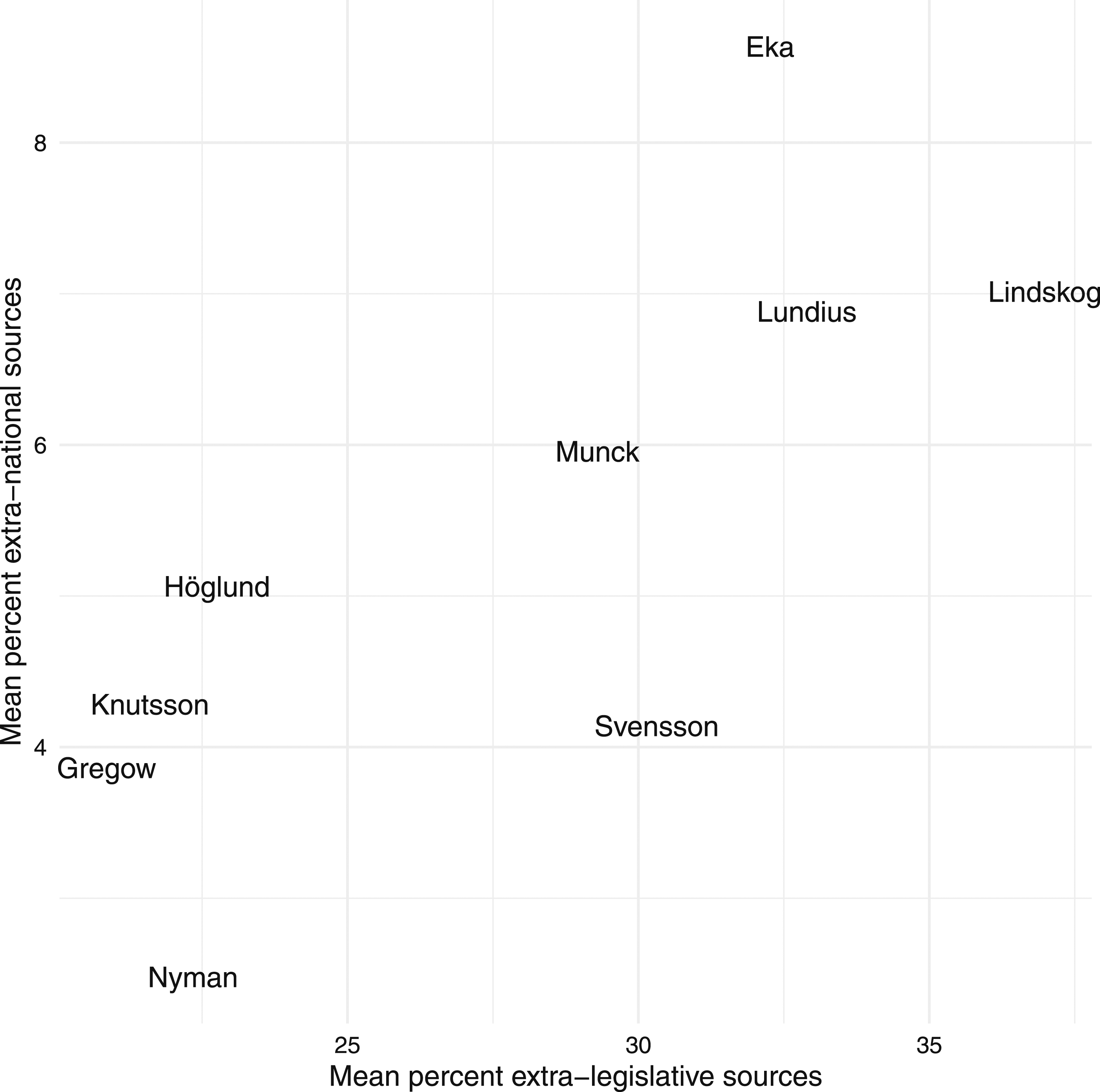
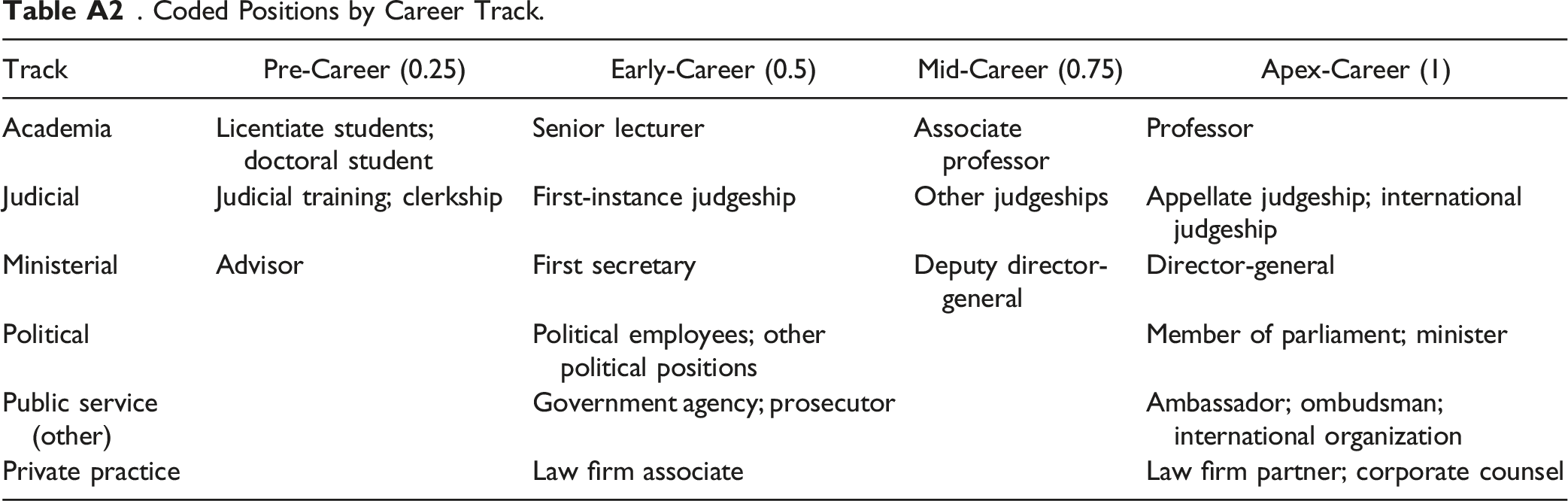
Second, in order to test our hypotheses about the correlation between individuals’ educational and professional backgrounds on judicial reasoning, we collect information on law school degrees and professional experience of the voting Justices. This includes variables on from which university they received their law degree 36 and a dummy variable on whether the law degree was awarded after 1983 (a ‘post-Europeanization degree’). Coding professional backgrounds in a standardized yet sufficiently simple and accurate way is a methodological challenge. A model must balance complexity and clarity, as focusing only on a candidate’s last position or longest-held role overlooks the diverse legal experiences of Swedish Justices, who may have held numerous, different positions before joining the high courts. We approach this problem by including six variables capturing the extent of the Justices’ professional experience in six major legal career tracks before joining the Court: academia, private practice, ministries, courts, politics, and public service. We have hand-coded how far each Justice advanced within each career track, assigning a theoretically informed value between 0 and 1 where 0 represents no experience and 1 represents reaching the highest positions possible within that track. 37
Third, we include controls for factors that may plausibly affect judicial reasoning and that may also be related to the educational and professional background variables. Most importantly, in light of the development presented in Section 3.2, it is likely that the sources used in Swedish law practice in general, including in judicial reasoning on the Supreme Court, has change over time. In 1995, Sweden became a member of the European Union, introducing a large body of EU law. Our analysis therefore includes a variable indicating whether the decision was taken before or after 1995. What legal sources are relevant to cite will also vary significantly between areas of law. We therefore include fixed-effect controls for twenty-four different areas of law and a single case may involve up to three different areas. Finally, although we have limited reason to believe that ideology plays a major role on judicial behavior on the Swedish Supreme Court, 38 it is prudent to include a control for this. We do so by including a dummy-variable on whether the Justice in question was appointed by a government led by a Social Democratic Prime Minister.
We employ the variables described above in two linear regression models, one for each of the two dimensions. In this way, we capture the correlation between, on the one hand, the share of extra-national and extra-legislative sources respectively that Justices refer to in their opinions and, on the other, the educational and professional background of the Justices who authored those opinions. Since our “treatment” is administered at the level of the judge, we estimate models with robust standard errors clustered at the judge level.
5. Results
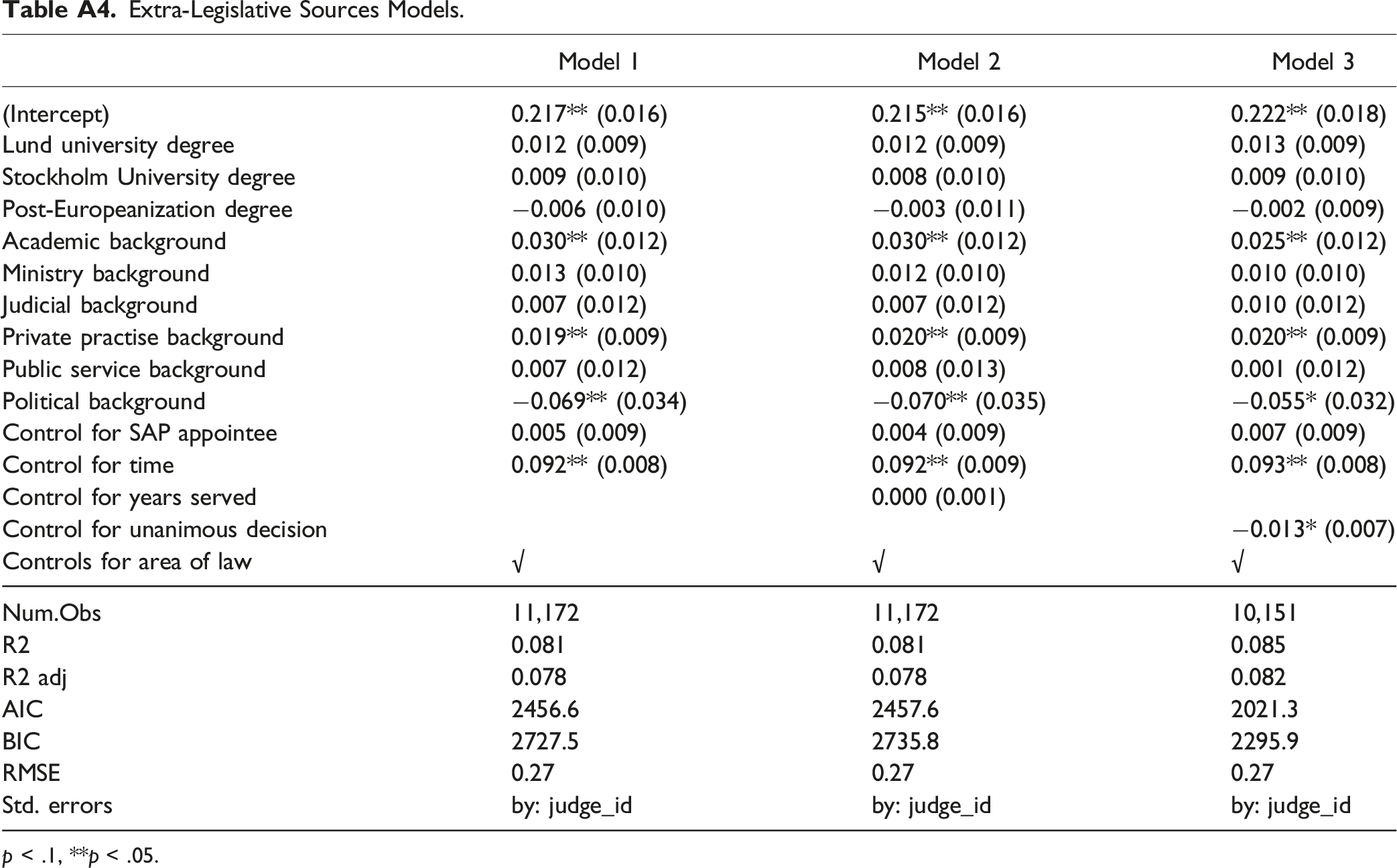
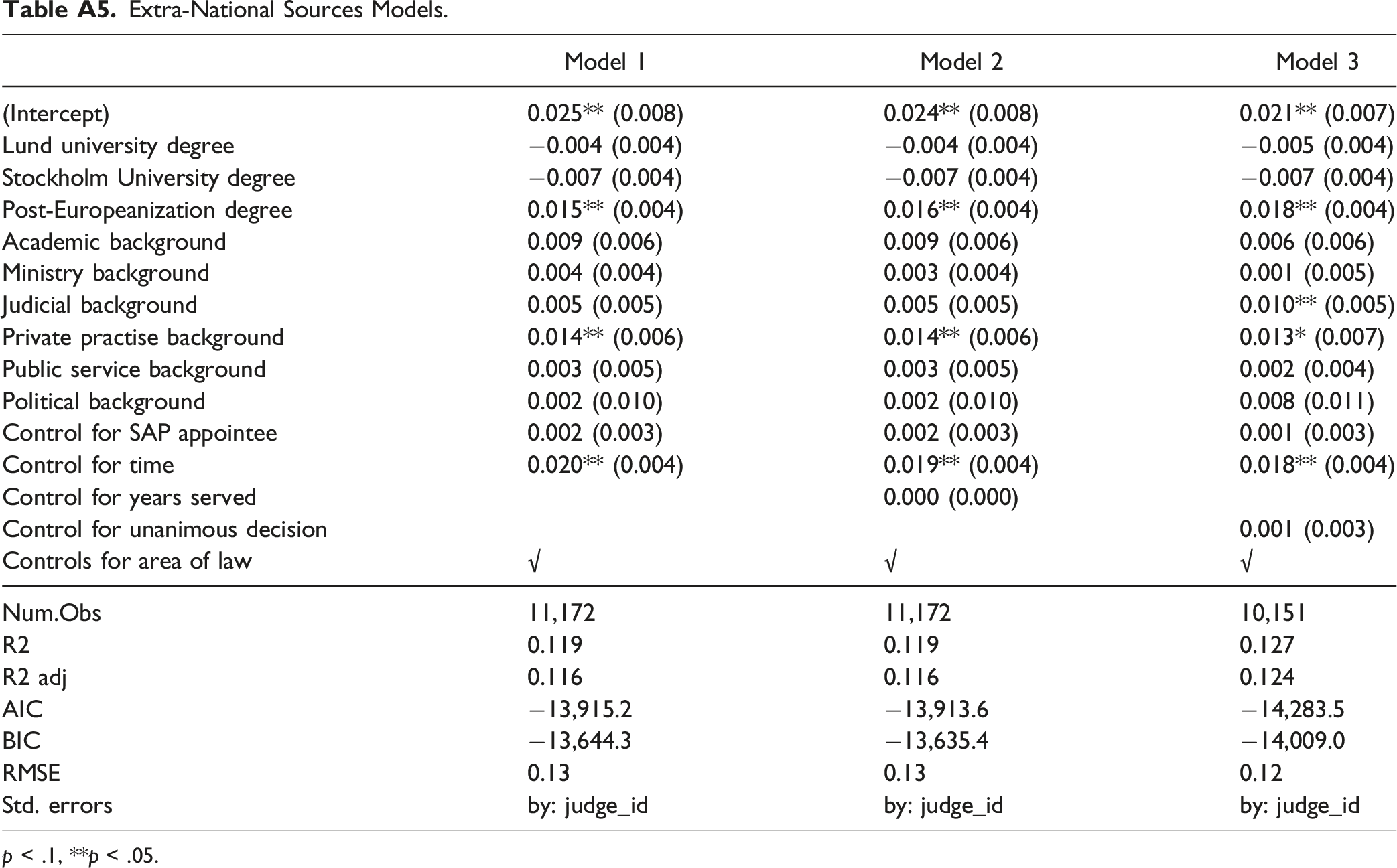
The results of our two models are displayed in Figure 4.
39
Our results are largely in line with our hypotheses, but we also find some interesting unexpected results. Two linear regression models capturing the effect of Swedish Supreme Court Justices’ backgrounds on their references to extra-legislative and extra-national sources respectively. Estimates plotted with 95% and 99% confidence intervals. Fixed-effect controls for area of law, SAP appointee, and time omitted from plot. For University degree variables, Uppsala University degree is used as the reference.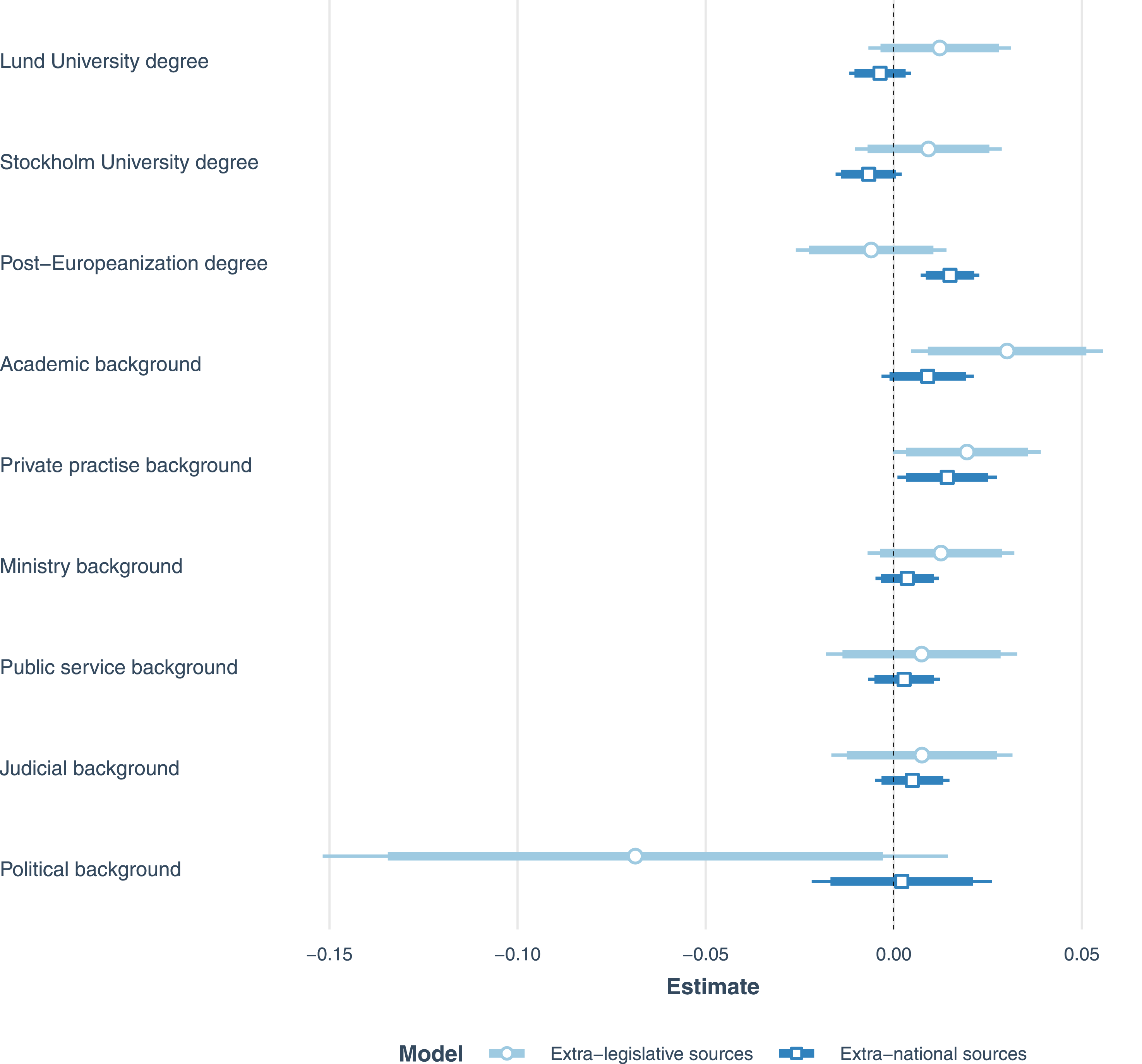
We begin our analysis with the effects of legal education. Contrary to what we expected, we do not find that Justices that graduated from Uppsala University (our reference category) include fewer references to extra-legislative sources in their opinions compared to Justices that studied at other law schools (Hypothesis 1). It thus seems that the strong realist tradition associated with the so-called Uppsala School does not have a measurable effect on references, at least not after many years after graduating, or that the difference in legal education between law schools is smaller than we theorized. We find, as we expected, there is also no difference between Justices based on where they studies law with regard to references to extra-national sources (Hypothesis 2).
Our results do however show that a variation in references can be connected to legal education. Our findings lend support to our hypothesis that Justices that graduated from law school in the ‘post-Europeanization era’ have a greater propensity for citing extra-national legal sources compared to those who had graduated earlier (Hypothesis 3). This finding suggests that what lawyers are taught in legal school is capable of influencing how they reason as judges and be a driver of variation in judicial reasoning. That legal education is capable on influencing judicial reasoning as such is less remarkable than that this effect is measurable for a long time and after many years of legal practise. As we noted above, we expect that the Europeanization effect on Swedish law and legal education of the EU membership and the adoption of ECHR as law in 1995 was greater than the ECtHR’s decision in Sporrong and Lönnroth v. Sweden. Thus, in a few years’ time, when Justices that received their legal education after Sweden joined the European Union and adopted the ECHR begin to appear on the Court, we may be able to see an even stronger time-bound educational effect on references to extra-national sources.
We now turn to the impact of professional experience. As predicted, we find that Justices that have pre-appointment experience in academia and private practice tend to cite both extra-national sources (Hypothesis 4) and extra-legislative sources (Hypothesis 5) in their judicial opinions to a greater extent than other Justices. No other type of professional experience has a significant effect, positive or negative, on either dimension. The only exception to this is the effect of political experience on references to extra-legislative sources which is strongly negatively correlated. While we had not explicitly hypothesized this connection, it is in line with our theoretical expectations (see Sec. 3.4). However, the uncertainty around this estimate is large due to few Justices having a political background, in particular in the later parts of the studied period. Only 11 of the 111 unique Justices that appear in the data have a professional pre-appointment background in politics.
That we find evidence of the expected correlation between Justices’ professional experience and the type of sources that they cite in their opinions does not necessarily mean that the former is causing the latter, although it is a possibility. What career track law school graduates pursue is the result of individual preferences and to a greater extent than when in time they happened to go to law school. It is possible, for example, that their views on the appropriate allocation of the power to make law — their understanding of who creates and ought to create law (see Sec. 1) — influences their career choices as well as their judicial reasoning.
In conclusion, our data provides significant support for four of our five hypotheses. This most directly provides concrete and novel insight into how educational and professional background can help explain variation in judicial reasoning. All legal systems differ to some extent from each other when it comes to the specific features of legal education, professional experience, and judicial reasoning. However, the fundamentals of the approach that we have herein proposed and successfully applied to the Swedish case should be easily adaptable to local features and therefore be generally useful for studying and better understanding variation in judicial reasoning.
6. Conclusions
We have proposed a general framework for how to study variation in judicial reasoning, with a particular focus on national courts. Our ambition is to develop a source-based theory of judicial reasoning that can be useful across jurisdictions. It takes inspiration from previous theoretical scholarship on legal centrism contra legal pluralism, arguing that there are two important dimensions in judicial reasoning on which judges may vary: the pluralist challenges of the nation-state as the exclusive center and of the legislature as the foremost creator of law. The theory is intentionally simple for the purpose of overcoming differences in law and judicial reasoning between specific legal orders. While legal scholars that seek to describe, explain, or normatively evaluate judicial reasoning in a specific case or legal context justifiably focuses on the micro-level, and what distinguishes judicial reasoning in particular legal orders, a different approach is necessary to explore variation in judicial reasoning on a macro-level. We believe that the theory that we have outlined here can serve as a basis for such exploration.
We have demonstrated the plausibility of the theory by studying variation in judicial reasoning on the Swedish Supreme Court based on Justices’ backgrounds. We have theoretically derived and empirically tested several hypotheses regarding the connection between Justices’ backgrounds and judicial reasoning. The fact that we largely found empirical support for the hypothesized variation lends support to the validity and value of our theoretical framework.
Of course, our study of variation in judicial reasoning on the Swedish Supreme Court is just one example and additional application is needed. It could be interesting and valuable to conduct similar studies on, for example, the U.S. Supreme Court. Justice Amy Coney Barett has claimed that Justices are not “partisan hacks” and that divisions among Justices on the U.S. Supreme Court is instead driven by variation in judicial philosophy (Barnes, 2021). We believe the theory and methodology that we have presented in this contribution could be used to empirically test these kinds of claims.
Footnotes
Acknowledgments
The authors take shared credit and responsibility for this publication and the research on which it builds. This study is part of a larger research project, Judicial Power and Power over the Judiciary, that is funded by the Swedish Research Council (VR) and that has been approved by the Swedish Ethical Review Authority. The authors would like to thank our research assistants at Umeå University for their invaluable help in compiling the data: Erik Engman Jonsson, Thomasine Francke Rydén, Angelica Kullström, Carl Lexenberg, Malin Thorneman, and Juni Wikman.
Declaration of Conflicting Interests
The author(s) declared no potential conflicts of interest with respect to the research, authorship, and/or publication of this article.
Funding
The author(s) disclosed receipt of the following financial support for the research, authorship, and/or publication of this article: This work was supported by Vetenskapsrådet (2018-1383).

Notes
Appendix
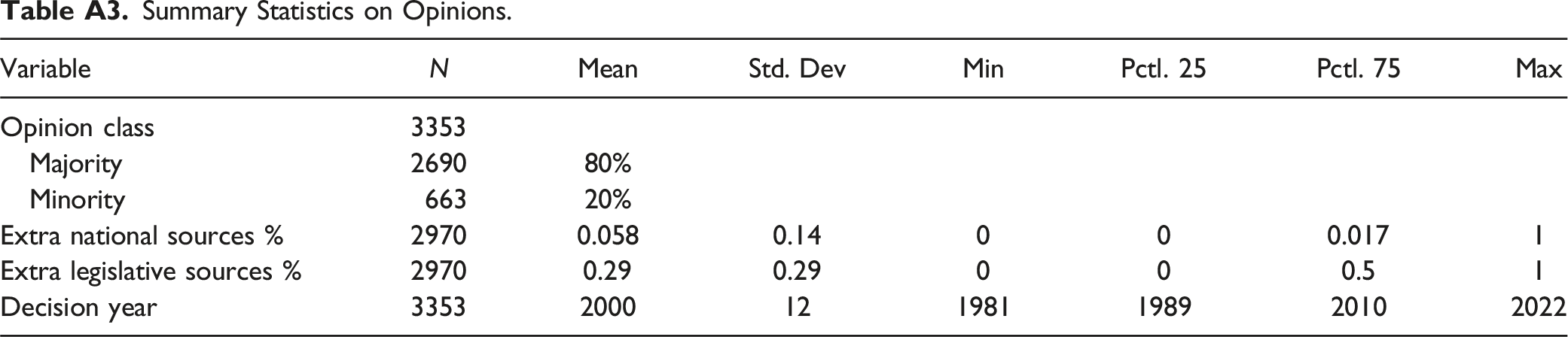
Coding of Sources on Dimensions. . Coded Positions by Career Track. Summary Statistics on Opinions. Extra-Legislative Sources Models. p < .1, **p < .05. Extra-National Sources Models. p < .1, **p < .05.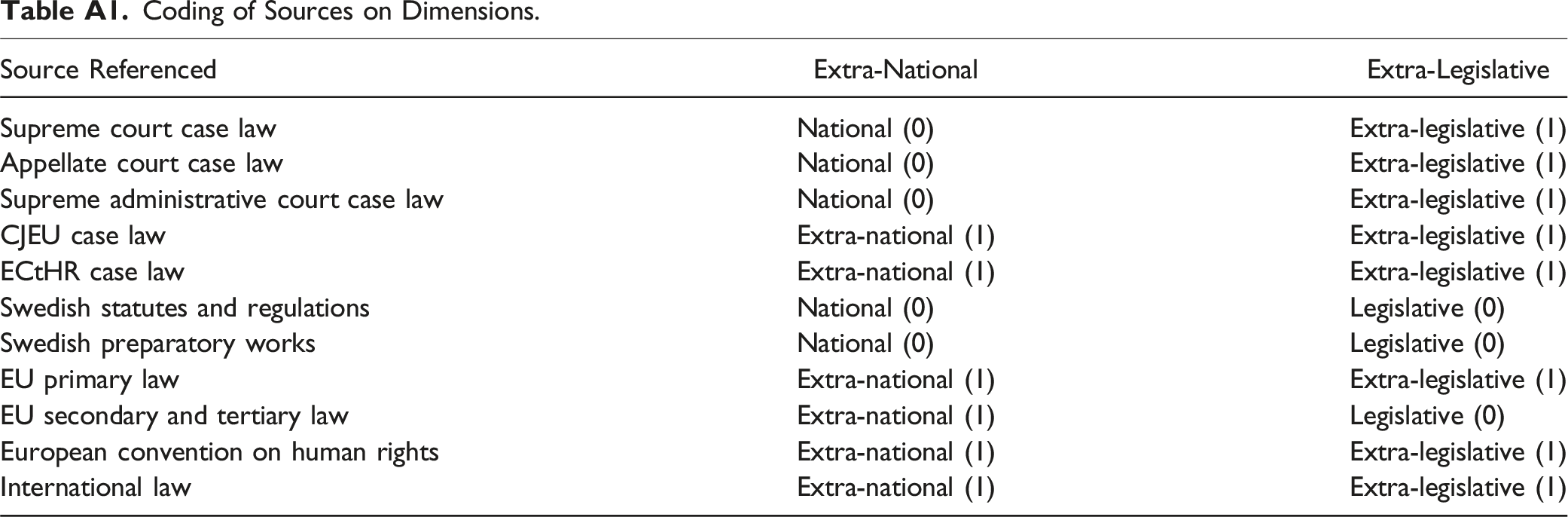
Source Referenced
Extra-National
Extra-Legislative
Supreme court case law
National (0)
Extra-legislative (1)
Appellate court case law
National (0)
Extra-legislative (1)
Supreme administrative court case law
National (0)
Extra-legislative (1)
CJEU case law
Extra-national (1)
Extra-legislative (1)
ECtHR case law
Extra-national (1)
Extra-legislative (1)
Swedish statutes and regulations
National (0)
Legislative (0)
Swedish preparatory works
National (0)
Legislative (0)
EU primary law
Extra-national (1)
Extra-legislative (1)
EU secondary and tertiary law
Extra-national (1)
Legislative (0)
European convention on human rights
Extra-national (1)
Extra-legislative (1)
International law
Extra-national (1)
Extra-legislative (1)
Track
Pre-Career (0.25)
Early-Career (0.5)
Mid-Career (0.75)
Apex-Career (1)
Academia
Licentiate students; doctoral student
Senior lecturer
Associate professor
Professor
Judicial
Judicial training; clerkship
First-instance judgeship
Other judgeships
Appellate judgeship; international judgeship
Ministerial
Advisor
First secretary
Deputy director-general
Director-general
Political
Political employees; other political positions
Member of parliament; minister
Public service (other)
Government agency; prosecutor
Ambassador; ombudsman; international organization
Private practice
Law firm associate
Law firm partner; corporate counsel
Variable
N
Mean
Std. Dev
Min
Pctl. 25
Pctl. 75
Max
Opinion class
3353
Majority
2690
80%
Minority
663
20%
Extra national sources %
2970
0.058
0.14
0
0
0.017
1
Extra legislative sources %
2970
0.29
0.29
0
0
0.5
1
Decision year
3353
2000
12
1981
1989
2010
2022
Model 1
Model 2
Model 3
(Intercept)
0.217** (0.016)
0.215** (0.016)
0.222** (0.018)
Lund university degree
0.012 (0.009)
0.012 (0.009)
0.013 (0.009)
Stockholm University degree
0.009 (0.010)
0.008 (0.010)
0.009 (0.010)
Post-Europeanization degree
−0.006 (0.010)
−0.003 (0.011)
−0.002 (0.009)
Academic background
0.030** (0.012)
0.030** (0.012)
0.025** (0.012)
Ministry background
0.013 (0.010)
0.012 (0.010)
0.010 (0.010)
Judicial background
0.007 (0.012)
0.007 (0.012)
0.010 (0.012)
Private practise background
0.019** (0.009)
0.020** (0.009)
0.020** (0.009)
Public service background
0.007 (0.012)
0.008 (0.013)
0.001 (0.012)
Political background
−0.069** (0.034)
−0.070** (0.035)
−0.055* (0.032)
Control for SAP appointee
0.005 (0.009)
0.004 (0.009)
0.007 (0.009)
Control for time
0.092** (0.008)
0.092** (0.009)
0.093** (0.008)
Control for years served
0.000 (0.001)
Control for unanimous decision
−0.013* (0.007)
Controls for area of law
√
√
√
Num.Obs
11,172
11,172
10,151
R2
0.081
0.081
0.085
R2 adj
0.078
0.078
0.082
AIC
2456.6
2457.6
2021.3
BIC
2727.5
2735.8
2295.9
RMSE
0.27
0.27
0.27
Std. errors
by: judge_id
by: judge_id
by: judge_id
Model 1
Model 2
Model 3
(Intercept)
0.025** (0.008)
0.024** (0.008)
0.021** (0.007)
Lund university degree
−0.004 (0.004)
−0.004 (0.004)
−0.005 (0.004)
Stockholm University degree
−0.007 (0.004)
−0.007 (0.004)
−0.007 (0.004)
Post-Europeanization degree
0.015** (0.004)
0.016** (0.004)
0.018** (0.004)
Academic background
0.009 (0.006)
0.009 (0.006)
0.006 (0.006)
Ministry background
0.004 (0.004)
0.003 (0.004)
0.001 (0.005)
Judicial background
0.005 (0.005)
0.005 (0.005)
0.010** (0.005)
Private practise background
0.014** (0.006)
0.014** (0.006)
0.013* (0.007)
Public service background
0.003 (0.005)
0.003 (0.005)
0.002 (0.004)
Political background
0.002 (0.010)
0.002 (0.010)
0.008 (0.011)
Control for SAP appointee
0.002 (0.003)
0.002 (0.003)
0.001 (0.003)
Control for time
0.020** (0.004)
0.019** (0.004)
0.018** (0.004)
Control for years served
0.000 (0.000)
Control for unanimous decision
0.001 (0.003)
Controls for area of law
√
√
√
Num.Obs
11,172
11,172
10,151
R2
0.119
0.119
0.127
R2 adj
0.116
0.116
0.124
AIC
−13,915.2
−13,913.6
−14,283.5
BIC
−13,644.3
−13,635.4
−14,009.0
RMSE
0.13
0.13
0.12
Std. errors
by: judge_id
by: judge_id
by: judge_id