



Abstract
Background:
Managing the coordination of the medicine supply chain in developing countries is highly challenging, particularly for malaria treatment drugs such as artemisinin-based combination therapies (ACTs). Numerous factors contribute to poor coordination in the ACT supply chain.
Objectives:
This study aimed to identify and prioritize supply chain coordination factors at the micro-, logistics, market and macro-levels that influence the availability of ACTs in Uganda’s general hospitals.
Methods:
Using the Analytic Hierarchy Process (AHP), 20 factors across the micro-, logistics, market and macro-environments were evaluated through expert input collected from four public hospitals in Uganda.
Results:
Micro-environmental factors – especially top management support, mutual understanding and information sharing – were identified as the most critical. Logistics, macro-environment and market factors followed in decreasing order of influence.
Conclusion:
A structured, context-sensitive approach is essential for improving supply chain coordination and ACT availability in resource-limited settings. These findings offer insights for healthcare managers and policymakers in similar contexts.
Plain language summary
Making medicines available for the treatment of uncomplicated malaria is very important for distributors, hospitals and patients. Many reasons have been identified in the literature by researchers that cause shortages of malaria treatment medicine in the government general hospitals. But no study had been done before to rank the most important to the least important aspects along the chain. To do this, interviews were carried out among 20 key hospital participants; those who plan, buy, store and distribute the malaria medicines. The findings indicate that factors that affect the availability of malaria treatment pills within the hospital environment were top management support. Then, the process of moving the medicines from the origin to the final patients was mainly affected by poor planning and ordering. The market factors that affect the availability of medicines were lack of information sharing with the suppliers, and the wider extremal factors were mainly social-cultural factors among the end users. The findings provide an all-inclusive outline to re-examine the management of malaria treatment pills, to make them available from an internal, immediate and external environment all combined within the context of developing countries. This study highlights a general approach to the management of interdependent relationships within the supply chain of malaria treatment pills, considering the general management environment, and offers insights for policymakers to increase the availability of medicines in developing countries.
Keywords
Introduction
Malaria remains a significant global health challenge caused by parasites transmitted through bites of infected female Anopheles mosquitoes. 1 According to World Health Organization (WHO) estimates, approximately 263 million malaria cases and 597,000 deaths occurred worldwide in 2023, with the disease prevalent in 85 countries, predominantly in sub-Saharan Africa. 2 In low-income countries, malaria continues to rank as the sixth leading cause of death, with Nigeria accounting for 26% of global cases, followed by the Democratic Republic of Congo (13%), Uganda (5%), Mozambique (4%) and Ethiopia (4%). Alarmingly, as of 2023, 95% of deaths globally occurred in sub-Saharan Africa, underlining the disproportionately high burden in this region. 2
In Uganda, despite considerable efforts such as the distribution of mosquito nets and indoor residual spraying, malaria remains a major public health issue, responsible for 15%–20% of hospital admissions and representing the leading cause of mortality among children under 5 years old.3,4 The Ministry of Health’s (MoH) recent report (2023/24) indicates malaria as the foremost cause of outpatient attendance, accounting for 29.4% of total visits. 5 Uganda is consistently ranked among the top 10 countries globally in malaria mortality burden, primarily due to inadequate treatment outcomes, necessitating improved coordination for medicine availability. 6
Efficient supply chain management is critical to ensuring the availability of essential medicines and health supplies (EMHS), including Artemisinin-based combination therapies (ACTs), which remain the most effective and affordable option for uncomplicated malaria treatment in many Sub-Saharan countries, including Uganda.7,8 The availability of medicines directly influences healthcare quality and effectiveness, significantly impacting efforts towards universal health coverage and Sustainable Development Goal 3. 9 Yet, in many developing countries, supply chains remain inefficient, with factors contributing to poor performance being inadequately understood and prioritized by policymakers.10,11
Currently, global initiatives aim to eliminate malaria by 2050 through new technological advancements and increased international political and financial commitment. 8 However, achieving this ambitious target requires efficient supply chains and reliable distribution systems for ACTs. The Ugandan government, collaborating with development partners, has developed and implemented policies aimed at strengthening supply chain coordination. Despite these efforts, frequent stockouts of EMHS remain a persistent problem, with availability declining significantly below targeted levels. 5
Existing research has often focused on the private sector or manufacturing industries, overlooking public health contexts and failing to holistically address supply chain coordination factors within healthcare environments. Hence, this study addresses this gap by investigating general public hospitals in Uganda, specifically targeting the supply chain of ACTs. The primary objectives of this study are to: (a) identify critical supply chain coordination factors within micro-, market, logistics and macro-environments and (b) prioritize these factors using the Analytical Hierarchy Process (AHP), offering actionable insights for policymakers and healthcare managers to improve ACT availability.
Literature review
The supply chain coordination environment consists of three main layers: micro-, market and macro-environments.10,12,13 Each of these environments encompasses various factors that can influence the effectiveness of supply chain coordination, often in combination. 14 However, earlier studies reveal a lack of comprehensive frameworks that identify relevant determinants to enhance the availability of ACTs. Poor management of the interdependent and complex relationships among healthcare personnel, along with inefficiencies in health information systems supporting service delivery, has exacerbated the problem. 15 This mismanagement has resulted in inconsistent supply chain outcomes. 16 Consequently, there is a pressing need for more rigorous empirical research that addresses the inadequacies in ACT availability in developing countries through the lens of macro-, market, logistics and micro-dimensions.
Micro-environment coordination dimensions
The micro-environment factors are internal to organizations. 17 Among the major sub-dimensions that influence the micro-environment are top management (TM) support, information sharing (IS), organizational factors, relationship and decision-making, mutual understanding (MU) among members and responsiveness. TM support is crucial for providing the necessary resources and building capacity at various governmental levels to manage actors, networks and institutions within the supply chain. Effective mentoring and assessment strategies are also vital for improving supply chain coordination.17,18 In addition to TM support, sharing real-time information for decision-making – including point-of-sale data, inventory levels, product quality and traceability – is essential for effective supply chain coordination. This transparency enables timely and informed decisions.19–21
The nature of organizational structures – whether bureaucratic or teamwork-oriented – significantly influences coordination. A collaborative organizational culture fosters improved efficiency in managing the supply chain.22,23 Effective coordination also requires open dialogue between departments and delivery bodies, based on a ‘no surprises’ policy in which trust and clarity are paramount. This ensures that all stakeholders are aligned and able to collaboratively address issues. 24 Furthermore, a shared vision and goals, along with mechanisms for reward and risk sharing and the joint implementation of replenishment decisions, are critical for maintaining coordination among supply chain members.25,26 Flexibility, on-time delivery, service reliability and the ability to adapt to process changes are also essential for a responsive supply chain. These factors enable systems to react to evolving circumstances and demands effectively.17,27
By understanding and addressing these micro-environmental factors, organizations can enhance supply chain coordination, ultimately improving the availability and distribution of ACTs in Uganda’s general hospitals.
Logistics coordination dimensions
Logistics plays a vital role in the supply chain by ensuring that services and products, such as ACTs, are delivered promptly, safely and reliably.28,29 Any failure within the logistics chain can disrupt the entire supply process. In Uganda, weak inspection procedures, poor supervision and inconsistencies between national guidelines and WHO recommendations contribute to frequent stockouts of medical supplies.30,31 These issues are further worsened by inadequate training and oversight of health workers, leading to logistical inefficiencies. Effective logistics coordination relies on several core dimensions:
Forecasting: Accurate forecasting helps estimate average monthly consumption based on disease patterns and stock card data. 32 It supports planning and ensures adequate supply levels are maintained.
Quantification: This involves aggregating consumption data to determine stock levels, including maximum–minimum thresholds. 33 Proper quantification minimizes overstocking or stockouts.
Procurement and Ordering: This includes needs identification, annual procurement planning, ordering based on approved budgets, and aligning with delivery schedules. 34 Efficient procurement ensures the right medicines are ordered and delivered on time.
Storage Management (SM) and Distribution: Proper storage practices include monitoring stock levels, labelling, checking expiry dates, using stock cards, maintaining appropriate temperatures, and ensuring only authorized personnel handle distribution. 35 These practices preserve medicine quality and ensure availability.
Dispensing: Rational dispensing ensures patients receive the correct medication in appropriate dosages at the lowest possible cost. 36 This promotes effective use of ACTs and minimizes waste.
Market environment dimensions
The market environment involves multiple actors – such as suppliers, manufacturers, wholesalers and retailers – whose interactions significantly impact the availability of ACTs. For hospitals, navigating these complex relationships is essential for effective communication, coordination and IS. Yenet et al. 37 emphasized the importance of strong coordination among market actors to maintain a consistent medicine supply. However, such coordination can be hindered by opportunistic behaviours, coercion or power imbalances between buyers and suppliers, which may negatively affect medicine availability at health facilities. 38 Drawing from existing literature and prior qualitative work, 39 the following market-related dimensions are critical for improving coordination:
Collaborative Partnerships: Forming strategic alliances with suppliers, government agencies and donors helps pool resources, distribute risks and enhance supply chain efficiency.40,41
IS: Effective communication among suppliers, the MoH and donors is crucial. Timely sharing of data regarding stock levels, demand forecasts and potential disruptions allows for proactive decision-making.42,43
Supply Chain Interdependence: Inter-agency collaboration and strong country-level commitments facilitate alignment of goals and pooling of resources to ensure consistent medicine supply. 44
Relationships Among Lower Health Units: Regular supervisory visits, redistribution mechanisms and engagement of district health officers strengthen relationships across health units. Multi-stakeholder alliances and sector-specific governance structures further improve supply coordination and drug availability. 45
Macro-environment dimensions
Macro-environmental factors refer to external forces beyond an organization’s control that influence the coordination and performance of drug supply systems. These include political, economic, social, technological and legal dimensions. 46 While many studies categorize these factors, few explore their direct impact on the effective management of ACT supply chains in Uganda. This study addresses that gap by empirically examining their role in supply coordination. The following macro-level dimensions were considered:
Political Dimensions: Political dynamics, including government policies, power structures and interest group influences, play a significant role in shaping the management and availability of drug supplies. Political stability and strong institutional support are essential for a well-functioning supply chain. 47
Economic Dimensions: Financial support from government subsidies and donor funding is vital for ensuring ACT availability. Effective resource allocation, financial planning and economic stability determine the sustainability of drug supply programmes. 48
Social-Cultural Dimensions: Community values, beliefs and behaviours – including self-medication and attitudes towards formal healthcare – can affect medicine use and adherence. These social dynamics influence demand patterns and should be considered when designing interventions. 49
Technological Dimensions: The use of digital tools, such as Rapid Diagnostic Tests (RDTs), information systems and mobile technologies, enhances supply chain efficiency. Technology improves forecasting, ordering, tracking and communication, contributing to more reliable service delivery. 48
Legal Dimensions: National policies and regulatory frameworks, such as the National Medicine Policy, guide the procurement, distribution and use of medicines. Compliance with legal standards ensures accountability and maintains medicine quality. 34
Methodology
This cross-sectional study was conducted in four general hospitals in Uganda – Tororo, Apac, Iganga and Kiryandongo – in 2018, as part of the corresponding author’s PhD research. These are the most malaria-prone districts in Uganda.
Population, sample size and data collection instrument
The AHP method does not mandate a large sample size; previous research suggests that a range of 5–50 respondents is sufficient. Within each hospital, there are 11 members of the Drug Therapeutic Management Committees (DTMC), who had relevant knowledge and experience in drug logistics and availability. From a total of 44 DTMC members, 16 experts were randomly selected to participate in the study. Four participants from each hospital were selected for their experience with drug logistics, supply and availability in high malaria-burden settings. A preference-based questionnaire with nine-point scale was used to collect data, as recommended by Saaty (2004). Participants completed pairwise comparisons to form judgement matrices at each level of the hierarchy.
Data analysis
Previous studies have identified various dimensions affecting the coordination of ACT supply chains. To prioritize these dimensions and sub-factors, this study employed the Multi-Criteria Decision-Making (MCDM) method known as the Analytic Hierarchy Process (AHP), chosen for its mathematical simplicity and flexibility.50,51 AHP allows the structuring of complex problems into a hierarchy and supports consistent pairwise comparisons using a ratio scale from 1 to 9. 52 A hierarchy model (Figure 1) was developed with four levels:
Level 1 (Goal): Prioritize the factors influencing the availability of ACTs in Ugandan hospitals.
Level 2 (Strategic Areas): Includes micro-, logistics, market and macro-dimensions.
Level 3 (Sub-dimensions): Comprises 20 sub-factors – six related to micro-environment, five to logistics, four to the market and five to the macro-environment – derived from prior studies.7,53
Level 4 (Results): Outputs of global priority weights.
Pairwise comparisons were conducted for each level to determine local weights, which were then multiplied by parent node weights to generate global composite scores. 52

Structuring the hierarchy model for prioritizing the coordinated supply chain.
Normalized priority weights and consistency testing
Judgement matrices were constructed from expert responses, and normalized priority weights were calculated for each sub-factor. To ensure consistency in the pairwise comparisons, the Consistency Ratio (CR) was computed using Saaty’s method. 52 A CR value below 0.10 indicates acceptable consistency.
Construction of pairwise comparison matrices
Each lower-level element was compared in terms of its influence on the element above it, generating square matrices of pairwise judgements. If element A was deemed more important than B, a value was assigned accordingly, with its reciprocal placed in the inverse cell. When two elements were considered equal, a value of one was used. The number of comparisons required was n(n−1)/2. Judgements from individuals were aggregated using the geometric mean method to derive a group consensus.
Degree of consistency
To assess the reliability of the results, the CR was calculated. Acceptable thresholds are 0.05 for a 3 × 3 matrix, 0.08 for 4 × 4 and 0.10 for larger matrices. 54 The priority vector was derived using the eigenvalue method – normalizing each matrix column, summing the rows, and averaging to obtain each factor’s weight. Once the local weights were obtained, they were synthesized across hierarchical levels to determine global priority weights. This approach allowed for a comprehensive prioritization of supply chain coordination factors impacting ACT availability in Uganda’s general hospitals.
Results and discussion
The factors identified in earlier stages were presented to focus groups for pairwise comparison and ranking. The CR for the overall matrix was 0.03, indicating that the expert judgements were consistent and suitable for further analysis. As shown in Table 1, the micro-environment emerged as the most influential factor in ACT supply chain coordination, with a global weight of 0.473. It was followed by logistics (0.336), while macro-environment (0.121) and market environment (0.069) ranked lower.
Average data from focused group.

Micro-coordination dimensions
Six micro-level factors were assessed: TM, relationship management (RM), IS, MU, responsiveness (R) and organizational factors (OFs). As presented in Table 2, all CR values for sub-factor matrices were within the acceptable threshold (CR ⩽ 0.1), indicating valid results. TM was the highest-ranked micro-factor (0.443), followed by MU (0.248) and IS (0.115). Responsiveness, organizational factors and RM followed in descending order.
Raw and normalize data for micro-management sub-factors.

TM: Effective TM is crucial for building strong teams that can work together to achieve supply chain objectives in any organization, whether private or governmental. TM that is proactive in decision-making and performance management can significantly contribute to supply chain success. 55 When TM understands and supports its team, other factors like MU and responsiveness can be more easily achieved. 56 This can be accomplished through consistent performance demands and recognition. Among the highly rated items, frequent feedback on stock status from TM can significantly improve ACTs availability (0.402), followed by TM support for redistribution (0.286) (Table 3). Support for continuous medical education had a weight of 0.179. These findings suggest that TM should focus on developing efficient feedback systems to improve drug allocation and timely identification of stock deficiencies. While the provision of transport during emergencies scored the lowest (0.133), long-term planning should include strategies for making emergency deliveries more efficient.
MU: MU is essential for building trust among team members. Without trust, achieving supply chain success is difficult. 57 Teams should have shared goals (0.568) and mutual trust (0.216) to facilitate collaboration and effective decision-making (Table 3).58,59 To improve the availability of ACTs, supply chain members must trust each other, share a common vision and make collaborative replenishment decisions.
IS: Effective IS (0.115) is critical for achieving drug availability in hospitals. In the digital age, IS remains a challenge. 60 Information owners must be willing to share and understand the impact of IS from a policy and management perspective. Survey data showed that Rx-solutions (0.463) and verbal communication (0.428) were highly rated. Information on stock cards scored the lowest (0.109), reflecting the shift to digital systems. Digitalizing stock information should be a long-term goal to facilitate IS among hospitals.
Responsiveness: Although responsiveness had a lower weight (0.087), it is crucial for reacting to changes and meeting societal needs. Responsiveness is essential for governments and non-governmental organizations (NGOs) to ensure ACT availability. 61 Scheduled issuance timelines by stores to units were highly rated (0.655). TM should focus on improving internal redistribution and responding to new information efficiently.
Organizational Factors and RM: Organizational factors (0.070) and RM (0.036) scored the lowest (Table 3). RM did not meet the minimum criteria of CR (=0.341) and was thus dropped. Accountability of ACTs (0.553) was a significant factor in organizational performance. Leaders should be held accountable for each therapy supplied to promote ACT availability. In conclusion, TM support, MU and effective IS are key to improving the availability of ACTs through micro-supply chain coordination. Building a strong supply chain requires a combination of strategic planning, team collaboration and efficient management practices.
Global and local weights of strategic factors and sub-factors of supply chain.

Logistics dimensions
Logistics is an integral part of supply chain that involves planning, implementing, quantification, effective forwarding or reversing of goods and services from source point to consumer point. 62 All sectors involved in distribution of malaria therapies, be NGO or central government, transportation and logistics share the biggest portion of operations – as agencies distribute drugs to and within the hospitals in Uganda. Thus, improving logistics mechanism does not reduce on the operation costs but also can have a significant impact on the availability of ACTs in hospitals. In this study five global factors that might affect logistics of ACTs were tested, these included quantification (Q), forecasting (F), dispensing (D), procurement (P) and storage (SM). Among these, procurement and ordering (P) had the highest weight – 0.417, followed by forecasting (F) at 0.290. SM and distribution of ACTs weightage was 0.159, while dispensing (D) was at 0.098. Finally, quantification of ACTs was at 0.036 (Tables 4 and 5). The CR value was in the allowable range.
Raw and normalize data for logistic management sub-factors.

Global and local weights of logistics sub-factors.

Procurement is directly responsible for ordering of any ACTs from and within the country. Owing to the volatility in malaria therapies resulting from bacteria change, it is very hard for management team to place an order in large quantities. Thus, while placing an order, extreme care is necessary to overcome such a challenge – otherwise old useless stock or over-under placing a certain therapy may be encountered. To solve this, adherence to delivery schedules by National Medical Store (NMS) can significantly improve the availability of ACTs in the hospitals. This can be seen from the results where adherence to deliveries scored 0.417. When the lower team develops the consumption rate of the therapies, it is NMS’s responsibility to meet the delivery dates; this can solve the problem of stock out – thus availability of ACTs. As the bacteria, vectors and viruses responsible for malaria disaster are diversifying, there is the need to identify new therapies. 63 Identification of need enhances ACTs availability was the second-high item under procurement – 0.265. Consequently, NMS should be in close loop with the people on ground, otherwise purchasing outdated therapies is equivalent to unavailability of ACTs. Budgeting is another fundamental principle that can solve the absence of malaria drugs in hospitals (PO4: Ordering based on approved budget enhances ACTs availability – 0.215). Spending within the budget limits helps the planners to know the regions with deficit supply so that adjustments can be made in the following financial year.
Forecasting is the process of determining the future consumption in advance. While planning for accessibility of ACTs, logistics team need to close the gap between the ordering and supply time. 64 To develop a reliable forecast, the logistic department need to incorporate factors like seasonal trend, financial muscle, consumption rate; based on such combined information, a trustworthy demand forecast can be developed. 65 However, extreme care must be followed since no forecast is accurate – they are based on someone’s experience and knowledge. Because any change in the governing pillar of the society (political, social and economic) can drastically affect the forecast. When asked to weigh the preference of forecasting items, estimating the average monthly consumption was ranked number one, 0.697. To coordinate malaria therapies availability at different centres in the country, monthly estimates are key in developing country’s yearly consumption. Monthly consumptions are able to show the seasonal trend for each medicine listed under ACTs. To have correct monthly consumptions, stock cards are fundamental since many hospitals lack centralized IT systems for inventory counting. Forecasting using stock cards weighted 0.225. Similar observation was made in Cabo Delgado, Mozambique. 66 Forecasting based on disease pattern was the least loaded item under forecasting – 0.077. From focused group discussion, this is attributed to the fact that, malaria cases have same pattern with almost insignificant variation. Therefore, policy makers in should encourage monthly stock taking using both stock cards and electronic means – this will improve the ACTs availability in hospitals.
Even in the presence of best procurement and forecasting team, poor store management make availability of ACTs vain. Store is a place where incoming materials (medicine) are kept until they are needed. The store should have enough buffer to cater for the demand between ordering and receiving the order – the ideal stock level for every medicine must be maintained at level that each hospital can get the necessary quantity without tying excess capital. 67 When stores are managed well, any drastic change in demand can be easily absorb. Medicines have expiry dates and keeping them in store has a cost attached to it; therefore, the overall goal of a store should be to minimize stocks while keeping short life-span medicine in balance. Although stock cards scored less under different strategic areas, under SM, stock cards were ranked number one item (0.318) in improving accessibility of ACTs in hospitals. A store card is like a communication gadget for any store manager. For countries like Uganda that are still using the traditional way of counting stock, cards are extremely important in monitoring the inflows and outflows.
Stock card usability is enhanced by labelling of drugs (weight: 0.250). Most of the people working in the stores are not aware of the medical names given to different malaria therapies; therefore, labelling the medicine with universal codes that can be understood by everyone is a key to monitor drug levels in stores. With well-documented stock cards and labelling, the store manager can easily observe the minimum stock of every therapy – observing least level can improve ACTs availability by 0.164 under SM factor. Among the sub-factors that scored above 10% was monitoring the room temperatures of the stores, 0.143. Temperature has a direct impact on the life span of any medicine – medicines are temperature sensitive. 68 A slight change in temperature (increase or decrease) can make ACTs worth millions to be spoiled in just 1 day. Therefore, store managers should ensure recommended temperature in all stores – be central or small stores at the hospitals. Currently, there is one central NMS in Uganda that supplies all hospitals with malaria therapies – therefore for better accessibility of ACTs, the government should consider having different stores in different regions.
Market environment
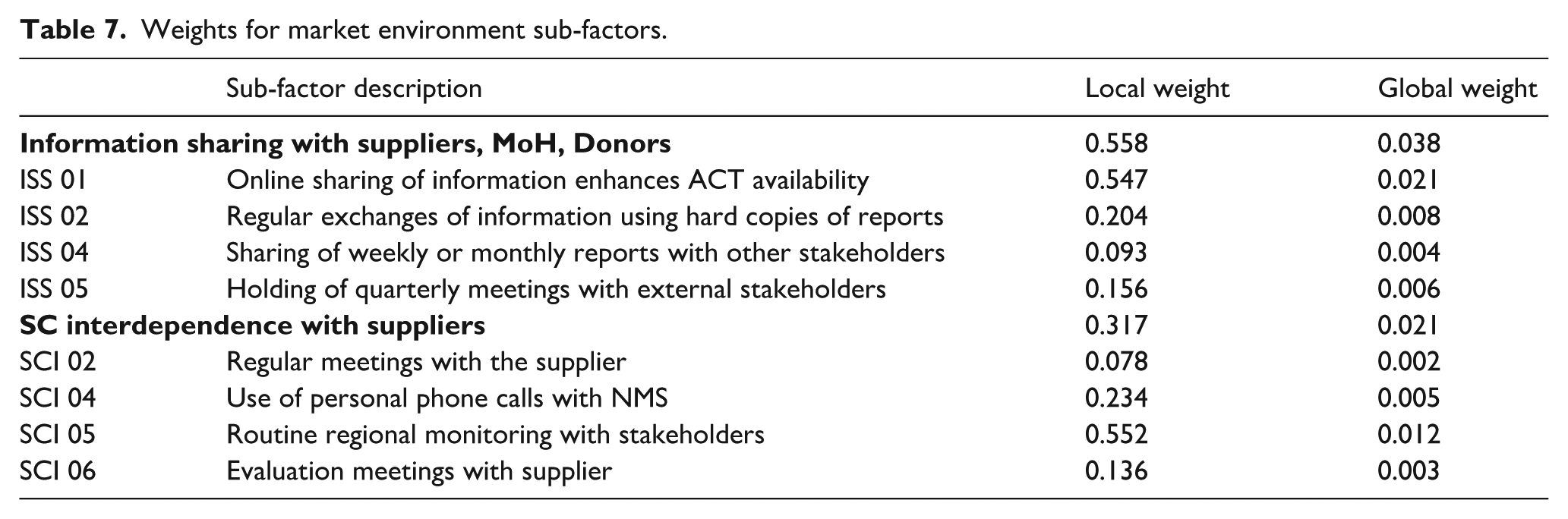
Among the strategic factors assessed,market environment had the least influence on the accessibility of ACTs in hospitals, with a global weight of 0.068. Although the CR for thus dimension was acceptable (below 10%, (Table 6), the results indicate that market forces have less prediction towards the availability of drugs. Market environment was measured using information sharing with suppliers (ISS), partnership training (CP), SC interdependence with suppliers (SCI) and relationship between lower health units (RH) (Table 7). Among these, RH and CP factors had the least significant effect towards the availability of malaria therapies in hospitals. Together, these two sub-factors accounted for less13% of the total weight in this dimension. Given their low relative influence and statistical insignificance, further discussion of market-related factors was not pursued in the analysis. However, it remains important to note that while market dynamics may currently play a limited role, strengthening supplier relationships and inter-agency collaboration could support long-term improvements in supply chain resilience.
Raw and normalize data for market dimension sub-factors.

Weights for market environment sub-factors.
Macro-environment
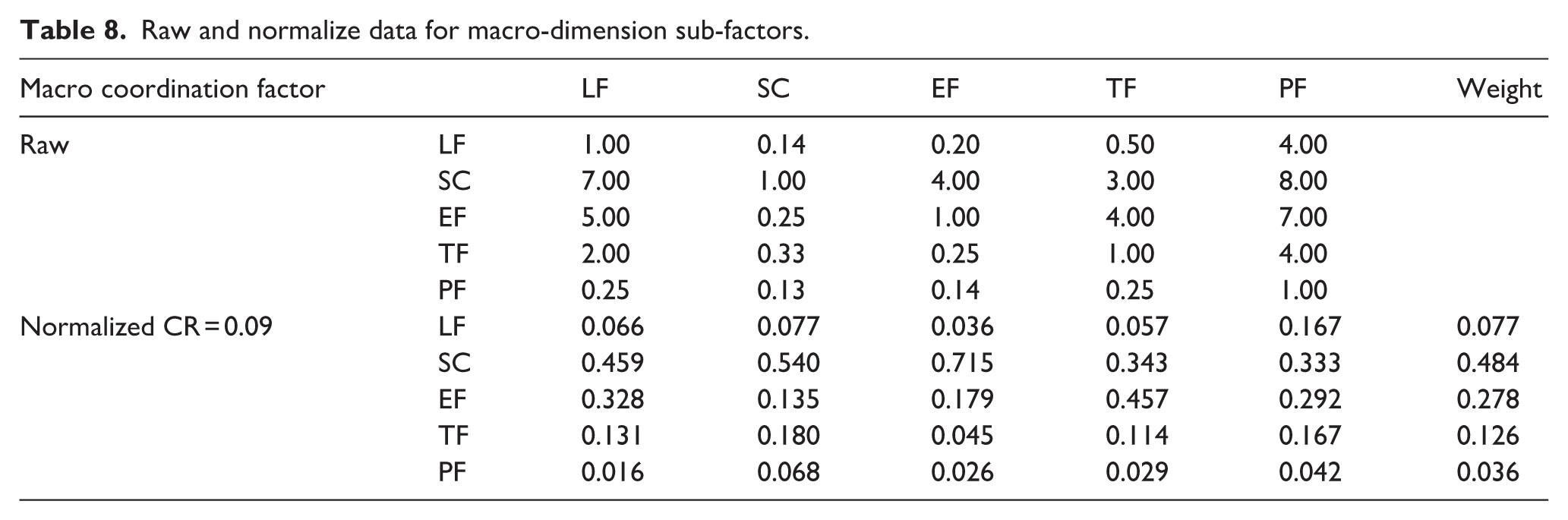
Macro-environment involves factors that are beyond the organization’s control; these factors are so dynamic with little prediction – they are external forces that affect the presence of ACTs. Regardless of the turbulence of these factors, the organization in charge of ACTs’ supply and distribution need to be aware and understand them; this can be achieved through external analysis of the environment. Macro-environment mainly focuses on political, economic, social, technological and legal environment – specifically, culture change, interest rates, weather, demographic and government regulations. The assessment of these factors helps to unveil the future threats and possible opportunities 69 while trying to make ACTs available to the last person. From the study, social-culture (SC) factors have the highest impact (0.484) towards the availability of ACTs in Uganda, followed by the economic factors (EF) (0.278). Technological factors (TFs) influence the accessibility of malaria therapies by 0.126, while legal factors (LF) have a weight of 0.077 (Tables 8 and 9).
Raw and normalize data for macro-dimension sub-factors.
Weights for the macro-environment sub-factors.

SC factors show how the society’s basic values, preference and behaviour affect the accessibility of malaria therapies. The preferences can be influenced by gender, age bracket, clubs and location that shape someone’s beliefs and values; failure to understand these factors can lead to a blunder in malaria therapies supply. The perspective of a group to which someone subscribe to, influences their present and future decisions – a change in one situation causes a different impact. Impact of clicks on availability of ACTs scored highly (0.700) compared to other parameters that measured SC factor. In Uganda, it has been a culture that people seek medical attention after having serious results from malaria – this is attached to the rooted culture of using herbal medicines. 70 As defined by WHO, herbal medicine is one that contains active materials from plants. Herbs have been known to treat malaria, respiratory challenges, sex impotence and child complications for centuries. In Uganda, more than 60% of the population depend on herbal medicines – for every 400 people, there is an herbalist; comparing this to western countries (1:20,000), the odds favour traditional medicine usage. 71 This is further escalated by the flooding of Asian drugs on the market. In addition, regardless of their availability, herbs are too cheap compared to the ACTs. Therefore, as people continue to associate themselves with such norms and clicks that do not encourage malaria treatments from recognized hospitals, the situation will continue to be worse – even if the stores are full of ACTs.
One of the main reasons why people use herbs to treat malaria is because they are cheap; thus, EF is a key player in making ACTs accessible to local people. There is a direct link between poverty and malaria. 72 Malaria therapies are special products because of their peculiar supply and demand. Thus, in some countries, the importation and distribution are heavily regulated to ensure affordability and consumer safety. However, competition should play a cardinal role in ensuing ACTs’ accessibility so that consumers can benefit quality, choice and variety, low prices and innovation. Focused group discussion ranked donor funding and cost sharing as the possible way of solving the problem – with the latter weighing 0.599. Cost sharing has been of the mechanism that has improved health system developed countries. This has been attributed to the fact that, cost sharing can raise extra revenue. 73 From group discussion, cost sharing in Uganda can be done through community insurance. Some ACTs are expensive to be affordable by a single person, but if the community has some insurance, the impact can be distributed across – thus easy access to ACTs. With the availability of donor funds and programmes such as community insurance, the accessibility of malaria therapies can improve. 74 Therefore, such programmes should be promoted by the authority.
Technology has become the driving engine for any business or service – by a click of few buttons, the world can be known in just seconds. The effect of technology has been more immense in medical sector – from medical research, manufacturing to the last consumer. Albeit the use of RDTs scored least (0.072) among the technological items, diagnostic of malaria-related causes has never been so easy and accurate like today after the introduction of nuclear medicine. RDTs allow the technician to examine the patient without invasive procedures. Under technology, the use of M-tracking systems and mobile phones was ranked highly, 0.628 and 0.301, respectively. With the help of mobile phones and M-tracking, the central distribution office can easily know the areas with less stocks, in addition to the stock rate consumption – hence, planning for the stock out in advance. M-tracking does not only help the planners but also the consumers. The latter can easily know which malaria therapies are available at the healthy centre before travelling there. The rapid development of M-tracking in Uganda supports this theory. Therefore, the government should develop systems that can facilitate the sustainability of Internet, since M-tracking needs Internet support to run at capacity.
Limitations of the study
While the methodology employed in this study – specifically the AHP – proved effective in prioritizing strategic areas and sub-factors influencing ACT supply chain coordination, several limitations must be acknowledged. First, the AHP relies on a conceptual rating scale that, although useful for establishing relative importance among factors, does not offer concrete action plans to address identified weaknesses. Second, the pairwise comparison process introduces the potential for subjective bias, as responses are based on expert judgement. This could affect the reliability of the final rankings if not carefully moderated.
In addition, some factors considered in the model may have interdependencies or feedback loops that AHP does not account for, as it is based on a strict hierarchical structure. In such cases, the Analytic Network Process (ANP) may be a more appropriate method. Unlike AHP, which assumes independence among criteria, ANP allows for the modelling of complex interrelationships and feedback effects, providing a more nuanced understanding of system dynamics.
Conclusion
This study aimed at identifying and prioritizing the factors affecting the coordinated supply chain management of ACTs in Uganda’s general hospitals using the AHP. Figure 2 summarizes the factors that play a critical role in the availability of ACTs. The micro-environment, with a weight of 0.480, emerged as the most influential factor. Within this environment, TM support was found to be the most critical sub-factor, followed by MU and IS. Effective TM, characterized by proactive decision-making and performance management, significantly contributes to supply chain success. Frequent feedback on stock status and support for redistribution and continuous medical education were highlighted as essential practices for improving the availability of ACTs. MU among team members, facilitated by shared goals and trust, is crucial for achieving supply chain objectives. IS, despite its challenges, plays a vital role in ensuring drug availability. Digitalizing stock information and enhancing verbal communication were identified as important strategies for improving information flow.

Summary of critical determining dimensions.
Logistics, with a weight of 0.333, was the second most influential factor. Within logistics, procurement and ordering were found to be the most critical sub-factors. Adherence to delivery schedules, accurate forecasting and effective SM were identified as key practices for ensuring the availability of ACTs. Therefore, more emphasis should be put on improving SM practices, including the use of stock cards, labelling and monitoring room temperatures, to prevent stockouts and maintain drug quality.
The market factors, with a weight of 0.068, were found to have the least influence on ACT availability. ISS, the MoH and donors were identified as the most critical sub-factor within this environment. Regular exchanges of information and holding meetings with external stakeholders were recommended to enhance supply chain coordination.
The macro-factors, with a weight of 0.120, also play a significant role in the availability of ACTs. Social-cultural factors, such as community preferences and attitudes towards health facilities, were identified as having the highest impact. EFs, including poverty levels and donor funding, also influence drug accessibility. The study highlighted the importance of understanding and addressing these external factors to improve the supply chain.
In conclusion, improving ACT availability in Uganda’s hospitals requires a multifaceted approach that emphasizes internal organizational alignment, responsive logistics practices, community engagement and policy-level support. These findings provide actionable insights for healthcare managers, policymakers and development partners to design targeted interventions that enhance the performance and resilience of medicine supply chains in resource-constrained settings.
Footnotes
Acknowledgements
We thank the Drug Therapeutic Management Committee (DTMC) members in the four general hospitals for taking part in this project.

Ethics approval
Ethical approval for this study was granted by the Research Ethics Review Committee of the University of South Africa (approval no. 2017-CEMS-ESTIL-005).
Consent to participate
All participants provided written informed consent prior to participation.
Consent for publication
Consent forms had a clause that ensured that individuals are informed and voluntarily agree to their information being published, respecting their privacy and autonomy.
Author contributions
Funding
The authors received no financial support for the research, authorship and/or publication of this article.
Declaration of conflicting interests
The authors declared the following potential conflicts of interest with respect to the research, authorship and/or publication of this article: We declare no competing interests. The manuscript is extracted from the PhD study of the corresponding author while studying at the University of South Africa.
Data availability statement
The data sets supporting the conclusions of this article are available on reasonable request from the authors.