



Abstract
The neurodiversity paradigm challenges educators to develop inclusive and affirming learning environments for all children. However, little is known about the neurodiversity-relevant training that U.K. school staff receive, or how confident they feel supporting neurodivergent pupils. This study extends previous research exploring the impact of training interventions, to investigate how everyday contact with neurodivergent individuals, attitudes to neurodiversity and perceived stress relate to self-efficacy in a diverse sample of U.K. school staff. The study had two aims: (a) to describe staff experiences in supporting neurodivergent pupils and the training they had received; (b) to identify predictors of self-efficacy in supporting neurodivergent pupils. One hundred and seventy-seven teachers and support staff working in mainstream schools in the United Kingdom completed a mixed-methods survey. Participants identified a range of rewards and challenges working with neurodivergent learners; the quality, type and duration of training received was highly variable. Better training emerged as a key professional development need. Self-efficacy also varied widely, and was predicted by respondents’ level of contact with neurodivergent people, both in and outside work, and by how well they coped with work stress. These findings highlight potential limits of training alone and suggest broader systemic and relational influences on staff confidence in inclusive practice.
Lay Abstract
What Is Already Known About the Topic?
Creating classrooms where all children feel supported—including those who are neurodivergent—is an important goal for schools. Research indicates that neurodivergent pupils are more likely to be excluded from school and to be unhappy at school than their neurotypical peers.
What This Paper Adds
We surveyed teachers and support staff working in mainstream schools across the United Kingdom. They told us about the challenges and rewards of working with neurodivergent pupils, and their confidence in meeting these pupils’ needs. We found that the amount and quality of training staff received varied a lot, and many said they would benefit from better, more consistent training. Staff who had more personal or professional contact with neurodivergent people, and those who managed work stress more effectively, tended to feel more confident in their ability to support these students.
Implications for Practice, Research or Policy
Overall, our findings suggest that training alone may not be enough—staff confidence is also shaped by their relationships, experiences, and working conditions. To truly support neurodivergent pupils, schools may need to think more broadly about how they create inclusive, supportive environments for both students and staff.
Introduction
Little is known about the duration and quality of neurodiversity-relevant training accessible to teachers and other school staff in the United Kingdom, but available evidence suggests that provision is inconsistent and often minimal. For example, the National Autistic Society (2023) reported that that only 39% of primary teachers and 14% of secondary teachers surveyed had received more than half a day of autism-relevant training in the course of their careers. Given that 10–20% of the school-age population is estimated to be neurodivergent (DfE, 2025a), this is potentially an important professional development gap. The current study explores U.K. teachers’ experiences of training, and their self-efficacy in supporting neurodivergent children at school.
While neurodiversity describes variation in neurocognitive function across the human species, neurodivergence denotes profiles that fall outside societally defined norms (Walker, 2021). Neurodivergence includes, but is not limited to, clinically defined profiles such as autism, attention deficit hyperactivity disorder (ADHD), dyslexia, and developmental coordination disorder (DCD), diagnoses that frequently co-occur (Astle et al., 2022). Substantial increases in neurodevelopmental diagnoses in children and adults have been reported in U.K. population cohort studies over the last 2 decades (McKechnie et al., 2023; Russell et al., 2022), a trend that has largely been attributed to more inclusive diagnostic criteria and raised societal awareness (Abdelnour et al., 2022). Concerningly, there is accumulating evidence of poor educational and well-being outcomes for neurodivergent children and young people. School exclusion rates for children with autism and ADHD are several times higher than for their neuro-majority peers (Cooke, 2018; John et al., 2022). In a survey of 947 parents, over 90% of children who had experienced school distress severe enough to cause extended periods of absence were identified as neurodivergent (Connolly et al., 2023). The few studies reporting first-person perspectives from neurodivergent pupils indicate that psychological distress is situationally linked with the sensory and social demands of school environments, and the need to “mask” neurodivergent differences to meet the expectations of teachers and peers (Goodall, 2018; Mesa & Hamilton, 2022). Thus, school distress often underpins long-term absence from school, impacting life outcomes for neurodivergent children and their families (Fielding et al., 2025; Hamilton, 2024). For example, parents often report a deleterious impact on their own mental health and financial stability, as they seek alternative educational solutions for their children who are not able to be school (Mullally & Connolly, 2025).
While there is variation across the nations of the United Kingdom in both the definition of additional learning need and approaches to inclusion in mainstream education, there are common contextual challenges (Knight et al., 2024). In England, the number of children identified with a special educational need (SEN) has increased each year since 2016: currently 5.3% of pupils have an Education, Health and Care Plan (ECHP) entitling statutory support, while an additional 14.2% receive SEN support without an EHCP (Department for Education, 2025a). An increase in children recognised as having significant or “complex” additional needs has outstripped the number of specialist places available across the United Kingdom (Norden, 2024). Given that most neurodivergent pupils are therefore educated in mainstream provision in line with policy priorities, a greater focus on neurodiversity-affirming educational practice at the whole-school level is warranted to support improved outcomes for neurodivergent pupils (Cook, 2024). An example of neurodiversity-affirming practice is Universal Design for Learning—which aims to ensure equitable access to learning by adapting teaching methods, materials, and spaces (Aitken & Fletcher-Watson, 2022; Mayer et al., 2014). However, it is unclear how neurodiversity is understood among school staff and to what extent specialist training is available to support neurodiversity-affirming practice in schools.
Teacher self-efficacy, or belief in one's capability to facilitate student learning and engagement, is a psychological construct that has long been linked to positive teaching behaviours and student outcomes (Zee & Koomen, 2016). In his original conceptualisation, Bandura (1997) highlighted that teachers with greater self-efficacy tend to believe that students perceived as “difficult” are teachable through appropriate individualised strategies. This core belief is critical to effective inclusive working with neurodivergent learners. Several studies have investigated teacher self-efficacy in relation to neurodiversity, most focusing specifically on autistic pupils. Findings indicate that teacher self-efficacy is associated with decreased perception of disruptive behaviours in autistic pupils (Segall & Campbell, 2014); reduced teacher burnout (Ruble et al., 2013) and stress; and positive student outcomes (Love et al., 2019). However, secondary subject teachers tend to have less belief in their capability to support autistic pupils effectively than senior managers or SEN teachers (Humphrey & Symes, 2013).
Cook and Ogden (2022) conceptualised self-efficacy as a balance between the challenges that teachers face in supporting autistic children and the identification of effective strategies to facilitate their achievement. Qualitative findings indicated that teachers in mainstream schools often had access to less specialist training and resource than their counterparts in specialist settings, and were more likely to implement generic interventions, such as time-out cards, than strategies mapped to individual children's needs. While most teachers support the inclusion of children with SEN in mainstream settings (Baek et al., 2024; Humphrey & Symes, 2013), there was a perception among the teachers interviewed in Cook and Ogden's (2022) study that the challenges of diverse student needs can be too great for school staff to manage, especially in the context of increasing class sizes, sharpened focus on attainment, competitive league tables, central regulation and performance monitoring. These findings converge with other research indicating that children with SEN risk being perceived as an additional burden in an already stressful work-life in teaching, which can bolster the view that supporting these children should be the responsibility of external, specialist agencies and militate against inclusive practice in mainstream schools (Little, 2017; Warnes et al., 2022).
It is plausible, then, that improving teachers’ self-efficacy may be one pathway to enhancing inclusive practice in schools. Research suggests that greater knowledge of conditions like autism and ADHD is associated with higher teacher self-efficacy (Latouche & Gascoigne, 2019; Lu et al., 2020; Wittwer et al., 2023). Autistic pupils themselves have highlighted staff understanding as key to improving their school experience (APPGA, 2017) and specialised training has been shown to boost self-efficacy in teachers and other professionals, presumably via improved knowledge (Clarke & Fung, 2022; Saade et al., 2024). Specialised neurodiversity training that combines evidence-based information with first-person neurodivergent accounts is desirable; however, the reach, duration and quality of specialist neurodiversity training received by school staff in the United Kingdom is currently unknown.
While there is evidence that training can enhance self-efficacy by improving knowledge, this relationship may be more complex in practice. Sound knowledge of facts about neurodiversity does not always translate into feelings of competence in working with neurodivergent pupils. Vincent and Ralston (2019) found that trainee teachers underestimated their own knowledge of autism in a self-assessment when compared with performance on a standardised measure. This finding suggests that knowledge alone is not sufficient for self-efficacy; experience of interacting with neurodivergent people may be another important factor. Mintz et al. (2020) reported that self-efficacy and positive attitudes to inclusion declined through the first year of teaching. However, beyond the novice year in practice, the amount of experience that teachers have in working with autistic pupils is predictive of self-efficacy (Wittwer et al., 2023). Contact with neurodivergent people outside the classroom is also likely to be important. People who have more contact with autistic people in their personal lives make less stereotyped judgements about, and hold more positive attitudes toward, autistic people in general (Dickter & Burk, 2021; Gemegah et al., 2021). Whether less stigmatising attitudes to autistic and neurodivergent people translates into higher teacher self-efficacy remains to be determined. Cook and Ogden (2022) reported that reduced self-efficacy among the mainstream teachers that they interviewed was linked with a deficit-focused conceptualisation of autism. The diversity of pupil characteristics and needs was identified as a barrier to inclusive practice, over aspects of the school environment. In contrast, positive attitudes to managing differences in the classroom are associated with effective classroom practice (Avramidis & Norwich, 2002). Attitudes toward neurodiversity may therefore also underpin teacher self-efficacy.
In summary, for neurodivergent pupils to thrive at school, there is a need for inclusive, neurodiversity-affirming school environments. Interpersonal interactions at school are particularly important; yet research suggests that not all school staff feel confident supporting neurodivergent pupils, which may be attributable to a lack of consistent, high-quality training. The current study sought to build on existing research in several ways. First, most existing studies relate specifically to autistic pupils. Given (a) the high rate of co-occurrence between neurodevelopmental conditions and (b) a lack of research in relation to certain conditions such as developmental language disorder (DLD) and dyscalculia (McGregor, 2020; Sousa et al., 2016), we adopted a more holistic operationalisation of “neurodivergence,” including a range of neurodevelopmental diagnostic categories that mean children often need accommodations within a mainstream environment. Second, while teacher self-efficacy is important, other school staff who regularly interact with neurodivergent pupils (e.g., teaching assistants, pastoral staff) are also integral to whole-school inclusive practice (Symes & Humphrey, 2011). We therefore recruited school staff in any role entailing regular contact with neurodivergent learners.
The study had two aims:
To describe experiences of school staff in supporting neurodivergent pupils, and the level of neurodiversity-relevant training they have received. To identify predictors of self-efficacy in supporting neurodivergent pupils. In relation to the second aim, we predicted that school staff who (a) had received relevant training; (b) have more contact with neurodivergent people and (c) hold less stigmatising attitudes to neurodiversity would show higher self-efficacy.
Method
This study employed a convergent mixed-methods survey design, triangulating qualitative analysis of responses to open-ended questions with correlational analysis of quantitative scales, with the aim of gaining both statistical and contextual insights while minimising participant burden. The qualitative analysis addressed the first study aim, by examining participants’ experiences of working with neurodivergent pupils and characterising the neurodiversity-relevant training that they had received. Quantitative analysis addressed the second aim, by examining predictors of self-efficacy in a multiple regression model; this analysis was preregistered (https://osf.io/k3ahs/registrations). Ethical approval was obtained from the School of Education, Language and Psychology ethics committee at York St John University.
Participants
Teaching and support staff working in mainstream schools were recruited via emails to schools, posts in online teaching networks, and via the online recruitment service, Prolific. In total, 195 responses to the survey were received. Fourteen were removed as respondents had completed less than 50% of the questions; a further four because participants did not meet the inclusion criteria (i.e., working in a U.K. mainstream school with pupils between 4 and 18 years). This left 177 participants whose responses were analysed.
Eighty-four percent of the sample was female (15% male; 1% nonbinary or preferred not to say). The majority identified as White/White British (92.1%); Asian/Asian British (1.1%); Black/Black British (1.1%); mixed heritage (4.0%); preferred not to say (1.7%). Nearly a quarter of the sample (23.7%) identified as neurodivergent themselves.
Participants’ mean age was 42.46 years (SD = 9.87); on average, they had worked in schools for 14.23 years (SD = 8.75). Eighty-four percent were educated to at least undergraduate level. Respondents came from most regions of the United Kingdom; the most frequently represented were Yorkshire and the Humber (34.5%), South-East England (16.9%), South-West England (9.0%) and London (8.5%). Ninety (51%) respondents were classroom teachers; 65 (37%) in support roles; 22 (12%) in senior leadership. Approximately half worked in primary settings (4–11 years), and half in secondary and higher settings (11–18 years).
The participant demographics in this sample closely reflect those of the national school workforce in terms of age, ethnicity and educational phase. However, there was a slightly higher than average representation of females (84%) compared to the national average (76%), and a higher ratio of qualified teachers to support staff (2:1) compared with the national average (1:1), which was also reflected in the higher percentage educated to at least undergraduate level (84%) compared to the national average (50% of the total workforce; Adams et al., 2023; DfE, 2023).
Measures and Procedure
An online survey was compiled using Qualtrics software. Full information on the study's aims was provided; participants were required to indicate their understanding and consent before accessing the questionnaire.
Following demographic questions, open textboxes asked participants to describe rewards and challenges of working with neurodivergent pupils in their roles; details of neurodiversity-relevant training received (e.g., “Have you ever received training on working with autistic and neurodivergent pupils?”; “Please tell us about this training [duration/type of delivery/who delivered/key learning points]”); and what, if anything, would help them feel more confident in supporting neurodivergent learners. These items yielded qualitative data to address the first research question.
Quantitative scales comprised:
Self-Efficacy
The Autism Self-Efficacy Scale for teachers (Ruble et al., 2013) was used to measure teaching self-efficacy of those who work with neurodivergent pupils. The scale comprises 30 items rating certainty in respondents’ ability to do various tasks with neurodivergent pupils (e.g., use visual supports; motivate students) using a six-point scale (1 = not at all certain–6 = very certain; range of possible scores: 30–180). The two items containing the word “autism” were adapted to refer to neurodivergence broadly rather than autism specifically (i.e., “With the pupils you work with in mind, how certain are you that you can describe your students’ neurodivergent characteristics” instead of “…your students’ characteristics that relate to autism.” Participants could skip items that were not relevant to their daily work. No more than 5% data were missing on any item; missing values were imputed using the expectation-maximisation method. Internal reliability for this scale was excellent (Cronbach's alpha = .97).
Contact With Neurodivergent People
Respondents indicated whether they knew people personally in four different capacities (friend, family, colleague, pupil) with a range of neurodevelopmental conditions (autism, ADHD, dyslexia, DLD, dyscalculia, DCD, Tourette's Syndrome). Tally scores were used as a proxy of participants’ range of contact with neurodivergent people in their daily lives (range of possible scores: 0–28).
Attitudes Toward Neurodiversity
The Attitudes to Neurodiversity scale (VanDaalen, 2021) comprised 24 statements (e.g., autism is a fundamental part of who someone is) rated on a 5-point Likert scale (strongly disagree–strongly agree). This measure is specifically tailored to autism; no measure of attitudes to neurodivergence more broadly could be sourced. Two subscales showed adequate internal consistency: Stigma, indexing stigmatised attitudes to autism (Cronbach's alpha = .84, range of possible scores: 0–56) and Identity, indicating how far autism is conceptualised as an integral part of identity (Cronbach's alpha = .71; range of possible scores: 0–28).
Stress at Work
Two single items (response scale: 0 to 10), previously reported to be sensitive to individual differences in work-related stress in teachers, were used (Eddy et al., 2019). The first ranks respondents’ current level of work-related stress; the second how well they are currently coping with stress.
Data Analysis
Responses to open-ended questions were subjected to conventional content analysis (Hsieh & Shannon, 2005). This inductive approach to theme generation foregrounds participants’ perspectives and was selected due to the limited existing literature on the topic of neurodiversity training for school staff.
Reading and Familiarisation
Responses were read repeatedly to gain a thorough understanding of content and the range of issues and sentiments expressed.
Identifying and Categorising Themes
The second author coded the full set of responses by hand; initial codes were generated by identifying recurring ideas, phrases and concepts and then organised into categories related to each question. Relationships between the categories were examined and interpreted, and higher-order themes formulated in the context of the first research aim.
Analysis
Each theme was quantified by calculating the percentage of participants mentioning it. Indicative quotations were selected to illustrate each theme.
Validation
A subset of responses (20%) was independently coded by the first author: interrater agreement was high (Κ = .82). Reflexivity was maintained by noting initial expectations based on prior knowledge of the subject, actively looking for unexpected findings or disconfirming cases, and discussion of the analysis between the authors.
To analyse the quantitative measures, self-efficacy was entered as the criterion variable in a hierarchical regression. Demographic factors were entered at the first step; work stress items at the second step, given the established relationship between stress and teacher self-efficacy (Skaalvik & Skaalvik, 2017). At the final step, the three predictor variables of primary interest were entered: contact with neurodivergent people; training; and attitudes to neurodiversity. Statistical analyses were conducted in SPSS v.28.
Results
Qualitative Analysis: The Experiences of School Staff in Supporting Neurodivergent Pupils
Two broad themes were derived from content analysis of the open text responses: (a) learning from training (defined by the categories: frequency/duration of training; who delivers; training focus; key learning; other sources of information) and (b) challenging and rewarding aspects of supporting neurodivergent pupils (defined by categories: challenging aspects; rewarding aspects; what would help). The full codebook can be found in Supplemental Table A1.
Learning From Training
One hundred and thirty-four (76%) respondents had received some level of training on working with autistic or neurodivergent pupils, with 50 (28%) describing it as one-off/historical/non-specialist training, and 84 (47%) describing multiple or regular training. Of those who had received training, most (49%) received short sessions (less than half a day), with only 16% receiving training that lasted one day or more and 19% taking longer courses (e.g., Master's degrees; National Award for SEN co-ordination). Most training was delivered in-house (38%) or by charities (25%). Other providers included local authorities (23%), universities (14%) and specialist schools (7%). Respondents referred to non-specialist (“Very vague training during PGCE”; “One afternoon as part of an LGBTQ + presentation”; “Trauma-informed schools”) or non-recent training (“Some twilight training, long long ago. I can’t remember much of it”; “A few sessions a long while back”), although some had undertaken more intensive programmes (“I completed an accredited diploma in autism awareness … 160 h long”) or more regular refreshers (“We have some form of group training on working with autistic and neurodivergent pupils annually”).
Respondents most frequently cited learning relating to interventions and adaptations that could be used to support autistic pupils (34%; “Mostly on autism”). This was followed by increased knowledge of traits, symptoms, identification, and diagnosis (18%; “The unit covered the triad of impairments, diagnosis, support services, and interventions”). Other areas included speech, language, and social skills, individualised training to meet pupil needs, mental health awareness/emotion regulation, behaviour management and sensory needs.
Many respondents had obtained knowledge about neurodivergence from other sources—mainly through experience at work (34%), talking to other staff members (14%), and personal experience (27%), but also through reading books (25%), articles (25%) and online sources (18%). Additionally, many had learned from TV/film/radio (21%) and social media (10%).
Challenging and Rewarding Aspects of Working With Neurodivergent Pupils
Teachers identified a wide range of challenging issues related to supporting neurodivergent pupils at school (Figure 1).

Content analysis of qualitative responses identifying challenges of working with neurodivergent pupils.
The most frequently cited challenge was time constraints preventing staff from getting to know a child's needs, planning effectively, and providing appropriate support. For example, a secondary school teacher stated, “I find that I am lacking in time to provide the high-quality individualised support that is expected and deserved. I see it as a priority therefore I have to cut back on other areas of my role, for example research and lesson planning in general. There is less and less support available due to budget cuts and fewer classroom assistants.”
Many respondents referred to limited training and resources raising uncertainty about how to meet the needs of students with higher support needs. One primary school teacher reported that the main challenge was, “Not really knowing whether you're doing things right, or possibly making things worse. Mistakes are an opportunity to learn, sure, but it's a pretty poor deal for the person on the receiving end of the mistake.” A SEN assistant from a primary school stated, “One pupil in particular is non-verbal and has no interest in interacting with others. He exhibits behaviour that challenges. The other children don't understand him and neither do most of the staff. We have had no training on supporting a child with his level of need - we have some idea what to do to support his academic development but no idea how to approach social skills, play skills or behaviour management with a pupil who appears to have no awareness of others and little understanding.” A sixth-form teacher concluded that, “It's not the neurodivergent children that are the problem but the lack of any real support for teachers and their neurodivergent students.”
Conversely, many identified rewarding aspects of working with autistic and neurodivergent pupils (Figure 2).
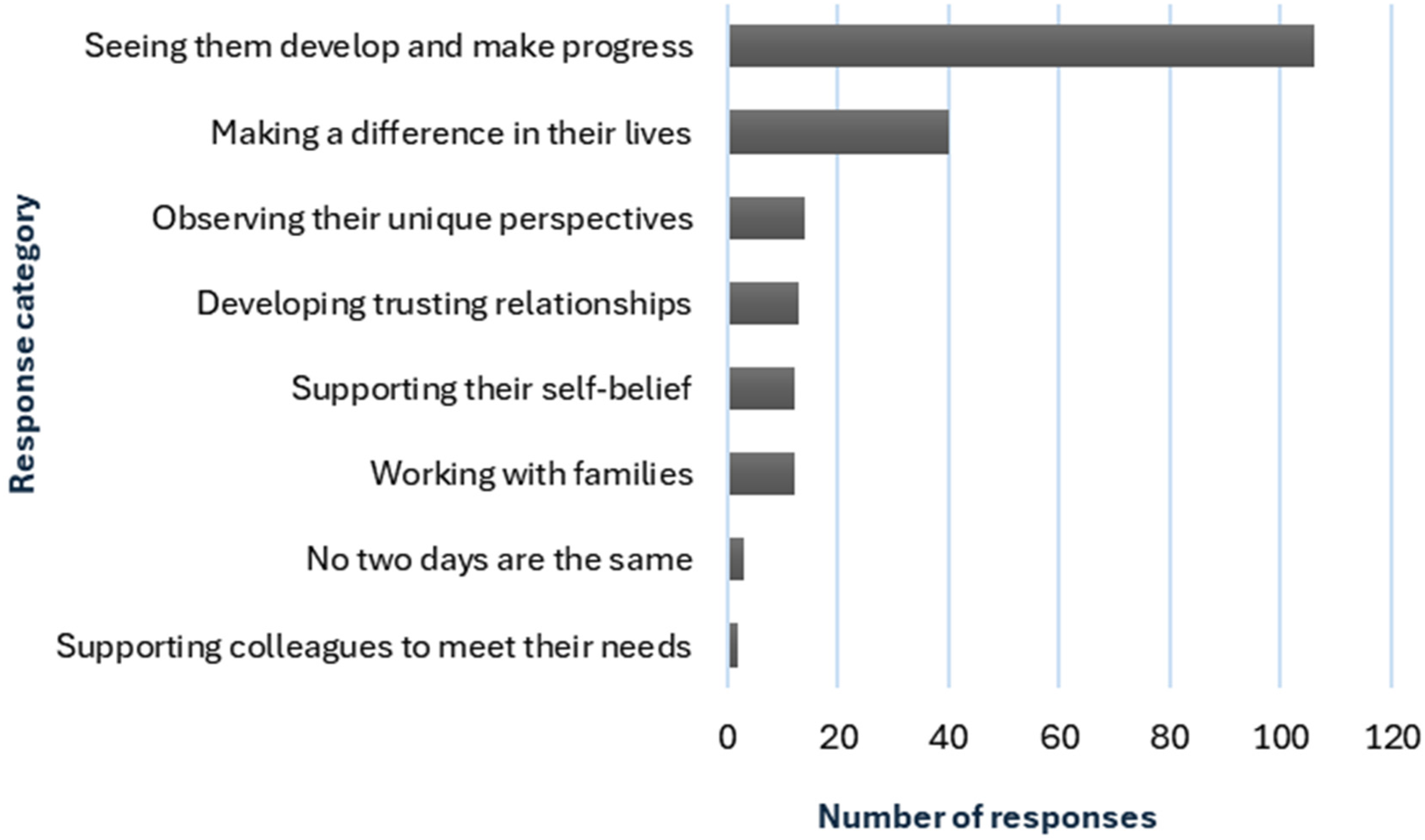
Content analysis of qualitative responses identifying rewards of working with neurodivergent pupils.
Many respondents (106) highlighted the reward of witnessing student development and progress, with 40 mentioning the satisfaction of contributing to positive changes in their lives. A Learning Support Practitioner from a secondary school stated, “When you see a student progress over time and reach goals set. These goals may be very small steps. Seeing a student grow in confidence and overcome the barriers they face is very rewarding. In a nutshell seeing students flourish and realise they are part of a community who accepts them for who they are.” Another from a primary setting reported that “The good days feel really good, and it is wonderful when you see a breakthrough, a little act of genuine kindness, the child making a friend and reciprocating companionship and feeling comfortable with it. The breaking down of barriers within our relationship, when a little girl you've worked with for two years and has never allowed any form of touch before suddenly takes your hand or gives a hug.”
When asked what would help them to feel more confident in supporting neurodivergent pupils, responses reflected the areas identified as challenging above, that is, increased levels of training, staffing and time and resource (Figure 3). But many identified other practices that would help such as a consistent school approach, better internal communication, environmental improvements in school, and parental support.

Content analysis of qualitative responses identifying factors that would help school staff to feel more confident in supporting neurodivergent pupils.
In summary, the content analysis revealed very wide variety in the type, duration, focus and recency of neurodiversity-relevant training experienced by U.K. school staff, with almost a quarter reporting never having received training. Respondents reflected on a range of challenges and rewards in supporting neurodivergent pupils in mainstream settings, identifying more and better-quality specialist training as a key professional development need.
Quantitative Analysis: Predicting Self-Efficacy in Supporting Neurodivergent Pupils
Frequency scores for contact with neurodivergent people through family, friendship or professional relationships are reported in Table 1. Approximately one-quarter to one-third of participants reported having family members, friends and colleagues with autism, ADHD and/or dyslexia. It was markedly less common for respondents to report contact with adults with DLD, dyscalculia, DCD or Tourette's Syndrome. Correspondingly, almost all respondents reported interacting with pupils identified with autism, ADHD and/or dyslexia (85–91%), whereas contact with pupils with other diagnoses was lower (58–75%).
Proportion of Participants who had Contact With Neurodivergent People in their Daily Lives (N = 177).

Note: ADHD = attention deficit hyperactivity disorder; DLD = developmental language disorder; DCD = developmental coordination disorder.
Descriptive statistics for the quantitative measures are reported in Table 2, alongside bivariate interclass correlation coefficients. There was considerable variation in self-efficacy; scores ranged from 48 to 180. On average, participants reported low levels of stigmatising attitudes, and high endorsement of autism as a core part of identity. Thus, many respondents adopted attitudes aligned with a neurodiversity perspective.
Descriptive Statistics and Correlation Coefficients (Pearson's r) Between Outcome and Predictor Variables.
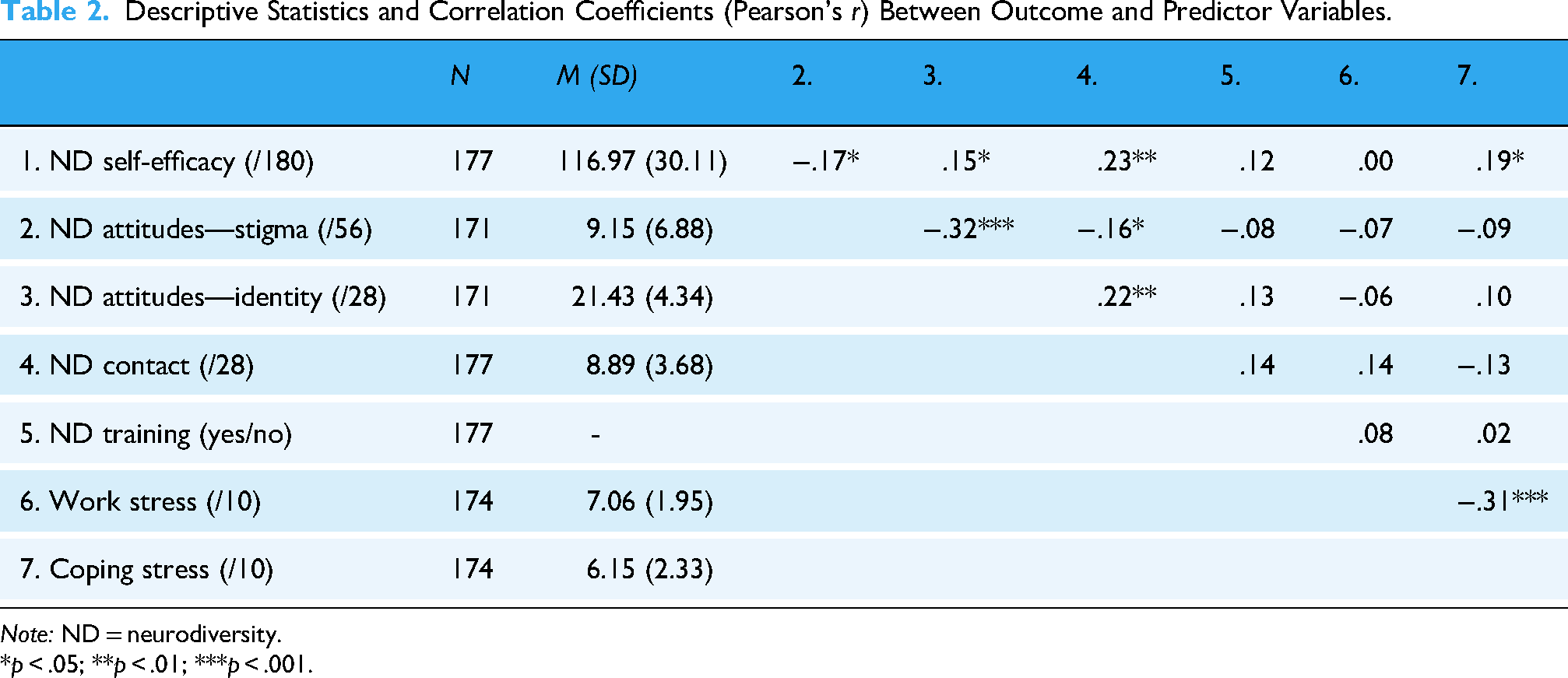
Note: ND = neurodiversity.
*p < .05; **p < .01; ***p < .001.
Self-efficacy was weakly correlated with attitudes to neurodiversity, contact with neurodivergent people and coping with stress (though not work stress levels). Specifically, participants with higher self-efficacy tended to believe that autism is integral to identity. People who had more diverse contact with neurodivergent people reported higher self-efficacy and more neurodiversity-affirming attitudes. Whether participants had received neurodiversity-relevant training was not associated with the other variables.
Next, demographic differences in the predictor and outcome variables were examined. Gender differences were observed in the two subscales of the Attitudes to Neurodiversity scale: Stigma—males > females (t(163) = 3.15, p = .004); Identity—females > males (t(163) = 2.11, p = .036); that is, female respondents reported more neurodiversity-affirming attitudes. No other gender differences were observed.
The variables did not differ according to job role (classroom teacher/support staff/senior leader), except the Stigma subscale. Classroom teachers showed significantly higher scores on this measure (mean = 10.76) than either support staff (7.61) or senior leaders (6.67) (F(2, 166) = 5.67, p = .004). Respondents who identified as neurodivergent did not differ from their peers in self-efficacy. However, they reported less stigmatising attitudes (t(165) = 2.28, p = .024) and that they were coping with stress less well than their colleagues (t(172) = 2.01, p = .046). None of the variables was significantly correlated with participant age or time working in schools.
To identify predictors of self-efficacy, a hierarchical linear regression was conducted (Table 3). First, demographic variables were entered: gender (dummy variable where 1 indicated female); job role (1 indicated staff who have completed teacher training, i.e., classroom teachers, senior managers); years working in school; neurodivergent status. At the second step, two indices of work stress were entered. At the final step, the variables of primary interest were entered: (a) attitudes to neurodiversity (stigma and identity); (b) contact with neurodivergent people (total tally score), and (c) training in neurodiversity (1 indicated training had been received). Missing data were excluded pairwise.
Hierarchical Regression Predicting School Staff's Self-Efficacy Supporting Neurodivergent Pupils.

Note: *p < .05; **p < .01.
The combined set of predictor variables explained 14% of the variance in self-efficacy (F(4,149) = 2.30, p = .015). Two unique predictors were identified: coping with stress and contact with neurodivergent people.
As a post-hoc analysis, contact with neurodivergent people was broken down into relationship context to examine whether contact with neurodivergent pupils in school specifically, or contact with neurodivergent people in everyday life more broadly, was associated with self-efficacy and attitudes. Nonparametric correlations indicated that contact with neurodivergent pupils was weakly positively associated with self-efficacy (ρ = .19, p = .011) but not attitudes to neurodiversity. Having neurodivergent family members was associated with self-efficacy and neurodiversity-affirming attitudes (ρ = .20–.29, ps < .01). Contact with neurodivergent colleagues was weakly associated with self-efficacy (ρ = .16−.27, p = .030) and identity beliefs (ρ = .26, p < .001) but not stigmatising attitudes. Having neurodivergent friends was not associated with self-efficacy or attitudes.
Discussion
In this study, teachers and support staff described substantial rewards in supporting the progress and development of their neurodivergent pupils, building relationships, and making a difference to their lives. Key challenges included time constraints preventing them from getting to know children's needs, lack of training and resources, and difficulty understanding and responding to diverse needs. To feel more confident, respondents emphasised the need for more and better-quality training, resources, and support, alongside improved communication and school-wide consistency. While the majority (75%) had received some form of training in working with neurodivergent pupils, this was often limited in duration and scope, with many respondents attending only short sessions or non-specialist training. Fewer than half reported engaging with multiple or regular training sessions related to neurodiversity. Despite these limitations, participants reported valuable learning in areas such as interventions, adaptations, and understanding traits and symptoms. However, the emphasis on identifying traits and implementing classroom-based interventions—rather than fostering a deeper theoretical understanding of neurodiversity or promoting broader cultural change—reflects a tendency in some training programmes to treat neurodiversity as an add-on topic rather than a foundational lens through which all teaching is approached. As others have noted, a narrow focus on diagnostic categories and individual interventions can inadvertently reinforce deficit-based models, where difference is viewed primarily as a problem to be managed (Baglieri et al., 2011; Florian & Pantic, 2017). To move toward more inclusive and neurodiversity-affirming practice, teacher education should also provide opportunities for critical reflection on the social and cultural dimensions of neurodivergence and challenge the notion of the “typical” learner. Without such shifts, efforts to support neurodivergent pupils risk remaining piecemeal and reactive, rather than transformative (Cook, 2024).
Self-efficacy ranged widely among the school staff surveyed, aligning with existing findings showing that not all teachers feel confident in working effectively with autistic pupils (Humphrey & Symes, 2013). We found no evidence that attitudes to neurodiversity uniquely predict individual differences in self-efficacy. On average, self-reported attitudes aligned with a neurodiversity-affirming perspective, showing low levels of stigma and high endorsement of autism as an integral part of identity (VanDaalen, 2021). However, there were demographic differences. Support staff and senior leaders reported less stigmatising attitudes than classroom teachers, as did respondents who identified as neurodivergent. Gender differences in attitudes should be interpreted with caution, given the small proportion of male respondents. The lack of predictive relationship between attitudes and self-efficacy in our findings may suggest that some school staff feel confident in supporting neurodivergent pupils despite holding less affirming views—though confidence may not necessarily translate to inclusive practice. Alternatively, limited variability in self-reported attitudes may underpin the weak observed correlations. It is also possible that our sample composition influenced these findings. For instance, classroom teachers made up a higher proportion of the sample compared with the national average, while support staff were underrepresented. Given that support staff tended to report more affirming attitudes, a more nationally representative sample might have yielded higher overall levels of positive attitudes, and potentially a stronger link between attitudes and teaching self-efficacy.
Whether or not respondents had received neurodiversity-relevant training did not predict teachers’ self-efficacy, contrary to our prediction. However, the wide variation in duration, scope and specificity of training revealed in the qualitative data suggests that a simple binary index was insufficiently sensitive to detect any effect. Our findings suggest that specialist neurodiversity training is not ubiquitous in U.K. schools, and in some cases is minimal in length, not recent and/or is combined with more general diversity training. Given the increasing numbers of neurodivergent students in mainstream schools, there is a clear case for consistent and regular professional development opportunities for all school staff, incorporating contemporary research evidence alongside lived experience insights. An emerging literature indicates that brief neurodiversity-affirming training can enhance teachers’ knowledge of autism and ADHD and thereby self-efficacy (Latouche & Gascoigne, 2019; Saade et al., 2024). However, whether these benefits translate to inclusive classroom practice remains to be determined. Much of the provision described by participants in the current study falls in the bracket of neurodiversity “awareness training,” which serves to provide individuals with key information and to demonstrate organisational compliance with legislation. However, awareness training alone is unlikely to effect sustained change in classroom practice in the absence of ongoing workplace capability-building and an enabling school culture. Context-specific professional development to support continual growth in capacity for inclusive practice, such as teacher coaching, is needed for the effective application of learning from training to practice (Kraft et al., 2018; Petersson-Bloom et al., 2023). Such techniques are resource-intensive and there are often contextual barriers to implementation and engagement, including workload demands, pressured school budgets, and strategic priorities of school leadership. Nonetheless, a collegial approach to improving the inclusion of neurodivergent pupils, drawing on peer support networks within and across schools, is optimal for teaching staff (Boyle et al., 2012).
In line with our hypothesis, self-efficacy was predicted by respondents’ contact with neurodivergent people in their daily lives. Knowing and interacting with an autistic person has been associated with positive attitudes to autism in children (Cook et al., 2020). Comparably, we found a positive association between contact and neurodiversity-affirming attitudes in school staff. This study adds to the literature by showing that more contact with neurodivergent people—both in and outside school—predicts self-efficacy in supporting neurodivergent pupils. It was noteworthy that personal contact with people with certain neurodivergent profiles (autism, ADHD, dyslexia) was reported more frequently than others (e.g., DLD, dyscalculia), despite comparable prevalence estimates (Francés et al., 2022). However, the quality of contact may be a more important factor; experience of high-quality interactions with people of different neurotypes may increase understanding, reduce stereotyped or stigmatising attitudes and enhance professional self-efficacy. The fact that contact via family relationships was most consistently associated with self-efficacy and neurodiversity-affirming attitudes in our data suggests that the quality of contact matters.
How well participants perceived that they were coping with work stress predicted their self-efficacy in supporting neurodivergent pupils. The nature and direction of this relation is unclear, since belief in one's capacity to achieve a goal (i.e., self-efficacy) may in itself be an effective tool in coping with stress (Verešová & Malá, 2012). However, Cook and Ogden (2022) observed that teachers who were expressing concern about work stress within highly competitive and regulated school cultures appeared more likely to present the demands of diverse needs in the classroom as unmanageable. The relation between stress, coping, self-efficacy and inclusive practice warrants further investigation. Moreover, the regression model explained a modest 14% of the variance in school staff's self-efficacy in supporting neurodivergent pupils. It is likely that wider organisational influences not captured in the current study, such as workload, leadership culture and strategic priorities, influence both teachers’ work-related stress and their feelings of self-efficacy.
Finally, the relatively high proportion of respondents who identified as neurodivergent (23.7%) is noteworthy. Although it was not an aim of the study to investigate the experiences and attitudes of neurodivergent school staff specifically, descriptive analysis indicated that this subgroup held less stigmatising attitudes toward neurodivergence than their neurotypical colleagues, and also perceived that they were coping less well with work-related stress. Neurodivergent educators’ perspectives are likely to have influenced responses across the dataset, perhaps especially in relation to the rewards and challenges of supporting neurodivergent pupils. Existing research has highlighted both the unique insight and empathy that autistic teachers contribute to inclusive educational practice and the additional emotional labour involved in navigating unsupportive institutional cultures (O’Neill & Kenny, 2023; Wood & Happé, 2023). Harnessing the expertise of neurodivergent school staff to foster inclusive school cultures is a timely imperative for educational research and practice.
Taken together, the findings of this study highlight that U.K. school staff often lack access to consistently high-quality training in neurodiversity. Effective training should be evidence-based and incorporate lived experiences, ideally through coproduction with neurodivergent educators (Wood et al., 2022). It is crucial to challenge the perception that supporting students with additional needs is outside a teacher's responsibilities. Enhancing self-efficacy among educators is a potential pathway to addressing this issue. Although the current study did not establish a direct link between training and self-efficacy, other research suggests that high-quality training improves teaching self-efficacy by deepening educators’ understanding of neurodivergence (Saade et al., 2024). A current ongoing pilot for primary schools in some areas of England, Partnerships for Inclusion of Neurodiversity in Schools, may be a first step to addressing this gap, although the programme is yet to be evaluated and is not yet applied to secondary school settings (DfE, 2025b).
Inclusive education aims to ensure that all students, regardless of background, abilities or differences, can thrive in school. However, data on exclusion and well-being from autistic and neurodivergent students reveal that this goal is not being met consistently across U.K. schools (Ferguson, 2021; Humphrey & Lewis, 2008), with effective practices often occurring sporadically rather than systematically. The current findings have a number of implications for professional learning and policy. Respondents articulated real challenges in supporting neurodivergent students and highlighted specific support needs that could be addressed through targeted training and resources, improved communication with other staff, and consistent whole-school approaches. Ideally, neurodiversity-affirming practices, such as Universal Design for Learning and neurodiversity-informed approaches to behaviour and attendance, should be integrated into the core teacher training curriculum and followed up with regular continuing professional development opportunities. Professional learning resources should be coproduced with neurodivergent families and educators to ensure relevance and accuracy. Participant responses signal the importance of leadership support, space for collegial dialogue, and time protected for educators to maintain and develop inclusive practice.
This study has several limitations. The model predicted a small amount of variance in self-efficacy, indicating that unmeasured variables may influence how confident school staff feel in supporting neurodivergent pupils. We used existing scales with available psychometric data for comparison; this led to some compromise on validity. The Attitudes to Neurodiversity Scale comprises items tapping attitudes to autism, which could not be easily adapted to neurodivergence more broadly. One subscale was removed from the planned analysis due to poor internal reliability. A revised version of this measure (VanDaalen et al., 2024) was not available at preregistration. The study employed a self-selecting sample and cannot claim to be representative. Respondents were likely more interested in neurodiversity than the U.K. school staff population as a whole, indicated by the relatively high proportion of neurodivergent respondents. Nonetheless, the findings offer a useful starting point for further investigation.
In conclusion, teachers and support staff reported rewards in seeing student progress and forming meaningful relationships, but faced challenges including time constraints, inadequate training, and limited resources. Although most had received some neurodiversity-related training, it was often brief and insufficient, indicating a need for comprehensive and ongoing professional development. Furthermore, self-efficacy in supporting neurodivergent pupils was highly variable, and was predicted by contact with neurodivergent people in daily life, emphasising the value of diverse interactions in fostering inclusive practices. Whilst prior research has demonstrated the benefits of structured training for increasing autism or ADHD knowledge and, in some cases, improving professionals’ self-efficacy (Clarke & Fung, 2022; Latouche & Gascoigne, 2019; Saade et al., 2024), our findings suggest that school staff confidence may also be shaped by the quality of their everyday interactions with neurodivergent individuals and by broader workplace conditions such as stress. This study contributes new insight by showing that these relational and contextual factors may be as important as training content in fostering inclusive practice—highlighting the need for both systemic change and relationally grounded professional development.
Supplemental Material
sj-docx-1-ndy-10.1177_27546330261419277 - Supplemental material for Supporting Neurodivergent Pupils in Mainstream Schools: A Mixed-Methods Survey of School Staff in the United Kingdom
Supplemental material, sj-docx-1-ndy-10.1177_27546330261419277 for Supporting Neurodivergent Pupils in Mainstream Schools: A Mixed-Methods Survey of School Staff in the United Kingdom by Lorna G. Hamilton and Anna Cook in Neurodiversity
Footnotes

Ethical Considerations
Ethics approval was provided by the School of Education, Language and Psychology ethics committee at York St John University.
Consent to Participate
Full information about the study was provided and participants were required to indicate their understanding and consent before participating in an online survey.
Consent for Publication
All data is anonymised in the current article as per ethical approval and data management approval.
CReDIT Statement
LH: conceptualisation; data curation; formal analysis, investigation; methodology; project administration, writing—original draft preparation; and writing—review and editing; AC: formal analysis; writing—original draft preparation; and writing—review and editing.
Funding
The authors received no financial support for the research, authorship, and/or publication of this article.
Declaration of Conflicting Interests
The authors declared no potential conflicts of interest with respect to the research, authorship, and/or publication of this article.
Data Availability
Data for this study are openly accessible via the Open Science Framework.
Supplemental Material
Supplemental material for this article is available online.
References
Supplementary Material
Please find the following supplemental material available below.
For Open Access articles published under a Creative Commons License, all supplemental material carries the same license as the article it is associated with.
For non-Open Access articles published, all supplemental material carries a non-exclusive license, and permission requests for re-use of supplemental material or any part of supplemental material shall be sent directly to the copyright owner as specified in the copyright notice associated with the article.
