



Abstract
Teachers should possess adequate knowledge of emotional and behavioral disorders (EBDs) to effectively meet the unique needs of students with EBDs. This study explored the implementation and outcomes of a professional development training program on EBDs. In addition, the study examined outcomes concerning the knowledge of in-service teachers about EBDs and their self-efficacy in working with students with EBDs. This study recruited 81 general education teachers from two Saudi Arabia elementary schools, assigned under the intervention or waitlist control groups. Measures of knowledge and self-efficacy in EBDs were obtained at baseline, immediately after training, and at 5 weeks follow-up. The results demonstrated that teacher knowledge and self-efficacy in working with students with EBDs significantly improved as a result of the training program. In addition, the study observed that teacher efficacy was significantly correlated with their knowledge of EBDs. Improving teacher knowledge and self-efficacy through professional development training will mainly increase their ability and willingness to teach students with EBDs successfully in an inclusive learning environment.
Keywords
General education teachers are faced with the task of meeting the unique challenges of students with emotional and behavioral disorders (EBDs) due to an increase in inclusion practices. Teachers rank EBDs as a top concern in the classroom (George, 2018). Students with EBDs present considerable challenges to educators and are considered the most difficult ones to teach (Sutherland & Oswald, 2005; Sutherland et al., 2004; Vannest et al., 2009). A potential exists for teachers to experience high levels of stress when they are unable to develop appropriate bonds with students. Teachers consider the teaching profession stressful and perceive it as a workplace with the highest level of stress compared with any other profession (Bermejo-Toro & Prieto-Ursua, 2014; Dicke et al., 2014; Hakanen et al., 2006; Schaufeli, 2003; Schwarzer & Hallum, 2008). Furthermore, chronic stress related to meeting the needs of challenging students may also lead to high levels of burnout and low levels of self-efficacy (Hastings & Bham, 2003; Hastings & Brown, 2002). Studies demonstrate that teachers retire early or leave the profession due to job stress and burnout (Flook et al., 2013; Høigaard et al., 2012; Howard & Johnson, 2004). Moreover, teachers report that student disengagement and misbehavior, and teaching students with challenging and difficult behaviors are a few of the most stressful aspects of their professional lives (Cancio et al., 2013; Center & Steventon, 2001; Dicke et al., 2014; Evers et al., 2004; Gastaldi et al., 2014; Karaj & Rapti, 2013; Kyriacou, 2001; Lambert et al., 2009). Opportunities for professional development create support for teachers. Therefore, providing teachers with training to increase their knowledge and confidence in teaching students with EBDs, within the general education setting, is seemingly warranted. However, teachers lack sufficient knowledge about EBDs and receive inadequate training for effectively educating students with EBDs.
Regular education teachers need to be equipped with adequate training to meet the unique needs of students with EBDs because the increased prevalence of these students is, indeed, a reality. Providing teachers with ongoing support required for teaching students with EBDs is similarly important and critical as providing the support necessary for students with EBDs.
The lack of adequate training can affect students with EBDs and general education teachers. First, the impact of inadequate teacher training and knowledge of EBDs on students is clear because teacher perception and expectations of student behaviors are vital in determining development in academia (Gadsden, 2009). Students with EBDs exhibit the poorest outcomes compared with other students (Gable et al., 2012). For example, Allday et al. (2012) elaborated that students with EBDs can become disheartened with the overall educational process if their needs are being unmet. Furthermore, the ability of teachers to relate to students with EBDs tends to lead to improvements in the academic outcomes of those students (Gage et al., 2017).
Second, scholars propose that teachers are also affected by inadequate training and knowledge of EBDs. Inadequate understanding of EBDs and their outcome, causes, associated problems, and treatments among teachers can affect their eagerness and confidence in educating students with EBDs. As such, poorly trained teachers can become aggravated by the severity of emotional or behavioral manifestations because they lack the skills to effectively respond to the challenges faced by them (Breeman et al., 2015). Teachers express frustration and feelings of low levels of efficacy when educating students with EBDs due to the lack of training for addressing the needs of this group (Almoga & Shechtmanb, 2007).
Multiple studies recognized the need for additional ongoing professional development for teachers in meeting the diverse needs of students; otherwise, little will be gained by attempting to include students with EBDs in general education classrooms (Alisauskas & Simkiene, 2013; Chong & Ng, 2011; Farley et al., 2012; Forness et al., 2012; Kindzierski et al., 2013; McKenna & Flower, 2014; Ryan & Rozalski, 2013; Short & Bullock, 2013; Stormont et al., 2011; Walker et al., 2013).
In addition, the literature confirmed that students with EBDs placed in successful, inclusive classrooms perform better socially and academically compared with those placed in special education classrooms (Gilmour, 2020; McKenna et al., 2019, 2021). If students with EBDs are not successfully included in an inclusive learning environment, then they may continue to display low levels of academic performance (Billingsley et al., 2018; McDaniel et al., 2017; Yakimowski et al., 2016). The efficacy of teachers could increase when armed with knowledge, and they could tend to improve and increase the inclusion of students with EBDs (Scanlon & Barnes-Holmes, 2013).
Tschannen-Moran and Hoy (2001) stated that “A teacher’s efficacy belief is a judgment of his or her capabilities to bring about desired outcomes of student engagement and learning, even among those students who may be difficult or unmotivated” (p. 783). Teacher self-efficacy is a major factor influencing the participation of teachers in the development of the social and emotional competencies of students and the support of student well-being (Finney, 2009; Hoy & Spero, 2005). Prior studies demonstrate that low levels of teacher self-efficacy could be related to the lack of knowledge, experience, and training in teaching students with EBDs (Reyes et al., 2017; Sharma et al., 2012). Therefore, improving teacher knowledge may increase their self-efficacy and willingness to teach students with EBDs, which may ultimately lead to providing this ever-growing needy population with the support they need and deserve. The literature indicates that general education teachers are ill-prepared; thus, providing them with additional training and support is needed to educate students with EBDs in general education classrooms. This study hypothesized that providing knowledge about EBDs through specific professional development training will increase teacher knowledge and self-efficacy, which could increase their confidence and feeling of preparedness when teaching students with EBDs. Thus, the twofold objective of this study was to determine (a) whether teacher knowledge of EBDs and self-efficacy increases as a result of participation in a training program, and (b) the relationship between teacher knowledge of EBDs and teacher self-efficacy in working with students with EBDs.
Method
The study employed a quasi-experimental, two-group, and pre-/posttest comparison design to evaluate the effectiveness of an in-service training program in increasing teacher knowledge and attitudes related to EBDs. A within-participant repeated-measure (pretest, posttest, and follow-up) design was used to assess the impact of the training on teachers within a period, where the results of all participants (intervention and waitlist control groups) were analyzed at pre- and posttest and 5 weeks after the training.
Participants
The study recruited 81 general education teachers from two elementary public schools in urban areas of the central region of Saudi Arabia. The teachers were categorized under the intervention (n = 41) and waitlist control (n = 40) groups. All participants are female and are qualified to teach. None of the participants were previously exposed to any educational or training program on EBDs.
Measures
Demographic information form
The form was used to obtain demographic information about the participants and employed a multiple-choice question format to collect data regarding the following areas: age, years of teaching experience, and highest degree earned.
Teachers’ sense of self-efficacy
Tschannen-Moran and Hoy (2001) developed the Teachers’ Sense of Self-Efficacy Scale (TSES) based on Bandura’s definition of self-efficacy. They considered the TSES to “represent the richness of teachers’ work lives and the requirements of good teaching” (p. 801). TSES has two versions, that is, the long (24 items) and short (12 items) forms. Three subscales—(a) efficacy for student engagement, (b) efficacy for instructional strategies, and (c) efficacy for classroom management—are presented for both forms. Responses are rated using a 9-point Likert-type scale ranging from 1 (nothing) to 9 (a great deal). The psychometric properties of both forms of the TSES are nearly identical. Moreover, the authors demonstrate that the TSES presents a strong internal consistency: the reported alphas are as follows: engagement = .87, instruction = .91, management = .90, and TSES total = .94. The TSES also exhibits positive correlations with other measures of teacher efficacy. Notably, scholars suggest that the TSES can predict job satisfaction and teacher performance in the classroom (Heneman et al., 2006; Klassen et al., 2009; Klassen & Chiu, 2010; Tschannen-Moran & Hoy, 2007; Wolters & Daugherty, 2007). This study used the long form of the TSES to measure teacher self-efficacy. The time to complete the TSES was 10 to 15 min.
Knowledge of Emotional and Behavioral Disorders Questionnaire
Shillingford and Karlin (2014) developed the Knowledge of Emotional and Behavioral Disorders Questionnaire (KEBDQ) based on the Diagnostic and Statistical Manual of Mental Disorders, Fourth Edition (American Psychiatric Association, 2000) and the work of Pierangelo and Giuliani (2008). The KEBDQ consisted of two parts: the first and second parts included seven multiple-choice and eight true-or-false items, respectively. The authors reported overall Cronbach’s alpha values ranging from .158 to .326 for the KEBDQ. Other researchers presented estimated threshold or cutoff alpha values as an indicator of sufficient or satisfactory level. The acceptable Cronbach’s alpha value for the reliability coefficient is ≥.6 (Cortina, 1993; Taber, 2018). Given that Cronbach’s alpha value for the KEBDQ is extremely <.6, this study conducted a test–retest and obtained a reliability of r = .85. This study used the KEBDQ to measure teacher knowledge about EBDs. Completing the KEBDQ took ~20 min.
Participant satisfaction form
This form aims to assess participant satisfaction with the intervention and contains four questions, three of which focused on the overall program, content, and presentation style. Items were rated using a 5-point Likert-type scale (1 = unsatisfactory, 2 = needs improvement, 3 = satisfactory, 4 = good, and 5 = very good). The last question solicited information about the degree to which the participants would recommend the training program to others using a 5-point Likert-type scale (1 = definitely would not; 5 = definitely would).
Intervention
The intervention was developed by the author based on years of experience in providing training and education to pre- and in-service teachers. The structure, contents, and materials of the intervention were drawn from a book entitled Classroom Management for Students with Emotional and Behavioral Disorders: A Step-by-Step Guide for Educators by Pierangelo and Giuliani (2008). This book is a user-friendly guide designed to equip teachers to meet the needs of students with EBDs and is organized into seven chapters called “Steps.” Figure 1 summarizes these steps. The program was conducted by the author and one research assistant. Program training was divided into two daily sessions across 5 days. The intervention was delivered within 20 sessions, with each session lasting for 2 h. The training sessions were presented as lectures with open discussion and case-based learning scenarios, which were mainly presented in a PowerPoint format. A copy of Pierangelo and Giuliani’s text was provided to each participant for use during training sessions as well as a reference for later use.
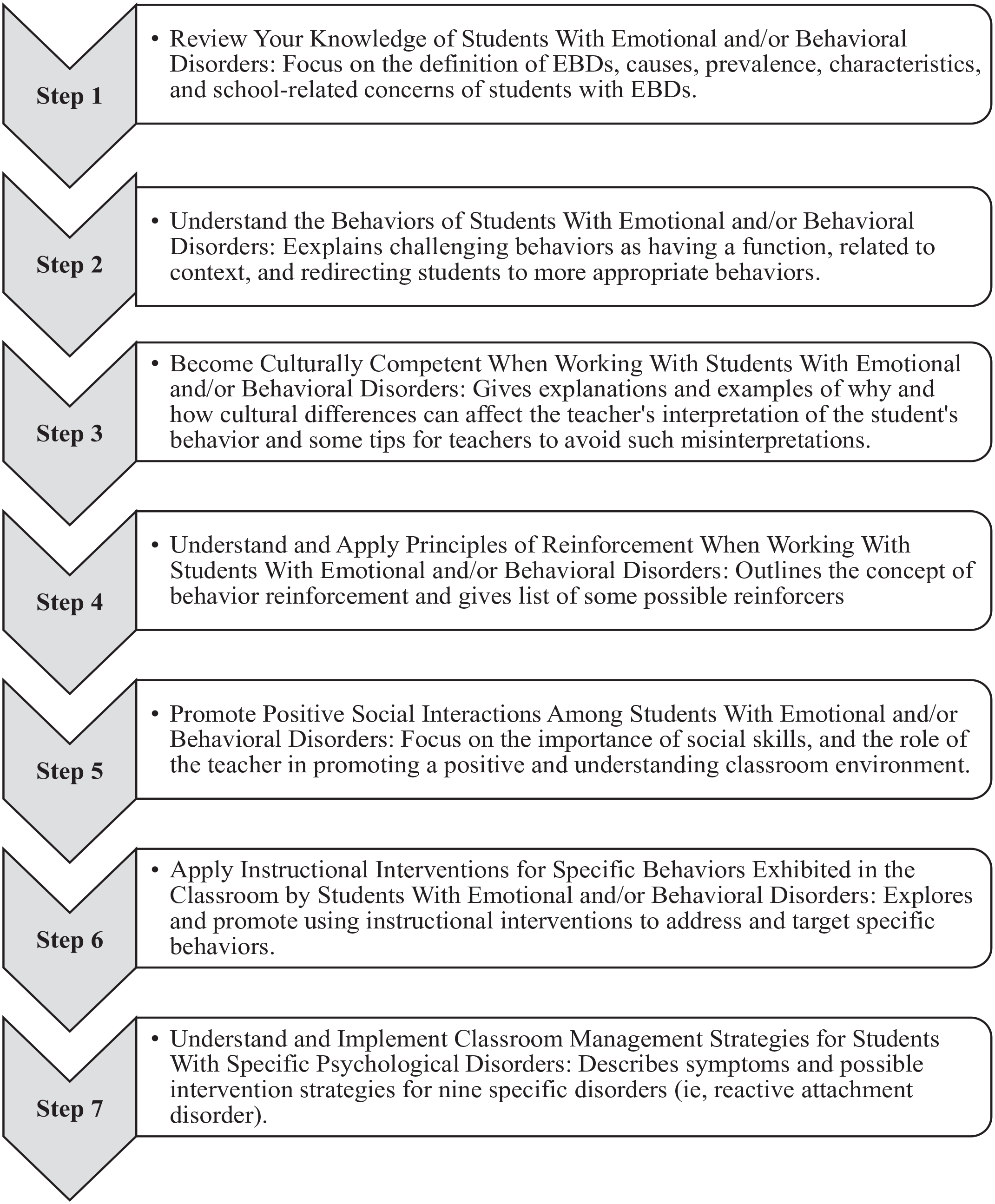
Summary of the training program.
Procedure
Two schools were selected through convenience sampling, based on a prior relationship of the researcher with the principals. The principals were individually informed about the research as well as the training program and research consent form. The consent form explained the objective of the study and clarified that participation is voluntary. Teachers from both schools were invited to participate in the study. The participants were requested to sign the consent form and to complete preintervention measures before accessing the training program. At the end of the training sessions, the participants were asked to complete the postintervention measures. The participants of the waitlist control group received intervention with a delay of 1 week. All participants completed the follow-up measures within 5 weeks after completion of the training program.
Data Analysis
Data obtained from the pre- and posttests were analyzed using Statistical Package for the Social Sciences. The t test for the two independent samples was used to examine the existence of differences between the average scores of the intervention and waitlist control groups. Moreover, the paired-sample t test was used to compare the means of the scores between pre- and postintervention. Repeated-measures analysis of variance (ANOVA), which is also known as “within-subject” ANOVA, was used when the same measure of assessment was used with the same participants at more than 2 time points (Davis, 2002). Therefore, repeated-measures ANOVA was used to evaluate any differences between the pre-/posttests and follow-up implementation of the intervention. The significance level tested at p < .05. Effect size eta (η) was used to calculate effect sizes (Cohen, 1973). Finally, Pearson’s correlation coefficient was used to detect the relationship between scores on the KEBDQ and TSES.
Results
Participant Characteristics
The demographic data of the participants indicate the lack of between-group significant differences. The participants were 23 to 58 years old, with a mean age of 37 years (SD = 3.68). Forty-four participants (54.3%) were between the ages 30 and 40 years. Teaching experience varied from 1 to 35 years, with a mean teaching experience of 13 years (SD = 4.71). The teaching experience of 46 (56.7%) participants was between 10 and 20 years. All participants completed a bachelor of education degree and only four (4.9%) completed a postgraduate degree. None of the participants received previous training in teaching students with EBDs.
Training Effectiveness
The paired-sample t test revealed a significant increase in teacher knowledge of EBDs and self-efficacy. Table 1 presents the results and shows that significant differences existed in the mean scores of the pre- and posttests before and after training on KEBDQ (t = 46.631, p < .001) and TSES (t = 61.951, p < .001).
Paired-Sample t Test: Pre- and Postintervention Scores for the KEBDQ and the TSES.
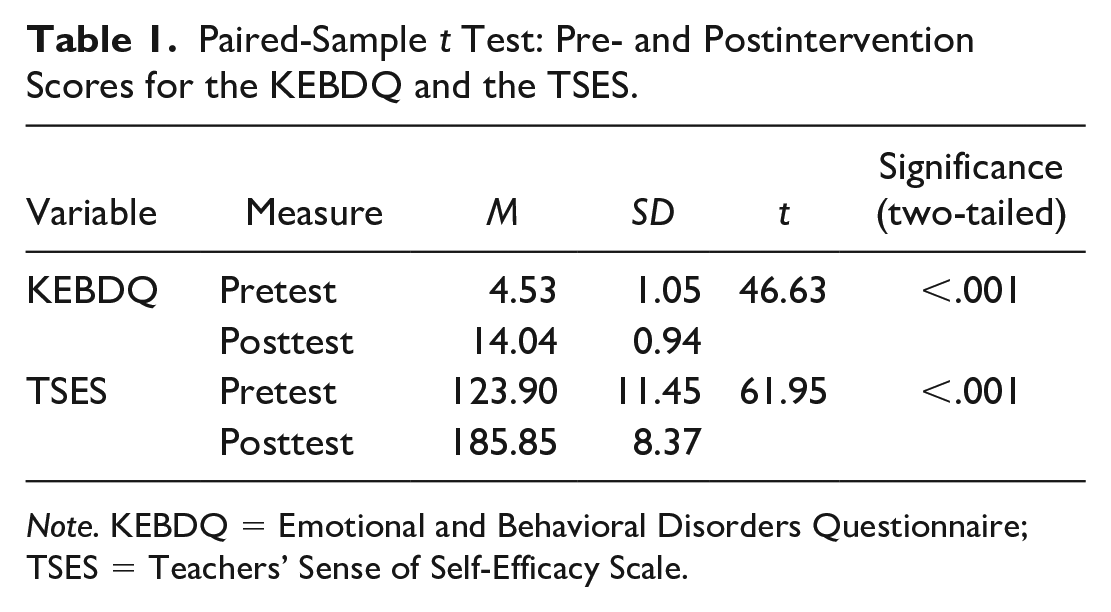
Note. KEBDQ = Emotional and Behavioral Disorders Questionnaire; TSES = Teachers’ Sense of Self-Efficacy Scale.
The independent sample t test was conducted to investigate the difference between the means of the posttest scores of the intervention and waitlist control groups on the KEBDQ and the TSES. Based on the results presented in Table 2, concluding that the posttest scores for the two groups were significantly different is reasonable (KEBDQ: t = 45.328, p < .001; TSES: t = 28.494, p < .001), which indicated that the intervention group displayed significantly higher posttest scores compared with those of the waitlist control group.
Independent Sample t Test: Posttest Scores of the Intervention and Waitlist Control Groups for the KEBDQ and the TSES.
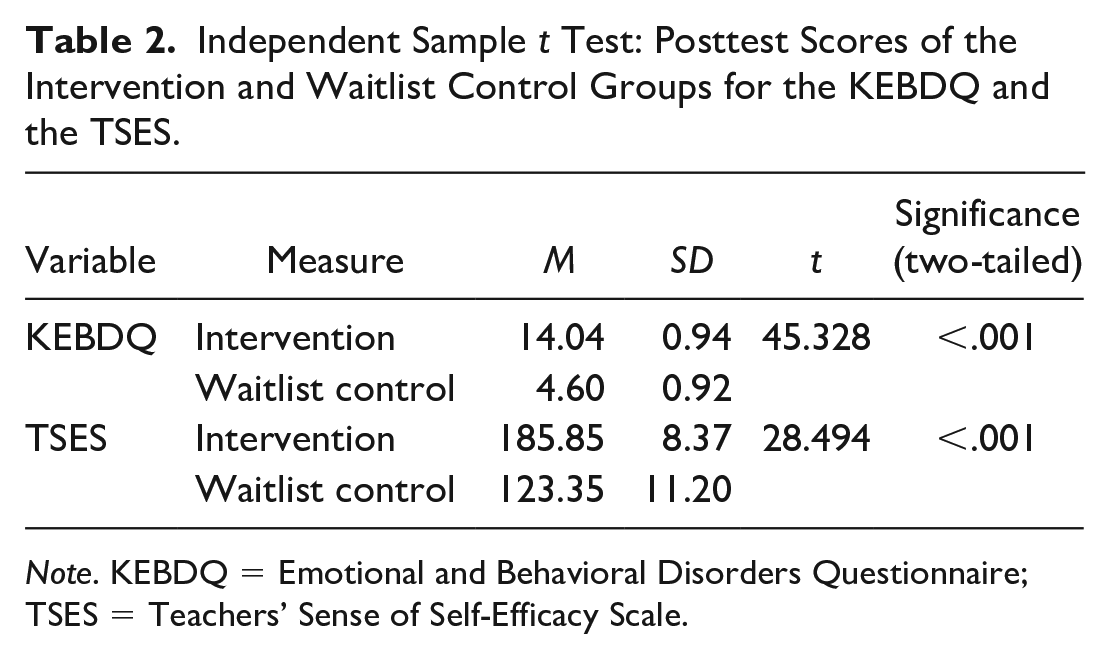
Note. KEBDQ = Emotional and Behavioral Disorders Questionnaire; TSES = Teachers’ Sense of Self-Efficacy Scale.
For retention of knowledge and self-efficacy, the study analyzed the scores for KEBDQ and TSES before, immediately after the completion of training, and 5 weeks after the training. The results of repeated-measures ANOVA (Figure 2) displayed a difference in the mean scores for KEBDQ among the 3 time points (F = 1,789.970, p < .001). The average score for KEBDQ increased by 9 points from pre- (M = 4.5679, SD = 0.9866) to postintervention (M = 13.9012, SD = 1.11361) and decreased by 3 points from postintervention to the 5-week follow-up (M = 10.5473, SD = 4.3873). Effect size eta squared (η2 = .93) is considered large (Cohen, 1988). The results presented in Figure 3, which are related to self-efficacy, pointed to a difference in the mean scores for TSES between before, after, and 5 weeks after the training (F = 1,057.959, p < .001). The average score for TSES increased by 62 points from pre- (M = 123.6296, SD = 11.26104) to postintervention (M = 185.9630, SD = 8.81255) and decreased by 3 points from postintervention to the 5-week follow-up (M = 182.9630, SD = 8.81255). The effect size eta squared (η2 = .89) is considered large (Cohen, 1988).
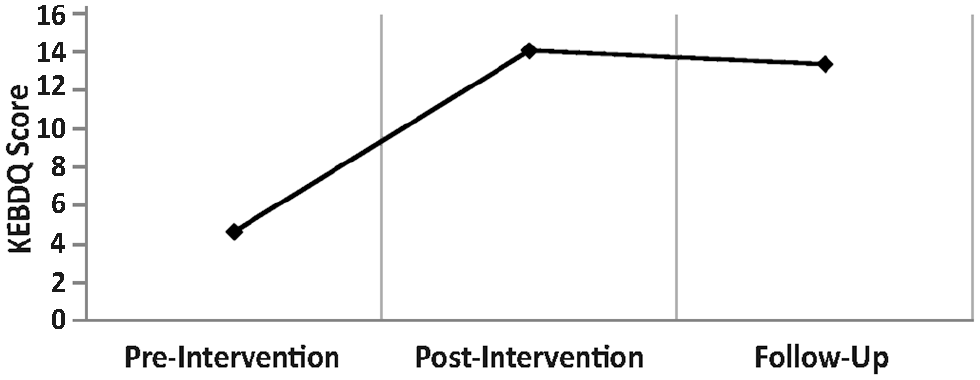
KEBDQ score at different points of assessment.
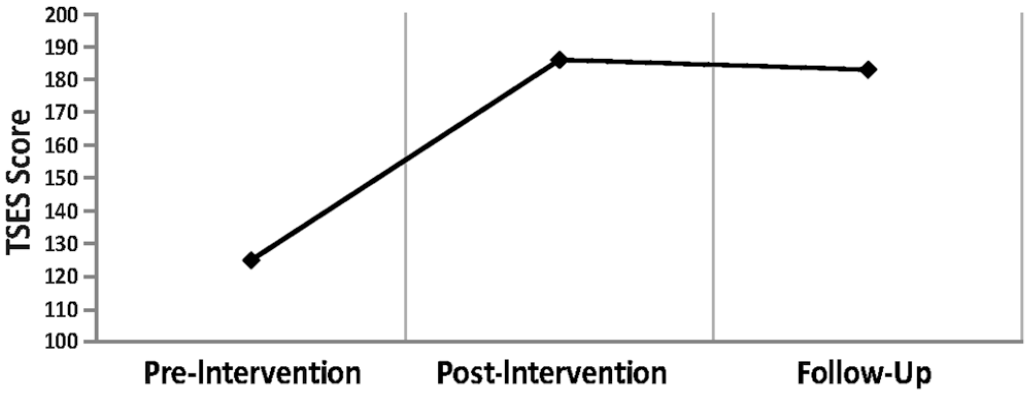
TSES score at different points of assessment.
Relationship Between Knowledge of EBDs and Self-Efficacy
The result of Pearson’s correlation after examining the relationship between teacher knowledge of EBDs and their self-efficacy in working with students with EBDs indicate a positive strong correlation (r = .786, p < .001).
Participant Satisfaction
Overall satisfaction was rated high because the ratings for each area fell under “good” and “very good.” Specifically, the majority of the participants reported that the overall training exceeded the “good” rating and approached the “very good” rating (M = 4.67, SD = 0.47). Concerning the content presented, the mean ratings were positive (M = 4.53, SD = 0.51). Moreover, ratings concerning the style of the presentation of materials reflected satisfaction (M = 4.49, SD = 0.57). The mean ratings of whether or not the participants would recommend the training to others reflect a very satisfactory score (M = 4.72, SD = 39), which ranges from “probably would” to “definitely would.”
Discussion
This quasi-experimental study aimed to gain an understanding of the efficacy of a 5-day in-service training in improving teacher knowledge and self-efficacy when working with students with EBDs. In summary, this training was found to be efficacious in increasing the knowledge and self-efficacy of teachers.
Regarding knowledge, the teachers exhibited a marked increase in the level of knowledge immediately after the training. After 5 weeks, this level slightly declined but remained significantly higher than that at pretraining. Furthermore, teacher self-efficacy displayed a marked increase immediately after the training, followed by a slight decline after 5 weeks. This increase is in line with that reported by previous studies on the effectiveness of professional development programs for improving teacher knowledge concerning EBDs (Aguiar et al., 2014; Alshehri et al., 2020; Barbaresi & Olsen, 1998; Corkum et al., 2019; Froelich et al., 2012; Jarque Fernández et al., 2021; Jones et al., 2008; Jongh & Wium, 2021; Kallas et al., 1997; Lasisi et al., 2017; Latouche & Gascoigne, 2019; Maag & Larson, 2004; Miranda et al., 2002; Staff et al., 2022; Syed & Hussein, 2010; Veenman et al., 2019). This increase in knowledge may be a result of the training presented to the participants in this study that was designed, developed, and conducted to meet their overall needs. All teachers perceived that the training more than adequately met their needs. None of the participants reported receiving in-service training. This notion supported previous findings that indicated that teachers have limited access to professional development when already in the workforce, (Hawkins et al., 1991; Piccolo-Torsky & Waishwell, 1998). In addition, George et al. (1995) reported that two thirds of teachers of students with EBDs perceived that the teacher preparation program did not sufficiently prepare them for working with students with EBDs. Moreover, according to Sciutto et al. (2000), a large proportion of teachers (52%) reported teaching students with suspected and/or diagnosed EBD. Teachers are continuously expected to work with students with EBDs daily, despite the lack of adequate training. Thus, all teachers should be allowed to learn about EBDs in-depth; in this regard, this study revealed that teacher knowledge about EBDs can be significantly improved through brief professional development training.
The investigation of the relationship between teacher efficacy and knowledge about EBDs demonstrated a significant correlation between these constructs. Previous studies supported this relationship and reported that teachers with high levels of knowledge display high levels of efficacy, particularly in their teaching abilities (Goddard et al., 2004; Goker, 2021; Gümüş & Bellibaş, 2021; Guskey & Passaro, 1994; Kartal & Dilek, 2021; Latouche & Gascoigne, 2019; Li & Cheung, 2021; Lu et al., 2020; Oliver & Reschley, 2010; Rahmadani & Kurniawati, 2021; Sharma et al., 2012). Although previous studies addressed the relationship between these two constructs, the relationship between knowledge and efficacy was not investigated, specifically concerning working with students with EBDs. Therefore, this study expanded on the previous literature by addressing a specific category of disabilities.
Certain limitations need to be addressed despite the positive findings demonstrated by the results of this study regarding the training. First, this study included the voluntary participation of teachers. Furthermore, all measures were self-reported and no observational data were collected. Therefore, an on-site practice assessment would enable comparison between teacher self-ratings and performance within the classroom setting. In addition, the time between the pre- and posttests was extremely short, and the duration of the training and follow-up was only 5 weeks.
Regardless of the aforementioned limitations, this study suggests that improving the efficacy and knowledge of teachers about EBDs within a relatively short period is worthwhile. This notion is important, given that educating teachers through brief professional development training about students with EBDs could be easier and less costly than solving the volatility implied by the lack of preparedness.
Footnotes
Acknowledgements
The author thanks the Deanship of Scientific Research and RSSU at King Saud University for their technical support.
Declaration of Conflicting Interests
The author declared no potential conflicts of interest with respect to the research, authorship, and/or publication of this article.
Funding
This is a research project that was supported by a grant from the Research Center for College of Education, Deanship of Scientific Research at King Saud University.
