



Abstract
There is anecdotal evidence of neurodivergent (ND) people preferentially befriending each other. Here we present large-scale mixed-methods evidence investigating whether neurotype affects friendship making and exploring ND and neurotypical (NT) experiences of being friends with ND people. Our results show that ND people have significantly more ND friends than NT people. Furthermore, people have proportionally more friends with the same neurotype as their own, for example, autistic people have more autistic friends. We used reflexive thematic analysis to address the questions of what participants like and dislike about their friendships with ND people, and whether there is something different about those friendships. Five themes were found that highlight issues of miscommunication between different neurotypes, the joy of communicating in your preferred style, the sense of connectedness and belonging between ND friends, the issues associated with having friends with conflicting needs to your own, and the complexities of giving and receiving support. We discuss these findings in terms of ND culture and acceptance of inherent differences in friendship styles.
Lay Abstract
Many people believe that neurodivergent (ND) people prefer being friends with other ND people, however, it is not clear whether this is actually the case. In this article, we look at whether a person's brain type affects the proportion of friends they have from different groups and ask people about their experiences of being friends with ND people. Our results show that ND people have mostly ND friends, and neurotypical (NT) people have mostly NT friends. We also found that people have more friends with the same type of brain as their own, for example, autistic people have more autistic friends. When we asked people about their friendships with ND people, we found five main topics of discussion (1) difficulties in communication with people with a different type of brain, (2) joy at being friends with people who like to communicate in the same way as you, (3) a sense of connectedness and belonging between ND friends (4) issues when friends needs conflict with each other, for example, if one person needs quiet and the other needs to make a noise, (5) how complicated it can be to give and receive support, particularly when you may have challenges of your own. We talk about the idea of ND people having their own culture, with friendships that work a bit differently to their NT counterparts.
Introduction
Until recently most research into neurodivergent (ND) friendship has been conducted by neurotypical (NT) researchers and has primarily sought to describe or correct perceived deficits. Autistic people are often described as having difficulties with social communication and adhering to social norms, and being socially isolated with limited friends (Lin & Huang, 2019). Similarly, people with ADHD are described as having difficulty in maintaining or developing relationships (Matheson et al., 2013). In each case, this has been attributed to deficits that cause the individuals in question to be unwilling or unable to form friendships. However, in this type of research it is very rare for the participants to be directly asked about their experiences. This epistemic injustice means that descriptions of ND friendship on their own terms are rarely found in the literature. In response to this there is a developing body of work that suggests autistic people have very successful friendships, but that these relationships look different to those conducted by their NT counterparts (e.g. Gillespie-Smith et al., 2024). We acknowledge that neurodiversity comprises of more neurotypes than ADHD and autism, however, whilst the literature is limited on those neurotypes it is non-existent in others. The current article will continue to add to this literature by asking both ND and NT people about their experiences of being friends with ND people. We will also support this with quantitative data investigating the proportion of friends of different neurotypes our participants have.
In contrast to the academic literature there is a wealth of anecdotal evidence that suggests that ND people are having very successful peer relationships with each other, however, there is limited empirical evidence to support this claim. For example, there is a viral tweet that has been widely shared across platforms that states ‘neurodivergent people tend to move in packs like poorly emotionally regulated wolves so if all of your friends have adhd i [sic] have some news for you’ (@rubycumulous, 2021, Jan 4). This humorous tweet is referring to the idea that ND people are very often friends with each other, regardless of whether they are aware of their neurotype or not. This is of note as it suggests that ND–ND friendship making is occurring organically, rather than through intentional decision making. This suggests that it is not caused by social pressure or other external motivations, but rather due to personal preference.
Deficits in social communication are considered such a defining feature of autism that it is one of the primary diagnostic criteria (APA, 2022). However, there is growing evidence that these are not deficits but differences. There is a ‘double empathy problem’ whereby autistic people struggle to communicate with NT people, but NT people also struggle to communicate with autistic people (Milton, 2012). For example, autistic peer-to-peer information transfer is as effective as in NT–NT groups, however, there is significantly poorer information transfer for mixed groups (Crompton et al., 2020b). This suggests that autistic people communicate as effectively as their NT counterparts, just in a different way. Similarly, difficulties in interpreting facial expressions are not unidirectional, with NT people struggling when the roles are reversed (Sheppard et al., 2016). It could be said that autistic communication ‘difficulties’ are only evident when interacting with NT people (Crompton et al., 2020b). Autistic people have different preferences within their friendships, for example: talking on the phone to make plans for an event, rather than just to chat, or meeting for an activity rather than to simply spend time together (Finke, 2023). There is also a value placed on ‘parallel play’ where socialisation is defined by proximity rather than interaction and discussion (Brownlow et al., 2015). Therefore, ND people may prefer to be friends with each other due to shared communication styles and ways of interacting.
Communication differences are also featured in the diagnostic criteria for ADHD, specifically: difficulties with maintaining conversations, getting distracted whilst talking, talking excessively, interrupting, and issues turn-taking are all included in the diagnostic criteria for ADHD (APA, 2022). There is limited research looking at communication differences in ADHD people. The main focus of the literature relates ADHD characteristics with negatively managing interactions, in particular, how emotional dysregulation can disrupt the ability to inhibit aversive reactions (Wymbs et al., 2021). Unfortunately, this approach does not tell us about ADHD communication preferences or whether communication is more effective and enjoyable when both parties have ADHD.
It is well established that people like people who are similar to them in some capacity. The homophily principle is exemplified by the phrase ‘birds of feather, flock together’ and has been shown to apply to relationships of many kinds (for a review of the principle see McPherson et al., 2001). We argue that ND people's friendships with each other may represent a form of value homophily, where the friends share their way of experiencing the world. It is possible that this has not been considered before due to negative attitudes towards neurodivergency. It could be that if ND is considered through the lens of deficit and disorder it would not be predicted to have the same grouping effect as if it is considered to be a culture and way of approaching life.
There is some evidence that autistic people are preferentially friends with each other. An important qualitative study reported the importance and benefits of autistic–autistic friendship (Crompton et al., 2020a). They reported three main themes around: (1) feeling easier, more comfortable, and better understood; (2) feeling in a social minority with NT friends and having to change behaviour to accommodate them (masking); (3) feelings of belonging and being able to be their authentic selves. Their overarching finding was that within-neurotype friendships are fundamentally different to their cross-neurotype counterparts and offer support and a sense of belonging not found elsewhere. A recent meta-ethnographic analysis found that the concept of developing friendships with ‘people like me’ was common across a number of studies (Black et al., 2024). This encompassed not just autistic peers, but people with disabilities or who were otherwise ‘different’ in some way. This suggests that friendship preferences could also encompasses members of the wider ND community, and not just those with the same neurotype.
Similarly, there is evidence that autistic people use different conversational styles amongst themselves than they do with the NT peers (Heasman & Gillespie, 2019). There is a lower demand for coordination with more fragmentation, irregular turn taking, and abrupt topic shifts. This is all supported by a generous assumption of common ground that allows rapid construction of shared understanding.
Unfortunately, there is very limited research into ADHD friendships. The majority of the existing research is framed by the pathology paradigm and marred by the epistemic injustice described above. In general, research from this perspective focuses on why and how ADHD (and other ND groups’) friendships are different, and therefore worse, than NT friendships, and how to rectify this perceived deficit. For example, researchers have found that ADHD college students have more positive first impressions of other students who match their severity of ADHD symptoms (McKee, 2017). However, the primary conclusion from this was concern that these friendships might present academic or psychological risks. Similarly, a study into the quality of ADHD adolescent's friendships found that their participants rated the quality of their friendships quite highly (Glass et al., 2012). They concluded that this may be because their friends are similar to themselves and therefore also have ADHD. However, the researchers then followed this up by suggesting that this would mean that both members of the friendship dyad overestimated the quality of the friendship, failing to acknowledge that there may be differences in friendship norms.
A recent study has considered ADHD adults’ experiences of friendship. Ginapp et al. (2023) identified two themes, which are particularly salient for the current research. Firstly, participants felt different from NT people and described masking their ADHD symptoms around them, which is exhausting and difficult to maintain. Autistic masking has been well documented, however, this is perhaps the first time that the phenomenon has been described for people with ADHD. Masking can be defined as ‘suppressing aspects of identity and action’ (Pearson & Rose, 2023), it is a blanket term to describe ND peoples’ attempts to suppress their native cognitive and social styles in order to integrate better and avoid stigma in an NT dominated world (see Pearson & Rose, 2023 for an in-depth discussion). Autistic masking is strongly associated with poorer well-being and negative outcomes. It is likely that this is also the case for ADHD people meaning that spending time with NT people could have a negative impact on wellbeing. Secondly, participants felt similar to other ND people and were able to relate better to them. This encompassed not only other ADHD people, but also ND people more widely. They described ND people as communicating more directly and being more understanding of ADHD symptoms, participants even went as far as to say they deliberately surrounded themselves with other ND people. To our knowledge this is the first time that cross-neurotype ND friendships have been described. Their findings also echoed those of Crompton et al. (2020) in terms of feeling a greater sense of belonging and understanding in ND groups, compared to NT equivalents. It is clear a more inclusive conception of friendship is needed (Brownlow et al., 2015). However, there is limited evidence as to what that concept might look like.
One recent study has asked autistic adults about their perceptions of friendships (Gillespie-Smith et al., 2024). They found an overarching theme they named ‘Spectrum of Understanding’. This reflected participants’ experiences of not only being understood and understanding others, but also modifying their understanding of how friendships are formed, maintained, and navigated based on those experiences. The authors reframe the double-empathy problem as a continuum of neurocultural learning. In this framing NT and ND people have different cultures and must learn each other's norms in order to connect successfully. In the same paper, Gillespie-Smith et al. (2024) report further themes around (1) friendships based on shared identity for example, being autistic and trans, (2) sharing values or ways of relating to the world, and valuing each other with an emphasis on friendship as an active reciprocal process, and (3) sharing space, ideas and interests, and maintaining friendships over time, autistic people are more understanding of periods of time with no contact. If we accept that these differences are manifestations of a different culture or cultures then using ethnographic and qualitative methods are an appropriate first step towards better understanding.
There is emerging literature that gendered norms affect autistic people's experiences including their friendships. Recent studies on adolescents found that autistic girls have friendships that are similar to NT girls, however, they experience more conflict and find it harder to manage that conflict successfully (Sedgewick et al., 2019, 2016). Girls’ friendships were focused around conversation, social networks and ‘fitting in’. In contrast, autistic boys friendships are more focused on shared activities such as video games or sports. Boys had a larger number of friends overall, but these friendships were not as close compared to the girls. Conversely, a recent study which also included adults (14–37 years) found no significant differences between men and women's understanding of friendship across several measures (Platos & Pisula, 2021). However, this may be because theoretical understanding of friendship is not modulated by gender, but practical experience of friendship is. Therefore, it is important to consider gender in all studies of ND friendship.
In the current research we will consider experiences of friendships from all minority neurotypes as well as NT experiences of being friends with ND people. This allows us to be among the first to explore ND culture through the lens of friendship. Our aim is to gain a deeper understanding of what ND people's friendships are ‘like’ and to better understand how ND friendships may differ from NT expectations. As outlined above, the traditional narratives suggest that autistic people are uninterested and unable to form fulfilling friendships, and that ADHD people are simply unable to sustain friendships and modulate their behaviours to be socially acceptable. If this is not the case, the impact could be far reaching. For example, if an ND person is feeling isolated and unhappy, the solution could be as simple as introducing them to a group of other ND people where they can develop healthy relationships.
We will use a mixed methods design to seek answers to the following research questions:
Do ND people have more ND friends compared to NT people? Furthermore, do ND friendships run along neurotype lines, for example, do autistic people have more autistic friends than other groups? Do ND prefer to have ND friends? Are ND–ND friendships different from ND–NT or NT–NT friendships? If so how? What do people (both NT and ND) like and dislike about being friends with ND people?
Methods
This study takes a critical realism perspective and recognises that social experiences are a reflection of both observable patterns and personal experiences. A mixed methods approach was adopted to capture this complexity. Quantitative data will be used to identify patterns in friendship making. Qualitative data will then be used to explore personal meanings behind these patterns of friendship. Combining these approaches allows us to investigate not only individual experience, but the wider social context.
Participants
Participants were recruited online across a variety of forums including Reddit, Instagram and Facebook. We did not collect information on participant location, but people from all over the world are known to use these platforms. Participant authenticity was checked using a combination of checking for duplicate IP addresses and a low Q_RecaptchaScore. Q_RecaptchaScore uses invisible reCAPTCHA v3 technology to detect bots, a score of 0.0 means the respondent is likely to be a bot, and 1.0 means they are likely to be human. There were a small number of responses with duplicate IP addresses, however, all of these had a Q_RecaptchaScore of 0.9 or higher and included unique qualitative responses and were therefore judged not to be bot responses.
Four participants stated that they were not ND, but later said that they were autistic (2), ADHD (2) or autistic and ADHD (AuDHD; 1). These five participants were removed from the quantitative dataset, but their qualitative data was preserved. This is because from a quantitative perspective it could not be determined which category their data would fall under. However, in the qualitative data whilst we wanted to explore participant's experiences of being friends with ND people, and whilst we acknowledged participant neurotype in the analysis, all data were ultimately pooled together.
There were 230 participants in total, aged 18–60 (mean = 29.56, sd = 9.17): 40 NT, and 190 ND. ND participants were of the following neurotypes: 48 autistic, 53 ADHD, 64 AuDHD, 14 Unspecified ND, where they were unwilling or unable to specifically label their neurotype, but identified as belonging under the ND umbrella, and 11 Other Neurotype that is, with another form of neurodivergence, such as bipolar and Tourette's, among other diagnoses. ND participants were also asked if they had a formal diagnosis, 130 participants did, 54 did not and 11 chose not to answer the question.
There were 55 men, 130 women, 34 non-binary participants and 11 who identified in a different way. The non-binary participants and participants who identified in a different way were grouped together for analysis to form one category of 45 gender non-conforming participants. Full details of participants can be found in Table 1. All participants gave their informed consent and all procedures were approved by the Abertay University Ethics Committee.
Number of Participants of Each Gender and Neurotype.

Materials and Procedure
The study was hosted online using Qualtrics. A pdf of the survey is available on the Open Science Forum (https://osf.io/k8tja/). Participants were asked to give their demographic information, and to give details about their neurotype and whether they had a formal diagnosis.
Participants were then asked what percentage of their friends fell into the following categories: NT (not ND), autistic, ADHD, AuDHD, or ND of uncertain type. They were asked to include their friends in the relevant category even if they were self-diagnosed or potentially even unaware that they may be considered ND. The percentage scores were required to sum to 100.
Participants were also asked to respond to the following two statements on 7-point Likert scales ranging from completely disagree (1) to completely agree (7), ‘I prefer being friends with neurodivergent people’ and ‘I think being friends with neurodivergent people is different from being friends with neurotypical people’.
Participants were then asked three open-ended questions with an unlimited character limit for responses: (1) What, if anything, is different about being friends with ND people? (2) What do you like about being friends with ND people? (3) What don’t you like about being friends with ND people?
Positionality
A critical realism perspective (Botha, 2021) was taken in the interpretation of the data. We acknowledge that each individual conceptualises and understands a singular reality in different ways. Therefore, the authors’ own experiences must influence our interpretations and sense making. Both authors are members of the ND community and have many ND friends across a variety of neurotypes. This lived experience was beneficial in understanding context and making connections within the data that may have been missed by those without our background. We acknowledge that there is a risk of our personal experiences influencing interpretation of the data. However, throughout the research process we remained mindful of ways that our positionality could influence our findings and every effort was made to ensure that the participants’ viewpoints were represented clearly.
Qualitative Analysis
Please note details of the quantitative analysis are embedded in the results section.
Five of the NT participants (12.5%) and 53 of the ND participants (27.9%) did not complete the qualitative sections of the questionnaire. Therefore, our final dataset comprised of 172 participants, 35 NT and 137 ND. The ND participants had an age range of 18–60 and comprised of 24 men, 78 women, 28 non-binary people, and seven people who preferred to identify another way. The NT participants had an age range of 18–56 and comprised of 10 men, 21 women, zero non-binary people and three people who preferred to identify another way.
The qualitative data was analysed using the reflexive thematic analysis framework of Braun and Clarke (2021, 2022). This acknowledges the inherent subjectivity in the analysis process and allowed the authors’ positionality to be used as an analytic resource (Braun & Clarke, 2022).
Due to the exploratory nature of the study we took an inductive data-driven approach to generate the initial codes. Researcher TS familiarised themselves with the data through reading and re-reading each response. NVivo software was then used to create a first round of codes, after which each response was carefully examined, and initial codes were generated and assigned. Coding was primarily completed at the latent level, however, some included more semantic content. Researcher TS then developed these codes into initial themes. These themes and sub-themes were then reviewed and refined collaboratively with researcher RJS. The researchers then discussed these themes together before finalising them by consensus.
Quantitative Results
All data are available on the Open Science Framework (https://osf.io/k8tja/).
Comparison of NT Versus ND Friend Types
To investigate whether people have more friends within their own neurotype, participants and friend neurotypes were collapsed and categorised as NT or ND, encompassing all non-NT neurotypes (Figure 1). A two-way ANOVA with factors participant neurotype (NT and ND) and friend neurotype (NT and ND) with the dependent variable of the percentage of friends in each group. There was not a significant main effect of friend neurotype F(1, 229) = 1.878, p = .172. There was not a significant main effect of participant neurotype, this is because participants were asked to give responses which totalled 100%, meaning that there is no overall difference between any participant. There was a significant interaction between friend neurotype and participant neurotype F(1,229) = 44.857, p < .001. NT people have significantly more NT friends (p < .001), and conversely ND people have significantly more ND friends (p < .001).
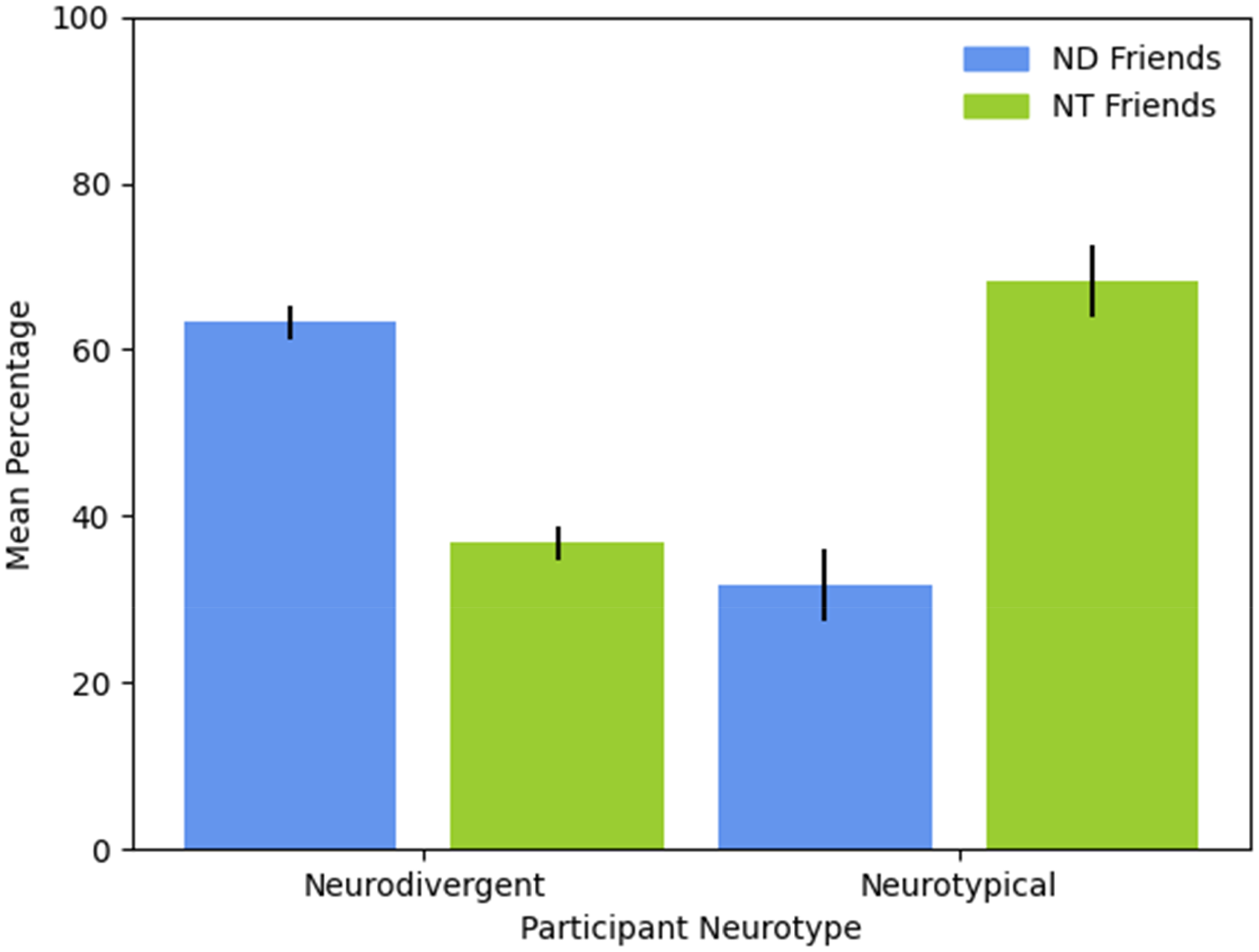
Percentage of Friends Participants have that are Either Neurotypical or Neurodivergent. Error Bars are ±1 Standard Error.
Analysis of Friend Neurotypes
Participants were asked what percentage of their friends were of each neurotype. The results are shown in Figure 2.
A 6 × 5 two-way ANCOVA was conducted with factors participant neurotype (NT, autistic, ADHD, AuDHD, unspecified ND, and other ND) and friend neurotype (NT, autistic, ADHD, AuDHD, unknown), and gender as a specified covariate. The dependent variable was the percentage of friends that fell into each category. Mauchley's test of sphericity was significant, χ2(9) = 135.57, p < .001, indicating that the assumption of sphericity was violated. We also wished to be conservative in our reporting due to the uneven sample sizes. Therefore, degrees of freedom were corrected using the Greenhouse–Geisser estimate (ε = 0.73). There was a significant main effect of friend neurotype, F(2.923, 651.820) = 22.064, p < .001. There was not a significant main effect of participant neurotype, for the same reasons as described above. There was a significant interaction between friend neurotype and participant neurotype, F(14.615, 651.820) = 6.141, p < .001. Gender was also found to be a significant covariate, F(2.923, 651.820) = 3.844, p = .01.
Bonferroni corrected post-hoc comparisons were conducted to investigate the interaction between friend neurotype and participant neurotype. The results show that NT participants have significantly more NT friends compared to the autistic, ADHD or AuDHD friends (all p < .001). Autistic participants have significantly more autistic friends compared to NT, ADHD or AuDHD friends (all p < .001). ADHD participants have significantly more ADHD friends compared to NT and autistic friends (all p < .001), and more AuDHD friends compared to NT (p = .003) and autistic friends (p = .021). Lastly AuDHD participants had significantly more AuDHD friends compared to NT friends (p = .006). All other comparisons were non-significant.
Exploratory Gender Analysis
As the covariate of gender had a significant effect we performed an exploratory comparison to consider the relationship between gender and friend neurotype (Figure 3). A 3 × 5 two-way ANOVA with factors gender (man, woman, gender non-conforming) and friend neurotype (NT, autistic, ADHD, AuDHD, unknown) was conducted. Greenhouse–Geisser adjusted values are reported. There was a significant main effect of friend neurotype, F(2.783, 631.656) = 48.688, p < .001, and no significant main effect of gender, for the same reasons explained above. There was a significant interaction between friend neurotype and gender, F(5.565, 631.656) = 4.016, p < .001. Bonferroni corrected post-hoc tests were conducted to further investigate the relationship between gender and friend neurotype. Gender non-conforming participants were found to have significantly fewer NT friends than men (p = .004) or women (p = .018). Gender non-conforming participants were also found to have significantly more AuDHD friends than either men (p = .002) or women (p < .001). No other comparisons were significant.

Percentage of Friends Participants have from each Neurotype. Each Bar Represents a Different Participant Neurotype and Each Colour Denotes a Different Friend Neurotype.
A Chi-squared test of independence was conducted to explore whether there were more ND gender non-conforming participants than expected. The results were non-significant χ2(2, n = 230) = 5.199, p = .074, φ = 0.15, but showed a trend in the predicted direction of more ND gender non-conforming participants being present in the sample than expected (z = −1.7).
Friendship Preferences
Participants were asked whether they preferred to be friends with ND people and gave their responses on a 7-point Likert scale ranging from completely disagree (1) to completely agree (7). Results are shown in Figure 4. ND participants had a mean response of 6 (mostly agree), evidencing a preference for ND friendship. NT participants had a mean response of 4 (neither agree nor disagree) showing no preference for or against ND friendship. A Mann–Whitney test showed that ND people have a stronger preference for being friends with ND people than NT people do (U = 1374, p < .001).
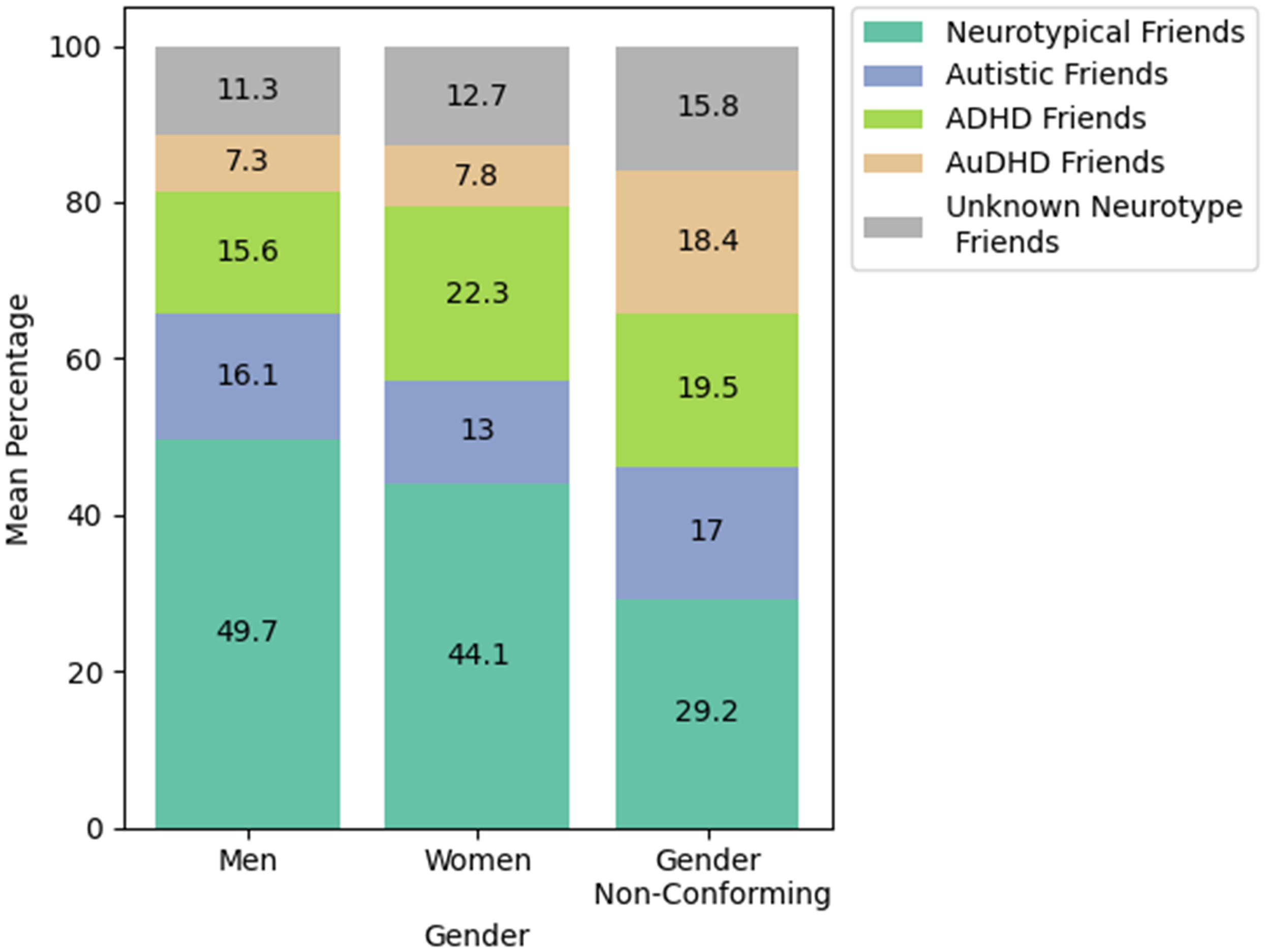
Percentage of Friends Participants Have From Each Neurotype. Each Bar Represents a Different Participant Gender and Each Colour Denotes a Different Friend Neurotype.
Friendship Differences
Participants were also asked whether they thought being friends with ND people was different compared to being friends with NT people. Once again responses were recorded on a 7-point Likert scale ranging from completely disagree (1) to completely agree (7). ND participants had a median response of 6 (mostly agree) and NT participants had a median response of 5 (slightly agree), both groups feel that there is a difference. Results are shown in Figure 5. A Mann–Whitney test showed that more ND participants think being friends with ND people is different to being friends with NT people, compare to NT participants (U = 2421.5, p < .001).

Responses to the Statement ‘I Prefer Being Friends with Neurodivergent People’ Where 1 is Completely Disagree and 7 is Completely Agree. Individual Data Points are Jittered for Clarity. Median and Quartiles are Shown by the Dashed lines.

Responses to the Statement ‘I Think Being Friends with Neurodivergent People is Different from Being Friends with Neurotypical People’ Where 1 is Completely Disagree and 7 is Completely Agree. Individual Data Points are Jittered for Clarity. Median and Quartiles are Shown by the Dashed Lines.
Qualitative Results
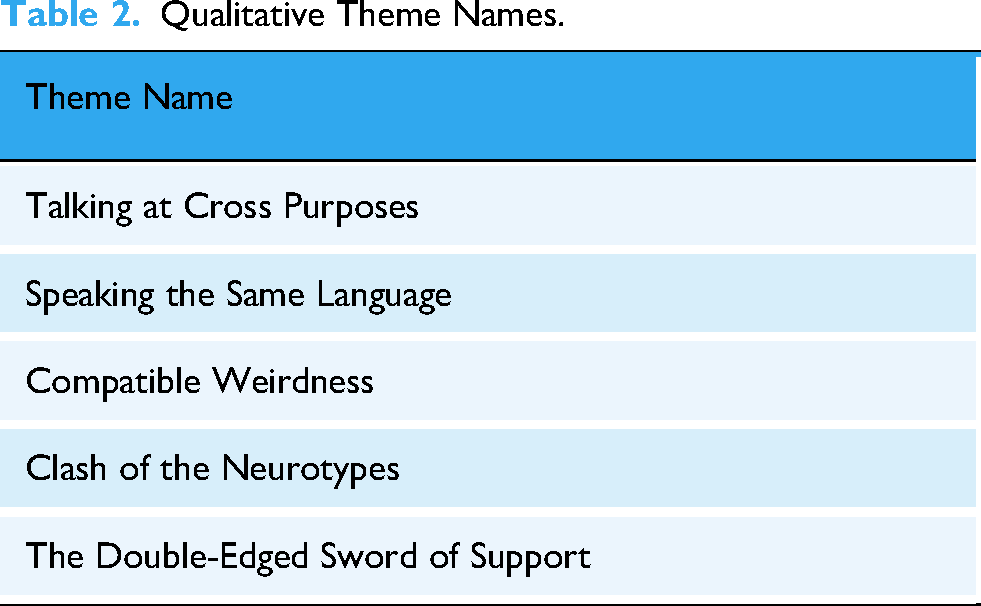
Participants discussed the differences between their NT and ND friends, as well as particular aspects they like and dislike about their ND friends. Five main themes were identified (Table 2). When attributing quotes ‘NT’ refers to NT participants, ‘ND’ to ND participants. The participants’ age and gender are also given, along with their numerical identifier.
Qualitative Theme Names.
Theme 1: Talking at Cross Purposes
One of the biggest developed themes was a difference in communication styles between neurotypes. Both, NT and ND participants identified differences in communication between themselves and their friends of a different neurotype. Participants described their difficulties with miscommunication and misunderstandings between themselves and their ND friends. These misunderstandings and miscommunication can go both ways, and can apply to intentions, social cues or any other aspect of social communication. This is a clear example of the double empathy problem, where neither party has a ‘deficit’, but both are struggling to communicate (Heasman & Gillespie, 2018; Milton, 2012). I'd say that miscommunication is the biggest difference. Both via messaging and face to face. (NT 33F – Respondent 6) More often there's potential for a “fallout” between us, often deriving solely from miscommunication or misreadings of emotion. (ND 21M – Respondent 68)
Participants expressed that a certain level of awareness and mindfulness may be required when communicating with their ND peers. The need to be careful in the way one expresses themselves to avoid misinterpretation of what has been said, or any misunderstandings, was mentioned as an important difference between their ND and NT friends. However, it should be noted that NT participants do not mention that they might misunderstand their ND friends, suggesting that they are not aware that communication difficulties can go both ways. Sometimes it is difficult to communicate and some words or gestures may be interpreted in a way I did not intend, so sometimes I feel a need to be extra-careful. (NT 36F – Respondent 147) There can be mix ups in communication difficulties between people, which sometimes can result in outbursts that leave all parties involved feeling hurt and misunderstood. (ND 38F – Respondent 170)
Some participants expressed somewhat negative feelings towards said differences, as they found them difficult to navigate at times. A particular aspect of this was that participants sometimes found it uncomfortable if confronted with rather blunt or straight forward communication by their ND friends, describing feelings of being overwhelmed, or hurt as a result. we are prone to end up in an argument because of my monotone way of speaking where her rejection sensitivity picks this up as me not caring/being affectionate. (ND 31M – Respondent 161) It can be uncomfortable sometimes when they miss social queues [sic] or are too forward in what they say. (NT 32F – Respondent 101) They have less empathy and dont [sic] understand when/how they may hurt my feelings. (NT 49NB – Respondent 51)
Overall, participants spoke of varying examples of how this difference in communication may require some additional awareness and navigating to accommodate their ND friends. It may be that learning more about ND communication styles may change some of the issues here. Reframing from ‘being careful’ to ‘learning a new culture’ could help change attitudes to allow for a more enjoyable cross-neurotype socialising (Gillespie-Smith et al., 2024).
Theme 2: Speaking the Same Language
ND participants expressed how much easier communication was with ND friends compared to NT individuals. They described communication that just ‘worked better’, as they shared a general understanding for and similarities in communication styles. This aligns with research on autistic-autistic communication in particular, which was found to be highly effective (Crompton et al., 2020b). One particularly prominent aspect highlighted by the participants was the more direct way of communicating with each other. I can trust that my ND friends tell me how they feel rather than expecting me to guess what they mean through ambiguous actions. (ND 22NB – Respondent 38) more direct/explicit communication seems to be more common among ND people and having that is really helpful and a relief to know that there are less likely to be underlying meanings in what someone is saying to me. (ND 18F – Respondent 160)
They highlighted that this left less need for interpretation and possible misunderstandings, both of which make communication with NT friends more difficult at times. Another important aspect of this more direct communication between ND friends is that there appears to be more room for clarifications and understanding. Participants described how it was much easier to ask for clarifications, and more tolerance for ‘slip ups’ in the flow of conversation. I never need to worry about if I'll be understood; in the case that I don't make sense, they're far more likely to ask for clarification or the right question to recontextualise the content. (ND 18NB – Respondent 83) In my experience, hearing something like “oh i interrupted you, i’m sorry, please finish your thought first” is much more common in conversation between ND people. (ND 18F – Respondent 160)
Overall, participants reported a certain sense of ease in the communication with their ND friends, which they did not experience with their NT friends in the same manner. While on the one hand this appeared to be due to a general commonality in communication style, it was also partially rooted in a sense of understanding for each other; it is easier to not be offended if the other person becomes side tracked amidst a conversation if one can relate and experience the same. This is supported by evidence that suggests autistic people create understanding differently to NT people. Heasman and Gillespie (2019) report that their participants were able to build rapport quickly through an assumption of commonality and that this allowed easier recovery from conversational missteps.
Theme 3: Compatible Weirdness
The data revealed an overarching sense of connectedness between ND friends. It was a reoccurring point mentioned by a large number of participants. This suggests that a fundamental part of ND friendship is sharing experiences, this allows a deeper sense of connection and understanding. We posit that it is this deeper level of connection that underpins the feeling of belonging found by Crompton et al. (2020a).
One aspect which highly reflected this understanding and connection, is the strong relatability of ND individuals for each other. Many participants reported that they can relate so much more to their ND friends, compared to their NT ones. It feels like we’re on the same wavelength, and I love not having to explain myself and the way I function to them, because they just “get it”. (ND 25F – Respondent 59) Other neurodivergent people seem to better understand some of the behaviors [sic] and feelings that often come with being ND. (ND 19NB – Respondent 134)
Sharing experiences and behaviours can make it easier to be oneself, rather than having to mask certain behaviours (Crompton et al., 2020a). Moreover, participants reported that even if some traits are not shared, there is more understanding and compassion for each other regardless. ND people know what it is like to not fit in and hence are more understanding for each other. I guess there's just an overall sense of understanding, even if neurodiverse people don't share the same experiences. (ND 25F – Respondent 36)
This feeling of relatability and understanding appears to create a sense of safety within the friendship and community. Participants mentioned that it is much easier to be themselves, instead of constantly having to monitor one's own behaviour for appropriateness and social acceptability, and to adhere to certain social rules. I don’t have to constantly monitor myself to not seem “weird” because I know my ND friends won’t consider my behavior [sic] and way of interacting with them “weird” because it's how their brain works too. (ND 26NB – Respondent 111) But it's also unique in that they don’t think in terms of what you're not measuring up to or how you aren't doing something in the acceptable way that people expect. It's okay to just be you and they will be them and you make room for each other and accommodate. (ND 32F – Respondent 150)
Having a safe space within ND friendships can help with feeling more comfortable to unmask and be more themselves. Several participants pointed this out, talking about how much easier it is to unmask with their ND friends. I don't feel like I'm walking on eggshells as much, I feel like I can unmask and be more authentic with my opinions, reactions, patterns of speech, etc. So this allows for a more genuine connection. (ND 32NB – Respondent 127)
There is more acceptance amongst ND people, and more tolerance for behaviours that may not be considered as socially acceptable by the NT majority. Participants emphasised the sense of being able to be their true selves when around their ND friends, which can be much more difficult around NT friends. We don't have to follow the social norms of society and can be our truest selves with each other rather than trying to suppress parts of ourselves like we usually have to. (ND 19F – Respondent 144)
Due to their more understanding nature, there is less shame when interacting with ND individuals. More so, they can relate to each other, not just in their general traits and experiences, but also in their perceived ‘weirdness’. ND people usually like to have more fun in a similar way to how I like to have fun. Compatible weirdness. (ND 32M – Respondent 14)
Some participants pointed out, that it is this shared sense of weirdness, being weird together, that gives a certain sense of comfort and connection with each other. I'm less afraid of being judged for being “weird”, because we're all “weird” in our own way. (ND 20M – Respondent 166)
The data further revealed that NT individuals shared this appreciation of ND understanding and tolerance. Several NT participants mentioned how they felt that their ND friends seemed to pay more attention to others and be more accepting due to their personal experiences. They pay great attention to other's [sic] needs and their surroundings in general. Given that they sometimes have their own special needs, they are more attentive and are more tolerant and accepting and empathetic. (NT 23F – Respondent 52)
It appears that the acceptance and understanding of ND people is not only extended to their ND friends, but also NT ones. Several NT participants expressed their appreciation for this safer space that their ND friends create. Moreover, some NT participants expressed their appreciation for ND individuals being less superficial. It came up on several occasions that ND people have a certain way of viewing the world and treating their surroundings. They are less superficial and are the deep thinkers and big hearted people that make company worthwhile. (NT 50F – Respondent 117)
A further aspect of ND connectedness is the alternative ways in which they maintain their relationships compared to NT individuals. ND participants reported that their relationships with ND friends were much less likely to degrade during longer periods without engagement. Many said they simply picked up where they had left off in their relationships, and that it was easier to do so than with their NT friends. No relationship degradation with time. Some friends I do not see for long long periods of time, but that is not important. We are able to reconnect with no hard feelings. (ND 30NB – Respondent 46) When it has been a long time since contact, it's always good to reconnect. No one feels forgotten. It's like picking up a book you set down and reading from where you left off. (ND 38F – Respondent 56)
NT participants on the other hand, seemed to have varying experiences with this. Some reported similar experiences to ND participants, where they found it easy to pick the friendship back up after longer pauses. Other participants, however, mentioned that they found it harder to maintain the friendships with their ND friends. Sometimes difficult to maintain friendships unless you are physically with them. (NT 29F – Respondent 17) Maintaining the relationship is very different compared to neurotypical friends. (NT 29F – Respondent 17)
The data suggests that in cross-neurotype friendships, there is a different understanding of maintenance of the friendship. It appears that for ND individuals, there is a general consensus that a longer pause in engagement does not mean the end of the friendship, whereas some NT individuals may struggle with this idea. This adds to our argument for broadening the definition of friendship and allowing for different preferences within that.
Theme 4: Clash of the Neurotypes
Up until this point, much of our analysis has been focused on ND–NT difficulties, however, that is not to say that ND–ND friendships are faultless. The ND participants widely discussed some of the challenges within their ND friendships. They described how certain traits may clash and create difficulties within their friendships which can require some additional navigating. Difficulties in other friendships can arise when one of my ND tendencies are at odds with someone else's. For example, my ASD friend with sound sensitivity does not appreciate my being oblivious when I'm hyperfocusing on something that is making noise. (ND 42F – Respondent 26) Also some types of ND rub up the wrong way against my own. Loud or overly talkative folks can put me on edge and I know it's their anxious desire to fill up space or not realising the volume they're talking out but it requires extra energy to socialise with them. (ND 46M – Respondent 8)
The spectrum of neurodiversity is very broad, with each person having very individual traits and needs. Hence at times, certain traits or needs may ‘rub against each other’. Some participants pointed out the difficulty it may pose to meet every individual's needs and accommodate them all. Due to the nature of many neurodivergencies, It can be challenging to make sure that everyone's needs are met. If one person needs darkness and silence and the other person needs noise and light, it can be difficult to be in the same room. There are a number of accommodations to manage all at the same time. (ND 47F – Respondent 35) Sometimes our needs directly conflict with one another (for example being overstimulated at the same time my friend is understimulated) and so it's hard to find middle found [sic] when we each need opposing accommodations. (ND 23NB – Respondent 92)
Another aspect highlighted by participants across all neurotypes was that at times they might struggle with understanding specific needs, or traits of another person. This lack of understanding was mentioned for both, NT–ND and ND–ND friendships. For example, one ND participant mentioned that at times they find it difficult to understand some of their ND friends’ problems, despite having a general understanding of the fact that they do have certain issues. Sometimes it's difficult to deal with people who have a different type of neurodivergence than you do. While you do understand that they they've got issues, it's harder to really get behind the issues themselves. Sometimes I find myself thinking “why is that a problem for you, just don't think/act like that, it's not that hard” because obviously our own problems seem logical to us while the problems of other people may not. (ND 25F – Respondent 44)
It is clear that whilst falling under the broad umbrella of neurodivergency does give people more common ground than with their NT counterparts, it does not guarantee complete understanding. There are differences between minority neurotypes which can lead to ND–ND cross-neurotype misunderstandings. Unsurprisingly, ND–NT friends encounter much the same issues. NT participants reported a certain lack of understanding for their ND friends’ struggles. As they do not share certain experiences with them, they might experience a certain sense of helplessness, because they do not know how to support them. I often don't understand and feel unhelpful when they discuss things related to their neurodivergency and can only really offer to listen. (NT 25F – Respondent 11)
Overall, it is clear that when two people of different neurotypes, whatever they may be, are friends there can be misunderstandings and clashes in individuals’ needs. However, it should be emphasised that these feelings are not applicable to only one group, but is common to many combinations of neurotype. Furthermore, the majority of our participants approached these difficulties with compassion and they therefore should not necessarily be seen as a barrier to friendship formation.
Theme 5: The Double-Edged Sword of Support
The theme of support and accommodations came up repeatedly across neurotypes. Both, NT and ND participants spoke of different ways in which ND individuals may need support, and how at times it can be lacking, or difficult to provide.
ND participants brought up how much support they can receive from their ND friends. Given that both individuals understand the struggles they face, it can be easier to support and accommodate each other's needs; be it accommodating sensory needs, or social and emotional needs. There is a common understanding of each other's struggles and the needs that come with it. That there is a mutual understanding that we exist in a world not designed for us. We have each other backs automatically and relate to the world in a similar way. (ND 43F – Respondent 27) They understand me and I understand them a lot better, and we can thus support eachother [sic] better than neurotypical friends can support us. (ND 20F – Respondent 149)
On the other hand, some ND participants mentioned that at times they may struggle finding the support that they need in the moment. If Im [sic] tired and or feel the need for support and not getting it, it can be hard to find someone else to be supportive in a way that fits me. (ND 18NB – Respondent 85)
One participant mentioned that they struggle with knowing whom to turn to when they want help understanding social situations. It can be difficult to find support in your peers if they are looking for the same answers. Similarly, sometimes it can be hard to help another person who shares the same struggle. Sometimes it feels hard not to know who to turn to when I'm confused about what is going on (eg., how other people are acting towards me, whether I'm being annoying, what the appropriate way to handle conversations is, anything organisational), because most of the people who understand me and who I tend to talk about my struggles to the most are also completely clueless about it. (ND 20NB – Respondent 96) They have the same or similiar [sic] difficulties I have and so we can't support or help each other to overcome those. (ND 22F – Respondent 108)
While generally, there is a great deal of understanding for each other within ND friendships, at times some individuals may struggle with supporting their friends when they have strong emotional reactions. The difficulties may arise from finding emotional moments overwhelming or from not knowing how to best react. When they do become emotional it is often to the extreme and overwhelming as the emotion has been built up for longer which can lead to unpredictable crisis and need for intense emotional support for brief periods of time (few and far between) while non ND people seem more able to express emotion in a more consistent and less extreme way making it more manageable when stressors increase. (ND 34NB – Respondent 128) When some of my ND friends get too wrapped up in their own emotions or how they perceive a situation and end up doing something wrong or rude or tone-deaf, it can also be difficult to be a good friend by telling them where they went wrong without feeling like I’m being mean or accusatory. (ND 18F – Respondent 160)
It may be difficult to remain supportive and accommodating in such instances. Several participants mentioned their struggle with being fully understanding at times. Moreso, at times it can be very demanding when confronted with the struggles of friends. Many people have had more troubles in life, so sometimes are more depressed or otherwise intense people, so they can be emotionally demanding in some ways. (ND 57M – Respondent 138)
Overall, the data showed how complex the topic of support and accommodations are. Being understanding and providing the support that an ND friend's needs can be challenging. Regardless of one's own neurotype, sometimes it is not possible to provide the required support, either because of a lack of understanding for the situation, or due to sharing the same struggle.
Discussion
The current study aimed to use a mixed-methods approach to explore ND people's experiences of friendship. The quantitative results show that ND people have significantly more ND friends than NT friends and the reverse is true for NT people. This is particularly notable given the relatively small number of ND people in the population. Furthermore, the results show a pattern of assortative friendship making, whereby participants have a higher proportion of friends of the same neurotype, for example autistic people have more autistic friends. ND participants also expressed a greater preference for having ND friends compared with NT participants. Similarly, ND participants felt that being friends with ND people was different than being friends with NT people, whereas NT participants saw significantly less difference. The qualitative data supported this with an over-arching theme that it was easier to be friends with people of the same neurotype. However, there was also discussion of how it can be difficult to support friends who are experiencing the same challenges as yourself.
For the first time we provide empirical evidence that ND people have more ND friends than NT people. Furthermore, we show that ND people recognise that ND–ND friendships are different and have a preference for them. This is not to suggest that ND–NT friendships are not valued on both sides, but to acknowledge that ND has different friendship preferences and practices. This is supported by the existing qualitative research into ND friendships (primarily autistic) and many of our themes overlap with those findings, particularly those relating to belonging and relatability (Crompton et al., 2020a; Ginapp et al., 2023; Sosnowy et al., 2019).
In our exploratory gender analysis we did not find any differences between men and women, despite previous literature suggesting that social pressures are experienced differently depending on gender (Sedgewick et al., 2019). Gender non-conforming people were found to have fewer NT friends and more AuDHD friends than men or women. This can be explained by the non-significant trend in the data of there being more ND gender non-conforming people in the sample than would be expected. This is in line with existing literature which suggests that autistic people, particularly those assigned female at birth, are more likely to express gender variance than NT people (Belluzzo et al., 2025). Gender variance is defined as gender identity or expression that does not conform to masculine or feminine gender norms (Cooper et al., 2018). Literature into an equivalent link for ADHD people is much more scarce. However, a recent review suggests that there is also a link between ADHD and transgender/gender diverse individuals (Goetz & Adams, 2024).
There was a common thread of ND friends showing strong compassion and empathy. Interestingly, this was not just commented on by ND participants, but also NT participants. It is unclear whether this increased empathy is a characteristic of particular neurotypes or a product of minority stress (Botha & Frost, 2020). This is not simply a matter of having greater understanding through shared experience, although this was mentioned often, but having compassion for another's difficulties even if they are outside our own experiences. However, it should be noted that this compassion is not limitless with some participants reflecting on the emotional cost of supporting a friend who is struggling, particularly, when you have challenges of your own.
The differences between ND–ND and NT–ND friendships are common across the themes. However, our findings take this further by considering differences between same-neurotype and cross-neurotype friendships, for example, discussions of the conflicting needs and preferences of ADHD versus autistic people. This gives an interesting new interpretation of the double-empathy problem. It is clear that all cross-neurotype friendships suffer from a level of misunderstanding but, it seems to be heightened for ND–NT friendships. It may be that this is not due to a particular feature of ND–NT friendships, rather that misunderstandings in ND–ND are mitigated by the compassion and understanding our participants saw in their ND friends. This could suggest that improving NT awareness of the need to learn the culture and etiquette of their ND friends could help reduce conflict in these relationships.
There are many examples of ND friendship norms throughout our themes and also in existing research (Crompton et al., 2020a; Gillespie-Smith et al., 2024; Ginapp et al., 2023; Sosnowy et al., 2019). Bringing these together we propose the following conception: ND friendships exist on a foundation of compassion and empathy. We posit that on a practical level this translates to the ‘generous assumption of common ground’ highlighted by Heasman and Gillespie (2019). All neurotypes valued this acceptance, but it was particularly important for ND participants as it allowed them to feel safe enough to stop or reduce masking behaviours. Furthermore, many of our participants spoke of feeling ‘weird’ in normal life and the relief of no longer feeling different when they were around like-minded friends. The second tenet we propose is that of direct communication. It is not simply that participants found direct communication preferable, but that they actively disliked non-specific or indirect language and found it upsetting. This is in direct contravention to NT preferences and social conventions where directness is often interpreted as rudeness. Lastly, ND friendships do not appear to have temporal constraints. They can be picked up many months or even years with almost no degradation. Compare this to our NT participants who specifically expressed concern about maintaining friendships over time. Future research should look to explore how these ideas could be turned into practical applications for support and improving wellbeing.
The finer details of ND cultural norms require more research. However, some have been hinted at in our data. For example, there is reference to different conversational styles and patterns of speech. Participants did not give enough detail for us to draw strong conclusions, but we suggest that ND–ND conversations would have a greater number of interjections, clarifications, and deviations.
There are some limitations to the current study. As our research is challenging some long-established ideas about ND relationships we felt it was important that we have a relatively large number of participants. This makes it clear that the experiences we describe are common amongst ND people. However, because the data were collected by means of three text box questions this limited the depth of the responses given and there was no opportunity for follow-up questions or clarifications. For example, we were only asking about experiences of being friends with ND people and as such we did not ask about ND people's experiences of being friends with NT people. This could offer insights into a new aspect of the double empathy problem (Milton, 2012). This in turn limited the depths of the insights we could gain. In the future it would be beneficial to conduct smaller scale interviews to really delve into the ideas we present here.
There are also limitations in our participant pool. Running the study online increased accessibility, particularly for non-verbal individuals or those who do not like to leave their homes. However, we know that the majority of our participants were from the autism, ADHD and AuDHD communities and it is hard to know if these findings would translate to other ND people's experiences. It is also likely that individuals with higher support needs were unable to participate unless assisted to do so. We do not know whether these groups have similar experiences to those described here, and therefore they should be asked in future research.
The study design is also limited because it did now allow for the possibility that a participant may have no friends. This means that a sub-set of the population may have been excluded as there is evidence that it is not uncommon for autistic people in particular to not have friendships. Indeed, one study found that 46.4% of their participants had no peer relationships (Orsmond et al., 2004). However, these data are hard to interpret as all responses were provided by the mothers of the participants and the researchers had a very strict criterion for friendship that was determined by NT norms. In a different study it was found that 40.7% of autistic people reported not having a close or best friend who was not a member of their family (Mazurek, 2014). This study also asked participants how many friends they had and whilst raw data are not reported, the mean number of friends was 3.1 with a standard deviation of 3.1, suggesting that there were participants who did not have any friends. However, these findings do not have a wider context. It is unclear whether the respondents are socially excluded, choose not to have friends, or if they have non-traditional friendships that are not captured by the data. A future exploration of the experiences of ND people who do not have friends is warranted.
Conclusion
In summary, we have provided evidence that ND people do have more ND friends compared to NT people. These friendships run along neurotype lines, where participants have more friends with the same neurotype. We bolster this with data showing that these ND–ND friendships are preferred and viewed as different to relationships with NT peers. Our qualitative data provides insight into the reasons behind these preferences showing that within-neurotype friendships are found to be easier and provide a greater sense of belonging. However, there was an acknowledgement of the difficulties around support and conflicting needs. We propose that ND friendships have three features (1) they are built on compassion and empathy, (2) direct communication is required, and (3) there are no/minimal temporal constraints.
Footnotes
Acknowledgements
We would like to thank Prof. Vera Kempe for her helpful suggestions.

Ethical Considerations
All procedures were approved by the Abertay University Research Ethics Committee (EMS7475). All participants gave their written informed consent.
Author Contributions
RJS: designed the study, collected the data, and analysed the qualitative data; TS: analysed the qualitative data; TS and RJS wrote and edited the final manuscript.
Funding
The authors disclosed receipt of the following financial support for the research, authorship, and/or publication of this article: This research was conducted with funding support from The Carnegie Trust (Research Incentive Grant No. RIG13307).
Declaration of Conflicting Interests
The authors declared no potential conflicts of interest with respect to the research, authorship, and/or publication of this article.