




Abstract
This commentary aims to shift the understanding of dyspraxia from a purely medical perspective to a social model, centring the living experiences of dyspraxic individuals as experts and advocating for their full inclusion in society. Dyspraxia's causes are debated, ranging from a pathological view emphasizing motor and speech deficits and reduced quality of life, to a social model focusing on societal barriers and masking behaviours. However, this commentary argues that the medical model's focus on aetiology and cure, which positions dyspraxic individuals as passive recipients, is insufficient. Instead, we contend that societal barriers and the pressure to mask dyspraxic behaviours significantly hinder participation. Therefore, we recommend a collaborative approach that partners professionals, academics, and dyspraxic individuals as allies, fostering an inclusive and supportive environment to promote social justice. Ultimately, this analysis positions dyspraxia as a form of neurodivergence within natural neurodiversity, akin to autism or attention dysregulation hyperactivity development, further emphasizing the need for inclusive environments.
Lay Abstract
Traditionally, dyspraxia has been viewed through a medical lens, focusing on its causes, motor and speech difficulties, and the impact on a person's quality of life. This approach often treats dyspraxia as a problem to be fixed. This commentary argues for a shift towards a social model of dyspraxia. This means recognizing that societal barriers and the pressure to hide dyspraxic traits (masking) significantly limit the participation and well-being of dyspraxic individuals. It emphasizes that dyspraxic people are experts in their own experiences and should be central to discussions about dyspraxia. This paper advocates for a collaborative approach, where professionals, researchers, and dyspraxic individuals work together as partners. This commentary wants us to move away from simply trying to “cure” dyspraxia and towards creating inclusive environments that support dyspraxic individuals. In addition, to encourage studies that explore the impact of societal barriers and the effectiveness of collaborative approaches, while promoting discussion of how to promote social justice and better media representation to ensure the full inclusion of dyspraxic individuals, recognizing dyspraxia as a natural form of neurodiversity, similar to autism and ADHD. In essence, it pushes for a change in how we think about and support dyspraxia, moving from a focus on deficits to a focus on inclusion and empowerment.
Keywords
Background
The Under-Recognized Neurodivergence
‘Misdiagnosis Always unaware, Maybe ADHD, Perhaps Autistic, But never recognized. Never fit in, Neither works, Feel not NT, Neither typically ND, Just wish someone said You are dyspraxic Long and proud Many years ago.’ (Warner, 2024, p.175)
Neurodiversity refers to the natural variation at neurological, cognitive, biological, and social levels – every human is part of this spectrum (Ne’eman & Pellicano, 2022). Approximately 15–20% of the world's population is estimated to be neurodivergent (Doyle, 2020), including groups like autism, attention dysregulation hyperactivity development 1 (ADHD), dyslexia, and dyspraxia. Although dyspraxia affects roughly 10% of children and 5% of adults (Blank et al., 2019), the notion that individuals with dyspraxia ‘outgrow’ it, is misleading. While motor skills may improve with development and targeted interventions, dyspraxia itself is understood as a lifelong neurodivergence that has its onset in early childhood. The observed reduction in prevalence in adulthood likely reflects improved coping strategies, environmental adaptations, and potentially a lessening of the most overt motor difficulties in some individuals, rather than indicating a complete disappearance of the underlying neurological differences. Nevertheless, dyspraxia receives significantly less attention in publications, scientific literature, and citations compared to other neurodivergences like autism, ADHD, and dyslexia (Bishop, 2010; Meachon et al., 2023; Layinka et al., 2024). This neglect may contribute to low awareness among professionals, academics, and clinicians, resulting in confusion, resentment, people assuming dyspraxia is fake, and misdiagnosis of dyspraxia as dyslexia or ADHD (e.g., Meachon et al., 2023, 2024; Wiles, 2023; as shown in the Misdiagnosis poem; Warner, 2024). Consequently, effective support for dyspraxic individuals is hindered, raising the question of how to address this gap. This lack of understanding, in turn, reinforces a poor self-concept in dyspraxic individuals.
A Dyspraxic Researcher's Positionality and the Paper's Aim
This paper positions the author as a verbal and motor dyspraxic 2 researcher. As such, the author's experience highlights how the nuanced realities of dyspraxia tend to be overlooked, thus leading to an advocacy for situating dyspraxia within the neurodiversity framework to challenge traditional deficit-based perspectives. The medical perspective narrowly focuses on symptomatic deficits by recognizing dyspraxia as a deviation from a perceived ‘norm’ in speech-motor and motor coordination abilities. This approach often overlooks the strengths and adaptive strategies developed by dyspraxic individuals, failing to recognize their intrinsic value within complex social environments. Consequently, alternative conceptualizations, such as social disability and neurodiversity-affirming models, become crucial. These models, emphasizing context, intersectionality, lived experiences, and identity formation, offer a more comprehensive understanding of dyspraxia. Dyspraxia should therefore be understood as a multifaceted identity shaped by individual experiences, family dynamics, community interactions, access to support, awareness, and life transitions (see Figure 1). This paper adopts a social model lens to understand the challenges faced by dyspraxic individuals. Here, aligning with the social model (Oliver, 2013), we contend that ableist societal barriers – design of building and items, attitudinal and systemic obstacles (e.g., discriminatory policies) – are key drivers of the negative experiences and marginalization faced by dyspraxic individuals. This society often fails to recognize and accommodate the unique needs and strengths of dyspraxic individuals, creating barriers in areas such as education, employment, social interaction, and access to support. By focusing on these societal barriers, we aim to shift the understanding of dyspraxia away from a purely individual ‘deficit’ and towards a recognition of the disabling impact of social structures and attitudes.
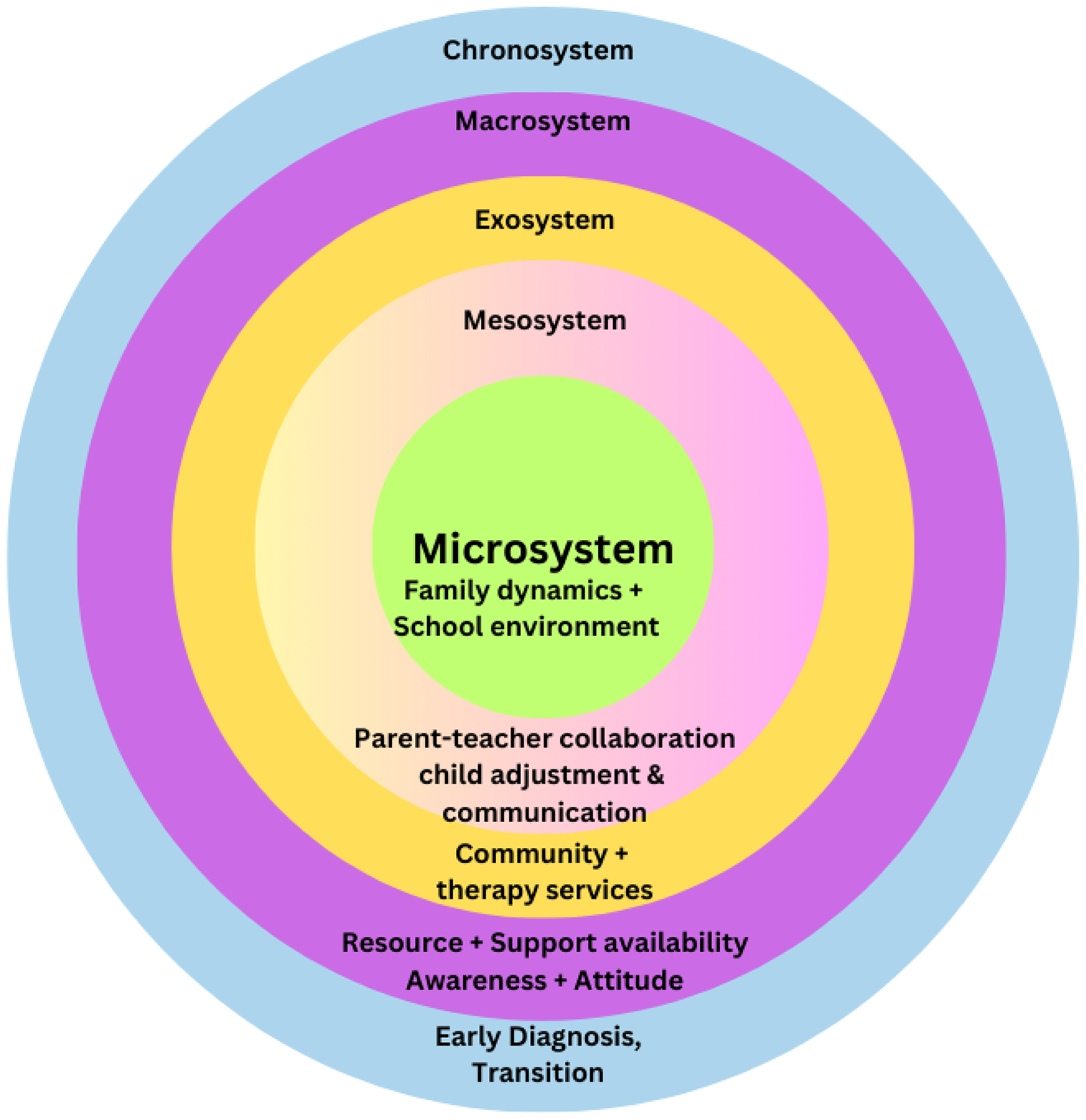
A systems model illustrating the interconnected layer of influence on a dyspraxic individual. note: Microsystem (immediate environment: family dynamics and school environment); mesosystem (parent-teacher interaction ,child adjustment, and communication); exosystem (external settings that indirectly affect the individual, such as community and occupational therapy access); macrosystem (cultural values, beliefs, resources, support availability, awareness, and attitudes); chronosystem(time and historical context; early diagnosis and transitions between educational and occupational systems). Source: Each layer impacts the Dyspraxic person's experience, adapted from Bronfenbrenner's (1986) ecological systems model. Alt-text: An infographic showing five concentric circles, illustrating ecological systems theory. The outermost circle, colored maroon, represents the Chronosystem, focusing on early diagnosis and transition. Inside that, the magenta circle is the Macrosystem, covering resource support, availability, awareness, and attitude. The yellow circle, third from the center, is the Exosystem, detailing community and therapy services. Next, the light pink circle is the Mesosystem, highlighting parent-teacher collaboration, child adjustment, and communication. At the very center, the lime green circle signifies the Microsystem, representing family dynamics and the school environment.
Understanding Dyspraxia: Definitions and Models
From Historical Definitions to Current Understanding
There are various labels for dyspraxia, each with embodied assumptions. Each term reflects the evolving understandings of the neurodivergence, including perceptual-motor difficulties, sensorimotor dysfunction, and developmental dyspraxia, all now broadly categorized under developmental coordination disorder (DSM-IV, American Psychiatric Association, 2000). However, according to the Diagnostic and Statistical Manual of Mental Disorders, Fifth Edition (DSM-5, APA, 2013), dyspraxia is a deficit in acquiring and executing coordinated motor skills, leading to difficulties manifesting as clumsiness, slowness, and inaccuracy, particularly in fine motor tasks (e.g., using scissors). Daily living activities appropriate for age, such as self-care, can also be impacted. While this medical definition is helpful for diagnosis and access to intervention (American Psychiatric Association, 2013), it overlooks a crucial aspect of dyspraxia: the significant heterogeneity within this group. Put simply, the definition fails to capture the wide range of experience and presentation of dyspraxia. Notably, speech, a commonly reported struggle among dyspraxic individuals (Gibbs et al., 2007), including the author, is often excluded from the DSM-5 criteria.
A Broader View: Social Context and Identity
To move beyond a purely medical understanding of dyspraxia, a social model offers a crucial alternative perspective, arguing that disability is not solely the result of individual impairments but is significantly shaped by societal structures and attitudes. Understanding the core tenets of the social model is essential for grasping the arguments presented throughout this paper, as it provides the lens through which we analyze the barriers and challenges faced by dyspraxic individuals. A comprehensive understanding of dyspraxia should include the lived experience of dyspraxic individuals, recognizing their identity as shaped by both community and individual experiences, and diverse intersecting identities (e.g., race, gender, and other neurodivergences; Elsherif et al., 2022). Operating within an ableist society (i.e., certain neurotypical values are valued over others; Wolbring, 2008) that devalues neurodiversity, dyspraxic individuals encounter systemic barriers and social exclusion, leading to trauma and internalized self-doubt (e.g., Bart et al., 2011; Missiuna et al., 2006; van der Linde et al., 2015). These daily encounters, marked by misunderstanding and the struggle to meet societal expectations, can lead to dyspraxic individuals being viewed as a burden (e.g., Bart et al., 2011; van der Linde et al., 2015). While these experiences of social exclusion and internalized doubt are shared with many neurodivergent individuals, dyspraxia uniquely manifests in significant challenges with motor coordination and planning. For instance, while an ADHDer might struggle with focus during a task, a dyspraxic individual may struggle with the physical execution of that task, such as writing legibly or coordinating movements in a team sport. Similarly, while autistic individuals may experience sensory overload, dyspraxic individuals might experience sensory overload that is compounded by difficulties processing spatial awareness and body positioning, leading to clumsiness and difficulty navigating their environment. For instance, the dyspraxic individual may misjudge distances between objects, struggle to maintain balance while turning corners and interpreting spatial cues such as the layout of hallways or the locations of doorways in visually busy or poorly lit environments. This sensorimotor interaction can lead to bumping into walls or furniture, difficulty orienting oneself, and increased anxiety in an unfamiliar or crowded environment, potentially leading to a dyspraxic meltdown. This crucial distinction in motor-based challenges, from fine motor skills like buttoning a shirt to gross motor skills like walking without bumping into things, sets dyspraxia apart from other neurodivergences in everyday contexts. As a result, dyspraxic individuals form their understanding of dyspraxia on both individual and social levels, bringing these insights into every interaction (Figure 1).
The Lived Experience of Dyspraxia
Systemic Barriers and Internalized Challenges (Social Model in Action)
How does this lived experience contribute to the challenges encountered by dyspraxic individuals? The pervasive impact of ableism significantly exacerbates these difficulties. In a society where neurotypical abilities and able-bodiedness is idealized, mandatory for participation and considered the norm (McRuer, 2013), dyspraxic individuals face implicit pressure to conform, despite their impairments. This pressure, coupled with the cultural interpretations of physical movement, leads to miscommunication and social experiences that deviate from expected norms. Dyspraxia can create challenges in both academic and social settings. For instance, in academic contexts, presentations may be difficult due to the risk of being misunderstood, while in social situations, difficulties with motor coordination, like holding a drink or maintaining eye contact, can lead to social anxiety and avoidance of gatherings. Consequently, dyspraxic individuals often internalize societal stigma, leading to negative self-fulfilling prophecies about their abilities and a diminished self-concept (Deroche, 2014; Missiuna et al., 2006). In essence, they may come to believe the negative portrayals of their condition, viewing themselves as a societal burden.
The Double Empathy Problem in the Context of Dyspraxia
The negative portrayals experienced by dyspraxic individuals may arise not only due to ableism but also from the double empathy problem, a concept from autism literature. The double empathy problem describes communication difficulties arising from a mismatch in social understanding and communication styles between autistic and neurotypical individuals (Milton, 2012). This can be applied to dyspraxia, as dyspraxic individuals’ unique communication challenges are rooted in motor coordination issues, executive dysfunction, and social anxiety that is exacerbated by neurotypical expectations and assumptions. For example, in educational or occupational settings, where fluid movement is crucial for peer relations. Dyspraxic individuals may have difficulties coordinating between brain and body, affecting facial expressions, movement or body language (see also Maw et al., 2024 who observed Prosopagnosia is highly co-occurring with dyspraxia). Simultaneously, neurotypical individuals may misinterpret the dyspraxic person's communication style, attributing perceived awkwardness or lack of engagement to disinterest as opposed to neurodivergence. This disconnect is further compounded by executive functioning differences where processing speed varies significantly. In turn, the dyspraxic individual might be confused by the outcome of the social situation and assuming they are the problem (e.g., Kanioglou et al., 2005). These communication mismatches can lead to significant social challenges. Moreover, the social anxiety often experienced by dyspraxic individuals, stemming from past communication difficulties, can intensify the double empathy problem, creating a cycle of misunderstanding and social withdrawal.
Adding to these interactional difficulties is the limited body of research specifically focused on dyspraxia (e.g., Bishop, 2010; Meachon et al., 2023). The lack of understanding among researchers, educators, and the wider public contributes to poor awareness of the unique challenges faced by dyspraxic individuals. In the UK, dyspraxic adults are less likely to be awarded disability support for higher education than their dyslexic peers or those with co-occurring neurodivergences, while receiving no support that helps dyspraxic individuals, in particular (Gentle et al., 2024; Kirby et al., 2008; Sumner et al., 2021). Consequently, misinterpretations and inadequate support in social, educational, and other settings are more likely to occur, further marginalizing this neurodivergent group.
Research and Representation: Amplifying the Dyspraxic Voices
Limitations of Current Research and the Need for Change
Here, the documented negative outcomes for dyspraxic individuals are not solely attributable to the neurodivergence itself but are also indicative of systemic barriers within the research landscape. These barriers, often reflecting broader societal ableism, influence the types of research conducted, the methodologies employed, and the interpretation of findings, ultimately contributing to a lack of understanding and effective support for dyspraxic individuals. For instance, in research settings, dyspraxic individuals are often compared to neurotypical comparison group. Studies have consistently shown that families with dyspraxic members report lower mental wellbeing compared to families with neurotypical members. While relative to neurotypical individuals, dyspraxic individuals themselves face a higher prevalence of negative outcomes, including social anxiety, reduced quality of life, lower levels of independence, poor cardiovascular health, challenges with physical health, social skills, self-care, low self-esteem, and even suicidal ideation (e.g., Bart et al., 2011; Cairney et al., 2017; Cleaton et al., 2018; Missiuna et al., 2006; van der Linde et al., 2015; Wilson et al., 2012). However, attributing these outcomes solely to dyspraxia itself overlooks the significant impact of societal factors. If an iota of critical thought is applied, it is unclear why difficulties with motor skills should inherently lead to anxiety, poor health, suicide, or social isolation. It is crucial to recognize that the social model and neurodiversity-affirming perspectives emphasise disentangling the inherent motor challenges of dyspraxia from the social consequences imposed by an ableist society. A critical and intersectional lens helps identify societal barriers that contribute to negative experiences, fostering a more nuanced understanding of dyspraxia. This research, focusing on the impact of societal factors on the lived experiences of dyspraxic individuals, aligns with similar approaches taken in understanding other neurodivergences (e.g., ADHD: Sonuga-Barke & Thapar, 2021; autism: Botha & Gillespie-Lynch, 2022; dyslexia: Johnson, 2023; stuttering; Constantino et al., 2022; Tourettes’ Syndrome: Bervoets et al., 2023).
The development of a negative self-concept in dyspraxic individuals is often a direct consequence of internalized societal stigma, a key concept within the social model. In an ableist society that values neurotypical abilities, dyspraxic individuals constantly encounter situations where their motor and coordination differences are perceived as deficits. These repeated negative experiences, coupled with a lack of positive representation and understanding, can lead individuals to internalize these societal messages. They may begin to believe the negative portrayals and view themselves as incapable or a burden, rather than recognizing that the challenges they face are often a result of societal barriers, not inherent flaws. This societal devaluation and lack of understanding are further perpetuated within research when the perspectives and lived experiences of dyspraxic individuals are not centred.
As a result, when non-dyspraxic researchers publish findings without considering the identity of a dyspraxic individual, we contribute to a vicious cycle where dyspraxic individuals can have feelings of low self-worth. In turn, we lead to an issue of communication and discussion of limitations. This does not mean we should present dyspraxia as a superpower, like the discourse usually argued in dyslexia (see commentary by Johnson, 2023). We should highlight the importance of dyspraxic individuals’ lived experiences ensuring they are actively listened to and understood throughout all phases of research. We should detail how research is communicated to the wider non-researcher audience, highlight that dyspraxia, like other neurodivergences, is heterogeneous and we should promote awareness of this underrecognized neurodivergence. Research has shown that dyspraxic individuals feel misunderstood and have difficulty to obtain appropriate support. The support received is often geared towards dyslexia, while neglecting the unique needs of dyspraxia (Sumner et al., 2021; Walker et al., 2021). The lack of understanding leaves dyspraxic individuals unaware of the support actually available to them such as coaching that may be more effective, appropriate and emancipatory (Walker et al., 2018).
Addressing Systemic Barriers and Promoting Inclusion
Documenting Systemic Barriers in Education, Social Settings, and Well-Being
Several solutions have been proposed to improve representation in disability research. Dyspraxic researchers are under-represented and rarely considered within these studies and are often seen as subjects rather than experts on their own lived experiences. There is a clear need to include dyspraxic individuals within academia given the limited existing research on dyspraxia globally. However, we cannot ignore the experiences of those who navigate a world often unsuited to their needs, where neurotypical expectations can create a significant obstacle course for their identity. This lack of representation, mirrors trends in research on other neurodivergences (Johnson, 2023; Constantino et al., 2022). This point may seem trivial but it results in research that overlooks unique insights only accessible to dyspraxic individuals (Fletcher-Watson et al., 2019; Gourdon-Kanhukamwe et al., 2023). While diversity in gender, race, sexuality, and ethnicity is valued, neurodiversity is equally essential (Elsherif et al., 2022). Collaboration with dyspraxic individuals through participatory approaches can reduce ableist narratives, and stigma while enhancing research quality and fostering a nuanced understanding (Manalili et al., 2023). Beyond improving research, this inclusion validates lived experiences and cultivates an inclusive research environment.
Re-Evaluating Concepts Like ‘Independence’ From a Dyspraxic Perspective
Traditionally, dyspraxia, like many neurodivergences, has been viewed through a medical model focused on identification and cure. However, this approach limits the development of neurodiversity-affirming environments. Instead, we should prioritise documenting the systemic barriers dyspraxic individuals face across domains, such as education, social settings, and psychological well-being. For example, while research indicates lower independence among dyspraxic individuals compared to neurotypical peers (e.g., Bart et al., 2011; van der Linde et al., 2015), these studies often define independence and quality of life from a neurotypical perspective (Bhattacharya et al., 2025). Therefore, it is crucial to investigate these behaviours from a dyspraxic perspective, recognizing our unique definition of success that may diverge from neurotypical standards (see examples of discussions of engagement within the autism field: Phan et al., 2025; Kaljusto et al., 2025).
The Need for Research in Higher Education and Broader Societal Contexts
While research has explored the challenges faced by dyspraxic children (Missiuna et al., 2006), a significant gap persists in understanding the impact of dyspraxia within higher education and broader societal contexts (Walker et al., 2018). A paradigm shift is needed, moving away from a primary focus on biological interventions toward addressing the substantial role of societal barriers that disable dyspraxic individuals. This shift should prioritize evidence-based research, rather than anecdotal accounts, in developing best practices for inclusion in education, employment, and society (e.g. see supplementary materials in Mahak et al., 2024 on anxiety differences between dyspraxic and neurotypical individuals). This includes the implementation of Universal Design for Learning (Steinfeld & Maisel, 2012), which ensures accessible and effective learning environments with necessary reasonable adjustments. Furthermore, research should investigate the co-occurrence of dyspraxia with other neurodivergences, mirroring studies on autism and ADHD (Zablotsky et al., 2020), dyslexia and ADHD (Brimo et al., 2021), and stuttering and dyslexia (Elsherif et al., 2021). By centreing the voices of dyspraxic individuals within broader neurodiversity research, we can move beyond anecdotal evidence and develop effective, inclusive support systems.
Media and Language: Shaping Perceptions
Harmful Stereotypes and Misrepresentation
The media plays a crucial role in shaping public perception of dyspraxia. However, current portrayals often perpetuate harmful stereotypes and contribute to the challenges faced by dyspraxic individuals. Dyspraxic characters are frequently ignored, given incorrect support, misdiagnosed, and portrayed in a negative light (e.g., Meachon et al., 2023; Wiles, 2023), leading to feelings of imposter syndrome. Often, dyspraxia is not explicitly named but instead coded through subtle cues, leaving room for misinterpretation and perpetuating a lack of understanding. This reliance on coded representations, such as the fleeting mention of dyspraxic traits (e.g., Ryan Sinclair from Doctor Who; Kornak, 2018), fails to provide meaningful representation. Characters exhibiting dyspraxic traits are often reduced to simplistic and harmful stereotypes. For example, the ‘clumsy’ trope, as seen with characters like Bella Swan (Taira, 2015), portrays dyspraxia as a sign of weakness, both mentally and physically, characterized by struggles with coordination, balance, and practical skills like driving. These depictions fail to capture the complexity and diversity of dyspraxia, often reducing individuals to their perceived limitations. This is particularly harmful to underrepresented groups, such as women, who may feel further marginalized by these narrow representations (Ackerley, 2018). To counter these damaging stereotypes, media narratives must shift from using clumsiness as a mere plot device to portraying dyspraxia as a nuanced facet of a character's identity. This requires explicitly naming dyspraxia and showcasing characters who accept and navigate their condition, similar to the portrayal of stuttering in the film Rocket Science (e.g., Constantino et al., 2022). By depicting dyspraxia as a part of a character's lived experience, rather than a defining flaw, the media can help normalize this neurodivergence and reduce damaging stereotypes. This shift towards authentic and empowering portrayals is crucial for fostering understanding, acceptance, and a sense of belonging for dyspraxic individuals within society.
Challenging Ableism and Promoting Inclusive Language
In addition, ableist language needs to be challenged (Zaneva et al., 2024). The prevailing negative language used to describe dyspraxia include terms like ‘suffering’, ‘ridiculed due to appearances’, ‘clumsy’, and ‘lazy’. The negative language spills into research as well. We should use different words to highlight the dyspraxia experience in less value-laden terms in order to combat harmful stereotypes that contribute to a stigma. Therefore, a campaign promoting neurodiversity-affirming language, similar to that of STAMMA (2020) and Bottema-Beutel et al. (2021), is essential (see Rudkin et al., 2025 for concrete examples in higher education). By using more positive language, we can contribute to removing the stigma attached to dyspraxic individuals, while promoting more individuals to recognize their dyspraxia as their identity instead of masking due to fear of rejection from society and oneself.
Conclusion: Towards a Science of Social and Motor Synchronicity
To conclude, we are in a world of perpetual motion, fluid and swift. The bodies dance with grace and wit. But as a spectator both clumsy and slow lost in a rhythm that dyspraxics surely want to know why they cannot escape that clumsy plight. Dyspraxia, like many other neurodivergences, is a natural variation in human neurotypes and experience. Dyspraxic individuals experience the world differently – they struggle with coordination, movement, language, speech and independence in a world often designed and designated for neurotypical individuals. We need to shifting our understanding of dyspraxia from a purely medical perspective to one informed by the social model of disability. The ableist environment can devalue and misunderstand dyspraxic people. Dyspraxia awareness is crucial to combat the lack of knowledge and care for this group. Dyspraxic individuals can contribute to neurodiversity by advocating for a more inclusive and accepting environment. However, true inclusion requires listening to dyspraxic voices and standing in solidarity but not speaking over and ignoring their lived experiences. From then on, with patience and kindness from non-dyspraxic to dyspraxic individuals, a language of understanding and compassion will be built, creating a science that promotes compassion, rigour and inclusivity, a true science of social and motor synchronicity.
Footnotes
Acknowledgements
The author thanks Piyali Bhattacharya and Emily Friedel for providing constructive comments and proofreading this commentary. It would not have been possible without either of you.

Funding
The author received no financial support for the research, authorship, and/or publication of this article.
Declaration of Conflicting Interests
The author declared no potential conflicts of interest with respect to the research, authorship, and/or publication of this article.