




Abstract
In recent years, the number of autistic people entering university has increased in Australia and worldwide. While an encouraging trend, autistic students’ completion rates remain much lower than non-autistic students in Australia. Perhaps unsurprisingly, numerous studies investigating autistic people’s experiences at universities have identified stigma and discrimination as a significant barrier facing autistic people in higher education. In this study, our team of autistic co-researchers and non-autistic researchers co-produced an in-depth qualitative study to understand the contexts and circumstances in which autistic people felt stigmatised or experienced discrimination at universities in Australia. We interviewed 21 autistic people who either had completed at least one university course, or were studying a university course, or had enrolled in but discontinued at least one university course in Australia. Using reflexive thematic analysis, we identified four themes: (1) ‘My disability is something that people just don’t have a clue about’, (2) ‘the system is really stacked against you’, (3) the onus is on autistic students, and (4) ‘grit and stubbornness’. Based on these findings, we suggested implementing Universal Design for Learning, neurodiversity-affirming and trauma-informed practices, together with a participatory approach to better design university curricula, processes, and support services for autistic students.
Lay Abstract
Autistic students experience many challenges at university. One significant barrier identified in past research was autistic students’ experiences of discrimination (i.e. being treat differently) and stigma (being judged differently). Our research team included both autistic and non-autistic researchers who designed a project to help explore autistic students’ experiences of stigma and discrimination at Australian universities. We interviewed 21 autistic students who went to a university – some had completed qualifications, and some had not. From our interviews, we identified four themes: (1) ‘My disability is something that people just don’t have a clue about’, (2) ‘the system is really stacked against you’, (3) the onus is on autistic students, and (4) ‘grit and stubbornness’. As a result, we recommended changes in the way courses are written and taught so that autistic people have opportunities that meet their ways of learning. It is also important for university staff to understand the impact of trauma experienced by autistic people and that universities work together with autistic people to design courses and supports that include autistic ways of learning, accessible university processes and identify support needs.
Keywords
Higher education is not accessible to everyone. International conventions on disabled people’s right to education have contributed to a growing number of disabled students enrolling at universities in the last few decades (Bakker et al., 2019; Department of Education, 2021; United Nations, 2016; von Below et al., 2021). While this is an encouraging trend, disabled students’ low completion rates indicate that their experiences and outcomes remain far from equitable (Chown et al., 2018; Newman et al., 2011). Take autistic people as an example: in Australia, the context of this study, the latest census data show that autistic people, including those with intellectual disabilities, are twice less likely than people with other disabilities and four times less likely than people without disabilities to hold a bachelor’s degree or higher (Australian Bureau of Statistics, 2018). Going to university – and being successful at university – is an important aspiration to many autistic people (Camarena & Sarigiani, 2009). Like many others (Bartram, 2016; Skatova & Ferguson, 2014), autistic people think that attending universities can bring about better career prospects and personal development (Cheriyan et al., 2021). It is therefore imperative to understand the reasons underlying these poor outcomes experienced by autistic students at universities.
Existing research on the experiences of autistic university students has made some progress in understanding these reasons. Several studies have shown that autistic students often feel a sense of otherness at universities (Cage & Howes, 2020; Vincent et al., 2017) and face others’ stereotyped beliefs about, or stigmatised attitudes towards, autism from their peers (Goddard & Cook, 2021; Gurbuz et al., 2019; Sarrett, 2018) and university staff (Scott & Sedgewick, 2021). Autistic students also generally report non-autistic people’s lack of understanding and awareness about autism and autistic people (Cage et al., 2020; Cage & Howes, 2020; Goddard & Cook, 2021; Gurbuz et al., 2019; Vincent et al., 2017), often leading to a lack of appropriate support and accommodations that could truly level the playing field for autistic students (Anderson et al., 2020; Cage & Howes, 2020).
Furthermore, many autistic participants in these studies have expressed their fear of discrimination as the primary reason for not disclosing their autistic identity (Bolourian et al., 2018; Cai & Richdale, 2016; Van Hees et al., 2015), which has sometimes led to delayed or no access to support services (Anderson et al., 2020; Van Hees et al., 2015). Autistic students’ fear of discrimination was perhaps not unfounded based on evidence presented in a recent systematic review, which provided an overview of university experiences reported by 587 autistic students across 24 studies. Almost one third of these studies (n = 7) involving 286 autistic students (48.7% of total sample) reported experiencing discrimination, marginalisation, and bullying (Davis et al., 2021). Despite the apparent prominence of this issue, to our knowledge, there have been no studies that have specifically examined autistic university students’ experiences of stigma and discrimination. To this end, we conducted an in-depth qualitative study to uncover the contexts and circumstances under which autistic students experienced discrimination at universities in Australia.
Method
Participants
This study was advertised on social media (Twitter and Facebook) between 15 and 29 November 2021 inviting autistic people to share their experiences going through university in Australia in a semi-structured interview. We included autistic people who (1) were 18 years and above, (2) used English, (3) had a clinical diagnosis of autism or self-identified as being autistic, and (4) had completed, had enrolled in but discontinued, or were currently studying at least one course at a university in Australia. We received expressions of interest from 26 eligible autistic people, all of whom were invited to complete the interview.
Of the 26, five either did not respond to our invitation or were unavailable. The remaining 21 autistic people were interviewed between 22 November and 24 December 2021. Participants were aged between 23 and 56 years old (M = 36.3 yrs; SD = 9.1; Table 1), predominantly domestic students (n = 20; 95.2%) and were non-Indigenous Australian or of European descent (n = 16; 76.2%). Participants identified as women or transfeminine (n = 13; 61.9%), transgender men or genderfluid between agender and male (n = 3; 14.3%), or nonbinary or genderqueer (n = 5; 23.8%). Twenty participants received their autism diagnosis either before (n = 4; 19.0%), during (n = 7; 33.3%), or after (n = 9; 42.9%) commencing their university courses. One participant self-identified as being autistic during university. At the time of interview, 11 participants (52.4%) were current students, while the remaining had either completed at least one degree (n = 8; 38.1%) or had enrolled but discontinued at least one course (n = 2; 9.5%). Specific information on socioeconomic status was not recorded. See Supplemental Table S1 for further participant information.
Participant characteristics.
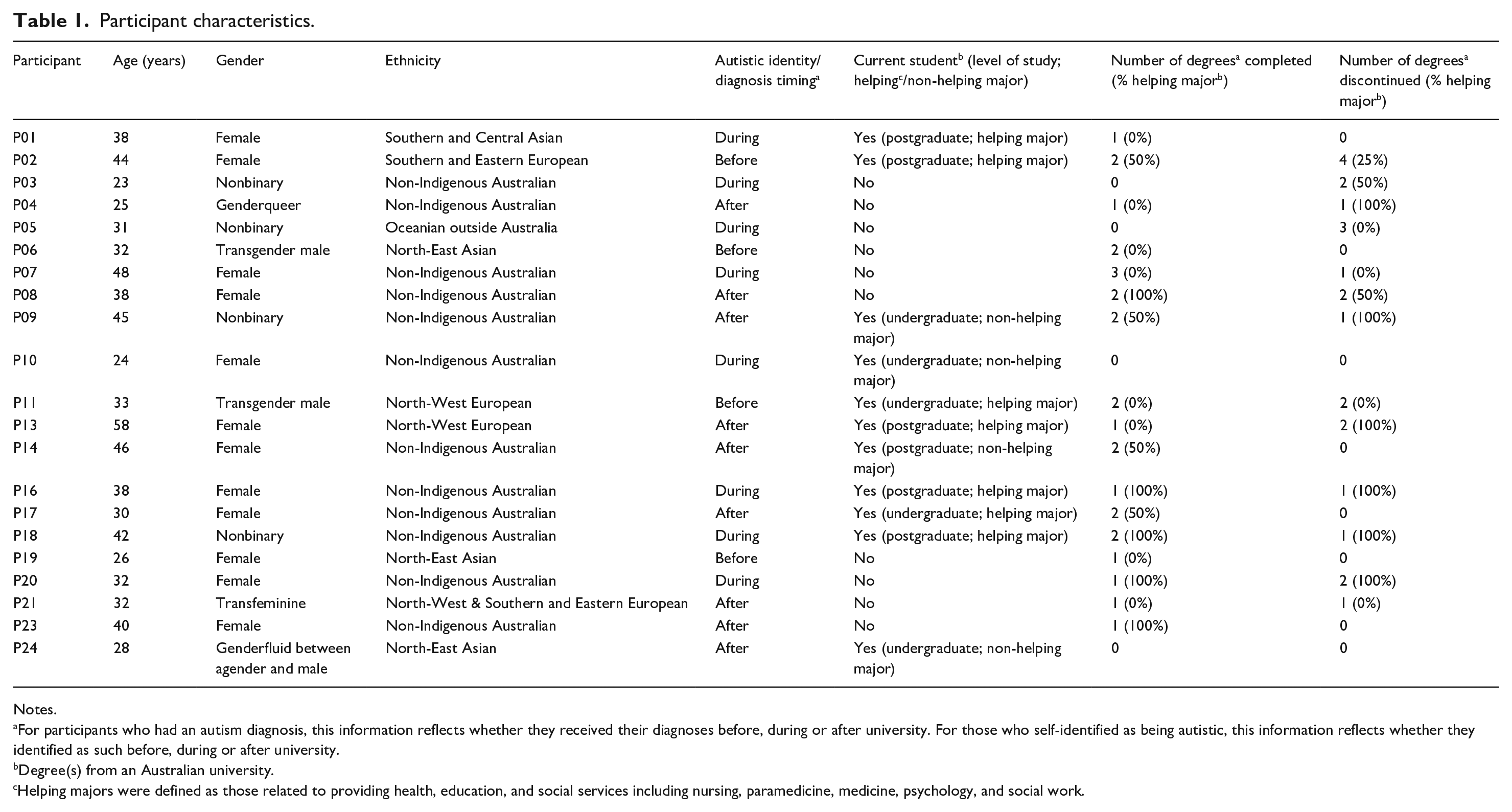
Notes.
For participants who had an autism diagnosis, this information reflects whether they received their diagnoses before, during or after university. For those who self-identified as being autistic, this information reflects whether they identified as such before, during or after university.
Degree(s) from an Australian university.
Helping majors were defined as those related to providing health, education, and social services including nursing, paramedicine, medicine, psychology, and social work.
Interview schedule
We asked participants six primary questions regarding their: (1) autism diagnosis or self-identification, (2) transition from school to university, (3) interactions with peers, (4) interactions with university lecturers and staff members, (5) experiences navigating university systems, and (6) any negative experiences that stood out to them during university. For the final question, the phrase ‘negative experiences’ was replaced with ‘experiences of discrimination’ if participants spontaneously mentioned discrimination or related terms during the interview. Prompt questions were used to elicit further details, if required (see Supplementary Material for interview schedule).
Procedure
Ethical approval for this study was granted by the Human Research Ethics Committee at Macquarie University. All participants provided informed written consent before participating in this study.
Participants first completed an online questionnaire administered on LimeSurvey (LimeSurvey Gmbh, 2012) and provided general demographic information, history of higher education, and communication and language preferences. Ahead of the scheduled interview, each participant was (1) sent the primary interview questions, (2) given an option to complete the interview with an autistic (MR) or a non-autistic researcher (DT), and (3) able to choose their preferred way of completing the interview either via web conference on Zoom (using video and/or audio), live text-based chat, email, phone call, or another method specified by the participants.
Six participants were interviewed by MR while the others by DT. Most participants completed their interviews via Zoom using video and/or audio (n = 20; 95.2%) and one participant via email exchange (4.8%). One participant did not wish to be recorded – in which case, with the participant’s permission, their interview was conducted by an interviewing researcher, while another researcher took notes. The interviews ranged between 26 and 107 min (M = 67.4 min, SD = 22.0). Participants received an AUD25 voucher as an appreciation for their time. Where appropriate, participants’ interviews were audio-recorded and transcribed verbatim by a transcription service. Transcripts were subsequently sent to all participants to edit or clarify any details if they wish. Nine participants responded with minor changes or additional information while the remaining participants did not respond to our request.
Data analysis
We employed Braun and Clarke’s (2019) recommendations for reflexive thematic analysis within an essentialist framework. We used an inductive approach without any pre-specified codes to identify patterned meanings within the dataset. The interviewers (DT and MR) kept a reflexive diary and met up regularly to reflect on the interviews and to discuss potential codes. Once the transcripts were available, the research team met to discuss any compelling observations and potential codes based on two transcripts. DT then familiarised herself with all transcripts, continued to meet with MR once a week over several weeks to discuss potential codes and interpretations, and applied codes to all transcripts using NVivo (Version 20; QSR International Pty Ltd., 2020). Next, DT generated a draft thematic map based on the codes and participants’ quotes which was reviewed and first discussed with MR and then with the research team. The results presented in the next section were based on several rounds of revisions conducted through an iterative and reflexive process with the research team. Our analytical approach was influenced by our training in psychology (DT, TH and EP), education (EP), social work (MR), and disability studies (TH), our professional experience as academics (DT and EP), our prior experience as international (DT) and domestic (MR, TH and EP) students in Australian universities, and positionalities as autistic people (MR and TH). Finally, a draft of the results section and thematic map were sent to all participants for member checking. Four participants responded and agreed that our findings were consistent with either their own experiences or those of other autistic people. The remaining participants did not reply.
Community involvement
This study involved a team of autistic (MR and TH) co-researchers 1 and non-autistic (DT and EP) researchers working together – and sharing decision-making power – throughout the research process. TH and DT had several discussions which contributed towards a funding application, which was awarded to DT (the scheme did not allow for multiple investigators). This project also received additional support from EP’s existing funding. All team members contributed to the ethics application, the design of the online questionnaire, interview schedule, study procedure, data analyses and interpretation, and manuscript preparation. MR and DT conducted the interviews and co-presented the study findings at conferences and group meetings. A more detailed reflection on outcomes of the participatory research process is reported in Appendix B (Staniszewska et al., 2017).
Results
Many of our autistic interviewees spoke of how they received their autism diagnosis or identified as being autistic during adulthood. Some had gone through university without knowing they were autistic. Consequently, without any support in place, our participants had ‘tried a few times to get different degrees’ [P05] in various formats such as face-to-face or distance learning and somehow ‘got through it’ [P21]. They ‘persisted even though it was really hard. I almost gave up so many times’ [P21]. From our analysis, we identified four themes (see Figure 1).
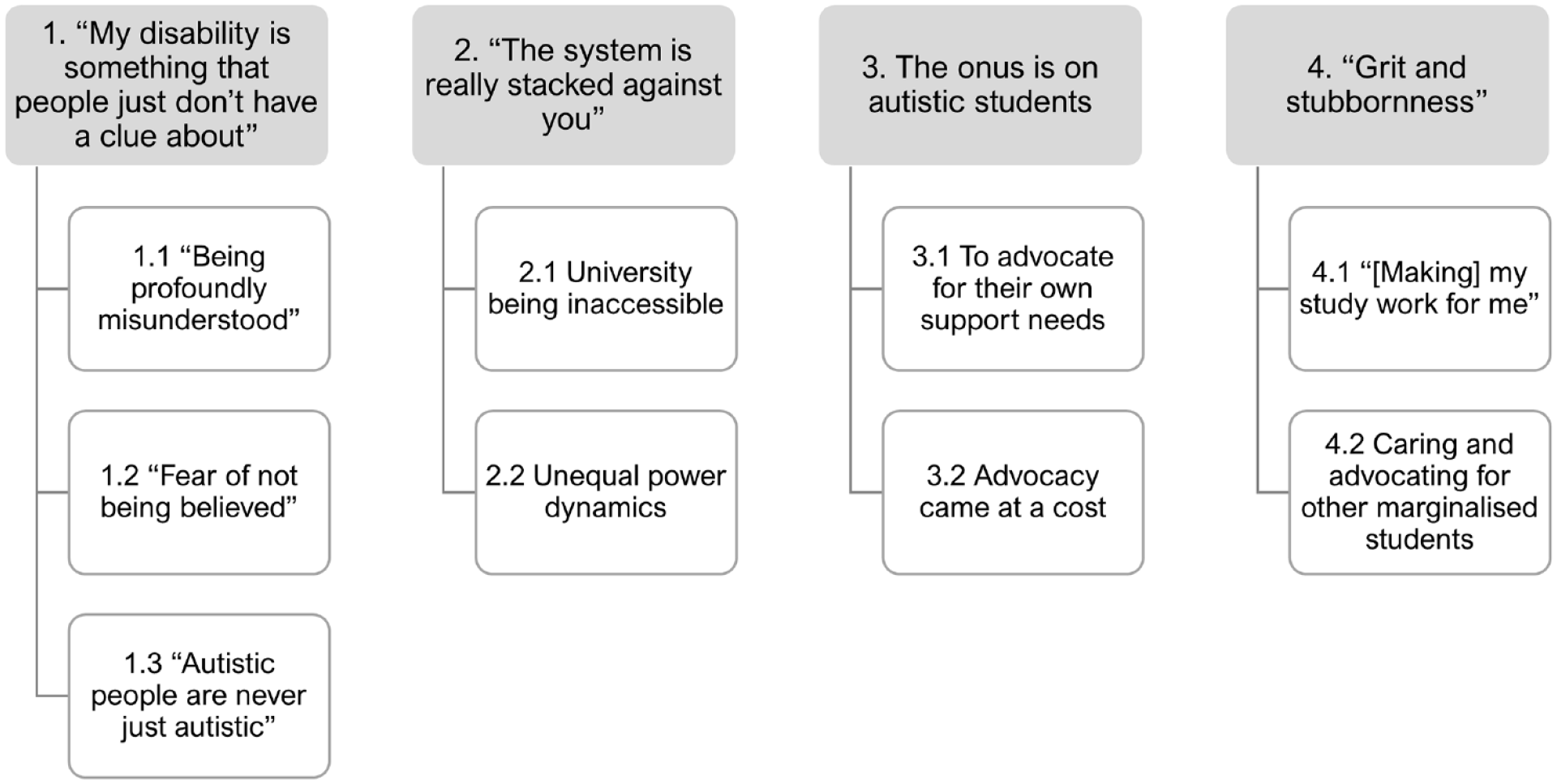
Autistic people’s experiences of discrimination at university: Themes and subthemes.
Theme 1: ‘my disability is something that people just don’t have a clue about’
Many participants spoke about ‘being profoundly misunderstood’ [P17] (subtheme 1.1) at universities. They felt either that autism is ‘something that people just don’t have a clue about’ [P17], or that non-autistic people often ‘expect to see somebody who is typically autistic in a certain way. Doesn’t make eye contact. Speaks in monotone. Very certain things. They don’t expect to see me’ [P01]. They were often told that ‘you can’t possibly be autistic because you don’t act like Rain Man’ [P07] or that ‘you are obviously fine. You’re obviously high functioning. You obviously have no support needs’ [P10]. Some participants described their experiences by drawing comparisons with physical disabilities: ‘It’s very different to somebody having a wheelchair or somebody having hearing issues. . . there’s technology and equipment set up to support that’ [P14], whereas they felt being autistic is an ingrained part of their disability: ‘It is not my legs. It is not an eyeball. It is my brain and neurology. There is no way I can exist outside of that’ [P17].
These misconceptions extended to the university teaching curriculum and academic discussions, which were recounted as being ‘extremely ableist’ [P23], ‘deficit based’ [P23], and ‘dehumanising’ [P02], and which ‘exists in a scientific bubble’ [P13] and ‘doesn’t fit a lot of people’ [P20]. The lack of autism knowledge also led to others – particularly university support services – having ‘a very poor understanding how [autism] affects capacity . . . how we approach university tasks’ [P09] and ‘not understanding why I would need particular things’ [P05] such as ‘recordings of lectures’ [P05] and ‘closed captions’ [P09].
Autistic interviewees disclosed their ‘fear of not being believed’ [P02] (subtheme 1.2) by their university peers or lecturers: ‘[my] credibility or . . . productivity or what I’m capable of gets dismissed’ [P01]. Autistic people were also made to feel that they were ‘stupid’ [P19], ‘lazy and a procrastinator’ [P09], and ‘inadequate, like I didn’t belong in the class’ [P04]. In some instances, autistic participants who had applied for special considerations or sought support from their lecturers were even seen as ‘trying to cheat’ [P11] or ‘cheating the system with my extra time and my rest breaks and my extensions’ [P10]. One striking example of such mistrust was described by an autistic PhD student who reflected on their experience applying for ethical approval for an autism research project: ‘I felt like I had to prove more because I was seen as a potential harm because of the fact that I am autistic – as in how can I be trusted to understand when somebody is distressed’ [P02].
Participants who were studying in areas of helping professions such as education or nursing were often questioned about their career choices when they disclosed being autistic. For example, a participant who was completing an education degree was told that they ‘wouldn’t make a very good teacher and that I should probably not continue with my course’ [P16]. Another participant who was studying to become a paramedic was told that they ‘probably can’t get a job even if you finish your degree because of your mental health’ [P03]. One participant explained this issue: People don’t even realise that they are being ableists. If you shove a wheelchair person out of the way, you know you are being ableist. It is pretty clear. If you don’t build a lift. It is pretty clear. It is more overt. Whereas, if you are just not sure if that person is being a little bit weird and you make a joke about them being retarded, it is so much more nuanced, the microaggressions and ableism that autistic and neurodivergent people experience. [P17]
Upon reflection on their experiences of discrimination at universities, many of our participants spoke about the intersections between their being autistic and a broad range of other stigmatising identities (e.g. being a non-male or a person of colour) because ‘autistic people are never just autistic’ [P02] (subtheme 1.2). Several autistic women spoke about ‘a lack of comprehension about what autism looks like and how it presents, especially in women’ [P07], thus there being ‘support groups [that] are specifically targeted for boys who like trains’ [P04]. Some encountered sexism at universities where men would ‘not take you seriously’ [P18], had ‘a sense of entitlement. . . and white male privilege’ [P13], and were ‘entitled to just speak and pretend we weren’t there. . . often men in a group or a class would talk over women’ [P13]. They reportedly ‘struggled being a woman in STEM and speaking directly [because] everyone would characterise me as rude or bossy’ [P10]. Autistic women of culturally diverse backgrounds described their experiences as ‘a triple whammy of me being a woman of colour’ [P01], which ‘come along with racism as well. Being an Asian woman, especially with white men’ [P24]. One participant expressed the complexity of their experience: My history is complicated as an autistic person, by also being half Italian. When I went to uni, I actually had people say how exotic it was that I was there. So, some of the stuff is hard to pull apart from getting an extra set of messages that I didn’t deserve to be there anyway. [P13]
Theme 2: ‘the system is really stacked against you’
There was agreement among our participants that such mistreatment went much deeper than the individual peers and lecturers with whom they interacted. They also spoke about the deeply entrenched systemic discrimination in their higher education experiences. Participants spoke in great depth about the university being inaccessible (subtheme 2.1) to them, including the physical environment, which had ‘too many people walking around’ [P23], with ‘lighting as abrasive as hell’ [P17], ‘so many smells, it was so loud, and the acoustics were bad’ [P02], and ‘weren’t well ventilated’ [P11]. They reported that such an environment ‘didn’t work’ [P05], ‘was enormously overwhelming’ [P13], and ‘was just completely inaccessible’ [P02].
Crucially, inaccessibility was further felt to be embedded within university processes, especially around requesting support from disability services. The processes involved in accessing support services were described as a ‘massive bureaucracy’ [P01] and an ‘overwhelming maze’ [P02] that ‘aren’t very flexible’ [P24]. There were ‘lots of hoops to jump through’ [P07] and ‘a million forms that you need to fill out’ [P09]. Overall, our participants thought that the disability service ‘works to a checklist rather than works to the needs of people they claim to be serving’ [P01] and is ‘superficial [and not] versatile enough to be meaningful for an individual’ [P17]. One participant described these processes as a ‘symbolic violence’ [P02] – ‘a deliberate process to make people like me give up’ [P02].
Because it almost feels like you have to play up or present a certain way in order to get the special considerations. So, my psychologist had to basically write a letter, saying my life was falling apart, in order for me to get special consideration. . . And I’m grateful that my psychologist knew how to play the system. Because I wouldn’t be able to. So, it feels like the system is really stacked against you. [P01]
Some participants also found certain compulsory teaching components and lecturers to be inaccessible. Compulsory teaching requirements such as lecture attendance were ‘absolutely unfair and so ableist . . . even though [lectures] have to be recorded’ [P17]. Our participants told us that some teaching staff ‘seemed so unfriendly’ [P05], were ‘completely inaccessible to students, so you had to try and catch the staff before or after class when they were rushing about’ [P11] and ‘could even be brutal . . . and pretty mean’ [P24]. One participant shared that ‘[lecturers] sort of expect everyone to work like they do, or to work like how they present it’ [P24]. Another wished that lecturers could ‘just [explain] things in different ways, or just [spend] a bit more time on people who take longer to process’ [P02].
Beneath it all, many participants spoke about the deeply seated unequal power dynamics (subtheme 2.2) within the academic establishment – with autistic students being ‘at the bottom of the pyramid’ [P01]. Lecturers were described as ‘authority figures’ [P24] and ‘somebody who’s in a position of power’ [P06]. This ‘hierarchical’ [P01] relationship was evident in several instances when our participants have gone through the arduous process with disability services ‘asking for what you need. And then the lecturers have the discretion of whether or not to do it’ [P03]. One participant told us that their disability advisor could ‘negotiate with the lecturers on behalf of students but if the lecturer says no, they cannot force the lecturers’ [P19] to provide the required support and accommodation. The following quote illustrated how such power difference played out for one of our participants: . . . [a lecturer] said, she doesn’t want any adjustments for students with disabilities. And also, she said she got lots of emails from Access and Inclusion that I was struggling with her course, but she said, ‘when I got those emails, I didn’t trust those emails because you didn’t look like you were struggling with my course. You didn’t need so much support. So you should be more confident with yourself’. Though the truth was I needed support, but she refused to implement adjustments for the entire semester. [P19]
There were also reports of instances in which lecturers have not been held ‘accountable for some of the deeply unfair and discriminatory practices that have caused very real harm to students like me and others’ [P01]. To submit a complaint, one participant was expected to ‘talk directly to the lecturer, and then go to the school or college, and then Students Association’ [P19].
Theme 3: the onus is on autistic students
It was clear from our interviewees’ responses that they felt the onus is all-too-often on autistic students to advocate for their own support needs (subtheme 3.1). Several participants told us that it was ‘really hard to know what [support or accommodation] to ask for’ [P03] because they have ‘never been to university before’ [P03] or ‘wasn’t aware of access and inclusion [and] the idea that I could get help like extensions etc’. [P21]. For others who understood the kind of support they needed, they reported having to ‘continuously ask for it’ [P02], ‘keep pushing until it resolves’ [P10] and ‘advocate for what I need’ [P14]. During this adversarial process, some participants felt that they had to ‘prove your worthiness as a disabled person’ [P07] by providing ‘highly personal, highly deficit-based’ [P02] documents such as diagnostic assessments but, in the end, receiving ‘very little [support] in return’ [P07]. Participants were adamant that the university staff and system should recognise that ‘we’re just looking for some stuff to make it a little easier for us to learn and engage’ [P05] and that ‘we’re there for a reason. Don’t question that. It’s kind of demeaning and dehumanising’ [P07]. One participant described the additional work required to seek appropriate support as the ‘classic being disabled at uni is doing an extra unit just to keep you in there’ [P10]. Another participant was frustrated that the time and effort spent on applying for accommodations often outweighed the benefits of these supports: This is the sort of thing they’re saying, we help all people, we like diversity, and all that, that’s complete bullshit. You expect a person who’s from the minority, you expect them to do all of that work and what are you actually giving in return? [P02]
While some of our participants were proud of their ability to advocate for themselves, they nevertheless felt that such advocacy came at a cost (subtheme 3.2). For many, the very act of asking for help comes with an ‘emotional burden’ [P07]—the feeling that ‘somehow it’s a failure if I ask for help’ [P01], that ‘someone feels pity or thinks that I’m pathetic’ [P05], which ‘impacts on one’s dignity’ [P07]. Ultimately, there is ‘the stigma that a lot of people carry and have internalised around disability services because they’ve internalised the shame of disability for whatever reason’ [P09]. Some participants felt that ‘it was really hard just seeing that I seemed to have trouble with the stuff that wasn’t hard for other people’ [P05], and they ‘just wanted to do things without having to ask’ [P08]. As one participant explained: ‘Even now, it’s not easy for me to ask for help from people who are not my friends. Well, actually, in general. I have pride in being independent and not needing help and being capable’ [P24].
Some participants felt that their self-advocacy had led to them being perceived as ‘a difficult student’ [P17], ‘getting side-lined, getting dismissed, [and] getting their ideas not validated’ [P01]—which they further felt underpinned their ‘lack of career progression’ [P09], ‘projects progress ends up getting delayed’ [P01], or a ‘loss of appetite’ [P07] for subjects about which they were once passionate. Furthermore, they spoke about their financial losses when negotiations for accommodations failed, including needing to drop out of university and having accumulated ‘a huge HECS 2 debt now because of all the subjects I attempted and failed’ [P09] or having ‘to pay out of my own pocket’ [P14] to get the support they needed.
Theme 4. ‘grit and stubbornness’
Despite the toll that self-advocacy could take in the face of such prejudice and discrimination, many participants told us that ‘grit and stubbornness’ [P08] helped them get through university. They demonstrated tremendous strength and determination in ‘[making] my study work for me’ [P11] (subtheme 4.1). They felt that through their university experience, they had developed ‘a better understanding of how I work’ [P02], ‘learned a little bit more about what I can and can’t do’ [P05] and were now able to recognise ‘when things are getting too much and [drew] boundaries’ [P24], albeit ‘a very expensive lesson to learn’ [P05]. One participant explained: Despite not being diagnosed when I was at [university] and despite having not much support after when I did know, I’m quite proud of still making it through with a decent GPA. I was a single parent. . . I had no money, no resources, it was a pandemic and I still finished with two thesis high D, HDs, and a 6.0 GPA. I’m really proud of that. [P07]
Many of our participants reported also caring and advocating for other marginalised students [subtheme 4.2]. Even after graduating from the university, one participant reported still feeling ‘worried about [a discriminatory lecturer’s] current students because. . . she is still refusing adjustments to students with disabilities’ [P19]. Another felt strongly about wanting ‘to help the medical profession recognise all the incredibly valuable aspects and beautiful parts of neurodivergence’ [P23]. Several of our participants went a step further to fill ‘a massive systemic gap’ [P01] to provide the much-needed support for other marginalised university students by voluntarily setting up a ‘peer support’ [P01] group or participating in a ‘peer mentoring’ [P18] programme for other neurodivergent students. One participant founded a ‘Pride society’ [P03] for queer students to create ‘a really good sense of community . . . not just for me but for other people in the group’ [P03]. Several enacted positive changes at the university administration level by developing ‘disability ally training for uni [staff]’ [P10] and by sitting on ‘Academic Board’ [P10] to influence university policies. One participant summed this up: So now I’m making one, not just a social group, no. So, I’m talking to high-level staff. And the idea is this is for staff and students. My focus will be on neurodiversity, but it can be anyone with disability. And this will be peer-to-peer mentoring, advocacy support. And hopefully, it’ll be able to impact teaching and learning and administration. So that’s what I’m doing. And I feel confident doing that now because I am autistic. [P09]
Discussion
This study provided an in-depth investigation on autistic students’ experiences of stigma and discrimination at universities in Australia. Our analyses revealed deeply unsettling accounts of discrimination which may explain the low completion rates and poor outcomes among autistic students. Here, we discuss the four themes identified in this study.
Our first theme echoed findings from numerous existing studies (Cage et al., 2020; Cage & Howes, 2020; Goddard & Cook, 2021; Gurbuz et al., 2019; Vincent et al., 2017) whereby our autistic participants also found people with whom they interacted at universities often lack understanding of autism and hold stereotypical beliefs about autistic people. These misconceptions sometimes contributed to our autistic students’ capability and competence being doubted at universities. Students who were studying in helping professions such as nursing and education were told to reconsider their career aspirations upon disclosing their autistic identities. This is likely due to the deeply damaging misconception that autistic people lack empathy (Baron-Cohen & Wheelwright, 2004; c.f. Fletcher-Watson & Bird, 2020), as empathy is deemed a necessary attribute in the helping professions (Moudatsou et al., 2020; Shaw et al., 2022).
While training has been shown to be effective in improving autism understanding (Gillespie-Lynch et al., 2015; Someki et al., 2018), the translation of this knowledge into more inclusive practices is limited (von Below et al., 2021). In one study, von Below et al. (2021) found an ‘attitude-behaviour gap’ among university teaching staff who reported autism awareness and inclusive attitudes towards autistic students but did not practise inclusive teaching. According to von Below et al., university staff should make conscious efforts to challenge ‘the implied student’ which refers to staff members’ expectations or even preferences in the kinds of students who attend universities (Ulriksen, 2009). If staff expect students to be non-autistic, they are likely to design their curriculum without considering the needs of autistic students. Furthermore, preliminary studies suggest that microaffirmations such as personalised supports, validations, and compliments towards marginalised students are effective in increasing students’ sense of belonging in the university environment (D’Angelo et al., 2020; Eisenman et al., 2020; Ellis et al., 2019). Similar approaches – termed as ‘neurodiversity-affirming’ – have been proposed in the autism literature (Hamilton & Petty, 2023) and is an important avenue for future research to determine its effectiveness in improving the educational experiences for autistic students.
The second theme was related to the issue of inaccessibility. Apart from inhospitable environments (Anderson et al., 2020; Cage & Howes, 2020; Goddard & Cook, 2021; Gurbuz et al., 2019; Van Hees et al., 2015), our participants further felt that support services were paradoxically difficult to access. One barrier was the requirement of a formal autism diagnosis. While many autistic students understood that this is to ensure that resources go to those who need it most, it also meant that many who are unable to access or afford diagnostic services would slip through the cracks (Sarrett, 2018). In addition to their academic pressures, autistic students who struggle with executive function (Dijkhuis et al., 2020) were disproportionately affected by the administrative burden of applying for support services which were time-consuming, complex, and inflexible. University administrations should implement processes to alleviate the burdens autistic students encounter while seeking such supports (Christensen et al., 2020).
One way in which administrative burdens of both autistic students and staff members can be reduced is by adopting Universal Design for Learning principles (UDL; CAST, 2018)—a framework that seeks to increase accessibility in teaching and learning for diverse learners (CAST, 2018). Based on our participants’ accounts, many required only ‘low-level’ supports like access to learning materials in advance (Accardo et al., 2019; Dexter et al., 2022) and lecture recordings (Anderson et al., 2018; Satterfield et al., 2015) with closed captioning (Burgstahler & Russo-Gleicher, 2015; Harris, 2018), which may be implemented as a default. This could serve as a cost-effective measure to allocate staff resource to students who require more individualised support (Ferguson et al., 2019; Hitchcock & Stahl, 2003). Moreover, university staff’s training in UDL and being aware of diverse learning needs have been found to be effective in reducing staff’s stigma towards autistic students (Waisman et al., 2023).
Like several other studies (Anderson et al., 2020; Dexter et al., 2022; Sarrett, 2018), our participants shared striking accounts of lecturers with allegedly discriminatory behaviours, including their refusal to implement individual learning plans or accommodations without clear reasons. According to our participants, these allegedly discriminatory lecturers have not been held accountable despite their legal obligations under the Disability Discrimination Act (1992), perceived largely to be due to the absence of an appropriate and safe reporting mechanisms for students to submit complaints against university staff. Participants felt that the lack of consequences for these staff allows such actions to persist for future students.
The third theme described the onus of identifying and getting the required support often falls on autistic students. The additional work involved in accessing support services has been described as the ‘hidden curriculum’ for disabled students where they are expected to do much more and work harder just to enable their learning at universities (Anderson et al., 2018; MacLeod et al., 2018; Ward & Webster, 2018). A recent study conducted in the United Kingdom found a strikingly similar theme where autistic university students were expected to know and continually advocate for what support they need (Dexter et al., 2022). Autistic students in our study shared in-depth the burden they experienced in advocating for themselves. Our participants’ experiences of self-stigma often stemmed from their lifelong experiences of being othered and stigmatised in schools and the community and they felt this was compounded by having to seek support at universities. This experience is parallel to disabled people’s experiences of the overly bureaucratic nature of benefit systems which tend to be onerous, inaccessible, and dehumanising (Saffer et al., 2018).
As many autistic people experience bullying and victimisation throughout life (Gibbs et al., 2021; Gibbs & Pellicano, 2023; Pearson et al., 2023), those who work with autistic people should recognise that empowerment and self-advocacy does not come easily for many autistic people. There is preliminary evidence that the implementation of trauma-informed practice in higher education – an approach that builds on safety, trustworthiness, choice, collaboration, and empowerment (Davidson & Education Northwest, 2017; Schroeder et al., 2023) – led to students feeling safer and more included and empowered within the university environment (Barros-Lane et al., 2021). University staff who underwent training on trauma-informed care also reported better recognition of students impacted by trauma, awareness of potential triggers, and an increased ability to support these students (Doughty, 2020). Further research is warranted to evaluate whether such an approach benefits autistic and other marginalised university students.
Despite the toll advocacy could take, our fourth and final theme emphasised the ways in which our participants deeply cared and passionately advocated for other marginalised students. University administration and support services should harness the practical wisdom of autistic and other disabled university students to identify and develop the best ways to support them. Service user involvement is increasingly common in healthcare services which have been found to benefit both service users who reported feeling more empowered in the decision-making process in service developments and service providers who reported improvements in services (Omeni et al., 2014). Related to higher education, Gillespie-Lynch et al. (2017) found that support services informed by the needs of neurodivergent students were associated with decreasing anxiety and increasing perceived social support at universities. Likewise, another study showed that autism knowledge training co-developed with autistic students was more effective in reducing stigma and improving autism knowledge than a training that was not co-produced (Gillespie-Lynch et al., 2022). Therefore, universities should consider adopting a participatory approach in developing support services and resources with autistic students for autistic students.
Limitations and strengths
Our study has three key limitations. First, there is a potential issue of self-selection bias whereby students with negative experiences at universities might have been more likely to sign up for our study. Second, while qualitative research does not seek to generalise, our participants were made up of mostly White European descents, none were cisgender males, and information on their socioeconomic status was unknown; hence the perspectives described herein may not be shared by the whole autistic population. Third, although we prioritised the testimonies of autistic students for this study, we did not, however, seek perspectives from teaching staff and disability support staff. This warrants further research to understand teaching and non-teaching staff’s experiences of interacting and working with autistic students, and the barriers in providing individualised support or implementing UDL.
Notably, there were two key strengths that improved the rigour of our study. First, all aspects of this research were co-produced with autistic co-researchers. The involvement of autistic co-researchers, particularly at the interview stage, meant that participants were afforded a safe space to share their often-challenging experiences as a university student (see further reflection in Appendix B). Second, we intentionally avoided initiating the topic of discrimination to minimise biases in the interviewees’ responses (Cairns-Lee et al., 2022). Despite this approach, almost all participants spontaneously spoke about their experiences of discrimination at universities.
Conclusion
Our study highlighted a pressing need for university staff and students to improve their autism knowledge and develop safe and appropriate channels for students to report discriminatory practices. We also recommend implementing UDL to overcome some issues with inaccessibility. In light of recent developments in several frameworks that aim to improve inclusivity including the neurodiversity paradigm, trauma-informed practice, and participatory approach, further work is needed to test the effectiveness of these frameworks in designing better support services and resources for autistic and other disabled students.
Supplemental Material
sj-docx-1-aut-10.1177_13623613231219744 – Supplemental material for ‘It’s a symbolic violence’: Autistic people’s experiences of discrimination at universities in Australia
Supplemental material, sj-docx-1-aut-10.1177_13623613231219744 for ‘It’s a symbolic violence’: Autistic people’s experiences of discrimination at universities in Australia by Diana Weiting Tan, Marion Rabuka, Tori Haar and Elizabeth Pellicano in Autism
Footnotes
Acknowledgements
The authors are very grateful to all of the participants, for being so generous with their time and for allowing them to share insight into their student experiences.
Author contributions
Declaration of conflicting interests
The author(s) declared no potential conflicts of interest with respect to the research, authorship, and/or publication of this article.
Funding
The author(s) disclosed receipt of the following financial support for the research, authorship, and/or publication of this article: This work was supported by a Macquarie University ECR Enabling Scheme 2021 and a Macquarie University Research Fellowship awarded to DT (grant no. MQRF0001113), and an Australian Research Council Future Fellowship awarded to EP (grant no. FT190100077). The funders were not involved in the design, analysis, interpretation, or dissemination of this project.

Supplemental material
Supplemental material for this article is available online.
Notes
References
Supplementary Material
Please find the following supplemental material available below.
For Open Access articles published under a Creative Commons License, all supplemental material carries the same license as the article it is associated with.
For non-Open Access articles published, all supplemental material carries a non-exclusive license, and permission requests for re-use of supplemental material or any part of supplemental material shall be sent directly to the copyright owner as specified in the copyright notice associated with the article.
