



Abstract
Previous studies have shown that support for autistic university students is not always consistent, accessible, or adaptable to individual needs. Therefore, providing personalised social support is essential for both academic success and wellbeing. The aim of this study was to assess, for the first time, the perceived value and potential benefits of an autism peer network (APN) in a higher education setting using a participatory approach. Eight autistic students were interviewed about their experience of higher education and involvement with the APN. These semi-structured interviews included questions related to evaluating the peer network, exploring personal comfort and social communication, and understanding the impact of the APN. Data were analysed using Reflexive Thematic Analysis. The first theme was ‘Sense of community’ with three subthemes namely sense of belonging, sense of identification and sense of validation. The second theme was ‘Safe space’ which included subthemes of a social space, physical space, and virtual space. To conclude, creating an autism peer network can provide multiple benefits ranging from social inclusion (developing friendships, reducing loneliness) to inclusive education and ultimately supports autistic students in higher education.
Lay Abstract
Previous research has shown that support for autistic university students could be improved. There is a need for personalised social support to enable both academic success and well-being. The aim of this study was to evaluate, for the first time, the perceived value and potential benefits of an autism peer network (APN) in a higher education setting. Importantly, this research involved autistic students throughout the research process. Eight autistic students were interviewed about their experience of higher education and involvement with the APN. Interview questions related to giving feedback about the peer network, exploring personal comfort and social communication, as well as understanding the impact of the APN. Data were analysed by looking at the recurrent themes from the interviews. The first theme was that the APN built a ‘sense of community’ and facilitated a sense of belonging, identification, and validation. The second theme was that the APN was a ‘safe space’ which enabled peer interactions via social, physical, and virtual spaces. To conclude, creating an autism peer network can provide multiple benefits that range from social inclusion (developing friendships, reducing loneliness) to inclusive education (all students having the opportunity to learn as well as developing skills) and this ultimately supports autistic students in higher education.
The number of autistic students in higher education is increasing (HESA, 2024), making it essential for universities to provide additional support. University life can be particularly challenging for autistic students, with studies indicating heightened mental health concerns (Jansen et al., 2018). Existing support has often been found to be insufficient, inconsistent, and inaccessible, failing to meet the individual needs of these students (Van Hees et al., 2015). Given the lower wellbeing reported by autistic students in education (Bailey et al., 2020; Cage & McManemy, 2022), research has highlighted the importance of personalised social support, particularly the value of neurodivergent- and autistic-led peer support in educational settings (Crompton et al., 2023; Fotheringham et al., 2023; Hillier et al., 2018). This study, therefore, aimed to explore the potential benefits of autistic-led peer support in higher education to address these challenges and enhance student wellbeing.
Autistic students face both academic and social challenges at university and they experience more difficulties with social functioning and mental health than non-autistic students (Gurbuz et al., 2019). Autistic students report difficulties with time management, information processing, social relationships and new situations that arise from the transition to higher education. These difficulties can impact their wellbeing, contributing towards feeling overwhelmed, stressed, anxious, and depressed (Van Hees et al., 2015). Autistic students experience higher levels of burnout and mental health symptoms than non-autistic students (Cage & McManemy, 2022) suggesting their wellbeing is of significant concern. Using mixed methods, Bailey et al. (2020) investigated the relationship between social experience and wellbeing in autistic students via online questionnaires and interviews. They identified that social connectedness and perceived social support accounted for 48% of variance in their subjective wellbeing. It was also reported that positive social connections were more possible at college/university than at high school, and that finding friends made adjusting to university easier. It was concluded that social experience was connected to subjective wellbeing.
These studies are a useful indication of the potential relationship between peer relationships and overall wellbeing in autism, providing a rationale for the current research looking for ways to support the wellbeing of autistic university students. Research by Vincent et al. (2022) suggests that several UK universities offer peer mentoring for autistic students, however none provide autism-specific peer support. There are some existing studies of non-autism peer support in higher education (see review by McDowall & Kiseleva, 2024). However, recent studies have identified the value of a structured support group style model for autistic students, particularly support from other autistic people. A study of 52 university students, formally diagnosed with autism, aimed to evaluate the effectiveness of a support group model, led by university staff, for improving psychological and functional outcomes (Hillier et al., 2018). Researchers found a significant reduction in feelings of loneliness and general anxiety, alongside a significant increase in self-esteem by the end of the program. Findings from this study display the value of a group style model of support. However, this was a highly structured, short-term scheme, and a non-peer led curriculum was set.
Moreover, when reflecting on school experiences, autistic adults reported that the support of other autistic peers was beneficial to them. Crompton et al. (2023) examined perspectives on support experiences and preferences, aiming to measure the extent to which autistic peer support is desirable and feasible in mainstream schools. This study found that having the ability to find like-minded peers and share the same space with other autistic people gave individuals the ability to be proud of being autistic. A further study has also found that a structured social support programme was perceived to be effective in tackling loneliness, providing support, and reducing stigma for autistic people in a non-educational setting (Valderrama et al., 2023). Participants found that in this space, they were able to share life experiences with their autistic peers.
Similarly, communication with other autistic peers may be more successful than communicating with a neurotypical individual (Crompton et al., 2022), if their communication style is considered different rather than impaired. More effective communication can potentially contribute to improved social support, highlighting the benefit of autistic peer support. These findings are in line with Milton's (2012) double empathy theory, suggesting a reciprocal disconnect in communication and understanding between autistic and non-autistic individuals. Differences in perceptions and experiences can make it difficult for them to empathise with each other. This theory can therefore provide a rationale for the benefits of support from autistic peers over support from non-autistic people. While there is no research directly comparing autistic and non-autistic peer support, it has been shown that information transfer and rapport between autistic people is more efficient than between autistic and non-autistic peers (Crompton et al., 2020).
Furthermore, a study aimed at helping autistic adults learn more about autism within a peer group context also found that the participants appreciated the autistic-led nature of the programme (Crane et al., 2020). Although this study has a different aim to the current research, it does support the basis that autistic individuals may benefit from peer support of other autistic people, which is reflected in the network structure of the current research. Previous studies have reported the benefits of peer support in schools and other adult settings, however, the university context has not been previously investigated.
Current Study and the Development of the Autism Peer Network
The Autism peer network (APN) is for autistic students at Kingston University London. The network engages autistic students across all courses and levels; undergraduate, postgraduate and PhD students are all able to join. The network is led by non-autistic staff, neurodivergent researchers and autistic students. It is advertised across the university and prospective members are invited to self-enrol onto a ‘Canvas’ module, where they can find a registration form. By joining this network, students have access to online resources, organised social events, and a community of other autistic students. The canvas pages provide several useful links to students, including information about network meetings and events, links to wellbeing and support resources, and also employability information with links to current career opportunities. As well as these online resources, students who prefer virtual interaction can join a peer-led WhatsApp group chat in which they can connect with other students within the network. Monthly social meetings are arranged by a member of staff and the paid APN administrator (who is an autistic student) for members of the network, which take an informal structure and are facilitated by members of the university's Developing Minds Lab within the Department of Psychology. Group activities are student-led such as quizzes and interactive games but students can join in as they wish and are welcome to take the opportunity to just socialise with their peers without engaging in any structured activity. These sessions allow for students to meet and develop friendships with each other across different faculties and levels of study. Similarly, social events outside of university are arranged and funded by the APN, such as bowling outings. The aim of this study was to assess, for the first time, the perceived value of an autism peer social network in a higher education setting and the impact this has on students’ lives. It also aimed to investigate the different types of benefits that being part of a specific autism peer network would bring.
Community Involvement
An important aspect of this study is that it involved autistic researchers throughout the research process from reviewing/adapting the interview questions, to interviewing participants, and carrying out the analyses as well as writing up and disseminating the findings. Therefore, this approach encompasses the values of participatory research (Vaughn & Jacquez, 2020). Although students were not involved in the original conception of the study, a neurodivergent researcher was (HS). An additional feature of this research is the employment opportunities it offered to the researchers (autistic and non-autistic) as research staff. Autistic students are a population that has been under-represented in research both as participants and in the role of researchers (Nicolaidis et al., 2019). As the focus of the study is on the unique experiences of autistic students in higher education, autistic students played a key role in the development of the qualitative study, also acting as researchers, ensuring the research would appropriately represent this population.
Method
Participants
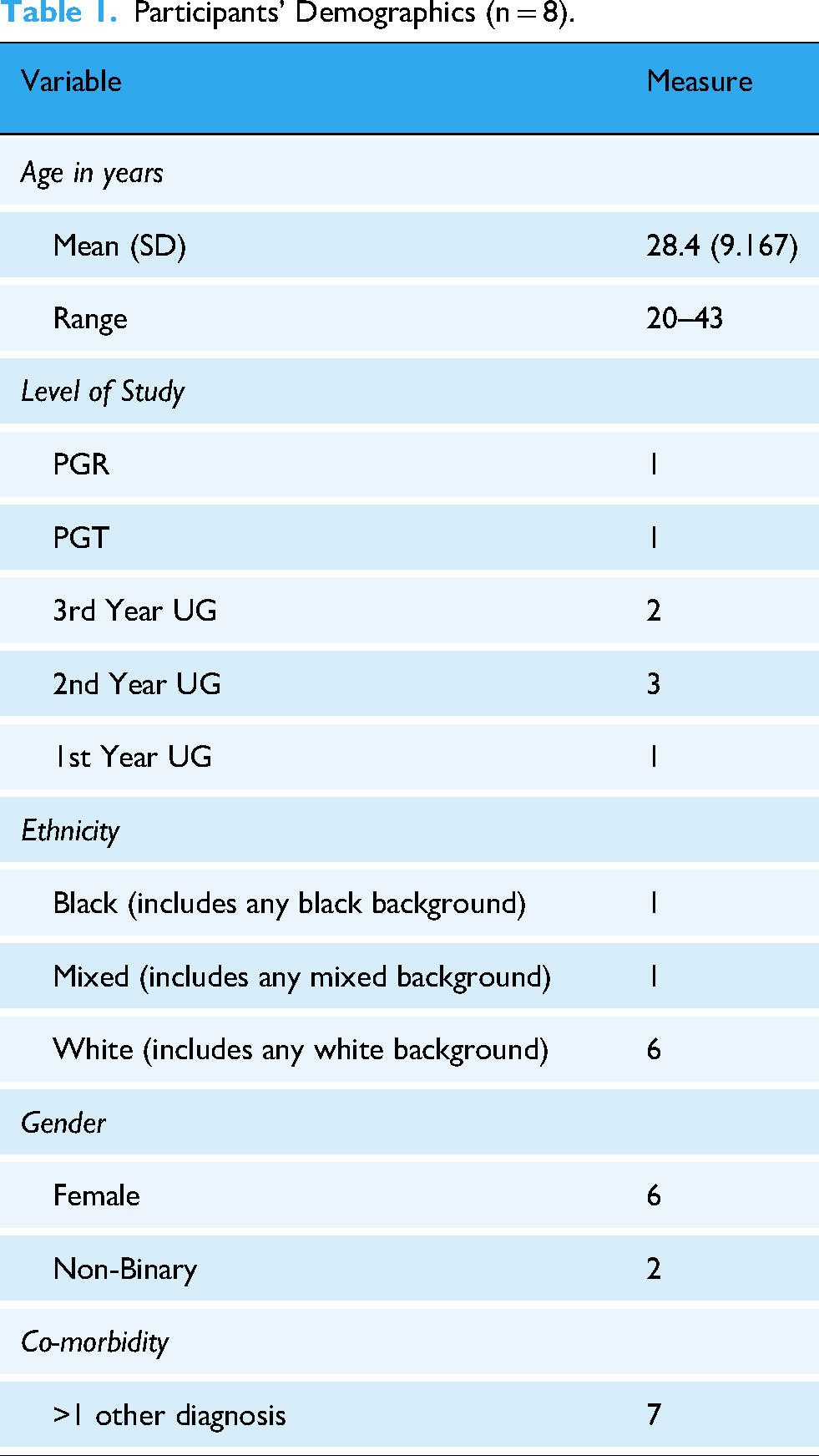
Eight participants voluntarily agreed to take part in the study. The sample size was purposeful to the research aims and available resources (Staller, 2021). The inclusion criteria were having a medical diagnosis of autism (seven participants) or identifying as autistic whilst awaiting diagnosis (one participant), being a currently enrolled student and a registered member of the APN at Kingston University. Participants were not excluded if they had any co-occurring diagnoses. These included ADHD, OCD, depression, and anxiety. Participants were recruited via advertising the study on the APN canvas page. For demographic information please see Table 1.
Participants’ Demographics (n = 8).
Materials
Semi-structured interviews were conducted consisting of 17 questions. This allowed flexibility in the interview schedule depending on the responses of participants. Senior researchers (KC and IM) developed the interview questions, all questions were reviewed and adapted by the rest of the research team including autistic student researchers. This was undertaken to ensure that all questions would be meaningful to the autistic community at Kingston University. The first part of the interview started with questions exploring general university support (e.g., “Can you describe your current university experience?”) for internal university purposes and are not analysed in this paper. The second part of the interview included questions specifically related to evaluating the APN, (e.g., “How would you describe your experience with the APN?”), exploring personal comfort and social communication (e.g., “Do you think this network made a difference to how you interacted with your peers?”) and understanding the impact of the APN (e.g., “Can you tell me if you have benefitted from the network? If so, how?/If not, why not?”). The full interview schedule can be found in the supplementary materials.
Design and Procedure
Using a qualitative design for the interviews allowed access to the autistic participants experiences and perspectives of the APN. This study received ethical approval from Kingston University's Research Ethics Committee. Participation was voluntary and data were anonymised. Written informed consent was given by participants. Participants received a £20 online shopping voucher after they completed the interview. Two autistic researchers conducted the interviews (six by PS and two by EM) via MS Teams (participants’ preference was for online rather than in person interviews). The interviews ranged from 12 to 43 min in duration and the mean duration were 26 min. Interviews were recorded and transcriptions were produced by MS Teams. These transcriptions were checked for accuracy and if necessary, amended by the researchers who conducted the original interviews by reviewing the audio recording. Both researchers were trained to conduct the interviews and subsequent steps by more senior members of the research team (KC, IM, HS). The autistic researchers together with the other members of the research team reflected on their positionality prior to and after the interview and analysis process. It was important that the researchers acknowledged their own experiences as neurodivergent within the context of the study. This included adopting a critical realist outlook for the study, which assumes that, while a reality exists independent of the observer; we cannot know that reality with certainty (Lyons & Coyle, 2007). The autistic student researchers had participated in the APN. Therefore, interviewees may have been aware that the interviewers were autistic although this was not explicitly mentioned in the interview. Interviewers reflected that this shared experience may have resulted in participants being more comfortable in discussing their experiences. Two senior members of the research team were involved in facilitating the APN (EB, HS).
Data Analysis
Interview data were analysed using Reflexive Thematic Analysis (RTA; Braun & Clarke, 2006, 2022; Clarke & Braun, 2017). RTA involves reflexive and iterative engagement with data that produces a robust analysis. It can be applied within a range of theoretical frameworks and primarily focuses on research related to participants’ experiences and perceptions. According to Braun and Clarke (2019), the focus of RTA is on meaning-making and active interpretation of data. The inductive approach to RTA provided a systematic method to develop clear links between the research aims and the dataset. This dataset was examined through the inductive lens, driven by the data in accordance with the different phases of RTA. The six phases of RTA are as follows: (1) familiarisation with the data and note-taking of initial analytic observations, (2) inductive coding of the data occurred, (3) initial theme development, (4) further theme development and revision of the viability of each theme, (5) naming and defining final themes and (6) reporting the analysis (Braun & Clarke, 2022). The audio recordings of the interviews were auto-transcribed by MS Teams and amended for accuracy by the two interviewers (PS and EM). Four researchers (EM, IM, HS and SP) divided the transcripts between them and analysed the transcripts independently. However, one senior researcher had an overview of all the data (IM). Regular meetings were held between the four researchers to discuss the data analysis and reach consensus when differences arose. Examples of codes developed during the coding process that focus on the assessment of the APN are: “Building resilience”, “Feeling less scared” and “Sharing similar experiences”. When an initial draft of the analysis was completed, it was sent to EB and KC for feedback, who then met with the researchers who initially worked on the analysis to discuss the themes and subthemes that had been developed. Regular meetings were held between EB and KC and the researchers to reach consensus across themes and subthemes and to finalise the analysis. The quotes that best represented the selected themes and subthemes were selected and agreed upon by the research team.
Results
The thematic analysis provided insights about the provision as well as the effectiveness of the peer network for autistic university students. Two main themes were generated from the dataset. ‘Sense of community’ was identified as the first theme with three subthemes, namely, ‘Sense of belonging’, ‘Sense of identification’ and ‘Sense of validation’. The second main theme was called ‘Safe space’ with three subthemes, which included, ‘Social space’, ‘Physical space’ and ‘Virtual space’ (see Figure 1).

Thematic map with themes and subthemes.
Theme 1: Sense of Community
In this theme, participants focused primarily on the development of a community within an academic setting fostered by the APN and the sense of belonging, identification, and validation they developed through engaging with other autistic students. These subthemes are discussed below.
Sense of Belonging
Autistic students emphasised the importance of cultivating a sense of belonging in academic settings alongside other autistic students. As shown in the quote below, participants argued that the APN reduced feelings of loneliness and isolation as well as creating an inclusive environment, as university can be a chaotic and overwhelming experience for autistic students. “So I think that it's great because it creates a sense of community and a sense of not being alone within an academic setting because university can be insanely.” (Participant 4)
There were distinct dialogues across participants about the social opportunities presented by the APN. Participants discussed their positive experiences of meeting other autistic students and participating in social activities with them. They also explained that this was one of the only university societies where they felt they belonged and related to other autistic people. “I don’t tend to join many of the societies, because I feel I don’t fit into a lot of them. But this is one of the ones I feel finally that I could fit in with and as I said, I feel I relate to it.” (Participant 6)
Several participants mentioned that the APN allowed them to reconnect with autistic students they met in other academic and social settings. In addition to liaising with people they had met in the past, they highlighted the importance of engaging with other autistic students. Participants reported that these connections were important to them, as they had the opportunity to meet people who could understand how they felt. “It helped me in the way that I connected with somebody I used to know… it was nice to reconnect and have somebody who understands how it is.” (Participant 1)
Sense of Identification
This subtheme refers to the sense of identification with other autistic students. They referred to the feelings of confidence and sense of identification they developed through their engagement with other autistic students in the APN. Students explained that the APN facilitated their connections with other autistic students enabling them to discuss their university experiences and find common ground with them. Participants noted that their involvement in the APN was “therapeutic”, it allowed them to express themselves and share experiences with others in a similar situation. “Just being with other autistic people, even if it's just for an hour and a half each month… and in being able to discuss things with them, like shared experiences of being at university, being able to relate to each other, it's really and sort of therapeutic.” (Participant 3)
Further exploration revealed that participating in the APN and engaging with other autistic students helped participants connect with students who had similar experiences. Participants explained that this process enabled them to realise that they were not different from their peers, fostering feelings of relief and satisfaction. “It's been really nice to have the opportunity to just talk with people and be like I’ve had this experience. None of my friends seem to have had this experience, “Have you had this experience?” and for people to go, “Yes, I’ve had this experience too.”. It's like Ohh wow!” (Participant 2)
Having a shared interest with other autistic students in the APN offered an opportunity to discuss challenges from a neurodivergent perspective. Participants explained that in most cases they felt that it is difficult for neurotypical people to understand the perspective of an autistic person. Furthermore, the APN afforded students to meet like-minded peers and they acknowledge the formation of friendships. “The friends I’ve made…Because often when you approach a neurotypical person and say, I have this struggle, they approach it in a neurotypical way, not in a neurodivergent way, so it's nice to have people who are neurodivergent to go, actually, this works well for me, so it might work well for you.” (Participant 2)
Participants explained that socialising with other students who have similar needs made them feel more understood and less afraid of sharing. As they argued, autistic people usually experience criticism and judgement, two concepts that were not present in the APN. “There's that group of people who know exactly what they’re going through as an autistic person and can empathise about like sensory struggles, without this judgment that someone with autism might usually face.” (Participant 7)
This shared perspective was expressed by other participants who reported their experiences of meeting other autistic students through the APN. In the following quote, the opportunity to converge with other like-minded autistic students is further discussed, thereby providing a sense of comfort. “The opportunity to just talk with other people who have gone through similar things I’ve gone through, but with a new perspective of, OK, well, we all went through these because of this, we have a shared thing in common that we’re all neurodivergent”. (Participant 2)
Sense of Validation
Participants explained that the APN helped eliminate stigma and raise awareness about autism. They emphasised that the APN made them feel safer within the university as they were able to connect with other students who were similar. “So, it's been really nice to have that kind of stigma/wall or barrier knocked down… I think it's made me feel a bit safer, I’ll stay at Kingston University specifically because I know there's people like me around.” (Participant 4) “It's definitely made me more comfortable in saying that I am just different, and that's okay.” (Participant 5)
All participants agreed that the APN should continue as it is one of the few university activities that promotes individual needs through the provision of personalised social support. Several students compared the APN to other social clubs that exist at the university, such as sports and religious clubs, and argued that its existence “validates” their own presence at the university. Considering the academic and social emotional challenges faced by autistic students in higher education, the development of such social networks may potentially increase awareness of autistic students’ individual needs and further promote their educational inclusion. “I think you need to have a louder voice. I think you need to tell people we exist. We do have an autistic student base and they are being… It's like a validation thing. We have so many things at Kingston for… I’ve seen students while very religious, who find a safe space to release in their specific religious group. Students who have you know, their, their little sports groups, this needs this definitely needs to continue.” (Participant 1)
Theme 2: Safe Space
The APN was perceived as a safe space designated specifically to autistic students at university. This theme explored how these participants experienced and perceived this social space as beneficial, and what it meant to be able to access a space specifically for autistic students. The space for autistic students was viewed as social, where students felt a sense of comfort along with an accessible physical space to use for APN meetings. In addition, student participants used an online social group (what's app) and the virtual learning environment (canvas pages) created for the APN acting as an alternative space to connect. Three subthemes were identified, ‘social space’, ‘physical space’, and ‘virtual space’.
Social space
Participants who regularly attended APN meetings found that they enjoyed spending time with other autistic students, experiencing comfort and safety. In this subtheme, the participants recounted that the meetings were relevant because they provided a space to get to know other students and, in some cases, improved their overall outlook on university life.
Recognising that the APN meetings presented a social space to be with similar peers, negotiating situations from a neurodiverse perspective was reassuring to student participants. There was a sense of having shared an experience that only each other, as neurodiverse students understand. This understanding meant that there was less of a need to mask within the APN context and more time to relax and communicate around other topics. “I feel like there's not that many spaces for us in the uni to kind of socialise with one another and you know, neurodivergents attract neurodivergents. We’re a lot more understanding of one another's issues and it's a lot less masking than having to keep up with the social requirements, isn’t it?” (Participant 8)
Creating a social space specifically for autistic students at university supported social interactions, as noted above by participant 8. There was no need to negotiate the parameters of what autistic students felt was expected, when attending the APN meetings. Giving students the space to unmask was echoed by participant 5 in the next quotation. “…it made you feel more comfortable talking with peers and have you felt like you haven’t had to sort of mask as much, that sort of thing.” (Participant 5)
Furthermore, developing social relationships with people in the APN, who were in a similar situation increased their confidence in approaching other people, not necessarily autistic, and discussing relevant topics. “It has helped me to have a bit more confidence in finding a similar topic to talk to with, you know, any new friends, not necessarily just a neurodivergent person”. (Participant 7)
Encountering a social space to communicate and connect with other autistic students meant they felt supported at university. As autistic students on campus, some participants expressed that the APN meetings were reassuring, they were not alone, there were other autistic students who aided in the representation of autism at university. The APN provided a comforting social space at the university for autistic students to engage with like-minded students because of their shared understanding and the freedom to unmask without constraint or social conforms.
Physical Space
Access to a physical space specifically created for autistic students at the university supported the participants in various ways. This subtheme identified how some of the participants involvement with the APN afforded a physical space to connect and meet other autistic students. It was expressed by some participants that autistic students required a space for autistic students, a space that was relevant to the students, and viewed as safe. There was a sense that the physical space represented a place where they were accepted by their peers, this was one of the most relevant concerns as an autistic student to support each other as neurodiverse students at university level. The APN rendered this opportunity. “I think having a space. So, for me that's like the biggest thing at the moment when it comes to helping autistic students”. (Participant 4) “…yeah it's been actually quite nice to be there and find other autistic people from, like, across campuses and across courses.” (Participant 7)
Being able to access a space for autistic students at university was beneficial to the participants for different reasons; social connections increased, from making new friends and having known peers attend the APN meetings for some participants. Having access to a physical space presented these students with options, to confidently interact with their peers and to use the space as they required. The APN was valued by these participants as a designated space for autistic students to access and seek comfort and friendships in a safe environment. Participants reiterated these notions of friendship developments because of the APN meetings. “I’ve benefitted from it by just…having the space to have old and new friends together for a while”. (Participant 7) “And you know, it is easier to form friendships with other autistic people. And yes, it is good to go out of our comfort zones too, I guess. But sometimes it's just nice to know that you’ve got that space”. (Participant 4)
Virtual Space
An alternative method to communicate for some participants was online. The APN created a canvas module and a WhatsApp group for autistic students to join. This online space was used for communication between the students about upcoming meetings and events. Students were encouraged to utilize the online space as an additional communication tool. Reflecting on their engagement of the WhatsApp group, some participants had different reasons for its use. This type of communication adequately assisted in providing a space to meet other students outside of the APN meetings. Whereas other participants were comforted and felt part of the network via the online group. It provided an alternative form of communication, peer connection and support to some participants. “I’d say only over text, mostly. I don’t really tend to meet up with people in person, but I’m comfortable texting people”. (Participant 3)
Access to the APN's canvas pages facilitated the use of readily available resources and was regarded as beneficial and could be viewed as psycho-educative in nature. “I have enjoyed the um, on canvas you can go on to the actual module page and there's quite a lot of resources on there. There's a number of books on the list that I found quite interesting and a number of authors and different types of people on there that I basically connected with to learn a little bit more”. (Participant 8)
Discussion
The aim of the current study was to assess, for the first time, the perceived value of an autism peer support network in a higher education (HE) setting, and to investigate the types of benefits that being part of such a network would bring. An additional novel aspect of this study was using a participatory approach. Paid autistic researchers interviewed students about their experiences and feelings specifically relating to being part of the APN. This research advances prior findings by identifying themes and subthemes that demonstrate several distinct benefits whilst aligning with Milton's (2012) double empathy theory and providing new evidence in relation to reducing the need for masking (see Pearson & Rose, 2021).
The Importance of a Sense of Community
Students were very clear that the peer support network enabled them to connect with and form a supportive and inclusive community of students who understood the challenges of the university environment and shared experiences. Through this, it was reported that a sense of belonging both within the APN and the wider university was developed. Part of this “community” was the fact that being part of the APN allowed students to identify positively as autistic. The data also supported the related concept that this group membership served as a validation of their differences but also their presence as members of the wider university community. The APN additionally presented students with a distinct space for their voice to be heard and validated – a significant aspect of enhancing the student experience.
This relates to past research where the link between social connectedness, social support and wellbeing was emphasised (e.g., Bailey et al., 2020; Crompton et al., 2023). Indeed, the importance of a sense of community and belonging concurs with findings from Finke and Dunn (2023) who report neuro-matched interactions are more rewarding than non neuro-matched (both for neurodivergent and neurotypical groups) and support the view that we need to promote belonging and prioritise opportunities for autistic individuals to form communities, interact and share experiences. Therefore, aligning with the values and findings of our peer support network. However, it should be acknowledged that the sense of community found in the APN likely reflects a self-selected group of autistic students who resonate with its focus, while others may find connection through university groups representing different aspects of their identities. Recognising intersectionality (Mallipeddi & VanDaalen, 2022) is important to understand that autistic students’ may be influenced by multiple, intersecting identity dimensions beyond neurodivergence.
The Importance of a Safe Space
It was important to students that they had a space that was just for them. The generated themes from the data found that a physical space to meet was particularly enabling. Students reported feeling safe, enjoying the opportunities to meet like-minded individuals, form friendships, discuss challenges and the sense of comfort afforded by being with other students who understood neurodivergence. It was reported that this had a positive effect on wellbeing and how they felt about being at university. However, the theme of a safe space went beyond just the physical space which afforded students with the opportunities described above, it also encompassed the online tools for connecting with each other (the use of the dedicated space on the virtual learning environment and online messaging groups).
The need for a safe social space is critical, allowing interactions within neuro-matched groups where friendships can form. Prior research supports the significance of safe spaces and highlights the social challenges and importance of friendship development in university settings (Goddard and Cook, 2022). The APN and the physical and virtual spaces it provides, is a potential tool in navigating these barriers. It was notable that participants mentioned that they felt more confident in their social interactions with neurotypical people and this aspect has improved since joining the network. Therefore, benefits can be seen beyond the peer network which is a novel finding in the context of higher education (see Crompton et al., 2024 for findings in relation to secondary school peer support).
Strengths, Limitations & Future Research
Whilst there are some peer support groups for autistic students in the HE sector, a key strength of the current work is evaluating, for the first time, the personal experiences of such a network from a participatory approach. Ascertaining whether membership of the APN has benefits to a group of students who have been shown to be more at risk of mental health difficulties and difficulties with progression and completion rates has significant implications for other universities and the types of support offered. Another strength is the relative diversity of the participants (variation in age, subjects studied and level of study) in the APN as well as in this study.
However, a limitation is that the group of students who agreed to participate in the study may have been a selective subgroup who were already more engaged in university life, having the confidence to sign up to and attend the APN meetings. Additionally, we recognise that whilst females are typically under diagnosed and underrepresented in autism research our participant group were mainly female. This might reflect a limitation with respect to the generalisability of our sample. Nonetheless, the demographic characteristics of our participants were reflective of the broader APN membership. The proportion of registered members of the APN that took part in the study was 23%. However, representation could have been improved if some males and Asian students had volunteered to take part in the study. We also appreciate the relatively small sample size, although this is not dissimilar to other qualitative studies in this area. Nevertheless, incorporating other methods such as synchronous text chat could have improved the sample size and allowed further analyses of demographic factors such as level of study.
Whilst difficulties in accessing the APN were explored in the interviews, these were not reported in the findings (as this was not frequently mentioned by participants). Some challenges/recommendations were shared by students in relation to practical considerations for the face-to-face meetings. These related to awareness of the network, food preferences, the physical space, and the activities that took place in these meetings. Exploring the challenges of peer networks in more depth would be insightful.
Whilst, given these limitations, one might want to exercise caution in generalising the results from this study, the study offers significant scope for further research. Moving forward it would be interesting to replicate this network in other institutions with a larger sample or using a longitudinal design and looking across other measures of success such as academic achievement, satisfaction with university experience, and potential impact on progression or drop-out rates.
Implications
The implications of the APN include that this peer led supportive group has important social benefits for university students. Critically, this work suggests that such provision should be accessible to students with a physical and virtual social space. There are implications for universities in planning and designing both physical and online spaces for forming communities, promoting acceptance and reducing stigma, as well as validation and friendship formation. There are also many beneficiaries of the research, firstly autistic students with respect to improving their wellbeing and social interactions as well as enabling the autistic student voice. Secondly, universities may potentially benefit from supporting students in relation to educational inclusion. Thirdly, parents and families may feel more reassured that their autistic children will be supported at a social level whilst in higher education. Moreover, these findings may facilitate networks to be created for other neurodivergent students, and schools/colleges could also benefit from developing similar networks.
Conclusion
Overall, this study provided novel qualitative insights from participants’ personal experiences with the APN. This peer support group was perceived as valuable by bringing together students in a supportive and safe environment, fostering friendships, developing a community and the space to socially interact. It is important to consider that inclusivity in education extends beyond academic support or adaptions to the curriculum and assessment. University can also play a role in helping students form social connections to develop as individuals. Peer support social networks offer an innovative space for fostering these connections and could have a positive impact on autistic students’ wellbeing and overall experience.
Supplemental Material
sj-docx-1-ndy-10.1177_27546330251329558 - Supplemental material for The Benefits of an Autism Peer Network in Higher Education
Supplemental material, sj-docx-1-ndy-10.1177_27546330251329558 for The Benefits of an Autism Peer Network in Higher Education by Elisa Back, Ellie Main, Phoebe Schur, Ifigeneia Manitsa, Katharine Clifford, Fiona Barlow-Brown, Swane Parchment and Hayley Spurin in Neurodiversity
Footnotes
Acknowledgements
We would like to thank members of the Autism Peer Network at Kingston University who participated in this study. Thanks also to Prof. Danielle Ropar and Dr Lauren Marsh (University of Nottingham) for initial discussions when developing the APN.
ORCID iDs

Funding
The author(s) disclosed receipt of the following financial support for the research, authorship, and/or publication of this article: This work was supported by the Santander Universities UK, (grant number N/A).
Conflicting Interests
The author(s) declared no potential conflicts of interest with respect to the research, authorship, and/or publication of this article.
Supplemental Material
Supplemental material for this article is available online.
References
Supplementary Material
Please find the following supplemental material available below.
For Open Access articles published under a Creative Commons License, all supplemental material carries the same license as the article it is associated with.
For non-Open Access articles published, all supplemental material carries a non-exclusive license, and permission requests for re-use of supplemental material or any part of supplemental material shall be sent directly to the copyright owner as specified in the copyright notice associated with the article.
