



Abstract
Inclusive education has recently increased focused on support for students with neurodivergent conditions including autism or dyslexia. A number of practice guidelines have been published. As neurodivergent students are more likely to drop out of higher education, it is tenable that environments, structures and processes may not address needs. This rapid review assessed robustness of evidence regarding adjustments and support in higher education and to identify priorities for future research and practice. Through a systematic process, we elicited studies summarised in 11 existing reviews. We found the evidence to be United States-centric and sample sizes small. We synthesised evidence for (a) examination adjustments, (b) explicit instruction, (c) strategy instruction, (d) technology-based interventions, (e) psychological supports, (f) mentoring and coaching, (g) comprehensive support programmes, (h) transition into university, and (i) transition into employment. Most studies focused on distinct conditions such as autism rather than taking a comprehensive approach. The evidence is overall modest and more focused on skills and learning, rather than educational outcomes (e.g. increasing successful completion) or life outcomes such as successful transition into work which we identify as a priority for future research alongside institutional neuroinclusion and curriculum design.
Lay Abstract
Efforts to make university education more inclusive have recently increased their focus on support for students with neurodivergent conditions including Autism or Dyslexia. Several practice guidelines have been published. Data tells us that neurodivergent (ND) students are more likely to drop out of higher education. We focused our definition on commonly researched conditions such as autism and dyslexia rather than a wider focus which also comprises mental health and transient conditions and recognise the limitations of doing so. We think that university environments, structures and processes might not be right to meet the needs of such students. This rapid review (a systematic way of locating and assessing literature in a specific timeframe) assessed what published literature tells us regarding adjustments and support in higher education for ND students. Through a systematic process we looked at studies summarised in nine existing reviews to consider the quality of evidence and priorities for research and practice. We found the evidence to be US-centric and sample sizes small. We synthesized evidence for (a) examination adjustments such as extra time, (b) whether clarity of instruction makes a difference, (c) focus on learning strategies, (d) technology-based interventions, (e) psychological supports, (f) mentoring and coaching, (g) comprehensive support programmes for example bringing groups of students together over a long time (h) transition into university and (i) transition into employment. Most studies focused on specific conditions such as Autism rather than taking a comprehensive approach. The evidence is overall modest and more focused on skills and learning, rather than educational outcomes (e.g. getting a good degree) and life outcomes such as successful transition into work. We suggest that future research needs to concentrate more on neuroinclusion at the level of the entire education institution, on curriculum design and on transition into work and actively involve learners when doing so.
Inclusive education, defined as an approach in which all students can participate and have equal value, is now as much a matter of concern in higher education (HE) as it has been in primary and secondary education settings (Moriña, 2017). Diversity is considered broadly to comprise differences on grounds of racial identity, socio-economic background as well as disability, commonly defined as prolonged impairments in daily functioning. Many countries have introduced legislation to ensure people are not discriminated against because of any protected characteristics. The Equality Act 2010 in the United Kingdom (Government Equalities Office & Equality and Human Rights Commission, 2013) and the Americans with Disabilities Act of 1990 in the United States (U.S. Department of Labor) are examples of such legislation which cover the educational domain as well as other domains. One key mechanism for equalising educational experiences with non-disabled peers are reasonable adjustments (UK terminology; which we will use in the following) or accommodations (US terminology). Disability is a broad concept which can be permanent or transient and according to the World Health Organization results from interaction between a health condition and the environment and personal factors (WHO, n.d.). A disability can be any physical or psychological condition that makes it more difficult for the person to engage in activities (limitation) and interact with their environment (participation; CDC, n.d.). Disabling conditions can be physical or psychological. For the purpose of this review we focus on neurodivergent (ND) or neurominority conditions (see Doyle, 2020, for a full overview) which are normally included in relevant legislation (Clouder et al., 2020). These include (a) applied neurodevelopmental minorities such as dyslexia and dyspraxia and learning difficulties (LD; typically referring to general developmental delays); (b) clinical and neurodevelopmental neurominorities such as autism and attention deficit hyperactivity disorder (ADHD); and (c) mental ill health as an acquired ND condition (Doyle, 2020). We excluded the fourth category of acquired neurodiversity through neurological illness or brain injury given vast ranges in functioning and proportionally lower population prevalence. We use the term ND for students who have been diagnosed or identify with a relevant condition. The broader term of neurodiversity includes ND conditions and refers to the naturally occurring variation in human cognition and neural functioning (Walker, 2021).
Historically, there has been some focus on dyslexia in HE given its purported impact on writing and spelling (see e.g. Riddick, 2001) and traditional emphasis on assessing students through written see and unseen examinations as well as coursework. More recent awareness has shifted to a holistic and pan-condition neurodiversity-affirming approach, such as a recent online publication by the British Psychological Society (Farrant et al., 2022) which argues that HE has historically been privileged with multiple barriers to access for ND students. The effects of such barriers are documented in historical access statistics. For example, postsecondary education participation for autistic students is far lower than the general population, with very few being awarded a degree (Shattuck et al. 2012).
To address access and participation issues, Farrant et al. (2022) argued for inclusive practices which facilitates inclusion for students and staff alike. They put forward 15 recommendations for practice. These included a review of curriculum design and assessments strategies, revision of language used to ensure that it is inclusive and a sympathetic approach to requests for information, training of all staff and appropriately designed physical environments. Numerous universities now offer more holistic resources to support neurodivergence, including guidance and toolkits. 1
Such supply addresses genuine demand. Recent years have seen a marked increase in the number of recorded ND students in HE (Dobson Waters & Torgerson, 2021; Kuder & Accardo, 2018; Zeng et al., 2018). Up to 2% of HE students are estimated to meet the criteria for autism spectrum disorder (ASD) diagnosis (Anderson et al., 2019; Davis et al., 2021; Widman & Lopez-Reyna, 2020). By different estimates, between 2% and 8% of HE students have ADHD (Ahmann et al., 2018; Emmers et al., 2017). A survey of over 2000 people who were about to start university in the United Kingdom in the academic year 2022/2023 showed that 14.2% of respondents considered themselves to be autistic and/or have ADHD, of which 8.4% reported having ADHD and 6.6% being autistic (Shaw & Selman, 2023). For dyslexia, it is estimated that the prevalence in the population of HE students is about 5% (Clouder et al., 2020; Dobson Waters & Torgerson, 2021). Yet, actual figures are difficult to establish because not all students declare their disabled status and not all are diagnosed (Ahmann et al., 2018; Zeng et al., 2018).
ND students are more likely to drop out of HE than their peers, which can have a negative effect on their long-term quality of life (Anderson et al., 2019; Davis et al., 2021; Dobson Waters & Torgerson, 2021; Emmers et al., 2017). However, it is tenable that it is the educational environment (e.g. programme structure, curriculum and assessment design, as well as actual support offered), and not ND students’ actual academic abilities that result in poorer postsecondary educational outcomes when there is a mismatch to individual needs (Anderson et al., 2019; Davis et al., 2021; Emmers et al., 2017). This perspective aligns with the social model of disability (Riddick, 2001) which purports that it is the environment, context, stigma and prejudice that are disabling rather than innate deficits. Examples might include long lectures with insufficient rest breaks to support concentration, overreliance on written work for assessments and a lack of knowledge on the part of staff who might misinterpret fidgeting or lack of eye contact as insufficient engagement with learning content. The misinterpretation of ND behaviours has been documented in other life domains, for example, in public/police interactions (Salerno-Ferraro & Schuller, 2000).
Despite the growing number of ND students in HE and increased awareness, universities are often unprepared to meet individual needs (Kuder & Accardo, 2018), do not necessarily base decisions for support provision on sound evidence or insufficiently tailor adjustments. For example, time extensions for assessments are common practice, yet such adjustments may not address and support underlying cognitive differences such as difficulty with memory, self-organisation and concentration which are implicated in many ND conditions (Doyle, 2020). Setting up habitual regular time adjustments could potentially be detrimental for life outcomes in the long term, as they might set unrealistic expectations and prevent the development of transferable skills. For example in the United Kingdom, legislation stipulates that adjustments have to be reasonable and practicable. This might mean in practice that a time extension for an employment selection test is appropriate, but continuous extensions for work which has to be delivered to critical deadlines is not (Doyle, 2022). Currently, the question of what works for ND students in HE remains open, with little robust research existing to investigate the efficacy of supports provided by universities. This requires urgent attention across ND conditions and across a range of potential adjustments and activities to ensure that current and future practice is grounded in evidence. Thus, we consider this review foundational as a stock-taking exercise to outline what is known and evidenced, what the gaps are and where research and practice could go next regarding adjustments for ND students.
Research aims and questions
It was our aim to identify ‘what works’ as well as gaps in knowledge regarding the effectiveness of adjustments for ND students across different conditions. This is because co-occurrence with other ND conditions and mental health conditions is highly common (e.g. Curnow et al., 2023), and initiatives focused on distinct conditions at a time may be limited in scope and unlikely to meet actual need. Thus, the following research questions informed the literature search and synthesis:
What evidence exists for the effectiveness of adjustments and supports provided to ND students in HE, regarding pedagogy and teaching strategies, assessment of learning, any extracurricular support as well as a holistic programme and design level? How robust is the overall corpus of evidence regarding specific adjustments and supports; where is it strong and what are any gaps in knowledge? What is known about the impact of adjustments on academic performance, and what is the evidence for impact on any other outcomes?
Method
We undertook a rapid review, which is a method of reviewing literature adapted from a full systematic review. The approach includes a comprehensive search, appraisal and synthesis of the literature, as well as a transparent accounting of the process, but a rapid review can be produced more quickly due to concessions to the breadth or depth of the review (Varker et al., 2015). This pragmatic approach was necessitated by resource limitations regarding staff and time allocation.
Given the broad scope of our research questions, which aimed to capture the experiences of university students across ND conditions, we undertook a ‘review of reviews’ (Smith, et al., 2011), or ‘meta-review’ as they are commonly called in the management/business literature (see, e.g. Cullen & Turnbull, 2005), in order to capture the breadth of relevant literature in the time available.
Identification of relevant literature
We performed a systematic literature search in the following databases: Education Resources Information Center (ERIC), PsycInfo, ProQuest, Scopus, and Cochrane Library. We applied a combination of terms to search titles and abstracts, with necessary changes to meet the requirements of the different databases.
Neurodiversity terms included ‘Neurodiversity OR Neurodiverse OR Neurodivergent OR Neurodivergence OR Autism OR Autistic OR Asperger OR Aspergers OR Asperger's OR ASD OR ASC OR Attention deficit hyperactivity disorder OR ADHD OR Attention Deficit Disorder OR Tourette OR Tourettes OR Tourette's OR Dyslexia OR Developmental co-ordination disorder OR DCD OR Dyspraxia OR learning disability OR learning difficulty OR learning difference’. Following a pilot search, we omitted dysgraphia and dyscalculia because of a lack of relevant research in the HE context and decided not to include mental health conditions as doing so generated too many irrelevant search results. Accommodation terms included ‘adjustment* OR accommodation* OR support’ and student terms included ‘student OR undergraduate OR postgraduate OR university OR college OR higher education OR post-secondary’. The searches were limited to reviews and meta-analyses. The search strategies are reported in our online supplemental materials (Appendix 1).
We conducted the searches in December 2021 and January 2022 to retrieve systematic reviews and meta-analyses published in the English language since 2010 when the Equality Act 2010 was introduced in the United Kingdom (Government Equalities Office & Equality and Human Rights Commission, 2013). This act stipulates the necessity for reasonable adjustments once a person has declared a recognised disability in education and other contexts. Given time constraints and our focus on adjustments based on evidence rather than established practice, we excluded unpublished grey literature and omitted a hand search of relevant journals and reference lists of selected literature.
Eligibility criteria and review selection
We selected publications meeting the following criteria: (a) published reviews employing systematic search methods or meta-analyses pertaining to ND students in HE; (b) reported on primary studies evaluating supports available to ND students and (c) published in English; and (d) excluding books and unpublished dissertations. All retrieved records underwent a two-stage selection process. First, we screened all titles and abstracts. If they met the eligibility criteria, or if a decision could not be made based on the title and abstract only, we progressed to full-text review. Both authors undertook title and abstract screening independently and any disagreements were resolved through discussion in the light of the inclusion criteria. The full-text screening was conducted primarily by Meg Kiseleva due to the time limitations of a rapid review, involving Almuth McDowall as necessary (for example, when eligibility for inclusion was not easily determined).
Data extraction and synthesis
We logged the data extracted from the included reviews into a pre-agreed extraction template, recording the number of primary studies and their samples and methodologies, countries where the primary studies were conducted, types of the described interventions, comparison groups and outcomes. We summarised the reviews narratively by type of intervention. Given some overlap in primary studies included in the reviews, we cross-checked results between reviews and primary studies that reported them to mitigate double-counting evidence. A summary of the primary studies and reviews reporting them, including the type of intervention, design, sample and outcomes, is available in online supplemental materials (Appendix 2, Tables S1–S9).
Critical appraisal
We conducted critical appraisal using the JBI Checklist For Systematic Reviews and Research Syntheses (Aromataris et al., 2015). The checklist consists of 11 questions covering different aspects of conducting a systematic review, which can be answered as ‘yes’, ‘no’, ‘unclear’ or ‘not applicable’. The checklist is available for reference in Appendix 3 and a sample question is, ‘Is the review question clearly and explicitly stated?’ (Q1 in Table 1).
Critical appraisal.
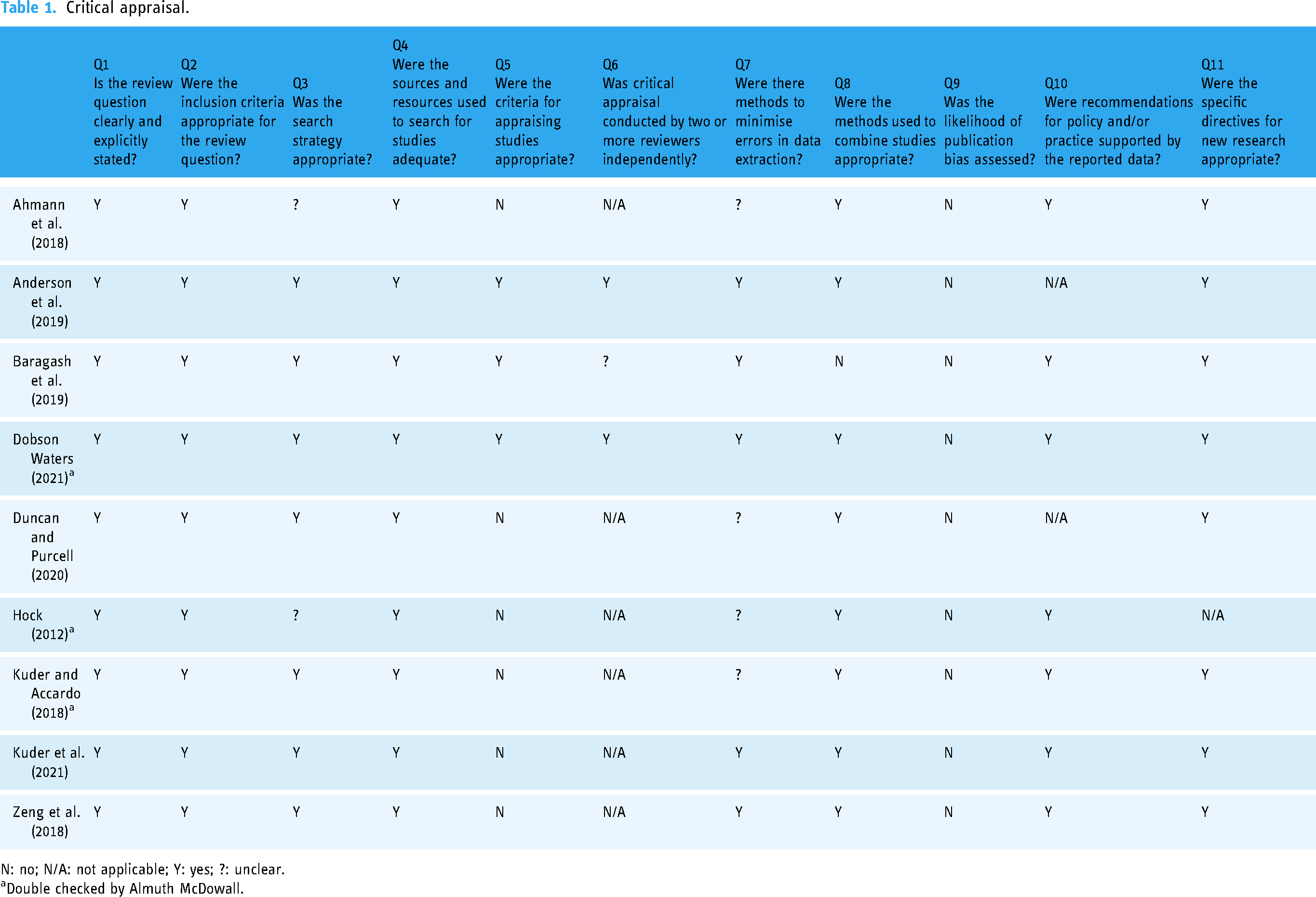
N: no; N/A: not applicable; Y: yes; ?: unclear.
Double checked by Almuth McDowall.
The critical appraisal was conducted by Meg Kiseleva, with Almuth McDowall undertaking a check of three reviews (33%). All included reviews were clear in their aim and used appropriate eligibility criteria for the research question and searched adequate literature sources. Most reviews (n = 7) provided sufficient detail on their search strategies, which were deemed appropriate. Two reviews did not report sufficient information to make judgement on the appropriateness of the search strategies. Most reviews (n = 6) did not conduct a formal critical appraisal of included studies. All but one review used appropriate methods to synthesise the included studies. None of the reviews assessed the likelihood of publication bias, however, some took steps to reduce it (e.g. placing no restriction on the publication sources). The results of the critical appraisal are provided in Table 1.
Results
Description of included reviews
Database searches identified 656 records with 27 duplicates. After title and abstract review, 68 records were selected for full text screening, but two full texts were unavailable. That left 66 records, of which nine were eligible for inclusion in this review. The screening process is displayed in the Preferred Reporting Items for Systematic reviews and Meta-Analyses (PRISMA) flow diagram (Page et al., 2021) in Figure 1, created using the online PRISMA flow diagram tool (Haddaway et al., 2022).

PRISMA flow diagram.
A summary of the nine reviews included is shown in Table 2. Five reviews reported on students with LDs, including dyslexia, four on autistic students and two on students with ADHD. A review could include more than one type of ND. Due to the changes to the Diagnostic and Statistical Manual of Mental Disorders (American Psychiatric Association, DSM-5 Task Force, 2013), a diagnosis of autism reported in the reviewed studies may include ASD, Asperger's syndrome, high functioning autism, or pervasive developmental disorder-not otherwise specified. For consistency, we use the terms autism and autistic.
Description of included reviews.
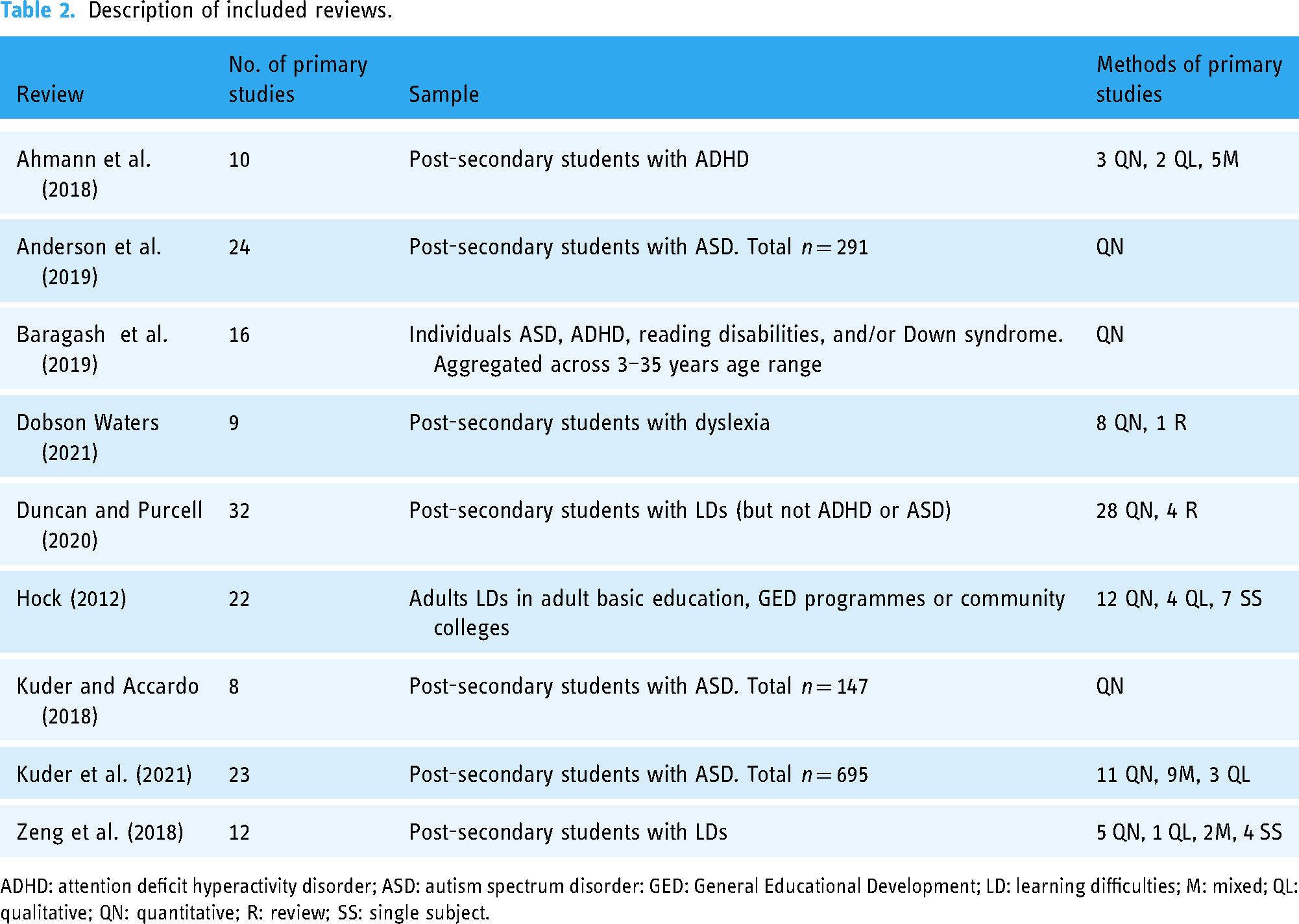
ADHD: attention deficit hyperactivity disorder; ASD: autism spectrum disorder: GED: General Educational Development; LD: learning difficulties; M: mixed; QL: qualitative; QN: quantitative; R: review; SS: single subject.
Most primary studies included in the reviews came from the United States. Overall, the obtained data was western-centric, with a strong focus on English-speaking countries. Only one of the identified reviews was published before 2018 (Hock, 2012), indicating a recent rise in interest in this area of research. Participants were from a range of study subjects; most interventions centred on generic skills such as memory techniques, improving numeracy and literacy, or generic rather than tailored support programmes. Sample sizes were varied, with many clustered at the lower end given the purported designs, ranging from a single case study to 969 (Harrison et al., 2012). Operational definitions for ND conditions were heterogenous, rendering it difficult to render any condition specific insights.
Evidence for the effectiveness of different type of support/adjustments
We grouped the findings in this section by type of adjustment. A detailed overview of all primary studies reported in the reviews are included in this synthesis and are available in online supplemental materials; these include design, sample and the main outcomes (Appendix 2, Tables S1–S9). Experimental studies were rare across all types of interventions and small convenience samples dominated the field, thus limiting the generalisability of the findings. In this synthesis and in the online supplemental materials, we have largely retained language and terminology used by the original authors; however, we note that community preference may be different (e.g. for more neutral language).
Examination adjustments
Granting additional time on examinations is a common adjustment offered to ND students. A review investigating the effectiveness of giving students with LDs extended exam time (Duncan & Purcell, 2020) found that primary studies followed three main paradigms: the maximum potential thesis (MPT), the differential boost hypothesis (DBH) and overinflation of scores (OS). The MPT assumes that granting additional time only benefits students with LDs because typically developing (TD) students can achieve their maximum potential under standard examination conditions. The DBH suggests that extra time benefits all students, but students with LDs show greater gains compared to TD peers. Finally, the OS hypothesis assumes that extra time benefits all students, resulting in overinflated marks. The review established that: (a) the studies that used a moderate standard time allocation meaning that most, but not all, TD students to complete the exam resulted in a differential boost, with students with LDs showing greater gains than peers without LDs; (b) the studies in which the standard time allocation allowed the vast majority of students to complete the exam, only students with LDs had increased scores; (c) the studies that allocated longer standard time than the vast majority of students needed found no improvement for either group (Duncan & Purcell, 2020).
The authors further referenced results of previous systematic reviews which did not elicit clear consensus about the effectiveness of granting students with LDs extra time on exams, potentially because study designs that were difficult to compare may have contributed to inconsistent results. However, they concluded that TD students usually perform better on timed tests than students with LDs, particularly under standard exam conditions. Given the lack of evidence that granting extra time puts students with LDs on a more equal footing with their TD peers, this raises the more fundamental question of whether timed examination is an equitable way to assess students’ knowledge. The authors further concluded that i the effectiveness of any time extension, given also the above caveats, may be contingent on how appropriate (proportional) this is to the initial assessment.
Another review (Dobson Waters & Torgerson, 2021) reported that, while dyslexic students performed significantly worse in an examination than the non-dyslexic control group, there was no significant difference between the two groups in performance on coursework (Osborne, 2006). This suggests that removing the time pressure associated with examinations and allowing dyslexic students to complete assignments in their own time may result in equalising performance of dyslexic and nondyslexic students.
One question which the reviews included did not fully address was the question of how much time is sufficient. A study reanalysing existing data on extra time (ET) comparing pupils with LD and without found considerable variation in time length from 50% to unlimited yet found that both groups of student would stand to benefit from time extensions, thus raising questions of fairness and validity (Cahan et al., 2016).
Explicit instruction
Explicit instruction is often used with adults and adolescents with LDs. It is a practice where instructors provide a clear explanation of the process involved in completing a task, model target behaviours for the students, provide guided practice, followed by independent practice, give feedback and evaluate students’ performance as a result of the instruction (Hock, 2012). Two reviews reported on studies evaluating explicit instruction interventions (Dobson Waters & Torgerson, 2021; Hock, 2012).
Overall, explicit instruction for improving reading outcomes appears promising. Students who were taught how to proofread to improve spelling only performed better in a condition in which they used a word processor with spell-checker, which means that the gains in spelling performance might have been due to the software and not to the instruction (McNaughton et al., 1997).
A classroom intervention in which the lecturer paused at suitable moments to let the students complete their notes resulted in better short-term, but not long-term recall of the contents (Ruhl et al., 1990). Moreover, participants in the pause-only group scored higher on short-term recall than participants who were also given a lecture outline, suggesting that the lecture outline might have distracted them from the note-taking instead of facilitating it (Ruhl & Suritsky, 1995).
A multi-sensory phonic intervention improved reading achievement and was significantly more effective than a non-phonetic technique or no intervention (Guyer et al., 1993; Guyer & Sabatino, 1989). Students struggling with Maths who received explicit instruction improved their Maths word-solving abilities, although not to the level of a normative sample of Maths-competent students (Zawaiza & Gerber, 1993). It was suggested that intensive, engaging one-to-one and small-group instruction was particularly helpful (Hock, 2012).
Strategy instruction
Strategy instruction helps students to develop and use techniques for more efficient learning. Such interventions were reported in three reviews (Anderson et al., 2019; Hock, 2012; Zeng et al., 2018) documenting promising outcomes, such as improvement and maintenance of grade point average (GPA) (Allsopp et al., 2005), improved writing abilities and metacognitive knowledge about writing tasks (Butler, 1995; Butler et al., 2000), ability to identify and recall information (Cooper et al., 2011), reading comprehension (Gaddy et al., 2008), understanding of course content and study preparation skills (Lock & Layton, 2008) and reduced test anxiety (Holzer et al., 2009).
Other studies elicited comparatively less promising findings. A think-aloud strategy did not help struggling readers improve their reading performance, attributed to the lack of skills necessary to successfully follow the strategy and to the discomfort of reading aloud in front of other people (Berne, 2004).
Mixed results were observed regarding teaching writing strategies: while one small-scale study with autistic participants resulted in improved quality of writing (Jackson et al., 2018), a slightly larger one with students with LDs did not find a significant difference in writing quality or writing self-efficacy between intervention and control groups (Nicholas et al., 2005).
Technology-based interventions
Technology-based interventions were covered in six reviews (Anderson et al., 2019; Dobson Waters & Torgerson, 2021; Hock, 2012; Kuder & Accardo, 2018; Kuder et al., 2021; Zeng et al., 2018), which, however, used varying definitions and contexts making any firm conclusions difficult to draw.
An early study of students with LDs’ use of the internet found that they enjoyed working on the internet, but sometimes did not have the skills to find the information they needed (Johnson & Hegarty, 2003). While this is an early reference and internet use has firmly taken hold since, there is a wider point about technology and infrastructure availability not equalling automatic mastery and skill.
In a qualitative study on the use of text-to-speech and speech recognition software for improving literacy, students reported being more engaged in learning, more organised and better able to engage in independent study (Silver-Pacuilla, 2006). Speech recognition software was also found to help students in using longer words and matching their vocabulary with writing tasks, although effects on writing performance were unclear (Stodden & Roberts, 2005). In another small-scale study of a text-to-speech programme, for some students, the number of correct answers to text comprehension questions increased (Floyd & Judge, 2012).
Using a direct instruction videodisc programme to learn algebra, students in the intervention group performed significantly better than the control group on measures of lesson content and had significantly higher grades in the college algebra course and on two measures of algebra skills and knowledge (Kitz & Thorpe, 1995). In a study testing the effectiveness of animated and non-animated lecture slides, both dyslexic and non-dyslexic groups thought there was no difference between animated and static slides in assisting the understanding of concepts and their application in practice (Taylor et al., 2007).
A number of reviewed studies examined using assistive technology to help students with their social skills. They were small in size, non-experimental and included such interventions as video modelling social skills for eye contact, facial expression, conversation turn-taking and shared emotions (Mason et al., 2012) and eye contact, conversational pause and initiating conversation (Pierce, 2013), as well as video feedback to enhance empathetic communication (Kern Koegel et al., 2016). Some, but not all, participants showed improvement on the target measures, with some studies suggesting such improvement was maintained.
Another technological intervention study examined the effects of biofeedback on heart rate variability to monitor stress and anxiety and showed that both autistic students and TD students showed small improvement in heart rate variability, with the ASD group having larger and more consistent gains; no assessment of anxiety was reported (McCoy et al., 2014).
Finally, a randomised controlled trial compared a psychosocial training programme to a computerised programme (brain–computer interface for ASD) for improving navigation of social situations, executive functioning, and dealing with stress (White et al., 2016). Participants reported both treatment programmes to be feasible, acceptable and enjoyable. Behavioural outcomes were insignificant and differed across participants and interventions. No change was detected in adaption to college, academic adjustment, attachment, personal–emotional adjustment or social adjustment.
Additionally, Baragash et al. (2019) conducted a meta-analysis of single-case studies using augmented reality (AR) technology in special education. They found significant improvement from baseline to intervention across four domains: learning, social, physical and living skills. The biggest improvement was observed in learning skills and the least improvement in living skills. The authors suggested that AR environments could provide immediate and relevant information to their users in the form of videos, 3D images, and animation, thus potentially facilitating understanding and learning and increasing motivation. However, it is important to note that the meta-analysis used single-case studies without a control group and did not provide a breakdown of results by age (range 3–35 years).
A review into the experiences of autistic students in post-secondary education found that less than a third of interventions used technology, despite the majority of participants reporting that they found technological interventions helpful and enjoyable (Anderson et al., 2019).
Psychological supports
Psychological supports were reported in three reviews (Anderson et al., 2019; Kuder & Accardo, 2018; Kuder et al., 2021). A study into the effectiveness of an (in-house) support group model to enhance psychological and behavioural outcomes for autistic students, using a pre- and post-design, found significant increases in self-esteem and reduction in loneliness and generalised anxiety, but no change in social anxiety, academic distress or depression (Hillier et al., 2018). The same study found qualitative support for potentially transferrable skills and function enhancement including better goal setting and improved coping skills.
Individual and group cognitive behavioural therapy combined with recreational activities showed significant improvements in psychological measures which were depression, state (situational) anxiety and self-esteem in Autistic students, but no change in trait (stable characteristic) anxiety scores (Furuhashi, 2017).
The other studies had more mixed results, with varied and fluctuating scores on social and academic feelings and behaviours between participants (Holgate, 2012) and some, but not other, participants showing improvements in problem-solving abilities and subjective distress (Pugliese & White, 2014).
Mentoring/coaching
Mentoring and coaching have received particular attention in relation to supporting autistic students and students with ADHD. While both are person-centred interventions, there are differences in conceptualisation. Mentoring commonly encompasses conveying knowledge and support from someone with more experience and a degree of direction. In the HE context, the mentor is often someone removed from the immediate study context. Mentoring often addresses goal-setting and, in the studies identified in this review of reviews, is frequently conducted by peers (Kuder et al., 2021). Such programmes were reported in four reviews (Ahmann et al., 2018; Anderson et al., 2019; Kuder et al., 2021; Kuder & Accardo, 2018).
Coaching involves specialist support for well-being, performance and potentially also life skills with a less knowledge-focused approach and skilful facilitation. Coaching also commonly supports students to set goals, break them into manageable tasks, identify strategies to complete the tasks and track their progress towards achieving their goals (Ahmann et al., 2018). Out of the 21 primary studies evaluating coaching and mentoring interventions identified by this review of reviews, 13 included participants with ADHD, nine with ASD and five with LDs. ADHD coaching studies overall showed mixed findings, with increases on some measures of executive functioning but not others (Field et al., 2013; Parker et al., 2011; Reaser, 2008; Swartz et al., 2005; Zwart & Kallemeyn, 2001).
Additionally, some studies reported reduction in distress and improvement in self-esteem and learning strategies (Prevatt & Yelland, 2015), as well as improvements in GPA (Parker et al., 2011) for students with ADHD. Small-scale peer-mentoring interventions aimed at helping autistic students with social skills noted some increase in attendance at community-based social events and informal social activities (Ashbaugh et al., 2017). There was also some increased attendance at structured social events, which was interpreted to potentially generalise to other non-structured social interactions (Kern Koegel et al., 2013).
In a pre- and post-comparative design peer mentoring study, autistic participants improved social and communication skills (Siew et al., 2017). Some small studies with Autistic students reported increases in GPA (Ashbaugh et al., 2017; Kern Koegel et al., 2013; Ness, 2013). However, just like the other measures, it is impossible to draw causal conclusions in the absence of experimental design.
Many studies relied on self-reports and the students generally reported a positive experience with mentoring and coaching. In one peer mentoring study with autistic students, participants reported higher satisfaction with individual meetings than group meetings (Ames et al., 2016). Autistic students indicated that provision of constant, stable, flexible and individualised support was helpful (Siew et al., 2017).
This group of studies featured coaching delivered by different types of mentoring/coaching support including peer-to-peer mentoring (e.g. Ashbaugh et al., 2017), coaching from more advanced students (e.g. Reaser, 2008) and formally trained coaches. We could not determine whether any of the individuals involved had specific ND-focused coaching training.
Comprehensive support programmes
Comprehensive support programmes, where students receive multiple types of interventions simultaneously, are purported to promote academic success amongst students with LDs (Zeng et al., 2018), as reported in three reviews (Anderson et al., 2019; Kuder & Accardo, 2018; Zeng et al., 2018).
In one such programme, students had zero dropout rate and a lower failure rate than the national average; however, there was no control group so it is impossible to establish whether these two variables had been affected by the intervention (Harrison et al., 2012). Nevertheless, most participants reported that the programme contributed to their academic success and helped them better understand their LD, explain them to others and advocate for themselves.
Other interventions were reported to improve self-efficacy and academic resourcefulness (Reed et al., 2009) as well as self-efficacy and future orientation (Pearlman-Avnion, 2016). Higher usage of learning support was associated with higher GPA and higher graduation rates in a correlational study (Troiano et al., 2010).
One descriptive study examined a combination of exam adjustments including support from student counsellors, deferring exams and taking them in a smaller groups. Students reported this combination to be effective for reducing stress and managing difficulties with planning and organisation. Additionally, extended time for other tasks was perceived to be effective in managing executive functioning difficulties (Jansen et al., 2017).
Transition to university
Transition services help students integrate into university after leaving high school and often focus on such aspects as early acclimation to campus, identifying and addressing everyday living needs, and supporting students during their first year in university, for example, with organisational and academic skills (Anderson et al., 2019; Kuder & Accardo, 2018). Effective transition support helped students to develop clear goals and successfully adapt to the HE environment. In contrast, a lack of formal transition planning often left students feeling unprepared to enter HE (Nuske et al., 2019).
Transition interventions were reported in two reviews (Anderson et al., 2019; Kuder & Accardo, 2018). The primary studies were non-experimental and used pre-post, post-only and multiple-baseline designs. Many studies reported mixed results, with some reduction in social anxiety, but not in worries about studying, leaving home and self-care (Lambe, 2015). There was also some increase in self-determination, but not amongst all participants (Kelly, 2008). Some studies reported slightly higher retention rates (Rando et al., 2016; Shmulsky et al., 2015) and GPA (Shmulsky et al., 2015) for the students in the transition programmes compared to all first-year students.
Transition to employment
One review reported on an employment support intervention (Kuder et al., 2021). In a pilot study, university disability, career and counselling centres collaborated to provide support with future employment to Autistic students through group and individual sessions to help them with career preparation goals (Meeks et al., 2015). Only anecdotal and descriptive data was provided. Students reported reduction in anxiety about interviews. A quarter of the students obtained internships.
Discussion
We summarised evidence from nine existing reviews into the effectiveness of supports for ND students in HE published since 2010. Regarding our first research question about adjustments in pedagogy, teaching strategies and assessment versus more holistic approaches, we summarised evidence focused on instruction practices and remedial adjustments such as granting extra time and proximal outcomes regarding learning and academic attainment, with far less evidence on any impact on well-being or transferable skills such as employability. There was no evidence of holistic programme-level design approaches.
Regarding the second research question about quality of evidence, we found no strong evidence as the empirical corpus is weak, external validity low and sampling US-centric. We further noted considerable variation in operational definitions for example of LD, or how relevant conditions had been identified which makes it difficult to meaningfully infer what works for whom. Many of the primary studies included in the identified reviews had non-experimental designs, small sample sizes and no control groups, making causal conclusions difficult to draw. Where experimental and quasi-experimental designs were employed, sample sizes were generally small. We also did not identify high quality qualitative or mixed methods primary papers which offered novel theory-building insights. It was notable that primary studies focused on distinct conditions rather than a wider neuroinclusive approach. For example, the research on coaching and mentoring, while somewhat promising, was limited to autistic and ADHD samples. Because research designs and sampling varies, it is difficult to draw conclusions about which accommodations are appropriate for distinct conditions; which the aforementioned likelihood of co-occurrence is however unlikely to be a particularly fruitful strand of enquiry- or an inclusive approach for educational practice. While some specific supports, such as granting extra time at examinations, are better researched than others, our overarching conclusion is that more high-quality research is required for HE institutions to be able to introduce evidence-based practice.
Directions for theory and conceptual development – some missing pieces in the puzzle
It is clear from our synthesis that the majority of accommodations and supports were aimed either at specific academic skills or at general support for learning, rather than pre-emptive and inclusive at the systems-level design. Universal design for learning (UDL) offers a potential framework, which is premised on considering all potential students’ needs at the point of design (Capp, 2017). While there is evidence for associated improvements in learning process and experience, impact on long term positive outcomes remains unclear (Capp, 2017). Rather than an overly tailored approach to individual learning needs, which may not only be overly individualised but also too complex to deliver, we suggest that a baseline understanding of ND differences is essential for the design and delivery of education and psychosocial support, given high prevalence rates in the general population. Better knowledge of ND differences, regarding strengths as well as challenges, should be a starting point for UDL efforts to ensure that education is designed holistically, and attends to likely intersectional influences. Intersectionality is increasingly recognised within ND conditions such as autism (Botha & Gillespie-Lynch, 2022) as a lens to better understand complexities for example in identity development and the experience of discrimination. The reciprocal relationship between intersectionality and neurodiversity has been proposed as a nadir for theoretical and practice development to promote social justice (Strand, 2017), which in our context equates levelling access and success opportunities for all HE students regardless of their neurotype or other marginalised identities.
While we found little strong evidence for the effectiveness of psychological interventions which may be individually focused or encompass emphasis on fostering psychosocial support in the educational environment, we believe that this is a fruitful area for future enquiry; and, where appropriate, should take a tailored approach to individual need and symptomatology. For example, it has been suggested that disproportionate emphasis is being placed on medication to help adults with ADHD cope with their symptoms and that psychological interventions may be an effective alternative. Specifically, Sedgwick (2018) argued that since cognitive behavioral therapy (CBT) has been shown to be effective with adults with ADHD, it may be helpful for university students for addressing maladaptive and self-critical thinking. Scholarship on neurodiversity-specific coaching is advancing in the realm of work, and we contend that portable principles gleaned from this domain, such as the need for clear, unambiguous and readily understood communication, is a vital starting point (Doyle & McDowall, 2023). Although we found overall little evidence for specific support for transition in and out of university, we think that these might be essential for long-term educational and life outcomes. ND people habitually struggle with transitions.
Finally, we recognise that we laid out a broad array of evidence rather than going into depth for any of the accommodations listed above, in particular regarding conceptual and theoretical framing. Future reviews, and primary studies, may wish to focus to unpack explanatory theories and mechanisms. For example, we were surprised not to see more reference to concepts such as stigma and discrimination in the reviews and primary studies. One reason for this may be that research has largely focused on structural accommodations, for example regarding assessments, rather than tackling beliefs and attitudes in the wider HE ecosystem. This appears a fruitful area for future research as for example a recent qualitative study on dyslexia (Hamilton Clark, 2024) outlines how dyslexic students habitually disguise their condition and even reject study support for fear of stigma, which in turn lowers self-esteem and has a negative impact on academic outcomes. Thus, there is an urgent need to address stigma and prejudice at the systems level so that students are not fearful of asking for support. Equally, support systems are often complex to navigate and access as for example disabled student support in the United Kingdom can require a lengthy and ambiguous application process, which in itself can be a barrier for individuals already struggling with memory and concentration issues.
Limitations, conclusions and directions for future research
This rapid review of reviews has a number of limitations. First, due to the constraints inherent to rapid reviews, only published, peer-reviewed literature located through database searches was included, which means we might have missed relevant grey literature and any additional evidence that might have been identified through hand searches of relevant journals and reference lists.
We limited ourselves to English language reviews, which resulted in a highly western-centric literature base, with a heavy emphasis on primary studies conducted in the United States. While we excluded reviews published before 2010 because of changes in UK equality legislation at the time, we observed a spike in reviews in the last few years, with only one of the nine included reviews published before 2018.
Further we recognise that broader and more comprehensive search terms, also including less researched conditions such as dysgraphia, and mental health conditions may have broadened the pool of reviews we drew from. Indeed, a fruitful avenue for future research may be to explicitly concentrate on conditions which are far less researched in an HE context such as tic conditions or dyscalculia.
The evidence documents a need for more high-quality evaluation studies in this area, including larger and more diverse samples, experimental and quasi-experimental designs, longitudinal studies and also well-designed qualitative and mixed methods studies to elicit a richer evidence base for ND student experience. It was notable by absence that none of the reviews (and from what we could glean also not the primary studies) implemented transparent participatory design elements to ensure that research involved the intended beneficiaries. Right now, comparatively stronger evidence is weighted towards remedial adjustments such as extra time; yet evidence from school contexts points to potentially unfair advantages if such adjustments are dispensed to certain groups only (Cahan et al. 2016). Future research should target holistic pedagogy design and evaluation, based, for example, on UDL which Capp (2017) documents in a meta-analytic study. This found evidence for improvements in learning, but not in academic outcomes. A more differentiated consideration of outcomes, which comprise learning, attainment, but also transferable skills and well-being is much needed to scaffold neuroinclusion. While much has been written about the strengths which ND minds can bring, it is a reality that many relevant conditions co-occur with distinct health challenges, such as mental health conditions (e.g. Bayeh, 2022). In this regard, comprehensive support programmes as well coaching and mentoring appear promising but would also have to be evaluated in terms of their utility, including cost-benefits. It is tenable that personalised support programmes that take into consideration individual students’ strengths and difficulties and tailored support may be more effective for holistic outcomes including academic success and successful life transitions than generic adjustments. Clearly specialist knowledge is needed to implement these, as for example in the study on group supports to autistic students (Hillier et al., 2018) which was delivered as a collaboration between psychology and faculty in-house. Future studies might wish to investigate how students could initially be supported and scaffolded in group sessions which focus on an array of relevant strategies but also foster in-group support, and then transfer of learning supported through mentoring for example from graduated ND alumni.
While transition into university has received some attention in the literature, currently there is a dearth of research into supporting ND university students in transitioning to employment – although we recognise that additional search terms in our protocol, such as ‘transition’, may have elicited additional results. It is an important area that requires more attention, particularly in the wake of the COVID-19 pandemic. One UK study (Donald et al., 2022) put forward a case to draw from careers literature and, in particular, career construction theory to frame relevant research and practical initiatives. More theory-grounded research would help to further our understanding of neuroinclusion, and inclusion in education more broadly, to elicit understanding not only of what adjustments work (or don’t), but also why they work (or don’t).
Last but not least it was noticeable by absence that none of the reviews or primary studies made explicit reference to co-creation and user involvement – what do students think of any interventions and do they meet actual versus perceived need? Calls for ‘nothing about us without us’ have become prominent in ND communities. Discipline-specific research speaks to this and makes the call for appropriate communication, involving ND students in the actual planning of any adjustments and managing transparent expectations (Kingsbury et al., 2020). We contend that such calls should be heeded in the co-production of any interventions as well as research evaluating such efforts.
Conclusion
We conclude that there is much to be done to proactively design neuroinclusive curricula which are supportive by design, to involve those with lived experience in their co-creation and to disseminate best practice. It is a gap in current understanding how any efforts not only impact immediate learning processes, but impact academic success and positive outcomes in well-being as successful transitions and life success beyond HE. We signpost neuroinclusive learning design, ND-informed psychosocial support and focus on transition into employment as key foci for practice and future enquiry.
Supplemental Material
sj-docx-1-ndy-10.1177_27546330241291769 - Supplemental material for A rapid review of supports for neurodivergent students in higher education. Implications for research and practice
Supplemental material, sj-docx-1-ndy-10.1177_27546330241291769 for A rapid review of supports for neurodivergent students in higher education. Implications for research and practice by Almuth McDowall and Meg Kiseleva in Neurodiversity
Footnotes
Acknowledgements
This work was funded by a grant from the (UK) Association of Heads of Psychology Departments.
Declaration of conflicting interests
The authors declared no potential conflicts of interest with respect to the research, authorship and/or publication of this article.
Funding
The authors disclosed receipt of the following financial support for the research, authorship and/or publication of this article: This work was supported by the Association of Heads of Psychology Departments.

Supplemental material
Supplemental material for this article is available online.
Notes
References
Supplementary Material
Please find the following supplemental material available below.
For Open Access articles published under a Creative Commons License, all supplemental material carries the same license as the article it is associated with.
For non-Open Access articles published, all supplemental material carries a non-exclusive license, and permission requests for re-use of supplemental material or any part of supplemental material shall be sent directly to the copyright owner as specified in the copyright notice associated with the article.
