




Abstract
Background
There is a growing number of autistic students in U.K. higher education institutions (HEIs), who may require autism-specific support to optimise their academic achievement, long-term prospects, and well-being. This study undertook the first known review of publicly available autism-related policies at U.K. HEIs.
Methods
Public websites of 132 HEIs were searched for eleven key terms, and the results of these searches were assessed using a policy appraisal approach. Qualitative framework analysis then explored the content of the policies identified.
Results
Three hundred thirty-six policies were identified from 92 HEIs, with 40 HEIs having no policies meeting search terms. The most common policy results were ‘autism support’ and ‘disability adjustments’. The qualitative analysis showed a wide range of policies which covered most areas of higher education life but with significant inconsistency in content and quality.
Conclusions
While many U.K. HEIs appear to be aware of autistic students and the need to support them, most institutions have minimal publicly available policies regarding support for autistic students. The policies to support students which do exist are patchy at best, and non-existent in some cases, requiring more work at individual institutions and across the HEI sector.
Lay abstract
Background
Autistic students in the United Kingdom may require specific support from higher education institutions (such as universities) to help them thrive in higher education (HE). This study looked at publicly available information about autism-related support policies at U.K. universities, to find out what kind of support is available.
Methods
We searched the websites of 132 universities to find policies related to autism, and evaluated those policies. We also summarised the content of policies.
Results
Most universities had some autism-related support policies, however some had no policies that we could find. There was a wide range of policies available for most areas of life in HE, but many were of poor quality or contained limited information.
Conclusions
Universities in the United Kingdom are aware of the need to support their autistic students, however the policies available to support students may be limited. Universities should work with autistic students and their families to develop more appropriate support, and to make information about this support publicly available.
From the earliest days of autism research, it was assumed that the majority of autistic people (language used in line with community preferences, see Kenny et al., 2016) had co-occurring learning difficulties, and therefore that they were highly unlikely to enter higher education (HE). This was an artefact, for a long time, of diagnostic criteria and societal attitudes which conflated autism and learning disability. Since the work of Wing and Gould in the 1980s (Wing, 1981), our understanding of the autism spectrum has expanded to include those who do not have co-occurring learning difficulties, thereby recognising that autistic people may go to university.
Indeed, there is evidence to suggest that of the current student population in U.K. Higher Education Institutions (HEIs), around 2.4% – roughly 60,000 – have declared themselves as autistic (Gurbuz et al., 2019). This is likely to be an underestimation, as some autistic students do not declare their diagnosis to their HEI due to fear of stigma (Stronach et al., 2019). These students make up a notable minority at HEIs, and a growing one. Recent National Health Service (NHS) statistics show that while 3.98% of current 18–24-year-olds (the age group most likely to be in HE) in England are autistic, 8.5% of 0–17-year-olds are autistic – meaning that there are roughly twice as many autistic young people potentially attending university in coming years (NHS England, 2022). This means that it is important for HEIs to have coherent and accessible policies and systems for supporting autistic students, to enable them to thrive and succeed in HE while maintaining good mental health and quality of life.
The transition to university is both a testing and exciting time for any student, whether they are autistic or not. It involves a significant increase in independence, from daily living responsibilities to navigating a timetable with classes potentially spread across multiple sites, and potentially changing from week to week, and each aspect of this poses its own psychological challenge (Briggs et al., 2012; Clark, 2005). These experiences, and the difficulties of a sudden shift to living independently, are often more intense for autistic young people, for whom the transition to adulthood can be particularly difficult (Cheak-Zamora et al., 2015; Lambe et al., 2019a). Early work on autistic adulthood presented a worrying picture – low levels of independent living, employment, or social connectedness (Howlin et al., 2013). More recent work, with samples of autistic people who did not have co-occurring learning difficulties, has still shown significant difficulties in moving out of formal schooling and into adulthood for many autistic people. This is despite the fact that autistic young people often hold the same hopes and expectations for their adult lives as their non-autistic peers (Anderson et al., 2015). Many autistic young people, and their parents, find it difficult to know what the post-secondary options and possibilities are, or what support there is available to achieve these. It can be a time characterised by stress and uncertainty, especially when support options are unclear, unreliable, or ineffective (Curtiss et al., 2020; First et al., 2016). This can leave autistic young adults adrift, resulting in high levels of social, community, educational, and employment disengagement (Hedley et al., 2018; Myers et al., 2015; Roux et al., 2013; Wei et al., 2015).
When it comes to the transition to university, there is significantly less literature exploring autistic students’ experiences or what factors can help them to make the transition as successful as possible. Significantly, suitable transition planning has been shown to be one of the strongest predictors of attending university for autistic young people, including taking part in events such as campus visits and meeting university staff members (Chiang et al., 2012; Retherford & Schreiber, 2015; Shmulsky et al., 2015). One key paper which has investigated ways to improve the transition to university comes from Lei et al. (2020), who evaluated an in-person transition programme for autistic young people. This focused on introducing them to many aspects of the university, such as trial lectures, discussing and practising interactions with staff such as tutors, stress management workshops, and information about clubs and societies, as well as experiencing potentially challenging situations such as meals in large campus cafeterias. They found that students who took part in this programme had both quantitative and qualitative improvements in their concerns and anxiety about starting university. They were also more optimistic about university in general than they had been prior to taking part. This shows the positive impact of even a relatively short-term transition programme for autistic students prior to starting university, as it meant that they were familiar with the environment and expectations of HE, potentially meaning that they were more able to engage and therefore succeed – although this study has not yet published any follow-up data on the cohort. Calls for better, often personalised and contextualised, university support (including transition support) are common across the literature looking at autistic experiences in HE (Dymond et al., 2017; Thompson et al., 2019).
However, evidence from autistic students to date does not support that this kind of pre-arrival preparation and planning is happening, with concomitant impacts on students’ experiences around starting university, especially in the realm of anxiety. Autistic students have been shown to have consistently worse mental health than their non-autistic counterparts (Jackson et al., 2018), with high levels of anxiety and depression in particular which do not fluctuate with the demands of the academic year (Scott et al., 2023). This is strikingly different from patterns seen among non-autistic university students, who tend to have spikes in mental health challenges around exams or assessment deadlines, for example, and in their final year when these assessments carry the most weight (Barker et al., 2018). While the specific issues which cause autistic students’ anxiety may change across the year, the fact that there is no period of their academic career where they are less anxious or depressed means that they are likely to require greater mental health and well-being support than their non-autistic peers. Where this can be problematic, though, is that such support systems are inherently designed for working with the non-autistic majority of students, and therefore may not work as well for those on the autism spectrum. This is an issue which has been seen with therapeutic and counselling approaches generally, with common interventions such as Cognitive Behavioural Therapy being less effective for autistic people (Weston et al., 2016), and has led to recommendations to adapt these approaches for autistic needs (Spain et al., 2015; Walters et al., 2016) Adaptations to these kinds of support offers for autistic students are also important to ensure their effectiveness, but there is no evidence that this is being done.
Autistic students are also more likely to leave HE without completing their studies, despite finding the academic side of university manageable (Cage et al., 2020). A range of factors have been shown to contribute to autistic students feeling the need to leave their courses prior to graduation. In addition to the independent living challenges and poor mental health discussed previously, research has identified several other areas where autistic students can face additional difficulty in university. Social challenges have been key among these (Gurbuz et al., 2019), with students experiencing high levels of anxiety around interacting with others and making friends, having smaller social networks than non-autistic students (meaning they have fewer people to call on for support in times of need), and finding social activities like group work in class more difficult (Goddard & Cook, 2021; Lei, Ashwin et al., 2020).
Autistic students also often encounter stigma in their time at university, both from other students and from staff. While HEIs are generally spaces where the population has been found to have high autism knowledge and low autism stigma (Stronach et al., 2019), this does not mean that autistic students consistently have positive interactions at university. Better knowledge does not always translate to more positive attitudes towards autistic people in university (White et al., 2019). Indeed, different diagnostic labels, particularly when associated with disruptive rather than passive behaviours (such as meltdowns rather than shutdowns for autistic students), tend to be more heavily stigmatised (Gillespie-Lynch et al., 2019). This can especially be the case for HEI staff, which can lead to students being denied reasonable adjustments, or being provided with insufficient or ineffective support (Scott & Sedgewick, 2021). Due to this stigma, and the fear of being perceived as ‘less than’ non-autistic students in some way, many autistic students do not disclose to their HEI, staff members, or even peers (Bailey et al., 2020). This is in line with work on autism and stigma more generally, where most autistic people are shown to be acutely aware of being perceived negatively by those around them and by society in general, and therefore adopt a range of coping and camouflaging behaviours to try to avoid this (Han et al., 2022). Camouflaging itself, however, is associated with poor mental health and well-being outcomes (Cassidy et al., 2020; Hull et al., 2021), and therefore autistic students who camouflage more heavily may experience even greater challenges than those who are open about their identity.
Considering the overview of autistic student experiences presented here, the overall picture is generally of a potentially uniquely vulnerable group in HEIs, which is growing, and which is not currently being well supported. This is despite the potential for autistic students to achieve highly and benefit significantly from university, both in their personal development and their long-term economic prospects – just as non-autistic students do. What is not known, at the moment, is what work HEIs in the United Kingdom are doing to support this group of students, at either the individual or the national level.
The current study therefore sought to expand the existing knowledge base regarding autistic people's experiences in HE by conducting a scoping review of publicly available autism-related policies and interests from U.K. HEIs. Specifically, it sought to address three research questions:
How many U.K. universities currently have publicly accessible policies relating to autistic students? What are the most and least common policy categories relating to autistic students at U.K. universities? What is the content of U.K. university policies relating to autistic students?
Methods
We conducted a thorough review of all policies relating to support offered to autistic students at U.K. HEIs. HEIs were identified using the Times Educational Supplement Good University Guide, which lists 132 HEIs in the United Kingdom.
Only support policies accessible on publicly accessible websites were included in the review, due to (1) limited time and resources and (2) a focus on the information available to prospective autistic students and their families.
Search strategy
Pilot study
To identify the optimal search terms, a pilot study was conducted using a sample of the top 10 Australian university websites. These were selected as autism research and public understanding is at a similar level in Australia as in the United Kingdom, and so we assumed that similar policies would be available at HEIs in both countries. Conducting a pilot study allowed us to develop search terms without using data from U.K. HEIs which might bias the terms.
The websites of these 10 universities were searched for any policies relevant to supporting autistic students. Seven search terms were identified as being used to link to or describe university support policies on these websites, thus providing context for where support policies might be found on other HEI websites:
Autism Policy Autism Support Autism Society Autism Adjustments Autism Career Autism Diagnosis Autism Preparation Autism Inclusion Disability Adjustments Neurodiversity Society
Following review by the research team, an additional three search terms were added to minimise the likelihood of missing any policies:
Main study
The search was performed between March 2022 and January 2023. The 10 search terms described above were used to search each HEI's website for policies. All search results were evaluated to determine whether they were relevant to autistic students specifically (yes/no). If a result contained any of the following terms, it was deemed as being relevant to autistic students: Neurodiversity; Neurodiverse; Neurodivergent; Autism; ASD; Autism Spectrum Disorder; Autistic; Asperger's. All policies were reviewed by one researcher, with queries discussed and resolved by the entire research team. Note that although autistic students may benefit from support policies targeted to disabled students and other groups more generally, for the purpose of this study we focused on policies which were specifically addressed towards or mentioned autistic students.
Results which described official statements or documents from the HEI regarding support available were classified as ‘policies’. Results meeting the search terms which described other autism-relevant information, such as research outputs, news, and blogs, were classified as ‘interest’ in the topic of autism generally, and used to measure the extent to which each HEI had an interest in autism beyond directly supporting or referring to its autistic students. Our reason for including these results was that they reflected awareness and/or interest in autism support at the HEI, but not formalised policies which could be evaluated using the appraisal methods described below.
Policy appraisal
All identified policies were evaluated following a Disability and Inclusion Based Policy Analysis approach (DIBPA; Institute for Research and Development on Inclusion and Society (IRIS), 2012). This approach evaluates policies with a specific focus on their impact on disabled people. Appraisal questions were adapted from the DIBPA ‘Guiding Questions for Disability and Inclusion Based Policy and Program Analysis’ (IRIS, 2012, pp. 15–19). A total of 14 appraisal questions relevant to autism support policies in HEIs in the United Kingdom were developed (see Table 1) and the research team agreed on criteria to answer each question based on the guidance available from DIBPA (see Supplemental Table 1).
Number of HEIs meeting criteria.
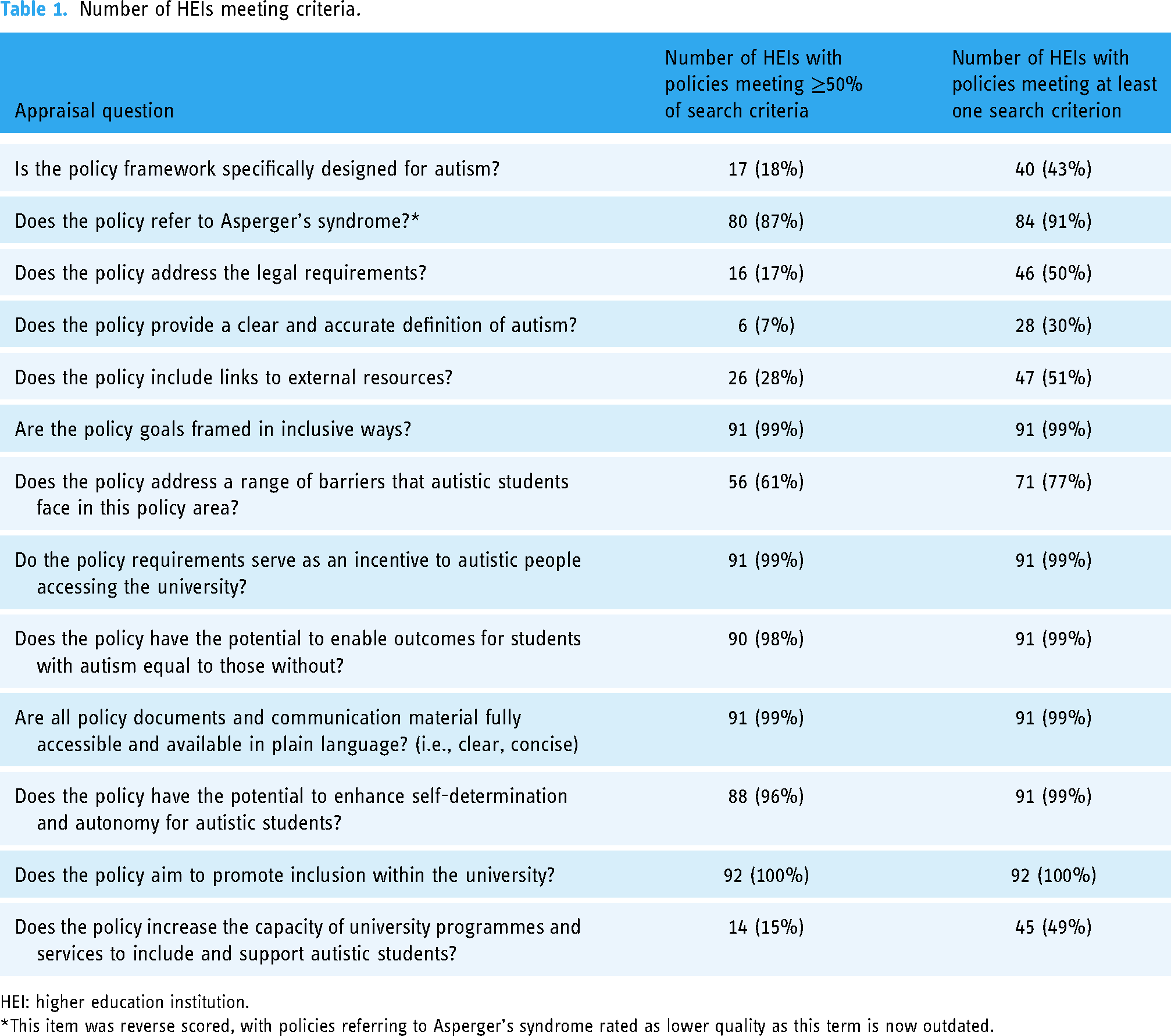
HEI: higher education institution.
*This item was reverse scored, with policies referring to Asperger's syndrome rated as lower quality as this term is now outdated.
Analyses
We used a sequential mixed methods approach to answer our research questions. For Questions 1 and 2, we summarised the number of HEIs who had available policies regarding support meeting each of the 10 search terms. For Question 3, framework analysis was used to provide a qualitative summary of the content of each policy at each university. A framework was developed based on the pilot study, with each policy within the main study reviewed against the framework twice by one researcher. Additional themes and subthemes were identified and added to the framework during the main study analysis.
Due to the large number of HEIs included, and the high likelihood of identifiability within the qualitative data, we present data at an overall level without identifying any specific HEI. However, the complete dataset including policies from each HEI is available from the corresponding author upon request.
Results
Policy appraisal
Table 1 presents the number of HEIs with policies meeting at least 50% of the 10 search criteria (i.e., HEIs with policies covering over half of the key contexts in which support might be offered), and those with policies meeting at least 1 criterion. Percentages are in reference to the total number of HEIs with at least one relevant policy (n = 92).
The appraisal suggested that the quality of HEI policies was very mixed, both between and within institutions. The vast majority of HEIs had policies which aimed to promote inclusion, were accessible, and had the potential to enable equal outcomes for autistic and non-autistic students. Most policies also used up-to-date language to refer to autism, and addressed a range of barriers faced by autistic students. However, in most HEIs the majority of policies were rated as not addressing the legal requirements (such as acknowledging the HEI's responsibility to provide adjustments for disabled students under the U.K. Equality Act of 2010), not providing a clear and accurate definition of autism, not being specifically designed for autism, and not increasing the capacity of university services to support autistic students. Many HEIs had several relevant policies of varying quality, suggesting variation within HEIs in terms of policy standards.
Quantitative results
Policies
A total of 336 policies from 92 HEIs were identified, meaning 40 HEIs had no policies meeting any of the search terms. Forty HEIs had policies meeting 1–3 of the search terms. Thirty-eight HEIs had policies meeting 4–7 of the search terms. Eleven HEIs had policies meeting 8–10 of the search terms, with only one HEI meeting all 10 search terms.
Table 2 shows the percentage of HEIs with policies relevant to each of the search terms. The most common types of policy across HEIs were policies relating to ‘autism support’ (52% of universities) and ‘disability adjustments’ where autism was specifically mentioned (48% of universities).
Percentage of HEIs with relevant policies.

HEI: higher education institution.
Interests
21 HEIs reported some kind of ‘interest’ meeting all 11 search terms (information related to research outputs, news, or blogs but not policies). Seventy-six HEIs had interests meeting 8–10 search terms. Thirty-three HEIs had interests meeting 4–7 search terms, while 16 HEIs had interests meeting 1–3 search terms. Four HEIs had no interests meeting any of the search terms.
Table 3 shows the percentage of HEIs with interest relevant to each of the search terms. Eighty-five percent of HEIs had some kind of interest in autism support, while 84% had an interest in autism diagnosis.
Percentage of HEIs with relevant interests.

One hundred fifteen HEIs had interests relevant to one or more search terms, but did not have policies relevant to the same search terms.
Qualitative results
Table 4 presents the five themes and subthemes identified in a framework analysis of the content of identified policies, alongside examples of each subtheme.
Table of themes and subthemes.

*Financial support from the U.K. government to cover study-related costs due to disability or long-term illness.
These results show that there is a greater variety and detail in what policies said about ‘Types of practical reasonable adjustment’ and ‘Employment’ than there were for other areas of potential need covered by our search terms. The majority of policies under all themes focus on what the student can request from the university in terms of support, particularly around direct support such as assessment arrangements or career advice. There was significantly less variety and detail in policies regarding social support or general inclusion, as shown by there only being two subthemes of ‘Society/Social Group’ and ‘Study Mentor’. This is especially pertinent as study mentors could also be seen as a practical support strategy, rather than social. Although mentoring is based around interacting with another person, and potentially addressing social challenges with activities like group work, it is still focused on improving access to core content at university rather than community involvement. This suggests that many universities see – or at least appear to see – their responsibilities to autistic students mostly in terms of educational engagement rather than more holistic personal development and well-being.
Discussion
This is the first paper to conduct a review of existing publicly available HEI policies regarding autism and autistic students in the United Kingdom. Through a systematic review of HEI websites, we have found that the majority of U.K. HEIs do not have policies which relate to all areas of university life for autistic students, and many had very few autism-related policies at all. Those policies which did exist focused on accessing financial support, reasonable adjustments for studying and assessments, and, less often, seeking a diagnosis. In contrast, the interests of HEIs (as represented by information about these topics publicly available from HEI websites, not in the form of official policies), were much more common and focused on general ‘autism support’, diagnosis, and autism societies as community spaces for autistic students. The qualitative results highlighted a further HEI interest in employment for autistic students, such as offering career appointments and advice on disclosure to potential employers.
What is notable about both the lack of availability (from the quantitative results) and the focused nature (from the qualitative, framework analysis results) of autism-related HEI policies is that much of what is available does not necessarily match up with what autistic young people and their families have said is important to them. HEIs appear to spend more time and effort, at least publicly, on sharing information about how they support practical elements of being at university, such as assessment adjustments, and the transition out of university into employment, such as how to gain support from post-university services than they do on areas such as social inclusion, mental health, or transition support, all known to be important to autistic students.
Previous literature has emphasised that welcoming and inclusive environments, free from stigma, and with opportunities for building social relationships, are key to good experiences in HE (Bailey et al., 2020; Scott & Sedgewick, 2021). However, these were only minimally touched on via HEI policy, generally in the format of policies regarding social group opportunities, and many HEIs had no policy at all relating to these search terms. This is especially important considering that environments which are not explicitly accepting of autistic people may – inadvertently – encourage their autistic students to mask or camouflage, fearing stigmatised responses and negative treatment (Botha & Frost, 2018; Han et al., 2022). As feeling able to ‘unmask’ and be a more genuine version of themselves is associated with better employment outcomes (Lindsay et al., 2021; Thompson-Hodgetts et al., 2020), there is strong reason to believe that making HEIs a safe space for similar disclosure would also improve educational outcomes. Social difficulties have been identified as a key factor in the increased drop-out from universities for autistic people (Gurbuz et al., 2019). Although HEIs may consider the social experiences of their students to be beyond their responsibilities, we argue that a supportive and welcoming social environment could be key to promoting a positive university experience for autistic students, and therefore HEIs should consider developing policies to better support their autistic students’ social needs.
Similarly, mental health challenges are known to be a key issue across the lifespan for autistic people, including those of university age (Hollocks et al., 2019; Robertson et al., 2018; Scott et al., 2023). Yet none of the HEIs had policies around mental health support for autistic students. While it is true that many HEIs may assume that autistic students needing support with their mental health may access this through the channels available to all students, these systems can be confusing and overwhelming for autistic students, especially those in distress (Gurbuz et al., 2019; Mulder & Cashin, 2014). This potentially makes them inaccessible, meaning that those students who are most in need are unable to gain any help at all – something which has previously been shown to be linked to non-completion of degrees (Cage et al., 2020). Finding ways to simplify these systems, and potentially individualise them according to things like preferred communication styles (Dymond et al., 2017; Thompson et al., 2019) provides an opportunity to avoid putting autistic students under unnecessary pressure in times of distress.
Transition support has been shown to be critical in autistic young people's success at, and enjoyment of, HE, and hence is of high importance to them and their families. While good transition support has been shown to have a positive impact on settling into university, improved attitudes towards learning, and better peer relationships and inclusion (Accardo et al., 2019; Lambe et al., 2019b; Lei, Calley et al., 2020), this was also something which was generally not covered in HEI policies. This may be because most HEIs do not offer this kind of transition programme or planning, or if they do, it is only made known to students once they have been offered a place. However, once again, knowing that this kind of programme is available is something which may well encourage prospective students to apply to that HEI. Knowing that support with your assessments is likely to be available is not necessarily enough to reassure someone that they will be able to manage the major life changes that going to university entails, and which autistic students often struggle with (Cheak-Zamora et al., 2015). Being able to see that support is available for the whole person, rather than just for their assessments, is likely to be highly salient and valuable information. In contrast, HEIs more commonly had policies relevant to the transition from university to employment, which is also important for autistic students. This area could be considered a strength of current HEI policies, although it is important to note that our review cannot determine how effective the policies are at supporting autistic students into post-graduate employment.
It is also worth noting that in putting the emphasis on practical reasonable adjustments students can apply for, such as examination adjustments or equipment to aid learning, HEIs are implicitly placing responsibility for accessing these on students themselves. As with those needing mental health support, this can be difficult for autistic students to do independently, as systems can be fractured and obscure (Scott & Sedgewick, 2021). It inherently sees autistic students in a more medicalised model of disability, with the responsibility for the management of the condition and time in HE on the individual, rather than a social or neurodiversity-informed model. These approaches, in contrast, would share responsibility between the individual and the university and work to ensure that the needed support options are available on-demand and that all staff are aware of them, rather than requiring students to request accommodations individually from different departments or teams. Although one sub-theme identified in the available policies was that academic staff should adapt their communication for autistic students, there was no mention of staff training on how to do this, or to improve staff understanding of autism, despite the evidence that staff stigma has a significant negative impact on students (Stronach et al., 2019). Seeing autistic students as the ‘other’ who have to work to fully access HEI, rather than as genuine members of the university community, may contribute to feelings of isolation and disengagement, leading to non-completion of degrees.
We would argue that the general lack of autism-related policies also subtly reinforces this point. While most HEIs had ‘interest’ in a high number of our search terms, they did not have corresponding numbers of policies to address these areas. While interest in supporting autistic students – whether through research, informal policies, or other initiatives – should be celebrated, without formal recognition of the legal need to support autistic students (i.e., policies), there is a risk that such support will not be offered unless staff have a personal interest in doing so. We recommend that HEIs ensure that any current support practices they offer are integrated into policies which are publicly available so that autistic potential students and their families can feel confident that support will be given as needed.
Limitations
There are some limitations to the piece of work presented here. Firstly, it was not possible to access internal documents or information about the support systems available to autistic students once they had begun studying at each individual HEI. It is likely that many relevant policies and systems are therefore missed from this review, meaning that the overall picture may be more positive than it appears. Secondly, the majority of our search terms were autism-specific, rather than addressing neurodiversity more broadly. There is a wider societal move to consider neurodiversity as an ‘umbrella term’ for a variety of neurodevelopmental conditions, which often co-occur or have overlapping presentations (such as attention deficit hyperactivity disorder, obsessive compulsive disorder, or Tourette's, for example). This means that our narrower focus on policies and interests which focused on autism alone may have missed some results which would be applicable to autistic students. Thirdly, we did not conduct a systematic review of literature relevant to our search criteria produced at U.K. HEIs, therefore it is possible we may have missed some relevant ‘interests’ through our search strategy. Finally, we acknowledge that this piece of work was not actively co-produced with autistic students themselves, meaning that the search terms may reflect some innate biases of the neurotypical research team. While we attempted to combat this limitation through the use of the pilot study, we cannot be sure that it was entirely successful – although the original idea for the research came from other co-produced pieces of work led by FS and LH (currently under review for publication). This means that the concept was informed by the experiences and interests of autistic students, although the specific approach was not. Future work should ensure that autistic people are directly involved in the design of such scoping reviews so that search terms definitively reflect the ways in which autistic students themselves would search for this kind of information on an HEI website.
Future implications
The current study has shown that there are significant gaps in the publicly available information from HEIs regarding autistic students. This suggests that HEIs should work to make all their autism-relevant policies available on their public-facing websites, as this will potentially support families in making decisions about where their autistic young person wants to apply for tertiary education. This is something which is not just relevant to undergraduate students – post-graduate and research students also deserve to make fully informed decisions based on the kinds of support and community they are likely to be offered when considering HEIs. Having a policy of transparency in advance of attendance is a way for HEIs to show their commitment to the inclusion of autistic and other neurodivergent students. There are currently schemes available to employers to be accredited as ‘Autism Friendly’ (e.g., through the National Autistic Society), and if something similar were to be created for HEIs, easily accessible policies would be a good metric to include.
Future research on HEI policy implementation would also be valuable. While this study has shown that there is a wide variation in the information available about HEI autism-related policies in the United Kingdom, we were unable to assess the extent to which these are actually used by students, how easy it is for students to access the offered support and the effectiveness of those policies and supports in improving autistic student outcomes. This could be measured through metrics such as mental health and well-being, quality of life, course satisfaction, and degree outcomes, as well as looking at onward employment. Similarly, future studies could explore whether the level of information about support does in fact influence student choice when deciding on applying to university, and if so, what prospective students would most value being able to access prior to attending HE. This would bring autistic student voice strongly into the conversation about HEI support offers, and maybe another convincing argument for improving both the support itself and the visibility of the help available.
Conclusion
This scoping review has shown that, despite the growing number of autistic (and otherwise, or multiply, neurodivergent) students in U.K. HEIs, there is a dearth of easily accessible information about the policies and support this group offers. While it may be that provision is more available and comprehensive once young people have joined specific universities, those who are looking for this kind of information in making their decisions about where to apply – or indeed, whether to apply to university at all – are left reliant on minimal information. This may result in some autistic young people and their families being reluctant to apply to and attend university at all, considering the considerable challenges the transition to HE can present for this group. It may be that public statements about support for equality, diversity, and inclusion measures are not fully translating into policy and practice ‘on the ground’ for many HEIs, with a direct impact on who gets to be part of the university community. We call on U.K. HEIs to make their policies and support offers publicly available, and broader in scope so that these can be fully informed decisions, and so that students once at university can access support as simply as possible. This will allow autistic students to thrive and fulfil their potential, to the benefit of HEIs as well as the students themselves.
Supplemental Material
sj-docx-1-ndy-10.1177_27546330241237882 - Supplemental material for What's out there? A scoping review of autism-related policies and research interests at U.K. higher education institutions
Supplemental material, sj-docx-1-ndy-10.1177_27546330241237882 for What's out there? A scoping review of autism-related policies and research interests at U.K. higher education institutions by Jess Cray, Laura Hull and Felicity Sedgewick in Neurodiversity
Footnotes
Declaration of conflicting interests
The authors declared no potential conflicts of interest with respect to the research, authorship, and/or publication of this article.
Funding
This research project was funded by the Research England Policy Support Fund awarded to the Elizabeth Blackwell Institute at the University of Bristol. LH is supported by the Elizabeth Blackwell Institute, University of Bristol, and the Rosetrees Trust. The other authors have no funding to declare.

Supplemental material
Supplemental material for this article is available online.
References
Supplementary Material
Please find the following supplemental material available below.
For Open Access articles published under a Creative Commons License, all supplemental material carries the same license as the article it is associated with.
For non-Open Access articles published, all supplemental material carries a non-exclusive license, and permission requests for re-use of supplemental material or any part of supplemental material shall be sent directly to the copyright owner as specified in the copyright notice associated with the article.
