



Abstract
This study identifies the extent to which autistic students, or those with high levels of autistic traits, are pursuing higher education in the performing arts, and examined the nature of the relationship between students’ autistic traits and reported wellbeing. Performing arts students (n = 280), along with a comparison group of students studying other subjects (n = 144), took part in an online questionnaire about their background (diagnostic history, neurodivergent traits), and their wellbeing (perceived educational self-efficacy, quality of life, mental health). Participants also answered open-ended questions about support needed, received, or desired, in their educational institution. Similar rates of autism diagnoses and levels of autistic traits were seen in the two groups. Regression analyses indicated that higher levels of ADHD traits and depression were associated with lower levels of educational self-efficacy. Despite a significant negative correlation between autistic traits and self-efficacy, autistic traits did not uniquely predict variance in the regression model. One third of all students reported a desire for more education-based support, particularly those with ADHD traits. These findings show that, within the community of those studying in the performing arts, those who are neurodivergent or who have high levels of neurodivergent traits, may be especially vulnerable to lower wellbeing.
Lay Summary
Many autistic people want to have a career in the performing arts and therefore are likely to undertake performing arts degree programmes. This study looked at the experiences of autistic students, or those with high levels of autistic traits. We wanted to understand how being autistic, or having a high level of autistic traits, might relate to student wellbeing – and whether this was specific to performing arts courses. In total, 280 performing arts students and 144 students studying other subjects (a comparison group), answered an online questionnaire about their wellbeing as a student. This included questions about how good they thought they were at different parts of the course, their quality of life, their mental health, their level of autistic and ADHD traits, and their experiences of support during their studies. We found similar numbers of autistic people and levels of autistic and ADHD traits in students from the two groups (performing arts and other subjects). For both student groups, we found that a higher level of ADHD traits and mental health conditions predicted lower confidence in people's abilities. Higher levels of autistic traits were also linked with lower educational confidence, but did not predict it as much as ADHD or mental health traits did. One third of all students said they wanted more support during their course, and these students tended to have higher levels of ADHD traits. Our findings show that students who are autistic, or who have high levels of autistic traits, may be particularly at risk of lower wellbeing while studying.
Introduction
Autistic people are pursuing careers in a variety of disciplines, including many where university-level education is a desirable, and sometimes even necessary, attribute. One survey that examined autistic people's views and goals concerning employment indicated broad and varied interests in this population, with 11% of respondents hoping to work in the arts or acting (National Autistic Society, 2016). Our previous research has confirmed that autistic people are working in the performing arts (Buckley et al., 2021a). Indeed, recent studies challenge the historical (and incorrect) stereotype concerning a lack of imagination and creativity for autistic people showing, for example, how autistic people excel on creative tasks (e.g. Kasirer et al., 2020; Liu et al., 2011). In keeping with this, are the notable number of high-profile autistic people (actors, singers, musicians, dancers; e.g. Ewing, 2013; Mackrell, 2015; Varga, 2019) working across a number of creative fields (e.g. Lyons & Fitzgerald, 2013). Further, research on the experiences of autistic performing arts professionals and their employers highlights how being autistic is credited with a number of strengths, including a unique perspective, a high level of engagement and a detailed approach (Buckley et al., 2021b).
With increasing numbers of people pursuing careers in the arts, many are enrolling onto higher education courses as a means of learning practical skills (Bennett, 2009). This, coupled with the fact that many autistic people work – or desire to work – in the performing arts suggests that there may also be a number of autistic people undertaking performing arts qualifications within higher education. We do not know, however, whether autistic students pursuing performing arts courses in higher education experience disproportionate difficulties compared to their nonautistic peers, and whether these difficulties are found to occur to a greater extent than for students studying within other disciplines. The current study therefore examined, for the first time, performing arts students’ and those from other disciplines’ autistic traits, perceived wellbeing, confidence in their abilities, and need for support.
There are increasing numbers of autistic school leavers interested in pursuing higher education (Camarena & Sarigiani, 2009; Sarrett, 2018; Wei et al., 2016). Yet, estimates from the United Kingdom suggest that only 9–22% of autistic school leavers go on to further or higher education – in contrast to 42% of nonautistic school students (Dillenburger et al., 2016). For those autistic people who attend higher education, there can be many challenges to overcome, including difficulties dealing with social interactions, course structure and curriculum demands (Bakker et al., 2023; Beardon et al., 2009; Cage & McManemy, 2022; Gurbuz et al., 2019). Autistic students can find the transition to university life challenging, and without adequate support they can struggle with both academic and social aspects, which can lead to them not completing their university courses (Cage et al., 2020). Case studies of autistic students in higher education have also revealed that these students may be at particular risk of anxiety, loneliness, and depression, and require both academic and non-academic supports (Gelbar et al., 2014; Jobe & Williams White, 2007; Madriaga & Goodley, 2010).
The additional challenges in accessing higher education that autistic people experience may result in less confidence about completing education-based tasks. Having confidence in one's ability to succeed at tasks – self-efficacy – has been found to be positively correlated with self-reported quality of life, and inversely related to severity of mental health symptomology in neurotypical people (Bandura, 1977; Luszczynska et al., 2005). Self-efficacy has also been found to be consistently, positively associated with academic performance (Brady-Amoon & Fuertes, 2011; Cassidy & Eachus, 2000; Chemers et al., 2001; Lane et al., 2004). There is a paucity of studies that have focused on the first-hand experience of autistic students in higher education (Gelbar et al., 2014) and only one has examined the self-efficacy of autistic students. In Shattuck et al.'s (2014) study examining autistic students’ experiences of higher education, they included a brief self-efficacy measure incorporating both general and educational self-efficacy. It comprised three items which participants were asked to rate on a 3-point scale ranging from ‘not at all like me’ to ‘very much like me’. They found that the autistic students (n = 120) reported high levels of self-efficacy concerning (1) getting staff to listen to them and (2) getting information they need, with 72% of students answering ‘very much like me’ to these items. They felt much less confident, however, about (3) handling most things that come their way, with only 41% reporting ‘very much like me’.
The findings are similar to the pattern seen when considering autistic people's experiences of working environments. The occupational self-efficacy of autistic people without intellectual disability has been found to be significantly lower than their neurotypical counterparts, even when receiving autism-specific support (Lorenz et al., 2016; Lorenz & Heinitz, 2014). In addition to those who have received, or qualify for, a formal diagnosis of autism, there are also suggestions that certain behavioural characteristics extend into the general population (Constantino & Todd, 2003; Hoekstra et al., 2007). For example, higher (albeit subclinical) autistic traits in individuals (without a formal autism diagnosis) are related to poorer social cognition and social skills (Sasson et al., 2017) and cognitive and behavioural inflexibility (Wainer et al., 2011).
Alongside the autism-specific challenges autistic students may be facing in higher education, many also have co-occurring conditions which occur at higher rates than the general population that can also make accessing higher education difficult (Lai et al., 2019; Levy et al., 2010). For example, 30–80% of the autistic population are estimated to also have ADHD (Rommelse et al., 2010; Simonoff et al., 2008). We also know that people who have a dual diagnosis of autism and ADHD are more likely to have poorer general self-efficacy and face more challenges with everyday functioning than those with only a sole diagnosis of autism (Leitner, 2014; Newark et al., 2016; Rao & Landa, 2014). For many students, struggling to adapt to university life and financial stress can drive higher incidence of mental conditions than the general population. Having a disability can also contribute to these struggles (Stallman, 2010; Verger et al., 2009). The majority of the autistic population are estimated to have mental health conditions (Lever & Geurts, 2016; Roy et al., 2015; Simonoff et al., 2008), with anxiety and depression being most prevalent (Strang et al., 2012). Students who are both autistic and experiencing mental health conditions may therefore face significant challenges in accessing their higher education.
In addition, the performing arts is considered a unique working environment, requiring many to have protean and self-managed careers, which often require small business acumen as well as creative specialism. Many performing arts professionals are constantly adapting and learning new skills to remain employable, have to take on varied and short-term employment, and often do not follow traditional models of career progression (Bennett, 2009; Menger, 2006) Our previous research (Buckley et al., 2021a) found that autistic and nonautistic professionals working in the performing arts reported mental health diagnoses and mental health symptomology at significantly greater levels than population estimates. These findings suggested that people forging careers in this unique working environment may be experiencing greater stressors than those in other industries. Likewise, our research examining the relationship between degree of autistic traits and occupational self-efficacy of neurotypical and autistic people who work in the performing arts revealed a significant inverse relationship between the two factors. We highlighted how those with elevated levels of autistic traits, with and without diagnoses of autism, are particularly vulnerable to low occupational self-efficacy and wellbeing (Buckley et al., 2021a). While performing arts training may involve different challenges from those identified within a performing arts career (e.g. completing assignments rather than networking and managing finances), research on autistic experience of higher education, together with the literature on autistic people's professional experience within the performing arts, suggests that there may be a specific subset of the student population who have additional needs: those within creative higher education.
The lack of research in this area means that the extent and nature of these needs, and of what education-specific support this population may require is not yet fully known.
The aims of this study were fourfold. First, we sought to understand the extent to which neurodivergent individuals, particularly those with autism diagnoses or elevated autistic traits, are pursuing education in the performing arts. Second, we examined the relationship between level of autistic traits and wellbeing, including educational self-efficacy, quality of life, and mental health in performing arts students. Third, we investigated the relationship between performing arts students’ level of autistic traits and their perceived support needs. Fourth, we compared the educational self-efficacy and wellbeing of performing arts students to students within other disciplines, to determine whether there were any challenges specific to studying in the performing arts.
To address these aims, an online questionnaire was completed by adults who studied courses either in the performing arts or in other areas of higher education. We predicted that similar to professionals working in the performing arts (Buckley et al., 2021a), individuals with higher levels of autistic traits would have lower educational self-efficacy, poorer mental health, and lower quality of life and would be more likely to need and desire educational support than those with lower levels of autistic traits. We also predicted that students who study in the performing arts would have significantly higher mental health symptomatology than those studying in other areas of higher education.
We hope that by comparing the experiences of students with high and low levels of autistic traits, studying performing arts and other higher education courses, our findings will allow students to make informed choices about the qualifications they choose to pursue, and offer insights for universities regarding the implementation of tailored student support.
Method
Participants
Two-hundred-and-eighty performing arts students (across 25 institutions) and 144 students studying other subjects (across 31 institutions) based in the United Kingdom (UK) completed an online questionnaire powered by Qualtrics (2019). Demographic information is provided in Table 1 and further detail on the subjects studied by students is available in Table 2. Both student groups had a majority of female participants (performing arts: 62%; other subjects: 74%) and the majority of respondents reported to be of white ethnic background (performing arts: 85%; other subjects: 76%). There was a relatively even distribution of student respondents across different years of study (see Table 1). Students studying other subjects ranged in their choices of course from anthropology, to physics, to international business (see Table 2 for full breakdown). The online questionnaire was advertised through targeted emails to performing arts schools, performing arts groups including student members of the UK performing arts union, Equity, promotion on social media, and word of mouth.
Students’ characteristics.

Breakdown of degree subjects for students studying other subjects.

Measures
The questionnaire contained six sections, which took approximately 25–30 min to complete. Part 1 of the questionnaire began with a series of demographic items, including participant age, gender, ethnicity, level of current study, and year of study. Participants were then asked to identify whether they were currently studying in higher education, whether this was in the performing arts or another discipline, and which topic they studied.
Part 2 of the questionnaire contained a bespoke scale to measure educational self-efficacy for performing arts students. Following Bandura (2006), it specifically targeted students’ perceived confidence when performing activities associated with their performing arts education (Bennett, 2009). An initial focus group was held with six performing arts professionals who had all studied performing arts in higher education to ensure certain aspects were currently included in performing arts courses, and therefore whether the questionnaire accurately captured components necessary to undertake the degree. The resulting scale contained 24 items, including, for example, ‘work with others to achieve a joint goal’, ‘structure my time to manage my workload’, and ‘get a teacher (or other member of staff) to help me if I have difficulty interacting with others at my educational institute’. Participants were asked to respond to such items on a scale ranging from 0 (‘not at all confident’) to 10 (‘extremely confident’). Scores from each item were summed to yield a total self-efficacy score. Higher scores reflected greater educational self-efficacy. See Supplementary Materials for the full scale. The scale showed excellent internal consistency (Cronbach's α = .94).
Part 3 of the questionnaire contained three closed questions about support in relation to students’ education settings, including (1) ‘Have you ever needed extra support for your current course but did not receive it?’; (2) ‘Have you ever received extra support for your current course?’; and (3) ‘Would you like extra support for your current course?’. Participants could answer ‘yes’, ‘no’, or ‘I do not wish to answer this question’ to each question. Participants were then asked to provide details about the support needed, had received or desired in an open comment box.
Part 4 of the questionnaire asked participants to provide details of any clinical diagnoses of autism, mental health conditions/neurological conditions, and/or a specific learning difficulty (e.g. dyslexia). If participants reported that they had any such conditions, they were then asked, ‘Do you feel that your condition(s) impacts on different aspects of your education? If yes, please go into detail here’ and an open comment box was available for participants to provide details.
Part 5 of the questionnaire contained several established measures to examine psychological traits and current levels of wellbeing.
The Subthreshold Autism Trait Questionnaire (SATQ; Kanne et al., 2012) assessed a broad range of subthreshold traits of autism in the general population 1 (Kanne et al., 2012; Nishiyama et al., 2014). The SATQ has 24 items and asks participants to respond to statements such as ‘I sometimes take things too literally, such as missing the point of a joke or having trouble understanding sarcasm’ with a 4-point scale ranging from ‘false, not at all true’ (score of 0) to ‘very true’ (score of 4). It has good internal consistency and reliability (Cronbach's α = .73, test–retest reliability = .79; Kanne et al., 2012; in the present samples α = .86). High scores on the SATQ reflect high levels of autistic traits.
The Patient Health Questionnaire depression scale (PHQ-8; Kroenke et al., 2009) is an 8-item questionnaire, which assesses traits of depression. It asks participants to rate how often in the past 2 weeks they have had particular feelings or acted in a certain way, for example, ‘feeling down, depressed, or hopeless’ and ‘trouble concentrating on things, such as reading the newspaper or watching television’ on a 4-point scale ranging from ‘not at all’ (score of 0) to ‘nearly every day’ (score of 3). Higher scores reflect greater severity of depression. The PHQ-8 cut-off point (scores of 10 or greater) has a sensitivity of 88% and a specificity of 88% for detecting major depression (Kroenke & Spitzer, 2002) and, regardless of diagnostic status, scores above the cut-off point typically represent clinically significant depression (Kroenke et al., 2001).
The Generalised Anxiety Disorder scale (GAD-7; Spitzer et al., 2006) assesses traits of anxiety and asks participants how often over the past 2 weeks have they been bothered by feelings such as ‘feeling nervous, anxious, or on edge’ and ‘becoming easily annoyed or irritable’. Participants respond to seven items using a 4-point scale ranging from ‘not at all’ (score of 0) to ‘nearly every day’ (score of 3). Higher scores reflect greater severity of anxiety. The cut-off point for the GAD-7 (scores of 10 or greater) has a sensitivity of 89% and specificity of 82% for detecting generalised anxiety disorder (Spitzer et al., 2006).
The World Health Organisation Adult ADHD Self-Report Scale (ASRS; Kessler et al., 2005) was used to assess traits of ADHD. Participants were asked to respond to six items regarding the (e.g. ‘How often do you have difficulty getting things in order when you have to do a task that requires organisation?’) on a scale ranging from ‘never’ (score of 0) to ‘very often’ (score of 4). Higher scores reflect greater ADHD-related features. The ASRS screener (Kessler et al., 2005) was scored in line with the recommendations of Ustun et al. (2017) to be consistent with criteria for ADHD described in the DSM-5. The screener with updated scoring has a sensitivity of 80% and specificity of 90% for identifying people who have a diagnosis of ADHD (Ustun et al., 2017).
The World Health Organization abbreviated version of the WHOQOL-100 quality of life assessment (WHOQOL-BREF; The WHOQOL Group, 1998) was used to assess students’ quality of life. It contains 26 items (e.g. ‘how satisfied are you with your ability to perform your daily living activities?’), which measure four domains of quality of life (physical, psychological, social, environment). Although each section is scored differently, overall, higher scores on the four domains of the WHOQOL-BREF reflect greater quality of life within those specific domains. The WHOQOL-BREF has been shown to be comparable to the WHOQOL-100 in having excellent ability in discriminating between ill and well respondents and high test–retest reliability across all four domains (Skevington et al., 2004).
Finally, in Part 6, participants could opt to make any extra remarks about their education or thoughts about the questionnaire in one final open comment box.
Procedure
Ethical approval was obtained from UCL Institute of Education Research Ethics Committee. The online questionnaire was anonymous. Given that we were particularly interested in relationships between measures, only respondents who completed all six parts of the questionnaire were included in analysis.
Data analysis
Quantitative analyses
An exploratory factor analysis (EFA) was conducted to examine the underlying factor structure of our self-efficacy measure, unveiling the latent factors within the data and provide insights in the interrelationships among the items using Principal Axis Factoring with an Oblique (Promax) rotation. Principal axis factoring is commonly used when one has latent factors that cannot be directly measured (Fabrigar & Wegener, 2012). Items were considered part of the primary factors if loadings were at least 0.40 (DeVellis, 2017). The Kaiser–Meyer–Olkin (KMO) and Bartlett's test of sphericity to assess the fit of the model in our data. In addition, Cronbach's α coefficients were computed to the scale, as well as subscales, to assess reliability.
We report the rates of neurodivergence and mental health conditions across both the performing arts and students studying other subjects groups. Next, Mann–Whitney U comparisons were run to compare the two students groups’ scores for educational self-efficacy on the reduced 21-item self-efficacy scale, autistic traits (SATQ), and wellbeing measures (WHOQOL-BREF, PHQ-8, GAD-7, and ASRS) and Chi-Square tests to compare rates of diagnoses of autism, ADHD, and learning disabilities. Finally, to investigate the relationship between individuals’ autistic traits and co-occurring conditions, we conducted a multiple linear regression analysis. This allowed us to investigate the influence of predictor variables, including mental health indicators (anxiety and depression), neurodivergent traits (ADHD and autistic traits), and programme factors (performing arts vs other students; support needs), on the outcome of self-efficacy in the field of education (focusing specifically on items that were not dropped by the EFA).
Qualitative analyses
Participants’ open-ended responses were analysed using thematic analysis, as detailed by (Braun & Clarke, 2019), and sought to understand the views and experiences of performing arts students with regard to the support that they have received and their perceived support needs. The transcripts were analysed from an inductive (bottom-up) perspective where themes were created within a ‘contextualist’ method of critical realism (Willig, 1999) focusing on the way individuals make meaning of their experiences alongside the influence of the broader social context. The first and middle authors carried out the thematic analysis and approached the analysis from the perspective of psychology researchers who have not studied in the performing arts and do not identify as autistic. Data were initially coded separately by group (performing ats students, students studying other subjects) with focus on the semantic content of the data, but after discussion the authors agreed that many of the codes were shared across the two groups and so the data from the two groups were combined, re-coding where necessary. The authors met together several times to discuss the themes and subthemes, checking that the themes incorporated the pattern of shared meanings across the entire data set.
Results
Quantitative analysis
Neurodivergence
The first aim of this study was to understand the extent to which autistic individuals, or those with elevated autistic traits, are pursuing education in the performing arts. We found similar levels of autism diagnoses and elevated autistic traits in the performing arts students (2.5% with an autism diagnosis; 4% scoring more than 2 SD above the SATQ mean) and the students studying other subjects (2.8% with an autism diagnosis; 3% scoring more than 2 SD above the SATQ mean). There were no group differences found in rates of autism diagnosis (χ² = 0.029, df = 1, p = .864), nor in mean SATQ scores (p = .834) between performing arts students (SATQ: M = 20.03, SD = 9.66) and students studying other subjects (SATQ: M = 20.29, SD = 11.18). There were slightly lower levels of ADHD diagnoses and ASRS scores at clinical significance in the performing arts students (3% with an ADHD diagnosis; 5% scoring at clinical significance) than in the students studying other subjects (5% with an ADHD diagnosis; 10% scoring at clinical significance); group differences were found in rates of ADHD diagnosis (χ² = 9.237, df = 1, p = .002), but not in mean ASRS scores (p = .492) between the performing arts students (ASRS: M = 7.53, SD = 3.85) and the students studying other subjects (ASRS: M = 7.50, SD = 4.15). Fourteen percent (n = 39) of performing arts students reported a specific learning disability, of which 26 (67%) reported a diagnosis of dyslexia. Ten per cent (n = 15) of students in other subjects reported a specific learning disability, of which 11 (73%) reported a diagnosis of dyslexia. There were no group differences found in rates of specific learning disability (χ² = 1.055, df = 1, p = .304) between the student groups. See Table 3 for diagnoses and measure scores for both student groups.
Diagnoses and measures scores for all participants.

Mental health
Nineteen per cent (n = 54) of performing arts students and 17% (n = 25) of students in other subjects reported a clinical diagnosis of depression, but 44% (n = 122) of performing arts students and 35% (n = 50) of students in other subjects scored above the PHQ-8 cut-off point, indicating clinically significant levels of depression. These percentages are much higher than the US population-based study of over 198,000 participants, which recorded a prevalence of 8.6% scoring over the cut-off point for clinical levels of depression (Kroenke et al., 2009), and 13.8% for undergraduate college students in the USA (Eisenberg et al., 2007). There were no significant group differences found in rates of depression diagnosis (χ² = 0.232, df = 1, p = .629), nor in mean PHQ-8 scores between the two groups (p = .068).
A similar picture was evident with respect to anxiety: 22% (n = 61) of performing arts students and 18% (n = 26) of students in other subjects reported a clinical diagnosis of anxiety, but 36% (n = 101) of performing arts students and 34% (n = 49) of students in other subjects scored above the GAD-7 cut-off point, indicative of clinically significant levels of anxiety. Again, these percentages are much higher than population norms: 5% scored over the cut-off point in a German population-based study of over 5000 participants (Löwe et al., 2008), although similar to results from a survey of Australian students with 17.5% scoring above cut-off (Farrer et al., 2016). There were no significant group differences found in rates of anxiety diagnosis (χ² = 0.811, df = 1, p = .368), nor in mean GAD-7 scores between the two groups (p = .223).
Quality of life
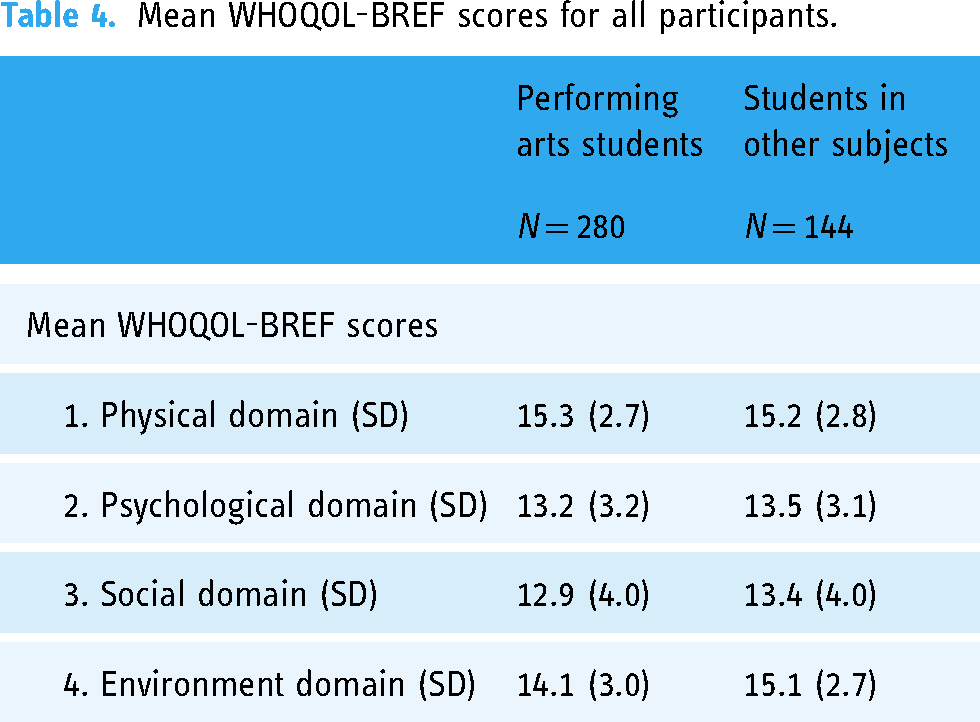
Quality of life scores for the two student groups are listed in Table 4 and were all within population norms (Skevington et al., 2004). Mann–Whitney U tests were used to compare the two groups’ scores on the four quality of life domains, the groups only significantly differed on the environment domain of the WHOQOL-BREF (p < .001, Cohens d = 0.992), with performing arts students scoring significantly lower than students studying other subjects.
Mean WHOQOL-BREF scores for all participants.
Support
Around one third (36%, n = 102) of performing arts students and just under one third (28%, n = 41) of students in other subjects reported that they had received educational support. Just under one quarter (22%, n = 62) of performing arts students and (24%, n = 35) students in other subjects reported that they had needed but not received support for their education. And around one third of the performing arts students (33%, n = 93) and students in other subjects (30%, n = 43) reported that they would like to receive support in the future. These three questions were combined to create a binary variable (‘educational needs’) regarding whether a respondent had ever wanted, received educational support or would have liked extra support (‘yes’ to any of the three support questions) or not (‘no’ on all three questions). In total, 153 (54.6%) performing arts students and 71 (49.3%) students from other subjects were classified as wanting/receiving educational support. A chi-square test revealed no association between the two groups and their educational needs χ2 (1) = 1.087, p = .297.
Self-efficacy
EFA was conducted on the bespoke self-efficacy scale. The expected number of factors to extract was determined by three criteria: (a) eigenvalues greater than one; (b) examination of the scree plot; and (c) parallel analysis. Eigenvalues suggested five possible factors, while the parallel analysis indicated three factors. Looking at the scree plot, it was evident that only three factors could be computed. Due to the inherently subjective nature of eigenvalues and scree plots (O’Connor, 2000), we followed the suggestion by the parallel analysis to compute three factors.
The Kaiser–Meyer–Olkin (KMO) measure of sampling adequacy was 0.896, surpassing the desirable threshold of 0.80. Bartlett's test of sphericity also demonstrated statistical significance χ2(276) = 6217.523, p < .001, validating the suitability of the data for factor analysis. The internal consistency and reliability of the measures and the scale were substantiated by a Cronbach's α coefficient which had a value of 0.937, affirming their acceptability.
Table 5 presents the factor loadings resulting from the principal axis factoring using oblique promax rotation. Only the items that were greater than 0.40 were considered in the final scale. Two items were dropped (item 4 and 18) in our model. Additionally, another item (item 17) appeared in two factors, however it was clustered in factor 2 due to the component fitting better due to similar measurements. Based on a content analysis, we determined the following three factors. Factor 1 was Social Course Component Efficacy: a subscale focused on measuring self-efficacy within interactive group settings, particularly in the context of collaborative endeavours with peers or classmates, exemplifying one's ability to work with others toward common objectives. Factor 2 centred on Academic Executive Function Efficacy: a subscale assessing self-efficacy related to executive function in educational contexts, such as the ability to effectively execute tasks like taking comprehensive notes. Lastly, Factor 3 was about Self-Efficacy in Enlisting Social Resources: a subscale highlighting self-efficacy concerning social resources and support, encompassing activities such as socialising with fellow classmates or peers (see Supplementary Materials for further details).
Factor loadings.
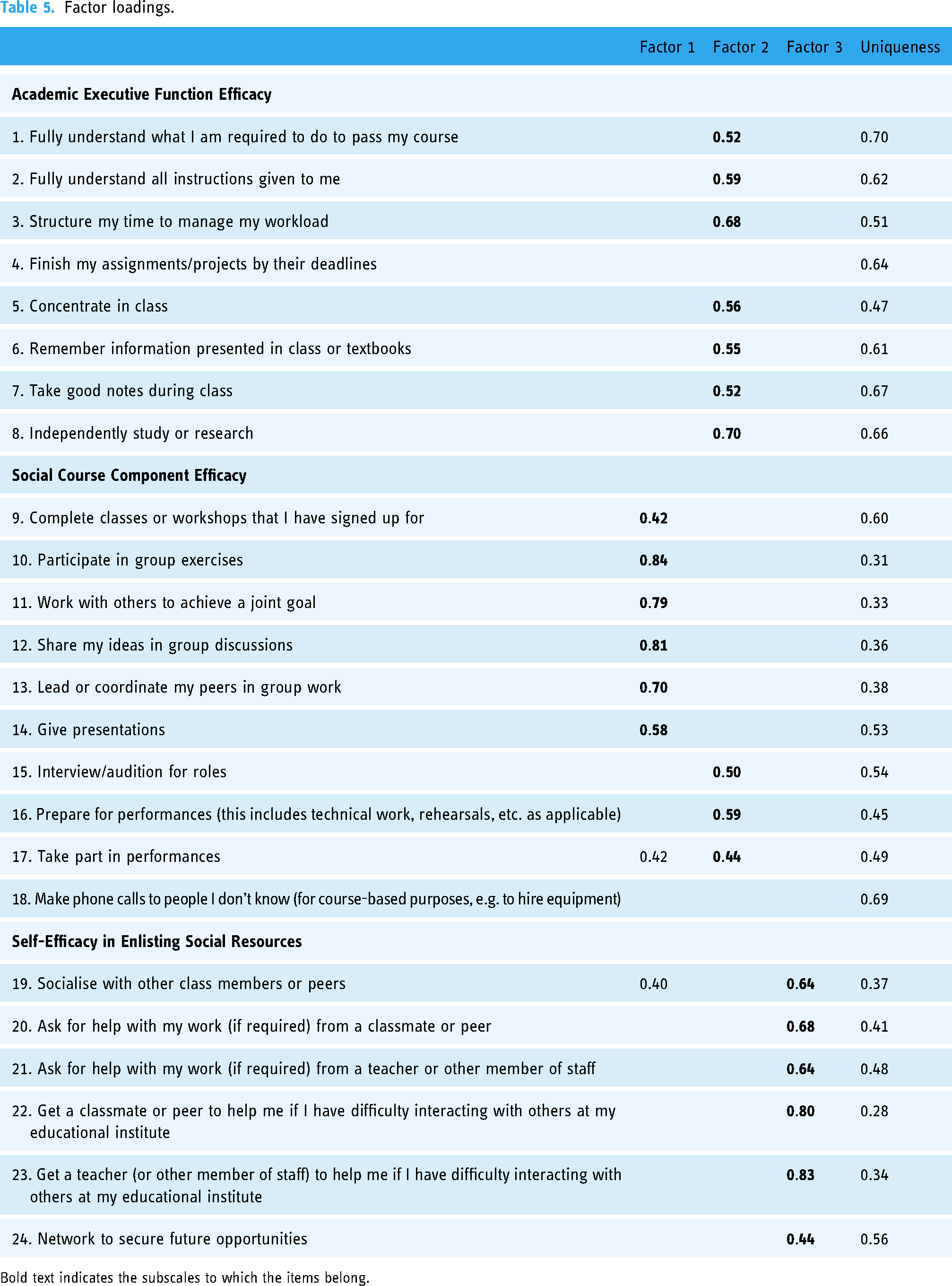
Bold text indicates the subscales to which the items belong.
Criterion validity
Correlations were computed between each self-efficacy subscale and mental health, wellbeing, specific traits, and needs in education variables which was measured through a binary variable (0 indicated no educational needs whereas 1 indicated educational needs). Most relationships were statistically significant, apart from Academic Executive Function Efficacy Subscale and autistic traits (p = −.082), Social Course Component Efficacy Subscale and autistic traits (p = −.094), as well as educational needs and autism traits (p = .063). Overall, higher scores on each of the three subscales results in students being less likely to require further assistance/or needs in their education. A correlation heatmap is presented below (see Figure 1).
Students experienced high self-efficacy with respect to their education with performing arts students scoring significantly higher (p < .001) with a total score of 170.51 (SD = 31.28) compared to 144.89 (SD = 42.69) for students studying other subjects.
Similarly, on all subscales, performing arts students scored significantly higher than those studying other subjects on all three subscales (all p < .001). See Table 6 for mean group scores on the subscales, and Supplementary Materials for individual scale item scores.
Mean self-efficacy scores for all participants.

The relationship between educational needs, self-efficacy and neurodivergence
A multiple linear regression analysis was conducted to investigate the influence of mental health indicators (anxiety and depression), specific traits (ADHD and autistic traits), and programme factors (support needs and course of study – performing arts or other subject), on the outcome of self-efficacy in the field of education (considering items that were not dropped by the EFA). Our analysis revealed that mental health, neurodivergent traits, and programme characteristics collectively played a pivotal role in the prediction of self-efficacy in educational settings.
Specifically, lower levels of ADHD traits (β = −1.072), depression (β = −1.592) and needs (β = −9.206) were associated with higher total self-efficacy scores. Conversely, higher levels of anxiety (β = 1.066) were associated with higher self-efficacy. Self-efficacy skills were notably lower among students pursuing a curriculum in other academic disciplines (β = −31.584) compared to their counterparts in the performing arts. Model summary and coefficients are presented in Table 7. Despite a significant negative correlation between autistic traits and the self-efficacy scale, autistic traits did not uniquely predict variance in the regression model.
Model summary and coefficients.

aVovk-Sellke Maximum p -Ratio: Based on the p-value, the maximum possible odds in favour of H₁ over H₀ equals 1/(-e p log(p)) for p ≤ .37 (Sellke et al., 2001).
Qualitative analysis
In total, 131 (47%) performing arts students and 64 (44%) students studying other subjects responded to the open question asking about whether they had previously needed, asked for, or would like support in their educational setting. Students from both groups expressed similar experiences and views so the analysis was combined and themes for all participants are presented together. Alongside analysing all of the survey participants’ comments together, we also sought to identify themes that may have been unique to participants who were autistic or who had particularly high levels of autistic traits (SATQ score > 2 SD above the mean; n = 16) or those who had ADHD or high levels of ADHD traits (n = 20). We did not identify any themes unique to these participants, but we highlight their contributions in the text below.
Overall, we identified three main themes. These are presented below along with their subthemes, which are italicised in the text (see Figure 2 for all themes and subthemes). Quotations from performing arts students are labelled with ‘PA’ and ‘O’ for students studying other subjects.

Heatmap displaying associations between mental health, neurodivergent traits, educational needs and self-efficacy subscales.
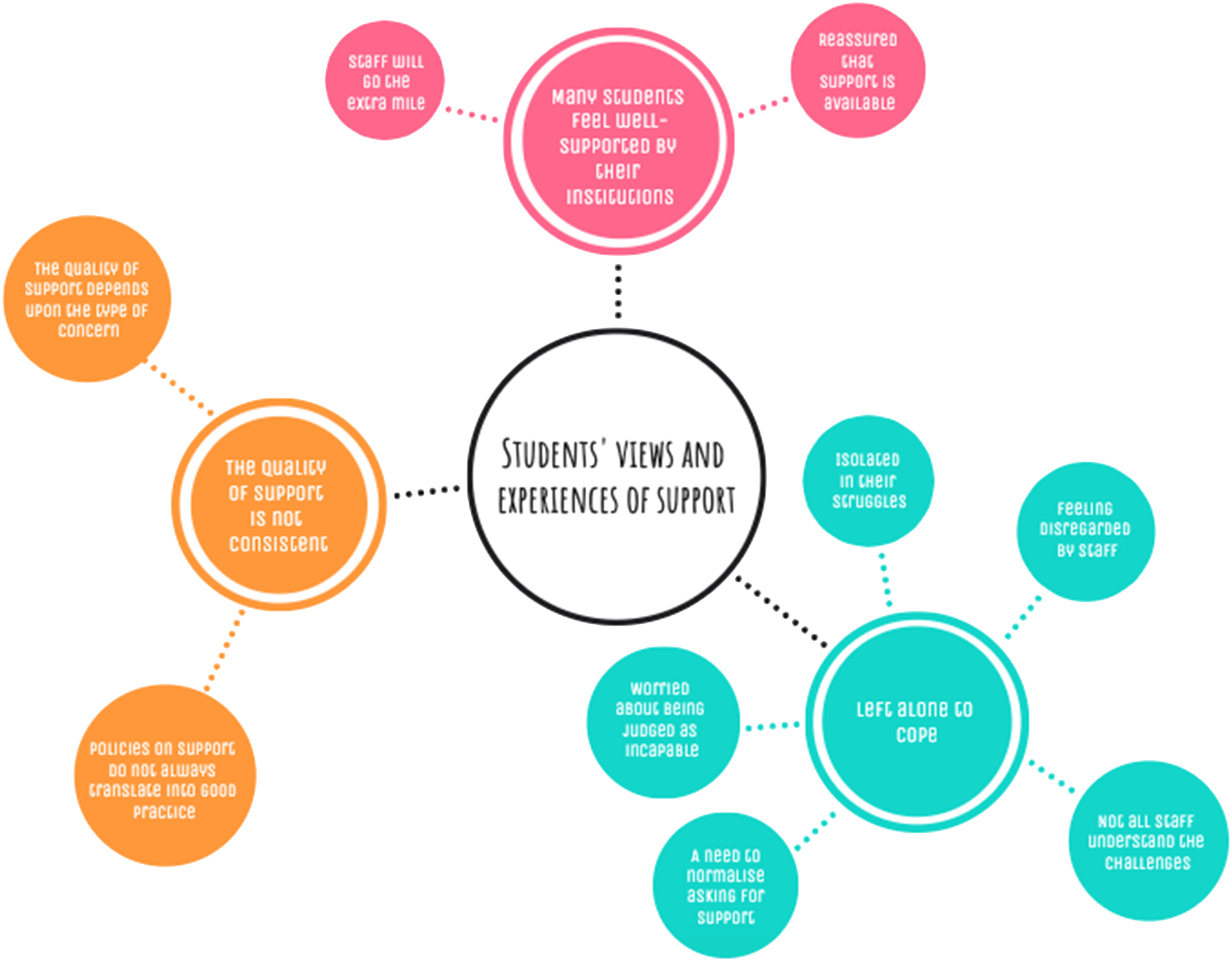
The views of all students on support received/desired and their self-identified support needs: themes and subthemes.
Theme 1: Many students feel well-supported by their institutions. There were many students from both the performing arts and other subjects who felt well-supported by their institutions. A common sentiment shared by many students was that they were reassured that support is available and could be provided if they asked for it: ‘When I need the support I know I simply have to ask for it and talk to the necessary people and I will be able to get it’ [PA158]. Many of the students in both groups also spoke about how they had found particular members of staff had gone the extra mile for them, in terms of giving their time and providing consistently good support: ‘My tutor went to great lengths giving up his free time to help me improve my skills one on one and it made a massive difference’ [O11].
Theme 2: Left alone to cope. That said, there were also students who did not report good levels of support and felt isolated in their struggles. One performing arts student with elevated autistic traits stated: It was a difficult time at the beginning and it felt like no one checked to see if we were settling or coping with the course. The organisation is very bad, support there would have been appreciated or someone to acknowledge it was bad rather that it seem like I was the only one struggling. [PA170]
A student studying other subjects commented on how they felt disregarded by staff when they reached out for help: ‘While I would like more interaction with professors, they ignore me and my requests’ [O68]. Students also discussed how they felt staff lacked awareness around certain conditions and found that not all staff understand the challenges they faced: ‘The main issue is the lack of awareness of learning difficulties with tutors’ [PA103]. Another student said, ‘dyspraxia and dyscalculia are not commonly known about but so many young people in the performing arts industry struggle with it. I believe many more tutors should have either training or a greater awareness for these conditions’ [PA44]. Students also discussed how the conversations around mental health and asking for support were still not always out in the open and how they wished for more of these conversations to happen so that asking for support was normalised: ‘I think the course could be much more adept at helping with the mental health of students. Encouraging this to be a conversation from term 1 of first year’ [PA142]. One performing arts student with elevated autistic traits spoke of their worries of being judged as incapable if they asked for the support they needed: ‘There have been times where I have felt I needed extra support due to mental health conditions, but felt unable to ask for it due to fear of being told I was not strong enough for such a competitive industry’ [PA30].
Theme 3: The quality of support is not consistent. The lack of awareness from staff translated into students reporting that the quality of support depends upon on the type of concern, and that support specific to their conditions or identity did not sufficiently address all of their challenges. One autistic performing arts student reported, ‘I have received support with exams in the form of a separate room and extra time. However, my course leaders have not been able to offer support when it comes to my difficulty interacting with groups or with other students’ [PA245]. One Black performing arts student commented on how they faced many more challenges than their white classmates and did not feel supported by their institution in studying in an environment where they were a minority: ‘The transition into Drama School can be difficult for BAME [Black, Asian, and Minority Ethnic]/working class students because we are launched into a completely middle-class environment where the social rules/norms are extremely different. There is rarely any real support given and it is easy to feel disabled in comparison to your peers’ [PA215]. Both performing art students and students studying other subjects reported that sometimes an institution's policies on support do not always translate into good practice. As one student with high levels of ADHD traits indicated: ‘Psych services were not very helpful as they are completely booked. Trying to receive help beyond medication is difficult next to studying and working, and that would be support that I could really use’ [O119].
Discussion
Stereotypical assumptions about autistic people lacking creativity might suggest that the performing arts is not an area of interest for those on the autistic spectrum. In contrast, the results of this study have demonstrated, for the first time, that autistic individuals and those who have high levels of autistic traits, are pursuing performing arts education in the UK – at a similar rate to those studying other subjects. There were few differences found between students studying the performing arts and other subjects, suggesting that the performing arts is not a uniquely stressful environment in which to study. This highlights that students with elevated levels of autistic traits studying in any discipline may be vulnerable to lower educational self-efficacy and higher rates of mental health issues and are more likely to desire education-based support than individuals with lower levels of autistic traits.
The idea that autistic people do not excel at creative thinking, nor are likely to follow creative career paths, likely comes from the diagnostic criteria for autism including rigid thinking and restricted interests, as well as research that has shown autistic people exhibiting less flexibility and fluency on creative tasks than neurotypical participants (American Psychiatric Association, 2013; Craig & Baron-Cohen, 1999; Liu et al., 2011; Turner, 1999). We have shown in this study that, contrary to this traditional view, autistic people are pursuing creative careers through studying at performing arts schools. This finding is further consolidated by our previous research that has shown autistic professionals working in creative roles and areas through pursuing and sustaining careers in the performing arts (Buckley et al., 2021a, 2021b).
The overall rates of mental health of performing arts students in this sample, as well as in students who study other subjects, is higher than expected based on general population estimates. In England, 17% of the adult population meet the criteria for a mental health condition at any one time (McManus et al., 2016), with the majority experiencing depression or anxiety. Twice as many students, in both groups, scored above the threshold for clinical levels of depression and anxiety on the screening tools as reported clinical diagnoses of these conditions. The higher levels of mental health difficulties seen in this study are closer to estimates seen in general student populations both in students studying in the UK (Jenkins et al., 2020) and globally (Bitsika & Sharpley, 2012; Bruffaerts et al., 2018; Ibrahim et al., 2013), suggesting that poorer mental health may be a common phenomenon for those in higher education. Mental health conditions are also most likely to onset in people's early twenties, which is the typical time many are enrolled on higher education courses (Kessler et al., 2007), which may explain these high figures. Moreover, for many students, struggling to adapt to university life and financial stress can drive higher incidence of mental conditions, and having a disability can also contribute to these struggles (Stallman, 2010; Verger et al., 2009). There is limited published research on the quality of life and mental health of the performing arts population, and no study, to our knowledge, on performing arts education, although it is known that there is a high incidence of poor mental health for those working in the arts (ArtsMinds, 2017; Buckley et al., 2021a; Eynde et al., 2016).
Many students described a perceived lack of educational support and this may go some way in explaining the high rates of mental health issues in our sample. Many of the comments from our participants focused on feeling unsupported, isolated, and misunderstood in their education. These experiences of loneliness in their education can negatively influence students’ overall academic experiences and perceptions of stress (Stoliker & Lafreniere, 2015). This isolation can also be due to reluctance disclosing mental health problems or asking for support due to perceived stigma (Quinn et al., 2009). Recruitment for this study may have also created a biased sample due to those with unmet support or mental health needs being potentially more likely to take part in study than those without.
While certain aspects of studying within higher education (whether performing arts or other subjects) are likely to be especially challenging for those with a diagnosis of autism or elevated autistic traits, our quantitative analysis suggested that it was mental health concerns and neurodivergence more broadly that led to these difficulties. Indeed, it appeared that participants with higher levels of ADHD traits had lower self-efficacy across all three subscales, while those with higher levels of autistic traits experienced lower levels of educational self-efficacy solely with regard to the social components of the course. As such, in contrast to our initial predictions, ADHD traits played a larger role than autistic traits in predicting educational self-efficacy within our study. This is in keeping with prior literature regarding reduced academic self-efficacy (Sarid & Lipka, 2023) and poor higher education outcomes for those with ADHD (Sedgwick, 2018). Future research could investigate whether the overlap between autistic traits/diagnoses and other conditions/traits could disproportionately affect wellbeing and self-efficacy within higher education.
These results indicating that self-efficacy, quality of life, and mental health are poorer for those students with high levels of neurodivergent traits than for those with low levels of neurodivergent traits could be due to many factors. One such factor may be students’ experiences of their educational environments. We know that many autistic students in higher education are likely to face challenges in both accessing their university course and the social relationships they have with peers and staff, which can mean feeling isolated, anxious and/or depressed, and desiring support (Beardon et al., 2009; Gelbar et al., 2014; Jobe & Williams White, 2007; Madriaga & Goodley, 2010). Similar experiences are likely for those with ADHD, where higher levels of traits have been linked to lower levels of wellbeing within higher education (Gudjonsson et al., 2009). The comments made by those with elevated levels of autistic traits in our study described educators as having inconsistent levels of knowledge and the ability to provide support concerning different needs, this lack of accommodation for some behavioural differences may be contributing to their lower quality of life and mental health. The students’ lower educational self-efficacy also reflects research that has found autistic people to have lower occupational and general self-efficacy than nonautistic people (Lorenz & Heinitz, 2014) and indicates that those with subclinical levels of autistic traits may also be experiencing considerable challenges (Constantino & Todd, 2003; Hoekstra et al., 2007). The students’ lower self-efficacy may be influenced by the reported lack of understanding from educators, who may not believe that disabled or neurodivergent students can perform at similar levels to their nondisabled peers. Helping educators to learn more about neurodiversity and neurodivergent traits, may improve the consistency and quality of support for students.
In our study, students with higher levels of neurodivergent traits were more likely than those with low levels of autistic traits to report support needs within higher education (i.e. that they have previously received support, or needed education-based support and not received it, or desired support in the future for their education). Students with autism diagnoses or elevated autistic traits described their worry about being judged as incapable if they revealed their difficulties to ask for support and then also found that support was inconsistently implemented when they did seek it out. These fears of being judged negatively are held by many autistic people (Davidson, 2010; Davidson & Henderson, 2010; Hull et al., 2017) and those with ADHD (e.g. Lebowitz, 2016), and it is common for those with any type of disability to be judged as less capable than those without (Colella & Varma, 1999) and for autistic people to experience more immediate negative reactions and less empathetic responses towards them than neurotypical others (Milton, 2012; Sasson et al., 2017).
The types of support that these students want are similar to those desired by all of the students surveyed: comprehensive support that addresses all of their needs and challenges, academic staff to have high and consistent levels of knowledge regarding specific challenges associated with disability, and a safe and secure environment where asking for support is comfortable and normalised. Future research should examine types of support that may be particularly effective for those with elevated levels of neurodivergence, to ensure that no group are disproportionately disadvantaged within higher education.
There were only two significant differences found between the two student groups: educational self-efficacy and quality of life in the environment domain. The lower educational self-efficacy score for students studying other subjects is likely due to the educational self-efficacy scale being designed specifically for those in performing arts education. Despite no change in the results after removing three items that were specifically performing arts focused, the scale may still be biased towards performing arts courses. The lower quality of life in the environment domain score for the performing arts students may indicate lower standards of living conditions for performing arts students, although it may also be due to the comparison group who were not matched evenly with the performing arts students, particularly on gender and level of study. It may well be that postgraduates are likely to experience better environmental quality of life than undergraduates, and so the high levels of postgraduates in the group of students from other subjects influenced the quality of life results. The two student groups otherwise reported similar levels of mental health symptomology and quality of life, alongside discussing similar experiences of accessing support, this is suggestive that performing arts courses are not causing any greater challenges to students than other higher education courses.
One strength of this study is that it is the first to use a large UK-based sample of performing arts students to examine individuals’ educational confidence and their perspectives on support available in the performing arts. It is also the first time that the relationship between autistic traits and these factors has been examined in this group. This study, however, is not without its limitations. We note, for example, that we conducted an EFA, and that future research should lead to the accumulation of additional data through the use of the scale we created for this study, and implement a confirmatory factor analysis.
In conclusion, these findings provide an initial investigation into neurodivergent traits and their relationship with educational self-efficacy, mental health, quality of life, and support needs for performing arts students. Furthermore, this study has highlighted that there are a number of neurodivergent individuals or those with high levels of neurodivergent traits training in the performing arts and that this group are particularly vulnerable to low educational self-efficacy and wellbeing and are more likely to have needed and desire education-based support. Future research should further examine the specific support needs of this group.
Supplemental Material
sj-docx-1-ndy-10.1177_27546330241245354 - Supplemental material for Higher levels of neurodivergent traits associated with lower levels of self-efficacy and wellbeing for performing arts students
Supplemental material, sj-docx-1-ndy-10.1177_27546330241245354 for Higher levels of neurodivergent traits associated with lower levels of self-efficacy and wellbeing for performing arts students by Eleanor Buckley, Vassilis Sideropoulos, Elizabeth Pellicano and Anna Remington in Neurodiversity
Footnotes
Acknowledgements
The research was supported by a Bloomsbury DTC Studentship. We thank the Royal Academy of Dramatic Art for their input and support throughout the study, and Equity for their help with advertising the questionnaire. We are grateful to Ali Northcott for her help with the study design. Research at UCL Centre for Research in Autism and Education is generously supported by the Pears Foundation.
Declaration of conflicting interests
The authors declared no potential conflicts of interest with respect to the research, authorship, and/or publication of this article.
Funding
The authors disclosed receipt of the following financial support for the research, authorship, and/or publication of this article: This work was supported by the Bloomsbury DTC Studentship.

Supplemental material
Supplemental material for this article is available online.
Notes
References
Supplementary Material
Please find the following supplemental material available below.
For Open Access articles published under a Creative Commons License, all supplemental material carries the same license as the article it is associated with.
For non-Open Access articles published, all supplemental material carries a non-exclusive license, and permission requests for re-use of supplemental material or any part of supplemental material shall be sent directly to the copyright owner as specified in the copyright notice associated with the article.
