



Abstract
The circular economy (CE) is widely promoted as a pathway to environmental sustainability and green growth, yet evidence from Accra’s informal settlements shows that its informal manifestation often reproduces social and health injustices. This study advances the concept of toxic sustainability to explain how environmental gains are achieved at the expense of human wellbeing. Informal plastic CE actors generate substantial environmental value but remain excluded from social protection, decision making, and value capture. Drawing on 42 in-depth interviews with informal plastic CE workers and a participatory validation workshop with 25 small-scale CE factory owners, informed by political ecology, environmental justice, and labour geography, the findings show that informal CE delivers environmental benefits while exposing workers and surrounding communities to hazardous conditions, chronic toxic exposure, and economic precarity. These outcomes are sustained by exploitative market relations, weak infrastructure, and policy neglect. Without targeted interventions in occupational safety, financial inclusion, infrastructure provision, and governance recognition, CE policies risk entrenching inequality rather than enabling just and sustainable transitions.
Introduction
The transition from linear production and consumption systems to a circular economy (CE) has become a central strategy for addressing resource depletion, pollution, and climate change. Circular economy frameworks promote recycling, reuse, and remanufacturing to retain materials within production cycles and reduce environmental degradation (Labra Cataldo et al., 2025; Simpson et al., 2025). In many cities of the Global South, these processes are sustained not by formal waste management systems, but by informal small-scale CE actors, particularly within plastic value chains, where formal infrastructure is weak, fragmented, or absent (Mensah et al., 2024; Solaja et al., 2024).
Informal CE actors perform a substantial share of material collection, sorting, and initial processing. Their labour is indispensable to waste diversion and resource recovery, yet they remain largely invisible in policy frameworks, planning processes, and official statistics (Solaja et al., 2024). This marginalization obscures their economic and ecological contributions while intensifying vulnerabilities related to income insecurity, health risks, and social exclusion. A growing body of scholarship documents the precarious conditions under which informal recyclers operate, including unstable earnings, lack of social protection, exposure to hazardous materials and toxic fumes, stigmatization, and limited access to protective equipment or regulatory oversight (Ampong et al., 2024; Püschel et al., 2024; Simpson et al., 2025).
Despite this evidence, the health and economic well-being of informal plastic CE actors, particularly those operating in informal settlements in the Global South, remain insufficiently theorized within CE research. Much of the literature frames informality as a technical inefficiency or a temporary stage preceding formalization, rather than as a structural feature of urban political economies. This framing privileges aggregate environmental outcomes while underplaying how circularity is produced through unequal social relations. As a result, CE transitions may appear environmentally successful while reproducing social and health injustices.
To address this gap, this study adopts a political ecology and environmental justice framework, complemented by insights from labour geography (Coe and Jordhus-Lier, 2011; Herod, 2001; Robbins, 2012; Schlosberg, 2007). From this perspective, the CE is not treated as a neutral technical solution but as a socio-ecological process shaped by power relations, institutional arrangements, and uneven urban development (Folke, 2006; Ostrom, 2009). Political ecology highlights how environmental benefits and burdens are unevenly distributed, often through the displacement of risk onto marginalized populations. Environmental justice foregrounds questions of recognition, participation, and distributive fairness, while labour geography situates informal recyclers as spatially embedded workers whose livelihoods and exposure to harm are shaped by place-specific market and governance dynamics.
Analytically, these frameworks guide an examination of how CE practices redistribute environmental risks and economic gains within informal plastic value chains. Political ecology directs attention to the externalization of hazards onto informal workers. Environmental justice raises questions about whose labour is recognized and whose well-being is excluded within CE governance. Labour geography focuses on how spatial location, informality, and market positioning shape income opportunities and occupational exposure. Together, these perspectives move analysis beyond material recovery rates to interrogate the social conditions under which circularity is produced.
Within this framing, the study asks a core research question: how do CE practices, governance arrangements, and market structures shape the distribution of benefits and burdens within informal plastic CE value chains? This question shifts attention from whether circularity functions environmentally to how it is institutionally organized and with what consequences for informal workers. Dominant CE narratives emphasize efficiency, innovation, and triple-win outcomes, often portraying circularity as inherently inclusive (Ampong et al., 2024; Tulashie et al., 2022). Such narratives risk obscuring the lived realities of informal CE actors operating under hazardous and weakly regulated conditions (Labra Cataldo et al., 2025).
This disjuncture is conceptualized in this study as toxic sustainability, a condition in which environmental gains and livelihood generation are achieved at the expense of worker and community health. From a political ecology perspective, toxic sustainability reflects processes of risk displacement rather than risk reduction, whereby environmental and occupational hazards are transferred from municipalities, firms, and consumers to informal CE actors. Circularity may therefore succeed environmentally while undermining the social dimension of sustainability.
The focus on informal settlements is deliberate. These spaces are increasingly recognized as critical sites where circular practices are enacted daily, not as policy innovations but as survival strategies embedded in everyday life (Agyei et al., 2023; Samper and Andrade, 2023). In Ghana, settlements such as Old Fadama, Agbogbloshie, Chorkor, and Darkuman illustrate how informal actors have constructed parallel waste value chains that sustain livelihoods while mitigating environmental degradation. However, environmental justice scholarship emphasizes that sustainability cannot be assessed solely through material recovery or pollution reduction, but must also account for dignity, well-being, and agency (Akuoko et al., 2023) .
Drawing on 42 in-depth interviews with informal plastic CE actors and a participatory workshop with 25 owners of informal CE enterprises in selected informal settlements in Accra, this study challenges representations of the CE as universally inclusive. The findings show that informal circularity operates through interconnected processes of exploitation, exclusion, chronic toxic exposure, and weak infrastructure. Without targeted interventions such as occupational health and safety frameworks, financial inclusion mechanisms, and governance recognition, CE policies risk entrenching inequality rather than enabling just transitions.
The study argues that toxic sustainability is an avoidable paradox. Environmental recovery and livelihood resilience need not be achieved at the expense of worker and community health. By integrating political ecology, environmental justice, labour geography, and socio-ecological systems perspectives, the paper advances a more socially grounded understanding of the CE and contributes to debates on how circular transitions can be both environmentally effective and socially just. The remainder of the paper is structured as follows. The next section reviews the relevant literature, followed by a section outlining the methodology. The subsequent section presents the results, which are then discussed in the section that follows. The final section presents the policy recommendations and conclusions.
Literature review
From justice-oriented CE scholarship to toxic sustainability
The CE has emerged as a powerful framework for sustainable development, emphasizing the regeneration of materials through recycling, reuse, and waste reduction. Initially rooted in industrial ecology and eco efficiency, CE thinking was largely technocratic, prioritizing material efficiency and waste minimization while paying limited attention to social relations and power dynamics. As CE discourse has expanded, however, scholars increasingly argue that circular transitions are not merely technical processes but deeply social and political ones, shaped by institutions, labour relations, and distributive outcomes (Ashton et al., 2022; Liu, 2025).
Across this emerging literature, critics contend that dominant CE narratives frequently obscure structural inequalities embedded within production, consumption, and waste systems. In the Global South, where formal CE infrastructure is weak or fragmented, informal CE actors play a decisive role in sustaining material recovery and resource circulation (Labra Cataldo et al., 2025; Simpson et al., 2025). Yet their contributions remain marginal within national CE strategies that privilege industrial scale solutions, technological innovation, and private capital investment. As a result, CE transitions risk reproducing, rather than transforming, existing social hierarchies and inequalities (Hadfield et al., 2025; Meagher, 2022).
Recent scholarship therefore calls for a redefinition of CE frameworks to incorporate justice, participation, and inclusion as core principles rather than secondary concerns. Concepts such as just circularity emphasize that sustainability cannot be achieved without fairness in the distribution of labour, risks, and rewards (Ashton et al., 2022; Schröder, 2020). The challenge is not only to close material loops, but to democratize them by embedding social equity within CE policy and practice (Hadfield et al., 2025).
It is within this critical debate that this study advances the concept of toxic sustainability. Toxic sustainability refers to a mode of sustainability transition in which environmental performance gains are achieved through the systematic externalization of social, health, and livelihood risks onto marginalized populations, thereby reproducing inequality while appearing ecologically progressive. In such systems, sustainability outcomes are secured not despite harm, but through harm. The concept therefore shifts analytical attention from unintended negative side effects of sustainability to the political economy through which sustainability is operationalized.
Toxic sustainability is analytically distinct from related concepts such as environmental injustice and sacrifice zones. Environmental justice scholarship primarily interrogates unequal exposure, recognition, and participation within environmental governance, whereas toxic sustainability highlights how sustainability itself becomes the organizing logic through which injustice is generated and normalized. Similarly, while sacrifice zones and slow violence foreground spatially and temporally concentrated harm, toxic sustainability emphasizes economic functionality, showing how exposure, precarity, and bodily risk are rendered productive inputs into circular efficiency. Unlike occupational health perspectives that treat unsafe labour as a regulatory failure or implementation gap, toxic sustainability demonstrates how hazardous and informal labour can become structurally necessary to achieving circular outcomes under cost constrained governance regimes.
Toxic sustainability is operationalized through four interrelated elements grounded in political economy, labour, and governance theory. First, environmental gains are realized through risk displacement rather than risk reduction, consistent with political ecology accounts of how environmental burdens are shifted along social and spatial hierarchies. Second, value capture without value protection reflects labour process and value chain perspectives, wherein informal CE actors generate environmental and economic value while remaining excluded from social protection, income security, and policy recognition. Third, institutionalized invisibility draws on governance and metrics critiques, showing how informal labour is indispensable to circularity yet systematically excluded from sustainability indicators, regulatory frameworks, and national CE strategies. Finally, the stabilization of precarity aligns with labour geography insights, demonstrating how informality is normalized as a cost saving and flexibility mechanism rather than treated as a transitional condition toward inclusion.
In much of the Global South, circularity already exists, operating through informal systems of recovery and recycling that sustain urban material flows. Informal waste pickers, scrap dealers, and small-scale recyclers prevent cities from being overwhelmed by waste while generating employment and environmental benefits at minimal public cost (Castro et al., 2025; Labra Cataldo et al., 2025). Yet these systems are routinely stigmatized, criminalized, or excluded from development agendas (Mukucha and Jaravaza, 2025; Solaja et al., 2024). Informality persists not as a temporary deviation awaiting modernization, but as a structural feature of urban economies sustained by weak regulation, fragmented institutions, and entrenched socio-economic inequalities (Labra Cataldo et al., 2025).
The resilience of informal CE lies in its adaptability and low barriers to entry, but this same flexibility exposes workers to chronic precarity. As Meagher (2022) argues, informal economies often generate livelihoods while simultaneously entrenching vulnerability and insecurity. In Ghana’s informal CE, this paradox is particularly stark. Waste pickers derive income from discarded materials yet remain marginalized from the wealth generated by industrial recycling and formal CE initiatives. Their labour embodies what Ferguson (2015) describes as survival without advancement, enabling subsistence but foreclosing mobility.
Without deliberate intervention, the CE risks becoming another mechanism through which marginalized populations absorb environmental and occupational risks while elites and institutions capture economic and reputational rewards (Schröder, 2020). Toxic sustainability thus represents the empirical antithesis of just circularity. It reveals how CE transitions, when detached from questions of power, labour, and redistribution, can stabilize inequality under the guise of environmental progress. In the Ghanaian case, sustainability is materially real but socially corrosive, achieved through systems that circulate materials efficiently while reproducing exclusion, exposure, and precarity.
The governance of exclusion and the politics of recognition
The persistence of informality within CE transitions raises deeper questions about governance and recognition. Scholars increasingly argue that the marginalization of waste pickers is not merely the unintended outcome of weak regulation, but rather the product of deliberate and selective governance arrangements that privilege formal enterprises and elite actors (Owusu, 2021; Schindler, 2017). As Owusu (2021) demonstrates, African urban governance often relies on systems of exclusion in which state authorities selectively recognize or criminalize certain livelihood activities to consolidate political and economic power. Schindler (2017) similarly contends that Southern urbanism is shaped by unequal state-market relations in which formal sector actors are positioned as the legitimate drivers of development, while informal labour is rendered invisible or disposable. These perspectives suggest that the marginalization of informal actors in Ghana’s CE is not accidental but embedded in wider political-economic logics that elevate capital-intensive, formalized solutions and systematically devalue informal labour.
This governance of exclusion manifests through both omission and commission. On one hand, through the absence of policies that meaningfully integrate informal workers, and on the other, through the deliberate displacement of these actors via privatized waste management contracts. Although policy discourse often invokes sustainability, CE initiatives frequently prioritize technological and capital-intensive solutions over the welfare of the people who sustain the system. The result is what Bening et al. (2021) describe as “contested solutions”, interventions that may appear efficient or innovative from a policy standpoint but are experienced by marginalized groups as dispossession, triggering resistance and deepening existing inequalities.
In contrast, cooperative and participatory governance models have shown potential for inclusion. Research across Latin America, Asia, and Africa documents how waste picker cooperatives can negotiate formal contracts, stabilize income, and access municipal support (Buch et al., 2021; Castro et al., 2025). Yet these models still face barriers such as institutional inertia and elite capture, which limit their transformative potential. Systems often favour established actors, leaving informal CE actors marginal to decision-making. Their effectiveness therefore depends not only on organisational design but on genuine recognition, fair remuneration, and sustained participation; without these, integration risks becoming symbolic rather than substantive (Simpson et al., 2025).
Over the past four decades, global advocacy networks such as Women in Informal Employment: Globalizing and Organizing (WIEGO) and the Global Alliance of Waste Pickers have reframed waste picking as an environmental service rather than a nuisance (Simpson et al., 2025). This epistemic transformation has slowly permeated policy spaces, contributing to greater visibility of informal workers. However, recognition has not necessarily translated into redistribution. Many inclusion initiatives remain symbolic, offering visibility without structural change. The challenge, as Meagher (2022) argues, lies in transforming recognition into redistributive justice, ensuring that informal workers share equitably in the value they create.
Circular economy in Africa: Promise and paradox
In the African context, the CE represents both an opportunity and a paradox. On one hand, the continent’s dynamic informal recycling systems demonstrate extraordinary resilience and efficiency in resource recovery (Ampong et al., 2024). Informal collectors handle a substantial proportion of urban waste, often outperforming formal institutions in coverage and responsiveness. On the other hand, these systems operate within contexts of deep structural inequality. Without institutional support, waste pickers face hazardous working conditions, lack access to protective equipment, and experience chronic income insecurity (Mukucha and Jaravaza, 2025; Solaja et al., 2024).
Empirical studies across Sub-Saharan Africa highlight persistent barriers to circularity. Debrah et al. (2022) identify weak financing mechanisms, fragmented policies, and limited technological access as major obstacles. Their earlier work emphasizes the role of public education in fostering behavioural change but cautions that awareness alone cannot substitute for structural reform (Debrah et al., 2021). Babayemi et al. (2019) provide continental evidence of the growing scale of plastic waste and the absence of robust recycling infrastructure. Their findings underscore the need for coordinated policy frameworks and investment in sustainable technologies.
However, even where policies exist, enforcement remains weak. Many governments adopt CE rhetoric without addressing the institutional realities that sustain informality. Agbogbloshie in Accra epitomizes this contradiction: a hub of resource recovery and employment, yet also a site of severe environmental pollution and human exposure to toxins (Püschel et al., 2024). The Ghanaian and Nigerian experiences thus reflect a wider pattern of uneven urban transformation, where the environmental burdens of circularity fall disproportionately on the poor (Owusu, 2021; Schindler, 2017).
The politics of CE is fundamentally about who controls decision making and whose priorities define circularity. What counts as “circular” is often defined by powerful actors: states, corporations, and international donors, whose visions of sustainability may diverge sharply from the lived realities of informal workers. Scholars have shown that CE interventions are rarely neutral; they reflect struggles over authority, legitimacy, and control (Bening et al., 2021; Liu, 2025). Technical solutions such as centralized recycling plants or extended producer responsibility schemes are often promoted as universally beneficial, yet they can marginalize the informal actors who currently sustain recycling networks (Hadfield et al., 2025).
The idea of contested solutions highlights the need for reflexivity in CE governance. Inclusive transitions require deliberation and negotiation rather than top-down imposition. This insight aligns with Gutberlet’s (2023) argument that informal waste pickers are not peripheral but central agents in achieving global plastic sustainability. Their experiential knowledge and community networks constitute an invaluable form of expertise that should inform CE design. Participatory research and co-production methods, where waste pickers collaborate as co-researchers, represent a promising pathway toward more democratic knowledge production (Simpson et al., 2025).
Recent studies expand the scope of CE research beyond environmental performance to include the human costs of circularity. Occupational health risks such as exposure to lead, smoke, and pathogens are well documented (Püschel et al., 2024). However, the literature increasingly recognizes the psychosocial dimensions of waste work. Chan et al. (2024) find elevated rates of depression and anxiety among informal waste pickers in Hong Kong, attributing this to chronic insecurity, social stigma, and the absence of institutional support. Similar vulnerabilities are reported in African contexts, where waste picking intersects with gendered poverty, homelessness, and urban exclusion (Mukucha and Jaravaza, 2025).
Beyond waste management, extensive scholarship on the African informal economy highlights informality as a structurally embedded feature of urban economies rather than a transitional or residual condition. Chen (2016) conceptualizes informality as a continuum of employment relations shaped by regulatory exclusion, unequal power relations, and segmented labour markets, challenging narratives that frame informal work as entrepreneurial choice. Similarly, the International Labour Organization (ILO) (2023) emphasizes that informality in African cities is sustained by weak social protection systems, limited access to finance, and governance arrangements that systematically exclude informal workers from labour rights and economic upgrading. This literature underscores that informal actors often perform essential economic functions while bearing disproportionate risks, operating in conditions characterized by income volatility, occupational hazards, and limited political voice.
Circular economy in Ghana
The transition toward a CE in Ghana has evolved from a niche sustainability discourse into a pressing national development agenda. This shift is driven by growing awareness of the ecological limits of linear production models and the economic potential of circularity in addressing waste, resource scarcity, and unemployment. Scholars widely agree that circularity presents an alternative pathway for sustainable growth, one that seeks to decouple economic advancement from environmental degradation (Ahenkan et al., 2025; Asare et al., 2023).
However, despite the increasing visibility of CE in Ghana’s environmental policy landscape, the literature reveals that the conceptual translation of circularity into practice remains weak and fragmented. Ghana’s policy frameworks refer to circular principles, yet implementation remains constrained by institutional silos, overlapping mandates, and limited enforcement (Agyei et al., 2023; Asare et al., 2023). The governance structure of waste management continues to operate within a predominantly linear logic, where waste is collected and disposed rather than valorised. Scholars argue that this reflects not a lack of awareness but an entrenched institutional culture that privileges end-of-pipe waste management approaches over systemic material recovery (Ahenkan et al., 2025; Bening et al., 2021).
Technological innovation has emerged as a cornerstone of Ghana’s CE narrative. Research has documented a range of experimental solutions from plastic-to-fuel technologies and pavement block manufacturing to hybrid waste-to-energy systems, demonstrating both local creativity and technical feasibility (Tulashie et al., 2022). These innovations are frequently celebrated as evidence of Ghana’s capacity to generate context-specific circular solutions that transform waste into economic resources. Yet the broader literature cautions that technological innovation alone cannot drive systemic circularity without complementary policy and financial infrastructure.
A recurring critique is that Ghana’s CE interventions remain project-based and donor-driven rather than systemically integrated into national or local governance structures (Tahiru et al., 2024). Scaling up these innovations requires not only capital and technology but also knowledge transfer, local entrepreneurship, and community participation. Agyapong and Tweneboah (2023) argue that the absence of accessible green finance and investment instruments significantly undermines the potential for industrial scaling. With limited credit facilities, high lending rates, and low investor confidence, circular ventures remain undercapitalized. Thus, the financial architecture for CE in Ghana is embryonic, and the private sector’s participation is often constrained by the absence of fiscal incentives, subsidies, or risk-sharing mechanisms.
Across multiple studies, informality emerges as the backbone of waste management and recycling, providing employment for tens of thousands of urban poor (Agyei et al., 2023; Iddris et al., 2025). Informal recyclers collect, sort, and trade materials that would otherwise end up in landfills or waterways, effectively sustaining the material loops that CE aspires to formalize. Yet this sector operates under precarious conditions, with little social protection, limited recognition, and minimal access to capital or technology.
Baffoe and Green (2025) frame this paradox as a justice problem: while the informal sector underpins Ghana’s de facto circular economy, it remains excluded from formal decision-making and profit-sharing structures. The authors argue that the circular transition risks reproducing structural inequalities unless it deliberately integrates social protection and participatory governance into environmental policy frameworks.
The e-waste sector exemplifies the broader contradictions of Ghana’s circular transition. Iddris et al. (2025) describe it as a sociotechnical system in flux, where informal recyclers perform critical environmental functions but bear disproportionate health risks due to toxic exposures and lack of protective infrastructure. Asibey et al. (2023) warn that unless informal participation is institutionalized through inclusive urban planning, the CE agenda may entrench, rather than alleviate, urban inequality. These arguments resonate with global calls for “just circularity,” which align environmental objectives with social justice and decent work (Baffoe and Green, 2025).
Methodology
Study context and design
The study was conducted in Accra within Old Fadama, Chorkor, Agbogbloshie and Darkuman communities. These communities are home to thousands of low-income residents who face multiple environmental and socio-economic vulnerabilities such as lack of access to clean water, inadequate housing, and insecure tenure (Mensah and Birch, 2021; Mensah et al., 2025; Preko et al., 2021). Furthermore, a key challenge in these communities is the accumulation of plastic waste. However, these same communities have also become active hubs of informal CE initiatives. Across many of Accra’s informal settlements, informal plastic CE actors such as waste pickers, small-scale recyclers, and aggregators play crucial roles in collecting, sorting, and reusing plastic materials (Mensah, 2026; Mensah et al., 2024). These four communities were therefore selected because they are widely recognized as hosting a substantial concentration of informal plastic CE actors in Accra (Mensah, 2026).
An exploratory design based on qualitative methodology was used for this study. An exploratory design was useful in helping to gain an in-depth understanding of the lived experiences, perceptions, and challenges faced by informal circular economy actors in the studied informal settlements (Creswell, 2014). A purposive sampling technique was employed to interview 42 informal CE actors in the studied informal settlements. Purposive sampling allows researchers to deliberately select participants who possess specific characteristics, knowledge, or experiences relevant to the research objectives (Palinkas et al., 2015). In addition, a structured validation workshop was conducted with 25 informal plastic CE factory owners.
In this study, inclusion criteria targeted individuals directly working and owners of small-scale plastic CE factories located within the studied informal settlements. The sample size of 67 was guided by qualitative principles of thematic saturation rather than statistical representativeness, as no reliable population data exist for informal plastic CE actors in Accra. Scholars argue that between 12 and 40 participants are generally sufficient for qualitative studies that seek to uncover complex social phenomena (Boddy, 2016).
In this study, saturation was reached with 67 participants. Saturation was determined when successive interviews no longer generated substantively new themes, and instead reinforced existing analytical categories related to occupational health risks and community exposure, economic precarity and exploitation, infrastructural and capacity deficiencies and lack of legal and policy recognition within the informal CE. This point was reached after repeated confirmation of these patterns across participant and workshop participants. Additional interviews conducted beyond this threshold yielded redundancy rather than novel insights, indicating that saturation had been achieved in line with established qualitative research guidance (Creswell, 2014).
Data collection and analysis
A semi structured interview protocol, developed around the key research objectives, guided the data collection process among informal CE actors in the studied informal settlements. Each interview lasted approximately 35 to 45 minutes and adopted a conversational approach that encouraged participants to speak freely about their experiences. This format enabled the researcher to probe for deeper insights and uncover the meanings that participants attached to their daily work and interactions within the informal CE.
Interviews were conducted in the informal plastic CE facilities to ensure that the interviewees felt comfortable and relaxed. The audio recordings were transcribed using both naturalistic and denaturalized transcription techniques, following Oliver et al. (2005). Naturalistic transcription was used in the initial analysis to preserve speech patterns and expressions central to understanding participants lived experiences, while denaturalized transcription was applied during analytic refinement and reporting to improve clarity and support cross-case comparison. This combined approach balanced interpretive depth with analytical rigour.
Each transcript was formatted in accordance with the main research questions and uploaded into NVivo version 14 for systematic organization and analysis. The analysis followed an axial coding process that involved repeated reading of the transcripts and assigning codes to meaningful words, phrases, and sentences. This iterative process helped to identify relationships between codes and to refine them into broader categories. Following the thematic analysis framework proposed by Braun and Clarke (2006), these categories were further synthesized into overarching themes that captured the essence of participants’ experiences within the informal CE. This analytical approach allowed for both conceptual depth and empirical richness in interpreting the data. In addition to the interviews, a workshop was also conducted with owners of these informal CE factories and lasted approximately three hours.
The workshop facilitation combined group discussions and plenary reporting. Participants reviewed themes, provided feedback, and reached consensus through iterative discussion. Thematic mapping was used to validate interpretations, ensure context-specific accuracy, and highlight convergence and divergence across stakeholder perspectives. Drawing on Denzin’s (2017) triangulation framework, data from individual interviews were systematically cross checked with insights generated during a validation workshop with informal CE factory owners. Feedback from the workshop informed the refinement of themes and was integrated into the final analysis to enhance the credibility and dependability of the findings. To preserve interpretive accuracy, translated transcripts were compared against the original audio recordings to maintain the integrity of meaning.
The study obtained ethical clearance from the Ethics Committee for Humanities at University of Ghana (ECH 204/22-23) and observed ethical standards throughout the study. Responses were anonymized using role-based identifiers, including informal CE actors (ICEA) and workshop participants (WP), to protect participant confidentiality. The researchers’ academic background had the tendency to influence data collection and interpretation. Reflexive strategies of iterative interview review and peer debriefing were used to mitigate bias, ensuring rigorous analysis.
Results
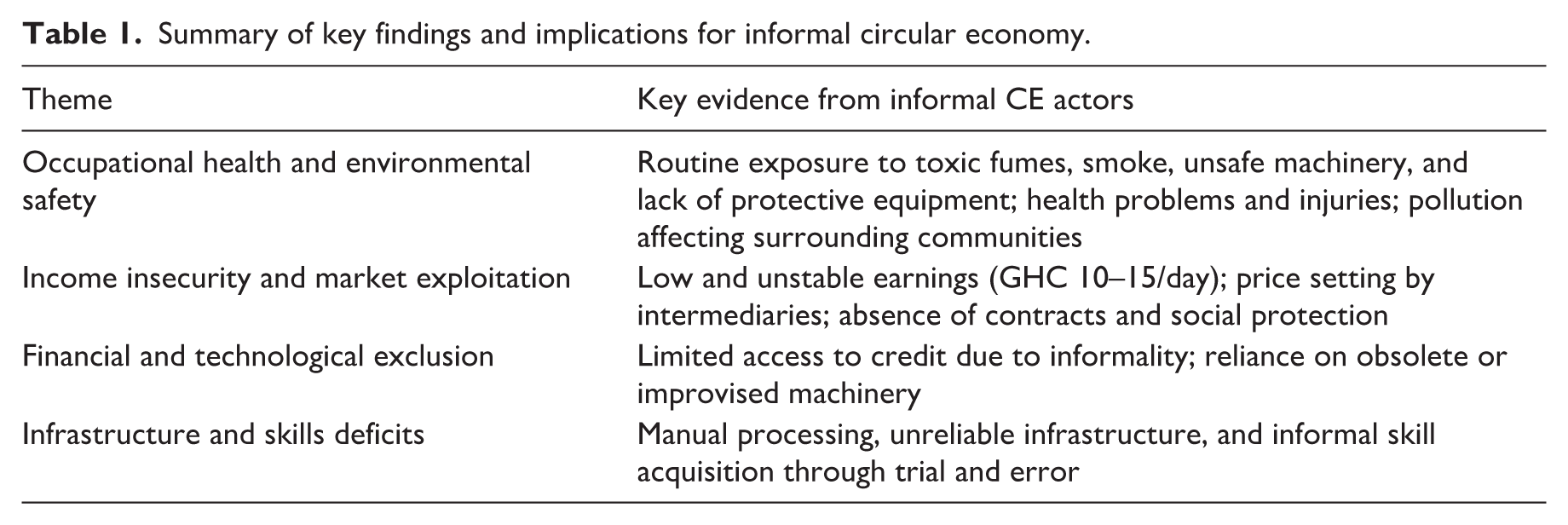
Although the CE is widely promoted as a sustainable and resilient development pathway, its informal manifestation in Ghanaian informal settlements reveals a more troubling reality. The findings show that informal CE practices are marked by severe occupational health risks and community exposure, economic precarity and exploitation, financial and technological exclusion, and persistent infrastructural and capacity deficiencies. Rather than alleviating vulnerability, circularity in these informal contexts often reproduces risk and deepens social marginalization. These findings are presented below and summarized in Table 1.
Summary of key findings and implications for informal circular economy.
Occupational health risks and community exposure
This theme captures the most visible challenge facing informal CE actors in Accra. Respondents consistently described working conditions characterized by constant exposure to fumes, smoke, and debris from crushed plastics, often within unventilated facilities embedded in dense settlement. As one participant explained, “the biggest challenge is the improper way of recycling, which release harmful toxins and chemicals into the air. We do the work because we must eat, but the smoke and smell make us sick” (ICEA, 12). This account captures the contradiction at the core of informal circularity, where workers endure environments that directly compromise their health. Participants reported prolonged inhalation of noxious gases during plastic crushing and melting, sustained skin contact with contaminated materials, and routine exposure to microplastics.
These risks are intensified by the near absence of protective equipment. Across interviews, workers emphasized that sorting, burning, and processing plastics are routinely performed without gloves, masks, boots, or protective clothing. One respondent stated plainly, “we work with our bare hands; sometimes the plastic smells bad, but we have no gloves” (ICEA, 3), while another added, “the smoke from burning plastics makes our eyes and chest hurt” (ICEA, 18). Such narratives reveal how exposure is normalized, transforming hazardous conditions into an accepted feature of informal CE labour.
The cumulative effects of this exposure were repeatedly linked to persistent health problems, including chronic coughing, skin rashes, fatigue, and physical injury. Participants associated these outcomes not only with toxic emissions during plastic melting, but also with the absence of occupational health oversight. This was underscored during the validation workshop, where one discussant noted, “a major challenge with this business is the health risks faced by individuals working in the informal plastic CE chain. In my factory, I had a worker whose fingers were cut off by the crusher machine” (WP, 5).
The environmental burden of informal CE activities extends beyond individual workers to neighbourhoods. Plastic crushing and melting contribute to persistent pollution within informal settlements. As one respondent observed, “the harmful toxins and smoke affect both the workers who do not have protective equipment and people living around the facility” (WP, 7). Consequently, CE practices intended to promote environmental sustainability often generate localized ecological crises. A respondent indicated that “pollution, flooding and water contamination problems” (ICEA, 2) are widespread in communities adjacent to recycling facilities.
Economic precarity and exploitation
This theme highlights that informal circularity, though economically vital, is precarious and exploitative. Informal CE actors operate within fragile value chains dominated by companies and intermediaries, leaving grassroots workers with low earnings, market exploitation, and dependence on middlemen. Participants emphasized their structural vulnerability: “we sell because we need quick money; the big buyers decide the price, not us” (ICEA, 32), and “we sell the crushed plastics cheaply to middlemen; they make big money from us” (ICEA, 26). Many described earnings insufficient for daily needs: “after a full day’s work, what we earn is not even enough for food” (ICEA, 40), with typical daily income ranging from GHC 10 to 15.
Economic precarity is compounded by the absence of social protection. Workers operate without contracts, insurance, or workplace safeguards, exposing them to exploitation and financial shocks. Market volatility further entrenches precarity: “sometimes the buyers stop coming; other times, the price drops suddenly” (WP, 3), and “we cannot plan because today they buy high, tomorrow they say the price has fallen” (ICEA, 2). Informal actors are heavily dependent on intermediaries, who set prices unilaterally, often citing waste quality as justification, reinforcing information asymmetries and power imbalances. One participant explained, “sometimes we work the whole week and still make nothing because no one buys” (ICEA, 20).
Financial exclusion emerged as a structural constraint. Informal actors face barriers accessing credit due to lack of registration, collateral, or financial records: “banks don’t take us seriously because we don’t have papers or collateral” (WP, 5). This prevents investment in capital-intensive technologies necessary for modern CE processes such as shredding, washing, extrusion, and pelletizing. Participants described reliance on second-hand or improvised machinery prone to breakdowns, producing inconsistent output and higher occupational risks. As one recycler explained, “we don’t have modern equipment; we use old machines that break down, and the materials do not come out as they should” (WP, 19).
This technological and financial marginalization confines informal CE actors to low-value segments of the value chain. Many must sell unprocessed or semi-processed plastics to intermediaries, reinforcing dependency and economic subordination: “since we don’t have the money to buy modern machines, our products are not well processed to get higher prices” (WP, 2). These narratives illustrate that informal CE actors, despite their indispensable role in sustaining circularity, remain structurally excluded from profit, value addition, and formal recognition, highlighting the entrenched inequities within Ghana’s CE.
Infrastructural and capacity deficiencies
Circularity in Accra’s informal settlements is constrained by inadequate infrastructure and capacity limitations. Instead of functioning efficiently within a CE, informal actors operate in degraded, improvised spaces, which restrict productivity, safety, and value recovery. Participants emphasized these structural constraints: “we lack infrastructure for the proper functioning of the plastic CE; there are no machines here. We just use knives to cut plastics” (WP, 14). Field observations confirmed that most processing such as sorting, size reduction, and melting are conducted manually or using makeshift devices, often over open fires, with minimal safety measures. One interviewee noted, “we lack adequate protective equipment in this facility, exposing workers to significant health risks” (ICEA, 29).
The lack of modern processing infrastructure also affects collection logistics, storage, and reliable electricity supply, leading to operational inefficiencies, material contamination, and uneven quality standards. These constraints limit the ability of informal CE actors to upgrade within the value chain, leaving them structurally reliant on better-equipped external firms. As one participant noted, “without access to processing machines, we are unable to add value to plastics and therefore receive lower prices” (WP, 14).
Skill deficits further compound these challenges. Informal learning dominates, with workers acquiring skills through observation and trial-and-error. A factory owner explained, “there is no structured training for our workers; they learn on the job, usually starting as sorters or washers before gradually learning to operate machines” (WP, 11), echoed by a worker: “when I came here I didn’t know how to operate any machine, but I have learnt this through my colleagues” (ICEA, 13). These narratives illustrate how infrastructural and skill constraints combine to limit efficiency, productivity, and value addition, making informal CE a site of marginal survival rather than innovation.
Lack of legal and policy recognition
The final theme highlights the systematic exclusion of informal CE actors from formal policy frameworks and Ghana’s waste governance architecture. Despite their central role in CE, these actors remain largely invisible in law and policy, absent from decision-making processes, and deprived of legal recognition, training, or institutional support. Participants emphasized this structural marginalization. One noted, “they only remember us when there is a cleanup campaign. No one supports us when we are sick or when our machines break down” (ICEA, 42), while another stated, “government only supports the big companies, not us. We don’t know of any policy that protects us” (WP, 17).
This lack of recognition not only perpetuates institutional marginalization but also denies informal CE actors social protection, collective bargaining power, and access to resources that could improve safety and productivity. A pervasive sense of political neglect was reported across Accra’s informal settlements, including Old Fadama, Agbogbloshie, Darkoman, and Chorkor. As one participant explained, “they make decisions without asking us, yet we do most of the work” (WP, 19), highlighting the paradox at the core of Ghana’s sustainability transition: those sustaining circularity at the grassroots are excluded from governing it.
This exclusion is reinforced by contradictory municipal practices. Local authorities periodically evict informal CE actors under the guise of sanitation or beautification, despite relying on their labour to reduce waste accumulation. One participant captured this tension: “when the city is dirty, they call us to collect the plastics. But when we ask for support or space to work, they say we are illegal” (ICEA, 31). Such narratives illustrate that while informal CE initiatives are promoted as sustainable solutions, their implementation without inclusivity and formal recognition can reinforce structural inequities, unsafe working conditions, and the undervaluation of essential labour, reflecting broader governance and social inequalities in urban Ghana.
Discussion
This study examined the dark side of the informal plastic CE in Ghanaian informal settlements by exploring the lived realities of informal plastic CE actors. The research was conducted in Old Fadama, Chorkor, Agbogbloshie, and Darkuman, prominent informal settlements in Accra. Data were collected through in-depth interviews with 42 informal plastic CE actors, complemented by a validation workshop involving 25 owners of plastic CE enterprises. Interview transcripts and workshop outputs were analysed thematically. The key findings are discussed below.
Circularity at a cost: Occupational health and community exposure
First, the findings showed that while the CE is promoted as a sustainable model for managing plastic waste, evidence from Ghana’s informal settlements reveals several negative consequences associated with its informal implementation. As observed in the informal settlements of Old Fadama, Chorkor, Agbogbloshie and Darkuman, informal CE actors in face severe health and environmental hazards arising from unsafe CE practices. Workers operate in unventilated spaces without protective gear, exposing themselves to smoke, fumes, microplastics, and toxic chemicals such as dioxins and heavy metals. There are reports of accidents and injuries resulting in harm to body parts especially fingers. Beyond individual risks, pollution from plastic crushing and burning affects nearby communities, causing air contamination, turning sustainability efforts into localized environmental and public health crises.
Indeed, in the Agbogbloshie scrap yard, research has discovered that open burning and rudimentary recycling techniques contribute to severe local pollution, undermining both ecological and human well-being (Babayemi et al., 2019; Debrah et al., 2021). While circularity promises sustainable production, in informal settlements it translates into embodied environmental harm. Workers and surrounding community members become both agents and victims of circularity, sustaining CE systems that compromise their own well-being. Clearly, in these informal settlements there is neglect of CE health and safety frameworks. Hence, the neglect of health and safety frameworks not only endangers informal CE actors but also challenges the ethical legitimacy of Ghana’s CE transition. From a political ecology lens, these findings illustrate how sustainability transitions reproduce risk for marginalized populations. Informal CE actors and their communities bear the environmental burdens of circularity, even as ecological gains are achieved.
Essential but exploited: Economic precarity, dependency, and labour inequality
Second, the findings showed that despite their vital roles in collecting and sorting plastics, informal CE actors occupy the lowest tier of the value chain, earning meagre daily wages while large companies and middlemen capture the most profit. Workers face structural inequality, with no contracts, insurance, or social protection. Market instability further deepens vulnerability, as fluctuating plastic prices, inconsistent demand, and buyer manipulation make incomes unpredictable. Financial exclusion worsens these hardships. Informal CE actors lack access to loans, grants, or equipment due to systemic barriers such as collateral requirements and formal registration demands. These conditions trap informal actors in a cycle of dependency and low returns, reinforcing structural subordination to intermediaries and formal enterprises. Consequently, they rely on outdated tools and manual processing, limiting productivity and innovation. Without financial inclusion, stable pricing, or access to modern CE technologies, Ghana’s informal CE actors remain economically marginalized, rendering their contribution to sustainability both essential and exploitative.
This situation perpetuates dependency on middlemen and prevents innovation. As Buch et al. (2021) argue, without access to credit and technology, informal actors cannot transition from survivalist waste picking to entrepreneurial CE. In this sense, the informal CE exhibits what Ferguson (2015) calls survivalism without advancement, referring to economic arrangements that enable subsistence but foreclose upward mobility or accumulation. Unlike Ferguson’s original formulation, which focuses primarily on labour absorption without structural transformation, the Ghanaian case highlights how environmental sustainability goals are achieved through labour regimes that stabilize informality rather than transform it. The unpredictability of demand and pricing further entrenches poverty traps, constraining both intra- and intergenerational mobility within the informal CE.
Informal circularity thus reproduces what Meagher (2022) calls the paradox of informality, a sector that generates livelihoods yet locks its actors into cycles of insecurity and inequality. As Debrah et al. (2021) argue, informal waste work often mirrors broader patterns of labour precarity in urban Africa, where the poor absorb the environmental burdens of sustainability transitions but seldom share in their economic benefits. This unequal distribution of risk reflects what Satterthwaite and Mitlin (2013) call the informal penalty, the structural disadvantage that informal workers face due to their exclusion from institutional protections and financial safety nets. Consequently, circularity in Ghana risks becoming what Schröder (2020) calls a selective sustainability transition, where the benefits of green growth are captured by elites while informal labour bears the hidden costs.
From a labour geography perspective, this situates informal actors as spatially embedded workers whose livelihoods, exposure to harm, and economic opportunities are shaped by place-specific dynamics, governance gaps, and market structures. Dependency on intermediaries, low-value work, and inefficient processes reflect how labour organization mediates both environmental and economic outcomes.
Circularity without capacity: Infrastructure gaps and skills deficits
Third, infrastructural and institutional deficiencies significantly constrain CE in Ghana’s informal settlements, undermining efficiency, safety, and sustainability. The absence of essential infrastructure such as sorting, washing, drying, shredding and melting machines limits productivity and exposes workers to health hazards. Most rely on rudimentary tools like hand cutters, and makeshift crushers, leading to inefficiency, waste contamination, and low-quality outputs. These infrastructural gaps reflect broader institutional neglect, as state and municipal systems have failed to integrate informal CE into formal waste management frameworks.
Compounding this challenge is the widespread absence of technical training. Most informal CE actors acquire skills through observation and experience rather than formal instruction. This lack of training limits innovation, perpetuates inefficiency, and confines informal CE actors to survivalist labour, rather than productive, dignified participation in Ghana’s emerging CE. Buch et al. (2021) highlighted that the absence of CE infrastructure in Global South cities undermines the operational capacity of circular systems and exposes communities to unmanaged waste and pollution. Thus, without capital investment, innovation stagnates, and informal CE actors continue to operate within precarious, manual, and unsafe conditions. Against this backdrop, Buch et al. (2021) argue that access to finance and technology constitutes a critical pathway through which informal CE actors can move from survivalist waste picking to entrepreneurial recycling.
Governance of neglect: Social exclusion, policy invisibility, and marginalisation
Finally, the findings showed that social exclusion and policy neglect remain defining challenges of Ghana’s informal CE, reflecting deep governance and institutional inequities. Despite their critical contribution to circularity, informal EC actors operate outside legal frameworks and remain largely invisible in national and municipal policy agendas. Government interventions continue to prioritize formal private sector actors while ignoring the role of community-based CE actors. As noted by Bening et al. (2021), the CE in developing contexts often evolves through “contested solutions” shaped by governance gaps. In Ghana, informal CE actors embody this tension, sustaining circularity while being excluded from the sustainability discourse.
This lack of legal recognition deprives informal CE actors of access to training, funding, and social protection, reinforcing unsafe working conditions and limiting their ability to organize or advocate for fair treatment. Institutional marginalization further reflects a governance model that undervalues informal labour while depending on it for urban sustainability. The failure to include marginalized actors undermines the legitimacy of sustainability policies and risks reproducing the uneven urban transformations described by Schindler (2017), in which green transitions occur at the expense of the poor.
Authorities frequently rely on informal CE actors to manage waste crises but fail to include them in long-term planning or resource allocation. This exclusion exemplifies Ghana’s “governance of neglect,” where informal workers sustain the system yet remain politically voiceless. This reflects what Owusu (2021) identifies as the governance exclusion in African urbanism, in which informal actors sustain urban systems but remain politically voiceless. Consequently, while CE initiatives are promoted as pathways to green growth, their implementation without social inclusion risks reproducing structural inequities.
Through an environmental justice perspective, these conditions reveal procedural and distributive inequities: actors are excluded from policy, training, and support. Informal actors sustain circularity yet are denied recognition, social protection, and voice. These findings extend political ecology, environmental justice, and labour geography scholarship by demonstrating how informal circularity produces toxic sustainability, where environmental gains are operationalized through structurally embedded harm, economic marginalization, and exclusion from decision-making, highlighting the inequities inherent in Ghana’s sustainability transition.
Recommendations
The findings of this study generate targeted policy lessons for reimagining Ghana’s CE transition in a socially inclusive, ethical, and context-sensitive manner. Five interrelated and Ghana-specific policy implications and recommendations emerge.
First, strengthening occupational health and environmental safety in the informal CE. The documented exposure of informal CE actors to toxic fumes, unsafe machinery, and frequent injuries underscores the urgent need to institutionalize occupational health and environmental safety frameworks within the informal CE sector. Rather than creating parallel systems, interventions should build on existing national mandates. The Ministry of Environment, Science, Technology and Innovation (MESTI), working through the Environmental Protection Agency (EPA) and Metropolitan, Municipal and District Assemblies (MMDAs), should develop sector specific safety guidelines tailored to informal CE practices.
These guidelines can be integrated into existing environmental health by laws enforced by city authorities in Accra. Based on evidence from high-risk sites identified in this study, pilot interventions in hubs such as Darkoman and Agbogbloshie should prioritize subsidized protective equipment, periodic mobile health screenings delivered through the Ghana Health Service, and basic safety training facilitated by MMDA environmental health officers.
Second, expanding financial access for informal CE actors. Findings on low incomes, market volatility, and chronic financial exclusion indicate that financial and skills inclusion mechanisms must be redesigned to reflect the realities of informal CE actors. Given the inability of most participants to meet collateral and registration requirements, policy should move away from commercial banking solutions. Institutions such as the Microfinance and Small Loans Centre (MASLOC) and selected rural and community banks could develop CE specific microcredit products linked to cooperative membership. The Ghana Green Climate Fund should earmark a defined percentage of funds for informal CE actors, supported by simplified application requirements.
Third, skills development for informal CE actors. In response to observed skill gaps and reliance on trial-and-error learning, partnerships between technical universities, such as Accra Technical University, and recognized CE associations could deliver short modular certification programmes focused on machinery operation, material quality control, and basic enterprise management.
Fourth, investing in decentralized infrastructure and shared processing facilities. The infrastructural deficiencies documented in the study, including reliance on rudimentary tools, unsafe workspaces, and unreliable electricity, point to the need for targeted public investment. National and local authorities, including MESTI, EPA, and MMDAs, should prioritize decentralized CE hubs, material recovery facilities, and shared processing centres within informal settlements. Facilitating access to affordable small scale CE equipment would directly address the productivity, safety, and efficiency constraints identified in the findings while reducing exposure to hazardous conditions.
Fifth, advancing inclusive governance and formal recognition. Evidence of systematic exclusion from policy processes and governance structures highlights the need for inclusive CE governance reform. Formal recognition of informal CE actors can be advanced by integrating their representatives into MMDA sanitation committees and extending labour protections through cooperative registration frameworks supported by the Department of Cooperatives. While resistance from private waste contractors is likely, the findings suggest that inclusive governance arrangements would reduce conflict, improve service delivery, and enhance the legitimacy and equity of Ghana’s CE transition.
Conclusion
While justice-oriented CE scholarship has highlighted the need to integrate social concerns into sustainability transitions, this study demonstrates how environmental gains in Ghana’s informal plastic CE are currently produced through labour regimes that normalize health risks, economic precarity, and institutional exclusion. The concept of toxic sustainability extends existing debates by empirically showing how circularity can function as an extractive system in which environmental benefits are decoupled from human well-being. Rather than merely restating calls for inclusion, the findings reveal concrete mechanisms through which injustice is reproduced, including dependence on middlemen, exclusion from finance, technological stagnation, and governance arrangements that prioritize private contractors over informal CE actors.
These insights suggest that incremental adjustments to existing informal CE frameworks are insufficient. A meaningful transition requires reorienting CE policy toward occupational safety, financial access, and institutional integration of informal actors as central, not peripheral, objectives. In the Ghanaian context, this entails embedding informal CE actors within urban waste governance structures and aligning CE implementation with labour protections and participatory decision making. Without these measures, CE interventions risk entrenching inequality under the banner of sustainability rather than delivering genuinely just and transformative outcomes.
Footnotes

Ethical considerations
The study obtained ethical clearance from the Ethics Committee for Humanities at University of Ghana (ECH 204/22-23) and observed ethical standards throughout the study.
Consent to participate
Informed consent was obtained from all individual participants included in the study.
Consent for publication
Participants gave consent for the data to be used for academic publication
Funding
The authors received no financial support for the research, authorship, and/or publication of this article.
Declaration of conflicting interests
The authors declared no potential conflicts of interest with respect to the research, authorship, and/or publication of this article.
Data availability statement
Data is not publicly available to protect participant privacy but may be available upon reasonable request.