




Abstract
This paper explores reasons for unproductive urban flood management agendas in informal settlements. Does geography of informal settlements inform city-led flood management agendas? And in what ways have residents of informal settlements responded to city-led flood management approaches? The paper argues that the supposed city managers – both state institutions and professional bodies – have consistently acted in their own interest while successfully using ‘blame game’ to alienate their responsibility of successfully implementing flood management agendas in informal settlements. Using Accra (Ghana) as a case study, the study used multiple qualitative methods such as interviews, focus group discussion and secondary data analysis. Findings indicate that, overall, residents of informal settlements are gradually embracing the reality that city managers do not promote their interests in addressing perennial flood events. In turn, the flood management outcomes that policies and plans ostensibly seek to achieve have only been modestly realised. Instead, flood management agendas have had perverse implications for residents of informal settlements. Recommendations to improve the situation are proffered.
Introduction
Considering the dangers of flooding to urban sustainability, its management has become a popular urban planning strategy for many cities around the world (Adelekan, 2010; Asiedu, 2020; Gupta, 2007; Huang et al., 2018). Managing urban flooding has profound implications for the economic, social, and spatial functionality, as well as natural environments of growing global conurbations (see, Adelekan, 2016; Amoako et al., 2019; Luo et al., 2015; Samu and Kentel, 2018). The practice of increasingly focusing on flood management as an urban planning strategy is routinely attributed to the common belief that addressing urban flooding intrinsically improves quality of life and provides future certainty (Asiedu, 2020; Poku-Boansi et al., 2020). However, mounting evidence from developing countries in Africa has demonstrated that urban flood management agendas 1 do not always lead to overall progress in urban sustainability (see Amoako et al., 2019; Korah &Cobbinah, 2017). African cities, such as Lagos, Nigeria (Adelekan, 2010), Dar es Salaam, Tanzania (Jenkins et al., 2014), and Accra, Ghana (Amoako and Frimpong Boamah, 2015), that have demonstrated policy formulation commitments towards flood management have simultaneously experienced increasing flood deterioration and natural resource degradation in their informal settlements.
Flood events have become more frequent and catastrophic, increasing the vulnerability of informal settlements and the urban poor (UN-Habitat, 2011). For example, in Dar es Salaam, Jenkins et al. (2014) report that about 70% of the residents live in informal settlements, with Obeng-Odoom (2011) reporting similar situation in Accra. Yet, little is known about the factors accounting for the failure or ineffectiveness of flood management agendas in informal settlements in African cities. While Cobbinah et al. (2015) identify capacity constraints of African cities in relation to resources (both logistics and personnel) to ensure the implementation of flood management agendas, Broto (2014) blames problematic urban planning regimes. Amoako et al. (2019) note that the motivation for the introduction of flood management agendas could be critical in managing flooding or intensifying its impacts. Given the risks associated with ineffective flood management agendas in informal settlements, factors accounting for the failures must be understood.
This study attempts to better understand the foundational reasons and assumptions for the failures and inadequacies of urban flood management agendas in informal settlements. By failures and inadequacies, the paper refers to the fact that despite the emerging flood management agendas, cities of developing countries are increasingly faced with the threat of flooding with increasing severity in informal settlements. The point of departure in this paper lies in the widely recognized unworkable management agendas associated with urban flooding in informal settlements (Amoako and Frimpong Boamah, 2015; Douglas, 2017). With rapid urbanization and climate change occurring simultaneously, urban flooding cannot be completely prevented. But it is expected that management agendas yield some positive outcomes for the most vulnerable city residents (Samu and Kentel, 2018). Framed around the theory of cities as complex systems and using Accra as a case study, the study answers two research questions: (i) Does the geography of informal settlements inform flood management by city managers? And (ii) In what ways have residents of informal settlements responded?
This study makes two important contributions to urban studies literature on informality and urban flooding: First, it contributes to scholarly works on qualitative assessment of the fundamental issues limiting the realization of flood management agendas in informal settlements in African cities. Previous studies on urban flooding in informal settlements often identify the causes and explain the effects of flood events (e.g., Amoako and Frimpong Boamah, 2015; Asiedu, 2020). However, this study uses the theory of cities as complex system to explore the reasons accounting for flood management agenda failures in informal settlements, contributing to urban flooding-sustainability relationship understandings. Second, the study findings offer opportunities for practical flood management actions in informal settlements. Since flood management agendas have largely been unproductive in addressing urban flooding in informal settlements in African cities (Poku-Boansi et al., 2020; Samu and Kentel, 2018), emerging planning responses need to consider and respond to the degree of geographical and socio-economic vulnerabilities within cities. Through this, the policy implementation gap between flood management agendas and urban realities in informal settlements can be bridged.
The paper is structured into five parts. The section following the introduction highlights the theoretical underpinnings of the paper. We then focus on the study contexts and methodology. Next after the methods section, we present the key research findings and discussions. Finally, the conclusion is presented.
Cities as complex systems: urban flood management in informal settlements
The realities of urban informality are evolving in African cities, with varying appreciation of its economic, spatial, and political spheres. Historical literature on urban informality (e.g., Hart, 1973; Moser, 1978) differentiates between the informal labour sector and the structured formal sector, describing formality as the model, and informality as a deviation, a conception that has persisted despite strong contention (Banks et al., 2020). Over the years, three viewpoints on informality characterisation have emerged within the context of capitalism. As argued by Chen et al. (2006) and Rakowski (1994), informality is first characterised as a dualist framework where small-scale economic activities for low-income people are differentiated from modern capitalism; second, it is described as ‘legalist’ framework where informal economic units are cut-out from the modern economy because of unfavourable red tape; and lastly informality is contested as a ‘structuralist’ framework where subaltern economic activities are unfavourably related to formal enterprises in a capitalist economy.
There is a longstanding reflection of these viewpoints in emerging research (Banks et al., 2020). While many (e.g., Harriss-White, 2020; Meagher, 2016) have contested and criticized the legalistic framework, others (e.g., Angotti, 2013) have debated the repudiation of dualist descriptions and challenge the disconnect between formal and informal domains. Some (Mitlin and Walnvcki, 2020) too, have debated the awareness of evolving structural dynamics shaping the re-characterization of the formal and informal. Beyond the economy characterization is the spatial domain. Informality in urban Africa has been much debated within the spatial spheres with early housing research recognizing the innovative and high-yielding capability of informality in urban spatial evolution (Banks et al., 2020). By implication, urban informality has contributed to the production of urban settlements with the prospects for consolidation over time (Mangin, 1967; Turner, 1972)
This study draws insights from cities as complex systems framework to advance our understanding of the vulnerability of informal settlements to urban flooding, and how geography-vulnerability relations unfold in African cities. Cities as complex systems is a theoretical framework that argues that cities are made up of component parts; and the continuous interactions among these parts shape the structure and functioning of the city involved (Allen, 2012; Batty, 2008; Bettencourt, 2015). The theory engages with functionality of cities by providing an understanding of these component parts and their inter-relationships (Allen, 2012). Literature on cities as complex systems suggests that informal settlements continue to feature significantly in urban flooding discourse as an influential lens to uncover more generally the intricate relationships between resilience, sustainability, and urban planning within the context of flood management (see Batty, 2008). Our interest in cities as complex system in this study is thus based on its usefulness in explaining how urgent it is to focus on the ‘whole’ geography of cities, particularly informal settlements, in basic urban planning process in the development and implementation of flood management agendas.
By using the cities as complex systems framework, we aim to examine how geography, politics, and vulnerability of informal settlements (Korah et al., 2017; Roy, 2005; UN Habitat, 2011) influence state or city-led flood management agendas in African cities. Urban informality, through its flexibility and shifting provisionalities, provides spaces to assess urban planning’s position in flood management (Bahadur and Tanner, 2014; Finn and Oldfield, 2015). This assessment involves examining the specific approaches that city authorities and local people have developed to address the increasing risks of urban flooding (Amoako, 2016). However, the order of formal as the standard and informal as an aberration has encouraged despotic policy measures (Banks et al., 2020), including ineffective flood management agendas in informal settlement residents. This understanding is particularly important as the neglect of informal settlements in effective flood management agendas across African cities is linked to the reproduction of vulnerabilities both within these informal settlements and the larger city. Within this context, a broader appreciation is required of the factors that contribute to ineffective flood management agendas, especially in informal settlements in African cities which are often exposed to extreme flood events (Kiunsi, 2013; Korah and Cobbinah, 2017).
Insights from the cities as complex systems framework provide an understanding for two important issues in this research. First, the cities as complex systems framework provides a context for evaluating flood management agendas as a response strategy for all parts of the city – both formal and informal settlements – that advances urban sustainability and resilience (Cobbinah & Darkwah, 2017; Gencer, 2013). City managers use reasons including beautification of the city and ridding it of crime, filth, and flood management (Cobbinah & Darkwah, 2017; Hardoy and Satterthwaite, 1993) to target, demolish and evict informal settlements without alternative options (Laquian, 2005). Many residents of informal settlements are rendered homeless, jobless, and left at the vagaries of future flood hazards following eviction exercises (see Wines, 2005).
Second, the cities as complex systems framework relates political attitudes towards flood events to the production of strong self-organizing alliances in informal settlements (Amoako, 2017). Frequently, state and city managers respond differently to flood events in informal settlements through political visits and supply of relief items. Residents either seize the opportunity to make more demands for community infrastructure or threaten political leaders with electoral defeats. In some cases, they openly confront political leaders who visit them after flood hazards (Amoako, 2016; Cobbinah & Darkwah, 2017; Grant, 2009). Given the foregoing context, an understanding of cities as complex systems is fundamental for urban communities to effectively adapt in an event of disaster (Norris et al., 2008). This research explores this understanding of the relationship between informal settlements and ineffective flood management agendas, by examining the foundational reasons for unproductive flood management agendas.
Case study area and research methods
Case study area
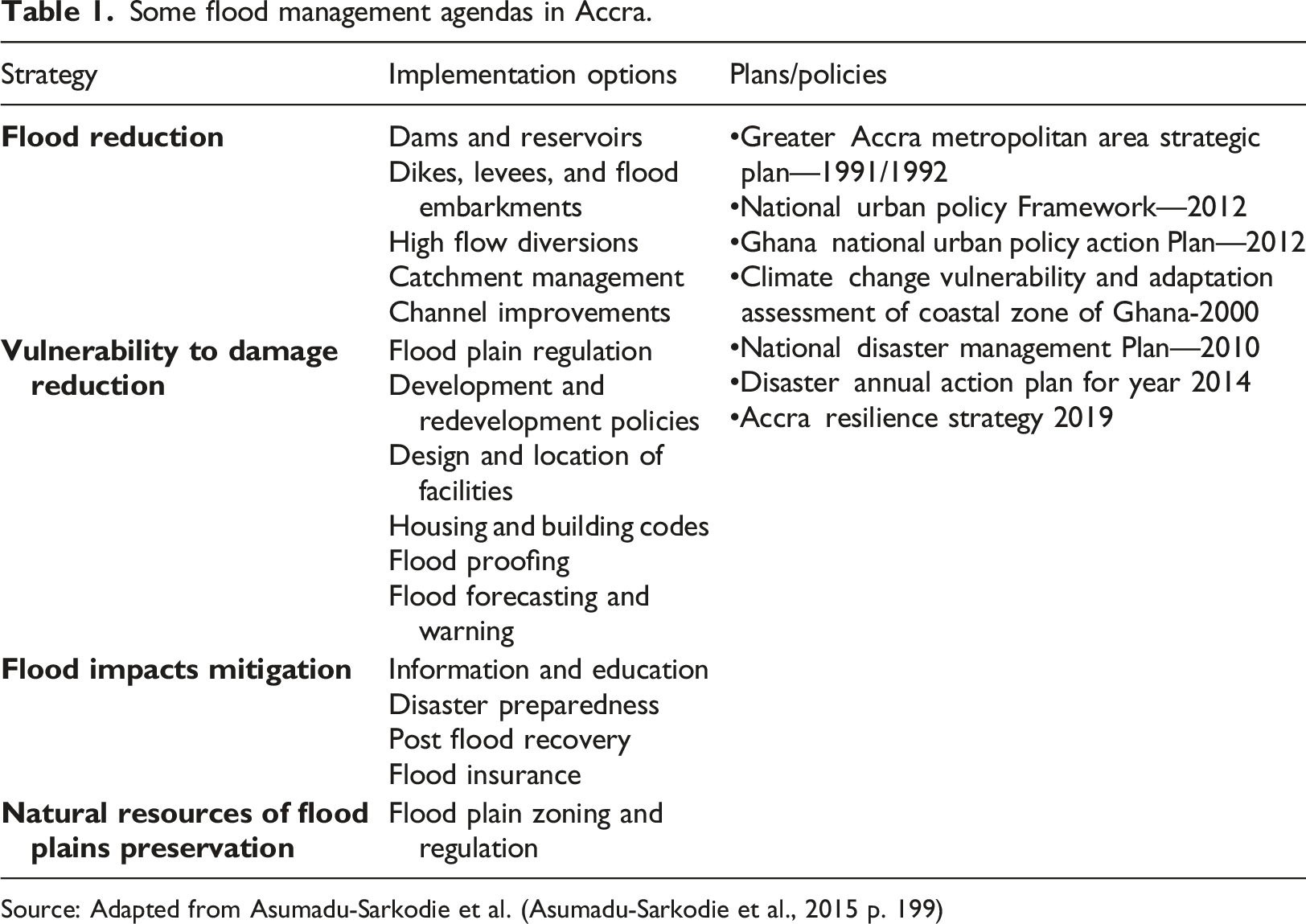
This study focuses on Ghana using Accra – the largest city and national capital – to understand why flood management agendas are ineffective in informal settlements. The location of Accra along the coastal belt and its flat landscape (Figure 1) predisposes it to frequent flood events which have become commonplace in informal settlements in Accra (Amoako, 2016). History of flood events and vulnerability in Accra dates to over 50 years ago (Karley, 2009), with major flood events becoming an annual experience and with a more severe impact (Amoako, 2017). Although, the vulnerability of the city and its defencelessness to flood risk seem to be a major worry to city managers and urban residents (see Amoako, 2016; Karley, 2009), considerable efforts have been made to resolve the perennial flood events in Ghanaian cities with little success (Amoako et al., 2019). While overall, emerging flood adaptation solutions can be categorized into four major strategic areas (see Table 1), flood management agendas in informal settlements are restricted to annual demolition of informal settlements perceived to be in flood prone zones; eviction of residents of informal settlements, and distribution of relief items (Amoako, 2016). Yet, these management agendas have not produced the desired outcomes. Geographical location of case study communities. Source: Amoako (2016) (p.9). Some flood management agendas in Accra. Source: Adapted from Asumadu-Sarkodie et al. (Asumadu-Sarkodie et al., 2015 p. 199)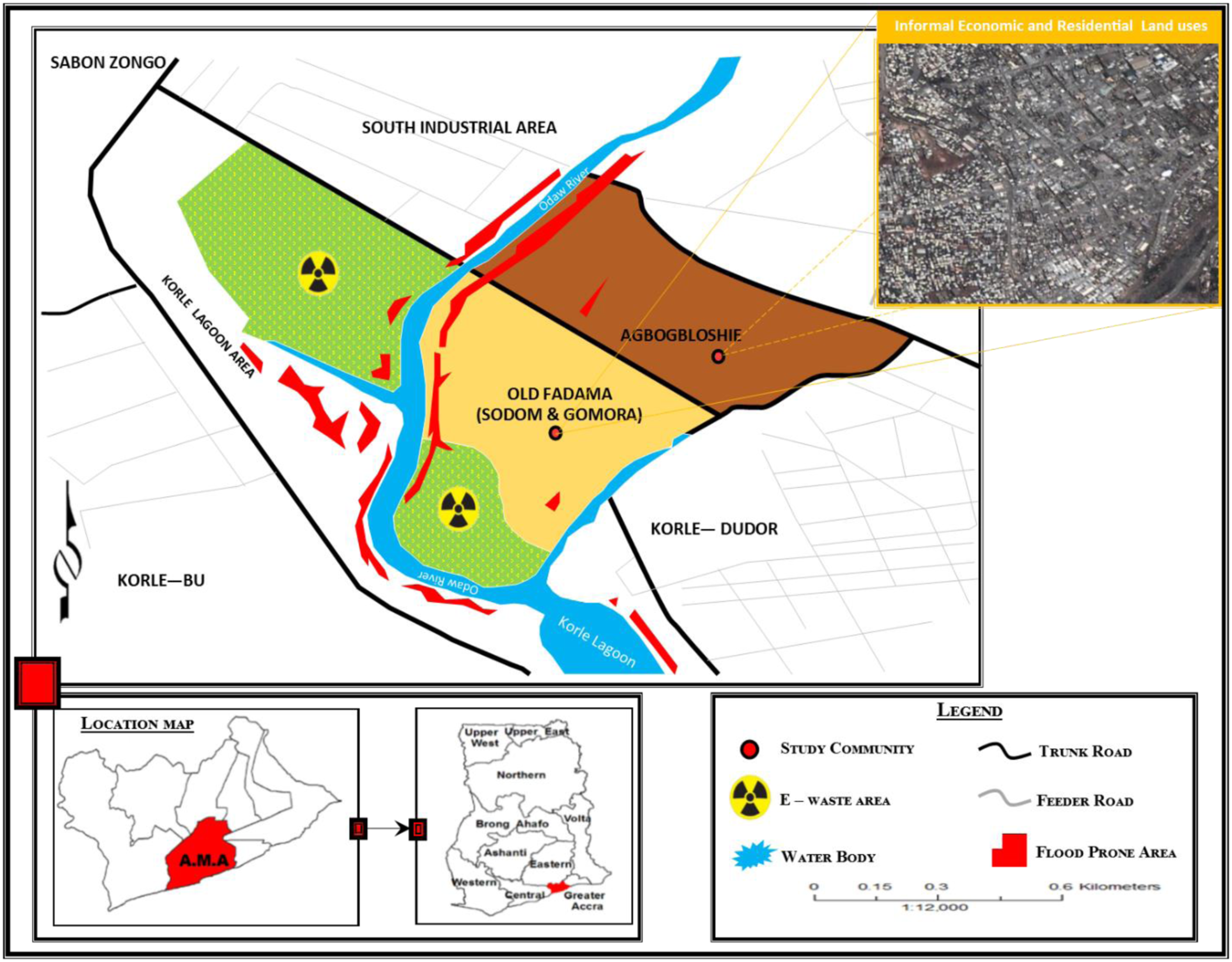
Accra was selected for the following reasons: (1) informality is the defining feature of Accra’s urban growth; (2) Accra has and continues to experience severe annual flood events; (3) The city is rapidly urbanizing with over five million population in the Greater Accra region (Ghana Statistical Service, 2021). Initial discussions with representatives of state institutions whose activities are related to flood and informality led to the identification of three major informal settlements located next to the Korle Lagoon and the Odaw River, including Old Fadama, Agbogbloshie, and Glefe. This research, however, focused on Old Fadama and Agbogbloshie informal settlements for the following reasons: (i) their neighbouring geographical locations (Figure 1), similar development characteristics and identical internal patterns; (ii) their exposure to same climate change and environmental related risks; (iii) availability of official data on their position as forming the largest informal settlement in the city of Accra (see COHRE, 2004; UN- Habitat, 2011); (iv) their location or occupation in a flood hazard area; and (v) severe exposure of residents to flood events.
Old Fadama and Agbogbloshie have a land size of about 31 and 115 ha respectively (Amoako, 2016; Farouk and Owusu, 2012). Bounded by the largest scrap yard in Ghana and exposed to over 15% of e-waste to Africa, fire outbreaks, flood, and other environmental hazards (see Boateng, 2011; Oteng Ababio, 2012), city managers have used evictions spurred by local media as flood management agenda(Grant, 2006). For more than two decades, residents of the two communities have received support from local and international non-governmental organisations (NGOs), mainly in the form of human rights advocacy, to resist forced evictions. But their exposure and susceptibility to flood risk, pollution from e-waste and poor environmental health conditions continue to increase. The area floods annually, displacing thousands of residents and livelihoods, causing damages worth thousands of Ghana cedis.
Research methods
Study respondents and documents reviewed.
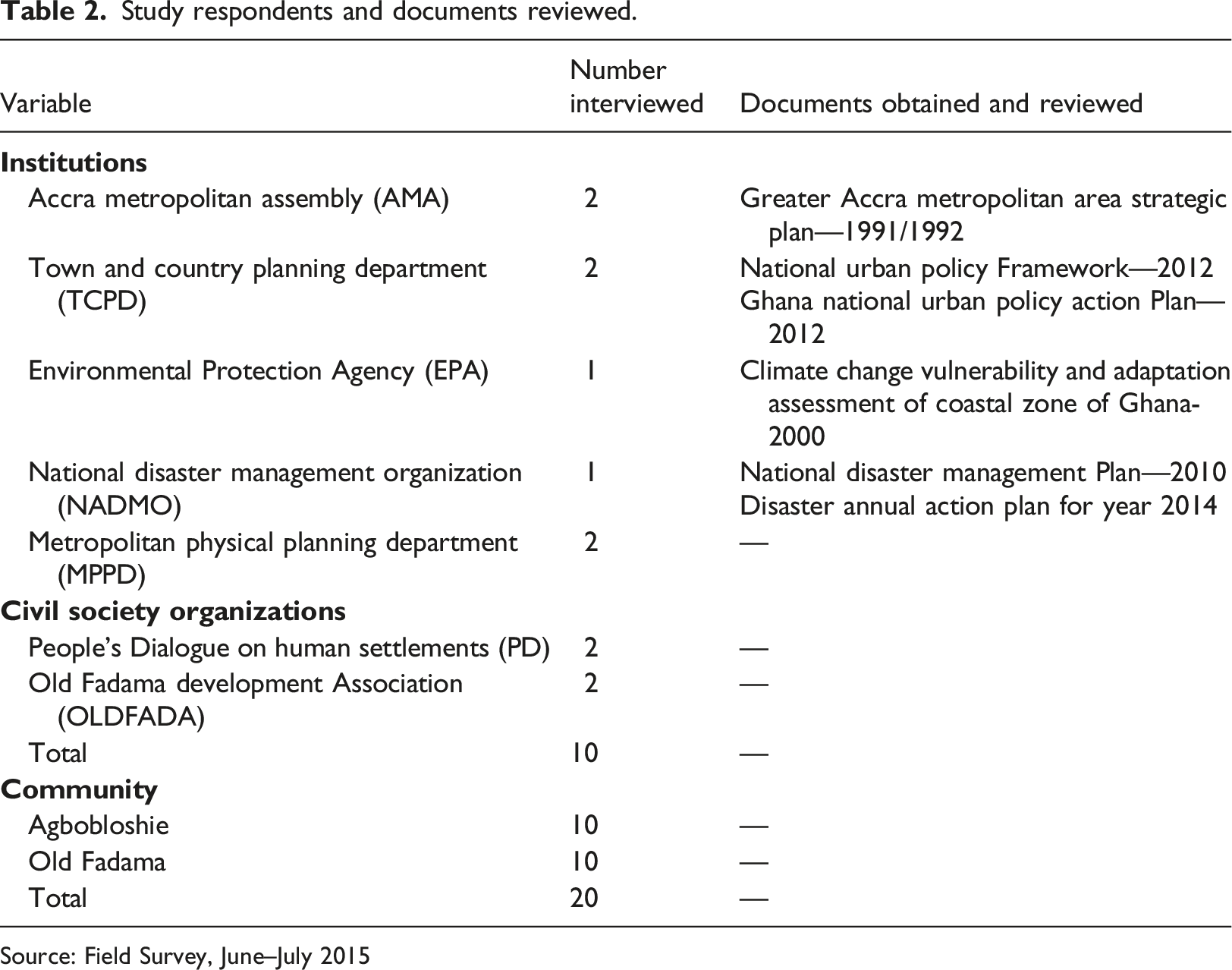
Source: Field Survey, June–July 2015
At the community level, two focus group discussions were conducted. One in each community, involving 6 to 15 participants in each session. The sessions comprised both males and females between 20 and 70 years who have lived in the communities for more than a year and have had an experience of flood events in their communities. The focus group discussions focused on understanding flood impacts and responses, based on community perceptions, experiences and knowledge.
Using NVivo 10 software package, content analysis was used to analyse the interview and secondary data. Codes and categories were developed using both inductive and deductive methods. Codes were inductively developed based on institutional and community participants perspectives on issues such as flood impacts, institutional and community responses, while categories such as the institutional management agendas for flood management in informal settlements were deductively generated based on the secondary data analysis. The codes and categories were merged and refined into more conceptual groupings using common themes to avoid possible discrepancies during data analysis (see Bryman and Burgess, 1994). The researchers’ understanding of the data set was increased, as the research participants perspectives on informality and flood management agendas reflected in the final categories. For instance, findings from the institutional interviews and secondary data were cross-referenced to examine the effectiveness or otherwise of flood management agendas in informal settlements.
Results and discussion
Annals of geographical precarity of informal settlements and the realities of flood events in Accra
Historical politics in the case study communities
Findings from the secondary data analysis and institutional interviews indicate that both Old Fadama and Agbobloshie communities have developed without land use planning. Interviews with the Town Planning Officials classified Agbogbloshie and Old Fadama into two types of informal settlements based on their historical development and the state’s description of their legality and tenure security. These are: (1) Agbogbloshie, officially recognised as an indigenous settlement by the Ga ethnic group, which due to, among others, poor urban planning has evolved as a major informal settlement; and (2) Old Fadama, regarded as a squatter human settlement that accommodates rural-urban migrants and located on an unoccupied public land. Given their geographical locations, all institutional officials interviewed highlighted that the two communities experience flood events from ‘normal downpour’ and the overflow of the Korle Lagoon and the Odaw River. The AMA official explained that Being officials of the AMA, we are fully aware of the fact that people living in Old Fadama and Agbobloshie have unpleasant experiences from floods events. Anytime Accra experiences any slight amount of rainfall, these areas become flooded. I want to also emphasize that the Korle Lagoon and Odaw River overflow their banks occasionally, thus, increasing the areas’ susceptibility to flooding.
Documents (e.g., Codjoe et al., 2014; Grant and Yankson, 2003) on the development of Agbogbloshie show that the community was established in the 1930s during British colonial government with its evolution flanking the European town, presently the CBD of Accra. The historical account of Agbogbloshie suggests a community that is characterised by spatial irregularity, with regards to inconsistencies ensuing between customary land tenure and the officially recognised urban planning practice instituted by the colonial administration. According to the officials of the Metropolitan Physical Planning Department, the dichotomy between the formally planned European town (a neighbourhood in Accra) and the informal Agbogbloshie was the foundation for the categorisation of formal and informal settlements: Because the European town was well planned based on the grid system of planning, and Agbogbloshie was left to develop organically, there were wide differences between the two communities. So, the planned community was called the formal area and Agbogbloshie was referred to as informal.
Although it was unplanned, Agbogbloshie was recognised by the British colonial administration as legal indigenous community. Grant and Yankson (Grant and Yankson, 2003, p. 67) describe Agbogbloshie as evolving as “congested, chaotic, and crowded with deplorable buildings and unhealthy conditions… pulled a considerable number of migrants, mainly from rural areas of Ghana and was detached” from the adjoining European town.
Three fundamental reasons were established for the informal growth of Agbogbloshie in the documents reviewed (e.g., Grant, 2006; Grant and Yankson, 2003), including the colonial administration’s disregard for urban planning in the informal settlement; locals’ resistance to proposed planning interventions regarding the transformation of the Korle Lagoon to the status of a harbour facility; and forced land acquisition by the state with the objective of providing commercial and industrial activities around the community. However, findings from the focus group discussions show that the general consequences of the history of Agbogbloshie have been negative, as there is limited provision of basic community facilities and services. In addition, data from the focus group discussion show the metropolitan assembly officials’ position of illegitimate spill over of the Agbogbloshie settlement into the riparian zones of the Korle lagoon and Odaw River further subject residents’ to increased flood hazards: In this locality, we do not have access to improved infrastructure, which I believe is obvious. The city management authorities (AMA) are of the view that we are occupying a flood plain and for that matter, we should not be provided with enhanced infrastructure and services.
The community’s position was underscored by the institutions that were consulted. Officials of the AMA reported that, earlier in the 1980s, Agbogloshie’s “illicit spill over” of developments, mainly housing, accounted for the emergence and subsequent expansion of Old Fadama community. Old Fadama is characterised as a squatter community located on land acquired by the state for the “Korle Lagoon Development” project (Grant, 2006: p. 9). But the Korle Lagoon Development project was halted after the overthrow of the first republican government of Ghana in 1966. Impolitely described as “Sodom and Gomorrah” by residents of Accra and elsewhere, Old Fadama received its initial migratory population in 1981 (Farouk and Owusu, 2012). Discussions with the Accra Metropolitan Assembly (AMA) officials reveal that city management officials paid less attention to the first settlers in the community as Old Fadama was regarded as “temporary and for that reason, the settlers would eventually move out of the community primarily because of the unavailability of basic infrastructure”. The Town and Country Planning Department officials provided an account of the intrusion of “Ghanaians that were repatriated from Nigeria between 1981 and 1983” as part of the first settlers of Old Fadama “with the consent of the then military government”. The document review (Afenah, 2009) shows that the city managers’ neglect of Old Fadama from its formative stages, significantly shaped its informal nature and subsequent growth.
Realities of geographical and political precarity to flood events in the case study communities
Since the turn of the 21st century, both Old Fadama and Agbobloshie have witnessed considerable growth facilitated by economic opportunities and affordable low-income housing to new migrants into the city. These communities have become the receptive hub for migrants in Accra looking for improved social and economic prospects. Institutional interview data suggest that the fast growth and development of these settlements was influenced, to a large extent, by “Ghana hosting the African Nations’ Soccer Tournaments in 2000 and 2008” and the socio-economic advantages generated through these tournaments, particularly for local (Ghanaians) and international (from other west African countries) migrants.
The informal growth and rapid development of these two communities have generated a series of demolition and force eviction pressures, with sections of the media calling for the relocation of these settlements, particularly Old Fadama (Amoako et al., 2019) usually supported by city managers. It was mentioned at the focus group discussion in Old Fadama that: There has not been a single year that we haven’t faced eviction… Once the media begins reporting on poor waste management and unplanned development here, then they (city managers) come and demolish our structures without given us any place to go.
Institutional interview findings show that the two informal communities are frequently perceived as one big slum with unending exposure possibilities, particularly in relation to flood hazards. The residents want to be recognised differently based on the tenure security and legality. During the focus group discussion at Agbogbloshie, a participant stated that: There is a well-planned layout (local plan) for the community’s physical development. But due to lack of regulation on land sales and encroachment, this place has become overcrowded. This community and Old Fadama are not the same … In Old Fadama, there is no plan for its development”
This quote explains the “legitimacy” and “legality” of Agbogbloshie as an indigenous community, separate from Old Fadama which is officially considered a squatter settlement. While the above quote was confirmed by the officials of the Metropolitan Physical Planning Department, the AMA officials believe these communities are both nuisance which required urgent removal by “eviction, relocation or redevelopment” to create available space for the planned Korle Lagoon Ecological Restoration project to commence. The AMA officials also consider the geographical location of these communities in flood plain zone as a fundamental indicator of flood risk, and the need for their relocation through eviction. The geography of the communities has a dual causality in terms of residents’ vulnerability to flood hazards: first, the location is often mentioned by city managers as a fundamental justification to undertake forced eviction exercises and/or redevelopment; second, the location is considered by residents as the major cause of flood hazard. One participant of the focus group in Old Fadama commented that: “We share the opinion that the position of our community primarily exposes us to annual floods. City managers ought to offer us instance to mitigate and adjust to annual flood events, rather than using flooding as the rationale to evict us. They fail to provide alternative places for habitation, which is not fair.
According to the residents, these two communities have become hotspots for perennial floods since 1986. Participants at the focus group discussions in the two communities also revealed that floods are caused by poor waste management practices – household wastes are dumped into local storm drains. These drains exceed their capacities during heavy rains and overflow. Through interviews, we categorised flood events into two: normal and devastating. From the perspectives of residents, a flood event is normal when there is no reported incidence of loss of human life, destruction of an important infrastructure, and life and livelihoods return to normalcy immediately after the flood event. The devastating flood event entails loss of human lives, displacement of households and destruction of domestic items; destruction of key community infrastructure; such that social and economic activities in the communities are halted for several days, generating wide media attention.
Aside dominant attribution of flood hazard to geography, residents attributed flood risk to the internal design of their communities. Mentioning haphazard and unplanned development, non-adherence to urban planning requirements leading to reclamation of nature reserves (e.g., wetlands, riparian zones of rivers etc.), and poor waste management practices, the residents expressed concern about the degree of unregulated informality of their communities which predispose them to flood risks. Rooted within these community reported causes of flood risk is the abandonment and non-appearance of the city managers in providing support, for example, in flood management infrastructure.
City-led flood management agendas in the study communities
As discussed in the previous section, there are several flood management agendas in Accra. Yet, focus group discussions in the two communities indicate that city-led flood management agendas in the informal settlements are reduced to evictions and demolitions. A key remark a focus group discussion participant in Old Fadama made about the magnitude of floods indicates the tangible impacts on residents and the socio-political tensions in the communities. The greater the magnitude, the faster the demand for compulsory evictions. These threats, according to an opinion leader at Old Fadama: lasts for a period of about a month… following this, there is practically no element of government presence in the affected communities.
However, institutional consultations revealed opposing views. For example, the Roads and Drainage Maintenance Unit of the AMA has occasionally undertaken flood reduction approaches such as construction of drains and the demolition of illegal structures on waterways to improve water flow: On the television and on the radio, you will see and hear that AMA is embarking on a cleaning exercise in Accra to reduce the city’s exposure to flooding. We usually do undertake eviction and demolition exercises when there need be.
The final approach that relates to the demolition of illegal settlements has been a major source of worry for residents. However, residents on many occasions, have withstood such efforts by the AMA. One focus group participant in Old Fadama said: “For more than 20 times, they have destroyed our buildings and we will always come back. They are fully aware of the fact that they cannot just evict us without making provisions for an alternative location for us to settle.
Interview findings show that AMA manages waste, both liquid and solid, in a bid to prevent the incidence of flooding in Accra. However, despite claims by the AMA, waste management challenges are rife in major Ghanaian cities, including Accra (see Cobbinah et al., 2017; Owusu, 2010).
The Metropolitan Physical Planning Department has been undertaking development control and spatial planning in Accra to preclude unapproved physical development in water ways. The department, functioning under a recently enacted legal provision, the Land Use and Spatial Planning Act, Act 925 (2016), is charged with the responsibility of promoting sustainable community development. The act establishes the Metropolitan Spatial Planning Committee, among others, with the responsibility of managing the annual floods. Yet, recent opinion indicates that the ongoing urban planning practice in Ghanaian cities (see Cobbinah and Darkwah, 2017) distorts, contradicts, and conflicts urban resilience philosophy (see López-Marrero and Tschakert, 2011; Norris et al., 2008). The National Disaster Management Organisation (NADMO) office in Accra, which is a sub-unit of the AMA, owes strong allegiance to their headquarters. This allegiance constitutes a potential institutional conflict. Interview conversations held with NADMO officials show flood readiness plan and reduction strategies employed by the Organisation in managing flood risks in Accra. This entail: • Trips to sensitize and analyse the degree of residents’ commitment to managing flood disasters in relation to preventive or mitigation measures. • Mobilising support in the form of finances and logistics from NGOs, development partners and Community Based Organizations (CBOs). • Provision of information on imminent disasters to create awareness among residents, often via the popular media (e.g., radio and television station). In collaboration with other agencies, NADMO collects relevant information to help communities prepare for possible flooding events. • De-silting and clearing storm drains before the rainy season. Facilitating the movement of persons and assets from flood affected areas. • The NADMO office also co-ordinates initiatives that relates to flood responses.
During the interviews, institutions such as Ghana Meteorological Agency (GMA), Ghana Health Service (GHS), Environmental Protection Agency (EPA), Hydrological Services Department (HSD), the Red Cross Society, 48 Engineers Regiment and other private voluntary organisations were identified to have collaborated with NADMO. Yet, some studies (e.g., Amoako, 2016; Cobbinah et al., 2017) have raised questions about the degree and efficacy of partnership amongst metropolitan and flood management agencies, particularly in informal settlements. As a result, it was expected that in evaluating the extent of success or otherwise of flood interventions at Agbogbloshie, a community leader asked: “if they have achieved any success, why do our communities get flooded every now and then?” The government and city managers’ duty in flood management has been uncertain and inconsistent within their various ministries, departments, and agencies (MDAs).
Overall, the study unveiled three approaches by city managers in addressing flood events in informal settlements. First is the limited participation by city managers in the delivery of storm drains or disbursement of relief items. Next, city-led intervention has usually taken the form of warnings or destruction of housing units perceived to be in water ways. These forced evictions and demolishing activities have warranted criticisms from international organisations such as Centre for Housing Rights and Eviction (COHRE, 2004) and Slum/Shack Dwellers International (SDI) that have supported affected residents to resist such decisions by city managers. The third approach of the city managers in flood intervention in informal communities has been absolute disregard or the rare community sensitization and supply of relief items.
Residents of informal settlements response to city-led flood management agendas
Results from the research indicate that residents of Old Fadama and Agbogbloshie have a good knowledge about their defencelessness to flood risks. They seem to show no element of interest in public education offered by institutions of the state such as the NADMO, EPA, and AMA. Interestingly, a considerable number of the residents mentioned that these public institutions must instead be enlightened on the effective means of delivering infrastructure and services for managing floods and improved quality of urban housing for the residents.
Participants of the focus group discussions in both communities have a somewhat good recollection of flood events, as well as deeper insights in to the processes that influence their level of exposure to flooding, even more than it is often reported in flood hazard analysis literature. For example, Cannon (Cannon, 2000, p.47) explains that both local and national government institutions responsible for disaster management describe flood-related problems in ways that best suites them and prescribe “solutions in terms of what is feasible and not what is actually required” by affected residents and communities. Residents of Old Fadama and Agbobloshie were of a divergent view as they regard their openness to flood hazards as a course entrenched in their daily lives and as a result, their understanding and recollection keeps advancing: I have stayed, worked, and married in this community for more than a decade. This is our place of abode; this is where we undertake and sustain our economic activities … the AMA must take notice of this fact.
Residents of the case study communities act against compulsory eviction by city managers, while making provisions for essential facilities and services. Findings from the focus group discussions suggest that residents of Old Fadama and Agbogbloshie are proactive in the social and political front, in terms of having formidable organisations that offer assistance in managing flood hazards. As a result, the communities’ ability to respond to floods have advanced by way of sustained progress in households’ capacity to respond as well as the coming into force of CBOs and NGOs that are actively involved in self-help initiatives. Based on the stock of available social capital, these locally based organisations have developed collaborations with some international institutions that are development oriented. However, results of the research indicate that the capacity of the community to respond to flood events is unequal between the two communities. In the context of Old Fadama, for example, it appeared relatively well-organised and proactive, and offered assistance by CSOs (Afenah, 2009; CORHE, 2004) and had effective structures for local mobilisation. Agbogbloshie, as an indigenous community, is organised along their distinct customary and/or traditional lines.
Through their evolving social capital, residents of these settlements have made significant strides in avoiding numerous compulsory eviction exercises instituted by city managers. A participant in Agbogbloshie mentioned that: “We have native organisations which socially bind us to make us a united front, on the political front, we are formidable. Even, some influential international human rights groups. … We have no intentions of leaving this community, until the state finds us an alternative place. It is quite unfair for the authorities to evict us from a place we conveniently describe us our home”
This finding shows that the communities are continuously changing flood hazards response capacity using available and easy access to social resources such as community-based organisations. With the engagements with the community-based organisations, residents of the two communities have developed social capital, learning and innovations in their flood responses. The capacities of these communities are not fully developed and harnessed, but these capacities still constitute the foundation for ongoing responses to flood events.
Discussion
This research shows that city-led flood management is extremely inefficient in informal settlements in Accra and may reflect the situation across many African cities. It is understandable to argue that personal and logistical constraints, complex land tenure system and urban planning inadequacies in Accra are in themselves fundamental reasons for inefficiencies in flood management agendas. Although this is partly accurate, many authors (e.g., Banks et al., 2020; Chen et al., 2006; Nunbogu et al., 2018) have asserted that unhealthy attitudes of city managers towards urban informality, frequently characterizing it as an aberration, has contributed to inadequate, poor, and ineffective flood management agendas in informal communities. Accra, in effect, is defined by this kind of institutional culture that consider planned neighbourhoods as areas requiring more attention, and informal settlements as nuisance or problem zones.
Most importantly, however, this research recognizes the effect of limited recognition of cities as complex systems in Accra. Cities as complex systems framework involves the understanding of providing equal opportunities and important cultural, spatial, social, economic, and environmental services and infrastructure for all residents across the city to maintain the functionality of the urban space and promotes urban sustainability and resilience (see Allen, 2012; Batty, 2008). However, the increasing ‘absence’ of effective city-led flood management agendas in informal settlements results in worries, paradoxes, and clashes in Accra. First, informal settlements are left to develop sporadically in flood prone areas with little or no city-led interventions, largely due to limited regard of the urban landscape as a set of complex system. In some cases, the actions of the city managers can be blamed for the unregulated growth of informal settlements. An example is state acquisition of the land around the Korle Lagoon; and the state’s refusal to develop it. With no state interventions, residents of these flood affected communities invest their limited household incomes in sub-standard houses. Businesses are built and livelihoods established, emphasising Banks et al. (Banks et al., 2020) description of informality’s tenacity. Second, city managers in responding to flood hazards in the informal settlements, adopt forced eviction and demolishing as the main flood management tool. These responses are not coherent with the complex systems theory, which focuses on building community resilience. Third, what city managers consider important in managing flood events through the supply of relief items and political visits do not lend credence to the understanding of the theory of cities as complex systems. Expectedly, these government interventions have not achieved the desired results. Even with relief item distribution after flood events, there are reported cases of limited transparency.
The purpose of this study is different from previous research on informality and urban flood management in the Global South in that it has drawn on cities as complex system framework to analyze informality and flood management agendas to uncover foundational reasons accounting for ineffective flood response. But it also supports more broad findings that flood management agendas in developing country cities are producing limited positive outcomes (Adelekan, 2016; Amoako et al., 2019; Luo et al., 2015; Samu and Kentel, 2018) and that informal settlements remain the most affected and vulnerable in addressing urban flooding (e.g., Amoako and Frimpong Boamah, 2015; Douglas, 2017).
In writings on urban informality and flood management, the politics of city managers responding equitably and responsibly is contested (Adelekan, 2010; Amoako, 2016). Findings from this study shows that the posture and flood management agendas of city managers show some strong ties between the state’s agenda and definitions of the settlements’ status as formal or otherwise. While recognising these city-led flood management agendas have co-evolved over the years with informal urbanisation (see Amoako, 2016; Korah and Cobbinah, 2017), they have broadly been unsuccessful because the basic causes of informality have not been tackled. In the city of Accra, these among others include complex urban land administration systems between the government and customary landowners, deficient community infrastructure, lack of affordable quality housing and inadequate sustainable livelihoods for poor urban residents. The failure of city-led flood management agendas in informal settlements has led to the emergence of non-state actors in the communities and the co-evolution of their capacities to address issues of flood hazards.
This study demonstrates that the community’s responses to flood events are framed by their constant connections and capabilities, exhibited in their political and socio-economic contexts such as accessing indigenous knowledge, political power, as well as self-organisations (Nunbogu et al., 2017). Findings show that clean-up activities and the constructions of temporary drainage systems to direct flood are founded on self-organisation and social capital. Through native expertise with varied flood consequences, community volunteers facilitate the evacuation of flood affected people to safety during flood events. However, the issues discussed here make effective city-led flood management agendas in informal settlements a distant dream in Accra. Poor attitude of city managers towards informal settlements is clearly not the only reason for the ineffective flood management agendas in Accra. As discussed in the introduction section, urban flood management in informal settlements in Africa is also faced with the threats of climate change and rapid urbanization amidst urban planning system inadequacies.
Conclusion
This paper examined foundational reasons for unproductive flood management agendas in informal settlements. Findings show that geographical precarity of informal settlements is complicated by politics of selective response, contributing to ineffective city-led flood management agendas. Understanding of, and actions towards cities as complex systems requiring inclusive flood response are lacking in Accra. Overall, residents of informal settlements are gradually embracing the reality that city managers do not promote their interests in addressing perennial flood events. In turn, the flood management outcomes that policies and plans ostensibly seek to achieve have only been modestly realised. Instead, flood management agendas have had perverse implications for residents of informal settlements.
This study makes three important policy recommendations for developing inclusive and sustainable urban futures: a. Rethinking urban planning and exposure to natural hazards through participatory urban planning system. This will entail higher levels of participation of flood affected residents in planning their communities, rather than relying on the current media notice of evictions. b. Harnessing community capacities for flood management. Local abilities could be improved via capacity building, collaboration, inter-organisational learning, and transfer of resources into local communities. When the capacity of the community is developed, it provides value to government agencies, CSOs, and the urban residents, particularly in flood hazard management. c. Changing role of city managers in managing flood hazard. City managers’ role could be improved through the two recommendations. With an improved urban land use planning that incorporates the dynamics of informal settlements and the exploration of community capacities for flood management, city managers in Accra, and other African cities will be well placed to bridge the trust gap existing between them and residents of informal settlements. As a departure from direct involvement of the city managers in managing flood, there are other ways through which city managers could formulate and implement policies and programmes to address urban flood hazards which are not directly related to flooding. In most African cities, these initiatives relate to eradication of urban poverty and marginalisation.
A considerable commitment to creating an inclusive and resilient Accra and other African cities demands a consideration of these recommendations which are based on the cities as complex systems framework.
Footnotes
Declaration of conflicting interests
The author(s) declared no potential conflicts of interest with respect to the research, authorship, and/or publication of this article.
Funding
The author(s) received no financial support for the research, authorship, and/or publication of this article.
