




Abstract
Multi-objective ecological restoration has the potential ability to provide social-ecological benefits according to different demands, contributing to sustainable development. However, the current multi-objective ecological restoration strategies are mostly dependent on supply-based benefits assessment for ecosystem services enhancement and tend to ignore the priority in different social-ecological systems. We discuss three questions, including why it is important to distinguish primary and secondary weights of ecological restoration objectives; what relationships exist between ecological restoration objectives and ecosystem services across scales; and what the future influences of regional development are on the social-ecological benefits after ecological restoration. Under the four perspectives of supply–demand matching, cost–benefit matching, global–local matching, and present–future matching, we emphasize the need for new approaches in the enhancement of prior ecosystem services to meet global and local demands of current and future social-ecological benefits in ecological restoration. Multi-objective ecological restoration should further emphasize quantifying the dynamics of ecosystem services supply and demand under different ecological restoration objectives, and prioritize the temporal characteristics of the trade-off between multiple benefits of ecological restoration to evaluate long-term benefits with upfront economic costs. Moreover, it is necessary to explore how to establish a regional or global unified market depended on the payments for ecosystem services in ecological restoration.
Keywords
Introduction
Ecological restoration, as a solution to global challenges such as climate change mitigation and biodiversity decline (Chazdon et al., 2016; Crouzeilles et al., 2017), can provide multiple social-ecological benefits that contribute to sustainable development goals (SDGs) (Griggs et al., 2013; Ferranti, 2019). To achieve the “multi-win” goal of benefits in ecological restoration with a social-ecological system perspective, social and economic objectives have been gradually incorporated into the assessment of ecological restoration benefits (Fischer et al., 2021), such as the income level and health status of local residents (Kiely et al., 2021), and trading of emission rights (Salzman et al., 2018). If these ecological restoration measures can reasonably distribute social-ecological benefits according to different demands, they will greatly improve the sustainability of local social-ecological systems (Di Minin et al., 2022; Erbaugh et al., 2020).
Ecosystem services, defined as the material or immaterial benefits people receive from nature, represent an interface between ecological and social systems (Diaz et al., 2015; Felipe-Lucia et al., 2022). Mapping ecosystem services can provide spatially explicit information for the benefit of assessment in ecological restoration (Liu et al., 2018). Here, however, we argue that the current multi-objective ecological restoration strategies are mostly dependent on supply-based benefits assessment for ecosystem services enhancement, and tend to ignore the priority of different social-ecological systems (Qiu et al., 2022). For example, developing regions may demand habitat conservation services more than developed regions, yet this demand will not be well documented in local supply-based benefits assessment when provision services are strongly promoting the economy in the developing regions (Yan et al., 2022) . The strategy of increasing the number of ecological restoration objectives often causes a decrease in gains for local dominant ecosystem services in the process of ecosystem service trade-offs; and the mismatch between ecosystem service supply and demand may reduce the efficiency of ecological restoration and even intensify social conflicts in local social-ecological systems (Wang et al., 2019).
We tend to explore the current problems of multi-objective optimization in ecological restoration, mapped in the relationship between different ecological restoration needs and ecological restoration measures, by sorting out the primary and secondary relationships, supply and demand relationships and spatio-temporal relationships among ecological restoration objectives. We propose that attention should be given to the identification of prior ecosystem services in local social-ecological systems, based on the quantification of ecosystem service trade-offs among different restoration objectives, the anticipation of dynamic of ecosystem service supply and demand, and the establishment of a regional or even global unified market for the payments for ecosystem services. We believe it would create efficient solutions with sustainable social-ecological benefits from multiple ecological restoration objectives by understanding the prior ecosystem services.
The ecosystem service trade-offs in multi-objective ecological restoration
Literature selection
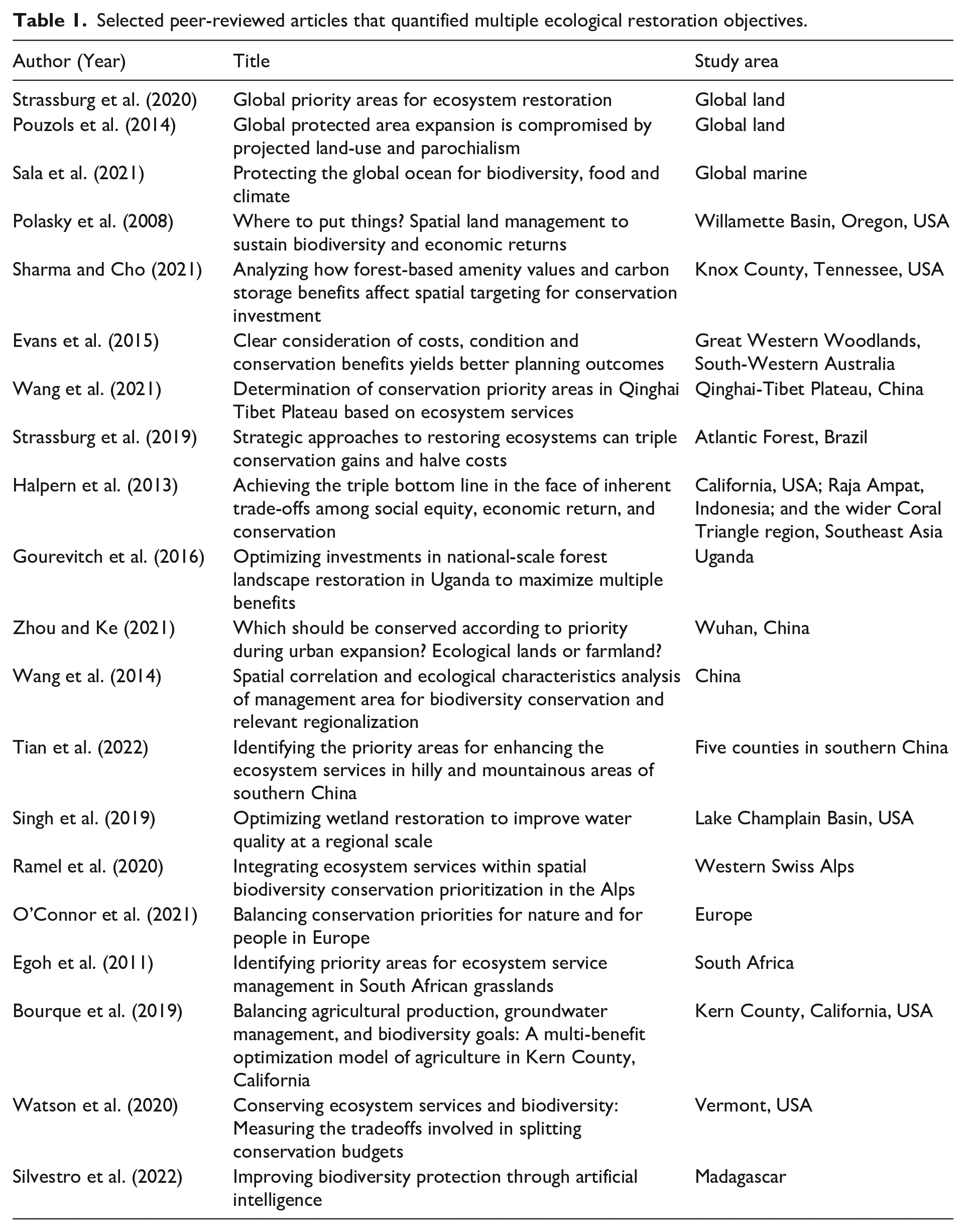
We used “ecological restoration priority areas”, “ecological protect priority areas”, “multi-objective optimization”, “ecological benefits”, “social benefits” and “economic benefits” as the field selection rule (the specific search rules is PY=2007 AND TS=“ecological restoration priority areas” AND “ecological protect priority areas” AND “multi-objective optimization” AND “ecological benefits” AND “social benefits” AND “economic benefits”). Three criteria were used for inclusion: first, the literature must be a research paper; second, the optimization of ecological conservation or restoration must include two or more objectives; and third, the literature must include an analysis of trade-offs between objectives. We searched 322 papers on Web of Science and analyzed them using three conservation or restoration objective dimensions: biodiversity (related to supporting services), socio-economics (related to provision services), and climate mitigation (related to regulating services). These ecological restoration objectives include most of the ecosystem services used to cope with current major global challenges in the Paris Agreement (Kiely et al., 2021), the Convention on Biological Diversity (Silvestro et al., 2022), and the Sustainable Development Goals (Palfrey et al., 2022). We selected 20 peer-reviewed journal articles published in the last 10 years that quantified multiple-objectives optimization and compared with single-objective optimization (Table 1). We calculated the objective achievement rate of each ecological restoration objective by using “the achievement of a single objective in multi-objective optimization” percentage in a study, divided by “the achievement of that objective in single-objective optimization” percentage in the same study . For example, if the achievement rate of biodiversity objective in single-objective biodiversity conservation is 50% enhancement, and the achievement rate of biodiversity objective in multi-objective optimization is 40% enhancement, the objective achievement rate of biodiversity objective in that study should be 0.8 (i.e., 40% divided by 50%).
Selected peer-reviewed articles that quantified multiple ecological restoration objectives.
Quantifying ecosystem service trade-offs in ecological restoration
The multi-objective optimization with the supply-based benefit assessment reflects an idealistic and formalistic view of the decision-making process, as it assumes the restoration process can provide an efficiency-maximizing solution by balancing the multiple social-ecological benefits for ecosystem services enhancement. However, similar to the recent mathematical analysis that suggested an increase in the number of objectives and stakeholders can reduce the possibility of win–win outcomes (Hegwood et al., 2022), the relevant 20 assessments show that increasing the number of objectives simultaneously reduced the benefit from the single-objective optimization in ecological restoration (Figure 1). Thus, the ecosystem services trade-offs apparently exist in multi-objective ecological restoration.
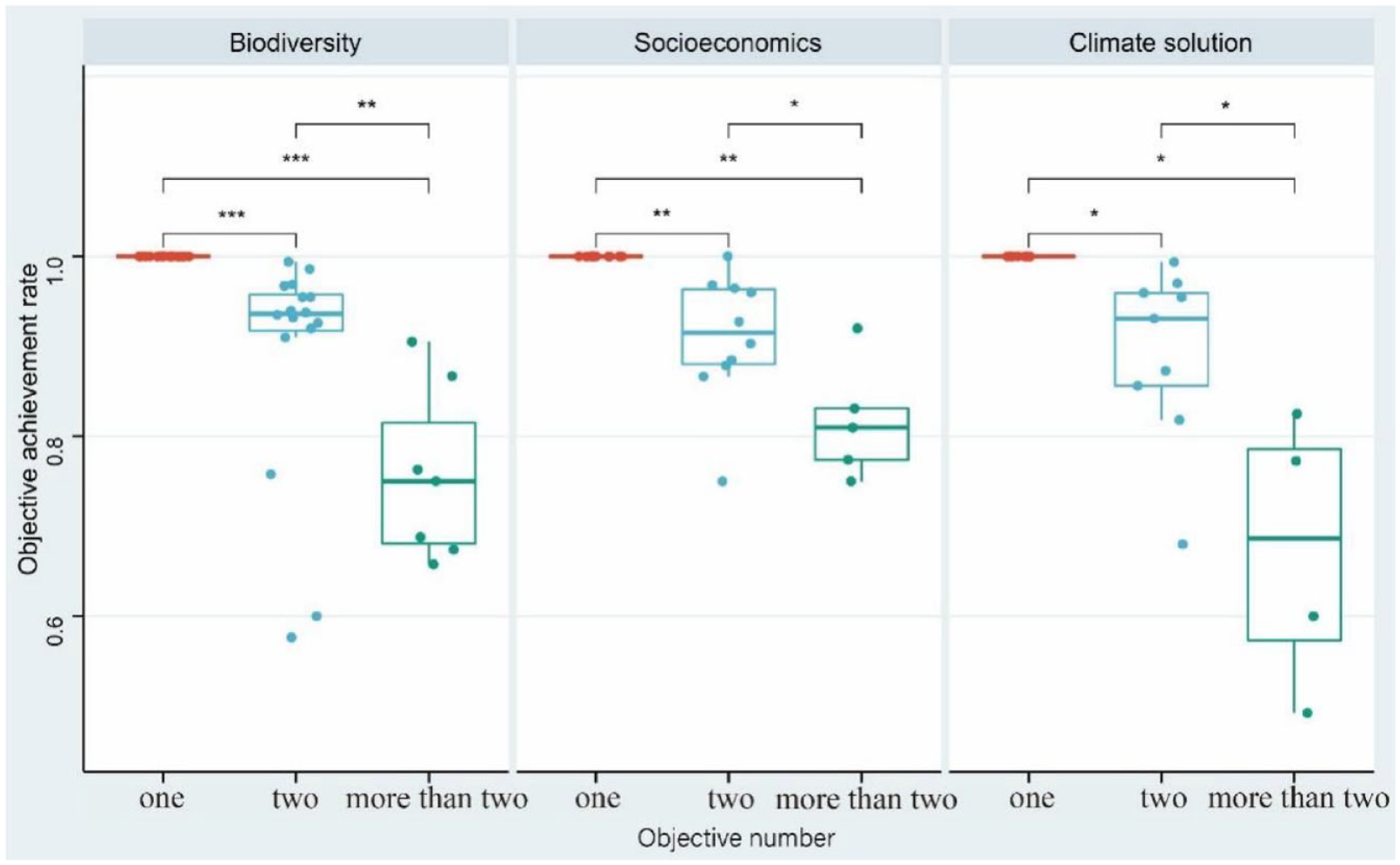
The objective achievement ratio decreased with the increased number of ecological restoration objects. The statistical results show that there are significant intergroup differences (***p < 0.01; **p < 0.05; *p < 0.1).
Within the practical requirements of increasing the operability of ecological restoration, the inclusion of constraining objectives, such as restoration costs, land tenure, and regional conflicts, is expected to continue to reduce the benefits for some important ecosystem services (Zeng et al., 2020). In this process, ecological objectives are more likely to lose out than socio-economic objectives due to the concerns of economic feasibility, e.g. the expansion of oil palm plantations in Malaysia and Indonesia at the cost of forest carbon sequestration (Xu et al., 2022). This deficiency will be even more pronounced when considered from a global and national relational perspective in multi-objective ecological restoration. This is because, in the absence of uniform and recognized goals for domestic ecological restoration and the lack of synergistic cooperation among countries, the ecosystem services trade-offs in social-ecological systems will vary greatly among countries. This is due to the differences in their restoration directions, target requirements, political conditions, economic levels, and resource stocks; and these differences among social-ecological systems may change along regional development progresses (Wu et al., 2022).
The lack of consideration for prior ecosystem services (supporting, regulating, provision or culture) among restoration objectives in different places will lead to ambiguity regarding what local social-ecological benefits will contribute to the global ecological restoration objectives. A large number of tree plantations in Africa, South America and Southeast Asia are dominated by economic forest (Ziegler et al., 2009), resulting a trade-off between provision service in local economic development and supporting service in habitat restoration. To address the urgent global challenges of climate change, land degradation, and biodiversity loss, the overemphasis on the number of objectives and multiple benefits for ecosystem services enhancement in local social-ecological system should be rethought. Although we have some understanding of the benefits of considering multiple objectives (Strassburg et al., 2020), the current challenge is seeking greater efficiency in achieving ecosystem services, which requires a view of the importance between ecological restoration objectives, as well as the cross-scale perspective and developmental perspective.
Key issues for understanding prior ecosystem services
Here, we discuss three key issues to understanding the priority of ecosystem services among ecological restoration objectives that gain long-term benefits, including: why it is important to distinguish primary and secondary weights of ecological restoration objectives (Figure 2a); what relationships exist between ecological restoration objectives and ecosystem services (Figure 2b); and what the future influences of regional development are on the social-ecological benefits after ecological restoration (Figure 2c).
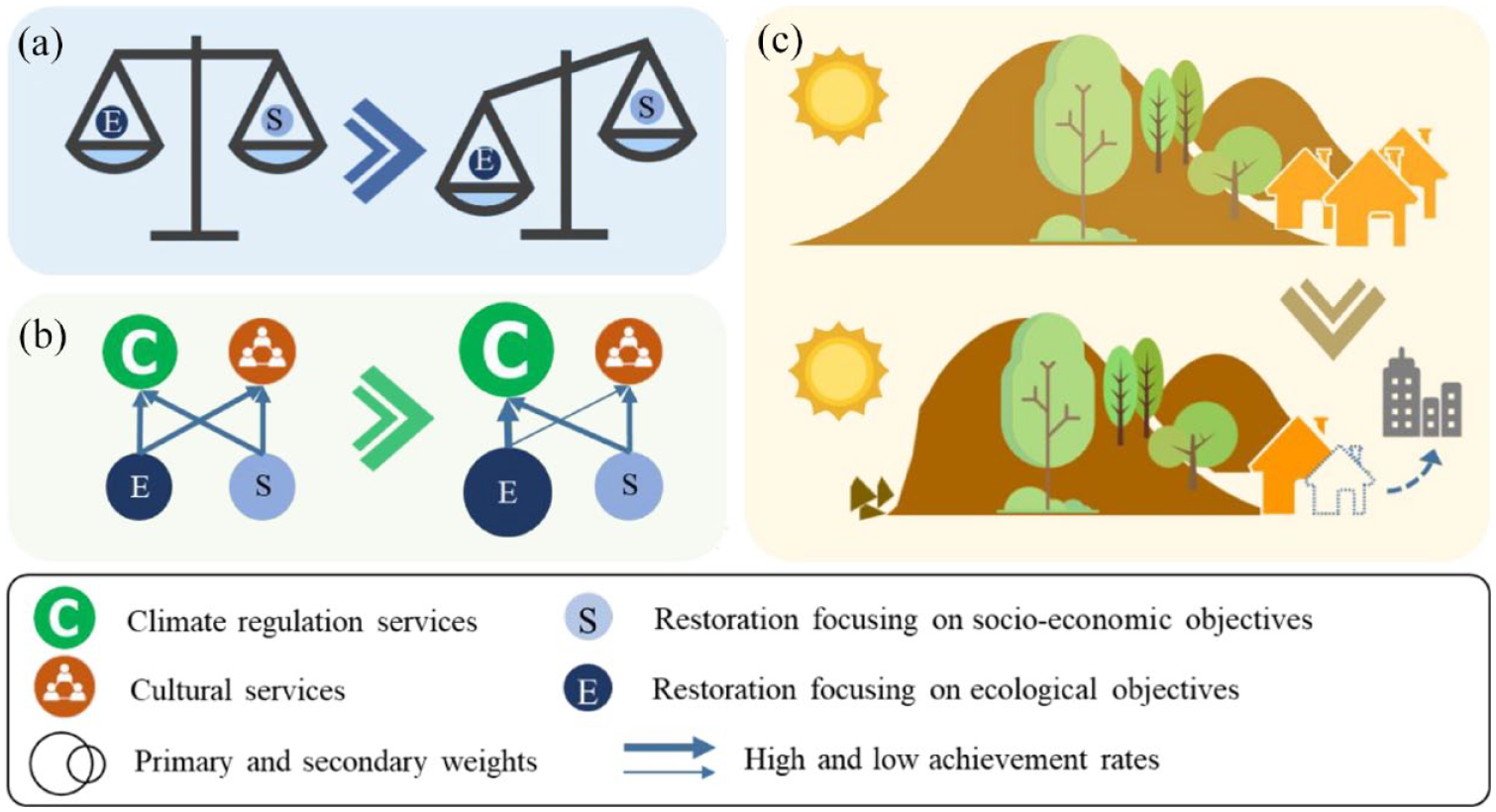
Three key issues for understanding the priority of ecosystem service in social-ecological systems. (a) Transition from balanced ecological restoration objectives to primary and secondary objectives; (b) relationships between different ecological restoration objectives and ecosystem services; (c) the dynamic impact of future regional development on social-ecological benefits after ecological restoration.
Primary and secondary ecological restoration objectives
Some ecological restoration objectives are shared globally, such as the Paris Agreement’s atmospheric cooling objective and biodiversity conservation objective (Carroll et al., 2022; Meinshausen et al., 2022). However, this does not mean that every place can contribute to these objectives from the supply-based benefits provided by multi-objective ecological restoration. Taking the global challenge of habitat conservation as a case, almost half of the 32,000 terrestrial vertebrate species currently extant are restricted to a few countries (Meinshausen et al., 2022). The responsibility for global biodiversity conservation, the need and suitability of areas for protected zone expansion, and the level of threatened biodiversity may vary markedly between countries (Yang et al., 2020). As the main responsibility for biodiversity conservation is concentrated in developing countries and regions with different conservation policies (Zhu et al., 2021), the supply-based benefit – especially the socio-economic benefits to indigenous populations - often present a trade-off with global biodiversity conservation challenges. According to local demands, part of the ecological benefits may not directly impact the social system or indirectly improve human wellbeing through the enhancements of some ecosystem regulating services, due to the lack of necessary inputs and transmission methods (Campos-Silva et al., 2021). Therefore, we argue that the current approaches of multi-objective optimization in ecological restoration are limited to the calculation of the amount of social-ecological benefit and the downplay of priority. Highlighting the benefits of global and local primary objectives while meeting the specific needs of the local secondary objectives could provide guidance for multi-objective optimization in ecological restoration.
Relationships between ecological restoration objectives and ecosystem services across scales
We summarized the benefit supply and demand patterns for different ecological restoration strategies and divided them into nine categories (Figure 3). We design a hypothesis that includes two types of countries, namely resource-rich but less developed country “E” and resource-poor but developed country “I”, in which we consider the possibility of economic cooperation between countries (Wang et al., 2022b). Different countries have their own ecological restoration objectives, and we specified two main restoration objectives in our hypothesis, namely socio-economic and ecological objectives, assuming that the pursuit of ecological objectives in “I” will slow down regional development (Wang et al., 2022a), while in the pursuit of socio-economic objectives in “E”, although hardly contributing to biodiversity, could promote the emergence of economic industries with supply capacity, such as commercial forests would contribute to carbon sequestration and climate regulation (Hua et al., 2022). The size of the ecosystem services icon represents the priority of restoration objectives from the perspective of local demand, while the size of the restoration objectives represents the priority of restoration objectives from the perspective of supply.
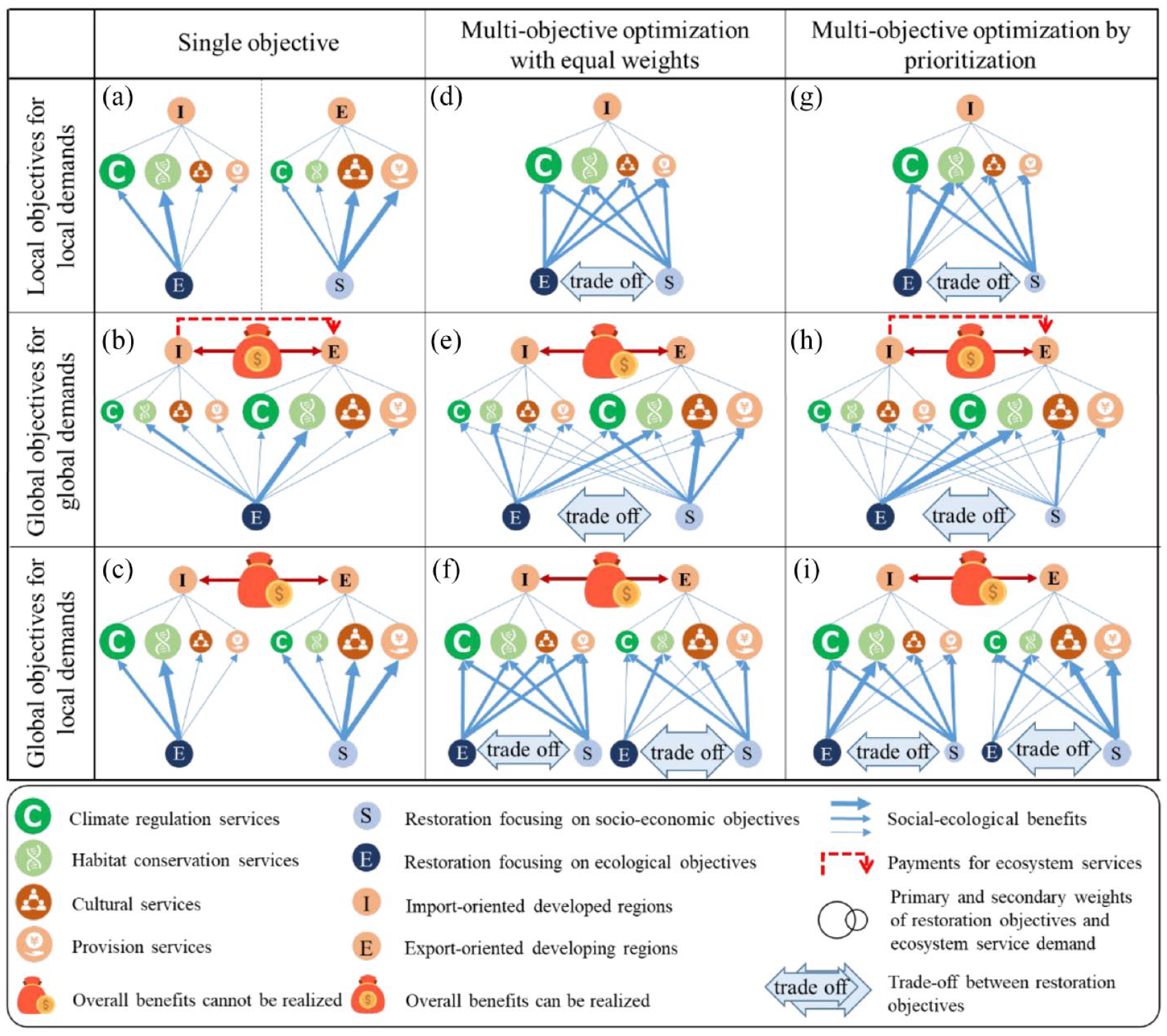
Relationships between different ecological restoration objectives and ecosystem services.
The first three categories indicate ecological restoration focusing on a single objective. At the local scale, only corresponding ecosystem services can be enhanced by either ecological objectives or socio-economic objectives with low restoration efficiency, e.g., the provision services of a resource-rich but less developed country and the climate regulation services of a resource-poor but developed country (Figure 3a). At the global scale, although other benefits can be compensated by payments for ecosystem services by ecological objectives, the restoration efficiency is still low due to the lack of social-ecological perspective (Figure 3b). When considering the global objectives for local ecosystem services demand, ecological restoration based on single ecological or social objectives focuses only on the local benefits and is therefore detached from the global achievement of all objectives (Figure 3c).
The next three categories indicate multi-objective optimization with equal weights in ecological restoration. At the local scale, controlling the trade-offs between ecological objectives and socio-economic objectives can maximize the combined benefits, but the mismatch between ecosystem services supply and demand can weaken the restoration efficiency (Figure 3d). At the global scale, trade-offs on multiple objectives tend to supply ecosystem services that have high local demand, while there is also risk for economic feasibility in local social-ecological systems (Figure 3e). For example, when restoration costs are considered simultaneously with climate mitigation and biodiversity, the Amazon rainforest is not given a highest restoration priority globally (Strassburg et al., 2020), possibly due to the local socio-economic obstacle of high restoration costs. This obstacle cannot be easily solved by merely considering local ecosystem services demand at the global scale, since developed regions can spend a lot on ecological restoration for both ecological objectives and social objectives, while developing regions cannot provide the same amount of social-ecological benefits with limited spending (Figure 3f) .
The last three categories indicate multi-objective optimization with primary and secondary weights in ecological restoration. At the local scale, the primary and secondary weights can match local ecosystem service demand under the trade-offs between restoration objectives (Figure 3g). However, when considering local demand at the global scale, the achievement of all objectives is weakened regardless of the primary and secondary weights, because the developing regions may focus more on provision and cultural service in local social-ecological system disregarding the global regulating service demands in these regions (Figure 3i). Such consequences arise mainly from areas with smaller populations, scarce resources, and few agencies. To avoid social-ecological benefits that only satisfy the local ecosystem service demand of a small population and lacks equity, payments for ecosystem services at the global scale should be the key (Figure 3h). This can reduce the inter-objective trade-offs between local ecological objectives and social objectives, and effectively enhance ecosystem services according to the global demands in ecological restoration. In short, global ecological restoration will struggle to succeed without cooperation at a cross-regional level to match the ecosystem services supply and demand, and will not be able to efficiently obtain global social-ecological benefits in the trade-offs between ecological restoration objectives.
Future influences of regional development on ecosystem service demand
There are four possible scenarios for ecosystem services enhancement after ecological restoration in the future, as the ecosystem service supply and demand are influenced by regional markets and costs. First, when an awareness of regulating services is lacking, the ecological benefits after restoration may degrade over time because they are influenced by not only local climate and soil conditions, but also intensity of use and management activities (Mirzabaev et al., 2022). Second, when provision services are overemphasized, they are susceptible to efficiency paradoxes (Lankford et al., 2020). For example, ecological restoration promotes the development of green industries, and the increase in regional population carrying capacity and resource development intensity is accompanied by a surge in regional attractiveness, and the demand also expands, which continues to simulate the emergence of new industries and infrastructure. This may bring about a transition from native to artificial ecosystems. Third, conversely, some rural areas will lack potential demand of supply services in the future as urbanization accelerates (Cumming et al., 2014). Even if the multi-objective ecological restoration brings greater benefits for indigenous equity and livelihoods, it may be difficult to offset the attraction that the opportunity of urbanization brings to middle and young villagers. Carrying out ecological restoration measures without consideration will lead to unnecessary waste of resources. Finally, the cost of restoration is an important indicator in determining the social-ecological benefits (Brancalion et al., 2019; Strassburg et al., 2020) . However, high costs may lead to a reduction in the priority of some important ecosystem services. For example, the tropical rainforests in Brazil have been deforested to sustain foreign trade through soybean crops (Song et al., 2021), so such restoration should not be considered just a “local responsibility”. Transforming “local responsibility” into a “global goal” will improve regional ecological restoration willingness. Therefore, to match the ecosystem service supply and demand in ecological restoration, the impact of future international situations and regional developments on the demand for temporal and spatial scales should be thoroughly considered.
Research development for understanding prior ecosystem services
We acknowledge current ecological restoration practices are useful for guiding short-term efforts, and the win–win concepts consistent with societal perceptions of equity and justice. However, the existing principles and measures in recent studies on multi-objective ecological restoration still lack an emphasis on the match of ecosystem service supply and demand, and the coordination of local and global social-ecological benefits for both the present and future. Therefore, we recommend expanding research into the following two areas.
First, it is necessary to quantify the dynamics of ecosystem services supply and demand under different ecological restoration objectives, and to prioritize the temporal characteristics of the trade-off between ecosystem services to evaluate long-term benefits with upfront economic costs (Li et al., 2021; Zheng et al., 2019). The time dimension of evaluation should be increased to judge whether the existing ecosystem services fit both the current demand and expected future demand in social-ecological system to guarantee the sustainability of ecological restoration. For example, if ecological restoration is carried out in villages with rapidly declining populations, both ecological and economic benefits will dominate at the beginning, but local economic benefits may decrease over time due to migration (Li et al., 2015). Thus, according to the change in ecosystem services demand, the prior ecosystem services can be adaptively adjusted in the long-term implement of ecological restoration strategies. Moreover, by increasing the time dimension in ecological restoration research, the delayed responses of ecosystem services supply after ecological restoration, and the sensitivity of ecosystem services demand for different social-economic factors could be further quantified and simulated.
Second, it is necessary to explore how to establish a regional or global unified market that oversees the payments for ecosystem services in ecological restoration (Farley and Costanza, 2010; Muradian et al., 2013). By establishing a unified market and value rules, the value of ecological products and ecological benefits can be systematically quantified to guarantee the equitable distribution of social-ecological benefits (Ouyang et al., 2020), and avoid the emergence of excessive concentration or fragmentation of ecological restoration arrangements at the local level. Bottom-up ecosystem services demand and top-down ecosystem services supply can be linked to establish internal matching of proximity benefits and cross-regional matching of long-range benefits, which can then be used to determine payment. For example, feedstock-providing countries require a wider range of funding sources to ensure the feasibility and international equity of global ecological restoration (Williams et al., 2021). Due to the large social-ecological benefit gap between global and local multi-objective ecological restorations, international organizations, national governments and local governments should provide reasonable incentive-based payment for the mismatch in trade-off that occurs when local restoration efforts fail to achieve global restoration objectives. According to the differences of social-ecological systems in global ecological restoration areas, extensive local and national research on the ecosystem services demand of the corresponding stakeholders is required for the strategy exploration of payments for ecosystem services (Liu, 2020; Peng et al., 2022).
Conclusions
This paper does not intend to criticize the “multi-win” concept of current multi-objective optimization in ecological restoration. However, we intend to emphasize the need for new approaches for the enhancement of prior ecosystem services to meet global and local demands of current and future social-ecological benefits in ecological restoration. We advocate fully specifying priorities on ecosystem service enhancement in the ecological restoration objectives, so as to support sustainable development from supply–demand matching, cost–benefit matching, global–local matching, and present–future matching perspectives. Accordingly, planners and policymakers should gradually improve the standard analytical process for multi-objective ecological restoration, which considers the ecosystem supply and demand across spatial and temporal scales. These improvements are of great practical importance for improving the efficiency and enhancing the feasibility of global ecological restoration practices.
Footnotes
Declaration of conflicting interests
The author(s) declared no potential conflicts of interest with respect to the research, authorship, and/or publication of this article.
Funding
The author(s) disclosed receipt of the following financial support for the research, authorship, and/or publication of this article: This work was supported by the National Natural Science Foundation of China (42041007, 42171088), the Science and Technology Project of Inner Mongolia Autonomous Region, China (NMKJXM202109), the Fundamental Research Funds for the Central Universities of China, and the Bayannur Ecological Governance and Green Development Academician Expert Workstation, China (YSZ2018–1).
