



Abstract
The value realization pathways of ecological products are major challenges for China’s ecological civilization construction, which plays a critical strategic and practical role. In the process of ecological restoration projects, the selection of value realization pathways provides a feasible basis for the practice of ecological restoration. Cost-benefit analysis can be used to select the best restoration measures or models for the government or businesses, maximizing the environmental and economic benefits of restoration projects. This paper reviewed the value accounting research related to cost-benefit assessment in China. Currently, traditional independent empirical studies on specific ecosystem services are the focus of research and some policies have been established from these. In the assessment, the relevant methods were seen to still have limitations in terms of data sources, reference systems, and database improvement. It is noted that the benefit transfer method is still underdeveloped in China but has good prospects. The paper analyzed the main role of benefit transfer in policy making and the method’s scientific development, as well as elucidating the problems and challenges of the benefit transfer method. This study also presents a review of current policies and research on ecosystem service valuation policies and potential ways for ecological restoration. Due to the great spatial variations in socio-economic conditions and resource endowments in different regions in China, it is necessary to consider regional differences and adjust ecological restoration to local conditions. Furthermore, relevant realization paths and future research perspectives were put forward.
Introduction
China’s ecosystems are complex and diverse and they are seriously degraded by factors such as climate change and human activities in some areas, which have become the main problems limiting regional sustainable economic and social development (Luo et al., 2019). In the last decades, China has continuously strengthened ecological protection and restoration efforts and carried out a series of projects, such as “Natural Forest Protection”, “Grain to Green” and “Sanjiangyuan Ecological Restoration” projects (Wang et al., 2019). The implementation of these projects has played a certain role in promoting ecological conditions at different scales (Peng et al., 2020a). In recent years, the Chinese government has further increased its efforts in ecological restoration and, most notably, 19 provinces in China have carried out ecological protection through the restoration of holistic approaches to conserving mountains, rivers, forests, farmlands, lakes, and grasslands, which are concrete practices to implement the concept that “mountains, water, forests, fields, lakes, and grasslands are a community of life” (Luo et al., 2019). It is an important way to improve ecosystem stability and sustainability while also promoting the construction of ecological civilization in China (Luo et al., 2019). Although ecological restoration of national land space is a major initiative to maintain national ecological security in the context of ecological civilization, there are still insufficient considerations of socio-economic and ecological coordination during the planning and implementation of projects, which has led to the overall unsatisfactory effect of these projects in China (Peng et al., 2020b). The main reason is a lack of knowledge in areas such as the implementation of Nature-based Solutions (NbS), the improvement of ecosystem services, and the scientific effectiveness evaluation (Wang et al., 2019).
According to international practices, when ecological conservation and restoration projects have an impact on ecosystems, comprehensive and in-depth cost-benefit analyses of the project should be carried out as required by more and more management and financial parties (Peng et al., 2019). The effectiveness and sustainability of ecological restoration needs to be considered not only for ecological benefits but also for socio-economic effectiveness. Also, it is necessary for the financial input for ecological restoration to be considered, so cost-benefit analysis is also a hot issue in ecological restoration nowadays (Cao et al., 2018; Qi et al., 2018).
The cost-benefit analysis involves the economic accounting of ecosystems. Although the study of the environmental value of natural resources was initiated late in China, great progress has been made with the research content mainly focusing on the valuations of ecosystem services (Ouyang et al., 2020). Many new concepts such as natural value, ecological value, ecological products, ecological capital, ecological assets, as well as ecological value realization and ecological asset management performance have been proposed and widely used in China (Yu and Yang, 2022). These concepts reflect human society’s in-depth knowledge of the value of nature and ecosystem services. They have also been applied to the practices of regional ecosystem management and have further provided better guidelines for the work of ecological restoration. Cost-benefit analysis takes the whole process of the restoration project into account, including the input and output, which has a strategic role and practical significance (Liu et al., 2016).
The Chinese government also recognizes that ecological restoration is an important part of the ecological product realization pathway, and therefore cost-benefit analysis is a central issue in the transformation of “lucid waters and lush mountains” into invaluable assets. Thus, cost-benefit analysis is the core issue of transforming ecological resources into ecological assets (Wang et al., 2020). China has carried out a comprehensive and large-scale valuation of ecosystem services, which provides a practical understanding of the path to realizing the value of ecological products in China for the “two mountains” theory, which could be directly translated to “lucid water and lush mountains are gold and silver mountains” in Chinese. There have been a large number of reviews, as well as theoretical and methodological studies for typical ecosystems such as rivers and forests in China (Peng et al., 2017). Currently, extensive research has focused more on the value accounting for ecological products, which can assess the trade-offs implicitly or explicitly involved in the decision-making of production processes. These results also provide important support for the integration of ecological benefits into the evaluation system of economic and social development. Many policies, including the value realization mechanism of ecological products, regional ecological compensation, natural resource asset auditing, and natural resource balance sheets are also supported by scientific valuation methods. At the same time, these methods can provide methodological support for the cost-benefit analysis of ecological restoration projects (Yu et al., 2022).
Ecological restoration is extremely expensive, with a typical project costing between $100 and $1000 per hectare (Benayas et al., 2009). The kind of ecosystem, level of ecosystem degradation, and technique of restoration projects all have a direct impact on costs and benefits (Benayas et al., 2009). Due to the time-consuming and costly features of conducting a new valuation for an ecological restoration project, researchers are often unable to initiate and complete the new valuation within legally mandated deadlines. Given the time and financial constraints of the last few decades, policymakers have gradually started benefit transfer analyses when they need to assign monetary values to ecosystem goods and services that are not tradable in the marketplace, especially in a relatively short period of time and with relatively small project inputs (Ran et al., 2013).
The prospect of the benefit transfer method in China is elucidated through the comparison of different approaches, and the problems and challenges of the methods are revealed. Furthermore, the basic transfer pathways, valuation methods, advantages, and limitations are described by reviewing the current relevant policies and studies. We propose relevant cost-benefit realization paths and future research perspectives.
Methods and approaches of cost-benefit analysis
The methods for assessing the value of ecosystem services include three major categories: direct market value approach, alternative market value approach (i.e., revealed preference approach), and simulated market price approach (i.e., stated preference approach); but there is no accepted standard for a detailed subdividing category (Liu et al., 2016). Five categories were used in the UN Millennium Ecosystem Assessment (MA): productivity change approach, cost-based pathway, embedded price approach, travel cost approach, and conditional value approach (Liu et al., 2016). Canada’s Environmental Valuation Reference Inventory (EVRI) database classified research methods into three categories: market value approach, revealed preference approach, and stated preference approach, which are further subdivided into 21 types (Gao, 2020). Worldwide, researchers have developed more economic valuation methods (e.g., the implied price method, the tourism cost method, the conditional value method, etc.) and accumulated more experience to estimate the value of ecological products and ecosystem services (Costanza et al., 2017).
The Chinese government launched the industry-standard “Technical Guide for Accounting of Gross Terrestrial Ecosystem Value”, which drew on the standards of the United Nations to build a systematic framework for accounting gross terrestrial ecosystem value. The guide introduces the accounting methods, data sources, and result expressions for different ecosystem services and values, providing a standardized methodological guide for accounting. The Guide still uses traditional accounting methods, such as the market value method, alternative cost method, restoration cost method, shadow engineering method, travel cost method, etc. Other guides such as “Forest Ecosystem Service Function Assessment Specification” of the national standard and “Technical Specification for Accounting of Gross Ecosystem Product (GEP)-Terrestrial Ecosystems” of the local standard of Zhejiang Province also provide fixed valuation methods that are consistent with the UN methods (State Administration for Market Regulation, 2020; Zhejiang Administration for Market Regulation, 2020).
In addition to the independent empirical studies of specific ecosystems, there are two other approaches to valuing ecosystem services. First, Costanza et al. have assessed the overall value of global ecosystem services, and the “value per unit area” of the various ecosystem services they provide is widely cited (Costanza et al., 1997). However, there are some issues to take into consideration, including the validity and rationality of applying global assessment parameters to a locality. Xie et al. developed a table of unit area values of terrestrial ecosystems in China (“equivalent factor approach”) by referring to Costanza et al.’s results and conducting a questionnaire survey of experts, revising the table in 2008 and 2015. The result has been widely cited in studies in China (Xie et al., 2015). In this approach, the valuation unit is distinguished by several Land Use /Land Coverage Change (LUCC), biomes, or landscape types (e.g., woodlands, watersheds), which are prerequisites for the implementation. A range of ecosystem service types (e.g., food supply, air regulation, cultural services, etc.) is then assigned to each land use type based on recognized ecosystem service classification systems (e.g., MA, The Economics of Ecosystems and Biodiversity (TEEB), etc.).
The second approach is to use the Benefit Transfer Method (BTM) for value estimation based on independent empirical studies already conducted. Using existing environmental economic information obtained at a certain time and place (original study), it is transferred to a different time and place (policy scenario) to make economic estimates of environmental services and products similar to those at the original study site (Kang and Huang, 2022). As shown in Figure 1, the benefit should be achieved from different aspects.
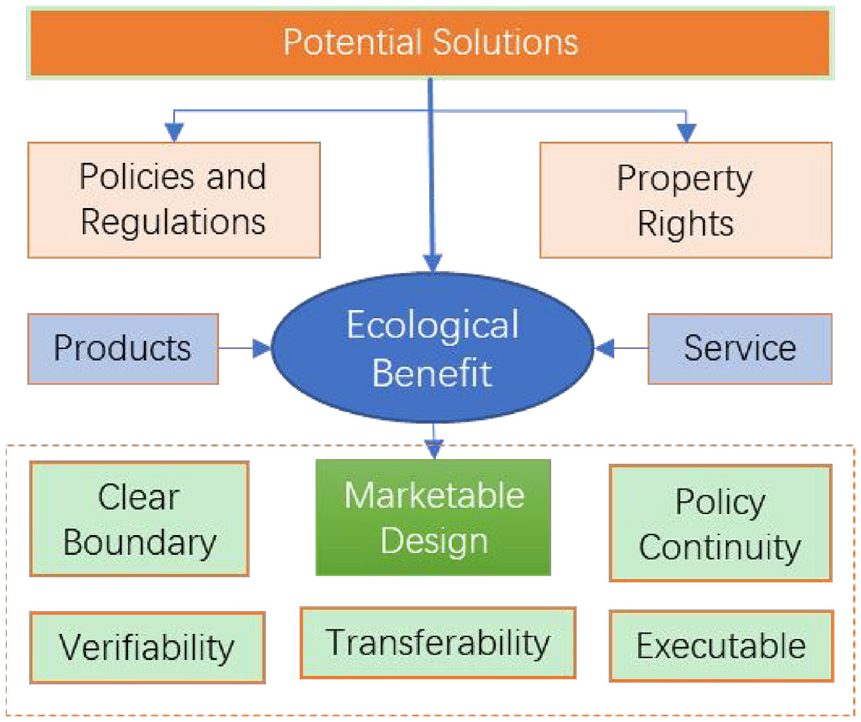
The guidelines for value realization.
There are currently two basic means of transferring benefits; one is unit value transfer (value transfer), where the unit value transfer tends to simply transfer the assessed value from the original setting to the new context in which economic estimates can be converted into monetary units of value (e.g., mean or median). The other type is the function transfer method, which uses either original assessment data or value equations based on explanatory variables defining the ecological attributes or the economic choices in a specific scenario (Richardson et al., 2015). For economic value estimation, multi-factor analysis of simple value equations, and econometric analysis such as the structural benefit transfer method could be used (Chen et al., 2012). Usually, the results based on the equation approaches are more reliable than unit value transfer. This is because the transferred value by the equation is determined by a set of explanatory variables rather than a single point value (Zhou et al., 2020). With the development of the non-market valuation study, meta-analysis has become widely used as a conventional statistical tool (Zhao et al., 2021).
The BTM method is relatively fast, simple, low-cost, and transferable across time and space, offering the possibility of large-scale assessment and providing a basis for comparing the values of different research objects, which is currently a widely used method for non-market value assessment in Europe, the United States, etc. (Czajkowski et al., 2017). A typical feature of BTM is the use of existing data or information rather than initial collection. Researchers can use statistical or econometric methods to transfer the valuation results from the existing “study site” to the “policy site” to be measured, using a set of parameters (Boyle and Wooldridge, 2018).
The advantages of the BTM are mainly the following: (1) Economic rationality. The benefit transfer method is usually less expensive than the original research. (2) Timeliness. Transfer studies can usually obtain results in a shorter period of time compared to original studies (Glenk et al., 2020). (3) Informativeness. Benefit transfer results can usually be used as a reference value to provide an initial judgment on whether a comprehensive and in-depth new original study is needed (Zhao and Wang, 2011).
The benefit function transfer approach focuses on the use of willingness to pay (WTP) as a means of benefit transfer, such as the assessment of tourist travel demand as a dependent variable applied to the valuation of recreational resources (Richardson et al., 2018). Meta-analysis is considered an alternative, more convenient transfer method. Meta-analysis systematically explains the differences in results and independent variables in relevant and methodologically sound initial studies by investigating three research motives: synthesis, hypothesis testing, and benefit transfer (Huber et al., 2018; Meya et al., 2012).
Uncertainties and challenges for cost-benefit methods
For the valuation, most of the data sources in China are mainly from field surveys, statistical yearbooks, or journal literature, and it is difficult to standardize the calculation criteria from multiple data sources. In the accounting process, the selection of value coefficients is a key step. Since the value coefficients are not constant, the localization of key parameters in the current accounting of ecosystem gross domestic product (GDP) in China needs to be further developed. Also, field monitoring and surveys are needed to continuously improve the key parameter database (DeGroot et al., 2012). Internationally, the TEEB database Ecosystem Services Valuation Database (ESVD) for global biodiversity, the Gulf of Mexico Ecosystem Services Valuation Database (GecoServ), and the Recreation Use Value Database (RUVD) established by Oregon State University have gained high recognition (Richardson et al., 2015).
In China, although a large number of “initial studies” have been carried out in recent years, most of them are still at the primitive stage, simply applying established evaluation methods directly to a case region (Liu et al., 2016). The homogeneity of evaluation methods and the uncertainty of the result data greatly limit further reference to the study, and the current studies are insufficient to support the establishment of large-scale Chinese Ecosystem Services Value (ESV) data (Zhao et al., 2008). For the benefit transfer method, there are three main sources of error. The first is the generalization error, which arises from the difference between the original study site (existing assessment values) and the policy study site (value transfer values). The second is the measurement error, which arises from the use of methods and research judgments in the original study. Sampling error also contributes to measurement error, but other methodological factors and judgments in original research also contribute to error (Groothuis, 2005).
On the other hand, the application of BTM has always been controversial because unmeasured services are simply considered zero and the reliability of data cannot be guaranteed. As a matter of fact, reality cannot provide all the ideal conditions required for benefit transfer. Therefore, the optimization goal of benefit transfer is to find ways to reduce transfer errors rather than eliminate them completely (Wang et al., 2019). A perfect function transfer requires the following conditions: (1) The same ecosystem service is valued; (2) The populations related to the ecosystem service have similar characteristics; and (3) The value measurement methods (e.g. willingness to pay) are the same at both sites. Therefore, researchers should be very familiar with the policy site in advance to find the function studies in the existing literature that satisfy the above criteria (Boyle and Wooldridge, 2018). The transfer results are also likely to depend on other factors, such as the evaluation method, the data quality, and literature sources. At present, meta-analysis is still in the early stages of case studies, and the empirical results are mostly used for the verification of simple linear relationships, while the reasons for the transfer efficiency are still little understood (Qi et al., 2018).
As shown in Figure 2, information transfer spans the ecosystem, economy, and society through cost-benefit analysis. In policy making “difficulty of identification and quantity” remains a real challenge for the evaluation of the economic value embedded in ecosystem services, which promote the realization of the value of ecological products (Boyle and Wooldridge, 2018).
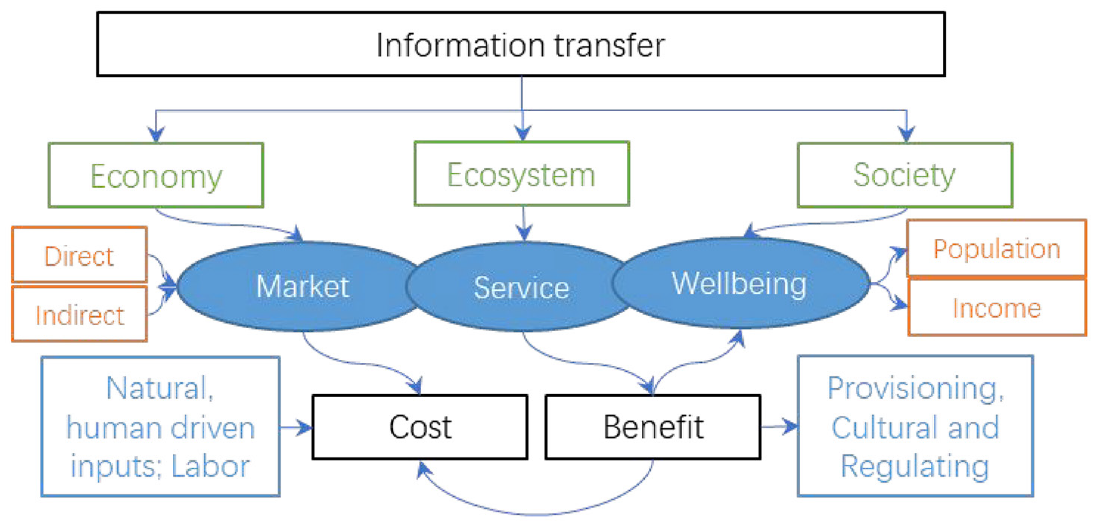
Information transfer and interrelationship of benefit transfer processes.
The limitations of using the benefits transfer approach are as follows: (1) The accuracy of the transfer results may be poor relative to original studies; (2) It is difficult to estimate the accuracy of existing studies; (3) Data treatment, conditional assumptions, and judgments are not explored in detail in existing studies; (4) Benefit transfer becomes impossible and inapplicable in the absence of suitable similar situations (Schiappacasse et al., 2012).
There are three aspects to the challenges of the benefits transfer: (1) Generalization errors between different studied environments, i.e., the bias of evaluation results due to unsatisfied consistency or similarity between research and policy sites (Czajkowski et al., 2017). (2) The need to distinguish intermediate ecosystem services from final services is often ignored by researchers (Czajkowski et al., 2017). For a certain ecosystem, it may include final services and intermediate services with different beneficiaries, and the intermediate services can be reflected in the final service value, so ecosystem service value may be “double-counting” (Rosenberger and Tanley, 2006). (3) Spatial heterogeneity needs to be considered. The effect of spatial, demographic and geographic variations will affect the results of benefit transfer methods (Hu et al., 2022). (4) The temporal dimension needs to be retained to verify the temporal stability of the ecosystem service value.
Policies and potential ways for ecological product value realization
In China, “ecological product” can be considered as an updated version of “ecosystem service”. The term “ecological product” has replaced “ecosystem services” in most Chinese government documents, although “ecosystem service” is still widely used in academic research. Introducing the concept of “ecological product” is to transform natural resources into exchangeable and consumable ecological product and more emphasis will be placed on using market mechanisms to realize the value of natural resources.
Establishing mechanisms for realizing the value of ecological products and transforming ecological benefits into economic and social benefits is not only an important measure to implement the concept of “lucid waters and lush mountains are invaluable assets” but also a useful exploration for the establishment of the ecological civilization system. Ecological product valuation is not the purpose, but a way to raise people’s awareness of ecological civilization and promote the implementation of related policies. Generally, there are three main policy ways as explored in the following section.
Payments for ecosystem services (PES)
PES is considered a public institutional arrangement for internalizing ecosystem services’ externalities through top-to-bottom fiscal transfer, lateral payments, or market trading in China (Kang and Huang, 2022). This suggests that China’s PES programs are tailored to the country’s particular institutional circumstances, such as public ownership of natural resources. At the same time, the major metric used to categorize PES programs is the financing source. Additionally, a large number of restoration or conservation initiatives in China that were researched and published under the PES umbrella are actually not included in PES programs (Chen and Zhang, 2000). According to the willingness to pay (WTP) of producers and payees of ecosystem service, PES instruments were further subdivided into bilateral voluntary payers, collective voluntary payers, compulsory and bilateral PES systems, and compulsory and collective PES systems (Gao et al., 2020).
Two policy documents on PES schemes were issued by the central government in 2016. One is the “Guidelines on Improving Eco-compensation Mechanism”. This document sets out the overall framework for PES schemes in China and targets building schemes covering non-commercial forests, natural grassland, wetland, desert, marine conservation areas, major watersheds, arable land, key eco-functional zones, and development prohibited zones by 2020 (OSC, 2016). The other document is the “Guidelines for Facilitating Lateral Mechanism of Eco-compensation between the Upper and Down Streams of the Cross Province River”. It specifies that the central government will provide financial support for PES schemes in cross-province watersheds based on provincial agreements and contributions (MOF et al., 2016).
In China, different PES programs have been fully established and widely applied (Figure 3). PES programs on important national eco-functional zones and specific funds like grassland conservation are among those that are entirely sponsored by the central government.
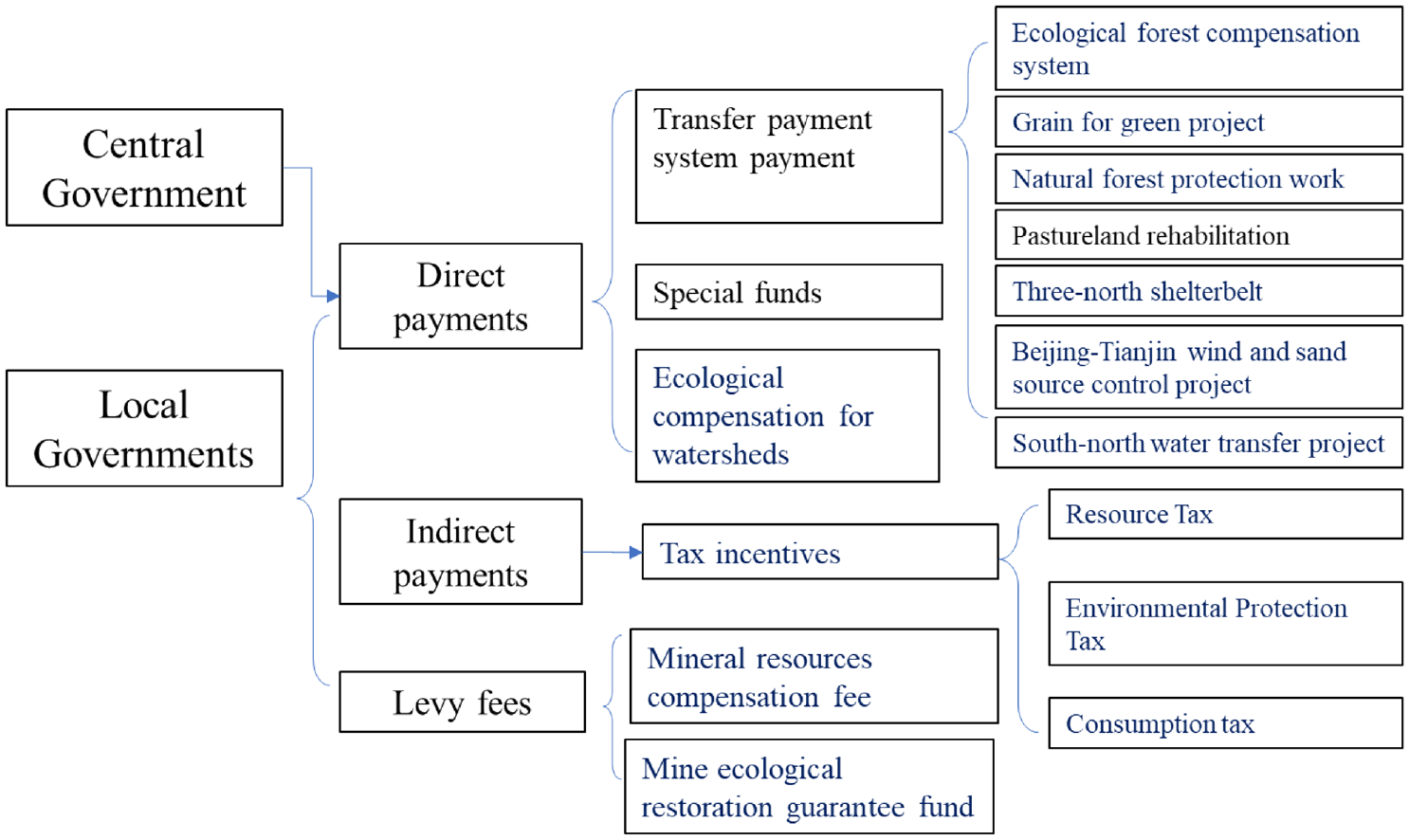
Main categories of China’s fiscal policy on PES.
Ecological product value realization typical case demonstration
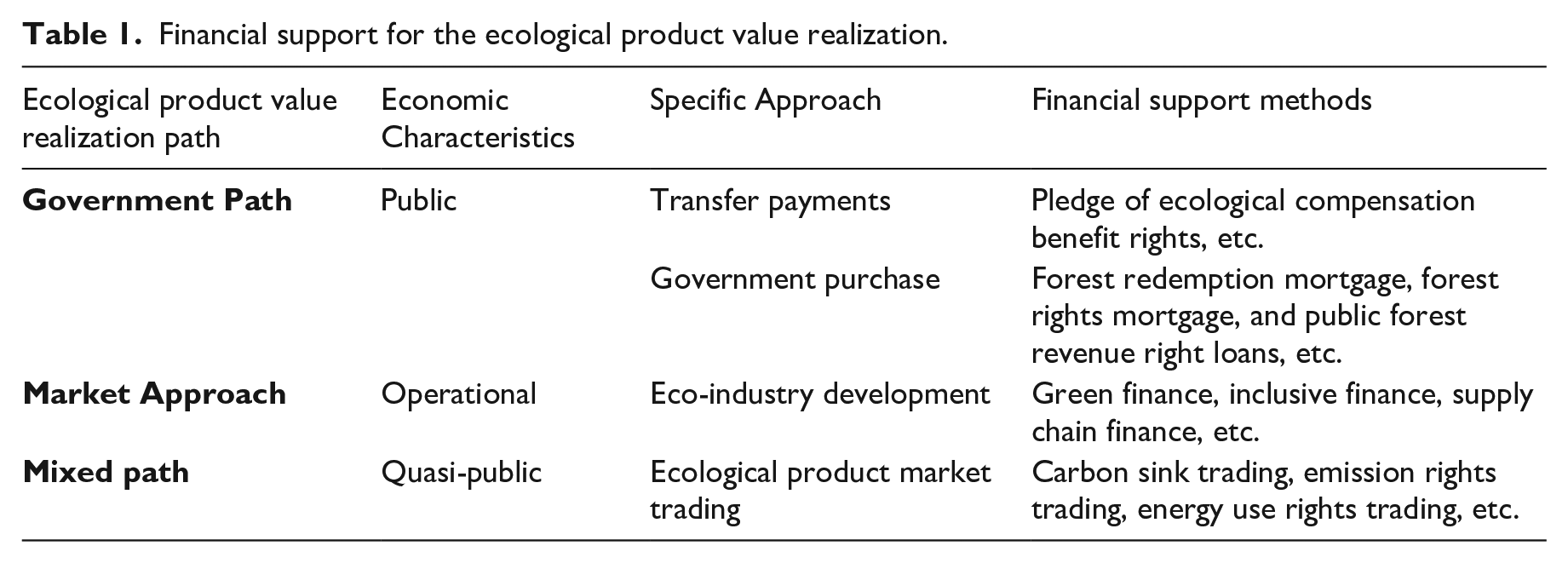
The value of ecological products can be realized in three ways. First is the government path, which relies on financial transfers to “buy” public ecological products and realize their value. Second, the market path, which mainly relies on market forces to allocate directly tradable ecological products. Third, the combined government-market path, in which the government creates demand for ecological products through laws, administrative control, or policy support, fosters trading agents, and the market realizes the value of ecological products through free trade (Table 1).
Financial support for the ecological product value realization.
In 2010, the State Council issued the “National Plan for Main Functional Zones”, which clearly lay out the strategic, basic and constrained development of national land space and introduced the concept of ecological products for the first time. After the Communist Party of China (CPC) Central Committee and the State Council issued the “Opinions on Improving the Strategy and System of Main Functional Zones”, Lishui and Fuzhou cities have become national pilot regions, providing early pilot cases for ecological product value accounting, property rights system of natural resources assets, ecological asset trading platform construction, ecological credit system construction, and government procurement mechanism for ecological product. These pilot works provide a model for the coordinated development of ecological resource endowment-rich areas. Further, the policy of “Opinions on Establishing a Sound Mechanism for Realizing the Value of Ecological Products” was issued in 2021, which summarizes the problems in realizing the value of ecological products. The problems are summarized as: difficult to measure, difficult to mortgage, difficult to trade, and difficult to realize. It also pointed out the challenges that need to be solved in the future and defined the goals and roadmap for ecological product value realization (Gao et al., 2022).
China has conducted a lot of practice on ecological product value realization. The following three lessons have been drawn from the experience. First, the advantages of regional ecological resource endowment need to play an important role in realizing ecological industrialization. In the process of exploiting ecological resources, the protection of natural ecosystems and improvement of services should be strengthened, while the transformation and application of various ecological resources should be improved to realize value enhancement and value “spillover”. Second, regional special industries based on local conditions should be developed to promote industrial ecological transition. It is necessary to carry out scientific planning of regional ecological resources and develop characteristic and advantageous green industries. Third, a market-based ecological compensation mechanism should be established to promote the realization of the value of public ecological products. The new government-led and multi-party participation pattern of ecological protection compensation can be formed to accelerate the market-oriented and diversified compensation and stimulate the enthusiasm of the whole society to participate in ecological protection. In addition to traditional policy tools such as environmental tax, emission permit trading modes for credit reduction and total amount control, which have been utilized in watershed management and air pollution control, also point out the direction for institutional innovation (Huang et al., 2012). New modes such as eco-certification, green finance, “eco-banking”, and water funds have strengthened the integration of ecological products with various industries, transforming ecological benefits into social and economic benefits.
Eco-environment-Oriented Development (EOD) policy for promoting the ecological restoration
In 2020, the National Development and Reform Commission and four other departments jointly issued the “Guidance on Expanding Investment in Strategic Emerging Industries to Foster and Strengthen New Growth Points and Growth Poles”. This policy pointed out to explore the EOD governance mode, which provides new ideas for market-oriented development of green projects. As an innovative way to better fund environmental improvement projects without increasing the government’s debt burden, the EOD model is receiving more and more attention recently in China, with pilot projects maturing, policies becoming more intensive, and financial products becoming more abundant.
In April 2021, a new policy was issued to set up 36 projects to carry out pilot work in EOD mode. These projects adopted industrial chain extension, joint operation, and integrated development, promoting the effective integration of ecological restoration projects with strong public welfare but poor profitability and related industries with better profitability. The projects will internalize the economic value brought by ecological and environmental treatment.
In April 2022, the EOD Innovation Center of the Environmental Planning Institute of the Ministry of Ecology and Environment was officially established, and at the same time, the second round of EOD projects was carried out. With policy development, the EOD mode is accelerating in China. There are great development opportunities for the EOD model in the fields of abandoned mine rehabilitation, comprehensive agricultural and rural development, comprehensive water environment management, and watershed management.
Through ecological network construction, ecological restoration and pollution control, supporting infrastructure, and industrial construction, the land in and around the area appreciates in value and provides a good ecological basis for the introduction of industry and population inflow (Figure 4). Industrial development increases the income of residents, profits of enterprises, and tax revenue of the government. The inflow of population also brings an increase in government tax revenue and the development of the regional economy. The ultimate goal is to achieve the integrated development of ecological construction, economic development, and social life.
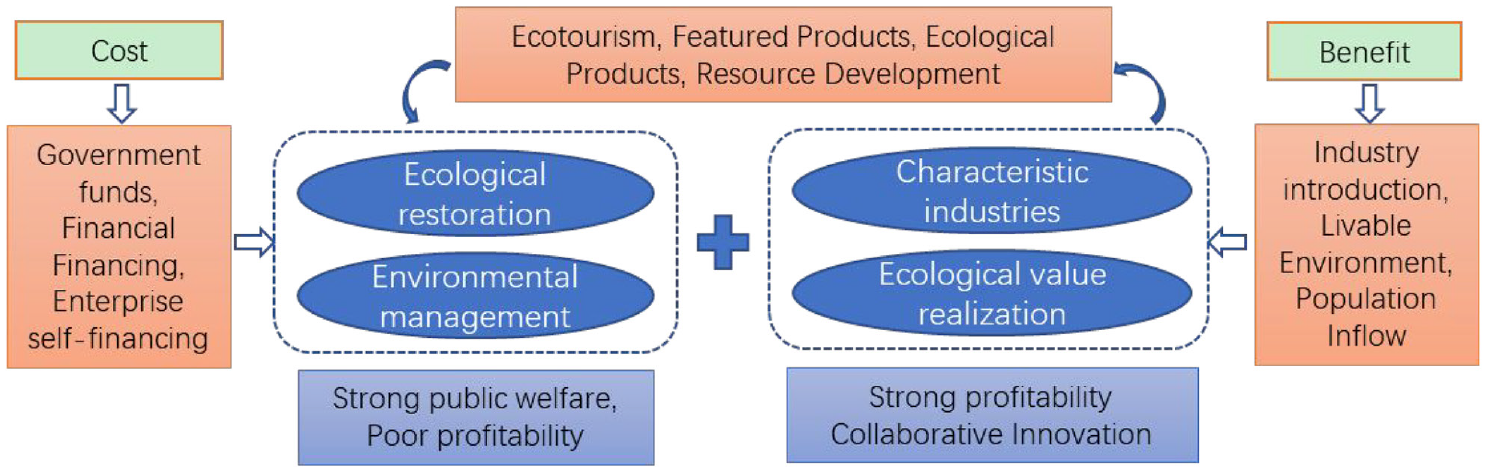
Input-output model of typical EOD model.
Implications and future perspectives
In conclusion, for the current ecological restoration, it is necessary to strengthen the study of the interaction between social benefits, economic benefits, and ecological and environmental benefits, especially for the analysis of ecological benefits.
We emphasized the challenges of the accuracy of the benefit transfer method and the sources of transfer errors and pointed out that the establishment of a value database of ecosystem services is urgent in China. The government should adopt the experiences of developed countries and establish the basis and standards for value evaluation, as well as the database, as a data source and basis for benefit transfer. Also, a unified best practice guide for reducing transfer errors could be developed for cost-benefit analysis in the future. The quantitative assessment of social benefits is an important element of cost-benefit analysis, and more attention should be paid to the methods referring to the assessment of economic benefits.
China has enacted laws and implemented special plans such as forest law, grassland law, natural forest resource protection, and marine ecological protection policies related to ecological protection and restoration. A large number of restoration projects have been carried out. The mode of “nature reserve system with national park as the main body” has been formed. In the future, China needs to further implement ecological conservation and restoration projects by effectively combining policy, industry, technology, and market, exploring the paths to realize the value of ecological products and implementing sustainable green transformation. More key issues should be considered during the implementation of ecological restoration programs, such as the potential contribution of the programs to global Sustainable Development Goals (SDGs), the baseline for effective evaluation and comparison of cost-benefit assessment with various restoration contexts, the sustainability of restoration measures (such as afforestation and reforestation). Cost-benefit dynamic assessment and accounting can effectively assist government departments to choose better restoration strategies and improve the ecological and economic benefits of ecological restoration projects in the future.
Footnotes
Declaration of conflicting interests
The author(s) declared no potential conflicts of interest with respect to the research, authorship, and/or publication of this article.
Funding
The author(s) disclosed receipt of the following financial support for the research, authorship, and/or publication of this article: The work was supported by National Key Research and Development Project (No. 2022YFF1303204), National Natural Sciences Fund Project (No. 42271097) and the second scientific expedition to the Qinghai-Tibet Plateau (No. 2019QZKK0405-05).