




Abstract
With increasing water consumption and pollution in cities and expanding urban areas, impacts on rural areas as water extraction and waste disposal zones are intensifying. To unravel these hydro-territorial dynamics, this paper studies the intersecting and overlapping Foucauldian ‘arts of government’ (‘governmentalities’) deployed to convey water from rural to urban areas in three Latin American cities: Lima (Peru), San Luis Potosí (Mexico) and Bucaramanga (Colombia). We examine conventional (cemented) water transfers, broadly promoted payment for ecosystem services schemes and their conjunction, combining scholarship about hydrosocial territories and governmentality. We demonstrate how particular urban-based imaginaries about rural areas, their inhabitants, norms, practices and identities become embedded in governmentality schemes, and how these are justified, materialized and sustained, producing particular entwined rural–urban subjectivities. We explore how these are accepted, negotiated or contested. Our application of the governmentalities framework to analyze the material and socio-political effects of rural–urban water transfers contributes to existing scholarship on the (re)shaping of rural–urban hydrosocial territorialities showing the ‘hidden’ and ‘invisible’ workings of subjectification. It also contributes to the literature on governmentalities by scrutinizing the importance of technology (including physical infrastructure) in creating rural subjects.
Keywords
Increasingly complex rural–urban dynamics
Urbanization and increasing interconnectedness between rural and urban areas are receiving growing attention in territorial planning policies and scholarship. To secure urban water supply, new canals and pipes are constructed to convey water from rural water bodies to cities (e.g. Bakker, 2010; Celio et al., 2010); water is stored in new reservoirs with corresponding adverse effects in rural areas (e.g. Kaika, 2006; Nixon, 2010) and desalination plants are installed along shores of arid places polluting the sea and using enormous amounts of energy (e.g. Swyngedouw and Williams, 2016). Also, other mechanisms such as payment for ecosystem services (PES) schemes or nature-based solutions have joined the stage and are promoted (e.g. by the recent World Water Development Report) as a way to sustainably manage upstream–downstream relations within rural spaces as well as between rural and urban areas (WWAP and UN-Water, 2018). In consequence, new and increasingly complex combinations of techniques, projects and discourses are evolving in relation to new water uses, new technologies and changing hydro-social conditions (Crow-Miller et al., 2017; Hommes et al., 2019). Yet, the realities, values and interests of rural populations may, in many cases, become backgrounded vis-à-vis urban needs and interests. In order to unravel the socio-territorial dynamics that transform rural–urban hydrosocial relations, we combine scholarship about hydrosocial territories, Foucauldian ‘arts of government’ (‘governmentalities’) and science and technology studies. The application of Foucault’s governmentality notion to the field of environmental sciences has seen a proliferation in recent decades as an approach to understand how stakeholder groups concerned with environmental governance deploy multiple strategies directed to conduct the environmental conduct of people into desired directions (Agrawal, 2005; Boelens, 2014; Fletcher, 2010, 2017). The ongoing governmentality discussions are very much relevant and useful to understand socio-territorial transformations unfolding around cities as a result of urban interventions in surrounding watersheds, but have not yet been applied in this context. Our application of the governmentalities framework, thereby, contributes to the analysis of the material and socio-political effects of rural–urban water transfers, the comprehension of the ‘hidden’ and ‘invisible’ workings of subjectification in reshaping rural–urban hydrosocial territorialities, and the understanding of the role of technology and hydraulic artefacts in subjecting and ‘subjectifying’ rural actors.
This paper analyses conventional rural–urban water transfers and PES in the cities San Luis de Potosi (Mexico), Lima (Peru) and Bucaramanga (Colombia), studying how diverse intersecting and overlapping Foucauldian governmentalities, enacted through urban water supply approaches, transform rural–urban relations and water flows. Even though different in political, socio-cultural and hydro-ecological regards, all three contexts are characterized by increasing pressure on limited water resources from a wide range of users, including cities, industries, hydropower plants, mining companies and rural communities. They represent part of the diversity of present-day rural–urban transformation dynamics in Latin America.
The paper is based on several months of field research in the three sites. In Colombia, preparatory field and desk research was realized between 2011 and 2015, and then again with a specific focus on rural–urban relations in 2017. During the second field research, 20 interviews with páramo inhabitants from different municipalities were conducted, as well as with representatives of the mining company active in the area, the water utility of Bucaramanga and 7 members of the local citizens movement. Public meetings for discussing the environmental impact assessment (EIA) of a mining project as well as debates and mobilizations in the city of Bucaramanga were attended. In Peru, ethnographic research was conducted in Lima and the Rímac and upper Mantaro watersheds (both essential to the city’s water supply) between March and September 2017, with a specific focus on the rural community of Marcapomacocha where the planned PES project is to be piloted. Sixteen interviews were conducted with community leaders and members in Marcapomacocha and seven interviews in other communities. In Lima, 19 representatives of state institutions, the city’s water utility and local and international NGOs were interviewed, focusing on actors’ views on ‘appropriate’ modes of water management and the roles of rural and urban water users in these. In Mexico, 21 municipal and federal water authorities, inhabitants of affected communities, engineers who participated in the design and construction of the water transfer, opponents (journalists, grassroots’ organizations and a priest), water rights experts and lawyers were interviewed. In each case, the main hydraulic sites and infrastructures were visited, and relevant policies, project documentation, media coverage and other secondary literature were analyzed.
In the following, we will first outline the conceptual framework that helps to analyze the complexity of hydrosocial transformations in the proximity of cities, combining scholarship on governmentality and science and technology studies. We then analyze the three case studies to show how the environmental, institutional and technological interventions combine different governmentalities and establish techniques of governance to realize territorial projects, promoting and shaping particular subjects and assigning specific roles to rural and urban water uses and users. We will then draw conclusions from the comparison of the cases and explore indications for future research.
Hydrosocial territories, governmentalities, technology and urban water supply
The case studies in this paper allow examining the constitution and realization of material–political orders that secure rural-to-urban water flows. Specifically, we explore technologies’ role in governmentalizing rural–urban hydrosocial territories, conceptualizing the later as the contested imaginary and socio-environmental materialization of a spatially bound multi-scalar network in which humans, water flows, ecological relations, hydraulic infrastructure, financial means, legal-administrative arrangements and cultural institutions and practices are interactively defined, aligned and mobilized through epistemological belief systems, political hierarchies and naturalizing discourses. (Boelens et al., 2016: 2)
Water technology and infrastructure are often closely connected to governmentalities and, in combination, play a crucial role in shaping hydrosocial territories that produce rural–urban water transfers. We understand technologies broadly as the ‘use of skills, tools, knowledges and techniques to accomplish certain ends’ (Jansen and Vellema, 2011: 169), or, to follow Pfaffenberger (1988), as a system of tools (including artefacts and physical infrastructure), related social behaviours and techniques. Through constituting part of the material environment and being present in everyday life, technologies (often expressed in artefacts) mediate behaviour (Jasanoff et al., 2001; Latour, 1993) and co-shape experiences and interpretations of the world. Technologies are ways of building order in our world (Laet and Mol, 2000), of ‘engineering relationships among people that, after a time, become just another part of the landscape’ (Winner, 1980: 124). Technologies are produced by specific socio-political relations, norms and knowledge frames, and in turn influence and co-shape those socio-political relations and material-normative frameworks. This makes that technologies (and the environments and subjects they produce) are a deeply social and highly political ‘matter’ (see, e.g. Clarke-Sather, 2017; Meehan, 2014; Menga and Swyngedouw, 2018; Rodina and Harris, 2016).
Foucault (1991, 2008) identified four distinct types of governmentality, which are arts of government to ‘conduct the conduct’ of people, steering what is internalized as being ‘appropriate’ and ‘normal’. The first is governmentality ‘according to immovable Truth’, which aims at prescribing what is true and right following religious, supernatural or fixed ideological beliefs that establish permanent norms, rules and an order of things according to which people must behave (Boelens et al., 2015; Valladeres and Boelens, 2017, 2019). The second governmentality is based on sovereignty, which includes forms of power and government based on as laws, regulations and dominant rulers’ legitimized violence (Dean, 1999; Fletcher, 2010). Disciplinary governmentality, as third art of government, operates through the establishment of social and ethical norms to which individuals adhere out of fear of deviance and immorality. It produces self-correcting subjects by invoking guilt, morality, conformity and compliance (Agrawal, 2005; Boelens, 2014; Li, 2007; Lukes, 2005). Fourth, Foucault elaborated on the notion of neoliberal governmentality in his College de France lectures of 1979, when he discussed neoliberalism in three post-war Western countries: West Germany, the United States and France (Gordon, 1991). In his book on Biopower, he elaborated that ‘Neoliberalism should not be identified with laissez-faire, but rather with permanent vigilance, activity and intervention’ (Foucault, 2008: 132). His claim was clear (and directly reflects Hayek’s (1944, 1960) groundwork and Polanyi’s (1944) famous analysis): the state’s role in neoliberalism is ‘to make the market possible’; in other words, neoliberalism means ‘a minimum of economic interventionism, and maximum legal interventionism’ (Foucault, 2008: 167). In that sense, neoliberal governmentality works through the internalized ideas of economic norms, values and incentive structures (Foucault, 1991). It builds on the idea that each individual is acting out of a self-interested, profit-maximizing rationality and that only the right incentive structures are needed to motivate appropriate behaviour (Dupuits, 2019; Fletcher, 2010; Vos and Boelens, 2018).
The four governmentalities do not function in a specific order but are often complementary, overlapping and differently relevant according to each specific context and according to the different interests of the actors employing them. That is to say that governmentalities are not only exercised as a form of power by the state but by a diversity of actors and institutions that aim to govern space and people according to their interests (Agrawal, 2005), such as for example national governments, municipalities, water supply companies, international NGOs and mining multinationals in the case of rural–urban relations.
Furthermore, governmentalities are intrinsically spatial as power is exercised in, through and over a certain space at a certain time (Brand, 2007; Ferguson and Gupta, 2002; Huxley, 2008; Rutherford, 2007). Spaces and territories are both objects and aims of government; they are deployed as techniques and sites of rule with the aim to geographically delineate and organize the exercise of political power over socio-material relations (Swyngedouw and Boelens, 2018). Studying water-based governmentalities in a context of urbanization provides an important opportunity to bring to the fore the material, physically grounded aspect of governmentalities, specifically through engaging governmentalities with technology scholarship (see also Alatout, 2006; Bijker, 2007; Bridge, 2014). There are several connections between conceptual considerations about governmentality and technology. If we consider governmentalities as aiming to ‘conduct the conduct’ of people, it is clear that they have similar objectives and effects as technologies (or technological artefacts, knowledge and skills), considering that technologies actively shape realities, behaviours, social and material relations (e.g., Collier, 2009; Hidalgo-Bastidas and Boelens, 2019; Meehan, 2013).
Modernist governmentalities, in particular, are powerful mechanisms of government because they work through internalized norms. The process of internalization of norms, self-disciplining and forming of subjects is conceptualized as subjectification. Subjectification refers to ‘all those heterogeneous processes and practices by means of which human beings come to relate to themselves and others as subjects of a certain type, […] a hybrid of flesh, artefact, knowledge, passion and technique’ (Rose, 1996: 38). We build on the notions of subjectification and creation of environmental subjects presented in literature (e.g., Brand, 2007; Harris, 2011; Hellberg, 2014; Kooy and Bakker, 2008; Rutherford, 2007; Vos and Boelens, 2014) and extend this notion to the creation of subjects in the case of hydrosocial territories that enable the transfer of rural water to cities.
Nevertheless, responses to, and outcomes of, hydro-technological intervention projects and governmentality schemes are diverse and not predefined (see e.g. Birkenholtz, 2009). Project outcomes are negotiated and often unforeseen due to the complexity, dynamism and unpredictability of the concerned territories and people; as well as because of the fact that multiple overlapping, and at times contradictory, governmentality projects act within the same time and space, mutually influencing each other’s outcomes (Huxley, 2008; Zenko and Menga, 2019). Accordingly, part of our analysis asks in how far and in what ways actual outcomes differ from initial intentions in the three case contexts. In particular, we are interested to understand how affected rural water users accept, negotiate or contest the specific subject positions promoted by rural–urban water transfer interventions.
The application of the framework contributes to the above-mentioned literature on governmentalities in that it shows the importance of water infrastructure and subjectification for the creation of hydrosocial territories that allow to transfer water from rural to urban areas. Through three case analyses, this paper scrutinizes how different governmentality endeavours produce specific, entwined materialities and socio-political relations that sustain rural–urban water transfer interventions.
Changing rural–urban relations around three Latin American cities
We now turn to the analysis of rural–urban relations around three Latin American cities. After a brief introduction to each case, we will analyze the governmentalities at work as well as the outcomes and contestations surrounding them.
The El Realito dam, San Luis Potosí, Mexico: Exclusive urban water transfers and the search for rural alternatives
San Luis Potosí is located in the Central Mexican Highlands and home to almost one million inhabitants (INEGI, 2018). Over the last 40 years, the city has witnessed a sharp population increase as well as substantial industrial development boosted by its strategic location between Mexico City and the US border. Located in a semi-arid climate with limited rainfall, San Luis Potosí relies on groundwater resources for more than 90% of its water use (INTERAPAS, 2013). As a result, the main aquifer is being overexploited, reducing the groundwater table by approximately 1–4 m annually (Hoogesteger and Wester, 2017; INTERAPAS, 2013). This has detrimental effects on water quality: an estimated 30% of the wells used for the city’s drinking water exhibit levels of fluoride and arsenic that surpass national safety standards (Alarcon-Herrera et al., 2001; INTERAPAS, 2013). Furthermore, due to the groundwater overexploitation, water supply of older, shallower wells becomes irregular and unreliable, particularly in poorer neighbourhoods. The situation is aggravated by outworn urban water infrastructure with leakages causing water losses of up to 40%. Despite this situation, the municipality continues to heavily promote industrial development. In combination with the population increase, this causes the urban water demand to constantly rise.
To reduce the problems of water shortage and contamination in San Luis Potosí, in 2008 the National Water Commission (Comision Nacional del Agua (CONAGUA)) constructed the El Realito dam, channelling the water from the south through a 132-km-long pipeline to the city (see Figure 1). The pipeline was constructed under a public–private agreement in which 58% of the costs were covered by a consortium of construction companies that, in exchange, obtained the right of economic exploitation of the water for 25 years (CONAGUA, 2017). The consortium sells the water to INTERAPAS, San Luis Potosí’s drinking water company. Providing one-third of the city’s water demand, the El Realito dam was projected to allow for closing a number of groundwater wells and thereby easing the pressure on the aquifer, while at the same time providing better quality drinking water (interview INTERAPAS, 2017). In reality, however, the continuous development of the city’s industrial sector outweighs the potential additional water availability, and no wells have been closed (interview INTERAPAS, 2017). As such, the main objective of the dam is not met.
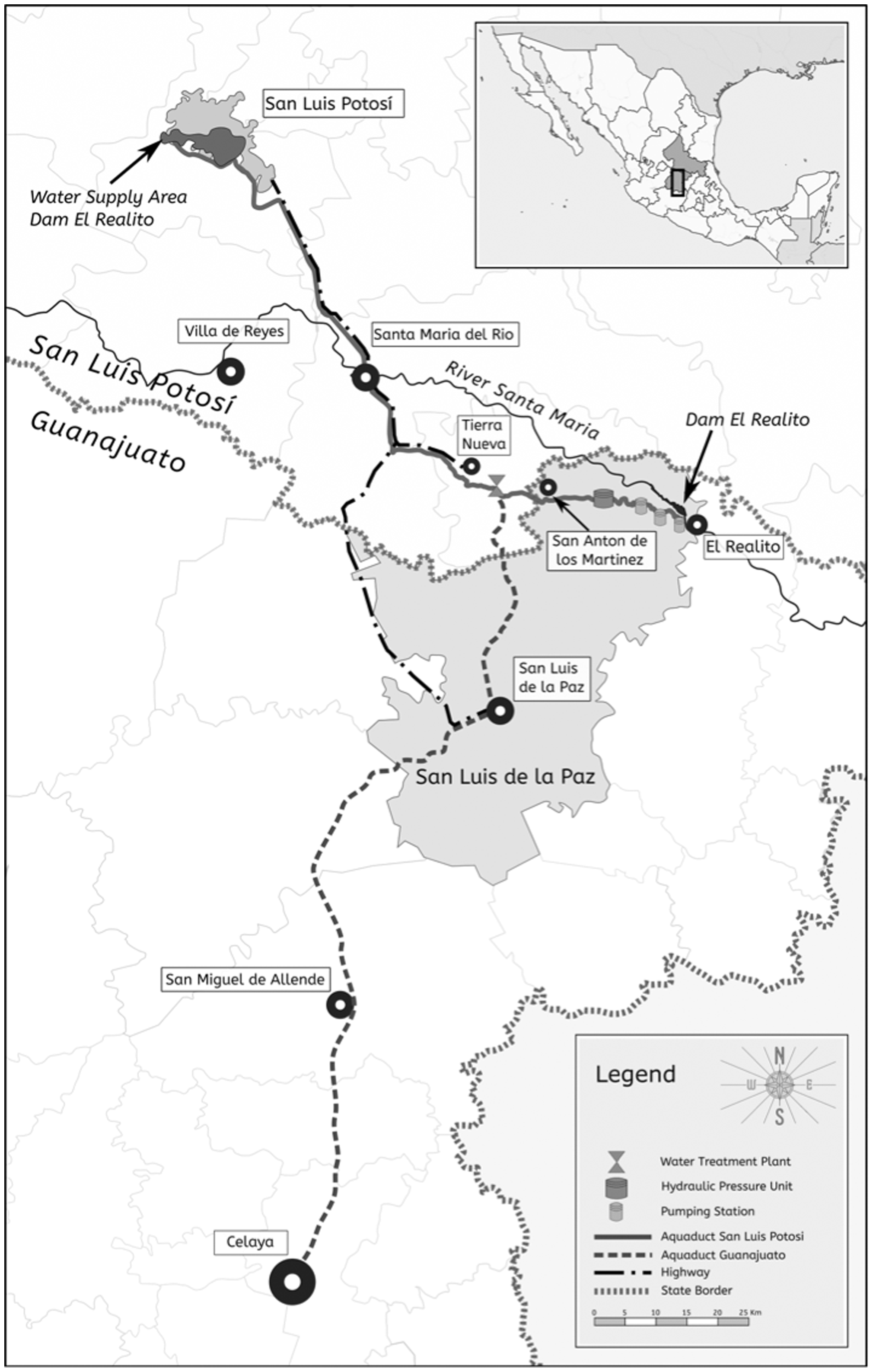
San Luis Potosí and its water supply infrastructure. Own elaboration.
What is particular about the El Realito dam is its pronounced reserved exclusiveness for urban use while two communities located just next to the dam’s pipeline cannot access the water passing in front of them. Instead, the local water sources of the communities of El Realito and San Anton de los Martinez range from collected rainwater and small private wells to water from a pond that is being shared with cattle, with the corresponding water quality implications. None of the houses has running tap water. Local communities perceive this situation, which stands in sharp contrast with the thousands of litres flowing every day towards San Luis Potosí, as unjust. Yet, official water agencies and municipal authorities fiercely defend it through different actions, shaping rural and urban subjects and installing hydrological infrastructure that results in urban-centred water hierarchies.
Sovereign governmentality
The base for the unequal opportunities for urban and rural users to access water from the El Realito dam are administrative rules regarding water rights allocation and their selective interpretation and application. In Mexico, CONAGUA is the responsible authority for assigning official water rights based on identified water availability and demands. In the case of El Realito, water rights were granted to the municipality of San Luis Potosí and two more cities in the neighbouring state of Guanajuato. According to state law, this means that all available dam water is reserved for urban use, excluding any other actors such as the two villages next to the pipeline, to access the water. Although providing these villages with water from the pipeline would be technically feasible and could have been included in the project design as most likely the cheapest and most practical solution for providing the villages with water, both CONAGUA and the municipality explain that all available water use rights have been assigned already and that, therefore, it is impossible to give any water to the communities (interviews Municipality of San Luis de la Paz and CONAGUA, 2017). Referring to water legislation, CONAGUA states that, once the water is allocated to a specific user, they do no longer have the possibility to interfere, while the municipalities who hold the water use rights – in this case, the municipalities of San Luis Potosí and San Miguel de Allende – refuse to cede even a negligible part of their water to the villages, which belong to a different jurisdiction.
Government authority, laws and regulations are thus evoked to realize and sustain urban water supply infrastructure that consolidates a water use hierarchy in which urban drinking water has exclusive priority. The possibility for any other, supposedly non-priority users to access the water now or in the future is dismissed. This is, furthermore, cemented in infrastructure and defended by expert-authority structures and engineering arguments: authorities argue that, since the system design is ‘closed’ and the pipeline lies underground, this physically impedes alternative water accesses.
Disciplinary governmentality
The dam and pipeline construction has been supported by discourses and norms aiming to mould people’s behaviour into desired directions. According to local residents, prior to the actual dam construction, a city-centred vision about modern development was promoted by CONAGUA officials among community members to evoke a sense of moral duty to not impede the only solution for resolving San Luis Potosí’s water crisis (interview local inhabitants, 2017). Discourses included stories about the city’s severe water crisis and implied the communities’ moral duty to collaborate to solve that crisis, trying to shape a subjectivity of rural inhabitants as complying citizens that hold back their own necessities for the sake of the greater (urban) good. In effect, local inhabitants felt morally obliged to sell their houses and farms. Yet, many were paid low prices for their properties, indemnified only partly or not provided with sufficient means to restore or improve their livelihoods afterwards, leaving some worse off (interview local inhabitants, 2017).
Governmentalities commonly entwine. Many people decided to sell their land because of a mix of moral feelings, internalized beliefs and material interests: partly accepting the development and progress discourse, partly in the hope to benefit from this urban project, partly for moral reasons, partly out of fear for governmental coercion. Soon, however, the resulting unequal distribution of benefits between urban and rural inhabitants started to cause resentment: ‘We feel as if we are a pack donkey carrying water. We are loaded with it, but cannot drink it’ (interview local inhabitants, 2017). The transfer pipe is the techno-political and socio-material axis of a deeply extractive hydrosocial territory. A villager explains how obtaining water from the pipeline has been impossible: ‘From the beginning, they [government officials] made it very clear that we could not ask for water. The water of El Realito was designated for the city; we could merely ask for small compensations, such as a fence to keep our cattle on our fields’ (interview local inhabitants, 2017).
In a search for alternative water supply systems, CONAGUA concluded that perforating a well was impossible in San Anton de los Martinez, whereas El Realito’s inhabitants refused the installation of a high-tech drinking water purification plant due to the community’s lack of resources for covering its operation and maintenance costs. While CONAGUA’s technical evaluations might certainly be correct, it is remarkable that the proposed options were capital-intensive high-tech solutions that clearly did not match the local context and resources. CONAGUA, furthermore, did not only disregard local socio-economic circumstances, but also reinterpreted the communities’ rejection of proposed alternatives as unwillingness and, in fact, expression of consent with the current situation, claiming that ‘the inhabitants do not even want a drinking water supply – they refused all options we gave them and prefer to carry water from the spring!’ (interview CONAGUA, 2017), thereby clearing itself of any responsibility for the communities’ situation.
The moral judgements induced by CONAGUA and other government representatives thus established the dam as ‘right’, ‘modern’ and ‘important’ given that it would solve the city’s water problems, while positioning rural inhabitants who complained as being ‘backward’ and ‘unconscious’. Those who supported the project were labelled as ‘good citizens’ because they were compatible with the government’s and cities’ interests.
Interestingly, while the above quotes show locally existing resentment and consciousness about water injustices, other villagers seem to have embraced the promoted humble position. In some cases, this has led to a lack of efforts to bring charges against the situation and to claim the right to adequate drinking water as granted by the Mexican constitution; in other cases, they have been discouraged by bureaucratic hurdles.
Neoliberal governmentality
While the affected rural communities are divided and ambivalent regarding the internalization of the discourse of rural backwardness versus urban modernity, the discourse is well accepted in most urban circles. With a government focusing on efficiency, rural development is not prioritized as cost–benefit ratios are generally smaller than in urban areas. A few officials raise their concerns: ‘At the moment, Mexico is facing an economic crisis. Hence, we expected a decline in government funding, but […] were shocked when we discovered that there was no budget scheduled for the rural areas; all money was to be invested in urban areas’ (interview rural development officer, 2017). The representative continued: ‘The water policy of the last decades focuses heavily on urban areas, and analysis of costs and benefits. Since providing water to rural areas is more expensive for the government, the focus has been on providing the cities with water’. Notwithstanding such critical voices, overall, Mexican water governance fosters water injustice and unequal distribution of funds with arguments and policy measures that are based on narrow economic cost–benefit calculations and market-based water values.
This also shows the rationality behind the dam’s water use, which fundamentally is meant to foster industrial growth. Rather than attending to rural necessities and a fair water distribution, El Realito dam water is distributed according to the logic of market forces. Neoliberal governmentality is thus internalized by decision-makers and water planners and materialized in the dam. Contrary to other cases, it is not directly imposed upon those affected by the project, but only indirectly works through offered compensations that function as incentives for rural inhabitants not to oppose.
Local responses to exclusive, top-down water management
Some of the inhabitants of San Anton de los Martinez and El Realito have migrated to the city; those who stayed continue to struggle to meet their daily water needs. Neighbouring villages with similar water management problems have mobilized and started raising money to construct rooftop rainwater harvesting systems that can provide water at low operation and maintenance costs. This has helped the communities to foster their water autonomy and, at the same time, construct themselves as active and self-determined subjects. However, this process has not been voluntarily but out of the necessity to secure an affordable and manageable water supply. Communities have, in fact, repeatedly requested subsidies for the rainwater harvesting systems, but neither CONAGUA nor the municipality have been willing to invest, claiming that the expensive treatment plants’ benefits outweigh those of the low-tech rainwater harvesting systems. 1 This expresses the continued perceived superiority of expensive high-tech solutions and the limited willingness of the government to invest in rural areas, which are seen as simple water extraction zones. The hydrosocial territory that is materialized through the water transfer project and the subjectification of rural communities is highly unequal.
PES and inter-basin water transfers: Entwined water technologies and governmentalities in Lima
Peru’s capital city is often referred to as the world’s second largest city located in a desert. It faces persistent water management problems, such as high inequality in water access between low- and high-income households, serious water quality issues and current and future water shortages (Ioris, 2016; Miranda et al., 2017). With almost 10 million inhabitants and still growing steadily, authorities struggle to meet Lima’s water demand. Besides relying on the already overexploited aquifers for 17% of the water supply, four Andean watersheds provide the remaining 83% of the city’s water resources, the Rímac-Mantaro water transfer system being by far the most important. Made up of numerous lakes, dams, canals and a trans-Andean tunnel, it transfers water from the Atlantic side of the Andes to the capital on the Pacific coast, providing more than 70% of the superficial water resources (SEDAPAL, 2014) and rotating the turbines of seven hydropower plants. Lima’s public water utility SEDAPAL (Servicio de Agua Potable y Alcantarillado de Lima) plans to construct additional dams and a second trans-Andean tunnel in the coming years (SEDAPAL, 2014).
These large hydraulic infrastructures are the result of an over 40-year-long history of highly centralized and technocratic water management in Peru with large investments made by public and private companies (French, 2016; Mills-Novoa and Taboada, 2017). Although the rural communities located in the headwaters of the Rímac and Mantaro have not been negatively affected by the volume of water extracted, they ‘perceive injustices related to the unfair distribution of costs and economic benefits, loss of autonomy over their water resources and the socio-environmental impacts of territorial transformations’ (Hommes and Boelens, 2017: 71). In other words, the mega projects create unequal power relations between rural inhabitants and urban actors, resulting in dependencies regarding water access (Hommes and Boelens, 2017, 2018). Despite government efforts to promote participation of local communities in integrated water management as stipulated by the 2009 Water Resources Law, communities’ participation in decision-making is limited. As in other watersheds in Peru, the Water Resources Council of Lima’s watersheds – the formal space of participation created in 2016 – does not involve communities in a significant way (French, 2016; Villanueva Vargas, 2016).
Since 2015, in compliance with the 2014 Compensation Mechanisms for Ecosystem Services Law, SEDAPAL puts aside 1% of its annual income collected through the water tariffs to be invested in watershed conservation through a PES-like scheme to increase Lima’s water security. Based on the understanding that activities in the headwaters such as agriculture, cattle breeding and deforestation have negatively affected the ecosystem’s capacity for hydrological regulation, the PES scheme envisages ecosystem conservation and restoration and water management projects in communal territories to recover ecosystems’ essential hydrological functions.
The combination of conventional hydraulic infrastructure and a compensation scheme based on market principles makes that, in Lima, different types of territorial projects and associated governmentalities come to play out within the same space, at times overlapping each other. It demonstrates the complexity of contemporary environmental policies in the rural–urban interface that aim to secure a reliable urban water supply. In the following section, we analyze the initial start-up phase of the PES scheme from 2015 to 2018.
Overlapping governmentalities at work
The first governmentality important in Lima’s watersheds is based on sovereignty in the form of, sometimes contradicting, laws and regulations that enable both the institutional arrangements and the material infrastructures. For example, the Water Resources Law (Law No. 29338) delegates decision-making power about inter-basin water transfers to the central government and establishes bureaucratic procedures that facilitate transfers from the Mantaro to the Rímac watershed; whereas, the new Sanitation Services Management Law (2016, legislative decree No. 1280) and the directive on PES schemes adopted by the Regulator of Sanitation Services SUNASS (2017) have made it obligatory for water utilities to allocate a percentage of their water tariff to watershed conservation and restoration, leading to PES-like arrangements to mushroom all over the country (Bleeker and Vos, 2019). In Lima, the PES scheme that is currently set up envisions, for example, construction of water infiltration canals, terraces, reforestation and wetland and grazing land management, paid for by the water consumers in the city.
Especially in the laws and directives that facilitate the setting up of PES schemes financed by water utilities, the sovereign and neoliberal governmentality become enmeshed: The market orientation inherent in these laws is reflected in language of cost recovery, efficiency and price value of ecosystem services (Ioris, 2012). At the same time, the Ministry of Environment, SUNASS, NGOs and the general political discourses promote and promise participation, inclusion and benefits for both urban and rural water users. However, up to date, such participation has been limited and selective according to the interests of those aiming to realize urban water supply projects (Boelens and Seemann, 2014; Paerregaard et al., 2016). For example, communities have not been significantly involved in the identification and selection of projects to be implemented, but were only invited to participate in validating some remaining details of already predetermined projects with fixed goals.
Disciplinary governmentality introduced through apparently neutral and apolitical discourses is deployed to realize and sustain both water transfers and PES schemes. For the case of the water transfers, Hommes and Boelens (2018) describe how these were portrayed as an indispensable step towards modernity, while a discourse about the necessity of providing water to Lima made communities feel it was their moral obligation to not oppose the water supply projects. In the case of the PES scheme, communities largely adopt, or are assumed to adopt, the conservation and win–win discourse of public agencies and NGOs. Many have internalized the idea that both up- and downstream water users benefit from ecosystem conservation and restoration, and that it is therefore their moral calling to participate. ‘Our livelihoods and the livelihoods of those further down in the watershed depend on the quality of our land, so it is our responsibility to take care of it with affection’ (interview president of San Mateo, 2017). This points to new subjectivities in which communities understand themselves and their role in the watershed in relation to the downstream city of Lima and in terms of their responsibility within these rural–urban water relations. Communities are thus, consciously or not, mimicking the promoted discourses.
But reasons behind the communal pro-conservation discourse are not just based on morally induced concerns about environmental degradation of ecosystems; they also reside in the hope for short-term economic benefits. In line with Foucault’s neoliberal governmentality, promoters of Lima’s PES scheme base their projects on the assumption that communities are rational, individual economy-maximizing agents and intrinsically motivated to behave ‘appropriately’. Consequently, they need environmental education and a comprehension of the economic profits of ecosystem conservation to correct their ‘lack of water culture’. While some community members do not seem to agree with this market-environmentalist rationality, in interviews it has become clear that many others respond to PES-induced economic incentive structures as long as they ‘offer enough’. A former communal authority of the Marcapomacocha community mentioned that ‘people are busy with their daily life and do not always live in the community. They may want to engage in installing [PES] projects in change for a payment, but it is unlikely they will organize themselves to implement or maintain it without additional financial incentives’ (interview, ex-authority Marcapomacocha, 2017). On the one hand, such economic reasoning responds to neoliberal governmentality; on the other hand, it severely challenges the canonical PES notion that claims its intrinsic sustainability in local contexts.
Finally, both the conventional infrastructure and the PES scheme are supported and justified by techno-scientific truths established through a range of technical studies – ‘truth governmentality’. Studies developed by the National Water Authority and SEDAPAL in collaboration with (inter)national consultants prove the necessity and technical–environmental feasibility of increasing water transfers and storage infrastructure (Korea Water Resources Corporation, 2015; SEDAPAL, 2014; Nippon Koei, 2011). At the same time, PES schemes are backed by studies elaborated by funding and development agencies, demonstrating the hydrological effectiveness of PES projects and its economic competitiveness when compared to conventional infrastructure solutions for urban water security. Expert studies are presented as neutral, technical solutions, establishing a specific truth through which acceptance of the projects and policies is created among policy-makers, urban user groups and rural communities. Similar to other PES governmentality projects in the Andean countries (e.g. Joslina and Jepson, 2018; Kolinjivadi et al., 2017; Rodriguez de Francisco and Boelens, 2015), these PES expert truths prescribe how territory and people should be managed. Technical experts present unquestionable territorial design rationality, in closed spaces such as the Natural Infrastructure Working Group (created by the National Water Authority and led by SEDAPAL). Communities consider SEDAPAL’s attempts for participative consultation a fraud since they merely include the validation of predefined plans and projects in a superficial and hasty manner. Thus, while discourses about community participation and incorporation of traditional knowledge are widely used by PES advocates and water policy-makers, in practise, rural communities continue being marginalized in the processes of knowledge integration and decision-making about land and water resources.
Changing subjectivities
Both conventional hydraulic infrastructure and PES involve specific imaginaries and discourses about rural communities. The acceptance of and the reaction to these promoted subjectivities differ largely between communities. For example, people in Marcapomacocha, similarly to other communities in the upper Mantaro watershed, feel they have not been given a fair compensation for the construction and damages caused by the conventional hydraulic infrastructures constructed by SEDAPAL and private energy companies in their territories during the last decades (Hommes and Boelens, 2017). The communities now want to solve this issue (in some cases through suing the utility) before considering engaging with SEDAPAL again in PES or other projects. Their self-perception is that of victims in need of (financial) compensation. They mistrust SEDAPAL and their interest in PES is low, especially since community members with decision-making power often work and live in nearby urban areas (Bleeker and Vos, 2019).
In other communities, however, the numerous NGO initiatives that promote PES and ecosystem restoration, have changed communities’ subjectivities. For example, in the Santa Eulalia sub basin, where much attention is focused due to the area’s importance for Lima’s water supply, communities seem to take pride in self-administering their territory in favour of hydrologically well-functioning ecosystems. As one community member from San Pedro de Casta explains: ‘Members of our community are proud of helping our brothers in Lima [to become more water secure] and we are glad that SEDAPAL and NGOs now recognize and support our mission’ (interview, 2017).
In conclusion, the combined use of overlapping governmentalities act to secure water resources for growing urban water demands through different technologies. For instance, providing environmental education to communities while at the same time offering economic incentives (disciplinary and neoliberal governmentality, respectively) are simultaneous strategies to change people’s behaviour. At the same time, the creation of certain pre-established truths through technical studies substantiates and legitimizes the legal framework in place (combining the truth and sovereignty governmentalities). The distribution of land and water and the decision-making authority over these resources through PES and conventional infrastructure are portrayed as natural, inevitable, technically and economically rational, benefitting both rural and urban water users, while actual practise contradicts discourses about inclusion and participation. As such, PES can be considered a continuation of an urban-focused technique of governance, in which authorities, private companies and NGOs create legal, technical and moral legitimacy for the implementation of water technologies in rural areas to safeguard the city’s water supply.
Contested rural–urban hydrosocial territories in Bucaramanga, Colombia
The Santurbán páramo, a unique Andean wetland ecosystem located in northeastern Colombia (2800–4290 masl), covering the departments of Santander and Northern Santander, is the water source for metropolitan areas such as Bucaramanga and Cúcuta, and home to family farmers and small-scale gold mining that has been practiced in the area since the 16th century (Buitrago, 2012). It is also a zone of ecological and, more recently, touristic interest. Since 2000, it has been in the focus of international mining companies. Thus, different rural and urban efforts, as well as local, national and global hydrosocial territorial projects, convene in Santurbán.
The case of Santurbán shows how discussions about land use planning and delimitation processes, ecosystem conservation, mining and urban water supply security entwine in one hydrosocial territory and create multi-dimensional dynamics, in which several governmentalities are mobilized to materialize specific interests. Urban and rural subjects are created that evoke consent and solidarity among some, and objection and protest by others.
Hydro-territorial reconfiguration of the páramo through truth-based and sovereign governmentalities
In the context of an increasing expansion of mining activities into fragile páramo ecosystems throughout Colombia, in the early 2010s, the government decided to take measures and piloted a delimitation process in the Santurbán páramo, led by the Ministry of Environment and Sustainable Development (MESD) with the respective regional environmental authority and the Alexander von Humboldt Biological Resources Research Institute (hereinafter Humboldt Institute). The aim of this political and scientific effort was to organize and zone the páramo to control economic activities that could harm ecosystem services and affect water provision and regulation.
In December 2014, the Humboldt Institute provided a technical and scientific substantiation to MESD that allowed setting new limits for the Santurbán páramo and establishing mining and non-mining zones. To mitigate the socioeconomic impact that this new hydro-territorial configuration might cause for residents of Santurbán and the mining sector, MESD and the Humboldt Institute differentiated between zoning for restoration areas (25,227 ha), sustainable use 2 (5,502 ha) and conservation (98,994 ha). In restoration areas, mining activities that acquired permits prior to 2010 could continue, but permits would not be renewed. Through this zoning, MESD aimed to achieve a supposedly harmonized coexistence between environmental conservation, a secure urban drinking water supply and socioeconomic welfare for páramo inhabitants.
The land-use zoning and delimitation process thereby combined mechanisms of both sovereign and truth-based governmentality, seeking top-down control and legal regulation of economic activities according to a state-defined truth of appropriate territorial management that was sustained by a strong discourse about the need to protect Santurbán’s ecosystem services. To silence protests by those sectors that were to be affected by the conservation measures (in particular, small-scale miners and subsistence farmers), the new policies had to be strategically backed by scientific expert mapping and zoning, which was represented as unmovable techno-ecological truths. This also served to scientifically demonstrate and back up the supposed compatibility between transnational companies’ economic interests and extractive activities, on the one hand, and national environmental policies that aim to preserve water for cities, on the other hand.
Mining in Santurbán and citizen mobilizations: ‘Our water is our gold’
After the delimitation, the Santander Mining Society MINESA – a Colombian-managed company owned by the Government of Abu Dhabi, United Arab Emirates – was set up to implement an underground gold and ore extraction project near (yet not inside) the Santurbán páramo zone. Since 2015, the company had been conducting explorative studies, submitting their EIA to the National Environmental License Authority in September 2017 to begin mineral extraction. In this process, the mining company started to prepare the ground for its mining activities, for example, by providing economic incentives to buy land so that parts of the population would resettle. Besides, they have also been developing participatory, inclusive governance techniques that promote ideas of enhanced local societal well-being (e.g. through fixing roads, improving local sewerage and water supply and discourses about bringing development to the area), parallel to exercising control and surveillance mechanisms to suppress any opposition or critical voices (for further analysis of dynamics between the mining company and rural communities in the area see Duarte-Abadía and Boelens, 2016).
The dynamics surrounding the mining project and, in more general terms Santurban’s hydrosocial territory, are substantially shaped by the area’s importance for the drinking water supply of the metropolitan area of Bucaramanga. Coming forth from concerns about potential risks and negative impacts of MINESA’s project for urban water supply, especially in view of the city’s expansion plans, in 2017 and 2018 there were several mass mobilizations in Bucaramanga. A central actor in these mobilizations was the Committee to Defend Santurbán's Water and Páramo (hereinafter, the Committee), a civic platform that was formed to defend the Santurbán water system and that is constituted by 40 organizations, among which Bucaramanga’s water utility, student movements, NGOs, local entrepreneurs and industrialists, neighbourhood grassroots leaders, academia, political parties and international organizations. They have been successful in mobilizing and uniting a diverse set of actors under the common goal of stopping the mining project and securing long-term sustainable management of the páramo, achieving that parts of the area were declared a national park to protect at least some of the water sources.
What is remarkable is the way in which the Committee and the associated mobilizations framed their struggle, the páramo and the rural–urban relations between the páramo and the city of Bucaramanga, enacting an internalized neoliberal governmentality (cf. Dupuits, 2019). This is manifested specifically in market language and monetary valuation and compensation arguments. Most revealing, the Committee refers to the páramo as ‘our water factory’ (Compromiso, 2017; Movimiento Cívico Conciencia Ciudadana, 2018) – a water production system that must be defended at all costs. This resulted in their rejection of the delimitation results, substantiated by the allegation that the MESD had denied them the right to consultation and access to public information on a project that jeopardizes citizens’ right to water.
Little after the first mobilizations, the mayor of Bucaramanga started to lead a proposal to make a collective effort for installing payments for ecosystem services in the area through which urban water users would compensate páramo inhabitants for the water received from their territories: ‘ … we must figure out how we will compensate the municipalities [of the páramo], […] their inhabitants and the people who have historically lived there. One way to compensate them is by paying them for the water … We have to make an effort, as a citizens’ collective and those who receive the benefits of that water factory’ (Rodolfo Hernandez Suarez, October 6, 2017, at the end of the citizen mobilization). The proposal to economically compensate the communities living in the páramo calls for the latter to re-orient their current economic practices, which are at least partly depicted as unsustainable and environmentally harmful, towards conserving the ecosystem. The citizenship mobilization has thus internalized a market-based logic, expecting to change and conduct páramo inhabitants’ behaviour and practices through the establishment of monetary incentives, positioning peasants from Santurbán as guards for the environmental conservation of the páramo to secure water for the growing city.
This shows how different collective subjectivities have developed and were strategically employed in the context of the mobilizations. First, triggered by the imminent danger of risks associated with the mining project, the Committee and other participants of the mobilization started to directly relate to the páramo and developed a new collective subjectivity: as Colombian citizens that demand their right to consultation and access to information vis-à-vis the national state’s zoning efforts, and later, as ‘consumers’ of the water factory vis-à-vis mining companies and páramo inhabitants whose practices are considered potentially harmful for urban consumption. 3 What goes hand-in-hand with the construction of the urban citizen subjectivity, is the subjectification of the peasants of the Santurbán páramo as subjects with unsustainable land and water management practices, but potential to become environmental caretakers if only provided with the right economic incentives. These new rural–urban relations and their specifically constructed subjectivities are expressed in the mayor’s proposal of a PES scheme that emerged in the context of public attention to the páramo’s importance for the city, as well as national and global promotion of PES as a silver bullet environmental governance technique. What is interesting is the way in which subjectification in Bucaramanga has worked both in active as well as passive ways: while the urban citizen subjectivity that embodies a neoliberal governmentality was actively constructed and mobilized, the compatible rural subjectivity was assigned to rural inhabitants by urban actors. However, as we will show in the following paragraph, this process was not uncontested, and the new rural subjectivity was not simply adopted by the subjects themselves.
Páramo inhabitants
Páramo inhabitants hold a difficult position in the territorial dynamics taking place. Besides agricultural activities, historically small-scale gold mining has been central in rural livelihoods and has shaped the way in which communities have been managing their territories and land and water resources. As a result, in the course of decades, gold, water and the páramo have become connected in rural people’s memory and oral traditions (Buitrago, 2012). This stands in stark contrast to the perspectives of the urban mobilizations, which depict páramo conservation and any kind of gold mining as incompatible. In consequence, páramo inhabitants largely reject mobilizations by Bucaramanga citizens, particularly challenging that they were stigmatized as water polluters and degraders of the ecosystem. Furthermore, the neoliberal governmentality embraced by urban groups that reduces páramo inhabitants to just rationally calculating economic subjects, does not consider the peasants’ actual land and water management practices that entwine logics of production, spirituality and culture all at once. This further increases the discrepancy between the urban subjectification of the rural and the actual lived rural subjectivities. Also, as a result of the enforcement of environmental policies, some páramo inhabitants have sought employment at MINESA, which further alienates them from the urban citizens’ interests and claims.
At the same time, most local Santurbán páramo residents strongly reject the environmental policies that enclosed and fragmented their territory, leaving some parts of their land in conservation, and others in restoration zones. In consequence, some peasants had to abandon their cattle activities, others sold their lands: ‘We couldn’t even cut a tree to fix a fence, because we would be penalized. So, I sold that farm … The people who work with the government are interested in our land’ (interview, farmer from Vetas, 2017). If they infringe environmental standards, rural people are threatened with imprisonment. ‘An official threatened us that, if we kept farming, planting potatoes, they would throw us in jail … ’ (interview, farmer from Vetas, 2017). Also, local traditional small-scale mining activities have been severely restricted. Since the early 2000s, the regional environmental authority CDMB 4 started to close traditional mines because they could not meet new environmental standards, and stopped internationally funded programs for helping small-scale traditional miners to actually meet these environmental standards. Thus, while standards do not oblige anybody to leave the páramo, they restrict local communities to freely practice their activities, affecting their livelihood income. Meanwhile, multinational mining companies in the area were given a free pass for mining exploration as the amended 2001 Mining Code exempted them from the need to obtain any environmental license.
For the páramo residents, so far neither the environmental authority, nor the citizenry, nor the governor’s office have offered any concrete development alternatives to address the tensions generated by mining and environmental policies. The páramo communities are aware that payments for environmental services have been announced for over 5 years, but they understand that these are transitional actions that will not resolve their actual survival issues or compensate for their right to live freely and work on the land they have inherited from their ancestors and want to pass on to future generations.
Discussion
Entwined governmentalities
While different in many regards, the three cases have all demonstrated the diverse, overlapping and sometimes contradicting ways in which Foucault’s four governmentalities, subjectifications and water infrastructure work out in the context of urbanization, resulting in place- and time-specific hydrosocial territories. In San Luis Potosí, sovereign governmentality is exercised through water allocation rules and laws, together with infrastructure and disciplinary governmentality mobilized through discourses about development and modernity that induce a sense of moral obligation for rural inhabitants to comply with what the city needs: rural–urban water transfers. In Lima, neoliberal governmentality becomes increasingly important within the context of an emerging PES scheme, being combined with laws and regulations (sovereign governmentality) and a normalizing, disciplinary governmentality. Also technical studies that establish a fixed truth about the most adequate water governance approach are central (governmentality according to Truth). Techno-scientific truths are similarly important in Colombia, where they are used for land zoning that determines where which economic activity – such as mining or agriculture – is allowed or forbidden. The convenient truths are constructed in closed spaces, involving only expressly invited actors, but later promoted as universally valid and legitimate certainties that are accordingly consolidated in laws and regulations: truth and sovereign governmentalities are entwined and mutually reinforcing. Fundamentally, all cases link to each other by showing a mixture of identical (though context- and history-coloured) governmentalities: the same government-rationalities are at work to reshape rural–urban hydrosocial territories by the reconfiguration of its socio-material relations, the re-signification of its constituting elements and the creation of ‘convenient’ rural(–urban) subjectivities that enable water to be transferred from rural to urban areas.
However, especially in the case of PES ideas, there are also inherent contradictions between governmentalities: on the one hand, moral obligations (disciplinary governmentality: ‘they have an intrinsic motivation and duty to conserve’); on the other hand, the need for compensation incentives (neoliberal governmentality: ‘only with incentives they will do so’). Lastly, it is remarkable that officials and companies intervening in rural areas to shape them according to their hydrosocial territorial imaginary may easily change from ‘soft, modern’ governmentalities (strategizing inclusion and participation) to top-down (sovereign) government rationality, whenever rural communities do not behave conveniently.
The creation of rural subjectivities through entwined governmentalities
A central aspect that is underlying each of the analyzed urban water supply projects are specific imaginaries, discourses and subjectivities of ‘the rural’, ‘the urban’ and the roles each should take in the rural–urban hydrosocial relations. Conventional water supply infrastructure (so ‘grey’ dams, tunnels, canals) such as constructed in Lima and San Luis Potosí have typically promoted urban supply infrastructure as an urban-centred modernity project, in which rural areas are framed as supply areas only and rural inhabitants (associated with the ‘traditional’ and ‘out-dated’) are expected to allow for the intervention without much disturbance. Typically, infrastructure planners promote and rely heavily – yet not exclusively, as analyzed above – on a modernity discourse that aims to evoke a sense of moral obligation within rural communities to not oppose modern projects and rather accept that their territories are to serve as water sources for growing cities.
The logic of PES programs, however, is different. Here, rural communities might, in the initial problem framing, be regarded as ecosystem ‘degraders’ and part of the cause of deteriorating ecosystem services and resulting urban water insecurity; but, in a next step, they are ‘promoted’ to become caretakers of upstream areas who are to assume a crucial role in conserving these ecosystem services for their own benefit as well as that of the nearby city. This change in water extraction/transfer ideology also reflects a shift from sovereign power modes to modern disciplinary and neoliberal governmentalities in Latin American water governance. As framed by Boelens et al. (2014: 86): “ … from expropriating the ‘inhabitants of unproduced nature’ to including the same as ‘managers of commoditized ecosystems’ … ” (see also Büscher and Fletcher, 2015; Kolinjivadi et al., 2017; Kosoy and Corbera, 2010; Sullivan, 2009). This is an interesting discursive and socio-material change, away from devaluing rural sites and communities, to revaluing them and acknowledging urban dependence on them, which goes hand in hand with a change in the governmentalities employed. It is no longer ‘simple’ modern-versus-backward discourses and imaginaries: neoliberal governmentality, which takes rural actors ‘serious’, framing them as rational agents who only need the right incentives to conserve ecosystems, becomes increasingly important. In how far this change in roles is consciously and clearly perceived by rural actors is an interesting matter for future research, especially in cases such as Lima where the change in water supply approaches and corresponding rural subjectivities is clearly marked, yet at the moment still co-existing.
As analyzed in the cases of San Luis Potosí and Lima, government officials have long been part of a neoliberal logic and institutional structure, in consequence, yet largely unconsciously, internalizing aspects of a neoliberal governmentality that is then embedded and passed on in future projects and water supply interventions. The Bucaramanga case shows that even multi-actor citizens’ movements increasingly deploy the language and rationalities of market-environmentalism (see also Dupuits, 2019), framing rural subjectivities accordingly, convenient to their (mostly) urban water interests (Duarte-Abadía and Boelens, 2016). As Huxley (2008: 1643) states: ‘regimes of rationalities … . may not necessarily be intentionally formulated: their origins and purposes … are often not very clear even to those who occupy a place and play a role in them.’ This is, however, not to say that each governmentality comes forth from an unconscious process: on the contrary, some are deliberately and strategically employed as purposeful techniques of government to realize a specific socio-territorial project.
It is important to also draw attention to the criticism on the tendency in political ecology of urbanization scholarship to analytically homogenize rural and urban areas and subjectivities (cf. Hommes et al., 2019; Hoogendam, 2019). Even though urban-centred discourses might indeed imagine rural areas as one coherent and in itself harmonious category, with inhabitants and territories possessing predictable characteristics, reality is obviously much more complex and ‘the rural’ (as well as ‘the urban’, for that matter) need to be analyzed in a differentiated manner, allowing to see who exactly reacts in what way to promoted subjectivities and how urban water supply projects and accompanying governmentalities impact inter- and intra-community dynamics and individuals in differentiated ways. To some extent, we have tried to do so in our analysis, but more specific attention can and should be devoted to this in the future.
Role of water infrastructure in shaping hydrosocial territories
The cases of Lima and San Luis Potosí, in particular, manifest how water technology connects urban and rural places, spaces and people to each other, in entirely new sociotechnical configurations. Beyond locally existing hydro-ecological conditions, hydraulic projects build water acquisition, storage and distribution networks that structure new conditions of access and use for different categories of users. Water artefacts and infrastructure systems, therefore, are not neutral but bear the class, ethnic or gender-based scripts of their planners and designers. As the Mexican case most clearly shows, water canals, pipes and distribution boxes carve power and moral relations in the rural–urban territory. Hydraulic infrastructure performs as ‘hardened morality’ (Pfaffenberger, 1988) and ‘materialized power’ (Boelens et al., 2016) that enforces particular organization, ethical behaviour and the distribution of water benefits and burdens: the case manifests how water technology is moralized, to the benefit of the city and affluent social actors (while, simultaneously, rendering these unequal social relations invisible).
The ways rural and urban actors and entities become connected to or disconnected from flows of water from different sources through choice of artefacts and infrastructure, fundamentally shape the new urban–rural hydrosocial territories: they change existing, lived spaces and boundaries and transform social and political hierarchies, producing new forms of collaboration and conflicts. The cases show how in particular for rural areas these sociotechnical governmentalization processes re-arrange or produce new relationships between water governors and subject water actors that respond to non-local economic and political interests, transferring water and curtailing territorial and water governance autonomies. All three cities’ governmentality projects seek to create a hydro-political order that makes the surrounding rural spaces comprehensible, exploitable and controllable. The hydraulic technologies they deploy construct new subjects (e.g. in terms of (non-)rightholders), arranged in new spatial management units fitting the dominant legal–political framework, linked to outside expert knowledge systems, state administrations and market players and forces. A fundamental challenge of local water justice struggles, therefore, is the effort to redesign and reshape the hydraulic grids, units and artefacts that underlie the structure and logic of dominant hydrosocial territories.
Conclusions
This paper has scrutinized three rural–urban dynamics in Mexico, Peru and Colombia, in which water transfer technologies are established to secure specific water flows and water use orders. As we have shown, the analyzed technologies are complexes made up of tools, knowledges, techniques and social behaviours that, in their effect, governmentalize and profoundly change rural–urban hydrological and socio-political relations. The case studies show how these technologies can thus be understood as having governmentality effects that foster urban-based water control and materialize new hydrosocial territories, defining new rules over space, social relations, infrastructure and water flows.
Our focus on water management in the context of urbanization and rural–urban relations has allowed combining insights from STS, governmentalities, subjectification and hydrosocial territories. It illustrates how governmentalities and the creation of subjects are about changing the conduct of rural actors in ways that facilitate material changes: particularly, the diversion and securing of water flows for urban areas. Thereto, as the cases manifest, moral messages and social relations commonly become embedded in hydraulic infrastructure but are shrouded in neutrality. In turn, these infrastructures co-structure organizational, cultural and political relations in new, water-extractive rural–urban territories. Rural and urban subjects that support rural–urban water transfers and self-correct behaviour are imagined and formed through different governmentalities, leading to the conduct of conducts that enable the materialization of envisaged hydrosocial projects. As shown in the cases, subjects are formed by diverse disciplining forces like societal pressure, law and law enforcement, knowledge generation and sharing and water infrastructure.
However, the cases have shown how the subjects to be formed by governmentalities and hydrosocial interventions, might react differently and either accept, contest or re-negotiate proposed projects. In San Luis Potosí, acceptance and the search for locally based water alternatives prevail. In Lima, reactions are characterized by hopes for economic benefits as well as claims for compensation for earlier infrastructure-induced damages. In Santurbán, urban water users mobilize to prevent mining in upstream areas and to promote PES as possibly win–win solution, while rural páramo inhabitants feel that their ways of living are forcefully circumscribed by these proposals as well as by state-sponsored laws and mining company’s territorial interventions. The presence of a strong sovereign governmentality (that, ultimately, is importantly based on disciplinary- and truth-governmentalities to induce neoliberal governmentality) leaves them with limited possibilities to openly and freely contest. In short, the three cases illustrate the complexity, unpredictability and contested nature of rural–urban relations. Thinking about governmentalities helps to shed light on these increasingly complex relations and the environmental policy landscapes that characterize rural–urban hydrosocial relations and grasp the diversity of simultaneously applied ‘techniques’.
Highlights
Studies how different governmentalities entwine in rural-to-urban water supply technologies in Latin America. Demonstrates how particular urban-based imaginations about rurality become embedded in governmentality schemes. Explores how governmentality and subjectification intersect in shaping hydrosocial territories.
Footnotes
Declaration of conflicting interests
The author(s) declared no potential conflicts of interest with respect to the research, authorship, and/or publication of this article.
Funding
The author(s) disclosed receipt of the following financial support for the research, authorship, and/or publication of this article: This research forms part of the activities of the Water Justice/Justicia Hídrica Alliance ( ). It was supported by a grant of the Interdisciplinary Research and Education Fund (INREF) of Wageningen University.