



Abstract
In recent years, pandemics have become one of the most significant challenges due to their huge socio-economic impacts. Fortunately, smart technologies have provided new ideas to fight against them. Many studies have focused on analyzing particular technologies applied in pandemics, but few have systematically discussed the difference and the relationship among multiple perspectives. China is well represented in the development of technologies and pandemic responses. Therefore, this paper uses China’s response to COVID-19 as an empirical study to systematically review the application of smart technologies and build a case base from multiple perspectives. A total of 1,102 cases from 14 technologies were collected from January 2020 to June 2020 after screening, and a series of analyses were conducted in terms of types, scales, stages, and targets. The result shows various subjects participated in pandemic responses using smart technologies. General technologies such as Big Data and Mobile Internet are most widely used. Besides, most technologies are used on the country or district/city scales and focus on the prevention and control of pandemics. There are significant differences in the penetration of technologies among different perspectives. We hope to provide a reference for applying smart technologies against pandemics in the future.
Introduction
Nowadays, pandemics like the Coronavirus Disease 2019 (COVID-19) have greatly impacted individual lives and global socio-economic development (Chilamakuri and Agarwal, 2021; Wang et al., 2020; Zhu et al., 2022). Fortunately, With the booming of a series of smart technologies, public health response capabilities have advanced significantly (Ahad et al., 2020; Kummitha and Crutzen, 2017; Yigitcanlar et al., 2018). Smart technologies are those under the background of the Fourth Industrial Revolution, such as Big Data, Artificial Intelligence (AI), Internet of Things (IoT), Mobile Internet, Cloud Computing, Robots, 3D printing, and Immersive Media. Different studies have different classifications of them. There are also some similar concepts such as “industrial 4.0 technologies” (Rudrapati, 2022), “disruptive technologies” (Abdel-Basset et al., 2021), “digital technologies” (Maharana et al., 2021), “Information and Communications Technologies” (Mishna et al., 2021), or “modern technologies” (Kumar et al., 2020). These technologies tend to be more automated, intelligent, interconnected, and have a higher frequency of iteration, which are the critical tools for increasing the smartness of cities (Rudrapati, 2022; Zhu et al., 2019). Smart technologies especially play a key role in non-pharmaceutical interventions (NPIs), which are measures that respond to diseases without requiring pharmaceutical drug treatments and have been usually utilized before the deployment of effective vaccines (Perra, 2021). They are widely used in warning, monitoring, contact tracing, and many other application scenarios, which could help reduce the impacts of pandemics and accelerate the recovery process (Chamola et al., 2020). For example, accurately recording spatial-temporal trajectories of high-risk groups via intelligent devices and Location Based Services; using drones for cruising and sanitizing environments; remote interaction for entertainment, working, learning, telemedicine, and other activities with VR devices. Moreover, the outbreak of pandemics also provides a chance for traditional industries and societies to fully embrace smart technologies and digital transformation (Golinelli et al., 2020).
In retrospect, pandemic responses have been closely linked with technologies for a long time. Since the Black Death in the 14th century, quarantine has become a primary measure for containing the spread of pandemics and evolved with the advancement of technologies (Tognotti, 2013). The 2003 SARS outbreak began to act as a catalyst for precise quarantine and surveillance mainly by using multiple data (Ooi et al., 2005; Wilder-Smith et al., 2020). However, the use of smart technologies was still limited (Tan et al., 2022). After a few years, the ability of disease detection, monitoring, and surveillance was further improved during H1N1 influenza (Fineberg, 2014). And the development of the internet had broken down spatial boundaries and enabled effective integration of pandemic-related knowledge, technologies, and resources (Liang et al., 2012). From then on, smart technologies developed and applied rapidly (Ahad et al., 2020; Carrasco-Farré et al., 2022; Lim et al., 2021; Papadopoulou, 2021). Currently, in response to COVID-19, they are being used more widely in various fields and scenarios. Compared with previous pandemic responses, they now play a more active role in improving urban resilience and supporting the resumption of residents’ daily work and life through diverse online services and digital facilities (dos Santos et al., 2021; Sharifi et al., 2021).
However, there are still some uncertainties in applying smart technologies for fighting against the pandemic. Firstly, how can they reduce the pandemic’s effects on urban production, daily life, and health risks? Secondly, what are the characteristics of applying diverse smart technologies, and how can we use them differently? Finally, these technologies have far-reaching effects in many ways, including some negative effects, which may affect the interaction between people and themselves (Hauk et al., 2019; Troisi et al., 2022). Therefore, it is essential to fully recognize and understand the application and impact of smart technologies in this pandemic, thus guiding their development more scientifically.
In such a context, numerous studies have conducted in-depth discussion and analysis on the application of specific smart technologies in COVID-19 and focused on their application scenarios, public feedback, social impacts, and challenges (Agarwal, 2021; Alhasan and Hasaneen, 2021; Chen et al., 2020; Guo et al., 2022; Ting et al., 2020; Wang and Tang, 2020). Various frameworks have been proposed for analyzing from different perspectives. Except for the type of technologies, most perspectives can be summarized as scales, stages, and targets. From the perspective of scales, numerous comparative studies have been conducted on a single scale of global, country, district, city, or community, such as comparisons between China and the western countries (Kummitha, 2020); comparisons among different African countries (Maharana et al., 2021); comparisons among different cities in China (Yang and Chong, 2021); and case study of smart technologies in pandemic response in community (Begay et al., 2021; Bricout et al., 2021; Wu et al., 2021). From the perspective of stages, the majority of studies have followed WHO’s recommendation to divide stages according to the pandemic process, such as identification, isolation, and quarantine (Kummitha, 2020), planning and tracking, screening for infection, contact tracing, quarantine and self-isolation, and clinical management (Whitelaw et al., 2020). Finally, from the lens of targets, smart technologies are frequently used to benefit the government, citizens, healthcare industries, and other businesses in COVID-19 (Abdel-Basset et al., 2021). Apart from the above perspectives, there are also other analysis perspectives or frameworks combined with the feature of both technologies and the pandemic (He et al., 2021). As a whole, many existing studies have focused on the analysis and prospects for smart technologies applied in this pandemic from a particular perspective. Few studies analyze from multiple perspectives. At the same time, most of them rely on specific case studies, lacking systematic case collection, statistics, and exploration of overall features and mechanisms.
As one of the world’s most populous countries, China faces great challenges in responding to pandemics (Wang et al., 2020; Wang and Wang, 2020). Meanwhile, China has attached great importance to smart technologies and their beneficial effects on urban governance, enabling China to steadily accumulate experience using them to fight against pandemics (Kummitha, 2020). During the early stage of COVID-19, China has taken innovative measures such as health codes and intelligent robots to contain the pandemic, which appears to be more diverse compared with the 2003 SARS outbreak (Li et al., 2020; Liang, 2020). Therefore, this paper uses China’s response to COVID-19 as an empirical study to systematically review the application of smart technologies and build a case base from multiple perspectives. We will make a breakthrough in terms of the analysis perspectives and the number of cases, hoping to further discover their characteristics in fighting against this pandemic, so as to bring some insights to future pandemic responses and enrich existing studies.
Framework and methodology
Conceptual framework
In order to more comprehensively analyze features and mechanisms of smart technology applications during the pandemic, we propose a specific and evolving conceptual framework with reference to the Systematic Combining of case research (Dubois and Gadde, 2002). The analysis perspectives and attribute labels were initially identified based on existing studies and adjusted as cases were collected and analyzed. The final conceptual framework consists of four core analysis perspectives that have been mostly used in previous studies, which are types, scales, stages, and targets (Figure 1). Among them, the differences in the application of each technology are the key research content of this paper, so the types are put in the first place. The scales, stages, and targets provide in-depth analyses of the smart technology applications in three specific aspects.

The conceptual framework of how smart technologies fight against pandemics.
The types of smart technologies are selected with reference to both the development and application of technologies in this pandemic (Javaid et al., 2020). A total of 14 representative smart technologies are chosen ultimately, including Big Data, Artificial Intelligence (AI), Mobile Internet, Cloud Computing, Internet of Things (IoT), Robots, Immersive Media, Intelligent Construction, Blockchain, Cybersecurity, 3D Printing, Nano Technology, New Energy, and Sharing Economy. Each of them has played a significant role in China’s response to COVID-19 and has typical characteristics.
The scales show the magnitude of each technology’s impacts during the pandemic. On different scales, uneven meteorological factors and management policies can lead to various response measures (Li et al., 2022). Their specific characteristics can be further analyzed by looking at the application of smart technologies on different scales. While most studies focus on one single scale, this paper summarizes and combines different scales, which are global, country, district/city, and community. The global scale means that the application of technologies is being promoted globally; the country scale indicates that the case is widely used throughout China; the district/city scale shows that the case is used locally in specific provinces or cities; while the community scale means that case is used in units such as particular residential communities, campuses, industrial parks, etc. Compared with previous studies, these four scales are more comprehensive and consistent with the cognition in common urban studies.
In terms of the stages, this paper moderately simplifies the division of the stages usually used in existing studies and better matches the characteristics of the pandemic response process in China, which consists of prevention and control of pandemics and resumption of social production and life (Xu et al., 2020b). The former is concerned with the direct control of infectious diseases, while the latter emphasizes reducing the impact of the pandemic and facilitating the resumption of daily work and life. Finally, the core service targets of smart technologies applications are summarized as the government, business, and citizen according to the results of the relevant practice, which also reflects the benefits of the technologies to different stakeholders.
Data sources and analysis methods
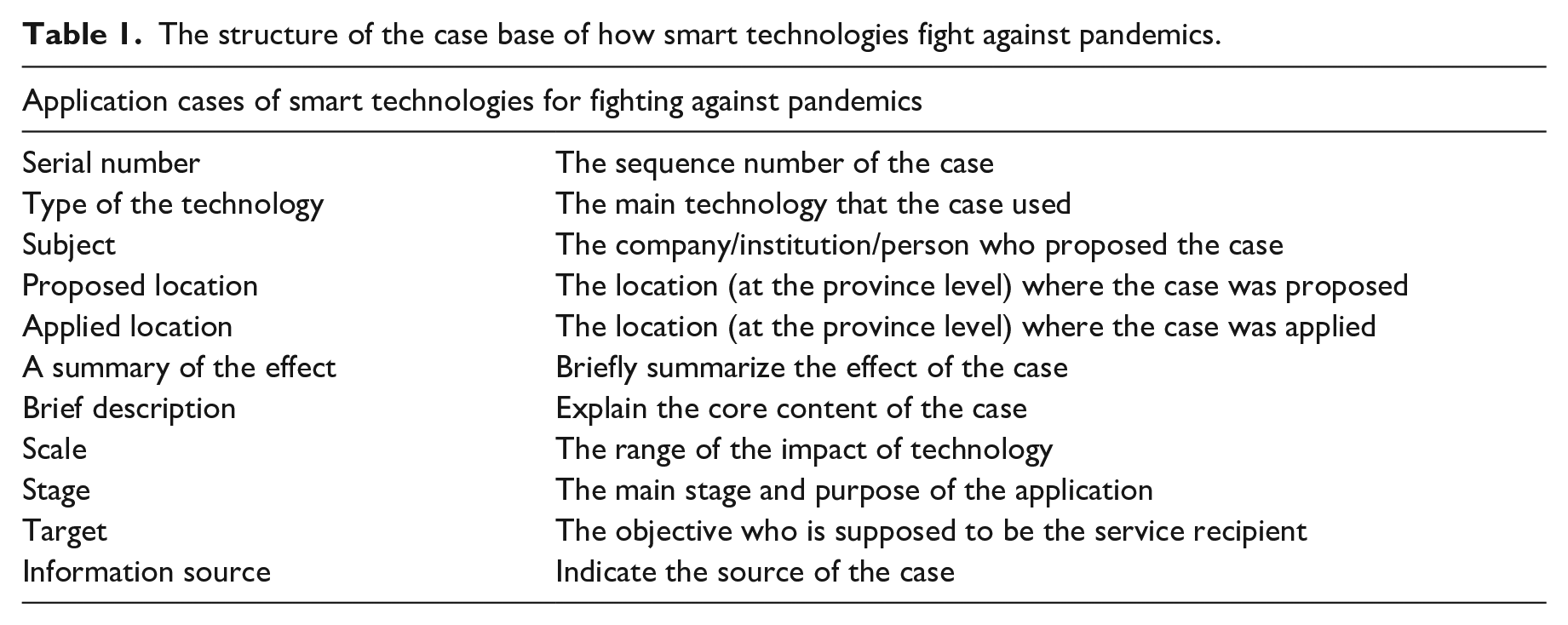
The empirical study consists of systematic and large-scale case collection and structured analysis. Considering the accessibility and relevance of information, the case base should contain four perspectives from the conceptual framework. Additionally, in order to record information more completely, we also collected the serial number, subject, proposed location, applied location, a summary of the effect, brief description, and information source (Table 1).
The structure of the case base of how smart technologies fight against pandemics.
The time for case collection is from January 2020 to June 2020, when China was suffering from the outbreak of COVID-19 and gradually stabilized (Yang and Chong, 2021). The information sources include published articles from the Web of Science, China National Knowledge Infrastructure, trusted news, government and organization articles via several widely used information media platforms in China, such as Public Accounts of WeChat, Weibo, and Baidu Search. Four college students who majored in urban planning or architecture volunteered to do a portion of the case collection. Each student was responsible for collecting application cases by searching terms of “COVID-19 OR Coronavirus AND [Specific Technology]” and using standardized software (Excel) to store the case data. Most works of the case collection were done in a Chinese context. Besides, to ensure consistency across volunteers, basic training was conducted before starting the collection (Nambiema et al., 2021). However, different sources of information and volunteers would still inevitably affect the result as well as the quality of cases, so we reviewed and screened the case base in four steps after the preliminary collection to minimize bias and ensure that the cases were relatively uniform and meet quality requirements (Figure 2). The cases not in China, not related to COVID-19 and technology, not trusted practice cases, or duplicate were excluded as invalid cases. Finally, 1,102 eligible cases were selected from 2,711 original cases for further in-depth analysis.

The flowchart of case collection and screening.
Results
The final case base shows that different subjects in China have widely applied smart technologies for dealing with various facets of this public health emergency. A “word cloud” is a visual representation of word frequency and is widely used to analyze qualitative data (Atenstaedt, 2012; Mathews et al., 2015). The more commonly a word appears within the analyzed text, the larger it appears in the generated image. The study uses the subjects who proposed the application cases, such as the specific name of the company, institution, and organization, as input texts for the word cloud analysis. It is worth noting that word clouds have some limitations, such as failing to group terms with the same or similar meanings, and thus it’s difficult to accurately reflect the actual content (Atenstaedt, 2021). However, in this study, they can still be used as a primary analysis tool to present the differences in the use of smart technologies by subjects in different fields for fighting against COVID-19.
The final result is shown in Figure 3. It is clear that internet and technology companies such as Baidu, Alibaba, Tencent, HUAWEI, and operators such as China Telecom, China Unicom, and China Mobile, as well as universities like Beijing University of Posts and Telecommunications, Tsinghua University, Wuhan University, etc., are heavily involved in using smart technologies for fighting against COVID-19 in China. The broad participation of diverse subjects also confirms the contribution of this pandemic to the development of technologies and economic transformation at the same time (Ba and Bai, 2021; Danilin, 2020).

The word cloud of subjects that proposed the application cases.
While there are many application cases without clear spatial boundaries due to ambiguous or missing information, part of them can still be judged and classified at the province level. In this condition, we distinguished between where cases were proposed and where they were applied, since cases may be proposed in one province and mainly applied in another province. The preliminary analysis result shows that both of them have imbalanced distributions in different provinces of China (Figure 4). In Pearson’s correlation coefficient test, a significant correlation was observed between the number of proposed cases and applied cases in each province (r = 0.970, p < 0.001). Considering that different pandemic situations may affect the number of proposed and applied cases, we also compared the cumulative number of confirmed COVID-19 cases up to the end of the case collection, i.e., June 2020. Unsurprisingly, the applied cases have a higher correlation with the cumulative disease cases (r = 0.702, p < 0.001) than the proposed cases (r = 0.631, p < 0.001). However, not all provinces with more proposed or applied cases have severer pandemic situations. Some regions, such as Beijing, show more applied cases than expected, contrasted with the cumulative disease cases. With more abundant innovative and public health resources and excellent anti-disaster infrastructure, there is a relatively apparent concentrated distribution of both proposed and applied cases of technologies in comparatively developed areas like Hubei, Guangdong, and other provinces (Liu et al., 2021).

The number of application cases and cumulative disease cases in different provinces of China: (a) the number of proposed cases, (b) the number of applied cases, (c) the cumulative number of confirmed COVID-19 cases (26 June 2020).
Types
Smart technologies are the critical tools for increasing urban smartness as well as the ability to fight against pandemics (Zhu et al., 2019). However, the application of different smart technologies also appears to vary. Under the same search strategy, the number of application cases of technologies can roughly show their impact and acceptability to a certain extent (Ting et al., 2020). As shown in Figure 5, Big Data, AI, Mobile Internet, IoT, and Robots are the most widely adopted smart technologies in the case base.

The number of cases of smart technologies with different functions.
Big Data ranks first with 339 application cases, far ahead of other types of technologies, reflecting the great value of Location Based Service (LBS) data. It has evolved from a digital tool to a data-driven idea that has been widely implemented in various scenarios. Compared with previous pandemics, Big Data in COVID-19 supports the real-time capture of personal identity, health information, and activities. Through digital programs such as health codes in intelligent devices, users’ data, including location and travel data, medical and health data, and online consumption data, are tracked and collected automatically (Wu et al., 2020), thus enabling accurate and rapid identification of confirmed cases or close contacts. In addition, many organizations and expert teams use Big Data statistics and simulation results to evaluate and forecast the pandemic development, further assisting government or companies in resource scheduling or decision making (Jia et al., 2020). At the same time, it provides an effective platform for all stakeholders to raise awareness of pandemics. A large number of media organizations provide visualization and query services of real-time pandemic data, such as high-accuracy distribution maps of the confirmed cases, which can better enable the public to anticipate the risk of the pandemic.
Mobile Internet, AI, and IoT are also widely used, forming integral parts of the new era’s digital infrastructures. Among them, the Mobile Internet, represented by 5G, provides technical support for transmitting large amounts of data and the operation of online services. Residents can conveniently inquire about authoritative pandemic information and personal health status, and make appointments for medical resources via mobile phones. Medical workers conduct real-time and high-precision telemedicine with the support of 5G. The supply and demand matching platforms, such as online forms or mini-programs, meet the emergency needs of different regions. AI provides numerous efficient, intelligent, and automated solutions for pandemic response. For example, it can quickly identify potential infection cases based on infrared cameras or CT images; assist in analyzing virus structure and drugs; and automatically complete telephone interviews and recordings through intelligent outbound services, reducing the workload of community managers. In addition, AI can be combined with Big Data to further improve the accuracy of pandemic analysis and prediction, and to provide early warning of high-risk pandemic transmission areas. IoT helps government, companies, or medical workers to monitor and dynamically manage patients, medical supplies, or the public environment in real time (Chamola et al., 2020).
The social acceptance of cutting-edge technologies such as Robots and Immersive Media exceeds expectations. The former reduces the direct contact through unmanned and automated services, which helps to control the spread of the pandemic (Shen et al., 2021; Zeng et al., 2020), while the latter expands the virtual spaces in the case of lockdown of part physical spaces and generates numerous application scenarios in management, telemedicine, entertainment, education, etc. (Abdel-Basset et al., 2021). Sharing Economy has also been popularized as an innovative idea, ensuring that part of the supply and demand relationship is maintained during COVID-19.
Beyond that, we have further summarized the specific functions of 14 smart technologies in the case base. The length of the bars in Figure 5 represents the number of cases where the relevant function was applied. The functions, such as “display and search pandemic situation” and “analysis public opinion, profile and flow” of Big Data and “contactless and intelligent delivery service” of Robots, tend to have a higher universality and impact. While “sensitively test for virus” of Nano Technology, “produce medical supplies” of 3D Printing, and “digital model (BIM) modeling and analysis” of Intelligent Construction, have more specific application scenarios, but the number of application cases is relatively limited compared others. In addition, we can easily find a closer relationship between different technologies. An application may rely on a variety of related technologies. For example, most applications of Robots are combined with technologies such as IoT and AI while the applications of AI are often based on Big Data. The integration of these technologies brings more powerful solutions for the pandemic response.
Scales
Most cases are on the country scale (57%), as shown in Figure 6(a), indicating that most technologies are highly universal and replicable. Among them, Big Data, Mobile Internet, and AI have the most applications, showing that these technologies have the highest combination and popularity with the pandemic response. In contrast, other technologies have relatively even applications. Large internet and technology companies or expert teams could rapidly popularize these technologies by designing standardized platforms or intelligent solutions. Furthermore, it also suggests that these smart applications and services have been mature enough and starting to promote the transformation of various industries, such as telecommuting, online education, telemedicine, diversified mobile applications, contactless delivery, and so on, which can be regarded as a disruptive innovation triggered by the impacts of this pandemic (Nagy et al., 2016). For instance, Alipay’s health code is a dynamic management solution based on the “red, yellow, and green” colors, which can serve as a consistent reference for pandemic risk assessment across multiple regions (Wang et al., 2021).

Statistical analysis results of different perspectives in case base: (a) the scales that applications work on, (b) the stages that applications work in, (c) the service targets that applications work for.
In addition, there are also many application cases on the district/city scale (31%), which are mainly applied by local governments or companies to meet local demands. Different regions have varying innovative technologies and resources, as well as the financing, markets, policies, and risks of the pandemic. In other words, part of the application cases doesn’t have the capacity and motivation to be promoted to a large scale in the short term. As a result, they can better match local conditions with affordable costs and particular application scenarios. Big Data and Mobile Internet are still widely used on this scale. Most provinces in China, such as Guangdong, Heilongjiang, and Beijing, have built provincial mini-programs for inquiring about citizens’ health and risk status. Robots, which are often applied for disinfection, treatment, cruise, and delivery during COVID-19, have been promoted significantly, reflecting the fact that the research, development, and applications of Robots still have regional differences.
Considering that there are always independent regulatory authorities on residential communities, schools, or other areas on the community scale, they are frequently utilized as basic management units in the prevention and control of pandemics (Hu, 2020). Therefore, most of the applications on this scale focus on monitoring, detecting, and intelligently intervening in the movement of individuals within them via IoT, Big Data, AI, etc.
Additionally, due to the significant differences in pandemic policies among countries worldwide, few applications are collected on the global scale (2%). Big Data, AI, and Sharing Economy have the most application cases. Compared to others, they are less affected by base stations, operators, IoT devices, or market competition among different countries. The existing cases include sharing pandemic maps, drugs, technologies, experience, and resources, which still have great development space in the future (Buss and Tobar, 2020).
Stages
Most application cases (81%) are being proposed in the stage of the prevention and control of pandemics (Figure 6(b)). Smart technologies, represented by Big Data, AI, Mobile Internet, Cloud Computing, IoT, Blockchain, etc., serve as digital infrastructure, enhancing the city’s emergency response capability mainly through strengthening monitoring and information transmission, and enhancing efficiency, intelligence, and accuracy. For example, developing a verification system for high-risk groups and vehicles; providing mini-programs for citizens to express their opinions; establishing an information exchange platform for relief materials to match the supply and demand; monitoring and identifying individuals using an infrared imager, magnetic door sensor, and other IoT equipment; and utilizing AI to assist with drug research and development and case diagnosis (Budd et al., 2020; Kummitha, 2020; Tan et al., 2022).
As the pandemic stabilized and related technologies matured, the applications for the resumption of social production and life have also gradually increased. Smart technologies, such as Mobile Internet, Immersive Media, etc., act as catalysts, accelerating the social and economic transformation with characteristics of multiple, shared, and connected (Soto-Acosta, 2020). Traveling, shopping, education, telecommuting, and telemedicine can be realized online and virtually. It’s worth noting that technologies like Sharing Economy have more obvious contributions in this stage. The development and maturation of massive virtual mobile applications and sharing ideas such as shared travel and shared employment will reduce the impact of the pandemic lockdown through the expansion of flexible virtual spaces and the efficient reuse of physical spaces and resources (Hua et al., 2021).
Targets
Monitoring, quarantine, healthcare, resource scheduling, logistics, and related industries are in high demand during the pandemic, resulting in many business-oriented applications cases (47%). Besides, maintaining social production and order is a critical component of pandemic urbanism (Andres et al., 2021). The combination of top-down and bottom-up applications becomes pretty necessary, verified by the similar number of citizens and governments in service targets (Figure 6(c)). In terms of technologies, Big Data is being used to serve the government significantly, demonstrating the Chinese government’s efforts to monitor the pandemic data in support of policymaking and governance improvement. Specific technologies, such as Robots, Cloud Computing, Nano Technology, Intelligent Construction, 3D Printing, etc., are often used for business instead of the citizen. More service-oriented technologies such as Mobile Internet, Big Data, Immersive Media, Sharing Economy, etc., are being used to serve the citizen. New life and social relations are constructed in the form of online offices, contactless delivery, virtual tourism, etc., which also satisfies the regular work and life under spatial quarantine during pandemics and develops additional service scenarios.
The features and relationships among different perspectives
By connecting the different perspectives of application cases with a Sankey diagram (Figure 7), we can further discover the characteristics and mechanisms of smart technologies at different scales, stages, and targets in response to the pandemic. The flow value is the sum of the number of cases, reflecting the connection among different perspectives.

The analysis of smart technologies from different perspectives.
The result shows clear distinctions in the penetration of various technologies on different spatial scales, temporal stages, and social service targets. Some technologies are used in limited scenarios, whereas others have a relatively higher penetration in multiple perspectives. AI, Cloud Computing, Blockchain, Cybersecurity, 3D Printing, and Nano Technology are often applied on the country scale, pandemic prevention and control stage, and serving business. While Immersive Media and Sharing Economy are mainly used on the country scale, the stage of resumption of social production and life, and serving the citizen. These technology applications tend to have less regional variation. In the pandemic prevention and control stage, more industry applications with a higher standardization are used to solve the urban economic and health problems directly. In the resumption stage, these technologies tend to create more available products and services for the citizen and promote the transformation of the city’s traditional industries. Other technologies such as Big Data, Mobile Internet, IoT, Robots, Intelligent Construction, etc., have more regional variation, as evidenced by the fact that they are mainly applied on more than one scale. However, most of them still mainly serve one stage and focus on one specific service target. Mobile Internet has apparent diversity in service stages and targets, indicating that there are more application scenarios than others.
In general, most technologies tend to be applied more on country or district/city scales and contribute to the stage of pandemic prevention and control, while their service targets are quite different. This suggests that during COVID-19, penetration of these core technologies tends to evolve toward a greater scope and more diverse service scenarios. At the same time, a significant proportion of applications serving government are spread on both district/city and community scales compared with those serving the citizen and business, which indicates that local governments and community managers also play an essential role.
Conclusions and discussions
Conclusions
This paper discusses in detail the role of smart technologies for fighting against pandemics. Through a comprehensive case collection and analysis, we evaluate the characteristics and interconnections of the application of different smart technologies in China during COVID-19. A wide range of subjects participated in this pandemic response using smart technologies. General technologies such as Big Data and Mobile Internet are the most widely used. With their support, fine-grained monitoring, tracking, and quarantine remain the core measures. Besides, most application cases work on country or district/city scales. The stage of prevention and control of pandemics contains most cases, while urban resilience has been further enhanced with technologies promoting the resumption of social production and life. A large portion of cases are business-oriented, and the number of cases for government and citizen is similar. Finally, there are significant differences in the penetration of technology applications in each perspective. And it has become a trend for technology applications to be more diversified and serve both pandemic stages and multiple targets.
Discussions
It is worth noting that countries such as the United States, the United Kingdom, and the Netherlands have also contributed significantly to the pandemic response using smart technologies during COVID-19 (Wang et al., 2021). In addition to the technologies mentioned in this paper, Wearable Medical Sensors, Biosensor, Holography, Internet of Medical Things (IoMT), DP3T, etc., are also being applied widely (Elbarbary et al., 2020; Hassantabar et al., 2021; Paranitharan et al., 2022; Pratap Singh et al., 2020; Troncoso et al., 2020). However, the specific measures for fighting against pandemics with technologies vary among countries due to population, economic, and political differences. Compared to other countries, the Chinese government has a more substantial capacity for resource mobilization. Thus, it is more inclined to integrate smart technologies with public health and opt for highly risk-averse approaches (Zhang et al., 2022). More extensive social media campaigns, intensive medical resources in use, and constant dynamic and flexible adjustment of measures minimize the impact of COVID-19 on normal urban production and life and make it possible to control the pandemic in China (Xu et al., 2020a).
While the case base reflects the vital role of smart technologies in the pandemic responses, some limitations remain. The case base relies on the number of cases to judge the impact of technology applications, which may result in bias in the analysis results. For example, the same type of technology applications developed by different companies may have some overlap. Although we have eliminated duplicate cases via screening and picked the representative application in one specific function from each company as one case, the final results may still have some duplication. In addition, the actual effect of different applications on the pandemic response varies significantly, which is not considered as one of the factors when conducting the case statistics and may also influence the final results. Assessing each case’s quality and real effect may be one of the solutions to optimize the outcome.
Although this study only systematically tracked China’s pandemic response in the first half of 2020, smart technologies continue to play an essential role in the subsequent years and provide support in more diverse and specific scenarios according to our observation. China has also shared its technologies and experience in fighting against COVID-19 with other countries and has been actively engaged in international cooperation of research and practice, making a considerable contribution to controlling the pandemic (Abbas et al., 2021). Considering the rapid change of both pandemics and smart technologies, the related findings of this study can only be regarded as a starting point, and further exploration and empirical studies are still required in the future.
Footnotes
Acknowledgements
We thank Wanyi Chen, Zijing Liu, Yuye Zhou, and Rong Yuan for their work of collecting cases as volunteers. Besides, We thank Yuyang Zhang for his advice and writing assistance.
Declaration of conflicting interests
The author(s) declared no potential conflicts of interest with respect to the research, authorship, and/or publication of this article.
Funding
The author(s) received no financial support for the research, authorship, and/or publication of this article.