




Abstract
Recent decades have brought dramatic urbanization to China. Between 1978 and 2018, the urban population rose from 17.9 per cent to 59.6 per cent of the total. Urbanization has many implications, including for education. China’s government has long been concerned about imbalances in access to and quality of schooling, and new imbalances have been introduced through market forces in the so-called shadow education sector of private supplementary tutoring, arising from both demand and supply. Urban families in particular seek private supplementary tutoring, and tutorial companies favour densely populated areas for higher enrolments. China has the world’s largest school system and most extensive shadow provision. This paper conceptualizes the space of shadow provision in educational, social and geographical terms. It highlights the changing scale and nature of private tutoring, observes the roles of new technologies and government regulations, notes the impact of COVID-19, and argues that shadow education both shapes and is shaped by urbanization.
I. Introduction
This paper focuses on what commentators commonly call the shadow education system of supplementary tutoring. The shadow metaphor is invoked because the curricula of supplementary tutoring closely track the curricula of classroom education.(1) The paper is concerned with tutoring in academic subjects provided on a fee-charging basis by companies, teachers undertaking such work in addition to their regular duties, and informal suppliers such as university students. Long prominent in such countries as South Korea, Japan and Singapore, shadow education has become a global phenomenon.(2) It has also become very prominent in China.(3)
Over the past five decades, China has also experienced dramatic urbanization. According to official statistics, the level of urbanization increased from 17.9 per cent in 1978 to 59.6 per cent in 2018.(4) This shift has brought changes of many kinds, including in the education sector. Yet while it is relatively common to note relationships between urbanization and schooling, both in China and internationally,(5) little attention has been given to relationships between urbanization and shadow education. The present paper observes that forces operate in both directions, since urbanization and shadow education in China to some extent shape each other.
An indication of the scale of shadow education is provided by a household survey by the China Institute for Educational Finance Research.(6) In 2017, the survey showed, shadow education participation rates were highest in northeastern China, at 60.8 per cent. Next highest were the eastern areas (38.1 per cent), central areas (38.0 per cent) and western areas (30.5 per cent). Further, participation rates of urban students, at 44.8 per cent, were more than double the 21.8 per cent of rural students. Average household annual expenditures on tutoring were RMB 5,021 (US$ 724) per student nationwide. Urban China had not only higher enrolment rates but also higher per-capita expenditures, at RMB 5,762 (US$ 831). Annual expenditures for rural students, by contrast, were only RMB 1,580 (US$ 228) per student.
With such matters in mind, the paper begins with a conceptual framework that includes a focus on the broad international picture before elaborating on Chinese specifics. Employing the concept of space,(7) the paper then analyses ways in which the development of shadow education has changed learning spaces and power dynamics. The following section discusses international spatial disparities in shadow education, both socially and geographically. In subsequent sections, the paper notes the roles of technologies, the implications of government regulations, and the impact of the COVID-19 epidemic that hit in 2020. The final section returns to the broader framework to identify insights not only for China but also more widely.
II. International Perspectives On The Nature And Scale Of Shadow Education
To provide a contextual framework, this section elaborates on the nature of shadow education and how it differs from schooling. It also describes the forces underlying the expansion of shadow education, particularly as they relate to urbanization.
Shadow education is voluntary, unlike schooling, which across the globe is compulsory, at least at the levels of primary and commonly lower-secondary education. Families choose whether to invest in shadow education according to their aspirations, capacity to pay, and availability of the service. The corollary of compulsory schooling is that governments have the obligation to provide it. No such obligation applies to shadow education, which operates in the private sector albeit in a few cases through private–public partnerships.
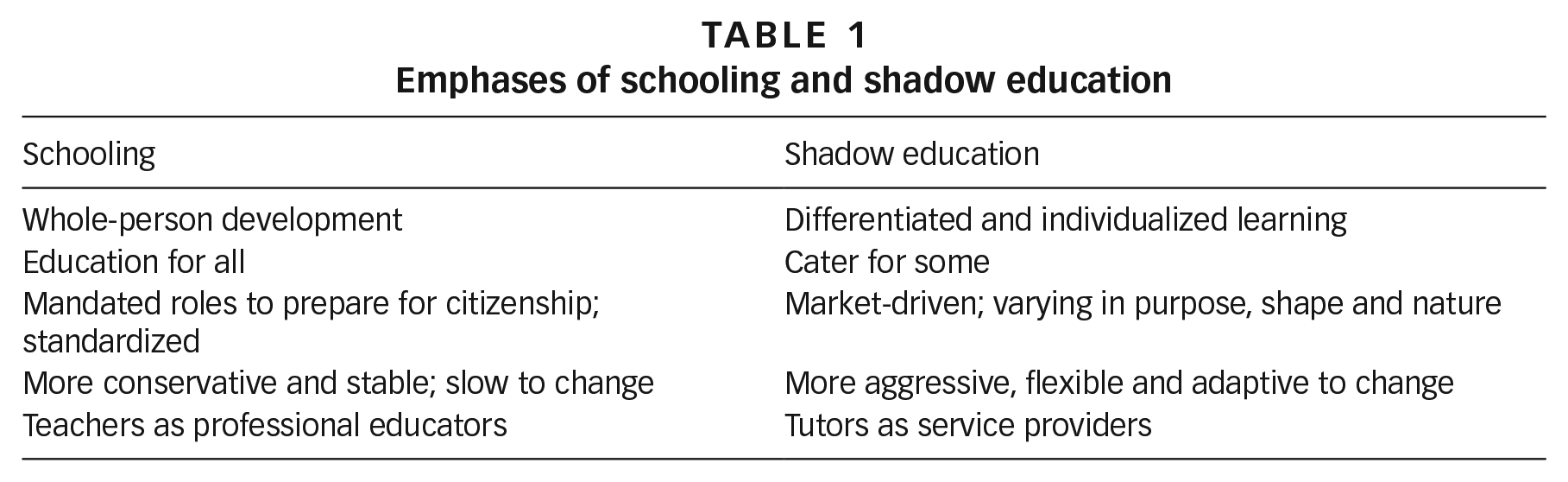
In China and many other countries, significant numbers of commercial enterprises supply shadow education. Other suppliers include regular teachers, university students and other informal providers. Many of the teachers work in public schools and offer private supplementary tutoring outside school hours to earn extra income, usually without formal approval of the governments that are their principal employers. Table 1 shows major differences in the emphases of schooling and shadow education.
Emphases of schooling and shadow education
The core factor underlying most family decisions to seek shadow education is social competition. Families particularly recognize links between examination grades and subsequent access to remunerative employment. In most countries, schooling is itself stratified, with students allocated to different streams at transition points, especially at the end of lower-secondary schooling. Families know that grades at the end of upper-secondary schooling are the main determinant of post-secondary careers. Schooling, as Hollis(8) points out, is a positional good insofar as the chief determinant of whether people consider themselves to have secured adequate learning and qualifications is whether the amounts and qualities of schooling are greater than those held by peers and competitors. Social competition has been intensified in most countries by expanded access to educational opportunities, greater geographic mobility, and the forces of globalization. Cultural factors may also play a role, and the fact that shadow education has been especially prominent in East Asian societies has commonly been linked to Confucian values of diligence and meritocracy.(9)
To illustrate the global nature of shadow education, examples from both high-income and middle-income countries are instructive.
In England and Wales, a 2019 survey found that 27 per cent of nationally sampled students aged 11–16, and 41 per cent of London students, had received private tutoring at some time.(10)
In Egypt, a 2012 national survey reported extensive private tutoring in all grades. Even in Grade 1, 33 per cent of surveyed students were receiving private lessons, and a further 9 per cent were in fee-paying help groups. In Grade 6, these numbers were 61 per cent and 12 per cent; in Grade 9 they were 64 per cent and 10 per cent; and in Grade 12, 56 per cent and 2 per cent respectively.(11) Urban students were considerably more likely than rural students to receive such shadow education.
In South Korea, national shadow education enrolment rates in 2019 were reported to be 83.5 per cent in elementary school, 71 per cent in middle school, and 68 per cent in general high school.(12) Across all grades, enrolment rates were reported to be 88 per cent in Seoul (the national capital), 77 per cent in other large cities, 58 per cent in small and medium-sized cities, and 47 per cent in rural areas.
The fact that in each of these countries shadow education enrolment rates were higher in urban than rural areas reflects both demand and supply. Urban areas have greater social competition and more families able to afford shadow education. On the supply side, companies favour locations with greater population densities; and universities, which commonly host students providing tutoring on a part-time basis, are more likely to be located in cities. However, schoolteachers are distributed more evenly, and are more likely to be the major suppliers of tutoring in rural areas. This pattern was especially evident in Egypt, where salaries were low and teachers in both urban and rural areas felt the need to supplement their incomes.
Also important are variations in the modes of tutoring. Whereas schooling is generally provided in classes of up to 50 pupils or even more, much shadow education is provided one-to-one or in small groups. However, shadow education may also be provided in full classes and even large lecture theatres. Further, new technologies have permitted tutoring through the internet across national boundaries. Such tutoring can also be one-to-one, one-to-small-group or one-to-many (even thousands), and can combine distance approaches with in-person teaching.(13)
Finally, a major contextual factor is a general acceptance of neoliberalism in the education sector. Introduction of market forces was a deliberate strategy by some governments to increase competition, with the goals of improved efficiency, expanded consumer (family) choice, and reduced burden on the public purse.(14) Commencing in such countries as the United Kingdom, New Zealand and the US, the approach spread to become a global phenomenon. Shadow education, however, is an example of what Verger et al.(15) call privatization by default rather than by deliberate strategy. Indeed, most governments, insofar as they have formulated a stance on shadow education, view it as problematic rather than something to be encouraged. Most problematic is the role of shadow education in maintaining and exacerbating social inequalities. Other problems include the study burden on students and the negative impact of shadow education on mainstream schooling.(16)
III. Society And Education In China
The dramatic pace of urbanization in China since 1978 has reflected and contributed to other fundamental shifts in Chinese society. Political, economic and social changes have shaped each other, as have changes in both regular schooling and shadow education.
The year 1978 was a turning point following the 1966–76 Cultural Revolution, as the beginning of China’s “open door” policy and the shift to a market orientation after the central planning implemented strictly since 1949. The shift permitted huge economic growth, with per-capita GDP rising from US$ 307 in 1978 to US$ 8,254 (at constant 2010 prices) in 2019.(17) This economic growth was particularly achieved through industrialization, which in turn was both facilitated by and contributed to urbanization.
Economic growth has interacted with urbanization in three ways.(18) First, in the “magnet” phase, factories sprang up in and around cities, offering incomes higher than those available in subsistence agriculture. Second was the “building binge” in which urban construction itself pushed economic growth; and third was the “smart city” phase in which the density of skilled workers enabled creation of knowledge networks that generated productivity in particular industries. These phases occurred at different times in different parts of the country, and to date only a few cities have moved to the third phase. As such, urbanization is an ongoing process.
Recognizing that qualitative aspects of markets vary in cities of different sizes, it is common to refer to cities as belonging to one of four tiers. While no official list places cities in any of these tiers, Tier 1 cities are generally agreed to be Beijing, Guangzhou, Shanghai and Shenzhen. Other dynamics of change also affect growth and development of cities in complex ways.(19)
Education has contributed significantly to urbanization by training skilled labourers, socializing children into responsible citizens, and promoting research and development; and schools and universities have themselves served as important engines of urbanization. Figure 1 shows the remarkable expansion of education at all levels. These quantitative achievements have been accompanied by equally impressive qualitative achievements.(20) Most was accomplished through the public sector, but the private sector emerged during the 1980s and 1990s and became especially visible at the kindergarten level.(21) In 2019, 56.2 per cent of kindergarten students were in private institutions. This compared with 8.9 per cent among primary students, and 14.2 per cent and 9.0 per cent respectively among lower- and upper-secondary students.(22)
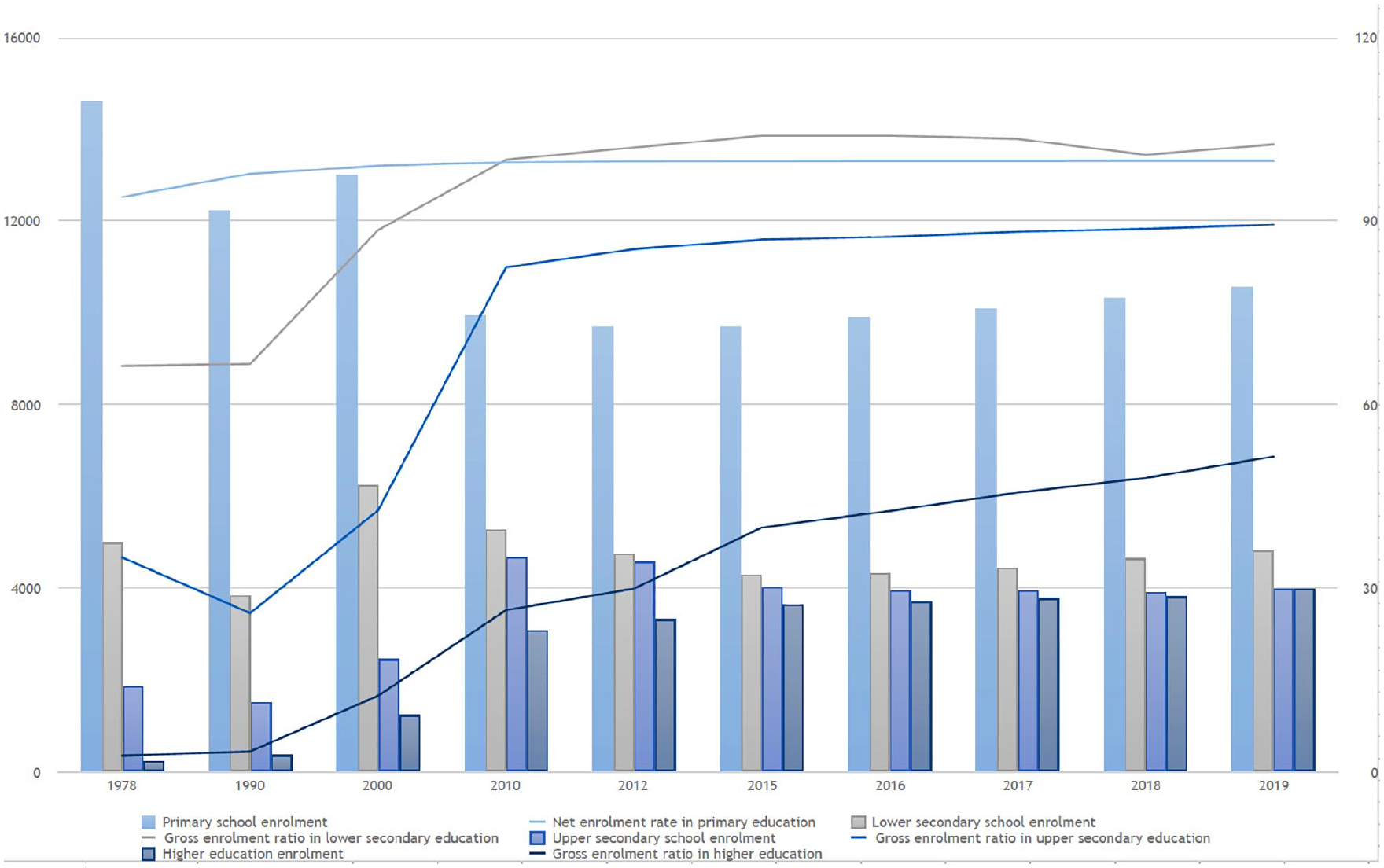
Expansion of primary, secondary and higher education in China (1978–2019)
During the initial period after 1949, suspended during the Cultural Revolution but then revived, some schools were designated for extra resourcing as key institutions.(23) A national government decision(24) removed the classification, but the vocabulary remains in common parlance and some institutions are still considerably better resourced than others. Differentials exist within geographic zones, but also markedly across rural and urban areas because the key schools are almost all urban. Rural areas, long challenged in access to human and physical resources, have further suffered from depopulation. Many rural children have been “left behind” by parents who have migrated to cities for work.(25) In response to the declining school-aged population in rural areas as a result of urbanization, the government has by stages since 2001 reallocated educational resources. Many rural small schools and “teaching sites” have been closed, requiring children in remote locations to move to county or town schools.(26) Such factors create complex pictures. Some children are left behind in remote areas; others board or move with relatives to counties and towns; and others join their parents in cities.
Within the school system, major watersheds occur at the end of lower-secondary (Grade 9) school, when students sit the Zhongkao examination, on the basis of which they will either have their studies terminated or proceed to stratified upper-secondary schools. At the end of upper-secondary schooling (Grade 12), students sit the Gaokao examination, which again determines whether they can continue their studies with entry to post-secondary institutions of varying levels of prestige. In part because of achievements in expanding lower levels of schooling, the Zhongkao and Gaokao examinations have become even more competitive than in earlier periods. Expansion of post-secondary education means that larger proportions of Grade 12 students can proceed with further study, but stratification within the system means that competition is in some respects even fiercer than before. This in turn has implications for shadow education. To get into a good post-secondary institution it is essential to secure high grades, which is easier from a good upper-secondary school. And to get into a good upper-secondary school it is similarly essential to have secured high grades at each stage, which is easier from good institutions, extending all the way back to the entry system for kindergartens. Students cannot be pushed out of the school system during the period of compulsory education, but they are ranked at each stage and most families view shadow education as an essential instrument in the competition.
Also pertinent are the hukou residence permits that govern access to public services. Many migrant workers in cities still have hukou residence only in their places of origin, and therefore have limited access in cities not only to medical care and public housing, but also to schooling. According to UNICEF,(27) 34.2 million children lacked hukou status in their cities of residence. Initially most city authorities denied migrant children access to public schools, but this prohibition was relaxed during the 2010s for the period of compulsory education. Children excluded from public schools attended private schools for migrants, some of which were unlicensed.(28) In 2019, about 14.3 million migrant children attended Grades 1–9 in urban schools,(29) but those without urban hukou still had to return to their places of origin for the Zhongkao examination.
Also pertinent is the one-child policy launched in 1979 but modified in the mid-1980s to permit rural parents a second child if the first was a daughter. The policy remained in effect for three decades, causing demographic and other imbalances between rural and urban areas. In 2013 the policy was revised to permit two children in families having at least one only-child parent, and then in 2015 all families were allowed two children. The pertinence for this paper lies first in the differentiation for three decades between rural and urban areas, and second the policy’s contribution to the rise of the “priceless child” on whom hopes and aspirations were bestowed.(30) On the one hand, such children received resources including for shadow education, but on the other hand they experienced pressures including through shadow education.(31) The impact of the two-child policy will be felt in the education sector in due course, but meanwhile, as noted by Deloitte,(32) adjustment of the population structure and expansion of household consumption has much expanded the education market.
IV. Changing Spaces And Power Dynamics In Shadow Education
Between 1949 and 1978, no private education of any kind was permitted in China’s schooling or in the shadow. The emergence of private schooling during the 1980s was modest, but gathered speed in the 1990s and beyond, and was accompanied from the early 1990s by the emergence of shadow education. Over subsequent decades, China’s shadow education industry became the largest in the world.(33) This section analyses its historical development, drawing on the literature and on empirical data collected by the authors between 1994 and 2020 from policymakers, school principals, teachers, owners of tutoring companies, tutors and families.
Understanding of the expansion and changing modes of shadow education may be enhanced by the conceptual lens of space. Gulson and Symes(34) noted, “Schools and universities, like other cultural institutions, are important sites in the constitution of the modern city, though the significance of these sites is often downplayed and has not received the same attention as shopping malls and theme parks”, The remark also applies to shadow education, which has become a learning space that not only brings challenges and opportunities, but also changes power dynamics in education and the wider society.
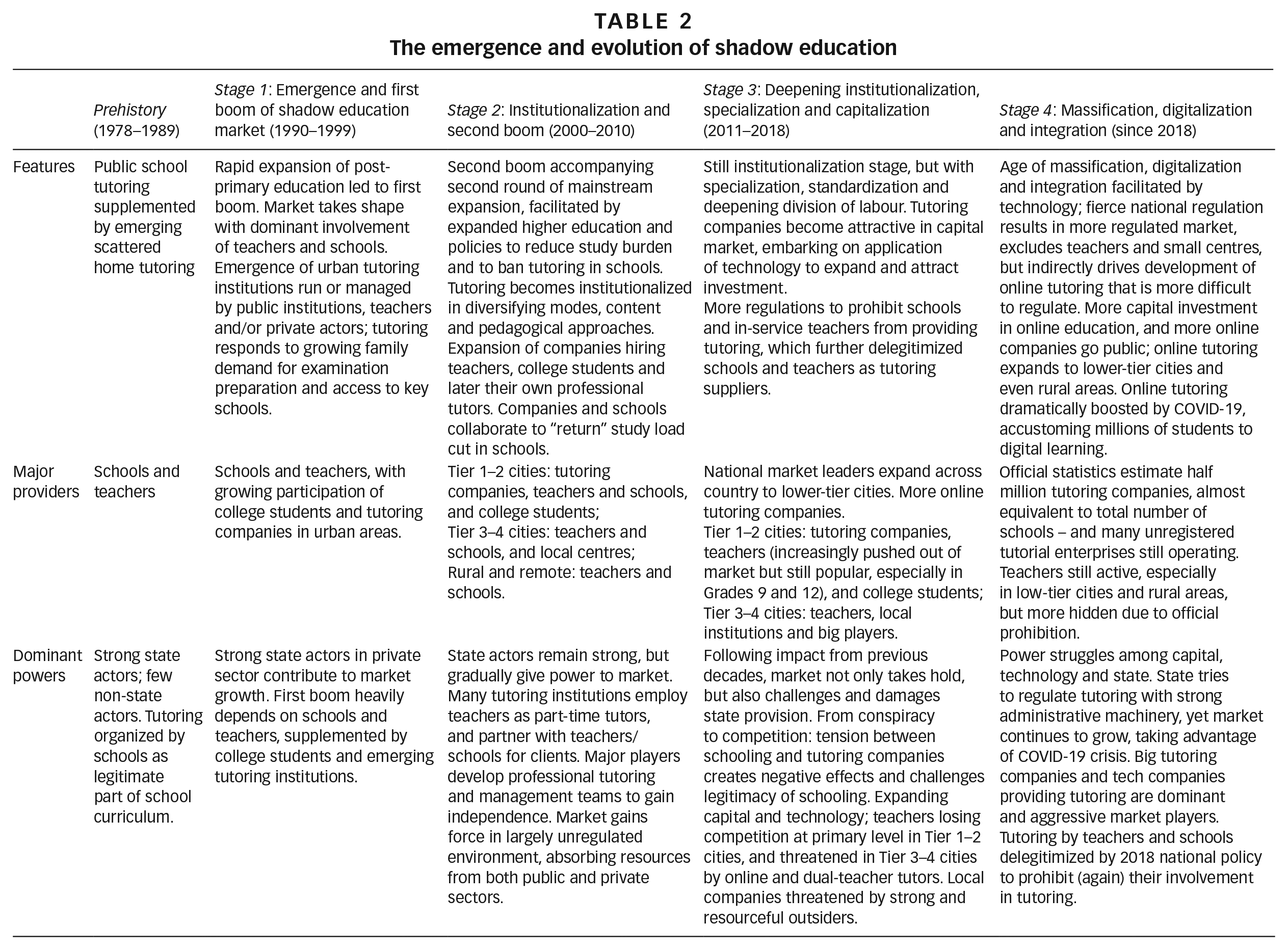
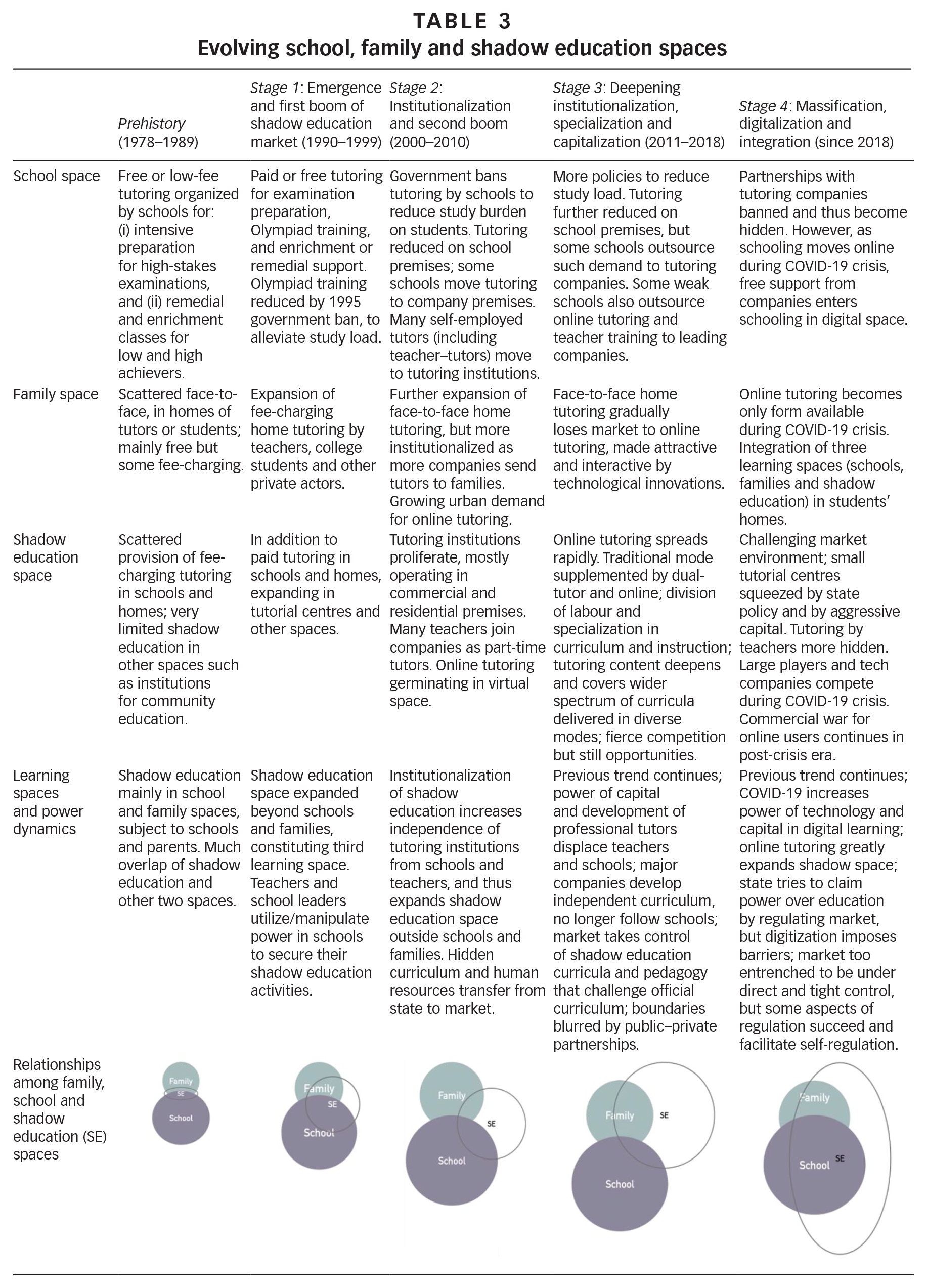
Tables 2 and 3 show the emergence and evolution of shadow education in four phases following what can be called its prehistory in the 1980s. During the period of prehistory, free-of-charge tutoring was commonly given by teachers, college students and others. Some fee-charging shadow education did emerge during the 1980s, but only during the early 1990s did it really become visible. Discourse analysis of literature from the time shows positive attitudes towards school provision of remedial tutoring and Gaokao preparation as part of school curriculum and teacher responsibility. Paid tutoring for entrance examinations germinated at this time. For example, Huang(35) documented the paid Gaokao tutoring organized by a public institution since 1984. During this period, families and schools were the main spaces where education, including tutoring, took place.
Stage 1 of the emergence during the 1990s was stimulated by the rapid expansion of post-primary schooling (Figure 1), and of opportunities for families able and willing to compete. As the tutoring market took shape, shadow education grew beyond school and family spaces to form the third learning space. Teachers operating independently or in conjunction with their schools were the main suppliers of private tutoring, but were accompanied by informal suppliers including college students and by emerging tutorial institutions. The tutoring served both low and high achievers, and school-organized tutoring particularly focused on preparation for the Zhongkao and Gaokao examinations. Other tutoring for elite students focused on the demanding Olympiad contests, particularly in mathematics, science and English.
A national policy(36) prohibiting school tutoring for Olympiads was among the forces pushing teachers away from tutoring on school premises to less visible sites, and providing a market for other providers. The tutoring boom in urban areas was fuelled by competition for access to key schools and elite classes within ordinary schools. Hua’s(37) report on study load provided an example from Tianjin. Among 472 students sampled from five primary schools, 67 per cent received tutoring; and among them, 92 per cent did so for entrance to lower-secondary key schools.
Many early tutoring companies had ties to public institutions. For instance, New Oriental, the second-largest tutoring company in China, was founded by a Peking University teacher in 1993 as a training institution for overseas studies. Following diversification at the turn of the 21st century, tutoring became the company’s major business. Similarly, Only Education, a work-study centre at Shanghai Jiaotong University established in 1984, was transformed into an education and technology company in 1992. It embarked on English tutoring, and tutoring in multiple subjects has been the company’s major business since 1998. Only Education is one of the oldest and largest tutoring companies in China. Several local and regional leaders still active today were founded by schoolteachers or managers during this period.
Stage 2, comprising roughly the decade from 2000, was stimulated by further expansion of mainstream education, especially at the upper-secondary and post-secondary levels (Figure 1), and the sector attracted growing interest from venture investors. At the same time, burden-reduction policies prohibited schools from accelerating instruction on the national curriculum and from providing tutoring.(38) These regulations shortened official school hours, and increased anxieties among some parents who then arranged tutoring to compensate.(39) The reduced school hours also released teachers’ time for tutoring, and strengthened collusion between schools and tutoring companies. For instance, in 2005, another national policy prohibiting schools from training students for Olympiads (indicating that such tutoring had resurfaced a decade after the 1995 ban) created opportunities for tutoring companies to “take over” demand for such tutoring. To maintain their performance, some schools collaborated by moving tutoring classes from their schools to partner companies, or by sending students to companies with strong reputations for Olympiad tutoring. In 2008, a document on professional ethics stated that teachers “should reject paid tutoring with consciousness, and should not gain personal profit from their positions as teacher”,.(40) This was in response to teachers working as tutors and recommending students to other teachers and to tutoring companies.
During Stage 2 many tutoring institutions obtained textbooks, teaching materials, homework assignments and examination papers from the mainstream schools with help from tutees and teachers. In addition to teachers, they employed students from elite universities, drawing on these universities’ prestige to brand their services. By the end of Stage 2, major players had built independent teams for teaching, research and management. As more teachers worked for tutoring companies, and more schools ran or collaborated with companies, personnel migrated to the third space to provide tutoring outside school premises. In this process, the shadow education space grew further beyond the school and family spaces. An example of institutionalized tutoring is Xueersi (meaning “learning and thinking”, in 2013 renamed TAL), the largest tutoring company in contemporary China. Xueersi was founded in response to growing demand for mathematics tutoring in Beijing, especially training for Olympiads. It started as a small tutoring centre run by a postgraduate student of Peking University who employed students from elite universities to provide the tutoring. After seven years of development, in 2010 the company went public on the New York Stock Exchange, with 647 full-time tutors in 109 learning centres and 87 service centres in Beijing, Shanghai, Shenzhen, Guangzhou, Tianjin and Wuhan.
Stage 3 saw further expansion of tutoring institutions accompanied by standardization, specialization and capitalization, during which the market not only took hold of shadow education but also caused more repercussions for schooling. Within the industry, the division of labour deepened. Professional tutors were supported by specialists in content development, assessment, customer service, marketing, branding and education technology. Different categories of tutors emerged, including leading tutors, assistant tutors and tutor researchers. This division of labour was accompanied by diversifying curricula and modes of tutoring. Online tutors were trained differently from tutors in traditional classrooms, and tutors leading mass classes had different skills and expertise from one-to-one tutors. In the dual-tutor mode, a popular strategy since the mid-2010s for market expansion in Tier 3 and 4 cities, lead tutors concentrated on teaching while assistant tutors facilitated classroom interactions and provided face-to-face feedback. Companies also specialized in learning content and target clienteles. Curricula in tutoring went beyond intensive examination preparation to capture diverse learning needs, and followed such international trends as an emphasis on STEAM (Science, Technology, Engineering, Art and Mathematics). Rapid development of education technology made online tutoring more attractive, but traditional tutoring also continued to expand. Shadow education became a hot target in the capital market. After the listing of Xueersi on the New York Stock Exchange, more companies followed suit in New York, Shanghai and Hong Kong.
Turning to the learning spaces, a 2015 government document prohibiting schools and in-service teachers from providing tutoring(41) further delegitimized schools and teachers as tutoring suppliers. These regulations increased uncertainties and anxieties among parents, pushed some schools and teachers out of the tutoring market, released more time from schools for tutoring companies, and created demand in tutoring companies for what had been cut from the schools. Tutoring therefore expanded further, with more self-reliance than dependence on schooling resources. Some schools outsourced activities to tutoring companies, particularly for examination preparation, Olympiad training and student admission.(42) Some weak schools also outsourced online tutoring and teacher training.
Alongside training of professional tutors, major companies also developed independent curricula, some of which created challenges for schools. When most students in school received tutoring, their teachers had to adjust their pace to fit the tutoring curriculum. Government efforts to equalize schooling were offset by better-off families using tutoring to maintain their children’s competitive edge.(43) Some teachers felt threatened by their students’ preference for the pedagogy and curricula of the tutoring companies.
Stage 4 commenced in 2018 with new and fierce national regulations. An initial statement jointly issued by four branches of the national government(44) was followed a month later by a Ministry of Education notice to accelerate regulation of tutoring enterprises.(45) A third major document was issued in 2018 by the General Office of the State Council (GOSC) with detailed instructions.(46) These regulations, accompanied by powerful business interests in the context of continued demand, contributed to massification and institutionalization of tutoring. The pressures for innovation and the rewards for success led to further development of modes of delivery through educational technology (EduTech), including blended learning. Teachers were displaced from their previous tutoring roles, and small tutorial centres faced increasing pressures.
During Stage 4, both national policy and COVID-19, which hit in 2020, pushed tutoring further into online space. A study by the Key Laboratory of Big Data Mining and Knowledge Management(47) showed that the value of the kindergarten to Grade 12 online education consumer market grew from RMB 8.5 billion (US$ 1.2 billion) in 2013 to RMB 88 billion (US$ 12.8 billion) in 2020. The corresponding market penetration rate increased from 6.8 per cent in 2013 to 15 per cent of all students in 2019, and jumped dramatically to 85 per cent in early 2020 with the COVID-19 crisis. Additionally, the study indicated growth of online tutoring in Tier 3 and 4 cities, even though 42 per cent and 35 per cent of online consumers were in Tier 1 and Tier 2 cities respectively.
During the COVID-19 crisis, modes of online tutoring for mass production at relatively low prices were offered widely by companies competing for consumers. Accessibility and affordability increased, facilitating massification of shadow education. Tutors and tutees were exposed online to close monitoring through evaluation and assessment tools, with little attention to privacy protection. These all reflected the expanded power of capital and technology in shadow education. As such, over the decades of development, shadow education has become a space in which the market, state and family compete for power over teaching and learning.(48) Some parents use it to control their children’s education in ways precluded for schools; and some schools use it to secure performance in the face of government reforms to equalize schooling. Venture investors use shadow education to accumulate capital, while technology companies manipulate it for both capital and data.(49) Shadow education has expanded as schooling and family education have been increasingly externalized to tutoring providers. It has become a significant third space in which different actors strategize for educational, social, economic and emotional purposes.
V. Spatial Disparities In Shadow Education
The analysis above conceptualizes shadow education as an educational space. This section adds to the spatial analysis with elaborations on its unequal geographic and sociological distribution. Eastern China generally has more and better schooling than Central and Western China, as do first-tier cities compared with lower-tier cities, more developed city districts compared with less developed districts, and urban areas as a whole compared with rural areas. The geography of shadow education mimics these patterns. Locations with demand for more and better schooling also demand more and better shadow education, chiefly because families have higher expectations and compete more vigorously.
Elaborating on disparities within cities, a Shanghai study showed that after controlling for socioeconomic status, family size, residential status and gender, students in the suburbs were less likely to receive tutoring than counterparts in the urban core districts, where schooling is stronger as well as highly competitive.(50) Disparities are also evident among schools around the country, with students in elite schools more likely to receive private tutoring than counterparts in ordinary schools.(51)
Likewise, in rural areas, the areas closer to cities generally have more and better access to tutoring. For instance, research in Chongqing Municipality(52) showed that on the urban–rural fringe, where many tutoring institutions were located, access to tutoring was easier and participation rates were higher than in poor counties and remote villages. And while almost half of the sampled students attending Chongqing county schools had an urban hukou, they were less likely to be tutored than students attending urban schools.(53) In Shanghai Municipality, Chongming County is the only rural area. Many parents from this county have migrated to the city for work, some bringing their children and others leaving them with family members. Tutoring in this region is mostly provided by schools and teachers (some fee-charging and some free of charge). But some better-off families send their children to the urban districts for tutoring by companies during weekends and long vacations.(54)
The Shanghai research also showed the importance of hukou residential status. Students who had migrated from other provinces with their parents were less likely to receive tutoring than students with Shanghai hukou. Because hukou regulations made most of them ineligible to sit the Zhongkao examination in Shanghai, few migrant children could proceed to academic upper-secondary schooling in the city and therefore had less incentive to compete. Students who did aspire to the academic track commonly returned to their places of origin before Grade 9 to sit the Zhongkao there.
Reflecting the concept of space as a social construction, disparities are also evident among different social groups in access to shadow education. Children without siblings are more likely to receive tutoring, which reflects the intensive focus on these children by parents and grandparents,(55) as are children in families of higher socioeconomic status.(56) The demand for tutoring is particularly salient among insecure and ambitious middle-class families.(57)
A temporal dimension adds to an understanding of the dynamics (Tables 2 and 3). In contemporary China, shadow education in Tier 1 and strong Tier 2 cities is in Stage 3 (deepening institutionalization, specialization and capitalization), moving to Stage 4 (massification, digitalization and integration). In weak Tier 2 and in Tier 3 and 4 cities, it is moving from Stage 2 (institutionalization and second boom) towards Stage 3. Rapid changes brought by technology are lifting poor rural areas that are still largely in Stage 1 (emergence and first boom) or even in prehistory, but cities still have much larger “third learning spaces” than towns, villages and remote rural areas.
The emergence and evolution of shadow education
Evolving school, family and shadow education spaces
Location also matters for other dimensions of supply. Tutoring institutions can more easily employ high-quality teaching and management staff in cities with abundant school and university resources. Major cities and developed districts in the cities also attract more capable college graduates.(58) Until the 2018 prohibition on employment of serving schoolteachers in tutorial institutions, the companies that hired teachers benefitted most in neighbourhoods with high-quality schools. To secure competent tutors and managers, the largest and oldest tutoring companies built their initial sites in developed districts of major cities that also had elite universities. Further, for easy access they located their tutorial centres near schools, in city/district centres, and/or near bus and metro stations. The national market leaders, New Oriental and Xueersi, were both founded in Haidian District, Beijing, where the best schools and universities were located. From there, they expanded to other districts in Beijing and to other cities. Even small tutoring centres that provide tailor-made services to students from specific schools or for admission to specific institutions are commonly located close to those schools and institutions. Thus private tutoring shadows schooling not only in curricula but also in space.
Nevertheless, as Table 3 shows, shadow education has seen significant shifts as it expanded, with face-to-face tutoring diminishing on school premises and in homes but picking up again with online tutoring, especially during the COVID-19 crisis. With the expansion of the industrial model for professional tutoring, standardized curricula increasingly compensated for disparities in tutors’ prior qualifications. The expansion of online tutoring and the application of education technologies also reduced the dependence on schoolteachers and part-time college students. Many small and medium-sized traditional tutoring companies in lower-tier cities and in peri-urban and rural areas still face challenges in attracting and retaining competent tutors and managers, but online tutoring companies are less constrained.
The enactment of the major 2018 national policy,(59) which unfolded in different ways around the country, has also had far-reaching implications for the geography of shadow education and urbanization processes.(60) The rationale for prohibiting serving teachers from offering private supplementary instruction was to avoid conflicts of interest and possible corruption. Teachers might have been tempted to put more effort into their private lessons than their mainstream duties, or to deliberately neglect their regular duties so that pupils would have to attend supplementary lessons. However, these issues did not arise universally, and the measure in effect removed a supply of tutors for rural students, thus enlarging rural/urban gaps.
The 2018 legislation also changed the landscape for entrepreneurs who operated tutorial centres in parallel to schools. The regulations on premises, personnel qualifications, contractual procedures, etc. forced some centres to close. Other tutorial companies continued to blossom – in some cases boosted by the closure of smaller enterprises. The most ambitious of these larger companies sought to expand their markets further from the Tier 1 cities to Tiers 2, 3 and 4. These actions made services more available, but also retained rural/urban gaps. Nevertheless, technology did reduce some gaps with downloadable modules, in some cases supplemented by live tutors operating at a distance. Other tutoring used the dual-teacher mode in which an urban-based tutor or an artificial intelligence (AI) tutor ran classes with the support of teaching assistants in the rural periphery.
Data on balances in cities of different development levels have been provided by IResearch,(61) which noted for instance that in 2019, 44 per cent of New Oriental’s 1,159 campuses were in Tier 1 and 2 cities. This company attracted many graduates from elite universities and created star tutors who, assisted by the internet and other technology, could be stationed in the buzz areas of large cities but also serve families elsewhere. Similarly, TAL has become the second-largest employer of graduates from the prestigious Peking University, only behind the multinational technology company Huawei. In 2020, 88 per cent of TAL tutors held undergraduate degrees and 11 per cent held postgraduate degrees.(62) The dual-tutor mode increased access to popular tutors in places where these tutors were unwilling to reside and work, including less developed areas in large cities like Shanghai and, even more significantly, rural areas.
These developments show that shadow education has started to liberate itself from the constraints of geography. Further, some large companies reach out to disadvantaged regions and communities in the name of corporate social responsibility.(63) This is not entirely disinterested, because the activities assist with branding and marketing; but the effect is to take shadow education further out of the shadows. These companies create industrial chains to serve their clients through technology, division of labour, and professional development. Within urban areas, some tutoring companies exert their presence by constructing educational compounds in collaboration with shops, eateries, bookstores, etc. These companies no longer feel the need to open premises in existing shopping centres, instead creating their own shopping centres that turn deserted spaces into populated city hubs.
VI. Conclusions
This paper has shown ways in which urbanization and private supplementary tutoring have shaped each other. Although an established literature has focused on relationships between urbanization and schooling, relationships with shadow education have received much less attention not only in China but also internationally.
The Chinese case is especially noteworthy because of the pace of change. Moreover, despite the dramatic speed of urbanization, from 17.9 per cent of the population in 1978 to 59.6 per cent in 2018, the process is far from over. Kroeber(64) stated that China remained less urbanized than virtually any other country of its income level, and added, “If one assumes, as many demographers do, that the urban share of the population will level off at around three-quarters, China’s urbanization process is only about two-thirds complete.” Urbanization may be expected to continue, and shadow education will maintain its symbiotic relationship.
The paper has shown that shadow education has expanded dramatically since the early 1990s. For reasons of both demand and supply, the expansion has been much more evident in urban than rural areas. Urban families have had higher incomes, smaller families, and more competitive dispositions; and urban areas also host companies keen to supply tutoring. The decades have brought significant shifts in the nature of provision, largely replacing supplementary tutoring by teachers with tutoring provided by companies. There has also been a shift in the size of companies, with smaller localized operations displaced by larger enterprises. The largest companies have expanded operations from Tier 1 cities to Tiers 2 and 3, and in some cases Tier 4, and have harnessed technologies to liberate themselves from personnel constraints.
Much differentiation, of course, is also evident within cities. China has made remarkable strides in the expansion of formal education, but this has not led to the widely anticipated degree of equalization. One constraint has been the hukou registration system, which discriminates against children of migrants. Even for those with the relevant registration, the system remains highly stratified. When the government sought to equalize schools and reduce the study burden on students, privileged families turned to shadow education to maintain social inequalities and compensate for the reduced burden in schools. While tutors and their employers claim they are supporting students and families, they are also maintaining social stratification and the associated stresses.
The paper has also highlighted ways in which spaces for families, schools and shadow education have shifted. Table 3 showed the shadow education space growing considerably faster than family and school education spaces. It also showed shifts in the nature of shadow education as it became institutionalized, specialized and capitalized. These processes convey urbanizing values. One, transmitted by technologies, was about competitive edges, privileges and shortcuts that could be purchased, and notions that chances of success are greater for those who pay for them. A second was that online mass tutoring replicated and exaggerated some of the features for which schooling had been criticized, namely a factory model in which one teacher feeds the same content to thousands of students. The model was dressed up as equal opportunity for all when in fact it was only available to those who could pay for it. Also, shadow education has been coercive – imposed by the market on families that had to invest in it to secure the same starting line as their peers. This contrasted with the fee-free and compulsory education guaranteed by the state on the grounds of human rights.
When set alongside patterns in other countries, such as the three on which specific statistics were presented in Section II, the Chinese case is also instructive from the perspective of regulation. Longstanding efforts by the Korean authorities to regulate the shadow education sector have succeeded in shaping its form but not in dampening demand.(65) This seems also to apply in China. The Egyptian authorities have tried to prohibit teachers from supplying private tutoring, but only with limited success; and their approach to tutorial companies has largely been laissez faire.(66) In this respect, patterns differ from those in China. Laissez faire approaches have also been evident in England and Wales, where the tutoring phenomenon has mushroomed in recent years.(67) By contrast, the Chinese government has strong administrative machinery and, at least following the launch of the 2018 regulations, considerable determination.
The question then becomes how regulations are implemented, with intended and unintended consequences. The regulations, by design or default, have favoured larger enterprises. They have also imposed some uniformity both in contractual arrangements with clients and in modes of operation and curricula. One effect has been to ensure that the shadow education sector remains a shadow in the sense of adherence to the content and structures of schooling. The regulations have also legitimized the shadow education sector, making it even more visible than it was before. What commenced as privatization by default in a bottom-up way has become a huge industry, with the largest players quoted on mainland Chinese, Hong Kong and US stock exchanges. Just as contemporary patterns of urbanization would have seemed inconceivable in 1978, so would contemporary patterns of privatization and industrialization through this third space in the education sector. Yet, as mentioned, processes are still moving – and thus will remain an important domain for continued monitoring, research and analysis.
Footnotes
Funding
The authors disclosed receipt of the following financial support for the research, authorship, and/or publication of this article: Major Projects Funding for Key Research Hubs of Shanghai Lideshuren Humanities and Social Sciences Fundamental Research Funds for the Central Universities (Regulating Private Tutoring to Its Diversity), Shanghai Pujiang Talent Program (2019PJC037), and the Program for Professor of Special Appointment (Eastern Scholar) (TP2019017).
