



Abstract
Urban systems are inherently multi-scalar, featuring interconnected processes and outcomes across spatial, temporal, and functional dimensions. These cross-scale dynamics present significant challenges for integrated planning and governance, particularly as cities grow increasingly complex. This paper advances urban systems science by presenting a conceptual framework that analyses cross-scale interactions through three key dimensions: spatial hierarchies, temporal dynamics, and functional relationships. Empirical insights, particularly from rapidly urbanising regions, demonstrate how these dimensions converge to shape urban development trajectories and governance outcomes. The findings highlight the need for adaptive, multi-scalar governance frameworks that can address cascading effects, feedback loops, and systemic barriers while balancing local priorities with broader regional and global objectives. This contribution is especially relevant for mega-city regions, where traditional single-scale approaches are inadequate for addressing interconnected urban challenges.
Keywords
Introduction
The complexity of contemporary urban systems demands innovative analytical approaches that transcend single scales of analysis and governance. Urban systems are inherently multi-scalar, with processes and outcomes at one level intricately linked to dynamics at other levels (Caldarelli et al., 2023). As cities expand and evolve, understanding cross-scale urban dynamics becomes essential for addressing critical challenges such as governance fragmentation, socio-economic inequalities, and environmental sustainability. There is a growing recognition that urban areas are interconnected through resource flows, economic linkages, and socio-environmental processes that operate simultaneously across local, regional, and global scales (Hall, 2014; Scott and Storper, 2015).
Traditional analytical frameworks, often constrained by a focus on single scales or rigid administrative boundaries, are inadequate for capturing the complexity of cross-scale interactions (Arcaute and Ramasco, 2022). These frameworks struggle to explain how local actions cascade across scales and how regional and global forces affect local outcomes (He, 2020; Lobo et al., 2020; Yang, 2020). This paper addresses these limitations by proposing a conceptual framework that explicitly engages with cross-scale urban dynamics. It examines three key dimensions of urban systems—spatial hierarchies, temporal dynamics, and functional relationships—to provide a more nuanced understanding of how urban processes unfold across various scales.
The framework offers three key insights into urban systems science. First, it provides a systematic approach for analysing cross-scale interactions by identifying coupling mechanisms, cascading effects, and intervention levers that shape urban processes. This structured perspective enhances the understanding of how urban systems operate and evolve across scales. Second, using empirical evidence from Chinese cities, it illustrates how these interactions occur in rapidly urbanising regions transitioning to quality-oriented development. These cases highlight challenges in balancing economic efficiency with environmental sustainability, addressing social inequities across jurisdictions, and coordinating governance at various levels. Third, it refines theoretical understanding by linking spatial, temporal, and functional dimensions to urban development outcomes. By emphasising the interplay among these dimensions, the framework highlights how multi-scalar governance and planning practices can be better designed to tackle cascading effects and systemic challenges, offering practical insights for policy coordination and integrated planning.
This paper is organised as follows: The next section presents the conceptual framework for understanding cross-scale urban dynamics. Then, empirical findings from this special issue are synthesised, demonstrating how they illuminate different aspects of cross-scale interactions. The subsequent section discusses implications for urban planning and governance, and the paper concludes with reflections on the theoretical and practical implications for urban systems science.
Conceptual framework: Cross-scale dynamics and hierarchical organisation in urban systems
Urban systems science necessitates robust theoretical frameworks that effectively capture the complexities of interactions across multiple scales. While methodological advances have enhanced scalable urban modelling from macro to micro levels (see e.g. Wegener and Spiekermann, 2018), the theoretical understanding of cross-scale feedback remains fragmented. This section synthesises insights from complex adaptive systems theory (Batty, 2013), multi-level governance perspectives (Bache and Flinders, 2004), and socio-ecological-technological systems thinking (Krueger et al., 2022; Ramaswami et al., 2018) to present a conceptual framework. This framework identifies three essential dimensions of multi-scalar urban dynamics: spatial, temporal, and functional domains (Figure 1).
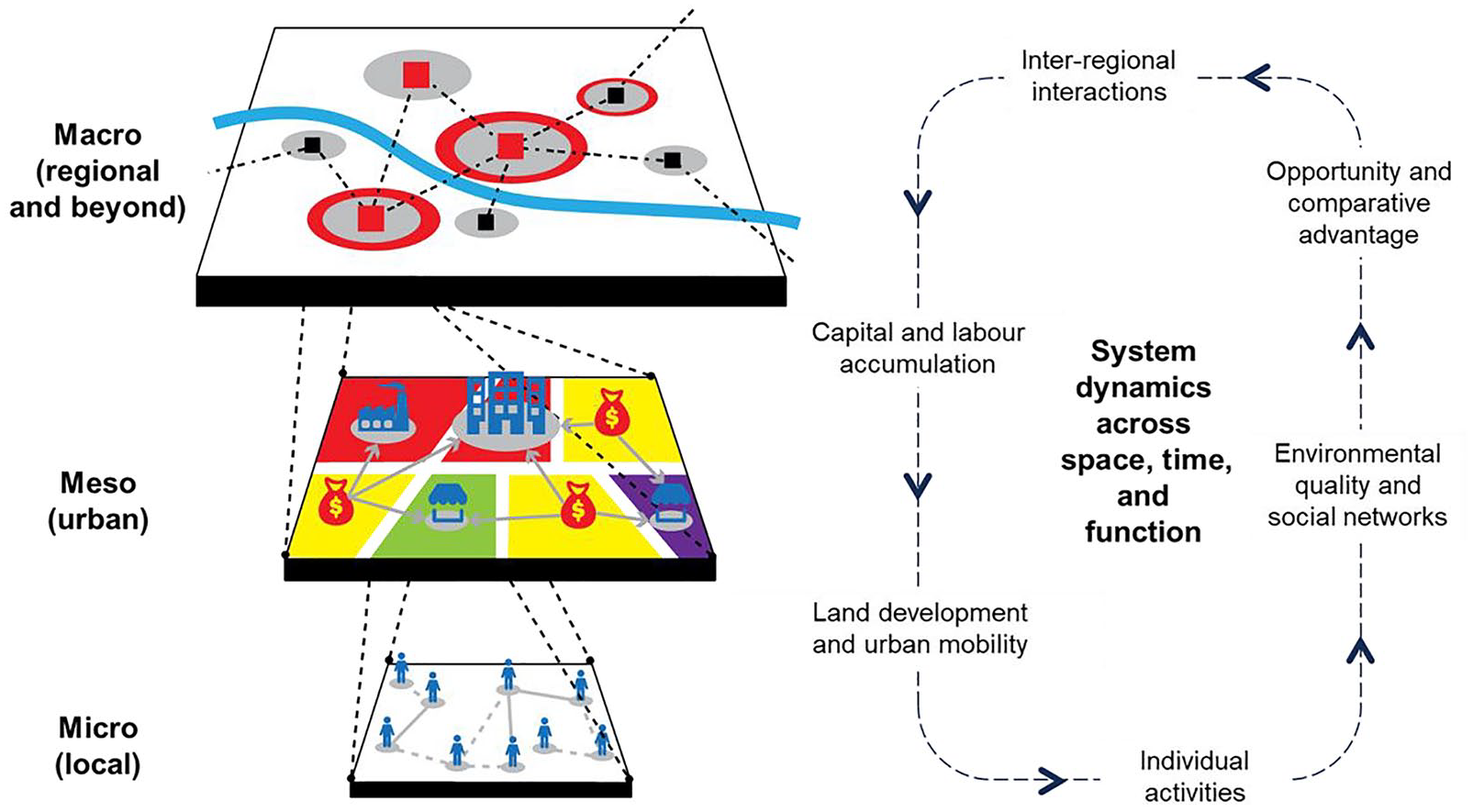
Hierarchical organisation of urban systems.
Spatial hierarchies
Spatial hierarchies illustrate how urban processes unfold across various geographic scales, ranging from micro-level neighbourhood interactions to meso-level district and city dynamics, to macro-level regional and national networks, and ultimately to global connectivity patterns. These processes do not operate in isolation; rather they are interconnected through complex feedback mechanisms.
For example, changes in land use at the neighbourhood level can trigger broader economic restructuring at the regional scale, reshaping local development trajectories. Conversely, national urban policies influence local implementation strategies through regional planning frameworks. This bidirectional interplay demonstrates the need for governance models that integrate spatial scales rather than treat them as separate units (Follmann et al., 2023; He and Cai, 2024). By recognising the interdependence of these scales, spatial hierarchies provide a foundation for designing governance frameworks that balance local flexibility with regional and national coherence (Hu et al., 2023; Zhang et al., 2023).
Temporal dynamics
Urban systems operate through overlapping temporal rhythms, ranging from daily fluctuations to medium-term policy cycles and long-term structural transformations. Building on Wegener et al.’s (1983) work on urban temporal scales, this framework emphasises how different speeds of development co-exist and interact within cities. Short-term decisions often create path dependencies that shape long-term possibilities, while long-term trends constrain immediate policy choices.
For instance, investments in transportation infrastructure can lead to decades-long spatial lock-ins while simultaneously influencing daily mobility patterns and medium-term land development cycles. Effective governance requires an understanding of how actions at one temporal scale ripple across others, often producing unintended outcomes (Arcaute and Ramasco, 2022; Ling et al., 2024). By addressing cross-temporal feedback loops, policymakers can better balance immediate needs with long-term resilience, ensuring that interventions align with strategic development goals.
Functional relationships
Urban systems operate through interconnected functional domains that span economic, social, and environmental spheres. Economic functions include production networks, labour markets, and capital flows that link local activities to global value chains. Social functions include migration patterns, cultural exchanges, and institutional arrangements that shape urban development trajectories. Environmental functions involve resource flows, ecosystem services, and metabolic processes that sustain urban life across various scales.
These functional domains interact through complex feedback mechanisms (Hu et al., 2020). For instance, economic agglomeration drives the spatial clustering of industries, influencing social mobility patterns and environmental quality. Conversely, environmental constraints shape economic development options, while social networks affect both economic opportunities and environmental behaviours. Understanding these cross-functional interactions is essential for urban governance, as it enables policymakers to design interventions that achieve synergies across domains while mitigating conflicts.
Cross-scale interactions
Building on the hierarchical organisation of urban systems (Figure 1), effective planning and governance require recognising how spatial, temporal, and functional dimensions interact across different scales. The framework identifies three fundamental aspects of cross-scale interactions, each with distinct dynamics and policy implications.
(1) Coupling and feedback loops. Urban systems exhibit strong coupling mechanisms between scales, manifesting through positive and negative feedback loops (Cash et al., 2006). Vertical coupling connects hierarchical levels, such as neighbourhoods, cities, and regions, while horizontal coupling links parallel systems, such as economic and environmental interactions at the same scale (Chen et al., 2023). Although government entities often dominate these mechanisms, non-governmental actors—such as residents, community organisations, and NGOs—also play a significant role, particularly in shaping local feedback loops. 1 Understanding these mechanisms is crucial for designing effective planning and governance strategies that address the complexities of urban environments.
(2) Cascading effects and threshold dynamics. Cross-scale interactions often produce cascading effects, where changes at one scale trigger sequential responses across multiple levels. These cascades are governed by threshold dynamics, in which gradual changes accumulate until they reach critical tipping points, initiating system-wide transformations (Qiao et al., 2024). Such processes are not linear and influenced by non-linear feedback loops and dependencies. Recognising these threshold-dependent cascades helps anticipate the far-reaching impacts of localised interventions.
(3) Intervention levers and systemic barriers. The success of urban interventions depends on identifying key leverage points and addressing systemic barriers that hinder cross-scale coordination (Waddell, 2011; Yang et al., 2019). Leverage points include strategic nodes in urban networks, windows of opportunity, and cross-functional synergies. Conversely, barriers such as institutional fragmentation, resource constraints, and entrenched path dependencies can obstruct cohesive multi-scalar strategies.
In summary, this conceptual framework integrates the principles of spatial hierarchies, temporal dynamics, functional relationships, and cross-scale interactions to provide a comprehensive understanding of urban systems. It highlights interdependencies across scales, emphasising coupling mechanisms, cascading effects, and intervention levers that shape urban processes. By addressing the interconnected spatial, temporal, and functional dimensions of urban systems, the framework underscores the importance of adaptive planning and governance models capable of navigating complexity.
Empirical knowledge of cross-scale urban dynamics
The papers in this special issue provide empirical evidence that supports and extends the proposed conceptual framework, demonstrating how spatial hierarchies, temporal dynamics and functional relationships manifest in contemporary Chinese cities. By integrating these studies into the framework introduced above, this section highlights how cross-scale urban dynamics operate in practice and influence governance and planning strategies.
Spatial hierarchies and functional polycentricity
The transformation of spatial hierarchies through regional metropolisation processes is effectively illustrated in the Pearl River Delta (PRD) study by Yan et al. (2024, in this issue). Their analysis reveals how suburbanisation and functional specialisation reshape centre-periphery relationships, creating new hierarchical arrangements that challenge traditional monocentric models. The evolution from core city dominance to a polycentric mega-city region demonstrates how spatial hierarchies adapt to changing economic conditions. Notably, they find that sub-central areas increasingly serve as nodes for knowledge-intensive services while maintaining specialised economic roles, exemplifying how spatial reorganisation fosters new functional relationships across scales.
Li and Lee (2025, in this issue) complement this discussion by examining the relationship between polycentric urban forms and carbon emissions in Beijing. Their study highlights that clustering high-impact economic activities in urban sub-centres promotes economic efficiency but also increases emissions by intensifying transportation demand and energy consumption. Conversely, spatially dispersed urban development can reduce emissions by distributing activities more evenly, alleviating congestion, and promoting shorter commutes. However, excessive dispersion risks inefficiencies in land use and infrastructure, underscoring the need for a balanced approach. This dual perspective reveals the trade-offs inherent in polycentric urban forms and underscores the importance of integrated planning that balances functional efficiency with the spatial distribution of land uses to align economic productivity with carbon neutrality goals.
Temporal dynamics and urban transition
Urban systems exhibit overlapping temporal rhythms that shape the continuity and evolution of cities. For instance, Chen et al. (2025, in this issue) provide an important empirical lens on temporal dynamics by tracking population transitions over time. By integrating job-housing relationships, spatial preferences, and demographic changes, this study underscores how temporal dynamics interact with spatial and functional dimensions. The model’s ability to capture population flows and residential transitions highlights the importance of long-term temporal consistency in urban planning, particularly in tracing the dynamics of commuting behaviours and housing location choices.
Temporal dimensions also arise from the periodisation of Chinese urbanisation into anti-migration, anti-settlement, and anti-civitas urbanism (Zhang, 2024, in this issue). These phases reflect changing governance priorities and societal responses, illustrating how institutional temporalities shape urban development. By linking temporal shifts in governance to spatial and functional reconfigurations, this work aligns with the framework’s emphasis on understanding urban evolution across multiple timescales.
Functional relationships and socio-spatial dynamics
Functional relationships among economic, social, and environmental domains are central to urban dynamics. In his exploration of Chinese urbanisation through the lens of homo urbanicus, Zhang (2024, in this issue) reveals how the relationships among the state, market, and society evolve. The study identifies distinct phases of urban governance, demonstrating how institutional structures and lived experiences shape, and are shaped by cross-functional interactions. This aligns with the framework’s focus on interdependencies between urban sub-systems, emphasising the need for human-centred approaches in planning and governance.
Li and Lee’s (2025, in this issue) study on carbon emissions further exemplifies the interaction between these functional domains. Their findings reveal how economic clustering and environmental constraints interact, indicating that urban forms characterised by low-centralisation and high-concentration can mitigate emissions while maintaining functional efficiency. This highlights the potential for functional synergies in achieving urban sustainability goals, particularly in addressing environmental challenges at the meso and micro scales.
Integration across dimensions
The integration of spatial hierarchies, temporal dynamics, and functional relationships is exemplified in the volumetric analysis of Hong Kong’s Wan Chai district (Liu and Jia, 2025, in this issue). This study traces urban transformations from 1841 to 2022, revealing how spatial configurations, temporal rhythms, and functional needs interact to create distinct morphogenetic regions. Each development phase responded to contemporary demands while preserving historical elements, demonstrating how urban systems adapt across various scales and dimensions.
Similarly, the study by Liu et al. (2025, in this issue) on the Lingnan Community offers a comprehensive understanding of how multi-scalar dynamics shape the socio-economic and spatial organisation of cross-border workers. By situating their analysis within the broader context of regional interconnectivity between Zhuhai and Macau, the study highlights the cascading effects of governance fragmentation and the need for adaptive planning approaches that align local housing and service improvements with regional economic and mobility patterns.
Overall, these empirical examples from mega-city regions highlight how spatial hierarchies, temporal dynamics, and functional relationships interact in complex ways that challenge conventional governance approaches. The cases demonstrate the need for more sophisticated cross-scale coordination mechanisms that can better align administrative structures with lived experiences and functional geographies. These findings underscore the need for adaptive governance models that embrace cross-scale interactions and multi-dimensional planning approaches to address the complexities of contemporary urbanisation effectively.
Towards a multi-scalar paradigm for urban planning and governance
The empirical evidence presented above underscores the need for fundamental changes in urban planning and governance. Building on these insights, three essential principles are proposed to guide the development of more effective multi-scalar frameworks.
Planning for cross-scale interactions
Planning frameworks should recognise and address the interconnected nature of urban dynamics across different scales. This requires shifting from viewing scales as discrete entities to understanding them as interconnected elements within spatial hierarchies, accounting for temporal dynamics, and considering functional relationships (see ‘Conceptual framework: Cross-scale dynamics and hierarchical organisation in urban systems’). As illustrated in the PRD case (Yan et al., 2024, in this issue), successful planning should integrate vertical coordination between administrative levels, such as municipal and regional governments, and horizontal alignment across functional domains, including transportation, land use, and environmental management.
A critical aspect of this principle is understanding cascading effects and threshold dynamics. Planning decisions can trigger sequential responses across multiple levels, potentially leading to system-wide transformations (He and Wang, 2019; Yu et al., 2019). For example, the relationship between local spatial configurations and regional carbon emissions, as highlighted in Li and Lee’s (2025, in this issue) study, demonstrates how local planning interventions can influence broader-scale sustainability goals. Therefore, planning decisions must be continuously evaluated and adapted based on their observed impacts across different scales.
Collaborative governance across boundaries
Effective governance requires collaboration across jurisdictional boundaries and institutional levels. As urban systems frequently extend beyond administrative borders, governance arrangements must reflect the functional relationships that shape urban life. This necessitates moving beyond siloed approaches towards integrated strategies that address shared challenges and opportunities. Collaborative governance structures can help to ensure that these decisions are aligned with broader strategic objectives.
Based on an analysis of phases of Chinese urbanisation (Zhang, 2024, in this issue), this may involve creating regional coordination mechanisms or reforming existing governance structures to address better inter-jurisdictional spillovers, such as traffic congestion, housing pressure, and environmental degradation. Such mechanisms should be designed to facilitate information sharing, joint planning, and coordinated implementation of policies for addressing the potential systemic barriers (e.g., institutional fragmentation).
Specifically, institutional reform should focus on bridging administrative levels and enabling vertical integration among local, regional, and national authorities. For instance, providing affordable housing across metropolitan regions illustrates this need. While national policies set affordability targets and funding parameters, effective implementation relies on coordinated action. Provincial authorities collaborate with municipalities to identify viable development sites, balancing density with infrastructure capacity. Local councils manage planning approvals and community integration, demonstrating how vertical coordination can address fragmented governance challenges. This requires a clear articulation of roles and responsibilities at each level, as well as mechanisms for resolving conflicts and ensuring accountability.
Transport planning further illustrates these dynamics, particularly in regions facing cross-boundary congestion. National infrastructure investments in high-speed rail networks must align with regional transit strategies and local mobility solutions. Provincial authorities may coordinate inter-city transit development, while municipalities implement complementary bus systems and cycling networks. This multi-level approach requires collaborative planning and funding mechanisms to ensure that transport infrastructure effectively meets cross-jurisdictional mobility needs and addresses competitions (see, e.g., Qu et al., 2024). Identifying intervention levers, such as strategic investments in public transport or coordinated land-use policies, is crucial for achieving desired outcomes.
Integrating spatial and temporal scales in planning tools
Planning support tools should consider both spatial and temporal scales to address the complexities of modern urban systems. Building on Li and Lee’s (2025, in this issue) findings on urban form and carbon emissions, planning approaches should integrate micro, meso, and macro perspectives, ensuring that localised interventions contribute to broader regional and national objectives. Therefore, planning tools should help planners strategically identify and leverage key intervention points—whether physical nodes or policy changes—to guide urban development toward desired outcomes.
Model-based scenario planning offers a powerful tool for addressing synergies and trade-offs between competing development aspirations (Yang, 2020). These scenarios can project pathways of system evolution, enabling planners to anticipate how different spatial configurations or policy interventions influence long-term outcomes. For example, balancing compact urban forms with dispersed development can help policymakers navigate the trade-offs between economic productivity and environmental sustainability. In addition, these tools should account for non-spatial factors, such as demographic transitions or economic shifts, which interact with spatial dynamics. By integrating temporal projections into spatial models, planners can adopt more proactive strategies to guide urban systems toward desired futures, rather than merely reacting to emerging challenges.
Implementing the multi-scalar framework
Implementing a multi-scalar framework requires ongoing efforts in capacity building, institutional reform, and collaborative governance. As cities become more complex, governance structures must reflect the interconnected nature of urban systems, enabling coordination across administrative levels, jurisdictions, and functional domains (see, e.g., Harrison et al., 2023; Pan et al., 2021). Establishing mechanisms to monitor and manage cross-scale interactions—such as the impact of local planning decisions on regional or national outcomes—is vital for ensuring that interventions at one scale align with broader sustainability objectives. This involves developing tools and practices to track spatial hierarchies and temporal dynamics, including feedback loops between micro- and macro-level processes, and creating institutional arrangements to address spillover effects across boundaries. This also requires investment in training and education to equip planners and policymakers with the skills and knowledge needed to navigate complex urban systems.
Equally important is fostering inclusive stakeholder engagement to ensure governance systems meet the diverse needs of urban populations. Collaborative approaches that involve local communities, private stakeholders, and public institutions can help align localised priorities with broader goals while promoting equity and legitimacy in decision-making. Even in contexts where formal participation mechanisms are limited, creating channels for dialogue and feedback can enhance the responsiveness and effectiveness of urban governance. By embedding these principles into urban governance, cities can better navigate the challenges of cross-scale dynamics, balancing economic, environmental, and social goals to create resilient, adaptive, and inclusive urban systems.
Conclusion
This paper highlights the complex and multi-scalar nature of urban systems, emphasising the importance of understanding urban dynamics as relational processes that transcend administrative boundaries and span spatial, temporal, and functional dimensions. The proposed framework offers a structured approach for analysing these complexities, demonstrating how spatial hierarchies, temporal dynamics, and functional relationships converge to shape urban transformation through coupling mechanisms, cascading effects, and intervention levers.
The empirical contributions from Chinese cities illustrate how cross-scale interactions manifest in rapidly urbanising contexts, providing valuable insights for governance and planning. From the Pearl River Delta’s evolution toward polycentric development to Beijing’s challenges in balancing urban form with carbon emissions, the cases underscore the need for adaptive governance frameworks. They reveal how challenges such as reconciling economic efficiency with environmental sustainability, addressing equity across jurisdictions, and integrating long-term resilience into short-term planning require multi-scalar strategies that consider feedback loops and threshold dynamics.
This analysis calls for a paradigm shift in urban planning and governance, moving beyond rigid, top-down approaches toward more inclusive, flexible, and integrated models. As demonstrated through the volumetric analysis of Hong Kong’s Wan Chai district and the examination of phases of Chinese urbanisation, effective governance must simultaneously address spatial configurations, temporal rhythms, and functional needs. By embracing multi-scalar perspectives, policymakers and planners can navigate urban complexities more effectively, ensuring that interventions at one scale align with broader societal, economic, and environmental objectives.
While this work lays a strong foundation, it also points to critical areas for further research. Future studies should explore cross-scale interactions in diverse urban contexts, develop sophisticated tools to track and anticipate cascading effects and threshold dynamics, and refine theoretical models to capture the non-linear and adaptive nature of urban systems. Comparative research across regions and governance systems will be valuable for broadening the framework’s applicability and advancing urban systems science, particularly in understanding how different institutional arrangements influence cross-scale coordination.
Ultimately, by fostering interdisciplinary approaches and bridging analytical insights with actionable solutions, urban researchers and practitioners can better address the challenges of contemporary urbanisation. As cities evolve in complexity, the ability to understand and manage cross-scale interactions becomes increasingly crucial for promoting sustainable, equitable, and resilient urban futures. This special issue serves as a step toward equipping cities with the theoretical understanding and practical strategies needed to navigate these multi-scalar challenges effectively.
Footnotes
Acknowledgements
The authors would like to express their sincere gratitude to Professor Fangzhu Zhang for her unwavering support and meticulous coordination, which ensured the successful implementation of this special issue. Special thanks are also extended to Professor Shenjing He for her visionary leadership in inviting participating authors on behalf of the HKU Urban Systems Institute and for her invaluable contributions to co-developing this special issue. The authors gratefully acknowledge funding support from the National Natural Science Foundation of China (52408095), the Hong Kong Research Grants Council (27601324), Guangdong Basic and Applied Basic Research Foundation (2025A1515010902), and the Young Elite Scientists Sponsorship Program by China Association for Science and Technology (2022ONRC001).
Declaration of conflicting interests
The author(s) declared no potential conflicts of interest with respect to the research, authorship, and/or publication of this article.
Funding
The author(s) disclosed receipt of the following financial support for the research, authorship, and/or publication of this article: The author(s) disclosed receipt of the following financial support for the research, authorship, and/or publication of this article: This work was supported by the National Natural Science Foundation of China [52408095], the Hong Kong Research Grants Council [27601324], Guangdong Basic and Applied Basic Research Foundation [2025A1515010902], and the Young Elite Scientists Sponsorship Program by China Association for Science and Technology [2022ONRC001].

Data availability
The data that support the findings of this study are available from the authors included in this issue upon reasonable request.
1.
For example, community-led initiatives to improve neighbourhood green spaces can create positive feedback by increasing property values, attracting new residents, and fostering a sense of community ownership, which in turn influences local planning decisions.