



Abstract
China’s system of territorial spatial planning requires an integrated layout of ecological, agricultural, and urban functional space. This paper examines urban and rural villages and finds that villages can be classified into five types: urban villages, suburban villages, rural villages, semi-ecological villages, and eco-villages. These villages have multiple functions such as ecological services, agricultural production, and town services, according to the relationship between villages and territorial space. Urban villages refer to villages within the urban space, which have certain urban socio-ecological service functions; suburban villages are villages located at the junction of urban and agricultural spaces, which adapt their functions to the needs of the town; rural villages refer to villages located in the vast agricultural space, which are dominated by large-scale agriculture, and which need to undertake the function of guaranteeing food security; semi-ecological villages refer to villages at the junction of the agricultural space and the eco-villages, which can develop diversified ecological services; and eco-villages refer to villages that are in, or essentially in, eco-space, and have an important role to play in the maintenance of natural ecosystems.
Introduction
In 2019, China formally proposed the establishment of a territorial spatial planning system, which requires the integrated layout of three types of territorial space, namely ecological space, agricultural space, and urban space, reflecting the importance attached to the entire territory of the country and to all types of elements.
The study of village types is the basis for an objective understanding of villages and guidance in planning and construction and is also the support for the construction of the national spatial planning system. The categorized governance of territorial space will realize the integration of elements across the territory. Villages are distributed among the three types of territorial space and are affected by every kind of territorial space, resulting in a differentiation of functions. The development of villages is no longer oriented towards the simple “industrialization model” or “urban backyard model” of the urban-rural dichotomy. The perspective of understanding villages also needs to change to the whole region and elements, and manifest the values and development needs of ecological civilization.
Therefore, based on previous studies on village classification, it is necessary to recognize the types of village development and define the functions and development positioning of every kind of village, based on the concept of eco-development and from the perspective of urban-rural integration and comprehensive development, relying on the three major types of land space in the territorial spatial planning system.
Along with urbanization, China’s economic and social development has achieved remarkable benefits and successes. It has affected spatial layout, resource utilization, and urban-rural relations (Liu, 2018). But it has also gradually widened the gap between urban and rural development.
In response to the many problems in development, China has explored the development strategy of urban-rural integration (Qiu, 2012). In 2017, the Measures for the Use Control of Natural Ecological Space (for Trial Implementation) was released, which divides the national land space into three categories: urban, agricultural, and ecological space, aiming to re-conceptualize the relationship between the city and the countryside from the point of view of the national land space and to judge the functions that each of them should take on; and in 2019, the “Opinions on Establishing a National Land Spatial Planning System and Supervising Its Implementation” was published, which called for the formation of a synergistic division of labor among the three categories of land space: urban space mainly undertakes the needs of urban construction and economic development, agricultural space has an important food production function and ecological space has the function of providing natural ecological services (Wang et al., 2018). The publication of this document marks the basic formation of the top-level design of the national land spatial planning system (Pan and Zhao, 2019).
Responding to the changing situation in the middle and late stages of urbanization, the land spatial planning system is closely related to the construction of ecological civilization (Zhao, 2019). Prioritizing the protection and development of ecological elements is the core value of the system, while the governance of ecological problems is its central role. This simultaneously requires the transformation of village understanding. It has been argued that the process of modernization and development has facilitated the flow of factors between urban and rural areas and that villages have diverged from their traditional agricultural production function and have become both productive and consumptive, generating a reverse migration of urban factors. It is therefore necessary to recognize the multiple roles of villages in the development of towns and cities, nature and agriculture, and to extend development and conservation actions to all types of resources across the spatial landscape.
Literature review: The need to categorize villages
Classification studies are an important way of recognizing interrelationships. The Bureau of Territorial Spatial Planning of the Ministry of Natural Resources has interpreted the Circular on Strengthening Village Planning for Rural Revitalization as suggesting that the characteristics of villages in territorial space should be studied to guide development and protection based on a scientific understanding of them, as well as to study and propose hard indicators for various types of action. The demand for the classification of village development has been raised by the phrase “to be compiled in a categorized manner according to local conditions”.
In specific historical conditions and fields, researchers have carried out studies on types of village development, exploring diversified influencing elements, such as natural geography, development stages, industries, culture, action plans, etc., and categorizing villages based on them, which provides effective support for village development and village planning (Figure 1).
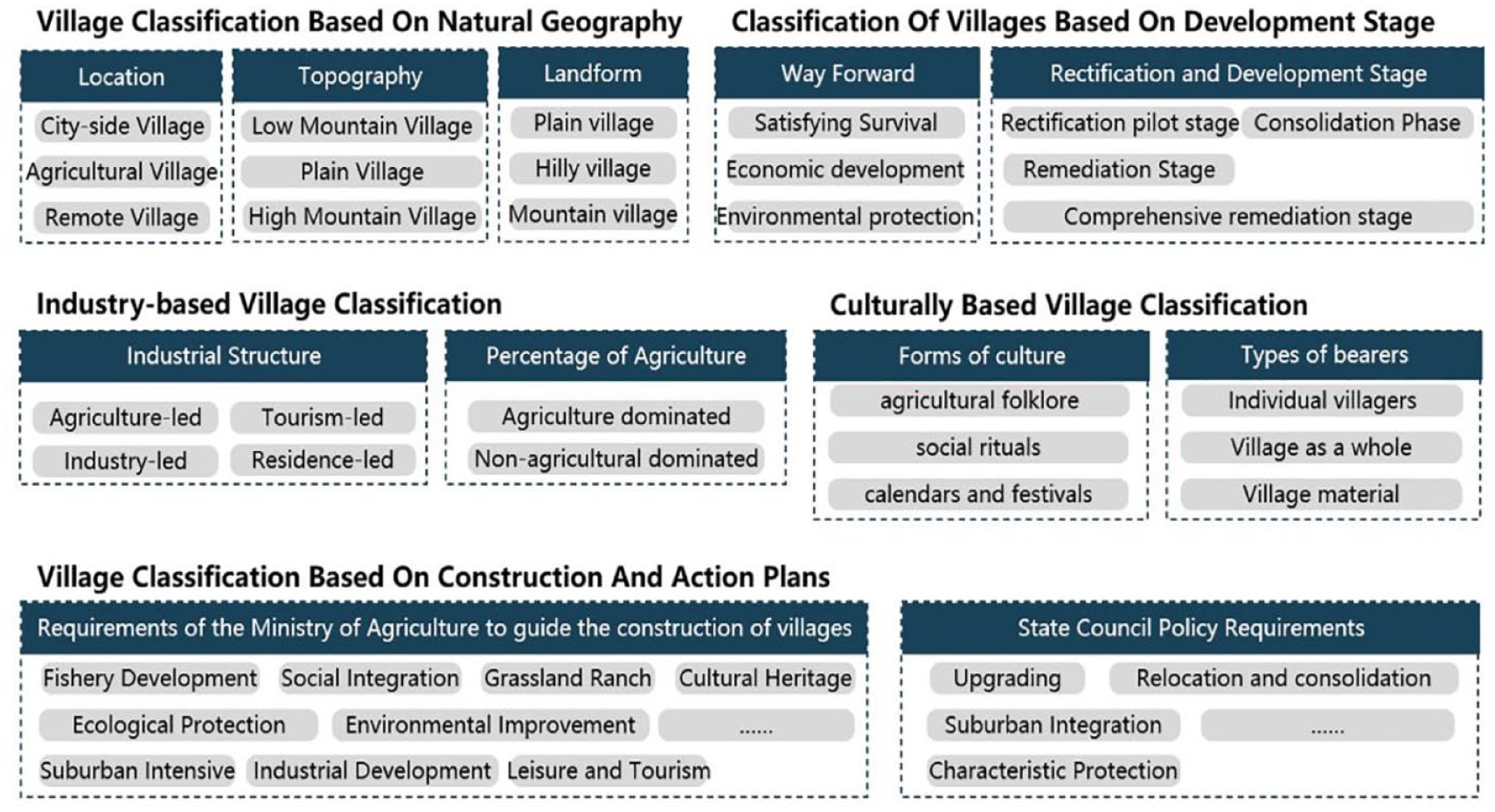
Relevant studies on village classification.
Natural geography influences the degree of aggregation of village settlements and shapes the development characteristics of villages. Village classification based on natural geographic factors reflects respect for natural elements (Ma et al., 2019). Research has proposed the need to change the current practice of planning that focuses on the centralized construction space of towns and neglects the value of natural space, and to introduce an ecological perspective to classify villages (Zhu and Wang, 2019). Research has found farm households in different topographic areas have different household division of labor and agricultural production patterns, such as the hilly areas with complex terrain, where villagers tend to choose to cultivate a diversity of crops in response to local conditions. However, villages in the plains more often choose to grow fruits and vegetables and food crops on a large scale. Thus villages can be divided into plain villages, hilly villages, and mountain villages (Ding, 2007). Further research has examined villages in mountainous areas in depth, and proposed that from the border between mountainous areas and cities and towns to the depths of the mountainous areas, the development of villages diverged, and thus villages were divided into city-side villages, agro-industrial villages, and remote villages, based on their distance from the city and the mountainous areas (Li et al., 2019) .
Stages of development refer to several periods delineated according to certain criteria. According to Li (2019), the various types of development stages in which villages are located can be dynamically transformed, and in different stages, villages have their dominant direction, such as villages in the stage of satisfying survival security, villages in the stage of developing economy, villages in the stage of building living environment, villages in the stage of building public service facilities, and villages in the stage of cultural inheritance. Liu et al. (2022) studied the spatial evolution pattern of villages and, in the perspective of urban-rural interaction, proposed that to recognize the type of village development needs to be imported into a specific location, combined with the development needs of the region.
Industry is the support for the sustainable development of the village economy. Some studies have examined the current status or development trend of village industries to categorize them, focusing on the types of industries and their development potential. Wu and Duan (2016) proposed that village classification should be based on industrial comparative advantages and endogenous dynamics, and the diversity of industries within villages should be examined in depth. Zhu et al. (2019) combined the functional analysis of the current situation to distinguish villages into three types, such as primary-industry-led, secondary-industry-led, or residential-function-led, and proposed that secondary-industry-led villages have the potential to be transformed into industrial characteristic towns, primary-industry-led villages can introduce the corresponding tourism industry, and residential-function-led villages can form high-quality residential communities by relying on the transportation network of central towns.
Culture consists of material and non-material culture, which is the adjustment method that human society has learned to adapt to the external environment (Wang and Zhu, 2006). Villages nurture diverse cultural forms, which are reflected in villagers’ linguistic expressions, psychological identities, and the organization of cultural activities. Therefore, some studies have categorized villages based on their cultural distinctions. Du et al. (2009) sorted out the cultural resources of villages in Guanzhong region, combined them with the development of the tourism industry, and classified them into farming folk villages, red culture villages, and historical relics villages, etc. Wang and Lou (2010) combined the characteristics of the tourism industry of villages with cultural resources to form the classification results of the types of villages such as agro-tainment villages, eco-agricultural villages, and lodging villages, thus providing a basis for the staggered development of the tourism industry in villages.
Village categorization based on planning, construction, and public policy is closely related to development goals. For example, in 2014, the Ministry of Agriculture, to guide the construction of beautiful villages, divided their development types into ten categories: industrial development, social comprehensive management, ecological protection, etc., that is, based on the formation of the future development goals. The Strategic Plan for Rural Revitalization (2018–2022) proposes that development types should be classified and promoted according to the development types of “clustering and upgrading villages, integrating into towns and cities, character-protecting villages, and relocating and merging villages”. This categorization method is more efficient in guiding village construction, but it needs to be deeply integrated with the actual needs of village development to meet the objective needs of village development. Scientific understanding of the development situation and functions of villages is a prerequisite for their categorization.
The national land spatial planning system manifests the values of ecological civilization, emphasizes regional synergy, and determines the direction of development based on the objective functions that the three types of space should assume. The village has experienced the joint action of natural, social, cultural, and economic elements, and the resources required for its production and life are organically configured in evolution and operate according to systemic principles. Adjustments and changes in the elements affect the development of the system (Li, 2019). In the context of spatial planning system, the function of the village is closely related to the function of the three types of space. So how many basic types of villages affected by the three types of territorial space should logically exist? This needs to be based on the new context, to deduce and summarize the logical types resulting from the interaction between villages and homeland space, to recognize the types of villages in national land space, and to define the functions and development directions that various types of villages should have.
Research objectives: Position villages in territorial space
Under the macro background of the national spatial planning system, the development of villages has made corresponding achievements: The modernization of agricultural production has improved efficiency and changed the mode of production organization, achieving basic self-sufficiency in cereals for the country. In 2020, China’s urbanization rate reached 63.89%, with a large number of people in villages moving to towns and cities. In an urban-rural dualistic perspective, this is often seen as the “decline” or “shrinkage” of villages. However, the national spatial planning system has a significant value orientation, namely, the integrated development of urban, agricultural, and ecological spaces, each with its responsibilities. The village is an important element in the national spatial planning system, which is not only closely connected with the towns and cities, but also interacts with the agricultural space and ecological space. Therefore, from another perspective, it can be regarded as the reduction of environmental pressure, the gradual restoration of the ecological environment, and the strengthening of the organic connection between villages and ecological elements. The multiple functions of villages in the areas of natural ecosystem maintenance, urban natural ecosystem services, and food security maintenance are gradually coming to the fore.
Village planning is the legal basis for the development and protection of land space, the implementation of land space use control, and construction activities. Therefore, there is a need to shift the perspective of development from the urban-rural dichotomy. Research needs to recognize the multiple roles of villages in the development of towns, nature and agriculture, and to extend development and conservation actions to all types of resources across the spatial landscape.
To focus on the basic characteristics of villages in the national spatial planning system, this study also focuses on the extent to which villages are affected by the three types of national spatial space and recognizes the basic functions of villages in national spatial space based on the relationship between the three types of national spatial space, namely, urban, agricultural and ecological space, and villages. The division of urban space, agricultural space, and ecological space in the national spatial planning system reflects the basic principles of ecology (Ma and Wang, 1984). According to Sun (2020), the three types of space correspond to “artificial ecosystems”, “semi-natural ecosystems”, and “natural ecosystems” in ecology. For example, urban space refers to the construction and spatial expansion areas of towns and cities, which has the characteristics of artificial ecosystems “strongly interfered by human activities”. Agricultural space is the production area of agriculture, which is similar to the semi-natural ecosystem defined as “affected by human activities, but still maintains a certain natural state”; while ecological space is the area to maintain natural ecological functions, and ecosystem ecology also defines natural ecosystems as “mildly affected by human activities, and has the role of self-regulation and ecological maintenance”. Artificial-natural ecosystems can be abstracted as a circle structure, reflecting the strong and weak relationship between the impact of human activities on nature, with artificial ecosystems, i.e., urban space, at the innermost; semi-natural ecosystems, i.e., agricultural space, at the middle; and natural ecosystems, i.e., ecological space, at the outermost.
Villages are distributed in all three types of ecosystems, i.e., the three types of territorial spaces, and at the level of the abstract model, villages can be located within a certain type of territorial space or at the junction of two types of territorial spaces, and thus there are only five positional relationships, i.e., within the town space, at the junction between the town space and the agricultural space, within the agricultural space, at the junction between the agricultural space and the ecological space, and within the ecological space.
Methodology
Research framework
This study focuses on the basic features embodied in villages affected by the three types of land space, referring to classical theories such as the Von Thunen Model of Land Use and making hypothetical deductions based on ideal situations. First of all, the three types of land space correspond to artificial-natural ecosystems, and their logical relationship is a circle relationship from inside to outside, with the innermost circle being the urban space, the middle circle being the agricultural space, and the outermost circle being the ecological space; in the circle relationship, villages can be located in a certain type of land space or at the junction of the two types of land space. From the inside to the outside, villages are gradually influenced by the development needs of towns and cities, and gradually influenced by the development needs of the natural environment. Villages in different locations are affected to different degrees by the various types of territorial space, and their development advantages and functions are different.
Combined with the naming conventions of related research practices, villages with these five position relationships are called “urban villages”, “peri-urban villages”, “rural villages”, “semi-ecological villages”, and “eco-villages” (Figure 2).
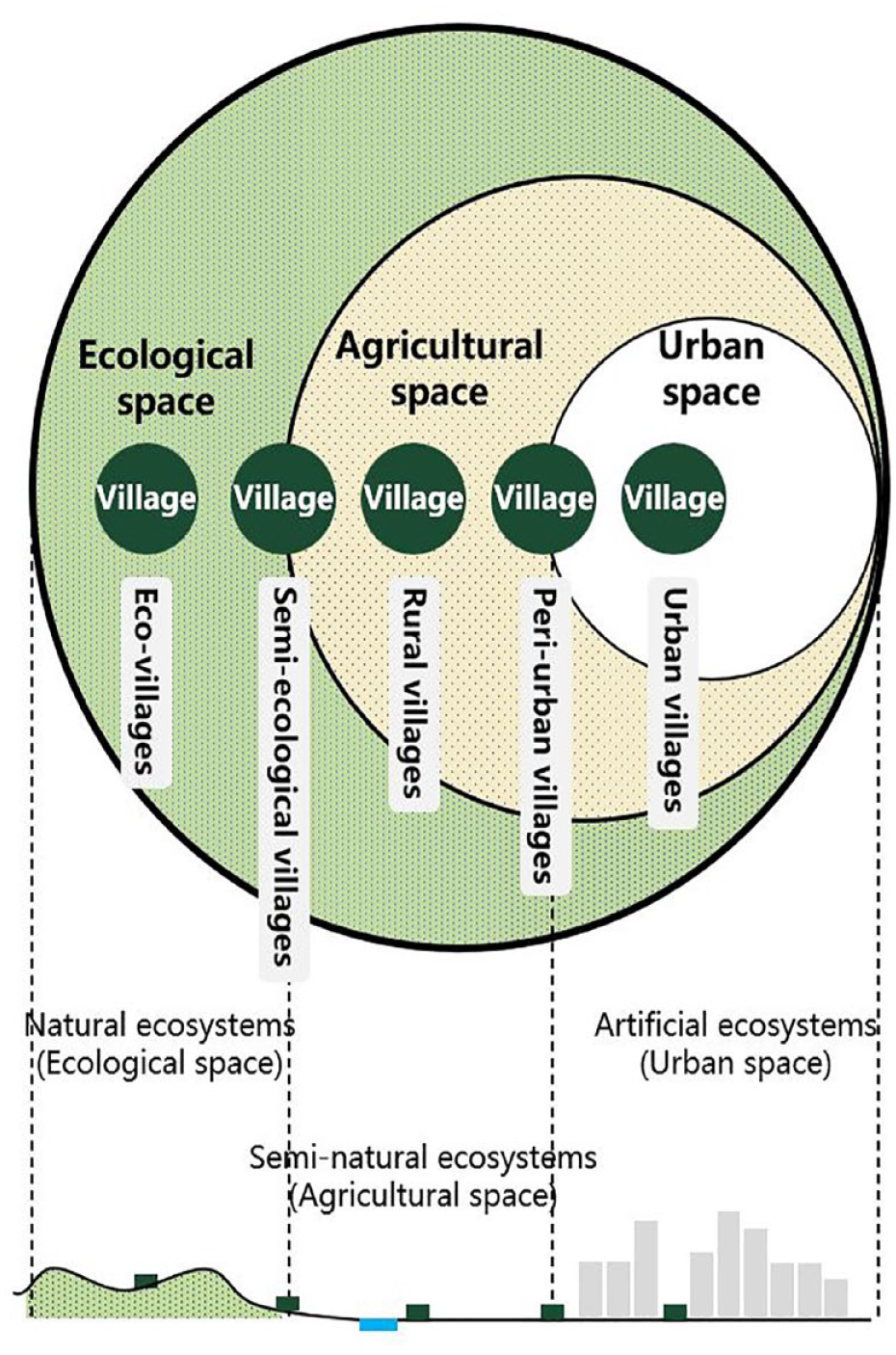
Types of village development in the territorial spatial planning system.
In this study, urban villages refer to villages that are in urban space and surrounded by urban development boundaries; peri-urban villages refer to villages at the junction of urban space and agricultural space and located in areas of urban-rural integration; rural villages refer to villages in extensive agricultural space; semi-ecological villages are at the junction of agricultural space and ecological space; and eco-villages are encompassed by ecological space. Thus, the deductive classification of villages in the whole territory of national land space is realized and, based on this, the corresponding hypothesis is put forward: in the land spatial planning system, influenced by the three categories of national land space. Villages exist in the five typical locations described above, i.e. five basic types, and each has unique development advantages.
Case studies
Village development is influenced by a variety of factors. The posture theory of ecology suggests that the position and role of ecological elements in the development of a system can be better identified by comparing them with neighboring units, while the stage of development theory states that the dominant functions of villages are influenced by the development needs of a certain geographic range.
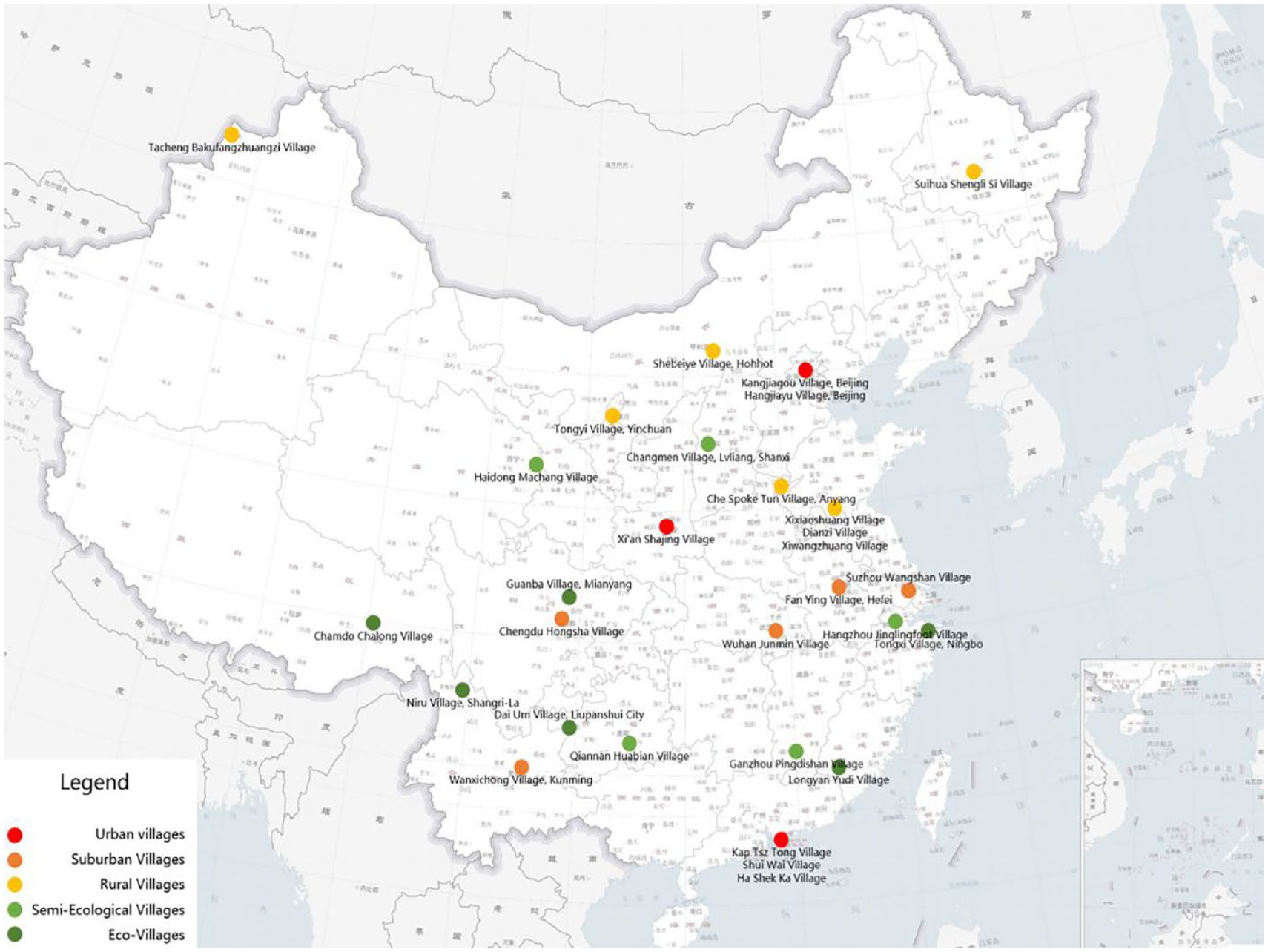
To focus on the basic characteristics of villages as influenced by the three types of territorial space, this study conducted a preliminary examination of five types of villages widely selected throughout the Chinese territory according to the location relationships of the five types of villages set in the hypotheses, taking into account the density of the population distribution and the natural geographic differentiation (Figure 3). Comparing villages of the same type in different geographical areas, the common characteristics of these villages can be extracted; comparing villages of different types in similar areas, they are similar in terms of large-scale factors such as climatic and atmospheric pressures, geological environments, and the stage of regional economic and social development under the same urban-rural relationship, so that the characteristics of these villages due to the ecological locations they are located in will be easier to compare and clarify.
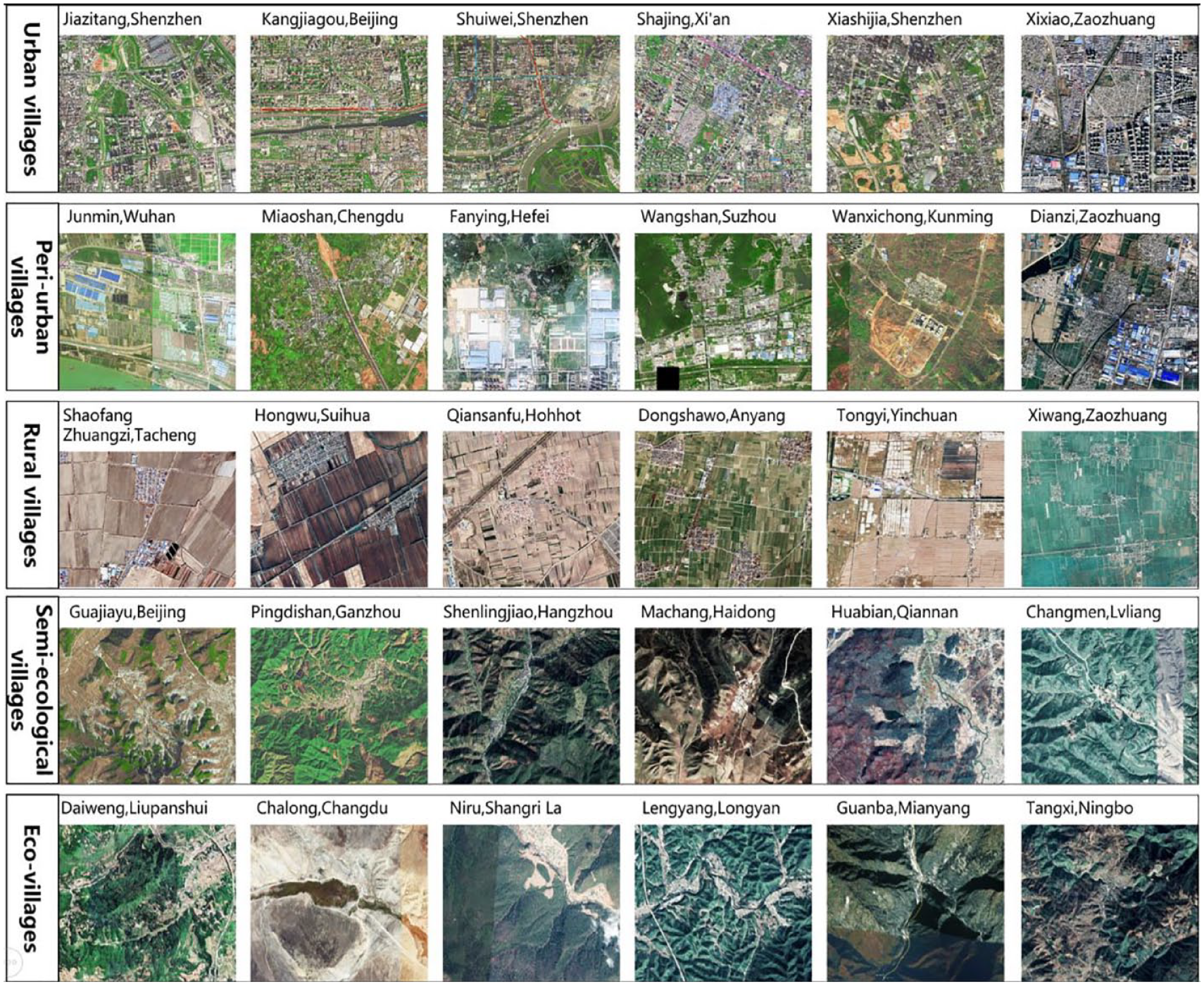
Distribution map of villages selected for this study.
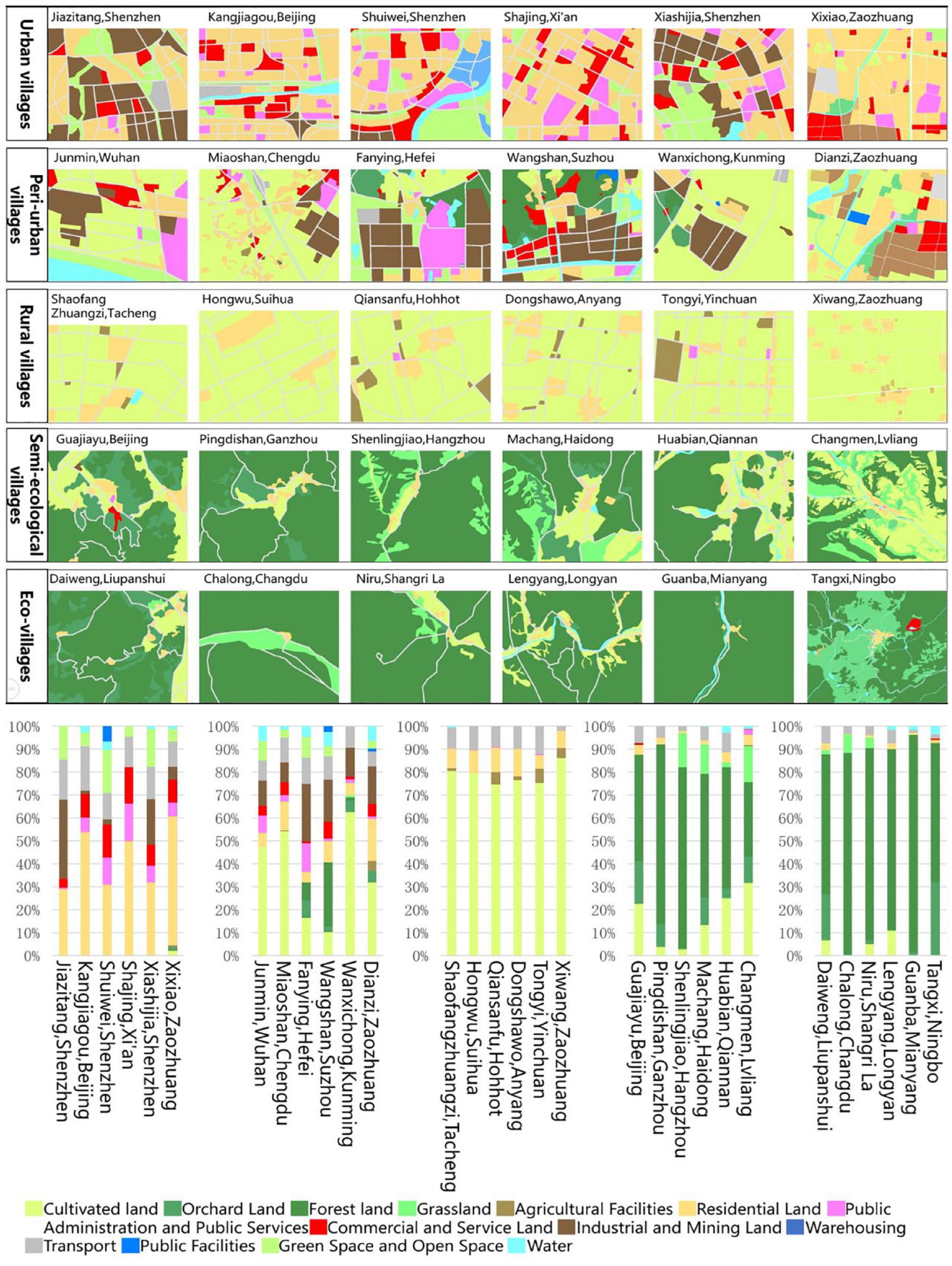
To harmonize the calibrations and facilitate comparative analysis. In this study, we intercepted the satellite images of the same range centered on the settlements of the selected villages (Figure 4). Each satellite image map is a range of 3*3 kilometers. The range is referenced to the average range of villagers’ activities interacting with the ecosystem (Li et al., 2018). After the interception, based on the land use categories required by the national land spatial planning system, the land use functions of each parcel are identified and the structure of the land use is summarized (Figure 5).
Comparison of satellite photos of five types of typical villages.
Comparison of land space land use characteristics of five types of typical villages.
Urban villages are in the inner part of the urban space, their land use has urban characteristics, and the periphery of village settlements has evolved functions such as industry, commercial services, and public services according to the demand of urban development, and no longer has space for agricultural development. Suburban villages are in the frontline of urbanization and are more affected by the demand of cities and towns, but they still retain agricultural land, and the spatial pattern is rich in diversity, and there is disordered development. Rural villages are in the inner part of agricultural space, and the land structure is dominated by arable land. Inside the agricultural space, the land use structure is dominated by farmland, with relatively concentrated settlements, regular farmland, and agricultural facilities land. Semi-ecological villages are in the junction zone of agricultural space and ecological space, utilizing the natural environment according to local conditions, the spatial pattern forms the distribution of garden land and woodland combined with topographical and geomorphological features, and the proportion of farmland is relatively small. Eco-villages are located in the interior of the ecological space, and the land use type is dominated by woodland, and the settlements are relatively small.
Upon comparison, it can be found that villages in different territorial spatial relationships have significant differences in the distribution and structure of land use in territorial spatial planning, which can initially confirm the interpretability of this hypothesis to the real situation. To further analyze and clarify the characteristics and development advantages of each type of village, we will combine deductive analysis and example observation to analyze them in depth.
Variegated types of urban and rural village
Urban villages: The functions of urban social and ecological services
In the context of the national spatial planning system, this study defines urban villages as “villages surrounded by urban development boundaries and within urban space”. In the process of urban expansion, the cultivated land of some villages is expropriated and eventually encircled by the urban built-up area, forming an urban village. With the advantages of land rent and location, it often becomes the rented gathering place for low-income groups in society, and thus assumes part of the functions of social and ecological services in towns and cities. Its spatial environment is relatively chaotic, and its public service facilities and infrastructure are not perfect. Because of the concentration of the migrant population, the centripetal force of the community is weak and there are governance problems. The informal economy is the mainstay of the economy.
Shenzhen has launched the Shenzhen Urban Villages Comprehensive Rectification Master Plan (2019–2025) to strengthen the social and ecological service functions of urban villages (Figure 6): for example, Minle Village, located at the junction of three districts, namely Futian, Longhua, and Longgang, has introduced the community property model to enhance the community service functions, and strengthened the villagers’ participation in governance; Shui-Wei Village has renewed its urban villages into talent apartments, which has enhanced the social and ecological service kernel while retaining the social and ecological service functions; Gongming Village has promoted the overall industrial upgrading, with the help of a good location to attract the scientific research platforms of colleges and universities, and implanted technical services, business incubation, industrial offices, and other functions, to help the regional scope of the city’s development needs.
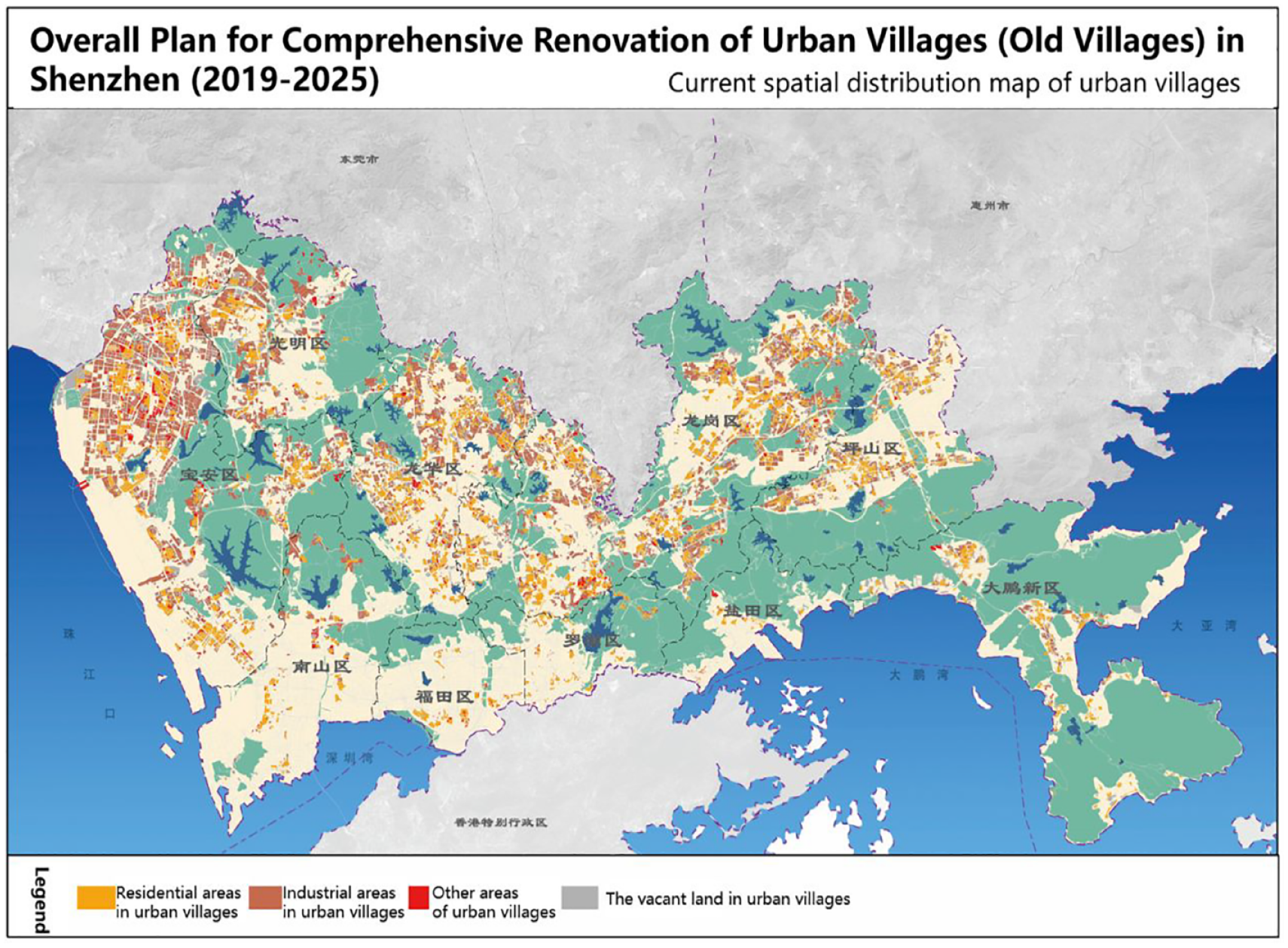
Spatial distribution of urban villages in Shenzhen.
At the level of the spatial environment, the morphological boundary between urban villages and cities is gradually blurred, and the urban road network system, building forms, and management mechanisms have an impact on the village space, which often results in the phenomenon of cross-management by multiple management bodies such as village committees, community management committees, and planning authorities: the relevant administrative affairs of the village are managed by the village committee, and the construction negotiation and management are shared by each of the three parties, and the construction and management areas are also formed in the old villages. The construction and management areas are also divided into old villages and neighborhoods. In the urban area, the community management committee enjoys part of the development income of the land. The increase in collective income of villages does not fully coincide with the development needs of towns and villagers, which increases the difficulty of spatial environment improvement in urban villages, and creates chaos in the spatial environment of urban villages.
At the socio-cultural level, the demographic structure of urban villages is in dynamic transformation. With the transformation of villagers into urban residents and the increase in the proportion of migrant workers and business people, it is more difficult to continue the customs, habits, and lifestyles accumulated in the common life of the village, and the traditional blood and geographic relations have been diluted. Villagers often choose to build houses against regulations and rent them out for profit, forming a group of “rent-eating and profit-taking” people who can make a living only by renting out their houses. This reflects the fact that villagers have not yet fully accumulated urban work skills or experience amid rapid change, and are limited in the trades they can engage in. Their demolition and resettlement, corresponding compensation, and work and employment are prominent issues that are prone to cause social conflicts, and grey areas of governance may also emerge.
At the level of the industrial economy, urban villages lack the foundation for industrial development and are not strong in gathering factor resources. They tend to take the citizenship and employment resettlement of villagers as a guide and rely on location advantages and capable people to develop service industries and actively connect with urban needs, gradually expanding their industrial capacity and social influence, and becoming a place of provision of regional socio-ecological services. In turn, it will upgrade its internal infrastructure and bring its public facilities into line with regional development.
The core impetus for the development of most urban villages comes from the demand for urban expansion. In the process of transformation from villages to urban communities, agricultural land in villages was replaced by urban construction, and agricultural activities disappeared from the villages. Urban villages have a shorter history of industrial development and a weaker industrial and economic base, and their industrial industries are often replaced before they are fully developed, while their service sector develops rapidly in response to growing urban demand.
The spatial planning response strategy for urban villages needs to reflect their characteristics in the national land spatial planning system, strengthen land use intensification, and spatial use efficiency, echo the requirements of the national land spatial planning system for optimizing the spatial pattern, shape the industrial structure and production and living mode of land use intensification and resource conservation, and assume some of the functions of social and ecological services in cities and towns. The development trend of the urban space in which they are located should be examined, the supporting layout of public services should be incorporated into the unified planning of the urban community, and the service level and quality of the productive space should be upgraded. Urban villages can be guided to develop urban social and ecological service functions, incorporate regional characteristics, guide the inclusive upgrading of informal industries, and optimize the relief of spontaneous phenomena such as group renting in an orderly manner.
Suburban villages: Assuming part of the functions of urban natural ecosystem services
In the context of the national spatial planning system, this study defines peri-urban villages as “villages adjacent to urban development boundaries and at the junction of urban and agricultural spaces”. Suburban villages are at the forefront of urbanization and play a prominent role in supplying the urban system. In the process of development, they gradually reflect multiple functions based on the services of the natural ecosystem, and their development direction is differentiated by the positioning and needs of the towns and cities, to realize the complementary functions of urban and rural areas. As areas of urban-rural integration, the characteristics of villagers in terms of employment, economic level, social customs, and demographic structure have changed, often forming a mixed urban-rural pluralistic community.
Although suburban villages are affected by urban development, they still retain arable land and agricultural production activities, with agricultural spatial characteristics and idyllic landscapes. They also can improve their spatial environment due to the intervention of foreign capital and development needs. The proximity of peri-urban villages to the center of towns and the well-developed transportation system reduces the time cost for urban residents to choose them as short-distance vacation and weekend leisure destinations, and thus the corresponding industries are developed. The process of urban-rural integration is dynamic, and the spatial structure, economic structure, and social elements of peri-urban villages will gradually take on the characteristics of a composite of towns and villages and may change their ecological position along with the expansion of urban construction. At the same time, as a typical development model, suburban villages will interact more frequently with neighboring villages and play a role as a model with their development experience.
For example, in Cenbu Village in Qingpu District, Shanghai, the village has been designated as a “quasi-protected area” of the Huangpu River Water Resource Protection Zone, and industry has gradually withdrawn from the village, transforming the village into an ecological service function, with villagers contracting a part of the transferred land to run crowdsourced farms, nature education bases, and other agri-tourism programs, and relying on the advantages of the outskirts of the village to attract the public to recognize the land in Shanghai and experience the benefits of farming, managing, and harvesting the land (Figure 7). Hongsha Village, Xingfu Village, Fuma Village, Wanfu Village, and Jiangjiayan Village of Sansheng Street in Chengdu City, which are peri-urban villages with close spatial connection, have formed the “Five Golden Flowers” urban leisure brand in the development. Relying on its popularity and suburban advantages, it attracts citizens as tourists to adopt vegetables and plant them to experience the fun of agricultural leisure.
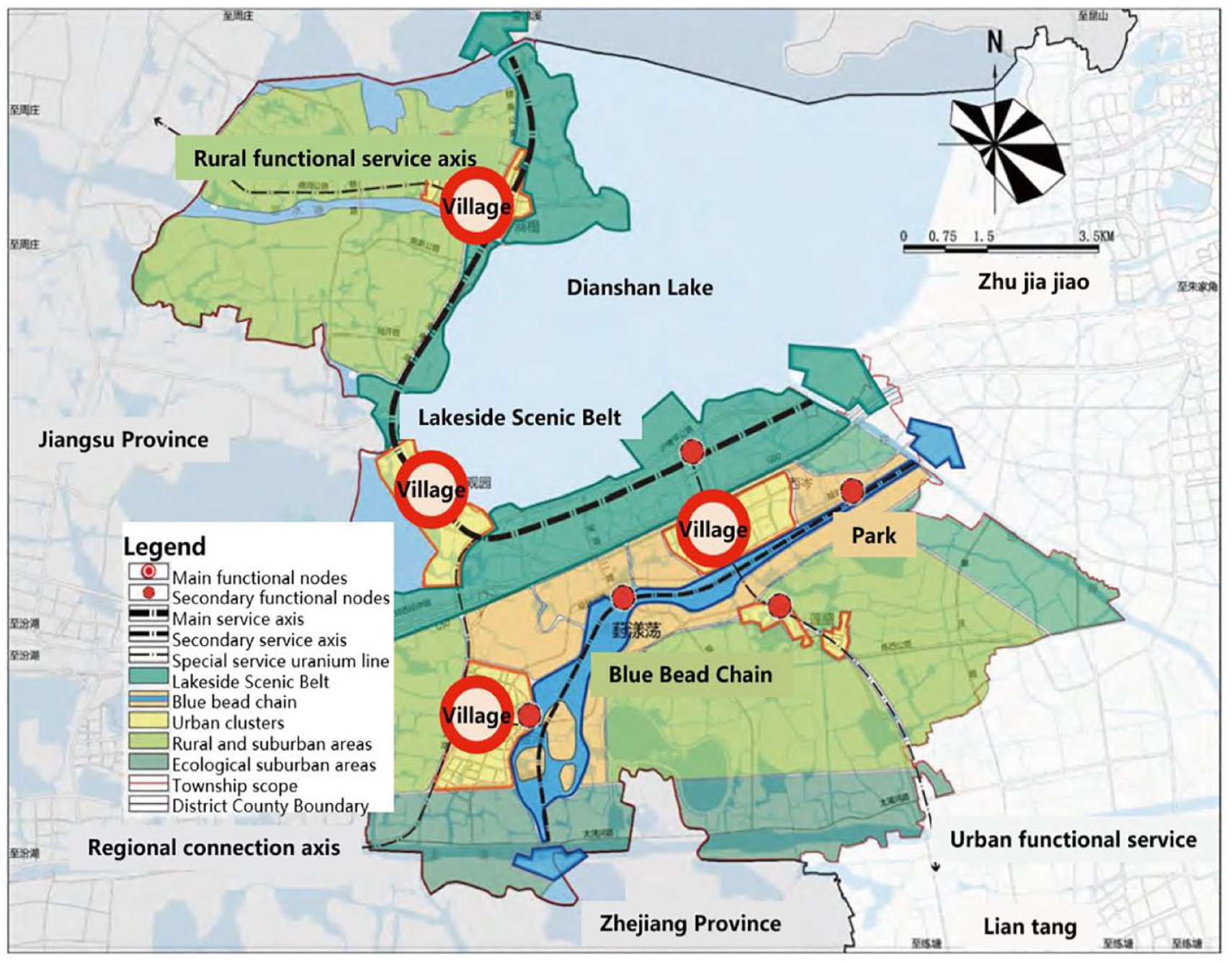
Spatial structure of Dianshan Lake area.
At the level of the spatial environment, although suburban villages are affected by urban development, they still retain arable land and agricultural production activities and have agricultural spatial characteristics and idyllic landscapes. They also can improve their spatial environment due to the intervention of foreign capital and development needs.
On the socio-cultural level, the exchanges between suburban villages and towns are relatively close, so there is a flow of talents and a process of cultural mutual influence. Returning talents can realize their ideals and encourage villagers to participate by running farmhouse and tourism projects. As a typical development model, suburban villages will interact more frequently with their neighboring villages and act as a model with their development experience.
At the industrial and economic level, as the level of urbanization continues to rise, suburban villages are more influenced by the city, reflecting the trend of a decrease in the number of purely agricultural households and an increase in the number of part-time urban workers, which inhibits the development of traditional industries in the villages. However, the proximity of suburban villages to central towns and the well-developed transport system reduces the time cost for urban residents to choose them as short-haul holiday and weekend leisure destinations, and thus the corresponding industries are developed. Central towns are the gathering place of talents, business, capital, and information, and have extensive consumer markets, which become the power source for the development of suburban villages. Consumption upgrading in central cities and towns has led to more diversified daily consumption needs and demands for leisure projects, which can no longer be fully met by the consumption space in the city itself, thus making the agricultural landscape and unique agricultural space in suburban villages highly desirable, and triggering the injection of foreign capital.
The spatial planning response strategy for suburban villages needs to reflect their characteristics in the national land spatial planning system and give full play to the service function of the natural ecosystem. As the frontier of urbanization, suburban villages can be guided to strengthen interaction with central towns, tap corresponding demand, and undertake a wide range of functions represented by urban ecological recreation and agricultural consumption, based on which they can promote the integrated development of urban and rural infrastructures, realize the complementary functions of urban and rural areas, and drive the revitalization of suburban villages. Agricultural production in peri-urban villages is relatively less profitable, but it is still necessary to protect farmland as a base for development, and then create a composite production and living space through the organization and renewal of settlements. Based on the development capacity of towns, co-ordinate village construction with natural environmental protection, reasonably judge the industrial scale and tourism development layout of suburban villages, and approve the boundaries of spatial control. While actively connecting to the needs of the towns, the characteristics of suburban villages in the junction area will be promoted, to avoid the homogenization of residents’ sources of income in the process of industrial transformation of suburban villages.
Rural villages: Maintaining food security
In the context of the national spatial planning system, rural villages in this study are referred to as “villages in a wide agricultural space”, and the relatively wide agricultural development space in rural areas is conducive to the promotion of family farms, cooperatives, agribusinesses, and other diversified subjects, which are jointly involved in the development of modern agriculture. To further enhance the efficiency of agricultural development, the countryside has often led to centralized residential actions, forming a regular and continuous settlement space. Maintaining food security is its development advantage.
Rural villages around the world are based on ecological location advantages, with multiple main agricultural management bodies working to facilitate an appropriate scale of agricultural development. Villages such as Shandong Rongcheng Yinzi Township are large agricultural villages, with the transfer of land in the township allowing the village collectives to found cooperatives to promote large-scale operations (Figure 8). Using land resources, water resources, and agricultural machinery resources to achieve the integration of the township’s agricultural service platform gives them stronger investment bargaining capital. Shandong Dezhou Donglangwu Village, Yaoqian Village, Nanwang Village, and 14 other villages, in cooperation with agribusiness, have transferred a total of 20,000 acres of arable land to promote the development of large-scale agriculture. After the transfer of land through ditch finishing and shoulder finishing, its actual arable land area had increased by about 30%, greatly improving the land utilization rate. Xi’an City, Liyang Village, relying on the Modern Agricultural Demonstration Park, established a standardized agricultural production system and, through scientific and technological breeding of test seeds, demonstrated and promoted new varieties of crops.
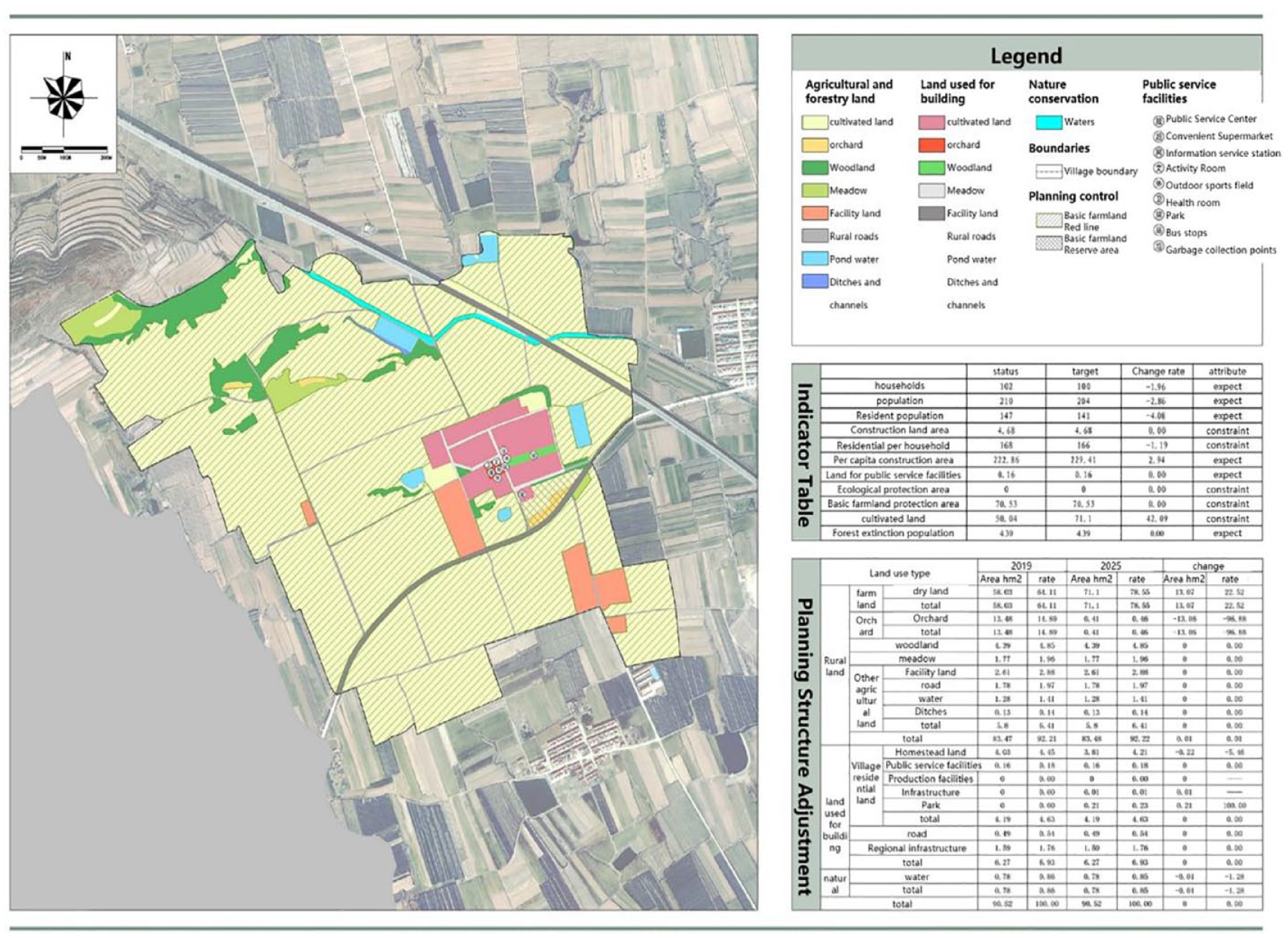
Xixiabu village planning.
At the level of the spatial environment, the development of moderate-scale agriculture in rural villages has led to the formation of large-scale farmland with distinctive features, and water conservation and production facilities that are characteristic of agricultural landscapes. To further enhance the efficiency of agricultural development, rural villages have often led to centralized residential actions, forming regular and continuous settlement spaces.
At the socio-cultural level, the stable development of agriculture has enabled the preservation and continuation of traditional customs in rural society, and folk festivals and cultural groups are active. Agricultural parks and large-scale farming have affected the social structure of rural villages, thus shaping new patterns of festivals and activities. Professional farmers have become the new identity of villages, but garden farming and the small farm economy still play a prominent role in maintaining the ecology and traditional living atmosphere of villages and can serve as a carrier for the living inheritance of China’s agrarian culture.
At the level of the industrial economy, rural villages have the advantage of developing moderate-scale agriculture and adapting to diversified subjects. Modern agricultural demonstration parks, agricultural companies, and family farms can co-ordinate the cultivation of agricultural products in villages and form standardized and branded special crops. The agricultural demonstration park is a sample of modernized agricultural development. It makes use of Internet technology, Internet of Things systems, and other modern technologies to enhance the quality of agricultural products while promoting related agricultural branding, rural villages’ e-commerce, and other economic activities, and strengthening risk-resistant capacity with industrial linkages. Although mechanization has improved the efficiency of agricultural production in rural villages, the development of comparative agricultural returns is still insufficient at this stage, and thus rural villages can still develop rural agrotourism and leisure services, new types of services, and processing of special agricultural products and other related industries based on the advantages of agricultural landscapes and resources, while actively developing moderate-scale agriculture.
Agriculture has a strong foundation for development in rural villages. Rural villages tend to have relatively flat terrain and fertile soil, with a long history of continuous agricultural development, and their ecological location makes it easier to promote supporting facilities for industrial development. The construction of farmland water conservancy facilities, industrial roads, river training, water supply improvement, field preparation, etc. can ensure the stable development of agriculture and the long-term maintenance of related agricultural production facilities. As an important area for food, vegetable, and fruit production, rural villages are well-developed in terms of logistics and transportation facilities.
The spatial planning response strategy for rural villages needs to reflect its identity in the national land spatial planning system and fulfill the function of maintaining food security. The planning should strictly comply with the protection needs of arable land and permanent basic farmland, improve the phenomenon of land fragmentation in the countryside, combine land consolidation and restoration, improve the quality of arable land, strengthen the high-yield and stable-yield performance of contiguous agricultural land, guide the transfer of land, optimize the conditions for large-scale operation, and provide support for the layout of rural industrial land. New agricultural production service facilities should be planned, supporting facilities for processing, storing, and transporting agricultural products should be laid out, and the combination of modern agriculture and sustainable rural development should be studied, to maintain and drive regional agricultural production, thus increasing the benefits of farming. It should prudently and reasonably guide the centralized residence and co-ordinate the villagers’ service facilities, clearly define the corresponding construction standards and service facilities configuration, and fully buttress the relevant policies such as land use increase and reduction linkage, to supplement the economic foundation of rural development and improve the villagers’ quality of life.
Semi-ecological villages: From biodiversity to industrial diversity
In the context of the national spatial planning system, this study defines a semi-ecological village as a “village at the junction of agricultural space and ecological space”. Its rich diversity is its outstanding advantage.
Located in the ecosystem crossroads, the semi-ecological village has advantages in biodiversity and industrial diversity and thus plays an important role in ecological security and soil and water conservation. Due to the fragmentation of arable land, a three-dimensional development pattern of forest and grain intercropping and corresponding agricultural landscapes has been formed, which has a positive effect on the ecological security of the region. Influenced by the demand for ecological space protection, their livelihoods tend to be diversified and small-scale, and the villagers form a composite income mode through the comprehensive utilization of land to resist the related natural and economic risks, but it also results in insufficient economic accumulation of the village collectives and the villagers.
For example, Changmen Village in Lvliang City, Shanxi Province, is located in the valley plain area of the Lvliang Mountain Range, and the geomorphology of the surrounding mountains and forests is complicated, forming a variety of communities such as forests and meadows. The villagers built earthen kilns and settled in the mountains. Due to the undulating terrain, the cultivated land is finely divided, and the villagers have formed diversified livelihood patterns, such as sorghum, millet, potatoes, and other small grains, distributed in the relatively flat areas close to the settlements. There are also sour sea buckthorn, asparagus, and fungus in the shallow slope areas. Tree species have been developed to perform complex ecological and economic functions, providing economic output while conserving soil and water (Figure 9). The village committee of Hangjayu Village in Beijing, located in the shallow mountainous area of Hangjayu, summarized its development model as “eight uphill”, i.e., optimizing the transportation and infrastructure conditions of the village and developing the forest and fruit industry and animal husbandry by the local conditions and relying on the natural resources of the area. Small-scale water cellars have been developed in the pits and ponds to meet the needs of fruit trees, thus forming a comprehensive utilization mode of “relying on the mountain to eat the mountain and raise the mountain”.
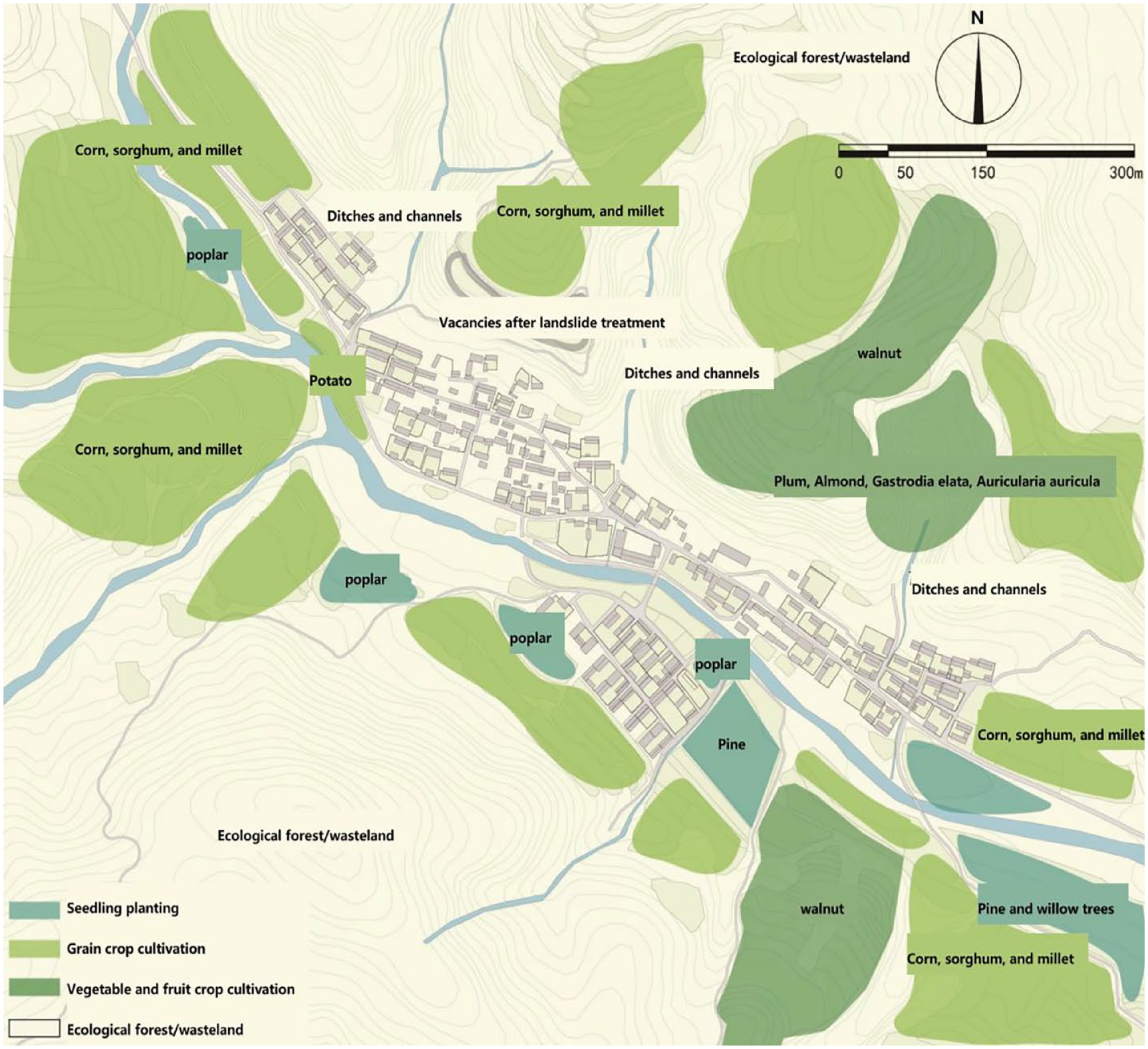
Cultivation status around the settlement of Changmen Village.
At the level of the spatial environment, the semi-ecological village is located in an ecosystem intertwining zone, with significant natural landscape features and a relatively high number of natural disaster elements. Due to the fragmentation of arable land, three-dimensional development patterns such as forest and grain intercropping and corresponding agricultural landscapes have been formed, which have a positive effect on the ecological security of the region. Semi-ecological villages’ natural water system, irrigation ditches, farmland, fishponds, flora, and fauna have both natural and agro-ecological characteristics and have rich potential for activity development. The rich diversity of species and ecosystem services also make it important in the area of regional ecological security.
At the socio-cultural level, semi-ecological villages’ society and culture are less influenced by towns and cities and are also characterized by self-sufficiency. In the course of development, the villagers have developed a certain division of skills, such as skilled breeders, growers, carpenters, stonemasons, electricians, decorators, and so on, so that most of the problems of production and life can be solved within the village and self-sufficiency can be achieved. There are problems such as the long-term outflow of young labor and skilled people.
At the level of the industrial economy, villagers’ livelihoods are diversified, with more types of industries and smaller scales, reflecting the development characteristics of utilizing the natural environment by the mountainous terrain. Constrained by natural conditions, villagers can form a complex income pattern through the comprehensive use of land, which protects them from related natural and economic risks, but also results in insufficient economic accumulation for the village collectives and villagers.
The production and living styles of villagers in semi-ecological villages have interacted extensively with the natural environment to form a unique circular agricultural production and living system, and the farmland in such villages has the significance of agricultural production and ecological conservation. With the deepening of the concept of ecological development, the yield value of farmland food production will be gradually converted into quality value and ecological value. Diversified agricultural entities create a variety of native landscapes, and the correct way of farming, although it will change the ecological environment, can also form a high level of biodiversity. In the context of the national spatial planning system, the role of good ecological location of semi-ecological villages has begun to be highlighted. In the villages, relevant leisure and tourism activities based on the ecological environment have emerged.
The spatial planning response strategy for semi-ecological villages needs to reflect their characteristics in the national land spatial planning system and maintain biodiversity and industrial diversity. The natural ecological pattern of semi-ecological village shapes the base of biodiversity, and the optimization of the spatial landscape and the enhancement of facilities should respect the natural elements, based on the integrity of the ecosystem, and clearly define the bottom line of the protection of resources, reflecting the sustainable development mode based on the mountainous terrain.
In the process of long-term interaction between farming families and nature, a certain anti-risk strategy has been accumulated, which is reflected in the diversity of village industries. In the spatial improvement of semi-ecological villages, it is necessary to respect the existing resource conditions, and it is not appropriate to overemphasize the function of food production or implant a new type of dominant industry, and avoid “one-size-fits-all” policies such as land transfer and subsidies for the promotion of economic crops, so as not to affect the diversity of the foundation of semi-ecological villages. Based on the continuation of the diversified planting structure, the traditional industrial chain can be extended, the diversified utilization of forest and fruit resources in the village can be developed, and social and cultural resources based on biodiversities, such as traditional customs, handicrafts, and festival culture, can be developed to enhance the economic returns of semi-ecological villages while maintaining the risk-resistant ability of farmers.
Eco-villages: Maintaining natural ecosystems
In the context of the national spatial planning system, this study defines eco-villages as “villages in the ecological space”. They are mostly small-scale villages formed for disaster evacuation and military and governmental development needs and have interacted with nature for a long time. In the early stage, they formed a simple ecological pattern of living off the mountain. With the development of productivity, human beings have increased their extraction and utilization of the natural environment, thus leading to overpopulation and resource scarcity, and tightening the relationship between people and land. There is an urgent need to change the development mode and return to the ecological concept.
The development of eco-villages is characterized by symbiosis with natural ecosystems, with the functions of natural resource protection and diversity maintenance. Ecological farming methods can protect the forest land and crop soils in eco-villages, so that they have a better role in water conservation soil stabilization and water storage, and reduce the risk of soil erosion and other natural disasters in the region. The villages in this ecological location have a close relationship with the ecological space, and there are restrictions on agricultural production, so it is not appropriate to cause excessive human disturbance, it is also necessary to impose constraints on village energy, material utilization, production, and life. Some of the eco-villages are at risk of disasters or have significant ecological protection needs.
For example, Tangxi Village at the western end of Simingshan Township in Ningbo City, adjacent to the Simingshan National Forest Park, developed economic forestry of flowers and trees based on natural advantages in the early days, and then gradually promoted ecological restoration to reduce the intensity of production to consolidate the ecological environment of the National Forest Park and the quality of tourism (Figure 10); and Niru Village in Shangri-La, Yunnan Province, which is surrounded by mountains on all sides, is located 75 kilometers away from the county town, and is less affected by the city. This region is the parallel flow of the Nu, Lancang, and Jinsha Rivers, with mountain gorges, snowy glaciers, primitive forests, alpine meadows, and other ecological communities distributed, and is regarded as an area of extremely rich biodiversity. After the Three Rivers Juxtaposition Area was applied for the heritage, the local ecological resources attracted corresponding sightseeing tourists, and the villagers’ traditional lifestyle of half plowing and half herding also has the necessary ecological maintenance. Dai Urn Village in Liupanshui City, Guizhou Province, had the folk belief of sacrificing poplar plum trees in the Guangxu Period, and the He family was stationed in the mountains and was responsible for the care and maintenance of the ancient poplar plum forests. Currently, the forest coverage of the village reaches 85%, and hundreds of ancient plum trees are still growing in a row, which has earned the village the title of “National Ecological and Cultural Village”, and plums have also become an important fruit industry and cultural brand of the village.
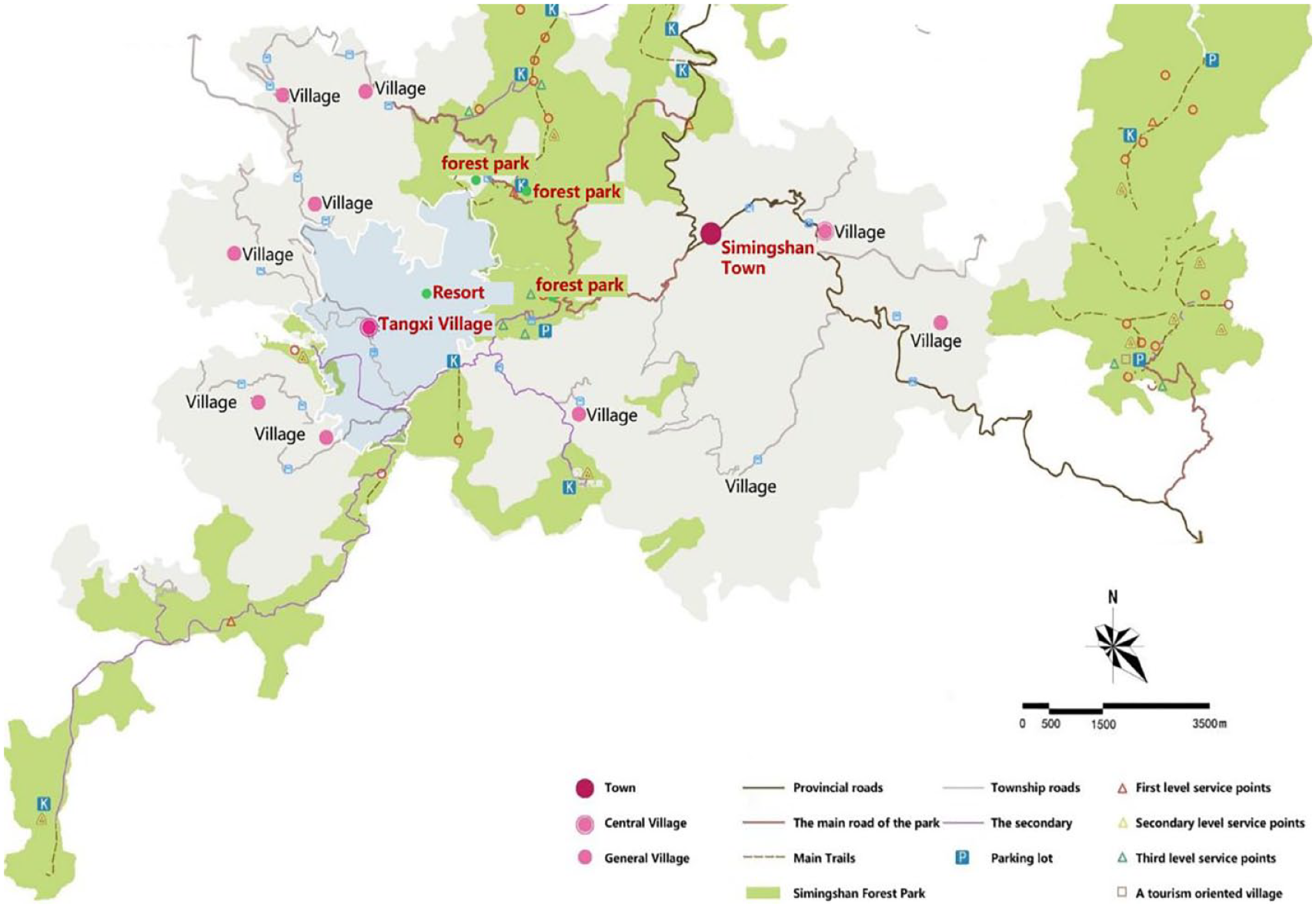
Scope of Siming Mountain Forest Park.
At the level of the spatial environment, eco-villages have favorable natural conditions, which provide habitats for the activities of abundant species, and the construction and expansion of villages are therefore limited to a certain extent. Settlements in eco-villages are dispersed, and, compared with villages in the plains, transport conditions are more inconvenient and information is scarce. This geographical closure also makes eco-villages’ special production methods more self-sufficient, with higher utilization of local resources.
At the socio-cultural level, because eco-villages have fewer exchanges with the outside world, the traditional social structure and village organization patterns have survived. There is a relationship between life and production and the maintenance of natural resources, and there is even a cultural kernel of “forest people coexisting” in Southwest China; using forests to maintain their livelihoods, planting trees, building spiritual support, and forming mature forest protection organizations and systems.
At the industrial and economic levels, natural conditions are an important factor affecting the industrial organization of eco-villages. Eco-villages often develop economic forestry, understorey planting, and corresponding resource management, forming a compound ecosystem for foresters and farmers. Eco-villages are characterized by the diversified use of ecological resources, so they can form a composite income structure based on biodiversity and industrial diversification, and actively develop an under-forest economy, fruit forests, Chinese herbal medicine, and corresponding resource management. The ecological conditions of eco-villages also serve as a basis for the development of a low-disturbance tourism industry.
Natural resource protection and ecosystem maintenance are important functions of eco-villages. The national land spatial planning system takes eco-civilization as a value guide, and the eco-village settlement space has also evolved its appropriate development direction – depopulation and the return of ecological functions. This is reflected in the fact that eco-villages have richer primary forest communities, which participate in atmospheric purification, carbon sequestration and the carbon cycle, and regional climate regulation through photosynthesis and other physical and chemical forms. The eco-villages’ ecological farming methods can manage the soil quality of forests and crops, so that they have better water conservation and soil stabilization, reducing the risk of natural disasters such as soil erosion in the region, and the scattered wetlands of the pits and ponds can maintain the regional water cycle and eliminate the risk of flooding, thus becoming important habitats for the maintenance of species diversity.
The spatial planning response strategy for eco-villages needs to reflect their characteristics in the national land spatial planning system and the role of maintaining the natural ecosystem. In the national spatial planning system, appropriate human activities in the ecological space can play a role in protecting the land resources and ecological environment, which is supported by the ecological farming activities in eco-villages. Not all eco-villages need to be relocated as a direction of development, but through the development of environmentally friendly forestry such as forest and forest-grass integration, the economic diversification and ecological benefits of eco-villages can be promoted.
For eco-villages that can retain and continue their ecosystem maintenance functions, the biodiversity of mountain forest areas can be enhanced through the treatment of soil erosion and the restoration and reconstruction of woodland ecosystems. The ecological space in which eco-villages are located often has a vast area of forested land with ecological public welfare benefits, so human disturbance and large-scale construction should be restricted, except for planning to upgrade the necessary infrastructure and facilities for forest maintenance.
Eco-villages are often faced with the contradiction between the red line of ecological protection and scattered settlements. For eco-villages that need to be relocated due to ecological protection, disaster prevention, and mitigation, the need for ecosystem maintenance should be carefully judged, and planning should lead to the removal of unauthorized structures, the preparation of inefficient industrial land, and the return of farmland to forests, to achieve ecological restoration and protection.
Conclusion
In the system of spatial planning, urban space, agricultural space, and ecological space together constitute the overall national environment. The development of villages depends on the natural environment and provides the foundation for towns and cities, and they are closely connected – the relationship between human beings and nature is the essence of the relationship between urban and rural development, which also determines the functions and development paths that villages should undertake in this new era. Based on the interaction between villages and various types of land space, this study abstracts the circle theory model with the center town as the origin. From the inside to the outside, the influence of the town on the village gradually decreases, and the influence of the natural environment on the village gradually increases. Based on the above logic and deduction, this study demonstrates that there are five basic types of village development in the national spatial planning system, which have different national spatial relationships and unique development advantages, through the study of field cases.
A categorized understanding of villages is a prerequisite for guiding their development. The territorial spatial planning system reinforces the coordinated development relationship between urban and rural areas. Villages are the basic nodes of the urban-rural network, taking over the economic and social influence of the region. Under the macro pattern of the three types of territorial space, villages are functionally differentiated according to their situation and play unique functions in areas such as the supply of leisure space, agricultural products, or ecological products. Therefore, it is necessary to effectively categorize and understand them, and use the categorization perspective as a basis for supporting villages to perform food production functions, natural ecology protection functions, or urban service functions by local conditions, to avoid blind construction.
Urban villages are most affected by urbanization and have the ability to provide richer social services in towns, and thus can be guided to develop corresponding spatial places and actively integrate with urban development. Suburban villages, which are more affected by urbanization, can be further guided to give full play to the benefits of the agglomeration of resources and population on the basis of safeguarding the ecological environment, to meet the needs of urban life and ecological development, and to improve the ability of urban-rural synergies. Rural villages are in the main production areas of regional agricultural products. The villages can be guided to play the role of guaranteeing food security by arranging centralized settlements, and by developing appropriate-scale agriculture. The guidance of semi-ecological villages needs to fully respect the endogenous production and living patterns and enhance the resilience of diversified industries. Eco-villages, as villages with strong ecological functions, need to further protect the ecological environment and be guided in the provision of ecosystem service-related products.
The dynamics of village development are closely related to the elements of the era in which the development of the territorial spatial planning system was formed. As China enters the middle and late stages of urbanization, villages are undergoing consolidation and functional reshaping. This study focuses on defining the five basic types of villages in the territorial spatial planning system and exploring the typical details and distinctions of the functional transformation of villages. In reality, villages are often characterized by a composite of multiple development types, influenced by micro features and territorial spatial development: for example, Cenbu Village, which is a case study of a “peri-urban village” in the previous section, mainly embodies the service function of the natural ecosystem of the town, but also has a certain degree of biodiversity and the characteristics of an “eco-village”. At the same time, the three types of national land space may be transformed in the course of development, for example, the urbanization process has transformed part of the agricultural space into urban space, and the return of farmland to forests has transformed part of the agricultural space into ecological space. The process of village development and differentiation revealed by the study is also a microcosm of the transition from traditional agricultural societies to modernization in developing countries. It has some empirical significance for the understanding of villages in other developing countries.
Footnotes
Contribution list
Liu Xiao: investigation, formal analysis, writing – original draft.
Li Jingsheng: methodology, writing – review and editing.
Declaration of conflicting interests
The author(s) declared no potential conflicts of interest with respect to the research, authorship, and/or publication of this article.
Funding
The author(s) received no financial support for the research, authorship, and/or publication of this article.
