



Abstract
The state remains central in contemporary environmental politics and policies, although environmental governance increasingly involves neoliberal and non-state mechanisms. Environmental management in China holds features of an ‘environmental state’ and has been undergoing continuous restructuring, manifested by a recent city-regionalism turn. Informed by the theories of eco-state restructuring (ESR) and eco-scalar fix, this paper investigates air pollution management in the Beijing-Tianjin-Hebei Region by tracing the practices of environmental and territorial governance over the past decades. Through the analysis of parameters of the eco-state, this paper conceptualises the air pollution governance in China into three phases, namely pollutants emission control (the 1990s–2005), campaign-style regional governance (2006–2012) and city-regionalism in air quality governance (2013 onwards). We find that the central state plays proactive but different roles in each phase, characterised by state strategic selectivity, adjustments of state apparatus, deployment of a set of policy instruments, and enhanced state capacities for monitoring, control and legitimation. In this context, the city-regional level has become the key scale at which environmental regulations are targeted and the economic and environmental realms are being (re)formed. This state-led eco-scalar fix process to cope with urgent environmental issues explains the underlying rationality of building up the Beijing-Tianjin-Hebei Region as a new national strategic project.
Keywords
Introduction
In recent years, there has been an evident tendency that environmental issues have been rescaled to regional or even global levels (Reed and Bruyneel, 2010). It has been well argued within scholarships of environmental governance that the scale should not be taken for granted as given, contained or nature entities (Bulkeley, 2005). Rather, the scales are usually regarded as politically and socially constructed, in which the nature of state spatiality is changing. The state remains central within the ongoing restructuring process (Meadowcroft, 2005; While et al., 2010), although environmental governance increasingly involves neoliberal and non-state mechanisms (Castree, 2008; Liverman, 2004). The reaching out across new spatial scales together with political processes of rescaling the objects and agents of environmental governance is an emerging field of inquiry.
The politics of scale and the rescaling of statehood have been explored as the result of the process of economic restructuring wrought by neoliberal reform in China (Li and Wu, 2012, 2018). China’s state selects city-regions as privileged sites for new forms of governance to cope with the entrepreneurialism crisis under the marketisation reform and regulatory deficit (Wu, 2016; Wu and Zhang, 2022). City-regionalism is no longer merely for promoting economic competitiveness but also due to the sustainable development pressures and demands. Comparatively, less attention has been directed toward the contribution of environmental governance to city-region formation in China. China’s rapid urbanisation phenomenon and economic growth have generated enormous pressures on the environment, natural resources management and public health. Due to the urgency of environmental issues, a new set of values were introduced into state regulations to focus more on the spatial dimensions of environmental governance beyond the technological and marketed-based solutions (Chung and Xu, 2016, 2021). A typical case is air pollution management, especially the heavy haze problems in Beijing between 2010–2013. China’s state has recognised the issue of air pollution that can spill over jurisdictional boundaries, and therefore the initiatives to address the air pollution issue in China have come to be implemented under a regional governance framework (Jin et al., 2016; Wu and Chang, 2020).
This paper aims to provide an alternative explanation of recent city-regionalism and to explore the phenomenon that environmental issues have been reframed at larger scales in China, what we called ‘environmental city-regionalism’ in this paper. More specifically, we examine the relationship between state, scale and regulatory logics of air pollution management during the environmental state restructuring process and their political and ecological implications on urban and regional development in China. Air quality governance for Beijing has become a highly complex and dynamic rescaling process involving cities within and outside the Beijing-Tianjin-Hebei Region (known as the JJJ region). Therefore, the ‘war against air pollution’ in JJJ is selected as the detailed case of this research.
The rest of the paper is organised as follows. The first section draws relevant conceptual frameworks from the eco-scalar fix, eco-state restructuring and city-regionalism, aiming to develop a geographical examination of environmental governance. The ESR framework incorporating the eco-scalar fix helps to analyse the evolution of the eco-state in China in air pollution management. Then the background of an empirical case study of Beijing-Tianjin-Hebei Region is elaborated. We conceptualise three waves of eco-state restructuring in China’s air quality governance and address the eco-state's changing parameters. Ultimately, we identify the state’s ‘strategic selective’ role in city-regional development.
Literature review and a conceptual framework
The rise of city-regional governance
City-regions have emerged and proliferated all over the world as the ideal spatial entities for policy intervention in the twenty-first century. Since the early 2000s, China has also seen the rising or remerging of city-regions for both domestic and international agendas, including economic regionalisation, coordinated development, environmental sustainability and international competitiveness (e.g., Li and Jonas, 2019; Wu, 2016). The formation of city-regional governance can be explained in different themes such as capital accumulation, regional urbanisation and state rescaling, in which the city-regionalism is politically constituted with the national state in the Western context (Brenner, 2004; Jonas and Moisio, 2016; Macleod and Goodwin, 1999; Scott, 2019).
Distinct from Western and other non-Western contexts, city-regionalism in China is not driven by social investment and collective consumption (Ward and Jonas, 2004), but represents a state-orchestrated selectivity or a new city-regional fix to maintain governance coherence (Wu, 2016). Likewise, the emergence of regional policies and planning since the 2000s can be regarded as a rescaling of statehood and the re-centralisation process to deal with the political fragmentation of urban entrepreneurism (Li and Wu, 2012). China’s territorial and scalar politics involve multiple levels of states and quasi-state actors, for example, the construction of mega-regional infrastructure projects (Yang et al., 2021; Zhang et al., 2020).
Regional governance could be understood as a theoretical concept to investigate the complexity of different actors, as an empirical descriptor to reflect the redistribution of state responsibility, and as a tool to enhance sustainable development in extant literature (Willi et al., 2018). The dimensions of city-regionalism, such as the politics of the urban environment and sustainability, remain important but undertheorized aspects of contemporary geographical forms and strategies of territorial management (Ward and Jonas, 2004). Therefore, it has become increasingly necessary to explore city-regionalism in relation to environmental politics and policies.
Rescaling of environmental governance
In many countries, regionalisation and regionalism are also widely promoted in environmental management for sustainable development. Rather than occurring as a result of bottom-up and voluntary organisation forms, regional environmental governance is usually argued as the product of interactions, resources and opportunities at multiple scales. Therefore, understanding the multi-scalar dimensions is crucial for an effective regional environmental governance (Morrison, 2007). Within this governance system, multiple actors exercise different levels of power, authority and actions at different scales.
The origins of the trend toward regionalisation in environmental management have been widely discussed in the broader themes, including the nature of territoriality, the role of regions in multi-level governance and democratic accountability, participation and voluntary capacity to manage environmental issues (Balsiger and VanDeveer, 2012; Morrison, 2007). There are two main strands of regional environmental governance, namely bio-regional paradigm and administration paradigm (Press, 1995). In the first strand, scholars view the region as a naturally occurring entity that reflects ecological differences and advocate to define, classify, and manage territorial space according to the landscape and ecological differences (Harvey, 1996). The rescaling to bio-region or ecosystem scale for governance is often justified by the internalisation of negative environmental externalities and by the desirability of alignment with ecological boundaries rather than jurisdictional boundaries. In the second strand, regions can be seen as important sites of decentralised control of the state. The transformation of the national state and the diffusion of governing authorities have challenged the traditional regime theory for environmental governance. The state's role in the reconfiguration of scale and environmental governance occurs along three axes: scaling up to form multi-level governance, scaling down to incorporate local actors and scaling out to empower non-state actors (Reed and Bruyneel, 2010). In practice, environmental governance is more prevalent and feasible at the regional scale than at the global scale in searching for cooperation in response to rising global environmental issues. The central government decentralises the responsibility for specific targets (e.g., carbon reduction) to urban and regional levels to achieve on one hand, and to enhance their administrative control on the other hand.
Scale is imbricated in two strands of regionalisation of environmental governance. Cohen and Bakker (2014) develop the concept of ‘eco-scalar fix’ to investigate how particular ecological configurations can be simultaneously depoliticised and re-politicised through a process of rescaling and reorganising governance. The eco-scalar fix is an extension of analogous concepts such as spatial fix (Harvey, 1981), scalar fix (Brenner, 2004), the environmental fix (Bakker, 2009; Castree, 2008), urban sustainability fix (While et al., 2004) and socio-ecological fixes (Ekers and Prudham, 2015, 2017) associated with neoliberalism. In China, the socio-ecological fix is associated with state entrepreneurialism that goes beyond neoliberal and entrepreneurial governance and is applied for genuine environmental goals (Zhang and Wu, 2022; Zhang et al., 2022). However, the construction of ecological scale is often overlooked in extant research.
The proactive role of the state in environmental governance and eco-state restructuring
Multiple environmental governance models and theories are interested in the interactions between state, market, and society (Partelow et al., 2020). Although the monopolistic view of the centralised state has been challenged in environmental governance, the state still plays a privileged and proactive role in solving environmental issues in practices, considering the public good nature of natural resources and environment (Meadowcroft, 2005). Environmental issues also become the central responsibility of the contemporary state (Duit et al., 2016). The theory of environmental state puts the state in the centre of environmental governance and emphasises its role in the constitution and reproduction of governance arrangements.
Duit et al. (2016) summarised four intertwined dimensions of the environmental state: (1) environmental state as a system of intervention influencing society-environmental interactions; (2) environmental state is constituted by the specialised administrative apparatus; (3) environmental state is responsible for both the dissemination and generation of a corpus of ideas and expert knowledge; (4) the state serves as a site for contestation and decision. Administrative apparatus of environmental administration is usually fragmented and administration at the regional and local levels is an important dimension of the environmental state where conflicts and decision-making processes often happen. To function and perform its role, the environmental state would require the strengthened capacity to monitor the environment, reconcile environmental objectives with other actors, redistribute the benefits and costs, deploy policy instruments and finance tools, and legitimate its activities by disseminating new environmental discourses and values (Meadowcroft, 2005; Partelow et al., 2020).
Since the 1960s, the environment has become an unavoidable theme of political discourse and an object of governance. Coinciding with the development of environmental regulations and administration, we have witnessed a transformation of environmental state across space and time, manifested in the four dimensions mentioned above. The environmental state model has expanded from original industrialized Western countries to a variety of polities (developing as well as developed, authoritarian as well as representative democratic) (Duit et al., 2016). Attention should be drawn to the diversity of structures, policies and outcomes with which this is associated. While et al. (2010) further developed the framework of eco-state restructuring (ESR) to explain the trajectories of different environmental states form a historical perspective. They identified three waves of environmental governance since the 1970s, dominated by pollution clean-up, sustainable development, and climate governance (carbon control) regime. Following this classic work, other scholars identified a new trend of eco-state and argue that from 2010 onwards natural resource management has become the environmental governance agenda of eco-state, which could be regarded as the fourth wave (Duit, 2014; Lin, 2021).
The focus of ESR is tracing the changing agendas for state environmental regulations and their implications on territorial governance, which is very useful to capture the conflicts, power struggles and strategic selectivity of state (While et al., 2010). China has also seen the emergence and restructuring of environment governance (Chang et al., 2016; Lin, 2021). As Chang et al. (2016) claim, China’s national development agenda has shifted from growth-first to ecological urbanisation and the state has played a dominant role in the environmental regime and rescaling process. According to the framework of ESR, the scalar dimension is an essential element for implementation. Therefore, it is natural and feasible to bridge the eco-state and eco-scalar fixes in the following analysis.
Case study: The ‘war against air pollution’ in the Beijing-Tianjin-Hebei Region
Air pollution in China has become a politically prioritised issue as the increasing severe air pollution has raised public awareness and concerns. Beijing, as the capital of China, is of great political and economic significance, but its air quality has been notoriously bad for a long time. Unlike other cities, the air pollution control was a political task with strong support from the central state at the very beginning (Jin et al., 2016). Beijing, Tianjin and Hebei Province, which formed the well-known Jing-Jin-Ji (JJJ) region, is confronted with the same significant environmental challenges. Although JJJ integrated development has been proposed and planned for a relatively long term to address regional disparities and environmental problems, its implementation is relatively weak. Until 2014, the coordinated development of the JJJ region was upscaled to a national strategic project and endorsed by the new generation of political leaders.
In addition, given that the industry in Hebei cities is pollution-intensive and their proximity to Beijing, the surrounding cities and regions have become the focus of air pollution prevention and control (Wong and Karplus, 2017). As one of the most air-polluted regions in China, greater regional cooperation is essential to cope with common environmental issues, manifested by one of the JJJ region’s positioning as ‘the demonstration area of ecological restoration and improvement’ (State Council, 2015). In other words, the formation of the JJJ region is essentially a state-led rescaling project with clear environmental sustainability goals. This rescaling process is not only limited to the jurisdictional area of JJJ region but extended further to cover the larger geographical scope and include several cities in neighbouring provinces (Figure 1). Therefore, the air pollution control in JJJ showcases China’s changing nature of state spatiality. Data used for analysis include literature, policy documents, reports from governments and international organisations and public interviews extracted from websites.
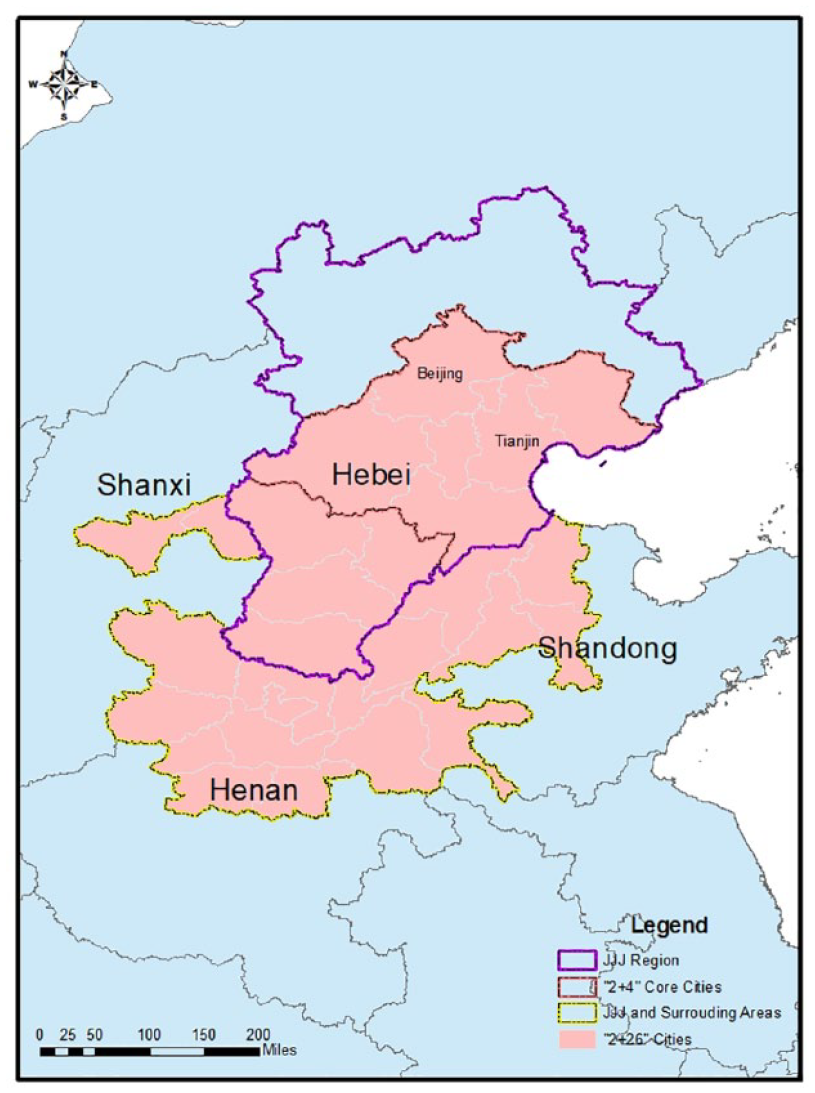
Different forms of city-regions for regional air pollution prevention and control.
Three waves of eco-state restructuring in air pollution management
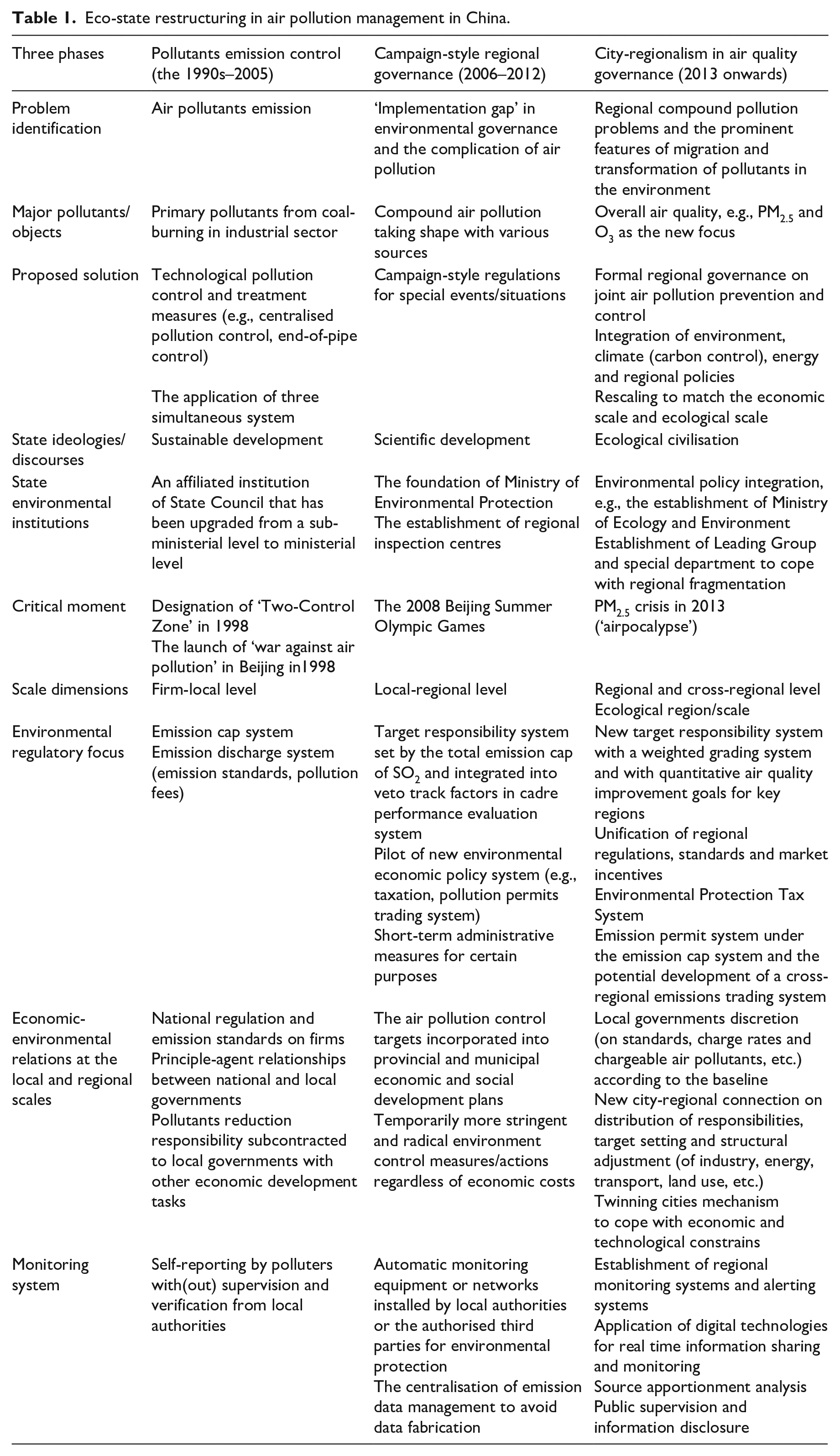
In this section, we conceptualise eco-state restructuring in air pollution management into three stages: pollutants emission control, campaign-style regional governance and city-regionalism in air quality governance. Critical dimensions of the conceptual framework include problem identification, major pollutants, proposed solution, the state apparatus, implementation scales, environmental regulations focuses and monitoring system (Table 1). It is worth noting that evolution is not a linear process. These three waves have distinctive features, but most new regulations and values in the former state were layered in the latter wave.
Eco-state restructuring in air pollution management in China.
Wave 1: Pollutants emission control (the 1990s–2005)
Environmental protection was initiated in the 1970s in China. Since the 1970s, a significant number of laws, administrative measures and regulations have been issued and released aimed at treating primary pollutants emissions (including SO2, NOx, CO and TSP) from industrial and coal-burning activities. The immediate air pollution problems have been mainly attributable to the primary pollutants directly emitted from industrial production. Among these primary pollutants, sulfur dioxide has become one of the most urgent air pollutants for air pollution control since the late 1990s.
Due to emerging and exacerbating environmental problems caused by the rapid economic development, environmental protection regulations and policies have been continuously revised and steadily strengthened at the national level, along with the enhanced legislative situation and adjustment of the institutional framework. The legislative situation and institutional framework of environmental management remained very weak initially. In 1988, the first independent national environmental agency, State Environmental Protection Agency (SEPA), was established, which was upgraded from a sub-ministerial department to a ministerial department in 1998, although still affiliated with State Council.
Together with the administrative enhancement, the discourse of sustainable development was explicitly proposed as the national development strategy by the central state in 1997, which denoted that the environmental protection and social and economic development should be integrated into the development strategy. One of the key areas of environmental governance at that time was air pollution governance in Two-Control Zones (‘Acid Rain Control Zone’ and ‘Sulfur Dioxide Control Zone’). The rapid upsurge in sulfur dioxide emission from coal-burning due to rapid industrial and economic development has led to disastrous climate conditions. In 1998, the Two-Control-Zone policy was formally established through the promulgation of the Zoning Schemes of the Acid Rain Control Zone and Sulfur Dioxide Pollution Control Zone 1 (State Council, 1998). Beijing, Tianjin and most cities in Hebei Province were designated as sulfur dioxide pollution control zones. Although the zoning mechanism has indicated the transition to regional air pollution control, the countermeasures were in fact implemented in individual cities within their jurisdictional area.
The war against air pollution in Beijing was officially launched in 1998, when Beijing Municipal Government published ‘Announcement of Urgent Measures to Control Air Pollution of People’s Government of Beijing Municipality’ to cope with the ambient concentration of sulfur dioxide (SO2) and total suspended particles (TSP) (UNEP, 2019). A series of countermeasures for air pollution control were implemented, which can be generally categorised into two types. First, ‘Three Simultaneous System’ was reiterated and applied. That means for any new construction, reconstruction or expansion projects, pollution prevention and control facilities should be designed, constructed and operated simultaneously with the design, construction and operation of the project. Secondly, end-of-pipe technological pollution control and treatment measures were proposed to reduce emissions, ranging from desulfurization retrofit, and renovation of coal-fired boilers to renovation of residential heating systems (UNEP, 2019).
Correspondingly, the emission discharge system and emission cap system were introduced as the focus of environmental regulations. The emission discharge system is targeted at pollution enterprises, and penalties and fines would be charged for their noncompliance with national regulations and standards. For the emission cap system, a maximum (cap) is set on the total amount by the central state and then allocated to local states to control pollution. Therefore, the principle-agent relationship between national and local governments is formed, and conflict of interests emerges simultaneously. The environmental regulations and policies have become more stringent at the national level. However, for a long time, local governments prioritised economic over environmental objectives because of GDP tournaments and entrepreneurial behaviours (Wu and Zhang, 2022). Moreover, the information for pollutant emission is collected from self-reporting by polluters with(out) supervision and verification from local authorities. The cost of breaking environmental laws is too low compared to the average abatement costs. Therefore, private enterprises do not have incentives to adopt technological measures to treat the pollutants and the emission data reported to environmental authorities were not accurate.
In this wave, Beijing, Tianjin and Hebei Province were allocated with different targets to reduce the total amount of SO2. However, by 2005, the targets failed to be achieved. On the contrary, the total emission and concentration of SO2 in Tianjin and Hebei remain increased, though these figures are slightly decreased in Beijing (Figure 2).
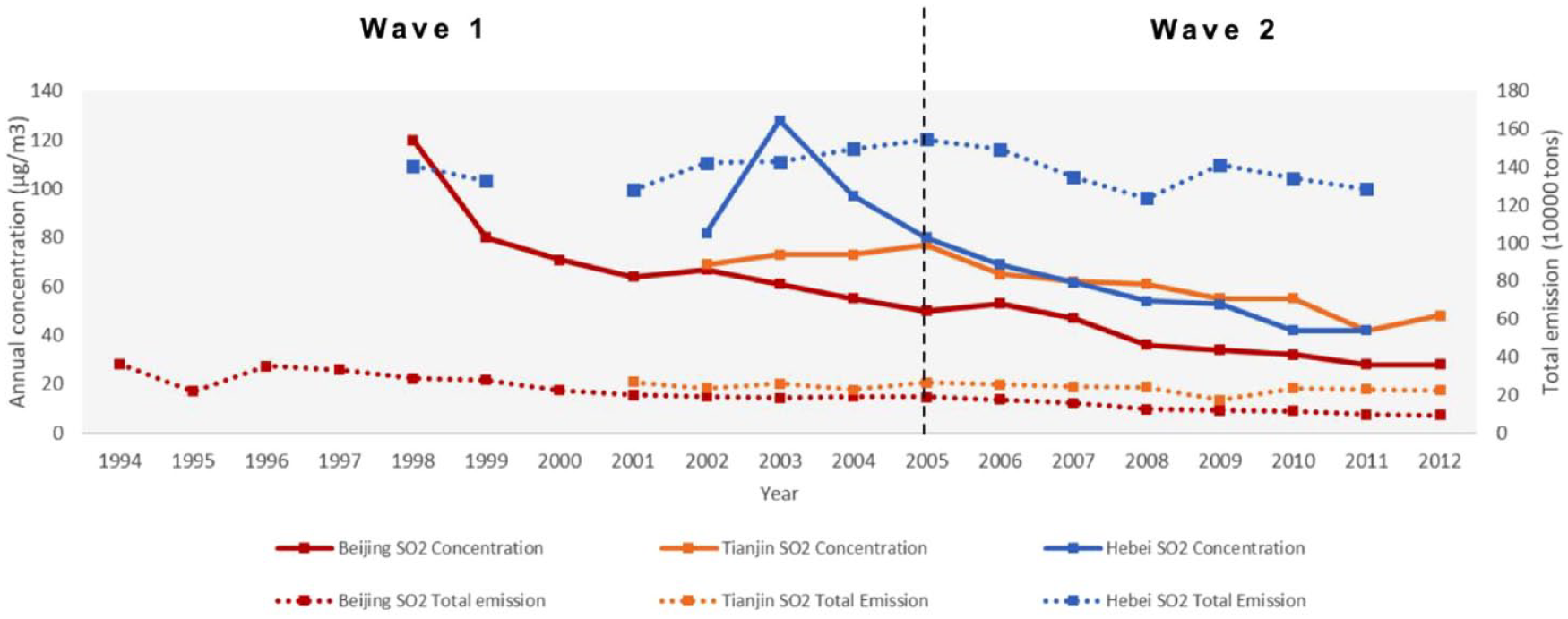
Changes in SO2 emissions and concentrations in Beijing, Tianjin and Hebei between 1994–2012.
Wave 2: Campaign-style regional governance (2006–2012)
The reduction in emission of key pollutants was essentially ‘low hanging fruits’ in air pollution prevention and control. However, some fundamental flaws exist in the first wave of the air pollution governance system that led to pollution management failure. The nature of the air pollutant emission control regime was essentially jurisdiction-based and project-based management (Jin et al., 2016). In fact, air pollution has become much more complicated. On the one hand, air pollutants can transmit and transform within a regional scope. On the other hand, air quality contains various primary and secondary pollutants, which means reducing SO2 does not necessarily improve air quality.
In this period, the central state recognised the scientific explanation for the ‘air pollution compound’, which took shape with multiple sources beyond industrial emission. Therefore, the prevention and control measures cover the industrial, agricultural, transport and energy sectors. Another important feature of air pollution management is that the central state has considered the regional transported pollution, especially during the campaign-style governance for Beijing Olympic Games. Improving Beijing’s air quality has become the top priority during planning and preparation for the 2008 Olympic Games. Special short-term measures and actions were implemented in Beijing and neighbouring cities and provinces, including Tianjin, Hebei, Shanxi and Inner Mongolia. Neighbouring provinces took similar control measures to improve ambient air quality, but the control magnitudes might be smaller than Beijing. The special short-term measures can briefly be summarised as follows: (a) limiting the use of government-owned vehicles; (b) applying a more stringent vehicle control system, e.g., an odd and even number plate permitting system temporarily; (c) halting industrial production; (d) suspending construction; (e) effecting controls to curtail evaporative emission at gas stations; and (f) reducing emissions in the targeted sectors (UNEP, 2009).
A series of fundamental institutional reforms and intensive mechanisms were introduced to overcome the implementation gap. First, in July 2008, the State Environmental Protection Agency was elevated to the Ministry of Environmental Protection (MEP), which further promoted the status of environmental protection. Secondly, six Regional Supervision Centres for Environmental Protection (RSCEP), namely East China (Nanjing), South China (Guangzhou), North China (Beijing), Southwest China (Chengdu), Northwest China (Xi’an) and Northeast China (Shenyang), were successively established from 2002 to 2008 to improve the enforcement of national environmental regulations and policies (Wu and Chang, 2020). The main task of RSCEP is gathering information and centralising emission data management to avoid local government manipulated emission data (Huan, 2011; Jin et al., 2016). Thirdly, a target responsibility system was set up to complement the emission cap system. In the 11th and early 12th five-year plan (FYP) period, the central state imposed total emission caps on SO2 as a binding indicator for national economic and social development (State Council, 2006). As specified in the national 11th FYP, a new state ideology, ‘scientific outlook of development’ was implemented by transforming the development model and improving resource efficiency. Related to air pollution control, the discourses of ‘circular economy’, and ‘energy saving’ emerged in environmental policies in 11th FYP, with a legally binding national energy intensity reduction goal (Xu, 2016). Environmental targets became mandatory and were incorporated into provincial and municipal economic and social development plans. The achievement was directly linked to cadre evaluation and promotion system. Fourthly, new market-based mechanisms were introduced to internalise environmental externalities to facilitate regional cooperation and coordination. On the one hand, existing market instruments such as emission charges rate were raised. On the other hand, the new market mechanism, including taxation and an emission permits trading system, was piloted in several provinces and cities, including Hebei, Tianjin, Shanxi, Henan and Inner Mongolia (Wu and Chang, 2020).
Air quality in this wave has been significantly improved. According to an Independent Environmental Assessment for Beijing Olympic Games, the average daily Air Pollution Index in Beijing during the Olympic Games was 36% lower than the average of the preceding eight years (UNEP, 2009). The ambient levels of major pollutants show different trends of decline. The achievement of air pollution management is best illustrated by the significant decrease in the total emission and concentrations of SO2 in Beijing, Tianjin and Hebei that all meet the annual air quality standard (Figure 2).
Nonetheless, campaign-style governance is just a temporary expedient for a specific event. It is an important supplement to a regular governance system but suspending regular activities to fulfil short-term goals is impossible to implement permanently (Liu et al., 2015). Air pollution prevention and control in Beijing and surrounding territories was the first genuine attempt based on regional mechanisms in China. Olympic Games can be regarded as a catalyst for the implementation of regional control strategies and future air quality management plans.
Wave 3: City-regionalism in air quality governance (2013 onwards)
In the third wave, the emphasis on environmental protection gradually shifted from total emission control to improving overall air quality. Compound air pollution became an ingrained regional issue with increasing amounts and types of primary and secondary pollutants involved in atmospheric chemical reactions. In January 2013, the recurrence of heavy haze episode caused by fine particulate matter, known as the PM2.5 crisis (‘airpocalypse’), raised public awareness of health issues and enhanced political will to resolve deteriorating air quality (Zhang et al., 2016). The PM2.5 crisis was a tipping point for China’s new environmental state formation. Triggered by it, the most stringent measures of air pollution prevention and control, China National Action Plan on Air Pollution Prevention and Control (2013–2017) (also known as Ten Tactics of Air Pollution), were promulgated by the central state in 2013 (State Council, 2013). Simultaneously, the Chinese National Ambient Air Quality Standards became tougher and included new pollutants. The secondary pollutants, primarily PM2.5, became the focus for control and an established part of the lexicon of political and media discourses. To consolidate the achievements of previous air governance, the Three-year Action Plan to Win the Blue-Sky Defence War 2018–2020 was issued at the end of Ten Tactics of Air Pollution as a follow-up policy (State Council, 2018).
One of the key features of air pollution control in Wave 3 is that the unified regional air quality management is further legislated and formalised. The regional air quality governance approach was reiterated in the Ten Tactics of Air Pollution and the Amendment of Environmental Law in 2015. In the Ten Tactics of Air Pollution, quantitative air quality improvement targets for major regions were set up. It is projected that the concentration of PM2.5 in the JJJ region will decrease by around 25%, and the PM2.5 annual concentration in Beijing will be below 60 mg/m3 by 2017. Highly specific technology-related targets for each municipality and province, ranging from the reduced production capacity of certain industries (e.g., iron, cement and coal) to traffic emission control, were set up in a detailed implementation policy document to ensure its implementation (MEP, 2013).
Regional contradiction and social problems could be caused by the implementation of more stringent regulations and adjustment or relocation of industries (Wang et al., 2018; Wong and Karplus, 2017). A wide range of regional air quality measures was put into practice to achieve the mandated target and balance the interests among different administrations. First, the regional coordination agency for the unified regional environmental management has been upscaled to the central state. It was initiated by Coordination Group for Air Pollution Prevention and Control in Beijing-Tianjin-Hebei in 2013. Beijing Municipal Government played an active role in establishing this working group, and its office was settled in Beijing Municipal Environmental Protection Bureau. In 2018, the Coordination Group was adapted into a Leading Group, the office of which was set up in the Ministry of Ecology and Environment (MEE). A special department was newly established within MEE to take responsibility for joint air pollution prevention and control in JJJ. A government official has stressed the effects of this adjustment: In the Coordination Group, the relationship between the members is equal, and collaborative, which is more like a notification mechanism. This mechanism effectively facilitates information exchange and collective actions to respond to serious pollution situations. However, it is necessary to coordinate from a higher level. The innovation of administration can standardized the work of the leading group and various departments and provinces and promote the unification of planning, standards, monitoring and other aspects in the region [. . .] Overall, this adjustment aligns with unified air pollution prevention and control in JJJ and surrounding areas, aligns with the need to coordinate and solve cross-regional environmental problems, and aligns with the objective laws of regional environmental protection, which can improve the collaboration between different actors and overall effectiveness of regional environmental protection. (Director of the Environment and Economic Policy Research Centre, Ministry of Ecology and Environment, 2018)
2
Secondly, Beijing, Tianjin and another 26 cities in Hebei, Shanxi, Shandong and Henan province (‘2 + 26’ cities) were identified by the MEP as the key cities along the air pollution discharge/transport channel in Beijing-Tianjin-Hebei and Surrounding Areas in 2017 (Figure 1). These cities are located upwind of Beijing and are highly concentrated with pollution-intensive industries. They are attributed as the major regional sources of the heavy air pollution in Beijing considering geographical and meteorological conditions. This state-led rescaling of air quality governance alignment with the ecological scale (the so-called ‘air pollution discharge channel’) and the joint regional governance is justified by environmental rationale.
Thirdly, a twinning-based cooperation mechanism was established. Beijing, Tianjin and four cities in Hebei (Tangshan, Langfang, Baoding and Cangzhou) are the core area of regional air pollution prevention and control (Figure 1). Following the delineation, Beijing signed a joint agreement with Langfang and Baoding, and Tianjin signed a joint agreement with its neighbouring cities Tangshan and Cangzhou. The Twining mechanism has strengthened the connections between core cities in the JJJ region. Beijing and Tianjin have provided financial and technical support to their neighbouring cities to improve air quality. The selective delineation of the core area and the twinning-based cooperation further reflect that the main objective of the city-regionalism of air pollution prevention and control in the JJJ region is to solve the air pollution issue in Beijing. This policy is Beijing-centred, and uneven development is inevitable. As government officials pointed out: Within the JJJ and surrounding areas, the JJJ region is the core area for unified air pollution prevention and control; Within the JJJ region, six cities namely Beijing, Tianjin and Tangshan, Langfang, Baoding and Cangzhou in Hebei Province are the core area for air pollution prevention and control. (Government official from Ministry of Environmental Protection, 2015)
3
The core area of JJJ joint air pollution prevention and control should also include Handan, which is almost always among the top 10 cities with the worst air quality in China. Unfortunately, the delineation of the core area in 2015 did not include Shijiazhuang and Handan, two heavily polluted cities in Hebei. It is a shame, and it also indicates that the delineation of the core area is mainly considered from Beijing’s perspective and did not fully consider the key cities in Hebei for Haze Control. (Deputy Director of National People’s Congress Environment and Resources Committee, 2015)
4
Another feature of air quality governance is the integration of environmental policies and regional development, aligned with the institutional building of ‘ecological civilisation’. First, the MEP was reorganised into the Ministry of Ecology and Environment (MEE) because of the institutional reform of the State Council in 2018. Environmental governance functions that were originally distributed in other ministries were integrated into the MEP to cope with institutional fragmentation. Secondly, there is a new tendency for air pollution management to be integrated with carbon control, economic policy and regional spatial planning. Provincial and municipal governments must coordinate with each other in emission source control, energy structure adjustment, industrial structure optimization and infrastructure construction (Jiang et al., 2021). Thirdly, efforts have been made to unify regional regulations, emission standards, technical specifications of emission monitoring and accounting to facilitate environmental enforcement. Moreover, previous pilot emission permit trading systems and taxation systems have been approved to be implemented nationwide. Market mechanisms can overcome territorial-based management limitations and internalise the negative externalities. The emission permits are expected to be traded within one regional air pollution prevention and control area or the same catchment (i.e., the ecological scale).
Regional air quality monitoring networks are being built for state surveillance and control to underpin the implementation of regional mechanisms. A regional monitoring centre, Beijing-Tianjin-Hebei Meteorological Forecast and Alerting Centre, was established in 2013. New regional monitoring stations were built at the edge of its administrative boundary of Beijing to monitor the transported pollution from the southeast and southwest. Also, the management of all city-level air quality monitoring stations and county level monitoring stations in the core area is recentralised to the central state level (MEP, 2016). Beijing has also performed source apportionment analysis of PM2.5 in 2014, 2018 and 2020 respectively. The latest source apportionment analysis shows that the regional transported PM2.5 increased from 34% in 2018 to 40% and up to 64% in heavy polluted seasons (Beijing Daily, 2021). Therefore, the regional air quality governance is listed as a key task to achieve air quality improvement. The PM2.5 crisis in 2013 also triggered intense public demand for better information disclosure. PM2.5 was not monitored before 2013 and newly included in the monitoring system (Figure 3). Updated digital techniques were integrated into the monitoring and alerting system to enhance the timeliness, reliability, accuracy and comparability of environmental data (Kostka and Zhang, 2018).
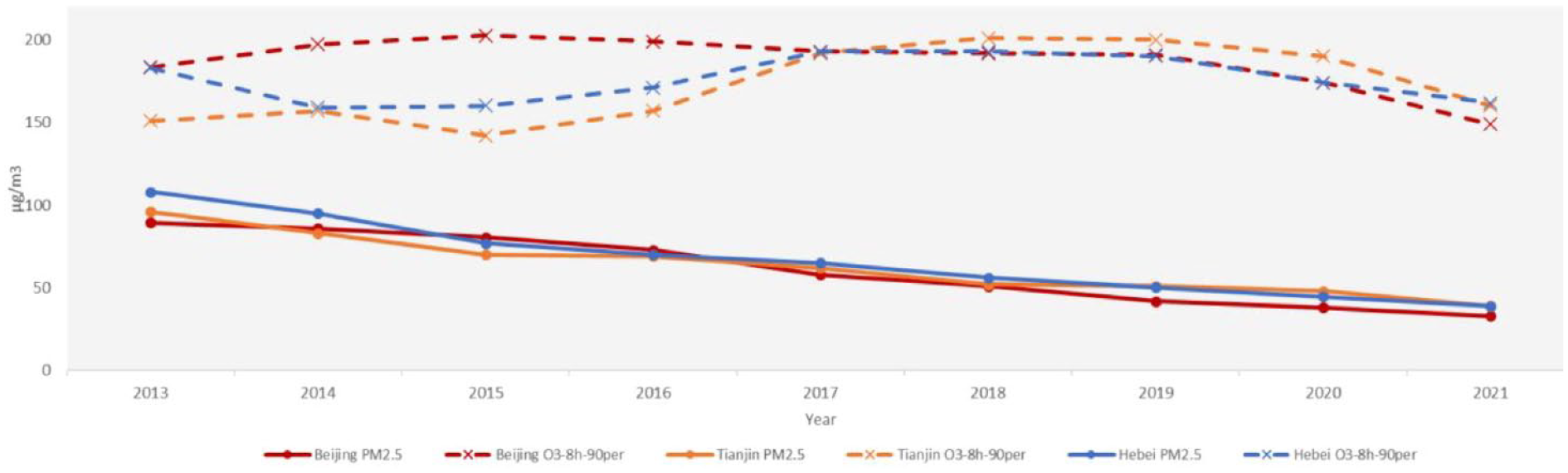
Changes in annual average concentrations of PM2.5 and O3 in JJJ region since 2013.
Air quality has significantly improved since the launch of Ten Tactics of Air Pollution in 2013. As great efforts have been made to combat PM2.5, the target of PM2.5 reduction has been successfully achieved in Beijing and the JJJ region in two action plan terms (Figure 3), which prove the efficiency of the regional air quality governance regime. However, ozone pollution shows a different trend and is becoming more prominent than other pollutants (Figure 3). Ozone pollution is also a typical regional issue, and it is more challenging to deal with than PM2.5. Therefore, the regional approach needs to be further enhanced in future to cope with the increasing ozone concentration.
Conclusions
This paper has examined the air pollution management of JJJ and its surrounding areas through the perspective of eco-state restructuring and its implications for territorial governance practices. We have argued that China has experienced three distinct waves of eco-state restructuring regarding air pollution governance, namely pollutants emission control (the 1990s–2005), campaign-style regional governance (2006–2012) and city-regionalism in air quality governance (2013 onwards) (Table 1). The central state plays a proactive but different role in each phase, characterised by state strategic selectivity, adjustments of state apparatus, employment of new market tools and knowledge, and state capacities for monitoring, control and legitimation. During the restructuring process, the state-environment-economic relations are being reformed at the urban and regional scale and the city-regional has become the key scale at which environmental regulations are targeted. Environmental city-regionalism (i.e., the third wave of ESR) marks a significant shift in state ideologies, rationalities and practices of governance and should be regarded as a response to the expanding environmental pressures and demands. The environmental city-regionalism is a top-down process promoted by the central state for better environmental regulations. The reform is a utilitarian approach to cope with increasing social issues and concerns in PM2.5 crisis and to align with the new development strategy ‘ecological civilisation’. As a result, the central state has strong political will to improve overall air quality in Beijing and JJJ region. This task has become a core responsibility for the new generation of political leaders.
The nature of state spatiality is changing, corresponding to the environmental state restructuring. As Jonas and Ward (2002) claim, environmental policy-making has been instrumental in rescaling urban governance in the Western context. Likewise, the regional approach is also regarded as an effective solution to environmental issues in China. However, there exist multiple forms of environmental city-regionalism in China. Within the environmental governance realm, the regional element has already been indicated in the first stage through the ‘Two-Control Zone’ policy which covers 175 cities/districts and 27 provinces (State Council, 1998). The implementation of the policy package was weak due to urban entrepreneurialism. In the second wave, the regional approach was more progressive, but it was still a command-and-control policy and just employed as a temporary solution for a specific event. Until recently, the environmental city-regionalism has been formerly legislated and institutionalised, manifested by the establishment of regional institutions. It is also noteworthy that two regional scales that do not share the same boundaries are introduced indeed. One is the JJJ region which aligns with the administrative boundaries of Beijing, Tianjin and Hebei Province, targeting coordinated and integrated development. The other is more rooted in environmental logic that includes cities in other provinces surrounding areas beyond the JJJ region. The deployment of ecological scales that transport major pollutants into Beijing and the JJJ region as governance units reflect the rescaling and reterritorialization process in environmental governance with political objectives. These two forms of city-regions have large overlap and the former one is the core area for regulations implementation considering administrative fragmentation.
Recent environmental city-regionalism is essentially a scale building and environmental scalar fix process. The rescaling aims to internalise social-environmental externalities and match the economic and ecological scales. It is a two-way process, including upscaling and downscaling. On the one hand, environmental governance is upscaled to be best dealt with at the (eco)regional scale to cope with the administrative fragmentation and ‘implementation gap’. On the other hand, the responsibility for air quality improvement is downscaled and distributed to lower states in practice.
Through this process, the central state can enhance its control and capacity in policy implementation, environmental monitoring and reconcile conflicting interests. The state-economic-environmental relations at the local and regional scales are being reformed along with the rescaling process. First, the local state has increasing political and economic incentives to engage in the polity. Secondly, environmental issues are no longer incompatible with economic development. Regional structural adjustment and new economies in industry, energy and transport sectors have replaced traditional technological treatment to reduce the negative impact of economic development as the major measure for air quality governance. Thirdly, genuine intercity cooperation between local states has occurred to cope with economic and technological constraints in less developed cities. However, as cooperation usually occurs limited in central cities, peripheral cities that suffer more severe air pollution are excluded from this type of cooperation mechanism.
This paper highlights the state’s role in environmental and spatial regulations at China’s urban and regional scales. It confirmed that the central state also drives the city-regionalism in China for ecological consideration rather than to cope with the excessive competition in urban entrepreneurialism (c.f. Li and Wu, 2012; Wu, 2016). China’s environmental state implemented a series of state strategies within and across different scales and claims to act in the name of ‘ecological rationality’. This paper extended the ESR theory from Western industrialized countries to China and provided a context-specific understanding of how multi-level states engage with environmental problems, especially in air pollution governance. China has seen a similar transition process in general, but the state’s role is much more prominent in reshaping the economic-environmental relationships and the territorial governance structure. These findings also contribute to understanding scalar politics and territorial politics. Further enquiries into politically orchestrated city-regionalism on the ground will be very useful to reveal how different struggles, negotiations and comprises between other actors are conducted in practice.
Footnotes
Declaration of conflicting interests
The author(s) declared no potential conflicts of interest with respect to the research, authorship, and/or publication of this article.
Funding
The author(s) disclosed receipt of the following financial support for the research, authorship, and/or publication of this article: This research receives funding from the H2020 European Research Council Project ‘Rethinking China’s Model of Urban Governance’ (Advanced Grant No. 832845- ChinaUrban).