



Abstract
This paper examines the historical and recent efforts towards constructing an integrated Beijing-Tianjin-Hebei global city-region, arguably the most politically privileged urban agglomeration in China. It considers how a progressive national policy discourse concerning city-regional integrated development is substantially focused on the central city (Beijing), thereby privileging the competitiveness and interests of the larger global city at the expense of those of the surrounding smaller cities and towns. The study argues that future research and policy informing city-regionalism should pay closer attention to the uneven power dynamics and distributional politics operating within, and often in tension with, the geopolitical orchestration of global city-regions by nation states.
Keywords
Introduction
This research article addresses the issue of the territorial-political status of small cities and towns within wider national competitiveness policy frameworks, which are heavily influenced by knowledge and imaginaries of global city-regions as drivers of global competitiveness (Kantor et al., 2012; Scott, 2001). Drawing on the experiences of global cities such as London, New York, and Tokyo, studies of city-regionalism have tended to evolve into a kind of global city-centred regionalism in which secondary cities – smaller cities and towns – within the same city-region lacking in the political and economic capacities of their major city counterparts are often overlooked (Harrison and Hoyler, 2015; Moisio and Jonas, 2018; Pendras and Williams, 2021). The article addresses this problematic by focusing on Beijing-Tianjin-Hebei (BTH) global city-region in China as a case study. We highlight how small cities and towns within aspirational global city-regions, such as BTH, often struggle to find a niche in global city-centric regionalism policy discourse, wherein they are often marginalised as peripheral and the territorial-distributional benefits of city-regionalism are unevenly distributed across such city-regions.
In China, small cities and towns were often positioned at the forefront of economic reforms in the 1980s, a period when the Chinese Communist Party (CCP) promoted ‘bottom-up urbanisation’ (Xu and Li, 1990). The rapid growth of small cities and towns underpinned the formation of new regional economic spaces, such as the Pearl River Delta and Yangtze River Delta (Ma and Fan, 1994; Sit and Yang, 1997). However, the privileged – even glamorous – regard in which small cities and towns were once held by Chinese national state policymakers has since faded. Part and parcel of this transformation has been a central state policy shift towards favouring major cities as centres of regional agglomeration economies. This transition started with the so-called city-administered-county reform, whereby the counties or county-level cities at the urban periphery were placed under the jurisdictional authority of a major central city (Ma, 2005). Consequently, the definition of cities as ‘small’ was not simply a function of economies of scale or population size; instead it was rigidly determined by the administrative hierarchy and asymmetric power relations internal to the Chinese state. Since the 1990s, the earlier phase of promoting growth around dispersed small city and town development has been surpassed by a new ‘city-based’ regionalisation (Lin, 2007), a tendency further reinforced by policy narratives of regional cooperation and integrated development in the first two decades of the twenty-first century.
The remainder of the paper is divided into three main sections. First, we review the city-regional literature and highlight the need to examine the uneven nature of territorial-distributional processes and politics operating within and across city-regions. This provides a context for critically examining whether global city-centric regionalism currently operates as a kind of ‘hegemonic project’ (Jessop, 1997) of the national state and the extent to which the coherence of this project is threatened by counter-hegemonic narratives that seek to expose territorial-distributional inequalities operating within and across global city-regions. Turning to the case of the BTH region, we examine two sets of distributional politics operating counter to the project of city-regional integration, namely, (1) income (GDP) and (2) property (housing market dynamics). We document geographies of territorial distribution within and across the BTH using diverse sources, including existing research studies, official regional policy publications, statistical yearbooks, administrative handbooks, and newspaper reports and websites. In the concluding section, we argue that the seemingly hegemonic discourse of regional integration serves to conceal its essential global city-centricity. As the global city at the centre of the emergent BTH region, Beijing continues to prosper at the expense of the surrounding small cities and towns. The paper concludes with some reflections on city-regionalism and the need for further research on the imbalances within, and distributional politics of, global city-regions.
Rethinking city-regional geographies
The emergence of city-regions, ranging from metropolis to megaregions, has attracted wide attention from scholars in the fields of geography, planning, and political science. Analysis city-regions has evolved from functional-economic and political-administrative towards geopolitical perspectives (Moisio and Jonas, 2018). Globalisation and competitiveness-building, along with their implications on territorial state formation, have dominated the assessment and explanations of city-regional development (Herrschel, 2014; Vogel et al., 2010). Prominent city-regions are selectively constructed and promoted as geo-economic actors within geo-politically powerful imaginaries, which in turn underpin regional accumulation strategies (Mackinnon, 2021; Roy, 2009).
Studies have further emphasised the emergent scale of the city-region as a kind of hegemonic project of the national state, whose powers and capacities are correspondingly rescaled as city-regions expand and develop their own functional and fiscal capacities around economies of agglomeration and associated social and infrastructural investments (Jessop, 1997; and see Zou, 2022, on state rescaling in the Beijing city-region). Thus metropolitanisation operates as a ‘techno-political conceptual assemblage’ (Calzada, 2018: 267) or ‘metrophilia’ (Waite and Morgan, 2019: 382), which reflects a dominant and triumphalist (major-)city-first approach to city-regionalism (Glaeser, 2012). According to Moisio (2018: 1422), such city-regionalist geopolitical imaginaries reflect ‘the increasingly central role of major cities and city-regions in the strategies of state governments that seek to build nation-states as territories of wealth, power and belonging in the contemporary capitalist conjuncture’. National states often privilege global city-regions whose central cities are already ‘high-performing “national champion” cities’ (Crouch and Le Galès, 2012; cited by Moisio, 2018: 1423).
Although these extensive and relational city-regional forms pose formidable challenges to state territorial administration and collective governance (Kantor et al., 2012), the literature tends to emphasise the overall functional and administrative coherence of such forms rather than their internal territorial-distributional problems and politics (Jonas, 2012). To the extent that territorial politics does feature in such analyses, the emphasis is often on how the national state provides incentives for sub-national territorial administrations to adapt to wider challenges, such as environmental and regional planning, rather than offering a more nuanced understanding of how local state territorial structures are moulded in response to locally uneven territorial-distributional conflicts occurring across metropolitan areas and lager city-regions (Cox and Jonas, 1993). Against this backdrop, studies have started to examine sub-regional territorial politics operating within what remain first and foremost profoundly jurisdictionally fragmented city-regions (Schafran, 2014).
In many countries, distributional inequalities within and across city-regions reflect the legacy of different national settlement systems and associated spatially uneven power structures. In the UK, for example, since the early 2000s different models of city-regionalism promoted by successive Labour and Conservative governments have exposed an urban-rural dichotomy in the framework of public administration. Critics argue that the application of national policies designed to foster urban and regional agglomeration economies does not serve the needs of rural interests located in peripheral areas of such putative city-regions (Beel et al., 2020; Harrison and Heley, 2015; Martin, 2015). Likewise, in countries such as the USA the political-cum-distributional interests of secondary cities located within dynamic city-regional agglomerations are often overshadowed by those of the dominant (global) urban centre (Pendras and Williams, 2021). Yet city-regional theory remains wedded to the distributional benefits of urban agglomeration economies and promulgate case studies of city-regionalism based largely upon dynamic global city-regions where self-organised systems of regional governance are seemingly capable of managing profound distributional inequalities within such city-regions (Kantor et al., 2012). Such efforts to identify putative global city-regions as self-organised instruments of state redistribution reflect a political-economic climate in which national state governments ‘are committed to neoliberal politics of international competitiveness and pursuing the national economic success of the territorial state’ (Moisio, 2018: 1423).
In summary, it is important to explore the spatial unevenness of city-region processes operating within and across emergent city-regional spaces as a basis for identifying the political actors promoting city-regions, which geographical areas, including smaller cities and rural areas, and social groupings are included or excluded from city-regionalism (be it the narratives of ‘global city-regions’, ‘megaregions’, ‘metropolitan regions’ or others), and, finally, who gains and who loses throughout these hegemonic global or mega city-regional process (Harrison and Hoyler, 2015: 19). Whilst there is growing awareness of these considerations in recent studies of, for example, the UK context (Clelland, 2020; Deas et al., 2021), we know little about how these factors play out in China. To fill this gap, the current study examines the BTH city-region as a prime example of global city-centric regionalism. As we shall suggest, the BTH city-region, although sharing a long history of building regional integrated development, is fundamentally a Beijing-centric city-region, whose rationality is consistently revolved around urban growth pole-led regional development. Although the dominant policy narratives suggests that spatial equalisation follows on from urban-cum-regional agglomeration processes, we suggest that territorial-distributional inequalities persist and, indeed, widen as a result. Accordingly, in this model small cities and towns, which are secondary places occupying the lowest level of the hierarchy of the urban administrative system, are increasingly marginalised in both political and economic terms by current global city-region policy discourses and practices.
The BTH city-region as Beijing-centric
Since the reforms of the 1980s, the Chinese state has rolled out a range of policies which, together, have promoted BTH as an integrated metropolitan region (Zou, 2022). As early as 1981, just three years after the inauguration of economic reforms, BTH was home to the North China Economic and Technological Cooperative Association. This was the very first example of organised (centrally planned) regional cooperation in China. Since then, there have been two main groups engaged with BTH city-region policy-making; one comprises planners involved in making spatial plans, the other group is involved industrial policy and includes economic geographers.
As for the former, BTH’s territorial plan was outlined in 1981, by the Land Resources Bureau, a part of the Central Planning Ministry. The plan considered the tension between population and environment (rendi guanxi) and attempted to coordinate population and economic growth under the carrying capacity of the environment, especially in terms of energy, water resources, and pollution (Li, 1985). The growing problem of uneven development and industrial polarisation within BTH was already noted at the time: The capital Beijing, which lacked resources, developed heavy industries very quickly. The industrial output increased over 200 times in 1980 compared to 1949, when the heavy industries accounted for 60 percent. A prime example is the building up of the largest steel-iron alliance company in the region, Shougang (literally, Capital Steel). The speed even dwarfed the neighbour Tianjin, which only increased 28 times, even though it used to be the economic centre of North China with a better industrial base. The over-concentration of heavy industries led to the growth of the population concentrated in Beijing (Li, 1985: 25; translated).
In 1996, another round of city-regional plans covering most of the BTH region was launched and chaired by the professor at Tsinghua University, Wu Liangyong. When published and approved by the time Ministry of Housing and Construction in 2001, the plan was called ‘Jing(Beijing)-Jin(Tianjin)-Jibei(North Hebei province) Urban and Rural Spatial Development Plan’. Yet, it is often referred to as ‘The Greater Beijing Plan’ for short, which reflects the motive of the plan focused on Beijing. At the time of the plan’s release, Beijing had just won the bid to hold the 2008 Olympics. As a consequence, the plan was employed to redistribute the spatial division of labour in the region and, consequently, upgrade Beijing to the status of a world city (Tsinghua University Human Environment Research Centre, 2002).
Another policy stream informing city-regionalism in the BTH focused on regional economic development around the exploitation of urban economies of agglomeration. In the 1980s, several economic associations covering different parts of the region were set up by different branches of the Chinese central state. However, these loose local organisations were more rhetorical than having real functions. Some policy intervention was achieved only in 2004, when the Department of Regional Economy under the National Development and Reform Committee (NDRC) brought Beijing, Tianjin, and the Hebei Development and Reform Committee together to push them to promote economic integrated development. In the same year, a so-called Langfang Consensus was released, which marked the beginning of the NDRC-led economic regionalism.
In 2006, two years later, the NDRC launched the formulation of the BTH metropolitan plan. In effect, the NDRC-led promotion aimed to squeeze a spatial element into an economic plan. However, the metropolitan plan was never published, even though the counterpart regions, like Yangtze River Delta (YRD) and Pearl River Delta (PRD), had already adopted similar NDRC-initiated plans. An insider’s view from the Hebei Development and Reform Committee revealed that the so-called ‘Langfang Consensus’ was in fact a case of ‘Langfang Differences’: The Beijing side did not agree with the wording of ‘economic integration’ but reiterated the term ‘regional cooperation’ [the playing of words reflect a mindset that you cooperate with me and for me, not that we are becoming the same as an integrated community]. Even Tianjin spared no efforts trying to integrate with Beijing, not to mention Hebei. Yet the response from Beijing was not active at all (Leadership, Decision Making and Information, 2004: 20; translated).
Another example shows the great divergence between Hebei and Beijing regarding cooperation (China Economic Weekly, 2010). In 2010, Hebei’s provincial government launched its provincial policy to build the ‘capital metropolitan region’, which aimed at being physically and functionally integrated with Beijing to attract spillovers, such as industries and population. However, Beijing launched its own metropolitan regional plan. This plan emphasised Beijing’s own vision of the role of new towns in the suburban area, which were designed to attract polluting industries and population from the city centre. Furthermore, the plan forced Hebei to add the word ‘green’ before its metropolitan regional policy – literally, ‘the green economic circle surrounding the capital’ – a strategy designed to restrict Hebei’s development, especially in terms of manufacturing and industries.
Both the planning department-led and the NDRC-led city-regionalism in BTH demonstrate a salient Beijing-centric rationality. The former is about the growth management of Beijing to improve the human environment of the capital. The latter focuses on the logic of economies of agglomeration in order to concentrate advanced industries in the capital city. 1 As a result, these initiatives did not achieve substantial progress towards metropolitan or regional integration because none of the departmental promoters on either the planning side or the NDRC side was powerful and authoritative enough to coalesce the localities.
The situation did not change until 2014, when President Xi Jinping proclaimed BTH integration to be a national strategy. This intervention by the leader of the CCP signalled that regional integration is no longer a local issue, but instead is an integral component of national economic strategy. The central state aims to construct BTH as the third pole of the national economy after PRD and YRD (Dong and Kübler, 2021). Moreover, built upon Beijing’s high-tech industry and Tianjin’s port, BTH was positioned as the city-region with the greatest potential in North China. However, these central efforts still reflect a Beijing-first mentality and Beijing-centric political structure. Rather than restraining the growth of Beijing, the various visions of an integrated BTH region attempt to optimise the spatial and industrial structure of Beijing through regional coordination, namely, by transferring no-longer wanted manufacturing to the peripheral region, which is now deemed as polluted and hence insufficiently advanced in terms of meeting modern environmental standards of green economic development. The distributional implications of these Beijing central city-regional policies on other cities in the BTH, especially the small cities and towns, are scrutinised in the following sections.
Small cities and towns in the BTH city-region
To investigate further the Beijing-centric rationality of BTH city-regionalism, it is important to map aspects of territorial distribution in the context of the jurisdictional geographies of this fragmented metropolitan region. The city-region is home to the central government and two state-administered municipalities (Beijing and Tianjin), being the national centre of politics and culture. These two major cities are surrounded by Hebei province, which governs 11 prefecture-level cities, 118 county-level cities and counties (Figure 1). This political geography of metropolitan jurisdictional fragmentation forms the basis for mapping two dimensions of uneven territorial distribution across the region around: (1) income and poverty; and (2) property values. We consider each of these territorial disparities in turn but recognise that they intersect with, and at times reinforce, each other.
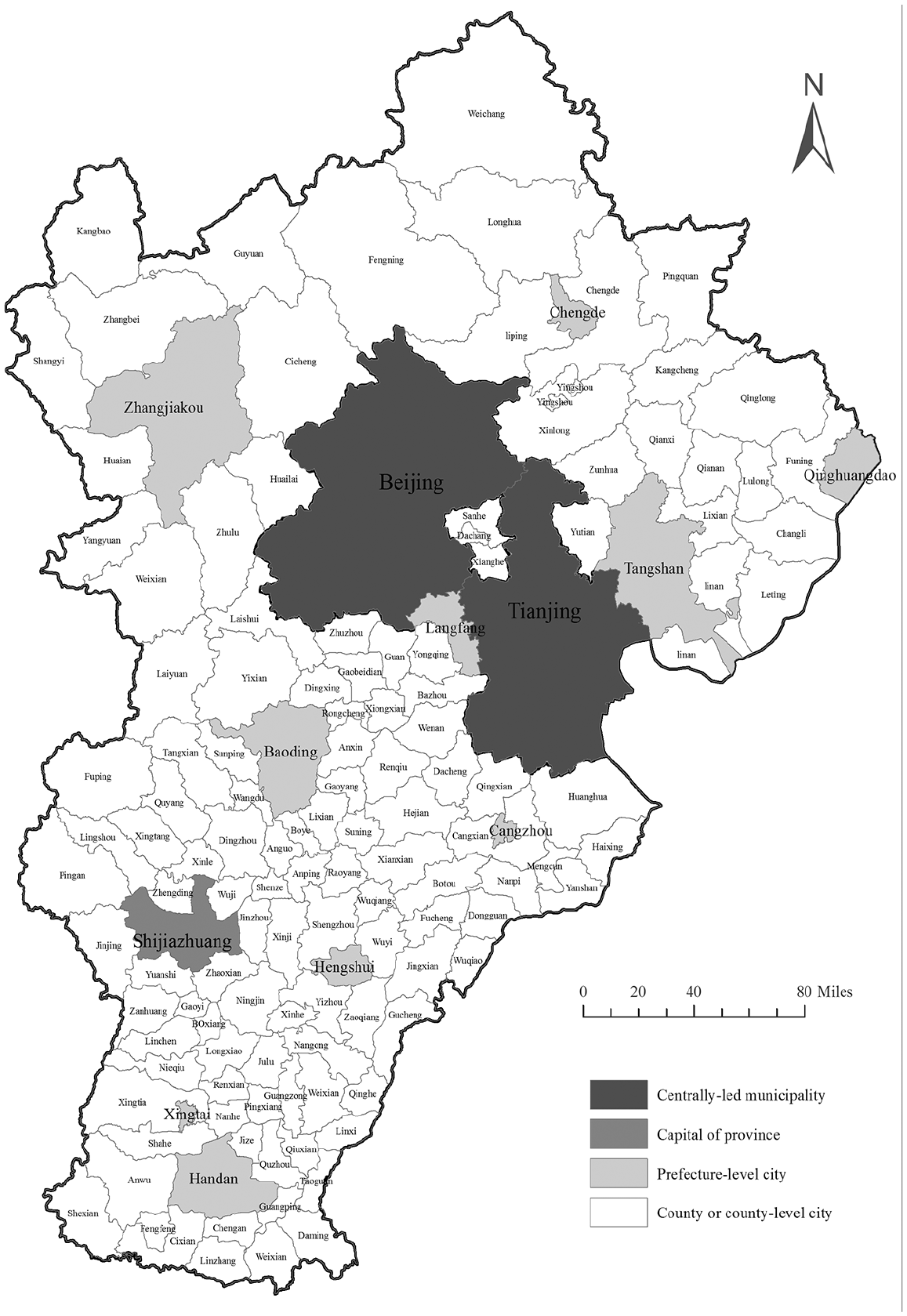
Municipal governments and administrative areas within the BTH city-region.
Uneven geographies of income distribution: The production of a ‘poverty belt’ surrounding Beijing
Being the most politically privileged urban agglomeration in China, BTH is also deemed to be the least integrated city-region compared with its counterpart regions. This is because it has inherited tremendous disparities in terms of the recent history of settlements and population development. Compared to the capital city Beijing and the other economic giant Tianjin, Hebei has lagged well behind. In 2005, a startling report was released contained in the socioeconomic development strategy of Hebei province (Liu and Liu, 2015). Jointly devised by Chinese and foreign experts with the aid of the Asian Development Bank, the report found that counties and cities in Hebei bordering Beijing and Tianjin were impoverished, with approximately 2.7 million people living below the poverty line (Figure 2). Beijing and Tianjin seem like an island of affluence surrounded by a belt of poverty. By 2005, the annual GDP in Beijing had reached 7,000 hundred million yuan (about 870 hundred million US dollars), whereas it averaged lower than 50 hundred million yuan (about 62 hundred million US dollars) for surrounding counties and cities. According to China Daily and other sources, the unbalanced development can largely be ascribed to the Beijing-centric mentality; various distributional-cum-fiscal sacrifices are made by these counties to support the development of Beijing (China Daily, 2005). For instance, some manufacturing enterprises in these counties were forced to close to cut water and electricity consumption and guarantee supplies for Beijing (Liu and Liu, 2015). In effect, the BTH ‘poverty belt’ is an emergent imaginary – albeit one constructed from material inequalities – that has actually been produced by the salient Beijing-centric BTH development mentality.
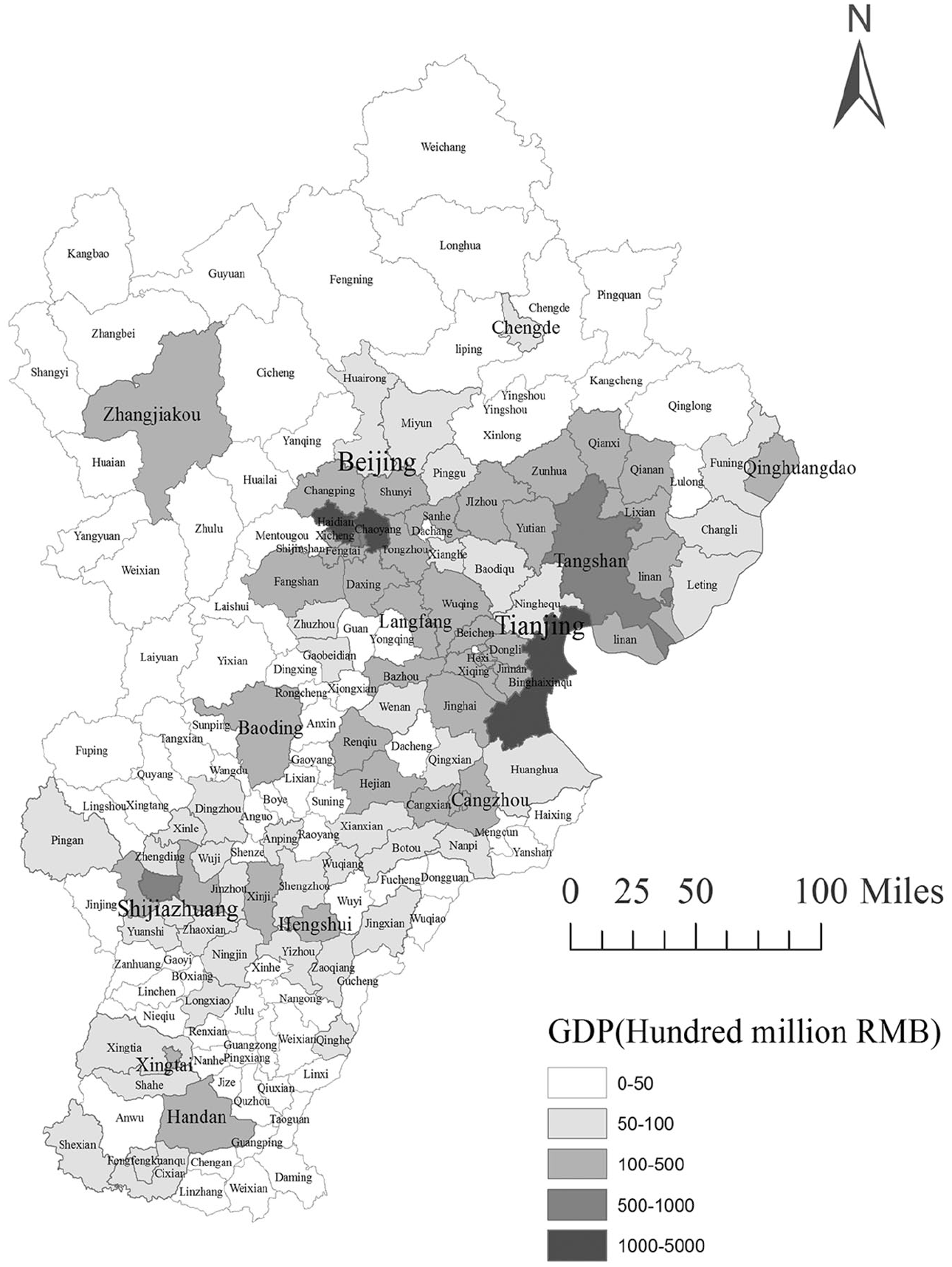
Geographies of GDP distribution within BTH in 2005 (Beijing, Tianjin and Hebei).
Uneven geographies of property development: The emergence of a ‘property belt’ embracing Beijing
The cumulative uneven growth is further reflected in widening inequalities and differences in the price of housing across the city-region, especially around Beijing. Take, for example, the suburban districts of Beijing, such as Tongzhou, which borders Sanhe county-level city under the jurisdiction of Langfang municipality of Hebei province. Although divided only by the (constantly dry) Chaobai River, some areas of Sanhe are in fact located even closer to Beijing city centre than Tongzhou, yet house price differences of each side of the river are pronounced. As illustrated by Figure 3, the house price of Yanjiao was less than half that of Beijing, in either the suburban or the central district.
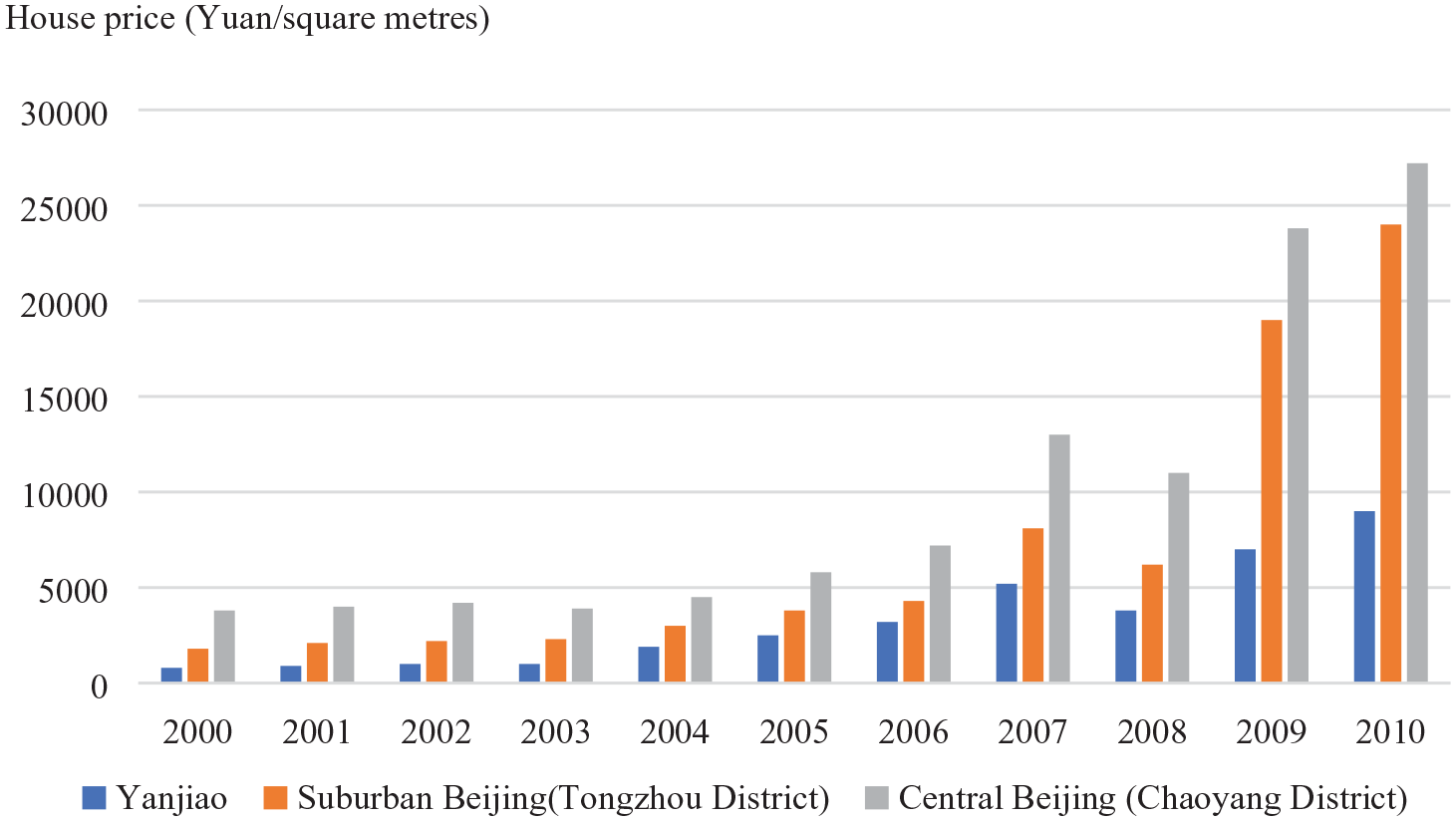
Trends in house prices in Beijing, Tongzhou and Yanjiao, 2000–2010.
The wide gap in the housing price as well as the unique location contribute to a wave of real estate speculation in those small cities and towns adjacent to Beijing. As a result, the one-time ‘poverty belt’ of impoverished small cities and towns has been transformed into a ‘property belt’ encapsulating all-range real estate projects, including everything from ordinary commodity housing to high-end villas. In contrast with the property development in other more peripheral small towns and cities, which cater to local markets, new developments concentrated in ‘new towns’ (xincheng) have been promoted as close to Beijing as possible.
Tensions around the future growth of BTH
The uneven territorial-distributional geographies discussed above feed into the wider politics of city-regional growth in some unexpected ways. New spatialities of politics are starting to emerge across the BTH region, which form the basis of a putative counter-hegemonic politics of metropolitan and city-regional integration. We now briefly discuss aspects of these territorial-political developments, which in many respects reinforce some of the spatial inequalities described above.
Since the property development boom, the local revenue of impoverished small cities and towns adjacent to Beijing has rapidly increased. A representative example is Yanjiao, a town near Beijing. In the year 2000, the local registered population was only 30,000 with a 180 million yuan fixed asset investment and a local revenue of 50 million yuan; today, the residential population is 900,000 and it shoulders half of the 2 billion fiscal revenue of Sanhe county-level cities (Yanjiao Local Government, 2020). Despite its recent economic miracle, Yanjiao may not ultimately be a fiscal winner.
Yanjiao has for some time been regarded as a promising development zone. It was approved by the Hebei provincial government to be a provincial-level economic and technological development zone in July 1992. Later, in December 1999, it was ratified to be a provincial-level high-tech industrial park. In 2001, it was listed as the first software import-export base of Hebei and the high-tech business incubator for overseas Chinese businesses. Nine years later, in 2010, the zone was crowned as the national level high-tech business park, making it the first-ever town-based industrial zone to reach the national level. With all these entitlements and its unique location, it attracted manufacturers based in Zhongguancun, the high-tech hub of Beijing. Henceforth, Yanjiao was hailed as the ‘Silicon Valley’ of the east of Beijing (Jingdong Guigu).
However, the forces that have contrived to transform Yanjiao into a high-tech development zone may have started to unravel. According to a local businessman who moved his enterprises to Yanjiao: When I moved my business here, an unexpected loss was that a third of my employees quit. For the local Beijing people who owned property in Beijing, they thought the commuting time was too much when moving to Yanjiao to work. For the others, they felt it was not very reasonable to work in Yanjiao (The 21st Century Business Herald, 2013: 13; translated).
Although Yanjiao has avoided a ‘low-end’ development path by attracting polluting industries, attempts to attract ‘higher-end’ industries has instead stimulated property speculation. During the property boom, much vacant land planned for industrial use was in fact reallocated for commercial and residential property (Guo, 2017). Despite the high-tech aspirations, real estate has become the main pillar of development in the industrial development zone, a situation that feeds into the wider issue of widening fiscal disparities across the region and spatially uneven distribution of local tax revenue.
Although the booming property market has boosted the local land market, the dependence of small towns and cities on income from local land revenues is not unproblematic. The current Chinese fiscal system does not claim any property tax, which represents a great loss for smaller yet fast-growing towns and cities. In the case of Yanjiao, the 400,000 residents working in Beijing and living in Yanjiao do not contribute to Yanjiao’s local revenue; instead income tax is collected in Beijing through company payrolls. In the meantime, however, the Yanjiao local government still must provide public services, such as education and hospitals. Local government obtain a lump sum of land revenue when leasing the land, but they must provide long-term public provisions, a situation which is fiscally unsustainable in the context of unstable housing markets and declining property values. To address the problem, there were agendas to innovate the current fiscal system and develop a Beijing-Hebei revenue sharing system to ease the situation under the BTH integrated development framework (China Economic Times, 2014). However, no concrete measures have been introduced thus far. Consequently, small towns and cities surrounding Beijing face a predicament in terms of where the stand in relation to city-regional integration. Even though there exists a significantly large market for cheaper and affordable housing, not only for migrants from other places to Beijing but also for the local Beijing population, the sustainability of the current model of promoting economic growth around integrated city-regions is in question especially under the current fiscal system and hegemonic national policy context of global city-centric regionalism.
Conclusions
Focusing on Beijing-Tianjin-Hebei (BTH) global city-region in China, this paper has scrutinised uneven geographies of territorial distribution within and across the BTH. By mapping two dimensions of uneven territorial distribution across the region in the form of (1) income and poverty, and (2) property values, the paper highlight the distributional politics operating counter to the project of city-regional integration. We argue that the seemingly hegemonic discourse of regional integration serves to conceal its essential global city-centricity. Indeed, small towns and cities are often marginalised in such global city-centric regional policy discourse, yet bear the brunt of the uneven territorial distribution of the fiscal benefits of city-regionalism. In the case of BTH, small cities and towns neighbouring Beijing struggle to find a niche in global city-centric regional policy discourse, for instance, to accommodate population and employment spillover from Beijing. Even though this triggered a boom in local real estate in such places, and raised local revenue by developing commodity housing, it has over the longer term created tensions around planning for future growth.
The results of this analysis have several implications for future research. First, theoretically and methodologically, a ‘bottom-up’ approach that examines locally uneven fiscal and political geographies of territorial distribution would profoundly enrich the understanding of city-regionalism beyond an exclusively ‘top down’ state-centric and institutionally-based framework. Although the city-region can function as the dominant scale where principal economic and social interactions occur that drive economic growth and competition (Storper et al., 2015), how city-regions develop and the fiscal benefits of economic development are distributed are nationally and regionally specific. Further scrutiny of the city-region lies not so much in its importance as a scale of governance, but as a critical context through which sub-regional (territorial) politics unfold (Glass et al., 2019).
Second, we endorse research that strives to attract attention to secondary cities as well as smaller towns and rural areas in the analysis of city-regional development (Beel et al., 2020; Harrison and Heley, 2015; Pendras and Williams, 2021). Indeed, we would go further to suggest that research into city-regionalism should be expanded to focus on non-global cities with a less privileged political-economic status and lower administrative status within the nation state (Cardoso and Meijers, 2017). Questions must be asked about how small towns and cities on the fringes of a big metropolis are often excluded from mainstream global city-centric regional policy and planning (Harrison and Hoyler, 2015; Pendras and Williams, 2021). Further scholarly attention must be paid to the tensions and processes encountered by such towns and cities as they strive to counteract the hegemonic projects of political actors that, by and large, speak for the larger metropolises and global cities therein, which benefit most from agglomeration processes. These perspectives would in turn help to open up the possibility of exposing the countervailing societal forces and geopolitical interests shaping different concrete manifestations of city-regionalism (Li and Jonas, 2019).
Finally, and regarding Chinese urban and regional studies, critical attention should be paid to the role of small towns and cities in the recent emergence of global and mega city-regions in China’s national policies and political discourse. This study argues that there has been an under-emphasis in the city-regional literature in China on how a local politics of territorial distribution remains a central part of the formative processes and politics of city-regionalism (Jonas, 2012). In the case of BTH, the under-provision of housing and, more fundamentally, the shortage of land supply has raised the costs of housing and made living in Beijing unaffordable for many, especially recent migrants. Finding solutions to governing city-regions necessitates further research on the role of small towns and cities in managing the predicaments of city-regional growth in the context of the Chinese state’s current and future territorial-administrative hierarchies and divisions.
Footnotes
Declaration of conflicting interests
The author(s) declared no potential conflicts of interest with respect to the research, authorship, and/or publication of this article.
Funding
The author(s) disclosed receipt of the following financial support for the research, authorship, and/or publication of this article: This work was supported by the National Natural Science Foundation of China (Grant Number: 42071206).
1
Note that the promotion of industry sectors by the state has changed over time; for example, in the planned economy, heavy manufacturing was much favoured, whereas now advanced manufacturing and high-tech are preferred.