



Abstract
In contrast to the one village one product (OVOP) and joint action (JA) models, e-commerce disintermediation is the focus of the Taobao village (TV) model pioneered in China. Drawing on original questionnaire survey data of village heads’ perceptions of the adoption of the TV model in 300 Taobao villages in Zhejiang province, we investigate: (1) the significance of the TV phenomenon; (2) the perceived benefits and disbenefits of the adoption of the Taobao business model on villages; (3) and the institutionalisation of the TV model. While the TV model remains weakly institutionalised, its effects appear to exceed those of the OVOP and JA models when raising rural employment and incomes but also appearing to promote selected dynamic economic gains and elements of diversification of livelihoods.
Introduction
E-commerce has developed rapidly in China. Alibaba’s Taobao platform in particular has risen to prominence. Taobao Villages (TVs) are recognised by Alibaba as ones in which (1) villagers use Taobao as their primary e-commerce platform, (2) total annual e-commerce transactions exceed RMB10 million, and (3) at least 10% of village households are engaged in e-commerce, or 100 online shops are opened by villagers. From its instigation in 2009, there were over 5425 TVs across China by 2020. This has seen the TV model hailed for its potential to alleviate widespread rural poverty (World Bank, 2016: 10) when stimulating business formation.
Extant studies of the TV phenomenon are divided into descriptive analyses of aggregate secondary data on numbers and geographical patterns of formation (Liu et al., 2020) or case study interview or business survey-based explorations of the effects of this platform in case study villages (Tang and Zhu, 2020; Zhang et al., 2018; Zhou et al., 2019). Little is known of the effects of e-commerce in general and the TV model in particular – though it seems clear that they are part of the transformation of rural agrarian-based economies into urban industrial and service -based agglomerations of business (Lin, 2019; Lin et al., 2016; Xu et al., 2015). In this paper we compare the origins and economic development effects of the TV, one village one product (OVOP) and joint action (JA) models from the extant literature. This literature review-based comparison allows us to make clear the connections each of these models have with agglomerative effects (Jacobs, 1969; Marshall, 1932) but also to distinguish the TV model as one centred on ‘platform’ (Langley and Leyshon, 2017) or ‘sharing’ economy (Martin, 2016) principles. The research questions addressed in the paper are: what are the local economic development effects of the TV model and what is the extent and effects of its institutionalization locally? The comparison of the different models frames an empirical investigation of the effects of the TV model allowing us to hypothesize that its ‘platform economy’ basis means that its local industry agglomeration effects will be less circumscribed than those associated with the OVOP and JA models. If reduced constraints on diversification of livelihoods are themselves inputs into income raising possibilities in rural areas (Ellis, 1998: 29–30) then the local economic development effects of the TV model are likely to be broad-based.
We begin by comparing the TV model with the influential OVOP and JA models of local economic development in order to generate a set of indicators with which to gauge the effects of the TV model specifically. In the next section we describe the methods used to generate novel empirical findings covering Taobao villages in the province of Zhejiang – the home of Alibaba and its proprietary trading platform. We utilise questionnaire survey returns from heads of 300 of 506 TVs existing in 2016. We gauge the benefits, disbenefits and institutionalization of e-commerce in TVs with reference to the perceptions of village leaders. We then present our findings. Despite the weak institutionalization of the TV model, we find a mixture of benefits that extend beyond simple static employment, enterprise formation, income and sales effects to encompass some of a broad range of dynamic effects. In conclusion we connect the empirical findings to theory-redolent questions regarding the sustainability of the model, how platform economy principles interact with extant physical and institutional arrangements for trading, and underline the value of dialogue between urban, rural and economic geography and development studies.
Three development models compared
The main points of comparison between the TV and the OVOP and JA models of local economic development are summarised in Table 1 and they inform our empirical investigation of the effects of the TV model. The TV model is one of several that have been advocated as a means of promoting local economic development. Economic development effects could be static or one-off effects such as increased employment, business formation, incomes and sales. Dynamic effects associated with the agglomeration of industry include the Marshallian (Marshall, 1932) advantages of specialization – labour market pooling, external economies of scale or specialization and local linkage formation and localized knowledge exchange. They also include Jacobs’ (1969) economies of diversification and reciprocity, typically found in the largest urban centres as a result of the growth of related upstream and downstream industries.
The OVOP, JA and TV models compared.
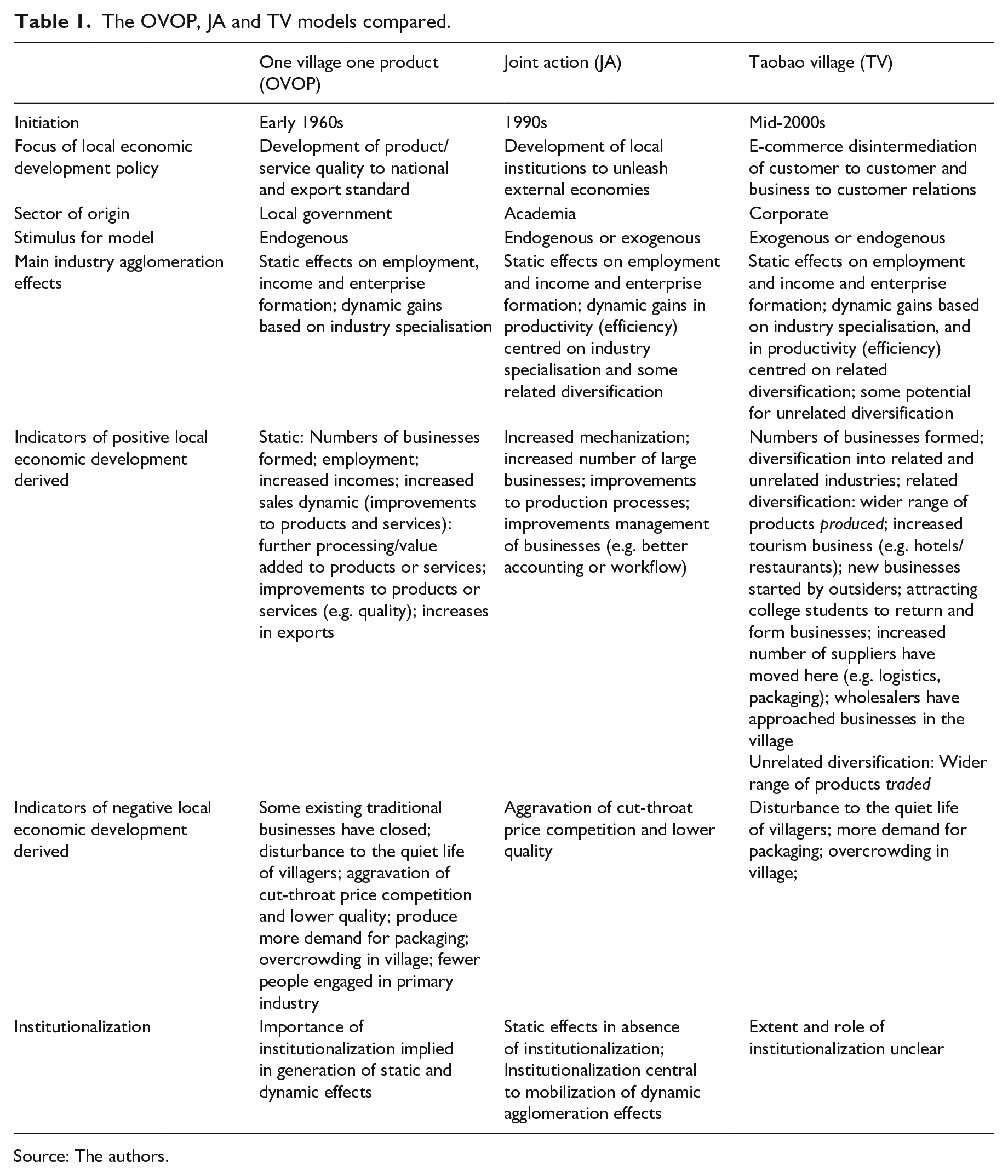
Source: The authors.
The OVOP model
The one village one product (OVOP) local government-initiated model was developed from the Oita province in Japan in 1961 and later promoted in the late 1970s in an attempt to halt depopulation (Natsuda et al., 2012). It has since been widely promoted by Japan International Cooperation Agency (JICA) and the Japan External Trade Organization (JETRO), evolving into a national government-sanctioned policy for poverty alleviation (Natsuda et al., 2012). With over 50,000 villages in China reported to have participated in its use (Smith, 2019), the OVOP model rivals the TV model we concentrate on here.
The model is focused on improving the quality of products and services based on the capabilities of a local community and a single product that can enjoy significant market demand, with Japanese agencies typically co-funding training and advice (Dadabaev, 2016). As the model has been disseminated, it has retained some of this emphasis on improving local products to international standards (Natsuda et al., 2012) typically focusing on developing the design content, value added and export potential of locally-produced items while losing some of the emphasis on endogeneity and human resource development (Mukai and Fujikura, 2015). The model has proved influential in policy circles in China and across Southeast Asia but also in Africa and Latin America (Mukai and Fujikura, 2015). The evidence from China suggests that it is a model that can be accompanied by a strong measure of local institutionalization with formation of collective village enterprises or associations and associated branding (Smith, 2019).
The OVOP model is based in practice rather than theoretical principles. While OVOP appears to have significant static economic effects in terms of employment creation and modest increases in income of those participating, the rapid extension of OVOP throughout Thailand also induced a surplus of replicated products, which resulted in price cutting and income losses for less privileged or less competitive OVOP enterprises (Natsuda et al., 2012: 375). In Malawi the effects of the model have been less positive, with few of the products being saleable in cities, let alone internationally (Mukai and Fujikura, 2015). Notwithstanding the emphasis on developing the quality, value and export potential of the products involved, as the name implies, the model seems likely to promote a strong measure of Marshallian industry specialisation.
The JA model
The concept of joint action (JA) focuses on the development of the institutional bases of local agglomeration – the formation or development of the institutions required to unleash latent Marshallian external economies that can drive industry development (Schmitz, 1995, 1999). The model emanates from the academic development studies community as hypothesis and policy advocacy rather than as a codified policy. As a model it is not prescriptive regarding the origin or nature of institutions promoted. The experiment with establishing local economic development forums as new institutions capable of initiating and developing local economic development strategies in Central Java in Indonesia (Phelps and Wijaya, 2016) was based on this model and provides some indication of the alternative institutional arrangements possible but also the difficulties in establishing them.
The JA model is based on the theoretical principle that, in many global south contexts, there is a need for joint action for firms to actively benefit from collective efficiencies. It should be noted that the causal connection between institutionalization and industry agglomeration is far from clear (Perry, 2005; Phelps, 1992; Phelps and Wijaya, 2016). The early optimism surrounding this model as one that might allow industry clusters across the global south to emulate the vaunted ‘Third Italy’ model of high-value, export-oriented agglomerations of small businesses (Weijland, 1999) has waned given the problems of insertion of local industry clusters into global value chains derived, in turn, from: the continuing demands to improve and evolve products in highly competitive industries (Nadvi, 1999); value capture by ‘middlemen’; and the hierarchical nature of value chains orchestrated by global north MNEs (Humphrey and Schmitz, 2002). The potential of the model to generate sustainable development has also been questioned where industry agglomerations are characterised by business segmentation, informality and survivalist strategies (Harris, 2016; Moreno-Monroy, 2012; Phelps and Wijaya, 2016).
The TV model
In contrast to the OVOP and JA models, internet disintermediation is fundamental to the Taobao village (TV) model currently being pioneered in China. The TV model is based on ‘platform’ (Langley and Leyshon, 2017; Sampere, 2016) or ‘sharing’ (Martin, 2016) economy principles which centre on the utilization of spare supply-side capacities in a host of industries and markets. The effects of the platform economy are said to be more disruptive than the incremental product, process and organizational innovations recognized in much of the literature on innovation with implications for traditional offline means of doing business and consequently extant industry agglomerations (Sampere, 2016).
Unlike the OVOP and JA models, thousands of TVs have arisen around a proprietary business model initiated by Alibaba in the mid-2000s. The TV model is a core part of Alibaba Group’s e-commerce business aiming to promote two-way trade between China’s rural and urban regions by stimulating information flows and removing bottlenecks in logistics. The TV model is associated with a measure of institutionalisation since Alibaba has sought to build rural e-commerce infrastructure at the county and village levels and cultivate rural ecommerce talent. The earliest recognised TVs – such as Qingyanliu of Yiwu City in Zhejiang Province – date back to 2009 (Li, 2017) but numbers of TVs have risen exponentially, primarily across the Eastern provinces of China, to 5425.
According to Azila (the Alibaba-owned media source), the TV model: provides rural villagers with access to a broader range of consumer products and services at a lower cost; offers a convenient channel for procuring agricultural tools and resources; enables the selling of specialty products beyond purely local markets; and provides brands and retailers with a channel to unleash the purchasing power of rural villagers. The TV model has been well received as one with potential for addressing rural poverty outside of China (Wei et al., 2020; World Bank, 2016). 1 At the same time, it is noted that the strong sense of national-level institutionalisation and dominance of the proprietary platform means that the TV model may not easily be transplanted (World Bank, 2016: 61). The institutional development surrounding the TV model has been thought to describe a distinct state-business nexus (Zhou et al., 2021), given Alibaba’s own multi-billion RMB investments in establishing and developing the platform in many communities across China both at county and village levels and the role of the Chinese Communist Party (CCP) in further supporting the development of TVs. The CCP has been observed to have: contributed to provision of basic infrastructure and specific e-commerce industrial parks and service centres, provided low-interests loans, tax concessions, improved administrative efficiency; facilitated liaison with universities for training provision, and; been involved in the planning and re-design of villages to better accommodate e-commerce related growth (Liang et al., 2016; Wei et al., 2020; Zeng et al., 2015). 2
The economic development credentials of the TV model are ambiguous. First, the proprietary nature of this model implies nothing in particular about the economic and societal sustainability of development associated with it – not least given the near monopoly position enjoyed presently by Alibaba in different segments of the internet services market in China (Li, 2017). These local economic development goals may come a poor second to corporate goals. At the time of writing, Chinese authorities had opened an investigation into Alibaba’s suspected anti-competitive practices (McMorrow and Mitchell, 2020). Such practices may include the active curation of markets (Langley and Leyshon, 2017: 15) and the driving down of work conditions and costs (Martin, 2016). As Li (2017) notes, while the TV model implies considerable investment from Alibaba, it has also allowed the company to dominate the rural market for consumption, capture sources of agricultural production and effectively preclude new market entry. Second, significant industry specialisation is not implied as in the OVOP and JA models. Third, the TV model might be thought to generate more sustainable patterns of development than the OVOP and JA models. Alongside efficiency, then, the World Bank has described the characteristics of the TV model as inclusion and innovation (World Bank, 2016: 10). The TV model encompasses the primary effects of the OVOP and JA models – the dynamic effects of improvements in product/service quality and increasing returns to specialization, mechanization and scale. At the same time, it does not preclude urban and rural economic diversification (Ellis, 1998; Rigg, 2006) in the form of related (upstream and downstream industries) and the attraction of ancillary logistics and marketing-related industries (Leong et al., 2016).
Empirical studies have revealed that the TV model is subject to some of the limitations of the OVOP and JA models. TVs are ‘now facing the urgent need for industrial upgrading, such as recruiting talent from outside to improve the e-commerce ecology’ (Li, 2017: 59). Emulation has also led to a high degree of product homogenisation on e-commerce platforms, cut-throat competition, and a lack of innovation, all of which hamper the sustainability of e-commerce businesses (Leong et al., 2016; Li, 2017; Tang and Zhu, 2020). Some of the benefits noted above are accompanied by disbenefits such as disturbance to and degradation of village environments (Leong et al., 2016).
Summary
Drawing on the extant literature on the TV phenomenon in China and initial fieldwork interviews (Wang et al., 2021), we developed a list of effects on which we sought village leaders’ perceptions (Table 2). Table 2 seeks to encapsulate the different effects of the OVOP, JA and TV models. Static economic benefits include increases in incomes, businesses, employment and sales which can be present in each of the OVOP, JA and TV models. The dynamic effects include improvements to product quality (emphasized in the OVOP model), specialization, capital intensity and returns to scale (the Marshallian externalities emphasized in the JA model), the development of upstream and downstream activities and diversification of product ranges (less relevant in the OVOP and JA models). Finally, our research also sought to investigate the extent and nature of institutionalisation (emphasized in the JA and TV models).
Indicators of impacts of TV model.
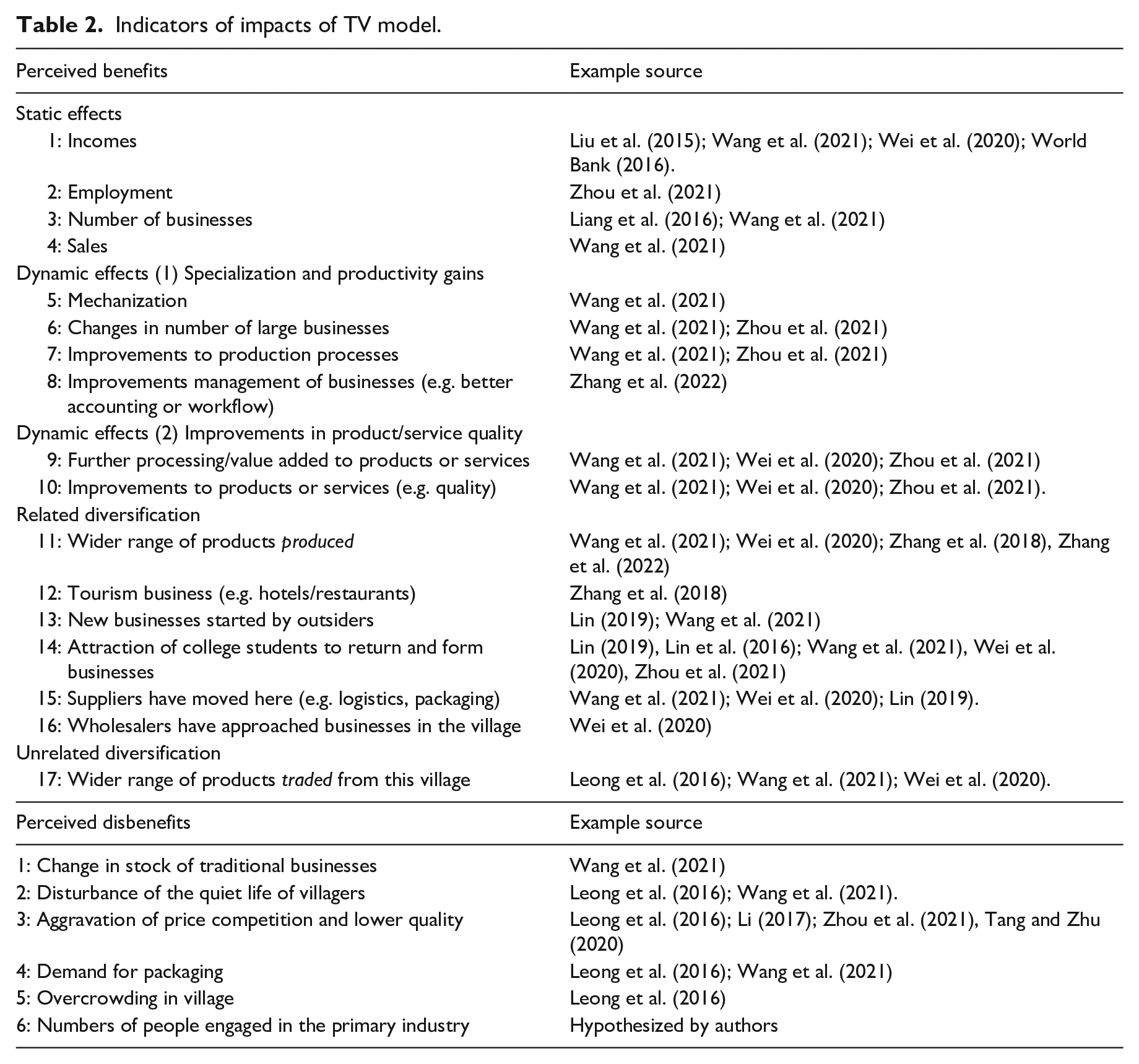
From the comparison of the different models of local economic development reviewed above, we might expect the TV model to: produce significant static economic benefits; a variety of dynamic and diversification benefits; some disbenefits associated with agglomeration and; be well-instituted at the local level.
Methods
In this paper we sought to investigate the local economic development effects of the TV model as specified in Table 2 and captured in questionnaire form. To make the collection of original survey and interview findings tractable we focused our efforts on a single province – Zhejiang province (Figure 1) which had a total of 506 TVs in 2016 defined by Alibaba – the year for which the latest data was available and the known population upon which we based our research (Ali Research, 2016). In relying on perceptions and estimates from village heads, our approach differs from but complements Wei et al. (2020) who surveyed individual Taobao businesses in a small sample of villages across Zhejiang.
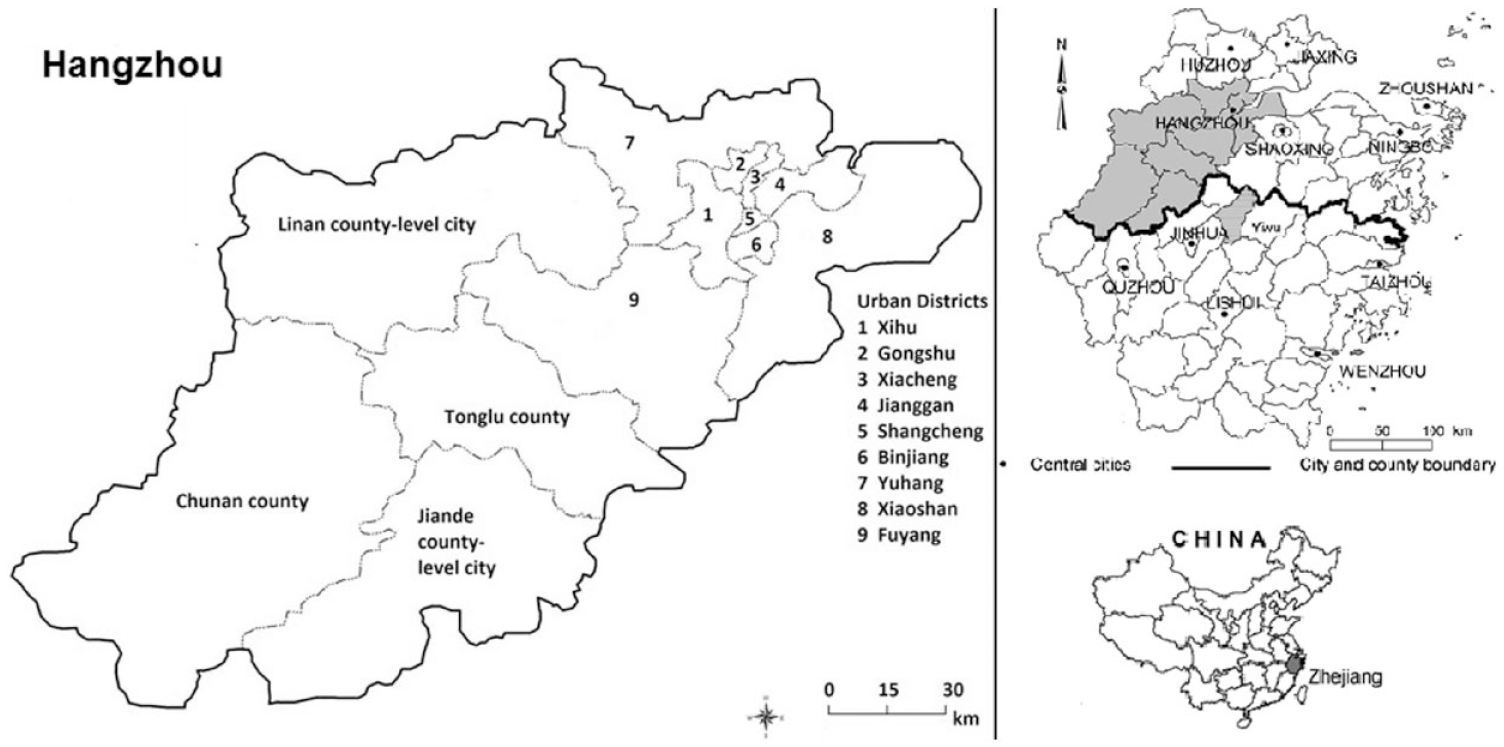
Map of Hangzhou and Zhejiang Province.
The TV phenomenon is now widespread across in China but it originated in Zhejiang in 2006 (Wei et al., 2020) and is associated with this province. Zhejiang is known for the dynamism of its small business ‘Wenzhou model’ (Liu, 1992; Wei et al., 2007). 3 The province is also known for supportive provincial and local governments that have propelled policy models such as ‘featured towns’ to national prominence (Miao and Phelps, 2019). Finally, Hangzhou is home to Alibaba, whose proprietary e-commerce platform gives its name to the TV phenomenon. As the number of TVs has grown nationally their geographical distribution has become more uneven favouring the eastern seaboard of China (Wei et al., 2020). As a large province well advanced in the diffusion of the model, we believe Zhejiang offered a suitably large and diverse population of TVs to study. Our case study province being in the vanguard of e-commerce may generate an overly favourable picture of the effects of the TV phenomenon not found elsewhere. Equally it may be revealing of the limits of the model, given the longer time elapsed since its uptake.
We recruited a professional survey company to manage the surveying all village leaders (village head, deputy head, secretary, deputy secretary, accountant or other senior position) of Taobao Villages across Zhejiang during December 2016 to February 2017. Village leaders were approached and surveyed in person with a standard two-page questionnaire. After an initial round of surveying, total responses stood at 186 and we requested the survey company achieve a quota of 300 questionnaire returns after a second round of surveying giving a response rate of 59.3% of the total number of Taobao villages existing in 2016. We did not design the survey to examine differences between TVs and non-TVs, though in effect we gained some evidence of villages that did not (at the date of survey) conform to Alibaba’s criteria. Thus, our survey is one which provides a broad-brush picture of perceptions of the changes to TVs over time.
In China where extensive reference to the personal dossier (hukou) system is made by officials, people in leadership positions were regarded as appropriate experts to complete a questionnaire survey. We believe they were well placed to provide accurate factual estimates and make informed judgements regarding the extent and direction of business changes and the main effects and of the TV model. Indeed, the extent and nature of effects were visible to the researchers even on short visits to the field and in conversations with village leaders and individual business – the findings of which are reported elsewhere (Wang et al., 2021). As with Chief Executive Officers and Managing Directors of companies, village leaders are not infallible as we describe below.
There are advantages and disadvantages associated with the use of professional survey companies. The advantage of ‘outsourcing’ to a professional survey company was that it significantly curtailed the administration and management of the data collection process in a national context where in person administration of the questionnaire was considered essential to gain a decent response rate. The disadvantage is that a measure of control over the quality and consistency of the administration of the questionnaire in practice including the elaboration of its purpose and the meaning of particular questions may be lost. Some of these limitations we believe were less than might be imagined since the questionnaire was composed largely of standardised closed questions. However, we also sought to overcome these limitations by: (a) piloting the questionnaire with survey company staff and further modifying the questionnaire; (b) briefing the company and its surveyors as to the meaning of each question and our purposes in surveying village leaders prior to its conduct; (c) being present and leading a first batch of surveys in villages before handing over full responsibility to the survey company; and (d) contacting a small sample of approximately 20 village leaders after completion of surveys to confirm the questionnaire was administered. Most village leaders answered all questions, but in the empirical analysis that follows valid responses vary around the 300 mark as not all questions were completed in the case of each village.
Our survey of TVs in Zhejiang is based on a total population of such villages defined by Alibaba. In the absence of other information collected by Alibaba on each TV, we have no reason to believe that the responses gained from this survey were biased in any significant way compared to the total population of TVs recorded for Zhejiang province or their orientation which Wei et al. (2020) summarise as production, hub and spoke production and market-oriented. Alibaba’s own criteria for designating TVs mean that none are urban in location. However, several of the villages that we visited could only really be described as suburban with often important consequences for the sorts of impacts generated as discussed elsewhere (Wang et al., 2021). Figure 2 indicates the geographical spread of the quota of 300 villages that we received questionnaire returns from. TVs and Taobao enterprises are found across Zhejiang in varying local conditions (Wei et al., 2020). Figure 2 shows that our responses are drawn from villages that are widely distributed across different rural, accessible rural/suburban and ostensibly urban environments in the province and which cover the three main market and agricultural and industrial product-oriented types Taobao enterprise (Space Planning Center of Nanjing University & Ali Research, 2018).
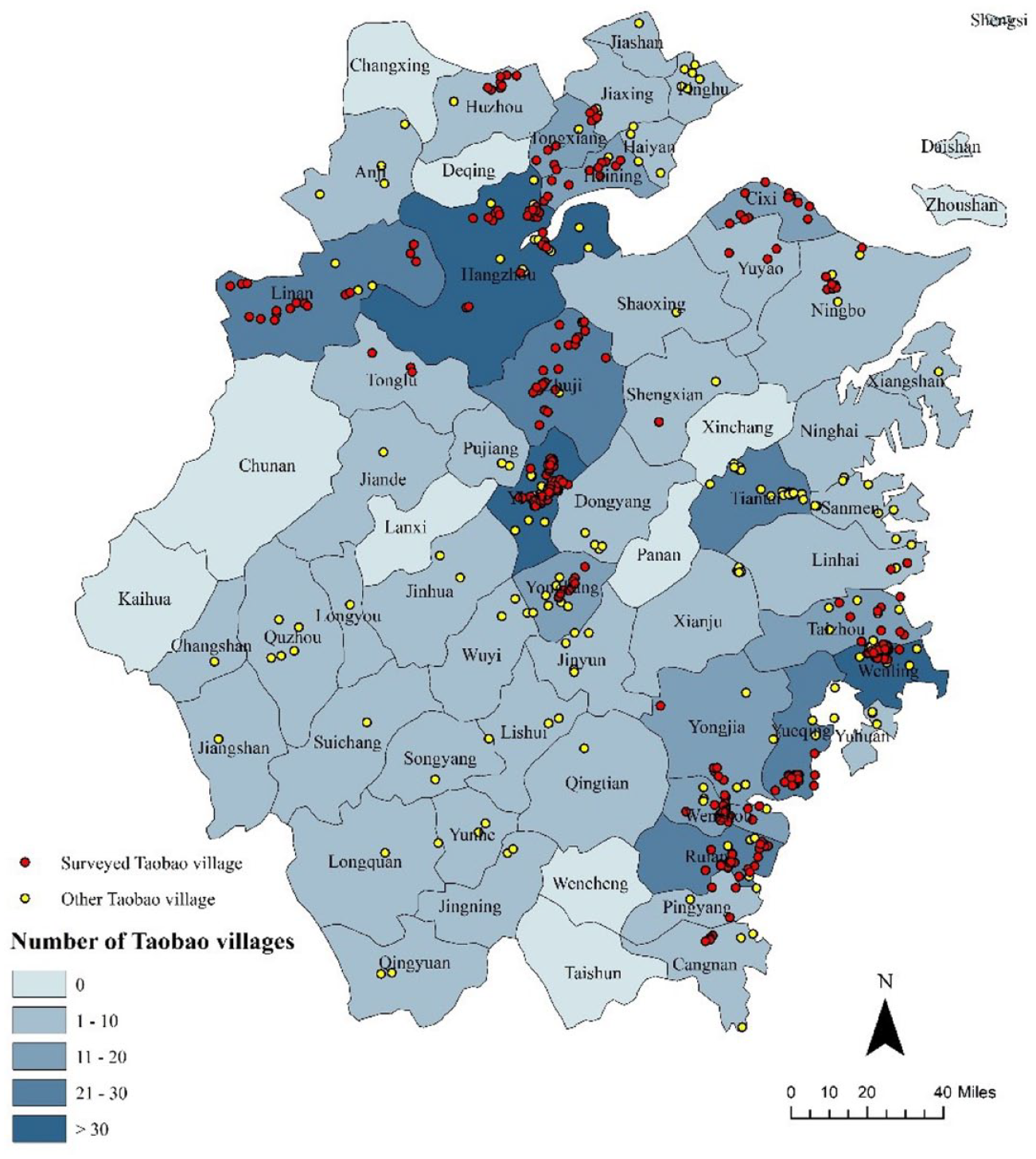
Map of villages surveyed.
That some village heads indicated Taobao businesses below the number threshold required by Alibaba suggests that a number of respondents may have been inaccurate in their estimations of the effects of the Taobao phenomenon. Two village heads in the 300 returns indicated that there was just a single Taobao business in their village (Table 3) – a figure that likely confuses a large number of separate businesses with the single official village Taobao collective. However, it is also likely that the figures reported reflect not error but flux in a rapidly changing e-commerce business environment. Numbers of businesses can fluctuate markedly and quickly around the official threshold – especially where they are associated with large-scale immigration. Our interview evidence suggested that there was a hierarchy of TVs in which a staged pattern of migration can promote the rapid rise and fall of some TVs (Wang et al., 2021).
Summary data: numbers and importance of Taobao businesses in Taobao villages.

Given the above discrepancies between official definitions and responses received in terms of numbers and proportions of businesses in villages, we compared the pattern of results from this initial quota of 300 returns obtained, and smaller subsamples of 132 villages where heads reported at least ten Taobao businesses and 112 of those where results conformed to the official definition of a TV. Exact results differed only marginally with respect to a small number of the perceived advantages and disadvantages of the TV model detailed in Table 2. With one exception, the directional pattern of statistically significant and insignificant results did not vary at all. In light of this, we opt to present data on all 300 returns from TVs.
We augmented our questionnaire survey findings with ongoing field visits across Zhejiang interviewing heads of 13 villages and local government officials for between 45 and 60 minutes and interviewing individual businesspeople in some villages for 10–20 minutes – the results of which are reported elsewhere (Wang et al., 2021). We conducted interviews in these villages seeking to elaborate on the corresponding questions on the impacts of the TV model posed in the larger questionnaire survey of villages and to explore more generally changes in livelihoods (Ellis, 1998; Rigg, 2006) and ways of life as well as the local economic development effects reported here.
E-commerce and local economic development in Zhejiang Province
Before presenting our main survey findings we set the scene regarding the rapid growth of the TV model in China.
The TV phenomenon
The findings we report here reflect the rapid adoption of the Taobao platform across China. In 2016, the year of our survey, there were 506 TVs in Zhejiang. By 2020 the number had risen to 1757.
For the sake of maintaining response rate and accuracy, the questionnaire survey sought information regarding present levels of activity and changes in TVs during the 2016 to 2017 period (Table 3). This is a short time period. However, in the brief history of the TV model it is enough to capture the variety of growth dynamics among villages. Our data suggest that the Taobao phenomenon is still on the increase overall. The total number of Taobao businesses across all villages surveyed in Zhejiang had increased by 16% in just one year from 2016 to 2017. Although 46.4% of villages recorded an increase in numbers of Taobao businesses in 2017 from 2016, as might be expected, a larger proportion (47.2%) had stabilised in terms of Taobao enterprise formation while a small percentage (6.4%) had actually experienced declines.
The significance of the Taobao phenomenon across Zhejiang villages varies considerably. The mean number of Taobao enterprises across all villages covered in our survey in 2017 was 129 but the number of Taobao enterprises in individual villages also varied from a minimum of 1 to a maximum of 4,000. As previously discussed, the minimum here raises questions regarding the accuracy of the data obtained from some village heads where they may have reported the presence of a single association rather than the total number of enterprises in that association. We also uncovered information during our field visits to suggest that numbers of Taobao businesses had been inflated in order to obtain the title of Taobao Village from Alibaba. The share of Taobao businesses within the overall stock of enterprises in villages varies from 4% to 100%. However, the TV model is still not yet the dominant mode of business across the villages surveyed in Zhejiang with only approximately 40% of all businesses in all villages being Taobao businesses.
Finally, Taobao is only one of a number of possible proprietary platforms for selling village products or services. Other proprietary platforms such as Jingdong and the mobile phone application Wechat exist. Moreover, these e-commerce and social media platforms exist alongside traditional means of marketing, distribution and physical points of sale. Our findings across 282 villages (Table 2) suggest that on average approximately 44% of village sales are through Taobao. A further 13% of village sales are conducted through these other e-commerce platforms or applications. These findings indicate that e-commerce is now the dominant mode of selling among village enterprises in Zhejiang. However, traditional methods of selling still represent roughly 42% of village sales on average. The likely complex interaction of traditional and e-commerce means of accessing market information and of selling products and services remains an important topic for research. Several of what on visual inspection could only be described as urban or suburban Taobao villages that we visited, existed precisely because migrant entrepreneurs had leveraged on the existing specialised international market in the case of Yiwu and the clothing manufacturing capacity in the case of Zhili (near to Huzhou). Here we see an important, perhaps defining, dynamic of the e-commerce or platform economy – the mobilising of excess production.
Our survey sought to collect data on the primary products and services of villages. While the TV model has been vaunted for its potential for improving rural incomes, its effects extend beyond the primary sector. Indeed, only 12.4% of villages indicated that their main product was agricultural. Some sense of the diversity of produce subject to the TV model here is provided by the fact that while our questionnaire offered 11 pre-coded categories for responses, the majority (51.2%) of respondents chose the ‘other’ category to specify their village’s primary produce. Sizeable proportions of villages produced clothing (39.1%), shoes and leather products (32.4%), toys and household goods (21.0%). The multiple responses here indicate a feature of the TV model and its divergence from the OVOP model in that the majority of villages are involved with the selling of more than one product or service.
Local agglomerative effects of the TV model
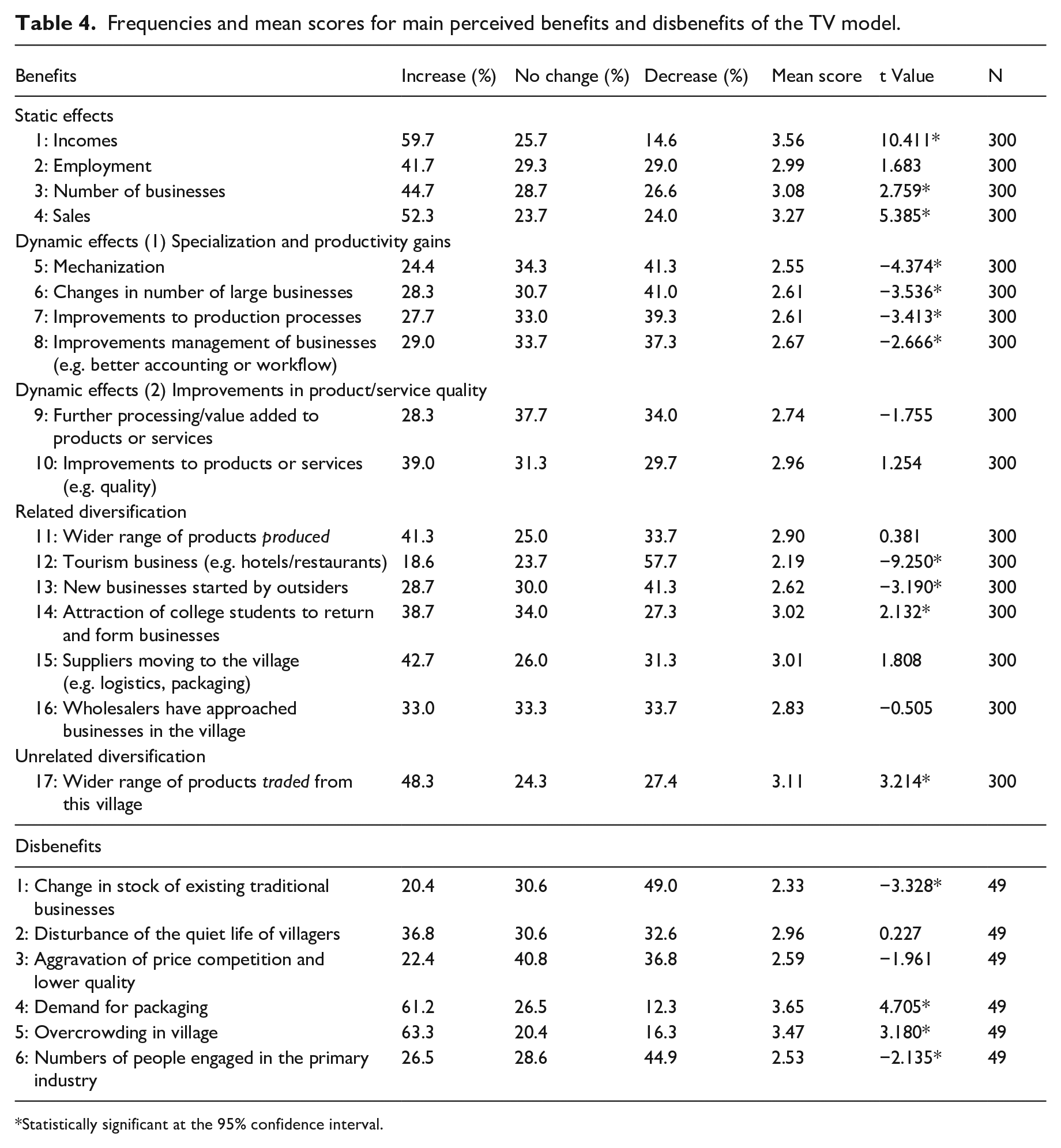
Respondents were asked to indicate on a Likert scale of 1 to 5 (where 1 corresponds to strongly disagree, 2 disagree, 3 neither agree nor disagree, 4 agree and 5 agree strongly) how strongly they agreed or disagreed that the TV model had delivered each of 17 pre-specified beneficial effects and 6 pre-specified disbenefits. We present the results in Table 4 in terms of mean scores and statistical significance (where the mean score for the specific benefit is greater or lesser than 1.96 standard deviations from the overall mean across all benefits and all disbenefits grouping these effects under several different headings (static effects, dynamic effects, related and unrelated diversification, and disbenefits). Since Likert scales can induce middling evaluations, Table 4 also presents frequency and percentage counts where the scores 4 and 5 are interpreted as their being a noticeable effect and scores 3, 2 and 1 are converted into a little or no discernible effect).
Frequencies and mean scores for main perceived benefits and disbenefits of the TV model.
Statistically significant at the 95% confidence interval.
The first observation to be made on the results in Table 4 is that large proportions of village leaders identify positive static effects of the TV model. This is revealed in both the mean score being higher than the global mean (across all 17 beneficial effects) and 42–60% of leaders indicating they agreed or strongly agreed that the TV model had had positive effects in terms of income, employment, numbers of business and sales. The results for three of these static economic effects were statistically significant at the 95% confidence interval (as indicated by a difference of means t-test), the exception here being the effect on employment levels. It is little surprise that these static effects have been present in the majority of villages as these are the most celebrated effects of the TV model, the ones to which its poverty alleviation potential are usually ascribed and those most likely in a period of rapid adoption of the model.
Second, the TV model seems to have fewer of the dynamic effects of specialization advocated with the JA model and associated with the OVOP model. However, remembering that such changes are being observed over just a single year, these dynamic effects might be regarded as more impressive than statistical tests suggest. Greater mechanization and capital intensity may be limited to those villages acting as collecting, processing and packaging points for surrounding agricultural communities as with the case of one walnut processing village located within the ‘big Hangzhou’ city jurisdiction (Figure 1). Minorities of leaders detected positive effects of the TV model in terms of increased mechanization, improvements in production processes and business management leading to the increased scale of businesses. Our results suggest that these effects are present in a quarter to a third of all villages. Moreover, the results are statistically significant with negative signs across all four indicators suggesting that perceptions of these dynamic effects are much less than the global average (across all 17 effects).
Third, while our survey findings suggest that the TV model appears not to promote dynamic gains in productivity as hypothesized under the JA model, the effects in terms of some measure of improvement in the value added and quality of products or services associated with the OVOP model appear mixed and statistically insignificant. The results here may reflect the small proportions of villages producing agricultural commodities reported above where the potential to increase value added through further processing is greatest. Instead, the majority of TVs are primarily involved with the production and sale of low technology manufactured items. Here a focus on product quality is likely necessary to garner sales beyond the local markets associated with traditional methods of selling and distribution. Judging by our data, the TV model appears to have had notable effects in terms of improvements in product quality in around 40% of villages.
Fourth, there is a mixed record of elements of diversification in the economy of villages into upstream and downstream related business activities associated with the TV model. The results indicated that the TV model is associated with a marginal increase in the range of items/services produced from the villages. Then there are contradictory results regarding different industry sectors involved with the circulation of products made in villages. As expected, increased enterprise formation induces the presence of suppliers (of packaging) locally as noted by others (Leong et al., 2016) while e-commerce disintermediation has had a negative effect on the presence of wholesalers in villages or doing business with village enterprises – though neither of these effects is statistically significant. The build-up of supplier industries is present in around 40% of villages. The broader effects of the TV model in fashioning more cosmopolitan local economies by way of tourism are significantly negative. Results surrounding the greater integration into non-local labour markets and sources of entrepreneurialism appear to be mixed. The effects of attracting students to return appear strong and statistically positive but are counterbalanced by statistically negative effects associated with the attraction of outsiders to start-up businesses.
Fifth, the TV model appears to have been significantly associated with the increased trading of (possibly unrelated) products and services from villages. Here the fear that the TV model (being based on an online trading platform) encourages a significant measure of unrelated diversification – whereby village enterprises become merely traders rather than producers – may have some foundation. Indeed, the effect among our surveyed villages deviates significantly from the average scores across all 17 indicators.
Turning to the perceived negative effects of e-commerce in TVs, a sixth of the leaders (49) of the villages from which we obtained returns indicated that there were disbenefits of the TV model. Once again, leaders were asked to indicate on a Likert scale how strongly they agreed or disagreed that the TV model had brought any of six specified disadvantages (Table 4). The advent of the Taobao platform has had mixed effects on the economy and social life of the villages concerned not always in keeping with some of the extant findings in the literature on the TV model (Leong et al., 2016). The advent of the Taobao platform is perceived to have impacted on numbers of existing traditional (non-internet-based) businesses and levels of employment. Both effects here were statistically significant. The responses from village leaders also indicate that the TV model is perceived to have generated demand for packaging and logistics industries – bringing them nearer to the village-level sources of products and impacting on congestion and crowding in villages. Somewhat contradictorily, these statistically significant impacts have not yet translated into statistically significant reductions in the quiet life of the villages concerned. In contrast to extant findings on the effects of the TV model (and the OVOP model) noted in the review above and encouraging from the point of view of the sustainability of the TV model, is the lack of any statistically significant rise in the cut-throat competitive practices found elsewhere (Leong et al., 2016).
Reflecting some of these disadvantages, a small minority of village leaders expressed strongly negative opinions regarding the TV model. However, overall, our results suggest that the impacts have reflected a mix of strong static economic benefits in terms of new business formation that likely more than offset the loss of some traditional businesses and net gains in employment as employment from traditional businesses is absorbed into a larger number of internet-mediated businesses. Some of these gains in businesses and employment doubtless are connected to supply industries that have moved closer to these new ‘rural’ sources of products with some effects on congestion and village life including the return of educated family members. More disappointing is the lack of consistently strong dynamic economic development effects. Our evidence suggests a lack of productivity gains from increased mechanisation and improvements in production processes and business management and that are commonly associated with the build-up of industry concentrations – namely the Marshallian externalities that the JA model seeks to leverage. More positively, a lack of cut-throat competition appears to have gone hand in hand with improvements in product/service quality as sought in the OVOP model.
Institutionalisation of the TV model
Despite its national notoriety, and the potential for a combination of corporate and government assistance (Zhou et al., 2021), a minority of village leaders were unaware that their village was a TV. This may reflect that local institutionalization has had little chance to develop with a model that has grown rapidly. Alibaba employs criteria for formal recognition of TVs but these do not include the necessity for the formation of village-level associations. Liu et al. (2015) observed a lack of collective organization of businesses in their case studies of TVs in Jiangsu province.
In our field visits we encountered one small TV in Yiwu that was in decline from around 60 to 30 businesses primarily due to problems of adapting to local government planning regulations on safety (eliminating live-work arrangements in a residential area). Here the local government regards the contribution and potential of the Taobao economy as unimportant. Yet in a neighbouring district of Yiwu, where the same issues pertain, the local government has created a ‘smart’ fire control centre in the village (Wang et al., 2021). These two contrasting cases appear to point to the potential importance of regulation and institutionalisation in shaping the prospects of the TV model (Wang et al., 2021).
Only 17 of the 300 (5.3%) Zhejiang province villages from which we obtained survey returns had associations. The earliest associations were formed in 2012 while 5 of the 16 had been formed in 2017 the year of our survey – underlining the very recent origin and growth of the TV model. The associations were also diverse – ranging from one to 500 members. The most commonly cited reasons for establishing the association were to provide training to members (mentioned by 14 of the 17), provision of a meeting place (mentioned by 13 of the 17) the arranging of visits to other TVs and shared service provision (each mentioned by 8 of the 17).
Where TV business associations exist they can have a visual, physical and virtual presence with respect to the branding of village products and their promotion to tourists and the organisation of production and distribution of produce. The associations can present a professional face as a result of hosting study tours from TVs from across China. This was the case in one walnut producing village and in the case of the now famous Qingyanliu in Yiwu. Where they do not exist, where the CCP has not lent support, or where immigrant entrepreneurs dominate, the branding of villages as TVs may be absent as in the case of villages involved with clothing-related e-commerce in Zhili (near Huzhou) and those in Yiwu using e-commerce platforms like Taobao to trade a variety of products. From our field visits and interviews, a key determinant of local institutionalisation appears to be the extent to which adoption of the TV model is by locals as opposed to non-locals which, in turn, appears to be connected to location with suburban Taobao villages growing primarily by way of immigration of entrepreneurs (Wang et al., 2021). Moreover, just as with processes of rural livelihood diversification more generally (Liu and Liu, 2016), adoption of the TV model appears is driven bottom-up by entrepreneurs and only later institutionalised by Alibaba or the CCP.
Village leaders were asked to indicate why there was not an association and were able to indicate multiple reasons. 41% of leaders indicated that there was no need for an association. A further 38% indicated that there was an absence of policy or other support to establish an association. The findings here are surprising given the investment of Alibaba and the role that the CCP has been argued to play (Li and Zhang 2015; Liang et al., 2016; Wei et al., 2020; Zeng et al., 2015). 22% suggested that there were no, or a lack of, appropriate leaders. The formation of new local institutions for economic development can prove highly problematic where there is a lack of human resources and where there are perceived opportunities for rent seeking (Phelps and Wijaya, 2016) and the creation of TV associations may be no exception. Administrative burdens of establishing and running an association and miscellaneous other reasons were each cited by fewer than 10% of leaders for not establishing an association.
Conclusions
The broad range of effects possible with the Taobao Village (TV) model of local economic development were highlighted in our literature review and investigated in relation to TVs in Zhejiang province. Our findings suggest, first, that village leaders estimated the static effects of growth in income, sales and employment and numbers of enterprises to be considerable. The indirect dynamic effects of the TV model are interesting for how they compare to the actual and hypothesized effects of other models propagated in development theory and practice. Our evidence suggests that dynamic effects have been focused more on improvements of product quality associated with the OVOP model and much less on the pursuit of the sorts of Marshallian externalities and productivity gains anticipated under the JA model. The findings here provide an indication that the effects of the TV model may be more complex to predict and encompass some elements of the effects associated with the OVOP and JA models. Second, a proportion of villages had felt negative effects associated with the TV model according to village leaders. According to our evidence these have not extended into the sorts of cut-throat price competition that have been found to be associated with the OVOP (Natsuda et al., 2012), JA (Harris, 2016) and the TV model elsewhere (Leong et al., 2016). Third, we expected, prima facie, the TV model to be well-institutionalized at the local level. Yet our results suggested it was only weakly institutionalised at the local level. There was local-level ignorance and distrust of the TV model itself and patchy institutional development surrounding it. These findings regarding the institutionalization of the TV phenomenon rather contrast with the general awareness of government support among Taobao businesses for e-commerce found by Wei et al. (2020) and expectations of a rural state-industry e-commerce complex (Zhou et al., 2021). These findings lead on to several broader conclusions for future research regarding the local agglomerative effects of e-commerce or platform economy business models.
The diverse effects of the TV model reflect some of the apparent openness of the e-commerce-led mode of local economic development but also the vast scale and scope of the TV phenomenon in individual provinces such as Zhejiang let alone across China as a whole. Indeed, as several studies have highlighted (Liu et al., 2015; Wei et al., 2020), it may be inappropriate to generalise regarding a single TV model. Research could usefully go further to discern whether there are different TV models with different effects emerging across China. From a policy perspective, it could also be important for future research to go further and explore the variety of pathways leading to distinctly different local economic development outcomes in TVs.
The empirical analysis leads on to theoretical questions regarding the TV model. First, although we did not investigate these ideas directly, the findings tend to suggest here was little evidence of the ‘related variety’ (Frenken et al., 2007) and ‘smart specialization’ (McCann and Ortegaargiles, 2015) effects celebrated in the global north. Instead, the TV model may be promoting unrelated diversification with: villages possibly becoming little more than a collection of shops trading goods; villages losing their attachment to sometimes ancient industrial specialisations and ways of life; and, in some instances, villages severing their relationship to the immediate natural environment. However, this would need to be the subject of future research which delves in more detail into the experiences of individual village economies and societies.
Second, what can the differential impacts of the TV model reveal regarding the geography of the emerging e-commerce platform economy? Liu et al. (2020) have explored some of the determinants of spatial aggregation of TVs in terms of local industrial base, neighbourhood effects, geographic location and socio-economic condition. Rather than the TV model being a simple instance of ICT leading to the ‘the death of distance’ (Cairncross, 1998), the geography of TV development is likely to reflect the complexity of ‘borrowed size’, ‘borrowed function’ and ‘shadow effects’ that are found unevenly across large and complex urban systems (Meijers and Burger, 2017; Phelps, 2004).
Third, what are the contributions of the TV model to processes of rural economic and community transformation (Rigg, 2006)? The various facets of rural transformation – diversifying occupations and livelihoods, occupational multiplicity, the balance of farm to non-farm income, the delinking of livelihoods and poverty from the land, increased personal mobility and the delocalization of livelihoods, the increased importance of remittances, the rising average age of farmers, and cultural and social change (Rigg, 2006) – are each now subject to the effects of e-commerce disintermediation presenting a vast agenda for future research. Investigations of the effects of the adoption of e-commerce such as the Taobao platform on rural communities have been offered by Lin et al. (2016) and Wang et al. (2021), but much remains to be explored of the detail of the effects of e-commerce mediated rural transformation. Take-up of mobile telephone and internet is significant across much of the global south – bypassing other forms of fixed infrastructure networks. Yet the implications of this diffusion of technology for sustainable local economic development remain unclear and the possibilities for the transplantation of proprietary e-commerce platforms such as the TV model equally so.
Finally, there is much to be gained in having a trading zone for development studies, economics and economic geography and rural studies scholars (Murphy, 2008). Where development practice and development studies literature have advocated the OVOP and JA models based on industry specialization, economic geography literature in the guise of ‘smart specialization’ (McCann and Ortegaargiles, 2015) and ‘related variety’ (Frenken et al., 2007) focuses significantly on overcoming the problems associated with excessive industry specialization.
Footnotes
Acknowledgements
The authors are grateful for the constructive comments of referees on earlier drafts of this paper.
Declaration of conflicting interests
The author(s) declared no potential conflicts of interest with respect to the research, authorship, and/or publication of this article.
Funding
The author(s) disclosed receipt of the following financial support for the research, authorship, and/or publication of this article: The work described in this article has been funded by the National Natural Science Foundation of China (Grant No. 41871106).