



Abstract
Over the past two decades, ‘waterscape’ and ‘hydrosocial territory’ have gained momentum in political ecologies of water. These concepts explore the material outcomes of the interplay of social and biophysical processes by building on two different core concepts of geography (‘landscape’ and ‘territory’). Relying on a quantitative and qualitative analysis of a corpus comprising 113 articles (1999–2019), this paper investigates the commonalities and divergences in the spatialities of water that these concepts convey. We show that the two concepts delineate two close but nevertheless different analytical threads with regard to water-related spatialities. Yet, the use of the concepts waterscape or hydrosocial territory does not directly result from a theorisation of space that would be specific to different spatial contexts, but rather from what is studied in these spaces, that is, the socio-spatial inequalities or injustices that characterise them, and the transformations – either radical or incremental – that shape them.
Keywords
Introduction
Over the past two decades, political ecologies of water (PEW) have paid much attention to the connections between water, power and space. Concepts such as ‘space’, ‘networks’, ‘scale’ and ‘territory’ appear in many recent papers pertaining to PEW and environmental geographies of water. Scholars have focused for example on the multiple knowledges of space which should be included in water management (McLean 2012), the fixing or the holding of water in space and time (Banister and Widdifield 2014; Linton 2014), the production of socionatural networks influencing the water geography of states and regions (Swyngedouw 1999), the politics of scale in relation to water governance (Norman et al. 2012; Norman et al. 2016) and hydraulic control and territorialisation processes (Banister and Widdifield 2014; Boelens et al. 2016; Mustafa and Tillotson 2019). Moreover, several concepts (e.g. ‘hydrosocial cycle’, ‘waterscape’, ‘hydrosocial territory’) have been put forward in PEW to investigate the coproduction of social and natural orders (Boelens et al. 2018; Linton and Budds 2014; Swyngedouw 1999). While the concept of ‘hydrosocial cycle’ is used to study the evolving relationships between water and society, the concepts of ‘waterscape’ and ‘hydrosocial territory’ consider the spatial dimensions of the coproduction of water. In an endeavour to make sense of the production of space in relation to water-society processes, these two concepts, which both directly engage with two different core concepts of geography (i.e. ‘landscape’ for the former and ‘territory’ for the latter), have been widely embraced in PEW.
Previous literature reviews have highlighted the growing interest for either one or both of these concepts. Rusca and Di Baldassare (2019), in a review on critical geographies of water, underline that such geographies raise the question of the ‘production of space’ and hereby hint at Henri Lefebvre's (1991) way of thinking together ‘the social, the physical and the conceptual’ (Rusca and Di Baldassarre 2019, 2). The authors evoke connections between the concepts of hydrosocial cycle and waterscape; however, they do not bring up the specificities introduced by the concept of hydrosocial territory. Ross and Chang (2020, 1445), in a paper on the connections between socio-hydrology and hydrosocial theory, emphasise the role of ‘Marxian understandings of capitalist accumulation’ in hydrosocial research to interpret the spatial manifestations of water's co-production on different and evolving spatial scales, the unequal access to water and inequalities more generally. The authors explain how waterscapes are hybrid constructs that embody multiple historical and geographical relations and processes. They connect the development of ‘hydrosocial territory’ with hydrosocial theory's growing interest in multi-scalar networks. Karpouzoglou and Vij (2017, 2), in a review on the concept of waterscape, highlight that the concepts ‘waterscape’ and ‘hydrosocial territory’ are often viewed as ‘complementary and even mutually reinforcing as they have the same roots in political ecology’. The authors also point at ‘some differences [between these concepts]’ though they do not delve into the details of these dissemblances as their paper is focused on the concept of waterscape. Altogether, the reviews mentioning both concepts highlight the complementarity between these two concepts which are both anchored in political ecology concerns regarding uneven power relations. However, these reviews do not explain why and when one concept is used rather than another. Therefore, there is still a need to show to what extent the two concepts (waterscape and hydrosocial territory) address different spatial processes and to explore the specific ‘spatialities’ conveyed by these concepts. Here in relation to water, we use the term ‘spatialities’ to refer to the ways in which social dynamics are embedded in (and in turn shape) space; we consider that ‘spatialities’ therefore encompass the different relations to space.
Against this background, in this paper, we focus on the concepts of ‘waterscape’ and ‘hydrosocial territory’, two concepts which appear to be increasingly used in PEW and which both integrate spatial processes in the study of the coproduction of social and natural orders. More specifically, we seek to clarify the differences between the two concepts by providing an overview of the spatial processes these concepts describe, and insights into the different and possibly diverging spatialities that they suggest. We ask: How have ‘waterscape’ and ‘hydrosocial territory’ been used? What spatial contexts are put forward through these concepts? Do ‘waterscape’ and ‘hydrosocial territory’ theorise differently the connections between water, society and space?
Our paper is structured as follows. In the next section, we outline the contours of the concepts of waterscape and hydrosocial territory based on the existing literature. Then we present our methodology: to study in detail the particularities of these two concepts and the way they enable political ecologists to explore water spatialities, we implement a mix method approach resting on the quantitative (through textual data analysis) and qualitative analysis of a corpus of publications mobilising ‘waterscape’ or ‘hydrosocial territory’. In section four, we present the results of the quantitative analysis; and in section five, we present qualitative insights. We show that the two concepts delineate two close but nevertheless different analytical threads with regards to water-related spatialities. Yet, the use of the concepts waterscape or hydrosocial territory does not directly result from a theorisation of space that would be specific to different spatial contexts (rural or urban contexts for instance), but rather from what is studied in these spaces, that is, the socio-spatial inequalities or injustices that characterise them, and the transformations – either radical or incremental – that shape them. These differences can be explained by the key and long-lasting influence of the seminal works that gave rise to these concepts, which focused either on the everyday production of waterscapes and structural inequalities, or on the way specific projects and interventions led by dominant coalitions of actors impact and transform existing (hydrosocial-) territories. We hope that these results may help inform future research in environmental geography and political ecology on the specificities of the two concepts and that such results will contribute to a theoretical discussion on spatialities within critical water research. It is necessary to articulate (rather than oppose) interactionist and structural perspectives on power in geography in order to better understand the embedded short-term and long-term evolution of water-space-society relations.
Water words’ in political ecologies: Power, space, and hybridity
As early as the mid-19th century (Wilson 2014), the word waterscape has been employed to ‘describe works of art that depict scenery with bodies of water’ (Orlove and Caton 2010, 408). Since the 1980s, the concept of waterscape has been used in landscape ecology (Orlove and Caton 2010), environmental psychology (e.g. Herzog 1985), water history (e.g. Hundley 1987) and in planning and architecture (e.g. Lewis 1995). The concept was introduced to PEW by Swyngedouw in his work about Spain in which he explores the socioecological interactions that shaped the country's current ‘water landscape’ or ‘waterscape’ (Swyngedouw 1999). He shows how water infrastructures built between the years 1890–1930 in this water scarce country were used as power instruments and served the modernist political project of Regeneracionismo while enabling specific groups to assert their power on a national scale and within the state. This translated into deep and lasting geographical reconfiguration of the ‘sociophysical space’ (Swyngedouw 1999) which also led to the production of unequal power relationships (Karpouzoglou and Vij 2017). In his later work on Franco's regime, while insisting on the active ‘role that water plays in shaping relations of power’ (Loftus 2009, 959) and, concomitantly, in shaping the Spanish waterscape, Swyngedouw (2007) departed from a previously prominent environmentally deterministic interpretation of the influence of hydrological systems on political regimes (e.g. Acharya 2015; Loftus 2009; Wittfogel 1957). In an important step towards the theorisation of the water-power relationship, Swyngedouw demonstrates that ‘water and power are mutually constitutive’ (Loftus 2009, 959).
Swyngedouw's analysis of the Spanish waterscape has had a great and lasting influence in PEW and is recognised as one of the main contributions to the field. The concept is commonly used to ‘address central concerns in political ecology such as “who controls, who acts and who has the power?” (Karpouzoglou and Vij 2017, 3). In his 1999 seminal article, Swyngedouw did not provide a precise definition of either ‘waterscape’ or ‘landscape’, and thus did not explicitly state the relationship between the two terms. In the past years, various papers have contributed to defining this concept more precisely in relation to space. These papers are often more broadly focused on the ‘hydrosocial cycle’ (Linton and Budds 2014). 1 Defined as a ‘sociospatial configuration that is constituted by social and ecological processes’, ‘waterscape’ allows to consider water not only in strictly material terms and therefore has been presented as a framework to study the modalities of water ‘coproduction’ (Budds and Hinojosa-Valencia 2012). Various other publications have contributed to characterising waterscape's spatiality: Bouleau defines waterscapes as ‘the geographical temporary outcomes of these [coproduction] processes’ (Bouleau 2014, 249); Karpouzoglou and Vij (2017, 2) highlight that the ‘strength of the waterscape is that it brings into focus the geographical situatedness’ of relations between societies and water; Acharya points to the polysemy and polyvalence of the ‘waterscapes’ which ‘like landscapes (…) also need to be understood as a complex assemblage of emotions, world views, practices and processes, as well as symbolic and material politics’ (Acharya 2015, 381).
Unlike the concept of waterscape, the more recent concept of hydrosocial territory has been defined in a developed fashion as: ‘the contested imaginary and socio-environmental materialisation of a spatially bound multi-scalar network in which humans, water flows, ecological relations, hydraulic infrastructure, financial means, legal-administrative arrangements and cultural institutions and practices are interactively defined, aligned and mobilised through epistemological belief systems, political hierarchies and naturalizing discourses’ (Boelens et al. 2016, 2)
The article in which it is defined, published in a special issue on ‘hydrosocial territories’ in Water International, not only introduced the concept but also specified the theoretical positioning to which it relates. In the continuity of other studies in PEW, hydrosocial territories are presented as socionatures, that is, ‘hybrids that simultaneously embody the natural and the social; the biophysical and the cultural; the hydrological and the hydraulic; the material and the political’ (Boelens et al. 2016, 3). The authors build on the Actor-Network Theory to define water as an actant within ‘multi-scalar networks’, which they identify as producers of territorialisation processes (Karpouzoglou and Vij 2017, 2). These multi-scalar networks are made up of ‘[l]egal-political and social institutions, cultural relations, ideas and practices as well as physical structures and the environment’ and ‘form territory’ (Hommes and Boelens 2017, 73). The actors who are part of these networks ‘collaborate and compete around the definition, composition and ordering of this networked space’ (Boelens et al. 2016, 4). For this reason, the concept has been described as ‘particularly attuned to scalar dynamics and relations’ and able to integrate a reflection not only on areas but also on the vertical dimensions of territories (e.g. the subterranean and atmospheres) (Jackson and Head 2021, 4).
To define the highly polysemic notion of territory (see Giraut 2008), Boelens et al. rely on several critical contributions developed by geographers (Agnew 1994; Baletti 2012; Elden 2010a; 2010b). Based on these contributions, hydrosocial territories are presented as networks connected to spaces and produced by actors – hydrosocial territories are ‘spatially bound, subject-built, socionatural networks’ (Boelens et al. 2016, 4) – as ‘[encompassing] material, symbolic and functional aspects’, and as being ‘at once judicial, political, economic, social, cultural, affective and physical’ (Hommes and Boelens 2017, 72). Hydrosocial territories are not a priori spatially delimited – they are ‘not fixed, bounded, and spatially coherent territorial entities’ (Boelens et al. 2016, 4). The limits of hydrosocial territories can be defined, imagined and performed by different stakeholders notably through hydraulic projects – ‘territories are not just bounded, material territorial projects, but also imagined waterbased territories’ (Mills-Novoa et al. 2020, 90).
Finally, from the outset, the two concepts of ‘hydrosocial territory’ and ‘waterscape’ appear to be related. Not only Swyngedouw and Boelens have collaborated and co-authored papers on ‘hydrosocial territories’ (Boelens et al. 2016; Swyngedouw and Boelens 2018), but also they acknowledge the strong ties between ‘hydrosocial territory’ and two other concepts, namely ‘waterscape’ and ‘hydrosocial cycle’. They explained having built on the waterscape literature and the literature on territories to forge a concept which should draw more attention to the diversity and the overlapping of ‘simultaneously existing hydro-territorial regimes and imaginaries’ (Swyngedouw and Boelens 2018, 130). The contributions around this concept point indeed to the diverse (and possibly conflicting) imaginaries and interests between groups of actors that give rise to ‘territorial pluralism’ (Boelens et al. 2016; Hommes et al. 2019; Hoogesteger et al. 2016) and to different ‘hydro-territorial regimes’ (Hommes et al. 2016).
Material and methods
A corpus of water words in political ecology: 113 articles and their main characteristics
To shed light on the various and evolving usages of the concepts under scrutiny (i.e. ‘waterscape’ and ‘hydrosocial territory’) in PEW, we designed a mixed methods framework relying on a quantitative and qualitative analysis. Similar methodologies have been implemented for review purposes by critical physical geographers (Dufour et al. 2019). To study commonalities and differences in the content of publications on the concepts of ‘waterscape’ and ‘hydrosocial territory’, using the Scopus and Web of Science (WoS) databases, we built a corpus of scientific articles 2 in English 3 containing the words ‘waterscape’ or ‘hydrosocial territory’. First, textual data computations are more meaningful when conducted on a homogenous corpus, and notably on a corpus which comprises texts of similar length (such as articles) (Pincemin 1999). Second, we focused on articles in English, although such a choice tends to set up an Anglophone perspective, as textual data analysis is only possible on monolingual corpora. The qualitative analysis mobilises other written formats than solely articles. We excluded the papers that were not relevant to PEW by removing from our selection the articles which used the word ‘waterscape’ but which did not contain ‘hydrosocial’ or ‘political ecology’ in their titles, keywords or abstracts (e.g. articles from other fields such as architecture, landscape research, ecology). 4 These different steps led to the production of a corpus consisting of 113 articles (see Supplemental material).
Our final corpus included articles which were published between 1999 (there were no results prior to 1999) and December 2019 in 33 different journals. Few articles were published before 2012 (Figure 1). The surge in publications on hydrosocial territories and waterscapes was particularly strong in 2019. 5 Publication peaks (Figure 1) correspond to the release of special issues: the 2014 Geoforum special issue on the hydrosocial cycle (Budds et al. 2014); the 2016 Water International issue on hydrosocial territories (Boelens et al. 2016); the 2019 themed issue ‘Rural-urban water struggles: urbanising hydrosocial territories and evolving connections, discourses and identities’ also published in Water International (Hommes et al. 2019) and the 2019 Water special issue on ‘Contested Knowledges: Large Dams and Mega-Hydraulic Development’ (Boelens et al. 2019).
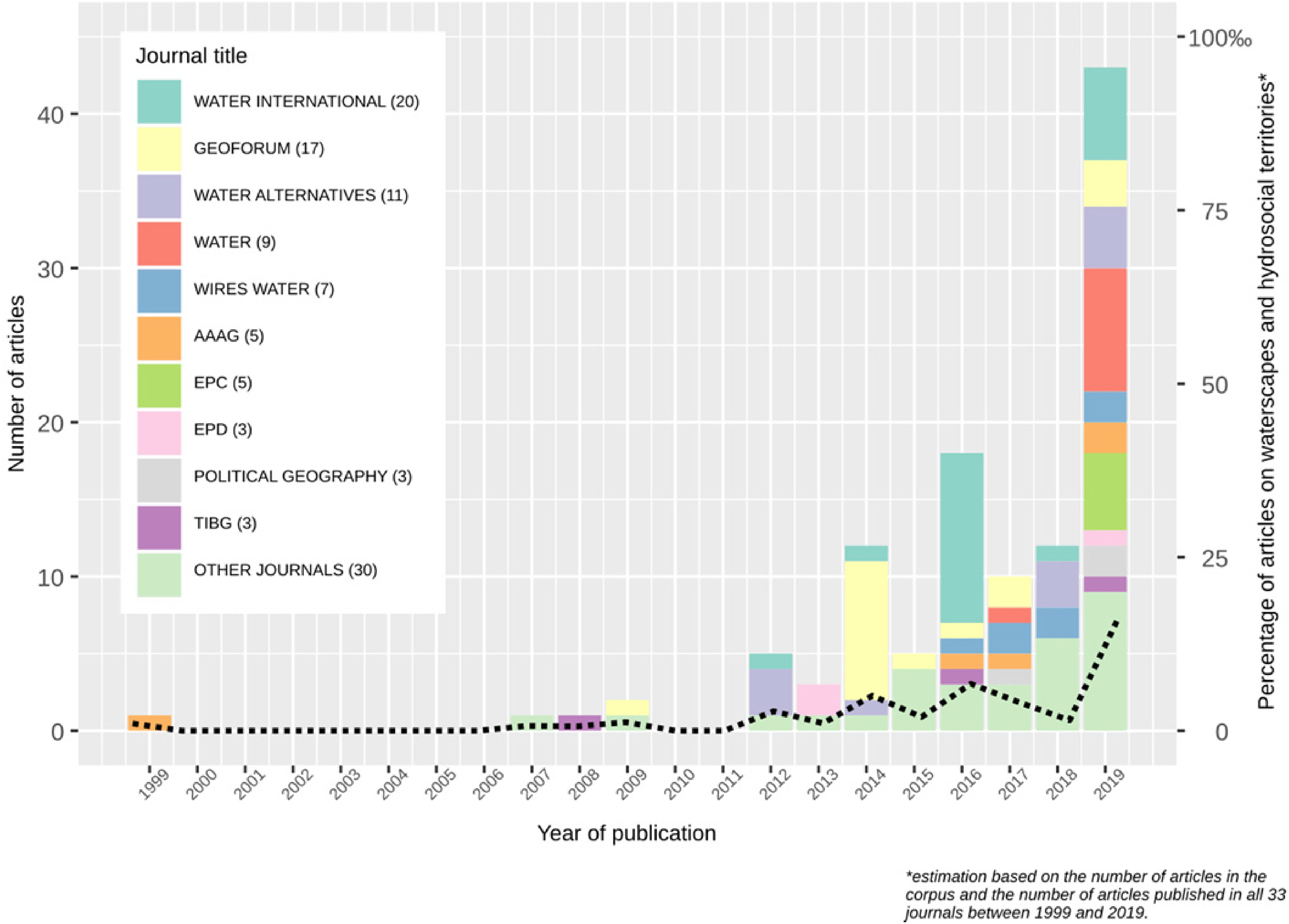
The evolution of the publications on waterscapes and hydrosocial territories based on the corpus (n = 113). Stacked bars are to be read on the y-axis on the left and represent the number of articles per year (absolute value) and according to the journals in which they were published. The black dotted line is to be read on the y-axis on the right and represents the yearly ratio between the number of the articles on waterscapes or hydrosocial territories (n = 113) and the total number of articles published in the 33 journals from which these articles were extracted (n = 42,343). AAAG: Annals of the American Association of Geographers; EPC: Environment & Planning C: Politics and Space; EPD: Environment & Planning D: Society and Space; TIBG: Transactions of the Institute of British Geographers.
Textual data analysis
Recent studies have relied on the analysis of abstracts extracted from scientific papers to understand among other topics, the geographies of research fields (e.g. Kirilenko and Stepchenkova 2018; Rogov and Rozenblat 2018). In this paper, we use ‘textual data analysis’ to study entire articles (and not only their abstracts). Indeed, the abstracts alone would not have allowed us to analyse in depth the context and objectives of the use of the concepts under consideration. Textual data analysis (also often called ‘text mining’) can be defined as a set of methods which rests in part on statistics to analyse text corpora (Beaudouin 2016; Heiden et al. 2010; Lebart et al. 2019). For the purpose of the textual data analysis, we downloaded the *.pdf files of the 113 articles and we converted them into text files. 6 We erased from the text files all information that could bias the textual data analysis (such as the bibliography, acknowledgements, author information and the information on the journals). 7 We imported the texts into two textual data analysis open-source programs: Iramuteq (Ratinaud and Déjean 2009) and TXM (Heiden et al. 2010). Iramuteq relies on R software and python language to perform analyses such as the clustering algorithm (Reinert 1983, 1990) 8 which allows for the identification of clusters also called ‘lexical worlds’ (Ratinaud and Déjean 2009). This method has been used in recent publications in environmental geography to identify discourses on different topics (e.g. Boyer et al. 2021; Comby et al. 2019; Cottet et al. 2015; Flaminio et al. 2021). TXM was used to conduct a finer quantitative and qualitative analysis on specific words, lemmas, 9 or expressions as it allows going constantly back and forth between quantitative results (e.g. frequency tables) and the text itself. We also used the ‘co-occurrence’ function of TXM which computes the ‘co-occurrents’ of a chosen word or expression. 10
Qualitative analysis
In parallel, we also conducted a qualitative analysis based on the reading of a selection of articles from the corpus. First, using TXM, we listed the articles with the most occurrences of the terms ‘waterscape’ and ‘hydrosocial territory’, and of space-related terms (‘territory’, ‘landscape’, ‘space’, ‘scale’, ‘place’). Second, we read the papers published in the special issues on hydrosocial territories to verify some of the hypotheses that emerged after the quantitative study of the corpus. Third, and through the reading of the reference lists of the papers from our corpus, we also identified for the qualitative analysis publications, papers and book chapters, some of which were not present in our corpus, but which were widely cited. We included such publications in the qualitative analysis because of their likely influence on how waterscape and hydrosocial territory have been understood and reused by PEW researchers. Finally, more articles have been published on waterscapes and hydrosocial territories between the moment in which we built our corpus for the quantitative analysis and the publication of our paper. For this reason, we also integrated into our qualitative analysis some references to papers published after December 2019, based on the monitoring of the publication of new papers on waterscapes and hydrosocial territories during 2020 and 2021, and on suggestions made by the reviewers.
‘Waterscapes’ and ‘hydrosocial territories’ in use, a textual overview
In this section, we begin by exploring how ‘waterscape’ and ‘hydrosocial territory’ are used based on the quantitative analysis of the corpus.
Two concepts unequally mentioned and rarely used together
Waterscape is mentioned in many papers (Table 1). However, one third of the papers use waterscape only once and less than half of them use the concept five times or more. 11 The average number of occurrences of the word ‘waterscape’ per paper is also lower than the average number of occurrences of ‘hydrosocial territory’ per paper. This suggests that references to ‘hydrosocial territory’ are often made more explicitly and in a more developed fashion than references to ‘waterscape’. Moreover, few articles from our corpus use the concepts of waterscape and hydrosocial territory together and only one paper uses both concepts five times or more (Table 1).
Number of papers using ‘waterscape’ and ‘hydrosocial territory’ (n = 113).
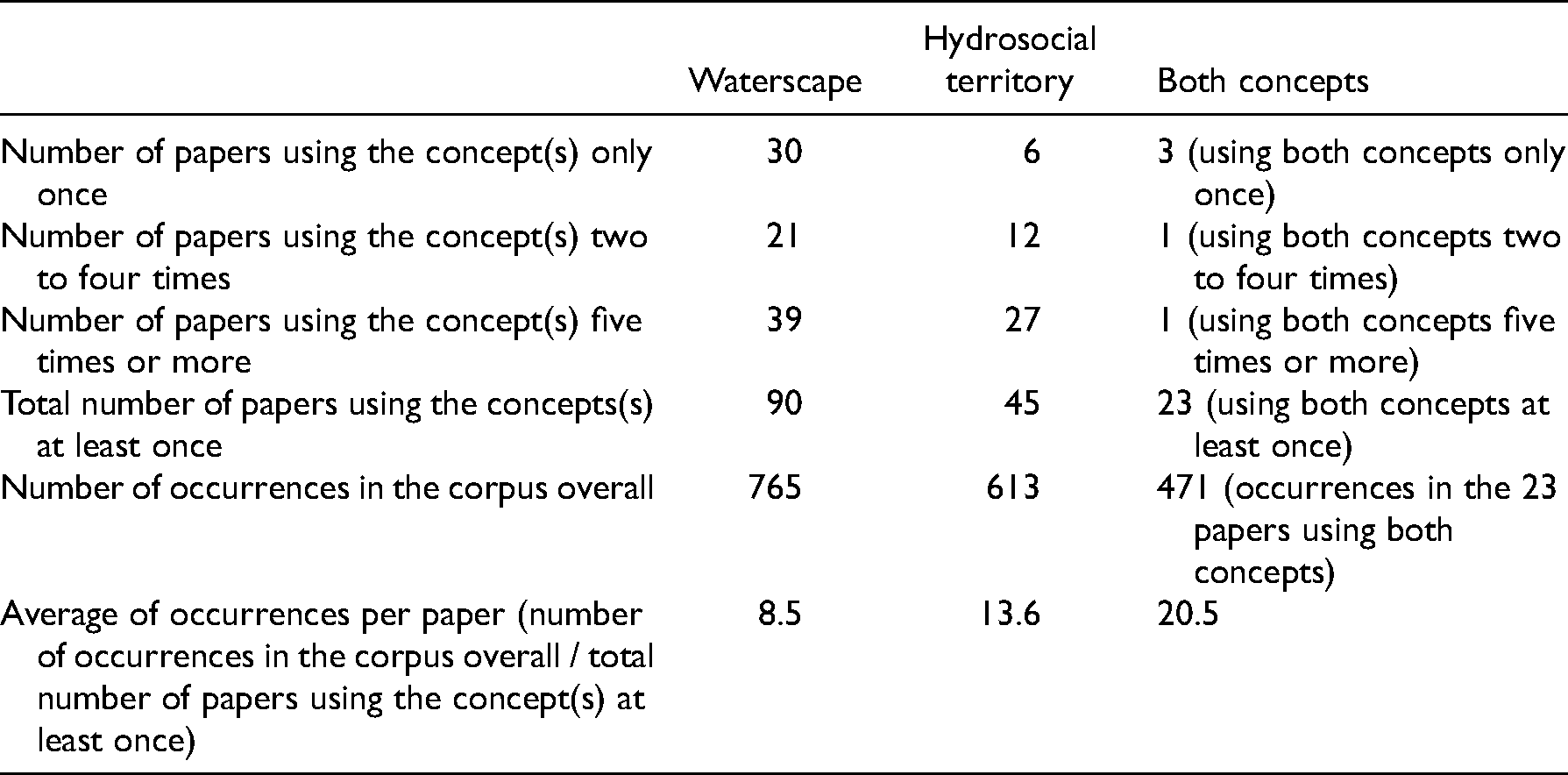
These first results highlight that the two concepts are rarely developed together in the articles that embrace them most firmly. Such results raise questions about the choice of one concept over the other. To better understand such differences, in the following subsections, we explore the textual contexts in which the concepts are brought up.
Eight lexical worlds relating to ‘waterscape’ and ‘hydrosocial territory’
The analysis conducted with Iramuteq allowed for the identification of eight clusters or ‘lexical worlds’ which highlight the lexical content of the papers (Figure 2).
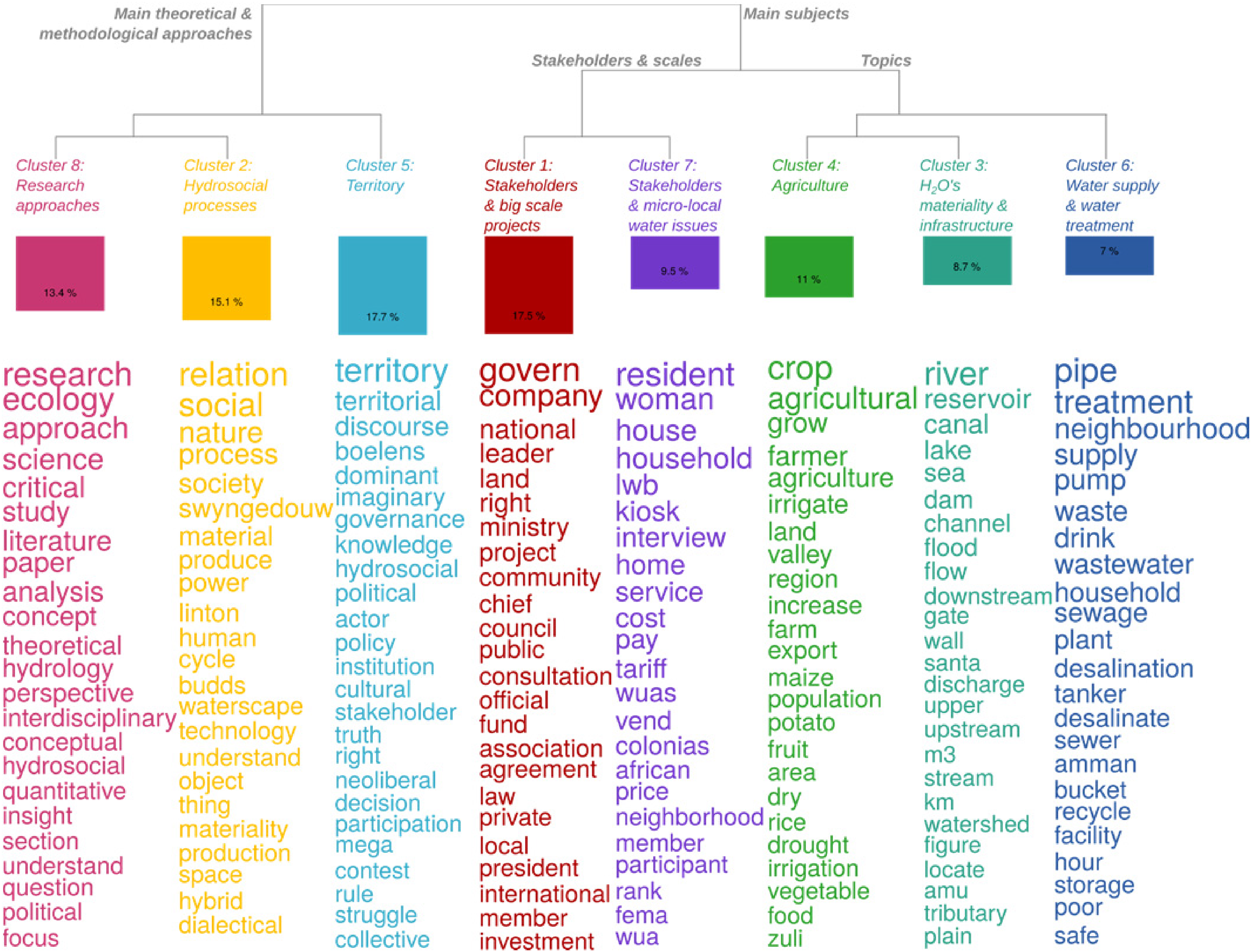
The eight ‘lexical worlds’ identified within the corpus with Iramuteq. The lexical worlds (or clusters) were automatically generated by Iramuteq. To guide the reading of the tree diagram, we gave names to each cluster (under the cluster number) based on our interpretation of the results and we also named the main branches of the diagram.
The clusters on the right-hand side of Figure 2 show the main subjects of the articles from our corpus:
– Cluster 1: Stakeholders and big scale projects. This cluster (17.5% of the text segments of the corpus) relates to stakeholders involved in hydrosocial projects and issues most likely on regional, national and even international scales (‘government’, ‘company’, ‘leader’, ‘ministry’, ‘project’). – Cluster 7: Stakeholders and micro-local water issues. This cluster (9.5% of the text segments) encompasses water-related issues on a micro-local scale: the household scale is encapsulated in the words ‘resident’ or ‘house’, as well as in pricing and access issues (‘kiosk’, ‘service’, ‘cost’, ‘tariff’). Specific actors also stand out at this local scale (‘woman’, ‘LWB’, and ‘WUAs’).
12
– Cluster 4: Agriculture. This cluster (11% of the text segments) shows the importance of the topic of agriculture and irrigation in the corpus (‘crop’, ‘agricultural’, ‘irrigate’, ‘maize’). – Cluster 3: H2O's materiality and infrastructure. This cluster (8.7% of the text segments) relates to H2O's material dimension (‘river’, ‘lake’, ‘flow’, ‘discharge’, ‘m3’) and is intertwined with infrastructure (‘reservoir’, ‘canal’, ‘dam’, ‘gate’). – Cluster 6: Water supply and water treatment. This cluster (7% of the text segments) is made of text segments which recall water supply and treatment and transformation (‘sewage’, ‘desalination’). – Cluster 8: Research approaches. This cluster (13.4% of the text segments) regroups segments regarding the conceptual framing and the methods adopted by the authors of the articles as shown by the terms ‘research’, ‘approach’, ‘science’, ‘critical’, ‘literature’. – Cluster 2: Hydrosocial processes. This cluster (15.1%) highlights reflections on the interplay between the social and natural worlds; terms such as ‘relation’, ‘social’, ‘society’, ‘nature’, and ‘hybrid’ stand out. It includes words related to changes and transformation (‘process’, ‘produce’, ‘production’) which may have material implications (‘material’, ‘materiality’). Furthermore, this cluster shows the influential authors and concepts contributing to research on hydrosocial relations. The first author mentioned is Swyngedouw and the concept ‘waterscape’ he introduced also stands out in this cluster. In addition, references to Linton and Budds’ [hydrosocial] ‘cycle’ are also present. Finally, the word ‘space’ is also connected with cluster 2. – Cluster 5: Territory. This cluster (17.7%) is characterised by the importance of the word ‘territory’ (and the related adjective ‘territorial’). The prominence of the words ‘discourses’ and ‘imaginaries’ in the same cluster suggests that they play a key role in the analysis of territorial processes. Issues of ‘governance’ (‘state’, ‘neoliberal’, ‘institution’) and ‘identity’ (‘indigenous’, ‘cultural’) are central topics of this cluster. Lastly, Boelens’ name is overly mentioned in this cluster, reflecting his key role in the formulation of this concept. The lexical content of these two clusters (2 and 5) suggests the existence of two different conceptual and theoretical approaches within the corpus.
The three remaining clusters (2, 5 and 8, on the left-hand side of Figure 2) pertain to more theoretical and methodological questions:
Among the clusters and words of the corpus, some major lexical contrasts and proximities can be observed (Figure 3). The main contrast in the corpus is between clusters and words which carry theoretical considerations (located in the left-hand half of the figure) and those which recall empirical concerns (on the right).
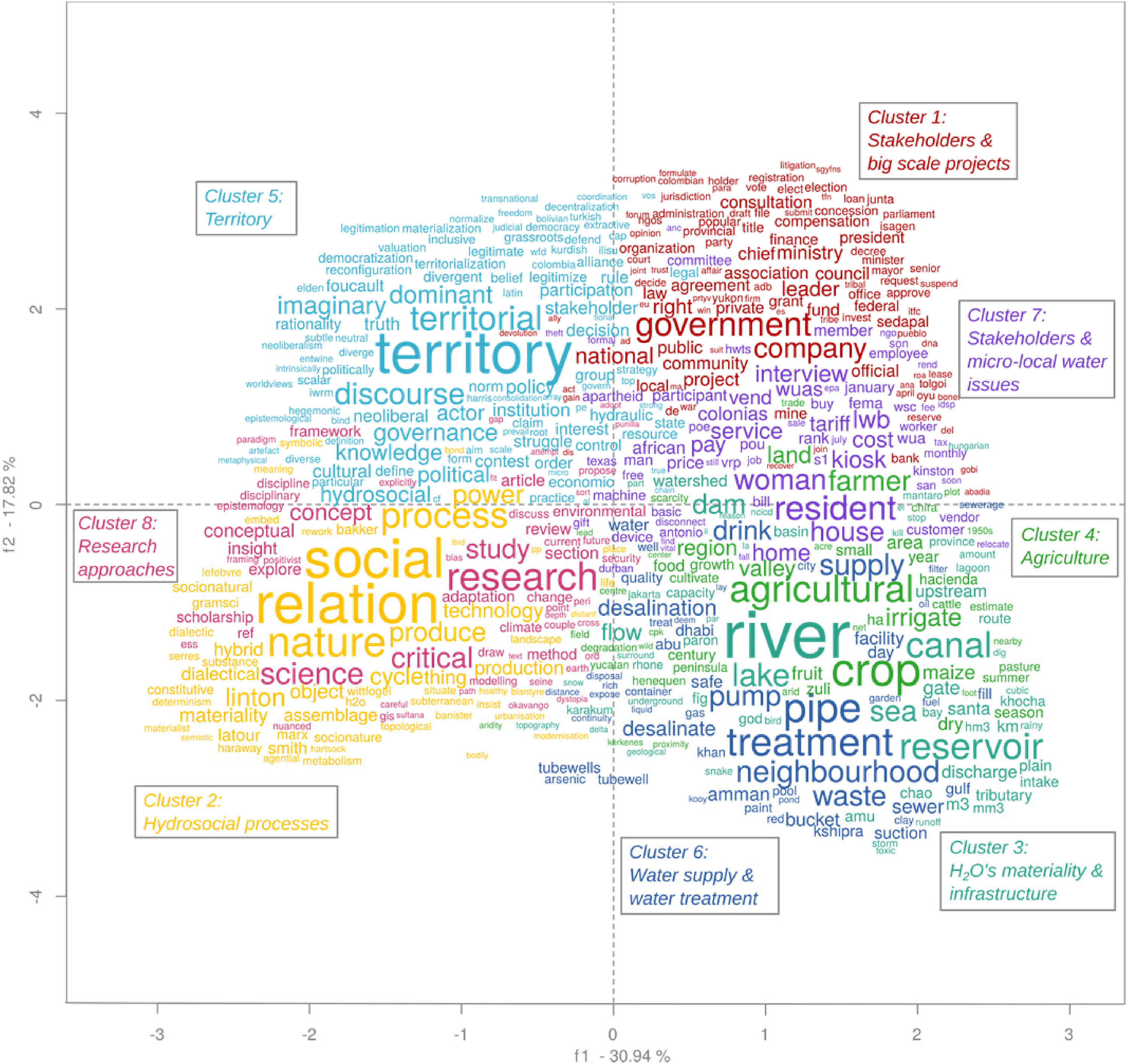
Correspondence analysis of the eight ‘lexical worlds’ identified with Iramuteq. For each cluster, the 50 words with the highest χ2 score (indicating the degree of association between the word and the cluster) are represented; the size of the words is proportional to their χ2 score. The colours used for the clusters and words on this figure are the same as those used on the previous figure (tree diagram).
Some proximities can be seen between the different theoretical approaches and more empirical topics. The proximities and correspondences between the theoretical considerations and the empirical subjects are to be read on either side of the x-axis (the top-left ‘theoretical’ clusters are related to the top-right ‘empirical’ clusters; the bottom-left ‘theoretical’ clusters are related to the bottom-right ‘empirical’ clusters).
First, the figure shows the closeness between cluster 5 (where the ‘hydrosocial territory’ and related words appear) and cluster 1 (which highlights stakeholders and large-scale projects). To a lesser extent, cluster 7 (involving stakeholders and water-related issues on a micro-local scale) is also close to cluster 5. Second, in the bottom half of the figure, an overlap between cluster 3 (on H2O's materiality), 4 (on agriculture and irrigation) and 6 (on water supply and treatment) suggests a strong proximity between these three lexical worlds. These clusters seem to be associated with clusters 2 and 8 (respectively on hydrosocial relations, including ‘waterscape’, and critical approaches), yet the proximity is not as obvious as that observed in the top half of the figure (proximity mentioned above between cluster 5 on hydrosocial territories and cluster 1 on stakeholders and large-scale projects). Third, while cluster 4 and words related to agriculture mostly appear in the bottom half of the graph, some words related to this theme such as ‘irrigation’ or ‘land’ are close to or even above the x-axis suggesting that articles adopting the hydrosocial territories approach also explore agricultural issues.
Altogether, these results highlight the main semantic characteristics and topics of the corpus. On the one hand, they show the proximity between text segments on hydrosocial territories (cluster 5) and those on stakeholders involved in large-scale projects (cluster 1). This does not necessarily mean that articles on waterscapes do not also focus on stakeholders involved in large-scale projects, or that articles on hydrosocial territories exclusively focus on stakeholders involved in large-scale projects. Rather, it suggests that articles on hydrosocial territories may focus more often on large-scale projects than articles on waterscapes and on other hydrosocial and critical approaches. On the other hand, these results show that there is a certain proximity between other hydrosocial and critical approaches (cluster 2) and text segments that relate to topics such as water supply and treatment and more generally to relations to water in its material dimension (clusters 3, 4 and 6). These results suggest that articles using the concept ‘waterscape’ and hydrosocial and critical approaches are likely to focus on such topics.
Four main lexical differences between waterscape and hydrosocial territory
To further investigate and understand these differences, we examined the co-occurrents 13 of ‘waterscape’ and ‘hydrosocial territory’ (Table 2). The results suggest some commonalities and four main differences in the use of ‘waterscape’ and ‘hydrosocial territory’; some of these related to spatial contexts and processes while others reflect discussions on power relations and temporalities.
Some co-occurrents of the word ‘waterscape’ and ‘hydrosocial territory’ (in their singular and plural forms).
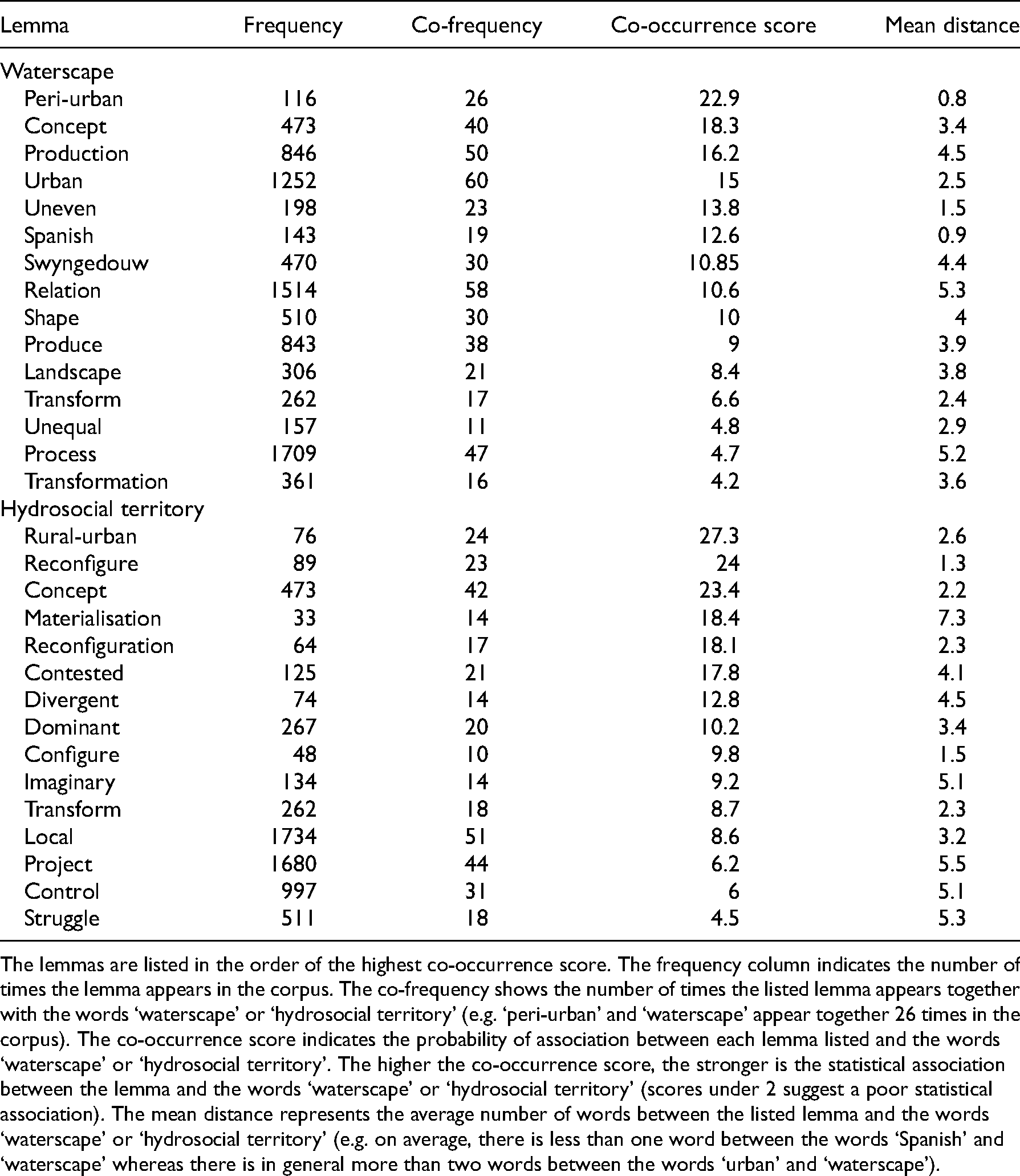
The lemmas are listed in the order of the highest co-occurrence score. The frequency column indicates the number of times the lemma appears in the corpus. The co-frequency shows the number of times the listed lemma appears together with the words ‘waterscape’ or ‘hydrosocial territory’ (e.g. ‘peri-urban’ and ‘waterscape’ appear together 26 times in the corpus). The co-occurrence score indicates the probability of association between each lemma listed and the words ‘waterscape’ or ‘hydrosocial territory’. The higher the co-occurrence score, the stronger is the statistical association between the lemma and the words ‘waterscape’ or ‘hydrosocial territory’ (scores under 2 suggest a poor statistical association). The mean distance represents the average number of words between the listed lemma and the words ‘waterscape’ or ‘hydrosocial territory’ (e.g. on average, there is less than one word between the words ‘Spanish’ and ‘waterscape’ whereas there is in general more than two words between the words ‘urban’ and ‘waterscape’).
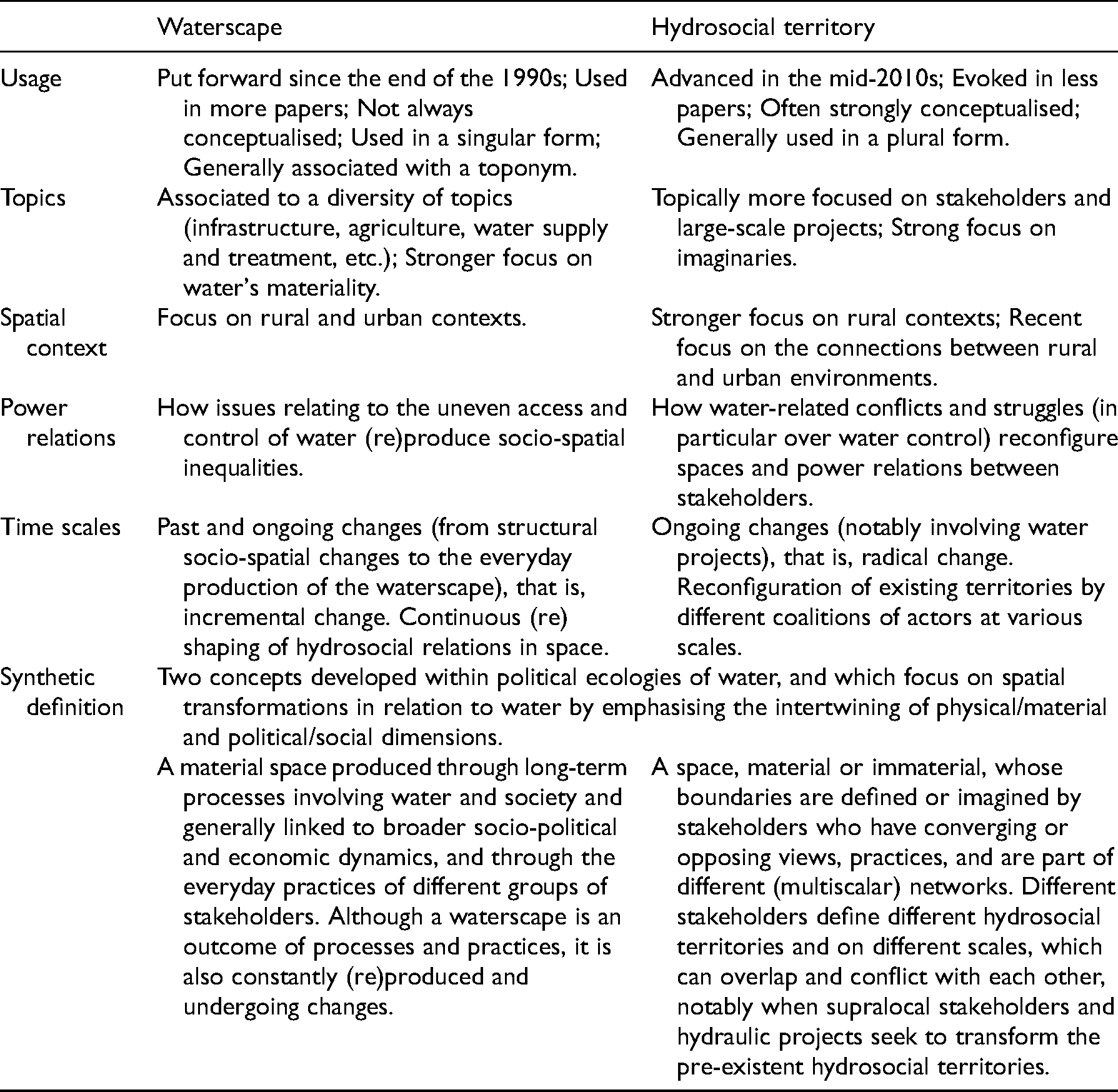
Commonalities and differences between the concepts of waterscape and hydrosocial territory (based on the literature review and on the quantitative and qualitative analyses conducted on the corpus of 113 articles).
First, if Swyngedouw essentially used waterscape in relation to rural contexts in his early publications on the Spanish waterscape, our results show that its usage has become important in relation to urban contexts. Indeed, while ‘waterscape’ is strongly connected to the words ‘peri-urban’ and ‘urban’ indicating its strong bond with urban issues, the concept of ‘hydrosocial territory’ is more closely related to the rural world considered in its connection to the urban one (as highlighted by the lemma ‘rural-urban’, whose frequency can be partly explained by the special issue published in 2019 in Water International about ‘rural-urban struggles’). Second, both concepts differently point to concerns regarding power relations and socio-environmental (in)justice. The waterscape is associated with the idea of inequality (‘uneven’ and ‘unequal’), while the hydrosocial territory is closely related to terms indicating conflict (‘contested’, ‘divergent’, ‘dominant’, ‘control’, ‘struggle’). Third, the two concepts are associated with words expressing different types of changes suggesting they theorise differently socionatural transformations: ‘waterscape’ co-occurs with ‘production’, ‘produce’, ‘shape’ while ‘hydrosocial territory’ co-occurs with ‘reconfigure’, ‘reconfiguration’. Fourth and finally, the two concepts come across as being entrenched in different temporalities. The co-occurrences between ‘hydrosocial territory’ and the words ‘project’, ‘local’ or ‘imaginaries’ are indications on how the concept of hydrosocial territory is conjured up to analyse forthcoming or ongoing processes resulting from interventions such as hydraulic ‘projects’. ‘Waterscape’ instead is often connected to toponyms of countries – e.g. ‘the Spanish waterscape’ (Swyngedouw 1999) which can be found in Table 2, but also the ‘Jordanian waterscape’ (Mustafa and Tillotson 2019) –, regions – ‘the Yucatan Peninsula's subterranean waterscape’ (Zurita and Munro 2019) –, or cities – ‘Durban's waterscape’ (Loftus 2007) or ‘Delhi's fractured waterscape’ (Truelove 2019b). The articles using such expressions seek to demonstrate how these (‘uneven’, ‘fractured’) waterscapes are produced over time: this suggests that ‘waterscape’ is used to describe past and in some cases ongoing changes.
Spatialities of waterscapes and hydrosocial territories
Building on the previous results which have illustrated how ‘waterscape’ and ‘hydrosocial territory’ have been used, this section further explores the spatialities associated with these concepts. The quantitative analysis hinted at some differences in the use of the concepts (urban/rural contexts; inequalities/conflict; project outcomes/structural socio-spatial changes; present and future/past and ongoing evolutions in time). Here, complementary qualitative analysis further delves into how the papers theorise differently the connections between water, society and space.
This section shows that (i) ‘waterscape’ is often used to highlight the continuous (re)shaping of socio-spatial inequalities; (ii) ‘hydrosocial territory’ is used when exploring the reconfiguration of existing territories by different coalitions of actors intervening at various scales; (iii) the two concepts, while revealing both interwoven material and political-economic dimensions, put emphasis on sociospatial processes with different time spans.
‘Waterscape’: a concept highlighting the continuous (re)shaping of socio-spatial inequalities
In urban studies, ‘waterscape’ has long been used to show how inequalities are continuously (re)produced, based on the study of socio-spatial relations around water services. We have already mentioned how Swyngedouw’s (1999) seminal article on the Spanish waterscape, studied at the national scale, has marked PEW, however, we should also recall his later inclusion in urban political ecology (see for instance Swyngedouw 2004 for the urbanisation of water in the city of Guayaquil, or more generally; Swyngedouw and Heynen 2003). The concept of waterscape has been amply mobilised by urban political ecologists and references to ‘urban waterscapes’ are thus numerous (e.g. Goh 2019; Karpouzoglou and Vij 2017; Kooy 2014; Loftus 2006, 2007; Loftus and Lumsden 2008; López Rivera 2013; Mehta and Karpouzoglou 2015; Singh et al. 2018). In this literature, ‘the waterscape foregrounds the dialectical relationship of capitalist development and the production of unequal socionatures’ (Karpouzoglou and Vij 2017, 3), recalling more generally urban political ecology's interest in the role of capital in the production of water (Trottier 2008). With a clear focus on power, it interrogates who has (or does not have) access to water, who controls water, and how. Urban political ecologists indeed demonstrate how water access, (in)formal settlement and citizenship are produced together through everyday dynamics (Anand 2017). For instance, in their paper entitled ‘Reworking hegemony in the urban waterscape’, Loftus and Lumsden (2008, 110) explicitly focus on the ‘everyday production of the waterscape’, stating that by ‘building critically on the work of both Gramsci and Marx, [they] seek to show how hegemony operates through concrete human activity in the production of nature’. This perspective echoes the influence that research on everyday life – such as Lefebvre's work on the production of space (Lefebvre 1991) – has had on urban studies more generally (Heynen 2017; Loftus 2012). Another emblematic example of the focus on the intimate links between unequal water services and urbanisation can be found in the special issue ‘Informal Space in the Urban Waterscape’ published in Water Alternatives in 2014: the authors insist on the ‘disaggregation and co-production of water services’ (Ahlers et al. 2014) and show how informal water practices are an integral part of the everyday processes of urbanisation (Kooy 2014).
However, the importance of studying how socio-spatial relations produce inequality is not limited to urban studies but extends to other research using the ‘waterscape’. This is shown for instance by Sultana’s (2013) iconic work on arsenic groundwater contamination. Indeed, the concept of waterscape has above all emphasised the entanglement of the materiality of water access and the production of poverty or injustice (Meehan et al. 2020). Feminist researchers have taken this perspective further by stressing the key role of infrastructure and technology in the production of uneven waterscapes (Sultana 2013) and by speaking of an ‘embodied urban political ecology’ (Truelove 2019a) which focuses at the same time on infrastructure, urban socionatures and bodies through the study of the household and bodily scales. This perspective on the entanglement of water access and the production of injustice echoes the results of the textual analysis described earlier on: the proximity between the ‘waterscape’ and the lexicon related to the materiality of water access and distribution (‘pipe’, ‘supply’, ‘pump’, Figure 2) and to water (in)security down to the household level (‘service’, ‘cost’, ‘woman’, Figure 2).
More generally, the focus is thus on the ‘relational patterns of water access, everyday water practices, and the experiential or subjective dimensions of the hydrosocial cycle that dynamically reconstitute the waterscape’ (Jepson and Vandewalle 2016, 67).
‘Hydrosocial territory’: deciphering territorial reconfigurations triggered by projects between local and supralocal interests
Compared to the ‘waterscape’, the development of the ‘hydrosocial territory’ included, since its inception, spaces, and issues beyond the urban contexts. In 2016, the special issue of Water International dedicated to the hydrosocial territory included several articles on rural issues, such as mining, agriculture, energy and/or conservation (e.g. Duarte-Abadía and Boelens 2016; Hulshof and Vos 2016; Rodriguez-de-Francisco and Boelens 2016). In the same journal, the concept of hydrosocial territory was key in another special issue, which focused on the transformation processes of very different rural spaces (remote or close to cities, specialised or not in intensive agricultural production, identified for issues of water pollution, flooding or drinking water supply), in relation to urbanisation (Hommes et al. 2019). Conversely, Cantor (2021) uses the concept of hydrosocial territory to study the city from its margins and surrounding rural areas, arguing that urban political ecologists rarely go beyond the boundaries of the city (‘the city as place’) when studying urbanisation processes. The use of ‘hydrosocial territory’ is not limited to articles studying rural or periurban spaces (e.g. Ioris 2016 on water scarcity in the city of Lima). It is rather used to highlight ‘multiscalar’ relations when showing the dynamic relations that shape territories (for instance relations connecting rural areas to a broader network of cities, or cities to their hinterland). Yet, the links between this multiscalar dimension and the spatialities conveyed more generally by the concept of hydrosocial territory remain to be made explicit.
Research on ‘hydrosocial territory’ focuses on explaining the local modalities of water use and control by unpacking the political interactions involved at different geographical levels. For instance, Romano's paper on the state and rural Nicaragua seeks to demonstrate ‘how local configurations of “water, power, identity, and cultural politics” (Boelens 2014, 234) – or grassroots hydrosocial territories – have been publicly projected in a way that has proved instrumental towards promoting the political inclusion and legal recognition of water committees vis-à-vis the state’ (Romano 2016, 76). Because of the diversity of interests and imaginaries of the actors involved, it can be noted that the concept is generally used in a plural form – hydrosocial territories – even when the articles study specific locations. The papers have various geographical scopes, whether these are countries or states (e.g. Perramond 2016 on New Mexico), regions (Hommes et al. 2016 on south-eastern Turkey), rivers basins (Marks 2019 on Chao Praya River Basin) or coastal valleys and wetlands (Hulshof and Vos 2016). Most show how the territories studied are transformed by the supralocal interests of powerful private and/or state actors, whether through capitalist production systems (Damonte and Boelens 2019; Vos and Hinojosa 2016), conservation projects or hydraulic development interventions. Much attention has been paid for instance to interbasin water transfers (Rocha Lopez et al. 2019; Rogers and Wang 2020) or large dams (see the 2019 special issue ‘Contested knowledges: water conflicts on large dams and mega-hydraulic development published’ in Water).
PEW studies using the concept of ‘hydrosocial territory’ focus more specifically on the struggles that may appear when such supralocal interventions transform existing local territories. This literature shows indeed how ‘so-called “integrated” or “hydraulic” projects are in fact means to configure and re-configure hydrosocial territories, altering the physical–ecological, socio-economic, cultural-symbolic and political spaces where they are realised’ (Hommes et al. 2016, 11). It focuses on ‘the impact of water flows through (mega) hydraulic artefacts with major effects for different user groups’ physical and ecological environment’ as well as on the local ‘political order’ (Hommes et al. 2016). The hydrosocial territory is thus understood as ‘an area where divergent socio-environmental imaginaries are generated and contested’ (Duarte-Abadía and Boelens 2016, 16). This attention paid to projects impacting local territories explains the quantitative results described in the previous section (i) on the proximity of text segments relating to hydrosocial territories and stakeholders (Figure 3), and (ii) on the co-occurrences between ‘hydrosocial territory’ and terms indicating antagonisms or oppositions (‘contested’, ‘struggle’, Table 2). The distinction between ‘powerful stakeholders outside the project area’ and ‘vulnerable groups in the affected (…) territory’ (Duarte-Abadía, Boelens and Roa-Avendaño 2015, 243) made it possible in this literature to put forward ‘indigenous ways of life’ (Wilson 2014), ‘pro-indigenous discourses’ and ‘customary water territories’ (Seemann 2016), as well as local resistances to exogenous projects more generally. This is illustrated by research on ‘counter-hegemonic water infrastructure’ as resistance in the occupied Golan Heights (Dajani and Mason 2018).
However, beyond the frontal opposition between coalitions of actors, research on hydrosocial territories also interrogates the ways the very categories of ‘state’ and ‘local community’ are reciprocally shaped. Indeed, through processes of negotiation or contestation, hydraulic and conservation projects shape the very representations that the different actors have of each other (relays of a public service, planners, or technocrats; beneficiaries of a development project, potential electorate, contestants), as well as the representations that the actors have of themselves (expert, right-holder, citizen…). This literature shows how the ‘ways in which people “naturally” represent themselves’ are transformed through such projects (Hommes et al. 2016, 11). Moreover, beyond the mere idea of domination of powerful actors over local communities, research in PEW using the hydrosocial territory ‘generates insight into how discourses generated “from below” can have a democratising effect on water governance by promoting more inclusive public policies and policy formation processes’, as ‘the state's inclusion of grassroots actors previously “below the radar” of formal water governance matters as a reconfiguration of actors, decision-making and spatial scales’ (Romano 2016, 86).
Various temporalities behind the embedded material and politico-economic dimensions of spatial transformations
‘Waterscape’ and ‘hydrosocial territory’ both focus on the very idea of spatial ‘transformations’ (Table 2) by emphasising the intertwining of physical/material and political/social dimensions. Yet, the previous results suggest that the two concepts put emphasis on processes with different time spans. We argue that it is precisely in this contrast of time scales – longer-term incremental change over historical time periods versus radical change occurring in a brief time – that we can understand the complementarity between these two concepts.
The waterscape is used to describe spatial outcomes of hydrosocial processes, especially the reproduction of structural socio-spatial inequalities, and their evolution through time. A connection can be made to the fluid, ever-changing aspect that characterises the notion of landscape (Goh 2019). Recalling the socionatural (Rodriguez-de-Francisco and Boelens 2016) and metaphorical (Appadurai 1990) dimension of landscape, various authors indeed insist on the fact that waterscapes change in ‘space and time’ (Buscher 2019; Perreault 2014). Previous results allow us to specify that PEW has often mobilised ‘waterscape’ to study particular forms of socio-spatial transformations. Indeed, waterscapes are described as spaces with a physical reality, but whose material transformations are generally linked to broader socio-political and economic dynamics that take place over a long-time span (Karpouzoglou and Zimmer 2016; Mehta and Karpouzoglou 2015; Swyngedouw 1999). The study of everyday life (Ahlers et al. 2014; Loftus and Lumsden 2008) and of infrastructure materialising political projects (Meehan 2014; see lexicon of technological artefacts in the textual analysis, clusters 3 and 6 on Figure 2) thus reveals the progressive transformation of the waterscapes. These changes (re)produce, in an incremental fashion, structural socio-spatial inequalities over time (‘uneven’, ‘unequal’, Table 2), inequalities that are embedded in broader and long-lasting political, economic and/or cultural dynamics of power.
In the case of hydrosocial territories, spatial transformations are often studied through the multiscalar networks that ‘reconfigure’ (Table 2) pre-existing yet never-fixed territories (Boelens et al. 2016; Hommes and Boelens 2017). This very idea of re-configuration shows that the evolution of territories over a long-time span is recognised, but also that papers using the concept of hydrosocial territory insist on the various factors which repeatedly transform the territories. Indeed, when using the concept of hydrosocial territory, PEW often focused on the effects of development interventions, which are explained by the supralocal interests of specific powerful actors such as the state or private companies (Vos and Hinojosa 2016). Therefore, the spatial changes under study (construction of dams, implementation of payment for watershed services, etc.) were often project-dependent, and thus embedded in shorter temporalities. The scholars who use the concept of hydrosocial territory focus on the plural objectives and visions carried by the different actors involved (as shown by the strong proximity between the hydrosocial territory and the lexicon of the stakeholders) and on the ways their imaginaries can either collide or complement each other. Because of the potential oppositions between actors in hydraulic or conservation projects, ‘hydrosocial territory’ is more clearly linked to issues of (open) contestations and resistances (Shah et al. 2019; ‘struggles’, ‘contested’, ‘divergent’ in the textual data analysis, Table 2) than ‘waterscape’, therefore easily leading to reveal short-term and sometimes radical transformations of the territories.
Conclusion
This paper intended to unravel commonalities and differences between ‘waterscape’ and ‘hydrosocial territory’, two concepts that build on two different core concepts of geography (‘landscape’ and ‘territory’) and that are increasingly used in PEW to denote the spatial dimensions of the society-water relations. Previous studies had hinted at some differences between the two concepts (Karpouzoglou and Vij 2017). Here we further explored these differences and investigated the spatialities of water conveyed by these concepts by implementing an original mixed-methods framework.
Our results show that ‘waterscape’ and ‘hydrosocial territory’ can often be evoked together in publications in PEW but are rarely put into conversation. Moreover, our results highlight how the two concepts are associated with different issues. There appears to be, on the one hand, strong connections between the study of stakeholders involved in large-scale projects and the concept of hydrosocial territory, and, on the other hand, a proximity between other hydrosocial approaches which encompass ‘waterscapes’ and issues related to infrastructure for water supply or treatment, and more generally the study of relationships towards water in its material dimension.
Regarding the spatial contexts and processes, the textual data analysis allowed us to pinpoint four main differences: the two concepts seem to be unevenly used to analyse urban and rural contexts; they look at injustice through different lenses; they focus on different types of socio-spatial changes and on different temporalities. ‘Waterscape’ and ‘hydrosocial territory’ therefore cannot be considered to be interchangeable, despite their commonalities, and although the ties between the two concepts have been acknowledged (see Swyngedouw and Boelens 2018).
We demonstrate that the concepts of ‘waterscape’ and ‘hydrosocial territory’ delineate two close but nevertheless different analytical threads with regards to water-related spatialities (Table 3). A closer look at the usage of these concepts through a qualitative analysis suggests that these differences can be explained by the key and long-lasting influence of the seminal works that gave rise to these concepts. Such works focused either on the everyday production of waterscapes and structural inequalities (e.g. Loftus and Lumsden 2008; Sultana 2013), or on the way specific projects and interventions led by dominant coalitions of actors impact and transform existing (hydrosocial) territories (e.g. Hommes et al. 2016). To sum up, waterscapes are considered to be the spatial translation of long-term socio-ecological processes involving water and more generally of incremental changes. As palimpsests, that is, objects marked by the past inscription of socio-spatial dynamics, waterscapes invite us to study specific spatialities and contribute to revealing the modalities of the establishment of power structures. The hydrosocial territory, on the other hand, has been put forward as a conceptual framework specifically designed to unpack the wide range of multiscalar hydrosocial relations. These relations contribute to the reconfiguration of existing (yet never fixed) territories. Although long-term perspectives are apprehended by recalling imaginaries related to water, the hydrosocial territory approach aims at identifying the dynamics of domination and resistance through the study of coalitions of actors and interests. It is used to explain the power struggles or the enrolment of actors which occur during the implementation of hydraulic or conservation projects, which directly impact local communities and may radically and rapidly change the hydrosocial territories, the multiple territorial re-configurations.
More broadly, our results echo discussions in political ecology on the differences between interactionist and structural perspectives on power (e.g. Lawhon et al. 2014). The waterscape literature pays attention to everyday interactions and practices to reveal how structural socioeconomic trends, such as the privatisation of water, shape inequalities. The hydrosocial territory approach focuses on the interactions (negotiations or conflicts) between the stakeholders of specific projects, the success of which depends on asymmetric power relations. We believe that despite their differences these two concepts should be considered as complementary to better understand the embedded short-term and long-term evolution of water-space-society relationships.
Supplemental Material
sj-rtf-1-peg-10.1177_27539687221106796 - Supplemental material for Waterscapes and hydrosocial territories: Thinking space in political ecologies of water
Supplemental material, sj-rtf-1-peg-10.1177_27539687221106796 for Waterscapes and hydrosocial territories: Thinking space in political ecologies of water by Silvia Flaminio, Gaële Rouillé-Kielo and Selin Le Visage in Progress in Environmental Geography
Footnotes
Acknowledgements
The authors would like to thank King's College ‘Contested Development’ writing group led by Alex Loftus. They also thank Gabrielle Bouleau, Alexis Metzger and Lise Desvallées for their comments on earlier versions of this paper. The paper stemmed from a discussion engaged at the Pollen 2020 conference and we would therefore like to thank the participants of our session. The authors would like to thank the three reviewers for their encouraging and extremely helpful comments. Finally, the authors also warmly thank the editorial collective of Progress in Environmental Geography for their help during all the different steps of the process.
Author contributions
SF and GRK organised a panel at the POLLEN 2020 conference that gave the idea for this paper. The literature review was done by GRK, with input from SF and SLV. SF produced the corpus and analysed it from a quantitative perspective, with input from GRK and SLV. SLV conducted the qualitative analysis, with input from SF and GRK. All three authors wrote and reviewed the entire article.
Declaration of conflicting interests
The authors declared no potential conflicts of interest with respect to the research, authorship, and/or publication of this article.
Funding
The authors received no financial support for the research, authorship, and/or publication of this article.

Notes
Supplemental material
Supplemental material for this article is available online.
References
Supplementary Material
Please find the following supplemental material available below.
For Open Access articles published under a Creative Commons License, all supplemental material carries the same license as the article it is associated with.
For non-Open Access articles published, all supplemental material carries a non-exclusive license, and permission requests for re-use of supplemental material or any part of supplemental material shall be sent directly to the copyright owner as specified in the copyright notice associated with the article.
