




Abstract
Solar photovoltaics are crucial technologies for purposive low-carbon energy transition, yet there is uneven oversight of the development of grid-scale solar facilities around the US. Where other forms of regulation are absent, National Pollutant Discharge Elimination System (NPDES) construction site permitting programs may take a prominent role in governing solar development. In this paper, we use the lens of hydrosocial territorialization to reveal how socio-material relations and power dynamics configured through this Clean Water Act program shape Pennsylvania solar energy landscapes. We specifically ask: 1. How has water regulation come to regulate grid-scale solar development? 2. How does the NPDES governance process work when regulating grid-scale solar developments, specifically, and who and what influence the process? 3. How does solar development, regulated through the NPDES program, become a form of hydrosocial territorialization? 4. How does conceptualizing grid-scale solar development as a hydrosocial territorialization process inform geographic scholarship on energy transitions? Through a case study in Pennsylvania, where grid-scale solar development has rapidly increased in some agricultural regions, we reviewed regulatory documents, conducted key informant interviews with individuals involved in NPDES governance, and conducted a focus group of residents who live near grid-scale solar development. Through our analysis, we uncover nuances in these hydrosocial relations that are not included in regulatory documents. Through their authority, expertise, and discretion, engineers, contractors, and county and regional officials influence the hydrosocial territorialization process; at the same time, vegetation and soil materialities also shape solar facilities. As development progresses around the United States, the NPDES program will continue to spur generation or modification of relationships, knowledge, and regulatory interpretations, reconfiguring rural geographies and solar landscapes in the process.
Introduction
Grid-scale solar facilities 1 are considered a crucial technology in the push to decarbonize electricity generation (see PADEP, 2018; USDOE, 2021). In the US state of Pennsylvania, goals in the state's Solar Future Plan target an increase in in-state solar generation capacity from approximately 0.3 GW (2018 capacity) to 10–12 GW by 2030, with somewhere between 65–90% of that generation coming from grid-scale facilities (PADEP, 2018). Whether development is happening at a rate that will meet this goal depends on who you ask; projections from the Solar Energy Industries Association, one of the main lobbying associations for solar energy in the US, show that the state would likely fall a few GW short of the goal, with approximately 5.5 GW being operational by 2028 (SEIA, 2024). The real estate data firm LandGate, on the other hand, estimates that 10 GW could be operational by the end of 2025 if projected “in-service dates” from the regional transmission organization are upheld (LandGate, 2024). In either case, it is apparent that solar energy development is rapidly scaling up across Pennsylvania, raising questions about how these developments are not only transforming the energy sector but also the places where they are being built. The regulatory process is highly influential in shaping these transformations. Yet, it has been understudied in the case of grid-scale solar, a gap this paper aims to address.
Across the US, state governments have varying degrees of authority and mechanisms to regulate this accelerating development. As of 2024, twelve states delegated principal authority in siting decisions to local government, five states retained principal jurisdiction within state government, and the remaining 33 states either shared authority or divided authority based on project size or other factors (Enterline and Valainas, 2024). Some states have also established environmental review programs for solar developments that receive state funding, permits, or licenses (Gomez and Morley, 2021). Pennsylvania is one of the twelve states that leaves siting decisions to local governments (Enterline and Valainas, 2024). Importantly, it does not have a solar specific review program. However, it does have the National Pollutant Discharge Elimination System (NPDES) program, 2 which is implemented by the Department of Environmental Protection (PADEP) as delegated by the US Environmental Protection Agency. Around the country, state-run NPDES programs aim to prevent degradation of water resources by requiring that potential “point sources” of pollution, such as construction sites, manage their runoff. Presently, this is the only state-level program that regulates every grid-scale solar development in Pennsylvania. 3 Thus, water regulation has come to shape solar energy development. This paper analyzes how this governance configuration came to be and what its effects are on energy transition in rural landscapes.
In line with geographic scholarship on energy transitions, we find territorialization processes at work within this governance of grid-scale solar development (Bouzarovski et al., 2015; Bridge et al., 2013; De Laurentis, 2023). Given the imbrication of water and energy infrastructure, regulation, and development in this context, we conceptualize the territorialization process as hydrosocial in nature (Boelens et al., 2016). We develop this conceptualization by drawing on data from key informant interviews and a community focus group in a region with multiple grid-scale solar projects under development. Our analysis is guided by four main questions: 1. How has water regulation come to regulate grid-scale solar development? 2. How does the NPDES governance process work when regulating grid-scale solar developments, specifically, and who and what influence the process? 3. How does solar development, regulated through the NPDES program, become a form of hydrosocial territorialization? 4. How does conceptualizing grid-scale solar development as a hydrosocial territorialization process inform geographic scholarship on energy transitions?
After reviewing scholarship on hydrosocial territorialization and discussing our data collection and methods, we will address the guiding questions through sections that are sequenced to follow the permitting process. First, we contribute to scholarship that topologizes hydrosocial assemblages by presenting expressions of discretion, expertise, and authority that characterize interactions that are part of stormwater permitting. Subsequently, we demonstrate the socio-materiality and agency of vegetation, soil, and stormwater that are part of the territorialization process. The discussion will include a model for understanding how hydrosocial territorialization is reconfigured and reproduced before concluding with the significance of this work and future research directions.
Theoretical framework: Hydrosocial territorialization
Purposive energy transitions involve intentional and inherently spatial changes in how energy is produced, transferred or transported, and consumed (Bridge et al., 2013), whether new power generators replace incumbent ones or are ‘stacked’ upon them (Harlan and Baka, 2024). Due to the ‘power density’ (Walker, 2022) and spatiality (Huber and McCarthy, 2017) of low-carbon transitions, much of this development will take place in, and reconfigure, rural spaces (Naumann and Rudolph, 2020). Thus, according to Bridge and collaborators (2013), it is important to discern if and how energy transitions operate as processes of territorialization, or, as Hommes, Hoogesteger and Boelens (2022: 2) define them, “effort[s] (conscious and unconscious) to bring about the right relationships, configurations, and order of socio-material ‘things’ in a certain space”. Multiple territorialization processes such as those embedded in extant energy regimes and systems and those mobilized by new policy and economic agendas can be at work influencing a transition (Bridge et al., 2013). Thus, to better understand the trajectory of energy transition, it can be productive to identify and examine relationships between the territorial drivers that emerge from a variety of scales and sectors.
In this paper, we will demonstrate that stormwater permitting can be an inflection point in the trajectory of grid-scale solar development. Rather than taking a water-energy(-food) nexus approach to analyze this relationship, which has become popular in recent decades for co-optimizing conceptually separate but materially linked resource and infrastructural systems (Albrecht et al., 2018; Hoff, 2011), we analyze it as a hydrosocial energy transition. Nexus approaches have been critiqued for treating inherently political socio-natural relationships as governable intersections between separate human and non-human worlds, in which technical solutions can advance resource security while failing to address underlying systemic inequities (Allouche et al., 2015; Bruns et al., 2022; Wiegleb and Bruns, 2018; Wilson et al., 2019). This, at least in part, stems from understanding water systems as hydrologic mechanizations, which does not account for the imbrication of politics and society in the production of water (Linton and Budds, 2014). Tracing the hydrosocial production of water and watery human-environment systems exposes power struggles and intra-actions of people, water, and information that compose them (Linton and Budds, 2014; Swyngedouw, 2009). Such a vantage sheds new light on how energy transitions are regulated, particularly when focusing on how hydrosocial interests and agencies shape or territorialize spaces of energy production. In this direction, this paper uses the concept of hydrosocial territorialization to understand the effects of stormwater policy enactment on grid-scale solar development. After Boelens et al. (2016: 2–3), we understand hydrosocial territorialization as the mobilization of technological, biophysical, infrastructural, economic, and political hydrosocial processes “through epistemological belief systems, political hierarchies and naturalizing discourses” to create contested socionatural spaces and “humanized waters”– or, in our case, contested energy developments and “humanized” stormwater.
Generally, stormwater is considered a product of urban hydrosocial systems (Wilfong and Pavao-Zuckerman, 2020) due to material conditions (lots of paved, impervious surfaces) and legal classifications that require municipal governments that meet specific “urban” criteria to implement stormwater management programs (Dhakal and Chevalier, 2017; National Research Council, 2009). However, rural land uses still produce runoff pollution, especially land used for conventional agriculture (USEPA, 2010). Development in rural places (such as grid-scale solar development) therefore changes the kind of runoff produced from “agricultural” to “stormwater”, and this discursive and material shift necessitates the activation of multi-scalar stormwater governance where regional, county, and local stakeholders become involved in reshaping the hydrosocial territory. Because rural communities are not monoliths and have various spatial configurations, socio-environmental contexts, political connections, and other characteristics, territorialization processes and their outcomes will look different in different places (Hoogendam, 2019; see also Cantor, 2021; Dörre and Goibnazarov, 2018); however, we can map out the hydrosocial assemblages that will influence solar energy development across contexts.
A conceptual model developed by Hommes et al. (2022) that reveals how infrastructure can ‘fix’ hydrosocial territorialization processes informs our approach. This model explains that normative or desired results of territorializing processes are contested by and interact with both the political actors and the environment of the territory (Hommes et al., 2022). Hydraulic infrastructures, both material (e.g., dams, pipes, sewers, etc.) and discursive (e.g., legal arrangements, institutional rules and norms, etc.) are used to ‘fix’ these imaginaries in place, resulting in new configurations of territorial relations (Hommes et al., 2022). Attempts to ‘fix’ dynamic territories through infrastructure often requires political and financial backing, concentrating this ability into a select few hands (Hommes and Boelens, 2017). Consequently, conceptualizing the “inherent power structures of hydrosocial communities” (Paerregaard et al., 2020: 186) is crucial to understanding hydrosocial territorialization processes. A review of studies on collaborative water governance found that while many research projects consider the role that power plays in governance operations and outcomes, there is not currently a consistent approach used across the reviewed articles (Brisbois and De Loë, 2016a). Brisbois and De Loë (2016b), for one, consider how power is expressed through collaborative water policy-making processes. Their non-hydrosocial approach focuses on how power is reconfigured by sociocultural ‘stimuli’ during policy-making rather than sociomaterial or nonhuman agency (Brisbois and De Loë, 2016b). Paerregaard et al. (2020) reveal conflicts when hydraulic engineers and highland community members with differing water ontologies and epistemologies engage in collaborative water governance in Peru. Describing three encounters, they demonstrate how these differences require each group to make knowledge claims and normative arguments when seeking management decisions that align with their hydrosocial imaginaries (Paerregaard et al., 2020).
The power dynamics that arise between human actors operate within hydrosocial territories that are constituted by “the natural and the social; the biophysical and the cultural; the hydrological and the hydraulic; the material and the political” (Boelens et al., 2016: 3). In other words, hydrosocial territorialization is not merely braided from the political economic relations between a few human actors but rather occurs because these relations are also woven into the fabric of nonhuman and material relations. Thus, though hydrosocial imaginaries made material “may be fostered, advanced, and imposed by a powerful minority”, more context is needed to understand why this materialization occurs or fails (Hommes et al., 2022: 3). McDonnell (2014), for instance, demonstrates that yes, the imaginary of a verdant Abu Dhabi was enabled by the United Arab Emirates’ access to capital; however, the processes by which that capital was gained and the manner by which the hydrosocial cycle was rerouted to desalinate water is mediated by the UAE's geographic and geopolitical access to varying forms of energy resources. Additionally, material and economic reconfigurations that can be aligned discursively with ecological improvement can provide parties with a depoliticized (and thus legitimized) motivation for territorial changes (Drapier et al., 2024; Rodríguez-de-Francisco and Boelens, 2016).
Political and socio-material relations may also resist or re-route re-territorializations imposed by elite actors through infrastructural fixes (Hommes et al., 2022; Wilson et al., 2019). Sometimes, funding landscapes and geologic formations together may delay the development of infrastructure that has the potential to fix new hydrosocial territorial imaginaries and materialities (Rest, 2019). When they are assembled, some legal and material infrastructures concentrate power amongst hydrocratic actors while simple infrastructures may chip away at this authority (Meehan, 2014). However, even the largest infrastructures may function in unexpected ways, as demonstrated by Marks (2019). During the 2011 Thailand floods, the Chao Phraya Dam interacted with the variably-sloping river basin, evolving political relations, and weather events to create new territories of inundation and vulnerable subjectivities that do not correlate with socioeconomic status (Marks, 2019).
Living creatures and resources that are productive of life also become enmeshed with infrastructure as habitus (Barua, 2021). These relations, and how they are interpreted, play a role in the formation and evolution of hydrosocial territories (Houart et al., 2024; Hurst et al., 2022; Reyes Escate et al., 2022). In coastal Peru, smallholders discern relationships to land and water that produce socioenvironmental well-being by interpreting moisture, textures, colors and other sensorial and spiritual conditions of the environment (Reyes Escate et al., 2022). In rural India, visual attention to vegetation conditions serves as a water quality indicator (Hurst et al., 2022). While technical methods for sensing E. Coli levels also produce theories about water quality, multispecies indicators of environmental health “manifest the material-semiotic knots” of hydrosocial territory, as these other-than-humans possess both material and representational capacities (Hurst et al., 2022: 10; Reyes Escate et al., 2022). Looking at solar developments in this study, they direct our attention to the ways that non-humans influence the hydrosocial territorialization process.
Methods
Research was conducted between May 2023 and February 2024. Early on, we began developing diagrams of Pennsylvania's NPDES permitting process based on relevant regulatory guidance documents (see Appendix A). 4 The diagrams we produced (Figures 1 and 2) depict discrete points when actor-groups become involved in permitting by making decisions and interacting with other actors, variegated pathways emerging from events that can have various outcomes, and mandated timeframes within which certain activities must be completed. These diagrams, presented in the subsequent section, were both used as a guide in interviews and revised based on interlocutor feedback.
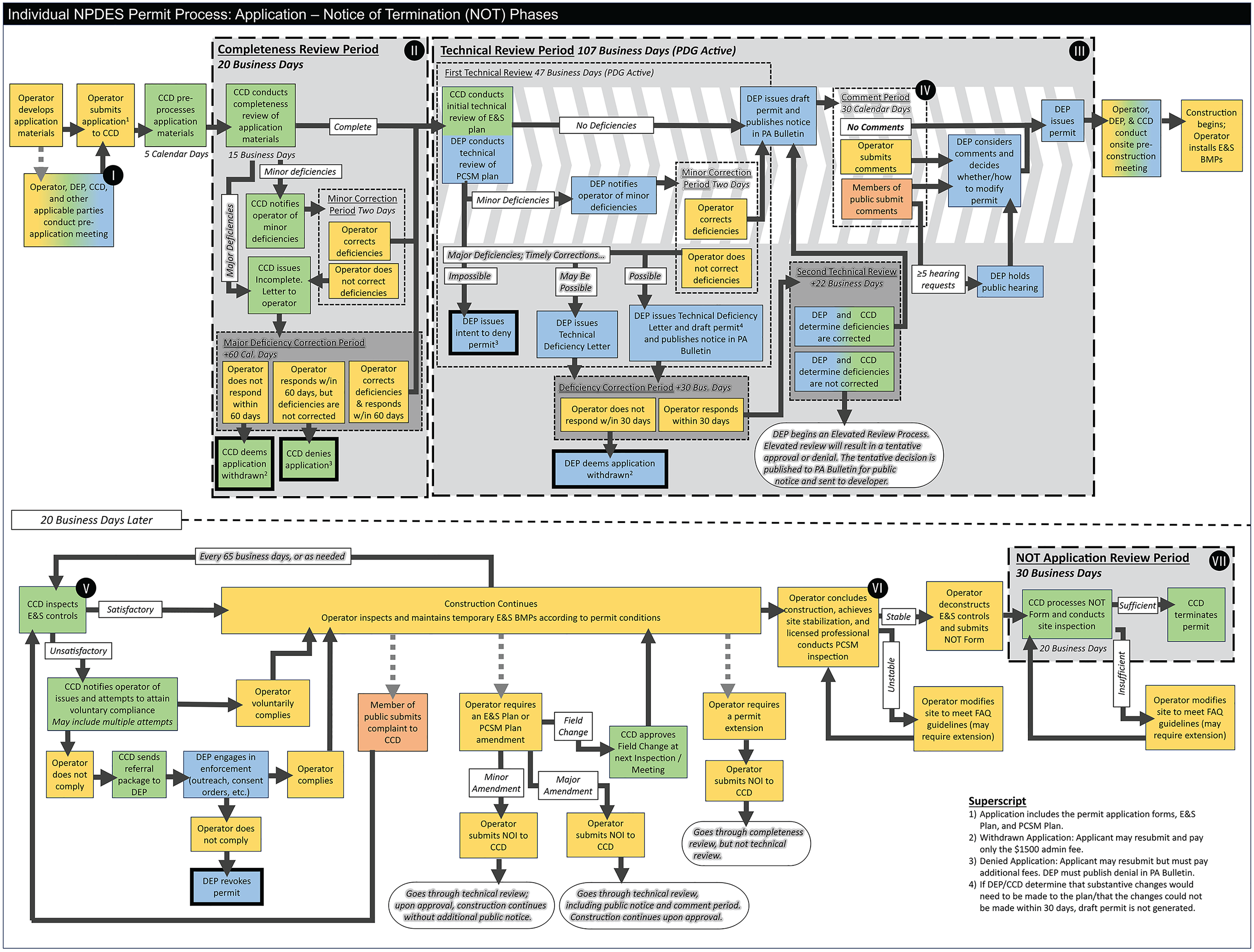
The Individual NPDES permitting process: Application – NOT phases. To read the chart, start at the top left box (Operator develops application materials) and follow the potential pathways. Most paths either run down or to the right, though there are some loops and paths that return to the top of the chart. After reaching the top right box (Construction begins; Operator installs E&S BMPs), the flow chart begins again at the left-most box below (CCD inspects E&S controls). See Appendix for Key (Source: Authors).
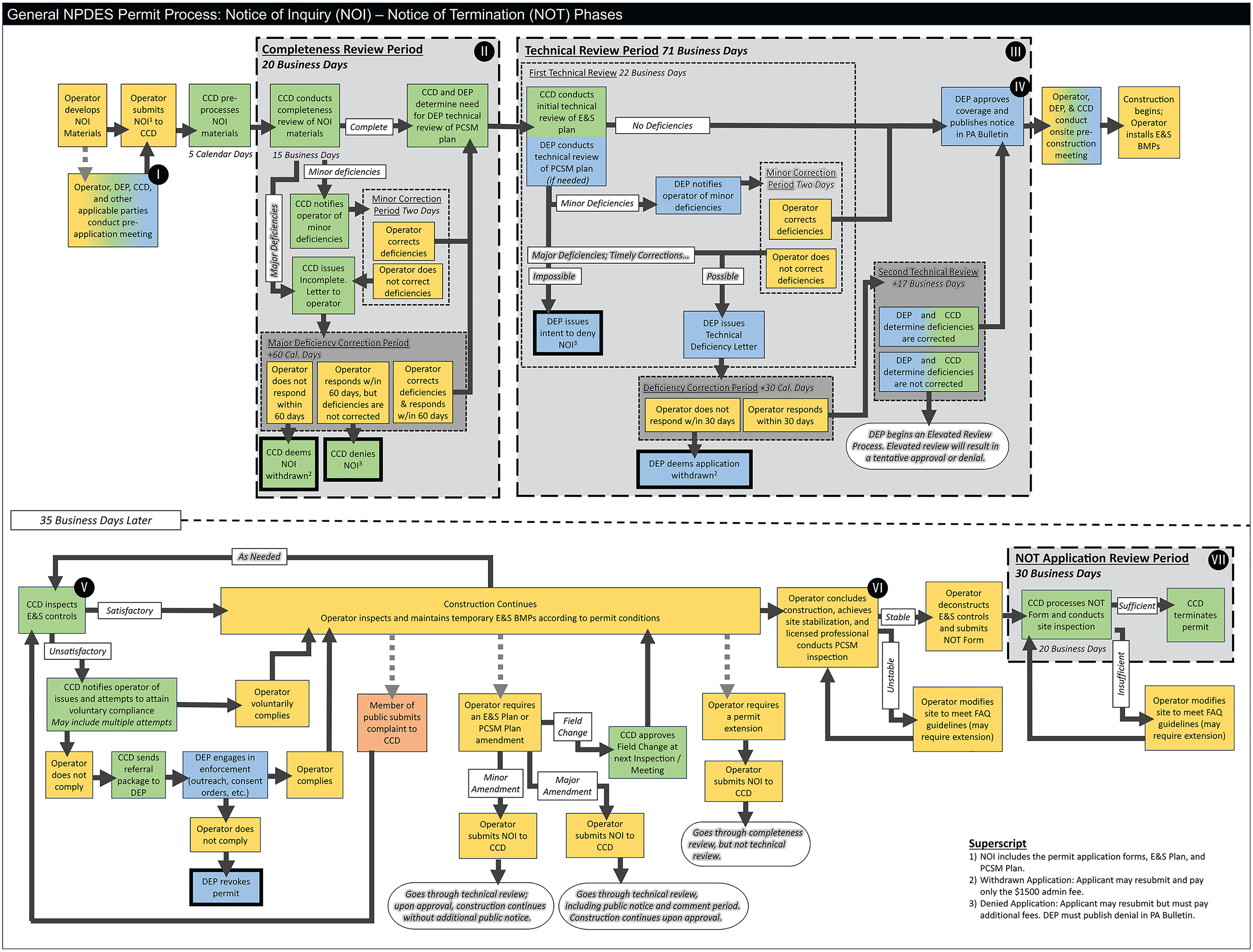
The General NPDES permitting process: NOI-NOT phases. To read the chart, start at the top left box (Operator develops NOI materials) and follow the potential pathways. Most paths either run down or to the right, though there are some loops and paths that return to the top of the chart. After reaching the top right box (Construction begins; Operator installs E&S BMPs), the flow chart begins again at the left-most box below (CCD inspects E&S controls). See Appendix for Key. (Source: Authors).
Interviews were conducted with ten participants familiar with the application of the NPDES permitting process to grid-scale solar development on Pennsylvania farmland, sampled using a “key knowledgeables” approach (Patton, 2015: 430). One informant was also recruited by snowball sampling (Bernard, 2011), and one informant also spoke to the particularities of projects on previously mined lands. Participants included: environmental regulators at the state (n = 1) and county levels (n = 6), project consultant engineers (n = 2), and a municipal engineer (n = 1). Interviews were conducted in-person (n = 6) or virtually (n = 4) and lasted 45 to 90 min. Topics of the interviews included the role of the informant within the process of grid-scale solar development and NPDES permitting, and in relation with other actors involved in developing or reviewing NPDES permit applications. These interviews helped identify how NPDES construction permitting is distinct in its application to grid-scale solar development and how the projects are engineered and constructed to meet permit standards. We queried how the social relations, policies and regulatory interpretations, and material elements of these projects contribute to the distinct nature of permitting and construction. These interviews were influenced by the positionality of the lead author, who is a white woman, previously worked in urban stormwater pollution prevention programming, and was an MS student at the time of these interviews. The confluence of these aspects of researcher identity, in relation to the positionality of interlocutors (most of whom were white men a few years to a few decades the senior of the lead author) likely helped the team to gain access to and rapport with these interlocutors. However, as reflected by the regulator-heavy sample, the gains in access were not universal; contractors who were contacted for interviews declined to participate, which to some extent limits our understanding of their discretionary activities within permitting and development.
A focus group with 16 residents in a rural region of south-central Pennsylvania was also conducted to better understand the lived experience associated with grid-scale solar. Participants were recruited by direct invitation, newspaper advertisement, and “network driven” sampling through working with local community groups to recruit their members (Patton, 2015). The session was held at a local fire station and lasted approximately ninety minutes, was recorded. Questions were asked to elicit discussion about local grid-scale solar development impacts and regulation. While much of this discussion is beyond the scope of this paper, some participants brought up impacts to the topsoil, and regulation thereof. These portions of the focus group were coded for use in this paper. The dynamic between the research team and participants was also different from that which was co-produced in interviews. Focus group members were not participating under the authority of any professional title while the research team was affiliated with a powerful university in Pennsylvania. Over the course of the conversation, however, most participants accepted the role we ascribed to them as local experts in and of their community as they shared and discussed their experiences and perceptions.
Interviews and focus group transcriptions were transcribed using Otter.ai and coded using a multi-step inductive and deductive coding process. We structurally coded the transcriptions in NVivo to identify sections of the interview transcripts that were on the topic of stormwater governance of grid-scale solar development (Saldaña, 2021). Next, an open coding process and a cutting and sorting technique was used to find themes that arise in the data (Bernard et al., 2017). Major themes included the ways in which NPDES governance actors interacted with each other that mutually or individually reinforced or limited their power in regulating development and landscape impacts from development. We returned to NVivo for axial coding (Saldaña, 2021), reorganizing the themes to reveal the power expressions and sociomaterial reconfigurations that constitute hydrosocial territorialization in this context. The three expressions of power (authority, expertise, and discretion) and the reconfigurations of hydrosocial systems (knowledge, relationships, and regulatory interpretations), described in the following sections, were identified in this final round of coding. Analytic diagramming or “codeweaving” was used as a memoing technique alongside written reflection to consider the relationships and differences between identified codes (Saldaña, 2021: 64). We produced a conceptual model of this hydrosocial territorialization process using this analytical technique, which we present in the discussion section.
Governing solar through water: Charting the regulatory background
NPDES stormwater programs, established through amendments to the Clean Water Act, provide most states with the authority to regulate point sources of stormwater runoff pollution to prevent the degradation of water resources (National Research Council, 2009). The statutory definition of “point source” orients the Clean Water Act toward regulating non-agricultural industrial and urban sources of stormwater pollution, meaning that most rural stormwater pollution is outside the purview of the NPDES program. However, earth-moving and disturbance related to construction activities is considered a specific type of industrial point-source within the Code of Federal Regulations (40 CFR 122.26(b)(14)). The NPDES program aims to prevent potential degradation produced by these activities by requiring a permit for construction activity that disturbs more than an acre of land (EPRI, 2020). Since rural grid-scale solar development meets these criteria and can lead to erosion and sedimentation of local waterways if not prevented through site planning and best practices (Mulla et al., 2024; Yavari et al., 2022), it is regulated by the NPDES program and requires a permit.
Attaining and complying with a NPDES construction permit is not a straightforward prospect. As described in the methods section, Figures 1 and 2 chart possible pathways, events, outcomes, and timelines within the NPDES permitting process as it is conducted in Pennsylvania. Two different figures are necessary because of the distinction between individual and general permit structures. Every five years, the PADEP develops a general permit for construction activity; applicants may apply for coverage under this permit if they do not have the potential to impact sensitive resources such as “high quality” or “exceptional value” graded streams or rivers. These designations indicate that after a year-long assessment of certain chemical and biological indicators, the PADEP determined that the waterway can support high quality or exceptional biological and recreational uses (Pa. Stat. § 93.4b). If developments have this potential to affect these uses by being in the same watershed, they must apply for an individual permit that receives more scrutiny during the review process. For instance, and as reflected in the flow charts, the technical review for an individual permit is allowed 107 business days versus 71 for the general, and inspections begin 20 days after construction begins and reoccur at least every 65 business days for the former versus 35 business days and again as needed for the latter. The junctures in both figures signify which actor(s) are responsible for making decisions that will affect the trajectory of the development. As will be demonstrated in this paper, in interpreting how to apply NPDES construction permitting to solar development, these actors command a degree of power in the roll out of solar development and re-shaping of rural land not often recognized. The key actors included in this diagram are the PADEP, County Conservation Districts (CCDs), and site operators, with “the public” having limited opportunity to influence permitting outcomes.
These diagrams attempt to render a step-by-step account of this process legible to readers of this paper. However, they also reflect how procedural and technical articulations in regulatory documents and in the descriptions provided by some informants depoliticize the permitting process. In the coming sections, we demonstrate the politics that occur at junctures where decisions are made and where permitting actors interact with each other and the socio-material components of solar developments. This examination of permitting ‘in practice’ allows us to unpack the ways permitting operates as a hydrosocial territorialization process. It also allows us to move from a description of the permitting process as it unfolds under Pennsylvania enacting legislation and governance structures into a more generalizable model that could be vetted through studies of NPDES regulatory programs in other states.
Power and sociomaterial relations in permitting
This section is split into two parts to reflect the distinction between the permit development phase and the construction phase, when development may or may not comply with the issued permit. The first part focuses on the development of the power relations between actors involved in the permitting process. The second part illustrates how those relations and power dynamics shift once ground is broken at the development site and sociomaterial components of the rural landscape and infrastructures enter the equation. A few key moments of interaction included in Figures 1 and 2 are marked with a roman numeral for easier cross-reference.
Developing the permit and expressions of power
Interactions between the PADEP, CCD, and the mix of developers, engineers, and contractors included under the umbrella of site operators are not as straightforward as Figures 1 and 2 might convey. To make sense of these interactions and their political dimensions, we describe them through articulating three expressions of power identified through our data analysis: authority, discretion, and expertise. Describing the expressions of power as separate is a useful heuristic that reveals how different actors assert their agency in relation to others, as the summative expression of power in a situation is also not produced by one actor but through relations with others (Hommes et al., 2022). However, moments and (inter)actions of territorialization are often characterized by a mixture of these expressions at the same time or in various sequences, which will also be made apparent.
On non-industrial rural properties, regulatory agencies have limited, if any, ability to require landowners to manage stormwater runoff unless new development occurs. Notification that a developer is applying for a permit for construction-related earth-disturbance activates legal instruments including state statutes, delegations, agreements, and certifications that change these configurations of power. For that reason, we discuss authority as the role and related capacities assigned to each actor through these instruments. For instance, upon receiving a permit application, the PADEP and CCDs assume distinct yet collaborative regulatory powers to review the submitted materials to find any incomplete components or technical deficiencies. There are limits to these roles; for example, when preparing their permit applications, 5 engineers have the option to schedule a pre-application meeting with the local CCD and, in some cases, the PADEP (Figures 1 and 2: I). While regulators find this to be an important opportunity to convey their knowledge, interviews with the PADEP and a CCD revealed that they cannot require these meetings (Interviews, PADEP, CCD).
This highlights the second expression of power we identified in our analysis: discretion. Though the permitting process is a highly regimented system, there remain opportunities for people implicated within it to “make choices” (Tadaki and Harrison, 2025: 281); for instance, operators may decide not to schedule the recommended pre-application meeting. Discretion may be exercised by the PADEP and CCDs as well when the explicit direction in statutes, delegation agreements, and standard operating procedures fall short of reality. Permit application standard operating procedures provide the disclaimer: “DEP reserves the discretion to deviate from this policy statement if circumstances warrant” and describes certain times at which the PADEP and CCDs may exercise administrative discretion, such as when they will engage in certain types of communication with applicants (PADEP Bureau of Clean Water, 2019, 2021b). This becomes apparent as delegated authorities at the PADEP and/or CCD review application materials for completeness and technical deficiencies (Figures 1 and 2: II, III).
6
According to a consultant engineer, after receiving some initial comments from the CCD during the completeness review:
…I'll resubmit everything back looking for admin complete. And they come back with a couple more comments. The odd thing is, a lot of times they're technical comments, because they're like, “Oh, I was looking through. And…I'd kind of like to see, you know, an R4 riprap instead of an R3.” And I'm like, “Well, that's a technical comment. How about saving that for the technical? Let's get through admin.” But they want to see it change in admin. So I changed my plans. Update it. Resubmit.
Interactions between expressions of discretion, authority, and expertise further complicate the actual progression of permitting in ways not immediately apparent in regulatory documents, or, indeed, Figures 1 and 2. According to another engineer, in some counties, CCDs are “a little bit more lenient,” and in others, they are “very thorough” and “very hands on.” This variability in the use of these powers to influence permitting outcomes further demonstrates a spatio-temporal unevenness of this process as across space, CCDs in different counties may affect project timelines in different ways depending on their level of involvement. At the same time, however, the engineer explained that as his team encounters more rigorous standards, they use them in their designs in all counties. Thus, certain practices guided by more assertive CCDs may become increasingly standardized in the plans drawn up by engineers, reproducing certain sociomaterial configurations in subsequent developments.
However, the CCD is not the sole regulator involved in this process. While the local CCD always conducts the completeness review (Figures 1 and 2: II), the extent to which the CCD completes the full technical review (Figures 1 and 2: III) or shares the role with the PADEP depends on the delegation agreement and whether the CCD has a licensed engineer on staff (PADEP Bureau of Clean Water, 2019; Interview, CCD). In most counties, when a technical review is required, the PADEP is involved; therefore, the power of the CCD and the PADEP is highly relational, and political economic factors that constrain the PADEP also constrain the CCD. Specifically, many informants spoke of understaffing issues at the PADEP that contribute to extended review periods. As one engineer put it, “engineers are a little pricey, and they tend not to hunker down into a DEP kind of a position– for long, anyway.” When engineers leave positions at the PADEP for higher-paid opportunities in the private sector, the PADEP's capacity to review applications diminishes and can elongate the review period.
Regulators can deny permits altogether, though according to informants, this is unlikely. Instead, according to one regulator, “…we just assume that thing's going to be issued and we're moving forward.” More likely is that there will be various completeness or technical deficiencies that trigger revisions and additional review. While “perfect” applications are guaranteed to go through the process in 71 (general permit) or 107 business days (individual permit) per delegation agreements and the “Permit Decision Guarantee” policy, additional review or request for a public hearing nullifies this timeline (PADEP Office of Program Integration, 2012; Pennsylvania General Assembly, 2019). Receiving no comments and remaining in this timeline, particularly for individual permits, is “very, very rare” (Interview, CCD).
When an application for general permit coverage is approved, public notice appears in the Pennsylvania Bulletin, which publishes notices from executive and independent agencies each week (Commonwealth of Pennsylvania, 2024) (Figure 2: IV). While bulletins list contact information for the regional PADEP offices should members of the public want to review these applications, there is no formal comment period. Individual permits, however, undergo a 30-day public comment period before receiving final approval (Figure 1: IV) (PADEP Bureau of Clean Water, 2019). Notice of this period is also posted in the PA Bulletin. Depending on the number of comments received, a public hearing may occur before the permit is issued; otherwise, the permit is issued at the end of the comment period (PADEP Bureau of Clean Water, 2019).
While this stage in the process does give members of the public some limited authority, only one informant we interviewed could remember an occasion when a member of the public had used the NPDES public comment process to protest a grid-scale solar development. According to one regulator:
…there's very few people that know about the PA Bulletin notice and where these projects are posted, so they can publicly comment on them…most of the comments kind of a loop around; they go either to the municipality or directly to us, they voice their concern. And if we think it's a valid comment, we'll incorporate it into our design.
At the end of this process, the PADEP issues the permit, which allows the operator to move forward with the development after a final pre-construction meeting with relevant actors (Interview, PADEP). While this process has produced a plan that has been negotiated and agreed upon by the parties mentioned, power struggles continue to take shape as development commences. Upon breaking ground, material and nonhuman elements of the hydrosocial system also influence the territorialization process as stormwater management practices break, vegetation fails to grow, and soils erode, creating opportunities for dispute as permit requirements are followed, broken, and contested. The next section introduces these solar landscape socio-materialities.
Site development and sociomaterial relations
Currently, published field studies that evaluate best practices for mitigating runoff, erosion, soil compaction, and other negative environmental impacts that specifically arise from grid-scale solar development are few in number and limited in scope (Dhar et al., 2020; Yavari et al., 2022; for an exception, see Yavari et al., 2024). Thus, most solar stormwater management guidance is based upon general low-impact development best practices and principles, rather than field studies or calibrated models of solar development runoff (Great Plains Institute, 2023; Yavari et al., 2022). One such guidance document is the PADEP's Frequently Asked Questions’ (FAQ) document that clarifies the “applicability and implementation of…(NPDES) permits for stormwater discharges associated with construction activities, including erosion and sediment control (E&S) and post-construction stormwater management (PCSM) for solar panel farms” (PADEP Bureau of Clean Water, 2021a). PCSM could include structures such as stormwater basins, but this document sets (non-binding) criteria under which structural practices are not necessary beyond “the preservation or restoration of the vegetated ground surface” (PADEP Bureau of Clean Water, 2021a). At the time of this research, criteria include minimizing earth disturbance and grading during construction, achieving 70% initial and 90% long-term “perennial vegetative cover”, limiting the slope upon which panels are placed, and arranging photovoltaic panels in a manner to encourage vegetative growth and minimizing “the production of concentrated runoff” (PADEP Bureau of Clean Water, 2021a). These criteria make plain which nonhuman materialities (e.g., erodible and compactible soils, impervious infrastructures, stabilizing and absorbent vegetation) of the territorial assemblage are important to NPDES governance, but not how their materiality influences territorialization. Returning to the interactions between governance actors and these nonhuman components of the hydrosocial assemblage elucidates how this territorialization process is constituted.
After construction begins, the CCD returns periodically to inspect the site for compliance with permit conditions (Figures 1 and 2: V) (Pennsylvania General Assembly, 2019). The periods are set by permit-type but are also modified by compliance-related determinations, such as if a member of the public submits a complaint to the CCD, or if an inspection reveals violations of permit conditions (Interview, CCD). If deficiencies are found at any point, the CCD will also request that the contractor repair or construct stormwater management practices and can involve the PADEP for enforcement if the contractor does not follow directions (Pennsylvania General Assembly, 2019). These deficiencies are listed categorically in inspection checklists used by CCDs (Interviews, CCDs), making complex, human-environment interactions legible to regulation.
One such inspection item, “Failure to notify DEP of new or expanded earth disturbance not identified in an NPDES permit application” (PADEP Bureau of Clean Water, 2022), abbreviates a monumental landscape-shaping conflict mentioned by multiple informants and focus group participants. According to CCD and the private sector informants, contractors working on solar sites enjoyed extra discretion during the early stages of the COVID-19 pandemic. Upon returning to the site for an inspection after “being sent home for a while,” the CCD representative found that the contractor had made a site into a “strip mine”, grading approximately 90% of the near-200-acre development rather than the approved five acres. According to engineers interviewed, solar developments are graded for stormwater management purposes as well as optimization for the panels to receive optimal sunlight. However, excess grading can be a short- and long-term hazard as it makes the soil more prone to erosion and compaction (Great Plans Institute, 2023; Yavari et al., 2022). In this instance, PADEP issued a fine for violating the terms of the permit.
This disturbance may also potentially inhibit future farming on the site when development occurs on agricultural land, especially if the topsoil was excavated during construction and not replaced (Focus Group; Interview, CCD). Other studies have found that imaginaries of Pennsylvania solar energy landscapes built upon farmlands include visions of future farm restoration or agrivoltaics (Goldberg, 2023; Spangler et al., 2024). The focus group revealed a desire for the preservation of farmland and an agricultural lifestyle and culture. One of the main concerns against grid-scale solar development in the region was excessive grading and topsoil stripping, which threaten that imaginary and place meaning. Interviews with CCDs in agricultural counties also revealed preferences toward agricultural land uses, reflected in frustration about topsoil stripping and other practices that would degrade “prime” agricultural land.
Therefore, while the material properties of the soil allow it to be moved and the territory shaped at the contractor's discretion, the materiality and epistemic value of soil can also work against the contractor's control of the territorialization process. Regulators and residents described the extra scrutiny they gave these projects once they learned of excessive earth-moving practices. Additionally, reflecting on the excessive grading incident, the consultant engineer had less to say about the physical impacts on the land than his relationship with the contractor. His “lesson learned”: “Don’t let the contractor go rogue on anything”. This demonstrates how power plays occur even between actors within aligned groups (e.g., “site operators”) and that socio-material interactions also reconfigure the relationships and agency of these actors.
The vegetation used to manage stormwater on solar sites is also key in reconfiguring these hydrosocial relations. As previously mentioned, the FAQ document puts solar developments “into kind of a different category [than] a regular project” (Interview, CCD), as it contains specific requirements for revegetation that must be met before a site is terminated (Figures 1 and 2: VI). Initially, this interpretation specified that vegetation had to reach 90% density before the CCD could terminate the permit. However, in the current version of the FAQ document, the condition is 70% with “a clear plan for achieving 90% establishment” when using “native ground cover” or “other naturalized and non-invasive species which provide habitat for pollinators and wildlife and/or other ecosystem services” (PADEP Bureau of Clean Water, 2021a: 3). This change resulted from the prolonged establishment period; one engineer talked about the pain of “babysitting” these sites, and through their relationship with regulators and position of expertise, they were able to influence this modified interpretation of the requirements. However, their expertise is not the sole determinant; this negotiation was made possible by the biophysical properties of acceptable vegetation. Alongside the benefits described in the FAQ document, this vegetation is desirable groundcover for its ability to infiltrate stormwater better than turf (Great Plains Institute, 2023; Interview, engineer); therefore, its materiality allows it to function and be read as infrastructure (Barua, 2021; Carse, 2012), facilitating compromises between regulators and developers and contractors.
Other aspects of vegetation's materiality create new opportunities for actors to exercise their discretionary power. The FAQ document for Chapter 102 permitting recommends that when determining “70% visual coverage”, inspectors should: … ensure you are looking down on the vegetation. If you look across the ground it gives a false view which looks like a heavier coverage than when looking down. For example, fast growing species like annual rye grass will grow tall and lay over, giving the appearance of near 100% cover but in reality, when looking down, you can see the stems barely account for 20% over the ground surface… (PADEP Bureau of Clean Water, 2024: 15)
Upon construction completion and site stabilization, the licensed engineer for the operation submits a Notice of Termination (NOT) to the CCD (Interview, CCD). At this point, permanent stormwater controls must be installed that will prevent a pre- to post-development net-change in stormwater discharge from the 2-year, 24-h storm (Pa. Stat. § 102.8.g.2). If the CCD inspects the site and confirms that it is stabilized and that all PCSM requirements are in place, they will approve the NOT, ending their responsibility to inspect the site (Figures 1 and 2: VII) (Pennsylvania General Assembly, 2019). After this point, it is a municipal matter if stormwater quality or quantity problems emerge from the site, as the final site plans are filed with the local municipal Recorder of Deeds (Interview, CCD).
Illuminating the hydrosocial territorialization processes
When grid-scale solar developments are regulated through NPDES permitting and permitted construction, not only are single sites transformed, but the process through which other sites can be shaped and power can be expressed is reconfigured. This section describes three interrelated ways this may occur through the (re)production of regulatory interpretation, knowledge, and relationships.
The previous section described how regulations are currently interpreted in the FAQ guide and also demonstrated how it is a “living document”, or a work in progress as all actors continued to gain experience over time and through “trial and error” in both managing stormwater and regulating management. While the PADEP is the formal entity to update and disseminate this interpretation of existing regulations, this is not a one-way, top-down system; rather, it was described by one informant as a “yo-yo”, in which a CCD or the PADEP could initiate a recommended change to interpretations, depending on who noticed an “issue” with the current guidance. Additionally, according to the PADEP participant, “industry” also drives the interpretations because “they want to know how…the regulations apply to them”.
Other informants described forms of horizontal and bottom-up communication that are part of developing best practices for stormwater management and permit review. CCD informants explained that sometimes, CCDs with more experience reviewing solar development application materials assist lesser experienced CCDs by reviewing the materials with them or through workshop presentations. The primary reason given for this was the scale of the development; many informants complained about or mentioned difficulties associated with the size of the plans they would receive from the engineers. Whereas plans for a subdivision development might be 20 sheets of 2 × 3 foot paper, a solar development plan could be 150 sheets of 3 × 4 foot paper, according to a municipal engineer. Engineering consultants also play a role in training some CCDs to review these plans; according to one such consultant:
I'm dealing with[…] seven different conservation districts right now, in Pennsylvania…and- at least three of them- this is their first solar project that I'm dealing with them on…And they're telling me, we've not done this before. Walk me through some of this. So, we look at that Solar FAQ the DEP put out, and we talk about various aspects of the project, or my design, and those kinds of things. Then they're like, “Oh, okay, I see what you're saying.” And I show ‘em pictures from other sites so that they can see.
This phenomenon illustrates the creation of new relationships that can be formed during this process; however, regulators exercise discretion when deciding which developers and consultants they recognize as having legitimate interpretations of NPDES regulations. An engineering consultant acknowledged that it might take a couple of developments in a county before the relationship between the CCD and consultant is fully developed. One CCD staff person spoke to what it takes to build a relationship with an out-of-state contractor, which was a common point of concern:
If it's an out-of-state contract we've never worked with before, our definition of “permanent stabilization” might be completely different from theirs. So typically, the first few, “Hey, we want to remove these chunks of sock because we think we have adequate grass growth,” We'll go out, verify that, give ‘em the yay or nay. Then after the project keeps going a little bit, they keep getting areas stabilized, it might be as simple as they request to remove a sock or a basin: “Hey, shoot us some photos just so we can verify”. Something along those lines.
It is more likely that CCDs will form relationships with contractors and consultants and produce knowledge through sociomaterial interaction than the PADEP due to the CCD's ability to be “on the scene”. This is not always to the contractor's advantage; as described previously, inspections can also lead to identification of deficiencies. However, legal infrastructures concentrate the most potent legal authority (enforcement) in one agency (see Meehan, 2014) which in this case is the PADEP. As one CCD highlighted their difference in authority compared to the PADEP, CCDs “are only allowed to recommend, request” that contractors take certain actions, while another stated that they are the PADEP's “footmen… we’re the first one on the scene”. Thus, the knowledge that CCDs produce must be legible to the PADEP so that they can make choices about enforcement, as exemplified by the following quote from the PADEP representative: …if the district sends a referral package … They are providing us with more than one inspection report… that show the same reoccurring deficiencies or just unwillingness to comply with the permit. So, the DEP would look at that and make the determination to either just outreach and work with them and be like, “Hey, they got the DEP involved. And maybe we're [in] a little bigger bath than the conservation district,” and get compliance that way, or we have consent order and agreements and more legal type actions, which puts them under notice that they must do something within a certain period of time, in addition to civil penalties…
Discussion and conclusion
Through the recounted process of NPDES permitting, this paper has revealed how hydrosocial relations are shaping solar development in Pennsylvania. Figures 1 and 2, outline roles, decisions, timelines, and outcomes of permitting but do not capture the political and relational dimensions of permitting. Drawing from Hommes et al.’ (2022) model, Figure 3 provides a conceptual model of how this process operates as hydrosocial territorialization. The power relations within the NPDES bureaucracy, organized by expressions of authority, expertise, and discretion, appear at the top of the model. These social interactions are mediated by non-human constituents of the rural landscape that are legible to NPDES and afforded through “meetings” such as construction and inspection. The result of these socio-material interactions territorialize specific hydrosocial energy landscapes while also leading to the development of new and enduring relationships, knowledge, and interpretations of NPDES regulations. These new configurations of hydrosocial power then shape and are reshaped by further applications of this permitting program to other grid-scale solar developments over time and space; in other words, this means that even as hydrosocial territory and the process of territorialization is reproduced, it is not “fixed”, as it is constantly being remade (Boelens et al., 2016: 4). Thus, Figure 3 improves upon Figures 1 and 2 to reflect the cyclical nature by which territorialization processes are reproduced and reconfigured.
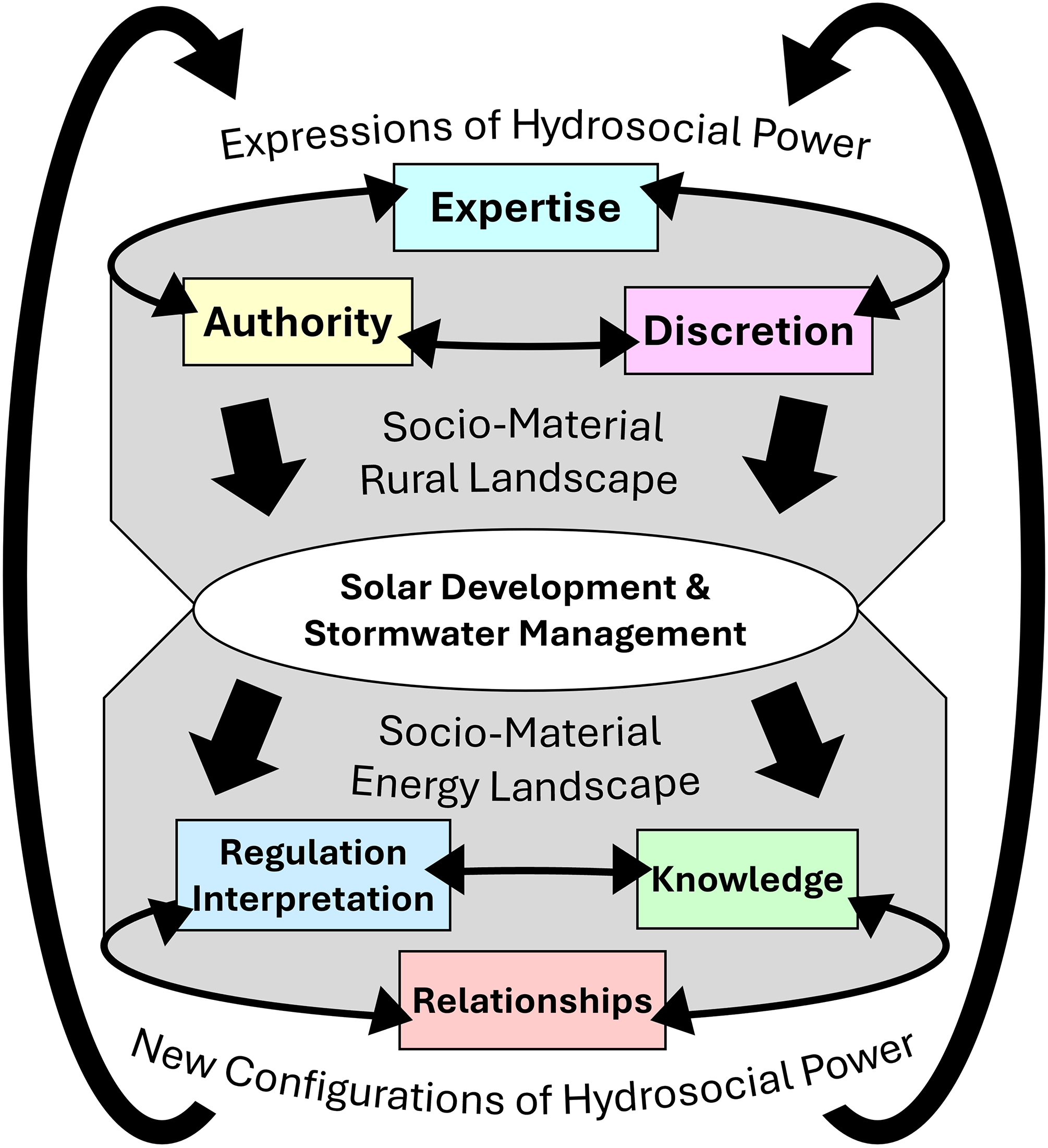
Hydrosocial territorialization process of solar energy developments (inspired by Hommes et al. (2022)).
The use of expertise to assert power in the making of hydrosocial territories has been widely discussed in other studies (Cousins, 2017; Hurst et al., 2022; Paerregaard et al., 2020). In the context of urban stormwater, “experts” operating under a “grey” epistemological paradigm may undervalue the need for meaningful community input and participation when planning green infrastructure development (Finewood, 2016; see also Dhakal and Chevalier, 2016; Wilfong et al., 2022, 2023). The resultant socio-material transformation can lead to socio-spatial reorganization such as “green gentrification” (Anguelovski et al., 2022) while leaving the hierarchies and systems of power currently extant in urban hydrosocial governance intact (Cousins, 2017; Finewood, 2016; Wilfong et al., 2023). In the context of energy development, Finewood and Stroup (2012: 76) found that rollbacks on regulation create the opportunity for private oil and gas firms to be the “legitimate source of knowledge and information” about the mitigation of adverse environmental impacts from fracking in Pennsylvania (see also Andrews and McCarthy, 2014). Crucial differences exist between the modifications to the hydrosocial cycle from fracking and solar development. In the former, water became an “economic input” and shifting authority was codified through legal statutes (Finewood and Stroup, 2012: 76). In the latter, water becomes stormwater and statutes remain unchanged, though some re-interpretation occurs through the negotiations surrounding the PADEP FAQ document. While the specific politics of expertise may vary between urban and rural contexts and different types of energy development, our study evidences a persistent need to examine the dynamic role of the expert in hydrosocial governance systems. This is particularly true given the exclusion of non-technical, local stakeholders from decision-making roles in much renewable energy development, a procedural concern in just energy transition literature (Elmallah and Rand, 2022; Moore and Hackett, 2016; Nilson et al., 2024).
Our identification of the importance of discretion is a more novel contribution and aligns with recent nature-society geography publications that argue for focusing on how discretionary actions of bureaucrats influence highly regulated environmental governance processes (Holstead et al., 2021; Tadaki and Harrison, 2025). We believe this is true in hydrosocial governance research; studies have revealed how actors with different water management goals make ‘discordant’ choices (Paerregaard et al., 2020) and may have the leeway to push the limits of what is legal to reconfigure hydrosocial territories (Duarte-Abadía et al., 2015). However, conceptualizing bureaucratic agential capacity in terms of discretion is not common in hydrosocial literature; meanwhile, studies of ‘street-level’ bureaucracy in fields such as law, economics, sociology, and political science demonstrate the usefulness of this conceptualization (Hupe, 2013; see also Fineman, 1998). Researchers in these fields identify different facets of discretion as they respectively study how street-level bureaucrats navigate “formal rules”, the influence of economic interests, personal judgment, and the interest of “the public” (Hupe, 2013). Reading across these fields, Hupe (2013) sees cause for a more holistic theory of discretion. This resonates with our work, as interviews revealed varying motivations for using discretion among actors and throughout development. However, we diverge from a framework that only assigns discretion to government employees, since the permitting process assigns roles to operators who must navigate and work within the associated bureaucratic confines. As Darling (2022) demonstrates, regulation through governance rather than government implicates more entities within bureaucracy, widening range of actors who engage in discretionary activity.
These expressions of power shape and are shaped by interactions with soil, water, and infrastructure. Site inspections- a socio-material interaction- produce knowledge about site conditions that may be interpreted as sufficient, an improvement on best practices, or a deficiency. These outcomes have immediate consequences for the project, triggering enforcement procedures, the termination of the permit, or other procedural actions. They also may have longer-term implications as knowledge is institutionalized in formal regulatory interpretations and in the creation or modification of relationships between CCDs, contractors, consultants, and the PADEP. Repeatedly, however, informants mentioned that the long-term outcomes of current practices are yet to be determined, and we can conceptualize this as part of the shifting nature of hydrosocial territories. The NPDES permitting process may initially lead to the development of a “meadow in good condition” below and between the arrays, allowing stormwater to infiltrate into the soil rather than cause runoff and erosion (Interview, CCD). However, other human and more-than-human processes may destabilize the continued production of these territorial properties. This could include rainfall exceeding that of the 2-year, 24-h storm, or the neglect of long-term PCSM maintenance. One CCD representative mentioned that already, the native vegetation on a solar site was being cut like a “lawn”, likely undermining its stormwater capturing function. However, since the NDPES permit had already been terminated, he was no longer regulating the site. Over time, therefore, the territorial configuration set in place by the process described in this paper may be eroded, reflecting the dynamic nature of hydrosocial territories (Hoogesteger et al., 2016).
Other terms used to describe vegetation characteristics, such as their capacity to be a “usable crop” or a “pollinator” species, demonstrate how actors affix certain imaginaries to these plants in ways that go beyond stormwater management. Though these imaginaries were not fully described in this study, these descriptors may indicate an expansiveness in how hydrosocial territorialization may happen through NPDES governance while exceeding its programmatic purpose. This also points to a broader need to clarify how territorialization processes and outcomes differ across different types of rural landscapes, as other studies have found that diverse rural hydrosocial systems react to territorialization efforts differently (Cantor, 2021; Hoogendam, 2019). Previously mined lands (for coal) in Pennsylvania are receiving increased attention as ideal sites for solar development and face some different stormwater management challenges from farmland, such as the presence of exposed, acid-producing rock and a lack of topsoil (LaBella Associates, 2024). Also, depending on the landscape, the presence of wetlands or cultural resources can trigger other forms of review that interact with the NPDES permitting process; these nuances and their relationship to the framework presented in this paper could be queried in case studies of specific grid-scale solar development projects.
Hydrosocial power dynamics must also be located within the context of the political economic landscape (Duarte-Abadía et al., 2015; Marks, 2019). Some informants cited political-economic conditions that primarily affected the PADEP, including understaffing from budget cuts and a perception that the current administration's “preference” for solar development results in pressures placed upon regulators to be more “lenient” in some aspects of permit review. Additionally, in discussing the enforcement action resulting from the over-grading incident, a CCD staff member reflected that the operator “picked the cheaper poison” to receive a fine rather than delay construction. This may demonstrate that financial enforcement capabilities may not be sufficient to overcome political economic factors that motivate contractors to exercise their discretion. Future research should clarify the extent to which these motivations influence NPDES bureaucracy, as new “hydrocracies” can form when the agency of regulators decreases in relation to private interests that manage water in the process of energy development (Duarte-Abadía et al., 2015). Moreover, further study could inform both policy debates about whether other aspects of grid-scale solar development should be regulated at the state-level in Pennsylvania, such as siting (Grant, 2025) and scholarship on the political economy and political ecology of devolved environmental regulation of energy industries (Baka et al., 2018; Spence, 2013).
Even as the processes and practices discussed in this paper may be modified by uncertain post-construction hydrosocial configurations, this research has uncovered a territorialization process that will play a part in regulating tens-of-thousands of acres of grid-scale solar in Pennsylvania and millions more acres across the US (PADEP, 2018; USDoE, 2021). The nation-wide reach of the NPDES program means that hydrosocial territorialization processes are shaping energy landscapes across the US in ways that are currently underexamined in energy transition scholarship. Though the specific processes identified in this paper are distinct to Pennsylvania's governance configuration, this research provides a framework that can help identify how these processes may be playing out across the country and even globally. This paper provides a path explicating how territorialization associated with energy transitions can operate through hydrosocial relations.
Highlights
National Pollutant Discharge Elimination System (NPDES) permitting and the hydrosocial relations it engenders territorialize rural Pennsylvania solar energy developments. Governance actors develop and express authority, expertise, and discretion when working with others during permitting, shaping their influence on development. Power relations are reconfigured through interactions with nonhuman components of solar developments such as vegetation and structural stormwater management practices. Future developments will be shaped by the relationships, human-nonhuman knowledge, and regulatory interpretations developed during the permitting of initial projects.
Footnotes
Acknowledgements
We would like to thank Dr Karl Zimmerer, Dr Trevor Birkenholtz, and Dr Erica Smithwick for their mentorship and feedback on an earlier draft of this manuscript that was prepared to fulfill the requirements of Kristin Schoenecker's M.S. degree. We would also like to thank Dr Zachary Goldberg and Hannah Wiseman, J.D., for their contributions to the larger research study from which this paper emerged. We thank the three anonymous reviewers for their insightful comments.
Author contributions
Consent to participate
Verbal consent was obtained from all research participants prior to participation.
Consent for publication
Not applicable.
Data availability statement
To preserve the anonymity of research participants, interview and focus group transcripts will not be made publicly available.
Ethical considerations
This study was approved by the Pennsylvania State University's Institutional Review Board (STUDY00021418).
Funding
The authors disclosed receipt of the following financial support for the research, authorship, and/or publication of this article: This research was supported by the Alfred P. Sloan Foundation (Grant #150768).
