




Abstract
In 2018, the Ghanaian government signed the Sinohydro deal, a resource-backed loan using bauxite as collateral, with Ghana's president highlighting the opportunity to develop an integrated bauxite-aluminium industry and boost industrialisation across the country. The deal has led to a number of protests against bauxite mining in Ghana, particularly at one potential site: The Atewa Forest Reserve. This paper analyses the politicisation of the Atewa Forest Reserve through the lens of political ecology. Political ecology recognises that forests are not neutral entities, but are shaped by political processes and dynamics. The Atewa Forest is seen as a political forest, as a particular constellation of power constituted by ideas, practices and institutions. The paper contends that the narrative constructed around the Sinohydro Deal strategically legitimizes mining in the Atewa Forest, positioning the project as a symbol of progress and national development. It also argues that the Sinohydro deal was designed to circumvent national environmental laws, leading to quick (political) success while being embedded in a powerful narrative. Therefore, the contestation over development is increasingly shaped by a discursive closure that limits dissent, influencing public opinion and decision-making. Despite presenting the developments as visions for the future, the narrative ultimately reinforces old development tropes of resource extraction, convincing even counter-movements to focus on the location rather than opposing bauxite mining as a whole. The findings are based on interviews conducted during fieldwork in 2018, 2019 and 2020, as well as analysis of secondary data such as political documents, press statements and speeches.
Introduction
In June 2017, the government of Ghana signed a Memorandum of Understanding with the People's Republic of China, culminating in the development of a $10 billion bauxite-for-infrastructure swap (part of which has also become known as the Sinohydro deal signed in 2018). In addition, the government announced the creation of an integrated bauxite-aluminium industry in Ghana, which is just one part of far-reaching industrialisation projects to diversify the national economy. The Sinohydro deal will enable and finance a number of infrastructure projects that are part of President Akufo-Addo's agenda: Ghana Beyond Aid. In order to finance the project, the bauxite industry will have to be scaled up, which is currently very marginal in Ghana. Several sites are being considered for bauxite mining, including the Atewa Forest Reserve. According to Schep et al. (2016), the Atewa Range contains the second largest bauxite deposit in Ghana and is covered by tropical forest, which means that the forest will have to be completely cleared if open pit mines are built. Regarding these ecological concerns, counter-narratives emanated from local NGOs and international media, contesting the idea of what constitutes appropriate development for Ghana. These counter-narratives argue, that the government's approach is environmentally destructive. In addition, there are international concerns about the role of companies linked to the government of the People Republic of China (see for example Asiedu, 2018; Gbadamosi, 2020; Oteng-Yeboah, 2019; Washington Post, 2019). While President Akufo-Addos's agenda is projected as contemporary and future-focused, in some way it reiterates existing narratives of development in Ghana that hark back to the immediate post-Independence period. During Ghana's independence years, the first President Kwame Nkrumah envisioned the establishment of an integrated bauxite-aluminium industry as an integral part of the ambitious Volta River Project. This visionary initiative represented not only a move towards political sovereignty but also a step towards economic self-reliance (see Hove, 2013; Miescher, 2014) The comprehensive project aimed to harness the energy potential of the Volta River for both industrial and infrastructural development. Unfortunately, despite Nkrumah's grand vision, only the Volta Dam was completed. These past development discourses echo the current debate and are interwoven with global narratives of modernization in a discourse of national development as modernization. Drawing back to these historic discourses, the Government of Ghana seeks to complete, what Nkrumah started. In that way, mining bauxite for the national interest is without alternative. There are already mining activities and aluminium production in the country, but now it is about adding value to this industry to boost Ghana's economy. However, bauxite mining is not a fait accompli, but it is normatively constructed as such.
The concept of Political Forests (Vandergeest and Peluso, 2015) helps to understand the production of forests, such as Atewa Forest, as contested governmental technologies of rule, territoriality, and subject formation (Devine and Baca, 2020). Especially in times of green neoliberalism (Vandergeest and Peluso, 2015) where non-state actors, especially transnational conservation organisations, gain an increasing role in governing conversation. Peluso and Vandergeest (2010) point out, that these organisations make claims that challenge the exclusivity of state jurisdiction. The NGO A Rocha Ghana, with a local office at the Atewa Forest Reserve, is advocating an upgrade of the Forest Reserve to National Park status. However, since the government of Ghana decided to make use of the bauxite resources, the state is seeking to (re-)gain control over the space. The paper employes a Foucauldian concept of power which has influenced poststructural theorizing of Political Ecology (Foucault 1980; 1995), arguing that power operates through discourses and disciplining institutions.
As I will show in the following sections, institutional arrangements in the form of new organisations create hierarchies and a certain order of things which enhances control over space. Moreover, the mining of bauxite is embedded in a national narrative, which is linked to other global narratives about modernisation and industrialisation and is therefore particularly powerful. In the following sections, the paper examines the fluid and evolving discourses around bauxite to capture the ongoing, emergent, and contingent aspects of environmental discourses, providing a more nuanced understanding of the evolving relationships between people and the ecosystems they inhabit. Drawing on these concepts, I will elaborate in what follows how the Atewa Forest becomes politicised as the bauxite resources underneath the surface increase in importance to the government of Ghana.
This paper argues that President Akufo-Addo's policy decisions during his first term have triggered the politicisation of the Atewa Forest Reserve. The mining plans are strategically justified through the construction of a purposeful narrative about industrialisation, modernisation, and independence from foreign aid. A closer examination, drawing on poststructuralist approaches to political ecology, reveals how the discourses surrounding the Sinohydro deal have been deliberately crafted. Discourse functions not only as a reflection of political choices but as an active agent shaping political and environmental realities.
Applying the notion of ‘becoming’ (Zimmermann, 1933), we can understand the dynamic nature of this discourse. It is not a static representation, but an evolving process that constantly adapts to changing political landscapes and power dynamics. Poststructuralism rejects the idea of fixed, essential identities and characteristics. In the context of environmental conflicts, this means that concepts such as ‘nature’ and ‘environment’ are seen as socially constructed and fluid (Demeritt, 2002; Richardson and Weszkalnys, 2014). The understanding of what constitutes an environmental issue is subject to ongoing negotiation and contestation (Le Billon, 2015). In addition, poststructural Political Ecology argues that power operates through discourses and disciplining institutions (e.g., Foucault, 1980; 1995), influencing how environmental issues are framed, understood, and acted upon (Ahlborg and Nightingale, 2018; Bassett and Peimer, 2015). There are multiple meanings of the concept discourse. Following Ahlborg and Nightingale (2018), discourse refers to sets of interlinked expressions, statements, and concepts. From a poststructuralist viewpoint, discourses are socially shared perspectives on a topic. Discursive power is exercised when actors produce discourses and manage to get other groups to adopt and contribute to the reproduction of their discourses (Svarstad et al., 2018). Actors shape projects based on different knowledge and worldviews, but also in defining what the underlying problem is and how it should be solved. Ahlborg and Nightingale (2018) argue that actors select strategies and framings in their communication to justify decisions. The article uses this analytical approach to argue that the narrative constructed around the Sinohydro Deal not only serves to legitimise mining activities in the Atewa Forest but also strategically positions the project as a symbol of progress and national development.
In this paper, the Atewa Forest Reserve is analysed as a political forest (Vandergeest and Peluso, 2015), which produces and is a product of political-ecological relations in physical, ideological, discursive and institutional terms, as well as being positioned in the claims of governing bodies. The article argues that examples such as Atewa Forest demonstrate how contestation over development is increasingly shaped by a discursive closure that limits the possibilities for dissent. The construction of such discourses and related narratives influence ways of thinking, public opinion, and thus decision-making (Svarstad et al., 2018). Although the narrative about the development of the Atewa Forest are presented as visions for the future, they end up repeating old tropes of resource extraction. A narrative, in this context, is a specific form of discourse that involves the unfolding of a story. Therefore, a Narrative is one way in which discourse can be organized and conveyed. In the end, the narrative about national development as modernisation through industrialisation was so convincing that even the counter-movements were not against bauxite mining per se, but only against the fact that it is taking place in the Atewa Forest.
Methods
Political Ecology case studies aim to follow webs of relations across scale. The analysis of practices, narratives as well as discourses can uncover less visible structures in order to follow the web of relations across scales and space-time (Helmcke, 2022). I used several methods to infrom the case study, including: qualitative interviews, document analysis and archival work. For the document analysis, I considered the Sinohydro Deal, political texts, speeches, or regulations. In addition, the archival work helped me to place the conflict in a broader historical context. The data were collected throughout fieldtrips in March 2018, March 2019 and March 2020. The interviews with state actors were designed as informal interviews. Informal interviews are unstructured and, according to Bernard (2006), they are also framed in social science as ethnographic interviewing. Burgess (1984) refers to this method as ‘conversations with a purpose’ (1984: 102). In addition, Swain and Spire (2020) highlight that informal interviews provide opportunities to add context and authenticity to other collected data. However, this method is also commonly used to gain trust and set up relationships with the actors involved. With the help of several informal interviews, the field of relevant actors could be established further key informant interviews conducted. With several questions already in mind, as well as background information collected beforehand, I could develop follow up with formal interviews. Considered institutions were the Minerals Commission, Forestry Commission, Ministry of Land and Natural Resources, Ministry of Environment, Science, Technology and Innovation as well as the Environment Protection Agency (EPA). Additional documents that I analysed were provided by an environmental scientist from the University of Ghana who also recommended other sources, including: A Rocha Ghana (an international environmental NGO with offices in Ghana and who lead in organising actions to protect the Atewa Forest); the Geological Survey Authority; the Mineral Commission; and Volta Aluminium Company Limited (VALCO). I focus my work on the first term of President Akufo-Addo (2016 to 2020) in which there was no bauxite mining in the Atewa Forest Reserve, but the emerging discourse and conflict could be observed in situ.
Ghana's Bauxite-Aluminium Industry and the Atewa Forest Reserve
Ghana's bauxite gained particular importance in the Volta River Project (VRP) during the 1960s, which included a hydroelectric dam, an aluminium smelter to process mined bauxite, new cities, a deep-sea harbour, and other infrastructural investments (Hove, 2013; Miescher, 2014). Under Ghana's first president, Kwame Nkrumah, the VRP became a symbol of a sovereign and independent Ghana, promising rapid industrialisation and reducing the country's dependence on cocoa exports. After the 1966 coup, Britain showed little interest in developing the bauxite-aluminium industry, and bauxite production has fluctuated in recent years due to an inadequate railway system for transporting ore from the mine to the coast. Bauxite has only been mined at one site, near Awaso, since 1944 (see Figure 1).
In 2010, the cost to transport bauxite along the outdated railway network became so high that the Canadian company Rio Tinto (until 2007 Alcan) decided to sell its stake in Ghana Bauxite Company Limited to the Chinese Bosai Minerals Group (Bertolli, 2010; Knierzinger, 2016). When the Bosai Group took over, continued difficulties with low efficiency and high costs of transportation led to a further decrease in production. From 800,000 tonnes in 2008 to 500,000 tonnes in 2010, and around 400,000 tonnes in 2011. By 2012, the company decided to transport bauxite by road rather than rail network (Oxford Business Group, 2013). In early 2011, the smelter restarted operations at about 20% of its full capacity, producing 3,000 tonnes per month, mostly for local consumption (Knierzinger, 2016). In addition, since 2012 bauxite production increased again to approximately 1.5 million metric tonnes in 2017 (Statista, 2024). Over the years, Western companies withdrew more and more from the bauxite and aluminium sector, due to the economic situation and inadequate infrastructure. By the beginning of the second decade of the twenty-first century bauxite, once described as ‘Ghana's most useful resource’ (Hart, 1977: 22), seemed to have surprisingly little economic importance for the country.
As well as issues with profitability, bauxite mining has increasingly become controversial in countries like Ghana because of concerns with environmental impacts. Indeed, even in countries where there is a large bauxite industry, the environmental impacts are significant. According to Ingulstad et al. (2013), in order to produce 1 tonne of aluminium, mining generates 10 tonnes of waste rock and 3 tonnes of toxic red mud. The highly corrosive and saline red mud is typically stored in artificial holding ponds, but when these repositories leak or overflow (which can easily happen because of heavy rains), it can contaminate soil, groundwater, and surface water. Furthermore, this leads to fish die-off and health risks for the local population.
One of three possible mining sites is Atewa Forest Reserve at Kibi (Figure 2) provides an overview of the Forest Reserve and highlights bauxite explorations in 2019. The Atewa Range, at 842 m, is one of the highest forested hills in Ghana, along with the hills of the Southern Scarp and the Nyinahin Range (Swaine and Hall, 1977). It is characterised by a series of plateaus, which are remnants of a tertiary peneplain (McCullough et al., 2007). The Atewa Range is an important watershed where three major rivers, the Densu, Ayensu and Birim, originate. The Densu River is part of Ghana's coastal river system and is one of the two main sources of water for the Accra metropolitan area (Schep et al., 2016). According to the Ghana Wildlife Society (2018), over 5 million Ghanaians depend on water from these three rivers. Environmentalists, as well as local officials, have criticised plans for bauxite mining in the Atewa Forest (Purwins, 2022) as they fear deforestation, water pollution and other environmental damage that will especially affect the local population.
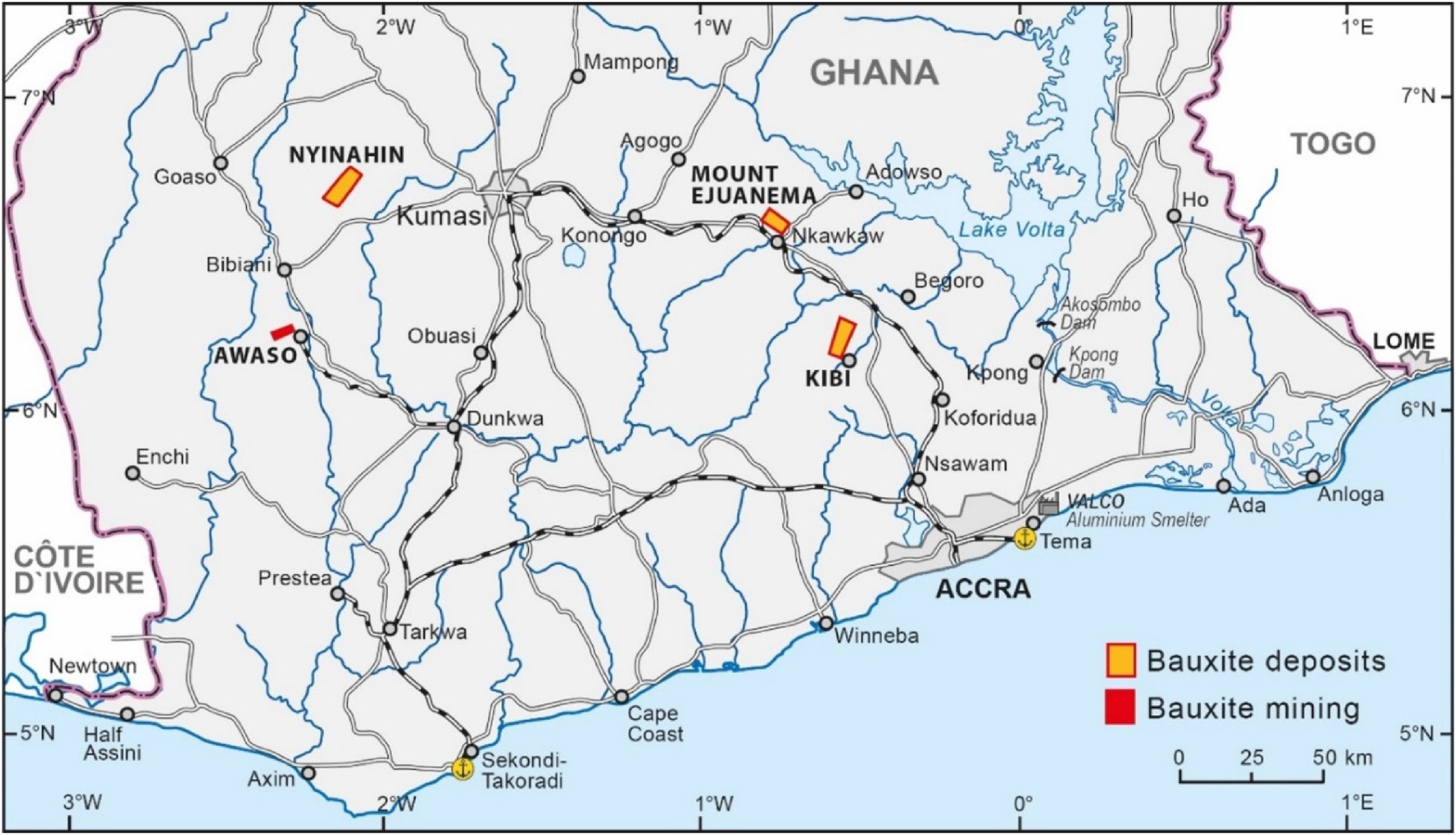
Geographical representation of Ghana's bauxite-aluminium industry (author's own source).
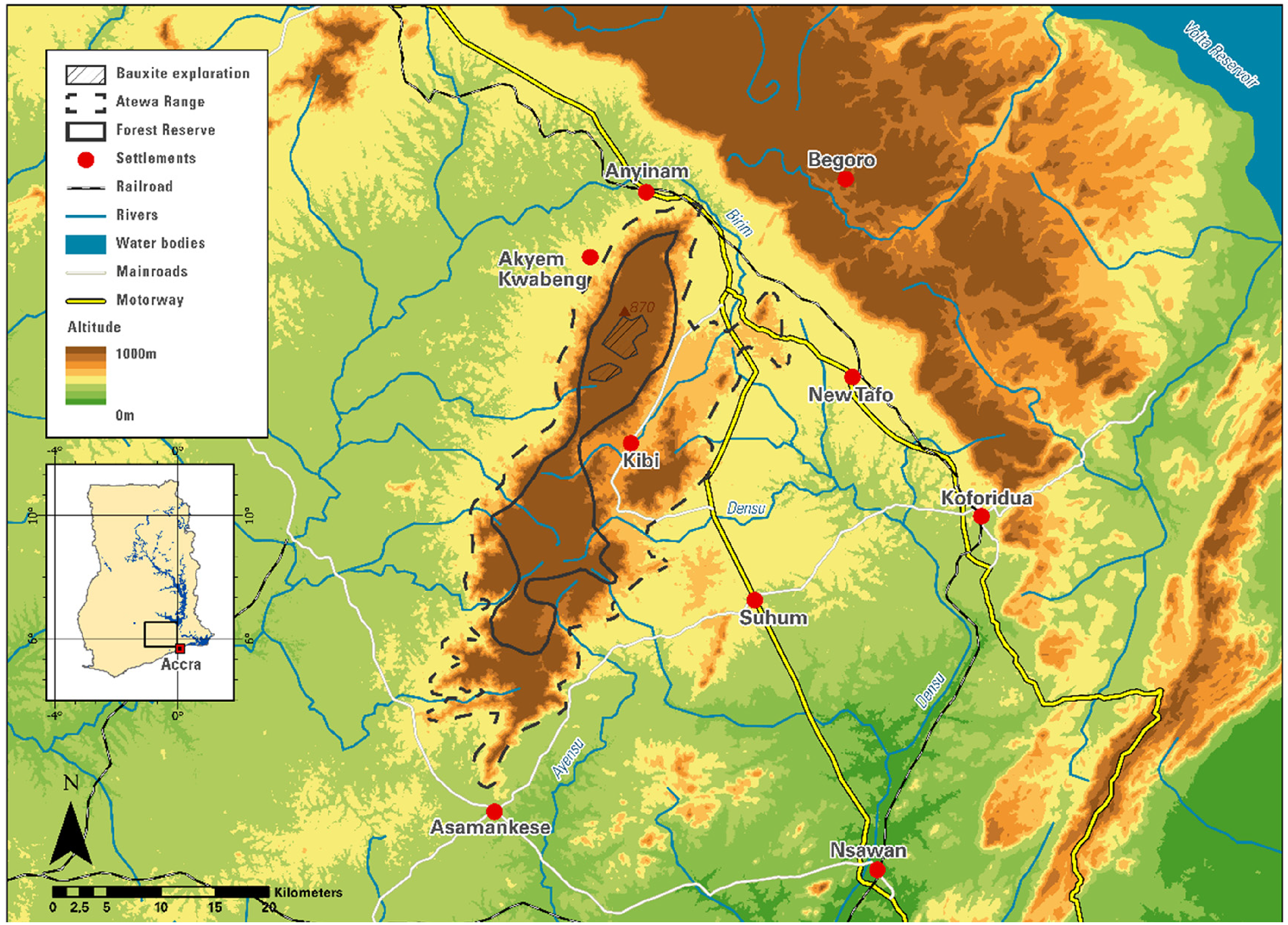
The Atewa Forest Reserve, a geographical overview (author's own source).
The Atewa Range Forest Reserve is not only recognised as a watershed but is also known to constitute the largest and most intact patch of upland evergreen forest in Ghana (Ayivor and Gordon, 2012). The reserve is one of only two in the country with upland evergreen forest (Abu-Juam et al., 2003; Hall et al., 1981). Due to its uniqueness, it has changed status over the years as a special biological protection area in 1994, a hill sanctuary in 1995, and as one of Ghana's 30 globally significant biodiversity areas (GSBAs) in 1999. In 2001, BirdLife International listed Atewa as an ‘important bird area’ (IBA) (Abu-Juam et al., 2003; McCullough et al., 2007). Since the area is declared as a forest reserve, some communal rights are granted: farming within the reserve (admitted farms), collecting forest products (including building materials, canes, vines, ropes, pestles, palm trees, snails, mushrooms, chewing sticks, medicinal plants, game and wildlife), receiving a share in timber royalties resulting from forestry on privately owned land, accessing sacred places, establishing hunting camps and washing for gold (McCullough et al., 2007).
According to Schep et al. (2016) around the forest reserve, there are ecological risks due to legal and illegal gold-mining activities. While gold concessions lie outside of the reserve, there are emerging concerns about small-scale operations (galamsey) within the forest. Such small-scale activities can be permitted as part of larger gold concessions, or they are illegally carried out. However, there is little information on this topic because observation is difficult and minor operations are not always recorded. In addition, intensive farming, and illegal logging cause further problems with erosion (Ayivor and Gordon, 2012). The Atewa Forest Reserve is therefore exposed to several stressors, such as small-scale illegal gold mining and illegal logging activities. Nevertheless, the possible bauxite deposits are in the high peaks of the forest reserve, and so their mining would cause deforestation and erosion on a large scale. Political Ecology offers a perspective from which to analyse the struggle over land, how different actors use different strategies to reach their goal, and how they use justify decisions. In the next section, I will outline how political ecology can help to understand the various aspects of the conflict concerning prospective mining at the Atewa Forest Reserve.
Political Ecology
Conflicts emerging from resource extraction and biodiversity conservation, as well as their interactions, are an ongoing concern in Political Ecology (Adams, 2017; Büscher, 2021; Büscher and Davidov, 2016; Enns et al., 2019; Huff and Orengo, 2020; Norris, 2017; Purwins, 2022; Symons, 2018). Political Ecology is a framework, to assess human–environment interactions, human decisions, and therefore impacts on the environment. Political ecology frequently criticizes mainstream approaches to understanding ecology (or the environment) because it sees these approaches as lacking knowledge about the ontology of life and because of the will to power that acts as a compulsion to dominate nature (Leff, 2021). In this regard, Tan-Mullins (2017: 17) argues that Political Ecology proves to be useful to ‘investigate actors interests and how they determine the behaviour of actors operating at a variety of scales influencing local interaction with environmental resources’. Pijpers (2019) and Bridge (2019), argue that the recent growth in studies and publications on resource extraction indicates an ongoing concern to seek a better understanding of extractive practices and their social, economic, political, and environmental effects around the world.
However, Political Ecology conceptualises the environment as an arena in which oppositional conflicts unfold. Agrawal (2005) argues that this imagination of an arena often turns into the assignment of credit and blame. Furthermore, actors are often divided into winners and losers. As Dietz and Engels (2018) similarly point out, that there is an ongoing dualism (e.g., winner and looser; state versus the people) when it comes to struggles over land. In addition, actors in conflicts over resources are often framed as homogenous groups like ‘the local’ versus ‘the state’ (Dietz and Engels, 2020). Carpenter (2020) argues this dualistic perspective oversimplifies and especially overlooks the exercise of power and political asymmetries in such conflicts over land and resources. Such linear and dualistic explanations suggest, rather than investigate, global and local linkages. The dynamics, actors and subject matter associated with conflict are related to a variety of individual factors. They are understood as a particular constellation of power constituted by ideas, practices and institutions that seek to regulate access to resources, granting legitimacy to some whilst excluding others (Elmhirst. 2011). Vandergeest and Peluso (2015) conceptualize political-ecological sites of contested regimes of rule and governmental practices that define and shape the relationship between people, territory, resources, and identity, as political forests. However, areas can consist of multiple overlapping, intersecting and conflicting political forests, rather than a single political forest (Marijnen and Verweijen, 2020).
The aim is therefore to understand the complex situation with different interests and conflicts and to provide a political ecological account of the Atewa Forest. Moreover, it is important to notice, that the state is not a single entity, but a network of organisations and individuals, often working towards conflicting goals. Within the field of political ecology, Marijnen and Verweijen (2020: 3) argue that the state is more and more conceptualised in ‘increasingly sophisticated manners, transcending previous monolithic understandings’. The state is not only seen as an institutional fabric with more or less stable structures but also as in itself a contested field of power (Dietz and Engels, 2017). Conde and Le Billon (2017) point out that emphasis should be placed on the internal dynamics of the state. Moreover, Bates (1975) highlights the role of intellectual leaders in shaping public opinion by using storylines which influence the cultural and political background.
Political ecology evolved with a strong focus on how power manifests in both discursive and material struggles regarding the environment (Forsyth, 2008; Robbins, 2012). It emerged as a way of criticising the reductionism of neo-Malthusian explanations of land degradation, or the notion of land degradation itself (Blaikie, 1985; Watts, 1983). This fusion of political-economic and cultural-ecological perspectives became known in anglophone geography as political ecology (Bassett, 1988; Blaikie and Brookfield, 1987). Political ecology rejects the hypothesis that as a result of greater environmental scarcity or a lack of resources, conflicts will increase; rather, it assumes that all human decisions are inherently political (Adams, 2015). The transformation of nature into a resource is a historical process of social construction which is related to human desires, needs and practices, as well as the conditions, means and forces of production (Harvey, 2004). Karlsson (2016) points out, that the meaning and uses of forests are not fixed but constantly evolving. He challenges the notion of nature as something inherent and given, instead arguing that human ideas about and utilization of nature are socially constructed and subject to change. Likewise, this article aims to point out that forests are not neutral spaces but are co-created through political and social interactions, influenced by various actors and forces at different scales. Political Ecology is interested what scale (national, global, etc.) is privileged in how we understand a particular issue, and who gets to decide at which level the issues is discussed.
In the context of extractive and conservation conflicts, the general questions posed by political ecology are who decides, how minerals, ores or metals are used and/or socially appropriated, and for what purposes, and whose interests do mining activities serve? (Dietz and Engels, 2017). Although there are a range of different approaches within Political Ecology, all of them emphasise power relations; that is, the notion that ecology is a social relation. It also emphasises the nonequilibrium characteristics of socioecological systems. Political Ecology is about recognising the power that actors have at the moment of deciding what, how, and where to conserve (García-Frapolli et al., 2018). Power is therefore at the core of political ecology (Svarstad et al., 2018). Ahlborg and Nightingale (2018) argue that actors are not in power nor do they hold power. Power is evident in relational, performative moments and produced in encounters between spaces, actors, discourses, institutions, knowledge, and practices across multiple levels (Li, 1999). Discursive power and Institutionalisation will play a decisive role in this paper. Institutionalization as a concept is understood as the process of structuration and stabilization by which policy arrangements are produced (Arts et al., 2000). Structuration highlights the mutual relationship between structures and human agency, emphasizing the dynamic nature of this interaction. Stabilization, on the other hand, underscores the need for order and resilience within institutionalized systems, ensuring their continuity and adaptability in the face of changing circumstances. Together, these concepts provide a nuanced understanding of how institutions are formed, maintained, and transformed over time. Furthermore, institutionalization plays a pivotal role in the production of policy arrangements, serving as a framework that guides the formulation and development of formalized plans and decisions. In essence, this study recognizes institutionalization not as a static state but as an intricate and continuous process integral to understanding the evolution of policy frameworks within a given context.
Furthermore, Ahlborg and Nightingale (2018) distinguish between power as human agency and constitutive power. The latter is understood as the pressures emerging through network dynamics and multiplicities of interactions. Constitutive power originates in discourses and institutional arrangements that produce and stabilize hierarchies (Ahlborg and Nightingale, 2018). As I will show in the following sections, institutional arrangements in the form of new organisations create a certain order of things and therefore pressure on executing the project to build an integrated bauxite-aluminium industry. Moreover, mining bauxite in the Atewa Forest Reserve is embedded in a national narrative, which is linked to other global narratives about modernisation and industrialisation and is therefore particularly powerful. This poststructuralist approach recognizes that discourses are not simply reflections of existing power structures but are actively involved in constructing and shaping those power relations. Poststructuralist Political Ecology critically examines how narratives, and representations contribute to the production of knowledge and the formulation of environmental policies. Discourses, much like the environment they describe, are fluid and constantly evolving. They are not fixed representations but are rather processes of becoming, reflecting the ever-changing interactions between society and nature. As Erich Zimmermann (1933) asserts, resources are not; they become. In the process of becoming, resources are neither fixed nor finite, but are socio-ecological relations in flux which are constantly becoming. This perspective invites the analyst to move beyond fixed representations and, instead, embrace the complexity and dynamism inherent in the interactions between human societies and the environment. By doing so, Political Ecology can better capture the ongoing, emergent, and contingent aspects of environmental discourses, providing a more nuanced understanding of the evolving relationships between people and the ecosystems they inhabit.
Atewa Forest Reserve as Political Forest
The Atewa Forest Reserve becomes because people understand and contest sets of material components and features of it through political processes. As such, following Vandergeest and Peluso (2015), the Reserve can be viewed as a political forest, highlighting its socio-political dimensions. Political forests are usually legislated, demarcated, and managed by state forestry institutions. However, more recently they are also protected and managed by non-state institutions, a development which has been labelled as the fourth moment in the historical evolution of political forests (Vandergeest and Peluso, 2015). This reflects the rising influence of international non-governmental organisations and multilateral aid donors, transforming the forest in a trans-nationalised space (Marijnen and Verweijen, 2020). In their paper, Marijnen and Verweijen (2020), highlight the need to analytically disaggregate the state in order to grasp the complexities of the fourth moment in the historical evolution of political forests, away from central state domination. They argue that the influence of central state authority cannot uniquely be ascribed to neoliberalisation. Indeed, it is also the result of regional warfare, militarisation and the rising regulatory influence of customary chiefs and patronage networks (Marijnen and Verweijen, 2020).
Devine and Baca (2020) label the fourth moment of political forest development as green neoliberalism. They use this term to describe an era of global environmental governance characterised by market-based solutions to socio-ecological problems accompanied by the rise of conservation, biodiversity protection, watershed management and eco-tourism. Vandergeest and Peluso (2015) also point to the rise and role of non-state actors producing and managing political forests, in particular non-profit, non-governmental conservation organisations. The efforts of the NGO A Rocha Ghana to redesignate the Atewa Forest Reserve as a National Park epitomises these observations. A Rocha is an international network of environmental organizations with a Christian ethos and a national office in Ghana. While they are not involved in managing the forest reserve, they still challenge how the political forest is (re-)produced.
Besides many attempts to mine bauxite, ongoing illegal logging, hunting and small-scale gold mining are damaging the forest and its ecosystems (Ayivor and Gordon, 2012). An important step to achieving better protection was to upgrade the reserve into a National Park. In 2013, A Rocha Ghana organised a national summit on the Atewa forest with all the key stakeholders, including the Forestry Commission, the Water Resources Commission, as well as the Minister of Lands and the Minister of Environment. The main outcome of the summit was a consensus that it was important to protect the forest and that no future government should go in there and mine bauxite. In the Foreword to the study by Schep et al. (2016: 7), the Minister of Land and Natural Resources at that time, proclaimed, that Atewa Forest should be upgraded as a National Park. Between 2013 and 2016, the Forestry Commission, the Water Commission, and the Ministry of Lands began the process of preparing the necessary documents in order to declare the Atewa Forest Reserve a National Park. Eventually, a letter of approval was sent to the cabinet. However, the general elections in 2016 thwarted these plans.
In the election of 2016, Akufo-Addo and his New Patriotic Party (NPP) defeated the sitting president (Mahama from the NDC). During the campaign, the NPP had declared it would leverage Ghana's bauxite resources to build an integrated bauxite-aluminium industry in order to create jobs and industrialisation. In this evolving political landscape, the new administration withdrew from plans to upgrade Atewa to a National Park and in June 2017 entered into a Memorandum of Understanding with the People's Republic of China that would culminate in the development of a $10 billion bauxite operation in return for new infrastructure, part of which is also known as the Sinohydro Deal. It is important to highlight that, out of these high-level negotiations, the agreement to build infrastructure in exchange for refined bauxite is between the government of Ghana and the Chinese company Sinohydro. Purwins (2023) points out that this case is another example for China's state-owned enterprises (SOEs) increasingly investing their own capital to build and operate infrastructure projects.
These developments led to protests, which were mainly organised and promoted by the national team of the international organization A Rocha. In addition, a group calling themselves Concerned Citizens of Atewa Landscape formed in 2018 to prevent bauxite mining in the forest. They are made up of people from civil society organisations, youth groups, interfaith groups, farmer-based associations, opinion leaders and community leaders. This group is separate from A Rocha Ghana and yet there are overlaps. They support each other and A Rocha Ghana, as a more established NGO, has other opportunities. Scheidel et al. (2020) argues that such movements, as well as people living in affected areas, are the two most frequent actor groups mobilizing to defend their environment. Furthermore, Scheidel et al. (2020) distinguish between non-violent actions and potential violent responses. Among the non-violent actions, they describe three categories: (a) non-violent protest and persuasion (such as petitions, public campaigns, street protests), (b) non-cooperation (e.g. strikes and boycotts) and (c) non-violent interventions (lawsuits, blockades, and EIA objections). However, the authors conclude that combining different forms of strategies is more likely to be successful, as the NGO A Rocha Ghana did (with the exception of non-cooperation). They initiated and promoted several non-violent protests against government plans. In March 2018, for example, the group started a six-day walk from the Eastern Region to Accra to protest against mining plans in the Atewa Forest Reserve and to present a petition to the government. By 2020, they had intensified their protests in various ways. In addition, some youth groups in the Ashanti region have vowed to stop bauxite mining in the Nyinahin Forest Reserve, another major bauxite site in Ghana. A Rocha Ghana galvanized all these organisations and movements into a coalition, bringing forward a non-violent intervention in form of a petition and suing the Ghanaian government for failing to comply with environmental laws.
Inadequate Environmental Protection
The environmental laws in Ghana come in the form of environmental impact assessments (EIAs) and strategic environmental assessments (SEAs), which are also very common in other countries (TCI, 2018). An EIA requires an analysis of the possible impacts that a proposed physical development would have on the environment, as well as on human wellbeing. In general, these assessments must be done before starting a project (Neal and Losos, 2021). Based on the results, the project needs to guarantee certain changes and implementations. An SEA is the systematic and comprehensive process of evaluating the environmental effects of government policies, programs, or plans (EPA Ghana, 1994; TCI, 2018). The Environmental Protection Agency (EPA) in Ghana permits projects (governmental as well as private) if they undertake an EIA and can prove that they will have no significant impact on the environment and public health. At this point, the question arises as to why the Ghanaian government has not undertaken a formal assessment of the agreement's potential environmental impacts. The requirement for a formal assessment does not apply to negotiations of agreements; in addition, an SEA will only be triggered if government plans are likely to affect the environment. However, the Sinohydro deal is crafted in such a way that it does not mention at any time the development of an integrated bauxite-aluminium industry – it is only agreed that Ghana will use refined bauxite as collateral. Moreover, the Sinohydro deal does not describe how Ghana will meet its contractual obligations. EIAs and SEAs have thus not been invoked and the Sinohydro deal has, in effect, bypassed environmental laws.
However, the Environmental Protection Agency has the duty to undertake or require assessments, but political pressure may have led to other decisions. The president can appoint the EPA's board members and its Executive Director, who manages the daily business of the agency (EPA Ghana, 1994). It proved difficult to assess the political influence applied to the EPA, as several attempts to speak with a relevant key informant were fruitless. However, in 2019, the EPA Executive Director expressed publicly that the EPA would approve the proposed bauxite projects because they had the president's support (Africa News Radio, 2019). The NGO A Rocha Ghana has also stated that explorations in the forest are already taking place and do not meet official regulations. They argue that in order to clear a forest area to start preliminary explorations, it needs an EIA first but, even more critically, it is prohibited in protected reserves according to the Environmental Guidelines in Mining in Production Forests (A Rocha Ghana, 2020). In July 2020, civil society organisations (CSOs) including A Rocha Ghana (ARG) took the Ghanaian government to court to overturn plans to mine bauxite in the Atewa Range Forest Reserve. However, the Attorney General dismissed the case, declaring that the adoption of responsible and sustainable mining practices would justify proceeding with the project (Ghana Business News, 2020). The circumstances mentioned above illustrate that the administration seemed to aim for a fast and quick implementation of the Sinohydro to get infrastructure built very quickly. The required EIA or SEA would have led to delays in negotiations, and so the signed deal was crafted to bypass these regulations. Furthermore, the EPA is not an independent administration but is a government agency under the influence of superior government bodies such as the ministry and even the president. This meant that the EPA ignored many calls from national activists, aligned with international demands, to carry out an assessment.
Meanwhile, building refineries and new mines in the future will require EIAs, but carrying out assessments after the deal has been signed is a very risky undertaking for the administration. In addition, many infrastructure projects are already in the construction phase and may be finished soon. At this point, the government cannot back out of the Sinohydro deal, because the condition of the agreement requires bauxite as collateral.
The NGOs’ protests and official requests were never publicly answered or acknowledged by the government. Instead, the government focused on the introduction of new regulations and institutions. In 2018, the administration forwarded a bill to Ghana's Parliament in order to establish the Integrated Bauxite and Aluminium Authority. This bill will set up the legal framework for the regulation of this industry. Hierarchies, representing the vertical arrangement of authority, play a pivotal role in formalizing roles and power dynamics within institutions. Structurally, they embody the ongoing interplay between structures and human agency, as individuals engage with and shape these hierarchical systems. Simultaneously, hierarchies contribute to stabilization by providing organizational order and clarity, facilitating efficient decision-making and fostering resilience in the face of change.
The Integrated Bauxite and Aluminium Development Authority Bill states that the Authority to be established will manage Ghana's bauxite resources (Clause 3 (b) of the Integrated Bauxite and Aluminium Development Authority Bill). Local NGOs (calling themselves the ‘Coalition against bauxite mining at Atewa Forest’) pointed out during this period that the Authority was unconstitutional. The constitution states that the Minerals Commission has a mandate to formulate recommendations on national policy for the exploration and exploitation of mineral resources. The functions of the Integrated Bauxite and Aluminium Development Authority are already vested in the Minerals Commission1. The Integrated Bauxite and Aluminium Development Authority Bill states that the authority will work with, but not regulate, the Minerals Commission. The coalition against bauxite mining in the Atewa forest fears that such an authority would have the power to ignore existing social and environmental regulations. However, their main argument is that the authority would be unconstitutional. Similar concerns are highlighted in a position paper by the N
The Ghana Integrated Aluminium Development Corporation (GIADC) was set up by parliament (established through Act 976 in August 2018) as a commercially based independent SPV (special-purpose vehicle) in charge of developing and managing the country's bauxite reserves (IMF, 2019). GIADC oversees organizing bauxite mining in the country and sets up plans to build refineries and required infrastructure. It is also in charge of entering into joint venture partnerships with investors for mining and refining. The GIADC board consists of representatives of the Integrated Aluminium Industry, members of parliament, a representative of the Ministry of Finance, the chief from Nyinahini, a representative of the Minerals Commission and a representative of the Association of Ghana Industries. Its Chief Executive Officer was a former senior vice-president of the Dell Corporation. The GIADC is a further institutional arrangement to produce and stabilize hierarchies. It adds another layer to the hierarchy, further distancing the President from the direct issues and opposition on the ground, as well as handing over responsibilities. GIADC currently has the government's entire shares in two existing companies – Volta Aluminium Company Limited (VALCO) and Ghana Bauxite Company Limited. Overall, the project to develop the integrated bauxite-aluminium industry is thus consolidated so that a new government cannot simply withdraw from the project even after an election.
Discursive Power
Having outlined how shifts in legislation and the formation of new institutions created a new regulatory environment that facilitated circumventing existing norms around sustainable mineral development, this section returns to the discussion of how the discursive construction of mineral development was integral to broader shifts in the geopolitics of Sino-Ghanian relations. In 2017, at the 5th Africa CEOs Forum, Ghana's President Akufo-Addo announced, ‘We want to build a Ghana beyond aid; a Ghana which looks to the use of its own resources’. (Communications Bureau, 2017: n.p.) and outlined an agenda, that he introduced in 2018 during his speech marking the 61st year of Independence. Ghana Beyond Aid is about the idea of transforming Ghana from an ‘underdeveloped country to a confident and self-reliant nation’ (Government of Ghana, 2019: n.p.). Infrastructure projects are an important part of the Ghana Beyond Aid agenda. For example, the building of roads, bridges, hospitals, or residential buildings. These projects are in line with the agreements reached in the Sinohydro deal. Sinohydro is thus building the infrastructure promised under the Ghana Beyond Aid Agenda. Bauxite mining and the development of an integrated aluminium industry in Ghana are linked to the Sinohydro deal and the President's agenda. Bauxite mining has made itself a project without alternatives from the government's perspective because: (a) it enables Ghana to establish an integrated Bauxite-Aluminium industry with the attempt to export higher levels of manufactures; and (b) it enables a deal with the Chinese company Sinohydro which leverages loans to finance projects of the Ghana Beyond Aid Agenda. This double dimension of being the material foundation for Ghana Beyond Aid and being embedded within this vision highlights the importance of this project and leads to circumstances where the governments seem to have no alternative to expediting it. However, the Sinohydro Deal and development of the bauxite industry in Ghana is, in effect, a project of political leaders and elites. Kumi (2020: 87) elaborates on the public perceptions of Ghana Beyond Aid and highlights that the agenda is ‘the desire of the governing elites to promote development through structural economic transformation by reducing their dependence on foreign aid’. Whether the Sinohydro deal can be used as an example for state capture in Ghana cannot be assessed conclusively, however. State capture is a type of systemic political corruption in which private interests significantly influence the decision-making processes of a state for their own benefit.
The rapid implementation of the Sinohydro deal, in which environmental regulations were bypassed, also enabled the government to achieve quick results. Neal and Losos (2021) argue that the Sinohydro Agreement thus demonstrates that the government is prioritizing fiscal and economic factors to the detriment of national environmental protection. Development is discursively framed by powerful actors in such manner that economic and financial interests take precedence over environmental considerations. This skewed prioritization is particularly evident in the way the relationship between forests and bauxite is socially and politically constructed. Powerful actors, driven by economic motives, tend to frame development in a manner that sidelines environmental concerns.
Fewer than 18 months after the negotiations concluded, road construction projects were underway. The important aspect here is that Ghana's President Akufo-Addo needed to show very quickly that the Sinohydro deal was worth the critical environmental and financial risks. Looking at the location of the prioritized projects, it appears that almost every administrative region in Ghana would benefit. If people see positive development in their region, they may be less concerned about criticisms from national as well as international environmentalists and the media, especially because 2020 was an election year and many roads would be finished – or at least under construction – within the first term of Akufo-Addo's presidency.
In parallel, infrastructure for the integrated bauxite-aluminium industry needed to be set up, and this would be best served via the railway. Therefore, Ghana signed several agreements with China Railway Wuju Group Corporation and China Civil Engineering Construction Corporation (Ministry of Railways Development of Ghana, 2019a, 2019b), to renew and extend its existing railway network. While the Sinohydro deal would serve public infrastructure projects across the regions, the government agreed on new loans to finance this construction to serve industry better. However, this would deepen the country's dependency on China as well as increase pressure in terms of the success of these projects. The establishment of the bauxite refinery to complete the aluminium value chain was, therefore, an important aspect of Akufo-Addo's presidential campaign in 2020 (NPP, 2020). With the Sinohydro deal and the developed vision Ghana Beyond Aid in 2018, the project took on a high degree of salience politically. In this context, it attracted more powerful political legitimisation, being now coupled with the vision of a nationwide industrialisation, modernisation and a self-reliant nation. This can be interpreted as an attempt to frame a discourse of national development, referring back symbolically to Ghana's first President Kwame Nkrumah. He had the vision of developing an integrated bauxite-aluminium industry to modernise the nation and not only to gain political souvereinity but also economic independence. However, this vision never became fully realised (see for example Miescher, 2014). Therefore, it is not the first time that bauxite is acting as a symbol of industrialisation and modernisation. The narrative thus only becomes stronger, as it refers to a collective past and, at the same time, ties in with global discourse. The choice of scale in discourse construction is significant. Political Ecology analyzes how certain scales are highlighted or obscured in environmental narratives. For example, the discourse that emphasizes the global modernisation narrative as well as the reference to past narratives about independence overshadows the local impacts of the development project, influencing public perception and policy decisions. This makes it difficult for counter-movements to make their case because who could possibility be against a Ghana Beyond Aid? It is for this reason that the NGO A Rocha Ghana never states explicitly that it is against bauxite mining per se.
At this point, excluding the Atewa Forest from the bauxite mining plans and thereby avoiding this conflict appears to be an easy solution. Nevertheless, the reserve is one of three major bauxite deposits in the country, and from a geographical point of view it is more suitable than other options since the region is closer to the capital than any other location. This would reduce transport costs as well as speed up delivery times. In addition, the only aluminium smelter that is necessary for further processing is in Tema, near Accra. Tema is an important industrial area with the necessary infrastructure and access to energy. Due to the enormously high energy requirements, it also seems unimaginable that a new smelter could be built quickly somewhere else. In addition, at the current location there is also a processing industry and a seaport. Acheampong and Mensah (2018) suggest that if bauxite is not transported by rail, the road infrastructure needs to be improved. Trucks with 70 tonnes of ore put immense pressure on the road network, and so driving shorter distances seems an essential prerequisite. Historically, it was planned to develop the bauxite-aluminium industry in the region between Atewa Forest and Tema due to the proximity of the port, the dam for power supply and the reserves of bauxite at Atewa. However, the administration entered an agreement with Sinohydro, without any refineries having been built.
In the case of bauxite mining at Atewa Forest, no group is hegemonic. Neither the government nor the local environmental movements can implement the goals they have set for themselves. Even if the government does not deviate from excluding the Atewa Forest from the mining plans, they are also not successful in implementing the necessary steps.
Political Ecology acknowledges that forests are never neutral but are co-created through politics. Furthermore, they are dynamic and differentiated by the specific local, regional, national, and international forces in play at particular moments (Peluso and Vandergeest, 2020). As argued previously, Political Ecology seeks to de-naturalise the relations between people and nature, i.e., the very idea of nature and making use of it are not given; it becomes. A territory demarcated as a forest and put under the jurisdiction of a state forestry agency is a political forest regardless of vegetation cover (Vandergeest and Peluso, 2015). However, the forest is contested by other state agencies, local people or political challengers to state power. In this regard, I want to point out the exercise of power and political asymmetries in this conflict, neglecting to differentiate between winners and losers. Marijnen and Verweijen (2020) highlight, that rather than approaching the state as a monolithic whole with agency of its own, it should be seen as resulting from and producing effects through the interactions between entangled intra-state, extra-state, and non-state actors and processes. The Forestry Commission as a state agency was a supporter of plans to upgrade the Atewa Forest Reserve to a National Park. Initially, the Forestry Commission and the Water Resource Commission supported the study by Schep et al. (2016), which made a number of arguments for protecting the forest reserve. In addition, the Forestry Commission commissioned a report with justifications to upgrade Atewa to a National Park. As argued earlier, however, the Forestry Commission is currently neither actively pushing mining at Atewa nor insisting on upgrading the reserve to National Park status. Under the new Minister of Land and Resources and a new government, agencies find themselves in a position of now working against their own previous plans. In addition, the President appointed the CEO of the Forestry Commission and in 2017 appointed a former Secretary General of his party as its new CEO.
Conclusion
In September 2021, the government of Ghana announced that it had selected Rocksure International to work on the development of the integrated bauxite-aluminium industry. The Accra-based company will own a 70% stake in the project and the Ghana Integrated Aluminium Development Corporation will have the remaining 30% (Dzawu, 2021). Contrary to the NGO's fear and media reports, it is not a Chinese company that is involved in bauxite mining which is initially to start at the Nyinahin-Mpasaaso site. There is still no news about the future of the Atewa Forest in this context. Even if the counter-movements to protect the Atewa Forest failed in having the protected area excluded as a mining area, they were at least able to cause delays and thus at least gain time. They have also been able to raise awareness and build pressure on the government. Since President Akufo-Addo is already in his second term – and in Ghana presidents are only allowed to serve two terms – future developments are unclear. Will a successor from his party pursue the goals ambitiously or set their own accents? Will the opposition take up its old plans and, if elected, classify Atewa as a National Park? Whatever transpires, the political agenda Ghana Beyond Aid is intended (in his understanding) to extend beyond Akufo Addo's term of office. Likewise, the Sinohydro deal will remain in place and the obligations under this contract must be fulfilled. Thus, there are certain path dependencies that cannot simply be wiped away.
The term political forests in this article reminds us to reframe forests as political-ecological entities; that is, to understanding forests as particular constellations of power constituted by ideas, practices, and institutions (Elmhirst, 2011). This perspective enables new understandings of territoriality, governance, knowledge production, and subject formation (Devine and Baca, 2020). In this regard, the article tried to understand the resistance against bauxite mining in the Atewa Forst not as opposition to the state, but in terms of how these actors constitute and reproduce the imaginaries of the forest. At the same time, discursive power was exercised, meaning that actors such as corporations, government agencies and NGOs, produce discourses and get other groups to adopt and reproduce their discourses (Svarstad et al., 2018).
President Akufo-Addo advocated the primacy of national development as modernisation through bauxite mining. Through new institutions and laws, a hierarchy was established which, in turn, was stabilised by the narrative of Ghana Beyond Aid. Therefore, the resistance that emerged from these developments cannot simply be described as local versus the state. During a hike with two members from the local office of the Forestry Commission at the forest border, I learned that the position on the government decision to mine bauxite was neutral. Nevertheless, the local NGO A Rocha Ghana works well with the office of the Forestry Commission in Kibi. The protest against mining therefore focused on the president and not on the state.
This article aimed to uncover discursive power by elites, like the president as an intellectual leader, and reveal the way that dominant discourses are modified, adapted, and resisted. Li (1999) suggests power is produced in political ecological encounters but is never held. It is the effect of dynamic interactions between spaces, actors, discourses, institutions, knowledges, and practices, across multiple levels. This article illuminates the fluid and contingent nature of power relations within environmental discourses, emphasizing the instrumental role of narrative construction in achieving political success while also influencing policy decisions and public perceptions. In conclusion, this analysis underscores the transformative impact of President Akufo-Addo's political decisions on the Atewa Forest Reserve, revealing a deliberate politicization of nature. The mining plans, intricately tied to a carefully constructed narrative of modernization and independence through industrialization, exemplify the power of discourse in shaping political and environmental realities. Meanwhile, the Atewa Forest is – at least until now – still standing and unmined.
Footnotes
Declaration of Conflicting Interests
The author declared no potential conflicts of interest with respect to the research, authorship, and/or publication of this article.
Funding
The author received no financial support for the research, authorship, and/or publication of this article.
