




Abstract
Chinese cities have undergone a process of urbanization that has resulted in significant urban sprawl in the past 20 years. This paper uses the “ecology of actors” framework to analyse the interactions among various state, market and civil society players that result in excessive land conversion from agricultural to urban use. The paper shows that under the existing institutional settings, the interests of most actors involved in the process are aligned towards greater land development and growth. The more land is developed, the more land lease revenue for the local government, the more profit for developers, and the more opportunities for compensation for farmers. Planners have been powerless to apply long-term planning principles. There is a need to change the underlying rules of the game so that environmental impacts of land conversion are fully taken into account in the future economic calculations of actors involved in the process.
I. Introduction
The term “urban sprawl”, loosely defined as dispersed, excessive and wasteful urban growth, has mostly been used in the past to describe the US urban development phenomenon, characterized by excessive land use of suburban single-family housing development. The inefficiencies in North American cities are mostly accounted for by excessive commuting and transportation costs, increased cost of infrastructure and other public services, and the loss of natural open space associated with far-flung development patterns.(1) The causes and cures of urban sprawl in the US have been well debated.(2) The demand-side explanation focuses on lifestyle choices favouring single-family housing, automobile ownership and low-rise workplaces, while the supply side includes homeownership tax subsidies, as well as small and fragmented local governments creating a steady demand for suburban and exurban living environments.(3)
The physical pattern of urban sprawl in Chinese cities appears quite different.(4) Schneider and Woodcock(5) categorized Chinese cities as “frantic-growth”, featuring extremely rapid land conversion rates and a tendency towards both dispersion and fragmentation, i.e. both continuous and leapfrog development patterns. Although the national-level urbanization policy – moving 250 million rural residents to cities by 2025(6) – could partially justify the demand for land conversion, the speed of urban land growth exceeds urban population growth. Urban population has more than doubled during the last 30 years, while urban land has more than tripled for all city sizes and locations.(7) Other than the negative impacts, including in transportation, infrastructure and the natural environment, there are unique patterns of inefficiency in China’s urban sprawl that call for urgent policy intervention.
Patterns of inefficiency are evident in China’s version of urban sprawl, characterized by the widespread irrational development. On one hand, land was converted from rural to urban use a long time ahead of real demand: a large amount of rural land stays vacant for years after being acquired for development.(8) This leads to loss of agricultural production during the time between land acquisition and actual development. In cases where the farmers were forced to relocate without adequate compensation, such land conversions have created social instability. Moreover, functional buildings have been demolished to build new ones, and some new buildings stay vacant for years. The China Housing Finance Survey revealed that the vacancy rate of residential homes sold in urban areas reached 22.4 per cent in 2013, or 49 million homes, and that 3.5 million homes remained unsold.(9) In several cases, areas containing these homes formed the Chinese version of “ghost towns”.(10)
Various studies have proposed reasons for sprawl in China. Some criticize the state’s farmland protection policy;(11) others blame it on local governments’ dependence on land sale revenue(12) or real estate developers’ speculative behaviour;(13) yet others explain it as the result of uncontrolled “illegal” development in rural areas without an official change in land use.(14) All of these explanations, to some extent, are like blind men touching different parts of the giant land conversion “elephant” in China. This paper aims to provide a fuller picture of the process, and to shed light on the policymaking processes.
In this paper, we use political ecology as an analytical lens through which to investigate the processes of urban sprawl in China. Specifically, we map the “ecology of actors” in the processes of urban sprawl and use this as a framework to understand how these processes are shaped by the interaction among various actors with different values, goals, policies and priorities. These actors are sometimes competing and at other times cooperating with one another. Our discussion is mainly based on a review of the literature and supplemented by anecdotal information from talking to local officials, developers and planners during two visits in 2013 and 2014. Following this introduction, we provide the analytical framework and map the ecology of actors in this situation. Then we describe each actor in detail. Finally, we discuss planners’ role in controlling urban growth, and point to the weaknesses in institutional settings that seem to have led to urban sprawl.
II. Analytical Framework
China’s land conversion processes involve many players(15) – the government, developers, village leaders and villagers – all of whom pursue their own interests based on existing institutions. This paper adopts the approach taken by scholars in the political ecology tradition(16) and considers the political economy of a place, including the idea of the “growth machine”,(17) to review how these different players have contributed to the urban sprawl in China. “Political ecology” theorizes environmental change as a function of power relations,(18) and provides the framework for a multi-scale analysis of environmental degradation (land conversion in this case) from a political economy perspective. Although a relatively new field that is still evolving with many unresolved debates, political ecology offers a multi-scalar approach that allows us to examine urban development and its related policy formulation at the central government level, and then consider its implementation at provincial, municipal and village levels.(19)
The power relations framework used in this paper is an adaptation of a similar framework proposed by Nick Devas(20) and used by Anirban Pal(21) in a study of the metropolitan governance process in India. Figure 1 maps the actors and institutions, as well as their interrelationships, in China’s rural land conversion context. Three sets of actors are involved – the state, market, and civil society. The state actors include national, provincial and municipal/county (local) government officials. The market actors include real estate developers and industrial land speculators. The civil society actors include both official village collectives and other informal organizations of villagers.
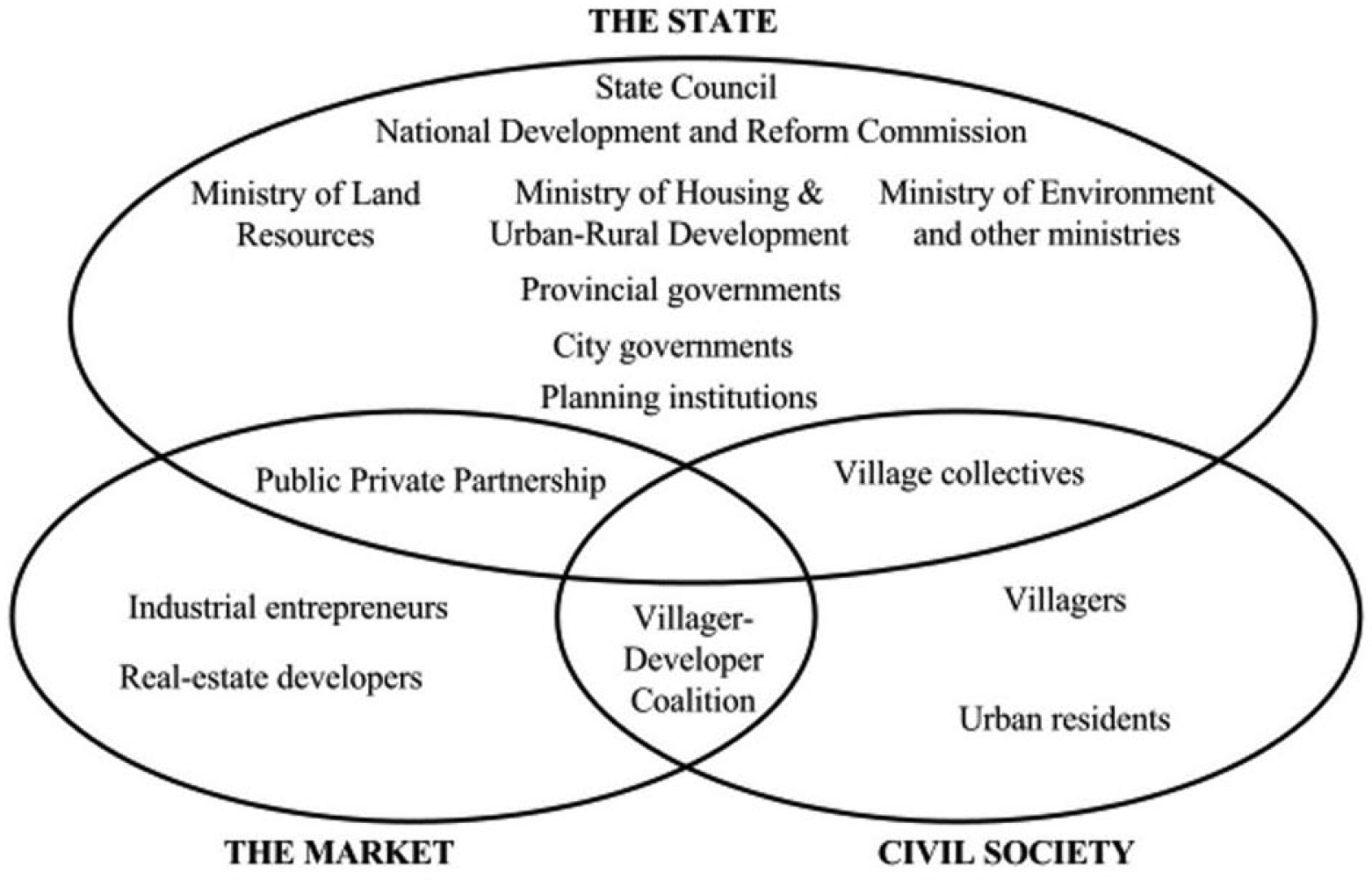
The “ecology of actors” involved in land conversion in China
The globalization literature has argued that development goals are best achieved through a synergy of state, market and civil society actors. Civil society actors in most countries include citizen interest groups, political parties, religious groups, non-governmental and community-based organizations, and the media. In China there is hardly any presence of organized civil society actors independent of the state, as this is seen as a threat to the Communist Party and such groups are therefore either co-opted or persecuted. We use the term civil society here to refer to formal village collectives with their elected village head, individual villagers or urban residents, or their loose associations in pursuit of a common purpose or action.
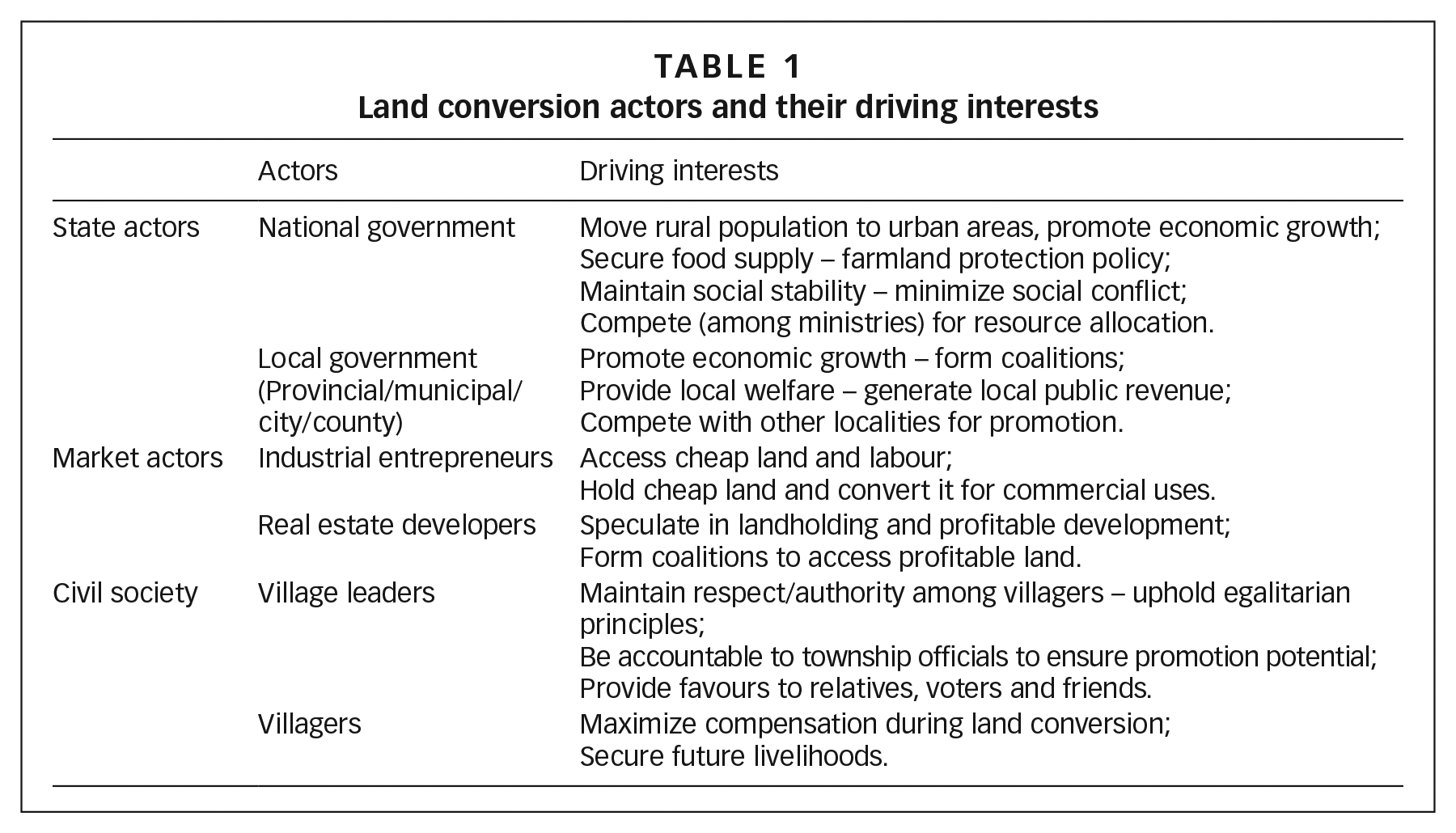
Table 1 briefly introduces the interests that drive various actors and institutions during the processes of land conversion.
Land conversion actors and their driving interests
III. State Actors
China’s governance structure can be characterized by economic decentralization and political centralization.(22) Economic decentralization implies that local governments are directly responsible for and deeply involved in developing the economies within their jurisdiction, and carry out most government functions. Political centralization implies that the national government controls not only ideology and the media, but also the personnel matters of local governments through its cadre evaluation system. The central government directly appoints, evaluates and dismisses key provincial leaders, and each tier of government in turn appoints and evaluates lower-level government officials. Although city, provincial and national governments are all state actors, they have different interests and motivations due to their place in the hierarchy of government structure.
Since the economic reform in the late 1970s, China has seen unprecedented economic growth. In the 1990s, urbanization was adopted by the national government as a strategy for economic rebalancing – a move to encourage domestic consumption in order to reduce reliance on export-led growth. In 1994, the central government embarked on a programme of fiscal centralization that left local governments with the huge burden of providing public services and scant revenue sources to finance them.(23) Although in recent years central government has been distributing more funds back to local governments, the situation did not improve much at the local level after funds had been filtered through the hierarchy of intermediary governments.(24) Given the scant sources from higher levels of government, land leasing fees became the main source of local revenue. China’s urban land is state owned and rural land is collectively owned by the village residents. The national government regulates land conversion and prohibits farmland from entering the land market without first involving state expropriation. The idea of land value capture is consistent with Henry George’s idea that land value increments created by regulatory changes, population growth and economic development should belong to the public.(25) The public land ownership in urban China allows this expropriation to be implemented at a large scale in cities. Local governments are allowed to acquire rural land from village residents on a compulsory basis, providing them with standard compensation (normally several years of crop yields), and then to install infrastructure services and lease the land to developers.
This system of decentralized responsibilities for public service provision within a system of centralized fiscal authority provides local government officials with powerful incentives to acquire land and lease it to developers. Land development and the related investments in infrastructure also boost local GDP, an important performance indicator for local officials seeking promotion. This core dynamic could explain much of the relationship among different levels of governments involved in land conversion in China. In the following pages, we separately explain the two major levels of government involved in the land conversion: national and local government.
a. National government
China’s national government regulates the permissible amount of new land that can be developed each year. The National Guidelines for Comprehensive Land Use Planning (NGCLUP) allocate buildable land quotas to provincial governments, based on provincial population size, level of economic development, and political importance, among other criteria. Provincial governments allocate these quotas on to local governments. This land quota was in line with the Farmland Protection Policy in the 11th Five-Year Plan (2006-2010), aiming to ensure that the national farmland stock remained above 1.8 billion mu (around 120 million hectares) by 2010. Since then the policy has turned its focus to designating permanent farmland boundaries, as well as urban growth boundaries for cities.
At the national level, the National Development and Reform Commission (NDRC), Ministry of Housing and Urban-Rural Development (MOHURD), and Ministry of Land and Resources (MLR), among 25 other ministries, constitute the State Council headed by the premier, which has direct influence and authority in regulating land transfer. This authoritative national coordination tends to impose uniformities, while the panoply of ministries remain heterogeneous in their orientations and often pursue contradictory goals.(26) It is difficult for MLR to achieve its farmland protection target amid other ministries with differing, and at times, conflicting development goals. For example, the Ministry of Transportation might want to build roads, MOHURD wants to control housing prices, and they both want to take more farmland. No ministry can afford to sacrifice its own political achievements for the sake of complying with the policies of other ministries, since ministers’ performance is evaluated based on what they have achieved, not what they have helped others to achieve.(27) China’s existing governmental structure has inherent weaknesses in horizontal coordination.
In reality, MLR is competing rather than partnering with other ministries at all levels of government. The vertical hierarchy within individual agencies encourages the leaders of an agency to compete with other agencies for more administrative authority. These benefits may sometimes be simply psychological, providing a sense of “being important”; but they are often more tangible, taking the form of gifts, cash, or personal favours.(28) At the national level, it is common for ministries to define programmes that fall within their administrative authority in terms that relate to urban development. For example, NDRC promoted the “low-carbon city” programme; MOHURD initiated the “eco-city” programme. More recently, the Ministry of Culture has started to designate “eco-cultural protection zones”. The local-level officials of these central government ministries, therefore, gain influence over the design, siting and approval of certain developments that fall under these categories. Some of these officials have been known to use this influence to obtain tangible personal benefits for themselves. Competition within ministries is mirrored also at a local level in the forms of different local government agencies claiming rights over certain pieces of land, through their inclusion as part of the “low-carbon city” or “eco-city” programme.
b. Local (provincial/municipal/city/county) governments
Local governments have strong incentives to promote economic growth. They tend to use land leasing for three interrelated reasons – to generate revenue to help meet their fiscal requirements at local level, to promote GDP growth as a key component of their performance evaluation, and to compete with other local governments for career advancement of key players in the city (mayors or party secretaries). The connection between economic growth and land expansion is evident in China(29): for every 3 per cent expansion in urban land, the GDP grows by 10 per cent.
The first challenge of the local government is to meet its public service responsibilities with its limited revenue sources. The “land revenue regime” allows local governments to gain revenue from land and infrastructure development.(30) Many scholars(31) have documented the propensity for local governments to increase their fiscal earnings from land conversion, and have related this to their increased responsibilities and reduced share of tax revenue from the national government since 1994. Zhang(32) argued specifically that the main driving force of urban sprawl in China is local government’s willingness to lease out more land. This accounts for anywhere between 30 and 70 per cent of a city’s revenue.(33)
Because of the financial pressure, local governments are willing to work around state-level policies on land protection. They usually respond with two strategies on land and infrastructure development: increasing the amount of buildable land, and increasing the potential revenue generated from the land. On one hand, local governments convert a lot more land than the buildable land quota they are allotted from the higher-level government. The national policy allows more buildable land if local government can compensate with the “creation” of new farmland, ensuring that the total amount of farmland in the region remains unchanged.(34) In practice, this kind of farmland reclamation(35) tends to ignore the location and quality of new farmland created, and drives the loss of good-quality farmland.
Pressured by their unfunded mandates, local governments also engage in illegal conversions, or they deliberately conceal or delay reporting of information to higher-level governments. Ma summarized their strategies as “execute first and report later” and “execute and do not report”.(36) Illegal land conversion projects are relatively safe as long as nobody makes a fuss by reporting them formally to higher-level governments or the media. Even if they do attract attention, projects with strong backing from the higher-level government usually face much lower risks than those supported by lower-level governments only.
Local governments also adopt regulations that allow for varied land leasing fees based on land use. Local governments usually provide subsidized (or free) land to manufacturing sector investors,(37) or embrace local state corporatism(38) to attract investment in industrial uses that could contribute to longer-term GDP growth. At the same time, local governments aim to maximize their gain from real estate and commercial land developers. Before the 2000s, developers usually obtained land through government ties. In the increasingly formalized land market, especially in the coastal region, more transactions in recent years have happened through auctions.(39) There are two different forms of auction: listing auctions (where the highest bidder wins) and tender auctions (where governments choose the winner by using a non-price mechanism).(40) The non-price mechanism implies that decisions may be made based on other factors, which leaves room for collusion between local officials and developers and provides opportunities for corruption.
Both of these land leasing strategies reflect the second challenge for local governments, the drive for higher GDP growth. Fainstein(41) argued that the failure of public land leasing in China is due to the absence of a private land market as a reference: a local government could ask for any price it wants. Public land leasing without proper oversight could open the door for government rent-seeking behaviour or malfeasance. Ye and Wu(42) found that economically stronger cities with higher real estate investment more aggressively pursued land acquisition, leading to worse urban sprawl in these larger cities. Population density in China’s large cities is much lower compared to other large cities in the world.(43)
The third challenge for local governments in China is competing in a politically centralized system, in which competition rather than coordination is characteristic across all levels of government.(44) As we illustrated earlier, authority over land is fragmented among different agencies and at different levels of the government in complex and overlapping ways.(45) Different interest groups are strongly motivated to claim their authority over development projects, in order to grab a share of the proceeds. The politically centralized, top-down structure in China hides the fragmentation of the economically motivated local governments. The high concentration of manufacturing industries in the coastal region was the result of competition among fragmented government agencies for industrial development.(46)
The issue is further complicated by China’s dual land ownership regime (urban land vs. rural land) and dual land administration institutions (urban and rural land managed by two different ministries). Competition in China exists both vertically and horizontally. The kind of horizontal competition described earlier at ministry level extends downwards to all levels of government.(47) Governments at different vertical levels could also become competitors. Provincial governments can reserve buildable land from their quota before distributing it downwards, to create provincial-level development zones within municipality boundaries.(48) The fragmentation of the state can sometimes provide room for market and civil society actors to create alliances with certain public institutions.(49) The lack of civil society in China, and the fact that the state is taking land from the hands of villagers, suggests the alliance is most likely to be formed between the state and market actors.
IV. Market Actors
The main market actors in this space include private or state-owned industrial companies that need land as one of their inputs (and sometimes receive land at a subsidized price), and real estate developers who can pay high leasing fees to develop land for residential or commercial use. Market actors seek profits, now and in the future, and this is what drives their interest in land. When demand for land exceeds supply, huge profits can be derived just by holding vacant or unused land long enough. Developers made huge profits during the late 1990s and early 2000s when land prices rose the fastest in the past three decades. Ma(50) cited several cases where private industry investors bought land zoned for industrial use at a subsidized price and left it undeveloped or underdeveloped until it was re-zoned for residential or commercial use. The absence of property tax or other penalties for keeping land idle encourages many developers to deliberately hold land or slow down construction for larger profits at a later time.
Responding to developers’ speculative behaviour, more regulations are imposed by state and local governments. The Ministry of Land (MLR) in 2011 announced that land unutilized for a year will incur a penalty of 20 per cent of the price, and the government may reclaim the unused land without compensation, if it is kept idle for over two years. Despite these directives, speculators have found ways to hoard land without making huge investments. One developer we interviewed in 2013 built tennis courts on land it had acquired, thus holding the land with minimal investments for more profitable development later. Generally, only bigger developers with more financial resources can afford to hold land.(51)
As mentioned earlier, the fragmentation of local government creates space for market or civil society actors to form coalitions with the public sector. Local governments have strong interest in promoting real estate development since it contributes greatly to the local economic growth; they often adopt entrepreneurial governance strategies, and develop symbiotic relationships with developers.(52) They provide regulatory and tax incentives or market access in exchange for corporate support – sometimes this takes the form of direct payoffs, at other times more subtle backing of state projects and priorities. Developers want cheap land while local governments want to raise revenues and GDP growth. Their land development interests are thus intertwined, and the process favours developers who have good guanxi(53) with local government.
Local governments and developers have continued to negotiate over how to divide the gains from land value appreciation among themselves. It is a common practice for the local government to impose extra conditions for a relatively “cheap” land transaction deal to be approved.(54) Some of these might allow the public to capture a bigger share of land value appreciation. However, the opaque nature of government decisions and the uncertainty they bring to the development process tend to become grounds for complaint for developers in land transactions.
When development within an urban area is highly regulated, there is a spillover effect in land markets in surrounding peri-urban areas that are less regulated and have higher potential for land value appreciation. In China, rural land that has yet to be converted officially fills the gap. Developers rent or buy the land use rights from village collectives or villagers directly, without it being first expropriated by the state – a process that is deemed “illegal” by the state. By offering higher compensation to villagers than that offered by the local authorities, developers sometimes form coalitions with the village collectives.(55) Market forces encourage developers to acquire land illegally. Negotiation strategies between developers and villagers in these informal land conversions vary according to circumstances. Developers usually seek support from village leaders, who have a personal interest in attracting investment for the village and usually facilitate such negotiations or even serve as go-betweens for developers and villagers. They normally negotiate with each individual villager separately.(56) The widespread informal developments on these peri-urban fringes have meant that many villagers become developers themselves with very little planning guidance. This phenomenon points to the need for land management at a larger regional level, regulating where to build, and also where not to build.
V. Civil Society Actors
China’s collective land ownership in rural areas gives villagers and village collectives a greater say in the process of rural-to-urban land conversion than their urban counterparts have. Urban residents can only indirectly create demand by buying up new urban development projects.
Every rural household in China is entitled to use two forms of land: arable land for agricultural production (gen di) and residential land for housing construction (zhaiji di). Villagers have the right to farm the former and use the latter for their own housing, or to rent or sub-contract both to other members of the same village. No one can sell, lease or rent the land to anyone outside their village, or use the land as security for obtaining bank loans. The collective ownership requires the land conversion decision to be made at the village collective’s level. In the absence of formal land markets in rural areas, villagers have responded to the demand for land for urban expansion, sometimes formally (by giving their land to urban local authorities and accepting compensation), and sometimes informally (dealing directly with developers and other market actors).
a. Village collectives
The village collectives, represented by their elected leaders, have power over the redistribution of land among the rural households, the collection of agricultural taxes (which ended in 2006), and the administration of irrigation facilities. The relationship between village leaders and villagers is one of both cooperation and conflict. Village leaders may want to provide favours to their relatives, voters and friends. However, being elected officials requires that they just behave in a relatively “reasonable” manner in order to maintain a certain degree of authority in the village. At the same time, village leaders have to be accountable to township officials since their performance, which is evaluated by township officials, is further linked to their salaries and bonuses, paid by village collectives.(57) In the case of compulsory land acquisition, as long as the higher-level government has made a decision, there is little village collectives or villagers can do to change it. In most cases, the village leaders’ role is limited to conveying official government notices to villagers, and “assisting” the township government to “persuade” villagers to defer to its decisions.
The impact of land conversion on village households is significant. Villagers either lose their farmland, or they lose all their land (both farm and residential) and are forced to relocate. Monetary compensation is the only economic gain that individual households can expect. In this situation, village leaders have considerable discretion over the distribution of the compensation received from the local government (or developers in the case of informal land transfers). Whether the compensation goes to individual villagers, or is kept at village level, is often decided by the village committee. In general, the strategy to distribute compensation and reallocate land use rights follows egalitarian principles to avoid conflict.(58) The distribution strategy in cases of land conversion varies depending on the type of land (reserve land, farmland or residential land) or the scale of the conversion (partial or whole village).(59)
If the land conversion involves only village reserve land, the village collective could decide to keep all compensation, distribute it among all the villagers, or a combination of the two. In cases when only a part of the village land is under high conversion pressure, only villagers whose allotted land is affected usually receive compensation. Other villagers could expect a higher level of compensation in the future since the compensation amount only goes up as time passes. In cases where farmland compensation seems to be mostly a one-time payment – for example, when a high-speed rail project is passing through a village – a village-level redistribution of compensation and remaining farmland among all village members would be more likely to occur. In cases where the whole of the village’s land is converted and villagers become urbanites, the most important connection between village leaders and farmers will no longer exist, and the power of village leaders over villagers will soon disappear. In such cases, land conversion is often seen by village leaders as a last opportunity to seek large personal benefits for themselves.(60)
b. Villagers
Villagers vary in their interest in land conversion based on their age and their connection to the land. To younger-generation villagers who have worked in cities as migrants for many years, compensation is the only concern. For the older age groups, resettlement totally changes their livelihood and way of life. Although the standard compensation for land expropriation is only a tiny fraction of the perceived market value, it is still a substantial amount for rural households that have been living on farming. Villagers generally comply with the state’s land conversion decisions. Their compliance around land acquisition is partly due to the Chinese tendency to defer to government, and to a perception that it is futile to resist the state.(61) Villagers might feel dissatisfied with their compensation at times, and might try to negotiate better terms of compensation or resettlement. Some projects may start out by offering higher compensation to expedite the land acquisition process, but most often, villagers attempt to negotiate. Those villagers with no alternative ways of making a living see land conversion as their last opportunity to exchange their land for money, and usually expect higher compensation.(62)
There are in general three negotiation strategies. First, villagers may choose to make up or hide information. For example, they may quickly plant more trees on their land if compensation is paid according to the number of existing trees. Sometimes these actions might gain support from village collectives, or even local governments, depending on who provides the compensation. Second, a villager may refuse to move while others in the village agree to the terms set by the local authority. Such households then become what are commonly referred to as “nail households”.(63) At any point in the negotiation process, the local government might choose simply to give up. If a whole village negotiates for higher compensation and refuses to move, it could lead to the leapfrog pattern of urban development, in which villages become surrounded by more developed areas. Third, dissatisfied villagers may choose to protest. Villagers resort to disruptive protests, sometimes leading to violence, after they have exhausted all lawful procedures(64) to fight eviction.
In response to villagers’ negotiation strategies, local governments might choose to compromise by offering villagers better compensation, including things like social security, medical care and free education for children, so that villagers are more likely to comply. In other cases, local governments might choose to enforce their power.(65) In recent years, increasing numbers of violent incidents have happened in China’s western regions, where the land market is less formalized and development pressures are rising. This pressure can cause social stress, confrontation and disorder around crackdowns,(66) unpleasant for all and a most painful experience for the villagers involved.(67) To villagers, local governments are responsible;(68) county and municipal governments were mostly blamed for compulsory land acquisition, while township authorities and village leaders were blamed for disputes related to farmland lease rights.
Other than negotiating for compensation money, villagers are also actively involved in capturing the land value appreciation. In suburban areas around large cities, where land demand is high, two significant development patterns have been widely reported. The first is the creation of Chengzhongcun (villages in cities), due to the large scale of farmland acquisition and delays in acquiring rural residential land (due to the high relocation cost involved). In these situations, villagers who have lost their farmland become surrounded by urban land. They respond to the increasing rental housing demand from the city by building multi-storey apartments on their allotted residential land, and by renting rooms to households (mostly migrants).(69) With sub-standard planning and construction, this housing provides an affordable option for migrant workers to live in China’s cities.(70) As land prices keep rising around these settlements, the Chengzhongcun will sooner or later be redeveloped, as has been documented in recent studies.(71)
The second phenomenon is the creation of small property housing. Responding to developers’ search for less regulated land, villagers recognize a new option for their collectively owned land: to rent informally to developers with compensation higher than the official standard. The informal transfers of land use rights through rental between villagers and developers are mutually beneficial,(72) although “informal and illegal” in the eyes of the state. Developers typically are capable of obtaining “implied” permission from local governments to carry out informal conversion. Attracted by huge potential profits, villagers opt to work with developers or on their own, and ignore state regulations, building housing catering to urban homebuyers who could not afford commercial housing with full property rights. Unofficial but widely accepted estimates suggest that at least 6 billion square metres of “small property rights” housing were constructed in China by 2010, accounting for more than 20 per cent of the nation’s total constructed urban area.(73) If this number is correct, small property rights housing has certainly contributed in a major way to urban sprawl, informally converting this sizable percentage of rural land for urban use without planning considerations. As long as there is a market demand for cheaper housing, villagers in peri-urban areas and developers will continue to risk participating in this informal development. Although the state denounces this “small property rights” development, in reality, because of concerns over social stability, this kind of development has rarely been punished.
We have elaborated how during China’s urbanization processes, the local state, driven by economic growth, is acquiring and leasing out more land to generate public revenue; how market actors are speculating, and hoarding more land for higher profits; and how villagers are motivated by compensation and capture of land value appreciation for themselves. All of them are ignoring the national-level policy of farmland protection. All are motivated by the economic benefit of land conversion, and less concerned about the environmental or social impact of development. The major actors in China’s land conversion processes, in other words, are all pro-growth, and stand to benefit from urban sprawl. Although well-intentioned, the national government’s weak vertical supervision has meant that land protection policies are not enforced.
VI. Discussion and Conclusions
When all actors involved in the land conversion process are motivated by economic growth, and national-level land protection policies are not enforced, this calls into question whether regional or local-level urban planning can manage growth to an environmentally sustainable level. However, if we explore the role of planning in China’s urban development processes, we find that the planning institutions that manage urban growth are part of the local government body. In theory, these planning institutions should be mediators, trying to balance the interests of different groups that are in constant development tension and conflict with each other. In most countries, these tensions are manifested in partisan political competition, with a broad and independent civil society confronting state and market interests.(74) In China, growth has become an imperative for governance, and planning is therefore pro-growth,(75) rather than the enemy of business as it is in the West. Planners help to justify the government’s economic growth ambitions and its legitimacy, and to internalize the economic growth model. Chinese planners work on the “…mere rationalization of political decisions”.(76) It is difficult for a local planner to present technical evidence against the decisions of the local government.(77) Moreover, Chinese planners at the local level are mostly physical planners, trained in architecture schools, and have very little training in economics, politics, social or environmental sciences. They generally lack the expertise to inform public decision making from a multidisciplinary perspective. Planners’ rational decision making is influenced by their own embedded interests in urban development, of which they too are beneficiaries, obtaining such personal favours as gifts, bribes and paid travel in exchange for other resources.
Chinese cities certainly pose unique planning challenges, given their dramatic growth: the large flow of rural surplus labour moving to cities looking for opportunities and the concomitant state promotion of migration from rural to urban areas make it hard, if not impossible, to predict cities’ population growth.(78) Larger and more economically developed cities in China tend to use vague population projection numbers to justify their urban sprawl. Although the inclusion of more land in the city helps to keep land value and housing costs affordable, the rate of urban land growth in China is much faster than the rate of urban population growth, especially in larger cities. This has led to a situation where population density in large Chinese cities is much lower than in other world cities of similar size.(79)
Our paper has adopted a “political ecology” framework to analyse the main stakeholders involved in the land conversion games in the rapidly urbanizing cities, and to draw a relatively comprehensive picture of China’s urban sprawl. We specifically focus on three sets of actors and institutions: state actors (national and local government), market actors (industrial entrepreneurs and real estate developers) and civil society actors (villagers and village collectives). Our main findings are the following:
National government actors have established multiple conflicting development goals. These conflicting goals lead local governments to understand that economic growth is the main factor on which they are evaluated in the politically centralized system. The limited local government revenues, their inability to levy their own taxes, and the weak vertical supervision from the top provide plenty of room for local governments to pursue economic growth through land and infrastructure development. The government fragmentation allows for coalitions to form between local government and enterprises, and these drive GDP growth and urban sprawl.
Without sufficient disincentives (fiscal or regulatory) against leaving land or housing vacant or underutilized, market actors are encouraged to speculate on land for future profits; the local development coalitions promote further land conversion and breed corruption; and the uneven development of land markets pushes developers to seek less regulated rural land, and to encourage informal development.
Villagers are generally attracted to land conversion by the “windfall” compensation, which is high in comparison to their farming income. They oppose land conversion only when compensation for the disruption of their livelihood is inadequate. Their desire to focus their negotiations on the level of compensation not only gives room for developers to offer higher compensation to acquire land, but also encourages villagers to engage in land speculation themselves.
Although planners are generally supposed to control development, planners in China end up having to justify development decisions already made by local or provincial officials. Planning education in China emphasizes physical planning and includes very little training in other disciplines that also affect plans. Planners are unable to offer independent opinions on public decisions on land development, based on expert knowledge. They also have embedded interests in the urban development processes, gaining more tangible benefits when they serve the interests of the officials.
As a whole, it is safe for us to conclude that the key actors involved in land conversion in Chinese cities have a vested interest in urban expansion and growth. This has led to urban sprawl at an unprecedented speed, in both formal and informal ways. Urban growth turns out to be a land grab competition among the state, market and civil society actors in China. Local governments want to generate more revenue to fulfil their responsibilities; market actors want to make more profit through land holding and development projects; and villagers want to obtain higher compensation for their land. Those who are supposed to stay neutral in these land conversion games, the planners, also benefit from development. They often use their technical skills to justify decisions already made by officials instead of bringing independent voices of reason into the development decisions.
Experiences from other growth control practices suggest that development coordination should happen at regional level to prevent urban sprawl.(80) An independent land court, a regional-level elected government, and a broad and independent civil society together create the institutions for checks and balances in land development. A sustainable urban growth system requires pro-growth efforts to be balanced by certain anti-growth forces. Evidently, China’s urban development lacks this opposition. The anti-growth forces in western countries originated either in individual communities that want to maintain their quality of life and resist change, or in top-down state-level legislation rooted in environmental concern over the fast disappearance of rural land(81) – or in a combination of the two. Our analysis has revealed that these forces have yet to evolve in China. The rural population (particularly the young) is attracted to urban life and the prospect of economically benefitting from its land. The farmland protection policy remains state-level legislation and has not been implemented and reinforced at the local level because it conflicts with economic development.
The land conversion process, with mostly pro-growth actors in China, suggests weaknesses in the institutional settings. The behaviour of different actors is in reality a “rational choice” to maximize individual gains by taking advantage of institutional shortfalls. Informal structures of power and practice in China’s political economy context render the formal farmland protection policy ineffective.
Responding to the findings from our analysis, we support the development of the following set of policies:
Fiscal devolution – A higher share of local revenues should return to local governments, and/or local governments should be allowed to levy their own tax, and to revise cadre evaluation criteria away from just GDP.
Land markets should be increasingly formalized to prevent market actors’ informal and illegal land conversion.
Rural land markets should be created and farmers’ legal control strengthened over the land they use. This could effectively balance the local government expropriation of rural land, and establish real market value for land transfer.
A set of disincentives should be institutionalized for those who speculate on real estate, either letting local authorities levy property tax or penalizing those who leave land or housing vacant or underutilized.
The successful improvement of the land conversion system hinges on the willingness and capacity of the national government to reform existing political and economic institutions. These discussions are currently on the table, including the modification of the cadre evaluation system(82) and a series of experiments on rural land reform.(83) These policy changes are all in the pilot stage and may take long time to be effective.
Footnotes
1.
Knaap, G J and Arthur C Nelson (1992), The regulated landscape: lessons on state land use planning from Oregon, Lincoln Institute of Land Policy, Cambridge, MA; also Kahn, M E (2001), “Does sprawl reduce the black/white housing consumption gap?”, Housing Policy Debate Vol 12, No 1, pages 77–86; Carruthers, J I and G F Ulfarsson (2002), “Fragmentation and sprawl: Evidence from interregional analysis”, Growth and Change Vol 33, No 3, pages 312–340; and Downs, A (1994), New Visions for Metropolitan America, Brookings Institution and Lincoln Institute of Land Policy, Washington, DC and Cambridge, MA.
2.
Gordon, P and H W Richardson (1997), “Are compact cities a desirable planning goal?”, Journal of the American Planning Association Vol 63, No 1, pages 95–106; also Ewing, R (1997), “Is Los Angeles-style sprawl desirable?”, Journal of the American Planning Association Vol 63, No 1, pages 107–126; and Brueckner, J K (2005), “Transport subsidies, system choice, and urban sprawl”, Regional Science and Urban Economics Vol 35, No 6, pages 715–733.
4.
Seto, K C and M Fragkias (2005), “Quantifying spatiotemporal patterns of urban land-use change in four cities of China with time series landscape metrics”, Landscape Ecology Vol 20, No 7, pages 871–888.
5.
Schneider, A and C E Woodcock (2008), “Compact, dispersed, fragmented, extensive? A comparison of urban growth in twenty-five global cities using remotely sensed data, pattern metrics and census information”, Urban Studies Vol 45, No 3, pages 659–692.
6.
Chen, R S, C Ye, Y L Cai, X S Xing and Q Chen (2014), “The impact of rural out-migration on land use transition in China: Past, present and trend”, Land Use Policy Vol 40, pages 101–110; also World Bank and Development Research Center of the State Council, People’s Republic of China (2013), China 2030: Building a Modern, Harmonious, and Creative Society, Washington, DC, pages 3–14.
7.
Schneider, A and C M Mertes (2014), “Expansion and growth in Chinese cities, 1978-2010”, Environmental Research Letters Vol 9, No 2, 11 pages; also Ding, C R and E Lichtenberg (2011), “Land and Urban Economic Growth in China”, Journal of Regional Science Vol 51, No 2, pages 299–317.
8.
Deng, F F and Y Q Huang (2004), “Uneven land reform and urban sprawl in China: the case of Beijing”, Progress in Planning Vol 61, pages 211–236.
9.
Fung, E (2014), “More Than 1 in 5 Homes in Chinese Cities Are Empty, Survey Says”, The Wall Street Journal, 11 June, accessed 2 May 2015 at  .
.
10.
Barboza, D (2010), “Chinese City Has Many Buildings, But Few People”, The New York Times, 19 October, accessed 19 June 2015 at .
11.
Lichtenberg, E and C R Ding (2008), “Assessing farmland protection policy in China”, Land Use Policy Vol 25, No 1, pages 59–68.
12.
See reference 8; also Lichtenberg, E and C R Ding (2009), “Local officials as land developers: Urban spatial expansion in China”, Journal of Urban Economics Vol 66, No 1, pages 57–64.
13.
Wang, L G, H Y Han and S K Lai (2014), “Do plans contain urban sprawl? A comparison of Beijing and Taipei”, Habitat International Vol 42, pages 121–130.
14.
Huang, Yan (2015), “Beijing to Revise Its Master Plan in the Next Five Years”, Beijing Evening News (in Chinese), 24 January, accessed 12 May 2015 at .
15.
Ma, Jianbo (2009), “An Institutional Analysis of the Chinese Land Conversion Process”, Dissertation submitted to the Faculty of the Graduate School of the University of Maryland, College Park.
16.
Evans, P (2004), “Development as institutional change: The pitfalls of monocropping and the potentials of deliberation”, Studies in Comparative International Development Vol 38, No 4, pages 30–52.
17.
Logan, John R and Harvey Luskin Molotch (1987), Urban fortunes: the political economy of place, University of California Press, Berkeley.
18.
Robbins, Paul (2012), Political Ecology: a critical introduction (2nd edition), Wiley-Blackwell.
19.
Tilt, B (2007), “The political ecology of pollution enforcement in China: A case from Sichuan’s rural industrial sector”, China Quarterly Vol 192, pages 915–932.
20.
Devas, Nick (2004), Urban governance, voice, and poverty in the developing world, Earthscan Publications, London and Sterling, VA.
21.
Pal, A (2006), “Scope for bottom-up planning in Kolkata: rhetoric vs reality”, Environment and Urbanization Vol 18, No 2, pages 501–521.
22.
Xu, C G (2011), “The Fundamental Institutions of China’s Reforms and Development”, Journal of Economic Literature Vol 49, No 4, pages 1076–1151.
23.
Zhang, T and H F Zou (1998), “Fiscal decentralization, public spending, and economic growth in China”, Journal of Public Economics Vol 67, No 2, pages 221–240.
24.
Yang, J W and G C Li (2014), “Fiscal and spatial characteristics of metropolitan government and planning in China: Understanding centralization trends in a decentralization context”, Habitat International Vol 41, pages 77–84; also Li, L C and Z J Yang (2015), “What Causes the Local Fiscal Crisis in China: the role of intermediaries”, Journal of Contemporary China Vol 24, No 94, pages 573–593.
25.
George, Henry (1879), Progress and poverty; an inquiry into the cause of industrial depressions, and of increase of want with increase of wealth–The remedy, W. M. Hinton & Co., San Francisco.
26.
See reference 16.
27.
See reference 15, page 126.
28.
See reference 15.
29.
Deng, X Z, J K Huang, S Rozelle and E Uchida (2010), “Economic Growth and the Expansion of Urban Land in China”, Urban Studies Vol 47, No 4, pages 813–843.
30.
Duckett, Jane (1998), The entrepreneurial state in China: real estate and commerce departments in reform era Tianjin, Routledge, London and New York.
31.
For example, Wu, F L and A G O Yeh (1997), “Changing spatial distribution and determinants of land development in Chinese cities in the transition from a centrally planned economy to a socialist market economy: A case study of Guangzhou”, Urban Studies Vol 34, No 11, pages 1851–1879; also see reference 12, Lichtenberg and Ding (2009); Yeh, A G O and F L Wu (1999), “The transformation of the urban planning system in China from a centrally-planned to transitional economy”, Progress in Planning Vol 51, No 3, pages 167–252; and Ding, C R (2007), “Policy and praxis of land acquisition in China”, Land Use Policy Vol 24, No 1, pages 1–13.
32.
Zhang, T W (2000), “Land market forces and government’s role in sprawl - The case of China”, Cities Vol 17, No 2, pages 123–135.
33.
Lin, G C S (2007), “Reproducing spaces of Chinese urbanisation: New city-based and land-centred urban transformation”, Urban Studies Vol 44, No 9, pages 1827–1855.
34.
Long, H L, Y R Li, Y S Liu, M Woods and J Zou (2012), “Accelerated restructuring in rural China fueled by ‘increasing vs. decreasing balance’ land-use policy for dealing with hollowed villages”, Land Use Policy Vol 29, No 1, pages 11–22.
35.
See reference 15. Jianbo Ma’s dissertation explains that Dragon County received 3,600 mu of buildable land quotas each year, while in reality they converted on average 6,000–7,000 mu of rural land annually. This was achieved through strategies including reclaiming land, buying quotas from other regions, and moving villagers into high-rise apartments to create new farmland.
36.
See reference 15, page 240.
37.
Tao, R, F B Su, M X Liu and G Z Cao (2010), “Land Leasing and Local Public Finance in China’s Regional Development: Evidence from Prefecture-level Cities”, Urban Studies Vol 47, No 10, pages 2217–2236.
38.
Oi, J C (1992), “Fiscal Reform and the Economic Foundations of Local State Corporatism in China”, World Politics Vol 45, No 1, pages 99–126.
39.
See reference 15.
40.
Yang, Z, R R Ren, H Y Liu and H Zhang (2015), “Land leasing and local government behaviour in China: Evidence from Beijing”, Urban Studies Vol 52, No 5, pages 841–856.
41.
Fainstein, Susan S (2012), “Land Value Capture and Justice”, in Gregory K Ingram and Yu-Hung Hong (editors), Value Capture and Land Policies, Lincoln Institute of Land Policy, Cambridge, MA.
42.
Ye, L and A M Wu (2014), “Urbanization, Land Development, and Land Financing: Evidence from Chinese Cities”, Journal of Urban Affairs Vol 36, No s1, pages 354–368.
43.
The Economist (2015), “The great sprawl of China - how to fix Chinese cities”, 24 January, accessed 14 April 2015 at .
44.
Wu, F L and J X Zhang (2007), “Planning the competitive city-region - The emergence of strategic development plan in China”, Urban Affairs Review Vol 42, No 5, pages 714–740.
45.
See reference 16.
46.
See reference 44.
47.
See reference 8.
48.
Recently the Yunnan provincial government established the Central Yunnan New Industrial Zone within its capital city of Kunming. Most often these provincial zones are not in capital cities, for more even regional development. In Yunnan’s case, since Kunming is the only well-developed city in Yunnan, its land became the competing ground between provincial and municipal government. See Yunnan Net (2014), “Yunnan Province Kunming Airport Economic Zone is established” [“云南省昆明空港经济区挂牌”], 23 November, accessed 12 May 2015 at .
49.
See reference 16.
50.
See reference 15, page 198.
51.
See reference 15.
52.
Zhang, T W (2002), “Urban development and a socialist pro-growth coalition in Shanghai”, Urban Affairs Review Vol 37, No 4, pages 475–499; also Pei, Minxin (2006), China’s trapped transition: the limits of developmental autocracy, Harvard University Press, Cambridge, MA.
53.
Guanxi is a general Chinese term used to describe relationships that may result in the exchanges of favours or “connections” that are beneficial for the parties involved. See Gold, Thomas, Doug Guthrie and David L Wank (2002), Social connections in China: institutions, culture, and the changing nature of Guanxi, Cambridge University Press, Cambridge, UK and New York.
54.
From interviews with developers and city officials in the summer of 2013. Extra conditions may include covering the cost of infrastructure development, building a public library, or even some under-the-table bribery.
55.
Zhao, P J (2011), “Managing urban growth in a transforming China: Evidence from Beijing”, Land Use Policy Vol 28, No 1, pages 96–109.
56.
See reference 15.
57.
See reference 15, pages 69–73.
58.
Tan, S H, N Heerink and F T Qu (2006), “Land fragmentation and its driving forces in China”, Land Use Policy Vol 23, No 3, pages 272–285.
59.
Li, Ping and Xiaobai Xu (2004), “Land Acquisition Reforms: Field Surveys and Recommendations”, China Rural Observations Vol 6 [李平、徐孝白:征地制度改革:实地调查与改革建议.《中国农村观察》2004年第6期].
60.
Qi, Xiaojin, Pu Cai and Chunhui Fu (2006), “The Rationalities of the Behaviors of Village Leaders During Land Conversion”, Society Vol 2 [齐晓瑾、蔡澍、傅春晖:从征地过程看村干部的行动逻辑 — 以华东、华中三个村庄的征地事件为例。《社会》2006年第2期,卷26].
61.
See reference 15.
62.
Yu, Jianrong (2005), “Land Has Become a Main Cause of Disputes for Farmers”, The Duowei Times, 2 December [土地问题已成为农民维权抗争的焦点。多维时报》2005年12月2日], accessed 12 May 2015 at .
63.
“Nail household” is a term used to describe a homeowner who refuses to accept the terms of resettlement even when the majority of their neighbors have moved away.
64.
Li, L J (2006), “Driven to protest: China’s rural unrest”, Current History Vol 105, No 692, pages 250–254.
65.
Official reports acknowledge that land acquisitions and forced demolition led to more than 22 per cent of the “mass incidents” (officially defined as unofficial gatherings of 100 or more people – ranging in nature from peaceful protests to spontaneous riots) seen in China in 2012.
66.
In October 2014, a violent confrontation between villagers and eviction forces led to the deaths of eight people in the southwestern city of Kunming. See Tiezzi, Shannon (2014), “Clash Over Forced Eviction Leaves 8 Dead in Yunnan, China”, The Diplomat, 17 October, accessed 9 January 2015 at .
67.
Zhang, Yunpeng (2014), “The vulnerable observer: Fear, sufferings and boundary crossing”, 4 April, accessed 7 May 2015 at .
68.
See reference 64.
69.
Wang, Y P, Y L Wang and J S Wu (2009), “Urbanization and Informal Development in China: Urban Villages in Shenzhen”, International Journal of Urban and Regional Research Vol 33, No 4, pages 957–973.
70.
Song, Y, Y Zenou and C R Ding (2008), “Let’s not throw the baby out with the bath water: The role of urban villages in housing rural migrants in China”, Urban Studies Vol 45, No 2, pages 313–330.
71.
Lin, Y L, B De Meulder, X X Cai, H D Hu and Y N Lai (2014), “Linking social housing provision for rural migrants with the redevelopment of ‘villages in the city’: A case study of Beijing”, Cities Vol 40, Part A, pages 111–119.
72.
See reference 15, page 246.
73.
Shen, Xiaofang and Fan Tu (2014), “Dealing with ‘Small Property Rights’ in China’s Land Market Development: What Can China Learn from Its Past Reforms and the World Experience?”, Lincoln Institute of Land Policy working paper, Cambridge, MA.
74.
See reference 21.
75.
Wu, Fulong (2015), Planning for growth: urban and regional planning in China, Routledge, New York.
76.
Flyvbjerg, Bent (1998), Rationality and power: democracy in practice, University of Chicago Press, Chicago.
77.
See reference 8.
78.
In 2004 Beijing forecast that its population would be 16 million by 2020 (Beijing Urban Master Plan 2004-2020); yet its total population reached 19.6 million in 2010. Beijing’s population was recently underestimated by 7 million. See Cheng, Jie (2014), “Beijing residents might be underestimated by eight million” [北京常住人口或被低估近800万], The Phoenix Weekly [凤凰周刊], 20 August, accessed 17 December 2014 at .
79.
See reference 43.
82.
In December 2013, the Organization Department of the Communist Party of China announced that it would modify the cadre evaluation system. Instead of worshipping GDP growth as the sole indicator of promotion, it will give more weight to environmental protection, resource efficiency, and a number of other social and economic considerations. See Xinhua Net (2013), “Improving Local Cadre Performance Assessment” [中央组织部印发通知-改进地方领导班子和领导干部政绩考核工作], 9 December, accessed 12 May 2015 at .
83.
On 4 March 2015, the National People’s Congress announced that the government would launch a rural land reform pilot programme covering 33 counties, allowing rural landholders to sell their land directly to other residents of the same county. It is a small step in creating a rural land market that may help to solve the problem of widening income gaps between rural and urban regions, and also facilitate the next phase of urbanization by better ensuring that rural residents moving to cities receive adequate payment for their land.