




Abstract
This perspective calls for decolonizing water diplomacy by shifting from a security–peace to an equity–identity-driven approach. Existing structures prioritize geopolitical and economic interests, reinforcing colonial power asymmetries and marginalizing communities. We highlight how the institutions, knowledge, and practices that constitute water governance perpetuate injustice through epistemic dominance and resource commodification. A decolonial approach centers historical accountability, local knowledge, and inclusive decision-making to foster just and sustainable water governance. By rethinking dominant narratives and power structures, we lay out trajectories for how water diplomacy can move beyond conflict management to transformative justice, ensuring equitable access, identity, and dignity for affected communities.
Introduction
The Global North’s 1 pursuit of geopolitical stability and economic advantage has long shadowed structural demands for equity and justice, 2 leaving systemic inequalities and historical grievances unaddressed. Natural resources, including transboundary waters, are governed by actors invested in fortifying existing power structures, where hegemonic control over ontologies and epistemologies rests with a select few. Influenced by colonial dynamics, decision-making remains dictated—often unjustly—by conventional and neocolonial articulations of international law, trade, and diplomacy. The material consequences of this architecture are evident across South West Asia and North Africa (SWANA). 3 From the occupied Western Sahara and the occupied Syrian Jawlan to Jordan and Palestine, “green” investment schemes, occupation regimes, and colonial-era treaties curtail local access to water. Across the wider Global South, cash-crop and water-intensive agricultural legacies still drain far more water than the people who cultivate them. It is within this contested terrain that water diplomacy—the diplomatic arm of global water governance—takes shape.
Water diplomacy operates as a hybrid arena where academic inquiry, policy design, interstate negotiation, and statecraft converge. Donor-steered research agendas define the “problem” space; state officials, diplomats, basin organizations, development banks, and civil-society actors negotiate and design “solutions,” each reinforcing the others through exchanges of funding, expertise, and political leverage. Lauded as a means of preventing conflict and fostering cooperation for broader international and regional peace and security (Global High-Level Panel on Water and Peace, 2017; Huntjens, 2016), water diplomacy remains deeply embedded in ideas of colonial circuitry and modernity. For several decades, Western policy and scholarly circles have articulated diplomacy within the logics of modern capitalism and neoliberalism manifested in narrow security-and-peace framings (Nagheeby & Amezaga, 2023), privileging capital and geopolitical trade-offs over just and sustainable water governance—defined here as equitable allocation, ecological integrity, participatory decision-making, water as a human right, and full respect for community dignity and identity (Boelens et al., 2018). Hegemonic actors and worldviews—operating through transboundary institutions, supposedly neutral legal rules, multilateral banks, Northern aid agencies, “apolitical” consulting firms, and well-funded research consortia—shape how water problems are framed. They also determine who is authorized to speak about them, perpetuating what wa Thiong’o (1998) describes as “mental slavery.”
These same structures also frame water diplomacy as a knowledge deficit, through the narrative of “better data, better cooperation.” A decolonial lens flips the question of how to improve data to asking who withholds or produces data, for whose strategic advantage, and whose knowledges are systematically erased? From “hydraulic imperialism” in colonial irrigation regimes (D’Souza, 2006; Octavianti et al., 2025) to military hydrometric restrictions, for example, the security-related limitations during British control of Afghanistan’s Kajaki Dam (Nagheeby & Warner, 2022), and donor-driven water conflict models predicting “water wars”, data control (see also Eck, 2012) reproduces the inequities that diplomacy claims to solve. The failures of ambitious schemes like the Nile Basin Initiative—which reframed negotiations around “water security” and “benefit-sharing” yet yielded little substantive progress (Arafat & El Nour, 2019; Cascão, 2009; Whittington, 2024)—offer a sobering reminder of these structural limits. This prompts fundamental questions: Whose interests does water diplomacy serve? Which “water” is its subject—water sustaining the neocolonial capitalist system, or water nourishing dignified local worlds? And if the goals of water diplomacy are security and peace, whose security, whose peace, it aim?
For Indigenous and marginalized communities, water is never merely a resource; it is multiple; a site of identity, sovereignty, and resistance, and an avenue for planetary justice and commoning (Figueroa-Benitez et al., 2023). The security–peace paradigm reduces water governance to technocratic bargaining, which obscures its political heart: who controls water, whose voices count, and whose knowledges are legitimized (Zwarteveen et al., 2017). To foreground these often-overlooked questions, we call for an equity–identity-driven, decolonial approach to water diplomacy—centering justice, dignity, and historical accountability. This aligns with emerging conceptual work by the lead author, tentatively framed as Western Asia Decolonizing Water Diplomacy (WADWD). 4 Only by challenging dominant governance mechanisms, legal frameworks, policy tools, and expert discourses can diplomacy move beyond tokenistic cooperation toward truly transformative hydropolitical relationships (Zeitoun et al., 2020).
Colonial legacies on water resources: Unpacking thesecurity–peace paradigm and its lasting impacts
Colonial legacies in environmental and ecological contexts (Beinart & Hughes, 2007)—particularly the re-engineering of land and water to serve export-crop economies—remain deeply embedded in contemporary water governance across the Global South. These legacies have entrenched structural dependencies shaping transboundary water management, especially regarding food security. From prioritizing water-intensive export crops like cotton, coffee, and sugarcane to displacing local agricultural practices, colonial logics have reshaped access to and control over water (Mathur & Mulwafu, 2018). In Jordan, for instance, the export of high-quality apples limits local access—a concern raised during the 2024 “Decolonizing Water Diplomacy” workshop (Water Diplomacy Centre, Irbid). Global trade agreements reinforce these dynamics, incentivizing cash crop production over food sovereignty and illustrating the enduring entanglement between colonial economic structures and contemporary governance.
Colonial legacies also manifest in oppressive control beyond mere allocation and usage. Israel’s severe restrictions on Palestinian water access exemplify how water becomes a site of humanitarian crisis and dispossession (Dajani, 2014; Nagheeby et al., 2023). Across the SWANA region, nationalist narratives often exploit natural resources while dispossessing Indigenous communities under the guise of protection or sustainability (Dajani, 2020). In the occupied Syrian Jawlan and occupied Western Sahara, “green colonialism” repurposes Indigenous lands for wind farms and export-oriented agriculture by state-backed and European investors. These projects proceed illegally under international law, further entrenching colonial control through sustainability discourse (Alkhalili et al., 2023; Hauenstein, 2025; Schuetze, 2023). Similarly, Jordan’s water governance, influenced by bilateral treaties and colonial-era policies, prioritizes economic development over environmental protection while sidelining Indigenous ecological relations (Hussein & Mason, 2024; Zeitoun et al., 2019). Such examples show how colonial power dynamics continue to shape environmental policies, compromising ecologies and marginalizing communities (Liboiron, 2021; Nixon, 2011).
Understanding how colonial imaginaries have shaped environmental discourses is integral to decolonizing water diplomacy. For instance, Bedouin populations in SWANA are depicted as environmental destroyers in European colonial and planning narratives (Chatty, 2000; 2003). These narratives deny Indigenous land rights and are closely tied to exclusionary politics of citizenship, identity, and cultural heritage (Abu-Hamdan & Mason, 2025). Dominant framings also depict SWANA’s landscapes as barren, hostile, or empty, justifying resource extraction and development under a civilizational mandate (Mason & Riding, 2023; Narayanaswamy, 2023; Tatour, 2019). The shift from British mandate era water policies to U.S.-sponsored conservation programs—such as USAID-funded watershed projects—demonstrates how foreign powers continue to dictate Jordan’s environmental governance, excluding community knowledge and needs (Hoffmann, 2018; Mason, 2025). AlSayer (2023) details how United States development aid casts the environment as desolate, framing technological intervention as salvation. Hoffmann (2018) similarly reveals how such representations perpetuate an “imperial Oriental imagination,” blaming societies for mismanagement while legitimizing external control.
Water governance in the Jordan River Basin exemplifies how colonial framings reduce water to a transactional, de-historicized commodity (Dajani, 2024). These paradigms privilege technical expertise while erasing complex societal, ecological, and cultural narratives (Zeitoun et al., 2019). Discourses of “efficiency” and “development” alongside historical portrayals of water as an economic commodity, justified large-scale extraction for imperial gain and delegitimized Indigenous practices (Alatout, 2003; Hussein, 2017, 2018).
A further blind spot in the security–peace paradigm is its neglect of the politics of resentment rooted in historical dispossession (Nagheeby & Amezaga, 2023). In Palestine, for example, water resources are strategically controlled and allocated by Israelis to perpetuate power asymmetries rooted in colonial histories, serving as tools of oppression (Selby et al., 2022), while similar dynamics appear in Jordan–Israel agreements where technocratic cooperation masks deep-seated injustices.
Coloniality also unfolds as “internal” colonization within and beyond former colonial powers, as states extend control over resource frontiers for dams, agribusiness, and “green” extractivism, displacing marginalized communities—from Sámi reindeer herders in Sápmi to minorities in the Mekong and South Asia (Akhter, 2022; Kim, 2024; Scott, 1998). These cases demonstrate how colonial logics persist within both North and South. For dispossessed communities, access to water is not just about infrastructure or efficiency but about recognition, identity, dignity, and justice. Given the pervasive influence of colonial structures, it is crucial to interrogate what decolonization truly entails to meaningfully reshape water diplomacy.
What is decolonization?
Decolonization lacks a universally agreed definition, varying across contexts and disciplines. Loomba (1998), in Colonialism/Postcolonialism, frames it not only as the end of colonial rule but as the dismantling of colonialism’s cultural, political, and economic legacies. Similarly, wa Thiong’o (1998), in Decolonizing the Mind, argues that decolonization must recover cultural identity, language, and ways of knowing. It extends beyond sovereignty to restoring dignity, autonomy, and justice while challenging persistent inequalities and epistemic erasures rooted in colonial systems (Mignolo, 2011). Sultana (2024: 6) similarly defines it as “rethinking and addressing various institutions and processes at multiple intersecting scales” to dismantle both colonial and present imperial powers, laying the groundwork for transformative change.
Understanding decolonization requires grappling with colonization itself. As Loomba (1998) explains, colonization extends beyond territorial control, embedding socio-political and economic imbalances in favor of the colonizer. European colonialism involved conquest alongside exploitative and oppressive systems (Lessenich, 2019). Rooted in capitalism, colonialism perpetuates exploitation through economic dependency, global trade, and epistemic dominance. New “emerging colonizers”—states, individuals, and large corporations—replicate these unequal exchanges.
Decolonization demands dismantling neocolonial structures and restoring cultural, political, and economic autonomy. It must move beyond metaphor to engage lived experiences and material realities (Liboiron, 2021). Tuck and Yang (2012: 1) argue that decolonization “brings about the repatriation of Indigenous land and life; it is not a metaphor for other things we want to do.” It is also deeply philosophical and personal. Fanon (1986) highlights how colonialism denied the colonized agency and humanity. Decolonization thus becomes an act of radical love and re-humanization, rebuilding existence and justice on terms defined by the oppressed. Ali Shariati’s (1979) concept of radical love frames decolonization as spiritual and material liberation beyond geopolitical interests.
Crucially, the decolonization of water diplomacy must produce tangible outcomes. Scholars, especially in the West, must avoid depoliticizing it and ground it in material actions. Sondarjee and Andrews (2022) contend that it must dismantle racial hierarchies, decolonize Western-centric knowledge, and reclaim humanity by valuing the experiences of the historically dehumanized (see Figure 1). Yazzie and Baldy (2018) demonstrate how water serves as an agent of decolonization for Indigenous communities advocating land and water rights. Recognizing decolonization as an emancipatory, materially grounded process enables the restructuring of water diplomacy, moving beyond rhetoric toward actionable equity–identity frameworks.
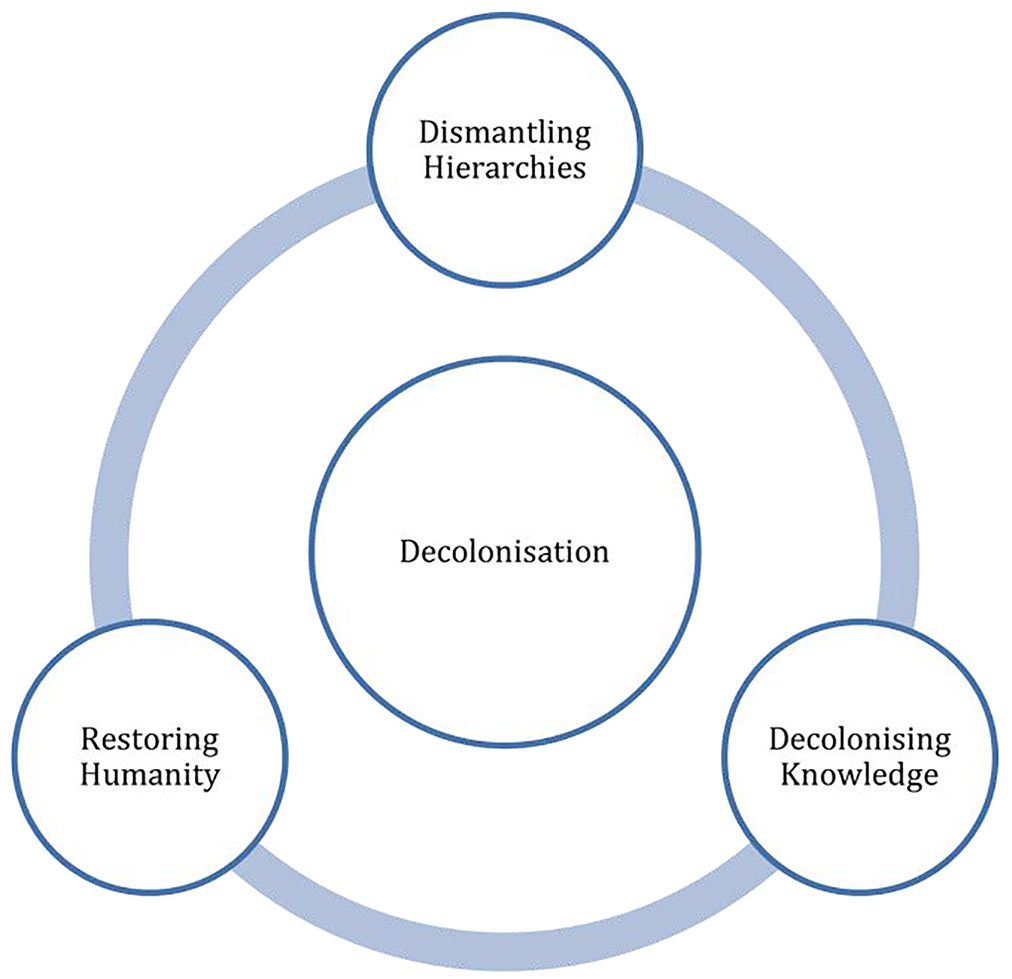
The key aspects of decolonization.
Reimagining water diplomacy through an equity–identity focus
To translate decolonial thought into practice, it is essential to reframe water diplomacy beyond the security–peace paradigm. This means centering equity and identity as foundational principles for restructuring global water governance. Nagheeby and Amezaga (2023) translate Figure 1’s decolonial pillars into the equity–identity framework depicted in Figure 2. Equity tackles material inequities through fair allocation and restitution; (collective) identity confronts epistemic hierarchies by elevating Indigenous, local, and regional (e.g., SWANA) knowledge. Together, they restore dignity and collective humanity, shifting water diplomacy from transactional bargaining to historically accountable, mutually respectful relationships. This requires challenging dominant Global North perspectives and making space for inclusive approaches from the Global South, including Latin America, Africa, SWANA, and beyond. Such a shift involves prioritizing equitable, reasonable water use and ensuring the voices of historically marginalized riparian states are respected. Addressing systemic inequalities embedded in water governance structures is central, as current systems favor powerful actors while excluding vulnerable communities.
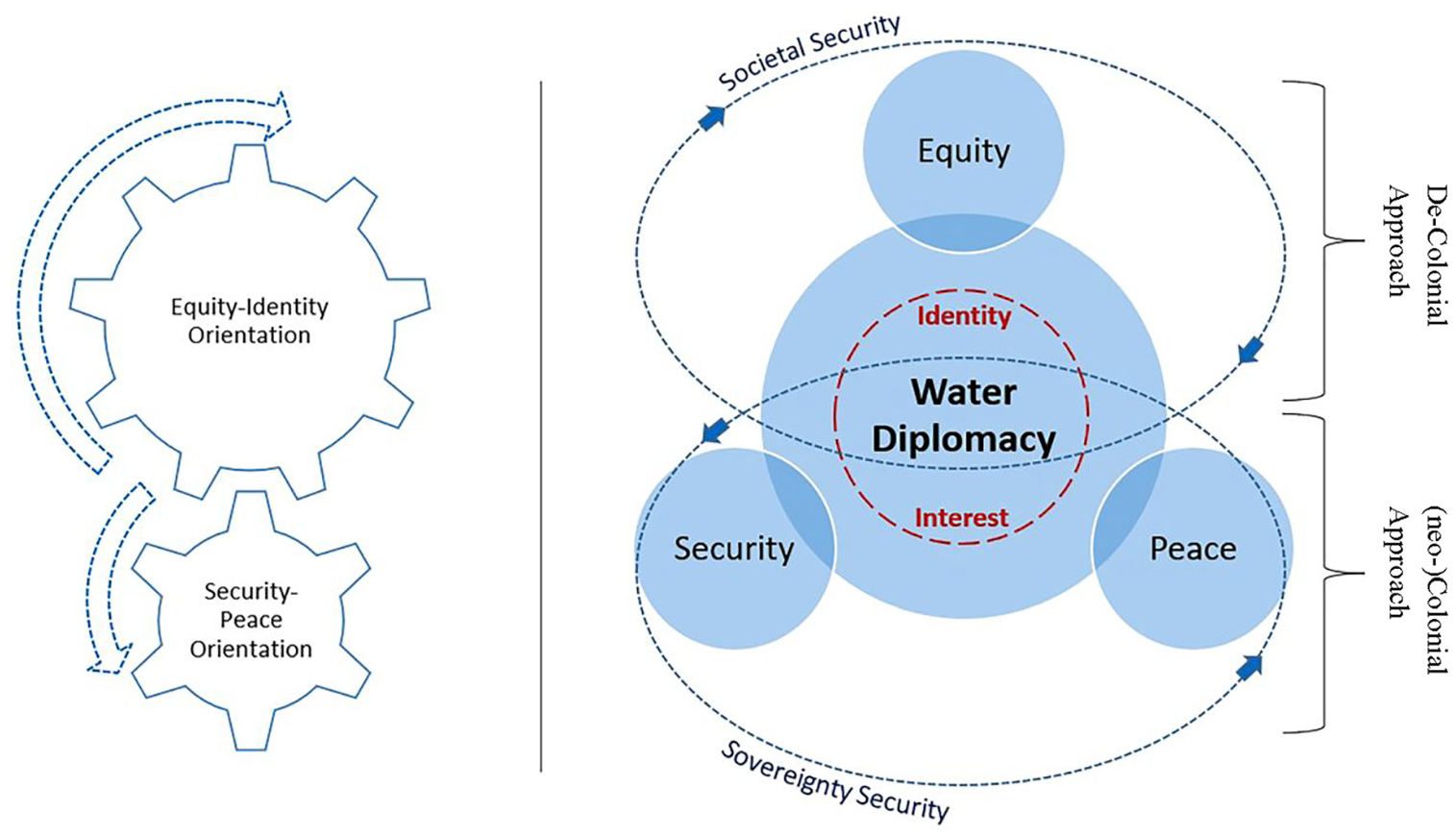
Different approaches to water diplomacy.
Alternative discourses centering equity and identity can disrupt entrenched governance systems. By reframing water as a cultural and social good tied to identity and justice, these narratives challenge the commodification and colonial perspectives. Incorporating these frameworks into water diplomacy fosters decolonized, historically accountable, locally driven, and community-empowered governance. This shift not only addresses systemic inequities but also promotes inclusive, sustainable decision-making.
Decolonizing water diplomacy requires promoting alternative ways of knowing, relating to, and using water. Storytelling initiatives like “community stories” in the Yarmouk River Basin document local practices and resistance to restrictive policies. These narratives challenge oversimplified technocratic frameworks by incorporating hydrological, political, and cultural insights (Yarmouk Knowledge Portal, n.d.). Amplifying non-academic voices—of farmers, women, activists, artists—is essential to redefining water as a multifaceted resource with diverse meanings (Alqaisiya, 2024; Dajani, 2020; Parsons, 2023; Sultana, 2024).
The identity dimension of this new approach recognizes water as more than an economic commodity—it is embedded in cultural and social life. Water diplomacy should foster collective understandings among riparian states, cultivating shared responsibility and mutual respect. Prioritizing equity and identity moves water diplomacy beyond reactive conflict resolution toward long-term, just, and sustainable cooperation over shared waters.
Decolonising policy in water diplomacy
One of the key aims of this article is to offer recommendations for beginning the process of true decolonization of water diplomacy. These suggestions are intended for three overlapping constituencies: (a) riparian state agencies and basin organizations, (b) multilateral and bilateral funders, and (c) grassroots movements, Indigenous authorities, and allied researchers. These groups should come together to redefine the goals of water diplomacy, challenge neoliberal structures, reform funding systems, decolonize knowledge production, and promote justice. We thus outline here how water diplomacy might be enacted through a series of interconnected recommendations.
First, water diplomacy’s goals must be redefined. Rather than narrowly focusing on achieving geopolitical stability through security and peace, diplomacy should prioritize equity and the recognition of identity. This requires not only amplifying the voices of historically marginalized communities but also centering their epistemologies, values, and cultural relationships to water within negotiations and governance frameworks.
Second, neoliberal structures that underpin contemporary water governance must be challenged. This includes dismantling neocolonial mechanisms that perpetuate water insecurity through unfair trade agreements, debt dependency, and the commodification of water. Restructuring global financial systems and rejecting exploitative Public–Private Partnerships is essential. While this is an ambitious undertaking, embedding these concerns within regional and transboundary diplomatic dialogues—particularly in the SWANA region—is a critical initial step.
Third, water diplomacy should prioritize strengthening regional and local governance while promoting community-led management and ownership. This requires shifting decision-making processes from top-down definitions of problems to inclusive, community-driven design and implementation of solutions. Ensuring that communities hold genuine ownership over water governance, rather than being passive recipients of externally imposed policies, is central to decolonizing water diplomacy.
Fourth, while international cooperation and geopolitical agreements have historically been shaped by the interests of powerful states, there remains a critical need to reorient these processes toward redistributive justice. This means not only advancing joint financial support for innovations such as data sharing, satellite monitoring, and community-based restoration projects but also fostering South–South cooperation rooted in shared histories of dispossession. Such cooperation can help build alternative ethics and values that prioritize justice, solidarity, and sustainability, even within a landscape still dominated by strategic rivalries.
Fifth, decolonizing water diplomacy demands the decolonization of research and knowledge production. Neoliberal and Euro-centric narratives continue to dominate water governance debates globally. To address this, water policy actors should actively prioritize regional, local, and Indigenous knowledge systems—for example, African Ubuntu, Latin American Buen Vivir, and SWANA philosophies such as those of Farābī, Al-Ghazālī, Ibn Khaldūn, Molana Rūmī, Sa’di, and Mulla Sadrā—that emphasize harmony with nature, dignity, and collective well-being.
Sixth, funding mechanisms require radical reform. Geopolitical agendas often concealed within international aid and donor frameworks must be critically examined. Funding processes must prioritize justice, regional autonomy, and ecological integrity, ensuring that resources directly benefit marginalized communities and threatened ecosystems, rather than reinforcing existing power asymmetries.
Seventh, legal frameworks must be revised to prioritize justice over procedural cooperation. The prevailing emphasis on cooperation in international water law cannot be the end goal if it perpetuates inequity. Legal reforms should advocate for meaningful equity, particularly in regions historically affected by colonial and neocolonial oppression, such as SWANA. Revised legal norms must ensure that marginalized voices, historical accountability, and ecological sustainability become central pillars of decision-making.
Admittedly, these recommendations may seem idealistic in the face of centuries of colonial entrenchment and contemporary geopolitical realpolitik. Yet, it is this very improbability that underlines their necessity—for as long as diplomacy remains captive to colonial structures, water justice will remain elusive.
Conclusion: Toward a new water diplomacy paradigm
This intervention marks an initial step in a long journey to critically reflect on nearly 500 years of colonial oppression and its enduring impact on water governance. While it advocates for concerted support—from river-basin communities and Indigenous organizations to researchers, donors, negotiators, and indeed everyone engaging with this intervention—to advance decolonization in water diplomacy, it also cautions against reducing “decolonization” to a buzzword. Genuine transformation, not performative rhetoric, is essential for creating a just and inclusive paradigm shift. The proposals outlined in this intervention are intended to foster dialogue and collaboration among a broad range of actors—including policymakers, academics, and community representatives—to explore and articulate what decolonization entails for different groups, both conceptually and in practice. Facilitating inclusive conversations around water diplomacy is not only beneficial but essential, as it ensures that diverse perspectives and experiences shape the reimagining of diplomatic norms and practices.
Decolonizing water diplomacy requires courage to move beyond superficial diplomatic gestures and confront the root causes of oppression, including colonial legacies. Cooperation, often portrayed as inherently virtuous, becomes counterproductive when detached from identity, equity, and justice. Tools like international water law, which aimed at cooperation, risk perpetuating injustice when fairness is sidelined. This is particularly relevant to regional initiatives and conferences in SWANA, where political “sensitivity” often silences critical engagement, for example, in confronting the ongoing and devastating (water and environmental) injustices in Palestine (particularly in Gaza), thereby reinforcing systemic inequalities.
Yet, global and local elites—including academics, researchers, and international programs—are often co-opted by the donors’ geopolitical agendas. Their silence during critical moments of dehumanization and complicity through training and capacity-building initiatives reveal the deep entanglement of knowledge systems with neocolonial structures. Acknowledging these flaws is vital for reimagining water diplomacy on truly decolonial terms.
Footnotes
Acknowledgements
The authors thank the anonymous reviewers and the editorial team for their constructive feedback. This paper is inspired by insights and discussions from the 2-day workshop titled “Decolonizing Water Diplomacy” in November 12 to 13, 2024, initiated through the Science Policy Incubator Grant, funded by the Geneva Water Hub (GWH) and Swiss Development and Cooperation (SDC). The workshop, held at the Jordan University of Science and Technology (JUST) in collaboration with the Jordan’s Water Diplomacy Centre (WDC) and the Blue Peace Middle East project (BPME), brought together a diverse group of participants from Western Asia—including researchers and policy makers—to critically examine the concept of colonization from multiple perspectives. We extend our gratitude to all participants whose contributions enriched this effort. In particular, we would like to thank the GWH, WDC, and BPME for their invaluable support in funding and organizing the workshop and fostering meaningful discussions.
Funding
The author(s) disclosed receipt of the following financial support for the research, authorship, and/or publication of this article: This work was supported by the Geneva Water Hub’s Science Policy Incubator Grant.
Ethical Approval and Informed Consent
This article does not contain any studies with human participants or animals performed by any of the authors. No primary data requiring informed consent were collected.

Data Availability Statement
No new data were created or analyzed in this study. Data sharing is not applicable to this article.