



Abstract
Previous research has shown that climate change can exacerbate conflict drivers or, on the other hand, incentivise ‘environmental peacebuilding’. One might, therefore, expect to find references to climate issues in peace agreements. This study draws on the PA-X Peace Agreement Database to shed new light on climate–peace interactions. Only seven out of 2,003 peace agreements signed between 1990 and 2023 explicitly mention ‘climate change’. However, an analysis of provisions in 28 peace agreements reveals that climate–peace interactions are much more complex than the paucity of the term ‘climate change’ in agreements suggests. Based on PA-X data, I argue that there are three main ways in which climate change and peace processes interact: First, as existing literature shows, the consequences of climate change can affect conflict parties’ bargaining positions and lead to conflict (de-)escalation. Second, conflict parties agree on climate action – often implicitly and for political reasons. This article provides the first comparison of levels of climate action ambition in peace agreements, from incremental and transformational adaptation to mitigation. Third, the results of political bargaining in peace processes can have positive and negative unintended consequences for the climate. For example, although conflict de-escalation can produce a more conducive environment for climate action, its stabilising effect may also enable carbon-intensive economic activities.
1. Introduction
Climate change, conflict and peace are deeply intertwined phenomena. The Intergovernmental Panel on Climate Change (IPCC, 2023, p. 72) finds that ‘multiple climatic and non-climatic risk drivers such as biodiversity loss or violent conflict will interact’ as global warming continues. Civil society organisations, local communities, heads of government and the highest executives of international organisations have acknowledged the relationship between the climate, conflict and peace. In 2023, the United Nations (UN) Secretary-General (2023, p. 15) urged the international community to ‘address the interlinkages between climate, peace and security’ and (2023, p. 21) to treat these issues ‘as a political priority’. The United Nations Department of Political and Peacebuilding Affairs (2022, p. 15) now encourages mediators to support the drafting of ‘climate-adaptive’ peace agreements.
A substantial body of literature has emerged examining how the environment, climate change and conflict affect each other, often focusing on unidirectional relationships at the expense of a closer examination of their reciprocal effects (Gleditsch, 2012; Homer-Dixon, 2001; Ide et al., 2023; Mach et al., 2019; Sharifi et al., 2021; von Uexkull & Buhaug, 2021). The IPCC (2022, p. 15) finds that the impact of climate change on conflict is ‘relatively weak’ when ‘[c]ompared to other socioeconomic factors’. The causal mechanisms linking climate change to armed conflict onset and intensity continue to be debated (Mach et al., 2020). However, researchers have suggested different pathways through which changes in the climate interact with socioeconomic dynamics to exacerbate conflicts (Detges & Foong, 2023). Mobjörk et al. (2020, p. 3), for example, describe four interrelated pathways ‘(a) livelihoods, (b) migration and mobility, (c) armed group tactics and (d) elite exploitation’ that can drive climate insecurity. Climate change, in particular when exacerbating natural resource scarcity or other conflict drivers, is thus considered as having an important indirect, and often escalatory, effect on armed conflict.
The relationship between climate change and peace processes has received less scholarly attention. Notable exceptions include studies in the ‘disaster diplomacy’, ‘water diplomacy’ and ‘environmental peacebuilding’ research fields, isolated examples of analysis of the relationship between climate change and mediation in the grey literature (European Institute of Peace, 2020; Gryzbowski & Hunnie, 2021), and studies on implications of specific peace agreements for the climate – chiefly of the 2016 Colombian peace agreement (Mendoza, 2020; Murillo-Sandoval et al., 2020; Valenzuela & Caicedo, 2018).
The ‘disaster diplomacy’ literature suggests that disasters, some of which are climate change related, can create ‘ripe’ moments for negotiations, or conversely cause peace processes to unravel (Ide, 2023; Kelman, 2011; Kreutz, 2012; Nemeth & Lai, 2022; Schleussner et al., 2016). Ide (2023, p. 17) finds that 25% of the 36 disasters he examines led to armed conflict de-escalation – with a further 25% of cases being escalatory and 50% with no effects. Ide (2023, p. 217) argues that ‘disasters rarely facilitate positive and long-lasting forms of peace’ but those disasters can open up ‘windows of opportunity’ to initiate negotiations under certain conditions.
Beyond ‘disaster diplomacy’, it has also been argued that environmental cooperation and ‘water diplomacy’ more generally can help resolve conflict (Brown & Nicolucci-Altman, 2022; Conca & Dabelko, 2002; Dresse et al., 2019; Johnson et al., 2021; Swain & Öjendal, 2018). Ban Ki-moon, the former UN Secretary-General, (United Nations Framework Convention on Climate Change Secretariat, 2016) called the Paris Agreement on climate change a ‘peace pact with the planet’. Ide (2018) finds that environmental agreements can indeed contribute to inter-state reconciliation. Dresse et al. (2019, p. 104) describe ‘environmental peacebuilding’ as ‘the process through which environmental challenges shared by the (former) parties to a violent conflict are turned into opportunities to build lasting cooperation and peace’, (2019, p. 114) distinguishing between ‘technical, restorative and sustainable’ forms of environmental peacebuilding. However, as Krampe (Ide et al., 2023, p. 12) notes, ‘it is still unclear whether environmental cooperation and resource management efforts do actually support peace processes’.
In sum, while the impact of disasters, resource scarcities and environmental cooperation on conflict and peacebuilding feature prominently in the research and policy discourse, we still lack an understanding of the relationship between climate change and peace processes. There remain gaps in the literature with regard to the impact of peace processes on the climate, and more broadly how both of these phenomena interact and reciprocally affect each other. Evidence on the nature and ambition of climate action agreed to by conflict parties is similarly scarce. This article draws on the PA-X Peace Agreement Database to address these gaps and to better understand how climate change and peace processes interact. PA-X search results show that only seven out of 2,003 peace agreements signed between 1990 and 2023 explicitly mention ‘climate change’. However, PA-X data also reveal that the impact of climate change on peace processes, and vice versa, is much more complex than the virtual absence of the term ‘climate change’ in agreement texts suggests.
The article unfolds as follows. I will first discuss the article’s approach, methodology and limitations. In the main part, I will describe the three main ways in which climate change and peace processes interact using PA-X search results and by referencing 28 peace agreements that offer rich conceptual insight. First, I will illustrate the impacts of climate change on peace processes which are in line with earlier findings in the literature around the challenges and opportunities that climate change poses for peacemaking. In the subsequent section, I will present new evidence on the nature and scope of climate action agreed to in peace agreements. This section provides the first comparative analysis of climate action in peace agreements, ranging from incremental and transformational adaptation to mitigation. Subsequently, I will discuss the positive and negative unintended consequences of wider political bargaining for the climate. The conclusion (i) underscores the central role of political, conflict and socioeconomic factors in determining the impact of climate change on peace processes, and vice versa, (ii) draws out policy implications from these findings (iii) and highlights areas for further research.
2. Approach, methodology and limitations
Peace agreements were chosen as a window through which to study the interactions between climate change and peace processes. Peace agreements mark key moments in what are normally non-linear and highly complex peace processes. These agreements indicate terms of common agreement between parties that, if nothing more, constitute a possible road map for change aimed at ending violent conflict (Bell & Badanjak, 2019). As Brown and Nicolucci-Altman (2022, p. 15) argue, ‘decisions that are taken early on in post-conflict situations can determine development pathways for decades’. Consequently, the European Institute of Peace (2020, p. 15) notes that ‘[i]t is important that peace agreements lay the groundwork for addressing climate change in the reconstruction and peacebuilding phase’. Furthermore, given the salience of disasters and climate extremes as drivers of conflict (and peace) in the literature and the policy discourse, one might expect to find references to climate change in peace agreement texts. Peace agreements may thus offer insights into the way conflict parties frame the impact of climate change on conflict issues and ways of resolving them.
The PA-X Peace Agreement Database Version 7 contains 2,003 peace agreements from 174 peace processes between 1990 and 2023 (Bell et al., 2023). PA-X is the most comprehensive peace agreement database available and includes agreements between states (‘inter’ and ‘inter/intra’); within a state’s borders (‘intra’); and at the local level when local issues are at stake that are distinct from conflict-wide issues (‘intra/local’). A peace agreement is a ‘formal, publicly available document, produced after discussion with conflict protagonists and mutually agreed to by some or all of them, addressing conflict with a view to ending it’ (Bell et al., 2023, p. 3). A peace process is defined as ‘a formal attempt to bring political and/or military protagonists of conflict, to some sort of mutual agreement as to how to end the conflict’ (Bell et al., 2023, p. 3). Agreements are classified according to the peace process stage they were signed at, ranging from pre-negotiation/process agreements, ceasefire/related, substantive-partial, substantive-comprehensive, implementation/renegotiation and renewal, to other agreements.
An iterative process was adopted to select relevant peace agreements from PA-X. First, I conducted a search on PA-X using predefined topic categories in the database, namely the ‘environment’, ‘land reform/rights’, ‘natural resources’, ‘pastoralist/nomadism rights’ and ‘water or riparian rights or access’. PA-X researchers reviewed peace agreements line-by-line and captured all peace agreement provisions referencing these topics (see the PA-X Codebook for details; Bell et al., 2023). Second, I performed a keyword search on the PA-X text corpus using the 920 terms included in the IPCC Glossary (2019). I excluded from the search results 95 generic Glossary terms not directly related to climate change (e.g. ‘governance’). The remaining terms include basic (e.g. ‘greenhouse gases’) and specialist climate change terminology (e.g. ‘meltwater pulse’), potential consequences of climate change (e.g. ‘desertification’), and climate action (e.g. ‘adaptation’). The PA-X search returned mentions of 51 of these remaining terms in 1,808 agreement provisions which I manually reviewed for their alignment with the definitions used by the IPCC. Third, I supplemented these structured searches with free-text searches for 21 terms – found in 509 provisions – that are closely related to IPCC Glossary terms but not included therein (e.g. ‘carbon’, ‘natural disaster’). I manually reviewed these search results to identify themes in how peace agreements relate to and frame climate change (see Supplemental Materials for all PA-X search terms and results).
Before launching into the analysis, two limitations are worth noting. First, the analysis focuses on formal peace agreements in the context of wider peace processes. The analysis only covers agreements on PA-X which excludes, for example, verbal agreements or mediation attempts, and the collection of local agreements on PA-X is not comprehensive for the 1990–2023 period. Second, only limited contextual research was conducted. A detailed assessment of (i) conflict parties and mediators’ motivation to include climate change-related provisions in peace agreements and (ii) the implementation of climate change provisions lies outside the scope of this article. As such, these findings do not fully reflect the content of peace processes because some climate change issues that were on the negotiation table may not have ended up in agreements. Nevertheless, the peace agreements analysed here are useful entry points to survey climate change–peace process interactions in a range of processes involving a variety of conflict actors over a 33-year time span.
3. Search results and discussion
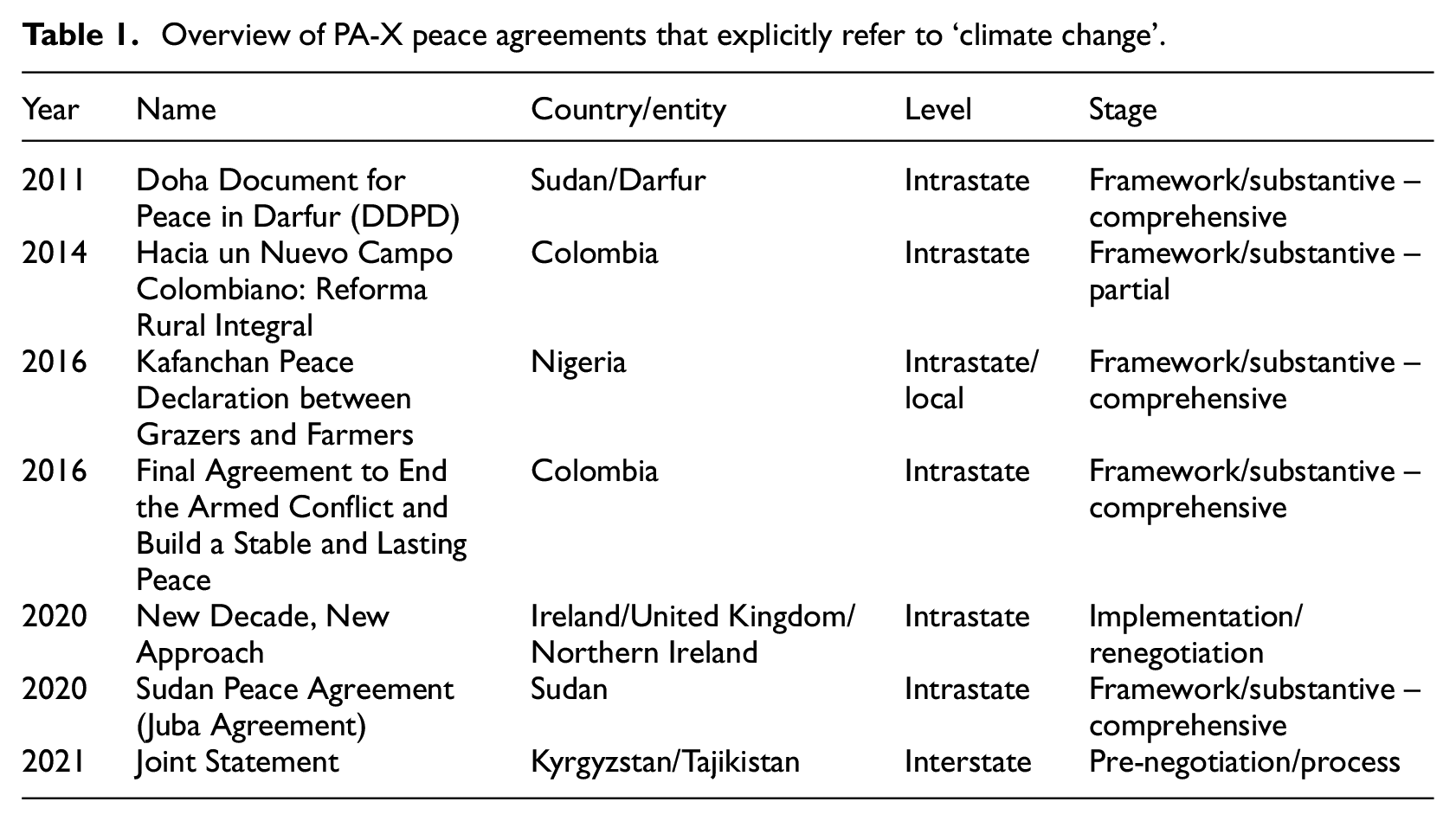
It may come as a surprise that despite the prominence of the topic in the academic and policy discourses, only seven of the 2,003 PA-X peace agreements signed since 1990 explicitly mention ‘climate change’. These seven pre-negotiation/process, substantive and implementation agreements were signed in five countries across four continents (see Table 1; refer to Supplemental Materials for references). One agreement, the Dar-Es-Salaam Declaration on Peace, Security, Democracy and Development in the Great Lakes Region, (PA-X, 2004, p. 7) refers to ‘climatic changes’. Perhaps unsurprisingly, none of these agreements is older than 25 years which corresponds to the more recent gaining in prominence of climate change terminology in peace process literature and practice.
Overview of PA-X peace agreements that explicitly refer to ‘climate change’.
However, PA-X search results reveal that climate change issues play a much more prominent role in peace agreements than the paucity of the term ‘climate change’ in agreements suggests. The environment, land use, natural resources, pastoralism and water are prominent themes in peace agreements because they often connect to core conflict issues, particularly resource competition and uneven land ownership. Figure 1 shows a relatively steady number of agreements including references to these topics over the last 33 years (see Supplemental Materials for details). As the climate–conflict literature shows, under certain conditions, climate change can exacerbate these conflict drivers (Koubi, 2019; Mach et al., 2019). The IPCC keyword search results similarly show that peace agreements address a range of environmental and climate change issues (Figure 2). In all, 998 out of the 1,808 references in PA-X peace agreement provisions matched the IPCC definitions of climate change terms, and relevant references include those to ‘forests’ (in 79 agreements), ‘biodiversity’ (18), ‘floods’ (16), ‘ecosystems’ (15) and ‘sustainability’ (15). Most of these references occur in substantive peace agreements (comprehensive and partial agreements), with few references found in pre-negotiation/process, ceasefire, and implementation agreements.
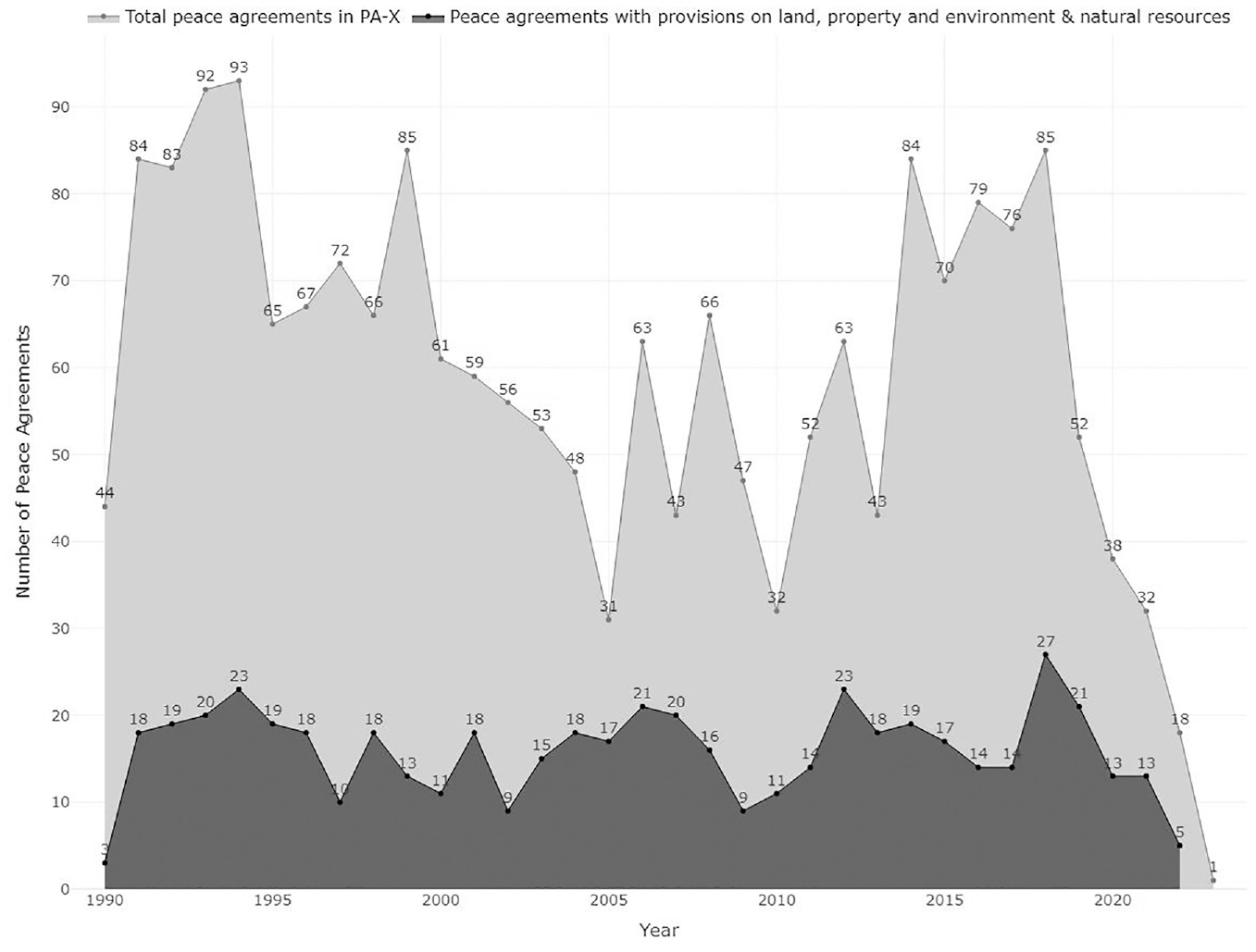
Total number of peace agreements in PA-X and agreements with provisions on land, property and environment, and natural resources, by year.
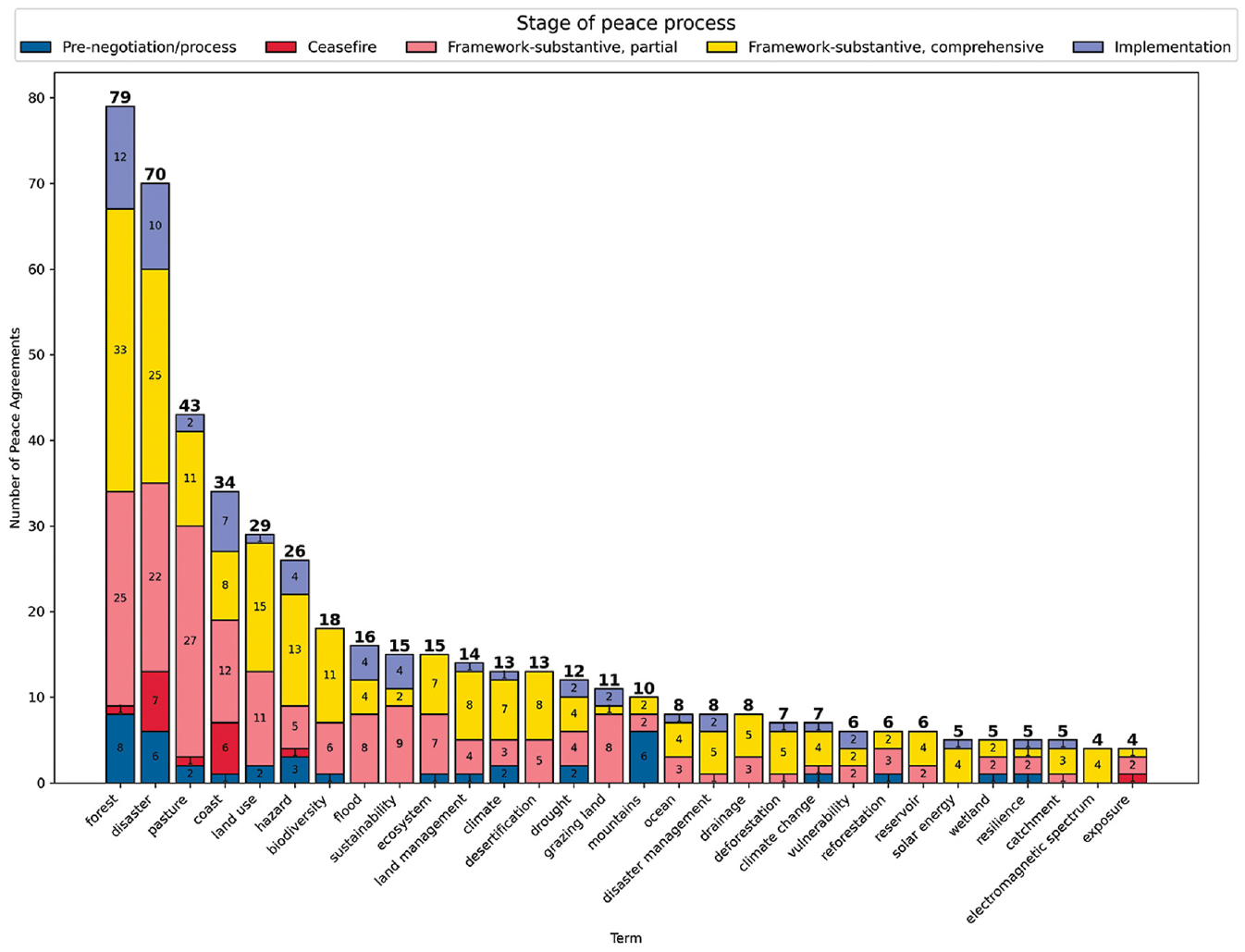
IPCC keyword search results on PA-X, by peace process stage (top 30 terms).
In the subsequent sections, I will discuss these search results and argue that they can be grouped into three main ways in which climate change and peace processes interact, namely (i) climate extremes and climate-related disasters, (ii) climate action and (iii) the consequences of wider bargaining between conflict parties for the climate. I will illustrate these three areas of interaction with reference to 28 peace agreements included among the PA-X search results, including the seven agreements mentioned above (Table 1), that offer rich conceptual insight.
3.1 Climate extremes and climate-related disasters: The impact of climate change on peace processes
Peace agreements across different contexts and at local, national and international conflict levels refer to disasters (70 peace agreements) and a range of hydrological, geophysical and meteorological phenomena, some of which may be directly climate change related (see Figures 3–5). The geographic distribution of these references reflects the IPCC’s (2023, p. 71) finding that ‘[r]egions at disproportionately higher [climate-related] risk include Arctic ecosystems, dryland regions, small island developing states, and Least Developed Countries’ because the majority of references are found in agreements from Asia and the Pacific, sub-Saharan Africa and the Middle East. In turn, I discuss what these peace agreement references reveal about climate–peace interactions.
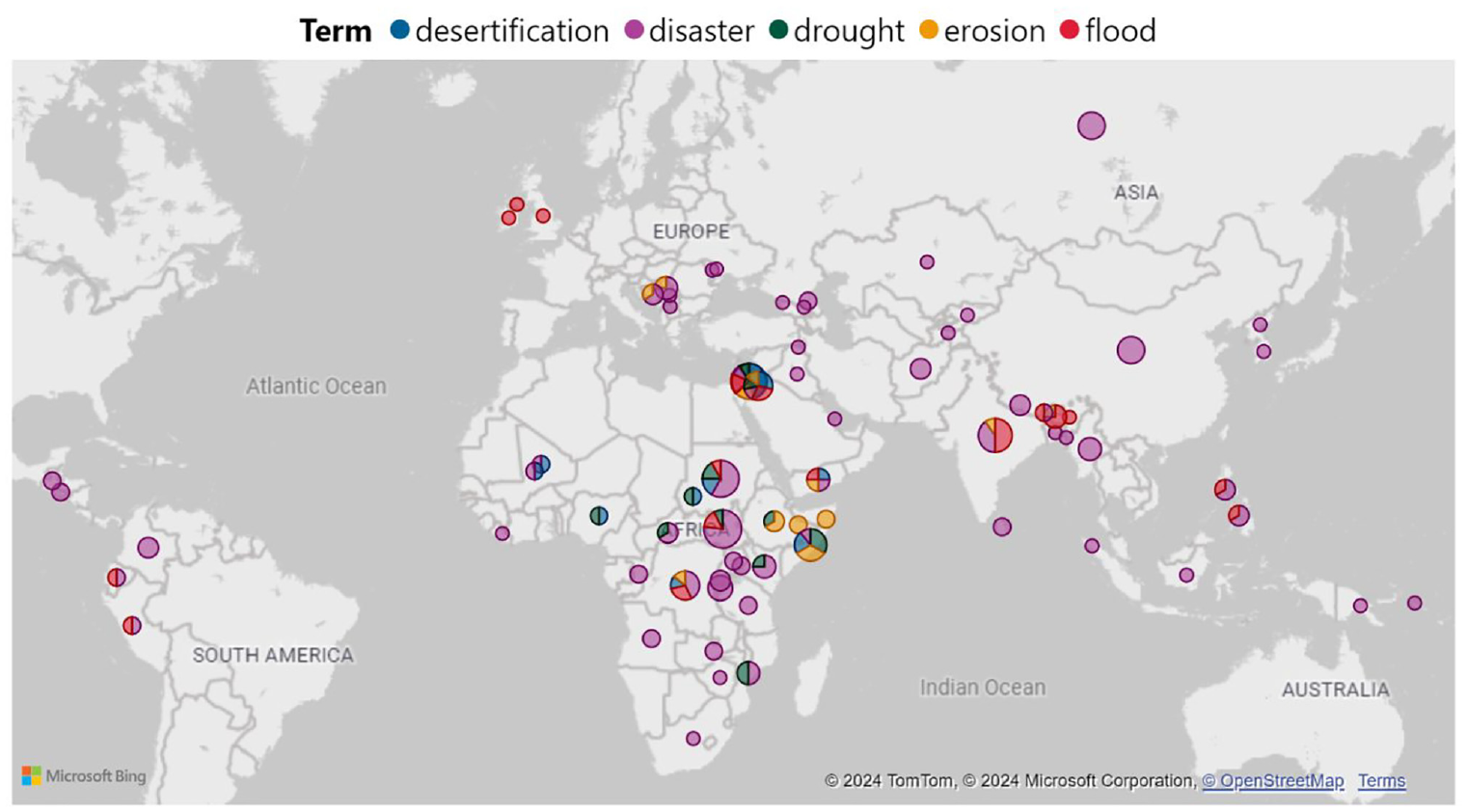
Global distribution of peace agreements referencing desertification, disaster, drought, erosion, and flood on PA-X.
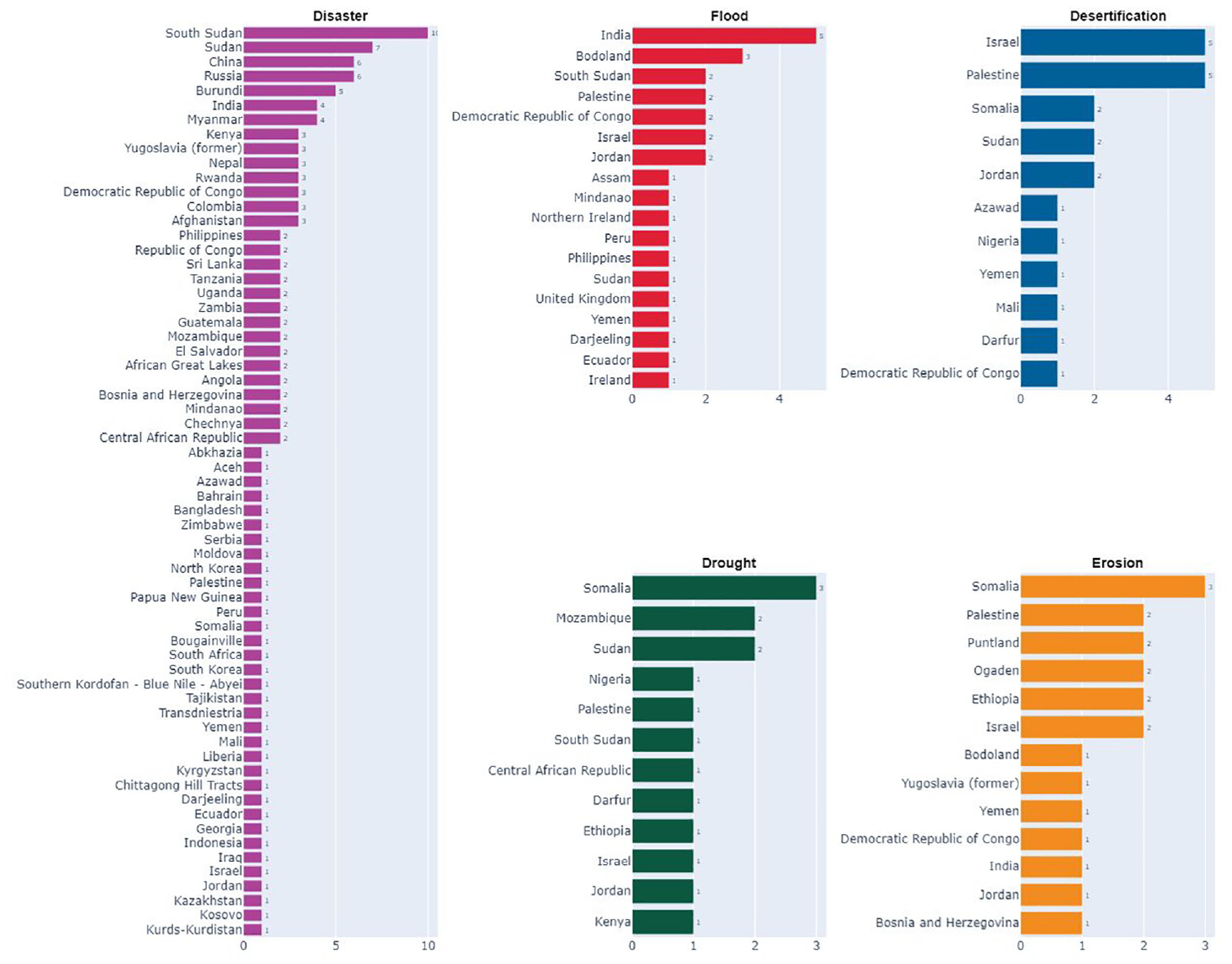
Number of peace agreements referencing desertification, disaster, drought, erosion, and flood on PA-X, by country/entity.
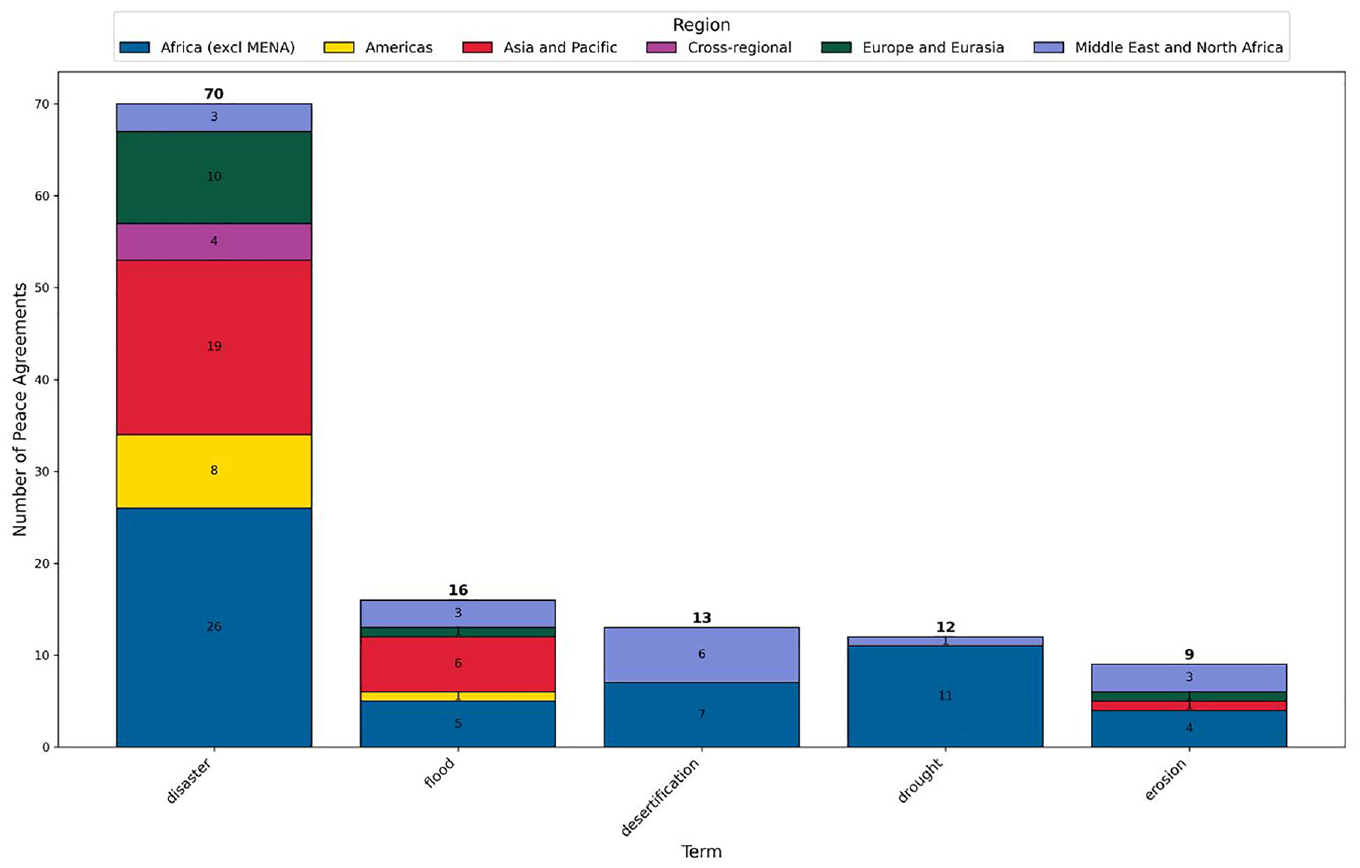
Number of peace agreements referencing desertification, disaster, drought, erosion, and flood on PA-X, by region.
While the IPCC (2022, p. 53) cautions that there ‘is insufficient evidence at present to attribute armed conflict to human-induced climate change’, it notes, with high confidence, that ‘food price spikes, food and water insecurity, loss of income and loss of livelihoods’ are mechanisms through which ‘[c]limate variability and extremes are associated with more prolonged conflict’. The loss of livelihoods, for example, is a prevalent theme in local peace agreements dealing with conflict between agriculturalists and pastoralists. The 2016 Kafanchan Peace Declaration between Grazers and Farmers addresses inter-communal conflict between Nigerian agriculturalists and pastoralists exacerbated by natural resource competition. In the agreement, conflict parties (PA-X, 2016b, p. 12) listed 21 causes of violence, among them ‘growing desertification caused by climate change’. Day and Caus (2019, p. 56) note how desertification and changes in rainfall patterns ‘drive cattle into new territories and reduce arable land’ in Nigeria. In total, 13 agreements on PA-X refer to desertification (all in Africa and the Middle East) showing that this is not an isolated issue (see Figure 5). In South Sudan, as in other neighbouring countries, ‘irregular’ cattle migration driven by droughts or floods can exacerbate armed conflict and is often linked to national-level elite interests (Muorwel et al., 2023; Deng et al., 2024). In their first review of the previously concluded Marial Bai peace agreement (PA-X, 2019), local conflict parties in South Sudan agreed to manage seasonal cattle migration and to settle disputes over water and land use and transhumance routes. Changes in the climate can thus become central to local peace processes.
National-level peace agreements also refer to climate change, including when they discuss the causes and impacts of armed conflict. In the Declaration on the Guiding Principles for Humanitarian Assistance signed between the Mozambican government and the Mozambican National Resistance, on 16 July 1992, for example, the conflict parties (PA-X, 1992, p. 1) stated that the ‘consequences of the armed conflict have been seriously aggravated by the worst drought in 50 years in the country’. In the Doha Document for Peace in Darfur, 31 May 2011, conflict parties (PA-X, 2011, p. 58) agreed that ‘[i]n order to foster reconciliation, the Parties agree to address the following causes of the conflict: i. Environmental degradation and dispute over access to natural resources’. In the subsequent Juba Agreement in Sudan, parties (PA-X, 2020b, p. 11) vowed ‘to end environmental degradation; to mitigate conflict over resources; and to seek to address […] all environmental causes of conflict as a key and necessary requirement for peacebuilding’. ‘Pasture’ and ‘land use’ are among the top five IPCC keyword search results (see Figure 2) and the number of agreements referencing ‘flood’ (16 agreements), ‘desertification’ (13) or ‘drought’ (12) (see Figure 5) underscores that the potential consequences of climate change matter to peace process stakeholders.
Once climate extremes cause disaster, their impact on peace processes is magnified. A disaster is defined as a serious disruption of the functioning of a community or a society at any scale due to hazardous events interacting with conditions of exposure, vulnerability and capacity, leading to one or more of the following: human, material, economic and environmental losses and impacts (IPCC, 2019).
It is important to note that not all natural disasters, such as earthquakes and tsunamis, are caused by changes in the climate. However, even the impact of non-anthropogenic disasters may be affected by climate change. As Li et al. (2018) argue, sea-level rise will likely increase the intensity of tsunami flooding. In addition, as Sen (1981) and de Waal (2018) have shown, some ‘disasters’, such as drought-related famines, can be either fully anthropogenic or triggered by a combination of human behaviour (e.g. political decisions) and natural forces (drought). This article adopts the term ‘climate-related disasters’ to reflect these nuances and to include any slow or sudden-onset disasters that have at least some anthropogenic climate change-related cause, or which are influenced by climate change in a way that magnifies their impact.
The peace agreements concluded in the aftermath of the 2004 Indian Ocean Tsunami – while not caused by anthropogenic climate change – offer a useful window into the impact of sudden-onset disasters on peace processes. This case is worth considering in the context of climate change given that tsunami hazards are projected to increase with sea-level rise, as mentioned above. Sri Lanka and Indonesia were both mired in self-determination conflicts at different stages at the time the tsunami struck. In response to the tsunami which caused widespread destruction and killed over 200,000 people across Southeast Asia (Le Billon & Waizenegger, 2007, p. 411), the Government of Sri Lanka and the Liberation Tigers of Tamil Eelam (LTTE) (PA-X, 2005c, p. 1) agreed in the Memorandum of Understanding for the Establishment of a Post-Tsunami Operational Management Structure, 27 June 2005, to cooperate ‘in recognition of this urgent humanitarian need and in a spirit of partnership’. Parties were unable to build on this initial commitment to advance peace talks, however. By contrast, while fighting initially continued in Indonesia, the Free Aceh Movement (GAM) eventually committed itself to a unilateral ceasefire in the aftermath of the tsunami. This was followed by the conclusion of the Helsinki Memorandum of Understanding on 15 August 2005 between the GAM and the Indonesian government in which the parties (PA-X, 2005b, p. 1) noted that ‘only the peaceful settlement of the conflict will enable the rebuilding of Aceh after the tsunami disaster’.
As Le Billon and Waizenegger (2007) argue, the primary reason for these contrasting trajectories was the difference in political and military contexts pre-disaster. While the peace process in Sri Lanka had already stalled pre-disaster, the newly elected leadership in Indonesia was determined to end the conflict, including through negotiations. In addition, while GAM was significantly weakened by Indonesian counterinsurgency operations pre-disaster, the LTTE had a stronger posture as reflected by its control over parts of Sri Lanka where it was the de facto government before the tsunami struck (Le Billon & Waizenegger, 2007). As Gaillard et al. (2008, p. 520) note, the tsunami had a ‘deep influence on the peace talks’ particularly as it accelerated the negotiations that had begun pre-tsunami. While other factors, such as the involvement of third-party mediators and politicisation of joint relief management, also played a role in these two cases, the 2004 Tsunami illustrates the importance of the pre-disaster political context and conflict dynamics in determining peacemaking trajectories in the aftermath of a disaster.
Peace agreements from other contexts illustrate the potential impact of slow-onset climate change-related disasters on peace processes. In the Joint Statement between the Transitional Federal Government and the Alliance for the Re-liberation of Somalia on Somalia Emergency and Drought Relief, 21 September 2008, conflict parties (PA-X, 2008, p. 1) agreed to establish a joint emergency office with members from both sides to provide relief to populations affected by drought, suggesting that the drought induced at least verbal commitment to cooperation between conflict parties despite their differences. Furthermore, as Ide (2023, p. 38) has argued, the severe drought that hit Burundi in the early 2000s reduced the Party for the Liberation of Hutu People’s (PALIPEHUTU) fighting capability as it suffered from higher food prices and decreasing support from their economically deprived support base in the population. Fighting between the Burundian government and the PALIPEHUTU slowed down considerably in the aftermath of the drought and the two parties ultimately concluded a Comprehensive Ceasefire Agreement (PA-X, 2006).
These agreements suggest that droughts can exert pressure on conflict parties to enter negotiations and agree on practical concerns of emergency relief. In fact, some agreements directly call on conflict parties to cooperate in relief efforts – see, for example, the Military Code of Conduct between the Government of Burma and Ethnic Armed Organisations (PA-X, 2015b, p. 3). However, it is important to contrast the drought-related cases above with research showing that droughts can increase the risk of sustained violence for highly agriculturally dependent or politically excluded groups (von Uexkull et al., 2016). Finally, while Ide partly explained the PALIPEHUTU’s reduced strength and increased willingness to negotiate with higher food prices, the IPCC (2022, p. 53) also notes that food price spikes driven by climate extremes are associated with conflict. The impact of droughts and food prices on conflict and peace processes thus appears highly context-dependent.
Overall, the PA-X search results show that both climate-related disasters and non-disastrous consequences of climate change are relevant to peace processes, and they reflect findings from the climate–conflict literature that describe how the climate can exacerbate conflict or provide peacemaking opportunities. Peace agreements provide evidence for how conflict parties perceive the role of climate change in conflict. The search results reflect the different pathways through which climate change can affect conflict drivers (e.g. by exacerbating natural resource scarcity) and conflict dynamics (e.g. by degrading a rebel group’s support base in the population). Since climate change has the potential to change the trajectory of conflicts, it equally has the potential to change peace process dynamics. This is because changes in the conflict environment directly affect conflict actors’ (perception of their) relative strength, and hence influence their willingness to enter negotiations or make concessions. Crucially, the search results demonstrate that context plays a fundamental role in determining the impact of climate change on peace processes. The following section turns this analysis on its head, showing how peace processes may affect the climate.
3.2 Climate action
The climate extremes and disasters described above may create incentives for conflict parties to cooperate in relief efforts and protect their constituencies from further harm. Indeed, peace agreements contain references to environmental cooperation which may offer opportunities for ‘environmental peacebuilding’. For instance, in the Proposal for the Establishment of a Coordinating Commission, 11 May 1994, Georgian and Abkhazian representatives (PA-X, 1994a, p. 1) agreed to establish a joint coordination commission ‘to discuss practical matters of interest’, including environmental issues. In the September 19th Pyongyang Declaration, signed in 2018, North Korea and South Korea (PA-X, 2018b, p. 2) set out to ‘conserve and restore the natural ecosystem’ and ‘pursue cooperation on environmental issues, starting with producing results in cooperation on forestry currently under way’. In a cessation of hostilities agreement between the Government of the Republic of the Philippines and the Rebolusyonaryong Partido ng Manggagawa ng Mindanao, the parties (PA-X, 2005a, p. 6) agreed to ‘strengthen environment and natural resource protection’ in the context of confidence-building measures. These agreements reflect what Dresse et al. (2019) have described as ‘technical environmental cooperation’ during which practical dialogue on joint environmental interests may keep conflict parties in contact despite otherwise difficult or stalled peace talks. In some cases, ‘environmental peacebuilding’ can thus lead to climate action.
Be it as a result of ‘environmental peacebuilding’ efforts or as part of wider peace talks, PA-X data show that conflict parties agree to take climate action in a variety of contexts and across local, national and international conflict levels. To fully understand the nature and ambition of climate action agreed to in agreements, I categorise peace agreement provisions according to IPCC definitions of climate adaptation and mitigation – two of the main pillars of the global climate action agenda. The IPCC (2019) considers adaptation approaches that are limited in scope and primarily aimed at maintaining existing adaptation systems, for example making irrigation systems more efficient, as forms of incremental adaptation to the changing climate. Transformational adaptation, on the other hand, seeks to alter ‘fundamental attributes of a socio-ecological system’, such as national-level environmental policies or societal beliefs about climate change (IPCC, 2019). Mitigation is ‘a human intervention to reduce emissions or enhance the sinks of greenhouse gases’ (IPCC, 2019). Loss and damage, the third pillar of the global climate action agenda, are not considered here. Unsurprisingly, there are no peace agreement provisions committing the main greenhouse gas emitters to compensate for losses and damages incurred in countries disproportionately affected by climate change.
3.2.1 Adaptation
Peace agreements contain a range of implicit references to climate adaptation measures. These provisions fall into the IPCC’s (2022, p. 22) four broad climate change adaptation and response systems: land and ocean ecosystems, urban and infrastructure systems, energy systems, and cross-sectoral considerations. For example, returning to the discussion of climate change-related disasters, the IPCC considers disaster risk management a key cross-cutting measure, and peace agreements provide for a range of measures addressing disaster risk.
Given that security sector reform is a key concern in peace agreements – 1,704 out of the 2,003 peace agreements on PA-X refer to the security sector – conflict parties often agree on the responsibility of the armed forces and other security actors in cases of natural disasters and emergencies. For instance, in a peace agreement signed on 26 October 1998, Ecuador and Peru (PA-X, 1998a, p. 4) agreed ‘to coordinate tasks related to preventing natural disasters, such as those caused by the El Niño phenomenon’ and that ‘[t]his will be done through the national civil defence entities and under the protection of the Natural Disasters Agreement of 1997’. Peace agreements also play a role in allocating primary responsibility for disaster risk reduction in peace processes where power is shared between the government and any new entities – the Annex on Power-Sharing to the Framework Agreement on the Bangsamoro, 8 December 2013 (PA-X, 2013, p. 7), for example, explicitly states that ‘[t]he Bangsamoro Government shall have primary responsibility over disaster risk reduction’.
A key adaptation to changes in land and ocean ecosystems is water resource management, itself a prominent topic in peace agreements. Two hundred agreements – about 10% of all peace agreements on PA-X – across 74 peace processes include provisions dealing with access to water, dams, harbours, watersheds, canals, seaports or the sea, wells or rivers (Bell et al., 2023, p. 63). A prominent case study of water scarcity and the adoption of adaptation responses is the Middle East Peace Process. The Treaty of Peace between the State of Israel and the Hashemite Kingdom of Jordan (PA-X, 1994b), and subsequent agreements, benefitted from ‘environmental peacebuilding’ in the form of practical cooperation over water resources which helped build trust between the Israeli and Jordanian governments (Ide et al., 2018). The agreement on cooperation on water-related matters between Israel and Jordan (PA-X, 1996), signed in support of the Oslo I Accords (PA-X, 1993), was intended to induce economic cooperation as part of the wider peace process. This declaration is an instructive example of an agreement in which two states set out a vision for joint natural resource management. The agreement details a range of incremental adaptation measures, including in the areas of environmental conservation, desertification control and more efficient water usage.
Examples of transformational adaptation measures beyond these more short-term responses and incremental adaptations to disasters and scarce resources are exceedingly rare in peace agreements. A notable exception is the Colombian Final Agreement to End the Armed Conflict between the government and the Revolutionary Armed Forces of Colombia (FARC) (PA-X, 2016a). Building on the earlier Hacia un Nuevo Campo Colombiano: Reforma Rural Integral (PA-X, 2014a), the Final Agreement (PA-X, 2016a, p. 4) put forward a transformational ‘vision of a new Colombia at peace’ based on, among other things, the ‘protection of the environment, respect for nature and its renewable and non-renewable resources and biodiversity’. The agreement (PA-X, 2016a, p. 14) introduced detailed rural land reform and environmental sustainability measures and (PA-X, 2016a, p. 25) called specific ‘preparatory measures to mitigate the risks of climate change’. The Final Agreement (PA-X, 2016a, p. 3) identified the concentration of land ownership as well the marginalisation and underdevelopment of rural communities as key causes of the conflict. The environmental and climate measures that parties agreed to directly relate to land use and sustainable development, and therefore ways to address some of the conflict’s causes. This agreement shows that conflicts do not need to be directly related to climate change for parties to agree to ‘climate-conscious’ peace agreements as long as environmental and climate considerations are considered relevant to conflict resolution.
3.2.2 Mitigation
Peace agreements since 1990 include a range of climate change mitigation measures but rarely label them as such. A small number of agreements include plans to promote clean energy and reduce greenhouse gas emissions, and some agreements refer to different types of carbon sinks. Overall, the scope of mitigation measures in agreements is limited.
To begin with, the most ambitious peace agreement in terms of climate mitigation is the New Decade, New Approach Agreement concluded in Northern Ireland (PA-X, 2020a). The agreement (PA-X, 2020a, p. 44) called for climate change legislation, a new energy strategy, a ‘transition to a zero carbon society’, and a review of the government’s carbon emission reduction strategy. While these provisions lack specific details, this agreement is exceptionally explicit about climate change. It is one of only two agreements that references the 2015 Paris Agreement (PA-X, 2020a, p. 8) – the other being the Joint Statement between Kyrgyzstan and Tajikistan (PA-X, 2021, p. 3) – and the only agreement that refers to a ‘climate crisis’ (PA-X, 2020a, p. 44).
In Northern Ireland, it was a political event that precipitated the inclusion of climate change in this agreement rather than the salience of climate change in the political settlement process. The New Decade, New Approach Agreement was concluded three years after the Northern Ireland Assembly was dissolved. While there were other deeper political challenges, the collapse of the power-sharing government was triggered by a row over the ‘Renewable Heating Incentive’ (RHI) scheme which was put into place as an environmental protection measure but ended in a fraud allegations scandal (McBride, 2019; McNicholl, 2020). Against this backdrop, it is unsurprising that the agreement included climate action provisions. The agreement is replete with references to the RHI and (PA-X, 2020a, p. 11) specifically called for further government reform taking into account the findings of the public inquiry into the RHI. This case shows the potential negative consequences of mismanaged climate action, which explains how climate change became an important issue two decades after the main Belfast/Good Friday Agreement (PA-X, 1998b). The scandal and its role in the government’s collapse underscore the context-specific ways, in this case, a political event, in which matters such as climate change can become key to wider conflict and peace agreement implementation issues.
While less ambitious in scope, conflict parties across processes have committed to promote the usage of clean energy, including by referencing renewable energy (4 agreements on PA-X), solar power (5), wind energy (4) and hydropower (7). For instance, in their Joint Statement of 29 June 2021, Kyrgyzstan and Tajikistan (PA-X, 2021, p. 3) agreed ‘to develop their huge hydropower potential to provide the region and beyond environmentally friendly renewable energy’ to ‘meet the growing needs of the population and economies of the Central Asian states and taking into account the negative trends in climate change and obligations under the Paris Agreement’. In the Yemeni National Dialogue Conference Outcomes Document, 25 January 2014, the Yemeni government (PA-X, 2014b, p. 176) committed itself ‘to stop buying electricity that is generated with diesel’ and to work towards a ‘clean and alternative energy strategy (gas, wind, solar power, and hot springs)’.
By regulating the use of and access to forests, wetlands, moors and mangroves, peace agreements also contribute to the protection and expansion of natural carbon sinks, a key goal of the global climate change mitigation agenda. Seventy-nine (79) agreements on PA-X include reference to forests, including six (6) agreements referring to reforestation and two (2) agreements calling for afforestation. Five (5) agreements refer to wetlands. The aforementioned Colombian Final Agreement (PA-X, 2016a, p. 20) called for the management of ‘forest reserve areas, areas of high biodiversity, fragile and strategic ecosystems, watersheds, moorland (and wetlands, and other water-related sources and resources)’. The Nepalese Constitution of 2015 (PA-X, 2015a, p. 157), considered a peace agreement on PA-X as part of the wider Nepalese peace process after the Nepalese Civil War (1996–2006), assigns the responsibility for ‘ecology management, […] national forest policy, [and] carbon services’ to the federal government.
The diversity of the geographies and nature of climate adaptation and mitigation measures examined in this section underscores that there is real precedent for climate action in peace agreements, particularly in comprehensive and partial substantive agreements. Climate action provisions relate to issues around sustainable development, environmental protection or resource governance, and greatly vary in terms of substance and detail. The provisions range from rhetorical statements to more detailed provisions prescribing specific measures. Climate action is rarely explicitly framed as such. The reasons for including climate action in agreements vary, but as the discussion of the New Decade, New Approach Agreement in Northern Ireland and the Colombian Final Agreement shows, political dynamics and the conflict context play an important role in determining whether parties address climate change in agreements. When climate change connects to an issue conflict parties perceive as core to their conflict, chances appear much higher that climate issues will be addressed in some form.
The majority of climate action provisions relate to incremental adaptation meant to cushion the impact of climate change. Transformational adaptation and mitigation measures are rare in peace agreements. The paucity of ambitious mitigation measures in peace agreements – with the exception of the New Decade, New Approach agreement – may not be surprising because (i) the main instruments for domestic climate action are the National Adaptation Plans (NAPs) and Nationally Determined Contributions (NDCs) and (ii) few peace agreements since the end of the Cold War have been signed in processes involving the main greenhouse gas emitters as direct conflict parties. Not a single peace agreement explicitly refers to NAPs or NDCs which is relatively unsurprising given how little time has passed since these instruments have been introduced. However, the limited nature of adaptation measures in existing peace agreements reveals a gap and points to the hitherto untapped potential of peace agreements in supporting transformative adaptation to climate extremes and the implementation of NAPs.
Unfolding this potential requires a delicate balancing act. Peace agreements are the result of what are often protracted negotiations during which conflict parties seek to maximise their interests, sometimes at the expense of the climate. Conflict parties face the difficult task of reconciling short-term elite interests, recovery and economic growth ambitions, and the related need for cheap and easily available energy (which is often derived from fossil fuels), on the one hand, with climate action and its associated long-term and large-scale financial investment needs, on the other. Furthermore, mediators have to triage a range of sometimes competing reform agendas during peace negotiations, among which environmental or climate issues may be perceived as only marginal by conflict actors. It may in some cases be difficult to carve out the space for these issues, and simply adding another topic to a long list of negotiation points may risk ‘overloading’ peace talks. There may thus exist a ‘climate–peace trade-off’, where conflict parties and mediators might have to omit climate action discussions for the sake of peacemaking, especially in contexts where climate change may not be considered a conflict driver by any of the conflict parties.
Finally, it is worth noting that ‘environmental peacebuilding’ and climate action can have adverse effects. Ide (2020) discusses a range of unintended consequences, including displacement of populations from natural reserves to be protected under a new agreement or depoliticisation of environmental issues that risk reinforcing underlying power asymmetries if unaddressed. Furthermore, where adaptation measures are poorly conceived or implemented, ‘maladaptation’ can lead to ‘more inequitable outcomes, or diminished welfare’ (IPCC, 2019) and, in some cases, local communities may resist climate action (Ben-Shmuel & Halle, 2023) which may, in turn, exacerbate conflict drivers (Dabelko et al., 2022, p. 56). For example, the expansion of renewable energy projects in conflict-affected countries may exacerbate existing conflict when poorly managed – as has been noted in relation to geothermal development projects in Kenya’s Rift Valley (Kong’ani et al., 2021). More broadly, global decarbonisation and a resulting decline in oil prices may have adverse effects on countries where oil income underpins fragile political settlements (Pospisil, 2024).
3.3 Consequences of wider political bargaining for the climate
Apart from (i) climate extremes and climate-related disasters and (ii) climate action, the third main way in which climate change and peace processes interact is through wider political bargaining. Peace negotiations and their outcomes can have positive and negative unintended consequences for the climate. Most fundamentally, peace processes that result in a reduction of armed conflict also lower carbon-intensive economic activity associated with the conflict, and, depending on context, have the potential to reduce environmental degradation and wildlife decline in conflict-affected areas (Daskin & Pringle, 2018). In the Agreement on Comprehensive Solutions between the Government of the Republic of Uganda and the Lord Resistance Army/Movement, 2 May 2007, the parties (PA-X, 2007, p. 10) noted the ‘significant environmental degradation’ the conflict has caused and agreed to take measures ‘to restore and manage environment[al] sustainability’. International discussions around the crime of ‘ecocide’ have re-emerged in the context of the 2022 Russian invasion of Ukraine and the related damage to Ukrainian ecosystems (Hosa, 2023). The carbon-intensive Russian and Ukrainian war economies and weapon manufacturing in countries supporting either side further drive greenhouse gas emissions related to the war. Peace agreements can thus indirectly roll back conflict-related emissions if they manage to reduce armed conflict.
Once the fighting is halted or reduced, successful peace processes can also create a more enabling environment for climate action. The IPCC (2019) defines ‘enabling conditions’ as ‘[c]onditions that enhance the feasibility of adaptation and mitigation options […] includ[ing] finance, technological innovation, strengthening policy instruments, institutional capacity, multi-level governance, and changes in human behaviour and lifestyles’. Arguably, it is easier for governments, businesses and civil society to agree on and implement climate action in peacetime than in wartime. Even if only partially implemented, peace agreements can (re-)establish government and provide the non-violent ways of political deliberation and economic decision-making needed to drive climate action. Peace agreements play a significant role in determining a country’s economic future and the scope for climate action because they often include economic power-sharing provisions (Bell, 2018). Successful economic power-sharing and greater stability post-conflict can increase access to international climate finance for adaptation and mitigation. This is particularly relevant for countries emerging from conflict that have previously received little climate finance from international financial institutions and foreign investors due to instability.
However, peace agreements can also have unintended negative consequences for the climate. Some peace agreements simply shift open power and resource struggles into new institutions and power-sharing models where discord continues to hamper any meaningful political or economic progress. Bell and Pospisil (2017) have referred to this as ‘formalised political unsettlement’. The Revitalised Agreement on the Resolution of the Conflict in the Republic of South Sudan (R-ARCSS) (PA-X, 2018a) is an example of a peace agreement that has resulted in a marked reduction in fighting between its signatories (International Crisis Group, 2022, p. 2), but which contains many unresolved issues (de Waal et al., 2019, p. 3). The agreement has arguably transposed political competition and conflict into the fledgling South Sudanese government institutions failing to deliver progress for its population, including on climate action. New forms of power-sharing and continuing political bargaining processes over executive structures may thus create additional challenges to agreeing on climate action.
In addition, while peace agreements may reduce environmental damage and emissions associated with armed conflict, they also pave the way for new climate-harming behaviour. For instance, evidence points to an expansion of coca-driven deforestation in Colombia after the signing of the 2016 Final Agreement (Mendoza, 2020), with an end of ‘FARC-led gunpoint conservation’ and an expectation of more favourable land tenure policies post-agreement leading to an increase in logging for cattle ranching, coca cultivation and land speculation (Murillo-Sandoval et al., 2020, p. 1). More generally, while post-conflict reconstruction remains challenging, under the right conditions, the absence of conflict can enable economic growth over time (del Castillo, 2008). If this growth is carbon-intensive, it will contribute to global warming. This is particularly the case when growth is based on the extraction of fossil fuels. In fact, peace agreements can pave the way for new increased hydrocarbon exploitation, particularly when they settle conflict over oil and gas resources.
For example, the Joint Declaration on Cooperation over Offshore Activities in the South West Atlantic (PA-X, 1995), signed by the governments of Argentina and the United Kingdom as part of their renewal of diplomatic relations after the Falklands-Malvinas War, called for the exploitation of offshore oil and gas in previously contested maritime areas. While the agreement was upended in 2007 and no oil production had begun by 2022 (Livingstone, 2022), this agreement underscores how the United Kingdom, the fifth biggest historic carbon dioxide emitter globally at an estimated 78.83 billion tonnes of cumulative carbon dioxide emissions as of 2022 (Friedlingstein et al., 2023), has attempted to use a peace agreement to continue fossil fuel exploitation. Other deals that encourage hydrocarbon exploitation or regulate hydrocarbon export and income distribution include peace agreements in Algeria, Indonesia/Aceh, Iraq and the Philippines. A range of agreements between Sudan and South Sudan settle oil disputes in a region that is disproportionately affected by the negative consequences of climate change. The aforementioned R-ARCSS has an entire section dedicated to oil concessions, production and revenue distribution (PA-X, 2018a, pp. 47–50).
At the same time, it is important to take into account countries’ relative contribution to global greenhouse gas emissions. The territorial carbon dioxide emissions of Sudan (22.01 million tonnes in 2022) and South Sudan (1.83 million tonnes), for example, are relatively low compared to those of Argentina (192.86 million tonnes) and the United Kingdom (318.65 million tonnes) (Friedlingstein et al., 2023). And while Sudan and South Sudan have done little to cause human-induced climate change, they suffer disproportionately from its consequences and are essentially caught in what could be termed an ‘adaptation trap’ where they are left to adapt to a warming climate without the means to substantially alter global emission pathways. This asymmetry in responsibility for emissions and the impact of climate change underscores that questions around ‘climate justice’ (Newell et al., 2021; Shue, 2014) and global patterns of fossil fuel consumption are deeply intertwined with the discussion of peace agreements’ potential adverse effects on the climate.
4. Conclusion
The relationship between climate change, conflict and peace processes is multi-faceted. Previous research has shown that climate change can exacerbate conflict drivers or, on the other hand, incentivise ‘environmental peacebuilding’. Building on this research, this article draws on a sample of peace agreements from the PA-X database to examine climate–peace interactions, a previously understudied topic. Based on peace agreement text data, I argue that there are three main ways in which climate change and peace processes interact, namely through (i) climate extremes and climate-related disasters; (ii) climate action and (iii) the consequences of wider bargaining between conflict parties. Critically, and despite the virtual absence of the term ‘climate change’ from peace agreements, I argue that there is widespread precedent for climate action in peace agreements. While climate action is rarely labelled as such, and its scope drastically varies, agreements across continents and local, national and international conflict levels address climate-related issues. Peace agreements tend to deal with the consequences of climate change, rather than its drivers, mostly proposing incremental ways of adapting to climate change. Transformative climate adaptation and climate mitigation measures are rarely included in agreements.
A common thread running through this analysis is the salience of contextual factors, in particular political, conflict and socioeconomic dynamics, in shaping climate–peace interactions. Politics and power are prominent themes across the three areas of interaction. Pre-existing political and conflict dynamics seem to play an important role in determining whether climate extremes contribute to conflict escalation or provide an opportunity for conflict parties to unite around the common cause of disaster relief or climate action. Climate action provisions in peace agreements tend to occur when the issue has become critical to conflict parties, sometimes for reasons other than their desire to protect the environment. The nature of climate action appears to be dependent on conflict parties’ perception of the role of climate change in their conflict and whether it is in their interest to commit to adaptation or mitigation measures. Finally, the political (un)settlements resulting from bargaining in peace processes can affect the climate in a number of unintended ways – positively by creating a more enabling environment for climate action, and negatively by paving the way for carbon-intensive recovery and growth.
This analysis has at least two implications for policy: First, for any peacemaking effort to succeed in areas prone to climate shocks, peace process stakeholders need to find ways to manage the (de-)escalatory potential of climate extremes and disasters, and, at the same time, mitigate against any unintended consequences of political decisions for the climate and climate action. To do so, the three areas of climate–peace interaction presented above could be integrated into ongoing conflict analysis to inform adaptive management of peace processes. In that process, stakeholders will need to examine the underlying power dynamics and political interests to identify entry points for ‘environmental peacebuilding’ and climate action. Second, conflict parties, civil society and mediators need to explore opportunities to mainstream climate action into peace negotiations and agreements. There is untapped potential in linking peace agreements to NAPs, and in supporting transformative adaptation measures. As this article shows, there is often precedent for climate action in peace agreements which could be expanded upon. The mainstreaming of climate considerations in peace processes will require careful balancing of different competing reform agendas and consideration of what the political marketplace of negotiations can bear.
For these initiatives to unfold their full potential, future research will have to provide new evidence on largely understudied issues. It would be worth examining the extent to which a ‘climate–peace trade-off’ exists, and under what circumstances mediators can carve out space for climate discussions in peace negotiations without risking to ‘overload’ the process. This comparative research would help us understand why some agreements are more likely to feature climate change considerations than others, and under what conditions parties agree on climate action. The extent to which climate action can serve confidence-building functions in peace processes could also be tested more empirically through this research. In addition, in-depth case studies of peace agreement implementation in contexts vulnerable to climate change could offer insights into the determinants of climate action success, particularly where climate action is relevant to tackling conflict drivers. These case studies could reveal under what circumstances climate action in peace agreements contributes to peacemaking, and how conflict-affected countries navigate the ‘adaptation trap’ in a changing climate.
Footnotes
Acknowledgements
Thanks are due to the two anonymous reviewers, Sanja Badanjak, Juline Beaujouan, Devanjan Bhattacharya, Oli Brown, Harriet Cornell, Alex de Waal, Valentin Geier, Fiona Knäussel, Kathryn Nash, Eliza Poor, Jan Pospisil, Julie Raasteen, Paul Seils, Laura Wise, as well as participants of the high-level workshop on ‘Climate, Mediation, and Conflict Resolution’ hosted by the European Institute of Peace on 6 July 2020, and respondents at a meeting of senior United Nations mediaton advisers, 1 February 2023, for feedback and comments on earlier drafts and presentations of this article. Special thanks are due to Christine Bell for her guidance, and Niamh Henry and Winnie Xia for their feedback and assistance in conducting the keyword and free-text searches and compiling figures.
Correction (April 2025):
Article updated to correct a few formatting and italicisation issues.
Declaration of conflicting interests
The author declared no potential conflicts of interest with respect to the research, authorship, and/or publication of this article.
Funding
The author disclosed receipt of the following financial support for the research, authorship, and/or publication of this article: This research is supported by the Peace and Conflict Resolution Evidence Platform (PeaceRep), building on the work of the Political Settlements Research Programme, funded by UK International Development from the UK government. However, the views expressed are those of the author and do not necessarily reflect the UK government’s official policies. Any use of this work should acknowledge the author and the Peace and Conflict Resolution Evidence Platform.
Ethical approval and informed consent statements
This article does not contain any studies with human or animal participants.
