



Abstract
Environmental peacebuilding, both in research and practice, demonstrates the potential of preventing, minimizing, and mitigating conflict, particularly in postwar societies. However, the complexities of the environment have not yet been fully considered. In consequence, environmental peacebuilding may involuntarily perpetuate violence instead of building peace. The paper aims to begin filling these theoretical and methodological gaps by critically examining the conceptual aspects of the “environment.” Studying through a postcolonial lens and applying indigenous methodologies, the paper reorients environmental peacebuilding scholarship by focusing on the politics of two drinking water projects in the eastern hills of Nepal. The study highlights the theoretical and methodological challenges of overemphasizing material aspects of resources that are embedded within the “environment.” The paper contends that the environment should not be deemed important only from material and usability perspectives but also for its historical and sociopolitical dimensions within the local community context. The paper concludes that ignoring these dimensions further obscures the conceptual and practical interlinkages between the environment, conflict, and peace. This, in turn, can undermine environmental peacebuilding efforts, a crucial approach to addressing climate change-induced conflict.
Keywords
1. Introduction
In this paper, I examine drinking water projects in Dharan, Nepal, to emphasize the need for theoretical and methodological reorientation of environmental peacebuilding in the wake of increased climate change impacts. Both in practice and research, environmental peacebuilding so far has often taken narrow, top-down, and technical perspectives on the environment that reduce it to a commodity (Sändig et al., 2024). As I show in this paper, this falls short of understanding the encompassing sociocultural meanings of the environment, whereby environmental peacebuilding efforts may even exacerbate conflict (Ide, 2020).
Nepal is a case in point to elaborate on environmental peacebuilding approaches at the nexus of climate change and environmental stress within a postwar context. Due to political, social, and geographic factors, Nepal ranks 125 out of 185 countries in climate change adaptation readiness (University of Notre Dame, 2020). It is the tenth most affected country in the world according to the Climate Risk Index (Eckstein et al., 2021) and, following World Bank (2022) estimates, 80% of Nepal’s population, especially indigenous communities, is at risk due to natural and climate change hazards.
Within Nepal, the paper examines the intersection of conflict, climate change, and environmental peacebuilding regarding drinking water scarcity in Dharan, located in the eastern part of the country. The city, which sits at the bottom of Churia Range (in between the plains of the Terai and the mountain ranges of the Himalayas), has a majority indigenous population and experiences complex climate change events: water scarcity, deforestation, biodiversity loss, landslides, flash floods, and increasing drought (Karn, 2007). The increased drought has aggravated the city’s perennial drinking water scarcity problem and related conflict. These conflicts take various forms: from household-level gender-based conflict to communal hostilities involving street protest based on ethnicity, caste, religion, and economic disparities.
In Dharan, I examine two drinking water projects. The first project was designed, funded, and overseen by the Asian Development Bank (ADB), which has taken a strong top-down approach. By contrast, the second project was a bottom-up initiative, designed, funded, and governed by the communities themselves. While the first erupted in protest and violent clashes, the second won long-lasting community support and mitigated local conflict. These two projects occurred in the aftermath of Nepal’s 10 years of civil war (1995–2005).
Drawing from Cahn and O’Brien (1996), my analysis of the two water projects is guided by the key question: how can environmental peacebuilding succeed? To answer this question, I am particularly concerned with how the involved actors—the ADB and indigenous communities—understand water and its role in society, and how these understandings shape prospects for peacebuilding.
I propose an indigenous methodology and argue that a situated definition of the environment based on local knowledge is crucial to environmental peacebuilding (Amador-Jimenez et al., 2024; Medina et al., 2023). My definition of the environment captures both physical and spiritual values that humans attach to the environment. It is a space where power, positionalities, development, cultures, values, and visions of the future meet and clash (Flamm & Kroll, 2024; Francis, 2024). In writing about a Nepali ethnic minority similar to the population in Dharan, Campbell (2013: 4) adds, “…the local environment is a place in which livelihoods, identities, and relationships of power are actively made between people, other species, and presences not visible to the human eye.” In summary, the environment in a localized context constitutes both material and non-material meanings encompassing everyday material usage as well as belonging. These aspects, I argue, need to be considered for effective environmental peacebuilding. In my analysis, peace denotes the transformation from everyday tension and violence to predictably stable, cooperative, and nonviolent relationships at the family as well as the community level.
This paper has the following sections. In the second section, drawing from environmental peacebuilding research, I highlight the theoretical gap that emerges when the environment is reduced to a commodity rather than seeing it as entangled within larger cultural systems and spiritual meanings. In the third section, I introduce the postcolonial theory and indigenous methodologies as useful frameworks to understand various environmental dimensions, beyond economic incentives. In the fourth section, I describe my research methodology, highlighting the reasons for selecting the field site including my data analysis technique. Finally, I offer a critical microanalysis of the two drinking water projects and conclude by reflecting on how the outcome of peacebuilding is linked with researchers’ and practitioners’ conceptualization of the environment.
2. Theoretical gap in environmental peacebuilding
Conflict researchers have found that at least 40% of violent conflicts globally are, one way or another, related to natural resources (Collier & Hoeffler, 1998; Collier & Sambanis, 2005; Matthew et al., 2009). This literature tends to reduce the environment into natural resources, that is, commodities. In this interpretation, actors fight for economic reasons (Kaplan, 1994; Homer-Dixon, 2001; Ross, 2004 & Blattman & Miguel, 2010). As part of this, sociopolitical dimensions of the environment are either overlooked or considered unimportant.
In the early 2000s, researchers began speaking of “environmental peacemaking” (Conca & Dabelko, 2002). They gave the environment attention not just for its conflict risks but also for its opportunities for building peace through revenue sharing (Bruch et al., 2016; Jensen & Lonergan, 2012; Lujala & Rustad, 2012; Young & Goldman, 2015; & Swain & Öjendal, 2020).). This mostly scarcity-led conflict research on the environment comes from the “rational choice” perspective in which social members pursuing self-interest choose to cooperate and coordinate rather than resort to violence (Dalton, 2011; Dombrowsky, 2009; Koubi, 2019). While rational choice is useful to contemplate, it overlooks environmental complexities, such as historical and sociopolitical dimensions.
Environmental peacebuilding is no longer limited to postwar contexts alone (Dresse et al., 2019; Ide, Bruch et al., 2021; Ide, Palmer, & Barnett, 2021; Krampe, 2018). Framed in this way, environmental peacebuilding suggests that the environment is “a possible means rather than an end” for building peace (Conca & Beevers, 2018: 55). Scholars identify key environmental dimensions that help build peace (Bruch, Jenesen and Emma, 2021: 13; Verweijen, Schouten and O’Leary, 2022: 6-7): security, economic development, political and social collaboration, and good governance. For these dimensions to cumulatively yield desired peace, Dresse et al. (2019:105) highlight “three main building blocks”: initial conditions, mechanisms, and outcomes.
Following Dresse et al., environmental peacebuilding can be initiated under conditions similar to Zartman’s (2007) “ripe moment” or mutually hurting stalemate theory, that is when warring parties turn to cooperation instead of continuing zero-sum fighting. In Dresse et al.’s second and third building blocks, the protagonists make rational calculations about shared environment losses from destruction and expected vs. actual benefit, based on which they decide whether to end violence.
However, this brief overview of environmental peacebuilding literature indicates a disproportionate focus on the economic dimensions of the environment in a top-down technocratic approach (Sändig et al., 2024). In response, some scholars have begun studying the environment from a bottom-up and more holistic approach. For example, Ide, Palmer and Barnett’s (2021) study on East Timor and Morales-Munoz’s et al. (2021) study in Columbia look at traditional customary practices of environmental management. Together, they emphasize community experiences in the sustainable use of natural resources and peacebuilding.
The disproportionate focus on the economic usability of the environment fails to sufficiently integrate complex sociopolitical dimensions. By reducing environment to narrow economic terms, we inadvertently overlook how (indigenous) communities see their environment as inseparable from their history, politics, and culture that cumulatively define their lifeworld.
The definition of the “environment,” which captures both physical and spiritual values helps us to recognize how communities participate in making and remaking the importance of the environment. Understanding these dynamics is crucial for effective environmental peacebuilding.
3. Postcolonial theories and indigenous methodologies to broaden the conception of the environment
Globally, many indigenous communities live on the frontlines of climate change and use elements of the environment, which they conceptualize holistically, to adapt (Yu & Maaker, 2021). They consider the environment not merely through a materialistic lens. Drawing from their distinct ancestral ties, indigenous peoples emphasize community needs and sufficiency, rather than just maximizing production and consumption (McGregor et al., 2020). Indigenous groups pass these forms of knowing from one generation to the next in ways that make their cultures and worldviews historically distinct from dominant societies.
Relatedly, postcolonial theory emerged to challenge colonial interpretations of the world by making alternative conceptions of issues such as the environment visible (Sharp, 2009). Guha and Martínez Alier (1998) point out the “varieties of environmentalism” to broaden the theoretical scope of understanding the environment. Other postcolonial scholars highlight social, cultural, political, and historical approaches to understanding the various environmental dimensions (Mount & O’Brien, 2013; Nixon, 2005 & 2013; Sharp, 2009). For instance, by applying decolonial theory, Rodríguez and Inturias (2018) emphasize the diverse non-economic views that communities have about the environment and that they use to foster dialogue between different cultures to transform conflict and build peace. Peacebuilding researchers can learn from these approaches (Ide et al 2023).
As a case in point, in 2021, the Nepalese Government decided to remove a rock that obstructs boats transporting goods and people in the Saptakoshi River, one of Nepal’s foremost. The Kirant community, an indigenous group in the area (and the same group who live in Dharan), loudly objected (Yadav, 2021). For the government, the rock was an obstacle to development. But for the community, the rock (“khuwalung” in the indigenous language) is sacred, with heavy symbolic import. The contestation simmered down after the government withdrew its decision. Postcolonial approaches help us to make sense of instances like the contestation over the “khuwalung” and the politics of water.
International financial institutions like the World Bank and ADB often speak of indigenous knowledge. Yet, they continue to struggle to include broad views of the environment that extend beyond narrow economic terms. The postcolonial theoretical approach helps us reorient our conceptualization of the environment beyond mere commodification.
3.1. Indigenous methodologies
The theoretical gap discussed above is directly linked to an important methodological gap. Multiple scholars (Chilisa, 2020; Kovach, 2016, 2021; Smith, 2012) highlight that indigenous methodologies can fill such a gap. Following Walter and Suina (2019: p. 234), this refers to “a methodology where the approach to, and undertaking of, research process and practices take Indigenous worldviews, perspectives, values and lived experience as their central axis.” Indigenous methodologies, thus, posit that knowledge about the environment rests in communities’ intergenerational belief systems, histories, memories, and cultures. Similarly, Gibson-Graham (2016) emphasizes place-based “vernacular practices” as the foundation for knowledge production. To this end, indigenous methodologies can supplement traditional western research practices through praxis, where the two knowledge systems (western and indigenous) entwine in partnerships (Ryder et al., 2020).
Indigenous epistemology rests in holism, interconnectivity, fluidity, and multiplicity of sources that includes the nonhuman (Amador-Jimenez et al., 2024; Kovach, 2016), which “refers to the relational dynamics between self, others, and nature” where spiritual and physical energies are considered the same (Kovach (2016: 394). In this context, knowing involves constant interaction with both the physical and spiritual world. Seen in this light, indigenous methodologies seek to develop situated holistic understandings of the environment.
4. Methodology
In Nepal, as elsewhere in South Asia, the state-centric approach to manage the environment combines a mixture of colonialist and extractive capitalist developmental models, which largely overlook indigenous experiences and views. In fact, these communities often face intimidation and eviction; they are regularly blamed for “destroying” the environment, allegedly, for being “uneducated” and “ignorant” (Diamond, 2005; Ives, 1987). Considering such unjustified narratives, methodologically, I aim to capture the divergent community views of the environment by re-telling and reporting them back to indigenous actors.
Indigenous methodology requires reflection on positionality. My upbringing in an indigenous Kirant Limbu community shaped my relationship with and understanding of the environment. This has been informative in studying how the people of Dharan, my research site, think about and interact with the environment through relationships. Before I went to Dharan as a teenager, my family and wider social relations taught me about Dharan’s historical, social, cultural, and economic importance for the Kirant community. For centuries, the Kirant community had ruled eastern Nepal, which includes Dharan, before it fell under modern Nepal in the late 18th century (Chemjong, 1967).
My fascination with Dharan began quite informally during personal visits. My acquaintances candidly shared a range of perspectives about water – some even showed heartfelt concerns and politics around water. During field research for this article, I was curious to understand how the residents navigate everyday water scarcity amidst hyper-politicization of the issue. Above all, I wanted to understand how water revealed and at times concealed environmental dynamics related to politics, culture, history, development, conflict, and peace. I also wanted to know how these conceptions of water shape what actually works in a water project.
Some of the data used in this article come from preliminary research trips I made to Dharan in 2017 and 2018. I learned a lot about the environment and water politics from attending social events, such as funerals, weddings, and dinner gatherings. In January 2023, I carried out a week-long intensive research trip dedicated to this article. I collected data through interviews and participant observations using open-ended questions. I conducted in-depth and semi-structured interviews with 17 individuals whom I selected based on their involvement with the two water projects. The participant observations included jungle walks to observe two water sources, having snacks, dinner, and tea talks with research participants, which resembles “kuragraphy” (Desjarlais, 2003). Kura in the Nepali language means to talk, and “talk” has various forms, nature, and intentions. Desjarlais introduces kuragraphy as an art of both talking and listening. I practice this method as a relational and reciprocal form of conversation. This method is crucial to studying indigenous communities like the Kirants whose lifeworld is based on oral (storytelling) culture and traditions captured in what is known as “Mundhum” (Subba, 1996). Indigenous epistemologies emphasize stories as a key window into indigenous worldviews.
I use re-telling the stories through an interpretive approach as the main data analysis technique. Re-storying can help represent communities with whom the study is carried out but do so in a co-creative accountable way. Indeed, re-storying and representing the research participants’ lived experiences is a challenging task. I am aware of the limitations of my sensory observation and positionality. Particularly, I found “reporting back” useful to help mitigate my own biases and positionality and an important part of indigenous methodologies (Smith, 2012).
Here I use “indigenous communities” to denote not a single ethnic group but a physical, political, historical, and sociocultural space. Those living in this space are tied to their social, cultural, political, and environmental realms both in historical and contemporary contexts. The two water projects I study here are related to the Kirant community, which includes four major ethnic groups in Nepal (Yakkha, Sunuwar, Limbu, and Rai), their worldviews, history, and relationship with the environment.
5. Water projects and indigenous perspectives on environmental peacebuilding in Nepal
5.1. Post-war context, climate change, and related conflicts
After the end of the Cold War and the demise of communism, Nepal plunged into civil war in 1995. The war was led by a self-proclaimed Maoist party aiming to establish a communist government. Many marginalized communities supported the Maoists in the hopes of being liberated from state discrimination and exclusion. In 2006, the war ended in a negotiated settlement with the promise of inclusion for those historically marginalized communities. Yet nearly two decades later, the marginalized communities still demand equality, access to state resources, and land ownership (Adhikari, 2014).
The increase in extreme climate events and other natural disasters have further challenged Nepal’s peacebuilding efforts. These events also increasingly cause casualties. Due to rising temperatures, in 2023, the Government of Nepal reported its first-ever outbreak of dengue in mountainous districts. In the same year, the erratic monsoon caused flash floods, damaged more than 30 hydro projects, and destroyed crops worth millions of dollars (Poudel, 2023). The World Bank Group and the ADB (2021) highlight that the country’s temperature is expected to increase by 1.2°C to 4.2°C by 2080. This would have further and potentially extreme impacts on human health, livelihoods, and ecosystems.
In Dharan, climate change has further aggravated conflicts over drinking water provision. However, water has long before been contested in the city for historical, social, economic political, and indeed environmental reasons (ICUN, 2011).
Conflicts over water in Dharan intersect with other societal conflicts including inter-ethnic tensions. Dharan is majority Kirant but also has a sizeable population of “high caste” Brahmin/Chhetris. The communities engage in violent street protests, scuffles with the security forces, fist fights, threats, and verbal abuse for access to drinking water (The Himalayan Times, 2020).
5.2. ADB-funded water project and conflict
For a population over 165,000, Dharan needs about 25 million liters per day (Dharan-Metropolitan official, personal conversation, February 2023). But, in the early 2010s, the city could supply only around 10 million liters per day. To address the shortage, the ADB funded a water project in Dharan investing more than $13 million.
Launched in July 2012, the project was completed in December 2019. The final project report states that the ADB has resolved 95% of the city’s drinking water problems (ADB, 2021). The city claims to provide 23 million liters per day. The project brought water to the residents through a deep-water drilling system. However, the local communities disagree with the ADB report and the city’s claim. My observation confirms the community’s view. During my visits in February and December 2023, there was an evident water shortage at the hotel where I stayed. I also witnessed long lines of empty jars of people waiting to get water. When I met the newly elected mayor, Hark Sampang, who won the election (in 2022) and promised to bring more water, his team was busy harvesting water at the Sardu River (for the river location see the right map in Figure 1), the main water source of the city. Due to drought in combination with the dry season, the river barely had any water. Hence, access to drinking water remains the city’s main problem.
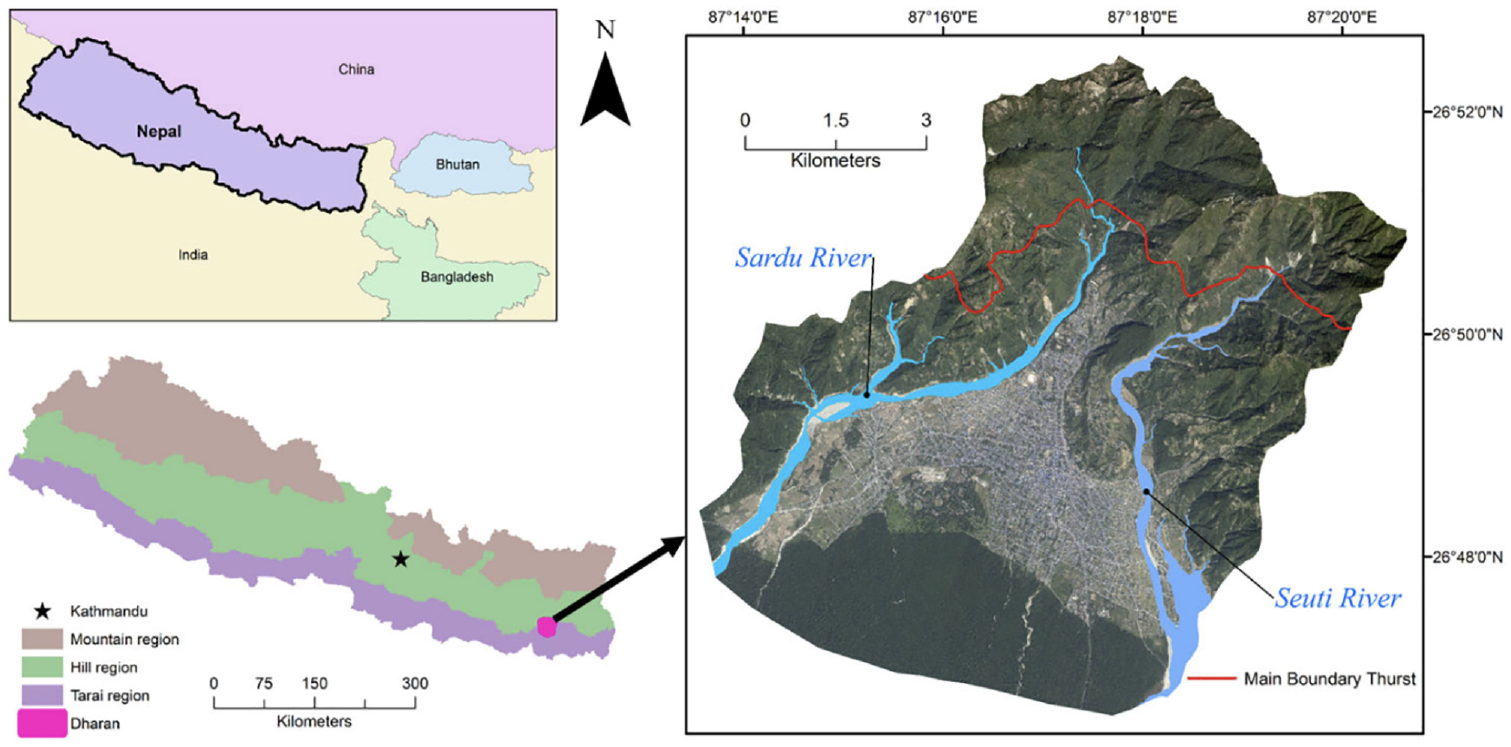
Maps of Nepal (to the left) and Dharan Sub-Metropolis (right), which includes major drinking water sources such as Sardu and Sheuti. Adopted from Aksha et al. (2020). The map is used with permission.
The failure of the ADB project to deliver its promise owing to its technical economic approach and its ignorance of how indigenous Kirant understood their environment. Consequently, the project suffered repeated setbacks from beginning to completion, triggering controversy, protests, and violence (Menyangbo, 2022).
Two reasons explain the protests. First, without considering the local historical and political dynamics around water, the ADB proposed that the water project would be managed by a newly formed Drinking Water Management Board, not by the Nepal Water Supply-Dharan (NWS-D), a government entity with local connections. The ADB bypassed the NWS-D because of its reputation for dysfunctional management and bureaucratic obstacles. But it “turns out that NWS-D is the most functional and well-managed office in the country,” said an ADB official (Personal conversation, Kathmandu, March 2023). The ADB learned about NWS-D and its influence at the societal level when a section of the consumers vehemently opposed their water project.
The NWS-D spread a false narrative that the residents would have to pay a higher price for water because they would carry the ADB loan burden. The NWS-D also claimed that it is capable of supplying the city’s water needs. This caused a division among the residents. The opposers organized political rallies, while the supporters criticized them as vikas virodhi or anti-development people. An ADB official shared that in hindsight the ADB could have done more to better “disseminate information” about the project (Personal conversation, Kathmandu, March 2023).
As it unfolded, the project became controversial and triggered more protests in the city. Violence erupted when the project touched the land entangled with the Kirant identity. This is an example of how environmental peacebuilding can deteriorate conflict – one of the “dark sides” identified in the literature (Ide, 2020). This conflict emerged when the project construction team cut down hundreds of trees to build a water storage tank in Bijayapur, located at the highest forested hilltop adjacent to the city. From an engineering perspective, it made perfect sense: an excellent spot to build the tank for water distribution to the residents. But for the indigenous Kirant community, it was an attack on their identity, history, and belongingness. As a result, the community protested violently against the decision: they gathered in the area, attempted to burn excavators, took the drivers hostage, and occupied the cleared area. In response, the government mobilized police. The police fired bullets in the air, including several rounds of teargas to disperse the protesters. The intense standoff lasted for 2 days and ended with the government withdrawing its decision to build the water storage tank in Bijayapur (Menyangbo, 2018). While no lives were lost, it will take several years to regrow the trees.
The conflict escalation was linked to the history of Dharan as a place of the Kirant community. The Kirants are indigenous to the eastern hills, which include Dharan, and ruled the region for hundreds of years before the Kathmandu-based Gorkha kings took over. According to a historian, a treaty known as noon-paani (or “salt-water”), between the Kirant ruler’s representatives and the Gorkha king’s representatives (who was modern Nepal’s “unifier”), was signed in August 1774 in Bijaypur—precisely where the ADB attempted to build a series of water storage tanks (Chemjong, 1967: 204-206). Bijaypur, now in Dharan, was then part of the Morong State, ruled by Kirant kings. The treaty ensured the autonomy of the Kirant from the Gorkha king’s interference, so the place directly conveys a powerful sense of sovereignty. However, over time the treaty was nullified as the Gorkha rulers gradually introduced laws and policies stripping away the Kirants’ traditional government system, particularly its customary land tenure known as kipat (Caplan, 1970; Regmi, 1976). Hence, Kirant community members still harbor deep resentment about the nullification of the treaty.
On this historical ground, the Kirants consider Bijayapur as one of their most sacred places. For them, it is their history, spirituality, and sense of belongingness. To protect Bijayapur meant protecting their cultural and ancestral heritage, which mattered more than the present-day water scarcity. Many Kirants put their lives on the line to protect Bijayapur, even if it meant limited drinking water.
The ADB overlooked this sensitive history when selecting Bijayapur as a site to build water storage tanks. The project was designed at the ADB headquarters in Manila (Personal conversation, Kathmandu, March 2023) as a top-down technical solution to address the water scarcity problem. Yet, by treating water as a mere resource unentangled with broader cultural meaning, the ADB disregarded the symbolic relevance of the place for indigenous communities. As these environmental peacebuilding efforts exacerbated conflicts, the case reveals the limitations of technocratic approaches.
5.3. A community-initiated and -funded water project
Dharan also offers another story, one in which a holistic understanding of the environment and a local sense of ownership create a lasting ecosystem of peace.
Dharan’s wards 11 and 17, located on the outskirts of the city, faced a dire water situation around 2006. Compared to the affluent residential wards such as 1, 2, and 3, residents of ward 11 and some parts of 17 are economically impoverished and politically disenfranchised. Most of them are squatters who belong to indigenous Kirant communities and work as day laborers in construction, three-wheeler auto-rickshaw drivers, livestock farmers, and homebrewers (Personal conversation, residents of Dharan 11 January 2023).
My interviewees emphasized that living under such conditions made them easily ignorable. Their repeated demands during the early 2000s for increased water supply to their area were ignored (Personal conversations, January 2023). Therefore, they took the matter into their own hands. In 2006, five local leaders (four of them belonged to an indigenous community and one from “dalit”) convened a meeting with the residents to share their plan for bringing water to the area. According to my interviewees, to begin the project, these individuals raised funds tirelessly, tapping into their networks including from the residents. This led to the creation of the Water Supply Management Consumer Committee Dharan 11/17 (WSMCCD-11/17).
5.3.1. Water Condition and Conflict in Wards 11 and 17
Before the WSMCCD-11/17 was launched in 2006, most residents used to spend at least an hour per day waiting in line to fetch water from the state-provided taps. During the dry season (March to May), the water was released only once a day for a short period. Due to its scarcity, these water taps turned into sites of not only long lines of empty water jars, but also of shouts, yells, verbal threats, scuffles, fistfights, and intimidation.
“Because of water scarcity, even a person who had never gotten into a quarrel, would get into it,” said Jayanti (Personal conversation, Resident ward 17, January 2023). Another resident expressed that “it’s hard to describe the pain and suffering women had” (Personal conversation, January 2023). All social life, including family relationships, revolved around water.
Women from impoverished households were among those social groups most impacted by water scarcity. These women, who run home-based businesses such as brewing and raising livestock, were also responsible to prepare food for the family and send their kids to school. If food was left unprepared by the time when the husband or other family members returned home, most women had to endure verbal and even physical assaults. In several conversations, women revealed that over time water scarcity “soured” family relationships.
Such a souring of relationships was not limited to the household level. It would spill over to the neighbors. Adjectives such as “selfish” or “cooperative” would straitjacket the relationship between the locals. For example, a person who is in the line would cunningly reshuffle the water jars line so that the relative’s turn comes earlier; this would be considered as “cooperation.” But if a person objected, then it would be considered as “selfish.” These kinds of behavior were expected because of the dire water needs. But those with low socioeconomic status, those who could not stand up or raise their voice loudly, would have to spend longer to get water.
Bhim Thattel, a local plumber who has been working for WSMCCD-11/17 over the last 16 years, summed the conflict as “paniko jhonk” or “a sudden eruption filled with anger and emotion, akin to water gushing out of the tap.” Those emotions and anger would set off chain reactions of frequent family violence as well as bitter and hostile social relationships. But the situation changed with the WSMCCD-11/17.
5.3.2. WSMCCD 11/17: Water governance and peacebuilding
WSMCCD 11/17 emerged out of the community’s desperation about drinking water scarcity. The water stress was increasingly unbearable, igniting recurrent community conflict. For example, some residents stopped inviting each other to festivals and cultural events and clashed in formal meetings. Some have conveyed that many important events were tinged with a loss of “ijjat,” or dignity, because of a lack of water shortage.
To tackle this challenge, in 2006, the water consumer committee raised funds. Depending on their economic status, the residents contributed from $1 to $50. Most funding came through different social and political networks, ranging from individuals to organizations. When the project was well underway, the committee also received funding and construction materials from UNICEF and the District Development Committee, Sunsari. Those who donated at least $50 or above were acknowledged through the carving of their names on the sandstone plate. This method was effective; the committee raised $47,000. But the biggest boost for the project came from the residents who donated their labor 5 to 6 hr a day for 4 months.
Although the ADB-funded project succeeded in distributing water to their area, most residents have not consumed it. “Our water, which comes from the mountains, is cheap, clean, and tasty,” Bhim, the plumber said, “but ADB water is not that tasty.” The ADB water supply comes from a deep-water boring system. But for others like Kalpana, the meaning of the WSMCCD-11/17 water project goes beyond just its taste and price. “We worked so hard to bring this water,” she said, “I feel proud about it and as long as it works, I don’t use ADB-water” (Personal conversations, Dharan, January 2023).
More difficult than constructing the taps was even to ensure the water supply. For this, the WSMCCD 11/17 committee negotiated with the community that lives near the creek, which is located to the northwest in Bishnupaduka (now ward 20, Dharan), about 5 km away steep uphill. The villagers use the water for drinking and irrigation. In several rounds of meetings, the WSMCCD 11/17 committee sought to find a win–win solution. They finally agreed to pay around $50 per month to the villagers. The money goes to protect and manage the two community forests aimed at sustainable watershed management, especially in the wake of increasing drought. In addition, the committee and consumers (in rotation) routinely go and work with the villagers to plant trees, protect them, and discuss their future collaboration. The collaboration reflects a joint understanding of the environment based not just on economics but also on sociopolitical and historical dimensions.
My interviewees described a sense of pride and accomplishment about the WSMCCD-11/17 project, and thus, they care for it. The residents, especially women, no longer need to get up early in the morning to stay in the line to get water. This enabled women to be more in “shanta” or “peace.” The wards 11 and 17 may not be “like a decorated bride,” as the plumber remarked but water-related conflicts have declined thanks to the project.
The consumers understand and respect that the water belongs to the villagers. Their agreement defines what environment means, who may derive benefits from it, and how. The villagers who live around the water source (the creek) know that they have the upper hand in controlling the water and could have demanded a higher monthly charge. But they also know that they are better off collaborating with the ward 11 and 17 residents so that they receive regular monetary compensation and additional collaboration to protect the water source and its surrounding area for its social, economic, historical, and ecological importance. As part of this, villagers look out for potential contamination and minimize uncontrolled cattle grazing at the creek. The committee, in turn, attends cultural and religious events that the villagers carry out around the water source.
The forged collaboration between the two communities is an outcome of their shared views about the complexities of water dynamics embedded within the environment. Tied with their indigenous worldviews, they know that sharing water is linked not only with everyday use in the material sense but also with recognizing belongingness and care for the environment. This is in both the immediate and longer-term sense of needs and sustainability. The outcome we see is an example of how environmental peacebuilding can succeed in conflicts that are aggravated by climate change and a postwar context of continued marginalization of indigenous groups.
6. Discussion
Several key points are emerging from the comparative analysis. First, as found in the WSMCCD 11/17 case, environmental peacebuilding that integrates local community views of the environment, which considers not just economic and technical but historical and sociopolitical dimensions, helps build (positive) peace. By contrast, by failing to incorporate these dimensions particularly the history of the site, the ADB-funded water project left deep resentment and skepticism among the indigenous community toward the government and the ADB. This rift has persisted, even though the project increased Dharan’s drinking water supply.
Second, certainly, I/NGOs and other civil society organizations can play key roles in community sensitization on various issues, such as organizing and facilitating meetings as well as gender inclusion. Yet, the affected people of wards 11 and 17 did not wait to be “rescued” from the challenges they faced. The residents demonstrated that despite limited resources they rose to the occasion.
Third, not everything is completely rosy with the WSMCCD-11/17 water project. Most importantly, as another example of the dark side of environmental peacebuilding (Ide, 2020), a contestation for leadership also hampers the project’s transparency and the committee’s functioning. There are rumors of embezzlement and personal favoritism.
Fourth, environmental peacebuilding researchers and practitioners must radically rethink how to systematically and scientifically study and capture community understandings about the environment, climate change, adaptation needs, and the notion of peace (Sändig et al, 2024; Šedová et al., 2024). This requires methodologies that are reflexive and innovative with the strong conviction that knowledge is nestled in communities’ history, memory, and everyday experience that might seem mundane and insignificant in the traditional academic sense . This way we can produce knowledge that is collaborative and accountable for those with whom we study and work, and we can do so while being cognizant of the power hierarchies and positionalities (Amador-Jimenez et al., 2024).
7. Conclusion
As I have shown, environmental peacebuilding efforts that take a too narrow interpretation of the environment can escalate conflicts rather than foster peace. The ADB-funded water project that aimed at building “inclusive development” unintentionally overlooked how local people understood their environment. This led to protests and even violent contestations as indigenous communities reclaimed their sacred and historically relevant sites. By contrast, the WSMCCD-11/17 case shows that local communities can be innovative and resourceful in finding ways to address the environmental and related social challenges they face.
Therefore, both practitioners and scholars of environmental peacebuilding must pay close attention to social, political, and spiritual dimensions, not just economic. Continuing historically colonialist and capitalist modes of top-down technocratic conceptualizations of the environment create a considerable gap in understanding. As seen in the drinking water projects in Dharan, incorporating indigenous views can be crucial for effectively building peace in environmental conflict. This is instructive as national governments, international organizations, and development actors craft climate change adaptation and mitigation policies meant to serve local communities.
Ultimately, how communities view their environment shapes their attitude toward it. The cultural and spiritual relationship that indigenous communities have with the environment is linked with their worldviews. They pass this place-based knowledge system about the environment from generation to generation. Environmental approaches to prevent, mitigate, and resolve conflict must extend the political horizons of environmental peacebuilding to include the indigenous “local” understanding of the environment.
Footnotes
Funding
The author received no financial support for the research, authorship, and/or publication of this article.

Data availability
Upon a reasonable request, the author can make the data used for this article available.