



Abstract
Experts increasingly agree that the impacts of climate change are likely to create new violent conflict risks and exacerbate existing ones. However, the extent of this link and the specific causal pathways are much less clear, and the role of gender in this process is under-examined. This paper theorizes that gendered norms, especially the expectations of how men perform their masculinities, are an intervening variable that might explain some of this relationship. In doing so, it engages with the emerging debate around the extent to which climate change influences the evolution of violent conflict, theorizing with an illustrative observation of the events of the Arab Spring in Tunisia and Syria. I find that there are plausible explanations for climate–conflict links involving gendered expectations of men’s behaviour serving as an intervening variable between climate change and violent conflict and discuss the implications of this for moving away from securitized approaches, future study and peacebuilding work.
1. Introduction
Climate change remains the single biggest existential risk to the lives and lifestyles of humanity and to describe it in any less urgent terms would only serve as a betrayal of environmental reality. As the international community’s response to this global emergency continues to be defined by a lack of adequate action (Hornsey & Fielding, 2020; Warner, 2013), it is timely to consider the mechanisms through which the environmental crisis could lead to suffering and destruction. Some impacts are direct, such as the increased frequency and severity of extreme weather events. Other impacts are indirect, such as longer-term shifts in crop yields (IPCC, 2023) or gradual population displacement (Abel et al., 2019). Climate change not only creates or exacerbates situations of adversity for vulnerable populations, it might also create the conditions that motivate groups to impose adversity on others through violent conflict (von Uexkull & Buhaug, 2021)
That climate change is connected with potential risks for violent conflict is a point of growing consensus (Koubi, 2019). Although the impacts of climate change (including changes in precipitation and hydrology; increasing numbers of extreme weather events; changing temperatures and resulting shifts in agricultural conditions and yields) might create or exacerbate social and political tensions that lead to violence, the extent of this relationship and, crucially, the causal pathways through which this link occurs are still contested and often unclear (Koubi, 2019; Mach et al., 2019). Much commentary and discussion have focused on alarmist, sensationalized ideas of climate change as a ‘threat multiplier’ (Huntjens & Nachbar, 2015) as understood through a securitized lens.
This paper serves as a plausibility probe (Eckstein, 1975), seeking to identify and articulate links between climate change and violent conflict that are influenced by differing gender norms and pressures on how people perform their gender identities. Building upon existing theories of masculinities and thwarted masculinities (Myrttinen et al., 2017), and with a qualitative exploration of illustrative cases, the paper posits that the social expectations associated with gender roles serve as an intervening variable between climate change and conflict and asks whether this effect further influences patterns of violence. The paper seeks to offer an alternative model to narrow securitized approaches to understanding the links between climate change and violent conflict. In doing so, it seeks to reinforce an approach that aligns more closely with the field of environmental peacebuilding (Dresse et al., 2019).
This paper examines the established debate around the effects of climate change on violent conflict, including the case of the Syrian conflict, and asks whether investigating the role of gender might fill some gaps in our understanding. In doing so, the aim is to contribute to the body of literature theorizing relationships between climate change and violent conflict and to suggest that gender norms and expectations may play a more prominent role as an intervening variable in this relationship than had previously been acknowledged. More specifically, it asks whether climate change-driven events and impacts such as drought and flood might create consequences for individuals that prevent them from being able to perform some of their traditional non-violent gender roles. And whether this denial of agency might create the conditions for violence to emerge.
To explore this possibility, the paper offers an illustrative comparison of the Syrian case with the Tunisian case and asks whether levels of violence in either country in the aftermath of climate pressures and the Arab Spring may be at least partially attributable to differing gender norms. The implications of the theory proposed here are relevant not just for our understanding of the impacts of climate change but for peacebuilding practitioners who seek reductions of violence in conflict-affected contexts, especially through locally specific and context-relevant efforts in the field of environmental peacebuilding (Amador-Jimenez et al, 2024; Medina et al., 2024).
The paper will begin by examining the existing literature on the climate–conflict nexus in an attempt to understand the links between climate change and violence that are already under discussion (Koubi, 2019). It will then lay out a clear feminist framework for understanding gender as a relational and performative social construct (Butler, 1990) and performed masculinities as a form of this (Connell, 2005). It will discuss how this informs the central argument of this piece. As a theory-building initiative, this is where the most vital contribution arises, placing considerations of gender and masculinities firmly within the established conversations linking climate change to violence, and introducing a vital lens through which to understand such connection. From there, the paper will utilize a discussion of the Syrian and Tunisian cases to offer real-world insight into the proposed mechanism before ending with a discussion of limitations and future research avenues.
2. Theory
2.1 Climate and conflict
Discussion of the links between climate change and violent conflict has proven contentious at times. Much of the conversation is rooted in earlier Neo-Malthusian considerations of the impact of environmental scarcity and degradation on potential conflict (Baechler, 1998, 1999; Homer-Dixon, 2001) though much work seeks to move beyond those roots (Selby & Hoffmann, 2014). Recent studies have used different methods (Daoudy, 2021; Ide, 2017; Lee, 2022) to examine the climate–conflict nexus, including specific hydrological impacts, such as El Niños, extreme rainfall deviation or flooding (Ghimire & Ferreira, 2016; Hendrix & Salehyan, 2012; Hsiang et al., 2011). Part of this conversation has been to theorize how these connections might occur through both direct and indirect consequences, including migration (Abel et al., 2019), though it is still argued that not enough evidence exists to specify these exact mechanisms (Koubi, 2019; Mach et al., 2019). This paper understands the climate–conflict nexus as being rooted in the discussion of how the direct and indirect impacts of climate change drive violent conflict, if at all.
Given this uncertainty, efforts to explain how climate–conflict links might be quantified in the context of climate change and used to predict future patterns of violent conflict (Buhaug & von Uexkull, 2022; Drake, 1997; Witmer et al., 2017), though useful, might be premature. Until more clarity is produced regarding precisely how any causal chain functions and the unidentified elements that may regulate it, predictive efforts may suffer from an incomplete information problem.
While feminist examinations of climate change are increasingly emerging (Buckingham & Le Masson, 2017; Pearse, 2017; Sultana, 2022), the climate–conflict literature has been much quieter on the role of gender. This is pointed out by Ide, Bruch, et al. (2021), who illuminate how gender roles and identities can serve as a hidden variable to facilitate or prevent conflict in climate-affected contexts, and further examination of this factor may lead to a stronger understanding of the overall climate–conflict link.
Some maintain the position that the conversation connecting climate change and conflict can be grounded in unhelpful tropes, ignore the political realities of such a link (Selby & Hoffmann, 2014) or be based on flawed models and research design (Adams et al., 2018). Overall though, expert opinion does appear to have reached a consensus that some causal relationship exists. However, there are no high confidence levels surrounding the strength or durability of this connection, nor universally accepted explanations for exactly how climate change might drive these increases in violent conflict (Mach et al., 2019; Scheffran et al., 2012)
Increasingly, the conversation is becoming more nuanced and with a broader understanding of peace and conflict that does not just try to analyse widespread direct violence or war as a potential outcome. This work instead often looks at more local-level violence including water-related small-scale protests and civil disturbance (Ide, Ensor, et al., 2021; Nalbo, 2024), urban unrest as a result of food price fluctuation (Hendrix & Haggard, 2015; Johnstone & Mazo, 2011) or gender-based violence (Cools et al., 2020; Ross et al., 2023).
The language used to discuss the links between climate and conflict in popular discourse has often coalesced around the idea, and particular phrasing of a ‘threat multiplier’ effect (Selby & Hoffmann, 2014). The language has become central to the way many parts of the UN system discuss climate change, including the UN Secretary General (UN, 2023), and many other organizations utilize the term. The phrase was even used in the proposed Green New Deal legislation (H. Res.109, 2019). The ubiquity of the threat multiplier framing creates an oversimplified mainstream narrative. It can contribute to increasingly securitized notions of climate change as something to be viewed through a hard security or militarized lens. Many climate security risk assessments have been developed, representing this interest in climate security, and many of them are very narrowly focused (Šedová et al., 2024).
The ‘threat multiplier’ framing represents a securitized approach. Securitization is a well-established concept through which important matters of policy are reframed as security threats to prioritize the response to them. By classifying particular issues in terms of ‘the designation of an existential threat requiring emergency action or special measures and the acceptance of that designation by a significant audience’ (Buzan et al., 1998), governments and other actors can marshal more resources and greater unity of purpose to tackle certain problems. Drawbacks and critiques of this approach include the lack of emphasis on issues of justice, human security and minority rights (Floyd, 2019; Roe, 2004). Furthermore, securitized responses minimize the decision-making power of those most negatively impacted by both a shifting climate and any increase in violent conflict (McDonald, 2021).
Significant discussion abounds regarding whether Syria’s decade-long civil war can be classified as one of the world’s first climate wars (Read, 2019). Or, more precisely, how much of an impact the effects of climate change had on the conflict and the subsequent uprising and therefore the evolution into war. Some commentators (Femia & Werrell, 2012; Gleick, 2014; Kelley et al., 2015) have sought to establish clear causal links between the extreme levels of drought the country suffered in the years preceding the outbreak of violence including through mechanisms of migration (Ash & Obradovich, 2020).
Conversely, others have sought to downplay the importance of this causality (Hendrix, 2017) with persuasive arguments unpicking this hypothesis (Daoudy, 2020; Selby et al., 2017) which contend that making definitive claims represents a misunderstanding of the complexity of the Syrian environmental, social and political shifts. The agricultural failures in the northeast often framed as a result of drought might instead be more accurately represented as a result of poor governance and state policy in an ethnically contested area (Selby, 2019). Ultimately, what this contestation reveals is that considerations of links between climate change and violent conflict, both in the abstract and in specific cases, are defined by the intervening factors that link the two phenomena.
2.2 Gender and masculinities
Gender is a social construct that is defined as an act through which people take up certain roles, adhere to equally constructed expectations and, crucially, perform their gender in repeated and socially defined ways (Butler, 1990). This understanding is built from a wealth of historical feminist theory (De Beauvoir, 1949; Wollstonecraft, 1792). Gender also plays a role in state construction and nation-building, suggesting that the construction of gender identities in these contexts might affect national outcomes (Enloe, 2014; Yuval-Davis, 1997). It is from this tradition that we draw the feminist framework utilized here to shape the understanding of gender as it is employed in the theory presented here linking climate change to violent conflict.
While gender has increasingly become a salient issue of exploration for political scientists, it has been notably absent from the vast majority of the emerging conversation exploring the links between climate change and conflict. Indeed, ‘with very few exceptions…the literature on climate change and conflict has so far not meaningfully considered gender’ (Ide, Bruch, et al., 2021). This gap is slowly being addressed as questions regarding the gendered impacts of climate change come to the fore through applying a gendered analysis to different environmental frameworks (Fröhlich & Gioli, 2015) or by understanding women’s roles and vulnerabilities through climate, peace and security lens (Smith et al., 2021). But even amongst this subset of the literature, there is little that focusses particularly on constructed gender norms, and even less on the role of masculinities.
Using the plural term masculinities in this sense further highlights the fluid nature of gender roles, representing that while an idea of ‘masculinity’ may appear or be discussed as fixed at one point in time and place, there are in fact multiple evolving masculinities that may share in common some features of domination but are often quite diverse in their definition (Connell, 2005). Through a feminist lens, it is possible to understand how rigid expectations of men as protectors and providers have the potential to create feelings of individual shame, frustration and inadequacy when sudden changes put the fulfilment of these roles out of reach, through vehicles of violence, scarcity, economic shifts or climactic events. This may be considered in a similar vein to the frustration-aggression mechanism Gurr (2012) describes as motivating individual engagement in political violence.
There has been an increasing focus on masculinities to be found in the literature on gender and violent conflict. This aids the understanding of complex, multi-faceted gender roles within conflict-affected contexts (Ashe, 2012; Baaz & Stern, 2009; Myrttinen, 2008). Masculinities are also discussed as part of wider efforts to conceptualize gender and peace through the different ways that men are involved as subjects of peace initiatives (Duriesmith, 2020) or how such initiatives conceptualize or co-opt masculinities (Wright, 2020).
It has been noted that ‘Insecurity and occupation create the conditions for masculinity nostalgia, or a yearning for a set of gender norms and relations linked to fantasies of a secure, “traditional” and ordered past’ in a piece by which Mackenzie and Foster (2017) highlights this phenomenon in a Palestinian context and specifically speaks to three forms of non-violent masculinity (father, breadwinner and landowner) that theoretically may be impacted by climate change. These ideas are sometimes spoken to through an idea of ‘thwarting’ masculinities in which men experience a gendered ‘gap between aspiration and reality’ (Myrttinen, 2017) which explains how men may react when the masculine roles they expected to be able to fulfil are denied to them. ‘Men’s sense of self-worth, derived from providing for and protecting their families, is often radically altered during conflict, as families are separated, livelihoods are lost, and trauma experienced’ (Vess et al., 2013).
This idea of thwarted masculinities emerges from a longer tradition of feminist analysis that places models of hegemonic masculinity as a context-dependent construct to which men often acquiesce, knowing that they benefit from the patriarchal placement of the masculine over the feminine even if they do not adhere to the hegemonic ideal (Connell, 2005). Furthermore, the expressions of violent masculinity theorized here are linked to contemporary understandings of toxic masculinity (Harrington, 2021), although they are not synonymous with this concept.
This concept of thwarted masculinities is particularly relevant to attempts to understand the climate–conflict nexus. The idea refers to the ways through which external pressures can create expectations of how men should perform their assigned gender roles while removing their agency to do so leading to ‘frustration and violence’ due to this inability to live up to expected norms (Myrttinen et al., 2017). In contexts where expectations of performed gender roles are very rigid and unequal, men might find that there are reinforced norms to adhere to in times of crisis or uncertainty, and this may influence the behaviours they exhibit. Logically, these times of crisis or uncertainty might be just as likely to be driven by climate change and the resulting impacts as by existing conflict.
In situations of instability and crisis, such as those created by a changing climate, gender norms play a central role in shaping the responses of individuals and communities to that instability. This impacts women’s experiences during such crises and how vulnerabilities at these times are gendered and differentiated (Lentin, 1997). Gender roles, when widely understood and adhered to, provide a framework for the way people are expected or allowed to react to adverse conditions (Solomon et al., 2005). This limited set of responses in most cultural contexts offers some gender roles more permission to demonstrate explicit sadness and distress, for example, typically women performing feminine roles. And it offers some gender roles, typically masculine, more permission to perform aggressive or violent roles, and more of an expectation that they will demonstrate agency on behalf of themselves and their family in any given context (Myrttinen et al., 2017).
Crucially, this feminist understanding of gender and masculinities means that while norms and expectations can be very rigidly defined and policed by social and cultural structures, gender is not deterministic of behaviour or performance. In recognizing both of these truths, it is possible to analyse the often restrictive context-specific institutions of gender that are created in different times and places whilst also rejecting an essentialist view of gender performance as pre-determined (Saguy et al., 2021). As such, it is important to recognize that tropes such as women either being necessarily victims of violence, or natural caretakers or peacemakers (what Fröhlich and Gioli (2015) call the ‘victimization fallacy’), are as baseless as accusations that men are inherently violent. In fact, the feminist framework adopted in this piece explicitly rejects such narratives (Butler, 2004; West & Zimmerman, 1987).
This paper recognizes the limits of its focus. Harmful gender dynamics and patriarchal norms are ubiquitous in differing forms in every country and culture on earth (Nash, 2020) and their connection to violence, especially male violence, is not confined to contexts of war or widespread political violence. Neither do gender identities exist in siloes, and intersectional approaches (Crenshaw, 1989) are valuable in understanding overlapping forms of oppression sometimes described as kyriarchy (Dawthorne, 2019; Osborne, 2015). This oppression can occur inside and outside of violent conflict contexts though such analysis is beyond the scope of this piece.
One of the key assumptions underlying the particular approach detailed in this paper is a feminist interpretation of gender as a relational concept rooted in patriarchy (Johnson, 2014; Lerner, 1987). In this understanding, gender roles do not exist in isolation but are rather defined in relation to each other. Women’s rights and masculinities are interconnected phenomena (Hearn, 2021). As such, the exploration of women’s rights in different contexts can offer insights into the types of norms and social permissions that also serve to construct masculine gender roles. In a context where women’s rights are better protected, and their economic and political opportunities more open, it is assumed that there are more flexible and broadly defined ideas of contemporary femininity which will align with an increased likelihood of similarly broad constructions of masculinities.
2.3 A theory of climate change, masculinities and violence
This paper theorizes an explanation of the causal pathway that links the impacts of climate change to violent conflict. This explanation is predicated upon the part that gender roles, and specifically constructed performances of masculinities, have in mediating this relationship. Many existing climate–conflict theories seek to explain the causal pathway through connected issues of food prices, food security, displacement and unemployment (Ghimire et al., 2015; Gleick, 2014). The theory outlined here understands those factors as important and relevant but posits that a key intervening variable may have been omitted by not considering how gender roles manifest in climate-affected contexts.
This theory instead sees such material factors, in part, as interacting with pre-existing gender dynamics and shifts how people can exhibit behaviours that conform to gendered expectations in their particular cultural context. Most relevantly, this process involves the shutting down of avenues to traditionally performed non-violent performances of masculinities, particularly the role of breadwinner or provider but also non-violent political masculinities (Kunz et al., 2018). This restriction of options can create a situation of ‘thwarted masculinities’ where the traditionally masculine roles people seek to play are denied to them and they are left with a more limited range of available behaviours (Moore, 1995). These remaining options fit within the socially accepted range of permissible performances of masculinity but may be more likely to be violent in nature (Ashe & Harland, 2014), perhaps framed in terms of protector or defender. Given such a shift, the likelihood of violent conflict emerging or being sustained is increased.
This relationship between climate change and an increased likelihood of violence through restrictions on available non-violent masculine gender roles is the basis of the theory presented here. However, it is important to recognize that local dynamics can mediate the relationship between climate change and violent conflict (He et al., 2024) and the role that factors such as socioeconomic marginalization, instability and state institutions play in regulating the instability caused by climate change for their populations. That is to say that such factors can serve as preconditions for the causal mechanism theorized here. A series of contextual factors including economic development and institutional capacity have been identified in the current climate–conflict literature (Koubi, 2019) while some discussion of the kind of societal vulnerabilities that lead to climate–conflict links has included ideas of socioeconomic marginalization creating this kind of space for increased risk of violence (Buhaug & von Uexkull, 2021)
Figure 1 offers a representation of the comparison this theory allows us to consider. In this diagram, climate change affects settings in which pre-existing instability or institutional failure is present in the form of low development, political exclusion and other institutional issues (Ide et al., 2020). The difference between the two contexts is that where gender relations are more (or less) equal, a divergence is created in the availability of socially permissible forms of performative masculinities. This leads to different outcomes and different resulting risk factors with regard to the likelihood of violence.
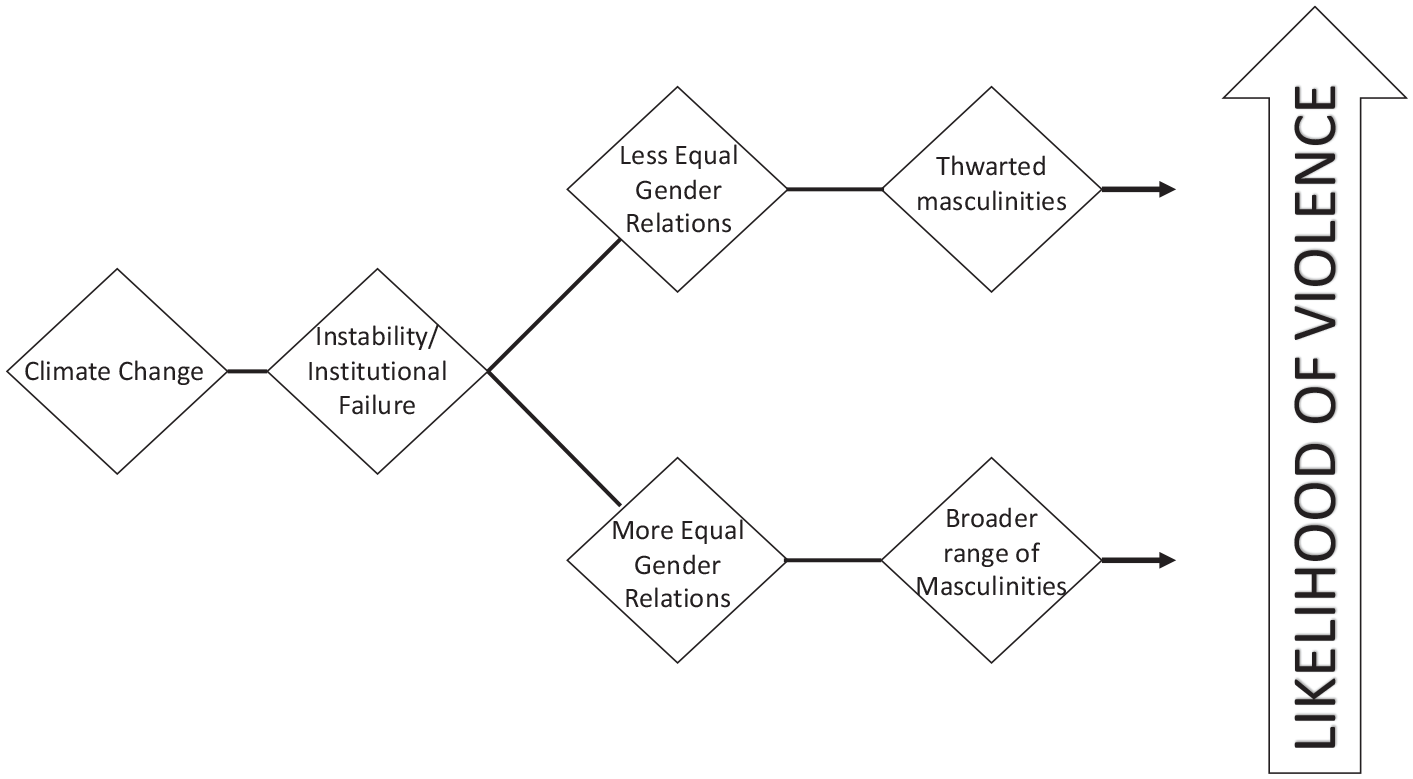
Divergent gender relations impact likelihoods of violence.
Theory: Climate change can limit the opportunities that men have to perform some traditionally masculine gender roles. In contexts of restrictive gender norms, often characterized by demonstrable gender inequalities, this is more likely to lead to the onset of situations of violence caused by a perceived limitation of the available non-violent performances of masculinity.
3. Approach
This paper explores two relevant and similar country-level cases within the broader context of the Arab Spring. The paper aims to examine the impacts of climate change and gender roles in both Tunisia and Syria to create more clarity on the social processes that occurred in the two settings. This approach will explore factors that contribute to an explanation of the difference in outcome whereby Tunisia emerged from the Arab Spring into a decade of fragile democracy (Bellin, 2018) that, though not without significant contestation, has been defined by relatively low levels of political violence (Mahmoud & Ó Súilleabháin, 2020). In juxtaposition, the Syrian civil war grew out of similar Arab Spring protest events but has led to a decade of extreme violence and conflict (Van Dam, 2017)
The paper draws from the Most Similar Case method in which case studies are selected based on their similarity in many regards as a way of identifying an explanatory variable in which they differ. The ideal (however unlikely) cases for this comparison would be identical in every way except for a singular point of difference, namely the variable being examined and the divergent outcome it creates. In this case, the paper has sought two examples in which much is shared in common to focus on key gender differences and interrogate whether these differences may have contributed to different outcomes (Meckstroth, 1975; Seawright & Gerring, 2008). However, as a plausibility probe, this paper serves as ‘a stage of inquiry preliminary to testing’ (Eckstein, 1975) and does not make claims to have tested the theory using this method so much as it intends to illustrate the plausibility of the theory through a similar style of case selection and comparison.
Syria and Tunisia share a common language, a common religion (Sunni majority, though Syria is led by an Alawite minority), a shared history, and many of the same cultural reference points (Harb, 2015; Rogan, 2011). They also both experienced significant environmental shifts and vulnerability in the years preceding the Arab Spring and in the years since and have faced many of the same internal social pressures. Examples of this include the floods experienced in Tunisia in 2008 and 2010 which, although not as prolonged as the drought in northeast Syria, still had many of the same knock-on effects, including in agricultural production (Reuters, 2008; UNESCO, 2020).
In Tunisia, the years 2008 to 2010 were characterized by extreme weather, including flooding and drought (Mohamed et al., 2023; Verner et al., 2018). The droughts are part of a longer historical trend impacted by climate change (Touchan et al., 2008). These weather impacts had a significant impact on Tunisian semiarid agriculture, which is around 80% rainfed and represents around 80% of the country’s water consumption (Lhomme et al., 2009) and is therefore vulnerable to changes in water availability (Mansour & Hachicha, 2014).
These agricultural consequences included significant effects on the country’s wheat harvest (Verner et al., 2018, p55) and cereal production (Mansour & Hachicha, 2014). With 8% of the Tunisian economy based on agriculture in 2010 (World Bank, 2014, p260), such climate-driven agricultural shocks have negative impacts on the Tunisian economy (Wiebelt et al., 2015) including through price rises (OECD, 2009). Localized effects were magnified by the context of the 2007/2008 world food price crisis (Brinkman et al., 2010), confounding economic and food security factors that have been linked to the beginning of the Arab Spring (Johnstone & Mazo, 2011; Sofi, 2019)
These extreme climatic and weather conditions are similar to those experienced in Syria during a similar pre-Arab Spring time frame (Trigo et al., 2010) and the agricultural and economic impacts of some of those highlighted in the literature on Syria and the climate–conflict nexus (Femia & Werrell, 2012; Gleick, 2014; Kelley et al., 2015). Although the effects are not perfectly aligned, their similarities allow for a comparative consideration.
Two notable areas where these countries differ are in the levels of violence experienced in the aftermath of their Arab Spring protest movements and in some subtle but important ways in the particular gender dynamics within each country. This article attempts to examine at least part of the difference in the emergence of violence in each country in terms of those varying gender dynamics, specifically variations in gender equality and constructions of masculinity.
The circumstances that led to the original Arab Spring protest movements in these two countries, and others in the region, are undoubtedly multi-faceted (Hussain & Howard, 2013; Salih, 2013). However, the dissection of the causes of the Arab Spring is beyond the remit of this paper. Here the focus is exclusively on the differences in levels of violence experienced as the protests evolved, and that took place across the next decade or more. It is an attempt to understand these differences in part as a consequence of different gender norms and expectations.
4. Analysis
4.1 Violence
The Syrian Civil War grew out of the interconnected events of protest and activism that were collectively characterized as the Arab Spring (Brownlee et al., 2015). A series of protest events against Syrian leader Bashar al-Assad took place and even after these protests were repressed by the Syrian state security forces they persisted (Sorenson, 2016). Escalating conditions of violence eventually led to a situation in which state violence was countered by the mobilization of formal and informal militias and this context eventually evolved into the multi-faceted civil war that would define the next decade of Syrian life (Rabinovich & Valensi, 2021).
In Tunisia, the events of the Arab Spring took an entirely different shape. Indeed, for many years, Tunisia was often referred to as the ‘success story’ of the Arab Spring (Malouche, 2019). The protest movement at the heart of it was able to mobilize online and achieve its aim of deposing the former dictator Zine El Abidine Ben Ali (Aleya-Sghaier, 2012; Breuer et al., 2015) and creating in its place a form of representative democracy that, though flawed and heavily contested, largely held in place for the next decade. This time was characterized by free and fair elections, respect for the rule of law and even the peaceful transfer of power (Bellin, 2018). Contemporary Tunisia faces problems of democratic backsliding (Huber & Pisciotta, 2023) and multiple social crises based on food security and migration but widespread political violence remains notably absent.
These significant differences in outcome cannot be attributed to any one factor (Dakhli, 2013). Brownlee et al. (2015) explain the divergence in structural terms and Allinson (2015) in terms of class politics. This paper proposes simply that gender dynamics were one of those factors. Indeed, any fair-minded assessment of the divergent paths of these two countries would have to begin by factoring in the state response in either context.
Tunisia and Syria shared similar patterns of protest events and response in the early days of the Arab Spring (Davenport & Moore, 2012) but how the ruling authorities chose to respond to this movement represented a different strategic assessment of what was possible (Josua & Edel, 2015). The Ben Ali regime in Tunisia at first tried to appease the protesters and retain power through a mixture of silence and moderate reform including ‘urgent measures to deal with youth unemployment’ (Honwana, 2013, p73), whereas the Al-Assad regime in Syria was much quicker to resort to brutal violent repression to attempt to quash the protest (Laub, 2023).
The Syrian case is also clearly shaped by the involvement of Russian interests (Allison, 2013; Jones et al., 2020). Indeed, some may see such factors as the predominant explanation (Lucas, 2015). Certainly to ignore this context would be to work with an incomplete picture of events. But the theory presented here is intended to complement rather than compete with those explanations. The identification of gender norms, and particularly the notion of thwarted masculinities, is posited as a concurrent idea to these other events and processes.
Though it may be unwise to dismiss or deprioritize state response as an explanatory factor, what is just as interesting is the way that violence was sustained in Syria (Rabinovich & Valensi, 2021) and, in contrast, how a relative form of peace and stability was sustained in Tunisia (Malouche, 2019). Taking into account this more longitudinal understanding of the decade following the Arab Spring, there is space to understand the differences between the two identified cases as not just a simple result of two alternative regime responses, or of international action, but of the complex social dynamics at play in each location, including expectations around the performances of gender roles.
4.2 Gender relations
Syria and Tunisia share significant social, cultural and historical ties (Rogan, 2011). As Arab-majority and Sunni Muslim-majority states consume overlapping media and exist within broadly the same geographical region, they represent countries with a lot in common. However, it is reasonable to characterize gender relations in the countries as significantly different in the years preceding the Arab Spring. And, as Chekir (1996) discusses Tunisia’s place as an Arab outlier in gender equality, further reasonable to define Tunisia as a country less defined by gender inequality and conservative gender norms. One reductive but illustrative example of this is the disparity in each country’s positioning in the UN’s Gender Inequality Index in 2010, with Syria ranked 103rd and Tunisia 56th (UNDP, 2010). This measure is a composite indicator taking into account many gendered issues including health, education and economic factors.
This difference is the result of a very different history and social approach to gender dynamics. Although there are regional similarities in attitudes to gender, it is important to remember that constructions of masculinity are not constant or homogenized across either the Arab world or the global Muslim community (Ouzgane, 2006). There are key and clearly identifiable differences between the two case studies selected here in terms of gender norms, expectations and equality.
Tunisia has a history of women’s equality movements and civil society engagement both before and after the revolution (Grami, 2008; Wolff, 2022). This builds from a history in which women’s participation was encouraged under the Bourguiba regime and where under the 1956 Code of Personal Status law, for example, polygamy was outlawed soon after independence (Chekir, 1996) – marking the country as an exception in the region to this day. This history of what is sometimes termed ‘state feminism’ is not without critique in Tunisia, and certainly does not equate to a 20th-century history of liberation or fully realized gender equality (Kallander, 2021; Murphy, 2003). But it represents a genuinely different approach throughout much of the Arab world and an approach to gender roles that would reshape Tunisian society in the direction of more equality and less rigidity of expectation than many other countries in the region (Chekir, 1996; Marks, 2013).
In the post-revolutionary space following the overthrow of the Ben Ali regime in 2011, women have played an active role in political life, taking a significant portion of nationally and locally elected representative roles (Zolman et al., 2020). Today in Tunisia women continue to play a prominent role in public life, including notable public figures such as celebrated global tennis champion, Ons Jabeur, and former Prime Minister Najla Bouden, the first woman to hold that title in the Arab world (Khogeer, 2022). None of these elements on their own defines a gender-equal society (Salem, 2015); indeed, they might be said to act as a smokescreen to hide broader inequalities (Ibrahim, 2022). However, they together begin to form an impression of a society in which questions of gender equality have been at least examined and discussed, and in which progress towards equality has been made.
Given the relative equality between people of all genders in terms of economic opportunities, participation in public life, education, legal status and inheritance rights (Charrad, 2007), Tunisia makes for an excellent point of comparison when considering links between climate change, gender and violence, juxtaposing this example of relative equality and less rigid gender norms and expectations with the rest of the Arab world, including Syria (Masri, 2017).
Tunisia sits in relative contrast to the Syrian context where ‘Syrian social life was defined by strongly gendered ideas of roles within the family and community’ (Rabo, 1996) or where, in juxtaposition to the idea that ‘women have been closely associated with the national narrative of Tunisia as a modern country’ (Wolff, 2022), instead we find that ‘Syrian nationalism is all about masculinity’ (Aldoughli, 2017). This proposition means that ideas about the core national identity are shaped in the language of rigid masculinity, from references to the ‘fatherland’ to specific structural and rhetorical constructions that privilege a very narrow view of masculinity, often associated with a strong sense of militarism. This prominence and social prioritization of masculinized militarization dominates much of the narrative of Syrian nationalism but also of Syrian Ba’athism, with evidence found in the 1973 constitution (Aldoughli, 2019).
Examining World Bank data for the year preceding the Arab Spring showed how the Syrian economy leaned much more into the construct of men as breadwinners, with female employment rates roughly half what they were in Tunisia (World Bank, 2023). Throughout the Syrian conflict too, even men who have migrated, whether seeking economic opportunities or asylum, have had their lives defined by concepts of masculinity related to the conflict (Monroe, 2020; Suerbaum, 2021) and this can affect the way they can access and experience humanitarian care (Turner, 2019).
While there is some evidence of subtle shifts in gender roles as captured by popular media, conservative and traditional tropes of masculinity remain present and often fore fronted in Syria (Berg, 2021; Chancellor, 2020; Joubin, 2020). These traditional and conservative expectations of gender performances also push women out of the public sphere with findings that there are only limited ways in which women’s public participation is sanctioned (Totah, 2013) which places a strong emphasis on men to act as economic and political agents in Syrian cultural life.
Differences can be found in the way in which each country experienced the revolutionary events of the Arab Spring and how it was influenced by gender relations. Moghadam (2018) discusses how differentiated contexts of women’s rights in the region impacted women’s collective action capacity at the time. In Tunisia, men and women played a vital role both in the initial protests and the political process that followed (Charrad & Zarrugh, 2013; Marks, 2013) whereas, aside from some notable exceptions, events in Syria were more dominated by men (Holliday, 2011) and this pattern increased as the violence escalated. And though conscription undoubtedly played a role in this pattern (Monroe, 2020), it also suggests a possible demonstration of the thwarted masculinities influence theorized here.
The differences outlined in this section lend credence to this paper’s theory. Tunisia’s relative gender equality theoretically leaves more opportunities for non-violent performance of masculinities in a way that we do not see in the gender rigidity of Syria. Connell (2005) describes hegemonic masculinities as being tied to the oppression of the feminine. Given that gender equality, women’s rights and forms of masculinity are inherently linked (Hearn, 2021), and social expectations of male dominance are sometimes linked with political violence (van de Vliert et al., 1999), the identification of gender equality as a proxy for a broader range of socially acceptable non-violent masculinities seems logical.
It is in these contexts that the idea of thwarted masculinities might emerge and define how people choose to respond to social pressures that evolve around them (Leander et al., 2020). Evidence from various cultural contexts identifies the common role of ‘breadwinner’ as a form of non-violent masculinity (Ralph, 2020) and that men rely on traditional performances of masculinity at times of hardship (Buzzanell & Turner, 2003). We can look back to previous theories of political violence occurring as a result of frustrations that occur due to a gap between men’s expectations and the reality they are faced with (Gurr, 2012). It is also clear that performances of violent masculinities emerge at times of hardship including unemployment in the form of domestic and intimate partner violence (Anderberg et al., 2016).
In a society that had been reshaped since independence to account for more shared responsibilities between men and women in social, political and economic life, as was the case in Tunisia relative to the Syrian context (Masri, 2017), there was likely less pressure on men to carry a sole burden of providers, and significantly less expectation that the fulfilment of such a role was inherently linked to their success or failure in performing their masculinity (Zuo, 2004). In this context, the motivation and social permission that may drive individuals to seek to assert their gendered expectations of masculinity, such as through involvement in political protest, civil unrest, resistance and eventually outright militarized violence in the context of a civil war are both much reduced in the Tunisian context.
4.3 Since the revolution
It is also revealing to consider the Tunisian context in the years since the 2011 revolution. In this time period, the country has experienced increasingly disruptive impacts of climate change including several years of drought (Cordall, 2023; Pechan et al., 2023) and has also been severely impacted by issues of food security (Bouatrous et al., 2022) and migration (McKenzie & Balkiz, 2022), especially in recent years. Beyond these factors, and sometimes linked to them, there has been a period of intense political instability and contestation. Tunisia’s nascent democracy survived multiple bitter public divisions in the years following the revolution and more recently a power grab by President Kais Saied has represented, in the eyes of many Tunisians, an end to democratic governance and a return to authoritarian rule (Ridge, 2022).
During this time, there have been significant protests and vitriolic rhetorical clashes in both the political arena and public discourse more widely (Berman, 2019; Desrues & Gobe, 2023; McCarthy, 2022); yet, it has never seriously appeared that the situation might devolve to one of political violence or insurgency in the image of the Syrian conflict. Of course, such outbreaks are hardly predictable (Kuran, 1991) but the continued relative non-violence of protest and resistance in a context of rapidly evaporating political rights (Ridge, 2022), rising food prices (Reuters, 2022) and significant migration (Sobczak-Szelc & Fekih, 2020) demonstrate a contrast with other political crises in the region over the previous 12 years. The comparative historical case for assessing Tunisia’s non-violence, in other words, has only been upheld by the period of relative peace that has followed, even in a context of severe social pressures.
5. Conclusion
The work presented here responds to a lack of certainty over how climate–conflict links operate (Scheffran et al., 2012) and relative silence on the role gender may play (Ide, Bruch, et al., 2021). It is intended as part of a theory-building process that begins to understand how gender mediates the relationship between the impacts of climate change and violent conflict. The cases discussed are by no means comprehensive, but highlight examples in which this impact might be visible through a consideration of contexts in which differing gender norms are identifiable and invites future work in this area. What is offered here is a probabilistic theory in which gender roles, and thwarted masculinities, can be identified as one of many factors that lead to forms of direct violence.
Future research could build on this theorization in a number of important ways. Firstly, how we understand and operationalize masculinities as a form of gender performance is an exercise that is ripe for innovative and novel thinking. Gender studies literature offers us insights into the way gender roles are defined and performed and the traits, behaviours and characteristics that are commonly associated with such roles (Martin, 1995). However, further efforts to specify these and devise ways in which to measure them would contribute to our understanding of the extent to which such norms are prevalent as well as the extent of their influence on potential violence. This should be done sensitively, recognizing that gender roles and the cultural norms that shape and surround them are not static ideas to be converted to simple metrics. Ideas of masculinity and femininity differ across time and cultural context but there is still value in trying to more accurately identify, operationalize and measure them in the pursuit of scholarship.
Secondly, the theory proposed here invites examination that is both broad and comparative, to ascertain whether certain trends and linkages exist across larger datasets and whether gender norms have the impact described in this paper in either a consistent or predictable manner. Such research would be invaluable in helping to identify the contexts in which the effects of climate change are more or less likely to increase risks of violence and, crucially, to the design and implementation of policies and programmes designed to mitigate that risk.
Finally, it would serve an understanding of climate–conflict linkages to expand and refine the theory included in this paper. There could be much greater scope for understanding the particularities of gender norms that are most relevant to this link. Moving deeper than simply the masculinities or even thwarted masculinities framework to consider the specific actions, stigmas and models of masculinity that are most likely to lead to violent or non-violent outcomes in climate-affected contexts, for example. Future research would also serve the conversation well by considering different types of gender identities outside of a problematic binary conceptualization or even a masculine–feminine spectrum. Considering how individuals with diverse sexual orientations and gender identities fit into this analysis is a vital step towards general understanding and a vital piece of the puzzle in understanding gender norms as constructed relationally.
The theory discussed here, then, finds plausibility amongst the identified cases. If we accept the possibility of an intervening gender variable in these cases, then this poses a number of questions with regard to generalizability. On the one hand, it is important to consider that gender norms, including norms of masculinity, are different in different places and therefore create different context-specific outcomes. On the other hand, there is a certain universality to the fact that almost everywhere on earth stands to be impacted by climate change and almost everywhere on earth also exists as part of a complex and inter-relational set of patriarchal gender dynamics, including particular norms and expectations.
The framework represented here belongs to a body of thought that seeks to offer alternatives to a securitized approach. Put simply, while climate change may serve to multiply the threats of violent conflict, a more thorough and nuanced examination of how this multiplication occurs could help to shift the language and the response to the phenomenon. This shift could be away from a narrowly securitized concept of the ‘threat’ to a more holistic understanding both of the specific pressures and tensions that are creating the link and of the idea of human security more broadly (Trombetta, 2012). This contributes towards a more intersectional approach to understanding climate–conflict links (Kaijser & Kronsell, 2014), again a step away from a hard security approach and with significant impacts on how peacebuilding, and especially environmental peacebuilding (Dresse et al., 2019; Ide, Lopez, et al., 2021; Krampe et al., 2021), approach climate–conflict issues.
The pace and patterns of climate change mean that its impact on the way we live our lives and organize our societies will only increase in the coming years. Given this simple fact and the emergence of some consensus linking these changes to conflict risks, it is important to ask questions to understand exactly how those links operate. This paper shows that there may be some utility in prioritizing an analysis of gender roles to better understand how violent conflict is stimulated and sustained. The theory presented here seems to plausibly suggest that gender norms, and specifically the idea of thwarted masculinities may, in some part, mediate this relationship. And though further interrogation of this is necessary, should the role of gender in this sense prove robust then this may shift the discussion away from reductionist securitized considerations of the climate–conflict link towards more peacebuilding-oriented analysis and solutions, increasingly relevant in a changing world.
Footnotes
Acknowledgements
The author is indebted to the journal’s reviewers who provided feedback throughout the review process that was not only insightful but at all times kind, collegial and truly carefully considered. This article is significantly improved by their comments. Thanks are also due to Shana Scogin for her support and to Debra Javeline, Ernesto Verdeja and Richard (Drew) Marcantonio whose feedback helped crystalize the initial idea and shape early iterations of this paper.
Funding
The author received no financial support for the research, authorship and/or publication of this article.

Data availability
None.