



Abstract
Gentrification, COVID-19 and cultural policy – these are external influence and changing socio-spatial conditions that increasingly impact and challenge ways of doing culture among scenes and DIY cultures. Questions of how to explain impacts of external influence and reflections about the significance of cultural policy within this realm have become increasingly relevant – especially during and after the pandemic. This article examines these questions at two different levels. In the first part, a theoretical examination will question a stronger focus on external influence in scene-related research by discussing the concept of cultural ecosystems. In the second part, a critical review of cultural policy support for music venues tries to conclude on the relationship between local music scenes and policy and how an ecological perspective might be understood as the ‘official’ discovery of alternative music practices by cultural policymakers and a step towards more inclusive cultural and urban planning.
Introduction
In the research of music cultures and scenes in cities, the following story sounds quite familiar: a scene-related music venue in a certain area well known for its significance for a local music scene and for its related cultural memory receives notice of termination of its rental agreement. The owner of the property plans to tear down the building in favour of constructing a hotel. What happened to Hamburg’s Molotow Club in 2023 has been forming a coherent pattern since the late 1990s. The displacement and symbolic exploitation of local music scenes as well as the loss of space for DIY or alternative cultural practice display a major contradiction and dilemma of policy concepts like the Music City or Creative City (Communian, 2011; Holt, 2013; Sadoux, 2021).
In contrast, we all might remember very well the effects of a singular event happening in March 2020: when the COVID-19 pandemic hit, more or less all social and cultural life has been suspended, and social exchange and personal meetings in groups suddenly have become impossible and even temporarily illegal. In terms of music scenes and especially in the case of live music activity, the pandemic caused a state of shutdown and loss of physical space, which could not be equated by virtual events (Carr, 2022; Taylor et al., 2020; Vandenberg et al., 2020). In many scenes, related spaces, gigs and events temporarily closed or irrevocably disappeared. The consequences of lockdowns and uncertain conditions of re-opening can still be observed – whether in a general change of modes of going out or in terms of amplifying the inequality between the live music industry and small scene-related venues or among artists and scene economies as alternative infrastructures (Bain, 2023; Frith, 2013; Stahl, 2022; Whiting, 2023).
As these two examples clearly reveal, external influence and changing socio-spatial conditions increasingly impact and often challenge alternative ways of doing culture. The list of such effects could be continued, for example, through the increasing economic divergence and high pressure on actors and organizations applying DIY practices or doing culture in more idealistic rather than commercial ways, the consequences of digitization and platformization or misleading cultural policy intervention (Grodach, 2013; Kuchar, 2020a, 2020b; Watson, 2024).
This raises questions about the state of (underground) music scenes in transforming urban contexts and how changes of socio-spatial and political environments affect and shift modes of ‘doing scene’ (Glass, 2012: 696): how might we explain the impact of external influence and the reaction by scene or DIY-driven actors within the scene perspective? What is the significance of cultural policy within this realm? And what does this mean for the state of scenes and DIY initiatives within the research of urban and grassroot culture?
Against the backdrop of post-pandemic challenges and trajectories, this article negotiates these questions at two different levels. In the first part, a theoretical examination will question external influence in scene-related research. After reviewing the current state of scene-related research, the contribution investigates the broadening of the scene perspective by using the concept of cultural and music ecosystem. In doing so, this article evaluates the state of ecological thinking in the field of culture and discusses a theoretical move of research among scenes and alternative cultural practices towards the complex interrelations with their social and spatial surroundings. This also leads to a reflection on what role the link between scene and cultural policy might have in such an analytical setting. In the second part, recent work on post-pandemic cultural policy support of local music production and music venues will be critically reviewed to draw conclusion on the recognition of and relationship between local music scenes and policy. This analysis questions how an ecological perspective might be understood as the ‘official’ discovery of alternative music practices by cultural policy and in which ways this might lead to more inclusive strategies in urban and cultural planning.
Relating scene and cultural ecosystem
The notion of music scenes has become a major concept of research in popular music since the early 1990s (Stahl, 2022; Straw, 1991). Though sometimes criticized as too open and vague (Hesmondhalgh, 2005), it succeeded in overcoming the rather class-based concept of subculture to describe and analyse spatial relations of distinct music practices and like-minded communities, specific modes of music production and consumption as ‘alternative infrastructures’ (Bennett and Peterson, 2004: 6; Stahl, 2022; Straw, 1991, 2004, 2015) and as a source of building collective cultural memory (Bennett and Rogers, 2016). According to this body of work, a scene represents a specific idea of cultural identity and aesthetic distinction beyond music as well as an open social structure in which various actors – musicians, labels, promoters, venues, fans and so on – participate and exchange.
The internal social structure and hierarchy of scenes – at the local as well as at the trans-local and virtual levels (Bennett and Peterson, 2004) – mostly contains a core with actors that drive the conventions of shared ideas and values. Towards the outside, the membership of scenes is increasingly casual (Lena, 2012; Otte, 2008). Cultural activities conducted in scenes are based on idealistic motivation and the striving for an autonomous cultural practice or status-seeking rather than out of commercial interest. Working in scenes widely corresponds to the idea of DIY careers (Bennett, 2018; Cluley, 2009; Grazian, 2013; Threadgold, 2018). Accordingly, scene-related activities can directly be associated with DIY practices in terms of shaping cultural entities (Spencer, 2008) and as a music-focused part of globalized DIY cultures (Bennett and Guerra, 2018).
But openness and adaptability – and especially the focus on internal structures and processes within scene-related research – has led to challenges and frictions about scene still being an accurate model for research. At first, the extension of the term within cultural (Straw, 2004, 2015), but mainly its increasingly ubiquitous use within various social contexts (Silver and Nichols-Clark, 2016), seems to foster misleading and in part quite superficial understandings of scenes, which – in this sense – could be everything and potentially dilute the concept’s specific explanatory power of cultural phenomena outside mainstream culture.
Second, and much more striking, the concept of scene has not adapted sufficiently to the rising significance of external influence. While it remains focused on internal processes and structures, the scene concept has scarcely been adapted to transformations of socio-spatial surroundings (Kuchar, 2020a, forthcoming): from the general trend towards entrepreneurial modes of cultural production (McGuigan, 2009; Reckwitz, 2017), via the high degree of differentiation into musical niches and micro-scenes (Chaney, 2004; Diederichsen, 2013; Grazian, 2013), to the consequences of appropriating scene activity, spaces and memory in postmodern urban economy (Lena, 2012; Zukin, 1995).
Whereas singular works reconceptualize scenes in unstable political and social contexts, e.g., as fragile scenes in the case of Tunisia or the Global South (Barone, 2016; Butete, 2023), in the Western world, there still is a lack of broader reflection on changing conditions for scenes as well as what this exactly means for scene-related research. In contrast, it seems obvious that scenes and scene environments become increasingly complex and contradictory: open but at the same time hierarchical, distinct but at the same connected with platforms and the music industries, ephemeral but locally inscribed as lasting cultural memory, struggling for self-governance and resources for ‘doing scene’, and torn between spatial pioneering and precarity on one side and symbolic exploitation and displacement on the other (Cohen, 2013; Grodach, 2013; Holt, 2013; Kuchar, 2020a, 2020b). ‘The different spatio-temporal aspects of the scene (…) indicate that the significance of musical life should be seen as occurring within a complex intersection of spatial and temporal logics and social praxis’ (Stahl, 2022: 59).
Especially in urban frameworks, the recognition of scenes as drivers of ideas around the Music City, tourism and urban development strategies by local authorities even seems to enhance these ambiguities (Ballico and Watson, 2020; Barber-Kersovan, 2014). According to urban studies and cultural policy scholars, key features of such processes do not interact in linear ways, hence requiring more complex ways of thinking and analysis: ‘These contradictions and dilemmas present in current policy are the result of a limited understanding of the complex interconnections which form the cultural development of the city’ (Communian, 2011: 1161; see also Vivant, 2013). Following Roberta Communian (2011: 1162–1167) and her demand for complex thinking 1 in urban cultural development, socio-spatial surroundings as well as scenes themself are open and dynamic systems and cannot be situated in a socio-spatial vacuum. In this sense, external influence and policy intervention on specific cultural practices – also on DIY cultures and music scenes – always exert a multidirectional impact.
Music scenes and the city, in this sense, can be understood as two interrelated and integrated systems negotiating and answering different kinds of mutual interactions at different socio-spatial levels like politics, community, policies, economy, technology and spatial infrastructures (Kuchar, 2020a, 2020b). As scenes and scene actors are unique in terms of their contexts (spatial density, shared conventions, longevity and symbolic status), their positionings and (re-)actions to external influences from the urban environment or urban policy might vary – from adaptation to changing conditions to different forms of resistance (Kuchar, 2020a, 2020b). Therefore, a coherent theoretical framework combining internal and external factors and going beyond singular longitudinal studies of scene environments and related trajectories is yet missing.
As a recent opportunity to consider complexities and socio-spatial interrelations in the field of music, cultural policy and related social sectors in more appropriate ways, the concept of cultural or music ecosystems has been gaining attention since the mid-2010s and has recently appeared as a ‘buzzword’ in cultural policy (Behr et al., 2016; De Bernard et al., 2021). Using linguistic analogies to ‘natural’ ecology, an ecologic approach towards culture not only tries to define the relationship of the entire cultural infrastructure with its social, political and spatial environment but also emphasizes a broader understanding of cultural value as social and aesthetic and not as purely economic (Holden, 2004, 2015). Hence, advocates of this perspective from cultural policy studies point out the key potentials of this perspective as the ‘inclusion of actors and institutions operating across multiple economic, cultural and social domains’ (De Bernard et al., 2021: 10).
Also, in music-related research, ecological thinking has been initiated – predominantly in the realms of live music studies and ethnomusicology. Recognizing the greater significance of external processes and relationships, research in music cultures notes that ‘an ecological study of live music means studying social agents which are not in any coherent ideological way members of the social networks that are described by Becker’s art worlds’ (Behr et al., 2016: 6; see also Van der Hoeven and Hitters, 2020).
In ethnomusicology, an ecological perspective mainly focuses on music’s intangible cultural heritage and sustainable musical practices. Within their analysis of various music cultures around the world, Catherine Grant and Huib Schippers (2016) described all factors that encompass cultural and musical practice as part of an ecological approach. Drawing on the initial ideas of musical sustainability by Jeff Titon (2009), they have developed a model of music ecosystem consisting of five major inter-related domains (systems of learning, musicians and communities, contexts and constructs, infrastructure and regulations, media and the music industry) and 40 singular categories for evaluating the state of distinct musical practices (Schippers and Grant, 2016: 338, Fig. 1).
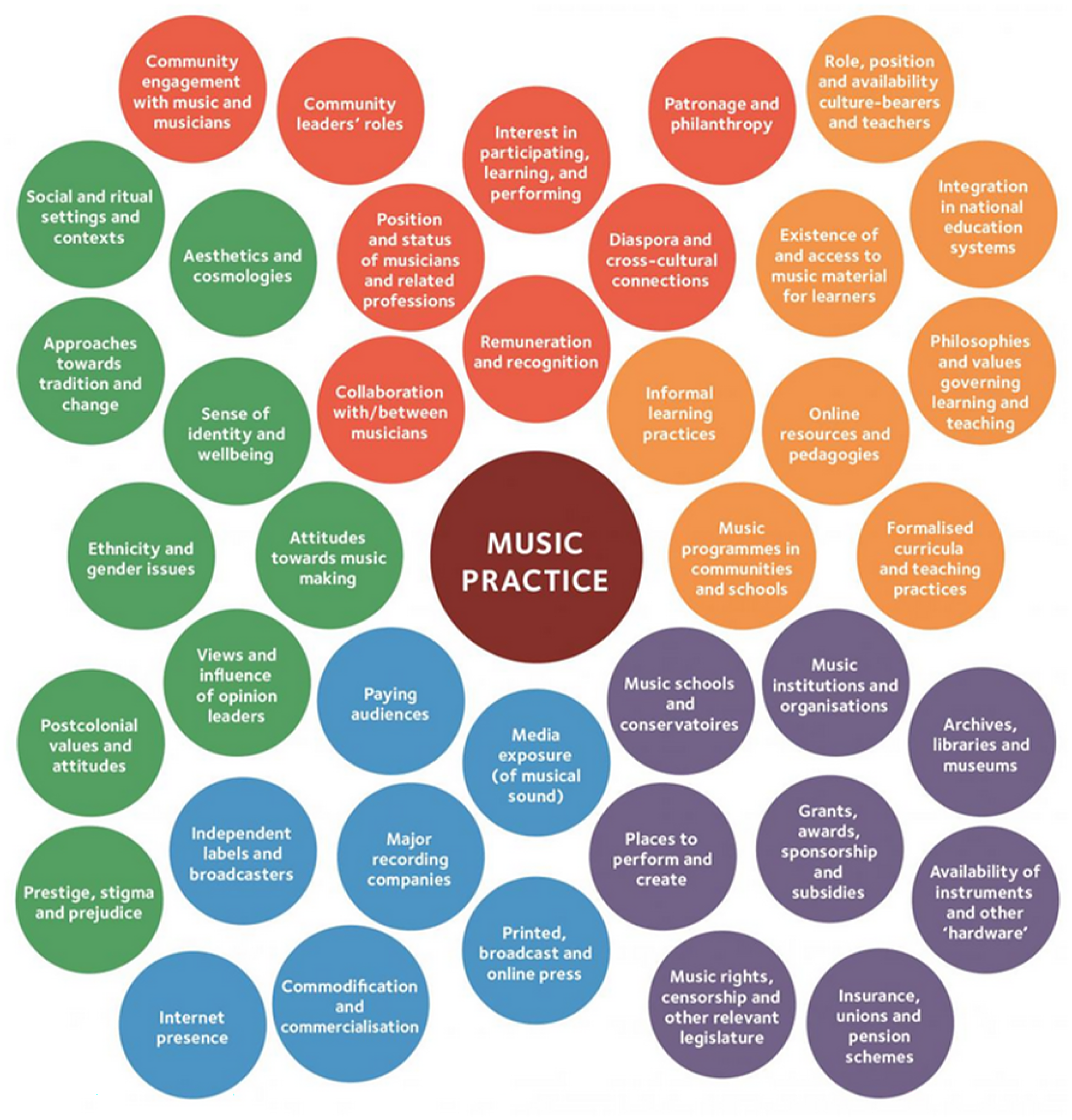
Music ecosystem as five domains and 40 categories (Schippers and Grant, 2016: 338).
For them, a music ecosystem contains the following: the entire complex of factors defining the genesis, development and sustainability of the surrounding music culture in the widest sense, including the role of individuals, communities, values and attitudes, learning processes (…) infrastructure and organizations, rights and regulations, diaspora and travel, media and the music industry. (Schippers, 2016: 137)
Therefore, a first and very basic definition of music ecosystem in this context points to ‘more or less coherent systems with regular interactions between social actors in the form of network connectivity occurring at different scales. It therefore includes the – often unequal – interactions between key actors, including artists and creators, live music, recorded music and distribution (…)’ (Berkers et al., 2023: 138). Hence, an ecological approach should consider different levels and values of cultural activity – from amateur and underground to industry, from fine arts to popular culture and from public and private to the civil sector as well as internal and external influences for a ‘healthy’ and ‘sustainable’ cultural development.
But in many studies, articles and research reports, a theorization or even a basic definition of cultural ecology or ecosystem is insufficient or even missing. This assessment corresponds to the empirical findings of De Bernard et al. (2021), who reviewed a sample of 56 studies and papers on cultural and creative ecologies and ecosystems in terms of their conceptual approach and theoretical understandings. In their analysis, they identified several problems with the ecological perspective so far – especially in terms of inconsistencies regarding definitions, the lack of a clear pattern of ‘ecological language’ 2 (e.g., ecology or ecosystem, cultural or creative) and ambiguities in terms of their geographic and spatial contexts. In summary, they concluded that ‘this series of definitional and terminological slippages in the literature makes it difficult to consistently summarise what scholars mean and what phenomena they are precisely addressing when using these terms’.
At the same time, the contextualization of local, trans-local or even virtual circumstances and the scope of a valuable ecosystem approach would be crucial for a full understanding of its structure and dynamics. Following DeBernard et al. (2021: 14), it therefore is necessary ‘to contextualise the accounts of which actors matter most within specific, real-life circumstances to avoid another one-size-fits-all approach to research and policymaking’.
In conclusion, there is a need for developing a shared understanding and research agenda in the field of cultural ecosystems in order to overcome misleading analogies of physical ecology and lasting ambiguities. Whereas recent publications and books like Global Creative Ecosystems (Virani, 2023) mainly focus on methodological questions of ‘doing’ and ‘supporting’ cultural ecosystems, a shared and convincing theoretical concept of the term is not existing.
Nevertheless, delving further into existing models of ecological thinking and the trajectory of ecology-orientated research in social sciences and the humanities foregrounds some important aspects to reflect and conceptualize ecosystemic implications towards urban music culture. Here, a first step is to have a look at what ‘ecological thinking’ exactly means and compare different understandings of ‘ecology’ and ‘ecosystem’ between humanities, social science and biology. This can be traced back to the 1920s, when approaches of human and cultural ecology by the Chicago school and cultural anthropology started to use analogies of biology’s ecological language to identify and describe patterns in urbanization processes (Park and Burgess, 1984) and the significance of internal and external impact on the development of culture (Steward, 1972). This work and further reflections like Marvin Harris’s (1980) concept of cultural materialism first and foremost focus on infrastructure as determining modes of cultural production and reproduction.
Whereas these examples mainly base on a rather physical understanding of environment in biological terms and pattern-seeking, at least the concept by Harris (1980, 1999) – as combination of infrastructure, structure and superstructure – can be located in the realm of system theory thinking to a certain degree, albeit in a very general sense.
As later approaches from the 1970s onwards show, human ecologies are multi-folded and appear as a kind of secondary ecology, adding immaterial aspects like symbols, social relations and practices compared to the purely materialistic and rather linear understanding in natural sciences (Bateson, 1971; Finke, 2008). Here, it appears crucial that a specific understanding of human and cultural ecology or ecosystem has to extend the biological approach of environmental adoption by far and requires the inclusion of active (human) processes of accommodation, infrastructuring and the negotiation of symbols, values and policies. Considering different levels and modes of cultural production, specific socio-spatial and socio-economic contexts and modes of culture-orientated governance, cultural ecosystems have to be understood as a combination of physical (infrastructures, artefacts, spatial scale) and immaterial (social practice, governance, norms, values) levels referring to elements of complex system thinking (Berkes et al., 2003; Communian, 2011). Hence, an ecological approach towards culture and music has to consider ‘a number of attributes not observed in simple systems, including nonlinearity, uncertainty, emergence, scale and self-organization’ (Berkes et al., 2003: 5–6) as well as a hierarchical logic of nested subsystems.
This basically corresponds to the initial definitions of music ecosystems by Schippers (2016) and Berkers et al. (2023) but supplements characteristics of complex social systems by emphasizing latent structures, internal and external subsystems and system boundaries as well as non-linear codes of self-preservation (Luhmann, 2004) and specific spatial contexts or scale.
What does this mean for the relation between (underground) music scenes, ecosystem thinking and external impacts on music cultures like cultural policy intervention or a pandemic?
From the work of Schippers and Grant (2016), it seems obvious that an ecosystem approach could represent a fruitful extension of the yet rather inward-looking concept of scenes – especially in terms of the highly relevant relationships of different fields and actors and its association with environmental impact and policies. Here, for example, the model introduced by Schippers and Grant (2016) considers social, political and economic factors that point to the increasing complexity of social life and the embedding of music cultures in general. In contrast, among research on scenes and DIY culture, external factors and effects exerted by social surroundings have been examined as counterparts rather than as part of a ‘scene environment’ so far.
For sure, scenes are complex systems themselves. As scene-related research over the last three decades has shown, life spans, trajectories and scene-related infrastructures vary and are always related to specific local contexts (Barber-Kersovan, 2014; Bennett and Guerra, 2018; Bennett and Kahn-Harris, 2004; Bennett and Peterson, 2004). In this sense, scenes and their environments also represent a form of ecosystem – but from an ecological perspective, these contexts have to be considered as specific ‘biotopes’ within a local or regional music environment. In an actual holistic ecological approach towards music and culture, scenes can be understood as only one part or as a nested sub-system within a larger cultural or musical structure.
In other words, the ecosystem represents ‘the whole’ and enables the integration of existing approaches, for example, scenes or DIY cultures, as specific ‘cultural habitats’ that are distinct but interconnected sub-systems of institutional arts as well as mainstream pop music, music industries, the live music sector, music education and other surrounding fields like urban planning and cultural policy. This view makes it possible to maintain the framework of scenes and at the same time relate it with other parts and socio-spatial levels of an ecological perspective.
Though against all critique of music ecosystem as, for example, being a too broad approach (Keogh, 2013) or kind of neoliberal legitimation (Whiting, 2023) and despite the current slippages and constraints of an ecological perspective (De Bernard et al., 2021), the concept could unfold a fruitful potential for research among scenes and DIY cultures and has been receiving increasing appreciation among scholars and cultural policymakers.
Cultural policy as ‘ecological’ influence on scenes and DIY cultures
As shown, the ecological perspective could enable a more holistic analysis as well as an examination of relationships between actors and their embeddedness in a wider social environment – including power relations and policies (Van der Hoeven and Hitters, 2020). This directly relates to the starting point of this article: public subsidies, policy support and the integration of DIY-based or scene-related actors in cultural planning mark a new level of institutionalization or a kind of ‘official’ discovery of alternative cultural practices by cultural and urban politics. Concepts like Creative or Music City foster such developments under the label of ‘inclusive cultural planning’ (City of Cologne, 2019) and the political economy of urban music. ‘Music – popular music in particular – can accommodate industry and state visions for urban culture, that flit across other cultural forms, and in forms that combine economic, social and cultural benefits’ (Homan, 2016: 75).
Hence, the exploitation of symbolic value and scene-related cultural memory represents a major strategy of music-based imagineering (Barber-Kersovan, 2014; Cohen, 2013). In this sense, scene-related symbolic capital and heritage can be understood as a significant infrastructure and resource for the post-industrial city and for the political economy of urban music (Homan, 2016; Grodach, 2013). This kind of (symbolic) value at the same time bases on alternative and subversive practices and provides legitimacy for the existence and cultural policy support of scene spaces and actors (Homan, 2016; Kuchar, 2020a, 2020b). For example, this contradiction is clearly visible in the case of alternative music venues that not only have enormous symbolic potential for placemaking but also have achieved the status of pop cultural heritage (Bennett and Rogers, 2016). This is particularly evident among genre-defining and well-known examples such as Berghain, CBGB's or Mojo. But discussions and struggles around economic pressure, gentrification and the cultural value of popular music reveal that the relation between music and the city is anything but linear. In contrast, entanglements between scenes, cultural policy and the urban are getting more and more complex.
In cultural policy studies, concepts focusing on cultural value (Holden, 2004) and cultural ecology (Holden, 2015) increasingly consider the significance of cultural practices beyond a purely economic level and the legitimization of neoliberal development. These approaches actually connect an ecological approach to social and cultural values to overcome the so-far economic-cantered view on culture. Therefore, it would be crucial to build on the ‘messiness of culture’ (Holden, 2015: 22) and at the same time not to ‘order’ this by implementing top-down measures or rigid future strategies as this would restrict cultural dynamics. In many cases, this is a question of space and the permission of experiments as a kind of ‘cultural opportunity’ understood as interrelated cultural resources (Gross and Wilson, 2020: 333) requiring acknowledgment of the collectivity of practices and layers of their socio-spatial embedding. Related to sociological concepts identifying ‘law and regulation’ as a crucial impact on modes and practices of cultural production (Peterson, 1990), the cultural policy-orientated idea of a music ecosystem might function as an inclusive approach not only based on regulation but also related to the different genres and sectors of music culture, fostering conditions for any musical practice.
In terms of scenes and music-related activities, this view means to focus on the spatial value of music (Van der Hoeven and Hitters, 2020: 155) and scene-related practice and to control or diminish major challenges for scene activities in urban districts. For example, measures against the concentration of property ownership and overheated property markets would ensure ‘that cultural districts remain more than curated destinations of independent consumption for young, educated and socially liberal creatives’ (Bain, 2023: 46).
Hence, initiatives to preserve locations for scene-related music venues by public funding and policy intervention as in the case of Golden Pudel and the Molotow Club in Hamburg (Kuchar, 2020a, 2020b; Kuchar, forthcoming), venue rescue plans like in London (Greater London Authority, 2017) or steps towards a more inclusive cultural planning could point to a starting point of ecological thinking in cultural policy. But there are questions remaining: can an ecological perspective in cultural planning really lead to an increased legitimization of scenes and DIY practices? And in which ways one-time support like emergency funding for singular projects or in cases like the pandemic rather might increase the dependency of DIY cultures and scene actors on cultural policy support? These questions will be discussed in the final section of this paper.
Post-COVID cultural policy – From initial support to long-term austerity?
The development among small and scene-related music venues in the time during and after the COVID-19 pandemic appears as an interesting case for discussing a cultural policy-orientated ecological perspective. Therefore, considerations briefly describe the situation before the pandemic and provide a short account about the situation of music venues and (cultural) policy measures in Germany during and after COVID-19. For the discussion, post-pandemic research and current studies on venues and the live music sector are taken into account to reflect on the role of cultural policy as well as evaluate the relationship between scene or alternative cultural spaces and the policy level in terms of an inclusive cultural ecosystem approach.
As research on live music and trajectories of scene-related music venues until the end of the 2010s has shown, club spaces and their socio-spatial functions are facing a variety of challenges within their social and spatial environments (Kuchar, 2020a, 2020b; Sadoux, 2021; Whiting, 2023). First, the strong commercialization of live music and the nighttime economy in general have been increasingly exerting economic pressure on local actors since the late 1990s (Frith, 2013; Holt, 2013, 2021). Second, in urban development, the symbolic instrumentalization of local (underground) culture and related cultural memory fosters urban valorization and displacement (Bennett and Rogers, 2016; Chatterton and Hollands, 2003; Reckwitz, 2017: 173–200; Zukin, 1995). Finally, the latter also affects whole local scenes in terms of spatial density and leads to a dispersal of scene structures in the city (Grazian, 2013). At the cultural policy level, the developments until the COVID-19 pandemic can be seen as twofold: on the one hand, there seems to be a growing awareness and understanding of alternative spaces and practices as valuable parts of urban cultural infrastructure (Bain, 2023). In the case of music venues and live music culture, this has been fuelled by the emergence and rising influence of lobby organizations on the local (Clubcommission, Clubkombinat), national (LiveKomm, Music Venue Trust) and European levels (Live DMA). As a result, in the case of Germany, cultural policy support and funding of small and scene-related venues have been increasing constantly, even though at a small scale (Initiative Musik, 2021).
On the other hand, the beginning of the pandemic clearly revealed the fragility of the entire live music and cultural sector (Dümcke, 2021; Mulder, 2023). The comprehensive closures in the wake of the first lockdown in March 2020 caused a sudden collapse of live music spaces (Carr, 2022; Taylor et al., 2020). In Germany, several emergency funds at local and federal state levels have been installed quite fast. In August 2020, the nationwide programme ‘Neustart Kultur’ (re-start culture) was implemented and later extended until the end of 2022.
In the course of the pandemic, discussions about COVID-related measures and the unsecure prospects for reopening (a.o. Rozbicka et al., 2021) fuelled the political discourse about the cultural status of popular music venues. In May 2021, the discussion culminated in the German Bundestag with a motion for a resolution on the recognition of music clubs ‘with a verifiable cultural reference’ as ‘facilities for cultural purposes’ under building and planning law (Deutscher Bundestag, 2021: 2). This decision represents the first official cultural recognition of venue spaces in Germany at a federal level. Remarkably, this decision has been made despite or precisely in a time of an almost complete absence of concerts and club events. So has this been a reasonable step towards a more inclusive perspective of cultural governance in the sense of a logic of cultural ecosystem or ecology?
So far, this remains questionable. When most of the COVID-related measures were released in 2022 and after the pandemic-related funding came to an end, the live music sector has changed dramatically. In the phase of ‘going back to normal’, the shift away from commercial live music and local live music scenes has grown considerably (Frith, 2013; Mulder, 2023). In addition, the audience has become less predictable and rather concentrated on large-scale events.
Being situated at the beginning of value chains in live music and facing a structural economic weakness (Holt, 2013; Frith, 2013; Kuchar, 2020a, 2020b), the case of small and alternative music venues shows that there is a need for more recognition and more inclusive policy approaches. Accordingly, results of current studies among music venues and club cultures (Live DMA, 2025; Moroux, 2025) and academic work related to post-Covid cultural policy (Watson, 2024; Dinardi et al., 2024; Dümcke, 2021) reveal that an ‘ecological thinking’ or understanding of culture as an ecosystem in cultural policy terms is, if anything, at its very beginning.
With regard to the pandemic, Watson (2024, p. 668) criticized local cultural policy for its narrow scope, ‘primarily focused on its role in fostering urban cultural economies and urban renewal’. In contrast, Dümcke (2021) concluded a similar situation in Germany; the pandemic has shown that there are hardly long-term and inclusive strategies that go beyond the mitigation of immediate effects: ‘it had no sustainable strategy (…) to reactivate the sector’ (Dinardi et al., 2024: 530). The evaluation of ‘Neustart Kultur’ shows that it was able to maintain Germany’s cultural infrastructure and could foster future-related impulses of digitization. But in music and performing arts, it first and foremost turned out as a rescue tool (Syspons, 2024). Hence, more sustainable models of production and distribution as well as new cooperative financial support models would be as important for cultural actors as to be heard and understood by cultural policy (Dümcke, 2021: 25). Therefore, a broader consideration of regional music production clusters and a combination of support featuring mentorship, financial support and creating networks and communities would be necessary (Watson, 2024: 677–678).
In Germany, the Bundestag resolution in 2021 seemed to be a turning point in terms of cultural appreciation, but its administrational implementation is still lacking reformations in the areas of planning and noise regulation. 3 In this sense, the actual policy support and recognition in most German federal states and municipalities exists only at a symbolical level. So club initiatives like LiveKomm, 4 Clubkombinat in Hamburg and Clubs are Culture 5 continuously criticize the political inactivity by expressing the demand for culturally integrated planning (Clubkombinat Hamburg e.V., 2022). Meanwhile, in some cities like Cologne, an inclusive cultural planning has been implemented. In early 2025, one of the key measures for music venues has been introduced: in the district of Ehrenfeld, a neighbourhood containing many music venues and clubs, the installation of a protected cultural area (Kulturraumschutzzone) restricts the construction of apartment buildings and favours cultural use to avoid the displacement of music-related spaces.
This approach is quite interesting as it shows how space for alternative cultural practices could be maintained and how this might help create the urban free space needed to achieve community effects among local actors. This could strengthen the local music scene as a whole. Whether the measures prove successful is yet uncertain. However, they might serve as a role model for new ways of urban cultural planning and a kind of cultural policy that not only aims for direct economic or symbolic benefits but also recognizes the challenges as well as social and cultural values of grassroot and alternative cultural spaces – at least to a certain degree.
Measures like protected areas could be a first step into a more holistic cultural and local policy considering ‘the messiness of culture’ and towards the recognition of actual needs and challenges of local scenes and DIY cultures. But on a broader level, the contradiction between support and ignorance of alternative cultural practices beyond a utilitarian purpose remains. Though there has been an increase of recognition, an ecological perspective in cultural policy and cultural planning hardly exists.
Conclusion
This article aimed for a theoretical discussion on the concept of cultural and music ecosystems in relation to scenes and tried to question the application of ecological thinking in the case of German music venues during the COVID-19 pandemic. At the empirical level, the exemplary analysis of music venues and cultural policy has shown the growing interrelations between scenes and cultural policy. At the same time, the observations in the case of Germany confirm the ongoing contradiction of policy measures between financial support and cultural recognition, on the one hand, and a lack of understanding of ecological thinking as inclusive and holistic planning on the other. So despite the frequent use of the ecosystem analogy in the field of (local) cultural policy, its use means a cliché and a symbolic figure rather than a real practical policy yet. Hence, the relationship between cultural policy and alternative cultural practice seems to proceed in the inconsistent ways it has been going on for the last decades – between placemaking qualities and precarious realities, especially for alternative and DIY venues and subsequently to COVID-19.
The question is why? One obvious answer may stem from the complexity of ‘real’ ecosystemic thinking, a fact that does not correspond with the rather linear logic in which practical policy operates (Communian, 2011). Another, more striking reason derives from the inaccuracies and not clearly defined meanings of ecosystem as a theoretical concept that allows a wide range of interpretation. Here, even at the academic level, understandings and definitions vary from hardly elaborated notions (De Bernard et al., 2021) to analytical (Behr et al., 2016; Schippers and Grant, 2016), prefigurative (Holden, 2015) and methodological (Berkers et al., 2023) models. This irretrievably leads to epistemological problems: what exactly is a cultural or music ecosystem and which theoretical and methodological implications would arise from a shared understanding of ecosystem as a kind of combined social science and humanities-based concept?
Whereas methodological approaches of ‘doing cultural ecosystem’ – as for example in terms of sustainability, diversity and resilience (Berkers et al., 2023) – already exist, the development of a more comprehensive theoretical model seems to be far more difficult. According to existing approaches, designing an ideal type of ‘cultural ecosystem theory’ would make it necessary to strengthen the differentiation between material and immaterial level, to enable a constructivist as well as context-led perspective of complex system thinking and to include a combination of phenomenological and prefigurative perspectives.
Nevertheless and as shown, the ecological perspective already has potential to broaden and complement existing approaches in cultural and music research. With a more coherent theorization, an increasing relevance and value of ecosystemic thinking in research on scenes and DIY culture and maybe also in cultural policy seem obvious.
Footnotes

Funding
The author received no financial support for the research, authorship, and/or publication of this article.
Declaration of conflicting interests
The author declared no potential conflicts of interest with respect to the research, authorship, and/or publication of this article.