




Abstract
I examine in this article how American “do-it-yourself” communities are established socio-spatially both as oppositional and subversive social spaces and scenes and as emerging alternative and autonomous worlds that challenge and transcend the effects and implications of the normative private–public distinction in the United States. I specifically analyze how these do-it-yourself spheres are organized around particular spatial discourses and spatial practices, policies, and interactions enacted at do-it-yourself shows that promote social intimacy, collective solidarity, diversity, and equality. Furthermore, I focus on the tensions and contradictions that exist within American do-it-yourself spaces and scenes in regard to utopian and “real” worlds, inclusive and exclusive social practices, and homogeneous and heterogeneous communities, as manifested through the tensions between private and public nature of American do-it-yourself spaces and scenes. Based on my long-term ethnographic fieldwork research in various US locations, and particularly on the American West Coast, I argue that this tension is, on one hand, both politically necessary and socially beneficial since it enables the creation of counterpublic spaces and with that also “new intimacies” and “new worlds” (Warner, 2002). On the other hand, however, it is also limiting and controversial for the political and social aspirations of American do-it-yourself communities. In the article, I delve into the history and theory of public and private spaces, as related to Western do-it-yourself music practice, and then continue with the analysis of my ethnographic data, where I pay particular attention to the publicness of the house, the body, and the scene, as related to American do-it-yourself communities. In this regard, I specifically examine program and space policies, as well as dance and bodily practices, at American do-it-yourself shows and further look at some of the social and political public engagements of American do-it-yourself participants.
Keywords
I start this article by giving voice to two prominent DIY (i.e., do-it-yourself) figures and zine writers from the 1990s San Francisco Bay Area DIY scene, Aaron Cometbus (zine Cometbus) and Erica Lyle (zine SCAM).
1
They both in their own way define the general outlines of the American DIY notion of “publicness”
2
: “I’m not anti-society,” Mike Muir once said. “Society is anti-me.” Well put. Yet even as the organs of society attempted to belittle us, neutralize us, co-opt us and explain us away, we fought tirelessly against social disintegration […] Every day walking to work and every night on BART someone would stop me to ask directions, ask advice, strike up a little conversation. Looking weird, maybe people thought they could take that chance. I had less of a guard up because I had less to lose, or at least less to protect. Every time I rode my bike around, I’d have to stop to lock it up to help push a car stalled in traffic. Would they have stopped to help me fix a flat? Ha! Ha! Ha! And every checkbook, wallet, or hound I found would be sent home with a note, “found by the punks.” Did I ever get a thank you note back? A reward? Being alive and in love and a little part of humanity was reward enough […] Did we help old folks cross the street? Push people in wheelchairs for miles? Escort women through scary neighborhoods at night? Of course we all did. And it was nice to know that those people felt more comfortable asking the punks than asking some stranger in a suit. Maybe it was just because we were there, on the street, while everyone else drove by or sat in the safety of their home. But that too was part of the punk credo. Live your life in public, avoid isolation. But still, we felt so isolated. Why? (Cometbus, n.d., pp. 42–43)
Cometbus’ rhetorical rant about the implications of punks’ street life foregrounds the “public” orientation of American punk and DIY culture: struggling against social alienation and disintegration by protesting, living on the street, being civic-minded and open toward the world, rejecting privateness, avoiding isolation, connecting with strangers, offering help to the marginalized and the people in need, and living life in public. Cometbus’ project is about being of and against this world and simultaneously building a new world, an inclination that is also in the center of Erica Lyle’s story.
When Lyle and her friends occupied an empty space in downtown San Francisco and turned it into a community center for 2 weeks in the 1990s, they wanted to do something different than what their punk predecessors were perceived to be doing: We wanted to do shows or art events that were more about what we are FOR than what we are against. I’m not saying we shouldn’t protest; George Bush will certainly keep our hands full with that these next four years. I’m just saying that I’m tired of being expected to self-identify as someone under attack, someone who is powerless and who is being forced out. We wanted to do shows that asked, “What do we WANT the city to look like? How can we make it happen? If we really had all the space everyone says they need to do stuff, what exactly WOULD we do with it?” We wanted to do shows that remind people of the power that they actually DO have. (Lyle, 2008, p. 111; cf. Olson, 1992/2011)
3
The occupation of the space itself was envisioned as a struggle against gentrification (Lyle, 2008, pp. 111, 116, 124–127). However, they wanted to turn that space into a community center where children could come after school to paint and where homeless people could get free food. They imagined it as a multipurpose space: a theater space, meeting space, art and music space, and work and living space with a community garden. They painted its inside walls with murals (on the theme of “community”) and organized an opening night with an intentionally “holistic” variety of social and cultural activities: free vegan food, mural exhibition, photo exhibition, readings, a lecture about the history of squatting, a political speech about gentrification (in which the audience was prompted to reply, “Take it back!”), and performances of various punk and non-punk bands. They endeavored to make it appealing to the whole neighborhood, and they gained support in the surrounding communities (Lyle, 2008, p. 112). The opening night represented “a wonderful mix of types […]—both urban hip and Market Street impoverished” (Lyle, 2008, pp. 120, 123, 124). Lyle and her companions continued with activities after that night and until their eviction 2 weeks later. They kept the art show open for public, together with film screenings, and a public cafe offering free food. In addition, they also hosted a kickball game and a bicycle race during that short time (Lyle, 2008, p. 126).
The new “utopian” world Lyle and her friends envisioned and temporarily enacted promoted creativity, collaboration, political activism, sustainability, autonomy (i.e., “community control”), “non-monetary” relations, education, playfulness, publicness, and heterogeneous and inclusive community (Lyle, 2008, pp. 216, 263, 268). Lyle summed their ambition with the following words: “It was pretty ambitious, but what is a dream about space but a dream about who we might be?” (Lyle, 2008, p. 112). 4
Both of these examples from the 1990s San Francisco Bay Area DIY scene’s activities and imaginations show how American punk and DIY communities in the late 1980s and in the 1990s started to reject the negational and nihilist “against” stance of punk and DIY culture from the late 1970s and early 1980s and turned toward the “positive” practice and action (Baumgarten, 2012, p. 136; Carroll & Holtzman, 2009; Debies-Carl, 2014; Hannerz, 2015, pp. 126–135; MacLeod, 2010, p. 53; Moore, 1998, pp. 257–258, 2010, pp. 60–63; Olson, 1992/2011). 5 Moreover, as the two examples above also demonstrate, the notions and spheres of privateness and publicness emerged as one of the most significant terrains for American DIY communities where these “positive” goals were to be manifested in spatial discourse and practice.
I take the lead from Cometbus’ and Lyle’s ideas and experiences from above and compare them with similar efforts of today’s American DIY communities. In this regard, I examine how these communities are established socio-spatially both as oppositional and subversive social spaces and scenes and as emerging alternative and autonomous worlds that challenge and transcend the effects and implications of the normative private–public distinction in the United States. I specifically analyze how these DIY spheres are organized around particular spatial discourses and spatial practices, policies, and interactions enacted at DIY shows that promote publicness, social intimacy, collective solidarity, diversity, and equality. Furthermore, I focus on the tensions and contradictions that exist within American DIY spaces and scenes in regard to utopian and “real” worlds, inclusive and exclusive practices, and homogeneous and heterogeneous communities, as manifested through the tension between private and public nature of American DIY spaces and scenes. I argue that this tension is, on one hand, socially and politically productive and significant since it enables the creation of “counterpublic” spaces and with that also “new intimacies” and “new worlds” (Warner, 2002). On the other hand, however, it is also limiting and controversial for the political and social aspirations of American DIY communities.
I examine the history and theory of public and private spaces, as related to music practice in the first part of the article, and then continue with the analysis of my ethnographic data, 6 where I pay particular attention to the publicness of the house, the body, and the scene. In this regard, I specifically discuss program and space policies, as well as dance and bodily practices, at American DIY shows and further look at some of the social and political public engagements of American DIY participants. All of these discourses and practices should be seen as DIY spatial endeavors aimed toward alternative goals of publicness, social intimacy, collective solidarity, diversity, and equality. However, before I continue, I briefly define American DIY culture.
American DIY culture is an outgrowth of the late 1970s punk culture which later expanded into a more heterogeneous assemblage that includes punk, indie rock, singer-songwriters, and experimental musicians and scenes. 7 American DIY participants utilize DIY practices and DIY spaces to circumvent dominant commercial and institutional channels. They do this partly for cultural and ideological reasons, by following DIY ethos, as they strive for creative and social autonomy. However, they are also pressed into finding DIY alternatives for structural reasons, specific for American context. These include the general lack of appropriate public and non-commercial community spaces available to social and cultural groups in the United States that practice non-standard ways of musicking and socializing (Holt & Wergin, 2013; Lofland, 2009; Lyle, 2008; Massey, 1998, pp. 126–129; Oldenburg, 1999; Sorkin, 2005, pp. 261–262) and the restrictive role of legislative regulation and age limitation for people under the age of 21 to attend public concert spaces where the alcohol is served (Stewart, 2006, 2010). DIY approach therefore functions both as a means to an end and as an end in itself.
Private, public, and counterpublic: a theory
Scholars recognize different aspects of the notions of privateness and publicness, which I understand here on three different levels: political, social, and economic (Fraser, 1990; Weintraub, 1997). In a political sense, a distinction between private and public concerns the interests of private individuals being voiced publicly (Habermas, 1964/1974). Publicness is in this way about active political participation, collective decision-making, solidarity, and equality (Weintraub, 1997). 8 In social terms, private and public designate intimate, personal, family, and domestic relations on the side of the private, and non-political and heterogeneous social interaction and “fluid sociability among strangers and near-strangers” on the side of the public (Weintraub, 1997, p. 17). Furthermore, private and public distinction is in social terms often related to access and control of private versus public information and to the notion of space: private as hidden versus public as open and accessible space (cf. Rössler & Glasgow, 2005; Weintraub, 1997, p. 5). In economic terms, private and public distinction refers to private economic interests versus public social and state interests. Moreover, Western distinctions between public and private spaces are historically, socially, and spatially constructed to organize social categories such as race, class, and gender into spatially demarcated hierarchical relations that often segregate these groups of people away from the “public” spaces, the latter being hegemonically defined as White, middle class, heterosexual, and male (Fraser, 1990; Hill, 1998; Leppert, 1993; Warner, 2002, p. 49).
As a part of my present argument, I specifically analyze political, social, and economic aspects of American DIY private and public spaces. I identify the political dimension of DIY public spaces in relation to inclusive DIY program and spatial politics employed by DIY participants in order to give voice and space to marginalized and historically excluded communities. Social publicness of DIY spaces is achieved through DIY spatial tactics (De Certeau, 1984, pp. 34–39, 97–102) that oppose social and physical spatial isolation and promote the establishment of affective social relations and intimate heterogeneous communities within DIY spaces. In economic terms, DIY participants reject private capitalist and commercial articulation of DIY spaces and their practices, in favor of collective and reciprocal alternative economic relations. However, in all these instances, it is not possible to talk only in binary terms about American DIY spaces and social relations, which, I argue, rather exist in between the private and public spheres, as “counterpublic” spaces (Flood, 2016; Isaacson, 2017; Warner, 2002; cf. Bhabha, 1994; Foucault, 1967/2011; Lefebvre [1974] 2004, pp. 19, 52, 60, 349, 391).
According to Michael Warner, counterpublics are a type of public spaces, but which are at the same time in a “tension” with them (Warner, 2002, pp. 57, 63). The participants of counterpublics are “marked off” as differing from general populations, and the counterpublic spaces usually “contravene the rules obtaining in the world at large” (Warner, 2002, p. 56). The identities of people participating at counterpublics are not predetermined (“formed elsewhere”) but are “formed and transformed” within the counterpublic spaces themselves (Warner, 2002, p. 57). Moreover, as Warner argues, counterpublics are not only about “representation” of particular interests in the public sphere (as is the case with Habermas’ public sphere) but also “transform private lives” and “elaborate new worlds of culture and social relations,” “including forms of intimate association, vocabularies of affect, styles of embodiment, erotic practices, and relations of care and pedagogy” (Warner, 2002, p. 57). In this way, they are transformative of both private and the public spaces and social relations. However, they are at the same time also “damaged” and “distorted” by their relation with the dominant cultural environment (Warner, 2002, p. 63; cf. Thornton, 1996, p. 25).
As related, I discuss DIY spaces in this study as particular kind of counterpublics. Furthermore, I identify and examine in it two notions of DIY intimacy, both private and public intimacy, each related to the constitution of homogeneous and heterogeneous communities, respectively. I define DIY intimacy as a tactic of affective, social, and spatial proximity that American DIY communities employ in order to achieve their notion of ideal community (Berlant, 2000; Herzfeld, 1997; Lipsitz, 1994; Stokes, 2010).
Genealogy of the private–public dimension of American DIY house shows
In the following section, I review the genealogy and the historical shifts in organizing private/public concerts in the Western context, from aristocratic and bourgeois semi-public, public, and private music affairs, to 1960s countercultural jams and happenings in communes and lofts and up to the emergence and spread of 1980s and 1990s punk and DIY house shows. Concomitantly, I also examine the social relations and cultural meanings behind these events.
The epistemological distinction between the private and public spheres emerges in the European context with the rise of bourgeoisie, in the 17th and 18th centuries. In social terms, life before the 18th-century Europe was “lived in public,” while the “intense privatization of the family and intimate relations, with a sharp separation from an impersonal ‘public’ realm,” appears with the new bourgeoisie class (Cieraad, 1999, p. 3; Weintraub, 1997, 11–18). The latter also reestablish the sphere of political publicness, dormant since ancient Greeks and Romans (Weintraub, 1997).
The bourgeoisie private–public separation also brought changes in the musical sphere. The new middle classes for the first time established the notion of ticketed public concerts organized in concert halls, while they arranged domestic “parlor” concerts in their homes. With this, they also separated the professionalized and male-dominated public music sphere from the private one, the latter associated with amateur and female-dominated music making (Attali, 1985; Bailey, 2010; Christensen, 1999; Forsyth, 1995; Leppert, 1993; Solie, 2004, pp. 123, 124, 136–143). However, domestic music-making activities of middle classes, as well as of lower classes, who were playing music in their homes for centuries, went into decline from the beginning to middle of the 20th century. These changes appeared partly due to professionalization of music, emancipation of women from the private sphere, and the effects of new domestic sound reproduction technologies (Bailey, 2010; Hazzard-Donald, 1990, pp. 94–119; Levine, 1988, p. 139; Slobin, 2000, p. 47; Taylor, Katz, & Grajeda, 2012; Yablon, 2007, p. 645).
After the general demise of domestic music making in America, many avant-garde and countercultural movements in the 1960s and 1970s started to revitalize the idea of private music performances, as they looked for more freedom and autonomy in an increasingly market-driven society. Their efforts included psychedelic rock performances in communal houses (Brown, 2007, p. 15; Doyle, 2002, p. 84; Echols, 2002, p. 27; Miller, 1999, pp. 142, 217; Perry, 1984, p. 36) and Fluxus, jazz, and disco events in New York lofts (Brewster & Broughton, 2000, pp. 140–151; Doris, 1993; Kahn, 1993; Such, 1993, pp. 79–82; Zukin, 1989, pp. 68, 69, 80, 118–119).
With the emergence of punk in the late 1970s, punk houses became sites for music performances, that is, “shows” as well (Andersen & Jenkins, 2001; MacLeod, 2010), but punk house shows were still scarce in the late 1970s and in the 1980s (Johnson, personal communication, August 25, 2012; Maley, personal communication, August 3, 2012; see below). They were also different from counter-cultural “hippie” house concerts and jams. Pat Maley, a DIY musician, producer, and organizer from Olympia, experienced both “hippie” house shows and later-day punk house shows. 9 “Hippie” houses, he said, were more focused on partying, drugs, and “people to make out with”; they hosted mostly local bands and did not have regular shows. Punk houses, on the other hand, operated more like venues, had more regular shows, and were part of the DIY touring circuit, hosting many out-of-town bands. There could still be partying, drugs, and “making out” in punk houses, he suggested to me, but that was not their main focus (personal communication, August 3, 2012).
DIY house shows became a widespread phenomenon in the United States later in the 1990s. 10 In the 1980s, participants established a national DIY touring network using phones, letters, and zines to communicate among themselves and to build the national DIY community (Andersen & Jenkins, 2001; Azerrad, 2001; Baumgarten, 2012). 11 In the 1990s, DIY communities started employing the Internet, which enabled quicker, more efficient, and more widespread communication around the United States and internationally (Kruse, 2010; cf. Castells, 1996/2010). This consequently also affected the practice of DIY touring.
Several scholars argue that with the corporate privatization and gradual decline of public space in the United States after World War II, the majority of Americans retreated into the privacy of suburban living (Hayden, 2003; Jackson, 1985; Katz, 1998; Lofland, 2009; Oldenburg, 1999; Sorkin, 2005). The suburbs, that is, “centerless cities” (Jackson, 1985, p. 265), attest to the increased separation between individuals and their families, and between families and their neighbors, and weaken a sense of community (Jackson, 1985, p. 272). In the suburban environment, the home becomes the “self-sufficient” center of people’s entertainment (Jackson, 1985, p. 278; MacLeod, 2010, p. 101). Looking for alternative communities, rejecting suburban individualization and isolation, and faced with a dearth of public spaces, American suburban youth in the late 1970s and early 1980s, as Dewar MacLeod argues, established communal suburban houses that became centers of their private and public lives, also serving as places for their creative and musical activities (MacLeod, 2010, pp. 101–102; Ngô, 2012, p. 211; Tucker, 2012, p. 207).
With organization of DIY house shows in American residential suburban or urban areas, DIY communities generate levels of noise that occasionally disturb their neighbors, but at the same time also offer an opportunity for the creation of viable and heterogeneous alternative communities that cross boundaries of race, ethnicity, class, age, and lifestyle (cf. Jackson, 1985, pp. 274, 275; LaBelle, 2010, pp. 45–86). In this sense, they challenge and reverse the established cultural meanings and social relations associated with American private and public socio-spatial domains. In a carnivalesque fashion, organizers and participants of DIY house shows in the United States turn private spaces of rest, nuclear family, and social hierarchy into public spaces of celebration, communal relations, and solidarity (cf. DaMatta, 1991, pp. 63–73, 81–87). Furthermore, they transform private spaces of domestic consumption into counterpublic spaces of music and social production (Christensen, 1999; Doyle, 2005, p. 54; Katz, 2004; Leonard, 1998, pp. 68–71; cf. Théberge, 1997, pp. 231–232).
American DIY counterpublics
The fun that’s in a house show […] is that it has a public/private vibe. (Mike from Villanova house, personal communication, January 20, 2011)
In this section, I discuss “private/public vibe” of DIY house shows, which I argue is a particular DIY spatial tactic of creating counterpublic spaces aimed toward transcending private–public distinction and the restrictive social practices related to it. With this, I refer to a range of DIY tactics, from public advertisement and organization of house shows, living publicly in private houses, and intimate social and corporeal private/public interaction at house shows, to public outreach and activism, while I also examine the perpetuation of private–public boundaries at DIY houses and shows. In this way, I specifically look at how these American DIY tactics and practices operate at three levels of concentric spatialities: the house, the body, and the local scene/community.
Many Americans unfamiliar with DIY culture think DIY house shows are private house parties with live bands entertaining a closed group of friends. During my studies at UC Davis, my fellow American graduate students sometimes asked me what kind of research I do, and when I told them “DIY house shows,” they often answered, “so, you basically just go to parties?” Although socializing and having fun are an important element of DIY house shows, their aim is equally about playing and hearing music and supporting local and touring bands (see Maley’s quote above). This value is reflected in the type of promotion and the social constitution of shows. See, for example, this excerpt from a zine guide about how to organize DIY house shows: Promotion: Honestly preh [pretty] much the most important part! Thangs [sic] to do: make a facebook event for the show. Invite all your friends, send it to each band playing and ask them to invite all of their friends. Span the shit out of that show and post it all over social media! Make a flier with bands, venue, date, time, admission price or donation and make it the cover photo. Print that out and post it around town! Bring handbills to shows following up to yours and pass them out to everyone. Whether or not people actually come to the show pretty much relies on this step […] If you don’t have time to promote the show, you probably shouldn’t be hosting it. Don’t throw together an ill-planned/ promoted event just because you think you’re doing the touring band a favor. Keep in mind that most touring performers are on a very tight budget and traveling is expensive. (Campau, 2012, p. 10; cf. “Let’s Chop Cats!”, 2003)
Evidently, a great value is placed on public DIY promotion that includes not only inviting friends and advertising on social media but also distributing posters and fliers around town and at other shows. This further affects more open nature of DIY shows and more heterogeneous constitution of audiences attending them. Many American DIY scenes also use local websites publicly open to all local performers and organizers to promote their events there. For instance, Davis has undietacos.org, Portland pc-pdx.com, Oakland The List (http://www.foopee.com/punk/the-list/), and Washington, D.C., a Facebook group DC DIY SHOWS (www.facebook.com/groups/dcdiyshows/).
Residents of DIY houses in general reject the notion of privacy and isolation and usually open their living spaces to the needs of a wider community and in that way embrace publicness not only as heterogeneous sociability among strangers but also as a political act. Brian Tucker from Columbus, Ohio, for example, explains in the following way the spatial policy of the house he lived in: At the time, our house was the headquarters for Food Not Bombs, Columbus Copwatch, and a splinter faction of Anti-Racist Action. Several book clubs and sundry other organizations held meetings in our living room as well. Columbus, while having a fairly sizable punk scene at the time for a city its size, couldn’t support its own meeting place or punk-run music venue, so most radical activism or DIY activities took place in someone’s home. House decisions were made using consensus based procedures in weekly house meetings. The house itself served to dissolve distinctions between public and private life; it was a home, a meeting place, and a site of politics. It was a means by which we could, at least in limited ways, live our politics and experience the possibilities of alternative ways of organizing ourselves […] In our happier moments, we’d claim that privacy was bourgeois; at other times we’d just grumble as people drifted in and out. (2012, p. 204; cf. May, 2013; Wreckage, 2012, p. 24)
The house in this way becomes not only a venue for shows and other cultural activities but also a site of politics. This is manifested in its content, when residents organize politically oriented projects and meetings, as well as in its form, when the public nature of DIY houses enables diverse social participation, collective decision-making, solidary action, and democratic dialogue. Furthermore, publicness works as an intentional spatial tactic aimed toward a subversion and transformation of historically constructed notion of privacy as associated with social alienation and civic passivity. These efforts have several dimensions and consequences.
Danielle, who lives in a feminist, queer, punk house Glitterdome, in Portland, once told me that living there is for her the same as “living publicly” (personal communication, March 21, 2012). As she explained, this is because the house has an open door policy for friends and DIY travelers and musicians (one DIY participant named it “a living room of the city”). Since Danielle passes the kitchen on her way from her bedroom to bathroom, she often encounters there—sometimes in her underwear—full room of people, some strangers, some friends. When residing in a DIY house, she added, people “know everything about you […] but I like living with a lot of people.” In this way, Danielle embraces the social publicness of her DIY house, but at the same time reveals the occasional inconveniencies and anxieties that come with it, which is also apparent from the end of Brian’s quote above (see also Figure 1).
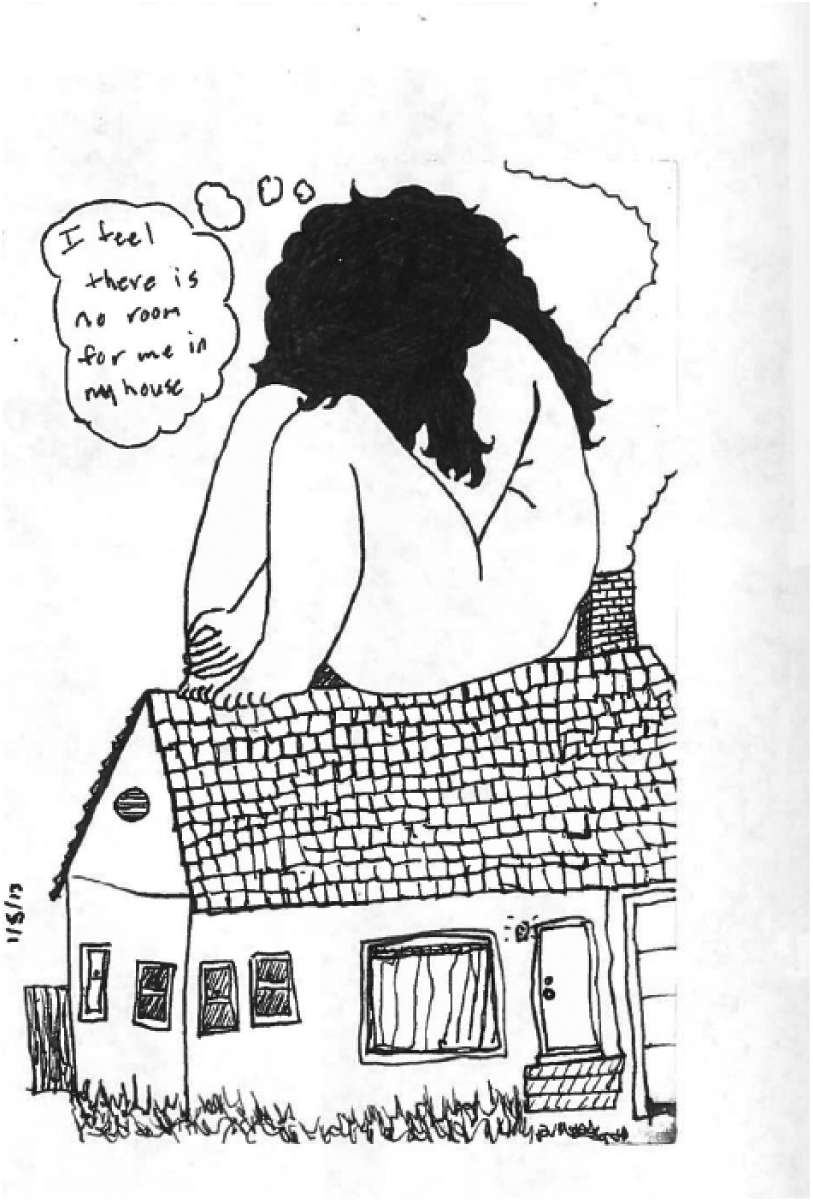
A drawing by Arolia from Portland (May, 2013, p. 16), indicating occasional anxieties related to “living publicly.”
DIY efforts toward transcending the private/public divide furthermore contribute to the type and quality of social relationships established at DIY house shows. While the house shows in private houses tend to be open for wider publics and represented as public events, they at the same time provide for a more “intimate” domestic atmosphere, usually not associated with public music performances. For instance, James, a participant and organizer of house shows from Davis, asserted that “maybe these things that we associate with ‘home’ create a more comfortable atmosphere. It is easier for me to talk to strangers at house shows than at venues, for example” (personal communication, May 5, 2011). At another occasion, James further elaborated, we are experiencing music outside of the modes of exchange that we are used to, even if we still pay donation money […] For me, something that exists outside the normal form of exchange—you go to a venue, bar—making money, going buying drinks; this is much more visceral, conducive to real interchange between people. (Personal communication, December 29, 2010)
12
Sean, an experimental DIY musician who lived and performed in Davis at that time, supports James’ view: “Yes, in a lot of ways it feels far more personal in a private space. At a professional venue, people sometimes feel less inclined to mingle. [They] interact more like customers than guests” (Jóhansson, personal communication, May 27, 2011).
In the view of these DIY participants, DIY house shows, because of their “comfortable” private and domestic atmosphere, enable “strangers,” who would otherwise, in a more commercial public venue, act like “customers,” to socialize and interact among themselves in a more “real” and intimate way. The social isolation and individual and private economic relations and interests, on one hand, and public anonymity and alienation, on the other, are thus rejected and transformed into a collectively asserted and intimate counterpublic space of DIY house shows. In a seemingly paradoxical way, domestic and “private” intimacy of social relations contributes to greater social publicness of DIY house shows.
Furthermore, DIY participants subvert the dominant, capitalist economic exchange system by rejecting the notion of individualized private profit and embracing communally (publicly) oriented reciprocal economic relations. For example, most of the organizational transactions within the DIY community are not based on profit, but on borrowing of equipment, and reciprocal exchange of “favors.” This approach includes reciprocal exchange of venues: music performers playing in other people’s places and later returning the favors by organizing shows in their own places (Verbuč, 2015, Verbuč in pressa). In addition, DIY participants oppose the capitalist notion of “exchange” value by embracing the “use value” approach. 13 For example, donations collected at DIY shows usually go to touring bands, in order to cover their gas expenses. Local bands and venue owners do not take any money from it.
American DIY communities also incorporate several spatial tactics at DIY shows aimed toward creating more inclusive and heterogeneous DIY spaces. In this process, they achieve a level of political publicness of their shows, as they open up space and give voice to groups marginalized by the American dominant society. These include social groups defined by age, class, ethnicity, gender, sexuality, and music style and status.
DIY shows in the United States are mostly organized as all-ages spaces, and American DIY participants usually vehemently reject the +21 policies established at most public music venues (Stewart, 2006, 2010). Door policies include sliding-scale donations that tend to be inclusive toward all classes (see Figure 2). For this reason, DIY organizers also sometimes write “no one turned away for lack of funds” or “pay what you can” on their invitations and door signs.
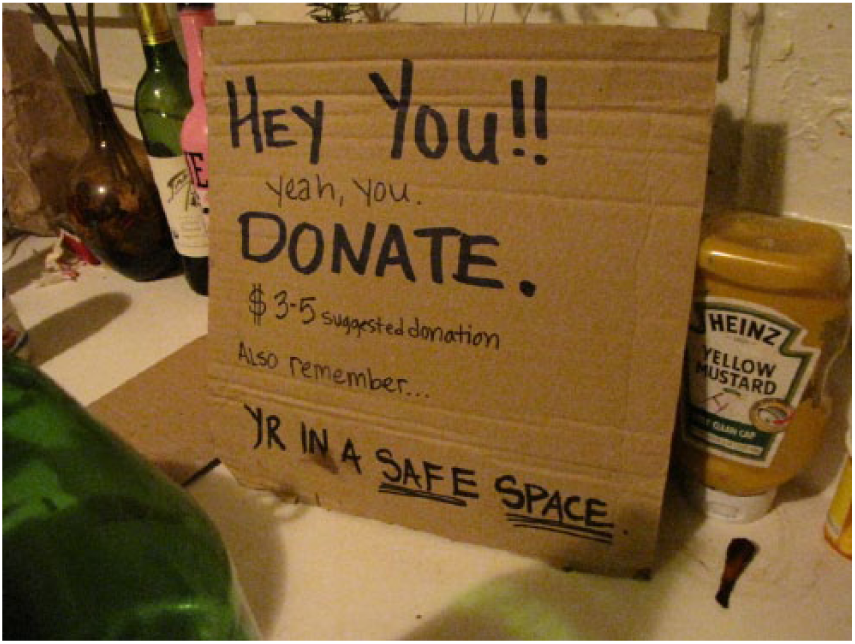
Donation and “safe space” sign at the show at the Jurassic Park house in Portland, January 18, 2012.
Furthermore, there exist DIY booking tactics that aim toward social inclusiveness in terms of music programming at DIY shows. Many houses and DIY venues endeavor to have at least one woman performer on the bill, and some of them subscribe to this principle as a rule.
14
While rarer, these inclusive programming tactics can in some venues and localities include efforts toward inclusion of non-White and queer performers. However, this is more possible in geographic areas with more diverse demographics, for instance, in Oakland, CA. To understand the reasoning behind these tactics, consider, for instance, the following advice included in “The Noisey Guide to Not Being a Shithole and Making Your Venue Inclusive” (Krajewski, 2016): [It] matters […] who you put on your bill. When you fail to give underrepresented communities a platform at your venue, these communities’ concerns—including racism, homophobia, and ableism [sic]—are also in danger of going unheard. “Having more representation also means that aspiring artists of those certain marginalized groups feel like there is a space for them where their art will be valued and supported,” says Elsa Mirzaei of Babely Shades. Too many music genres are dominated by white cisgender men. As you’re going through submissions, consider not just which band sounds awesome, but their makeup’s impact on your audience as well. […] “If you’re going to put a band from Mars on a bill, you will attract Martians to your show. People will know they are welcome there and can feel like they’re around others who have their back” [says Aliermo of Hooded Fang and Phèdre]. (Krajewski, 2016)
These kinds of policies not only promote socially inclusive and heterogeneous publicness of DIY spaces but also create political public forums inclusive of historically marginalized DIY communities who are able to express their feelings and concerns openly through their music, talk, and stage performance at DIY shows (Duncombe & Tremblay, 2011; Marcus, 2010; cf. Nguyen, 1998/2010). In addition, DIY programming policies often also encourage music diversity and are supportive of performers from all skill levels, including beginners.
Moreover, many DIY spaces ascribe to “safe(r) space” policy, which is meant to discourage and prevent any forms of racism, sexism, homophobia, transphobia, classism, ableism, ageism, and violence within particular DIY spaces and with that to make marginalized people feel “safe(r)” in these kinds of spaces. The policy is usually posted on the walls of DIY venues, on websites, and/or on event invitations, for example, posters, flyers, and Facebook invitations (see Figure 2). Safe(r) space policy can be “embedded,” or “built-in” as a permanent space policy of particular DIY spaces, or can be “event-based,” a temporary policy that is tied only to particular organizers and events (cf. “Silent Barn,” 2013). There are many debates within the American DIY communities about proper approaches to enabling safe(r) spaces, social effects of these policies, and related issues (Cupcake, 2015; Krajewski, 2016; Reid, 2015; “Silent Barn,” 2013), but I deal with this topic more extensively elsewhere (Verbuč, in pressb).
These DIY space, program, and door policies that work as spatial tactics enabling inclusion, diversity, and equality within DIY spaces and scenes constitute DIY publicness that is on the surface related to the content of cultural events. However, this publicness is political in form, as it is concerned with material and embodied practices of solidarity, direct and heterogeneous participation, democratic collectivity, and negotiation of difference. Moreover, it enables and is a part of a wider public dialogue existing among various DIY constituencies, which also introduces a level of self-reflective critique.
For example, there exist many non-White, female, and queer American DIY participants who are critical of contemporary American DIY scenes. Mimi Nguyen, the author of a DIY zine Evolution of a Race Riot (1997; cf. 1998/2010, 2002, 2012), provides a scathing critique of American “punk” scenes in this regard (her experiences with punk scenes come mostly from the 1990s): Indie rock girls ask why gays and lesbians want “special rights,” punk boys rape or beat girlfriends and acquaintances, queer kids deny racism and their class privileges and in between there are innumerable insults, the slips of tongues, and the violent gestures. (2002, p. 109)
She rounds up her indictment by saying, Punk rock proves to be a contentious a cultural, political, and social sphere as any other, including a national one. As such, punk rock is not an exception to the rule, to the so-called “mainstream” [… it is] hardly an “alternative,” but a subsidiary or more, parallel public […] I used to believe [in punk as community] but I don’t any more […] punk rock is not a “safe space” for me. (Nguyen, 2002, pp. 110, 111)
However, there are also many other non-White, female, and/or queer DIY participants who claim American DIY scenes are “affirming” and “empowering” for them as marginalized people (“Aint Shit” n.d.; Denizio, 2011; King, 2008, p. 111; Nguyen, 2002; Vo, 2012, pp. 7, 10, 13, 18, 22, 32), sometimes being the only “subversive game in town” (Duncombe & Tremblay, 2011, pp. 231, 235, 241–248, 252; Habell-Pallán, 2011, p. 222). Many of them also believe and assert that American DIY scenes are changing and becoming more conscious, self-critical, and pro-active about the oppressive practices still existing within the DIY scenes (Hassan, 2016; Lafebvre, 2016). As these DIY constituencies form a significant and vocal part of American DIY spaces and scenes, they do not so much contradict the notions and tactics of DIY publicness but help constitute them as such.
American DIY participants tend to transcend their role as “passive” consumers by endeavoring to engage in “active” participation at shows (Verbuč, in pressb). In doing so, they often breach the socially constructed notion of physical privateness of their bodies and open them up toward public expressions of affective social intimacy. “Living publicly” in DIY houses, as the examples above demonstrate, already transcends this social predilection at some level, but this is further intensified with dancing and physical participation at DIY shows. For example, at more lively and rowdier DIY shows in small and crowded spaces such as basements and living rooms, DIY participants often energetically move, dance, and/or “mosh” to the music
15
while rubbing their sweaty bodies and playfully pushing and bumping into each other (see Figure 3). Many DIY participants consider the element of crowding, and not the music itself, as the most exhilarating part of DIY events. One American DIY participant, for example, makes the following remark in a zine dedicated to house shows: “The shows I have the most fun at are the ones where you’re in a packed basement where you can’t breathe, can’t move and are covered in sweat” (Gaworski, in Connor, 2012, p. 71; cf. Tuan, 1977, pp. 59, 63, 64, 65; see Figure 3).
16
A DIY participant from New Jersey elaborates further on the issue of sweaty intimacy in a blog post: That’s the beauty of basement shows, the feeling of connection with people around you, the communal feel that makes you throw your arm around a stranger drenched in sweat and scream at the top of your lungs with them. Cliche [sic] as it sounds, I know that personally, being able to feel that connection with a total stranger makes me feel like part of something bigger, and reading this blog, I know that I am. […] The basement was packed from the back wall all the way to the band, and the ebb and flow of the people in the crowd was as powerful as the waves in the ocean, and equally as difficult to stand against. We were all part of a collective whole, pushing back and forth and side to side, powerless to stop it or to stand apart from it. And no one wanted to! From my spot in the front left corner, squeezed against an amp and sometimes a guitarist, I looked behind me and saw nothing but mouths open wide, screaming the words they knew so well. It was incredible. (Grieco, 2010; emphasis in original)
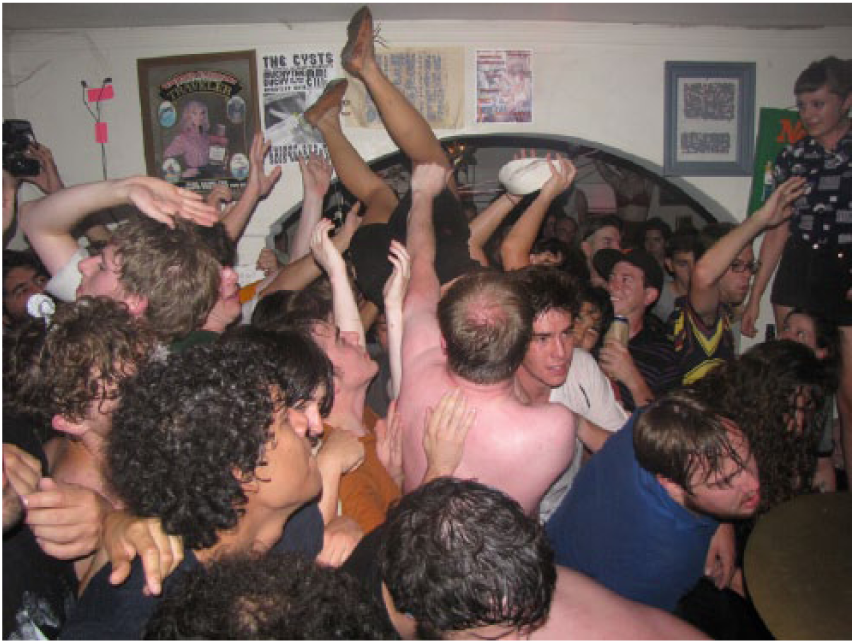
Mayyors’ last show at the DAM Haus, Davis, September 5, 2010. Note the singer, a person without a shirt, with a raised left hand, singing from the middle of the crowd, and somebody crowdsurfing.
Through physical contact and intimate connection with strangers, American DIY participant transcend the boundaries of private “personal space” and temporarily establish an affective intimate community (cf. Garcia, 2011, pp. 74–112; Muñoz, 2013). In this way, the private intimacy of the body is transformed into public and communal intimacy, both physical and social.
In American culture, the importance of individual social privacy and the physical privacy of the body is particularly significant. Edward T. Hall argues that Americans particularly value the possibility of being “alone,” and in personal interactions, they avoid standing “too close” during conversations and tend to retain a “comfortable conversational distance” (Hall, 2003, pp. 52, 58). Beate Rössler and Rupert D. V. Glasgow similarly assert that the body in American culture “forms a nucleus of what one calls and wants to keep private” (Rössler & Glasgow, 2005, p. 5; cf. Gerstein, 1984, p. 167). However, the body is not necessarily an isolated entity. According to affect theory, the body is “implicated in its milieu,” capable of connecting with other bodies and forming larger affective collectivities of shared feeling and movement (Probyn, 2010, pp. 76, 77, 86). American DIY intimacy in a similar way subverts and transcends the socially normative private–public divide on the level of the body, either by “living publicly” or when a mass of crowded bodies move in synchrony at more rowdy types of American DIY shows.
In these kinds of situations, some DIY participants only reluctantly let other people into their own personal spaces, but most of them see this as casting off of personal inhibitions, letting themselves go, and establishing closer physical and affective relationships with people surrounding them at shows. Elisa, one of the DIY participants from Davis, CA, expressed her reluctance toward these kinds of situations and considered the idea of crowding at shows as “gross.” Discussing the typically crowded and rowdy shows at the DAM house (or DAM haus) in Davis, she told me the following: “I like going [to DAM house shows] because my friends will gonna be there, but I don’t know if I ever stayed for the whole show. Cause it gets gross in there” Hough (personal communication, June 20, 2011). However, in an article she wrote about the termination of the DAM house, she discusses more approvingly the “sticky” intimacy of DIY house shows: The best and worst part about live music at the DAM Haus was that the boundary between artist and audience was nonexistent. You could dance and shout side by side with the bands, but at any moment you would have to be prepared to get hit in the face with the head of a guitar or be showered in the singer’s spit. It was a sticky intimacy lost in real concert venues. You would be jostled around by a rowdy crowd, packed to the maximum and slowly suffocating from the house’s smoke machine. There would be no ventilation, of course, because sound would escape into the quiet streets, alerting the aging neighbors and the Davis Police Department. …] By the end of the night, you would be soaked in sweat, yours and your friends’, and you would be loving it […] Even though I always got dizzy and dyspeptic at DAM Haus shows, and even though I rarely lasted through a whole bill before biking home just to be able to breathe again, I mourn the loss of a small-scale community institution. (Hough, 2012)
Elisa’s case clearly indicates that despite socially conditioned norms and anxieties of the private body, American DIY communities nevertheless embrace the notion of public intimacy that often subverts and transcends the social boundedness of the body (cf. Garcia, 2011, p. 83). In this way, they aspire to achieve the ideal DIY community, comprehended by them as both intimate and inclusive, and private and public. Moreover, these efforts corporeally realize and celebrate not only the social publicness of DIY shows but also their economic and political publicness, as they embody in the form of performer–audience interaction DIY economic and political ideals of social participation, reciprocity, solidarity, collectivity, and equality.
DIY participants do not only endeavor to overcome the privacy of the house, and the body, but also seek ways to transcend the intimate boundedness of the DIY scene and community. One way how they reach out of their social privateness is through public promotion of their shows and through inclusive door, programming, and safe(r) space policies (see above). Furthermore, they endeavor to connect with other communities through programming of shows that incorporate musicians from American ethnic minorities. While there is a considerate amount of these constituencies present within the American DIY scenes and communities (see above), DIY participants also aim to forge cross-cultural collaborations with ethnic minority musicians from musical fields that are not commonly represented at DIY shows.
In Washington, DC, local punk organizers, for instance, organized mixed shows in the 1980s that featured local hardcore punk heroes Minor Threat playing together with local African American go-go funk group Trouble Funk. However, according to Mark Andersen’s and Mark Jenkin’s evaluation of these shows, “the hopes of racially mixed audience [went] unfulfilled” because “most of 1,200 fans [at the concert] were white” (Andersen & Jenkins, 2001, p. 148). More recently, “Goof punx” organizers in Portland 17 used to organize shows that paired hip hop and punk musicians together at shows, in order to establish collaborative relationships with local African American hip hop communities. They were inspired to do so by similar events happening in Minneapolis. However, as one of the organizers told me, these kinds of shows did not always work in the best possible way since the hip hop and punk audiences did not mix well and were not always interested to watch each other’s music performances. In Los Angeles, Sean Carnage, who organized shows at a popular local DIY venue Pehrspace, told me that part of his programming concept was to represent “best of new bands” and to “mix scenes.” He often invited Mexican-American punk and ska-punk bands from East and South East Los Angeles to play there with DIY performers from other local DIY scenes and genres. However, he told me he also encountered similar problems as mentioned above in regard to DIY efforts from Portland and Washington, DC (Carnage, personal communication, September 27, 2012).
Nevertheless, when I went to a September 17, 2012 event at Pehrspace, I saw a show there that mixed more classical local DIY rock groups (Batwings, Whqles, and XBXRX), with a local African American hip hop act Ratchet set, which also included a twerking performance group. Based on audience reactions and my own, the whole event was a particularly successful and exhilarating event. I also have similar experience from a couple of Oakland DIY shows I attended there in 2012. Ladyfest at the ABCO warehouse in Oakland, on September 15, 2012, for example, was particularly diverse in terms of ethnicity, gender, and sexual orientation of audiences and performers.
Moreover, when Erica Lyle and her companions organized DIY and punk shows in historically Hispanic area of the San Francisco’s Mission district, in the 1990s (see above), there seemed to be a general approval by the local community for what they were doing. This is how Lyle remembers it: After that we did more shows in the Leed’s doorway, at the BART, at Tire Beach, and in Dolores Park for the rest of summer. The shows all brought huge crowds, went off without police hassle, and were even well received by the Mission community. I remember at one show an elderly Latino guy came up to me and put his arm around my shoulder and shouted into my ear, “This is great, what you are doing for the community! This brings people together!” (2008, pp. 77–78; see also Lyle’s squat event story above; see Figure 4)
18
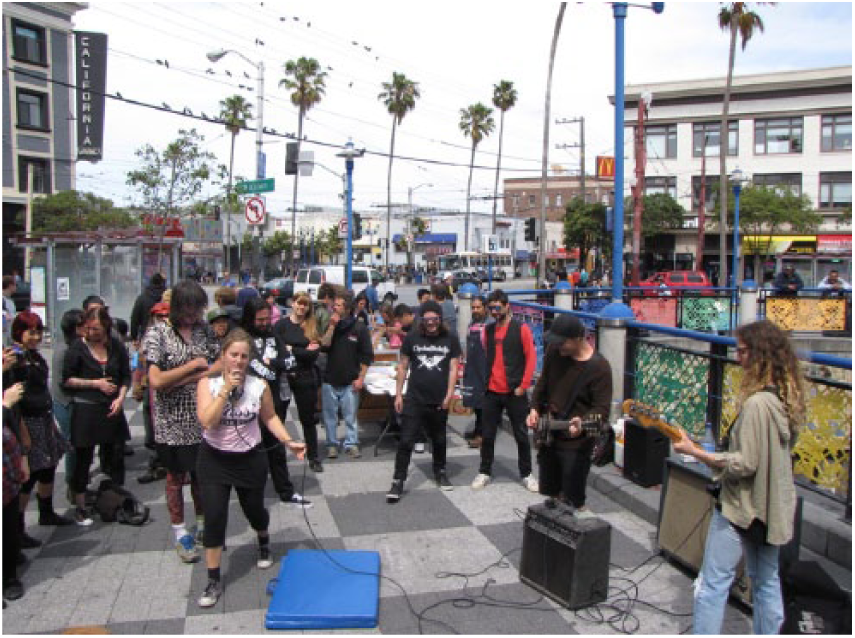
Black Rainbow with Erica Lyle on guitar, playing 16th and Mission BART show in San Francisco, May 17, 2014.
American artist, punk, and DIY participants often live and organize shows in low-income and ethnic minority neighborhoods, which is usually considered controversial, as these “bohemian” communities are often seen as primary initiators of the gentrification process (Brown-Saracino, 2010; Lloyd, 2005; Ngô, 2012; Zukin, 1989). However, they themselves usually contend that the problem is systemic and that the main responsibility for regulating the negative effects of gentrification therefore lies with the local and state governments (Lyle, 2008, pp. 44, 45). Many American DIY participants also usually distance themselves from the more entrepreneurial “neo-bohemians” that are seen as directly implicated in the systemic side of the problem (Jones & Wood, 2008; Lloyd, 2005). Moreover, American DIY communities often organize or participate in various social-political public actions, protests, and cultural projects against gentrification in their immediate neighborhoods and in the process connect and stand in solidarity with local populations most affected by this process (Anti-Cyborg Conglomerate, 2013; Ayer 2009; Brown-Saracino, 2010; Capps, 2014; Erbacher, 2012; herecomeslemmy, 2009; Lyle, 2008, p. 171; Road, 2004, pp. 7, 32; Smith, 2005, p. 78). In this way, American DIY communities extend their cultural and political efforts toward greater public interest. For instance, in their printed guide for house guests, the DIY residents of the RCA/Hot Mess squat (also a DIY concert venue) in West Oakland expressed their spatial policy in regard to gentrification and the local communities: We have also made it a main priority while living here to be honest and open with our neighbors. Please say hello to our neighbors when they walk by, ask us about the history of the neighborhood, what folks are doing to fight gentrification and home foreclosures. We aint tryin to be no scumfucks here at the hot mess [sic]. (RCA, n.d., p. 7)
Furthermore, DIY participants engage in political work that assists various marginalized populations. They often organize benefit shows for various local community organizations that cater toward prisoners, youth, or social minorities (e.g. Books for Prisoners, Street Light/Porch Light Youth Shelter, Big Mountain, and Black Mesa Native Americans) or for animal hospitals and shelters. They also help with homeless programs, such as Food Not Bombs, 19 or needle exchange programs for drug addicts (Lyle, 2008) and organize or participate at political demonstrations (Andersen & Jenkins, 2001; Holtzman, Hughes, & Van Meter, 2007, pp. 48, 49, 51; Lyle, 2008; Marcus, 2010). In addition, official DIY communal spaces often offer their space for the meetings or cultural events of other non-DIY local groups (Olson, 1992/2011, 193; Stewart, 2010; Tucker, 2012, p. 204). In this way, American DIY participants endeavor to materially constitute wider social and political publicness through political participation, collective action, solidarity, and democratic dialogue with non-DIY minorities in the United States.
However, American DIY shows, venues, and communities also often get accused of exclusivist spatial practices and policies, and there are several pragmatic and political reasons for these kinds of DIY boundary-making approaches (cf. Thornton, 1996). In one way, DIY shows and venues are often unintentionally exclusive. DIY spaces are often small in size, which prevents larger publicity and larger audience participation. In addition, these spaces are often located in more remote or secluded residential or industrial neighborhoods, or sometimes in areas considered by wider publics as “gritty” and dangerous.
Some DIY organizers fear police intervention, so they sometimes avoid making public promotion and posting of the location and exact address of shows on promotional materials. For this reason, they sometimes just write “ask a punk” or “call [given phone number] for directions” on their promotional materials (Darms, 2013, p. 18). As some DIY venue organizers from Oakland told me, they often change the names of their venues for this reason, so police could not track them down too easily. For example, DIY show house venue Terminal from East Oakland often used the following alternative names in their history: Temple, Ptomaine Temple, The Well, Black Lodge, and Fuckhouse (Ryan, personal communication, September 14, 2012).
DIY venues often advertise their events publicly (see above), but depending on the neighborhood and other factors, they sometimes limit their publicity, in order not to “bring in all the riff raff” (personal communication with the residents of North East Portland’s Glitterdome house, September 1, 2012). Members of the House of Preblon, a DIY show house venue located in the industrial part of the South East Portland, told me they usually avoid public advertising, not to “overblow” their events which could turn into “raging parties” full of underage people getting drunk and breaking bottles on the street. In addition, this policy also prevents “weirdos stopping [at their shows] on their way between strip clubs” (personal communication, May 24, 2012).
For similar reasons, DIY organizers often shun certain music genres associated with loud and unruly behavior, in which way they prevent noise complaints from their neighbors. Members of the Villanova house from Davis, CA, admitted they do not program reggae and funk bands because they “bring too many people” who want “just to party,” which makes the event “out of control” (Villanova residents, personal communication, January 20, 2011, and December 6, 2011). On another note, DIY organizers also have other hesitations when it comes to program policies, as some of them resent music performers who “exploit” the DIY circuit of venues, only to gain experience and “notoriety” (personal communication with Jim and Jeff from Olympia, August 10, 2012; Edge, 2004, p. 367), or if they exhibit or support racist, sexist, homophobic, or transphobic behavior in their music or performance (see above). Craig, a music organizer at a DIY space Percolator from Lawrence, KS, told me that “anything goes” in terms of the program policy of their shows, but only “if it’s not cock rock or ‘I-want-to-be-famous bull-shit’” (personal communication, July 3, 2012).
Various DIY boundary-making practices are therefore a result of multiple factors. They can be outcomes of larger structural and geographical circumstances; they can be designed to administer autonomous and safe(r) spaces or to safeguard the DIY character and DIY political agenda of these spaces. However, it is important to acknowledge that these kinds of DIY program policies can sometimes also be intentionally or unintentionally exclusive and biased, and perhaps elitist and overindulgent, when it comes to making assessments about who to program at their shows and accept into their spaces.
Furthermore, American DIY music venues often program music performers that play music that is difficult to listen to and thus seen as exclusive by at least some members of the wider publics (e.g. hardcore punk, metal, noise, experimental music), although the DIY shows often also include arguably more audience-friendly music genres (e.g. acoustic singer-songwriters, indie pop, indie rock, and garage rock). However, at least some DIY organizers believe the more specialist DIY program policies should not be seen as a distraction when it comes to the politics of publicness of the American DIY communities. This is what Mark Andersen from the Washington D.C. organization Positive Force thinks about the issue: Honestly, […] I would say that most of marginal, or marginalized communities that we would want to be in solidarity with, they are not that interested in punk music, and so to expect them to come out [to our shows] is an illusion. You know, there is certainly lots of examples of non-white folks involved in punk music, and played significant roles—Bad Brains clearly did—but overall, it’s largely a white phenomenon, at least here in DC, and a middle-class phenomenon. I think that that doesn’t have to be a bad thing, it’s just recognizing the reality. […] it’s not really fair to expect punks to appeal to everyone. What it is fair to say is that when the punks come together that they would be thinking about the ideas they are talking about and find ways to build those bridges. And that’s why our [Positive Force’s] work in terms of getting folks involved in the community, delivering groceries, tutoring kids, working in meals programs, doing whatever, [is so important]. Why is that important? Because it seems to me there you can … um, the shows become a place to inspire folks, to let them know about alternatives, and to give them the encouragement to go out and do that. But the actual relationship building has to … it can start at shows, but then it has to go beyond that. I think that’s something that Positive Force has fought very hard to try to do and do well. (Andersen, personal communication, May 14, 2012; cf. Olson, 1992/2011; Tucker, 2012, p. 207)
Nancy Fraser writes similarly about alternative public spaces, or “subaltern counterpublics” created by “members of subordinated social groups—women, workers, people of colour, and gays and lesbians,” that challenge and redefine the oppressive dominant public sphere (Fraser, 1990, p. 67). For Fraser, these alternative public spaces have a dual character: On the one hand, they function as spaces of withdrawal and regroupment; on the other hand, they also operate as bases and training grounds for agitational activities directed toward wider publics. It is precisely in the dialectic between these two functions that their emancipatory potential resides. (Fraser, 1990, p. 68; cf. Hooks, 1990)
American DIY communities, on one hand, often strive to organize inclusive shows that can generate heterogeneous communities and transformative spaces of intimate collectivity, solidarity, inclusivity, and equality, but they also focus on maintaining their spaces autonomous and open for social and artistic experimentation. This creates a culture of specialized and semi-private or counterpublic intimacy, not always accessible to outsiders. In this way, the tensions between private and public, intimate and inclusive, and homogeneous and heterogeneous sociability that exist within American DIY spaces can be seen as both necessary and beneficial for the American DIY communities. On the other hand, American DIY communities also endeavor to build bridges with American marginalized communities and larger publics in different ways outside of their shows. Social, cultural, and political spatial efforts of American DIY communities usually challenge the restrictive dominant notions of private and public spaces on the level of the house, the body, or the scene, which are seen as being alienating or oppressive. Nevertheless, the DIY communities to a certain extent also mirror and replicate some of these same practices within the DIY spaces themselves. Therefore, the “new worlds” of the counterpublics generated by American DIY communities also simultaneously function as “distorted” and “damaged” alternative worlds.
Conclusion
By being “against” social isolation, alienation, and disintegration, American DIY participants employ several socio-spatial tactics of publicness that help them promote and generate “new” alternative worlds. They aspire toward wider publicness in three tactical ways, related to three types of publicness: social, political, and economic. In social terms, they open up their houses, bodies, and scenes, to establish heterogeneous but intimate public sociability among strangers, scensters, and friends. In political sense, they endeavor to give voice to wider publics at DIY shows, for example, by employing spatial tactics of inclusive and heterogeneous DIY space, door, and programming policies. By doing so, American DIY participants not only enable democratic representation of heterogeneous DIY constituencies but also transform DIY spaces in this way through DIY heterogeneity embodied in practice and sound. Finally, American DIY participants reject privatized economic relations present in the dominant American music venues (e.g. renting a space or selling of tickets and beverages for profit) and instead promote reciprocal and collectively established social relations and exchanges within DIY spaces (Verbuč, in pressb).
By committing to a variety of representational and embodied DIY forms of publicness (social, political, and economic), American DIY communities use integrated and comprehensive spatial tactics of discursive and material counterpublicness that not only reject bourgeois notions of public and private spaces but also foster new alternative worlds (in Erica Lyle’s words, they are not only about “what we are against,” but “more about what we are FOR”). Furthermore, this comprehensive approach proves much more effective than if only one or two forms of publicness would be utilized by the American DIY communities, as each of these reinforces each other in the process of counterpublic subversion and transformation of dominant notions and practices of privateness and publicness.
However, these DIY spaces are also limited in their utopian aspirations, not always being able to avoid exclusivity, isolation, and private comfort, to successfully integrate their shows and spaces, or to erase the effects of dominant social and economic relations and exchanges on their spaces and practices. The tensions that exist within American DIY spaces between private and public, intimate and inclusive, and homogeneous and heterogeneous sociability prove to be both beneficial and limiting for American DIY communities. Their aspirations and practices can be complex and contradictory, as well as socially and politically innovative. And they both reflect and generate the social challenges and progressive changes that transpire in American society.
Footnotes
1.
The research for and the writing of this article was supported by the Faculty of Humanities, Charles University Prague (grant FHS 260 47001).
2.
While many of the first-hand ethnographic examples included come from the American West Coast (more on methodology below), I also include numerous other ethnographic sources observations, interviews, do-it-yourself (DIY) literature from the whole United States. Consequently, this article is generally about the notions of publicness within American DIY spaces, scenes, and communities, but with a particular emphasis on American West Coast. I also need to add one terminological clarification here: I commonly use “America/n” in place of United States.
3.
Erica Lyle recently changed her name and gender identity. She was previously using name Erick.
4.
The American West Coast, and particularly San Francisco Bay Area, has a rich history of activist efforts related to reclamations of public space: Berkeley’s free speech movement, and “fair housing” and rent control laws (Wollenberg, 2008), countercultural take-overs of public parks (the Diggers’ guerrilla performances, Summer of Love events in San Francisco’s Golden Gate Park, occupations of People’s Park in Berkeley), San Francisco Pride street parade, Critical Mass, anti-gentrification, and Occupy movement efforts (Lyle, 2008; Mahler, 2012; Opillard, 2015). This history consequently informs and inspires DIY scenes and participants from the area, and their notions of publicness, as many of my interlocutors attest. However, I argue in this article that these and similar kinds of aspirations and orientations are also pervasive among other American DIY communities.
5.
In the popular and academic discourse, punk and DIY culture are often still considered as “negational” and essentially oppositional (Duncombe, 1997/2008, 46–48; Kruse, 2003, pp. 6, 27, 161, 120, 149; Sabin, 1999, p. 3). In this way, punk and DIY culture are assumed to be culturally universal, ahistorical, and unchanging.
6.
The findings that I present in this article are based on my long-term ethnographic study of American DIY house shows and scenes, particularly on the West Coast. For my research, I conducted interviews, attended concerts, lived in DIY houses, toured with bands (two tours on the West Coast, and one in the Midwest), and studied DIY literature (e.g. DIY zines, comic books, and blogs from the whole United States). I have spent several years of doing fieldwork in Davis, CA (I was also doing my graduate studies there at UC Davis), 9 months in Portland, OR, 5 days in Washington, DC, and 14 days each in Olympia, WA, Los Angeles, and Oakland, CA, with multiple additional 1-day trips to the latter location during my stay in Davis.
7.
DIY movements exist in the United States since the early 20th century, for example, in the form of pragmatic “build-it-yourself” home building and home-improvement efforts (Broman, 2009, 2010; Hayden, 2003; Luvaas, 2013, pp. 8–10). However, DIY as an ideological orientation emerges first with the 1950s and 1960s countercultural movements (Wehr, 2012, p. 14) and becomes a central ideological principle for independent music production and an interchangeable term for punk, with the second wave of British and American punk bands (Crass, Black Flag, Minor Threat) in the late 1970s and 1980s (Luvaas, 2013, p. 13; Oakes, 2009; O’Connor, 2008, p. 45; Savage, 1992, pp. 296–297).
8.
This notion mostly refers to the civic sphere and political citizenship, but public can politically also signify political sphere of the state.
9.
Maley lived at the hippie communal house Yogurt farm, in Olympia, in the early 1980s, and in the 1990s, he was a resident of a punk house ABC house, also in Olympia.
10.
In the 1990s, house shows (and other types of venues) also gained popularity within the folk communities in the United States as well (Gruning, 2006, pp. 94–95).
11.
The international zine directory Book Your Own Fuckin’ Life from the early 1990s proved to be an indispensable tool for touring bands and other users among the DIY community in the United States.
12.
Sharmi espoused James’s observation: Having this thing that is not part of the business model, not part of this competitive, like well “I’m trying to get to the top,” we all … like everybody [in the DIY community] is trying to make something, to be able to survive with what you’re doing; this community—just like the feeling of being around people who want you to do well is very very [sic] alternative to …just like a capitalist system in general. (Basu, personal communication, December 29, 2010)
13.
DIY participant Tom Jennings, for example, writes about the subversion of capitalist “exchange value” with the donations approach of DIY shows: Bands selling records at shows aren’t “amassing capital” to be used later to control more money—but probably to buy beer, a T-shirt from the other band, gas to drive to the next show with, and if they’re lucky, rent. When I give you $5 for a record, I am exchanging something of value (my money/effort) for something else of value (your record). (Jennings, in Eggplant, 1998, pp. 206–207; cf. Holtzman et al., 2007, p. 45)
14.
Many people within American DIY scenes are aware that this policy can promote tokenism and they often try to overcome it by booking more than one woman performer per show. On the contrary, as one booker mentioned to me, advocating for more female participating on stage might also be intended to attract more male audiences to the show.
15.
Moshing is a form of ritualized punk dancing that includes aggressive or otherwise intensive bumping of audiences into each other at shows (Blush & Petros, 2001; Tsitsos, 1999, p. 24). Moshing is often subverted into playful physical interactions at DIY shows.
16.
Yi Fu Tuan discusses crowdedness, as an aspect of space, as being potentially positive. In his words, crowdedness indicates safety, can be “exhilarating,” increases “warmth and tolerance,” and creates a “sense of group solidarity” (Tuan, 1977, pp. 59, 63, 64, 65).
17.
Members of the band Taxpayers, and their friends, were also organizing Portland’s festival The Gathering of the Goof Punx.
18.
With these guerrilla shows, as Lyle argued when I interviewed her, she and her friends succeeded in turning a “morbid” space of the BART station into a “festive” place for all people to feel comfortable there (personal communication, October 24. 2012).
19.
Food not Bombs is a grassroots, informal, and volunteer program that includes cooking and distribution of food for homeless and other people in need.