



Abstract
This paper discusses an experimental modality of ethnographic filmmaking that my interlocutor/collaborator and I came to call the ‘ethnographic B movie’. I explore what I mean by the term and describe its use as novel approach to collaborative multimodal research. I argue that this approach – which encourages unprofessionalism, low quality, absurdity and caprice – provides an opportunity to centre research contexts, ontologies and epistemologies on the fringes or margins of conventional anthropological content, thought and context. Through situating the approach within ideas of arts-based research or research-creation the ethnographic B movie becomes a way to take the process of filmmaking as ethnography for the sake of an open and co-imaginative world. In the ethnographic B movie as filmic approach and representational frame, communicable meaning and narrative coherence are substituted for the spirit of co-creation, and interlocutor-driven content.
Keywords
It's sometime in the distant future. Fragments of an ethnographic film released in May 2020 have been discovered. In the film, Dr Carlos Popper, an ethnographer, is sent by the King and Queen of Spain to study why humans have vanished into total virtual reality. He walks down Queen St West through the neighbourhood of Parkdale, Toronto, carrying the snakeskin-like residue or ectoplastic
1
husk of a human body – all that remains of a physical presence before becoming entirely virtual. Dr Carlos Popper tries to locate the body's origin. A guide will take him to the room where the body, totally virtualized, consumes and is consumed by unbridled capitalism. Dr Carlos Popper will come to call this process “plastic-virtual transformation” and the “dawn of Homo-Plasticus.”
(Figure 1).
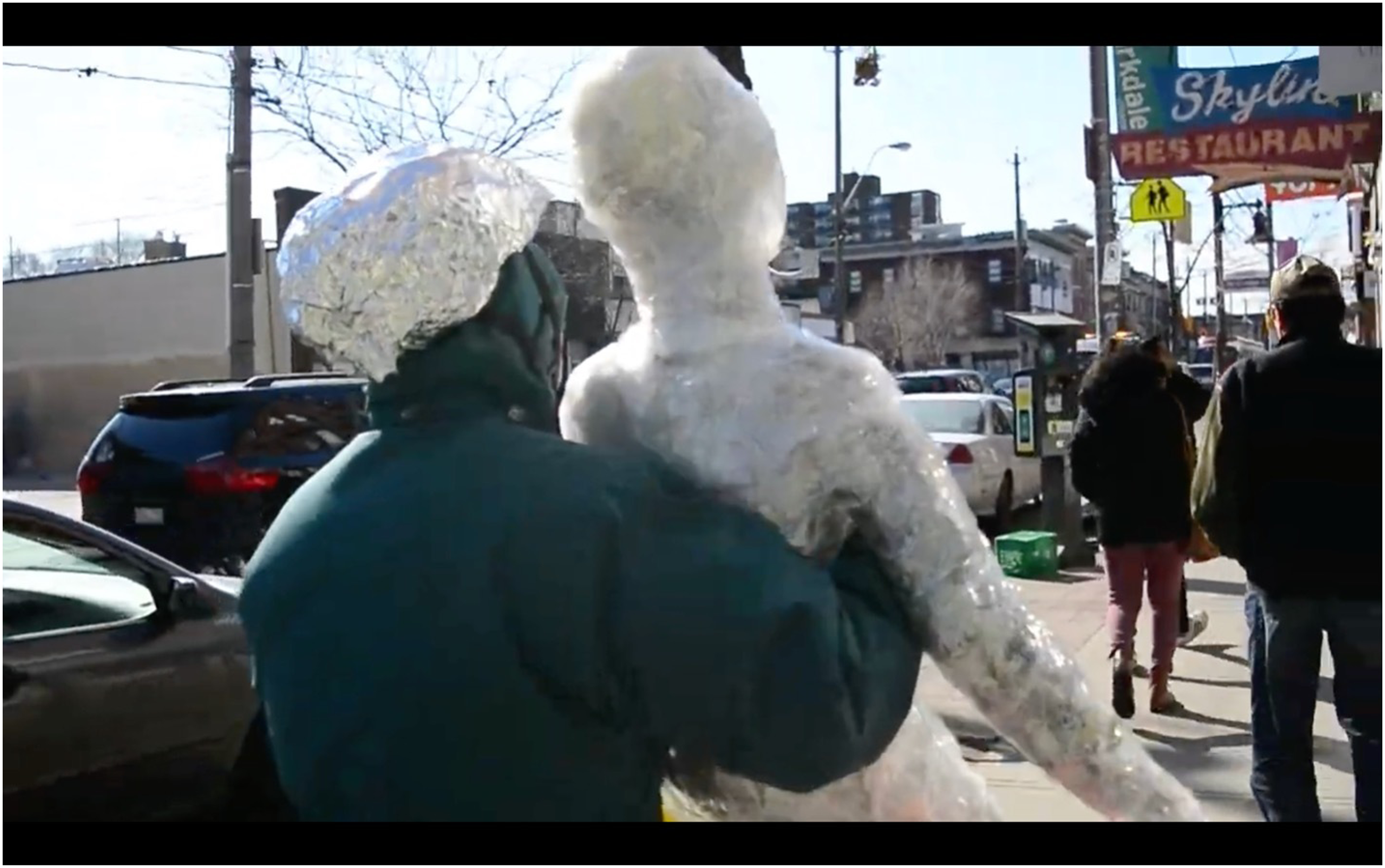
[film still] Ectoplastic, Dr Carlos Popper (D) walks down Queen St West with ectoplastic body searching for who the body belongs to (May 2020).
D, my interlocutor and collaborator in my PhD research, plays Dr Carlos Popper, while I film. We’re standing on a street corner. He holds a human body cast I made of myself using plastic wrap and packing tape. We watch people, wondering who to ask to participate in a scene of the film. We find someone, a neighbour of D's in his seniors social housing building. We explain the scene to them: ‘Popper will walk up to you holding the body and he's going to ask if you know who this is, who it belongs to and where he could find them. You reply with, “I don’t know, I have no idea.” That's all’.
We’re shooting a speculative ethno-fiction film, a mockumentary about a Covid-19 conspiracy theory future we invented. In this imaginative reality, the pandemic was created by Jeff Bezos, Mark Zuckerberg, Elon Musk and other global tech giants to bring about the dawn of total virtual reality. Making this fiction film (and others that follow 2 ) together is the focus of my ethnographic fieldwork studying our collaborative, co-creative process. The style and genre of our films we came to call ‘ethnographic B movies’. In this article, I discuss the ethnographic B movie as a modality of ethnographic research-creation or arts-based multimodal ethnography. Drawing from examples of our work and process, I discuss how the B movie concept helped to frame and encourage our filmmaking freeing us from the limitations of our lack of skills and technology as well as the constraints of narrative coherence. It freed us to explore sometimes confusing and often absurdist storytelling. Along the way, I highlight the ethnographic B movie as a form of filmic arts-based creative research similar to what ethnographic filmmaker Michael MacDonald (2023) has recently called ‘cineworlding’, a concept, that refers to the worlds that emerge through filmmaking. I discuss how the B movie idea was borne from D's singularly unique ideas, which required a unique research method. I first explain the historical context of the B movie genre, before turning to the research context in which the ethnographic B movie emerged. Next, I create space for the ethnographic B movie within historical and contemporary discussions of multimodality challenging conventions that equate high quality filmic form and content with high quality ethnography. Within this discussion, I provide a snapshot of our filmmaking process through a documentation assemblage of filming a particular scene. Lastly I advocate for the ethnographic B movie as a novel approach to collaborative, creative ethnography.
What is a B movie?
B movies emerged within the American film landscape 3 during the 1930s and were often screened as the second half of a double bill, following a bigger budget film with A-list actors and crew. During the Depression, this allowed theatres to give more experience on the dollar to the audience. Theatres would block buy films from the major studios, paying a certain amount for the premiere films, and then would have to buy a quantity of B movies as well. These B movies were made with a fixed budget, and due to block buying, generated a fixed revenue. But this fixed risk and reward system ended with a 1948 United States Supreme Court ruling which prohibited the practice of block buying. As Blair Davis (2012) argues, this shifted the nature of B movie making, and led to the beginning of independent film making in the United States.
B movies have often been synonymous with genre-specific films such as Westerns, Sci-Fi or Horror. It was not until the late 1970s and early 1980s, Davis explains, that the B movie became synonymous with ‘Bad’ movies. During this time Harry and Michael Medved published a book The Fifty Worst Films of All Time (1978) and then the Golden Turkey Awards (1980), giving out awards for the worst in a variety of film categories. This ushered in a new kind of film culture celebrating the worst of film making. In contemporary film culture, the cult of the B movie continues to grow in which a film like The Room or Trolls 2 (Bartlett, 2021) are considered so bad they’re good. The how and why D and I called our work ‘ethnographic B movies’ is the central thread that runs through this article.
Context and background: the emergence of an unplanned ethnographic encounter
I met D at a community meeting in a neighbourhood drop-in centre in Parkdale, Toronto, in November 2019. This meeting was open to anyone: residents, community members, organizers, activists, professionals, anyone with a social concern for the well-being of the neighbourhood. Like most central neighbourhoods in Toronto, Parkdale is gentrifying. The neighbourhood still has a high density of rooming houses and low-income community housing, though this housing is being lost to ‘reno-victions’, new developments, and predatory landlords (Parkdale Neighbourhood Land Trust Report, 2017). The neighbourhood has a strong and organized community network challenging these profit-driven changes. The meeting was hosted by one of the primary organizers in this ongoing battle. D and I ended up sitting at the same small table.
In our introductions, D talked about having recently written and performed a puppet theatre for a housing demonstration. I talked about my fieldwork and desire to understand the spirit of place and precarity amidst urban change. He invited me to attend a theatre group at the same community centre the next day. I attended the theatre group several times and we chatted afterwards, wandering around the neighbourhood. D wanted to lead a revolution inspired by his unique philosophical, cosmological and socio-political system called the Musicality of Reality, a kind of neo-communist blend of Heidegger, Plato, Marx, quantum physics, Kabbalah and shamanism; a system that takes at its core a social interpretation of the fact that the movement of quarks mirrors the spatiality of musical structure. D, when explaining the basic tenets, would demonstrate with a homemade paper mobius strip. (Figure 2).
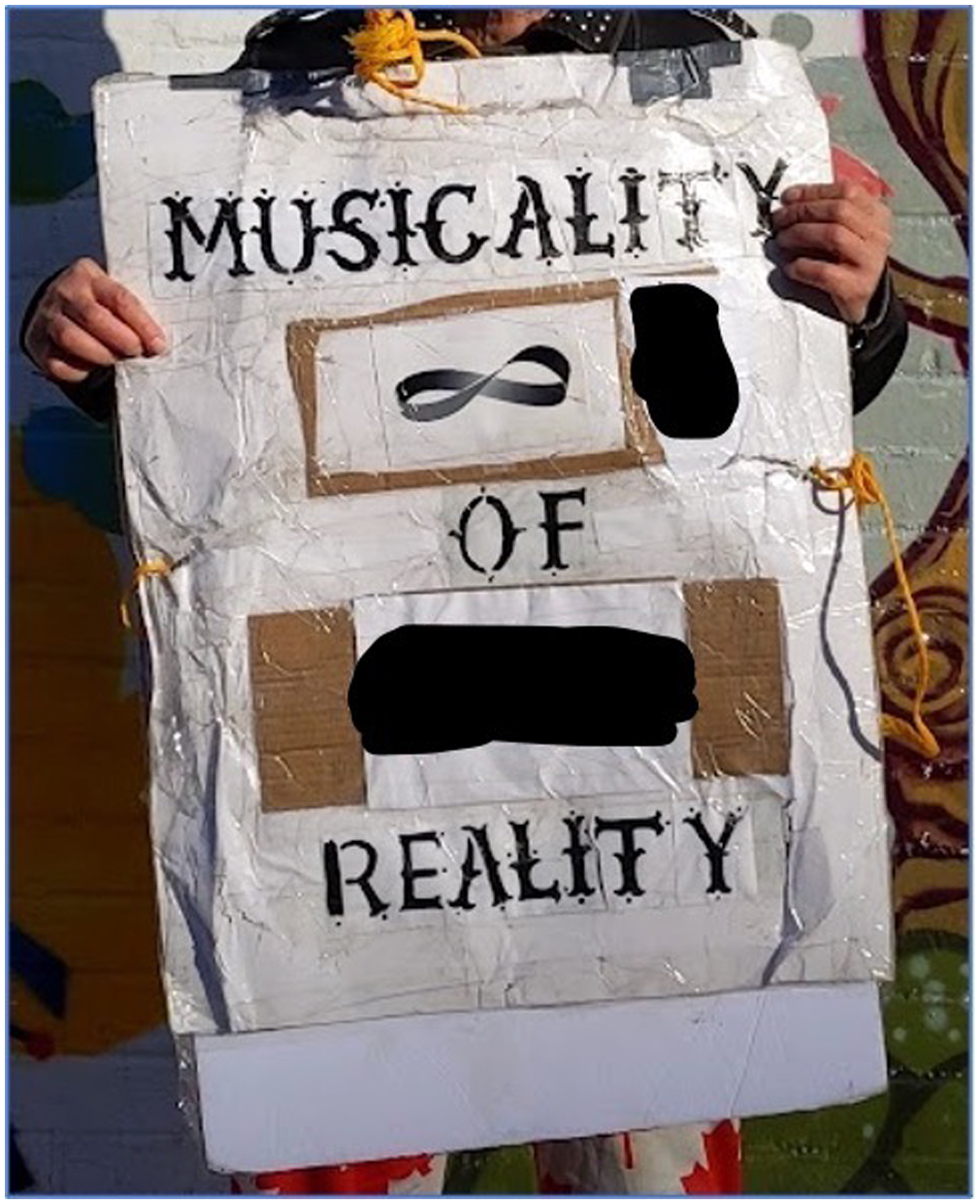
D wearing his Musicality of Reality sandwich board sign, which includes an image of a mobius strip. Before we began our film work, D's primary means to share his ideas was wearing his sign and walking the streets of Toronto, hoping to entice people into conversation. I’ve blurred out his name and email. (December 2020).
He wanted me to help him with his revolution and find ways to share his ideas and build an audience. D has a PhD in sociology with a dissertation focused on a synthesis of Heidegger and Marx. He held, but then lost, an academic position in Turkey. He returned to Toronto and spent years living in and out of shelters until securing an apartment with Toronto's Seniors Housing Corporation in Parkdale. He refers to himself as a failed academic and failing to have had a middle-class life. How he lost his position and the details of his years living in shelters, remain unknown. It was clear he didn’t want to talk about his past. I’ve only learned fragments through what he's written into the narrative of our films. What was clear, however, was that D still wanted to be recognized as a legitimate thinker and revolutionary. This is who D wanted to be as an interlocutor of my fieldwork. I became a disciple of his ideas and we decided to make films (Figure 3).
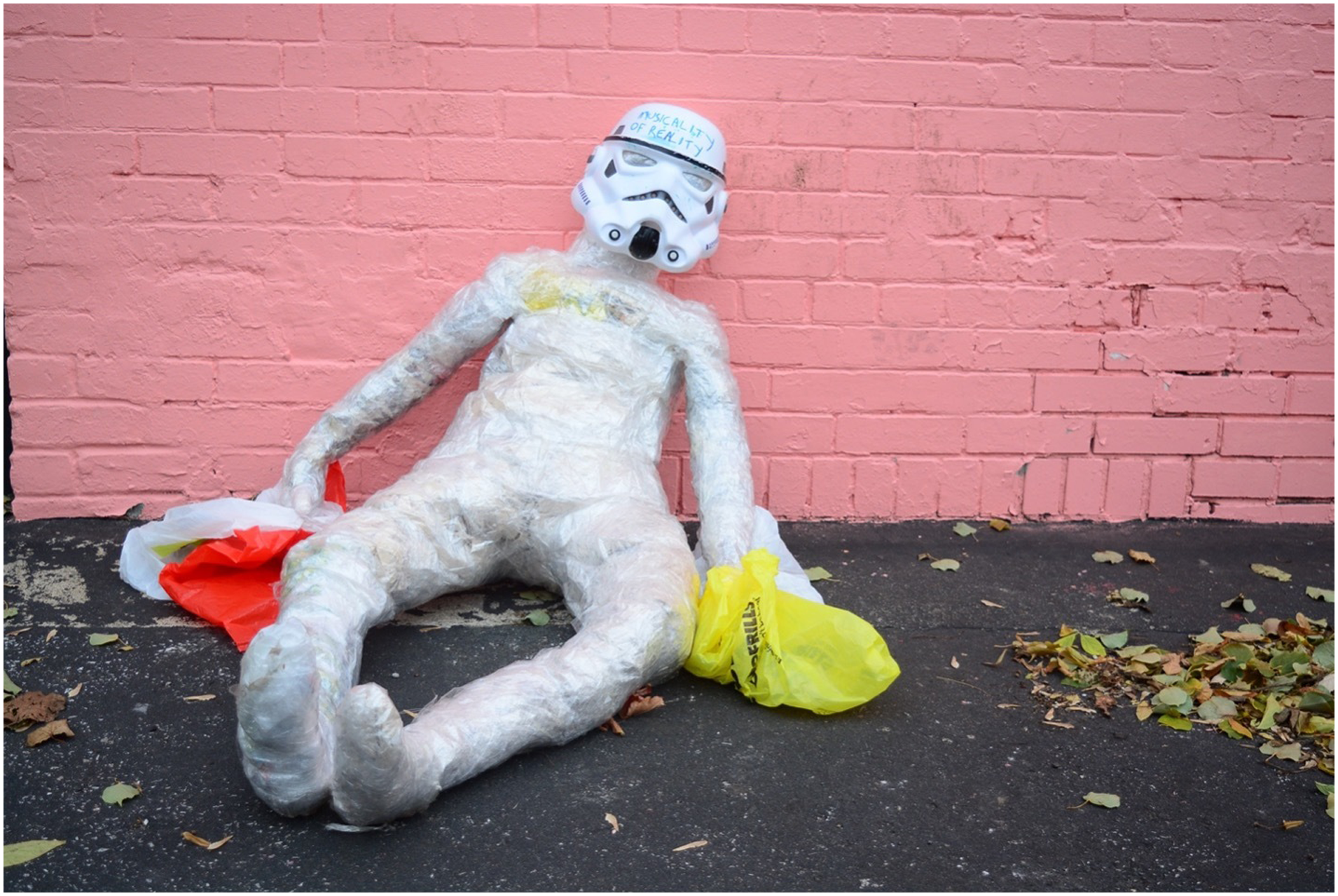
The ectoplastic body: body cast made with plastic wrap and packing tape.
Documenting absurdist ideas: creating bad movies as research-creation
In this section I describe how the concept of research-creation helps to articulate how we came to make films in the first place and why the B movie idea came to make sense. In our films, D is the primary creator, writer and lead actor. I acted, edited, directed and filmed. Though I had wanted to engage my fieldwork through creativity, I had no intention to make films. I’m not a filmmaker, but this is what the ethnographic moment called for and I went with it. Thinking through Jean Rouch's (2003) notion of shared anthropology or John Jackson's (2004) idea of the film as gift, it was my job to help D realize his vision through film. It allowed me to enter and co-create an imaginative world, to bear witness to his ideas and understand their relation to the social world. Not being a filmmaker, not having professional equipment, and being generally unsure what I was doing or how to do it meant that the content we created mattered much less than the process of our creative unfolding. Knowing that we weren’t going to create professional quality material didn’t stop us from filmmaking, but instead encouraged a focus on process and collaboration.
It was not long into our collaborative practice that we came to call our filmmaking ‘ethnographic B movies’. Creating this name gave us both courage and an excuse to continue making films in our no-budget amateur style. Situating our work within this genre encouraged both of us to not take the work or ourselves – myself as ethnographer and D as, in his words, ‘ethnographed’ – too seriously. The novel research atmosphere was generative and imaginative. It allowed us to create a fictional world within distinct overlapping contexts: a neighbourhood's historical moment of gentrification, precarity and the pandemic; D's biographical moment as a revolutionary but marginalized thinker; and my own moment as a PhD student doing fieldwork. We encountered each other as normative versions of ourselves, but became multiple others in the filmic world. Though still beholden to a baseline of research normativity, based on the necessities of my doctoral degree, co-creating with D muddled any certainty of what or who I was studying. We were being creative together but what exactly of it was ethnographic or how exactly I was the researcher or D the researched, remained unclear. 4
Through the ethnographic B movie, our approach to film making was characterized by playful creativity, unprofessionalism, low quality and absurdism. Drawing from Gibson’s ([1979]2015) idea of affordances, the ethnographic B movie created a novel research environment and theatrical stage for D's singular individuality as he wanted to articulate it. A more conventional ethnography would have centred his biography and marginality situating his ideas as the project of mental illness rather than those of a singular thinker. This gesture would have framed D in a more normative position as an outsider of neurotypicality creating a more easily communicable subject position out of which his ideas emerge. Instead, he could be who he wanted to be on the filmic stage, and not who I wanted him to be for an easy-to-communicate research context.
D's system of thought and ideas for the films are utterly absurdist, ambitious and uniquely individual. The B movie approach, not taking ourselves too seriously and accepting low quality aesthetics and technology created the freedom and situation for him to share these ideas. At the core of the Musicality of Reality is a critique of the ‘petit-bourgeois’ and any profession or cultural institution to which he feels himself marginalized. Yet this critique as written and performed in our films is uniquely zany and absurd. When I asked D about the zaniness of his narratives and characters he responded, ‘It's my destiny to be absurd’. He remains steadfast to his own individuality, ‘striving’, as he puts it, to maintain his unique intellectual, political and creative disposition despite this steadfastness keeping him on the social margins. D's desire for recognition, along with his refusal to conform to ‘petit-bourgious’ academia highlights the potentially exclusionary practices of academic norms. With the goal of receiving funding or publication, these norms promote easily communicated and understood narratives excluding neurodivergent modalities of communication. For example, he reflects on his individuality against normativity, while performing as Plato in a closing scene of The Quest for the Musicality of Reality [forthcoming]. Every time even the faintest thought of compromising my intelligence and going with the flow, accepting what most people think, though it might get me somewhere socially, I’ve always refused with the greatest of disgust. So why do I do what I do? Why does a thinker think? Why does the tide come in? Because it has too. That's its nature…While I may be discomforted by being on the margins of society, I can view my position with integrity and dignity and take pride in my being and choosing to be what it is I am.
We set a stage, a theatrical space and performative opportunity that a camera within an ethnographic encounter provides. The camera, following Michael MacDonald (2023), as a kind of more-than-human other, opened up this encounter in which we could play and perform. Further the camera as an affordance of generating knowledge, created a modality of thinking or ‘image of thought’ (2023: 20). The camera provided, what Jean Rouch called ‘cine trance’ (2003: 38) referring to the role of the camera in the creative and generative process of filmmaking. Writing about cine trance, Jay Ruby (2000) argues that ‘the presence of the camera could provoke a cine trance in which subjects revealed their culture’ (2000: 12). Filmmaking allowed D to reveal his ideas, reflections, hopes and frustrations. It was specifically through filming as imaginative ethnographic encounter that this was possible. Writing about activating the imagination through ethnography, Kazubowki-Houston and Magnet argue that it has the ‘potentiality to subvert and remake the existing world’ (2018: 364). For D his professional failure to maintain his academic position, homelessness and inability to have a middle-class life are subverted for the sake of remaking a world in which he is at the centre of a revolutionary moment.
Once I met D, the B movie was perhaps inevitable: How could I have created a conventional ethnography out of such an intentionally unconventional subjectivity? I include the following caveat to help the reader get a sense of the necessity of a novel ethnographic approach. Each time we’ve started a film project, D has been confident it will have ‘global historical impact’. For D, the global impact will occur because of the absurdist, confusing and low quality content. Therefore, the low quality and style are not a barrier to overcome. As he’d say, we were working in the spirit of Edward D. Wood Jr., a pioneer of post WWII American genre B movies.
5
Recently (June 2023), D had completed the structure of a novel which will become the screenplay for a feature length film. This is the synopsis, sent over email: I am about halfway through writing a novel, one more attempt to craft a popular vehicle for our revolutionary-existential project entitled The Musicality of hanging upside [down]) in the Tree of Life. I have blended elements of Norse myth (Odin hanging upside [down]in the tree of Life for nine days to obtain knowledge of the runes), a Marxist critique of the spectator society consumed by spectacle, ecocide, genocide, and UFOs. The tale occurs in contemporary Las Vegas, where a senior Canadian citizen lives in cyber cafe in this Odin-like way and obtains the goals of wisdom by sacrificing his life to restore the once abundant springs in Las Vegas while stopping the looting of a Home Depot organized by an opioid gang in cahoots with Nazis from outer space. It is my usual mix of absolute nonsense. This nonsense could be the basis of our first artistically and commercially successful full-length feature film.
6
Research-creation is a unique term similar to more widely used ideas of arts-based research. As a defined modality, it has emerged through the Canadian university landscape as a specific category within the national funding agency, the Social Sciences and Humanities Research Council of Canada (SSHRC). Erin Manning (2016) in her summary of research-creation, argues that though arts practice has always been connected to knowledge production and ‘forms of inquiry’ the specific category of research-creation opened a space in which arts practice could be more focused around ‘academic aims’ (2016: 26). The importance of this concept for Manning is to centralize the hyphen between research and creation: what hyphenation does to each word as a hybrid concept. It's not just to do ‘creative research’ or to ‘research creatively’ but this hyphenated concept becomes a starting point beyond traditional methodologies to create totally new kinds of experiences, research encounters and embodied practices. She writes: It touches not only on the question of how art itself activates and constitutes new forms of knowledge in its own right but, perhaps most importantly, incites us to inquire into the very question of how practices produce knowledge, and whether those forms of knowledge can engagingly be captured within the strictures of methodological ordering. (2016: 26)
As a kind of filmic research-creation, the ethnographic B movie is an example of what Michael MacDonald (2023) calls ‘cineworlding’. Cineworlding combines ideas of world making, as process, as perpetual relational becoming through filmmaking. I studied myself as filmmaker, researcher, actor and co-producer as well as D as writer, thinker, actor, creator and artist. Research-creation and ethnographic filmmaking provide a scholarly space that gives more attention to the importance of creative process and practice as the focus of ethnographic research. For MacDonald, research-creation provides emergent affordances and activations, he writes: while ethnographic cinema has been committed to representation as a mark of its rigour, the new paradigm that research-creation offers is a way to rethink ethnography beyond representation, to think-feel creativity and becoming as rigorous in its own way, and to innovate models for digital creative education and experimental cinema-thinking (2023: 3).
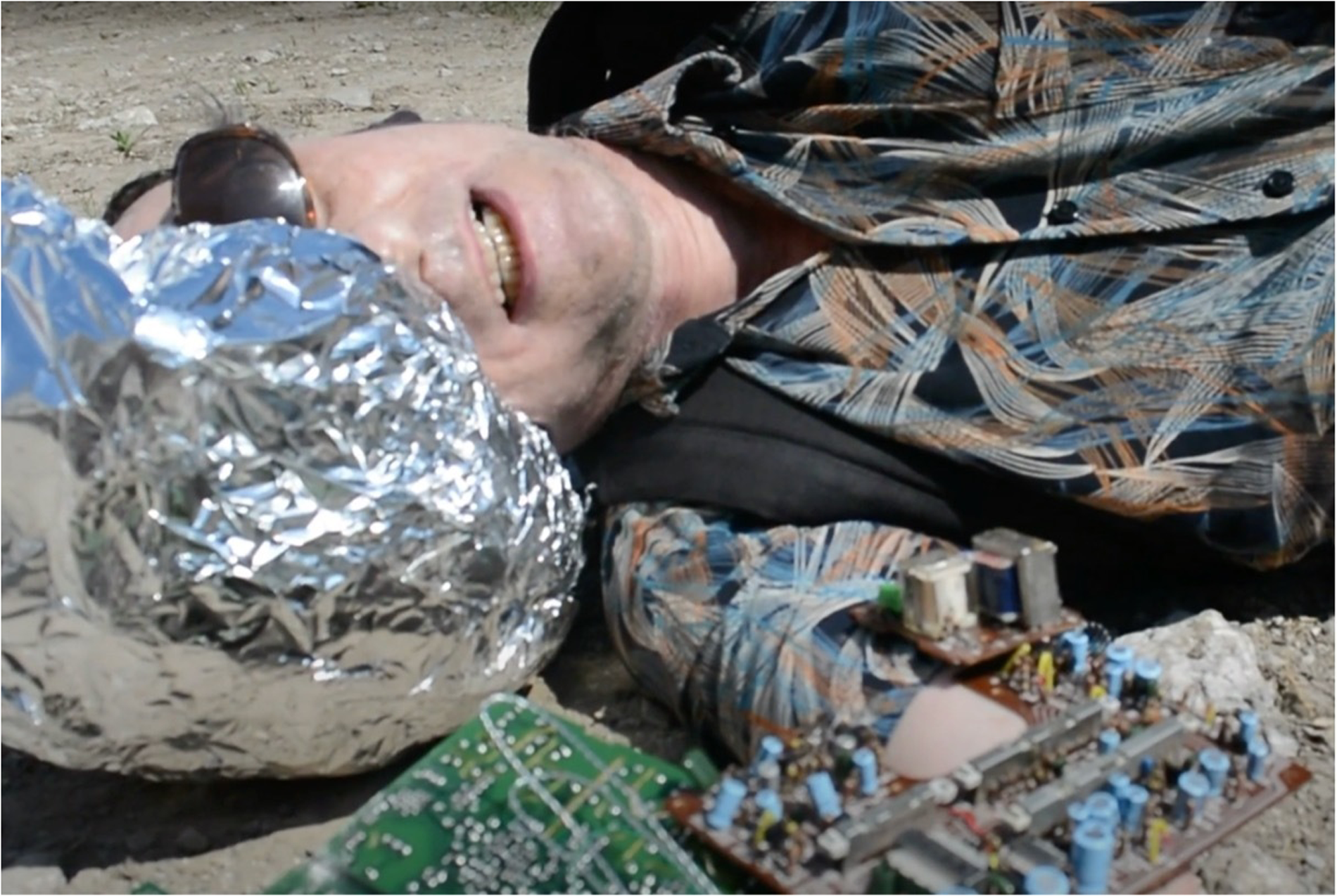
Dr Carlos Popper on the verge of succumbing to total virtual reality in a scene from Music Sound Noise (April 2021).
The B movie becomes ethnographic
Within the history of ethnographic film theory and practice, Sol Worth (1966) and Jay Ruby (2000) argue that ethnographic film should be seen more as a modality of visual communication rather than a professional art form within the realm of commercial documentary. For them, ethnographic film has sought legitimation as a genre of commercial documentary and therefore only skilled professionals and high-quality resources have been the norm of ethnographic film. Further that the value of ethnographic films, what makes them ‘good’ or not, has been based too heavily on professional aesthetics and documentary film standards. Ruby believes that this expectation of high quality has limited anthropologists from using film as a method of research. For example, he suggests that the camera can itself be a device of exploration in the field not just a tool to document and render what is already known (2000: 37). For a properly ethnographic film to flourish, Ruby argues, we need to disentangle it from the professional aesthetics of commercial documentary film making. Rouch (2003) also speaks of the relationship between ethnographic and commercial film, but instead focuses on how the film industry could be more adaptable to difference. He writes; ‘Only when universities, cultural agencies, and TV networks cease their need to make our documents conform to their other products, and learn to accept the differences, will a new type of ethnographic film, with specific criteria, be able to develop’ (2003: 36). MacDonald (2023) shares a similar take on scholarly film that we ‘take for granted the observational documentary mode as the de facto scholarly approach to filmmaking’ (2023: 45). He questions why this has become so rooted and seemingly obvious, suggesting that scholarly film has yet to directly engage with ‘aesthetics of truth’, such that there could be other modalities of scholarly film and new conversations around what that means. I follow Ruby and MacDonald as an invitation to situate the ethnographic B movie as a kind of experimental modality or approach to ethnographic filmmaking.
Becky Bartlett (2021) in her recent book Badfilm: Incompetence, Intention and Failure highlights that B movies, or what she calls ‘badfilm’ often contain lofty narrative ambitions: zombie attacks, alien invasions, the end of the world. In other words, narratives difficult to render professionally or realistically with small production budgets. Yet, the limitations do not alter the desire and practice even if overly ambitious, to create a particular cinematic reality. From total virtual reality, post-apocalyptic social media, dinosaurs attacking a reporter or Dr Carlos Popper talking to a Triceratops avatar of Edward Bernays 7 , to D's own desire to lead a global revolution, there was no shortage of unrealizable or difficult to render ambition in our filmic collaboration. We tried anyways. Calling our films B movies gave us a kind of confidence and vision to create despite limitations, because B movies are a genre defined by limitations. Yet these limitations provided an excuse to create a limitless imaginative horizon, because it accepts that it will never be more than it imagines itself to be. Thus, our films were borne out of limitations that are not, within the B movie framework, considered shortfalls but define the atmospheric conditions of our cinematic world. Though always aware of our subject positions as ethnographer and ethnographed, co-creating in a playful research space that didn’t take itself too seriously, seemed to dissolve the inherent verticality of research relations. Working with what we had, finding ready-at-hand free or cheap solutions and a general disregard for aesthetic and narrative clarity, gave our collaborative filmmaking a childlike quality: two friends making silly movies together.
The making of the dream sequence in a plotless film in search of itself
To give the reader a clear sense of our B movie filmmaking process, this section provides an archival assemblage of our process creating a particular scene. I include excerpts of fieldnotes, recorded conversations, stills from the film and photographs.
8
The material draws from fieldwork conducted between 26 October and 3 November 2020. We’re filming for the dream sequence of the Quest for the Musicality of Reality in which Dr Carlos Popper, played by D, and the Ethnographer, played by me, meet each other for the first time. After filming for four blocks, we go get coffees and discuss how this scene fits into the larger narrative. We don’t get anywhere except to call it “a plotless film in search of itself.” During this conversation, I see two model World War II planes. D's ecstatic.
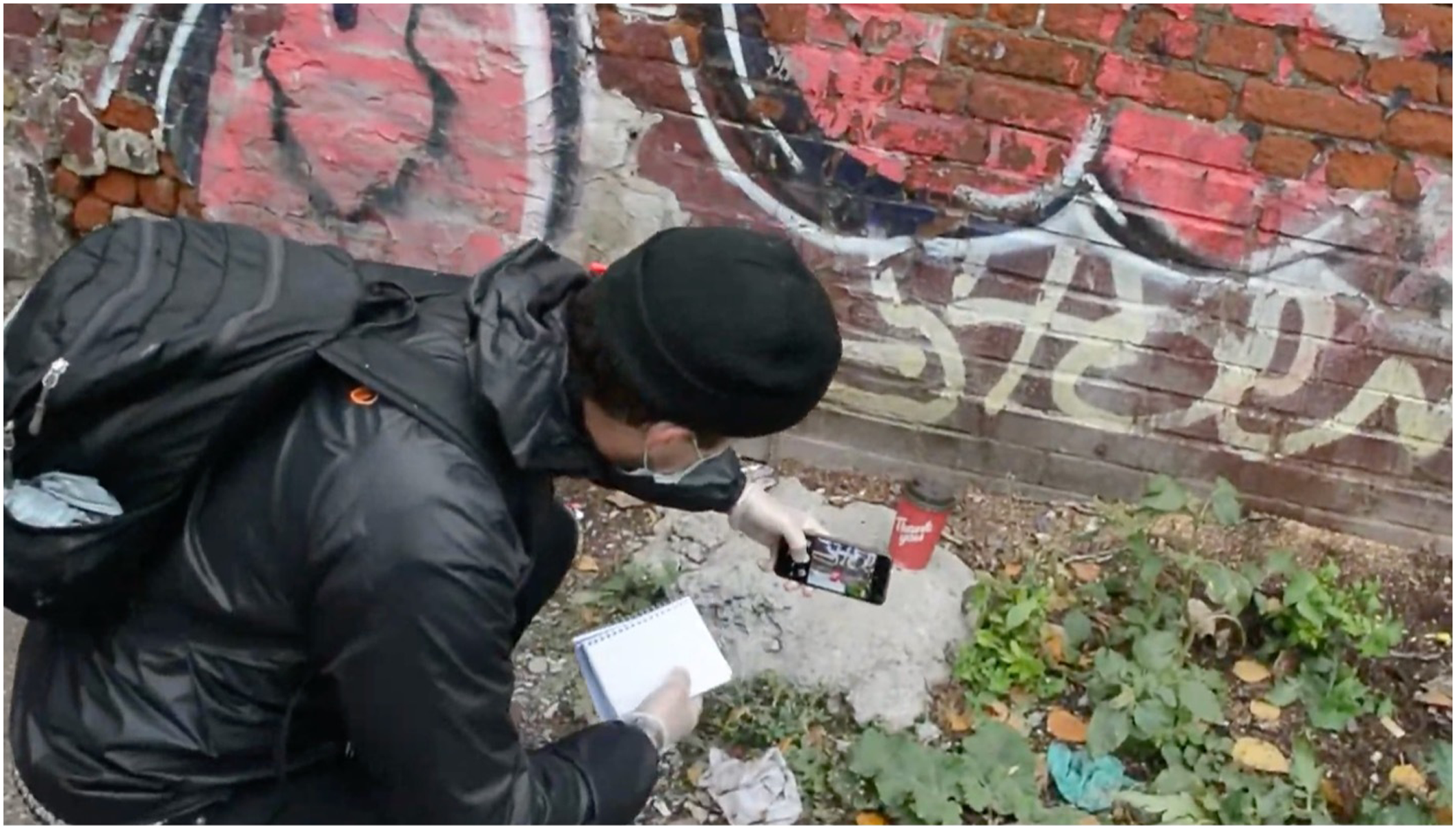
D films me as an ethnographer in The Quest for the Musicality of Reality (forthcoming release).
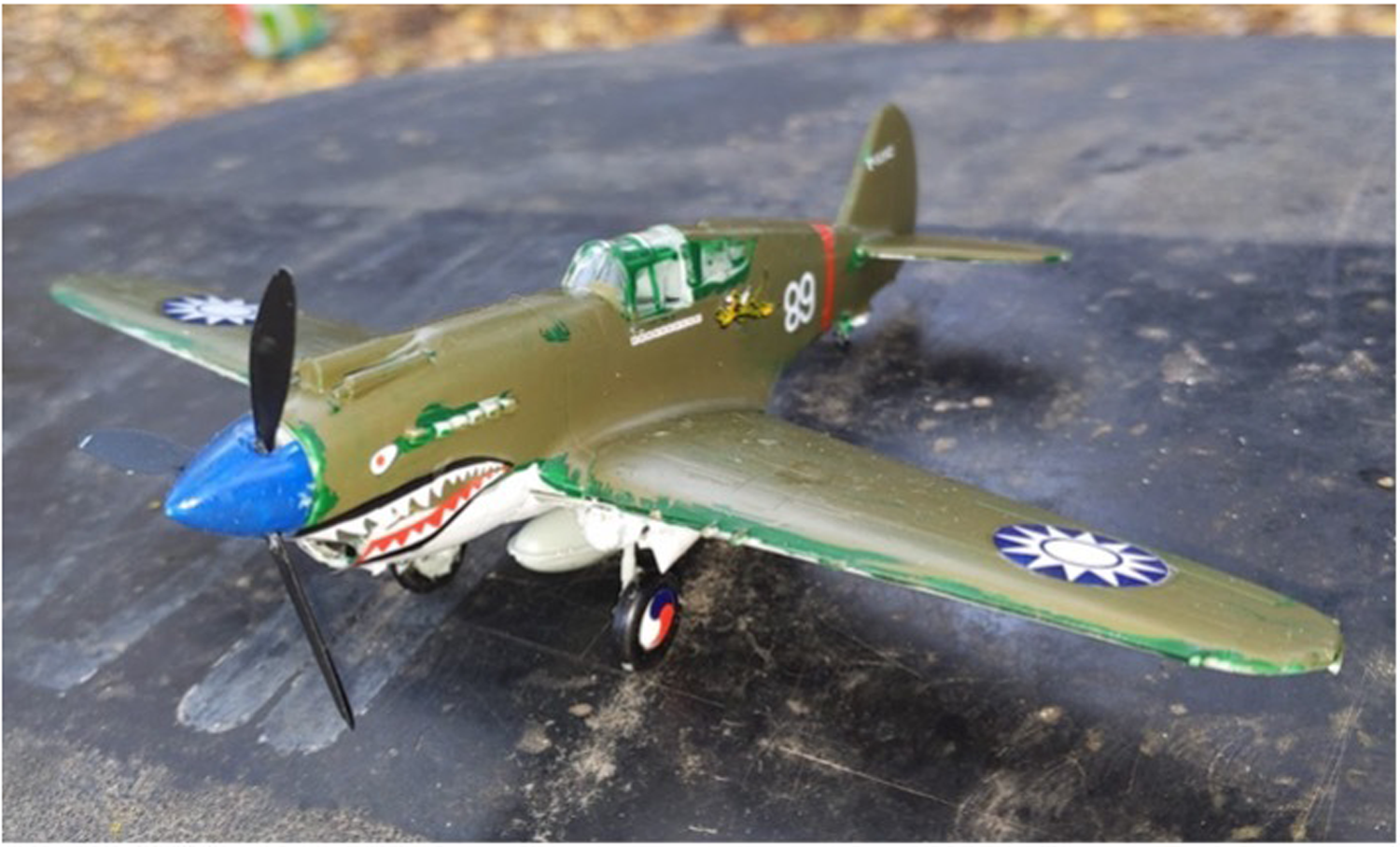
Image of the two planes as I found them.
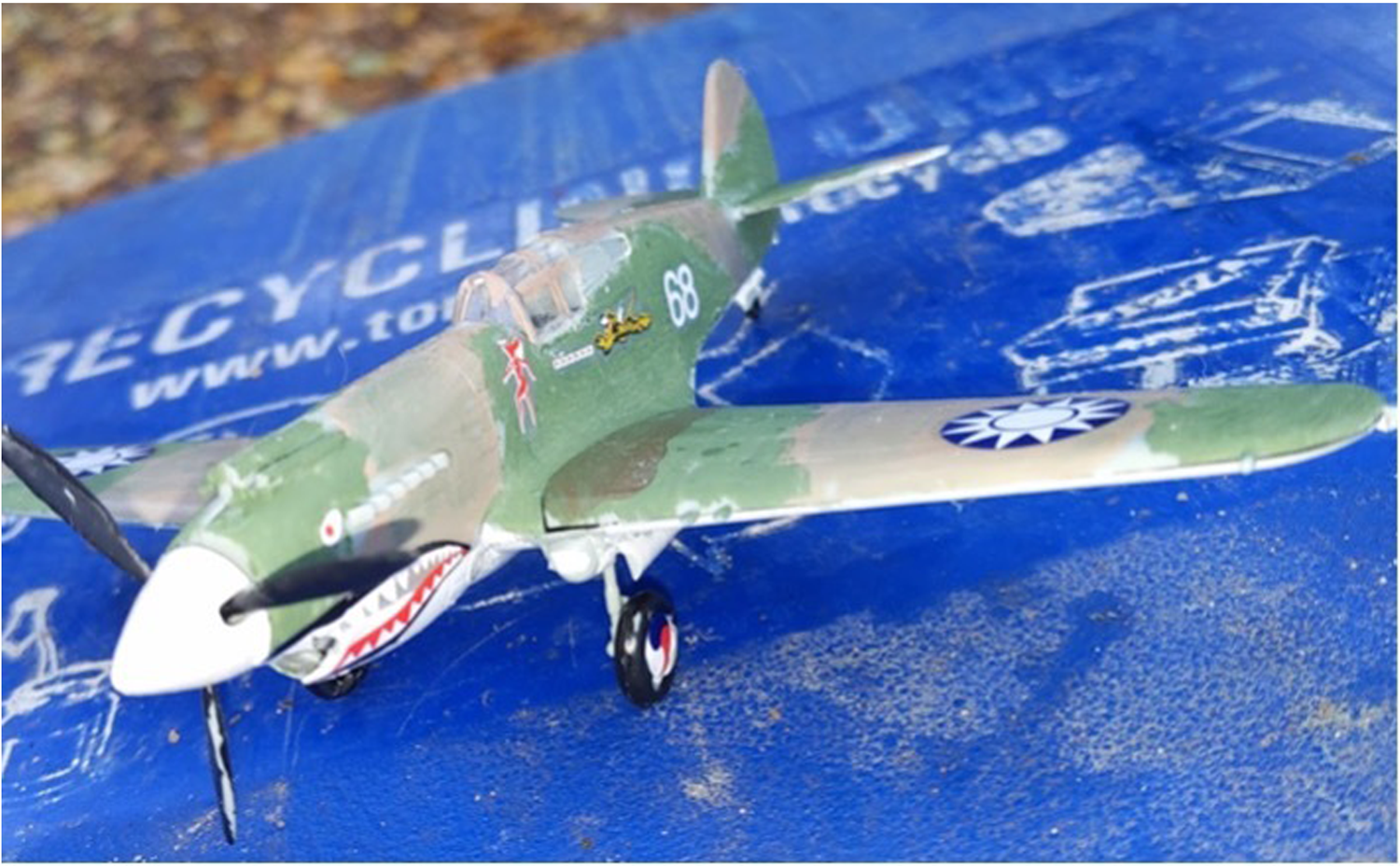
Image of the two planes as I found them.
[field recording: excerpt of our conversation immediately after finding the planes]
D: This is beautiful, this is the plot, it's so absurd! With these elements we can draw out the plot… how we miss each other, we can be flying different planes…
Me: Maybe the one I find, says find the other.
D: Maybe like it's dropping a paper bomb.
Me: Ya, the other [plane] is around your neck.
D: Yes, right exactly. Beautiful, that's really absurd, that's surreal. I love it. Keep these in a very safe place. Don’t let anyone else know about them.
D: And then they fly by each other, for example, we can do that with the two small planes we have. We can take some wire and hang them up, worthy of Edward D Wood Jr. themes…Each character expresses his overriding tendencies, the ethnographer talks about the object, the outside world.
[speaking as the ethnographer character] ‘Geez, that sounds like a vintage World War II plane. What's that doing in Parkdale, is that the flying spirit of Parkdale, am I looking at how the spirit flies over Parkdale and this is my imagination of it. Am I imagining?’
And then Carlos is all wrapped up in his feeling of inadequacy. ‘Flight of imagination. Only I have the flight of imagination!’
Those are just my thoughts for the moment. Now let's see, I’ll go into character. What would Popper say, he would say; ‘How can this be, here I am in the cockpit [makes airplane sounds]
9
. Gunning for anyone else against positivist philosophy’.
These two characters, characters of ourselves, will subconsciously meet for the first time, somnambulisticly, as in sleep walking. And it's going to be some large table where the umbrella meets the sewing machine
10
.”
D: The plastic man is going to be there. I didn't bring my mobius strip, which would be the mustache on the plastic man representing your character. After the [last] scene I appear again and take the plastic man and I start talking to it as if it's you; carrying it, I'm talking to it. I'm talking to myself as we walk to the park.
Me: Right, down the alley.
D: Right, And there lo and behold you are with your costume. I play out my passive aggressive character and you're there and you're not there. Play all sorts of tricks right. The dummy's there, the dummy is not there, you're there, I'm not there, whatever. When I’m carrying the character, I’m sort of building up the heat.
Me: You’ll see me. Then maybe you put the plastic guy down. You’re mad, you’re angry at him that he's not listening to you. You say something like; ‘say something, say something.’ You put him down.
D: I’ll talk about the mobius strip and the music as the space of two note chords. You know, I really reveal the secret of the world to this plastic dummy. And so dumb is the world. It's just not paying attention to me. Speaking out of real agony here. People on the street they don’t notice me. They’ll notice me now.
Anyway, right so I get boiled and angry. I explain my heart out about nature and music and silence and the mobius strip and I just get no response whatsoever. Finally, I put the mobius strip on the dummy. I’ve got you now. Listen to me! Listen to me! You know, my usual overacting.
We get to the park. I throw the dummy down, so it's not destroyed. I put it down decisively and then I see you. And then, well I see you and then I don’t see you. Right, that's the thing. Like, when I’m speaking to you and I think you’re here but you’re over there. We’ll play with that.
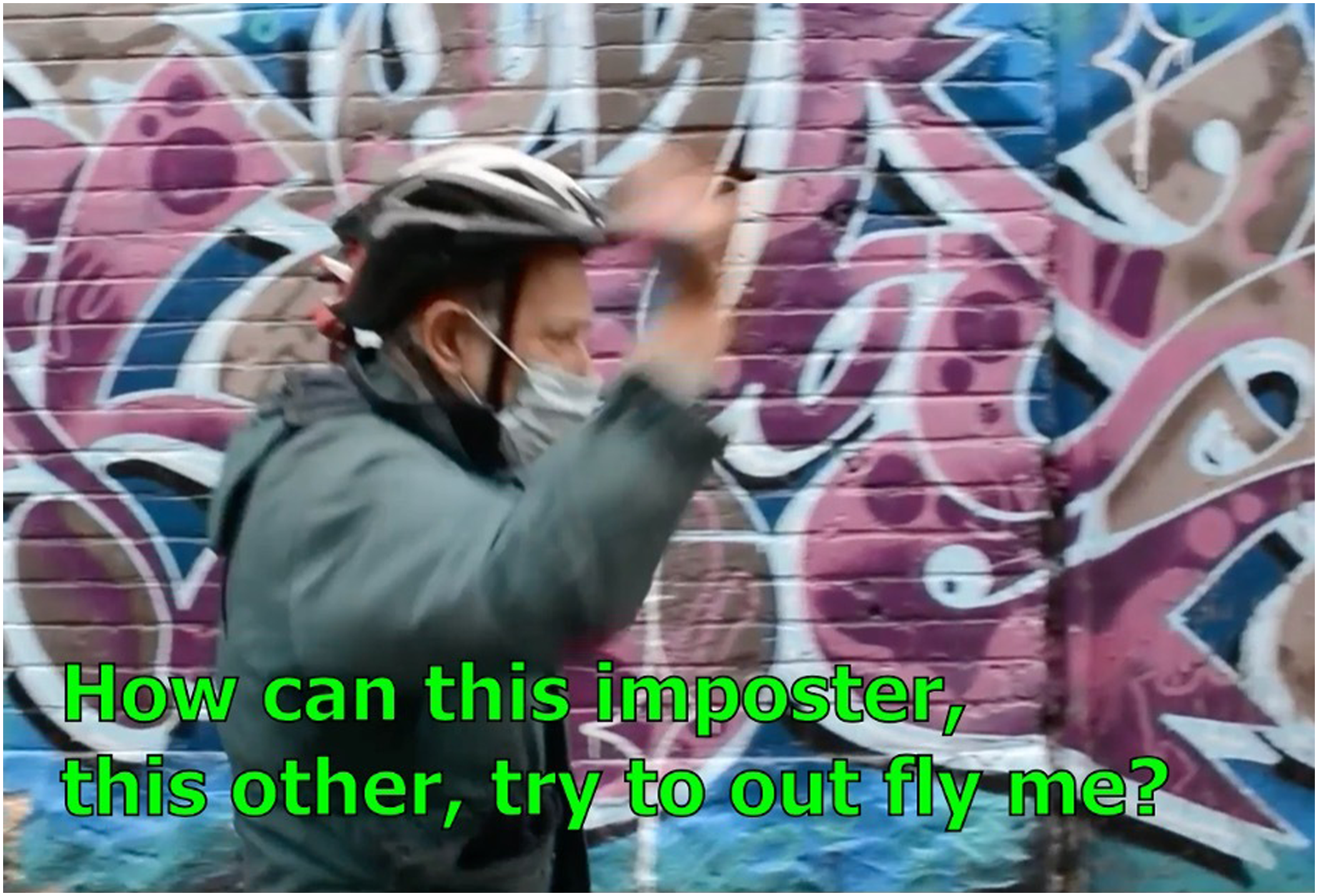
Film still with monologue, filming thought process of scenes for The Quest for the Musicality of Reality, forthcoming.
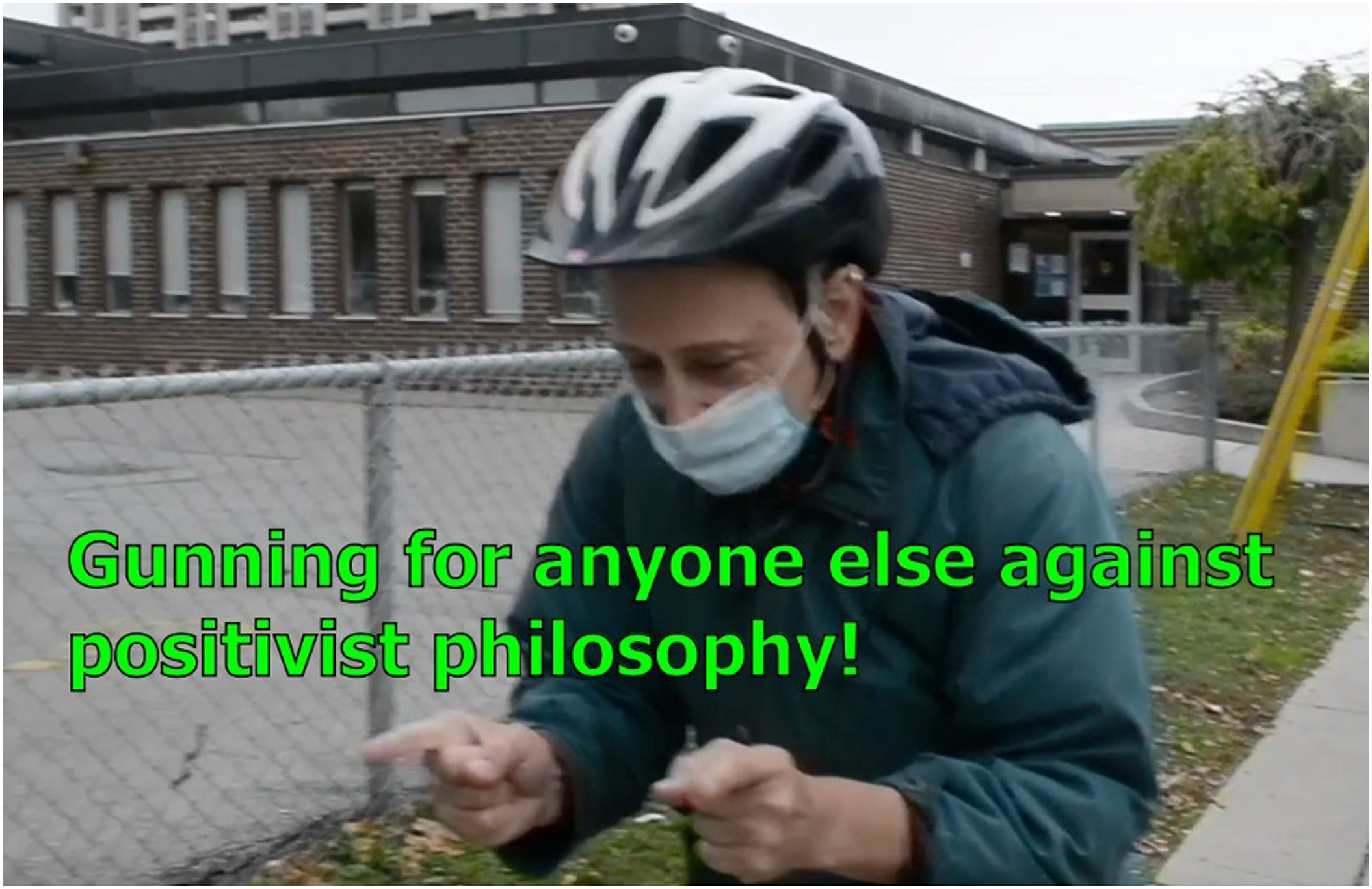
D as Dr Carlos Popper practicing part of the dream sequence in The Quest for the Musicality of Reality, forthcoming.
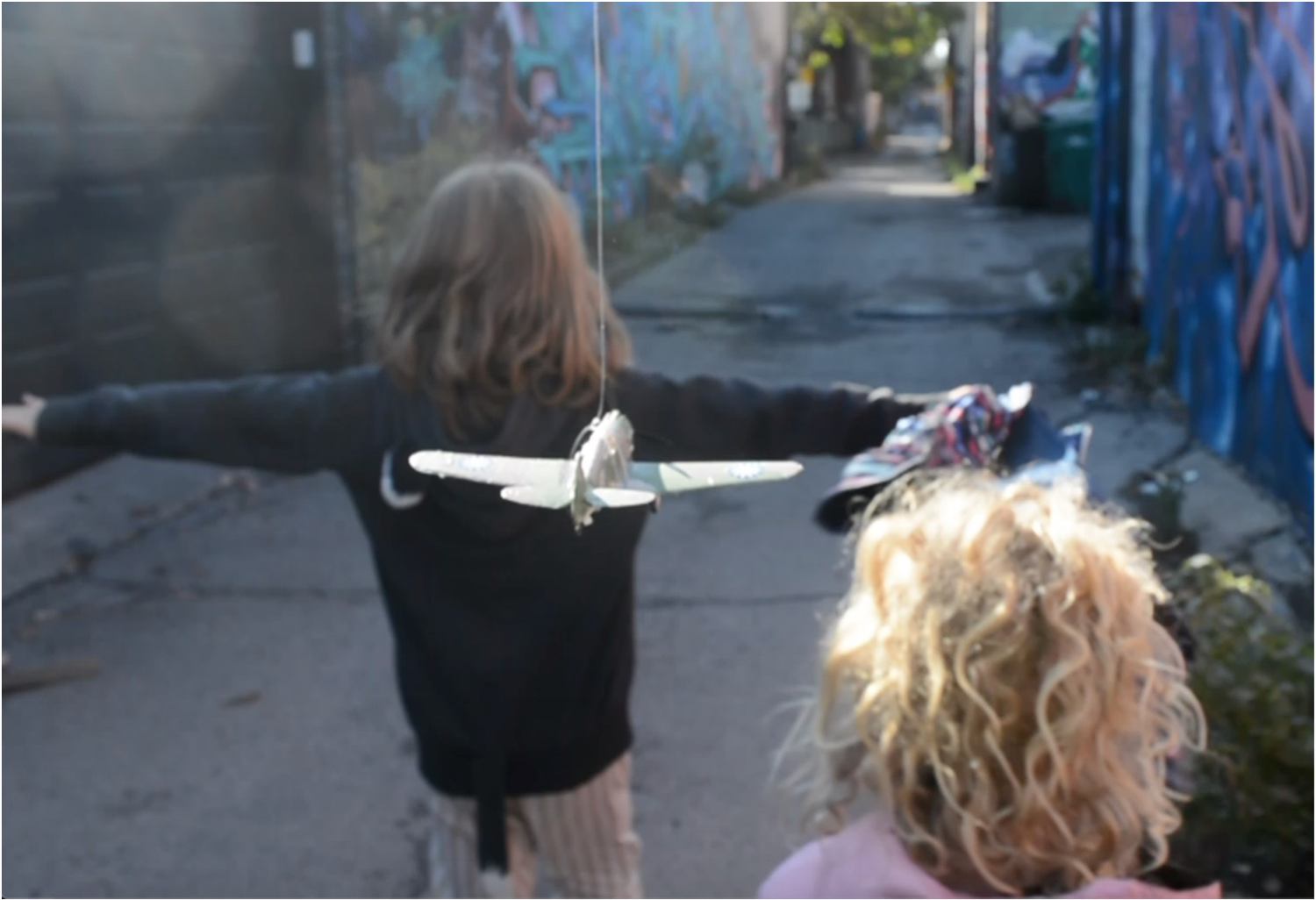
Filming The Quest for Musicality of Reality with D and my kids, forthcoming.
I meet D at the corner of Queen and Cowan, the plastic body sits below the globe wearing a storm trooper mask on which is written ‘Musicality of Reality.’ D arrives and someone walks by wondering if it's a Halloween costume. ‘No, we’re shooting a movie’, I respond. D reprimands me. ‘Who cares what they think, we don’t have to explain ourselves to anyone. They can think what they want’ (Figure 11).
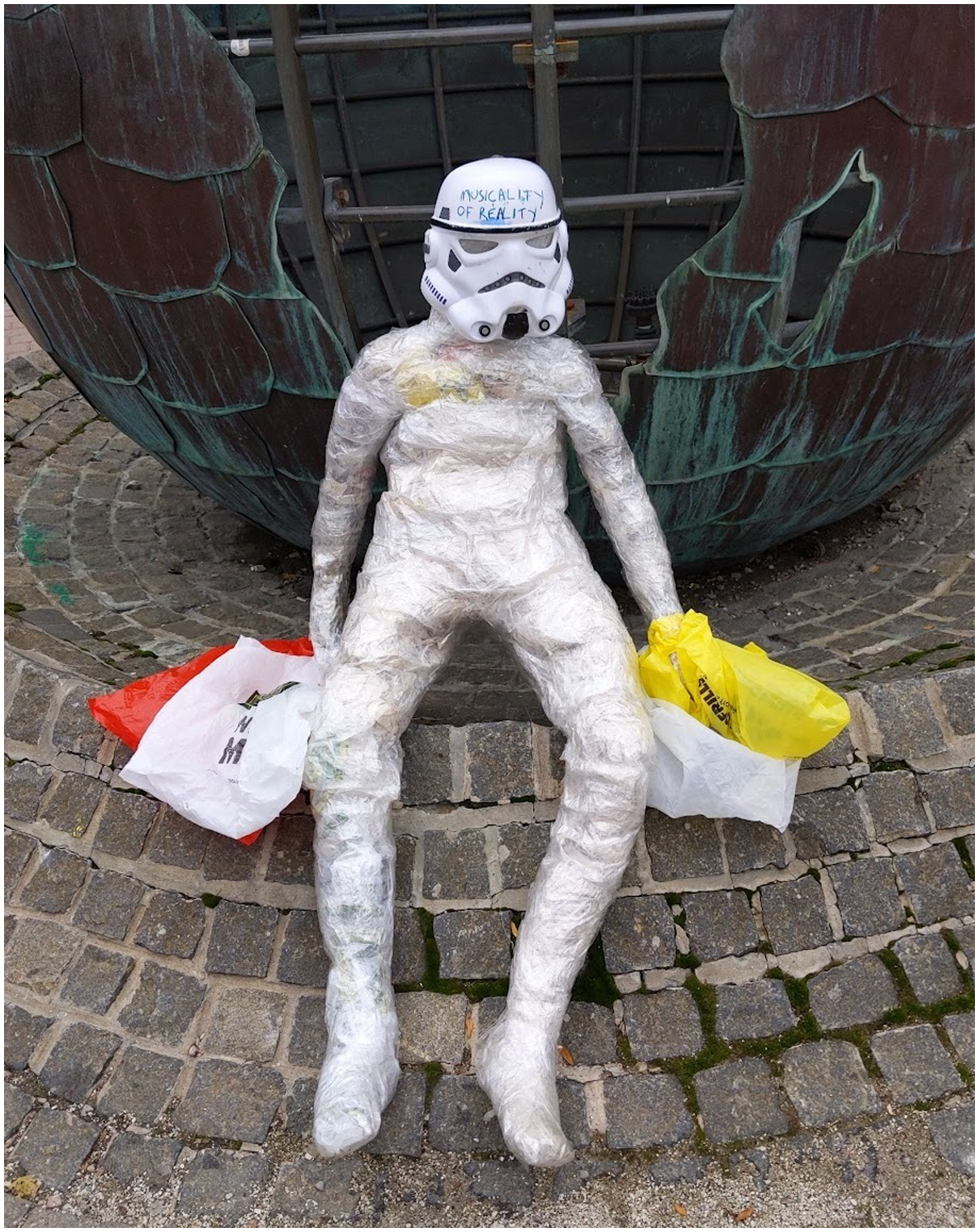
The recurrent presence of the ectoplastic body, in front of the public library in Parkdale.
The plastic body is in the pool, someone walks by and asks who died. There's a silence then D responds, ‘Seriousness!’ I’m wearing my American tights now and an Edmonton Oilers hockey jersey. There's a construction crew working on the roof of Masaryk Community centre, at the north edge of the park. I’m embarrassed and uncomfortable. I’m hoping D will change his mind about the scene. But I tell myself he spent $30 on his Canadian flag pants. The show must go on. The plastic body becomes the ethnographer. This feels like the most absurd moment of my fieldwork (uncanny, unfamiliar, beyond outside, uncomfortable). Though we had discussed some guidelines, about how we could arrive at the pool and meet, we mostly just ran around the pool. Popper and the Ethnographer, never entirely meet, but run and move in circles never crossing paths (Figures 12 and 13).
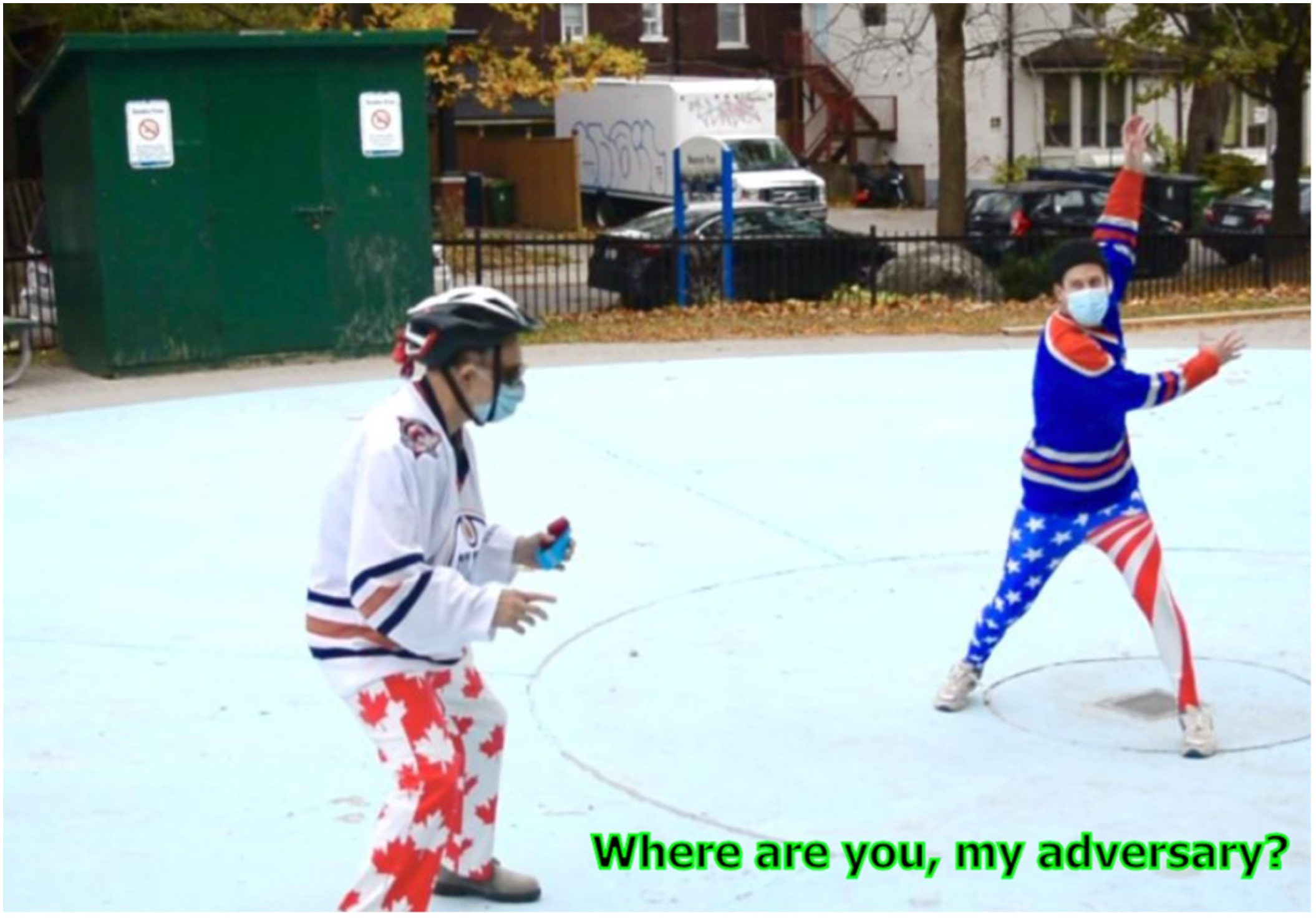
Filming the dream sequence in empty wading pool for The Quest for the Musicality of Reality (forthcoming release).
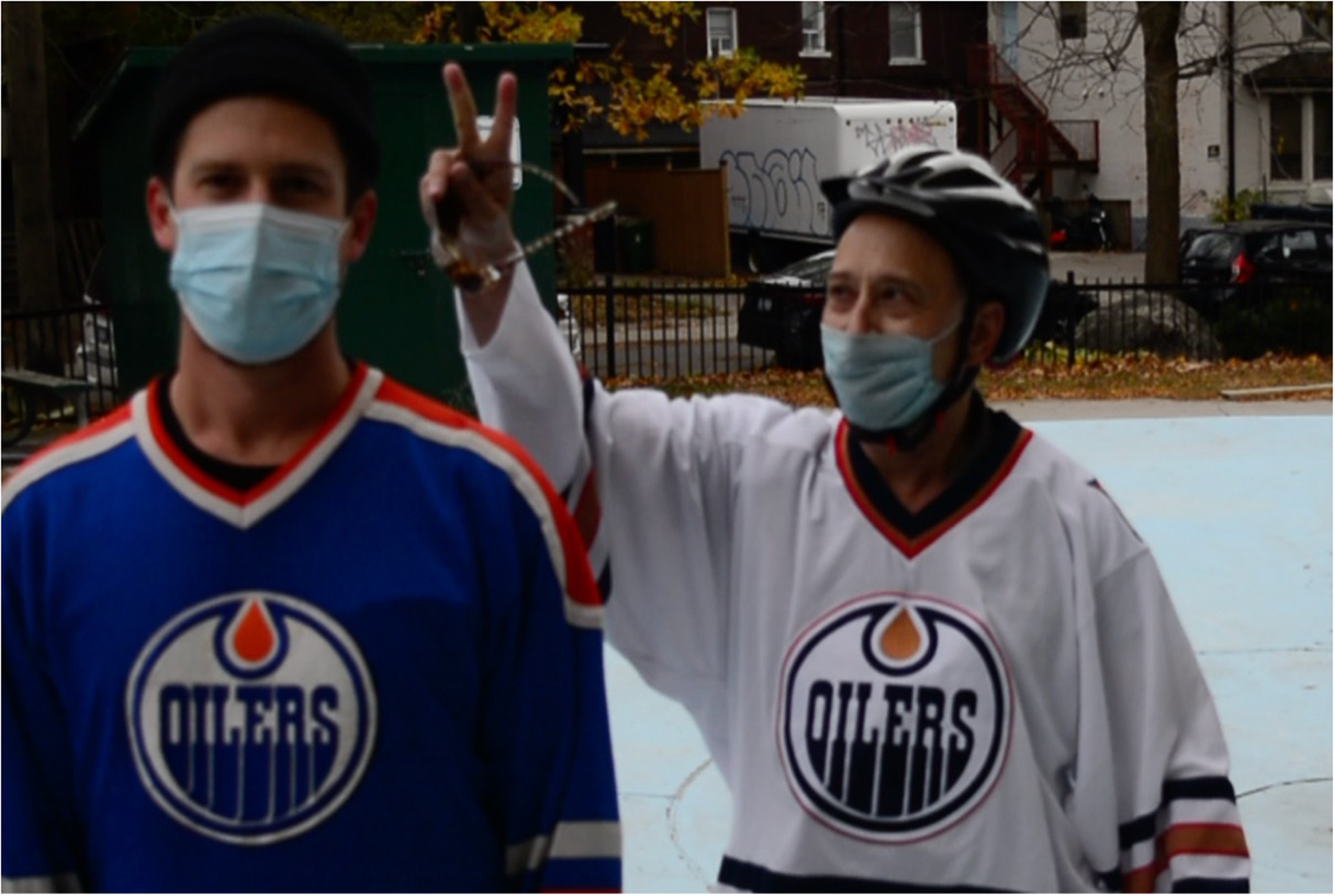
Documenting our playful process.
We’re both out of breath after running around the wading pool wearing masks. D reiterates his thoughts on the performance: ‘I think it's a powerful and cathartic work even if in the format of an ethnographic B movie, because we have important things to say and we want to be heard.’
Criticisms of ethnographic film: quality, technology, truth, accessibility
I now shift the focus and situate the ethnographic B movie within specific conversations around ethnographic film that challenge normative assumptions of what ethnographic filmmaking should be and how it could be otherwise. To this point I have focused more on D's ideas, our process and the content we generated and how these fit into the ethnographic B movie approach. Here I explore skillset, technology, veracity and value as they relate to aesthetics and low filmic quality.
Responding to questions around veracity, meaning and representation, Trinh T. Minh-ha argues that too often getting at the ‘truth’ of a situation has been equated with the appropriate technological equipment to document a particular reality. She calls this blind spot the ‘aesthetics of objectivity’ (1995: 262) in which it is believed that only high-end gear, whether audio or visual, can reproduce the truth of a given context. Minh-Ha highlights a desire for different kind of ethnographic film, away from the conventional expectations and parameters of disciplinary value and acceptability. Ruby (2000) questioned if, as video technology got cheaper and more accessible, the paradigm of only high-quality film would shift. The acceptance of lower quality and less professionalism would require ‘an intellectual framework that [would] justify a move away from the documentary-film world’ (2000: 20). Part of the thought process behind defining and advocating for the ethnographic B movie is to develop an intellectual framework that encourages this paradigm shift or at least creates space for a constellation of like-minded ethnographic filmmakers to create at and push the threshold of acceptability. At the time of Ruby's, as well as Minh-Ha's, writing, a greater acceptance of lower quality ethnographic films was yet to emerge, and perhaps it hasn’t yet.
Cuban filmmaker and critic Garcia Espinosa had raised similar arguments supporting the acceptance of low quality film in his manifesto Towards an Imperfect Cinema ([1979]2014). Though encouraged by Cuba's own emerging national film culture, he remained critical of the expectation that film could truncate the gap between the bourgeois and working class. He was critical of the institutionalization of filmmaking within the elite sphere of the academy: filmmakers, though telling stories about the working class, were not of that class and the working class had no access to make films themselves. He envisioned a more egalitarian and imperfect cinema culture where filmmaking should be accessible and anyone could generate content, not just the cultured elite, regardless of status, ability, education and access to technology.
The ethnographic B movie, by intentionally allowing for low-quality and limited resources, helps to avoid the potential unequal technology access. We didn’t use or need high end gear. D bought our tripod from the local thrift store for $10. Because it was mostly just D and I working on the films, whenever I had to act, D would have to film. Everything was shot with a Nikon D5200 DSLR camera, with video capabilities, that I bought in 2013. Due to the gear we used, it was a simple teaching process. ‘Push the red button. Does the screen say record? Can you see me in the frame?’ And that was all that was required. We worked with what we had on hand such as the airplane models we found or fashioning a green screen from dollar store plastic tablecloths (Figure 14).
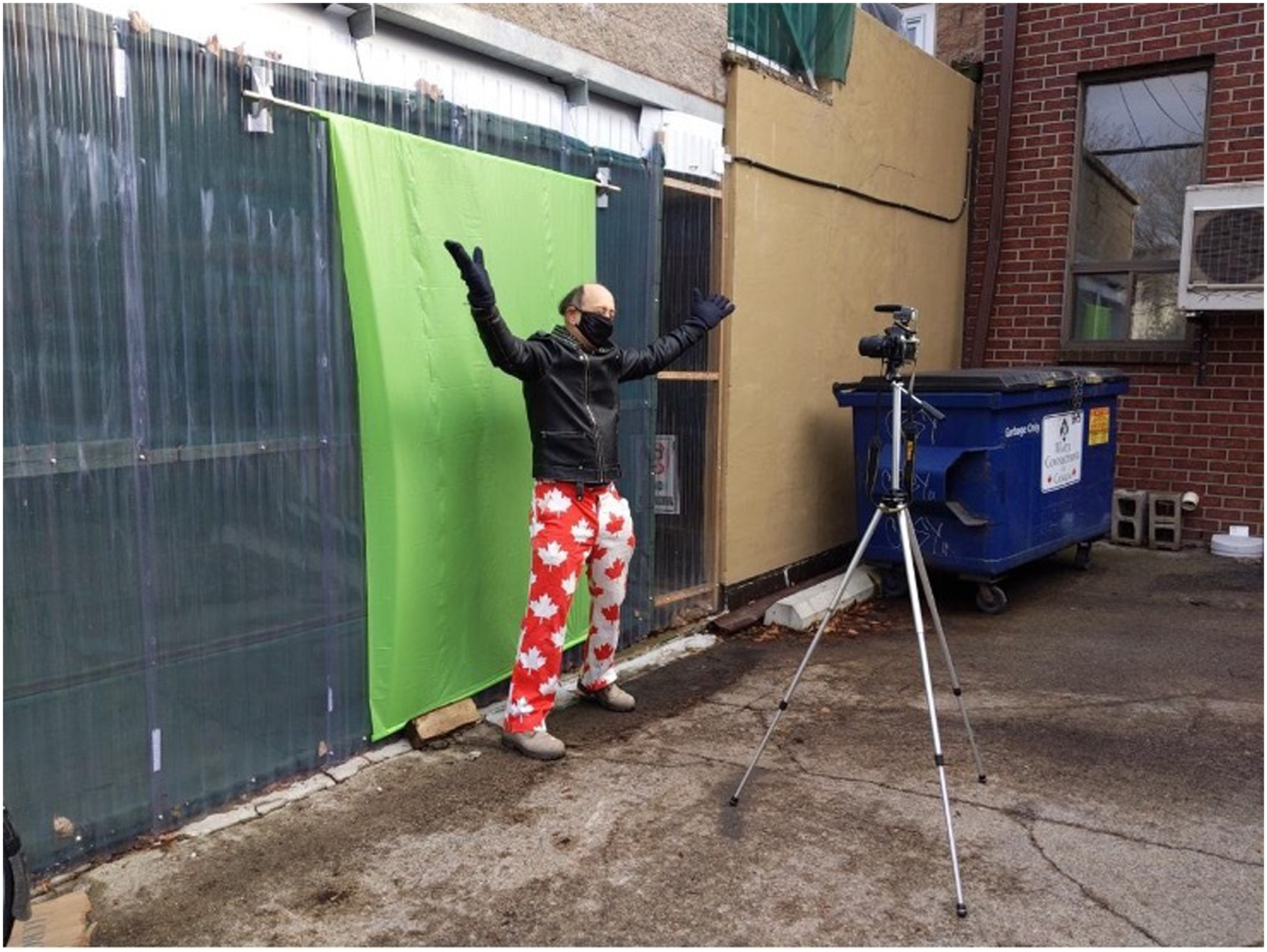
D performing as one of his characters in Mayoral Candidate of Muddy York, October 2021.
Michael MacDonald, in CineWorlding (2023) offers a similar kind of poor quality approach he calls ‘dirtbag artfulness.’ It centres enthusiasm and process, such that one can feel the process of work ‘on the surface’ of the product, a sense of immediacy and spirit that ‘always feels a little bit outsider, a freedom … full of life at the edge of capacity and articulation’ (2023: 33). It was this kind of spirit within the ethnographic B movie that we fully embraced which allowed us to get carried away into the moment regardless of our resources or technical aptitude. As a self-professed failed academic, D railed against academic formalism and professionalized thinking, criticisms that I was interested in exploring as well in my ethnography, and therefore we were adamant to stay outside the serious arena of professional and academic film. But how could I stay outside the academy while within it? I was a PhD student bound to certain expectations and conventions of my program in order to receive my degree, yet also beholden to D and the ethnographic moment I had already invested so much time in (Figure 15).
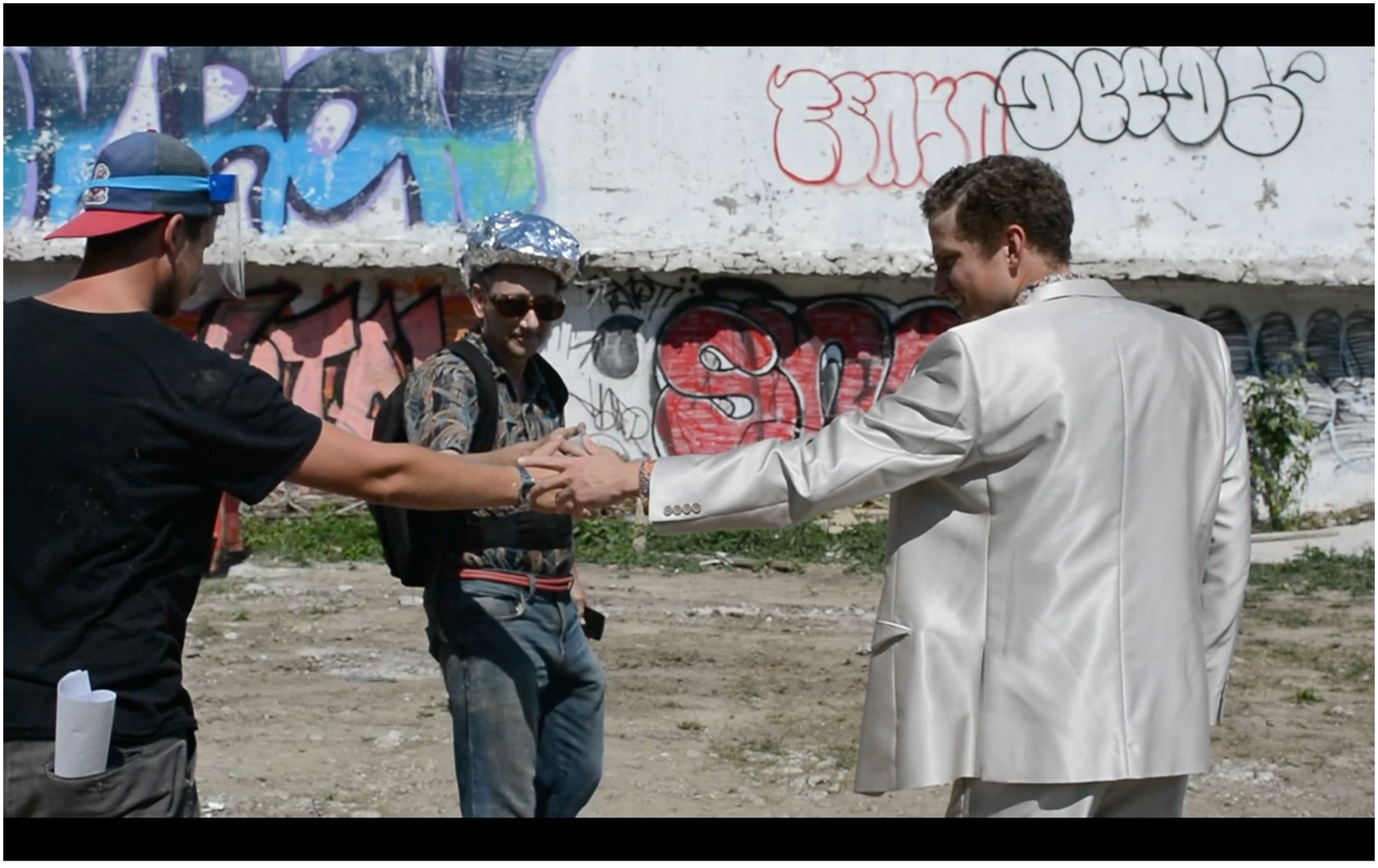
Film still from Music Sound Noise (April 2021).
Conclusion: the B movie within the academy?
Through unprofessionalism, low quality aesthetics and absurdist confusing content, the ethnographic B movie does not try to improve upon or transcend conventions of ethnographic film, elitist academic hierarchies and cutting-edge technologies. Instead, it's an experiment and invitation to be decidedly worse; to descend below, not raise above, conventional representation and value. I argue that the practice and approach of the B movie can create a novel research atmosphere in which our collaborators and interlocutors not only guide the encounter but can do so however they wish, to be themselves on their own terms. In this context, the ethnographer is forced to reflect upon their position in the encounter, how much control they are willing to give up, or how much uncertainty and messiness they can accept. The negotiation of control and authorship remain unresolved. The approach is meant to open a space for reflection on ethnographer and ethnographed relationality. While I have had the opportunity to hold control film editing or now, writing this text, I gave it up in the space of the performance and filmic narrative.
In Dr Carlos Popper's closing monologue of Ectoplastic, he encounters my character who has already unknowingly become totally virtualized. Popper laments, Oh ectoplastic discharge of logocentric recalcitrance (Figure 16).
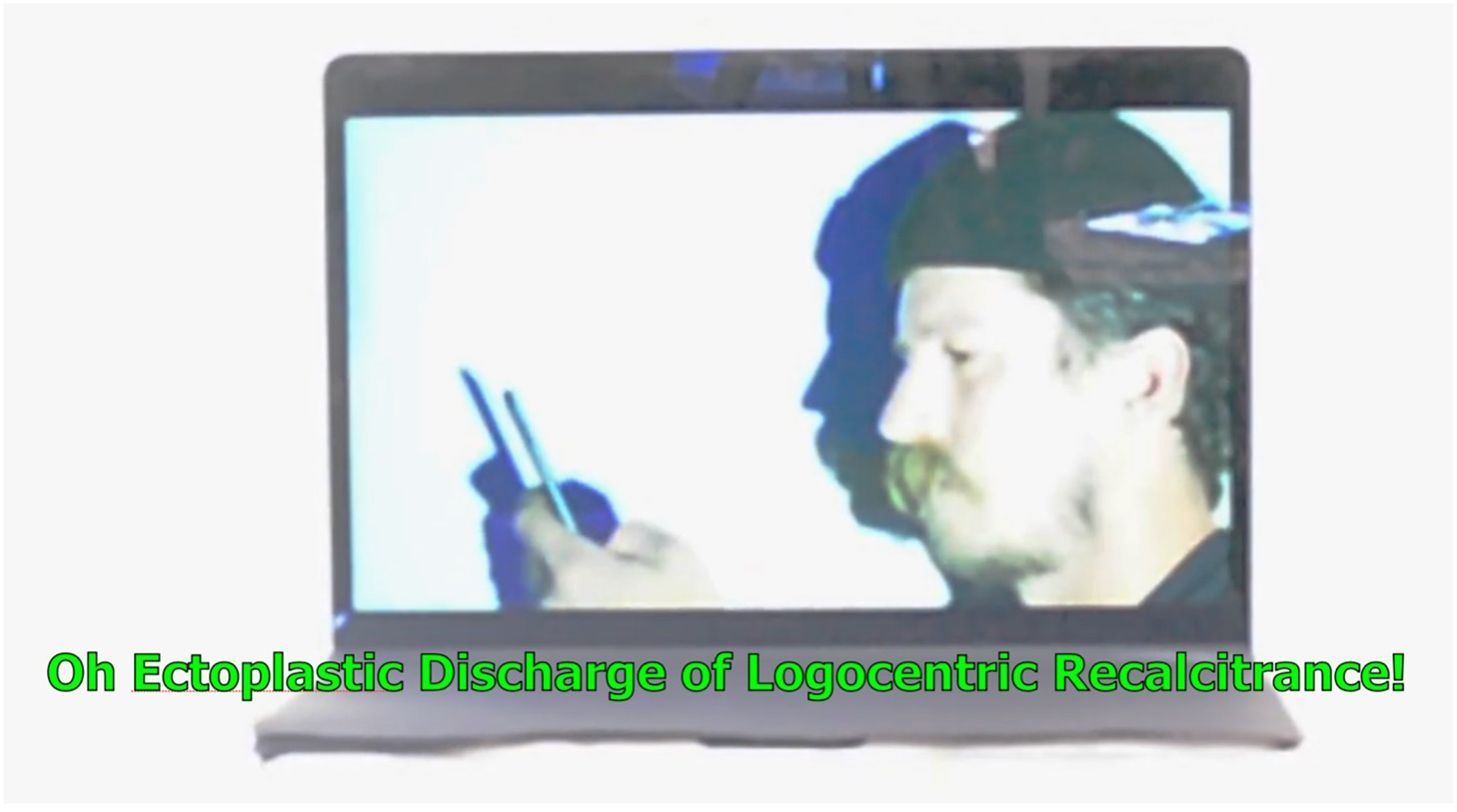
Closing scene of Ectoplastic (May 2020).
According to ChatGPT this is a meaningless arrangement of words. 12 I’m not entirely sure what it means either. I never asked D to explain and communicate its meaning. The research moment itself was my focus, not its discursive meaning. What mattered was to create a cineworld, a situation for something to be said. When I didn’t know what D meant in his writing or while acting, I refused to challenge him, as if from a position of authority, to be more understandable. I believe the editorial gesture of challenging D to create more coherence would have bridled his creativity. Further, this gesture would be based on an illusion of my authority as if I knew better what would have been an appropriate script, centring my conventional academic authority. Centring D's authority as a writer created the atmosphere of study. MacDonald argues that through cineworlding it matters less the kinds of films that are made but that they are made, because they create a ‘collective situation of study’ (2023: 72). The concept of study introduced here comes from Harney and Moten in The Undercommons (2013) in which they suggest that study is foremost ‘what you do with other people’ and that the intellectual activity of the study as relation does not descend into or arrive but is immanent, already there unfolding within the relational moment. It does not come from elsewhere, alone and afterwards (109–110; quoted in MacDonald 2023: 68).
Our filmmaking emerged out of the ethnographic encounter; the ethnographic encounter did not emerge out of a desire for filmmaking. Had the reverse been true, and I had arrived with a plan to film, and just needed the subjects to populate it, what kind of emergence or situation of study would have occurred? What kind of relation with D or intellectual immanence would have been possible if I already knew what I had wanted to do but simply needed to fill in the key informant slot? D invited me into his imaginative and revolutionary world and I accepted that invitation even if it meant a kind of fictional anthropology that didn’t take itself too seriously, and an unprofessional, confusing and absurd filmography. Perhaps the ethnographic B movie requires a specific kind of collaborator. It was a matter of circumstance that I sat at the same table as D that night in Parkdale. Speaking of D's singular creativity and character, who else would spend time and energy with a researcher making silly movies, with the confidence to write absurdly and act poorly? Yet I hope by describing this modality of filmmaking it encourages others to experiment with creative, collaborative research and explore what happens when you don’t take yourself or your output too seriously. What microworlds, individual revolutions and singularly creative individuals can we invite into research spaces?
Recently our second film Music Sound Noise screened at the Freiburger Filmforum (May 2023). The film seemed to fit awkwardly amidst so many high quality, beautifully rendered documentary films. Yet the curators who chose my film, Rajat Nayyar and Rana El Kadi of the Emergent Futures CoLab, 13 insisted on the film's inclusion because for them it unsettled conventions of what ethnographic film could be. After the screening another filmmaker told me that he loved the film but would never make something like it. He said he’d be worried he wouldn’t get any more funding after the project as funders always look at the last film one makes. If this is the contemporary situation of ethnographic filmmaking, what other kinds of subjectivities and situations remain on the fringes of acceptability? Or what unconventional sites of study are unexplored simply because of the academic rat race? Perhaps the ethnographic B movie can open a space of exploratory freedom. A space to enjoy filmmaking with others for its own sake, in which the people we work with, and the situations ethnographic fimmakers find important, are what really matter regardless of aesthetics, narrative and representational conventions (Figure 17).
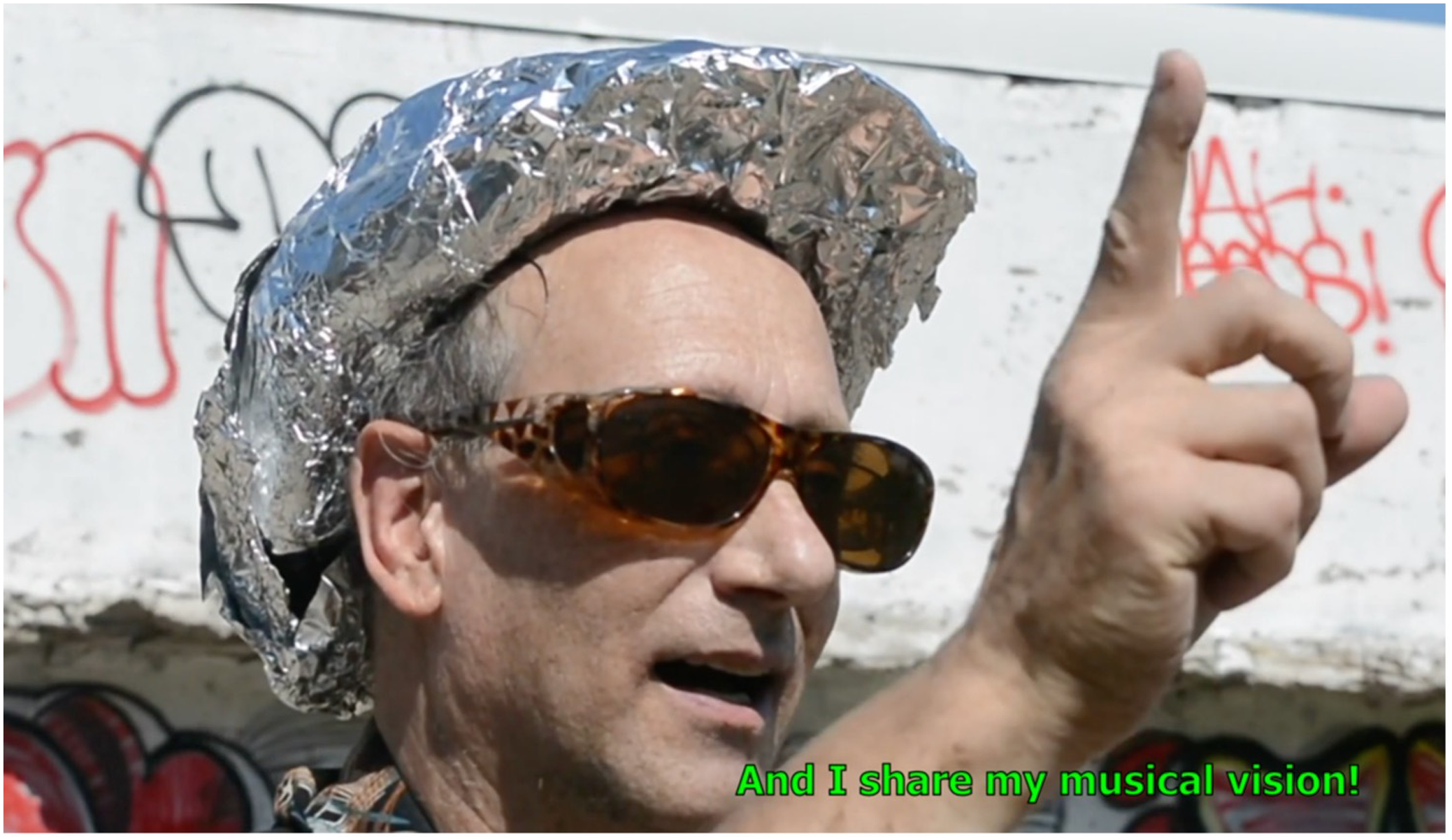
Dr Carlos Popper's closing line of Music, Sound, Noise (April 2021).
Footnotes
Declaration of conflicting interests
The author declared no potential conflicts of interest with respect to the research, authorship, and/or publication of this article.
Funding
The author disclosed receipt of the following financial support for the research, authorship, and/or publication of this article: This work was supported by the Ontario Graduate Scholarship.
