




Abstract
In this brief research note I discuss and share from, Stir (2020): a collection of poems that were written while I was the research associate on the Distant Voices project based at the University of Glasgow (2017–2021). These poems reflect on my experience of doing ethnographic research in carceral spaces, and are written from the perspective of an outsider with a pass that allowed access for a limited time only. The collection is open access and available to read online. The note situates my project within the context of poetic practice in the social sciences. Inspired primarily by feminist scholarship, I also draw on actor-network theory to describe my research process as one of ‘translation’. The note also touches on historical anxieties about the legitimacy of the approach and the sociological preference for ‘found poetry’. I reflect on some ethical and creative questions that arose for me in writing poetry as social research, including representing research participants, use of pronouns and authorial voice, and emotions and research. I also discuss the affordances of working creatively with ethnographic materials, and the role of poetry in pursuing social change.
Introduction
In this research note I discuss and share from, Stir (2020): a collection of poems that were written while I was the research associate on the Distant Voices project (2017–2021). 1 I’m a visual sociologist (sociologist with an art practice as part of their approach) and these poems reflect on my experience of doing ethnographic research in carceral spaces, written from the perspective of an outsider with a pass that allowed access for a limited time only. I hope that these brief reflections on practice will be of interest to researchers and poets alike.
The collection was due to be printed and launched as a pamphlet at our project’s culminating festival in April 2020, but due to the ongoing Covid-19 pandemic the festival has been postponed until a safer time. As such, I decided to publish a poem a week as a TinyLetter email (May-June 2020). There is a public archive of the poems available to read at https://tinyletter.com/Phil_Crockett_Thomas/archive and alternatively, as a printed pamphlet or a free downloadable pdf at https://crowdedmouth.wordpress.com/. The (to be) risoprinted cover pictured here (Figure 1) was designed by Nathaniel Walpole. 2
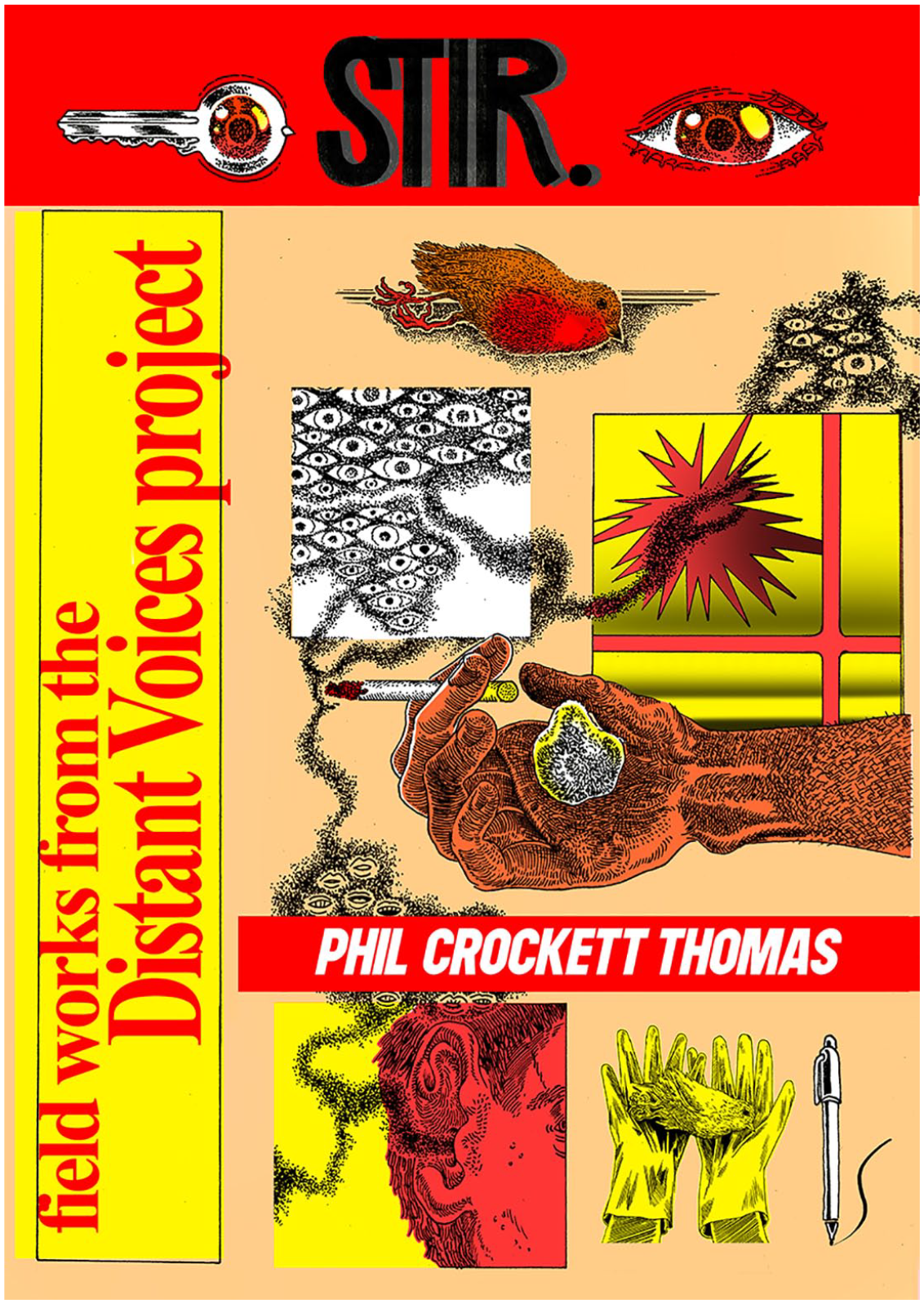
Stir (2020) by Phil Crockett Thomas.
Stir – selected poems
Bower bird, 1
“He’s the sort to grab a rock and smash a window just to get sent back in.” I put the bag down on the table crossed onions with rhyming dictionaries: (bunions minions). Thankfully no one ate my error. The next day he brought us apples like bloody pointed teeth. He said that they hurt his disguised a gift as a warning. Cigarette in his left bow-fingers the pair on his right pulse the button in his throat as he names each bird nesting under the lid of the hall. He goes on. Sees gulls out loud as if I had never (never mind). I let him teach because. Words fleshed out by a soft machine. His fix visible a cyborg no older than my dad (because my dad) takes my hand and presses into it a bit of gravel rasps “this stone is special but no one’s even noticed it!” We write a song about his television sound furnishes the nest. Head cocked, ecstatic he weathers floods and famine gleaning things to care for from the thatch of a world that has nowhere else to put him.
3
These boys
These boys are all fathers or will be soon so they can cradle some soft thing and smile. In the baby harness he goes up like Peter Pan teasing the audience briefly as white as his trainers. The parole board say “it’s good for the boy a baby will keep him grounded.”
4
Punishment exercise
I am worried for her edges or lack of them like my body in the mortuary if the plastic gloves come off like my body in the mortuary I have never been that open they are working on sharpening her edges with colouring books that teach her to stay within the lines to colour balance to read the wheel “Do you touch people when you talk to them? An elbow a cheek?” Think back rewind backwards something of her has peeled away and stowed up along my calf, an itch tracing the line of motion heads shoulders, you know the rest it’s my mother with her ‘sticky willies’ I walk the story back through the bushes where she strips and sharpens the green “there that’s yours now – stuck to your back you won’t even feel it.” I outline her here in the mortuary again mum says: “that’s you that is.”
5
Requiem
She is making a song for Katie. A requiem with no words but the chords conjure pinks and grey, and Paris in old movies. On the banks of the River Seine a bangle drops down her arm at a feminine gesture: tucking hair behind her ear – imagine if being watched could once more be a pleasure.
6
Names
The title of the collection references a slang term for prison (as in ‘to go stir-crazy’). 7 The ‘field works’ of the subtitle refers to the fact that these poems all originated from my participation in song writing workshops in criminal justice settings (three prisons and a ‘young offenders’ institution), which formed an important part of the fieldwork for Distant Voices.
Part of my role in these workshops was to write notes about what I observed and experienced, and I found that my practice as a fiction writer (Crockett Thomas, forthcoming; Thomas, 2019) led naturally to the production of poetic, fragmentary fieldnotes (e.g. the poems Bower Bird 1 and 2). I was also drawn to write in this way because, rather than observing at a distance, I took up a creative role in the workshops, often co-writing song lyrics with participants and occasionally leading creative writing exercises. During quiet moments I even managed to write a few poems (Fish Story and Kintsugi). Other poems emerged through later reflection (e.g. Punishment Exercise, Requiem).
Although I am the author of these poems and the responsibility for the content is mine, Distant Voices is a collaborative project and these poems are indebted to my colleagues in the project and workshop participants. We research with people who have diverse experiences and perspectives on punishment (e.g. as people who have been harmed by crime, prisoners, prison staff, people with experience of custody, their families). Many of the people who work on or have participated in the project have experience of more than one of these experiences. For example, they are survivors of harm as well as people who have been punished. With this diversity, it’s important to stress that these poems only speak to my experiences and perceptions rather than for the project as a whole.
With this in mind, I had some qualms about which pronouns to use. I was worried that using ‘they’ for prisoners or prison staff might seem ‘othering’. I experimented with a more inclusive ‘we’, but this seemed confusing and flattened important differences. ‘We’ also risked claiming other’s experiences as my own, or of suggesting that others shared my views. In some of the poems I have used ‘you’ as an invitation to the audience to imagine themselves into the scenario. I have not solved these representational problems.
Why did I share these poems?
As I have noted, stir is slang for prison. However, to stir is also to emotionally move or affect; to change in some way via an encounter with someone or something. One of the aspects I have found hardest about undertaking this fieldwork is spending an intense period of time working with people to make songs, being stirred by and building connections with people in custody and then having to leave, potentially never to meet them again. These poems are a testament to this experience of connection and separation which faintly echoes the much more devastating separation of people in custody from the world outside. These privations have increased during the Covid-19 pandemic with the curtailment of visits and activities.
Theodor Adorno wrote that, ‘the splinter in your eye is the best magnifying glass’ (Adorno, 2005: 50). His aphorism makes me think about how pain can focus one’s attention, but also that pain can act to distort perception. These are sad, angry, occasionally hopeful poems born out of glimpsing the trauma of imprisonment and the struggle to live well in that environment. They are written through the eyes of an outsider who has had limited access to prisons and who has only been inside for a few days at a time. However, as part of my role and placement with the arts charity Vox Liminis, I work closely with people who had made positive future plans whilst serving sentences and who are now struggling to enact these whilst navigating the (often) crippling conditions of their release. As such, these poems hinge on a ‘double bind’ that affect and queer theorist Lauren Berlant termed ‘cruel optimism’: where ‘something you desire is actually an obstacle to your flourishing’ (Berlant, 2011: 1). In this case, where the desire to thrive and live a ‘normal life’ is made impossible and even harmful by the nature of the legal constraints and socio-economic conditions experienced by many of those who have served or are serving a sentence. You can see this ‘double bind’ in my poems These Boys and Requiem included above.
Poetry and research or poetry as research
My approach to writing fiction and poetry as a research method is underpinned by my engagement with poststructuralist and feminist theory and collaborative and practice-based research methods. In this brief note I do not have the space to adequately discuss these influences, so for a detailed explanation of my research practice and its theoretical underpinnings, see (Crockett Thomas, forthcoming). Inspired by actor-network theory, I have come to think about research as a form of translation (Callon, 1981), by which I mean a process of transforming experience and information into different forms, primarily written texts. Like other researchers, for example Bruno Latour (Latour, 2014), I am interested in the gap between translations – the information that cannot or will not be translated. Aptly the poet Robert Frost claimed that ‘poetry is what’s lost in translation’. Fiona Sampson helpfully re-phrases this: ‘poetry is what’s lost in paraphrase. To write a synopsis of a poem is to lose its uniqueness’ (Sampson, 2009: 14). These poems contain insights about the research that are not present in some of the other forms that the research takes. They aspire to translate the emotion of the experience into the texture of the poem so that the reader can take that away with them.
I am certainly not the first social scientist to write poetry and share it. I gained much from studying with the brilliant sociologist and poet Yasmin Gunaratnam at Goldsmiths, University of London. As writing is a big part of the academic life, I am sure that there is a lot more poetic ‘writing for the desk drawer’ that exists. The different names self-applied to work that does get shared by practitioners, such as ‘field poetry’ (Flores, 1982), ‘poetic transcription’ (Glesne, 1997) or ‘poetic inquiry’ (Butler-Kisber, 2002) mark these poems as like, but not quite, poetry. They remind us that they are meant to be seen as research. 8
Many of the pioneers of this approach in the 1980s and 1990s were feminist scholars who, concerned with power and the ethics of representation in their work, saw the potential of developing ‘found poetry’ (i.e. poetry where you work to re-order pre-existing text) for working with their interview material in ways that better reflected their participants’ voices (Butler-Kisber, 2019: 3). These poems performed a critique of representation and knowledge production within the social sciences. For example, Laurel Richardson argued that this way of working, ‘displays how sociological authority is constructed, and problematizes reliability, validity, and truth. . . A poem as “findings” resituates ideas of validity and reliability from “knowing” to “telling”’ (Richardson, 1993: 704).
These researchers also hoped that poetry might be more accessible to readers beyond the realm of academia. Whilst this approach was gaining credibility in the 1990s, there were still strong criticisms from within the social sciences. For example, the sociologist Michael Schwalbe worried that readers might be unable to determine how much they should trust the researcher’s account of real social life if we stopped following the ‘rules’ of sociological writing (Schwalbe, 1995: 398). He also worried that poetry was inaccessible to most readers, arguing, ‘If ethnography and qualitative analysis are supposed to make the worlds and experiences of people understandable to others, then the creation of access, via language, is a defining feature of the craft. . . Using a restricted code, whether academic or literary, defeats the purpose of the craft, which is, in part, to break codes and let others in’ (Schwalbe, 1995: 396–397).
Although I don’t think Schwalbe is entirely fair here either to social research or poetry, one of my worries in writing and sharing this work was that poetry is widely seen as opaque, obscure or self-referential, and therefore perhaps elitist. In his book The Hatred of Poetry the poet and novelist Ben Lerner writes about the impossible task given to poets, that what they write should be simultaneously comprehensible to all without an education in poetic form, but yet also be unique enough to further the art form and justify publication (Lerner, 2016: 41).
‘Found poetry’ is still the most common creative approach taken by social scientists who wish to work in this way. A number of factors mean that this is unsurprising. For example, the desire to stick closely to research participants’ recorded speech; because practically it is less intimidating than starting a poem with a blank page; and because found poetry makes the gap between data (interview transcripts, fieldnotes) and the translated findings (poem) seem small, and therefore more ‘scientific’ than creative approaches which don’t limit themselves to participant’s words. 9 Increasingly, however, there are scholars (including myself) who might use some found text but don’t constrain themselves to existing data, and instead develop poems as a way of thinking through research experiences and communicating them to others.
I have focussed on the scholarly approaches above because like my work, they have developed from ethnographic methods and working with living participants. As such, they engage a similar set of ethical issues and commitments. There are of course academics working outside these approaches who expertly blur the boundaries between poetry and scholarship through the production of poetic prose. Many of these practitioners work across literature and contemporary theory; for example, Lauren Berlant, Alexis Pauline Gumbs, Donna Haraway, Saidiya Hartman, Maggie Nelson, Fred Moten, Jackie Orr and Kathleen Stewart. These important scholars tend to work with written texts and archives as source material rather than with living participants. As such their work engages with different questions of power and representation to mine, and there is not space in this brief note to explore the resonances between our respective approaches.
As I discuss at length elsewhere (Crockett Thomas, forthcoming), as a scholar working within a poststructuralist framework I try to be mindful of the danger of ‘humanist positivism’: treating the subjective meaning-making of researchers and participants as factual starting points of qualitative theoretical work (Gordon and Pfohl, 1986: 596–597). This is complicated by working with people who have experienced criminalisation and hitherto been treated as untrustworthy or untruthful. In avoiding doing ‘epistemic violence’ (Spivak, 1988) to our research participants, there is much that we can learn from experimental writing practices, particularly those developed by Black feminist scholars such as Hartman’s ‘critical fabulation’ (Hartman, 2008) which perform a polyphony of perspectives, intersectional politics, and critical histories of oppression, confinement and erasure.
Who’s speaking?
Although lots of poets create characters and write in different voices, or depict imagined scenarios in their work, poetry is often associated with a first-person perspective, and a speaking ‘I’ that is reflecting on authentic experiences and feelings. Unlike the sociological fiction I have previously written which works with created characters and experiments with perspective and plot, these poems are from my perspective, and I’ve mostly written about things I directly experienced. This lack of poetic license is something that marks these ‘field works’ as distinct from poetry.
Initially most of the poems only included descriptions of the social dynamics, events and sensations experienced during the song writing sessions. I tried to keep myself out of them as much as is possible, or at least provide no image of myself other than the outline provided by what I have chosen to write about. Although, even if one aimed to be purely descriptive, ‘A poem is never a holiday snap. Instead poetic material is a mixture of emotion, observation, insight, preoccupation. It is, in short, a mixture of elements very much like the self who writes’ (Sampson, 2009: 20).
Gradually, personal details started to creep into the poems, because you don’t leave the rest of your life at the door when you enter a prison or begin a piece of research. This temporality is perhaps most bluntly expressed in my poem Punishment Exercise. A prison has a social configuration which triggers reflections on one’s experiences of other social configurations, however in making these connections I am not seeking to claim equivalence to the experience of imprisonment, because I have not experienced that.
Finally, ‘stir’ also links to the metaphor of making trouble, or ‘stirring the pot’ and setting something in motion. Can poetry make trouble? Hopefully, even if it’s only in moving us to imagine how things could be different. As researcher-poet Laurel Richardson wrote: ‘poetry is a practical and powerful means for [the] reconstitution of worlds’ (Richardson, 1993: 705). There are many poets whose practice connects ‘private troubles’ to ‘public issues’, thus engaging the ‘sociological imagination’ (Mills, 2000) of their readers. For example, poets like Muriel Rukeyser and lawyer-poets like Charles Reznikoff and M. NourbeSe Philip have worked with the form of legal texts, fragmenting and reworking them to produce hugely affecting works that critiqued the machinations of justice (Crockett Thomas, forthcoming).
So, what can we say of the relationship between hope and ‘cruel optimism’? Part of the cruelty of ‘cruel optimism’ is an enduring investment in a status quo that harms us, rather than an ability to embrace a change which may be better. I believe that poetry has a role in the envisioning and making of change. As a powerful recent example of poetry in action, the fragment quoted below from Claudia Rankine’s astonishing poem Citizen: An American Lyric (2014) became a rallying cry of the 2020 global Black Lives Matter movement: ‘because white men can’t police their imagination black men are dying’ (Rankine, 2014: 135).
As Audre Lorde writes in her essay ‘Poetry is Not a Luxury’ (1977) for those who face oppression, ‘poetry. . . is a vital necessity of our existence. It forms the quality of the light within which we predicated our hopes and dreams towards survival and change, first made into language, then into idea, then into more tangible action. Poetry is the way we help give name to the nameless so it can be thought’ (Lorde, 2017: 8).
Footnotes
Acknowledgements
These poems are dedicated in love and solidarity to our research participants that I can’t name, and to my friends and colleagues in Distant Voices, in particular: Alison, Claire, Colleen, Dave, Donna, Fergus, Graeme, Jo, Lisa, Louis, Lucy, Oliver, Rollo, and Rosie. Thanks to Edwina Attlee for editing my poems so deftly, and to Nathaniel Walpole for his thoughtful cover design. Thanks to Matt for everything.
Funding
The author disclosed receipt of the following financial support for the research, authorship, and/or publication of this article: Distant Voices is supported by the Economic and Social Research Council [grant number ES/P002536/1].
Notes
Author biography
