



Abstract
Issues of legacy are central to our modern discourse as we reexamine the actions, values, and virtues of individuals using contemporary social mores. This tension between creative development and present-day ethics highlights an enigma for the person who wishes to be remembered through the generations. However, the answer is simple: a person’s legacy is a creative product of gatekeepers. We look at the life of Fritz Haber—famed chemist, Nobel laureate, and the father of chemical warfare—to illustrate this phenomenon. Primary data in this case are print material (e.g. biographies) that were coded for their characterization of Haber as either a “brilliant scientist,”“unethical antagonist,” or a hybrid as a “complex man.” Our analysis demonstrated that Haber’s characterization was informed by the lenses and roles of the print material authors. Results demonstrated the situated, complex, and dynamic ways that gatekeepers portrayed Haber, and thus constructed his legacy for posterity. This case study exemplifies the emergence of legacy as social creation among gatekeepers.
Introduction
In December of 1896, Alfred Nobel passed away. In his will, Nobel stated that, all of [his] remaining realizable assets are to be disbursed as follows: the capital, converted to safe securities by [his] executors, is to constitute a fund, the interest on which is to be distributed annually as prizes to those who, during the preceding year, have conferred the greatest benefit to humankind… (Nobel, [1895] 2018).
Today, the Nobel prize is widely accepted as one of the highest achievements an individual or group can receive for their outstanding work. Nobel was able to fund such an endeavor from his many patents, especially his invention of dynamite. He did not want to be remembered for his dangerous creations, but instead for his prize honoring those in the pursuit of knowledge, literature, and peace. Nobel was successful in aligning his name, and thus his legacy, with the ideal of ultimate success.
Issues of legacy are central to our modern discourse as we reexamine the actions, values, and virtues of individuals using contemporary social mores; called presentism. This lens of presentism—interpreting the past using current values—may cause us to reinterpret an individual’s actions, beliefs, dispositions, and creative products, not always favorably. Thus, presentism provides a challenge for the person who wishes to be remembered through the generations. While people may view their work and lives as virtuous, honorable, and noble, others may not.
Following, we look at the life of Fritz Haber—famed chemist, Nobel laureate, and the father of chemical warfare—to illustrate that a person’s legacy is a creative product of gatekeepers (e.g. Csikszentmihalyi, 1999); individuals who participate in the construction of Haber’s legacy. Specifically, how we are remembered is not our decision, but dependent on the worldviews and lenses of others.
Fritz Haber won a Nobel prize for his Haber-Bosch chemical process, which resp-onded to a growing human crisis leading towards famine and war. He devised a system that fixed atmospheric nitrogen to hydrogen under extreme pressure and temperature to produce ammonia; an important ingredient in fertilizer and food production. The process increased crop yield and stabilized the growing human population worldwide. Today’s world population would not exist without “his” nitrogen-rich fertilizer (Huxtable, 2002). As famous as Haber had become for the Haber-Bosch process, he became equally infamous as the father of chemical weapons in World War I. The juxtapositions within his life challenge a simple answer of whether he was a “good” or “bad” person, making this a particularly interesting case to understand legacy. Specifically, his legacy highlights the complexities and contextual specificity that may lead to a dichotomized and reductive view of a person’s life.
In the following sections, we first describe the theoretical framework guiding our inquiry: the participatory creativity framework (Glăveanu, 2010; Hanchett Hanson, 2015). Next, we introduce Fritz Haber and highlight his self-perceptions. We then describe our qualitative study and results, concluding with a discussion about legacy to suggest that legacies must be treated as dynamic products that shift within the situated contexts of gatekeepers.
Current Study
In this study we explore the various ways that contemporary writers view Haber’s life and work, in contrast to his own perspective. We conducted a database search to produce a set of records for our research. We coded the records to determine if the author(s) described Haber as a “brilliant scientist,”“unethical antagonist,” or a “complex man.” We chose these three descriptors to encompass the breadth of evaluations of Haber’s legacy including reductively positive or negative views that demonstrate the possible way that authors craft and curate his legacy. Results suggested that authors’ views of Haber were framed by the lenses through which Haber was written.
We use a case study design to answer our research questions; focusing on Haber’s self-perceptions in contrast with his gatekeepers’ depiction of his life. Our constructivist, case study approach is advantageous—it highlighted emergent patterns and themes (Stake, 1995), was bounded (Merriam, 1998), focused on processes (Creswell & Creswell, 2018; Gruber & Davis, 1988), and captured and described creativity as a dynamic and evolving process (Hanchett Hanson & Glăveanu, 2020). Gruber (1989) advocated for case studies when he suggested that creativity research must attend to the individual interacting within their social, complex, and dynamic context. Our case study is unique because we not only look at Haber, but characterizations of him. Thus, the data for this case include our construction of his life (acting as his newest gatekeepers), accounts of his view of himself, and written material about Fritz Haber, the man. Similar to Weisberg’s (2006) case studies about the discovery of the DNA double helix and Picasso’s Guernica, the case study of Haber provides “us with ‘data’ of a sort we will have occasion to refer to many times as we consider theorizing” legacy as a creative process (p. 6).
The Participatory Creativity Framework
Haber’s dedication to his country and his scientific pursuits—often overlapping as one enterprise—guided his life and work. However, today, individuals vary in their view of Haber. Following, we used the participatory creativity framework (Glăveanu, 2010; Hanchett Hanson, 2015) to examine how contemporary gatekeepers have [re-]examined and [re-]interpreted Haber’s legacy.
The participatory creativity framework views creativity as a relational, social process that has roots in cognitive science, developmental psychology, and sociocultural theories (Clapp & Hanchett Hanson, 2019). Sociocultural theories are unique to creativity research because they propose creativity is a developmental, dynamic process that is culturally situated, socially influenced, and impacted by time and available materials (Glăveanu, 2010; Glăveanu et al., 2020; Moran & John-Steiner, 2003). Thus, creative work occurs over time, by an agent, in social settings (Gruber, 1989). Therefore, guided by these ontologies, the participatory creativity framework rejects the “lone creative genius” metaphor to describe creative endeavors as a development process over time that reflects a person’s self-perceptions, social context, and the available resources to tacitly and explicitly accomplish goals (Hanchett Hanson, 2015). This does not preclude aha experiences, but instead suggests they occur within a system (Gruber & Davis, 1988).
From this approach, theorists view creativity as a person’s evolving point of view with motivational components (Hanchett Hanson, 2015) and is thus an “individual and socio-cultural” process (Glăveanu, 2010, p. 48). Creativity is not simply a product, “but as action in and on the world” (Glăveanu, 2014, p. 9, sic). The socio-cultural context in which a person exists frames their meaning-making and decisions associated with their creative enterprises.
Viewing Haber through the participatory creativity lens, we might suggest that his evolving perspective and drive to solve world issues and respond to the local war effort was mediated by his context and roles (Clapp & Hanchett Hanson, 2019). As a German scientist, he saw himself as engaged in an ethical pursuit that benefited the State (Haber, 1986). However, as we see, his gatekeepers do not always see him that same way.
Csikszentmihalyi (1999) noted the significance of gatekeepers in creative endeavors when he advanced a sociocultural theory that described creative products manifesting from three interrelated components: individual, domain, and field. He argued that the field is made up of gatekeepers (e.g. experts, critics) who determine what is—and often more importantly, what is not—valued. However, this is not a static process, but occurs across time and generations (Hanchett Hanson et al., 2021). Therefore, new gatekeepers in the field may shift an earlier appraisal, proposing a new perspective and lens to perceive the creative product. In this study, gatekeepers include authors who write about Haber and their product is Haber’s legacy.
Given that the case at hand includes the development of a weapon, a framework from the field of dark creativity may seem like a fitting choice, in particular because dark creativity does not rely on the producer’s intentions (e.g. Kapoor & Kaufman, 2022). However, our focus is on Haber’s gatekeepers rather than his creative products, themselves. Dark or malevolent creativity may investigate and determine products as either good or bad (Reis et al., 2024), which is antithetical to our view of legacy as a complex and dynamic creative product.
The following research questions guide this inquiry:
How do Haber’s gatekeepers characterize his legacy?
Is, and if so how is, legacy a participatory, creative process?
A Note on Author Positioning
Writing a case study is always a task of framing a person’s biography and thereby positioning oneself. Akin to legacy, case studies and biographies are constructed and shaped by presentism and the authors’ perspectives. We attempted to present a gestalt-perspective and to account for the complex personality, morality, and life of Fritz Haber. We wrote his case aiming to do justice to his own point of view and those of his diverse contemporaries. Yet, by presenting not just his life but also his legacy, we are simultaneously taking part in reshaping that legacy. Thus, we inevitably and purposely hold a (presentist) perspective and act as gatekeepers ourselves, in particular regarding the ethical dimensions of the case. We cannot and do not want to in any way minimize the harm done by Haber’s inventions. This in itself is a moral stance based on the knowledge we now have and a presentist perspective which simultaneously contradicts a balanced presentation of the case: we try to demonstrate the complexity of the case, yet morally we are subject to the same bias that makes us cautious in presenting the case without taking a moral stance. We invite our readers to critically reflect on the recursive nature of our endeavor in answering our research questions and join us as in the participatory process of curating Haber’s legacy.
The Life of Fritz Haber
The following case study details the life of Fritz Haber looking at four overlapping periods: (a) early life, (b) development of the Haber–Bosch Process, (c) World War I and postwar Germany, and (d) the final year of Haber’s life when the Nazis came to power. Throughout these periods, Prussian and German values that reared him in childhood appeared to motivate his actions.
Early Life
Fritz Haber was born in Breslau, Prussia (modern-day Wrocław, Poland), to a well-off Jewish family; however, his family assimilated into German culture and did not significantly participate in religious life (Stern, 2012). His mother died soon after he was born, and his father—a city councilor and merchant of dye pigments, paints, and pharmaceuticals—remarried (Huxtable, 2002; Stoltzenberg, 2004).
Haber was born during an important cultural shift in the German enlightenment where intellectuals and industrialists were idolized over theologians and clergy. During this time, he was socialized with the patriotic maxim of Deo-Litteris-Patriae (for God, Science, and the Fatherland; Dunikowska & Turko, 2011), that promoted individuals to work for the collective, the State (Popper, 2012). Haber’s son from his second marriage said of him, He was the embodiment of the romantic, quasi-heroic aspect of German chemistry in which national pride commingled with the advancement of pure science and the utilitarian progress of technology. Haber’s patriotism was unusual even in an age when jingoism, into which it so frequently spills over, was condoned. He was a Prussian with an uncritical acceptance of the State’s wisdom…” (Haber, 1986, p. 2).
Independent of his family’s assimilation, anti-Semitic prejudices persisted even though Jews in the newly formed German Reich (State) were given equal status (Stern, 2012). Understanding that his Jewish ethnicity was a barrier to personal and professional goals, at the age of 23 (Friedrich, 2019), Haber was baptized under the movement of Kultur-Protestantismus, Culture-Protestantism, which afforded him more freedom to participate in society (Stern, 2012).
Before and after his baptism, Haber received technical training in the field of chemistry; for example, by working on and off at his father’s company. In the autumn of 1886, Haber attended the University in Berlin to study chemistry, philosophy, mathematics, biology, and economics (Goran, 1967; Witschi, 2000b). In 1888 and 1889, Haber had his first experience in the military during his compulsory national year of service (Witschi, 2000b). In 1891, Haber received his doctorate in chemistry and moved back to Breslau to work for his father, again. In 1894, Haber became an assistant professor at the Technical University of Karlsruhe and where he eventually developed his Nobel Prize winning work: the Haber-Bosch process (Witschi, 2000b).
The Race to Save the World: The Haber–Bosch Process
At the 68th Annual meeting of the British Association for the Advancement of Science, Sir William Crookes (1898) said, …England and all civilized nations stand in deadly peril of not having enough to eat. As mouths multiply, food resources dwindle. Land is a limited quantity, and the land that will grow wheat is absolutely dependent on difficult and capricious natural phenomena… I hope to point a way out of the colossal dilemma. It is the chemist who must come to the rescue of the threatened communities. It is through the laboratory that starvation may ultimately be turned into plenty (p. 562).
These words signified the beginning of the scientific race to stabilize the world food supply, end wars, sustain the growing world population, and obtain eternal glory (i.e. leave a legacy).
It was known that imported South American nitrogen-rich fertilizer with ammonia improved crop yield (Witschi, 2000b). The natural process takes nitrogen from the atmosphere and converts it to produce ammonia. The process of nitrogen fixation is fundamental to most life on the planet, but few living organisms can reduce nitrogen organically (Huxtable, 2002). The science community was perplexed as they did not know how to sequester and fix the abundant element.
Haber believed that by finding the answer to nitrogen fixation, he would gain status amongst his colleagues (Morton, 2011). He presented his early empirical findings at a lecture where a fellow chemist publicly doubted the veracity and reliability of the data (Oyama, 2015). Embarrassed by the incident, Haber was determined to win the race and defend his status as an intellectual (Witschi, 2000b).
Early in the 20th century, Haber discovered a process to fix atmospheric nitrogen to hydrogen under higher pressure and at a high temperature from methane using a catalyst (Huxtable, 2002). In 1909 he showed the process to representatives of Badische Anlin und Soda Fabrik (BASF), including, Karl Bosch, who converted the process for mass production (Goran, 1967).
Haber won the metaphoric race by combining academia, technical skill, and patriotism (Morton, 2011). He brought pride to Germany and his colleagues. His colleague Carl Engler (1908) said of Haber, that he “is a very busy, pushy man, from whose talents and energy I still expect important successes…” (as cited in Stern, 2020, p. 84).
The Father of Chemical Warfare: World War I and Postwar Germany
With his new glory, Haber was appointed as the founding director of the Kaiser Wilhelm Institute in 1911 (Haber, 1986); an institution free from university politics and dedicated to research and industry (Witschi, 2000b). Work on the protection against and weaponization of gas were some of the early projects at the new institute (Witschi, 2000a, 2000b). This included the development of pesticides, like the Zyklon system (Witschi, 2000b). The chemical compound was placed in tins and, when opened, evaporated into lethal gas.
In 1914, Germany went to war with Austria-Hungary, Bulgaria and the Ottoman Empire; and fought against the Allied Powers of Great Britain, France, Italy, Japan, Russia, and the United States. Haber was quick to support the German war machine by using his training and the resources of the Kaiser Wilhelm Institute. Haber (1926) believed that the “state does not serve its citizens, but the citizens serve the state” (as cited in Dunikowska & Turko, 2011, p. 9). He publicly signed a manifesto and joined other scientists, writers, and artists that asserted the Nation’s culture and military were intertwined (Stern, 2012). This was a signal to the rest of the world that the social elites were devoted to the war effort (Stern, 2012).
Because most of the nitrogen products came from South America, the ability to produce nitrates domestically proved to be an important consideration throughout the war (Witschi, 2000b). The nitrates from the Haber-Bosch process were used to build explosives for bombs and ammunition (Morton, 2011).
Haber and his team produced poisonous chlorine gas for the war. They wanted to shock their enemies into fear as Haber knew the Allied Powers would be able to develop this technology soon. Haber was correct and French chemist, Victor Grignard, would go on to produce phosgene projectiles that were more effective than chlorine and accounted for about 80% of World War I causalities caused by chemical weapons (Dunikowska & Turko, 2011).
In April of 1915, Haber traveled to the war front in Ypres, Belgium, and personally managed the chlorine gas setup and deployment (Witschi, 2000b). In complete disregard of The Hague convention of 1899 and 1907, which forbade the use of chemical projectiles in war, Haber prepared chemical weapons and facilitated the release of 180 tons of gas on French and Algerian soldiers (Huxtable, 2002).
Eyewitnesses recalled the chlorine gas slowly moving across the battlefield and choking the soldiers in their foxholes. Huxtable (2002) reported that the gas caused pulmonary edema, where fluid fills the lungs, and the person “drowns” from inside. Purportedly, 5,000 to 10,000 soldiers died and thousands more were wounded (Huxtable, 2002; Witschi, 2000b). Later, a British chemist wrote about gas warfare and said, “It is a hateful and terrible sensation to be choked and suffocated and unable to get breath: a casualty from gun fire may be dying from his wounds, but they don’t give him the sensation that his life is being strangled out of him” (as cited in Haber, 1986, p. 292). Haber left feeling accomplished and proud. His unwavering dedication to a German victory earned him great honor and he was promoted to the officer’s rank of captain, unprecedented for an ethnically Jewish soldier (Witschi, 2000b). He was so proud that he publicly wore his uniform often (Stern, 2012). Sometime later, the German minister of War, Heinrich Scheüch (1918), wrote to Haber and said, “During the long duration of the war you put your broad knowledge and your energy unrestrainedly in the service of the fatherland…You were able to mobilize German chemistry…Your brilliant success will remain…unforgotten” (as cited in Stern, 2020, pp. 125–126). However, some of the German High Command did not agree with his tactics and found them barbaric and too reliant on chance (e.g. dependent on the direction of the wind; Witschi, 2000b).
Clara Immerwahr, Haber’s first wife, was also mortified by chemical warfare. She was an intelligent woman and accomplished chemist who was one of the first women in Germany to hold a doctorate in chemistry. She was also born to a Jewish family and knew Haber for most of her life. She was very independent and motivated by her own volition. In a letter to her doctoral advisor, Clara Immerwahr (1909) confessed, What Fritz has gained during these eight years, I have lost… Even if external circumstances and my own peculiar temperament are to blame too, the largest share of responsibility for this loss rests with Fritz and his permanent self-confidence and certainty about his place in the marriage and in running the household. He simply destroys every personality that is unable to stand up to him, like me. I keep asking myself if superior intelligence is sufficient to be a more valuable human being than others and if the part of me that has gone to the devil only because I did not meet the right man was not more important than even the most significant part of the theory of electrons (as cited in Dunikowska & Turko, 2011, p. 10059).
Similarly, in a letter to one of Haber’s collaborators and friends, Clara Immerwahr complained that Haber worked too many hours and did not concern himself with his family (Oyama, 2015). Haber appeared to be a better soldier and chemist, than a family man.
Clara Immerwahr and Haber’s marriage was strained prior to World War I, and the events in Ypres, Belgium caused greater tension. His temperament and use of chemistry may have led to Clara Immerwahr’s suicide. On May second, she shot herself with Haber’s army pistol (Huxtable, 2002). Hermann, their 13-year-old son, found Clara Immerwahr dying (Oyama, 2015). The day following his wife’s suicide, Haber returned to the war front to prepare for another chemical attack, which was carried out against the Russian army on May 31, 1915 (Huxtable, 2002).
During the war, Haber married Charlotte Nathan. Together, they had two children (Witschi, 2000b). They separated after about 10 years of marriage (Huxtable, 2002; Witschi, 2000b).
After Germany’s defeat, like many other Germans, Haber was distraught, but did not hesitate to continue to dedicate himself to his Nation. For example, for 6 years, he looked for a chemical process to extract gold from the ocean to help pay for war reparations imposed by the Treaty of Versailles (Witschi, 2000b).
The Final Year: Drittes Reich (Third Reich) and Haber’s Death
On January 30, 1933, Adolf Hitler became the chancellor of Germany and, in April of the same year, introduced anti-Semitic initiatives: The Law for the Restoration of the Professional Civil Service. The law, amongst other components, required all Jewish public servants to resign from their posts. These regulations specified Judaism as an ethnic identity, thus all converts were subject to the law. However, war veterans, like Haber, were exempt. When members of the institution called for Haber to dismiss all Jewish scientists and workers, he resigned.
Haber lost his status as a soldier and a patriot and “became—the Jew, Haber” (Coates, 1939, p. 1672). Interestingly though, he continued to remain privately loyal to the Fatherland and never publicly criticized Hitler or the Nazi party (Witschi, 2000b).
In the summer of 1933, Haber met with fellow scientist and Zionist leader, Chaim Weizmann. Later, Weizmann asked Haber to become the director of the Daniel Sieff Research Institute in the British Mandate of Palestine. He said to Weizmann (1949): Dr. Weizmann, I was one of the mightiest men in Germany. I was more than a great army commander, more than a captain of industry. I was the founder of industries; my work was essential for the economic and military expansion of Germany. All doors were open to me. But the position which I occupied then, glamorous as it may have seemed, is as nothing compared with yours. …you are trying to restore a derelict people to a sense of dignity. And you are, I think, succeeding. At the end of my life I find myself bankrupt. When I am gone and forgotten your work will stand, a shining monument, in the long history of our people. (p. 354)
On a trip to regain his health, Haber died in Basel, Switzerland on January 29, 1934. Max Planck, then the President of the Kaiser Wilhelm Institute, hosted a memorial service for Haber a year after his death. Planck spoke of Haber’s achievements on ammonia synthesis, his Nobel Prize, and his efforts during World War I. While 500 people attended, Planck’s eulogy of his late colleague was not heard by peers, but by professors’ wives who stood proxy for their husbands (Dunikowska & Turko, 2011; Manchester, 2002). His former peers aimed to preserve their status with the Nazi party, who forbade event attendance (Dunikowska & Turko, 2011; Stern, 2012). The Nazis later removed Haber from history texts because of his ethnic Jewish roots (Witschi, 2000b).
Four years later, World War II broke out and the Nazi regime explored efficient mass murder of groups and races they deemed inferior. In the middle of the war, Adolf Eichman, the architect of the Final Solution, developed death camps. This plan used a gas, Zyklon B, to suffocate and murder their enemies, like Jews and other Untermenschen (e.g. Romani people, homosexuals). Zyklon B was developed from the Zyklon system produced at the Kaiser Wilhelm Institute during Haber’s directorship.
Haber’s Self-Perceptions
From his historical and social context, Haber was engaged in actions that he saw as good. He developed the Haber-Bosch process, which sustained population growth. He pushed his technical skills and employed them for his Fatherland, which he viewed as good (Haber, 1986), Understanding the complex legacy of Haber demonstrates the varied perspectives held by him and his contemporaries. We now transition to explore how his gatekeepers—those who write about him—construct his life story, and thus his legacy.
Methods and Analysis
We conducted a modified database analysis (Page et al., 2021) to identify written material about Fritz Haber and his life. We queried Scopus producing a sample of 63 records using the following search terms: fritz AND Haber; fritz AND Haber AND biograph* → in title, abstract, keywords; and fritz AND Haber AND life → in title, abstract, keywords. We screened all records and removed duplicates and records associated with the Fritz Haber Institute of the Max Planck Society in Berlin, Germany. Next, we screened records for inclusion criteria: records that were an article, book, chapter, or review; were published in English, German, or Hebrew; and included a full abstract. The final sample included 18 records. A schematic representation of our identification, screening, and inclusion can be found in Figure 1.
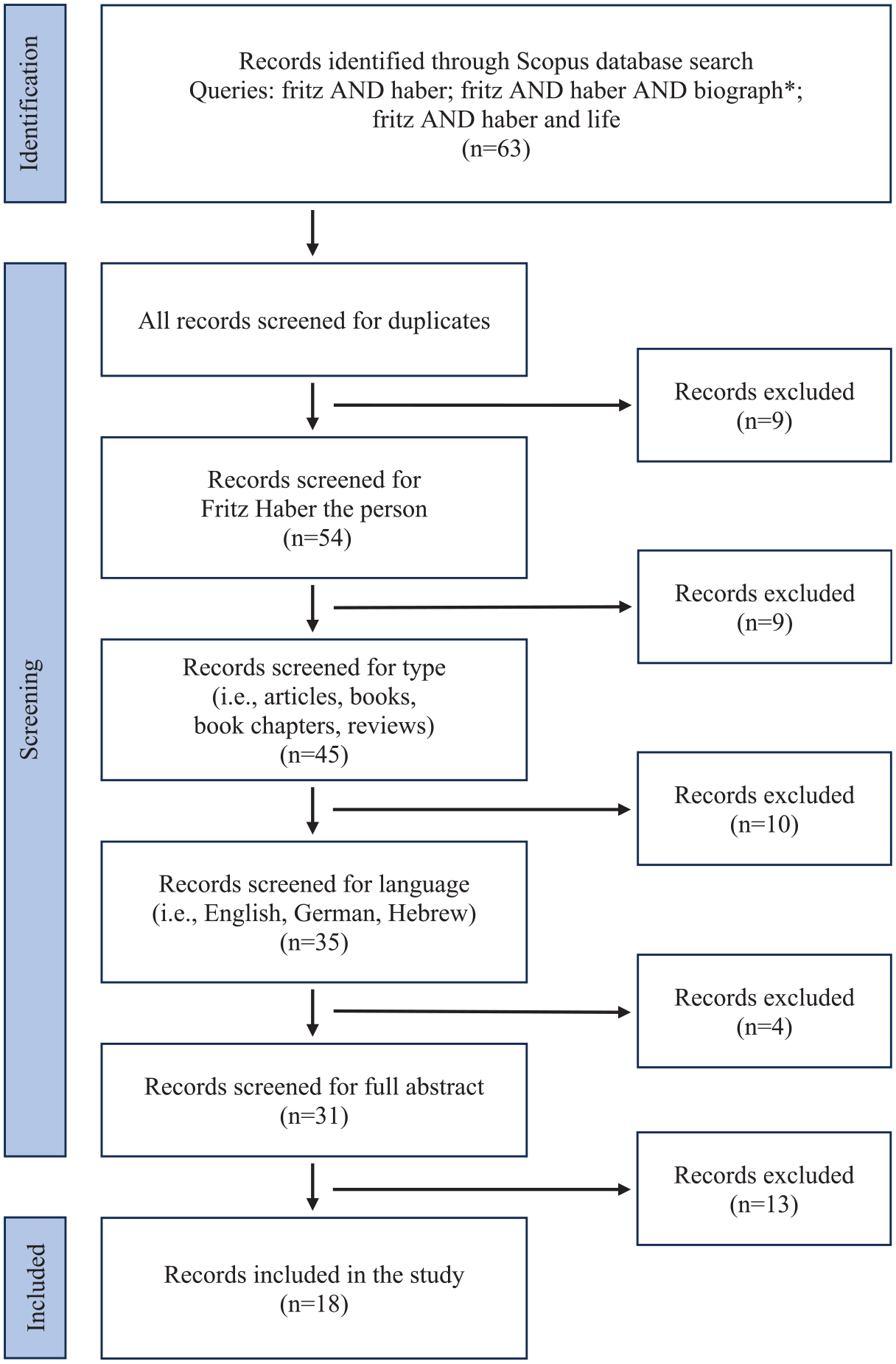
Flow diagram for record selection of Scopus database.
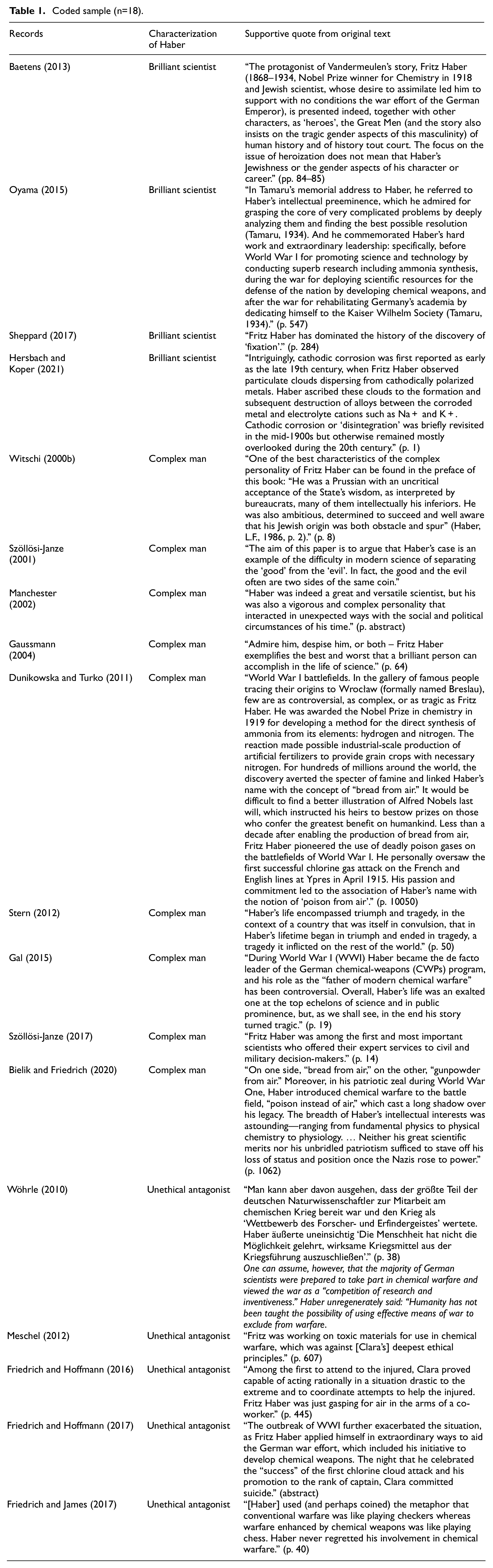
Next, we deductively coded the 18 records using three descriptors: (a) brilliant scientist, (b) unethical antagonist, or (c) complex man. Brilliant scientist codes emphasized Haber’s scientific pursuits. Unethical antagonist codes were associated with records that characterized Haber as immoral (e.g. foregrounding his advocacy of chemical weapons or his seeming neglect for this family). Finally, complex man codes defined Haber as including and negotiating his immoral actions and scientific pursuits. We used the term “complex” because of its ubiquity by gatekeepers to explain Haber holistically. For example, Witschi (2000a) refered to Haber as having “a complex personality” (p. 1) and Manchester (2002) added that his “complex personality…interacted in unexpected ways with the social and political circumstances of his time” (abstract). Manchester continued and described Haber as having a name that is “associated with the invention of the Haber process” and “is also famous and infamous for the part he played in the development and introduction of poison gas in World War I” (p. 64).
Two coders met to refine the codes. Records were split between the coders, who first coded the abstracts, which the other coder audited. When necessary, coders met to compare coding and resolve disagreement, improving the validity of our methods (Stake, 1995). Next, coders reviewed the original article to confirm accuracy of coding. Codes were updated if the full record did not match the original coding based on the overall tone of the text.
Results: Characterization of Fritz Haber and His Legacy
Of the 18 records, four characterized Haber as a brilliant scientist, five as unethical antagonist, and nine as a complex man. We found that this pattern was independent of publication date or record type (i.e. article, book, book chapter, or review). Table 1 includes the 18 records, characterization codes, and an exemplary quote from the respective record.
Coded sample (n=18).
Review of the qualitative coding suggested that Haber’s characterization was influenced by the lenses of the author(s), their goals, and Haber’s contemporaries. In relationship to Clara Immewahr, Friedrich and Hoffmann (2017) and Meschel (2012) described Haber as a repugnant, immoral, and neglectful husband. For instance, Friedrich and Hoffmann’s (2017) description of Haber was mediated by Clara Immerwahr’s biography, which described her frustration toward her absence from science: “This was aggravated by Haber’s sharp-elbow mentality and his obsession with his work and career, which left little room for Clara Immerwahr’s professional development and reduced her more and more to a mother/housewife” (p. 53).
In contrast, authors viewed Haber favorably when detailing his scientific discoveries and collaborators. For example, Oyama (2015) wrote about her grandfather, Setsuro Tamaru, a collaborator and friend of Haber’s. She described Haber as a brilliant scientist and focused on his work in the domain of chemistry. Similarly, Hersbach and Koper (2021) discussed Haber only in relation to his scientific work, ostensibly characterizing his brilliance.
A majority of the sample described Haber as complex: straddling his scientific pursuits and his perceived unethical behaviors. This holistic view of Haber highlights tensions in his legacy as a giver and taker of life, a neglectful husband, and a brilliant colleague. Stern (2012) wrote, [Haber’s] life story is easily twisted into a morality play, and simplistic, often sensationalist, mystification ensues; the media in its many forms have stripped his life of its complexity, and even well-intentioned critics and ideologues have given us ahistorical judgements. It is because of that pervasive mystification, that rush to judgement, that a historian’s view may be useful…We need, and Haber deserves a more balanced view. (p. 50)
Discussion
Overall, our analysis suggests that characterization of Haber—and thus the creation of his legacy—was dynamic. The re-evaluation of Haber, from his own point of view, was related to the gatekeepers’ goals and perspectives. For example, when discussing Clara Immerwahr, authors tend to portray Haber negatively. Specifically, Meschel (2012) said that Clara Immerwahr “was unable to surmount being trapped in an unrewarding relationship with a difficult husband” (p. 609). However, Oyama (2015) described Haber as a brilliant scientist and kind person. She said that “Setsuro Tamaru recalled that Haber was extremely busy, but very cheerful and kind to everybody” (p. 537). The tension between these two opposing legacies highlights the social, dynamic, and complex ways that authors—acting as gatekeepers—construct a person’s life after their death. While writing about fictional works of Haber, one of Hoffmann and Laszlo’s (2001) reviewers commented about the ease with which we rather understand/present a person reductively, rejecting a gestalt perspective. The reviewer commented, “There seems to be a strong tendency to condemn a person, or to worship him, and it seems difficult to realize that sometimes people behave in both ways. We should learn…to reach for understanding of the whole by considering all important aspects of a person’s actions.” (p. 4602)
This reaffirms the overall data in that “Haber [stood] partially in the shadow and partially in the light. Depending on viewpoint…” (Huxtable, 2002, p. 3).
It is this evolving viewpoint that drew us to this case: the multiple ways in which Haber’s gatekeepers determined his legacy as a scientist, antagonist, or complex man. This goes far beyond an appreciation of the creation itself, but the complex system dynamics and lenses the gatekeepers are subject to and take on. A legacy is not determined by the person who lived the life, but by those who selectively construct the narrative of a life: the gatekeepers. In that sense, Haber’s legacy is a creative product that is socio-culturally constructed, influenced by time and available materials (e.g. other legacies)—thus, legacy is a participatory creative enterprise.
Gatekeepers, among others, are members of a field, which dynamically emerges from complex interactions between public opinion, cultural zeitgeist, field-based perceptions, and much more. It is within these field dynamics that new and evolving points of view are developed. Thus, gatekeepers within their respective fields may hold beliefs or make assertions that may not align with other gatekeepers, from other fields. This is the case when examining Haber’s characterization between the fields of fiction and chemistry. However, we also see different descriptions within fields; for example, among historians that may or may not apply presentism to their work.
In historical inquiry and history education, presentism may mark a limitation of a person to properly contextualize the past (e.g. Ashby & Lee, 1987), but presentism may also be a natural phenomenon that emerges when a person attempts to make meaning of history (e.g. Endacott, 2010; Miles & Gibson, 2022). While it may be difficult to understand the situated actions, decisions, motivations of a person in their context (e.g. VanSledright, 2001), retroactively examining a person in the past afford gatekeepers a holistic perspective that may include new knowledge. Thus, we acknowledge the multivalent role that presentism may play in the creative process of a person’s legacy and its role in case studies. We believe that future researchers must reflect on their positionalities, presentist biases, and note the dichotomous, reductive, or complex ways that case studies portray a person (see Hanchett Hanson et al., 2023).
Conclusion
Fritz Haber was raised in a community that celebrated intellectualism and national pride. He was a world-famous scientist who brought honor to the German Nation when he won a Nobel Prize for his positive contribution to the world. However, using those same technical skills, Haber volunteered to develop chemical weapons that he thought would bring a swift end to World War I and earn pride for the Fatherland. Though he consistently dedicated himself to his community and his Nation, he eventually felt excommunicated by the Nationalsozialistische Deutsche Arbeiterpartei (NSDAP) as new ruling party. Throughout most of his life, Haber believed he embarked on a moral pursuit, motivated by his Prussian and German values and fulfilled by his scientific skills. He felt no guilt for his actions during the war (Haber, 1986) and received positive messages, like when the German war minister celebrated Haber’s brilliance and legacy (Stern, 2020).
The actions and products of creative individuals can support their goal to curate their own legacies, as “the creative act” can go “beyond [their] own death” (May, 1974, p. 25). This promise of legacy can motivate individuals to produce eminent work that benefits society (Csikszentmihalyi, 1997). However, as we have shown, these prominent and prolific individuals do not posthumously organize their legacy. Gatekeepers retain this power—yet gatekeepers, like society, change and may be scrutinized by other gatekeepers in different times, locations, or fields. In the case of Haber’s legacy, the creation is not the Haber-Bosch process or chemical weapons. It is not the output of his life and his achievements. It is his legacy, his story.
Thus, gatekeepers are not simply wardens of what is deemed creative, but they are producers in the creative act of legacy construction. Studying legacy as creative products over the course of time includes a recognition of anachronisms, biases, and continuously changing perspectives of presentism that in turn reveal the respective perspectives on morality, progress and—centrally—creativity. Legacy must then be understood in its complex multifaceted nature and continuously shifting shape, which is subject to ever new interpretations of reductive presentisms based on the knowledge and morals at the time. This has implications for researchers of creativity as well as case study research in general, as gatekeepers—like us—and legacy become their own research subject. These researchers themselves must also recognize their own position in participating simultaneously in the gatekeeping and [re-]creation of legacy. From Haber we learn that legacy is not something we as creators can control. We never will.
Footnotes
Declaration of Conflicting Interests
The author(s) declared no potential conflicts of interest with respect to the research, authorship, and/or publication of this article.
Funding
The author(s) received no financial support for the research, authorship, and/or publication of this article.
